
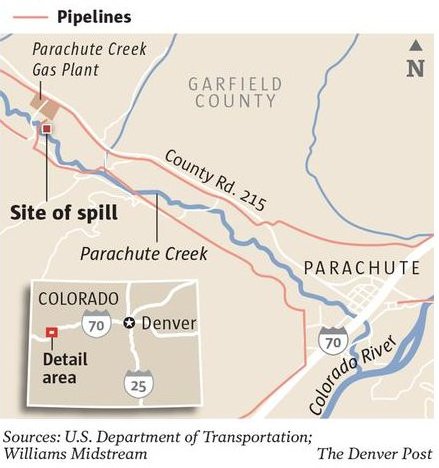
From The Denver Post (Bruce Finley):
The amount of contaminated groundwater siphoned from the spill, revealed in March, also is growing and has surpassed 369,000 gallons. While 155,000 gallons already was buried in a disposal well, 214,000 gallons currently in storage tanks will be treated on site and pumped back into groundwater along the creek, Colorado health officials said in response to queries last week.
Six months after the spill by Williams energy companies, which tainted the creek with cancer-causing benzene, the continuing cleanup and looming restoration work show a widening impact on resources. An underground plume created by the spill covers 10.6 acres and is still contaminating groundwater…
Along Parachute Creek, “all remaining petroleum-contaminated soil associated with the pipeline release will be removed from the site by the end of July,” said Colorado Department of Public Health and Environment spokesman Mark Salley. “The cleanup of hydrocarbons will continue until recoverable hydrocarbon is no longer present in the groundwater and the hydrocarbon is no longer contaminating the groundwater.”
An additional 280 cubic yards of contaminated soil has already been sent to the East Carbon Development Co. landfill, located 150 miles southeast of Salt Lake City. It handles heavy-duty waste such as New York harbor dredgings and Los Angeles sludge. Williams and CDPHE worked out the plan for removal of excavated soil. No deadline for completion of the overall cleanup and restoration has been set. Neither the CDPHE nor the COGCC has imposed penalties on Williams…
Williams officials contend 80 percent of spilled liquids evaporated and that 10,122 gallons entered soil.
Chemicals in the liquids include benzene, toluene, ethylbenzene, xylenes, hexanes and heptanes, CDPHE officials said. Other chemicals found in recovery trenches — tetrachloroethene and bromoform — are not from natural gas liquids.
Oil and gas industry response crews dug trenches and have been collecting the concentrated hydrocarbon liquids — an effort to stop the contamination of groundwater. Those liquids — about 7,490 gallons collected so far — can be cycled back into Williams’ plant.
A system for treating contaminated groundwater on-site, tested last weekend, must remove contaminants so that water can be discharged under a permit through a filtration system into groundwater along the creek, Salley said. The contaminated groundwater “will be treated to meet standards before being returned to the water table,” he said, “and does not pose a risk to public health.”
