Fremont County: Tallahassee Area residents are now 1,000 strong in opposition to Black Range’s uranium operation

uraniumdrilling.jpg

From The Mountain Mail (Joe Stone):

When residents in the Tallahassee Creek drainage northeast of Cotopaxi learned about potential uranium mining in the area, they organized to oppose it. More than 1,000 property owners now make up the Tallahassee Area Community group, including more than 500 year-round and seasonal residents, said Cathe Meyrick, TAC president.

As previously reported in The Mountain Mail, Black Range Minerals Colorado plans to use a borehole mining process to extract uranium ore at the Hansen deposit, located within the South T Bar Ranch development along Tallahassee Creek. If the mining operation proceeds, 44 local property owners will become the first people in the world to live within 500 feet of active uranium mining, according to the TAC website.

Background

The history of uranium mining in western Fremont County dates to the 1954 discovery of uranium ore deposits.
Following the discovery, relatively small mining operations created 16 open pit mines in the Tallahassee Creek area. All of the mines were eventually abandoned but not restored to original conditions because of the absence of environmental and mining regulations.

In the 1970s, Cyprus Mines Corp. acquired the Taylor Ranch mineral and water rights. In 1981, after drilling thousands of exploratory wells, Cyprus received permits to mine uranium ore at the Hansen deposit and operate a nearby uranium mill. The project never advanced beyond the permitting stage because uranium prices collapsed in the wake of the Three Mile Island incident.

With the ensuing cancellation of nuclear power plant construction projects, demand for uranium remained low for decades, as did uranium prices.

While uranium prices remained too low to support local mining operations, Fremont County commissioners knew about the presence of uranium ore and failed to designate the area as a Mineral Resource Area. In 1974, HB 74-1041 amended the Colorado Land Use Act, encouraging counties to make such designations in order to prevent incompatible land uses, thereby preserving the ability to develop mineral resources.

Lee Alter, chairman of the TAC Government Affairs Committee, said the 1976 Comprehensive Plan for Fremont County recommended that county commissioners establish a more definitive zoning plan. Alter also cited a 1980 Fremont County Land Use Plan that makes similar recommendations in order to “avoid incompatible land uses.” But the designation never happened, and the county approved the subdivision of ranch land into large rural residential parcels, benefiting local developers and contractors. Alter said the 1990 Fremont County Master Plan designated the preferred nonagricultural land use in the area as residential.

The current version of the Fremont County Master Plan, adopted in 2002 and available on the county website, states, “The primary nonagricultural land use (in the Mountain District of Fremont County) will be residential” (page 97). The master plan also states, “Long-term industrial operations will not be encouraged in the (Mountain) District. … Industrial development should be discouraged along … Fremont County Road 2 (Tallahasee Road)” (page 98), which provides the only access to the area.

Given these master plan statements and a general lack of disclosure by local developers and real estate agents, Meyrick said residents who bought land and built homes in the area had no idea their investments could be threatened by uranium mining.

However, increasing use of nuclear fuel to generate electricity in recent years, particularly in Asia, has investment firms like JPMorgan forecasting uranium prices of $80 a pound by 2014.

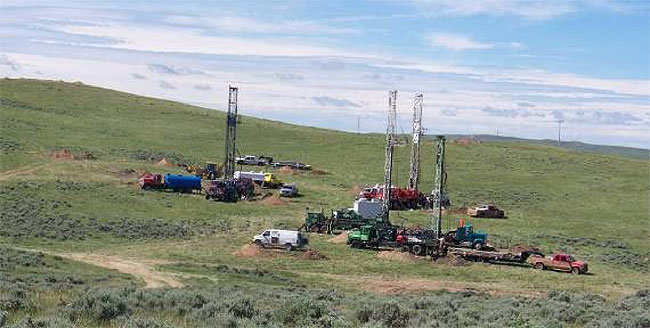
Projections like these prompted Black Range Minerals’ interest in mining the Hansen deposit, and the company acquired the privately held mineral rights to 13,500 acres along Tallahassee Creek. Alter said local residents began seeing lights and hearing machinery on Taylor Ranch in 2007 and learned that Black Range was conducting unpermitted drilling for test wells. He said Black Range eventually obtained a permit but not until after drilling 70 test wells. By then, Meyrick said, it was too late to obtain baseline water samples, making it impossible for residents to prove whether or not contaminants in their well water resulted from Black Range exploratory drilling.

The lack of oversight and accountability demonstrated by the unpermitted wells prompted local residents to organize, Meyrick said. Land-use issues Local residents cite several issues they believe should prevent Black Range from mining the Tallahassee-area uranium, beginning with incompatible land uses.

Alter said the market value of undeveloped ranchland in the early 1980s, including land with known uranium resources, was less than $200 per acre. Unimproved, subdivided ranch parcels sold since the mid ’80s for $1,000-4,000 per acre and more, Alter said. “Many of the residences and small hobby ranches that have been constructed over the past 25 years are valued at $500,000 or more.”

Alter also pointed to the recently constructed Benedictine Fellowship of St. Laurence Retreat. Permitted by the county in 2008, the retreat sits on the banks of Tallahassee Creek approximately 2 miles downstream from the Hansen deposit. Alter said the current assessed valuation from local residential parcels is approximately $40 million, resulting in annual property-tax revenue to the county of more than $250,000.

Given the degree of residential development in the Tallahassee Creek area and the value of that development to the local economy, Alter said he believes uranium mining “would clearly be incompatible with the current rural residential and recreational land use.” Alter also said, “The county tax base and the local economy would suffer” as a result of uranium mining. “In addition, the stigma associated with this ‘dirty’ industrial activity would significantly impact tourism and recreation – a major economic driver of this scenic county.”

But more importantly than the economics, Alter said, human-health and environmental risks associated with uranium mining make it incompatible with current residential land use. Citing Fremont County land-use authority – established by the state Legislature and confirmed by the 2009 Colorado Supreme Court decision – he called on county commissioners to “disallow uranium mining and ore processing in Tallahassee.”

Water issues

Members of TAC also cite water as a source of concern stemming from proposed mining activities. Residents of the Tallahassee Creek area rely entirely upon aquifers for drinking and household water. Tests show the uranium content in some local wells has increased since Black Range began exploratory drilling, Meyrick said, and water from some wells exceeds drinking water standards by large margins.

Water availability in the area highlights another facet of the water issue. Black Range ended up purchasing water from Cañon City for exploratory drilling after the state engineer’s office denied the company’s substitute water supply plan (SWSP) in 2012. The ruling states, “Due primarily to the lack of replacement water to accomplish the applicant’s proposal, the plan will not … prevent injury to other water rights.”

Alter noted that the mining processes proposed by Black Range – underground borehole mining and ablation ore-concentration technologies – would require much more water than exploratory drilling.

One point of interest cited in the state’s denial of the SWSP involves North Spring Ditch water rights:

“The North Spring Ditch water rights were changed in 1980, rendering any irrigation use since that date unusable for calculating historic consumptive use for a subsequent change of use.” Court documents show that the 1980 change of use involved the transfer of irrigation water rights from Taylor Ranch to Cyprus Mine, which changed the use of that water to mining. Alter said Cyprus Mines sold those water rights back to the Taylors in 1993, and in 2012 the Taylors filed a case in Division 2 Water Court, to “confirm” their rights.

Alter said TAC members believe the Taylors filed the case to determine how much water they can sell to Black Range Minerals for proposed mining operations, prompting TAC to enter the case as an objector.

Given: (1) the significance of historical consumptive use in determining the amount of water Black Range could acquire and
(2) the SWSP ruling rendering “irrigation use since (1980) unusable for calculating historic consumptive use,” Alter said he believes Black Range has insufficient water for mining for underground borehole mining.

He cited estimates that the mining process could require as much as 50,000 gallons of water per hour.

Technology questions

The third area of concern voiced by TAC members encompasses the relatively new mining processes that Black Range proposes to use. Underground borehole mining uses a high-pressure water jet to break apart ore and bring it to the surface in a slurry.

Alter expressed concern about the elevated levels of oxygen present in pressurized water. The increased oxygen levels, he contends, will create chemical reactions that increase the likelihood of uranium and heavy metals contaminating well water and other natural resources. “This water and the recovered water in the slurry,” Alter said, “will contain oxidized, solubilized uranium, other radioactive constituents and heavy metals that otherwise would remain underground and insoluble.”

Alter said he also objects to the ablation process that Black Range proposes to use to concentrate mined ore. The process employs two jets of ore slurry fired directly at one another from opposing sides of the ablation machine. The impact when the slurry jets meet would dislodge uranium ore from the sandstone to which it is attached. Black Range contends that this process is a component of mining, but TAC members believe it is a uranium processing activity that requires additional permitting.

Members of TAC also question whether or not the remaining water and sandstone could be returned to the subsurface, as proposed by Black Range, without contaminating the aquifers that supply local wells.

More nuclear coverage here and here.

Move water from west to east or dry up agriculture?

flaminggorgedrycoloradoestuary9billionbillboard.jpg

Hannah Holm recaps the Gunnison Roundtable discussion of the proposed Flaming Gorge Pipeline in this column running in the Glenwood Springs Post Independent. Here’s an excerpt:

One reliable way to rile up a room full of western Coloradans is to start talking about moving water from the Colorado River basin (“our water”) east across the Continental Divide for use by Front Range cities. You’ll hear lots of muttering, and someone will probably say something to the effect that not one more drop should go over while a blade of bluegrass remains in the Denver metro area.

It doesn’t even have to be water that resides in Colorado to get people’s backs up, as was demonstrated by the reaction to a proposal floated by entrepreneur Aaron Million to pump water from the Flaming Gorge reservoir in southwestern Wyoming east along the I-80 corridor and then south to a reservoir near Pueblo. In September 2011, billboards sprouted up along I-70 protesting providing funding to even study the idea. The billboards were funded by environmental organizations, but a host of resolutions approved by the City of Grand Junction, Mesa County and others roundly condemned the proposed project as well.

However, if Front Range cities can’t take water from our side of the hill, they have to look elsewhere — and that usually means “buying and drying” agricultural land. Since western Coloradans tend to like farms, even if they are east of the Divide, this creates a bit of a quandary. While some claim that ramped up conservation could preclude the need for more water transfers, it’s not easy to see how to push conservation far enough to close the 500,000-acre-foot gap between supply and demand that is forecast to afflict the state by 2050 if measures aren’t taken. Besides, if the Front Range has to dry up lawns, we might have to do the same — and that becomes a more complicated conversation.

Despite the billboards and resolutions, the state did fund a committee to study the potential benefits and impacts of the Flaming Gorge proposal. It included representatives from each of Colorado’s major river basins, including many highly skeptical of the proposal as well as potential beneficiaries, and it met once a month for a year. In short order, the committee broadened its mission and ended up developing a series of questions to be addressed for any proposed major movement of water across the Divide, as well as criteria for what would be a “good” project. This report was presented to the Gunnison Basin Roundtable and Gunnison “State of the River” meeting in Montrose June 3.

More Flaming Gorge Pipeline coverage here and here.

Drought/runoff news: Will the streamflow be there to finish crops this year? #COdrought

usdroughtmonitor06042013

seasonaldroughtoutlookjune62013

From The Greeley Tribune (Eric Brown):

On paper, northern Colorado’s recovery from months of drought appears to be nearly complete. The plethora of moisture in recent weeks has put precipitation and snowpack figures in the South Platte River basin above average and, collectively, reservoir levels are getting close to normal. According to the most recent U.S. Drought Monitor, northern Colorado is no longer in a “drought” — being labeled instead as “abnormally dry.”

However, that doesn’t mean everything’s quite peachy keen for the area’s farmers. “Things are greatly improved, but we’re not home yet,” said Gus Sidwell, who grows corn and alfalfa near Gill. “We’re probably only at first base at this point.”

Many northern Colorado farmers today have far more water to work with this year than they thought they would back in March and April. But, depending on how much water they own, they might not have enough to finish off their crops in August and September — late in the growing season, Sidwell said. He and others say they’ll still need rain, or cities to lease out some of their excess water — maybe both. “If we don’t get that, we’re looking at only partial production,” Sidwell said. “We’ll have to let some acres go.”

Greeley Water and Sewer Department Director Jon Monson, said leasing water to agriculture will be discussed at the next Greeley water board meeting, on June 19, but said there’s no guarantee they’ll decide to release more water to agricultural users. Cities own the majority of the region’s water, leaving a number of farmers and ranchers to depend on renting water from those municipal neighbors to grow what’s needed. In most years, they can do that. But cities this year have so far been holding on tight to their water supplies.

Until April, snowpack, precipitation and reservoir levels were far below average, and city officials at the time were wanting to use any snowpack there was to refill their high-mountains reservoirs — after having depleted them during the drought of 2012.

In recent weeks, though, snow and rain has arrived. As of Saturday, snowpack in the South Platte River basin was 153 percent of average, according to a report from the Natural Resources Conservation Service released Wednesday. That’s the fourth-highest mark for June 1 during the last 25 years.

The NRCS report also noted that, thanks to cooler than normal temperatures in the mountains, that snow is melting slowly — meaning the abundance of snowmelt will be flowing into farmers’ irrigation ditches later in the growing season. And reducing farmers’ dependency on irrigation water right now is the fact that the ground is moist.

In the Greeley area, for example, precipitation in 2013 was 9 percent above average through the end of May, according to numbers provided by the Colorado Climate Center in Fort Collins.

Doug Rademacher, a farmer near Platteville, said he had to start irrigating his crops last year in April, because of how dry it was at the time. In the first week of June this year, he still hasn’t had to irrigate his corn, sugar beets and others crops he planted this spring. The increase in snowpack, slow snowmelt and abundance of moisture in the ground are no doubt good. But, like Sidwell, Rademacher said rain or renting water from cities will be needed to fully finish off his crops.

A water meeting that will have large implications is that of the Northern Colorado Water Conservancy District, which oversees operations of the Colorado-Big Thompson Project, the largest water supply project in northern Colorado. Since the C-BT project went into use in 1957, the Northern Water board has set a quota every year in April to balance how much water could be used through the upcoming growing season and how much water needed to stay in storage for future years. The historic average for the C-BT quota has been just above 70 percent. This past April, the Northern Board set the C-BT quota at 60 percent, because of low reservoir levels and limited snowpack. As they often do, board members will consider increasing the quota at their June 14 meeting.

But, like Monson, Brian Werner, a spokesman for Northern Water, said there’s no guarantee they’ll be releasing more water to help agriculture. “Everyone is still watching things really close,” he said.

From The Mountain Mail (Peter J. Goetz):

Delayed snowpack peak, cool weather and continued wet weather patterns in the northern part of the state have contributed to a delay in snowmelt and eased some of the strain on water supplies in northern Colorado. However, it is unlikely that the southern part of the state will see much relief from drought conditions this year, Natural Resources Conservation Service officials said Thursday.

Snowpack reading as of June 1 is 93 percent of median statewide, Randy Randall, acting USDA Natural Resources Conservation Service state conservationist, said. “This respectable percentage is due mainly to the generous amount of snow that remains across northern Colorado. In contrast, the snowpack in the southern portion of the state is nearly depleted even at the higher elevations,” Randall said.

Current streamflow forecasts for the Upper Rio Grande and combined San Juan, Animas, Dolores and San Miguel basins call for well below average flows this summer.

Late-season snow accumulation in April and early May considerably improved the water supply outlook in the northern basins of the state. Forecasts for the Colorado and South Platte river basins still generally call for slightly below average flows this season but have improved considerably from predictions earlier this year.

At this stage in the melt season, high-elevation temperatures will play an important role in how rapidly snowmelt will occur in the northern basins, Randall said. Water managers can monitor these temperatures using data from the automated SNOTEL sites in their watersheds.

From the Associated Press (Nelson Harvey) via the Aspen Daily News:

Flows in the Roaring Fork River basin may have already peaked for the year, according to some hydrologists and forecasters with an eye on the watershed. Still, there’s a chance that warm weather in the coming weeks could bring a second peak, pushing levels slightly higher than they were on Thursday, May 27, when a gauge on the lower Roaring Fork River near Glenwood Springs recorded a flow of 3,394 cubic feet per second (cfs)…

If May 27 does turn out to be the date of peak flows on the Roaring Fork, it will be one of the earliest peaks since record keeping began on the river in 1907. In only three years — 1964, 1967 and 1992 — did the Roaring Fork River peak before that date…

Flows so far this year have been significantly higher than they were during the historic drought of 2012. That year, the river peaked in early June near Glenwood Springs at less than 2,000 cfs…

On the Fryingpan River, a tributary of the Roaring Fork, flows were averaging about 110 cfs on Monday. Engineers with the federal Bureau of Reclamation are required to release at least that much water from the Ruedi Dam at this time of year, to insure the health of fish and other organisms in the river.

Ruedi Reservoir is expected to get within “a few feet” of filling by around mid-July, according to Kara Lamb, a spokeswoman for the Bureau of Reclamation. As of Monday, the reservoir was about 75 percent full. It holds a maximum of just over 101,000 acre-feet of water.

Lamb said engineers typically divert about 48,000 acre feet of water each year to Colorado’s eastern slope, though a series of tunnels upstream of the reservoir known as the Frying Pan-Arkansas Project. So far this year, she said, engineers have diverted about 14,000 acre-feet.

From The Wall Street Journal (Mark Peters):

Some communities in Texas are down to 180 days or less of supply, while areas of rural New Mexico have been drilling deeper wells to keep taps running. Officials here in Wichita are looking at big-ticket items such as a pipeline and the reuse of wastewater because a reservoir that supplies nearly two-thirds of the city’s water was forecast until recently to run dry by fall 2015.

National data show a six-state region that also includes parts of Colorado, Nebraska and Oklahoma remains extremely dry, even as parts of the Midwest and Great Plains have come out of last summer’s historic drought, with states such as Iowa and Illinois dealing with floods this spring.

A three-month forecast released Thursday by the National Weather Service predicts the drought will persist, or even intensify, in many areas already facing extreme conditions, while the drought in more eastern sections of Kansas, Texas and Oklahoma will ease further.

And while the effects on agriculture—from crops withering to ranchers struggling to find grazing land—have garnered much of the attention, public water supplies in some areas of the country face increasing challenges as dry conditions drag on.

Stormwater: It turns out that Colorado Springs did need a stormwater enterprise after all

fountaincreekerosionpueblocountychieftain.jpg

From The Pueblo Chieftain (Chris Woodka):

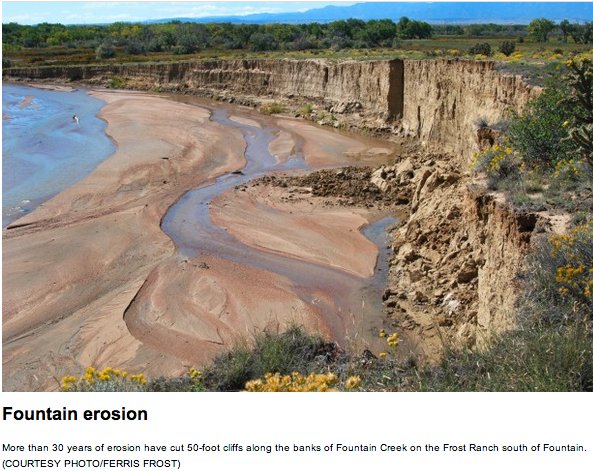
Colorado Springs has spent about $24 million toward $88 million in critical stormwater projects that would reduce the impact of Fountain Creek floods — those that were identified in 2005. Had its City Council not eliminated the stormwater enterprise in 2009, the full amount would have been nearly covered by now, Pueblo County Commissioner Sal Pace said. Although the city’s priorities have shifted toward new projects, it will continue working on the stormwater needs previously identified, Mayor Steve Bach and City Council President Keith King told Pace in a letter this week.

“Colorado Springs and its enterprises will continue to make substantial progress in high priority stormwater projects in the coming years, and (are) working diligently to design and implement a sustainable funding source and stormwater management structure to complete all the appropriate work,” they wrote. The city is concerned because the sufficiency of stormwater efforts required under Pueblo County’s 1041 permit for Southern Delivery System that have been raised by Pace, along with Commissioners Terry Hart and Liane “Buffie” McFadyen.

Colorado Springs plans to spend $46 million on stormwater projects this year, but much of that is for mitigation of damage caused by the 2012 Waldo Canyon Fire, airport drainage and Pikes Peak Highway projects that were not anticipated in 2005. The stormwater enterprise would have spent $17.6 million annually over five years to address the $88 million in critical projects that would reduce the impacts of flooding on Fountain Creek. Two of the projects were completed and $24 million was spent before the stormwater enterprise was dismantled by Council in 2009. Colorado Springs is reviewing its critical needs, and plans to address them, Bach and King said.

Pace plans to meet Monday with Colorado Springs City Council, with eight of the nine members newly elected since council’s decision to discontinue the stormwater enterprise. “They have spent about half of what was intended. Had they not eliminated the stormwater enterprise, they would have spent more,” Pace said. “The letter is positive, because it shows they recognize their obligation.”

From The Colorado Springs Gazette (Monica Mendoza):

The Pikes Peak Regional Stormwater Task Force set out this year to find a way to pay for the $900 million in regional drainage projects detailed in a report released in December. The group of business leaders, city councilors, county commissioners, water district representatives and Colorado Springs Utilities representatives has shortened its list to two funding options: a voter-approved tax or property fees. The task force expects to bring a final recommendation to the Colorado Springs City Council and El Paso County Commissioners in July.

[John Cassiani], who headed up a committee that examined several funding models, is pushing an option modeled after a stormwater authority in Arapahoe County that was formed in 2006 and includes the city, county and area water districts. The group, Southeast Metro Stormwater Authority, sets and collects stormwater fees to pay for construction, operation and maintenance of drainage projects. “The authority is a one-stop shop and responsible for taking care of all the issues,” said Cassiani, owner of RealTech Development. “It manages the programs and hires and contracts.”

In El Paso County, any mention of fees or taxes is risky business. The task force members know the political climate and voters’ reluctance to approve new taxes. In 2009, the Colorado Springs City Council ended a stormwater enterprise fund after voters approved Issue 300, which required the city to phase out payments from city-owned enterprises. But Cassiani thinks it’s time to try again. “We can’t be afraid of certain people in this community,” Cassiani said.[…]

The other model is the Southeast Metro Stormwater Authority, which includes Centennial, Arapahoe County and three water districts. The authority sets and collects fees, has a staff and oversees the projects for the region. Under that model, El Paso County voters would be asked to approve the creation a stormwater authority that has permission to set and collect fees. It’s a model that has more liabilities than the PPRTA model, said County Commissioner Amy Lathen. It would put a great deal of power in the hands of the authority, which would issue permits and be responsible for water quality, development and program management. Attorneys still are reviewing the legal issues of such an organization, she said.

More stormwater coverage here and here.