
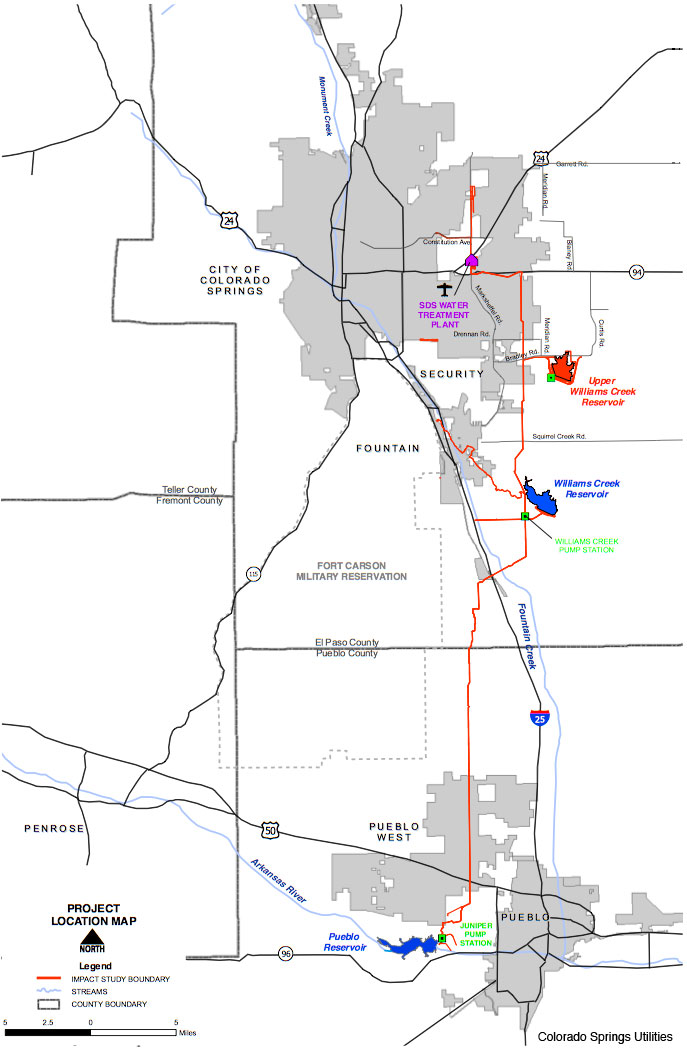
From Colorado Springs Style (Joe Stone):
As SDS Program Director John Fredell explains, Colorado water law dictates that water native to Front Range streams and rivers can only be used once. For example, Colorado Springs Utilities can divert Fountain Creek water for use by residential customers, but any of that water not consumed must be treated and released for downstream users. With Western Slope water, Colorado Springs has the right to “use the water to extinction.”
However, Fredell says, no “plumbing”currently exists to allow the Springs to fully consume its Western Slope water. The water gets used once then flows downstream to the Arkansas River via Fountain Creek. By connecting a pipeline from Pueblo Reservoir to the Springs’ water system, the SDS provides the plumbing that will change that. Colorado Springs Utilities will soon be able to exchange water sent down Fountain Creek for water stored in Pueblo Reservoir. “With SDS, we’re basically reusing our water, getting two to three uses of that water, which is extremely valuable.”
Fredell points to several economic benefits of reusing the city’s Western Slope water, including preservation of Arkansas Basin agricultural water rights, which are frequently targeted by growing Front Range cities. Once municipalities acquire agricultural rights and change them to municipal use in Water Court, productive farmland is dried up with little chance of ever being returned to agricultural production.
The immediate benefits of the SDS include revenue for local businesses and jobs for the local workforce. “The SDS is the biggest thing going,” says Fredell, “and we worked hard to get local contractors and companies involved. A lot of people questioned the timing of this project, asking why we would start such a big project during an economic downturn. My answer is, ‘Why wouldn’t you start now?’ You get better pricing on materials and services because of a more competitive market, and you help move the economy forward. This project provides work for over 300 Colorado businesses.” Furthermore, historically low bond rates add up to huge savings over the project’s forty-year finance period.
Officials with Colorado Springs Utilities must also take into account the age of the city’s existing water infrastructure. Bringing Western Slope water to the Springs requires a complex system of twenty-five dams, 200 miles of pipes and four major pump stations in nine counties. That infrastructure is aging, and some parts of the system are more than fifty years old. As parts wear out and fail, the redundancy provided by the SDS will ensure an uninterrupted water supply during repairs and maintenance, which will become more frequent as system components get older.