
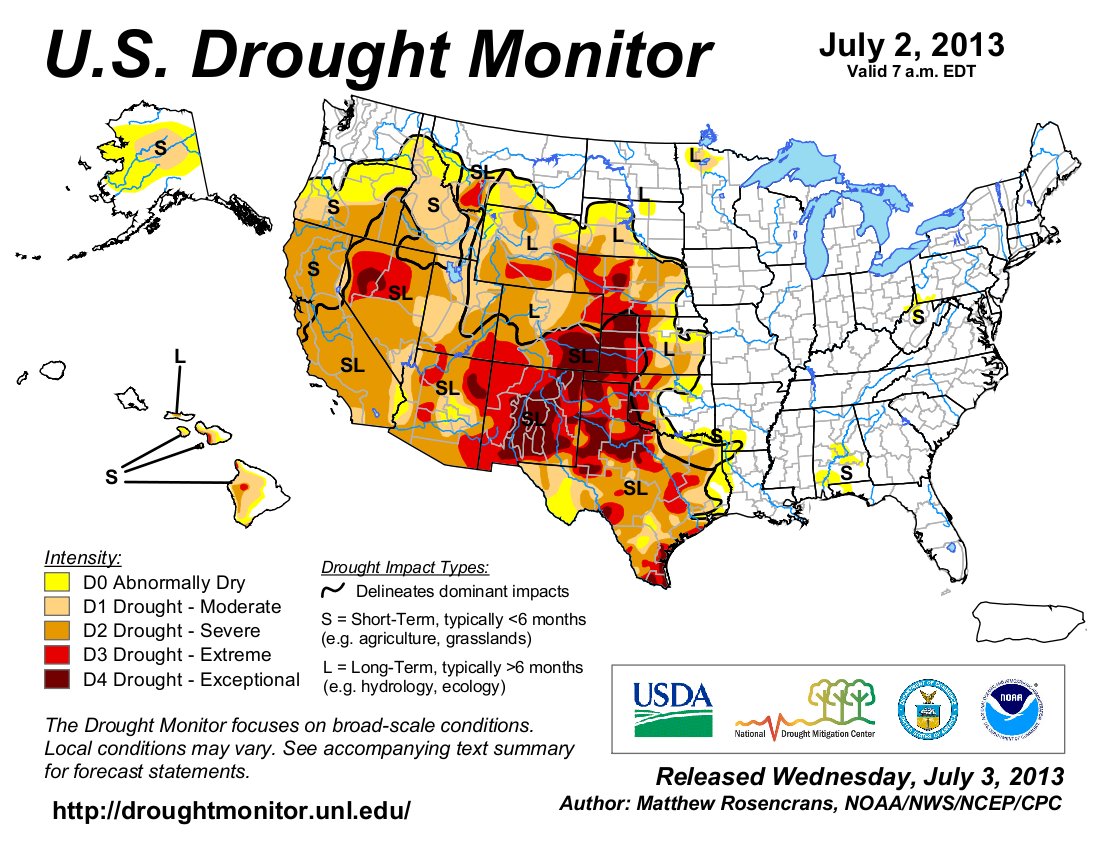
From The Mountain Mail (James Redmond):
Because of ongoing drought, the U.S. Department of Agriculture designated Chaffee County a contiguous disaster county Wednesday, making farmers and ranchers in the county eligible for additional Farm Service Agency assistance.
The USDA declared 14 counties primary natural disaster areas and 24 as contiguous disaster counties.
The primary counties are Alamosa, Conejos, Delta, Garfield, Gunnison, Jackson, Jefferson, Mesa, Moffat, Montrose, Rio Blanco, Rio Grande, Routt and Saguache.The contiguous counties are Adams, Arapahoe, Archuleta, Boulder, Broomfield, Chaffee, Clear Creek, Costilla, Custer, Denver, Douglas, Eagle, Fremont, Gilpin, Grand, Hinsdale, Huerfano, Larimer, Mineral, Ouray, Park, Pitkin, San Miguel and Teller.
Producers in counties designated as primary or contiguous disaster areas become eligible for consideration for Farm Service Agency emergency loans. Farmers in eligible counties have 8 months from the date of the disaster declaration to apply for assistance. The FSA will consider each emergency loan application on its own merits, taking into account the extent of production losses, security available and repayment ability.
“Hot and dry conditions continue to take their toll on farmers and ranchers throughout the state,” Sen. Michael Bennet said. “These disaster declarations will provide critical assistance to producers as they deal with the damaging effects on crops and livestock.“It also further demonstrates the need to get the Farm Bill passed and signed into law. Our rural communities need certainty to help them plan for the future and to navigate weather disasters like these severe drought conditions.”
Local FSA offices can provide affected farmers and ranchers with additional information. The FSA can be reached at a satellite office in Cañon City at 719-275-4465.
From the Denver Business Journal (Cathy Proctor):
The Aurora City Council on Monday voted unanimously to allow three-day-a-week watering. That city, like Denver Water, had limited lawn watering to two days a week since April 1…
The relaxation of watering restrictions is due to a series of heavy, wet snowstorms in April that boosted the mountain snowpack, and later, reservoir levels when the snows melted. In March, Aurora’s reservoirs were at 46 percent of capacity. As of Monday, the city’s reservoirs were at 67 percent of capacity, close to levels reported at this time last year, the city said.
From the Bureau of Reclamation (Mary Perea Carlson/Filiberto Cortez):
With the flow between Elephant Butte and Caballo reservoirs ending on Monday, the shortest irrigation season in the history of the Rio Grande Project is quickly coming to an end [ed.emphasis mine]. Although a limited flow will continue between the two reservoirs for the next few days, there are no further releases scheduled for 2013.
Flows from Caballo Reservoir for Rio Grande Project water delivery will end on July 14, which will mean the river channel between the two reservoirs and downstream of Elephant Butte will begin to dry.
Water levels at Elephant Butte Reservoir are at a historic 40-year low. The current level is 3.1 percent of total storage capacity. Irrigators on the Rio Grande Project received an initial allotment of just six percent of a full supply this year. The irrigation season began on June 1, 2013 and lasted just over one month.
Rio Grande Project water is used to irrigate lands in the Elephant Butte Irrigation District in southern New Mexico, the El Paso County Water Improvement District No. 1 in west Texas and Mexico. Project water is also used for municipal and industrial purposes by the city of El Paso, Texas.
One thought on “Drought news: Chaffee County included in drought disaster declaration #COdrought”