
Click here to go to their climate dashboard. Scroll down for the latest briefings.
Throughout August, the monsoon continued to bring subtropical moisture into the region, but the results were more spotty than in July. Much of Colorado, southern Utah, and far northeastern Wyoming were wetter than average, but northern Utah and the rest of Wyoming were drier than averageWestern US Seasonal Precipitation. The southern Front Range including Colorado Springs saw 5–8″ of rainfall for the month, with some locations seeing about half of their annual average. Conversely, parts of far northern Utah and central and northern Wyoming had less than 25% of average precipitation, and these same areas were also very dry in July. With one month left in the water year, the HPRCC Water Year Precipitation map Western US Seasonal Precipitation still shows only isolated parts of the region with above-average precipitation since October 1.
As in July, the temperatures in AugustWestern US Seasonal Precipitationwere warmer than average across most of the region, except in parts of southern Utah and western Colorado. Most areas were 1–4°F above monthly average temperatures for August. Salt Lake City was again the hot spot, capping off its hottest summer (June–August) ever with a record-hot August 2013 which averaged 82.7°F (5.7°F above average).
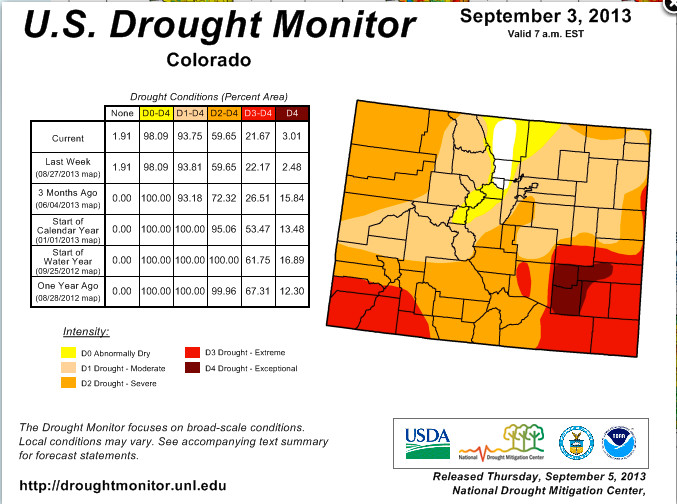
Many of the areas that were wetter-than-average during August have improved by one or two categories in the latest US Drought Monitor Modeled Soil Saturation Indexrepresenting conditions as of September 3. The largest areas of improvement are in northeastern Colorado (to D1) and southeastern Colorado (to D2/D3) Modeled Soil Saturation Index. In Wyoming there were smaller areas of improvement in the northeastern and southeastern corners, while D1 expanded slightly in the northwestern corner. In Utah, there was an expansion of D2 in the northwestern part of the state. Overall, drought conditions across the region are similar to where they were at the beginning of June, with improvement in Colorado balanced by drying in Utah and Wyoming.