
From NBCNews.com (Tony Dokoupil):
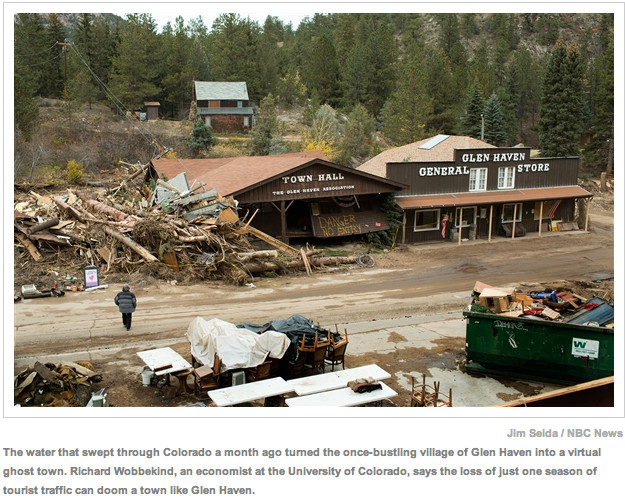
…while the bigger cities of central Colorado — from Boulder to Loveland to Fort Collins — are bustling again, at least two once-gleaming villages in the foothills are virtual ghost towns, isolated by gaps in the asphalt and rivers that undid a century of civilization in a week of heavy rain. In Glen Haven, a 400-person jewel box on the road to Rocky Mountain National Park, an estimated 80 percent of the homes are empty and every business downtown is closed or totally gone — swept seven miles into the town of Drake, a thousand-person tourist draw that’s also now obliterated and empty except for a handful of holdouts who refused to be evacuated…
The water that cascaded out of the Rockies last month ripped through 24 counties, killing nine people and dampening 2,500 square miles in the heart of Colorado. But the communities of Glen Haven and Drake may be the most devastated, deserted areas left — as well as the most at risk of becoming genuine ghost towns before the “spirit of recovery” finds them too.
“There’s been a lot of talk and a lot of meetings but not much action,” said Steve Childs, owner of the Glen Haven General Store, which was knocked sideways in the flood by a Ford Bronco and the remnants of Town Hall.
Though still officially closed by the county, with roads blockaded to discourage mischief and buildings nailed with red signs reading “UNSAFE,” NBC toured Glen Haven and Drake this week with a pass from the sheriff and the good will of locals. The result, coupled with interviews with more than a dozen residents, was a tour of two map-dots that feel forgotten by the relief effort — and the locals are fighting to make sure they aren’t forgotten by history…
As winter approaches it’s only going to get worse for both towns. Many homes in the area are considered seasonal or secondary, which federal assistance won’t cover, and while a Federal Emergency Management Agency representative says that requests for public assistance through firehouses and homeowners associations should be approved, they haven’t been yet in Glen Haven — the kind of paperwork delay Gov. Hickenlooper has blamed on furloughs at FEMA’s Washington office during the government shutdown.
But who should clean up the destroyed downtowns and private roads chewed through by water? That’s easy to answer in a tax center like Boulder or Fort Collins, which has its own heavy equipment and a staff of skilled operators. Small towns rely on the county, in this case Larimer, which so far hasn’t found the funds to help with the “community needs” list on the fire house wall in Glen Haven. It includes dump trucks, dumpsters, chainsaws, a wood chipper, barricades and traffic cones…
In Drake, according to Sgt. Gerald Baker, a first responder in the county sheriff’s office, “a whole mountain came down” in a mudslide so loud that people covered their ears. They “believed the earth was coming to an end,” he said, and after debris temporarily dammed up the river, it almost did for some people. The blockage released a “tsunami” of water into the canyon. Or as a member of the road crew rebuilding Highway 34 put it: “Goodbye, Drake.”
From the Northern Colorado Business Journal (Steve Lynn):
Cities and water districts are on the hook for at least $13.5 million to repair water and sewage systems ripped apart by floods that struck Northern Colorado in September. The city of Evans was among the hardest hit: The cost of a new wastewater treatment plant to replace the badly damaged plant will cost as much as $7 million, Evans spokeswoman Kristan Williams said…
Cities in Northern Colorado are grappling with how to deal with the flood-battered wastewater treatment infrastructure. While water infrastructure in some cities such as Fort Collins escaped unscathed, Loveland, Greeley, the Left Hand Water Conservancy District and others saw heavy damage…
The Left Hand Water Conservancy District estimates $2.5 million in repairs to its damaged water infrastructure, General manager Chris Smith said. Flooding redirected Left Hand Creek so that the district’s main water intake no longer collects water. The water district also saw damage to multiple treated water lines on Boulder Creek and the St. Vrain River…
In Loveland, city officials estimate repairs will cost between $3 million and $4 million. Damage to wastewater lines will hundreds of thousands of dollars more to repair. The city’s water treatment plant on the Big Thompson River was not damaged, but flooding along the Big Thompson destroyed sections of two other important water lines, including a 20-inch water line and another 36-inch water line. The city disconnected service in those lines and patched in service to the 48-inch water line that city and construction contracting crews were able to save. The city has stopped getting water from the Big Thompson, instead drawing its supply from Green Ridge Glade Reservoir because of river water quality concerns…
The city of Greeley suffered damage to a portion of one of five treated water lines, cutting service to more than 50 customers, said Jon Monson, director of Greeley Water and Sewer. The city has rerouted clean water from other sources to those customers.
From The Denver Post (Mark Jaffe):
As floodwater started to rise Sept. 11, some oil and gas operators began shutting wells and securing facilities. It would be five days before state regulators announced their own plans.
“Did the state have a disaster plan for the oil and gas fields?” asked Bruce Baziel, energy program director of the environmental group Earthworks. “It was hard to tell.”From the start, state oil and gas regulators were gathering information and passing it on to the incident commander overseeing disaster response, said Alan Gilbert, a Colorado Department of Natural Resources official.
“That’s our role as a technical agency,” Gilbert said.
Throughout the first flood weekend, oil companies provided information on their own operations to the Colorado Oil and Gas Conservation Commission.
“Demands on us to be transparent were high,” said Tisha Schuller, president of the Colorado Oil and Gas Association, an industry group.
Yet as pictures of bubbling pipes, spouting wells and floating tanks began to appear on social media, fears rose about what was happening in the flooded oil fields. On Sept. 16, as the flood covered parts of the oil-rich Denver-Julesburg Basin, more steps to assess impacts were announced by the oil and gas commission staff.
“We intend to compile an ongoing spreadsheet with the status of operations,” said Matt Lepore, executive director of the commission.
Regulations require operators to report spills. Lepore asked for the industry’s voluntary cooperation in assessing the status of all wells.
“In the middle of a disaster, it strikes me that this ought to have been required,” said Peter May-smith, executive director of Conservation Colorado. “If it wasn’t required by regulation, the governor should have issued an executive order.”
The steps announced were “ad hoc,” but the commission was monitoring the situation, DNR’s Gilbert said.
“We are going to have a formal review,” Gilbert said. “We’ll look at what worked and what didn’t work.”
Within days, the commission had about 18 inspectors in the field checking sites. It used its mapping capabilities to identify wells and facilities in floodplains and focus on those. About 1,500 wells were identified in the floodplains of the South Platte and other Front Range rivers, Gilbert said.
“For years, conservation groups have pressed for limited drilling in floodplains, and the state and the industry have fought it,” said Gary Wockner, Colorado program director for Clean Water Action. “Part of this wasn’t a natural disaster but a man-made disaster.”
The industry estimated that at the height of the flooding, 1,900 wells were shut in. There are more than 20,000 wells in the basin. State inspectors counted 14 “notable releases” primarily from overturned or damaged tanks, totaling 1,042 barrels (43,764 gallons) of petroleum products. There were 13 releases of produced water—which contains well impurities—totaling 430 barrels (18,060 gallons), according to the state.
“That’s thousands of gallons of pollutants poisoning our waterways,” Wockner said. “It isn’t something to be dismissed.”
By Thursday, inspectors had covered 90 percent of the wells and facilities in the floodplains, Gilbert said.
“When you have an industrial activity of this scale, you need clear contingency plans,” said Conservation Colorado’s May-smith. “A clear plan in advance.”
State officials will review how effective regulations were in preventing flood spills and whether reporting and emergency plans were adequate, Gilbert said.
Could that lead to new rules or plans?
“That is what we are going to look at,” Gilbert said.
State and industry officials insist their performance was good.
“It was chaos—11,000 homes, 200 miles of road, destroyed,” the Oil and Gas Association’s Schuller said. “You can’t plan for that. You just have to be flexible and responsive.”
From The Denver Post (Joey Bunch):
Nearly a month in steps are being taken on the long road to Colorado’s recovery from September’s floods that tore through roads, towns, homes and lives. In response, the Colorado legislature announced a 12-member bipartisan Flood Disaster Study Committee Wednesday.
Senate Democrats appointed Sen. Jeanne Nicholson of Gilpin County, Sen. John Kefalas of Fort Collins and Sen. Matt Jones of Louisville. The Republicans named Sen. Kent Lambert of Colorado Springs, Sen. Scott Renfroe and Sen. Kevin Lundberg of Berthoud.
Republicans in the House are represented by minority leader Brian DelGrosso of Loveland, Rep. Stephen Humphrey of Severance and Rep. Jerry Sonnenberg (of Sterling. The Democrats appointed Rep. Mike Foote of Lafayette, Rep.Jonathan Singer of Longmont and Rep. Dave Young of Greeley.
House Speaker Mark Ferrandino, D-Denver, stated, “We’re doing this in a strictly bipartisan way because politics has no place in disaster relief. Unlike Washington, we’re coming together to address a difficult issue facing our state.”
The group will meet five times before and during the next legislative session to review short-term relief and long-term planning for flood recovery.
State and FEMA analysts are still collecting information about the losses. Eventually they will tell us how costly the storm was. The preliminary numbers have been grim, and the toll is expected to rise as FEMA continues to collect damage assessments and calculates more specific estimates on how much repairs will cost.
“It’s abundantly clear that we need to get to work on policy that helps victims and proactively mitigates future disaster,” Nicholson said in a press release from the Senate Democrats. “We have a nonpartisan, urgent charge, and I welcome the help of anyone in fulfilling it.”
Kefalas added in his statement: “In the days following the flood, I spent time with displaced families, and I witnessed how our community pulled together. Collaboration between the public and private sectors was critical for effective, timely and humane responses.”
DelGrosso’s statement called helping flood victims a top priority for the special committee. “I am hopeful the committee will find consensus on ways we can assist flood victims, better equip Colorado to respond to future flood disasters and rebuild the infrastructure impacted by the floods as soon as possible.” he said.
From the Colorado Springs Business Journal (Cameron Moix):
While the north-central section of the state received the brunt of damage caused by the summer flooding — which the governor’s office has estimated at $300 million to $500 million — Colorado Springs and its surrounding communities also sustained severe damage to parks and infrastructure…
The majority of work on or pertaining to state roadways in the Pikes Peak region should be completed by early spring and will produce a bill of approximately $15 million, according to estimates by the Colorado Department of Transportation.
Doug Lollar, the north program engineer for CDOT’s Region 2, said that the majority of El Paso County’s damage is concentrated around the Waldo Canyon burn scar near Manitou Springs, which covered U.S. Highway 24 with feet of floodwater, scattered debris and left much roadway in disrepair…
El Paso County sustained initial damages to its roads estimated at $1.85 million from late-summer floods, according to a Sept. 18 news release…
While the city of Colorado Springs has experienced an estimated $13 million in damage as a result of the floods, Senior Communications Specialist Krithika Prashant said that damage assessments are ongoing to determine specific areas of focus and a concise breakdown of that estimate.