
You are here.
[800,000 years of atmospheric CO2 levels up to now.] pic.twitter.com/UnXzSiPnlu
— Peter Gleick 🇺🇸 (@PeterGleick) January 3, 2015
Month: January 2015
@nature_org: 10 Great Conservation Successes of 2014
10 Great Conservation Successes of 2014: http://t.co/b2B3sNvaXT pic.twitter.com/Qo7cKrMh7T
— The Nature Conservancy (@nature_org) January 5, 2015
Water strategies on the Conejos — the Valley Courier #COWaterPlan

From the Valley Courier (Nathan Coombs):
The Conejos River is the largest tributary to the Rio Grande River in Colorado. The Conejos and its tributaries Los Pinos and Rio San Antonio irrigate about 100,000 acres in the south end of the San Luis Valley and pay a significant portion of the Rio Grande Compact. With some of the oldest water rights in the state and basin, this water has been subject to many changed uses and modifications over time.
In 1928-38 when the Rio Grande Compact commission studied the flows of the rivers in order to calculate a compact arrangement with New Mexico, Texas, and Mexico, the system was already completely appropriated. The only method of irrigation at the time was flooding. Whether for the meadow, the vegetables or the grain and alfalfa fields, flooding was the only method used, or even contemplated.
With the unique physical properties of the Conejos basin, the flooding of fields filled the shallow aquifer with both run off and percolation. This building of the aquifer built a large amount of sub surface water that benefitted irrigators down gradient from where the earlier irrigation water was applied. These subsequent irrigators were able to apply less water to their crops, and gained the benefit of their crop’s roots being in contact with the ground water longer.
This method of irrigation also provided another benefit. The irrigation water diverted from the Conejos and filling the unconfined aquifer, caused return flows which also paid a large percentage of the Conejos’ portion of the compact. Irrigators used the water and paid compact with a large portion of this same water through return flows.
Over time, farm land was leveled, irrigation moved from flooding to sprinklers, and weather patterns trended towards drier winters diminishing sufficient supplies. As the efficiency of water application methods continued to improve, return flows decreased, so more water had to be left in the river channel to pay the compact. With this necessity of leaving pristine water in the channel, it became increasingly difficult for water users to depend on enough water for the entire season. Compounding this issue were years of significantly less than average snowfall. More adapting and changing were necessary.
In 1969 the Rio Grande Compact was being administered more strictly. This change in water management brought about the need for accurate accounting and measurement of the waters within the river. Water users were now experiencing curtailments to diversions in order to meet the compact. This curtailment meant that some water users were experiencing less water than historically available. Issues arose around how to make sure that those curtailed were in fact impacted to the least degree possible. This required a lot of time and effort from the DWR’s river commissioners. Also In 1991, The Conejos Water Conservancy District bought exclusive rights to the Operations and Maintenance to Platoro Reservoir. This change brought an opportunity to district water users to utilize the reservoir to store and re-release their water later in the growing season. With the opportunity to use reservoir water to offset some of the compact administra- tion issues, this development also brought the challenge of tracking this retimed water throughout the system.
In order to be proactive and solution minded, water users on the Conejos developed a strategy by first recognizing the issues they faced. First off, there was not an efficient way of tracking the different types of water in the river. It was very difficult to accurately and efficiently know where the different types of water were at all times, much less separate out the native from the reservoir from the Compact head gate by head gate. Secondly there were large inefficiencies with the infrastructure used for getting the water out of the river in priority, and allowing optimal use of both native and the reservoir water to diminish reliance on ground water. Finally, there needed to be a way to mitigate the effects of inaccurate forecasting of snowpack and insufficient stream flows . Water users felt that addressing these issues would help individual water users make better informed decisions on their farm’s water budget for a given year.
GAUGING
In 2012 to overcome some of the first of these challenges, 72 river diversions were fitted with a nearly live ability to “see” what was being diverted. Stilling wells were constructed and fitted with measurement and recording devices that transmitted wirelessly through an entirely new telemetry network that was built to transmit this information. The data is recorded, collected, and stored off site and available to administrators and water users through a secure password. This system also allowed the DWR river commissioners to be very specific with the use of their time and miles for regulating the diversions . With the new system, administrators are now able to make sure that the correct water amounts are being either diverted or passed through to the compact or other water users in priority.
AUTOMATING
The second proposal was to work in conjunction to the gauging/measurement of the diversions. Four of the largest water diversions on the Conejos System were automated. This effort regulates the water to the correct amount for each of these head gates. The automation was able to ensure that these diversions were able to both receive their correct amount of water and not “absorb” the diurnal effect of the river. By correcting the flows at these largest diversions water that should go down river to either another priority or the compact was available. The automation also saved countless hours of regulating and re-adjusting these head gates throughout the day. Because of the tremendous positive impacts of automation, the district is currently automating three more structures along the Conejos with plans for more being drawn up at this time.
PREDICTING
Finally , to help mitigate the “Mother Nature” component , the district is looking at bettering the methodology of both measurements and forecasting for the basin. Currently, the DWR uses reports from NRCS that are based on snotel sites, manual snow course measurements, and the NRCS’ own forecasting to predict total stream flows for both the Rio Grande and the Conejos. The input data are the foundation of the NRCS’ predictions. The problems however are that the number of measured sites is insufficient , their coverage is not complete, and in the case of the Conejos basin, they only represent about 35 percent of the watershed. With both winter inaccessibility to many areas for manual snow surveys, and USFS wilderness restrictions , a large portion of sub drainages simply are not measured.
With a partnership with CWCB, (Colorado Water Conservation Board) NCAR (National Center for Atmospheric Research) NOAA, (National Oceanic and Atmospheric Administration) NWS, (National Weather Service) and NSSL, (National Severe Storms Laboratory) the district has installed six additional “snotel lite” stations, flow gauges on tributary streams, and one radar truck!
The new measurement sites are placed on boundaries with the USFS wilderness areas and will ground truth what the radar truck is seeing . Since the radar has the ability to scan across both the wilderness and inaccessible areas of the basin, the concept is that water users will be able to refine the data used to predict actual snow levels down to the sub basin level.
The flow gauges on the tributaries will allow water administrators to calibrate how much of the system’s water is generated on the respective tributary’s sub basin. Then for an example; if a tributary is significantly higher or lower than the forecast pre supposed, immediate corrections to the compact curtailment can be made. This action will help refine the calculations necessary to administer the compact on a daily basis. This timely correction to compact administration will allow Valley water users to more fully use Colorado’s share of the water.
The Conejos Water Conservancy District does not have all the answers, and may not even yet have the right questions. The district does however, have a desire to place as many pieces in the water puzzle as it can.
Nathan Coombs is the director of the Conejos Water Conservancy District in Manassa.
2015 Colorado legislation: A look at the Boulder and Broomfield counties delegation

From the Longmont Times-Call (John Fryar):
When the Colorado Legislature’s 2015 session gets under way on Wednesday, Boulder County and Broomfield could once again benefit from being represented by several of the lawmakers holding key leadership positions and committee assignments.
That’s long been the case, several of those current and former leaders said in recent interviews, with current Boulder County and Broomfield legislators playing major parts in determining what bills become state laws, and which ones won’t, by the time the session concludes in May.
State Rep. Dickey Lee Hullinghorst, a Gunbarrel Democrat, will be Speaker of the Colorado House of Representatives, the first Boulder County lawmaker to hold that chamber’s No. 1 post in 121 years…
There now will be no senators representing parts of Boulder County or Broomfield who’ll hold top leadership positions in the GOP-controlled Senate.
Boulder’s Rollie Heath, who last year was Senate majority leader, will the Senate Democrats’ assistant minority leader this year.
Heath said, though, that trying to negotiate compromises while crafting legislative proposals “has always been my style,” regardless of whether his party was in the majority in one or both houses of the Legislature. He said he’ll continue that approach…
Heath said one of the underlying questions facing lawmakers from both parties as they introduce legislation this year is: “Do we really want to get things done, or do we just want to make a point?”
Said Heath: “In my mind, we’ve got to figure out where the public is, in terms of priorities.”[…]
Unlike many recent years, Boulder County won’t have any lawmakers on the Joint Budget Committee, a powerful joint House and Senate panel that crafts annual state government spending recommendations for the full Legislature’s consideration. Levy served on that committee, as did former Reps. Todd Saliman, D-Boulder, Jack Pommer, D-Boulder, and Tom Plant, D-Nederland…
Hullinghorst has also appointed Becker vice chairwoman of the House Agriculture, Livestock and Natural Resources Committee. And the speaker has chosen Rep. Mike Foote, D-Lafayette, to be vice chairman of the House Finance Committee, and has reappointed Rep. Dianne Primavera, a Broomfield Democrat whose district extends into Boulder County, to chair the House Public Health and Human Services Committee. Rep. Jonathan Singer, D-Longmont, will be vice chairman of that Health and Human Services panel.
While no Boulder County or Broomfield-residing Democratic lawmakers will chair GOP-majority Senate committees this year, the new Senate Republican leadership has named Vicki Marble to be chairwoman of the Senate Local Government Committee and vice chairwoman of the Senate Education Committee. Marble, a Fort Collins-area Republican, represents a district that extends from southeast Larimer County through southwest Weld County into Broomfield.
From The Durango Herald (Peter Marcus) via the Cortez Journal:
The GOP has lamented about an “over-reach” by majority Democrats in the last two sessions, during which controversial bills concerning gun control, elections reform and renewable energy, among other issues, enraged the right-leaning base.
Republicans picked up three seats this past November, slashing the Democrats’ majority to 34-31. Republicans also took control of the Senate.
“The reality is that stuff that is highly controversial, common sense tells us that that’s probably not going to pass,” said House Minority Leader Brian DelGrosso of Loveland. “What it is going to bring is middle-of-the-road legislation that is basically supported by both sides of the aisle.”
House Republicans are aiming for an agenda that sticks to the basics: education, the economy, transportation and public safety…
Building the economy
On the economy, Republicans will continue to push for breaks for the business world, once again looking at the business personal-property tax. Last year, Republicans and Democrats came together by allowing small-business owners to claim a tax break up to the first $15,000 on equipment purchased. DelGrosso said Republicans will look to build on that.
Some GOP members are also looking at additional reforms to enterprise zone tax credits. They were outraged last year when Democrats limited the credits for business investment in rural counties, suggesting that the move would inhibit economic development.
“The prosperity on the Front Range has not reached rural Colorado, and by providing additional incentives in these depressed rural areas, we can give businesses more resources to create jobs, increase wages and bring more prosperity to these parts of our state,” said Rep.-elect Yeulin Willett of Grand Junction, who will carry the measure.
Also in the economic-development category, Republicans and Democrats are expected to again try a bipartisan effort to curb construction-defects lawsuits.
Funding transportation
Republicans are especially concerned about transportation, pointing out that general fund spending has not gone toward Colorado’s crumbling roads and highways.
DelGrosso said his caucus will push measures to guarantee multi-year funding for projects by the Department of Transportation. He also will introduce a bill to transfer $100 million in one-time funding from the general fund to rebuild roads and bridges across Colorado.
“The safety of our roads and bridges affects all Coloradans,” DelGrosso said.
My, my to hear them tell it, it was all Kumbaya for the recent session.
Is An Aqueduct A Practical Answer To Western Kansas’ Water Crisis? — Heartland Health Monitor

Significant portions of the Ogallala Aquifer, one of the largest bodies of water in the United States, are at risk of drying up if it continues to be drained at its current rate. Courtesy of MSU

Kansas Aqueduct route via Circle of Blue

Ogallala aquifer boundaries
From KCUR.org (Bryan Thompson):
Western Kansas is heavily dependent on the Ogallala Aquifer. But since 1950, that ancient supply of underground water has been rapidly depleted by irrigation. That irrigation produces corn, which is fed to livestock to support the beef and, more recently, dairy industries, which are the foundation of the western Kansas economy. But water levels have dropped so low in parts of more than 30 counties that irrigation pumps can no longer be used there. That’s why rivers in western Kansas are little more than dry stream beds.
Mark Rude is tracking the depletion of the aquifer for a groundwater management district in the heart of the affected area.
“We’re only 9 percent sustainable with that 2 million acre-feet that we use in southwest Kansas,” Rude says. “And 9 percent sustainable is a very formidable number, because you can’t conserve your way out of that.”
In other words, 91 percent of the water currently being pumped would have to be shut off just to keep the aquifer from declining any more. But if the water doesn’t come from the aquifer, where could it come from? The 2011 flooding on the Missouri River gave Rude and others an idea about how to answer that question. While devastating to those along the river, the flood looked like an opportunity.
“Folks who realize the deep value of water in western Kansas looked at that and go, ‘Wow, if we only had a couple days of that flow we could fill the aquifer, and we’d all be happy,’” Rude says.
Rude looked into that idea, and rediscovered the 1982 study proposing a system to capture excess water from the Missouri River and store it in a huge, new lake near White Cloud in the northeastern corner of the state. It would then be pumped uphill through an aqueduct to western Kansas. There it would be stored in another new lake — by far the largest in the state — for distribution.
The cost was estimated at $1,000 per acre-foot of water delivered. With that price tag, the concept was dead on arrival. But recently, the Kansas Water Office told the committee charged with updating the old study that the cost is now closer to $500 per acre-foot. The savings are due to lower interest rates. Cost is a concern for committee member Judy Wegener-Stevens, but it’s not the only reason she’s opposed to the project.
“I don’t feel an aqueduct should be built,” Wegener-Stevens says. “I feel that people in western Kansas have been pumping water unconditionally, without any rules, for 40 years, and they have not used their resource very well.”
Wegener-Stevens, who lives in White Cloud, said the nearby Iowa Tribe of Kansas and Nebraska would fight a proposed aqueduct. They have rights to water in the Missouri River and are working to quantify those rights. There might also be objections from other states, even though the idea is to take only “excess” water. Throw in anticipated battles over property rights and environmental concerns, and some committee members say the aqueduct still doesn’t appear realistic.
But committee member Clay Scott isn’t willing to give up on the idea. Three generations of his family raise cattle and grow irrigated corn and wheat near Ulysses, in southwest Kansas. Scott points to an Arizona aqueduct called the Central Arizona Project as proof that a Kansas aqueduct is feasible. He says a reliable source of water is vital to the future of his family’s farm.
“I’ve got three boys that are looking to maybe come back to the farm, but, you know, it takes a lot of acres in western Kansas to support a family — especially coming through these last three years of drought,” Scott says. “It’s a challenge to tell your boys that there’s an opportunity. There’s a future for you here.”
Scott and other members of the advisory committee say the first priority should be some sort of compact with other states and Indian tribes to secure rights to Missouri River water. Then they can worry about all the other obstacles to the project. Earl Lewis, the assistant director of the Kansas Water Office, agrees with that approach.
“Moving forward and investing considerable time and funds into pursuing a project that doesn’t have the legal security of a water right or some kind of compact doesn’t make a lot of sense,” Lewis says.
Even if the Missouri River doesn’t pan out as a water source, Lewis says there may be other options. State law could be changed to make it easier to transfer surplus water to western Kansas from other parts of the state. And Kansas may be able to get some financial help from Colorado, in exchange for providing water to ease shortages on the Front Range. But it will be up to others to explore those options and others. The advisory committee’s charge was solely to update the aqueduct study and make recommendations. Those recommendations are due by the end of January.
More Ogallala Aquifer coverage here.
What the CRomnibus says about water policy in Congress
@Bipartisanism cartoon: Value for shareholders
"Yes the planet got destroyed. But for a beautiful moment in time we created a lot of value for shareholders." pic.twitter.com/tfUsDBWAD9
— Bipartisan Report (@Bipartisanism) January 3, 2015
John Fleck’s New Years water newsletter #ColoradoRiver
John Fleck's New Years water newsletter – http://t.co/fv3tHRiq58
— John Fleck (@jfleck) January 4, 2015
Free river, futile call policies pondered — The Pueblo Chieftain

From The Pueblo Chieftain (Chris Woodka):
The state is looking at changes in water policy that will allow more efficient use of water without violating the prior appropriation doctrine of “first in time, first in use.” The policies deal with a “free river,” a concept that is not found in state statute, and futile calls, which are accounted for in law, but difficult to administer.
A free river occurs when every water right is satisfied, such as during a flood. In the Arkansas River basin, that condition has not occurred on a widespread scale since 1999, and occurred only about a dozen times in the last 60 years.
A futile call occurs when water in a reach of stream cannot physically be delivered to a senior water right in another area, even though it is in priority. That can occur during flash flooding, but also during well pumping when groundwater levels are high.
“The policies, especially the policy dealing with futile call, are less focused on the determination of the stream condition and instead are focused on administration of diversions once the stream condition has been determined,” Deputy State Engineer Kevin Rein said in an email last week.
“The actual objective of the two policies is to set out the direction through which the State Engineer’s Office and the division engineer can allow maximum utilization of the water supply while complying with the law and preventing injury.”
The policies most likely would be useful in discussions about flood control structures on Fountain Creek, particularly those designed to stop catastrophic floods. The question of water rights is under review by a technical committee.
It also could answer similar questions that have arisen in the South Platte River basin following record flooding in 2013.
The free river policy has provisions for storage under existing water rights or without a water right, as long as water is put to a beneficial use. The policy would allow for storage beyond a decreed water right. It would prevent injury to senior water rights and requires compliance with existing water storage regimen.
The water could be stored for a one-time use, with successive use of return flows determined by the division engineer on a case-by-case basis.
The futile call policy also makes provisions for diversion into storage with or without a water right, and outlines the state’s position that such diversions could become conditional or absolute water rights.
More Colorado Division of Water Resources coverage here.
America’s Weather-Tracking Satellites Are in Trouble — Popular Mechanics

From Popular Mechanics (Kathryn Miles):
When Superstorm Sandy nearly sank New York City two years ago, we knew it was going to happen. Same with snowmageddon in 2010: D.C. got more snow than a Saskatoon Christmas, and, again, we knew it was going to happen. Those were both devastating storms, but we were as prepared for them as we could have been, thanks to two very important satellites. Now, however, as superstorms become more frequent, those two very important satellites are running out of time.
To pull together your five-day forecast, meteorologists rely on two types of satellites. The first sits 22,000 miles up, capturing basic information on a fixed location. The second orbits the poles, 500 miles up, filling in crucial image gaps and, more important, providing essential information about cloud formation, surface temperatures, and atmospheric conditions—the data that help us know where a storm is heading and how big it will be when it gets there.
Those polar-orbiting satellites, a primary and its backup, are the ones in crisis. The primary satellite—a short-term pathfinder built to test emerging technologies—was never really intended for use. Its backup isn’t much better: an aging satellite with failing sensors that passed its predicted life expectancy last year. We would send up a replacement now, but it’s still being built. When it is ready, should it survive launch, it could take until as late as 2018 to transmit usable data. Which means that, depending on when our current satellites stop working, the U.S. could be without crucial data for years. That’s worse than inconvenient. It could cost us trillions of dollars, and hundreds, if not thousands, of lives.
It didn’t have to be this way. It didn’t used to be: For most of the 1970s and ’80s a partnership between NASA and the National Oceanic and Atmospheric Administration ensured that we always had two fully operational birds flying, with a backup in the barn. It was, says James Gleason, senior NASA scientist, a golden age. That all changed in 1994, when President Clinton tried to cut costs by combining the NOAA and Department of Defense weather-satellite programs. The marriage was doomed from the start. Both organizations came with top-heavy bureaucracies and their own specific needs. Together they formed a dysfunctional agency defined by budget overruns, infighting, and passive– aggressive stalemates. In all the turmoil, work on any new satellites slowed to a crawl, and any surplus dried up. By the time President Obama separated the two organizations in 2010, NOAA had to scramble to pull together a new program. As a stopgap, it sent up the only option left, our current satellite—that demonstration model, with a life span of only three to five years.
Gleason predicts that the satellite’s spacecraft will last long beyond that span. But those instruments. NASA engineers have what he calls serious uncertainties regarding them. Three were developed under the previous satellite program, which means they didn’t undergo NASA’s rigorous review process. (A U.S. Government Accountability report called the workmanship of these instruments “poor.”) When private-sector and government scientists are asked about them, they literally knock on wood.
The best-case scenario has them knocking for years. And although engineers at Ball Aerospace and Technologies in Boulder, Colorado, are currently putting the finishing touches on a replacement, NASA doesn’t expect it to be launch-ready until 2017. Even after launch it’ll take another year of testing before the satellite is fully operational. And that’s if it doesn’t explode. “That’s just a fact of life,” Gleason says. “We could have a really bad day on the launch.”
That’s where we get into trouble. Should the new satellite explode (or just fail—a distinct possibility, considering satellites’ high early-mortality rates), we’re stuck waiting for the next version. Scheduled date of completion: 2022.
If that happens, NOAA has proposed a variety of mitigation plans, from targeted jet missions to private and international outsourcing. The federal government recently signed agreements with Japan, Canada, and Europe to secure support in the case of catastrophic satellite loss, but there are no guarantees those programs will provide the data we need—or that we can afford them.
The most comprehensive solution happens to also be the one that upsets the most people: The Chinese currently have two polar orbiting satellites in commission and they’re about to launch a third. But since the Chinese weather program is tied directly to its military—and since, you know, it’s China—the idea of buying data from them has sparked more than a small firestorm on Capitol Hill.
Whatever the solution, we need to decide on one. Quickly. Meteorologists want to predict the weather with the best tools available, and that’s getting harder every day. They know that another Sandy or snowmageddon is inevitable. It’s just no longer a given that we’ll see it coming.
2015 Colorado legislation: Sonnenberg to chair Senate Agriculture Natural Resources and Energy Committee
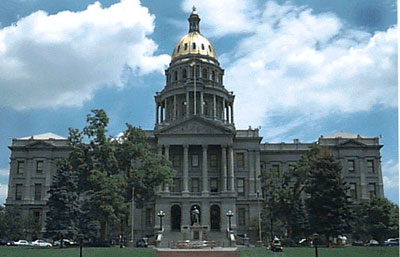
From the Sterling Journal Advocate (Marianne Goodland):
The Jan. 7 start of the 2015 Colorado General Assembly will bring in a class of ten new members to the 35-seat state Senate and 20 new representatives to the 65-seat House.
And while northeastern Colorado’s two legislators are part of that incoming class, neither is new to the Legislature.
Rep.-elect Jon Becker (R-Fort Morgan) gave up his House seat in 2012 after he and Rep. Jerry Sonnenberg (R-Sterling) wound up in the same district after House districts were redrawn in 2011. Becker is returning to the capitol for a second term under current law, but that’s a law he may challenge in the future.
During his first term in 2010-11, Becker sat on the powerful Joint Budget Committee, which annually produces the state budget. This time around, Becker will serve on two committees: House Agriculture, Livestock and Natural Resources; and Appropriations, a nod to his experience on budget matters…
Heading over to the Senate, Sen.-elect Sonnenberg will continue his agenda for agriculture, as the Legislature’s only full-time farmer.
After the November election, Sonnenberg was immediately tapped to be part of the Senate’s leadership team by Senate President Bill Cadman (R-Colorado Springs), who named him chair of the Senate Agriculture Natural Resources and Energy Committee. Sonnenberg will serve on four other committees: he will co-chair the State, Veterans and Military Affairs Committee; and he will also serve on the Appropriations, Capital Development and Water Resources Review committees.
As a member of the water resources committee, which he also served on while in the House, Sonnenberg will sponsor several of the group’s six bills. Those bills include creating a grant program to fight invasive phreatophytes. A second bill directs the Colorado Water Conservation Board to administer two pilot programs in the Gilcrest/LaSalle/Sterling areas. Those programs would “evaluate alternative ways to lower the water table” in areas experiencing damaging high groundwater levels, according to a draft copy of the bill…
Among his 2015 bills is one to address the continuing concern over fracking. Sonnenberg said this bill would address the “takings” clause of the state constitution as it pertains to mineral rights. “If a community prohibits oil and gas production [including fracking], it has limited a property owner’s right to access” those mineral rights. Under his bill, the community would have to pay for that.
He also will carry a bill on a “sunset review” of pesticide applicators. Sunset reviews are bills that look at whether to continue certain state laws. Sonnenberg said he wants to make sure farmers can continue to utilize pesticides in agriculture and that the state not make it so challenging.
From the Craig Daily Press (Janelle O’Dea):
During Colorado’s 70th legislative session, transportation, funding for education and stunted economic growth in rural areas will be some of the most prominent issues discussed by Colorado’s General Assembly…
One of Northwest Colorado’s state representatives, Republican Rep. Bob Rankin, is already working on the state’s financial plans in his new position on the state’s Joint Budget Committee. The JBC has met since November 2014.
Rankin represents House District 57, encompassing Garfield, Moffat and Rio Blanco counties.
The state will spend $26.8 billion this year and Rankin said based on current projections, it’s an increase of about 11 percent compared to last year. He said the money is all spoken for and even more is being requested for various needs.
“We will still be way underfunded for K-12, higher education and transportation,” Rankin said…
State Senator of District 8 Randy Baumgardner said there’s another education bill that has not been introduced yet, but will direct money to schools instead of raising taxes and attempting to give the money to schools.
“That (raising taxes for education) hasn’t worked thus far and isn’t gong to work in the future,” Baumgardner said.
Senate District 8 encompasses Garfield, Rio Blanco, Moffat, Routt, Jackson, Grand and Summit counties.
Baumgardner also said as chair of the Transportation Legislation Review Committee, he’s going to make sure Colorado’s roads are taken care of. Previous legislation funds transportation repairs, and Baumgardner wants to assure that happens…
With Colorado’s House of Representatives controlled by Democrats and the Senate controlled by Republicans, Democratic Senate President Morgan Carroll hopes the 2015 legislative session ushers in a year of compromise between the parties.
Carroll, State Senator for District 29, has five bills of her own to introduce. District 29 encompasses Aurora and eastern Arapahoe County.
One of Carroll’s bills will focus on refinancing Coloradans’ student debt. Another will give human trafficking victims a defense to criminal charges to prostitution and allow them to purge their criminal record of prostitution if they were a victim of trafficking.
From The Greeley Tribune (Kayla Young):
With Colorado’s legislative session beginning Wednesday, farmers in the Gilcrest area are renewing their call for action on rising groundwater levels.
As the South Platte Basin aquifer continues to spill over into homes and productive cropland, members of Weld County’s Groundwater Coalition hope legislators will treat their situation with emergency measures.
While legislation met opposition in 2014, LaSalle farmer Glen Fritzler, a coalition organizer, said efforts to educate legislators could bring Weld farmers short- and long-term relief.
“What I’m concerned about is that it may not be the emergency type of legislation we need. … The farmers need to know by March 1 to plan accordingly to adjust their acres and what kind of crops to grow,” Fritzler said.
Although the urgency and reality of the Gilcrest area is known, the answers are not as easy to identify. For Groundwater Coalition members, the issue lies in curtailed well usage that has allowed aquifer levels to steadily rise over the past decade.
“Damaging high groundwater is caused because of the curtailment of pumping of irrigation wells. The curtailment of pumping of the irrigation wells is because augmentation requirements are too strict,” Fritzler said. “Stipulated decrees were agreed upon because municipalities had us against the ropes; we might lose everything if we went to trial.” [ed. emphasis mine]
John Stulp, the governor’s water policy adviser, said high groundwater cannot be attributed to one cause alone, however. Gilcrest’s low-lying position in the basin, as well as its clay soils, also leave the town at higher risk for water accumulation, he said.
“If you’re citing a place for a city, you might not choose the location of Gilcrest, knowing what we know today. It sits in a water-prone area where water doesn’t drain out very well,” he said, explaining that the town, as well as areas around Sterling naturally experience higher levels of groundwater.
Golden-based engineering firm Brown and Caldwell has been tasked with carrying out a six-month study of high-risk areas, such as Gilcrest, to better inform the technical committee that Stulp chairs on how the hydrology functions along the basin.
In the meantime, Stulp said farmers should not expect the immediate solution they are hoping for: “It depends on what kind of relief we’re talking about. Will they have ability to pump all water they want? Likely not.”
He expected legislation to pass through the state Legislature early in the year to establish a better monitoring system and pointed to the possibility of a dewatering system being discussed through the Central Colorado Water Conservancy District.
While dewatering wells have been proposed as a possible short-term option, Randy Ray, conservancy district executive director, said the cost of such a system would only place Gilcrest further into debt.
“In the Gilcrest area, you’re looking at $80,000 per well and operating costs of $20 per acre-foot pumped out of it. For 1,000 acre-feet, the cost would be $20,000,” he said. Gilcrest Mayor Jeff Nelson said the town recently took on a 20-year $1.09 million loan through the state revolving fund to repair the damages incurred to the sewer system, rebuilt in 2004, from high groundwater.
Reagan Waskom, director of the Colorado Water Institute, explained that while farms and farmers suffer in the Gilcrest area, Colorado water law is functioning as intended.
“The strict implementation of our water laws has resulted in rising groundwater levels, as it was intended to do. This reversed a long, downward trend of declining groundwater levels in the basin,” Waskom said.
While the rise in water levels can be considered positive overall, the impact has varied drastically along the South Platte Basin.
“Pumping has returned to within 10 percent of historical levels, with the exception of Water District 2 — the area along the main stem of the South Platte downstream of Denver to Greeley,” Waskom said. “Farmers along the Front Range have a harder time developing enough water to ensure full pumping allocations due to proximity to urban areas, which has kept water prices high.”
For downstream users in the Sterling area, strict policy enforcement has meant greater security in the area’s water rights, said Joe Frank, general manager of the Lower South Platte Water Conservancy District for Morgan, Washington, Logan, and Sedgwick counties.
“Senior water rights rely on those return flows and if a junior well intercepts that, it is injuring the stream and when you add a bunch of wells, they have large impacts on the stream,” Frank said.
Respect of senior water rights has been a leading reason farmers have not been able to simply turn their wells back on, explained Greeley Water and Sewer Board chairman Harold Evans, who opposed legislation in 2014 that would have provided temporary relief.
“It didn’t really provide the protection for senior water right holders that has historically been the case in Colorado,” Evans said. “One of the complicating issues is the pumping has a lag time depending on how far away you are from the river. … In the Gilcrest area, there is a lag time of five or six years. The purpose of a water court-approved augmentation plan is to show you won’t have an impact.”
LaSalle farmer Harry Strohauer, who manages Lorenz Farm, in addition to other properties, said that while the Groundwater Coalition recognizes the prior appropriation system, they have been set up for an impossible task.
“The analogy we use is, when you’re flat on your back with a knife to your throat, what are you going to do? None of us could afford to go on, while municipalities like Boulder, Highlands Ranch and the city of Greeley are fighting us with unlimited money, and we couldn’t do it,” Strohauer said
Strohauer has uprooted significant acreage from Weld County, including his signature fingerling potatoes, and moved them out of state because to uncertainty and damages suffered over groundwater levels.
Waskom said long-term damage to croplands could become more common.
“One concern I have that is not on the radar screen for most people is that water logging and poor drainage inevitably lead to salinization of croplands. This is a slow but sure process that will rob the productivity of the basin if not addressed,” Waskom said.
James Eklund, director of the Colorado Water Conservation Board, which drafted the Colorado Water Plan, said the state will be looking to find a groundwater solution in 2015 that satisfies users throughout the basin and protects the prior appropriation system.
“In 2015, we will need to tackle this. The Legislature I’m sure is going to be interested in looking at it, as well as us,” Eklund said. “I’ve tromped around in basements that have been flooded. It’s not a pretty scene. We know those people need relief now, and they don’t need it to be studied to death.”
More 2015 Colorado legislation coverage here.
NOAA: What is the Madden-Julian Oscillation, and why do we care?
What is the Madden-Julian Oscillation, and why do we care? Learn more in our latest blog post: http://t.co/FKRrjyTbA2 pic.twitter.com/7U94MFo0eu
— NOAA Climate.gov (@NOAAClimate) January 2, 2015
Here’s a discussion from Climate.gov. Click through for the whole article and the animation:
The articles posted on this blog have described ENSO, its regional and global impacts, and the challenge of forecasting it, among several other topics. Here we introduce another important player on the tropical stage: the Madden-Julian Oscillation, or MJO. While the MJO is a lesser-known phenomenon, it can have dramatic impacts in the mid-latitudes. Several times a year the MJO is a strong contributor to various extreme events in the United States, including Arctic air outbreaks during the winter months across the central and eastern portions of the United States.
So what is the MJO?
Imagine ENSO as a person riding a stationary exercise bike in the middle of a stage all day long. His unchanging location is associated with the persistent changes in tropical rainfall and winds that we have previously described as being linked to ENSO. Now imagine another bike rider entering the stage on the left and pedaling slowly across the stage, passing the stationary bike (ENSO), and exiting the stage at the right. This bike rider we will call the MJO and he/she may cross the stage from left to right several times during the show.
So, unlike ENSO, which is stationary, the MJO is an eastward moving disturbance of clouds, rainfall, winds, and pressure that traverses the planet in the tropics and returns to its initial starting point in 30 to 60 days, on average. This atmospheric disturbance is distinct from ENSO, which once established, is associated with persistent features that last several seasons or longer over the Pacific Ocean basin. There can be multiple MJO events within a season, and so the MJO is best described as intraseasonal tropical climate variability (i.e. varies on a week-to-week basis).
The MJO was first discovered in the early 1970s by Dr. Roland Madden and Dr. Paul Julian when they were studying tropical wind and pressure patterns. They often noticed regular oscillations in winds (as defined from departures from average) between Singapore and Canton Island in the west central equatorial Pacific (Madden and Julian, 1971; 1972; Zhang, 2005).
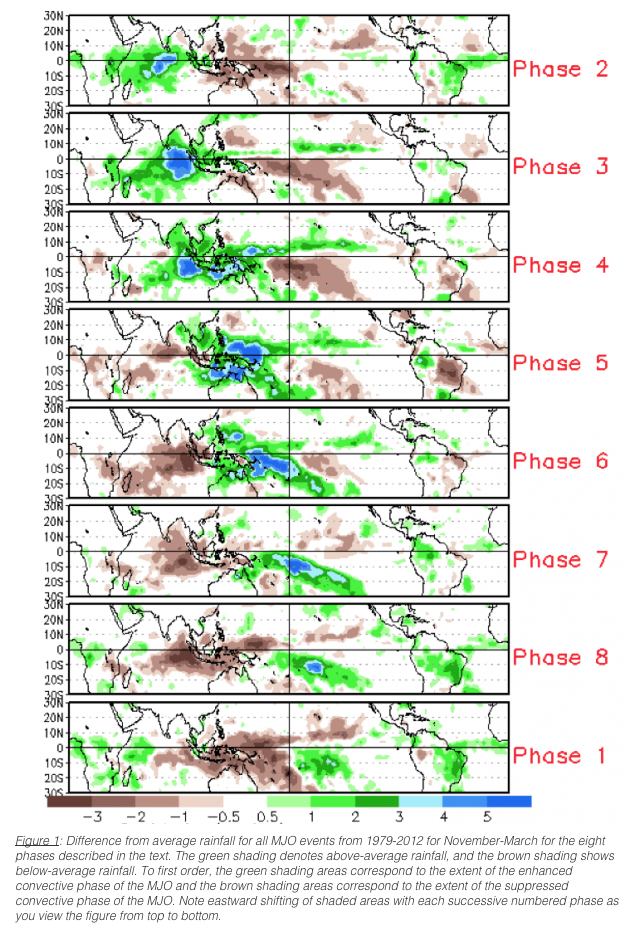
The MJO consists of two parts, or phases: one is the enhanced rainfall (or convective) phase and the other is the suppressed rainfall phase. Strong MJO activity often dissects the planet into halves: one half within the enhanced convective phase and the other half in the suppressed convective phase. These two phases produce opposite changes in clouds and rainfall and this entire dipole (i.e., having two main opposing centers of action) propagates eastward. The location of the convective phases are often grouped into geographically based stages that climate scientists number 1-8 as shown in Figure 1.
2015 Preview: States React to New Era of Water Scarcity — Circle of Blue
States responding to water scarcity – mostly by spending money? @waltonwater http://t.co/vgfxx15086
— John Fleck (@jfleck) January 2, 2015
From Circle of Blue (Brett Walton):
Water is priority in state Legislatures and governors’ offices.
California, its hand forced in 2014 by a nasty drought, brought its groundwater laws out of the Gold Rush era and into line with nearly every other state in the Union. New York’s Democratic governor banned fracking for natural gas, in large part because of concerns about water pollution.
Kansas debated how to cope with a shrinking Ogallala Aquifer, its main source of irrigation water. Voters in California, Florida, and Maine endorsed new state spending on water conservation, water treatment plants, pollution cleanup, and river restoration. And more than one dozen states, spooked by drought and needing guidance, discussed or submitted new water plans.
Taken together, these actions represent an awakening in the United States that water supplies are not as abundant as once thought. A series of severe droughts in recent years — from Texas in 2011 to the Midwest in 2012 to California today — is the frontline reality of a hotter, drier era that is forcing state leaders to take stock of their water assets and reevaluate laws, regulations, and investment strategies.
More is coming in 2015.
In states that voted for water spending, leaders this year will open the public purse. The Texas Water Development Board, a loan-making agency, will distribute funds from a $US 2 billion pot of money that voters approved in 2013. Applications for the first round of loans are due in February and the loans will close by December. Though much of the money will be spent on new pipes, wells, reservoirs, and treatment plants, state law requires at least 20 percent go toward water conservation and recycling.
The Florida Legislature also will spend a pile of cash, in its case from a fund seeded by real estate taxes and designated for land and water conservation. Approved at the ballot box in November, the fund could generate between $US 10 billion and $US 18 billion over 20 years for land purchases and infrastructure investments tied to improvements in water quality.
Montana lawmakers will consider a $US 336 million infrastructure package that was proposed by the Democratic governor. Thanks to an oil boom in neighboring North Dakota, border counties in the eastern third of the state are outgrowing their water and sewer grids. Roughly one-sixth of the package is dedicated to water, sewer, and irrigation projects.
In California, the nine-member California Water Commission is laying the groundwork for expending some of the $US 7.5 billion in bond money that voters approved in November. The commission, whose members are appointed by the governor, must write the rules for deciding priorities…
Groundwater on the Agenda
Debates about groundwater, as in 2014, will continue to echo in statehouses. Wisconsin, for one, will be a battleground for groundwater regulation. Lawmakers rejected a bill last session that would have forced regulators to approve new wells without considering cumulative effects of groundwater pumping on rivers and lakes. The Wisconsin League of Conservation Voters hopes to keep attention on the state’s aquifers, making groundwater legislation one of its top priorities in 2015. Their concern is well placed. An explosion of high-volume irrigation wells in central Wisconsin is causing streams to dry up.
The loudest chatter, however, may come from Texas, a state in which groundwater is essential to urban growth and agriculture…
In addition to new laws, several states — Arkansas, Colorado, Kansas, and Montana among them — will be finalizing water plans that were introduced in 2014. Both Arkansas and Colorado are proposing multibillion dollar infrastructure projects. In Arkansas’s case, new canals will wean farmers from unsustainable groundwater use. In Colorado, the growing cities of the Front Range are looking to move more water across the continental divide, from the Colorado River Basin.
Other states, meanwhile, will hope that long-running legal disputes will be resolved this year in the U.S. Supreme Court. Texas has sued New Mexico over declining flows in the Rio Grande, while Florida successfully petitioned the justices to consider Georgia’s use of water from shared rivers.
More general interest coverage here
Snowpack news: Arkansas Basin = 115% of normal (best in state), Rio Grande improves = 73%
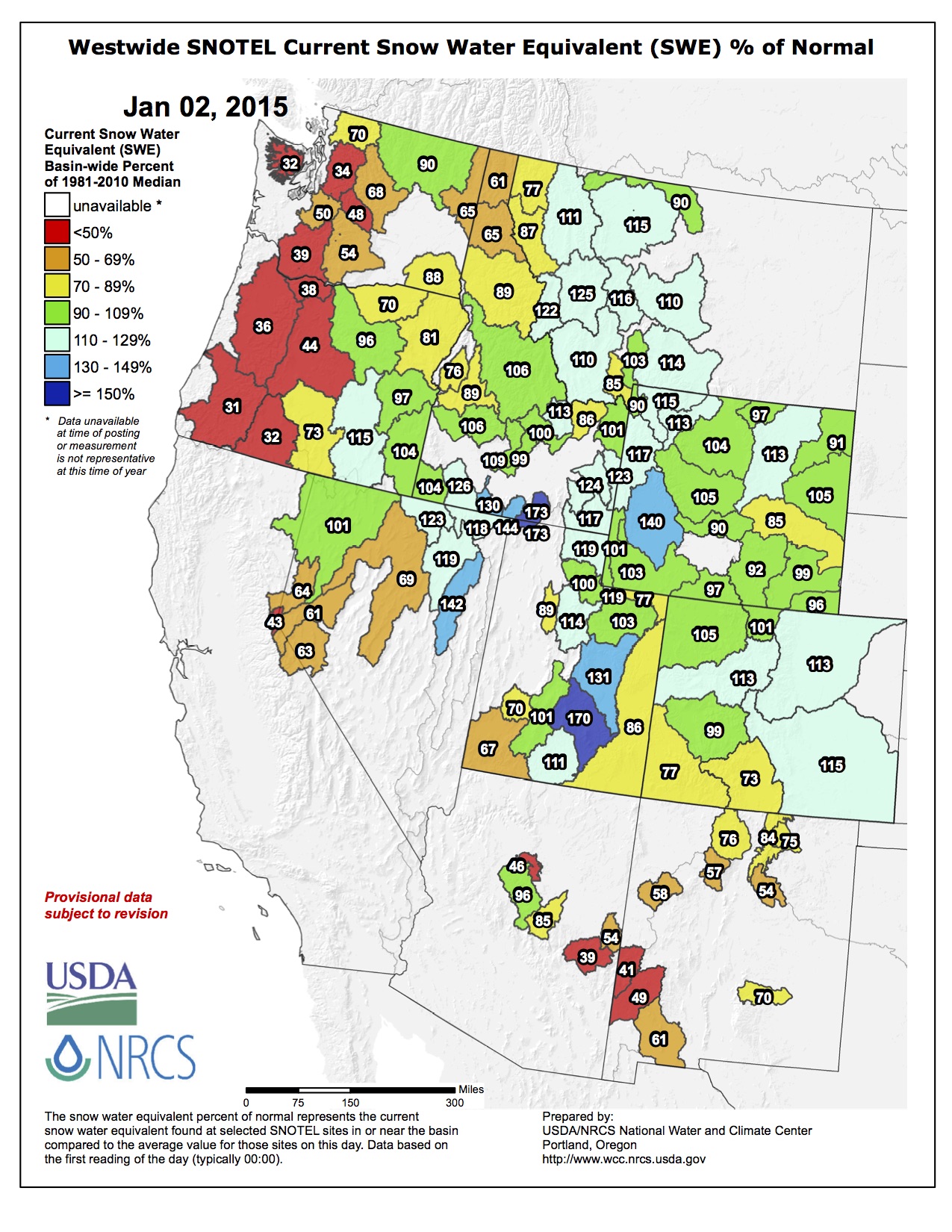
Click here to go to the NRCS website for snow maps and other products.
Resolve to conserve in 2015
Can Colorado approve a water right to grow pot? — Aspen Journalism

From Aspen Journalism (Brent Gardner-Smith) via the Glenwood Springs Post Independent:
Can the state of Colorado issue a water right to irrigate marijuana plants when federal law still says that growing pot is a crime?
That’s the question being asked by a division engineer and a water referee in Division 5 water court in Glenwood Springs, in response to a water rights application filed by High Valley Farms LLC.
“Even though the cultivation of marijuana and the sale of marijuana is legal in the state of Colorado, because it is still not legal under federal law, this question is still out there — whether beneficial use includes any use that is not legal under federal law,” said Alan Martellaro, the division engineer in Division 5.
Martellaro said a water right in Colorado can be issued only if the water is being put to a beneficial use, such as irrigation.
But the use of the water also has to be lawfully made. If it is not a lawful use, it is not a beneficial use, and so no water right can be issued.
On the other hand, Martellaro recognizes the logic of a counterargument, which is that if it is legal under state law to grow pot plants, then it is a lawful act to water them, regardless of federal law.
“We’re not coming down one way or the other, we just want an answer,” Martellaro said.
High Valley Farms, LLC is controlled by Jordan Lewis, who owns the Silverpeak marijuana store in Aspen and a new 25,000 square-foot indoor marijuana growing facility along the Roaring Fork River south of Basalt.
High Valley Farms filed an application with the water court in August seeking the right to annually pump 2.89 acre-feet of water (941,710 gallons) from the Roaring Fork River to irrigate 2,000 to 3,000 marijuana plants in the Basalt facility.
It also is seeking approval of an augmentation plan for a back-up supply of water.
‘APPLICANT MUST EXPLAIN’
On Nov. 19 Martellaro, after conferring with the Division 5 water court referee Holly Strablizky, issued a “summary of consultation” about the High Valley Farms application.
“The applicant must explain how the claim for these conditional water rights can be granted in light of the definition of beneficial use as defined in (Colorado state law),” the summary of consultation stated.
“Specifically,” the summary report said, ”beneficial use means ‘the use of that amount of water that is reasonable and appropriate under reasonably efficient practices to accomplish without waste the purpose for which the appropriation is lawfully made.’”
The word “lawfully” is in italics in Martellaro’s summary report, but that’s the extent of how the question is posed.
Whether it is legally a “beneficial” use or not, watering marijuana plants in Colorado is a valuable practice.
In the first 10 months of 2014, people spent $574 million on marijuana legally grown in Colorado, according to “The Cannabist” at The Denver Post.
In May, the U.S. Bureau of Reclamation issued a policy in response to Washington state and Colorado legalizing the growing of marijuana.
The federal agency said it “will not approve use of Reclamation facilities or water in the cultivation of marijuana,” given that the Controlled Substances Act of 1970 still prohibits growing weed.
This has lead to a tentative working assumption by some water providers that it is OK in Colorado to provide water for irrigating marijuana plants, as long as it is done with “nonfederal” water.
The augmentation plan filed by High Valley Farms includes a contract for a back-up supply of water from an irrigation ditch owned by the Basalt Water Conservancy District.
The Basalt district often leases water it controls in Ruedi Reservoir, which is a Bureau of Reclamation facility.
But the contract between High Valley Farms and the Basalt district says the water provided on High Valley’s behalf will be only from “nonfederal sources.”
High Valley’s augmentation plan also includes a contract to buy water from the Colorado River District out of Wolford Reservoir, which is a nonfederal reservoir north of Kremmling.
PRECEDENT-SETTING CASE?
Other marijuana-growing operations in Colorado have so far gotten their water by using existing water rights, Martellaro said, not by applying for new ones.
For example, a grower might have bought land that came with water rights, or may have leased water from a district or city with existing water rights.
Martellaro said this is apparently the first time an applicant has filed in Colorado for a new water right specifically to grow marijuana.
Beth Van Vurst, a water attorney for High Valley Farms, responded to the division engineer’s summary of consultation on Dec. 19.
“The procedure for addressing this concern will be discussed at the next status conference,” Van Vurst told the court, which has set the next conference for Jan. 13.
At that time, Martellaro expects that a deadline will be set for High Valley Farms to file a legal brief on the issues raised by the court.
Van Vurst said Wednesday she could not discuss the issues in the case as they are pending before the water referee.
If High Valley Farms does file a legal brief, Strablizky, the water referee, would have several options, Martellaro said.
She could accept the explanation from High Valley Farm and the matter could end there.
She could, without making a ruling, refer the case to Judge James Boyd, who presides over Division 5 water court.
She could reject the legal argument, and High Valley Farms could then appeal to Boyd.
And if the judge eventually rules against it, High Valley Farms could appeal directly to the Colorado Supreme Court.
Many water court cases include a number of parties that have filed “statements of opposition” in the case, which gives them standing to appeal decisions.
However, only one party has filed a statement of opposition in the High Valley Farms case, and that’s the Roaring Fork Club.
The club’s office is next door to Silverpeak’s new growing facility and it owns water rights on the Roaring Fork River.
“The Roaring Fork Club will probably get invited to weigh in on this, but we’re very likely to take no position on this issue,” said Scott Miller, a water attorney representing the club, referring to the issue raised by seeking a right to water marijuana plants.
“Our primary issue in this case is to protect our water rights in this stretch of river, which is already heavily diverted,” Miller said.
Aspen Journalism, The Aspen Times and the Glenwood Springs Post Independent are collaborating on coverage of rivers and water. More at http://www.aspenjournalism.org.
More water law coverage here.
@EklundCWCB: Kudos to Meg Dickey-Griffith & Rachel Duran working together to build 1st ever Arkansas River Compact website
Kudos to Meg Dickey-Griffith (CO) & Rachel Duran (KS) wkg together to build 1st ever Arkansas River Compact website! pic.twitter.com/4rbQT0T3Lu
— James Eklund (@EklundCO) December 17, 2014
Healthy Animas, healthy animals: quality of water & vegetation is the focus of a $159K project — The Durango Herald
Healthy Animas, healthy animals: quality of water & vegetation is the focus of a $159K project http://t.co/FYNUzhlGUa pic.twitter.com/hycibzFtHj
— Durango Herald (@DurangoHerald) December 15, 2014
Open Water Foundation wins SXSW Eco Social Impact Not-for-profit Startup Competition!

Click here to go to the Open Water Foundation website for all the inside skinny about the award and to watch Steve Malers presentation.
Here’s an article about the SXSW conference from Popular Mechanics (Tom Foster). Here’s an excerpt:
STARTUP SHOWCASE: NOT-FOR-PROFIT SOCIAL IMPACT
Open Water Foundation, based in Fort Collins, Colorado, is a social enterprise that builds open-source software that helps people and organizations conserve water resources. The collaborative, open-innovation model frees groups from relying on government funding or self-funding to build smart water solutions. The result, in theory, is a focus on solving shared problems, which increases both cost-effectiveness and overall usefulness.
Evergreen: Popular fishing holes need to shore up water rights
From the Canyon Courier (Sandy Barnes):
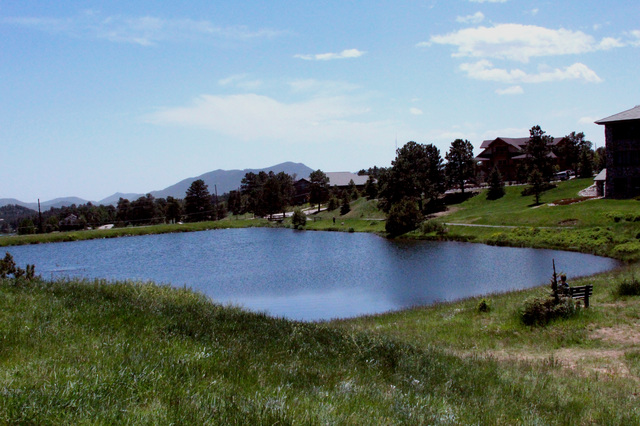
The two ponds beside Buchanan Rec Center are stocked with trout and are popular among Evergreen residents and visitors who like to try their luck fishing.
The source of water for the ponds is Troublesome Creek, a tributary of Bear Creek that flows under the Highway 74 overpass near the property in Bergen Park.
Since Buchanan Park was developed in the early 2000s, maintaining water for these small lakes has not been a significant issue.
However, the Colorado Division of Water Resources recently informed the Evergreen Park and Recreation District of a potential problem concerning water rights for the Buchanan ponds, said Ellen O’Connor, EPRD executive director.
“We have learned the ponds were originally part of the Village at Soda Creek Lake development,” O’Connor said. “The original water rights were pretty robust and included storage, irrigation and augmentation.”
However, it is unclear as to whether the park district acquired those water rights when the property was purchased for Buchanan Park in December 1994.
“We’re trying to make them aware of the issue,” said David Nettles, an engineer with division one of the Colorado Division of Water Resources. “Someone could seek water rights from the ponds.”
“From looking at what I have, I don’t see any water rights,” Nettles remarked.
The park district would be notified if someone filed a claim for water rights at the Buchanan ponds, he added.
There are two inactive cases on file with the state water court regarding water rights for the Village at Soda Creek development. In the early 1980s applications were filed by Gayno Inc. and George Alan Holley to acquire water rights for the planned project. Those rights were tied to an original decree dating from 1884 for the Lewis and Strouse Ditch.
It’s possible that the rights were subsequently abandoned because of a failure on the part of the previous owners to file a required diligence report with the state, Nettles said.
To address the issue, EPRD has formed a two-member subcommittee. Board members John Ellis and Peg Linn are researching the matter and are expected to report to the board on their findings. O’Connor also has been conferring with Tim Buckley, the water commissioner serving the district for Evergreen…
Historic water issues at Buchanan Park
When Thomas Bergen, founder of Bergen Park, acquired his homestead from the federal government in 1875, water rights for the property were not a given.
The homestead certificate, which bears the signature of President Ulysses Grant, gave Bergen and his heirs an 80-acre tract of land, subject to “any vested and accrued water rights for mining … and rights to ditches as reservoirs used in connection with such water rights, as may be recognized and acknowledged by the local customs, laws and decisions of the courts.”
The Evergreen Park and Recreation District purchased two parcels of this historic property from the Fahnenstiel family in 2006 as part of a bond issue. This property is now part of Buchanan Park and the site of the Evergreen community garden, which is served by water taps provided by the Evergreen Metropolitan District.
A final note: While it is impressive to see, the authenticity of the signature of President Grant on the 1875 homestead certificate for Bergen is questionable. According to historical research, secretaries copied presidents’ signatures onto these documents after being authorized to sign them as proxies by President Andrew Jackson in the 1830s.
More water law coverage here.
@alexwitze: See #Elwha dams come down in a @ScienceNews video
https://twitter.com/alexwitze/status/550317986829967360
More restoration/reclamation coverage here.
The BBC looks at Didymo (rock snot)
From the BBC (Larry O’Hanlon):
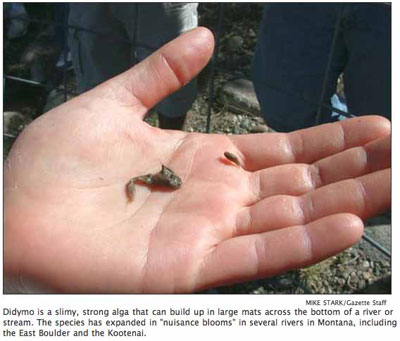
It began with a few small strange patches of slime, clinging to the rocks of the Heber River in Canada. Within a year, the patches had become thick, blooming mats. Within a few years the mats had grown into a giant brownish-yellow snot. And within a few decades this snot had spread around the world, clogging up rivers as far away as South America, Europe and Australasia.
This snot, which is still flourishing today, is caused by a microscopic alga, a diatom that goes by its scientific name Didymosphenia geminata. It has become so notorious it has its own moniker, Didymo. People have been blamed for the sudden, global explosion of this tiny organism, unwittingly carrying the algae from river to river on fishing gear, boats and kayaks. The huge snots it forms have wreaked havoc in waterways, forcing governments and environmental organisations to initiate huge and costly clean-up operations.
But underlying the snots’ strange appearance is an even stranger story. About Didymo itself, about what it is, and how it behaves.Scientists are now discovering that the sudden appearance of Didymo may not have been so sudden after all.
Its blooms aren’t really blooms – instead they are more of an elixir-induced metamorphosis. And Didymo seems to ignore the usual rules followed by invasive species. It even appears likely that this little diatom may not even be a significant problem itself; instead the brownish-yellow snot it forms may be a symptom of greater changes underway in freshwater systems around the world.
Malignant morphs
The diatom was first spotted in 1988, a few patches of alga within Heber River, in Vancouver Island, British Columbia. By 1989, several kilometres of river were covered in thick mats of the stuff, a surprise since the rare alga was not thought to grow this way. Today, Didymo coats the rocks of streams and rivers around the globe, from Quebec in Canada, Colorado and South Dakota in the US, Poland and Norway in Europe, even reaching Iceland, Chile and New Zealand.
Normally diatoms or other algae bloom when water is rich in nutrients, feeding an explosive increase in reproduction. This has a massive detrimental impact on freshwater systems. After diatoms increase in huge numbers, they also die in huge numbers, creating a surge in decay that depletes oxygen in the water. That suffocates freshwater animals such as insects, crustaceans and fish. Algal blooms essentially create an aquatic apocalypse.
But intriguingly, none of this applies to Didymo. When it creates huge snots, it’s not actually reproducing, scientists have discovered. Instead, it’s morphing, from something benign to something malignant. Each single-celled organism exudes long stringy stalks of mucous that entangle, creating the mats and snots that coat rocks.
“We usually think of massive cell division in a bloom,” says ecologist Cathy Kilroy, of New Zealand’s National Institute of Water and Atmospheric Research Ltd, in Christchurch. “That’s not the case here.”
The water conditions which cause this transformation are also unexpected. “Most algal blooms are attributed to too much nutrients,” explains diatom researcher Sarah Spaulding, of the US Geological Survey in Colorado.
“This is the first time it’s attributed to too little nutrient.”Didymo, it turns out, only turns malignant when waters are very low in phosphorus, a nutrient often associated with pollution by detergents and fertilisers. It’s this paucity of phosphorous that causes the stringy stalks to grow, not the alga trying to reproduce, says Kilroy, whose experiments helped establish the connection…
Ever-present?
Didymo is also pulling a second surprise on scientists. For decades, it was thought that people spread the diatom around the world, the alga hitching a ride on the tackle, nets and wading boots of fishermen, and boats and boating equipment. To counter the threat, river users have been encouraged to clean their gear between visits.
But Didymo may not have been spread across the globe after all. It may have been there all along, believe Brad Taylor of Dartmouth College in Hanover, New Hampshire, US and Max Bothwell of Environment Canada’s Pacific Biological Station in Nanaimo, BC.
The two diatom researchers have just published a study in the journal BioScience. It reveals fossil and historical evidence that Didymo has long existed on every continent except Africa, Antarctica and Australia. Fossilised forms of Didymo, for example, can be found in at least 11 countries in Europe, across North America and Asia, and in South America.
“The idea that D. geminata is a recently introduced species or a native species expanding its range has been accepted and promoted,” say the scientists in their study. But that idea is wrong, they argue. And it explains why legislation banning certain types of wading gear, thought to help spread algae, has had no impact on the spread of Didymo’s brown snot into new rivers. Because Didymo was already there…
Catastrophic or not?
However, to fishermen and boaters wrestling with Didymo’s brown, or sometimes yellow or green snots, its origins are academic. They want to know what it’s doing to the waterways, whether it’s hurting fish or invertebrates such as the insects on which fish depend.
Even here though, the diatom continues to surprise. Research has shown that the alga boosts numbers of small insects, such as midges and gnats, while reducing numbers of larger insects, such as mayflies, stoneflies and caddisflies. “That seems to be a universal change in these streams,” says fisheries biologist Daniel James of the US Fish and Wildlife Service in the Black Hills of South Dakota, where Didymo appeared in 2002.
James’s research has focused on the diets of freshwater fish, and whether they have less to eat due to the presence of brown snots. But the reduction in larger insects hasn’t so far caused a problem, as the fish are just eating more of the smaller insects.
While the fish of South Dakota seem unaffected by Didymo, which covers around a third of the riverbeds studied by James, he cautions that may not be so in other places, such as in New Zealand. There the snots can blanket the whole river.
However, on the whole, Didymo doesn’t yet seem to have caused the ecological catastrophe that so many feared. “At first there was a huge concern about how Didymo was going to affect fish,” says James. “But it’s more of an annoyance.”
It can cause some problems for irrigation systems, says Kilroy. But its biggest impact seems to be aesthetic. “The main effect of Didymo is how it changed the appearance of rivers and streams,” she says. “It’s not toxic. It really doesn’t do anything really awful.”
The real invaders
So what then, is the real meaning of the Didymo phenomenon worldwide? The true significance of the brown snot taking over the world’s rivers may not be the snot itself, but what it tells us about our own, human impact on freshwater ecosystems.
Bothwell, Taylor and Kilroy have collaborated on new research recently published in the journal Diatom Research. They propose a few mechanisms by which humans may have altered the world’s rivers, creating the opportunity for Didymo.
First, the burning of fossil fuels such as oil and coal has increased the amount of nitrogen compounds on the atmosphere. That nitrogen causes soil organisms to better use phosphorous in the soil, meaning less phosphorous runs into rivers and streams. That creates the more phosphorus-free water beloved by Didymo.
A second mechanism, which has the same effect as the first, is the increasing addition of nitrogen-rich fertilisers to soils by agriculture and forest managers.
A third involves climate change, and the way it changes the timing of growing seasons and melting of snow. This might somehow also reduce the amount of phosphorous entering freshwater ecosystems, the researchers say, again creating the environment in which Didymo brown snots can flourish.
It could be that different mechanisms are the cause of Didymo blooms in different places around the world, or that they are working in synergy.
But whichever turn out to be at work, the research seems to suggest that we have met the invaders, and they are not brown snot-causing Didymo diatoms. They are us.
More invasive species coverage here.
Arkansas River Basin: Watershed group expands — Leadville Herald-Democrat

Arkansas River Basin via The Encyclopedia of Earth

Arkansas River near Leadville

Arkansas River Basin — Graphic via the Colorado Geological Survey

Mount Massive and Leadville from 6th St via Wikipedia Commons

Leadville

Leadville Mine Drainage Tunnel

California Gulch back in the day
From the Leadville Herald-Democrat:
The Lake Fork Watershed Working Group elected to expand the group to focus on a larger geographic area, include additional stakeholders and prioritize additional watershed issues. The decision was made at the group’s Nov. 14 meeting.
The Lake Fork Watershed Working Group was created in 2000 by approximately 30 stakeholders to address water-quality issues associated with historic mining in the Lake Fork Watershed, focusing on the Sugarloaf Mining
District located just southwest of Turquoise Reservoir.Since the group’s formation, roughly $5 million, largely grant funds, have been spent on projects that have measurably improved water quality in the Lake Fork.
The newly expanded watershed group will focus on the entire headwaters of the Arkansas River upstream of Granite, including the Twin Lakes area. The next steps for the group will be to create a watershed plan document that analyzes watershed issues affecting this area and then prioritize projects that will further improve overall watershed health. The plan will address issues that could impact the watershed, such as forest health, water quality, water quantity, sedimentation and erosion, development, open space, climate, wetlands, riparian, education and recreation.
Citizens or organizations that have an interest in watershed issues or would like further information are encouraged to contact the watershed group by emailing nrm@coloradomtn.edu.
More Arkansas River Basin coverage here.
Happy New Year

@sasagronomy: This is how big a grizzly bears paw is
Montana v. Wyoming and North Dakota: “The test comes in dry years. That’s when the system gets pushed” — Pete Michael
From the Associated Press (Matthew Brown) via The Bismarck Tribune:
Justice Clarence Thomas wrote Monday’s decision.
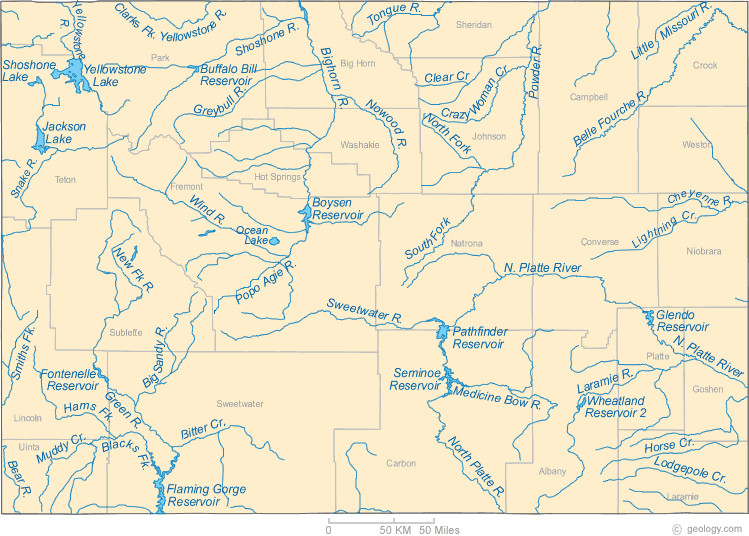
It centered on modern irrigation systems that use sprinklers to allow farmers to increase crop yields by applying water directly to crops, rather than flooding entire fields. In the case of the Tongue and Powder rivers, that means less water left over to run downstream into Montana.
But justices determined Montana’s loss does not mean Wyoming is doing anything wrong. Thomas compared improved irrigation methods with farmers who recapture water so it can be used more than once – a practice that has been upheld by the Montana Supreme Court.
“By using sprinklers rather than flood irrigation, those water users effectively recapture water,” Thomas wrote. “They are simply different mechanisms for increasing the volume of water available to the crops, without changing the amount of diversion.”
North Dakota is also listed as a defendant because it is a party to the Yellowstone Compact. However, no claims have been made against it and the outcome of the lawsuit is likely to have little bearing on the state.
Wyoming Deputy Attorney General Pete Michael said the ruling resolved an important issue, by putting to rest at least one aspect of a case that could threaten the state’s agriculture and energy industries if it ultimately goes in Montana’s favor.
Although river levels are expected to be high this year following heavy winter snows, the struggle over the region’s scarce water supplies will continue, Michael said.
“The test comes in dry years. That’s when the system gets pushed,” he said.
Justice Antonin Scalia was the only dissenting vote. Justice Elena Kagan did not participate in the case because she worked on it while in the solicitor general’s office.
Scalia wrote in his dissent that Montana was merely trying to protect its rights under the 1950 agreement – not seeking a precise volume of water every year. The question is not how much water is diverted from the rivers but how much is depleted from the overall water supply, Scalia wrote.
He added that his colleagues disregarded the text of 1950 agreement and instead substituted their own “none-too-confident reading” of common law.
Montana Attorney General Steve Bullock had argued the case before the high court in January. Assistant Attorney General Jennifer Anders said Monday it was “hard not to be disappointed” with Monday’s ruling but said it needed to be put in perspective.
“We brought four claims, and the Court is allowing three of those claims to move forward,” she said. “. “Our objective in bringing this lawsuit was to protect Montana water users and to fairly administer the agreement between our state and Wyoming. Even with today’s decision, we will reach those goals.”
A court-appointed special master had rejected part of Montana’s claim last year. Stanford University law professor Barton Thompson Jr. agreed with Wyoming attorneys who argued that the case came down to how much water was being taken out of the Tongue and Powder rivers, not what happens to the water after that.
In October, the court ruled that Montana has raised a valid issue with its lawsuit and rejected Wyoming’s attempt to dismiss the case.
Remaining aspects of the lawsuit could have consequences for Wyoming’s natural gas industry. Over the last decade, companies seeking a type of gas known as coal-bed methane have pumped billions of gallons of water from underground aquifers shared by the two states.
Montana contends the companies are draining water that would otherwise feed the Tongue and Powder rivers. A Texas-based energy company, Anadarko Petroleum Corp., attempted to intervene in the case but was denied.The case is Montana v. Wyoming and North Dakota, 137, Orig.
More water law coverage here.
@NWSBoulder: The Year 2014 at a Glance for Denver
The Year 2014 at a Glance for Denver: #COwx pic.twitter.com/lJlsX6Rntw
— NWS Boulder (@NWSBoulder) January 1, 2015