Drought news: Reservoir storage above average in Colorado

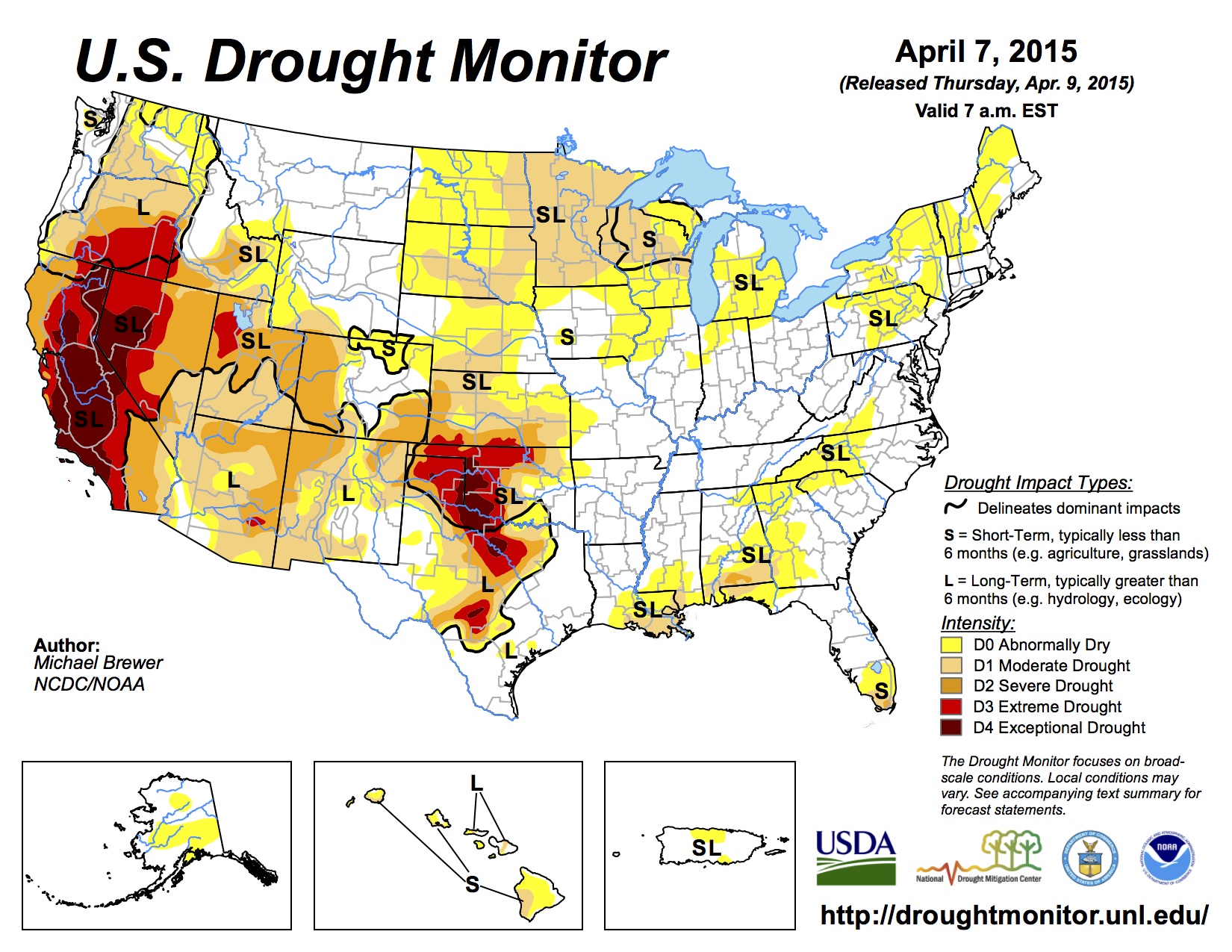
Click here to go to the US Drought Monitor website. Here’s an excerpt:

Summary

This U.S. Drought Monitor week saw improvements in the Southwest as overall conditions continued to improve across parts of the region. Improvements primarily were focused upon west-central New Mexico and northern Arizona where most long- and short-term indicators have pointed toward improvements, although reservoir storage levels in various drainage basins remain below normal. During the weekend, residual moisture associated with Hurricane Dolores fueled showers and thunderstorms across southwestern California and western Arizona leading to locally heavy rainfall accumulations and flash flooding. Despite well-above-average precipitation in southern California during the past 90 days, recent rainfall has had little impact on the overall drought situation in the state. In the Pacific Northwest, above average temperatures and precipitation deficits continue to mount across the region with growing concern about potential crop losses in central and eastern Washington. Moving eastward, short-term precipitation deficits led to slight deterioration of conditions in the northern Plains while locally heavy rainfall was observed across drought-free areas of Illinois, Indiana, Ohio, Kentucky, and Missouri. In the Southeast, conditions continued to deteriorate across portions of Alabama, Georgia, and South Carolina where excessive heat and lack of rainfall dried soils and reduced streamflows. According to the National Centers for Environmental Information (NCEI) climatological rankings, the contiguous U.S. average temperature for June was the second hottest in the observational record (1895–2015). On a state level, California, Idaho, Oregon, Utah, and Washington all experienced their hottest average-temperature Junes on record since 1895…

The Plains

Across the central and northern Plains, temperatures were near normal in eastern portions while western parts were below normal. In the southern Plains, temperatures were near- to-slightly-above normal for the week. The heaviest rainfall accumulations (two-to-four inches) were observed in isolated pockets of northwestern Kansas and the Oklahoma Panhandle, while lesser amounts (one-to-three inches) were recorded in the central and northern Plains. On the map, areas of Abnormally Dry (D0) expanded in Kansas, North Dakota, and South Dakota where short-term precipitation deficits exist…

The West

During the past week, average temperatures were below normal across much of the West with the exception of western portions of California and Oregon, eastern New Mexico, and Washington. During the weekend and into Monday, moisture associated with Hurricane Dolores triggered showers and thunderstorms across parts of southern California and western Arizona. Some locally heavy accumulations (two-to-four inches) and flash flooding were reported. Despite well-above-average precipitation during the past 90-days in parts of central and southern California, the Sierras, and portions of the Great Basin, the recent rains have not impacted the overall drought situation in these areas because significant precipitation deficits remain as well as agricultural and hydrological (low reservoirs, below normal streamflows) impacts. In the Pacific Northwest, precipitation has been below normal since the beginning of the Water-Year (Oct. 1). The trend has continued during the past 60-days leading to very low streamflows, dry soils, and increasing concern in the agricultural sector. In the Southwest, some improvements were made on this week’s map in areas of Severe Drought (D2) in west-central New Mexico as well as east-central and northern Arizona where long- and short-term drought indicators (precipitation, soil moisture, streamflows, and vegetative health) have shown improvement during the past year. However, according to the Natural Resource Conservation Service (NRCS), statewide reservoir storage remains below normal in both Arizona and New Mexico. According to the Salt River Project (SPR), the Salt River system reservoirs are currently 53% full while the Verde River system reservoirs are 52% full. In New Mexico, Elephant Butte (the state’s largest reservoir on the Rio Grande) is currently 27% of average – up 9% from the same time last year. Elsewhere, statewide reservoir storage is above average in Colorado, Idaho, Montana, and Wyoming…

Looking Ahead

The NWS WPC 7-Day Quantitative Precipitation Forecast (QPF) calls for generally dry conditions across most of the western U.S. with the exception of some modest accumulation (one-to-two inches) in northern portions of the Great Basin, northern Rockies, and North Cascades. In contrast, the central and northern Plains and western portions of the Midwest are forecasted to receive one-to-three inches while heavy precipitation is forecasted in southern Georgia and Florida with totals in the three-to-seven inch range. The CPC 6–10 day outlooks call for a high probability of above-normal temperatures east of the Rockies as well as along the West Coast while most of the interior West will be below normal. Across the West (with the exception of extreme southeastern Arizona and southwestern New Mexico), there’s a high probability of below-normal precipitation while the central and northern Plains, western portions of the Midwest, Northeast, and Southeast have a high probability of above-average precipitation.

Sportsmen support federal water rule — The Durango Herald #cleanwaterrules

Fen photo via the USFS

From The Durango Herald (Peter Marcus):

The bipartisan poll – conducted by two separate pollsters – highlights support across political lines, despite partisan gridlock in Congress. Critics of the survey, however, believe the poll left out key questions…

The Clean Water Rule will take effect Aug. 28. It clarifies regulatory authority under the Clean Water Act to protect streams and wetlands.

In Colorado, 66 percent of sportsmen support applying the Clean Water Act to smaller streams and wetlands, with 43 percent indicating strong support, according to the survey. About 31 percent indicate opposition. Across all the four states surveyed, 83 percent of hunters and anglers thought the EPA should apply the Clean Water Act to smaller, headwater streams and wetlands.

The poll was conducted by right-leaning Public Opinion Strategies and left-leaning Greenberg Quinlan Rosner Research.

“This is incredibly broad,” said Al Quinlan, president of Greenberg Quinlan Rosner Research. “It’s as broad of support as I see for any issue in the electorate today.”

The survey was completed after interviews with 1,000 registered voters who identify as hunters and anglers. Pollsters completed 260 interviews with voters in Colorado.

A spokesman for U.S. Rep. Scott Tipton, R-Cortez, who has strongly opposed implementation of the rule, suggested that the poll should have included questions pointing to local environmental protections.

“This sin of omission is misleading, and skews the survey to the desired outcome of those asking the questions,” Tipton spokesman Josh Green said. “To imply that there is wide support for the EPA’s Waters of the U.S. rule – with this survey as the evidence – is deeply misleading and insulting.”

More Environmental Protection Agency coverage here.

Paradox Valley Unit: Earthquakes yes, but less saline water in the #ColoradoRiver

Here’s an in-depth report from Stephen Elliott writing for The Watch. Click through and read the whole thing. Here’s an excerpt:

Nestled in an unassuming corner of Paradox Valley along the banks of the muddy Dolores, the work done at the Paradox Valley Unit, a facility operated by the United States Bureau of Reclamation, has enormous implications for the water supply of major cities in the Lower Basin of the Colorado River, including Las Vegas, Phoenix and Los Angeles.

The project is also having a literal impact closer to home, in the form of seismic activity; since injection began at the site in 1991, seismic monitors have recorded around 6,000 “seismic events,” or earthquakes, within 16 kilometers of the injection well.

It is known beyond any reasonable doubt that the earthquakes are the result of the brine injections.

“The injection history and seismicity history correlate pretty well in both the spatial and temporal extent. It’s generally accepted that the seismic activities in Paradox Valley are induced by injection,” said Shemin Ge, a hydrogeology professor at the University of Colorado.
“Yes, we induce small earthquakes,” said Andy Nicholas, facility operations specialist at the Paradox Valley Unit. “They knew from the beginning that there was the likelihood to do that.”[…]

When it comes to water quality in the western U.S., the importance of the Paradox Valley Unit cannot be overstated. If the salt wasn’t extracted from beneath the Dolores in Paradox Valley, it would end up not only in Lake Powell and Lake Mead, but also in treatment facilities for major urban Lower Basin water-user cities.

At the Paradox Valley facility, extraction wells between 40 and 70 feet deep along the Dolores pull brine out of the groundwater beneath the river, process it and pump it three miles across the valley to the injection well. The injection well then shoots the brine more than 2.5 miles down into the Mississippian Leadville Formation, beneath the Paradox salt formation that serves as a barrier preventing the brine from ascending back upwards.

Prior to the Bureau of Reclamation’s extraction-and-injection process, which began in the early 1990s, the Dolores River picked up roughly 185,000 metric tons of salt each year as it flowed across Paradox Valley. (Unlike most river valleys, which are created by erosion, this one was formed by the collapse of a salt-cored geological fold, instead of the flow of a river. Indeed, paradoxically, the Dolores River cuts across this span instead of paralleling it, giving the Paradox Valley its name.)
Between 2008 and 2012, the average injection rate at the Paradox Valley Unit was 190 gallons of brine per minute. As of last month, the PVU well had injected just over two million tons of brine beneath the muddy Dolores riverbed during its 24 years of operation.

The total tonnage of salt removed from the Colorado River system by the PVU is impressive, but the significance of the facility depends on the valley’s status as a so-called point source of salinity. A majority of the salt that flows into the Colorado River system does so through non-point sources such as large agricultural areas, where a tract thousands of acres in size might contribute a relatively small amount of salt to the river. At Paradox Valley, however, all of the salt enters the river system in a comparably small area, and can be more easily extracted and quantified than at non-point sources.

At non-point sources — say, a large agricultural valley where irrigation runoff pushes salt into a river — the best the Bureau of Reclamation and its partner agencies can do is offer canal-lining projects, which prevent some salt in the soil from flowing with excess irrigation water into rivers, and provide education for farmers about more efficient irrigation practices.

At the PVU, on the other hand, the Bureau of Reclamation can physically extract salt from the groundwater and quantify it, making it the only such location in the Colorado River Basin where salinity control impacts are 100 percent known. (There is a point source of salinity near Glenwood Springs that is perhaps more significant than the one at Paradox Valley, but no salt extraction is done there.)

All told, 10 percent of the salt taken out of the entire Colorado River system by the Colorado River Basin Salinity Control Program is extracted at the Paradox Valley site.

“It’s the only place where we’re removing salt in a physically measurable way. We’re measuring the quantity of salt, so we’re certain that we got that pumped out of the river,” said Steve Miller, a water resource specialist with the Colorado Water Conservation Board. “[The PVU] gives us a chance to really grab a large amount of salt in a very controlled fashion. The project is really important to the Lower Basin [states], but not so important to Colorado. In terms of the total amount of salt reaching Lake Powell it’s very important, because in Paradox we can get a lot of salt out in one fell swoop.”

Sentiments on NISP continue to run high — The Fort Collins Coloradoan

Click on a thumbnail graphic for a gallery of NISP maps.

From the Fort Collins Coloradoan (Kevin Duggan):

Disagreement over the proposed Northern Integrated Supply Project and its impact on the Poudre River has not mellowed with time.

Supporters of the project, which would build two new reservoirs, say NISP is needed to meet the future water needs of growing Northern Colorado communities.

Opponents say the project would drain and irreparably harm the river and its ecosystem, especially through Fort Collins.

Both sides turned out in force Wednesday for a public hearing in Fort Collins on a supplemental draft Environment Impact Statement, or EIS, for the project, just as they did when the document was initially released in 2008.

The issues haven’t changed over the years, several speakers noted.

Longtime Fort Collins resident and former City Council member Gina Janett said NISP is about growth, not about saving farmland from being bought and “dried up” by municipalities for water.

Development of irrigated farmland has gone on for decades and will continue, she said.

“The truth is, this project will provide water to buy and develop thousands of acres of irrigated farmlands, the willing sellers will be the farmers in the areas adjacent to the towns … and farms won’t be dried up and remain vacant but will be sold along with their water to developers to build new subdivisions and shopping centers.”

Proponents of the project said the “buy-and-dry” phenomenon is real and threatens to take thousands of acres out of agricultural production.

Bruce Gerk, a farmer from Julesburg, said water from NISP is needed to keep farms and cities viable in Colorado’s arid climate.

“If we are going to have a society that has the surety of water in this desert … then we have to control that resource and we need to do it in a responsible way,” Gerk said. “But we do need storage.”

Fifteen municipalities and water districts are participating in NISP through Northern Colorado Water Conservancy District, also known as Northern Water.

The project would yield 40,000 acre feet of water a year to participants. An acre-foot is roughly 325,851 gallons, enough to meet the water needs of three to four urban households for a year.

The draft EIS looks at four alternatives for the project, including a “no action” alternative. The version of NISP preferred by Northern Water is Alternative 2, which would build Glade Reservoir northwest of Fort Collins.

Glade would be a bit larger than Horsetooth Reservoir and inundate the valley through which U.S. Highway 287 currently runs from north of Ted’s Place to a point south of Owl Canyon Road.

Water would be drawn from the Poudre near the mouth of its canyon during times of peak flow, primarily May and June, to fill the reservoir with up to 170,000 acre feet. Seven miles of U.S. 287 would be rebuilt to the east.

Galeton Reservoir would be built east of Ault and draw water from the South Platte River. It would hold about 45,000 acre feet of water.

The project would use new pipelines and existing canals to transfer water and meet requirements for returning water to the rivers.

Opponents of the project maintain the water that would be provided by NISP could be realized through conservation. Another concern is the ecological impact of reduced river flows as water is diverted into reservoirs.

Fort Collins resident Greg Speer said plans for reducing flows in the original draft EIS were “fatally flawed.” The supplement document is no better, he said.

“There are a lot of problems with NISP as well,” he said. “The bottom line is these flows still as projected are fatal for the Poudre.”

Representatives of several communities participating in NISP said they have taken steps to increase their conservation efforts. Dave Lindsay, town manager of Firestone, said the town had reduced its per capita water consumption by 13.5 percent.

“That’s substantial but it’s not enough,” he said.

To have a sustainable future, Colorado needs projects like NISP to store water that otherwise would flow out of the state, he said.

The EIS is required under the National Environmental Policy Act. The U.S. Army Corps of Engineers is responsible for its production. The EIS process for NISP began in 2004.

Northern Water expects the final EIS to be issued next year, with a decision on the project coming in 2017.

More Northern Integrated Supply Project (NISP) coverage here and here.

Groundwater levels in the north-central San Luis Valley increased over late spring and early summer

San Luis Valley Groundwater

From The Pueblo Chieftain (Matt Hildner):

Groundwater levels in the north-central San Luis Valley increased over late spring and early summer, thanks to wet weather and reduced pumping.

“Hopefully we’re changing the direction of the storage,” Allen Davey, an engineer for the Rio Grande Water Conservation District, said Tuesday.

After a three-year decline that saw water levels in the unconfined aquifer drop by 700,000 acre-feet through 2013, the shallower of the valley’s two major aquifers has added over 100,000 acre-feet this spring and summer.

The unconfined aquifer is fed by stream flows, surface-water diversions and the return flows from irrigation.

More San Luis Valley groundwater coverage here

Colorado Parks and Wildlife scientists have bred whirling disease resistant fish — The Loveland Reporter-Herald

rainbowtrout

From the Loveland Reporter-Herald (Pamela Johnson):

Anglers have been reporting catches that they haven’t seen in Colorado rivers in many years — good size rainbow trout — due to an effort from scientists to restore populations of the fish that were devastated by whirling disease.

Colorado Parks and Wildlife scientists have been breeding whirling disease resistant fish in hatcheries across the state and stocking them in waters around Colorado since 2006, including in the Poudre River west of Fort Collins.

“We are seeing an increase in the rainbow trout population,” said Eric Fetherman, aquatic research scientist. “We haven’t seen them reproduce in the (Poudre) River. We’re not to that point yet.

“We are starting to the see natural populations coming back in other parts of the state. In the Gunnison River, the natural population there is enough to consider not restocking.”

On the Poudre, the fish are stocked above the narrows near Rustic but have made their way downstream and onto the hooks of happy fishermen and women all along the river.

“We’ve had reports of people catching them at Picnic Rock and even all the way through town,” said Fetherman…

In 1986, a private hatchery unknowingly imported infected rainbow trout from Idaho and stocked them in 40 different waters. The disease -— which infects the spine of young fish, causes then to swim in a whirling pattern and ultimately die — spread throughout the state and essentially ended natural reproduction of rainbow trout in most Colorado rivers.

Brown trout, which are not susceptible, took over as the dominant fish.

Then in 2002, at a national conference in Denver, researchers learned about a family named Hofer in Germany who was raising rainbow trout that were resistant to the parasite that causes whirling disease, according to Colorado Parks and Wildlife.

Colorado researchers imported eggs from the Hofer hatchery and began to study them.

Sure enough, research showed that the Hofer trout were resistant to whirling disease, and some were stocked in reservoirs west of Berthoud.

However, because these fish had been in domestic hatcheries for generations, researchers knew they would have little chance of survival in creeks and rivers because they did not possess the instinct to avoid predators and to survive in fluctuating water.

So, the research team, led by George Schisler, an aquatic scientist based in Fort Collins, began cross-breeding the Hofers with wild trout. After three years, they stocked the first Hofer-cross rainbow trout, but the first fish did not survive.

Again in 2010, biologists stocked fingerlings in the Colorado River, and just over a year later, they found good numbers of 15-inch rainbow trout and evidence that the young fish were hatching in the wild, according to Colorado Parks and Wildlife.

Since then, the fish have been stocked in many rivers including the Poudre, East, Taylor, Gunnison, Rio Grande and Yampa. Biologists vary the time of year, size and location to optimize survival of the rainbow trout.

This year, 6 million Hofer crosses will be raised across all the Colorado Parks and Wildlife hatcheries and released into water statewide. At the Bellvue fishery right now, 150,000 Hofer crossed with Colorado River rainbow are growing in troughs to be released into the Poudre and St. Vain Rivers in late August and early September.

After Hottest Year On Record, Ocean Warming Is Now ‘Unstoppable’ — IFL Science

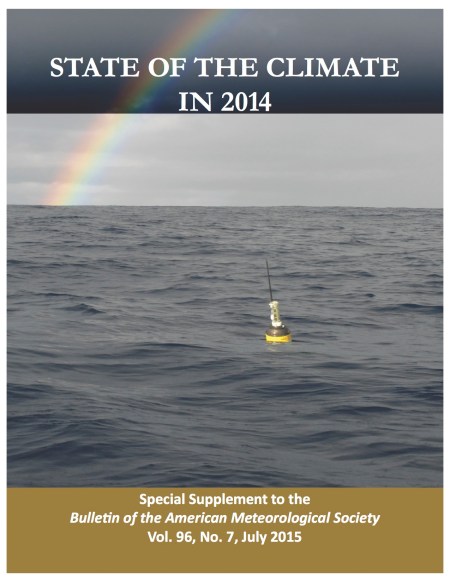
americanmeterorlogicalsocietystateofclimate2014cover

From IFLScience.com (Josh L Davis):

Sea levels, warming of the surface and upper layer of the oceans, greenhouse gases and land temperatures all hit a record high in 2014. In addition to this, glacier melt and tropical storms were also at a high, while sea ice loss continued. These are the findings from the annual State of the Climate report, published in the Bulletin of the American Meteorological Society. The results are based on the work of 413 independent scientists from 58 countries.

“This report represents data from around the globe, from hundreds of scientists and gives us a picture of what happened in 2014,” explained Thomas Karl, director of the National Oceanic and Atmospheric Administration who carried out the report, which has been produced every year for the last 25.

“The variety of indicators shows us how our climate is changing, not just in temperature but from the depths of the oceans to the outer atmosphere,” he added.

The report also hints at something even more worrying. Even if greenhouse gas levels were cut immediately, the researchers claim the warming of the oceans is predicted to continue for centuries and millennia. It seems we might have reached the tipping point, and crashed over the edge.

Water managers dodge bullet with ‘May miracle’ rains — The Los Angeles Times #ColoradoRiver

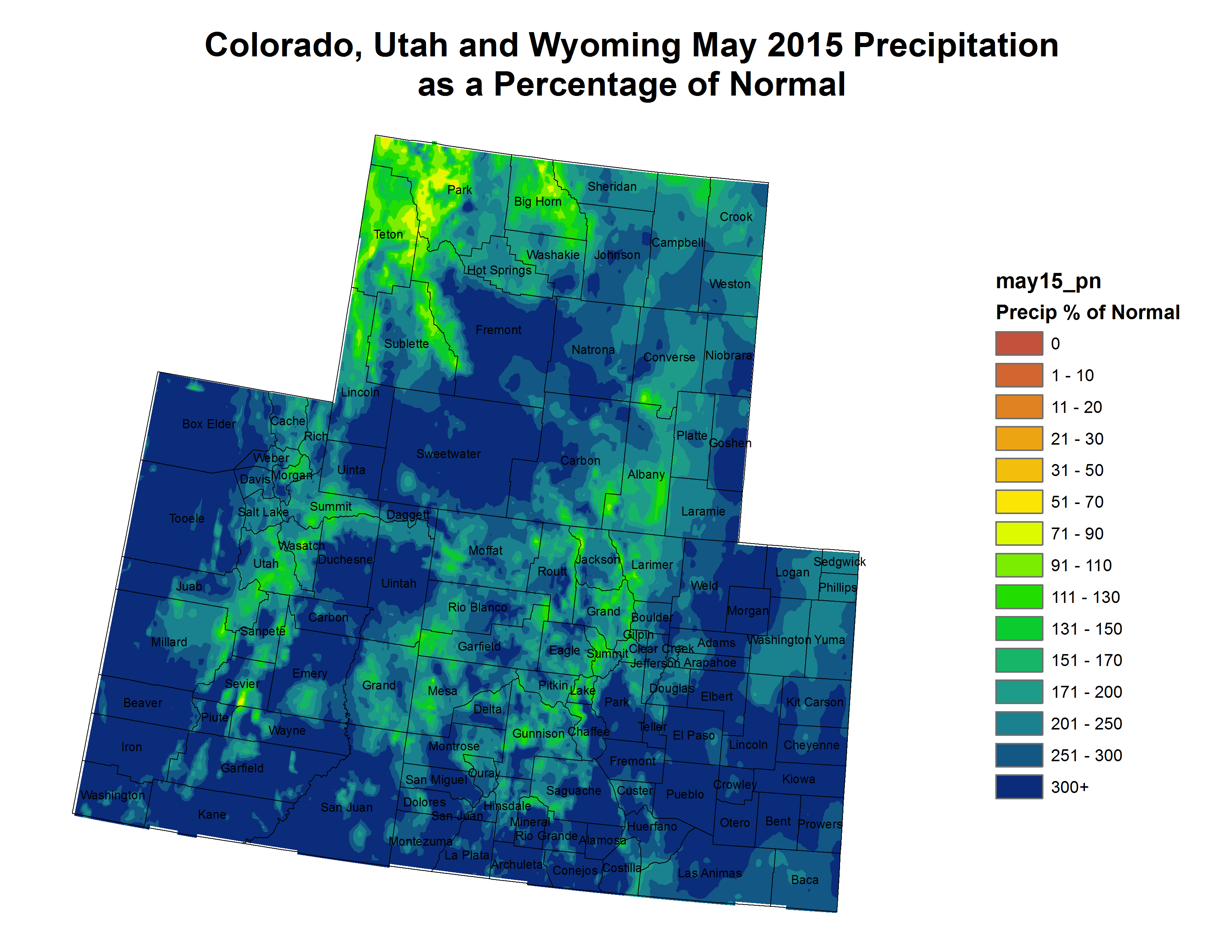
Upper Colorado River Basin May 2015 precipitation as a percent of normal

From The Los Angeles Times (Rong-Gong Lin and Rosanna Xia):

For drought watchers, it has become known as the May miracle.

At a time when water levels in Lake Mead were getting so low that officials prepared for drastic cutbacks, it started raining. A series of powerful storms pummeled the mountains that feed the Colorado River, a key source of water for California, Arizona and Nevada.

Water from the rain and snow flowed down the river and into reservoirs that are essential to modern life in the American West.

Lake Mead, where the water level this spring had fallen to lows not seen since Hoover Dam was built in the 1930s, began filling up again — enough to avoid the first cutbacks ever imposed in water deliveries, which the public had been warned could happen next year.

“It’s taken us out of that potential red zone for this year. There is a 0% chance of a shortage” for next year, said Jeffrey Kightlinger, the Metropolitan Water District of Southern California’s general manager. “That really good May offers us some breathing room.”

Bill Hasencamp, the MWD’s Colorado River program manager, was more blunt: “We dodged that bullet.”

Had it not been for those storms, Southern California could have faced 30% to 40% reductions in imported water, Kightlinger said.

That’s because Nevada and Arizona wouldn’t have been as willing to lend California their unused river water if a shortage affects them.

Southern California is already draining its largest reservoir, Diamond Valley Lake, to keep faucets flowing in Los Angeles. Without more loans of river water, Diamond Valley Lake could have been drained down to its emergency reserve by the end of the year…

The May miracle was so stunning that some officials could not believe how much water was flowing into Lake Powell, the reservoir upstream from Lake Mead…

The storms came as the jet stream — a powerful flow of winds that moves from west to east — bypassed much of California and slid into the Great Basin over Nevada and Utah. It then transformed into spinning vortexes of energy, known as a cutoff low, Colorado state climatologist Nolan Doesken said.

Beginning in late April, the vortexes were supercharged by subtropical moisture off Mexico’s coasts, Doesken said…

The result? Six powerful storms moving slowly across the southern and central Rocky Mountains and dumping rain that was unprecedented in the modern historical record.

“By the end of May, it was like, ‘Whoa! What did just happen?’ ” Doesken said…

But the storms don’t resolve the long-term problems that California, Nevada and Arizona face in their water supply from the Colorado River.

For decades, Lake Mead’s water reserves, even in previous droughts, had remained generally stable because of low demand.

It wasn’t until 2000 that demand for river water soared just as a 15-year drought along the Colorado River basin began, Hasencamp said. Since then, we have been taking water out of the bank.

“Unfortunately, that’s the reality of the Colorado River: There is a long-term imbalance that we can’t continue to operate in the future as we have in the past,” Hasencamp said…

A shortage at Lake Mead could force further draining of Lake Powell, which could eventually affect the water supply in Colorado, Utah, Wyoming and New Mexico, which must share river water with states further downstream, said James Eklund, who works to protect Colorado’s interests on the Colorado River…

A shortage could create a catastrophic domino effect. If Lake Powell is drained too much, water won’t be able to get into the pipes that power turbines that generate electricity at Glen Canyon Dam. That could raise electricity prices, Eklund said.

“It’s kind of the — hang together, or we all hang separately — deal,” Eklund said.

Flooded confluence of Cherry Creek and the South Platte River June 2015 photo via Andy Cross, Getty Images and The Denver Post

El Niño ends dry run in Southwest Colorado — The Durango Herald

From The Durango Herald (Mary Shinn):

Higher-than-average precipitation in the region could continue into the winter if El Niño patterns persist, said Jim Pringle, meteorologist with the National Weather Service in Grand Junction.

“It looks highly likely La Plata County should stay out of any drought classification,” Pringle said.

Browns Canyon Dedicated as a National Monument — KRCC.org

From KRCC.org (Andrea Chalfin):

The nearly 22,000-acres of public land that stretches from Buena Vista to Salida in Chaffee County along the Arkansas River is well known for its recreation and wildlife…

Comments during the nearly 90-minute ceremony centered on thanking those involved for cooperation and dedication during the decade-plus long process, everyone from local residents to government officials, past and present.

It’s a sentiment that strikes a chord with Tom Tidwell, Chief of the U.S. Forest Service.

“The significance of this is an example of what can be done when communities come together and deal with differences, address each other’s concerns, but do it in a way where they really value those differences,” says Tidwell…

“It’s a great form of rural economic development, to get more tourists to come into the state,” says Hickenlooper. “They come into Denver or Colorado Springs or Fort Collins, they’ll spend a couple of days there, and then they’ll go off and come to these amazing places. And having Browns Canyon be a National Monument, I think will significantly increase tourism, the number of people coming through Colorado Springs.”

National Monuments can be created by an act of Congress, but legislation there stalled. President Barack Obama used the Antiquities Act to designate the land as a National Monument earlier this year.

It’s a move criticized by some, including Republican Representative Doug Lamborn, whose district includes Chaffee County. Lamborn issued a statement Friday, calling the designation an abuse of executive power and a land grab.

But U.S. Interior Secretary Sally Jewell dismisses those concerns, and in her prepared remarks during the dedication ceremony, she called the country’s public lands a gift.

“And as we grow and we urbanize and we diversify as a nation, and we get more and more disconnected from the outdoors and nature, it is more important today to protect these special places than ever before,” said Jewell.

Management of the area will remain with the U.S. Forest Service, Bureau of Land Management, and Colorado Parks and Wildlife. Historic uses, including cattle grazing, hunting, and fishing will continue, and a management plan to come will include input from the local and state levels, as well as tribal concerns.

More Arkansas River Basin coverage here.

Aspinall Unit operations update: Current inflow forecast for Blue Mesa = 105% of avg

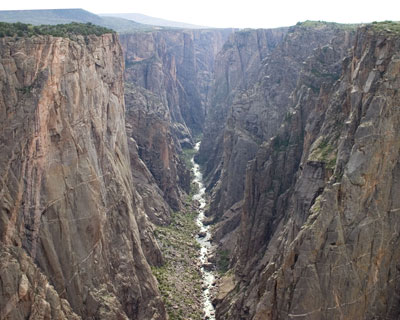
Black Canyon via the National Park Service

From email from Reclamation (Erik Knight):

Releases from Crystal Dam will be decreased from 3000 cfs to 2000 cfs, over the next 3 days. Releases will be decreased by 400 cfs on Wednesday, July 22nd, by 350 cfs on Thursday, July 23rd, and by 250 cfs on Friday, July 24th. This reduction is in response to the declining inflows to Blue Mesa Reservoir which have allowed the reservoir elevation to drop to 2 feet below the maximum water surface elevation. The current forecast for April-July unregulated inflow to Blue Mesa Reservoir is 710,000 acre-feet which is 105% of average.

Flows in the lower Gunnison River are currently above the baseflow target of 1500 cfs. River flows are expected to stay above the baseflow target for the foreseeable future.

Pursuant to the Aspinall Unit Operations Record of Decision (ROD), the baseflow target in the lower Gunnison River, as measured at the Whitewater gage, is 1500 cfs for July and 1050 cfs for August.

Currently, diversions into the Gunnison Tunnel are around 1050 cfs and flows in the Gunnison River through the Black Canyon are 2000 cfs. After this release change Gunnison Tunnel diversions will be around 1050 cfs and flows in the Gunnison River through the Black Canyon should be around 1000 cfs. Current flow information is obtained from provisional data that may undergo revision subsequent to review.

More Aspinall Unit coverage here.

“There is not consistent political leadership in Colorado Springs” — Jay Winner

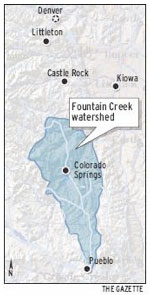
Fountain Creek Watershed

From The Pueblo Chieftain (Chris Woodka):

In order to ensure stormwater control in Colorado Springs in the future, Colorado Springs Utilities needs to take over the job, or the city will face further legal action over the issue.

“Everything’s in place to do this,” said Jay Winner, general manager of the Lower Arkansas Valley Water Conservancy District. “If this were an enterprise of Utilities, the work would be brought up to speed immediately.” Utilities controls water, sewer, gas and electricity in Colorado Springs.

Winner is suggesting adding stormwater as a fifth utility. The idea has been discussed, but has not had a champion until now.

Attorneys for the Lower Ark are wrapping up the final draft for a federal district court complaint over alleged violations of the Clean Water Act by Colorado Springs. The lawsuit has been contemplated for two years, based on Colorado Springs’ inability to find a permanent stormwater funding source. A filing is expected within 60 days.

Making stormwater a fixture within Utilities might be a way of avoiding the lawsuit, Winner said.
Colorado Springs Mayor John Suthers and City Council President Merv Bennett on July 6 gave assurances to Pueblo City Council that the city would find ways to fund $18 million in stormwater control activities annually from its general fund.

Winner, who attended that meeting, was not convinced.

“They’re constantly telling us how they are doing these wonderful things,” Winner said. “But their political leaders can be recalled or choose not to run again. There is not consistent political leadership in Colorado Springs. One of the things Utilities is good at is leadership.”

Bennett also has made appeals to the Lower Ark board to hold off on the lawsuit while Colorado Springs gets its house in order. But Winner said there are no actions to back up the rhetoric.

“Merv Bennett turned it over to Colorado Springs staff. I’ve had no meaningful conversations with them in the last six months,” Winner said.

Colorado Springs voters last November turned down a regional stormwater fee concept that sprung from two years of political meetings in El Paso County.

Colorado Springs City Council eliminated its stormwater fee following a 2009 vote on a proposal launched by Doug Bruce, a tax activist who became an El Paso County commissioner and state lawmaker before he was convicted for tax evasion.

Funds totaling about $29.6 million for six Colorado Springs enterprises, and transfers from Utilities to the general fund, were to be phased out over eight years under Issue 300 on the 2009 Colorado Springs ballot. Before the election, council members had talked about making about $3.7 million in cuts annually until the total was reached. After the election, council has opted only to eliminate the stormwater enterprise, which would have generated about $15.4 million in 2010.

“Springs City Council made the wrong decision,” Winner said. “If there’s one thing that Utilities knows how to do, it’s make good decisions.

They would not have made that decision to eliminate the stormwater enterprise.”

Council in August 2010 made the determination that Colorado Springs could keep “surplus payments” from Utilities without violating Issue 300. Those payments have totaled more than $30 million annually since that time, according to a 2014 bond rating statement filed by Utilities.

“Seems like there would already be some funding available for stormwater,” Winner said. “Plus, Utilities has the engineering, equipment and experience to do the sorts of projects that need to be done.”

While council oversees Utilities, future members would be less likely to arbitrarily end stormwater funding, any more than they would remove water, sewer, gas or electric service, he added.

More Fountain Creek coverage here and here.

Weekly Climate, Water and #Drought Assessment of the Upper #ColoradoRiver Basin

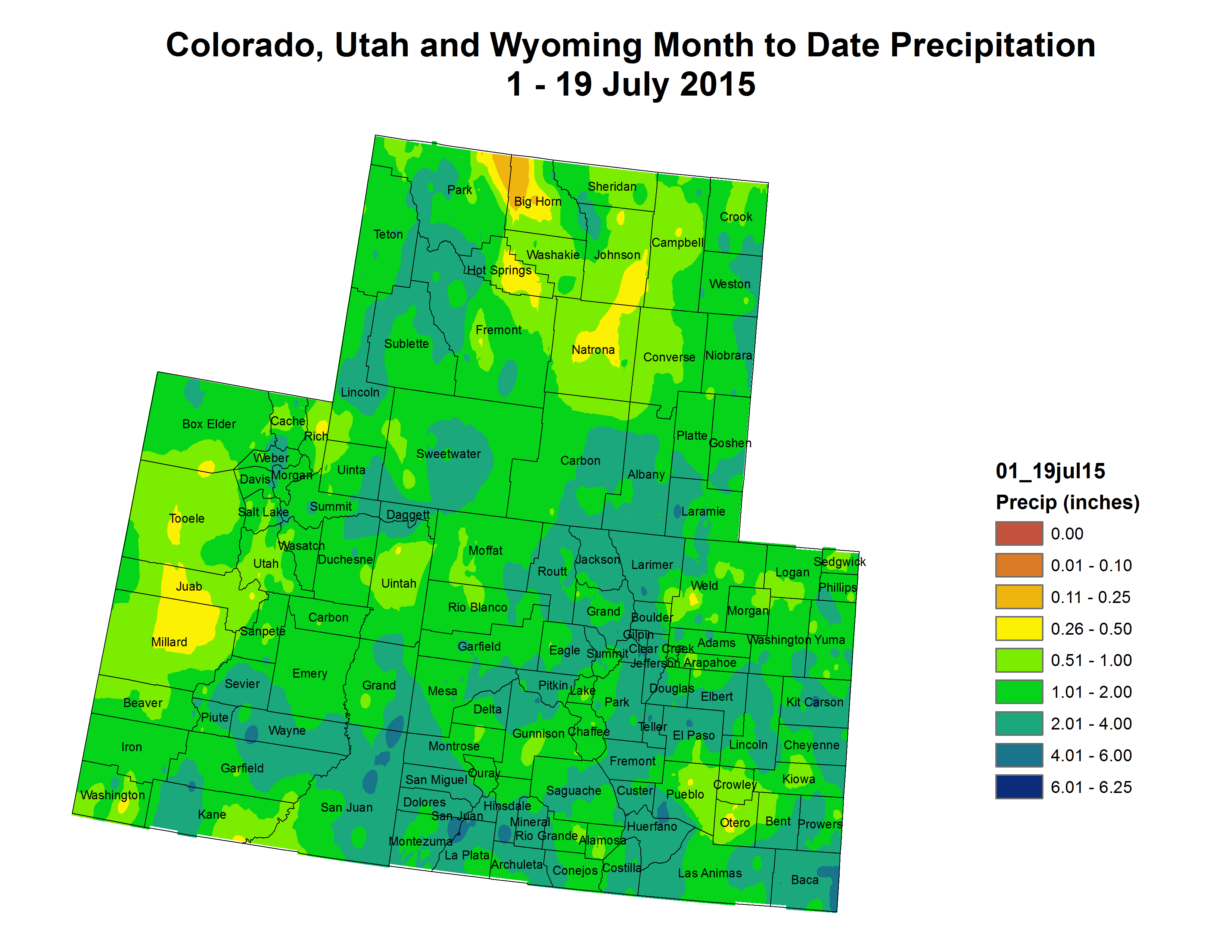
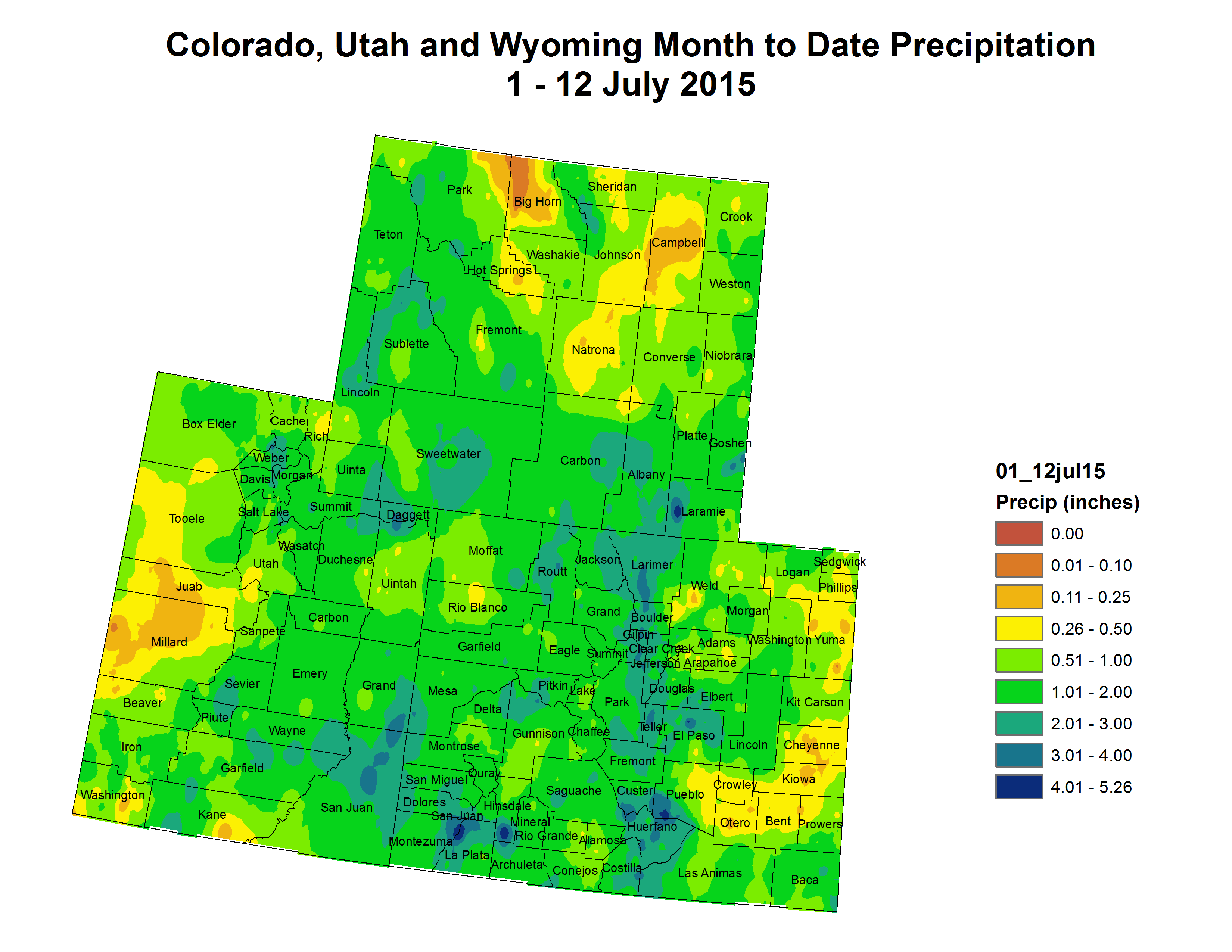
Upper Colorado River Basin month to date precipitation July 1 through July 19, 2015

Click here to read the current assessment. Click here to to the NIDIS website hosted by the Colorado Climate Center.

More Colorado River Basin coverage here.

A Citizen’s Perspective on Her Water Utility

CWCB: What’s new in #COWaterPlan – July 2015? (webinar) for your listening pleasure

More Colorado Water Plan coverage here.

CPC: Outlook through October 31 for Colorado — cool and wet

3-Month precipitation outlook through October 31, 2015 via the Climate Prediction Center
3-Month Temperature Outlook through October 31, 2015 via the Climate Prediction Center

From the Cortez Journal (Jim Mimiaga) via The Durango Herald:

“It’s one of our better monsoons we have seen in awhile, and is producing deep moisture, often for three or four days in a row,” said meteorologist Chris Cuoco, of the National Weather Service…

“You can see the plume of moisture on satellite, drawing moisture from the eastern Pacific, then delivering thunderstorms along western Mexico and into the western U.S.,” Cuoco said.

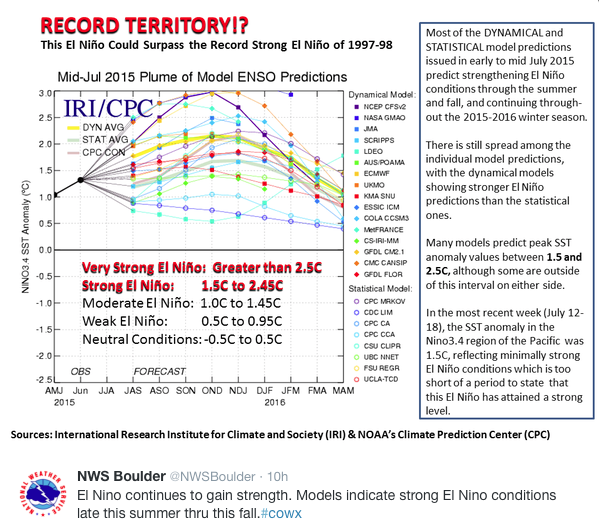
Also, El Niño, – characterized by warming of the eastern equatorial Pacific Ocean – is in effect, which can also bring moisture to western Colorado.

Cuoco rates this El Niño as “strongly warmer,” with surface temperatures rising 3 degrees Celsius.

“It’s sizing up to compare with the strong El Niño in 1997 and 1998 that brought record moisture to the western U.S.,” he said.

El Niño doesn’t guarantee moisture for Southwest Colorado, but it can increase its chances.

“Because the El Niño is matching up with the monsoon, it signals higher than normal precipitation,” Cuoco said.

In 1998, a strong El Niño year, Cortez saw above-average precipitation, said Cortez weather observer Jim Andrus…

…2015 has been a good year for Durango, which officially measures precipitation and temperatures at the Durango-La Plata County Airport. May saw rainfall of 222 percent above average with 3.02 inches of rain, and June was 102 percent above average with 1.66 inches. July, as of Monday, had received 1.62 inches of rain, or 80 percent of the monthly average, with 12 days to go.

The National Oceanic Atmospheric Administration also forecasts the Four Corners will be wetter than average from July through September. According to the U.S. Drought Monitor, Southwest Colorado went from severe to moderate drought in April to the current no-drought status, based on total precipitation for 2015.

Colorado’s water plan faces choppy waters — The Durango Herald #COWaterPlan

Evening, running through choppy waters image by James Gale Tyler -- Wikimedia
Evening, running through choppy waters image by James Gale Tyler — Wikimedia

From The Durango Herald (Peter Marcus):

…some wonder if rural Colorado is over-accommodating metro areas with the plan. State water officials – with input from eight regional water basins – outlined an estimated $20 billion in projects related to a municipal water-supply gap, which is growing largely because of Front Range expansion.

A second draft of Colorado’s Water Plan was made available to the public earlier this month. State lawmakers and water officials held a legislative meeting in Durango on Monday evening to present the plan and allow for input.

“We know the state is not going to be able to handle the burden, so we’re going to need to think outside the box,” said James Eklund, director of the Colorado Water Conservation Board.

In a change from the plan’s first draft, the second draft includes an elaborate “critical action plan,” which includes proposals for legislation and Colorado Water Conservation Board policy.

The plan focuses heavily on funding, proposing ideas that run the gamut, including a possible ballot initiative that would ask voters to approve a fee on beverage containers. Voters have rejected past tax hikes for water issues.

Other ideas include creating a tax credit for homeowners who install efficient outdoor landscapes and irrigation, and exploring public-private partnerships to implement projects…

“Colorado can no longer be all things to all people,” commented Dick Ray, representing the Archuleta County Farm Bureau.

Sen. Ellen Roberts, R-Durango, pointed out that state officials must delicately balance population-dense Colorado with agricultural areas.

“We hear the desire to limit the number of people coming into the state of Colorado, but I don’t know how you do that,” Roberts said. “I don’t know how you close the door.”

More Colorado Water Plan coverage here.

Pro-Con: The Northern Integrated Supply Project — The Fort Collins Coloradoan

Northern Integrated Supply Project preferred alternative

From the Fort Collins Coloradoan:

Michael D. DiTullio is general manager of Northern Colorado Water Conservancy District, a proponent of the Northern Integrated Supply Project. Mark Easter, an opponent, is the board chair for Save the Poudre: Poudre Waterkeeper. Here’s what they had to say about the proposal to build two reservoirs that would add 40,000 acre feet of water to the Front Range’s inventory.

Question: Recently released is the Army Corps of Engineers’ nearly 1500-page supplemental draft environmental impact statement for proposed NISP. What do you want community members to know?

DiTullio: The biggest takeaway is that the SDEIS reveals the impacts of the project are minor and can be successfully mitigated. The participants are committed to making sure this project is built in an environmentally responsible manner. For instance, the low-flow augmentation release will increase the flows in the river at the times it is most needed, which is generally through the summer. By building bypass structures at four diversion dams through Fort Collins the project will allow those minimum flows to move downstream and also allow fish passage back upstream. Both of which do not occur today.

Easter: In nearly every aspect, NISP/Glade Reservoir is as bad, or worse than was previously proposed. The SDEIS reveals that NISP/Glade has not fundamentally changed — it would further drain and destroy the Cache la Poudre River, stripping the heart of the June Rise and diverting a huge chunk of the river at the canyon mouth. The Poudre will not survive if NISP/Glade is built. The Poudre would become a silted up, stinking ditch through Fort Collins.

Q: There’s debate about whether Glade Reservoir, if built, would reduce flows in the Poudre River.

DiTullio: This issue has been studied extensively for the past six years, and the results show there will be a small reduction during the spring rise but only when the snow pack is above normal. The biggest take to the river is that the project will provide more water when it is needed most, when the river is at its lowest level. This will provide for a live stream through Fort Collins year-round and to maintain a trout fishery in downtown Fort Collins. No other group or entity have done anything close to cleaning up the river that this project will.

Easter: The Water Resources Technical Report, published with the SDEIS, shows the stark truth — flows below the canyon mouth would be hurt in almost all years. May, June and July flows — the peak flows so critically important to healthy Front Range rivers — would be cut the most, nearly 15 billion gallons in wet years, 3.8 billion gallons in dry years and 6.1 billion gallons on average at the Lincoln Street Bridge.

Q: A lot of people talk about Glade Reservoir and damming the Poudre River as one in the same. Is that correct?

DiTullio: The Glade Reservoir is not a dam on the main stem of the Poudre River. The reservoir is located off stream, making NISP more environmentally friendly. The reservoir will create a new flat water fishery and recreational area that will benefit the citizens of Northern Colorado.

Easter: No matter where you put the reservoir, the result would be the same. The last free-flowing, unallocated water left in the Poudre would be diverted at the canyon mouth, along with an additional 20,000 acre feet per year (6.5 billion gallons) of water typically diverted by farmers downstream. The river downstream suffers identical fates when that water is diverted, regardless of where the water is stored.

Q: With this project, there is so much information to digest. What are falsities you’d like to address?

DiTullio: There are two major misconceptions that are advanced by the opponents to NISP: No. 1. That the project will dam the Poudre River, and No. 2. is the project will cause the Poudre to dry up. The Glade Reservoir will be located in a dry valley north of Ted’s Place and will have minimal impact on the area. Although the project will take water from the river during the spring runoff, it will not cause the Poudre to run dry. To the contrary, it will in fact add water back to the Poudre, 3600 acre feet annually at critical times to enhance the environment and the fisheries. Further, in response to the concerns of Fort Collins, the NISP participants have agreed not to divert water into Glade if the minimum streamflow’s are not being met.

Easter: The proponents absurdly claim a winter flow “augmentation” plan would leave the river better than before. They refuse to acknowledge the devastating impact of stripping the peak flows off the river. The proponents have some of the highest per-capita water use rates in the region, yet they claim further water conservation is impractical. And, they turn a blind eye to the fact that NISP would harm agriculture at least as much or worse than if no project were built.

Q: It could be years until the final EIS is released and further public comment collected, not to mention the possibility of a group challenging the decision in a court of law. Will Glade Reservoir come to fruition? How many years from now?

DiTullio: We don’t think it will take years. The project is needed now and should be built as soon as possible. The Army Corps on their website states they will release a final EIS next year. When the record of decision is released in 2017 we believe the project will move forward at that time. Obviously, any one or group has the right to challenge the Army Corps if they so choose to do so. One of the reasons that the Corps moved forward with a SDEIS was to have certainty that whatever decision they make is defensible in court.

Easter: It could take the Corps at least three more years to permit or deny the project. If permitted, both EPA and the Colorado Water Quality Control Division have to sign off, taking years more. The Corps faces lawsuits, court battles, and legal action from any proponent or opponent who doesn’t get what they want. Expect at least a decade before a resolution or the project dies of its own weight. We will oppose the project as long as it takes.

Q: What, if any, are alternatives to NISP?

DiTullio: There are no reasonable alternatives. This is well documented in the SDEIS documents. The “no action alternative” is to significantly increase the purchase of water that is used by agriculture which would lead to dry up of existing farmland. Many of the participants rent irrigation water to the ag community and value what they do to enhance the quality of live here in Northern Colorado. Conservation alone will not solve the water issues for Northern Colorado. The opposition champions a scheme that simply is not realistic and will not work.

Easter: The Corps touts the project proponent’s straw man “no action alternative,” an unrealistic and ironic “alternative” that is really no such thing. The Corps and NISP/Glade proponents refuse to accept that new water diversions are a thing of the past, and that conservation, efficiency and partnerships with agriculture must be embraced to keep our rivers alive. The fate of the Cache la Poudre — our home river — depends on collaboration and innovative thinking.

Q: How do we address water in Fort Collins, while also looking at the state’s water future as a whole?

DiTullio: The City of Fort Collins has done a good job of taking care of its citizen’s water needs. They were able to secure senior river water rights on the Poudre before many of the participants existed. However, not all of the citizens of Northern Colorado reside in Fort Collins. The water right for the NISP is junior to those of Fort Collins and the city will not be harmed by the project. The participants have an obligation to their citizens to provide a water supply for the future. It is ironic that my district, the Fort Collins-Loveland Water District, currently serves approximately 32,000 residents within the City of Fort Collins.

NISP is only part of how we address the future water needs of Northern Colorado. The water community and this includes the City of Fort Collins must come together in harmony to collectively manage the water resources that we have. None of us can do it alone or should we. We are all citizens of this planet and we all have the right to choose where we live with our families and this includes Northern Colorado.

Easter: The Fort Collins water utility is not a NISP/Glade participant. Fortunately, our water utility “gets it.” City staff appears to understand the critical importance of innovation in keeping our home river healthy and vibrant while it meets our water needs. In contrast, Northern Water and the NISP/Glade proponents rely on 19th Century solutions to solve 21st Century problems. It is time to embrace the future.

Want to weigh in?

•There is an open house at 5 p.m. Wednesday and a 6 p.m. hearing thereafter at the Hilton Fort Collins, 425 W. Prospect Road. Attendees may share their perspectives during a public comment period.

•Those who can’t attend may submit comments in writing to:

John Urbanic, NISP EIS Project Manager

U.S. Army Corps of Engineers, Omaha District

Denver Regulatory Office

9307 S. Wadsworth Blvd.

A look back at Fountain Creek flooding

Fountain Creek
Fountain Creek

Here’s a report from Chris Woodka writing for The Pueblo Chieftain (Click through for the photo gallery):

On June 16, nearly 50 years to the date from its biggest wallop, Fountain Creek jarred Pueblo’s collective memory of just how destructive it can be.

The flood of 1965, which built in intensity from June 14-17, was the largest recorded storm event on Fountain Creek, although it ranks second to the 1921 Arkansas River flood in terms of the destruction it caused. While the response to the Arkansas River flood was almost immediate — levees and a barrier dam were complete within five years — relief for Fountain Creek languished for 24 years, until an $8.6 million levee system was completed in 1989. Even then, it was a half-measure. The U.S. Army Corps of Engineers in 1970 said the best protection from Fountain Creek for Pueblo would be a dam.

But then, Fountain Creek returned to its typical state — a meandering trickle in a sandy bed, largely hidden from view by a forest of vegetation. The city of Pueblo slowly removed development from the major flood plain. There were occasional alerts, but Fountain Creek behaved and stayed within its banks.

Until 1999, when a moderate flood nearly took out Pueblo’s Target store and conversations began about how much worse large-scale development in Colorado Springs would make the next flood on Fountain Creek.

Part of the answer to that question arrived this year, when six weeks of wet weather softened the banks and the river — after all, that’s what it became — punch through places it shouldn’t have. Things happen slowly on Fountain Creek, and the call for a dam hasn’t washed away.

Widespread, dangerous

Many Puebloans still remember driving over to Fountain Creek to view the roaring water 50 years ago. The Pueblo Chieftain reported that thousands flocked to high ground east of the “Fountain River” to view the flood. Pueblo police reported traffic problems, but were more concerned about people who did not realize they were in danger zones.

Precipitation was widespread, with heavy rainfall of up to 16 inches over the four days in both the South Platte and Arkansas River basins. No place in the eastern half of the state escaped. Pueblo, Lamar and Trinidad were all in the path of the storms. Up north, Denver, Greeley and Sterling all felt the effects of torrential rains.

Danger accompanied the drama, with 21 deaths statewide attributed to the 1965 floods, most by drowning.
Three who died were from Pueblo, including James Oznowitz, 22, a recent graduate of then-Southern Colorado State College and intern for The Chieftain, whose sports car plunged into Plum Creek between Monument and Castle Rock; Ralph Cooper, 40, whose truck was swept into Plum Creek as well; and Robert V. Reutter, 15, who was electrocuted while he helped clean a flooded feed yard on South La Crosse Avenue a few days after the flood.

Statewide, more than 2,500 homes were destroyed and 250,000 acres of farmland were inundated. The total damage was estimated to be more than $500 million.

Tension remains

Controversy on Fountain Creek, particularly the tension between Pueblo and El Paso counties, never really went away.

A plan to build a dam north of Pueblo failed in the early 1970s because of a lack of funding. The idea was never supported by Colorado Springs, whose officials said there could never be enough water to fill a recreational pool that was part of the benefits package.

Part of the planning for the dam included a commitment by the city of Pueblo to the Army Corps of Engineers to maintain the channel, first negotiated less than a month after the flood in exchange for levee repairs, renewed in 1969 when promise for a dam remained alive and continued forward when new levees were completed in 1989.

A water quality controversy began in the late 1970s and continues to this day. Repeated spills into Fountain Creek from Colorado Springs Utilities sewage treatment plants from 19992005 resulted in state penalties, remedial action and federal lawsuits. Steps to assure water quality were written into the federal contract for the Southern Delivery System in 2010, based on the environmental impact study.

Colorado Springs committed to spending $75 million to fortify its wastewater treatment system to prevent Fountain Creek spills in its 2009 1041 permit for SDS with Pueblo County.

The levee system on Fountain Creek took nearly the entire decade of the 1980s to complete. After it became clear that a dam would not be funded, the levees became Pueblo’s main push for congressional funding. Finally, in 1988 funding was approved.

Not ‘flood proof’

Local officials deemed Pueblo “flood proof” at the 1989 dedication, but by 2006, sedimentation from Fountain Creek flows that had increased fourfold since the 1960s threatened the effectiveness of the levees.

Subsequently, Colorado Springs agreed to dredge the Fountain Creek channel in Pueblo as part of its 1041 commitments for SDS, but later paid Pueblo County $2.2 million instead, at the request of the city of Pueblo, which sought the funds at the time to remove an obstructive railroad bridge.

Politically, the 1999 flood on Fountain Creek brought El Paso, Pueblo and Teller counties together to fix problems on Fountain Creek. Technical meetings continued through 2005, when most of the public officials who created the effort were not fully engaged.

That effort led to the Army Corps’ Fountain Creek Watershed Plan, which set priorities for projects on Fountain Creek. A dam got low scores, in favor of wetlands and bank stabilization projects, many of which proved ineffective in the 2015 flooding.

After a year of tension, the Fountain Creek Vision Task Force was formed in 2006, with Pueblo and El Paso county and municipal officials, along with private landowners.

At the same time, the Lower Arkansas Valley Water Conservancy District and Colorado Springs collaborated on creating a Fountain Creek Corridor Master Plan, which recommended smaller detentions up and down Fountain Creek.

In 2007, then-U.S. Sen. Ken Salazar, D-Colo., introduced the Fountain Creek Crown Jewel Project, which culminated in the introduction of legislation that would include multipurpose dams on Fountain Creek. The legislation failed to advance.

Finally, in 2009, the Colorado Legislature created the Fountain Creek Watershed Flood Control and Greenway District to fix Fountain Creek. The district is now studying how to protect downstream water rights if a dam or flood detention ponds are built. The district delayed its deliberations on developing property tax funding until El Paso County was able to have a vote on regional stormwater funding in 2014. The vote failed.

Subsequently, Colorado Springs officials have tried to assure Pueblo funding for stormwater control will be secured annually, even though its city council eliminated a stormwater fee in 2009.

The only source of major funding for flood control on the horizon is $50 million paid to the Fountain Creek district over five years once SDS begins delivering water in 2016. The district hopes to use that to leverage other money, but still must complete studies on the best method and location for dams, as well as deal with water rights issues.

After the most recent round of damaging floods, Pueblo and El Paso counties are seeking federal relief to the tune of $15 million, most of that in El Paso County.

Sources for this story included Chieftain archives, U.S. Army Corps of Engineers reports and U.S. Geological Survey data.

WORST FLOODS

Here is a list of the most intense floods in Pueblo on Fountain Creek:

  • June 17, 1965: 53 city blocks were inundated with water up to 8 feet deep, damaging 370 homes and 59 businesses. Damage estimated at $3.7 million. Peak flow of the flood was estimated at 47,000 cubic feet per second.
  • June 11, 1864: Flow of 45,000 cfs. Waters rose 20-30 feet, sweeping away Colorado City.
  • May 30, 1894: Flow of 40,000 cfs. Five lives lost and $2 million in property damage.
  • May 30, 1935: Flow of 35,000 cfs. Damages in Colorado Springs were $1.8 million, and four people died. In Pueblo, damages were $500,000.
  • June 3-4, 1921: Fountain Creek’s flows were 34,000 cfs, adding to the worst flood in Pueblo history on the Arkansas River, where flows were 110,000 cfs. After the flood, 78 bodies were recovered. More than 500 homes and 100 commercial buildings were destroyed. Damage was more than $10 million.
  • April 30, 1999: Peak flow of 18,900 cfs. A highway bridge at Pinon was swept away by the waters. Pueblo’s Target store was threatened. Damages in Pueblo and El Paso County totaled more than $30 million. Extensive damage in North La Junta as well. By comparison, the most recent flood on Fountain Creek peaked at 13,800 cfs in Pueblo on June 16.

Note: Damage amounts listed at the time of floods, not adjusted for current values.


More Fountain Creek coverage here.

State plan takes on the challenges of water future — The Crested Butte News #COWaterPlan

Gunnison River Basin via the Colorado Geological Survey

From The Crested Butte News (Alissa Johnson):

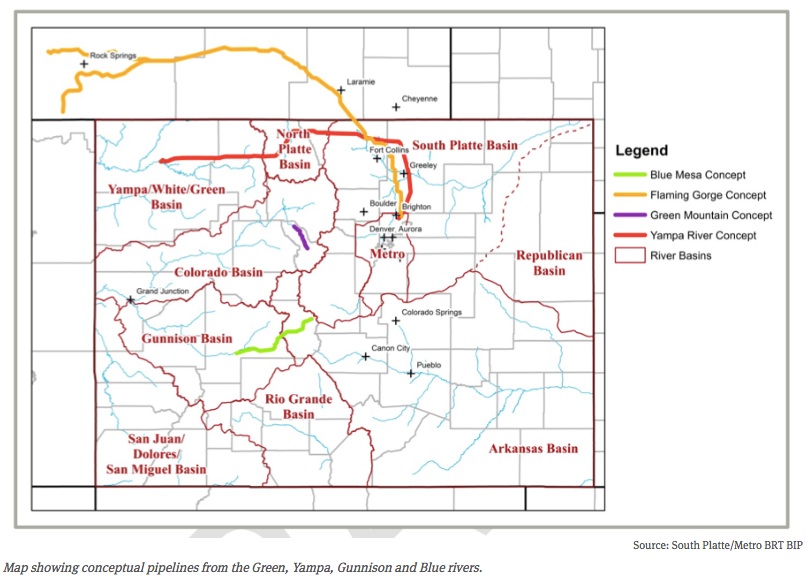
The plan has been getting a lot of attention for addressing potential transmountain water diversion projects that would carry water from the Western Slope to the Front Range, including the Gunnison River. But local water experts say that’s one small part of a comprehensive document.

“One thing that’s interesting is the amount of attention that transmountain diversion has gotten in the Colorado Water Plan. That’s really just a page or two out of about 500 pages, but it has gotten more attention than the rest of the document combined,” said Frank Kugel, general manager for the Upper Gunnison River Water Conservancy District.

In fact, the plan doesn’t address specific project proposals for transmountain diversion. It provides a conceptual framework to guide the consideration of any future proposals—what Kugel calls sideboards for future discussions—including protection for local communities.

“There will be strict principles applied to any future transmountain diversion projects. The diverter has to accept the risk of that project and understand that if there is no water available, they are the first ones to be shut off,” Kugel said.

The full plan considers many other aspects of water management. As Kugel explained, “We’re facing the risk of having twice as many people [in Colorado] by the year 2050 and some 10 to 15 percent less water supply due to climate change. Those two paths are going in opposite directions, so we need to figure out how to serve more people with less.”

To do that, all nine of Colorado’s Water Basin Roundtables, the Interbasin Compact Committee (IBCC) and the Colorado Water Conservation Board have been providing input to the plan.

As the Water Plan website states, “The 27 members of the IBCC, representing every water basin and water interest in Colorado, have agreed that unless action is taken, we will face an undesirable future for Colorado with unacceptable consequences.”

The process has attracted a lot of attention from the public. Julie Nania, water director for High Country Conservation Advocates (HCCA), says that more than 24,000 public comments were submitted on the first draft of the plan.

“As a plan itself it’s important, but it also facilitates a conversation, taking a closer look at the difficult water issues in Colorado… and how to move forward and protect natural resources while ensuring that communities have the water they need to thrive,” Nania said.

After an initial review of the second draft, Nania is encouraged by the progress that has been made: there are strong urban conservation goals; emphasis has been placed on the importance of healthy rivers, watersheds and watershed planning (including a recognition of the $2 billion to $3 billion needed to keep them healthy); and stringent principles have been developed to vet any future transmountain diversions projects.

“Two things HCCA will look at as we move forward are funding… and more robust criteria for projects before the state decides to fund them,” Nania said. While the plan acknowledges the cost of maintaining healthy rivers and watersheds, there is no funding mechanism identified for other types of projects.

“And we would always like to see stronger language against new transmountain diversions,” Nania continued.

Dolores River watershed

From The Durango Herald (Peter Marcus) via the Cortez Journal:

The July 2 release of the plan marks a critical juncture for Colorado’s Water Plan, which has been hailed by Gov. John Hickenlooper as one of the most important pieces of policy facing the state. The draft was actually released about two weeks early…

Local and state water officials will hold a meeting July 20 at the Holiday Inn & Suites in Durango, where state Sen. Ellen Roberts, R-Durango; James Eklund, director of the Water Conservation Board; and Mike Preston, chairman of the Southwest Basin Roundtable, are expected to give an overview.

Preston said the plan represents an opportunity to frame the future of water in Southwest Colorado and throughout the state for the next 50 years…

Policymakers must balance the interests of rural Colorado – where water is precious for agricultural needs – with the needs of the rapidly expanding Front Range and suburban communities. One sticking point could be transmountain water diversions for Front Range communities. Front Range plans call for more transmountain water, but Preston questions the viability of such a strategy.

Officials must also preserve the state’s “prior appropriation” system, in which rights are granted to the first person to take water from an aquifer or river, despite residential proximity. Water rights often dominate policy conversations.

The Southwest Basin is complicated, flowing through two Native American reservations and including a series of nine sub-basins, eight of which flow out of state. Complexities exist with agreements with the federal government, which owns large swaths of land in the region…

Preston said he has a team currently combing through the second draft of the plan to determine what changes occurred from the first draft. He was not immediately able to comment on any updates to the plan.

“We’ve got a lot of substance, really a 50-year strategy in the plan, and then a bunch of unresolved issues on a statewide level,” Preston said. “So, we’re really going to press for broader community education and engagement from here forward.

“This is a living document,” Preston said. “We’re pretty serious about what’s in it, both in terms of trying to develop our own supplies for the future and how we need to participate in the statewide exercise.”

More Colorado Water Plan coverage here.

International report confirms: 2014 was Earth’s warmest year on record — NOAA #climatechange

americanmeterorlogicalsocietystateofclimate2014cover

Here’s the release from NOAA:

In 2014, the most essential indicators of Earth’s changing climate continued to reflect trends of a warming planet, with several markers such as rising land and ocean temperature, sea levels and greenhouse gases ─ setting new records. These key findings and others can be found in the State of the Climate in 2014 report released online today by the American Meteorological Society (AMS).

The report, compiled by NOAA’s Center for Weather and Climate at the National Centers for Environmental Information is based on contributions from 413 scientists from 58 countries around the world (highlight, full report). It provides a detailed update on global climate indicators, notable weather events, and other data collected by environmental monitoring stations and instruments located on land, water, ice, and in space.

“This report represents data from around the globe, from hundreds of scientists and gives us a picture of what happened in 2014. The variety of indicators shows us how our climate is changing, not just in temperature but from the depths of the oceans to the outer atmosphere,” said Thomas R. Karl, L.H.D, Director, NOAA National Centers for Environmental Information.

The report’s climate indicators show patterns, changes and trends of the global climate system. Examples of the indicators include various types of greenhouse gases; temperatures throughout the atmosphere, ocean, and land; cloud cover; sea level; ocean salinity; sea ice extent; and snow cover. The indicators often reflect many thousands of measurements from multiple independent datasets.

“This is the 25th report in this important annual series, as well as the 20th report that has been produced for publication in BAMS,” said Keith Seitter, AMS Executive Director. “Over the years we have seen clearly the value of careful and consistent monitoring of our climate which allows us to document real changes occurring in the Earth’s climate system.”
Key highlights from the report include:

  • Greenhouse gases continued to climb: Major greenhouse gas concentrations, including carbon dioxide, methane and nitrous oxide, continued to rise during 2014, once again reaching historic high values. Atmospheric CO2 concentrations increased by 1.9 ppm in 2014, reaching a global average of 397.2 ppm for the year. This compares with a global average of 354.0 in 1990 when this report was first published just 25 years ago.
  • Record temperatures observed near the Earth’s surface: Four independent global datasets showed that 2014 was the warmest year on record. The warmth was widespread across land areas. Europe experienced its warmest year on record, with more than 20 countries exceeding their previous records. Africa had above-average temperatures across most of the continent throughout 2014, Australia saw its third warmest year on record, Mexico had its warmest year on record, and Argentina and Uruguay each had their second warmest year on record. Eastern North America was the only major region to experience below-average annual temperatures.
  • Tropical Pacific Ocean moves towards El Niño–Southern Oscillation conditions: The El Niño–Southern Oscillation was in a neutral state during 2014, although it was on the cool side of neutral at the beginning of the year and approached warm El Niño conditions by the end of the year. This pattern played a major role in several regional climate outcomes.
  • Sea surface temperatures were record high: The globally averaged sea surface temperature was the highest on record. The warmth was particularly notable in the North Pacific Ocean, where temperatures are in part likely driven by a transition of the Pacific decadal oscillation – a recurring pattern of ocean-atmosphere climate variability centered in the region.
  • Global upper ocean heat content was record high: Globally, upper ocean heat content reached a record high for the year, reflecting the continuing accumulation of thermal energy in the upper layer of the oceans. Oceans absorb over 90 percent of Earth’s excess heat from greenhouse gas forcing.
  • Global sea level was record high: Global average sea level rose to a record high in 2014. This keeps pace with the 3.2 ± 0.4 mm per year trend in sea level growth observed over the past two decades.
  • The Arctic continued to warm; sea ice extent remained low: The Arctic experienced its fourth warmest year since records began in the early 20th century. Arctic snow melt occurred 20–30 days earlier than the 1998–2010 average. On the North Slope of Alaska, record high temperatures at 20-meter depth were measured at four of five permafrost observatories. The Arctic minimum sea ice extent reached 1.94 million square miles on September 17, the sixth lowest since satellite observations began in 1979. The eight lowest minimum sea ice extents during this period have occurred in the last eight years.
  • The Antarctic showed highly variable temperature patterns; sea ice extent reached record high: Temperature patterns across the Antarctic showed strong seasonal and regional patterns of warmer-than-normal and cooler-than-normal conditions, resulting in near-average conditions for the year for the continent as a whole. The Antarctic maximum sea ice extent reached a record high of 7.78 million square miles on September 20. This is 220,000 square miles more than the previous record of 7.56 million square miles that occurred in 2013. This was the third consecutive year of record maximum sea ice extent.
  • Tropical cyclones above average overall: There were 91 tropical cyclones in 2014, well above the 1981–2010 average of 82 storms. The 22 named storms in the Eastern/Central Pacific were the most to occur in the basin since 1992. Similar to 2013, the North Atlantic season was quieter than most years of the last two decades with respect to the number of storms.
  • The State of the Climate in 2014 is the 25th edition in a peer-reviewed series published annually as a special supplement to the Bulletin of the American Meteorological Society. The journal makes the full report openly available online.

    State water board rules against Glenwood’s proposed whitewater rights — Aspen Journalism #ColoradoRiver

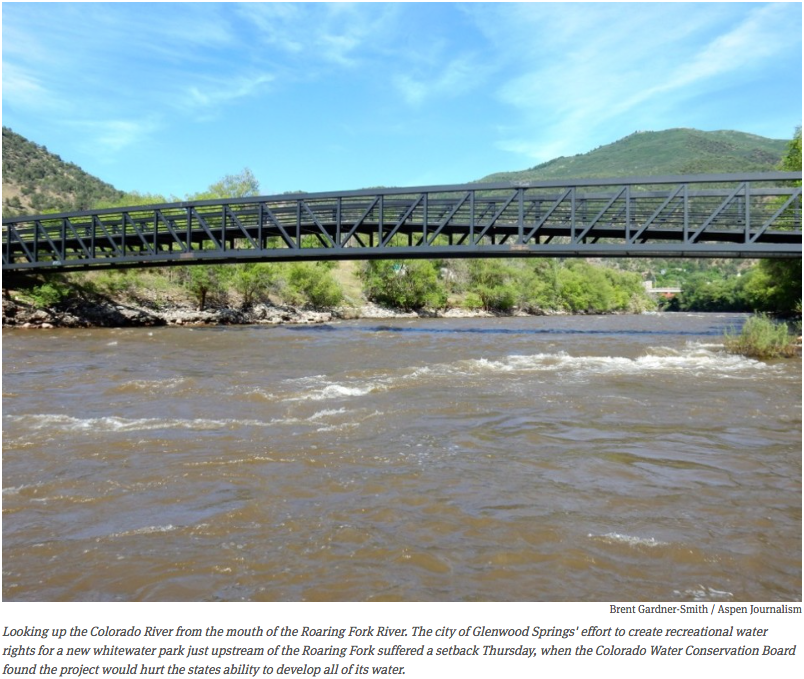
    Upstream view of the Colorado River at the mouth of the Roaring fork River
    Upstream view of the Colorado River at the mouth of the Roaring fork River

    From Aspen Journalism (Brent Gardner-Smith):

    IGNACIO — The ongoing effort by the city of Glenwood Springs to establish a new water right for three potential whitewater parks on the Colorado River was dealt a setback Thursday by the directors of the Colorado Water Conservation Board.

    The CWCB board voted 8-to-1 to adopt staff “findings of fact” that the proposed water rights for a “recreational in-channel diversion,” or RICD, would “impair Colorado’s ability to fully develop its compact entitlements” and would not promote “the maximum beneficial use of water” in the state.

    James Eklund, the director of the CWCB, and a nonvoting board member, was asked after the meeting what he would tell a kayaker in Glenwood about the board’s vote on Thursday.

    “These are complicated issues,” Eklund said. “The CWCB values recreational water projects and takes very seriously its charge to strike a balance among recreational, environmental and consumptive uses. The proponent’s data and analysis weren’t able to demonstrate that the RICD as proposed struck this balance to the satisfaction of the CWCB.”

    The CWCB board is required by state law to review all applications made in water courts for new recreational water rights, and to make a determination if the water right would prevent the state from developing all the water it legally can.

    Colorado’s “compact entitlements” stem from the 1922 Colorado River Compact, which requires seven Western states to share water from the larger Colorado River basin.

    The compact requires that an unspecified amount of water be divided between Colorado, Utah and Wyoming, and estimates of the amount of water Colorado can still develop under the compact range from zero to 400,000 acre-feet to 1.5 million acre-feet.

    Mark Hamilton, an attorney with Holland and Hart representing Glenwood, told the CWCB board members Thursday that there would be “no material impairment” to the state’s ability to develop new water supplies.

    “If the issue really is what’s the additional upstream development potential, we would point out that significant upstream development can still occur,” Hamilton said.

    Hamilton also said that the recreational water right would be non-consumptive, meaning the water would stay in the river and simply flow over u-shaped, wave-producing concrete forms embedded into the riverbed.

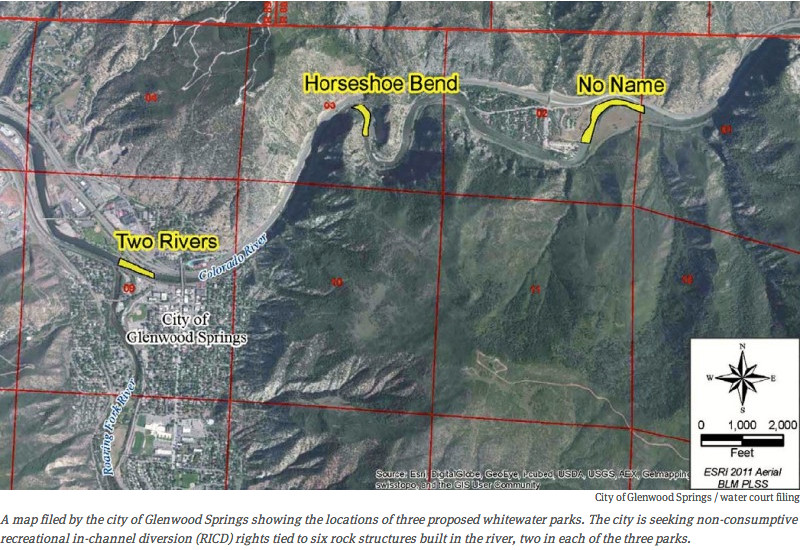
    Glenwood is seeking the right to call for 1,250 cubic feet per second of water to be delivered to three whitewater parks at No Name, Horseshoe Bend and Two Rivers Park, from April 1 to Sept. 30.

    It also wants the right to call for 2,500 cfs for up to 46 days between April 30 and July 23, and to call for 4,000 cfs on five consecutive days sometime between May 11 and July 6 in order to host a whitewater competition.

    Aurora and Colorado Springs, together as partners in the Homestake transmountain diversion project, are opposing Glenwood’s water rights application, which was filed in December 2013.

    “We do not oppose reasonable RICDs, but we believe this RICD claim is extraordinary by any measure,” Joseph Stibrich, the water resources policy manager for the city of Aurora, told the CWCB board, which was meeting in Ignacio on the Southern Ute Indian Reservation.

    “We believe that a water claim of over 581,000 acre feet will seriously impair full development of Colorado’s compact entitlement,” Stibrich said. “This claim will severely impact the state of Colorado’s ability to meet its future water needs.”

    Stibrich also said “this RICD is going to shift the burden of water supply development to meet the future needs of the state to the Yampa, to the Gunnison, and to the Rio Grande basins, while promoting further dry-up of irrigated lands throughout the state.”

    Denver Water is also opposing Glenwood’s water rights application.
    As part of the Colorado River Cooperative Agreement, Denver Water agreed not to oppose a RICD application from Glenwood, but only if Glenwood did not seek a flow greater than 1,250 cubic feet per second, which is the same size as the senior water right tied to the Shoshone hydropower plant.

    Casey Funk, an attorney with Denver Water, said the utility stands by its agreement, but since Glenwood has asked for more than 1,250 cfs, it is opposing the city’s water court application. However, Funk said Denver Water is willing to keep negotiating with Glenwood.

    The city made the case on Thursday that it was asking for more than 1,250 cfs on only 46 days between April and September, and it was doing so because the stretch of the Colorado from Grizzly to Two Rivers Park was more fun to float at 2,500 cfs than 1,250 cfs.

    According to testimony Thursday, Glenwood also offered to include a “carve-out” in its water right to allow for 20,000 acre-feet of water to be diverted, stored and transported upstream of the proposed whitewater parks at some point in the future.

    But that did not do much to sway the concerns of the CWCB staff.

    “Staff is concerned with this provision, as it does not include water rights for transmountain diversions,” stated a July 15 memo to the CWCB board from Ted Kowalski and Suzanne Sellers of the CWCB’s Interstate, Federal & Water Information Section.

    The CWCB staff memo also found that Glenwood’s recreational water rights would “exacerbate the call on the river and materially impact the ability of the state to fully use its compact entitlements because the RICDs will pull a substantial amount of water downstream.”

    Peter Fleming, the general counsel for the Colorado River District, suggested the CWCB board give the parties in the case more time to continue negotiating before it ruled on its staffs’ findings.

    The River District, which is also a party to Glenwood’s water court case, represents 15 counties on the Western Slope.

    “We think that compact issues are effectively done,” Fleming told the board about Glenwood’s application. “We believe there is sufficient water above the RICD to develop.”

    But the CWCB board did not take Fleming’s suggestion, and after relatively little debate and discussion, a motion was made to accept the staff’s findings that Glenwood’s RICD failed two of the three criteria the CWCB board was supposed to rule on.

    “I think it is really unfortunate that the board took the approach they did,” said Nathan Fey, the Colorado stewardship director for American Whitewater, after the board’s decision against Glenwood.

    American Whitewater and Western Resource Advocates are both parties in the water court case, and they are supporting Glenwood’s application.

    “It is unclear what evidence the staff presented that shows it is of material impairment to developing our water, or maximizing use of the state’s water,” Fey said. “Those are significant concerns, but I don’t think the state made a very strong case on those points. And it sounds like we would prefer to see another transmountain diversion and some future use on the Front Range, rather than protect the current river uses we have in our communities, like Glenwood Springs, now.”

    The board’s finding will now be sent to the Division 5 Water Court in Glenwood Springs, where the city filed its water rights application and the process is still unfolding.

    And while the CWCB board’s determination is not binding on a water court judge, it has to be considered by the court as part of the ongoing case.

    But Hamilton, Glenwood’s attorney, said after the meeting that the court would also need to consider additional balancing information presented by Glenwood.

    It could be an uphill journey for Glenwood, though, as the CWCB staff has also been directed by the CWCB board to remain a party in the water court case and to defend its “findings of fact,” which includes more issues than were considered by the CWCB on Thursday.

    Given the board’s vote on Thursday, Stibrich of Aurora said settlement discussions with Glenwood Springs are now likely.

    “I’m certain they will make overtures to us and we’ll talk,” Stibrich said. “We’ll see if something can be reached or not.”

    Editor’s note: Aspen Journalism is collaborating with the Glenwood Springs Post Independent and The Aspen Times on coverage of rivers and water. The Post Independent published this story online on July 16, 2015.

    More whitewater coverage here.

    City of Glenwood Springs proposed whitewater parks via Aspen Journalism
    City of Glenwood Springs proposed whitewater parks via Aspen Journalism

    2015 Colorado legislation water bill recap

    Colorado Capitol building
    Colorado Capitol building

    From The Fort Morgan Times (Marianne Goodland):

    It began with the interim water resources review committee, which last summer held hearings on studies on groundwater levels in the South Platte River Basin area. That led to four bills dealing with flooding and groundwater issues in the Basin.

    House Bill 15-1178 provided $165,000 in 2015-16 for grants administered by the Colorado Water Conservation Board to be used for emergency dewatering of wells in LaSalle and Sterling, due to high groundwater levels that have damaged crops, homes and businesses in those areas. The money comes the CWCB construction fund. It was signed into law on June 5 and went into effect upon the governor’s signature. Rep. Lori Saine, R-Firestone, said emergency dewatering started in LaSalle in April. Another $290,000 will be available in 2016-17 for additional dewatering.

    A related bill, HB 1013, requires the CWCB and state engineer to select two pilot programs, one from LaSalle/Gilcrest and the other from Sterling, to test different ways for lowering the water table. The law requires an annual report on the project to the General Assembly, with a final report due in 2020.

    The law also tasks the state engineer with making changes on operations and design of recharge structures (such as wells) for augmentation plans that include construction of those wells. Augmentation plans are required when someone wants to take water out-of-priority and must replace enough water to avoid injury to the river or other water users.

    Currently, when the water court considers an application for an augmentation plan with a well, the court looks at whether the plan will provide that replacement water, but the court hasn’t looked at the effect on groundwater for nearby water users. HB 1013 requires the state engineer to examine that issue. The bill was signed into law on May 29 and goes into effect on August 5.

    A bill from the water resources review committee puts off a change to state law regarding the Dawson aquifer. The aquifer is one of four within the Denver Basin, which extends from Colorado Springs to Denver and east to Limon and into Morgan County. On July 1, 2015, those who pump from Dawson would have been required to use calculations based on the aquifer’s current condition when figuring out how much water would be needed to replace stream depletions. This dates back a law passed in 2001, and delayed several times since then. Because the state has never had the money to do the modeling necessary, the requirement needed to be postponed again. The legislation did not provide a new implementation date.

    Finally, the annual CWCB projects list included $125,000 for South Platte River basin groundwater level data collection, analysis and remediation.

    Among other significant water bills passed in the 2015 session:

    • Major changes to the fallowing program administered by the Colorado Water Conservation Board. Currently, agricultural land-owners can lease their water rights to municipalities for up to 10 years. This pilot program was expanded by the General Assembly to allow for leasing of water rights for other agricultural, industrial, environmental and recreational uses.

    Garrett Mook, a fourth-generation farmer from Lamar, talked about the value of expanding the program with the Senate Agriculture, Natural Resources and Energy Committee in March. Mook cited as an example a feedlot in Swink that relies on well water. The well was shut down because of the drought in Southeastern Colorado, and farmers in the area wanted to help the lot owner by leasing some of their water. They weren’t able to do that because the lease-fallow program only allows leasing water rights to municipalities, and the feedlot owner had to find water elsewhere.

    “The way crop prices varies from year to year and rainfall varies from year to year, a new source of revenue is crucial for us…It gives farmers my age a fighting chance,” he said.

    The bill, sponsored by Sen. Larry Crowder (R-Alamosa) and Rep. Ed Vigil (D-Fort Garland), sailed unanimously through both the House and Senate and was signed into law by the governor on May 1. The new law goes into effect on August 1.

    • A $5 million grant program was set up to manage invasive phreatophytes. These are deep-rooted plants that draw their water from a nearby water table. In Colorado, that means tamarisk and Russian-olive trees. The bill, HB 1005, came from the water resources review committee.

    Colorado has been dealing with these problem plants for more than a decade. The grant program goes into effect on August 5.

    • Rep. Jon Becker, R-Fort Morgan, called SB 183 the most important water bill of the session. The bill quantifies historical use of consumptive water (water that is consumed by crops, for example, and not returned to a stream).

    The bill ran into problems in the House, in the Agriculture, Livestock and Natural Resources Committee. It was opposed by the Colorado River District, Trout Unlimited and the Audubon Society. Chris Treese of the Colorado River District said the issue had become a West Slope/Eastern Plains dispute. He pointed to two water court cases where the bill would hamper, rather than hinder, appropriate determinations of consumptive use.

    In one case, an agricultural water right that came through a transmountain diversion (water that is diverted from the West Slope to the Eastern Plains) was sold to two municipalities. The Pueblo water board sought an immediate change-of-use decree from the water court. The city of Aurora did not, although it used the water for 22 years. The city finally went to water court in 2009 to seek the proper permit. But the judge in the case counted all the water used in the decree, including the 22 years of non-decreed (illegal) use. The state Division of Water Resources argued that the water decree should be reduced by 27 percent to account for the years of illegal use. That would be done by using zeros in the calculation, representing the years of non-decreed use.

    The case is pending in the state Supreme Court.

    Becker told this reporter that SB 183 would provide certainty and stability in water court cases. He disagreed with the suggestion that the court use zeros in its calculation of consumptive use. “Non-decreed uses can’t be a benefit but it shouldn’t be a detriment,” Becker said. The courts should use a calculation based on actual consumptive use. He also pointed out that in Aurora’s case, the state engineer had the authority to stop non-decreed use, and didn’t.

    The law established under SB 183 would allow the courts to base the consumptive use on wet years, dry years, and average years, and exclude the year(s) of non-decreed use.

    The law went into effect on May 4 when the governor signed the bill.

    More 2015 Colorado legislation coverage here.

    #Drought news: Colorado is now officially out of drought — KUNC

    From KUNC (Poncie Rutsch). Click through for the great animation showing the progression our of drought. Here’s an excerpt:

    The period from July 2013 to June 2015 is the second wettest two-year period in the U.S. Drought Monitor’s 120 years of observation for the state of Colorado — and that helps. Yet more rain doesn’t always satiate a drought, since too much at any one time means flooding and water runoff. The better solution is snowpack — the amount of snow that falls over the winter and refills the state’s reservoirs as it melts over the winter.

    “What you want is kind of a gradual melting of the snowpack in the late spring and into the summer so that you get that gradual filling of the reservoirs,” explains David Simeral, a meteorologist and author of the U.S. Drought Monitor.

    “It’s been gradually getting better since 2013,” says Simeral. The rains and flooding helped ease Colorado’s drought, and steady rain and snowfall have continued to finish the job…

    The annual monsoon doesn’t hurt.

    “That generally doesn’t help the reservoirs,” says Simeral, “but it helps the vegetation and keeps stream flows up.”

    Vegetation and stream flows are two other indicators that Simeral uses to monitor drought, along with precipitation, soil moisture, and local temperatures.

    “The monsoon is very difficult to predict,” says Simeral. Still, he forecasts more wet weather for the rest of the summer, keeping the state out of drought.

    From InkStain (John Fleck):

    I would like to point out that the first six months of 2015, which roughly coincides with the time since I quite writing about drought for the Albuquerque Journal, have seen the wettest statewide [NM] average precipitation since the epic year of 1941.

    Ag Tech Summit recap

    dronecowpopularscience
    Drone and cow photo via Popular Science

    From the Produce News (Tim Linden):

    From drones mapping tens of thousands of acres to a personal in-home eco-system, technology advances for the agriculture industry were celebrated at The AgTech Summit, held in Salinas, CA, July 8, as part of the Forbes Reinventing America series. Western Growers was a major sponsor of the event.

    One of the highlights of the day was the winner of the year-long Thrive Accelerator Program, developed by SVG Partners in conjunction with Forbes, Verizon and Western Groves. the Thrive Accelerator is a highly selective mentorship and investment program for technology-enabled startups working specifically in agriculture. Originally, there were close to three dozen firms submitting proposals, 10 were picked to move forward and team with ag industry mentors to help them develop their ideas into real-world products…

    Tom Nassif, president and chief executive officer of Western Growers, helped kick-off the day by participating in the opening panel, titled “The World’s Biggest Opportunity.” The panelists discussed how a generation of new technologies will revolutionize the way farming is done in the future. Nassif focused his remarks on the need for innovative solutions to the challenges facing the future of agriculture, in particular the increasing regulatory and market pressures to grow more with less.

    “In the future, farming companies must continue to seek out and adopt new technologies that will allow them to increase yields while using less resources and inputs — such as water, labor, fertilizers and pesticides, and energy — and generating less waste,” said Nassif…

    While the event was held in Salinas and specialty crop production was highlighted by several speakers, it was fairly apparent that the agronomic crops and the huge farms that dot the Midwest tend to be the focus of research in the ag technology sector. The fresh produce industry will clearly benefit as these technologies are developed and adopted, but speaker after speaker spoke of mapping huge farms with drones and satellite images to more efficiently water and fertilize these thousands of acres. One speaker talked about a 70,000-acre lentil farm in Canada.

    Many different companies have surfaced that use public mapping data from satellite images to help growers better manage their crops by more efficiently using resources and drilling down to sub-acre plots, even as small as five-meter plots.

    Another topic of interest that surfaced several times during the day was biotechnology and other advances in plant breeding. Robert Fraley, the chief technology officer for Monsanto, discussed genetic engineering and similar advances that are helping to produce better varieties and crop protection tools that can solve a multitude of issues. Both he and Neal Gutterson, vice president of agricultural biotechnology at DuPont Pioneer, talked about technology that allows researchers to look into the micrbiomes of a plant. This allows plant breeders to study the genomes of a plant cell and be much more targeted in their approach.

    One very interesting session featured Gabe Blanchet, the 24-year-old co-founder and CEO of Grove Labs, which is producing a bookcase-sized ecosystem that endeavors to put a green house in every home. The piece of furniture uses a fish tank and its byproducts to help provide nutrients for a mini greenhouse that he said can give consumers two to three robust bowls of salad per week. The company has already produced and sold the first 50 of these ecosystems in the Boston area. He expects to be in full production this fall with a price tag in the $2,000 range.

    Larimer Co. to buy flood-ravaged properties — The Fort Collins Coloradan

    Plume of subtropical moisture streaming into Colorado September 2013 via Weather5280
    Plume of subtropical moisture streaming into Colorado September 2013 via Weather5280

    From the Fort Collins Coloradan (Nick Coltrain):

    The Larimer County Board of Commissioners gave the OK [June 9] for the county’s Community Development Department to move forward with the plan. The properties, all in the Big Thompson Canyon and North Fork areas, were substantially damaged in the floods to the point where they can’t be built upon.

    Terry Gilbert, the community development director, emphasized that the program is voluntary. The estimated value of the parcels range from about $10,000 to $30,000, with a total cost estimate of about $1.2 million. The money would come from federal reimbursements for road work the county did in the immediate aftermath of the flood.

    “We know there’s a lot of landowners struggling and wanting to move forward,” Larimer County Emergency Management Director Lori Hodges said…

    Gilbert said the county had looked at chasing a FEMA grant to buy 18 of the properties, but found the process onerous for the government and the property owners and potentially not worth the savings. The use of FEMA funds would have required every property to be assessed at least twice and, if sold to the county, maintained in perpetuity.

    The assessments alone could have exceeded the value of some of the parcels, Gilbert said.

    Using county money gives more flexibility for buying, reselling and the level of maintenance provided for the properties. It is also potentially a quicker process for property owners looking to get rid of land they can no longer build upon.

    More South Platte River Basin coverage here.

    CPW: Celebrate All Things Moose During 6th Annual Grand Mesa Moose Day, July 25

    moosestreamflowgageidaho122012

    Here’s the release from Colorado Parks and Wildlife:

    Colorado Parks and Wildlife is celebrating the success of the state’s moose population with festivals honoring the charismatic ungulates, including the upcoming 6th Annual Grand Mesa Moose Day, Saturday, July 25, atop the Grand Mesa at the U.S. Forest Service Visitor Center, a few miles east of Grand Junction.

    Then, on Aug. 22, the moose celebration moves to State Forest State Park for the inaugural moose festival in North Park, the site of Colorado’s first moose relocation in 1978.

    The rapid growth and expansion of moose populations in Colorado has become one of CPW’s most successful and publicized wildlife management efforts, providing the public with an extraordinary watchable wildlife experience and hunters with increasing opportunity.

    “Unlike other states, moose populations are doing very well here,” said Watchable Wildlife Coordinator Trina Romero, of CPW. “We think it’s important to celebrate that, and provide the public with info about moose and how to enjoy them.”

    The Grand Mesa Moose Day festival will feature viewing and safety tips, including information about the growing moose population on the Grand Mesa. Visitors can participate in a hike with a wildlife officer to learn about radio collar telemetry, learn interesting moose facts, enjoy a scavenger hunt, make moose antler hats and learn what a moose eats by making ‘moose salad.’ Because fishing is one of the Grand Mesa’s most popular attractions aspiring anglers can take advantage of casting demonstrations provided by CPW staff.

    “This is a great event that both kids and adults enjoy,” adds Romero. “We thank all our partners that make the Grand Mesa Moose Day possible, including the U.S. Forest Service, Cabela’s, Moose Radio, and the Grand Mesa Scenic and Historic Byway.”

    This year, Cabela’s donated prizes for attendees, ranging from a gift card to a hunter pack. Drawings for the prizes will take place during the event.
    Wildlife managers estimate there are now over 400 moose from the original 91 animals relocated to the Grand Mesa between 2005-07, increasing the need for education. Colorado Parks and Wildlife continues to remind the public that preventing potentially dangerous wildlife conflicts is everyone’s responsibility.

    “There are increasing reports about moose showing up in areas where only a few years ago, it would have seemed unusual,” said Romero. ” This is why it is critical for people to learn as much as they can about a species whose presence is growing in our state.”

    Romero reminds the public that moose should always be viewed from a distance, ideally with a camera with a telephoto lens, binoculars or a viewing scope. She adds that dogs are a serious concern and warns people to avoid letting dogs, on or off-leash, approach moose at all times.

    “Part of being a citizen of Colorado should include learning about wildlife, how it is managed and how to watch it without causing harm to yourself, or the animal,” says Romero. “We understand that people enjoy taking their pets outdoors, but it is critical that they remain on a leash at all times. Dogs are one of the leading causes of conflicts which includes humans and wildlife, sometimes ending up with one or more involved being injured.”

    To learn more about moose, take Highway 65 from Interstate 70, Exit 49, to the U.S. Forest Service Visitor Center at FR 121. From Delta, drive east on Highway 92 then north on Highway 65. Anyone heading to the event is reminded to be attentive as it is increasingly likely to catch a glimpse of a moose.

    Be sure to pack a picnic lunch and make this a fun day trip for the entire family.

    Who: Colorado Parks and Wildlife, U.S. Forest Service, Cabela’s, Moose 92.3, and the Grand Mesa Scenic & Historic Byway.

    What: 6th Annual Grand Mesa Moose Day

    When: Saturday, July 25, 10 a.m.- 3 p.m.

    Where: U.S. Forest Service Visitor Center – 20090 Baron Lake Drive, Hwy 65 and FR 121 – Top of the Grand Mesa

    Contact: Trina Romero at 970-255-6191

    For more information about the moose transplant effort on the Grand Mesa, visit http://www.cpw.state.co.us/learn/Pages/MooseReintroductionProgram.aspx

    For more information about the Grand Mesa, Uncompahgre and Gunnison National Forest, visit http://www.fs.usda.gov/gmug

    More general interest coverage here

    New water clarity proposal considered for Grand Lake — The Sky-Hi Daily News #ColoradoRiver

    Grand Lake via Cornell University
    Grand Lake via Cornell University

    From the Sky-Hi Daily News (Lance Maggart):

    Debate continues to swirl around water clarity standards for Grand Lake, but recently stake holders on the Western Slope presented a new proposal in hopes of moving negotiations forward.

    Western Slope stakeholders recently presented a revised clarity standard proposal to the Water Clarity Stakeholders group for consideration. The revised clarity standard proposal presented by the Western Slope stakeholders is for 3.8 meters, or 12.5 feet, with a 2.5 meter, or 8.2 feet, minimum clarity depth. This is a reduction from their previous proposal of a 4-meter standard.

    Representatives from the Western slope stakeholders together with others from the east side of the continental Divide make up the Water Clarity Stakeholders Committee (WCSC). The WCSC is formed from the various entities affected by water clarity in Grand Lake and the operation of the Colorado-Big Thompson Project (C-BT), which pulls water from the Three Lakes region that is sent through the Alva B. Adams Tunnel out of Grand Lake to the Front Range.

    The WCSC includes representatives from the U.S. Forest Service, Town of Grand Lake, Western Area Power Administration, Grand County, Northern Water, the U.S. Bureau of Reclamation, power consumers from the affected area, the U.S. Environmental Protection Administration, the Colorado River Water Conservation District, the Three Lakes Watershed Association, Northwest COG, Colorado Parks and Wildlife, Trout Unlimited, Middle Park Water Conservancy District, U.S. Geological Survey, the Grand County Water Information Network, and various other groups.

    Representatives from the WCSC hope to negotiate a single water clarity proposal amongst themselves that can be presented to the Colorado Water Quality Control Commission, the entity that will give final approval of any new water clarity standard. The Commission is part of the Colorado Department of Public Health and Environment. The WCSC is working toward a deadline; their proposal is due in November.

    WEST SLOPE COMPROMISE

    Grand County Manager Lurline Underbrink-Curran has helped shepherd the process for the county.

    “The West Slope group came up with compromises we felt we could live with and presented them to the larger group,” she said.

    Underbrink-Curran explained that if the various groups cannot come to agreement on a proposal then multiple proposals will likely be submitted to the Water Quality Commission.

    “Sometimes the various factors to consider are at odds,” she said. “If the Stakeholders group can’t come to a coordinated proposal then the West Slope group would make a proposal and the East Slope group would likely make their own proposal.”

    The debate has been ongoing for several years now and started in earnest in 2008 when a committee was formed to study possible methods for improving water clarity in Grand Lake. According to Canton O’Donnell, president of the Three Lakes Watershed Association, that committee, which later became the Water Clarity Stakeholders Committee, was formed from the sustained lobbying efforts of the Three Lakes Watershed Association to improve the water clarity standard.

    “All these years we have proposed a 4-meter standard,” said Canton. “Northern Water says that is not possible.”

    UNATTAINABLE

    The Northern Colorado Water Conservancy District, better known as Northern Water, operates the C-BT though the facilities are officially owned by the federal Bureau of Reclamation.

    “We don’t think that is an attainable standard,” said Brian Werner, Public Information Officer for Northern Water. “Looking at history and what we have been able to achieve in the past; we’ve been able to achieve 4 meters some years at certain times of the year. But oftentimes the clarity gets worse than that.”

    Werner also expressed concerns over how such a standard would be enforced and how penalties for failing to meet any new standard would be applied.

    More Grand Lake coverage here and here.

    Gore Canyon park dedication floats whitewater enthusiasts’ boats — the Sky-Hi Daily News #ColoradoRiver

    Upper Colorado Gore Canyon whitewater park

    From the Sky-Hi Daily News (Marissa Lorenz):

    More than 100 people gathered at the Pumphouse Recreation area south of Kremmling on Monday, July 13, for the official ribbon-cutting of the newly opened Gore Canyon Whitewater Park.

    The park, completed in March, consists of a man-made underwater structure that creates a series of waves stretching across the Upper Colorado River. The resulting “park and play” area offers a space for kayakers, stand-up paddle boarders and other whitewater enthusiasts to cycle through the waves repeatedly or to continue downstream.

    It is the fruition of a five-month-long construction project, designed by Jason Carey of RiverRestoration and built by Bryan Kissner and Kissner Construction. And Monday was an idyllic day to revel in its completion…

    However, the whitewater park is merely the physical manifestation of a five-year collaborative effort for legal water rights, fishery protection, and increased recognition and value for non-consumptive water uses in Colorado and the American West.

    And it was as much, if not more, the commemoration of this less tangible victory that brought commissioners from Grand, Eagle, and Summit counties together with other invested government employees, water conservationists, water advocates, water planners, water engineers, water attorneys, water recreators, and every other sort of water lover to both celebrate and experience first-hand the success of the Gore Canyon Recreational In-Channel Diversion.

    Grand County has been the project lead since its inception in 2010. With support from Commissioners Merrit Linke, James Newberry and then-Commissioner Gary Bumgarner, the county would navigate practical, legal, and funding hurdles. They would be the primary donor, with government and citizens giving over $600,000 toward the $1.7 million project.

    It was fitting then that Linke would preside over Monday’s ceremony, introducing and expressing gratitude to the project’s many partners. Recognized were fellow funders from Eagle County ($349,000), the Colorado Basin Roundtable ($100,000), Colorado Department of Local Affairs ($200,000), and the Colorado Water Conservation Board ($400,000). Other essential supporters such as Summit County, Denver Water, the U.S. Bureau of Land Management, the U.S. Forest Service, and American Whitewater were introduced and appreciated…

    “Government timelines are like geologic time,” joked Linke, “and this was like lightning speed.”

    “The times they are a changin’,” quoted April Montgomery of the Colorado Water Conservation Board, whose $400,000 contribution to the project was their first to be granted to a recreational water right. She praised the project as courageous and said, “It’s exciting to be on-board at a time when recreational water rights are being recognized and valued on par with traditional consumptive rights, such as for agriculture and industry.”[…]

    Nathan Fey of American Whitewater, a stakeholder in the Upper Colorado Wild and Scenic River designation and management efforts, explained that the project was praiseworthy for its ability to create a new water feature with a very small ecological footprint.

    “Because of the existing recreation area, the park and observation deck do not conflict with the existing uses and can fill a niche for a Class III park in the area,” he explained. “Of 28 RICDs in the state, it is the first on the Upper Colorado and the water rights that accompany it will support local industry and protect against the threat of a water call, shepherding the water downstream to maximizing water use throughout the state.”

    Once introductions, acknowledgments, and remarks were all made, the bevy of water-fans made their way down the newly constructed sandstone steps to the base of the water feature itself. Linke cut the official ribbon and cheers were sent up in salute…

    For more information about the Gore Canyon Recreational In-Channel Diversion project, contact Caroline Bradford, Project Coordinator at CarolineBradford@wildblue.net.

    For information about the Pumphouse Recreation Area, or recreating on the Upper Colorado River, contact the Bureau of Land Management, Kremmling Field Office at 970-724-3000. Information on commercial rafting companies can be had by contacting the Kremmling Area Chamber of Commerce at 970-724-3472 or Vail Chamber and Business Association at 970-477-0075.

    More whitewater coverage here.

    WRA Training Helps Water and Land Use Leaders Shape a Better Future Together

    LULA-blogwra052015
    From Western Resource Advocates (Drew Beckwith):

    WRA recently led an innovative training series in Colorado to empower land use and water planners. Our goal was to give them the knowledge they need to make smart, water-saving decisions for their cities and towns.

    Water conservation must become integrated into the fabric of Western communities if we are to meet growing water demands while still maintaining everything that makes the West a great place to live. In Colorado, we’re projected to add more than 4 million new people by 2050—equivalent to five new cities the size of Denver popping up along the Front Range over the next 40 years. This growth explosion will run up against the age-old problem in the arid west—water. Water supplies, already strained by existing populations and the impacts of climate change, will need to stretch even further in the future.

    The workshop series we hosted in May focused on better integrating water planning and urban development for the fast-growing Front Range of Colorado. The four-day Land Use Leadership Alliance Training Program, ‘LULA’ as we affectionately call it, was hosted by WRA and taught by Pace University law professors and local land use consultants. The LULA workshops foster dialogue and collaboration between city planners, developers, water providers, and key government officials who are focused on decreasing the water demands of future development WRA brought together more than 30 participants from the communities of Broomfield, Commerce City, Lakewood, and Westminster.

    Henry Hollender, a Planning Commissioner from Lakewood, framed the challenge we face in this way: “The Front Range of Colorado is a semi-arid region that will double in population in the next 35 years. We are already experiencing water supply issues during dry periods. This will only get worse if we don’t take water conservation more seriously in our planning efforts.” I couldn’t agree more…well said, Henry.

    WRA’s LULA workshop provides an opportunity for Front Range communities and selected leaders to be better prepared for that rapid growth by identifying smart ways to integrate land use planning with water planning. This type of planning locks in water savings at the time of construction, in a way that is much cheaper and more reliable than retrofitting households at a later date. Homes and communities that are planned “water-smart from the start” can use half the amount of water of typical new homes.

    One of the best parts of these workshops is bringing together local leaders and giving them the tools they need to work together and plan for a more water efficient future. Stu Feinglas, the Water Resources Analyst for Westminster, said, “Land use planning and water supply planning share the same ultimate common goal but differ in their language, methods and parameters. The LULA training helps those involved in both areas to understand each other and the value of cooperation.” Tim Lowe, General Manager at Bancroft-Clover Water and Sanitation District, added on, “For those who do not do land use planning but are affected by it, this is a great opportunity to learn about the process and start thinking pro-actively about how to integrate it into your own long term planning.”

    The real magic happens, though, when these LULA graduates go back to their communities and start putting what they’ve learned into action. I’m looking forward to seeing the fruits of our labor growing out of LULA-generated ideas, such as a data sharing agreement between a city and its separately-run water provider, a commitment to specifically include water in an upcoming comprehensive plan update, and a tap fee reduction program for water smart landscaping. These types of programs will build upon our collective momentum to ensure that the Front Range grows in the most water-smart ways.

    More education coverage here.

    East Cherry Creek Valley Water and Sanitation hopes to tap RO effluent for additional supply

    Reverse Osmosis Water Plant
    Reverse Osmosis Water Plant

    From The Denver Post (Bruce Finley):

    East Cherry Creek Valley Water and Sanitation District officials, who serve 55,000 southeast suburban ratepayers, say a high-tech cleaning process to be unveiled Thursday will increase alternative water supplies.

    The push to extract drinkable water from salty, chemical-laced waste liquid reflects an increasingly creative scramble along Colorado’s high-growth Front Range.

    “We can take that concentrate down further, take more water out of it,” said Matthew Bruff, CEO of Denver-based Altela Inc., which is running a $100,000 pilot project for ECCV.

    It’s unclear how much this water will cost, ECCV project manager Chris Douglas said. “But what water is cheap? We’re looking at the total picture of how we can provide water. If we can clean the water in this brine steam, then we don’t have to go out and buy or use as much other water.”

    An added stage of treatment at ECCV’s 2-year-old, $30 million plant in Brighton also would reduce the volume of waste that must be pumped down a 10,000-foot disposal well for burial…

    Such efforts to clean wastewater for reuse probably will increase around the West, said Laura Belanger, an engineer tracking reuse for Boulder-based Western Resource Advocates, a conservation group.

    “We’ve just run out of new water you can divert out of streams and rivers,” Belanger said. “So now we need to be more creative, use water more efficiently.”

    The pilot project relies on a machine the size of a shipping container that heats waste and traps condensate.

    This produces more drinkable water and a more concentrated waste, more than twice as salty as seawater.

    Altela officials said they are seeking Colorado Department of Public Health and Environment certification that their cleaning is sufficient to meet drinking water quality standards.

    More water treatment coverage here.

    Eleven Colorado counties get disaster declaration after May rains

    Upper Colorado River Basin precipitation as a percent of normal May 2015
    Upper Colorado River Basin precipitation as a percent of normal May 2015

    From The Colorado Springs Gazette (Ryan Maye Handy):

    President Barack Obama issued a disaster declaration Thursday for 11 Colorado counties that were heavily damaged by more than a month of unprecedented rain this spring.

    The declaration ensures that millions of dollars will reach the counties – including El Paso – but the funds are still several steps away from hitting county coffers, said Randy Welch, a spokesman for the Federal Emergency Management Agency (FEMA), which distributes the money. An initial damage assessment by FEMA determined if counties were eligible for the declaration, but another assessment must be done to identify how much each project will need, Welch said…

    El Paso County had the highest cost of damages, at least $24 million, to include infrastructure damages in the county and cities of Colorado Springs and Manitou Springs, as well as Colorado Springs Utilities.

    The presidential disaster declaration is the fourth for El Paso County in three years – since 2012 the county has had two wildfires and flooding, all of which were federally declared disasters.

    The declaration opens the doors to millions in federal funding to help the 11 counties pay for repairs. But the FEMA money is not a hand-out, and comes with a match requirement from every entity that takes federal funding. FEMA will pay for 75 percent of a project’s costs, leaving the remaining 25 percent to be picked up by the state or others. During recent disasters, the state often split this 25 percent match with a county, each paying 12.5 percent.

    The money is eligible to repair any damages incurred between May 4 and June 16, a period that brought severe storms, flooding, mudslides and tornadoes to the state. The other counties included in the declaration are Baca, Elbert, Fremont, Logan, Morgan, Pueblo, Saguache, Sedgwick, Washington, and Yuma.

    The money, however, is only for public infrastructure and cannot be used to help private property or individual citizens.

    From The Pueblo Chieftain (Chris Woodka):

    President Barack Obama Thursday issued a major disaster declaration for severe weather that occurred from April 16 through June 20 in 11 Colorado counties, including Pueblo.

    Preliminary assessments showed nearly $20 million in damage in the affected counties, but the amount of assistance available could change.

    Gov. John Hickenlooper requested the declaration last week, supported by U.S. Sens. Cory Gardner, R-Colo., and Michael Bennet, D-Colo., and U.S. Reps. Scott Tipton, Ken Buck and Doug Lamborn, all Colorado Republicans.

    The damage in Pueblo County was assessed at $685,000.

    Other area counties were El Paso, $13.9 million; Fremont, $626,000; Baca, $140,000; and Saguache, $22,000. Other counties were Elbert, Logan, Morgan, Sedgwick, Washington and Yuma.

    Pueblo’s damage occurred mainly along Fountain Creek, including a washout of Overton Road and extensive damage within the city of Pueblo, as well as damage to roads in Beulah.

    From The Denver Post (Anthony Cotton):

    Federal funding is available to state, tribal, and eligible local governments and certain private nonprofit organizations on a cost-sharing basis for emergency work and the repair or replacement of facilities damaged by the severe storms, tornadoes, flooding, landslides, and mudslides in the counties of Baca, Elbert, El Paso, Fremont, Logan, Morgan, Pueblo, Saguache, Sedgwick, Washington, and Yuma.

    In requesting the funds, Colorado’s emergency management office said that since 1995, Colorado has had nine major disaster declarations and five emergency declarations. In addition, four declarations, including the Royal Gorge and Black Forest wildfires and the High Park and Waldo Canyon fires, remain open.

    Of the $20 million, El Paso County, which had the Black Forest and Waldo Canyon fires, said its estimated damage from this spring’s weather was almost $14 million.

    Federal funding is also available on a cost-sharing basis for hazard mitigation measures statewide, The White House said on Thursday.

    More stormwater coverage here.

    LoveColoradoWater.org: Enter to win 2 tickets to the premier of the “Great Divide” movie

    Havey Productions' Great Divide film on water in Colorado will debut in Spring 2015.

    Click here to enter. From the website:

    Contest

    The Great Divide, a feature length documentary film from the Emmy award winning team of Havey Productions, in association with Colorado Humanities, will illustrate the timeless influence of water in both connecting and dividing an arid state and region. From Ancient Puebloan cultures and the gold rush origins of Colorado water law to agriculture, dams, diversions, and conservation; the film will reveal today’s critical need to cross “the great divide,” replacing conflict with cooperation.

    greatdividefilmpremierdetails

    If you don’t win, check out one of the dates on the film tour.

    Enter by July 30. The winner will be chosen by random. Tickets will be e-mailed to the winner.

    CWCB approves transmountain diversion framework #COWaterPlan #ColoradoRiver

    Conceptual vision of potential transmountain diversions from the South Platte Roundtable Basin Implementation Plan
    Conceptual vision of potential transmountain diversions from the South Platte Roundtable Basin Implementation Plan

    From The Pine River Times (Carole McWilliams) via The Durango Herald:

    The Colorado Water Conservation Board (CWCB) is drafting the plan. Meeting at the casino Wednesday, the board voted unanimously to include the conceptual framework in the water plan. The board was scheduled to continue meeting Thursday.

    CWCB member John Stulp called the conceptual framework “a guidance document for future negotiations.” The guidance notes that future TMDs will avoid increasing the risk of a compact deficit, the amount of water Upper Colorado River Basin states are obligated to deliver to Lower Basin states as measured at Lee’s Ferry in the Grand Canyon. Declaration of a compact deficit could have serious impacts to Western Slope water users.

    Board member John McClow added, “On the West Slope, TMD is the number one issue in the water plan. I think this framework addresses that very well. It’s a concern on the Front Range, as well.”

    Several CWCB members and other speakers said the conceptual framework and the state plan is a big step forward.

    Durango water engineer Steve Harris agreed, but he objected that the plan doesn’t include a cost versus water-yield comparison of TMDs with alternative water sources.

    “We think it’s very important that (it) be included,” he said. “I understand it’s not included, and it should be.”

    Southwest Water Conservation District Director Bruce Whitehead called the framework “an elegant balance that was achieved. If it strays too far in any direction, we may lose that delicate balance.”

    The water plan includes Basin Implementation Plans created by nine water basin roundtables around the state. Whitehead said the Southwest Basin Roundtable “supports first the development of resources (such as storage projects) in the basins that have the biggest supply gaps.”

    He agreed with Harris that alternative supplies versus TMDs should be considered in the state water plan, not just in the Southwest Basin Implementation Plan.

    More Colorado Water Plan coverage here.

    Seven-point draft conceptual agreement framework for negotiations on a future transmountain diversion screen shot December 18, 2014 via Aspen Journalism
    Seven-point draft conceptual agreement framework for negotiations on a future transmountain diversion screen shot December 18, 2014 via Aspen Journalism

    #Drought news: D0 removed from most of western Colorado

    Click here to go to the US Drought Monitor website. Here’s an excerpt:

    Summary

    This U.S. Drought Monitor week saw some minor improvements in the Northeast while continued generally hot and dry conditions led to minor degradations in the southern portions of the Mid-Atlantic states and Southeast. Further west, recent rainfall activity continued to improve conditions in western Colorado and Texas while southeastern Idaho saw deterioration in conditions as a result of above-average temperatures and precipitation deficits during the past 60 days. In recent weeks, anomalously wet conditions in northeastern California led to minor improvements in areas of exceptional drought. Overall, temperatures were above normal across northern portions of the Pacific Northwest, Northern Plains, and the Southeast during the past week. In contrast, unseasonably cool temperatures were observed across the remainder of the West, Central and Southern Plains, and Midwest. Precipitation accumulations this week were greatest (in excess of five inches) in southern portions of the Midwest where a series of upper- level disturbances along a stationary front led to heavy shower and thunderstorm activity that impacted the region resulting in significant flash flooding in Kentucky. Elsewhere, pockets of heavy rainfall were observed in portions of Texas and eastern Oklahoma…

    The Plains

    Across the central and southern Plains states, temperatures were well below normal for the period while the northern Plains were above normal. Most of the region was generally dry during the past week with the exception of moderate-to-heavy rainfall accumulations in eastern Oklahoma and some isolated pockets in eastern Kansas. Short-term precipitation deficits and low streamflow led to the expansion of areas of Abnormally Dry (D0) in northwestern Kansas extending just across the border into southwestern Nebraska. In the northern Plains, small areas of Abnormally Dry (D0) were eliminated in southwestern North Dakota and southeastern South Dakota…

    The West

    During the past week, average temperatures were two-to-ten degrees below normal across most of California, the Intermountain West, and the Southwest. Southern portions of the Pacific Northwest were cooler than normal while northern portions were two-to-eight degrees above normal. The continued overall hot and dry conditions in the Pacific Northwest led to movement of the impact lines on this week’s map to reflect the short-term impacts being reported across the region. Hot and dry conditions during the past 60 days have impacted the region’s agricultural sectors, fisheries, and wildland fire conditions. Warm water temperatures in Oregon have led to fish mortality in both the Deschutes and Willamette rivers. According to the July 6, 2015 USDA NASS Crop Progress and Conditions report, non-irrigated crops in parts of Washington are showing signs of stress. Pastures in central Washington are reported as being short and extremely dry. In southeastern Washington, the winter wheat harvest is expected to be two weeks ahead of schedule. On the map, short-term precipitation deficits and low streamflows led to the expansion of Moderate Drought (D1) in southeastern Idaho. In northeastern California, recent thunderstorm activity led to a one-category improvement in areas of Exceptional Drought (D4) in Modoc County. According to the NRCS in Alturas, the recent rains have improved rangeland conditions as well as area groundwater, ponds, and springs in some locations. In western Colorado, east-central Utah, and southwestern Wyoming, areas of Abnormally Dry (D0) were removed in response to above-average precipitation (both short- and long-term), normal streamflow activity, and improved soil moisture….

    Looking Ahead

    The NWS WPC 7-Day Quantitative Precipitation Forecast (QPF) calls for dry conditions across an area extending from northern California to the Pacific Northwest while portions of the Southwest are forecasted to receive monsoonal moisture with forecast accumulations in the one-to-three inch range – primarily centered over Arizona. Moderate precipitation accumulations (two-to-three inches) are forecasted for eastern portions of the central and northern Plains while the Midwest, Northeast, and parts of the Southeast are expected to receive light-to-moderate accumulations (one-to-three inches). The 6–10 day outlooks call for a high probability of above-normal temperatures along the West Coast while northern portions of the Southwest and Intermountain West are expected to experience below-normal temperatures. Meanwhile, the eastern half of the country has a high probability of above-average temperatures, especially in the Southeast. Out West, there’s a high probability of above-average precipitation forecasted for western portions of the Southwest, southern California, Intermountain West, and eastern portions of the Pacific Northwest. Likewise, the Midwest and Northeast have a high probability of above-average precipitation while Texas and the Southern Plains are forecasted to be dry.

    From The Denver Post (Jesse Paul):

    Only about 2 percent of the state, limited to the extreme northwest and southwest corners, is still under a designation of “abnormally dry.” Last week, 25 percent of Colorado, limited to the Western Slope, was under that category.

    US Drought Monitor April 7, 2015
    US Drought Monitor April 7, 2015

    Three months ago, 75 percent of the state was listed as being under drought.

    The last time Colorado had so little drought was in July 2009, federal statistics show…

    Forecasters have credited record rainfall, coupled with about 10 months of cooler temperatures, with helping to break Colorado’s dry trends.

    “It takes awhile to get into drought,” Mark Wankowsi, a meteorologist with the weather service’s Pueblo office, told The Denver Post in May. “And it takes awhile to get out.”

    The next CWCB Water Availability Task Force meeting is July 22

    Blue River
    Blue River

    From email from the Colorado Water Conservation Board (Ben Wade):

    The next Water Availability Task Force meeting will be held on Wednesday, July 22, 2015 from 9:30-11:00a at the Colorado Parks & Wildlife Headquarters, 6060 Broadway, Denver in the Bighorn Room.

    More CWCB coverage here.

    The latest newsletter from the Colorado Coalition of Land Trusts is hot off the presses

    Saguache Creek
    Saguache Creek

    Click here to read the newsletter. Here’s an excerpt:

    Colorado Department of Revenue Issues Emergency Ruling on Gross Conservation Easements

    On Wednesday, July 15, 2015, the Department of Revenue issued an emergency rule which explicitly adds nonprofits as a category of qualified taxpayers:

    “A nonprofit corporation, regardless of whether it has unrelated business taxable income, can claim a gross conservation easement credit for a conservation easement donation it makes to a qualified organization; except that a nonprofit corporation which has a state governmental entity as a shareholder cannot claim such a credit.”

    Thank you to everyone in the community who submitted valuable comments and feedback to the Department of Revenue. This is a wonderful outcome for conservation in Colorado!

    Read DOR’s emergency rule here.

    More conservation easements coverage here and here.

    “People are the Rodney Dangerfield of water use” — Patricia Wells #COWaterPlan

    Sloans Lake
    Sloans Lake

    From The Pueblo Chieftain (Chris Woodka):

    Maybe because it was nearing lunchtime, the conversation about the state water plan turned to food Wednesday as the Colorado Water Conservation Board digested the final draft of the document at its meeting in Ignacio.

    “I think you may have bitten off more than you can chew,” John Mc-Clow, a board member from Gunnison told the board’s staff.

    “We haven’t opened our mouth,” CWCB Executive Director James Eklund replied. “This is the menu. We should be hearing more through the public comment process.”

    Although saying changes from the first draft of the plan showed progress, McClow noted there were 83 funding actions listed in the plan and more focus was needed.

    The board was divided about how much detail the plan should mention about specific projects and the ways to fund those projects, outlined in Chapter 10 of the newly released Colorado Water Plan. The board had looked at 181 “critical” projects during a June 23 work session, but differed on whether the projects were endorsed or simply identified.

    “I would like to have a little more time to look at the list again,” said Alan Hamel, who represents the Arkansas River basin on the board.

    Board members April Montgomery (Southwestern Colorado) and Travis Smith (Rio Grande basin) wanted more detail in Chapter 10, but were also concerned that the plan promote recreation, forest health and agricultural values. Montgomery wanted more clarity about whether a project’s chances of being funded depended on it being listed as “critical.” Smith said there was little in the plan about how projects would be prioritized.

    Board member Patricia Wells, Denver Water’s general counsel, disagreed on the need for more detail in the 500-page plan, saying no one would read a long, detailed list of projects. She was also critical that the plan put so much emphasis on urban conservation, rather than promoting the value of people living in cities.

    “Eighty-six percent of the people live in urban areas…they are the economy,” Wells said. “The only mandate in here is that the people use less water…Residential outdoor water is 2 percent of the water use in Colorado, but it contributes to the quality of life…People are the Rodney Dangerfield of water use. I think we should give them a break.”

    Her comments were largely offset by conservation groups that addressed the board. Western Resource Advocates, Trout Unlimited and American Rivers speakers all praised the plan.

    “Our impression is favorable,” said Drew Peternell of Trout Unlimited. He singled out stream management plans, which are cited as a way to meet environmental and recreational needs. “This will give us tools to identify what are the flow regimes we need to support nonconsumptive needs.”

    Comments on the plan will be accepted through Sept. 17, and the final version of the plan will be submitted to Gov. John Hickenlooper in December.

    The entire plan can be viewed at coloradowaterplan. com. Past documents and instructions for submitting comments also can be found on the site.

    More CWCB coverage here. More Colorado Water Plan coverage here.

    Northern Water: NISP momentum captured at rally

    Northern Integrated Supply Project preferred alternative
    Northern Integrated Supply Project preferred alternative

    From email from Northern Water:

    More than 150 Northern Integrated Supply Project supporters rallied at Northern Water’s headquarters on July 2 to celebrate momentum created by the recent release of the Project’s Supplemental Draft Environmental Impact Statement.

    Speakers U.S. Sen. Cory Gardner, U.S. Rep. Ken Buck, State Senators Mary Hodge and Jerry Sonnenberg, Chris Smith (Left Hand Water District general manager and NISP Participants Committee chairman) and Eric Wilkinson (Northern Water general manager) addressed an enthusiastic audience comprised of NISP participant representatives, mayors, county commissioners, lawmakers and private citizens.

    Common themes shared by the speakers included the importance of attending the Supplemental Draft EIS public hearings, hosted by the U.S. Army Corps of Engineers July 22 and 23; and building the project as soon as possible to capture and store water to meet the needs of future generations.

    “My challenge to everyone at this rally is to come with their family, friends and neighbors to attend the public hearings in Fort Collins and Greeley,” said Buck.

    Sen. Gardner noted, “This year, 1.3 million acre feet of water that NISP would have captured flowed out of Colorado and we didn’t even get a thank you note from Nebraska.”

    NISP Called “The Ultimate Rain Barrel”
    State Sen. Jerry Sonnenberg echoed the others in discussing Glade’s potential to store water. “There’s been a lot of talk about using rain barrels this year. Well, we’ve got to find a way to keep Colorado’s water in Colorado. We have the ultimate rain barrel, ready to be filled, right up the road here.”

    Several speakers warned that without NISP, more farmland will be dried up as water providers find necessary supplies for their needs. The SDEIS studies show this could lead to a dry-up of an additional 100 square miles of irrigated farmland – an area approximately twice the size as the City of Fort Collins.

    “That would mean a $400 million loss of agricultural output,” said Gardner. “That is economic devastation. We can’t keep pushing it down the road. The longer this takes, the higher the cost, and the more acres that get dried up,” he added.

    Poudre River will be Enhanced
    Poudre River Trust board members Joe Rowan and Jim Reidhead said what excites them most about NISP are enhancement opportunities for the Poudre River. “NISP will protect recreation and habitat in the Poudre Canyon for everyone to enjoy,” said Rowan.

    “We support NISP, added Reidhead. “The Poudre is a working river and NISP would enhance habitat while keeping the river healthy and sustainable – it can be done.”

    We need your support at the upcoming NISP public hearings hosted by the U.S. Army Corps of Engineers. It is critical to have as many NISP supporters as possible attend and testify why they believe the Supplemental Draft EIS findings are sound and why the project is critical to northern Colorado.

    Dates and locations for the U.S. Army Corps of Engineers public hearings on the NISP Supplemental Draft EIS are:

    Wednesday, July 22
    Hilton Fort Collins
    425 West Prospect Road
    Fort Collins, CO 80526

    Thursday, July 23
    Weld County Administration Building
    1150 O Street
    Greeley, CO 80631

    The public hearings begin at 6:00 p.m. and will be preceded by open houses beginning at 5:00 p.m.

    If you wish to submit your comments in writing, they must be submitted by September 3, 2015. Submit to:

    John Urbanic, NISP EIS Project Manager
    U.S. Army Corps of Engineers, Omaha District
    Denver Regulatory Office
    9307 S. Wadsworth Blvd.
    Littleton, CO 80129
    Email: nisp.eis@usace.army.mil

    More Northern Integrated Supply Project coverage here and here.

    Say hello to LoveColoradoWater.org

    lovecoloradoorgscreenshot

    Click here to go to the new website.

    Grand Lake clarity standard

    Grand Lake via Cornell University
    Grand Lake via Cornell University

    From The Denver Post (Canton O’Donnell):

    In 2008, those concerned for Grand Lake established a site-specific water clarity standard through the Colorado Water Quality Control Commission. This visionary application of a water quality standard to lake clarity, which was intended to restore the scenic attraction of Grand Lake, is unprecedented in Colorado.

    Now, negotiations are ramping up to modify specifics of the standard. Western Slope stakeholders recently made broad concessions on a possible joint standard proposal with the Northern Colorado Water Conservancy District, which distributes C-BT water to Northern Front Range consumers. The concessions are intended to be motivating yet practical for all stakeholders

    The Western Slope stakeholders’ proposal — a target of 12.5 feet average clarity, with a 8.2 foot minimum — is still a far cry from the 30.2 feet of clarity measured prior to implementation of the C-BT. Yet this proposed clarity standard is an effort to recognize the water-delivery mandate of the Colorado-Big Thompson system while protecting lake health and allowing time for the U.S. Bureau of Reclamation to evaluate a more robust permanent solution.

    The Western Slope stakeholders — made up of Grand County government, the Three Lakes Watershed Association, the town of Grand Lake, Northwest Colorado Council of Governments, and the Colorado River District — proposed this modified standard to be applicable for all of July, August and 11 days in September at the height of the region’s tourist season.

    It is the hope of Eastern and Western Slope stakeholders to arrive at an agreement prior to the start of Colorado Water Quality Control Commission submittals beginning in November, for the sake of this valued resource.

    More Grand Lake coverage here and here.

    Gore Canyon Whitewater Park makes good on promise of Upper #ColoradoRiver — The Denver Post

    Upper Colorado Gore Canyon whitewater park

    From The Denver Post (Scott Willoughby):

    Officials from Grand, Eagle and Summit counties joined representatives from the Bureau of Land Management, U.S. Forest Service, Dept. of Local Affairs, Colorado Water Conservation Board, American Whitewater and about 100 others on the banks of the Colorado River on Monday to formally dedicate the new Gore Canyon Whitewater Park at the BLM Pumphouse Recreation Site south of Kremmling.

    The $1.7 million wave feature, some six years in the making, is viewed as much more than a play spot for kayakers and river surfers. To those who have rallied support for the complex collaboration, the structure imbedded between boat launches at the rec site represents the symbolic cornerstone of a plan designed to keep the upper Colorado River flowing healthy for many years to come.

    “The significance of the wave is that it creates a way to permanently protect the flows for boating on the upper Colorado River,” said project coordinator Caroline Bradford of Eagle. “This whitewater park investment protects the quality of life for locals who love the river and provides a great experience for over 75,000 people who float on this reach of the Colorado River each year.”

    While the benefit to kayakers and standup paddlers (SUP) is readily evident in the frothy pile of surf-friendly white foam stretching nearly the width of the river, others stand to reap rewards as well.

    The concrete structure would mean nothing without the complementing recreational in-channel diversion (RICD) water rights ranging between 860-1,500 cubic feet per second from April 5-Oct. 15, annually. That’s an obvious boon to fish and fishermen frequenting the reach of river recognized with the highest number of fish per mile along the length of the Colorado. And it clearly benefits whitewater rafting outfitters and local boaters seeking a spot to float.

    Interestingly enough, the symbiotic relationship between rocks and water in the river runs both ways when it comes to the man-made version. Colorado water law requires a man-made, engineered structure before the flows in any waterway can be legally protected. So without the new feature, there was no guarantee.

    “The times they are a changin’,” CWCB board member April Montgomery said at Monday’s dedication. “Colorado Water Conservation Board is evolving too, and we now recognize the importance of recreational uses of water right along with agriculture, municipal and industrial.”

    More whitewater coverage here.

    Weekly Climate, Water and Drought Assessment of the Upper #ColoradoRiver Basin

    Upper Colorado River Basin month to date precipitation July 1 thru July 12, 2015 via the Colorado Climate Center
    Upper Colorado River Basin month to date precipitation July 1 thru July 12, 2015 via the Colorado Climate Center

    Click here to read the current assessment. Click here to go to the NIDIS website hosted by the Colorado Climate Center.

    More Colorado River Basin coverage here.