
From the High Plains/Midwest Ag Journal:
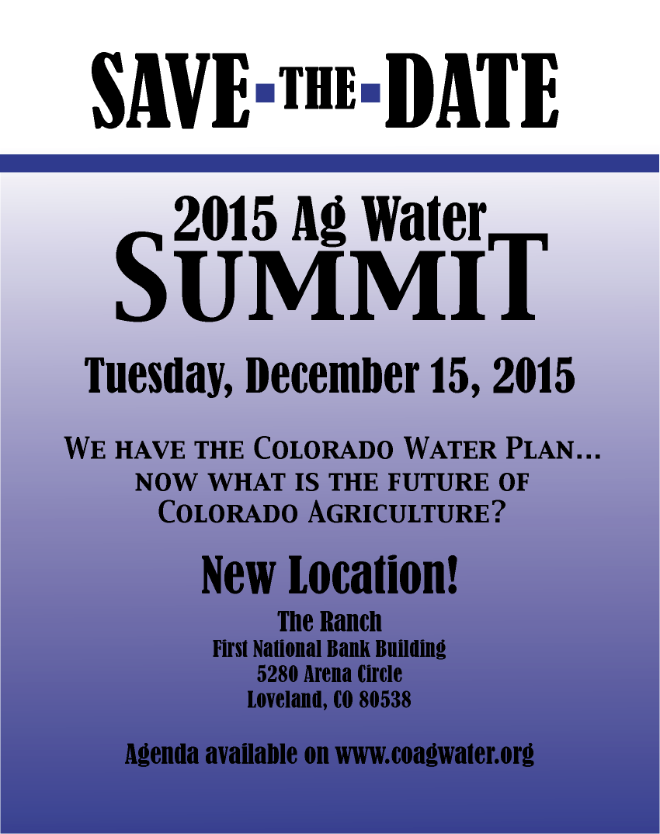
Water experts from across the state are set to convene for the 2015 Colorado Ag Water Summit, taking place Dec. 15 from 7:30 a.m. to 7:30 p.m., at the First National Bank Building at The Ranch in Loveland (5280 Arena Circle).
The event is hosted by the Colorado Agricultural Water Alliance—a group of leaders from the state’s ag industry, whose goal is to empower agriculture stakeholders to make the most informed and viable decisions regarding Colorado’s water.
The event is open to the public. Anyone interested in attending can learn more and register at http://coagwater.colostate.edu, or at http://www.coloradocorn.com.
This year’s summit is titled, “We have the Colorado Water Plan … Now what is the future of Colorado agriculture?” During the day, topics will include the Colorado Water Plan, the loss of ag water due to growing demands elsewhere, the future of food production in the state, lessons learned from the California drought, Colorado’s “use it or lose it” water laws, and the future of water regulation in the state, among other topics.
The approximately two dozen water experts and state officials slated to speak at the summit include:
Colorado Gov. John Hickenlooper;
Gregory J. Hobbs Jr., former Colorado Supreme Court justice;
John Stulp, special adviser on water to Colorado Gov. Hickenlooper;
Dick Wolfe, state engineer and director of the Colorado Division of Water Resources;
Ajay Menon, dean of the College of Agricultural Sciences at Colorado State University;
Amy Beatie, Colorado Water Trust executive director;
A.G. Kawamura, former secretary of the California Department of Food and Agriculture;
Charlie Bartlett, Colorado Agricultural Water Alliance president, Colorado Corn Growers Association vice president and Colorado Corn Administrative Committee board member; andSeveral others.
“Colorado’s water challenges no doubt demand our utmost attention and a united focus,” said CAWA President Charlie Bartlett, who farms near Merino, Colorado.
In 2010, the Statewide Water Supply Initiative study showed that Colorado would need between 600,000 and 1 million acre-feet per year of additional water by 2050 to meet its municipal and industrial needs. That same study showed that water being diverted from farms and ranches to meet Colorado’s projected municipal and industrial shortfalls could result in as many as 500,000 to 700,000 acres of irrigated farmground drying up by 2050.
“Agriculture in Colorado faces big challenges when it comes to water,” Bartlett continued. “The discussions at this year’s summit will be aimed at finding the right balance in meeting Colorado’s diverse water needs, and also examining how we can do that while honoring Colorado’s water law and protecting our state’s $40 billion-plus agriculture industry—a top two or three contributor to Colorado’s economy each year. The task at hand is a difficult one, and progress can’t be made without having conversations like the ones we’ll have at this year’s water summit.”
