From Inkstain (John Fleck):
I’m not sure who came up with the “More Slices than Pie” title for the panel discussion I moderated Thursday at the annual meeting of the Colorado River Water Users Association, but it had a nice ring. A big thanks to Tom McCann from the Central Arizona Project for putting the panel together and inviting me to help out. Important audience, important messages about the risks if basin water managers can’t come to grips with the need to stop draining their reservoirs so quickly.
There’s some important signaling here. For a long time, this thing we have come to call the “structural deficit” – the reality that paper allocations on the river exceed actual water supply – was an elephant in the room. It’s not that the overallocation problem was ignored in official discussions. People both inside and outside the basin’s water management institutions have talked about this for years…
There is a tension in the Colorado River management between the core group of managers operating at the basin scale who are trying to work out ways to deal with the overall shortfall, and water managers working at more local scales back home, who just want the water promised to them on paper by the deals negotiated back in the day. When it gets wet, as it did in the winter of 2010-11, it takes the pressure off of that conflict, because we can simply keep using water and sucking down the reservoirs rather than dealing with the shortfall.
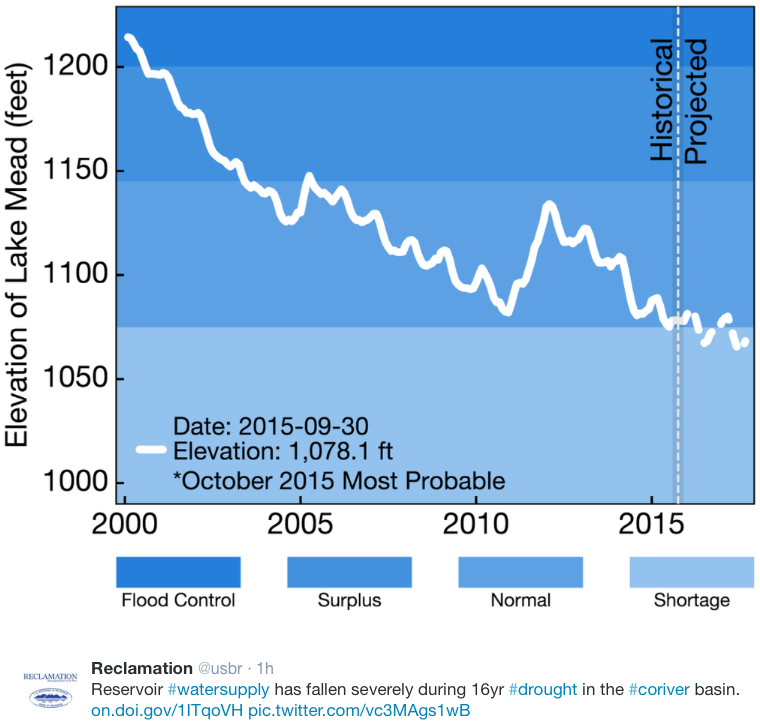
But Mead is back to its record-setting lowest-it’s-been-since-it-filled ways. Thursday’s session putting the basin’s overallocation problem on the main stage at CRWUA for discussion by representatives of four of the major Colorado River Basin water agencies suggests that managing scarcity and risk rather than assuming abundance is, at least for now, the conventional narrative.
CRWUA is a strange and wonderful thing, an annual gathering that brings all the disparate elements of the disaggregated Colorado River water management community – federal, state, local, farm, city, environmental, recreation – together in one spot. In a system in which no one is in charge, this ritualized annual coming together is critical for the social capital needed to deal with the basin’s tough issues. I wish I had the formal skills of an anthropologist or one of those people who studies formal and informal networks. CRWUA would make a great field study area.
There’s an odd turn of phrase that I’m increasingly hearing in the Colorado River management community in describing the risk of Lake Mead dropping in a hurry – “blowing through 1,020”. It’s an action verb, describing a reservoir in free fall if we don’t get bailed out by whatever the opposite of climate change and drought are. The problem is that as reservoir levels decline, the V-shaped profile of the big Colorado River reservoir means that there’s less water for a given amount of elevation, which means that we shift quickly from dropping five or ten or fifteen feet per year to plummeting from 1,020 to 895 in a hurry. When I started working on Colorado River issues, “895”, the level at which you can’t get water out of Lake Mead, didn’t get talked about much. But the number came up a lot at this year’s CRWUA.