
From the Sterling Journal Advocate (Marianne Goodland):
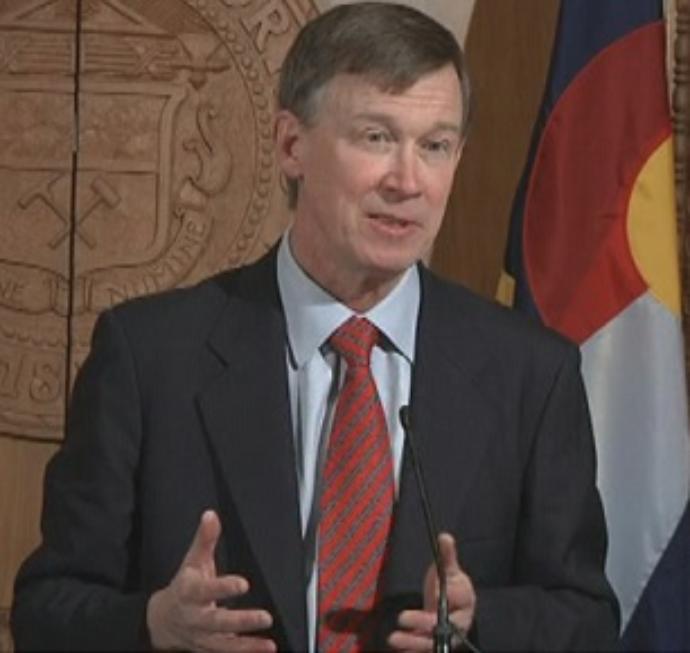
Gov. John Hickenlooper Thursday used his annual State of the State speech to chide lawmakers for failing to compromise last session on the state’s most pressing issues: the state’s budget, which he believes will have to be cut in 2016-17, changes to a hospital provider fee that could free up $1 billion over five years for transportation and education, and reforms to a state construction defects law that developers say prevents them from building affordable condominiums.
Last year’s partisan gridlock was due largely to split control of the General Assembly. It’s the same for this year — Republicans have a one-vote majority in the state Senate, and Democrats hold a three-vote advantage in the state House.
While democracy “wasn’t designed to be argument-free,” it also “isn’t designed to be combative to its own detriment,” Hickenlooper said. “Our conflicts aren’t serving us,” either at the state Capitol or in Washington, D.C. “We used to take pride in compromise… but in today’s politics we revel in getting our way without giving an inch, and stopping the other guy from getting anything done.”
Coloradans excel at working together after a tragedy, but that shouldn’t be the only reason lawmakers compromise on the state’s biggest challenges, Hickenlooper said…
Hickenlooper also brought up the state water plan, which was finalized in November, stating that the time has come to put it to work. He didn’t identify any specific ideas to implement it, although he promised there would be legislation to give the Colorado Water Conservation Board, the plan’s author, “greater flexibility in funding our most important water projects.”
Becker said Hickenlooper should have endorsed the Northern Integrated Supply Project, which would add two new reservoirs along the Poudre River in Larimer County. Will the governor support “the biggest privately-funded water storage plan in the state?” Becker asked.
Sonnenberg was “thrilled” with the governor’s remarks on water. The two have begun discussing the plan, water storage and related issues. “I’m pleased we’re moving forward with some aspects of the water plan,” Sonnenberg added.
From The Durango Herald (Peter Marcus):
During his State of the State address Thursday, Gov. John Hickenlooper outlined efforts to avoid future catastrophic incidents such as the Gold King Mine spill.
“When we recognize a threat to our natural environment, we need to take action,” Hickenlooper told a joint session of the Colorado House and Senate during remarks that lasted just over 40 minutes. “Last summer’s Gold King Mine spill showed us what can happen when abandoned mines with environmental or safety issues are not properly remediated.”
[…]
In Colorado, Hickenlooper said his administration is developing a statewide inventory of leaking mines to prioritize cleanup efforts. But the governor said Congress needs to act to minimize liability concerns associated with reclamation. Proposals in Congress would create a “good Samaritan” program, allowing private entities and state and local governments to clean up inactive mines without liability fears.
“Tackling watershed contamination presents a challenge because of federal laws that prevent cleanup efforts that fail to meet anything less than these national standards,” Hickenlooper said.
Rep. J. Paul Brown, R-Ignacio, applauded the governor for underscoring the mine issue.
“We need to address that and be looking at those areas where those old mines might be dammed up, where there might be a spill like that,” Brown said. “Hopefully we can do it in an economical way. I think there’s a lot of science showing that there may be some new techniques to clean up water that won’t be as expensive as a Superfund.”
Click here to read the Governor’s address.
From Circle of Blue (Brett Walton):
State of the State speeches highlight water resources
Arizona
Governor Doug Ducey (R) drew a contrast between California’s drought emergency and Arizona’s forward-thinking water policies that helped keep hydrological deprivation at bay. The reality is a bit more complex. Yes, Arizona passed a groundwater act more than three decades ago that was ahead of its time. And the state does store surplus Colorado River water underground, in case of a shortage. But outside the designated groundwater management areas, aquifers are largely unregulated. Streamflows and water tables have dropped in the state’s southeast corner.
In his speech, Ducey also promoted a “water augmentation council” that he appointed in December to investigate new sources of water. Brackish groundwater is expected to be an option when the council’s report is filed July 1…
Colorado
After approving the state’s first water plan in November, Governor John Hickenlooper (D) turned in his speech to implementation. He also spoke about developing a mine-drainage inventory in the wake of the Gold King mine spill of last August…
Idaho
Governor Butch Otter (R) praised a water-sharing agreement signed by farmers who irrigate with groundwater from the Eastern Snake Plain Aquifer, a declining resource. Groundwater users agreed to cut withdrawals by more than 10 percent…
Kansas
More than two years ago, Governor Sam Brownback, returning home after two full terms in the U.S. Senate, called for Kansas officials to develop a 50-year water vision. The western third of the state relies on the declining Ogallala Aquifer to sustain its farm economy, while reservoirs in the eastern half are filling with sediment, cutting their capacity.
Brown used his State of the State speech to highlight some of the water successes during his tenure. But despite widespread acclaim for the locally driven conservative plans he championed, few districts have endorsed them.