The health of our waters is the principal measure of how we live on the land — Luna Leopold
Meeting the demands of the #ColoradoRiver — James Eklund #COWaterPlan #COriver @EklundCO
Here’s a guest column from James Eklund writing in The Grand Junction Daily Sentinel:
Heavy attention on California’s sustained and severe drought, recent coverage of water sharing agreements in the Lower Colorado River Basin, and most recently an insightful piece in this newspaper from Colorado River Water Conservation District General Manager Eric Kuhn (Sixteen years of drought in the Colorado River Basin: Reality or talking point? May 12) might have people wondering, what does this mean for our headwaters state of Colorado? What kind of actions are Colorado and the Upper Basin states undertaking in this climate of uncertainty and water scarcity?
Colorado River Basin, USBR May 2015
The Lower Basin states of Arizona, California, and Nevada recognize the threat of extended drought on the Colorado River and are working on a contingency plan to responsibly take voluntary shortages in Lower Basin water use if conditions continue to deteriorate. Likewise, in the Upper Basin states of Colorado, New Mexico, Utah, and Wyoming, we have been working on preparations to ensure the health of the Colorado River system in sustained dry conditions. We have focused our efforts on operating our reservoirs as effectively as possible and managing our water demands.
Using these tools, our water data modeling shows we can make substantial progress toward our goal of sustaining critical water storage volumes in Lake Powell. Coupled with our continued work on cloud seeding and removal of invasive plants like tamarisk that drink too much, we can create more certainty for Colorado River water users and the environment.
And because Coloradans statewide rely on Colorado River water, we are working with water entities on both sides of the Continental Divide to ensure our headwater state is represented during these important discussions. We are proud to say that many Upper Basin water users, including Coloradans, have answered the call to voluntarily explore ways in which we would be able to manage our Colorado River water demands should the need arise. These water users are piloting temporary reductions in their water use so that we can better understand the effect we can have on Lake Powell.
While each part of the basin has its own reasons for developing contingency plans, both Upper Basin States and Lower Basin States have been meeting jointly to identify and capitalize on the benefits if both plans were to operate together. Those benefits also appear to be substantial.
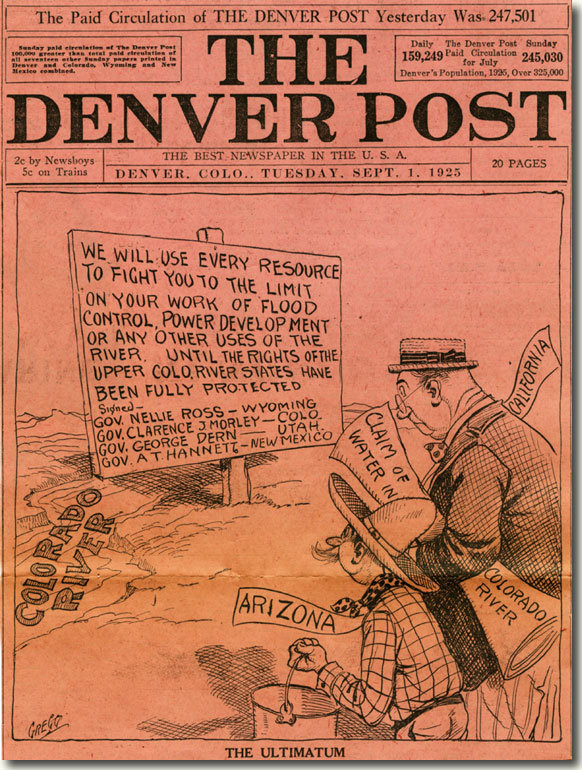
Upper Basin States vs. Lower Basin circa 1925 via CSU Water Resources Archives
The old ways of litigating and saber-rattling on the Colorado River are not viable solutions if we are to confront the very real and difficult challenges of reduced hydrology in a timely fashion. Nor can we — to extend the comments of Eric Kuhn — dismiss our dry hydrology as merely a “drought.” Doing so converts hope into a strategy. We can do better. Like Colorado’s Water Plan, the path forward on the Colorado River requires collaboration and recognition that water connects us all. In this spirit, we look forward to continued work with Coloradans statewide and the other Colorado River Basin States to craft contingency plans that add certainty and resiliency to our namesake river.
James Eklund is director of the Colorado Water Conservation Board and Colorado’s representative on the Upper Colorado River Commission.
The dam that forms Gross Reservoir, located in the mountains west of Boulder. Photo: Brent Gardner-Smith/Aspen Journalism
The crest of the dam across the Fryingpan River that forms Ruedi Reservoir, which can hold 102,373 acre-feet of water. Photo courtesy Bureau of Reclamation.
Sunrise at Ruedi Reservoir October 20, 2015. Photo via USBR.
Turrquoise Reservoir, which stores water brought under the Continental Divide from the Eagle, Fryingpan and Roaring Fork river headwaters. Photo credit: Aspen Journalism
Aurora Reservoir via Active Rain
Strontia Springs Reservoir started spilling on May 2, 2015. Between 1,200 and 1,700 cubic feet per second has been flowing out of the spillway since that time.
Dillon Reservoir via the Summit County Citizens Voice
Rifle Gap Reservoir via the Applegate Group
Green Mountain Dam via the Bureau of Reclamation
Cheesman Reservoir February 2013
Wolford Mountain Reservoir. An aerial view of Wolford Reservoir, formed by Ritschard Dam. The Colorado Water Plan outlines many different types of projects, including reservoirs and dams, that need funding.
Rampart Reservoir. Photo credit: The Applegate Group
Paonia Reservoir. Photo credit: The College of New Jersey
Windy Gap Reservoir
Carter Lake photo credit Northern Water.
Homestake Reservoir circa 2010. Photo credit Aurora Water.
Willow Creek Reservoir.
Mcphee Reservoir
Glen Canyon Dam back in the day when the reservoir was nearly full
Long Draw Reservoir
Granby Reservoir Indian Peaks in background
Elkhead Reservoir back in the day.
Taylor Park Reservoir
Horsetooth Reservoir
Ridgway Reservoir during winter
Boulder Reservoir.
Chatfield Reservoir
Spinney Mountain Reservoir
Aspinall Unit dams
Glen Canyon Dam
US Flag at Hoover Dam as the Olympic Torch passed over the dam in 1996