From The Cortez Journal (Jacob Klopfenstein):
Cortez Sanitation District board members on Monday discussed a rate increase next year of $1 per month for wastewater treatment up to 5,000 gallons.

From The Cortez Journal (Jacob Klopfenstein):
Cortez Sanitation District board members on Monday discussed a rate increase next year of $1 per month for wastewater treatment up to 5,000 gallons.
Click here for all the inside skinny and to register.
From email from Doug Kemper:
Our Summer Conference is now just six weeks away. I am writing to give you some quick updates.
Registration for our Summer Conference that will be held August 23 to 26 at the Sheraton Steamboat Springs is proceeding quite well. We have enjoyed a long run of great summer conferences at the Sheraton and we hope you will be able to join us as we celebrate our last time at the Sheraton. (The hotel has been sold and will no longer hold events such as ours.)
For more information and to register for the conference, Click Here.
Interim Water Resources Review Committee
We are pleased to have the Interim Committee with us again this year. This is an excellent opportunity to meet with your legislators early as they prepare water legislation for 2017.Workshops
We have 7 workshops this year in addition to an extensive workshop on Stream Management Planning. The latter is actually a co-event presented by the Colorado Water Trust with funding from the Colorado Water Conservation Board. A separate registration is required for this workshop and space will be very limited.Room Reservations
Room reservations at the Sheraton are filling up quickly. We are urging attendees to get their room reservations in soon.Conference Program
We are finalizing program speakers. Please look for updates as speakers are confirmed and adjustments to the program are made.We are pleased to have just confirmed Sue Sims, Group Manager for External Affairs for the Metropolitan Water District of Southern California who is managing a $2.2 Million water conservation campaign called H2Love. Also confirmed is Jennifer Persike, Director of External Affairs with the Association of California Water Agencies (our California counterpart) who under contract with the State of California is managing an $11 Million statewide public communications campaign on water conservation. They will present a workshop on Wednesday along with Denver Water’s Melissa Elliott. Sue and Jennifer are also on the main conference program on Thursday.
POND Activities
Our POND Committee has created six exciting activities on Thursday afternoon: Storm Peak Lab Tour, Hayden Generating Station Tour, Fish Creek Falls Hike, fly fishing, mountain biking, and golf. The will also host a reception, gondola ride, and an evening on the mountain with live music.
Coyote Gulch will be in Steamboat Springs live-tweeting the goings on. Don’t be bashful — say hello if you see me.

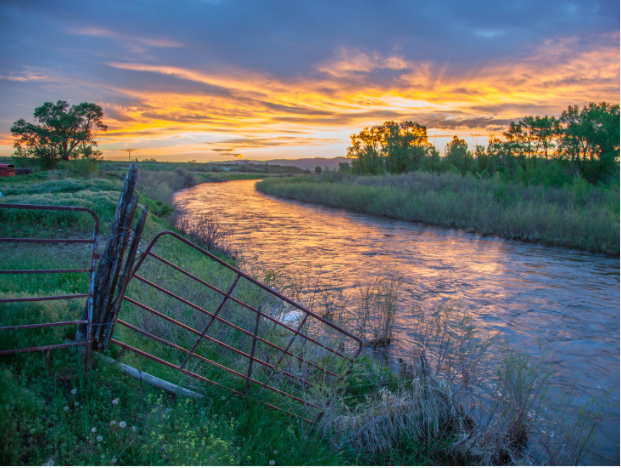
Click here to go to the website for the cool photography and story. Here’s an excerpt:
Wild River. What comes to mind? It’s a trick question because there aren’t many wild rivers. The Yampa River, which begins as a trickle from melting snow high in Colorado’s Flat Tops Wilderness is the only remaining wild river in the Colorado River watershed. The Yampa flows freely to the Green River, a major tributary of the Colorado River, so the Yampa has a big role if we’re ever to reach some measure of stream flow sustainability in a watershed that runs from Wyoming’s Wind River Range to the Gulf of California – it doesn’t make it that far today. Colorado’s thirsty Front Range cities that surround Denver are calling for transmountain diversions from the Colorado River watershed – importing 195,000 acre feet for growing cities and 260,000 acre feet for irrigation. I wonder, does irrigation include growing Kentucky Blue Grass to be installed and watered forever? An acre foot is as it sounds, one acre that is one foot deep. Drought is the new normal, rivers are over allocated, people are flooding in, and there’s this one wild river in northwest Colorado. Logically we must have the courage to let the Yampa run free.


Click here to go to the US Drought Monitor website. Here’s an excerpt:
Summary
A ridge of high pressure across the South and a trough of low pressure over the Northwest combined for an active storm track along the northern tier of the U.S. into the Midwest and southeastward into the Tennessee Valley. As numerous cold fronts tracked from the Northwest and southwestern Canada into the Nation’s mid-section and encountered the Southern ridge, they would stall and generate bands of heavy showers and thunderstorms. The week’s greatest totals fell on western and southern Kentucky, south-central North Dakota, central Minnesota, and northwestern Wisconsin where 4-8 inches (locally over 10 inches) was measured. Elsewhere, light to moderate rains occurred in the northwestern quarter of the U.S., most of the northern two-thirds of the Great Plains, upper Midwest, western Corn Belt, Tennessee Valley, portions of the Southeast, most of the Carolinas, and sections of the Northeast. Mostly dry weather enveloped the southwestern quarter of the Nation, the southern Plains, most of Florida, the Ohio Valley and eastern Great Lakes region, and mid-Atlantic. Weekly temperatures averaged below normal in the West, northern Plains, parts of the Midwest, and in New England. Positive temperature anomalies were found in the southern half of the Plains, across the Southeast, mid-Atlantic, and eastern Great Lakes region, with excessive heat (anomalies more than +6 degs F and triple-digit highs) in the southern High Plains. Precipitation decreased in Alaska as compared to last week (except in east-central sections), windward showers continued across Hawaii, and most of Puerto Rico saw light to moderate showers except for drier weather in south-central and southwestern sections of the island…
Plains
Several storm systems from the Pacific Northwest and southwestern Canada dropped moderate to heavy rain (1-5 inches, locally 8 inches) on Montana, North Dakota, and parts of South Dakota, providing a 1-category improvement where the totals exceeded 2 inches. While much of the heaviest rain fell on non-drought areas of the Dakotas, some D0 and D1 were improved in southwestern North Dakota (Morton, Grant, and Sioux counties) and northwestern South Dakota (Corson and northeastern Perkins counties). Farther east, a general 1-category improvement was made in southeastern North Dakota and northeastern South Dakota (see Midwest summary) where 2-5 inches fell. In contrast, less rain fell in northwestern South Dakota and extreme southwestern North Dakota (Bowman and Slope counties), and with reports of low yield and alfalfa harvests rivaling 1988, near-record June warmth, and poor VegDri values, some deterioration was made. D2 was extended northward into western Harding County, SD, and D1 was pushed northward into western Slope County, ND. In the central Plains, showers were more scattered in nature, with the few small D0 and D1 areas generally unchanged except for the removal of D0 in eastern Nebraska (see Midwest summary). In the southern Plains, scattered decent rainfall was limited to southwestern Texas, north of Midland, TX (Martin, Howard, Borden, and Dawson counties), and northeastward into central Oklahoma. Hot weather, however, overspread much of the southern Plains with temperatures averaging 6 to 9 degs F above normal and triple-digit highs. Where the rains missed and short-term (at 30- and 60-days) deficiencies have developed, small D0 areas were added in the Texas Panhandle, northeastern Texas, and south of Beeville, TX (Live Oak and San Patricio counties). Similarly in Oklahoma, D0 and D1 was expanded where the rains missed and short…
Northwest and Northern Rockies
After last week’s addition of D1 along the Oregon coast due to unseasonably dry and occasionally warm weather since April, this week brought unseasonably cool and wet weather to the entire region. In fact, it was cold enough for accumulating snow to fall in central Idaho north of McCall at an elevation of 6,000-7,000 feet. With precipitation amounts of 0.5-2 inches along the coast and in the northern Cascades and parts of the northern Rockies, it was almost enough to make improvements in parts of the region, however, since the past 3-4 months were quite dry and warm and some drought impacts had already commenced (e.g. northeastern Oregon), this event was not enough for any improvements west of the Rockies. In the northern Rockies and eastward, however, enough precipitation (2-3 inches) fell to remove D0 in northwestern Montana (Lake County) and 1.5-2 inches in northern Musselshell and northern Golden Valley Counties in central Montana. In eastern Idaho, D0 was reassessed, with the northern portion removed per 0.5 inches of precipitation and good water supplies while D0 was shifted southward into the headwaters of the Snake River where less precipitation fell and most indicators are showing moisture shortages. In northern Colorado (central Rockies), D0 was expanded into Larimer, Boulder, and Gilpin counties due to recent dryness, 6-month SPIs 0 to -1.5, and the VegDri showing some stressed vegetation. Western Boulder County saw a wild fire start last week aided by the hot, dry, and windy weather…
California and the Great Basin
The normally dry summer months in this region lived up to its billing as no precipitation fell across the entire area except for light amounts (0.1-0.5 inches) in far northern locales. Temperatures generally averaged below normal for the week, providing some relief for containment of new wild fires thanks to lower readings and higher humidity. As to be expected during the summertime, status-quo is most-likely for the next few months – unless the monsoon changes its trajectory – and even that may not be enough for any improvement depending on temperatures…
Southwest
After a promising start to the monsoon last week in the Four Corners states, shower activity abruptly stopped across most areas as dry and warm weather prevailed. In fact, weekly temperatures averaged 6-8 degs F above normal with triple-digit highs in eastern New Mexico and west Texas, but gradually decreased to subnormal readings in far western areas. Light, scattered rains (less than 0.5 inches) were confined to extreme southeastern Arizona and parts of New Mexico, with heavier amounts (0.5-2 inches) in southwestern Texas. The rains were enough near El Paso, TX, to remove a bit of the D0 there. Since the previous week was generally wet and short-term indices are actually near or above normal (wet) due to low late spring and early summer normal precipitation totals, no changes were made…
Looking Ahead
During the next 5 days (July 14-18), light to moderate precipitation (0.75-1.5 inches) is expected across much of the northern and central Plains, Midwest, Tennessee Valley, southern Appalachians, Carolinas, southern Louisiana and Florida, and the Northeast, with the largest totals (2-3.5 inches) in the south-central Plains, southern Appalachians, and North Carolina. Little or no rain is forecast for much of the Far West, Rockies, southern Plains, and coastal New England. Temperatures should average above normal in the Southwest and southern High Plains, Deep South, and in the Atlantic Coast States, with subnormal readings in the Northwest, northern Plains, and Midwest.
The NWS 6- to 10-day outlook for July 19-23 favors sub-median precipitation for much of the lower 48 States (West, northern Rockies, Plains, Midwest, southern Alaska), except for odds tilted toward above-median rainfall in northern Alaska, the Southwest, and small areas of the Pacific Northwest, southern Texas and Florida, and eastern Carolinas. The chances for above normal temperatures are high in southern Alaska and across much of the contiguous U.S., especially in the North Central States. Exceptions to this include eastern Alaska and the Pacific Northwest where subnormal readings are likely.

Here’s the release from the State of the Rockies Project:
Five Colorado College State of the Rockies Project student researchers are in the field this summer, studying and comparing issues of river governance and river management.
Joseph Friedland ’17, Emelie Frojen ’17, Lea Linse ’17, Mollie Podmore ’17, and Amy Rawn ’17, along with Program Coordinator Jonah Seifer ’16 and Associate Director Brendan Boepple ’11, are working in two of the West’s largest river basins, the Colorado River Basin and the Columbia River Basin. The focus of the 2016-17 State of the Rockies is “Inclusive River Governance in a Changing West,” with the core this year’s project being a comparative study of water issues in the Southwest vs. Northwest,
The State of the Rockies Project research team recently spent four days in Silverton and Durango, Colorado, where they examined how governance systems allow for the incorporation of traditionally under-represented values in water management. These issues are particularly important in an increasingly water-stressed future, affected by climate change and growing populations throughout the West.
“We were fortunate to meet with a diverse set of stakeholders involved with the Animas River on the trip, and were also able to sit in on a meeting of the Animas River Stakeholders Group, the local watershed group that has been working to address the region’s mining legacy for the last 20-plus years,” says Boepple, who has been with the project for five years.
“The trip not only allowed the students to further their research and see some of these important issues firsthand, but it also allowed them to see how actual management decisions are made,” says Boepple. “Additionally, the Gold King Mine spill, which occurred last August, provided an interesting backdrop to conversations and research discussions about the Animas River and its management.”
While in Silverton, the team visited the Mountain Studies Institute, which conducts scientific research and environmental restoration in the area, and emphasizes the need for communicating that research to a wide audience in the San Juan Mountains region. Boepple says they have some of the most complete data on the Animas River before, during, and after the Gold King Mine spill, and have been sharing that information with the local community to help residents understand the impact of the spill.
The State of the Rockies team will head next to the Pacific Northwest, where they will spend two weeks researching tribal water issues, the debates surrounding regional dam deconstruction, and the important role that salmon play in the management of the Columbia River system.
This summer’s research will be published in the 2017 State of the Rockies Report, due out in the spring.

From email from Reclamation (Erik Knight):
Releases from Crystal Dam will be increased from 1850 cfs to 2000 cfs on Friday, July 15th. Flows in the lower Gunnison River have been dropping quickly over the last week and are now just under the baseflow target. This increase is intended to raise flows in the lower Gunnison River as well as manage the reservoir content to reach the end of year winter target elevation. The current April-July runoff forecast is now at 91% of average. The current content of Blue Mesa Reservoir is 796,000 acre-feet which is 96% full.
Flows in the lower Gunnison River are currently below the baseflow target of 1500 cfs. This increase should restore flows to a level at or above the baseflow target.
Pursuant to the Aspinall Unit Operations Record of Decision (ROD), the baseflow target in the lower Gunnison River, as measured at the Whitewater gage, is 1500 cfs for July.
Currently, diversions into the Gunnison Tunnel are around 1050 cfs and flows in the Gunnison River through the Black Canyon are around 850 cfs. After this release change Gunnison Tunnel diversions will still be at 1050 cfs and flows in the Gunnison River through the Black Canyon should be around 1000 cfs. Flows in the river may be less than 1000 cfs if the maximum capacity of the Crystal powerplant proves to be less than 2000 cfs. Current flow information is obtained from provisional data that may undergo revision subsequent to review.

From The Brush News-Tribune (Katie Collins):
Tuesday night saw the Mark Arndt Events Center in Brush packed full with nearly 400 citizens who gathered to take in information regarding the newly updated floodplain map that recently changed the borders throughout Morgan County.
The Open House format was somewhat of a surprise for the hundreds who floodedinto the Morgan County Fairgrounds for the 4 p.m. start, but there, all were able to visit booths set up by representatives of the National Flood Insurance Program, the Colorado Water Conservation Board and FEMA who converged to host the informational event.
Local entities from the Morgan County Planning and Zoning Commission, City of Brush, Town of Wiggins, the Morgan County Board of Commissioners and even local insurance agents were also present for the packed house, answering questions, fielding comments and concerns and helping property owners plug in addresses for an in-depth look at how the new borders might affect them and their insurance requirements.
More information on specific property placement within the new map, on the City of Brush floodplain ordinance requirements, FEMA’s floodplain resources or on the National Flood Insurance Program, can all be found online at http://www.brushcolo.com by clicking on the orange ‘FLOODPLAIN UPDATES’ box.
The digital map program that provides a more detailed property search can also be found at http://tiny.cc/CSLF_Morgan_County.

From US Senator Gardner’s office via the Kiowa County Press:
The Senate Energy and Natural Resources Committee today approved three bills authored by Senator Cory Gardner (R-CO): legislation pertaining to the Arkansas Valley Conduit and Florissant Fossil Beds Monument as well as the Bolts Ditch Access and Use Act.
Authorized in the 1960s, the Arkansas Valley Conduit project in Southeast Colorado will deliver clean drinking water to local communities across the region upon completion. Gardner’s bill extends greater flexibility to the Southeastern Colorado Water Conservancy District by allowing the maximum use of miscellaneous revenue collected from the Fryingpan-Arkansas Project to be immediately reinvested into the Arkansas Valley Conduit once construction begins.
Gardner’s Bolts Ditch Access and Use Act would authorize special use of the Bolts Ditch headgate and the segment of the Bolts Ditch within the Holy Cross Wilderness Area, allowing Minturn to use its existing water right to fill Bolts Lake. This would solve a problem created in 1980 when Congress designated Holy Cross Wilderness area, but inadvertently left Bolts Ditch off of the list of existing water facilities.
“I’m proud the Energy and Natural Resources Committee approved legislation I authored relating to the Arkansas Valley Conduit and Florissant Fossil Beds Monument, as well as the Bolts Ditch Access and Use Act,” said Gardner. “My Bolts Ditch and Arkansas Valley Conduit bills recognize Coloradans, not Washington bureaucrats, know how to best manage our state’s water resources, and I’m proud to return power to local Colorado communities.”
Gardner’s Florissant Fossil Beds Monument legislation will allow for enhanced wildfire protection as well as additional habitat for wildlife and recreational opportunities for visitors. Established as a national monument in 1969, the Florissant Fossil Beds National Monument is located west of Pikes Peak and less than 40 miles from Colorado Springs, CO. The park is home to diverse fossil deposits, maintaining a collection of over 12,000 specimens. The park also provides recreational experiences and curriculum-based education programs for its visitors. A private landowner submitted a proposal to donate 280 acres of land adjacent to Florissant Fossil Beds Monument, but due to current law the land transfer cannot take place. The park, which currently possesses 5,998 acres of land, has a legislative ceiling of 6,000 acres. Therefore, if acquired, the 280-acre parcel of land would project the park above its legal threshold. This legislation is commonsense in that it would permit a private landowner to donate land to Florissant Fossil Beds National Monument.

From Rocky Mountain PBS (Jim Trotter):
The river system, with its headwaters in Rocky Mountain National Park, has been stressed by drought since 2000. The most recent national climate assessment for the Southwest forecasts that the country’s hottest and driest region can only expect more of the same.
“This may be what the start of a water war looks like,” suggested a recent story in the Los Angeles Time.
The story by ace writer William Yardley focuses on negotiations between the lower basin states of California, Arizona and Nevada to voluntarily reduce withdrawals from Lake Mead in order to forestall the mandatory, more drastic cutbacks that most likely would come with a federal declaration.
Yardley calls the approach “tinkering.”
But Tom Buschatzke, director of the Arizona Department of Water Resources and one of the senior water managers on the river, says, “I like to describe this as another incremental step.”
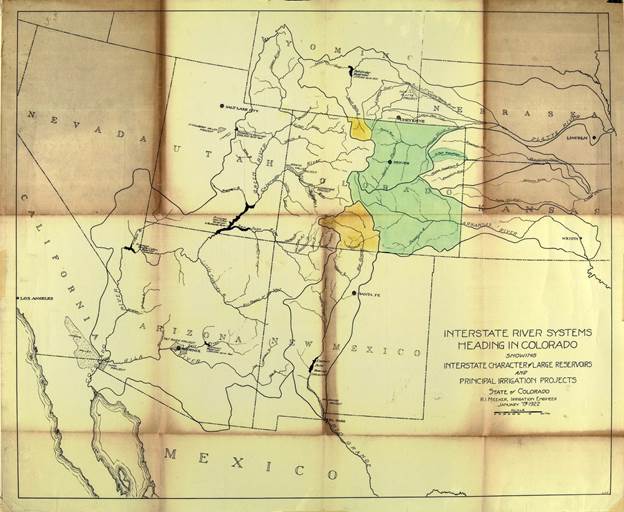
The question is, can incremental steps preserve the governance of the river pretty much as is, defined by the Colorado River Compact of 1922 and modified by numerous laws and court decisions since?
“I don’t think a water war is inevitable,” Buschatzke tells Yardley.
The upper basin states generally and Colorado particularly are not as in dire shape as the lower basin states. As we’ve said before, Colorado has almost been in a bubble the past couple of years – average to above average snowpack, strong runoffs, filled reservoirs. But if water runs short for 25 million people in the lower basin, many of whom are in Southern California, no one can expect to remain untouched.
Yardley seems to admire the Arizona approach.
“But for Buschatzke,” he writes, “who has spent decades efficiently providing water for a desert population – Arizona uses less water now than it did 60 years ago even though the population has soared from 1.1 million to 6.7 million – the big fix is actually in the accumulation of all the little fixes he and others are constantly making. A federal grant for new technology that will better measure water use. Paying a farmer to fallow a field. Saying nice things about your colleagues across the state line and the fine folks in Washington. Keeping things collegial. Sharing. Saving. Preserving the process – and the peace.”
Obviously better than a new water war.

From The Grand Junction Daily Sentinel:
The city of Rifle on Wednesday lifted weeks-long water restrictions after the completion of repairs.
The city had barred outdoor water use June 1 due a break in the pipe delivering water from the Colorado River to its treatment plant.
The break also damaged pumps. The city began pumping from a secondary water source and was able to begin allowing outdoor watering by residents on odd or even days, depending on their address, a little more than a week after the problems began. The city has fully restored service after completing pump repairs.
City manager Matt Sturgeon said in a news release, “The city never wants to be in a position where water restrictions are necessary, especially during a time when temperatures are reaching into the triple digits, and the city appreciates the cooperation from our citizens during this difficult time.”

Here’s part one of a recap of the meeting in Brush yesterday from Stephanie Alderton writing for The Fort Morgan Times:
The Colorado Ag Water Alliance, along with the Colorado Cattlemen’s Association and the Colorado Water Institute, hosted a three-hour workshop for producers to help explain the new Water Plan’s application to agriculture. Speakers with various roles in water and agriculture talked about the new state plan’s emphasis on alternative transfer methods (ATMs) to conserve water, how the plan will be implemented in the South Platte Basin in particular and how farmers can increase water efficiency. People came from all over the state to hear and discuss details in the plan.
“A good Colorado plan needs a good South Platte plan,” Joe Frank, of the South Platte Basin Roundtable, said. “Nine out of the top 10 ag producing counties are in this basin.”
During his talk, the first of the day, he explained that the area has an increasing water supply gap as the population grows, which the Water Plan seeks to address. Frank’s group is in charge of implementing the plan in South Platte by coming up with a balanced, pragmatic program for farmers that is consistent with Colorado law. He said that program will focus on maximizing the use of existing water, encouraging farmers and other organizations to use ATMs in order to share water more effectively and promoting multi-purpose water storage projects, among other things.
Mike Applegate, of the Northern Water Board, talked about the status of current storage projects all over the state, while MaryLou Smith of Colorado State University gave a list of reasons why producers should want to use their water differently in an effort to conserve more. Phil Brink, of the CCA, reported the results of a survey on farmers’ opinions of ag water leasing, while Dick Wolfe, an engineer with the Colorado Division of Water Resources, explained the problems with the “use it or lose it” mentality farmers tend to have toward their water rights. John Schweizer, a producer from the Arkansas Basin, talked about the success of the Super Ditch near his hometown, an ATM project that recently started seeing results. After a final panel made up of people involved in various ATM projects, including Morgan County dairy farmer Chris Kraft, the audience spent more than an hour trading questions and comments with the speakers.
The purpose of the workshop, according to a CAWA press release put out beforehand, was to bring people together to discuss the “opportunities and barriers” the Water Plan presents. The speakers in the second half of the day presented many opportunities in the form of ATMs and other projects. For example, Schweizer said the Super Ditch, though it’s taken many years to be completed, has the potential to help many farmers conserve water without new legislation or complicated water rights battles.
“We’ve had a lot of people say this wouldn’t work,” he said. “We’re starting to prove them wrong…I see nothing but a glorious future for this project.”
But it was clear that many people at the workshop saw many remaining obstacles to water efficiency. During the question and answer session at the end, several people pointed out that, while ATMs can make it easier for farmers and other organizations to share water, they can’t solve the problem of water shortages by themselves.
“We are concerned that the state Water Plan talks so much about these ATMs, and a lot of policy makers around the state are counting on them,” Smith said while moderating the discussion. “Part of what we want to do is get the message of what you guys are saying back to some of those policy makers.”