Click here to the Denver for Colorado River Studies at Utah State University for all the inside skinny on the report. Here’s the executive summary:
The Fill Mead First (FMF) plan would establish Lake Mead reservoir as the primary water storage facility of the main-stem Colorado River and would relegate Lake Powell reservoir to a secondary water storage facility to be used only when Lake Mead is full. The objectives of the FMF plan are to re-expose some of Glen Canyon’s sandstone walls that are now inundated, begin the process of re-creating a riverine ecosystem in Glen Canyon, restore a more natural streamflow, temperature, and sediment-supply regime of the Colorado River in the Grand Canyon ecosystem, and reduce system-wide water losses caused by evaporation and movement of reservoir water into ground-water storage. The FMF plan would be implemented in three phases. Phase I would involve lowering Lake Powell to the minimum elevation at which hydroelectricity can still be produced (called minimum power pool elevation): 3490 ft asl (feet above sea level). At this elevation, the water surface area of Lake Powell is approximately 77 mi2, which is 31% of the surface area when the reservoir is full. Phase II of the FMF plan would involve lowering Lake Powell to dead pool elevation (3370 ft asl), abandoning hydroelectricity generation, and releasing water only through the river outlets. The water surface area of Lake Powell at dead pool is approximately 32 mi2 and is 13% of the reservoir surface area when it is full. Implementation of Phase III would necessitate drilling new diversion tunnels around Glen Canyon Dam in order to eliminate all water storage at Lake Powell. In this paper, we summarize the FMF plan and identify critical details about the plan’s implementation that are presently unknown. We estimate changes in evaporation losses and groundwater storage that would occur if the FMF plan was implemented, based on review of existing data and published reports. We also discuss significant river-ecosystem issues that would arise if the plan was implemented.
From The Grand Junction Daily Sentinel (Gary Harmon):
Making Lake Mead the primary water storage facility on the Colorado River isn’t as simple as it might seem and would require more study than it’s been given so far, says a study released Thursday.
Backers of the Fill Mead First idea said the study underscores the need to move ahead with studies and a spokesman for the Colorado River Water Conservation District said the discussion ignores a significant element: the need for Colorado and other states to save water in Powell.
The Center for Colorado River Studies at Utah State University said more study of evaporation from Lake Powell is needed, as well as a study of groundwater into the reservoir and of the fine sediment that would be released should Lake Powell be drained.
That would be a good start, said Eric Balken, executive director of the Glen Canyon Institute, which drafted the idea of filling Lake Mead instead of storing water in Powell so as to reduce water lost to evaporation.
The Interior Department has so far “written off” the idea, Balken said.
“Now is the time to initiate new measurement programs of (evaporation) losses at Lake Powell and Lake Mead so that future policy discussions have access to less uncertain data regarding evaporation and groundwater storage,” Balken said in an email.
The idea ignores Lake Powell’s “primary purpose,” which is to serve as a savings account for the upper Colorado River Basin states to deliver an average 7.5 million acre-feet of water per year to the lower basin, said Chris Treese of the River District.
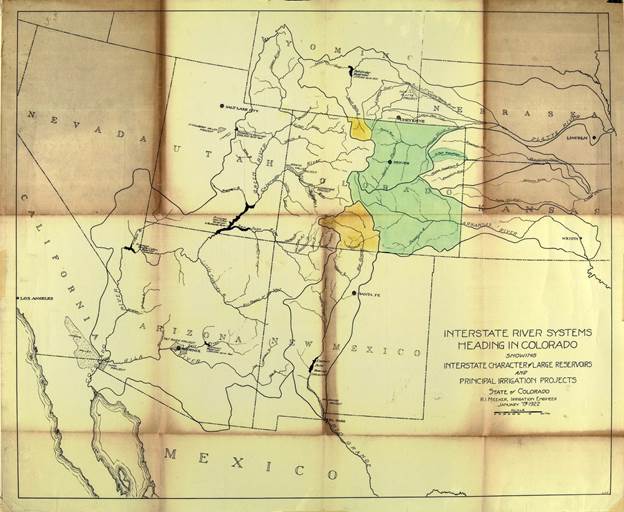
The amount is set in the 1922 compact that governs the use of the river, which provides water to millions of people in the arid Southwest.
Advocates of draining Lake Powell tend to write off the upper basin concerns by saying it’s “with a wave of the hand that you’d have to ‘make a few changes’,” to the compact, Treese said, “As if it’s simple and desirable to open up the Colorado River Compact.”
The Fill Mead First idea proposes draining Lake Powell in a three-stage process and storing the water in Lake Mead, 300 miles downstream.
“It is surprising how much uncertainty there is in estimating losses associated with reservoir storage,” said Jack Schmidt of the Center for Colorado River Studies, who served as chief of the U.S. Geological Survey’s Grand Canyon Research and Monitoring Center from 2011 to 2014.
Evaporation losses at Lake Mead are measured by the U.S. Geological Survey in a state-of-the-science program, but there have been no efforts to measure evaporation at Lake Powell since the mid-1970s, Schmidt said.
Using the most recent data, researchers showed the Fill Mead First plan might reduce evaporation losses slightly, but noted that such a prediction is uncertain.
The Interior Department should conduct a thorough scientific investigation of evaporation and seepage losses at lakes Powell and Mead, as the Utah State study suggests, Balken said.