
From the Australian Bureau of Meteorology:
Negative Indian Ocean Dipole ends, while central tropical Pacific Ocean warms
The Indian Ocean Dipole has returned to neutral levels, after being in a negative phase since May. The tropical Pacific Ocean remains El Niño–Southern Oscillation (ENSO) neutral.
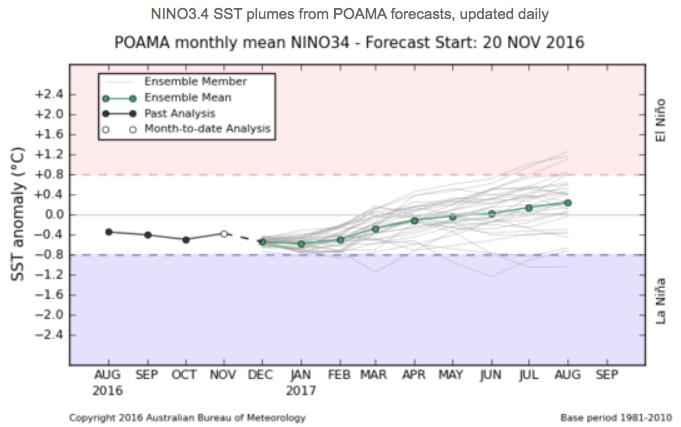
In the tropical Pacific, most indicators of ENSO are well within neutral bounds. In the past fortnight, sea surface temperatures in the central tropical Pacific Ocean have warmed once again, further dampening chances of La Niña. The Southern Oscillation Index (SOI) has been negative since late October (La Niña values are typically positive) but remains neutral. Trade winds are currently close to average. Only cloudiness near the Date Line continues to show some La Niña-like characteristics.
Climate models predict the tropical Pacific Ocean will remain cooler than average, but in the ENSO-neutral range, through until the end of the 2016–17 summer. Only one of the eight models surveyed indicates La Niña for the summer months. A La Niña developing this late in the calendar year has only occurred once since 1980.
The Indian Ocean Dipole (IOD) has returned to neutral levels as the monsoon trough transitions to the southern hemisphere. This shift changes the wind patterns over the tropical Indian Ocean, breaking down the typical IOD circulation. The strong negative IOD event helped drive Australia’s wettest May–September period in 117 years of record. The July IOD value was equal-strongest for at least 50 years.