FromColorado Politics (Marianne Goodland) via The Durango Herald:
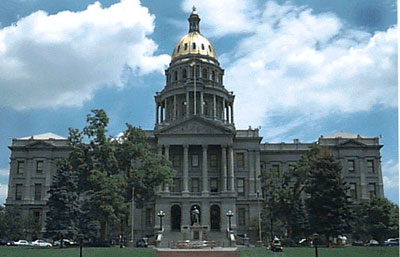
Becker…reorganized a few committees, eliminating the Agriculture, Livestock and Natural Resources Committee in favor of a “Rural Affairs Committee.”
[…]
In a Sunday statement, Becker said the Rural Affairs Committee “will oversee issues of particular importance to rural Colorado such as agriculture, water, rural broadband and rural economic development.”
[…]
And there’s one new committee: Energy and Environment…
Rural Affairs (formerly Agriculture, Livestock and Natural Resources) will be chaired by Rep. Dylan Roberts of Avon and vice-chairwoman Rep. Donald Valdez of La Jara.
Energy and Environment will be chaired by Rep. Dominique Jackson of Aurora; vice-chairwoman will be Rep. Edie Hooton of Boulder…
The Energy and Environment committee, and the Finance committee, will be led by African Americans; five of the 11 committees are led by women.
The news came as the heads of two big water agencies, the Arizona Department of Water Resources (ADWR) and the Central Arizona Water Conservation District (CAWCD), presented a plan to water stakeholders in hopes of pushing the group closer to a resolution.
Arizona needs to finalize an internal drought deal so that it can enter into an agreement with the other Colorado River Basin states…
“I fully endorse this plan, the state endorses this plan,” said ADWR Director Tom Buschatzke at Thursday’s meeting of the DCP Steering Committee. He said Ducey himself will “advocate strongly” to make sure the $30 million budget request gets passed.
Buschatzke also acknowledged several items still need to be worked out.
The plan builds on an earlier, three-year proposal from the CAWCD board put forward in case something longer could not garner support.
This new proposal takes the state through 2026, when an existing set of drought guidelines expires and will need to be renegotiated. The plan now on the table provides specific amounts of water and money to “mitigate” Pinal County farmers, cities, and Native American tribes for water they will lose under the DCP, although the mitigation volumes will decrease as the plan goes on.
“This is a bridge from having no shortage to having one, and then the new future — whatever that might be — after 2026,” said Ted Cooke, general manager of the CAWCD. “The mitigation program will be done by the end of 2025.”
The water for mitigation will largely come from 400,000 acre-feet of CAWCD water currently being stored in Lake Mead. Many stakeholders say using that for mitigation is against the intention of the drought plan in the first place. But Thursday’s framework creates a “Lake Mead Offset” component to make up for those drawdowns.
Money for the plan includes:
$60 million from the CAWCD.
$30 million state appropriation proposed in Gov. Ducey’s upcoming budget.
$8 million from a collection of non-governmental organizations in the Water Funders Initiative.
$20 million to $30 million in federal money already required under existing programs.
An unspecified amount of money, from both federal coffers and Central Arizona irrigation districts, for a groundwater infrastructure program for Pinal County farmers.
But Rob Anderson, with the Home Builders Association of Central Arizona, said, “we think that economic development is an important message and that having nothing in there for developer mitigation is an issue.”
He noted a separate but related water agreement between CAWCD’s groundwater replenishment arm and the Gila River Indian Community appears stalled without approval from the Gila River council. That agreement is important to homebuilders and developers, as more water for replenishment means groundwater can be pumped out by new housing developments. Gila River Gov. Stephen Roe Lewis told stakeholders at Thursday’s meeting that he would work hard to get that agreement passed if the new DCP proposal moves forward.
Paul Orme, who represents Pinal County irrigation districts, was concerned about the lack of firm funding for groundwater infrastructure projects, among other things.
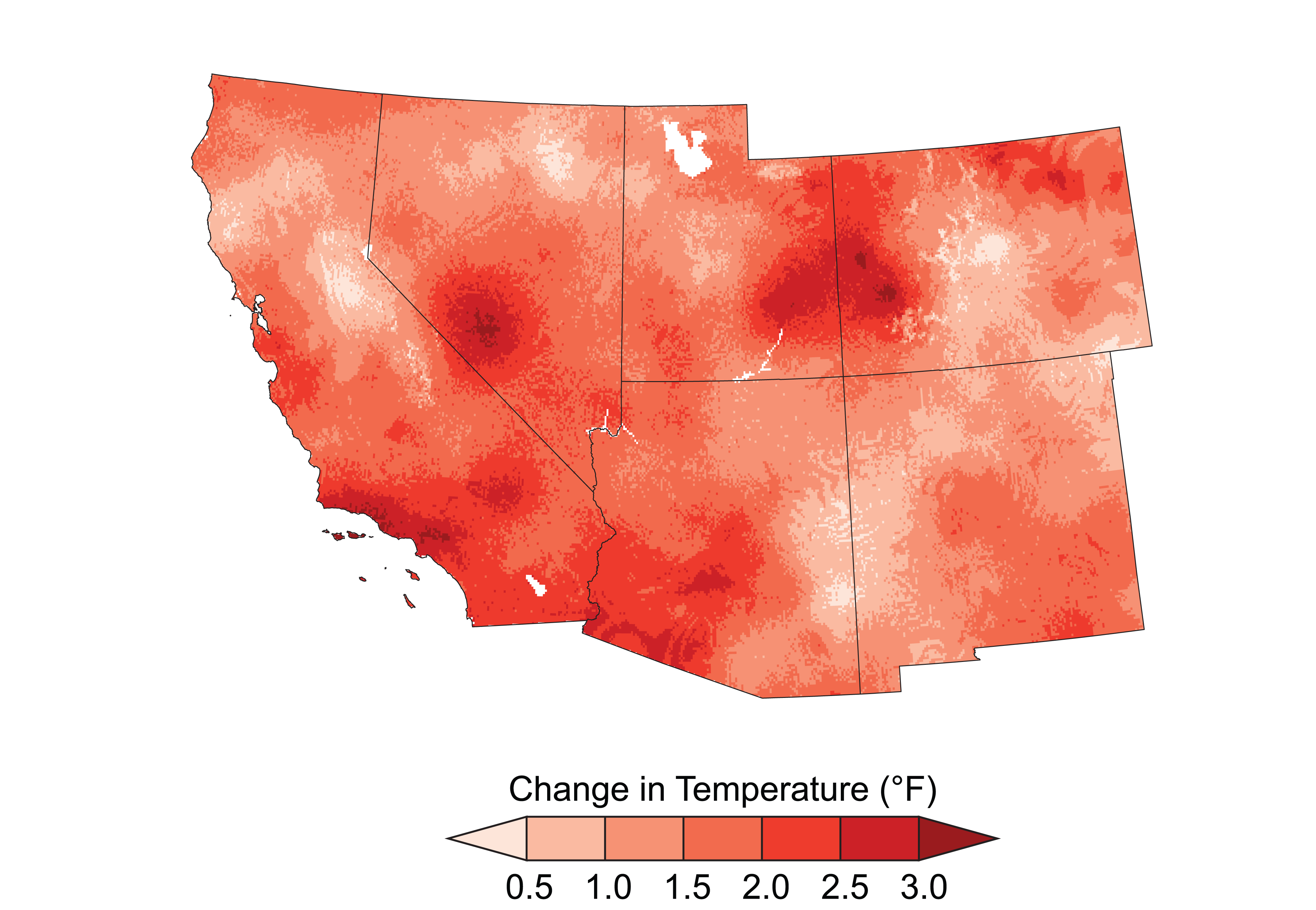
Temperatures increased across almost all of the Southwest region from 1901 to 2016, with the greatest increases in southern California and western Colorado. This map shows the difference between 1986–2016 average temperature and 1901–1960 average temperature.23 Source: adapted from Vose et al. 2017.23. Map credit: The National Climate Assessment 2018
The collapse of civilisation and the natural world is on the horizon, Sir David Attenborough has told the UN climate change summit in Poland.
The naturalist was chosen to represent the world’s people in addressing delegates of almost 200 nations who are in Katowice to negotiate how to turn pledges made in the 2015 Paris climate deal into reality.
As part of the UN’s people’s seat initiative, messages were gathered from all over the world to inform Attenborough’s address on Monday. “Right now we are facing a manmade disaster of global scale, our greatest threat in thousands of years: climate change,” he said. “If we don’t take action, the collapse of our civilisations and the extinction of much of the natural world is on the horizon.”
“Do you not see what is going on around you?” asks one young man in a video message played as part of a montage to the delegates. “We are already seeing increased impacts of climate change in China,” says a young woman. Another woman, standing outside a building burned down by a wildfire, says: “This used to be my home.”
Attenborough said: “The world’s people have spoken. Time is running out. They want you, the decision-makers, to act now. Leaders of the world, you must lead. The continuation of civilisations and the natural world upon which we depend is in your hands.”
Attenborough urged everyone to use the UN’s new ActNow chatbot, designed to give people the power and knowledge to take personal action against climate change.
Recent studies show the 20 warmest years on record have been in the past 22 years, and the top four in the past four years. Climate action must be increased fivefold to limit warming to the 1.5C scientists advise, according to the UN.
The COP24 summit was also addressed by António Guterres, the UN secretary general. “Climate change is running faster than we are and we must catch up sooner rather than later before it is too late,” he said. “For many, people, regions and even countries this is already a matter of life or death.”
Guterres said the two-week summit was the most important since Paris and that it must deliver firm funding commitments. “We have a collective responsibility to invest in averting global climate chaos,” he said.
He highlighted the opportunities of the green economy: “Climate action offers a compelling path to transform our world for the better. Governments and investors need to bet on the green economy, not the grey.”
[…]
Ricardo Navarro, of Friends of the Earth in El Salvador, said: “We must build an alternative future based on a just energy transformation. We face the threat of rightwing populist and climate-denying leaders further undermining climate protection and racing to exploit fossil fuels. We must resist.”
Another goal of the summit is for nations to increase their pledges to cut carbon emissions; currently they are on target for a disastrous 3C of warming. The prime minister of Fiji, Frank Bainimarama, who led the 2017 UN climate summit, said his country had raised its ambitions. He told the summit: “If we can do it, you can do it.”
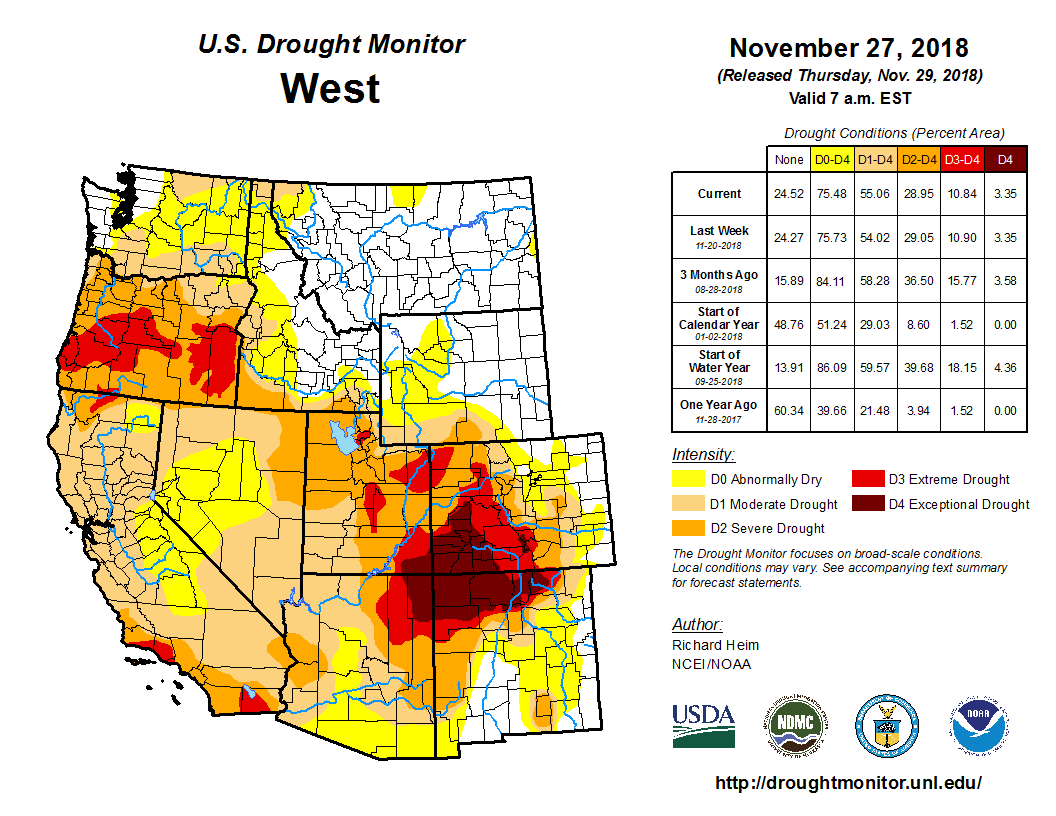
The U.S. Drought Monitor shows conditions have improved only marginally since the summer and meteorologists and water advocates say whether the snow is adequate to quench the most parched parts of the state won’t be known until spring, when the runoff begins.
Areas of Colorado that most need the snow still are at below-normal snowpack levels compared to the deep snow reported in northern Colorado.
“We have been able to rebound a little bit with these storms,” said Megan Stackhouse, a meteorologist with the National Weather Service in Grand Junction. “Durango is in our forecast area, they are still 8.66 inches below normal (precipitation) for the year so far.”
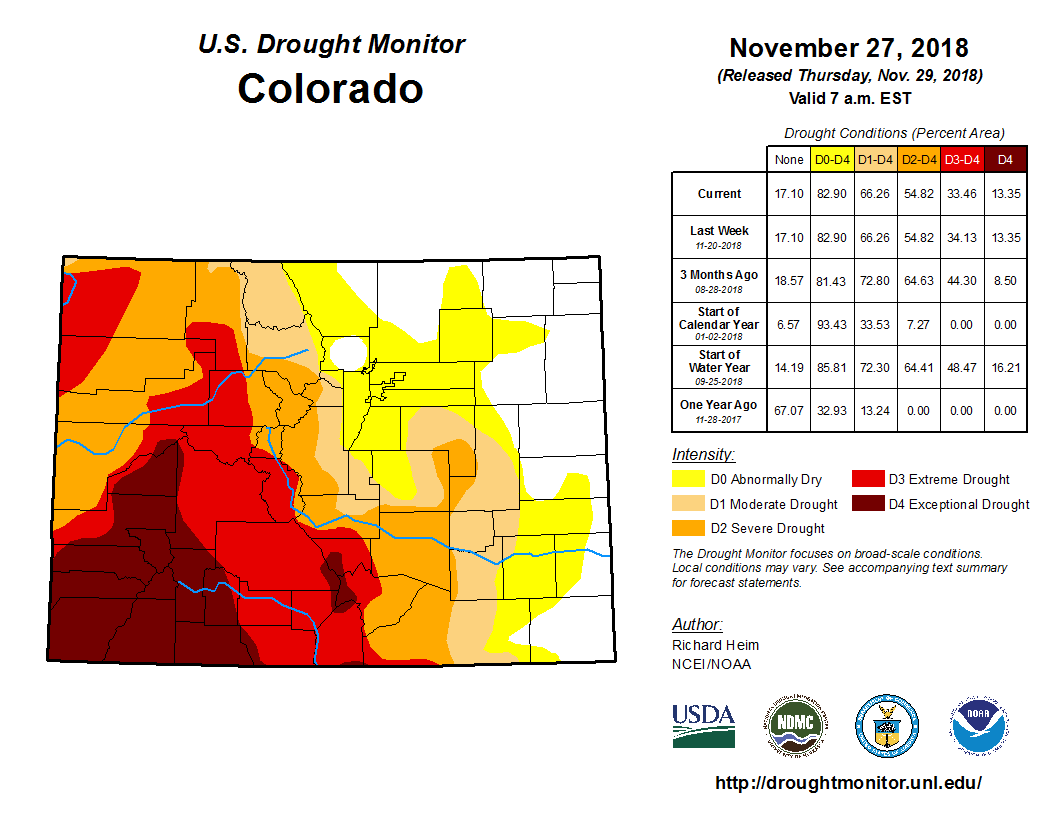
West Drought Monitor November 27, 3018.Colorado Drought Monitor November 27, 3018.
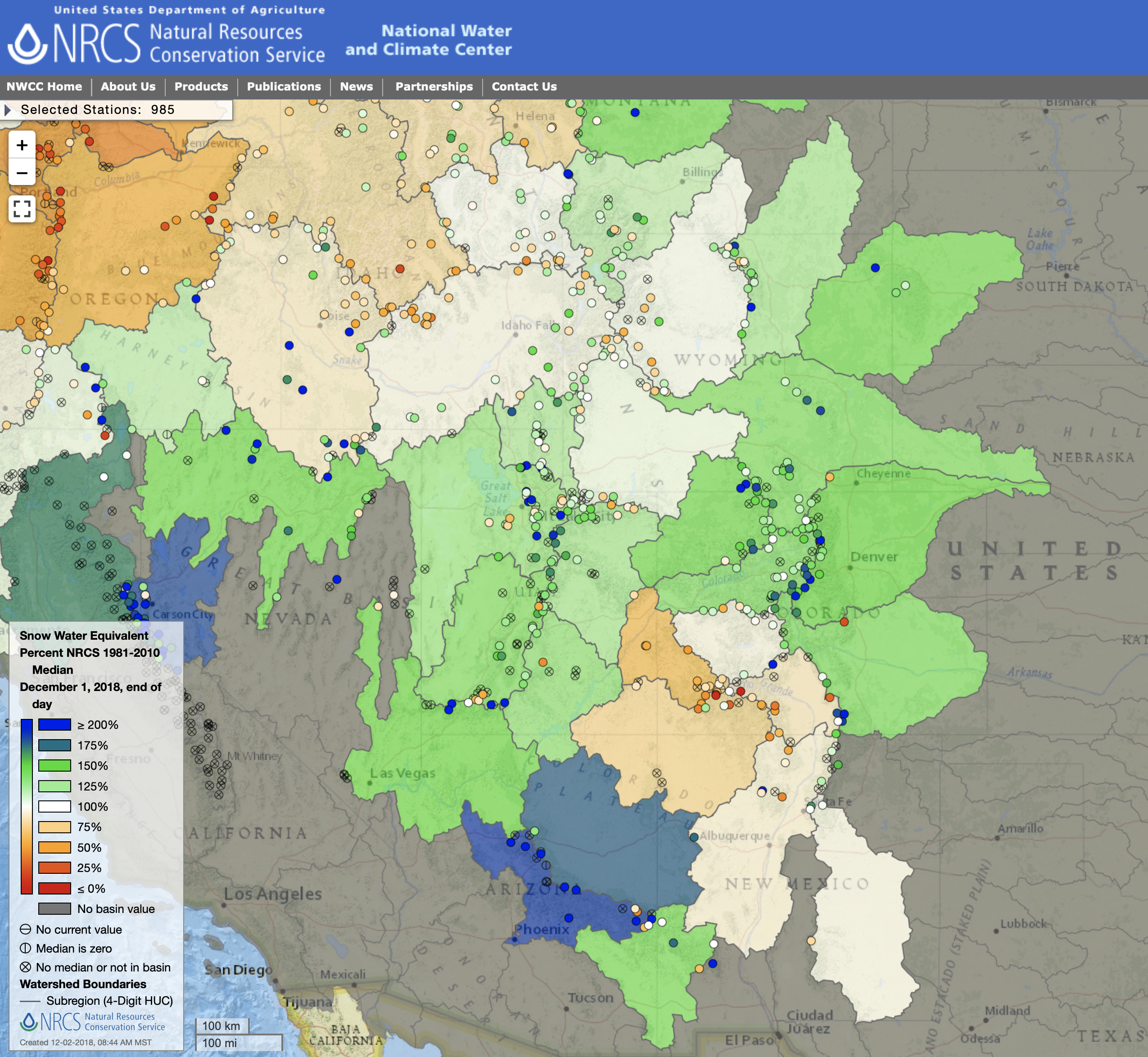
Snowpack in the San Miguel, Dolores, Animas and San Juan river basins was at 70 percent of normal as of Friday. The Gunnison River basin was at 94 percent of normal. The Rio Grande River basin was at 86 percent of normal and the Colorado River basin — which hydrates much of the the Front Range — was at 133 percent of normal.
The South Platte River basin’s snowpack level was 155 percent of normal heading into the weekend, when more snow fell.
Overall, the state’s snowpack level on Friday was 114 percent of normal, 108 percent of average, and 186 percent compared to last year’s level at this time.
A congressionally mandated climate change report predicts dire consequences for the United States if greenhouse gas emissions are not immediately reduced, adding that some of the most severe impacts will occur in Utah and other parts of the Southwest.
Utah experts say those changes are not on the doorstep, they’re already here.
“We are just on the fringe of this. It is only going to get more intense with droughts that are longer and hotter, and snow becoming less common until we have no snow at all,” predicted Brian McInerney, senior hydrologist with the National Weather Service in Salt Lake City…
The report’s findings include:
• The season heat wave length in many U.S. cities has increased by 40 days since 1960.
• Large declines in Western states’ snowpacks have occurred from 1955 to 2016.
• Atmospheric concentration of carbon dioxide, the largest contributor to human-caused warming, has increased 40 percent since the industrial era.
• Alaska is warming faster than any other U.S. state and has warmed twice as fast as the global average since the mid-20th century.
In Utah, summer temperatures are sizzling as well, the nighttime lows are getting higher, and the state continues to struggle with the impacts of protracted drought.
“Drought is embedded and holding in the Four Corners, mostly over New Mexico and Colorado,” said Royce Fontenot, senior service hydrologist with the National Weather Service in Albuquerque. “It’s really had an impact on water supply, and we’re seeing record-low stream flows.”
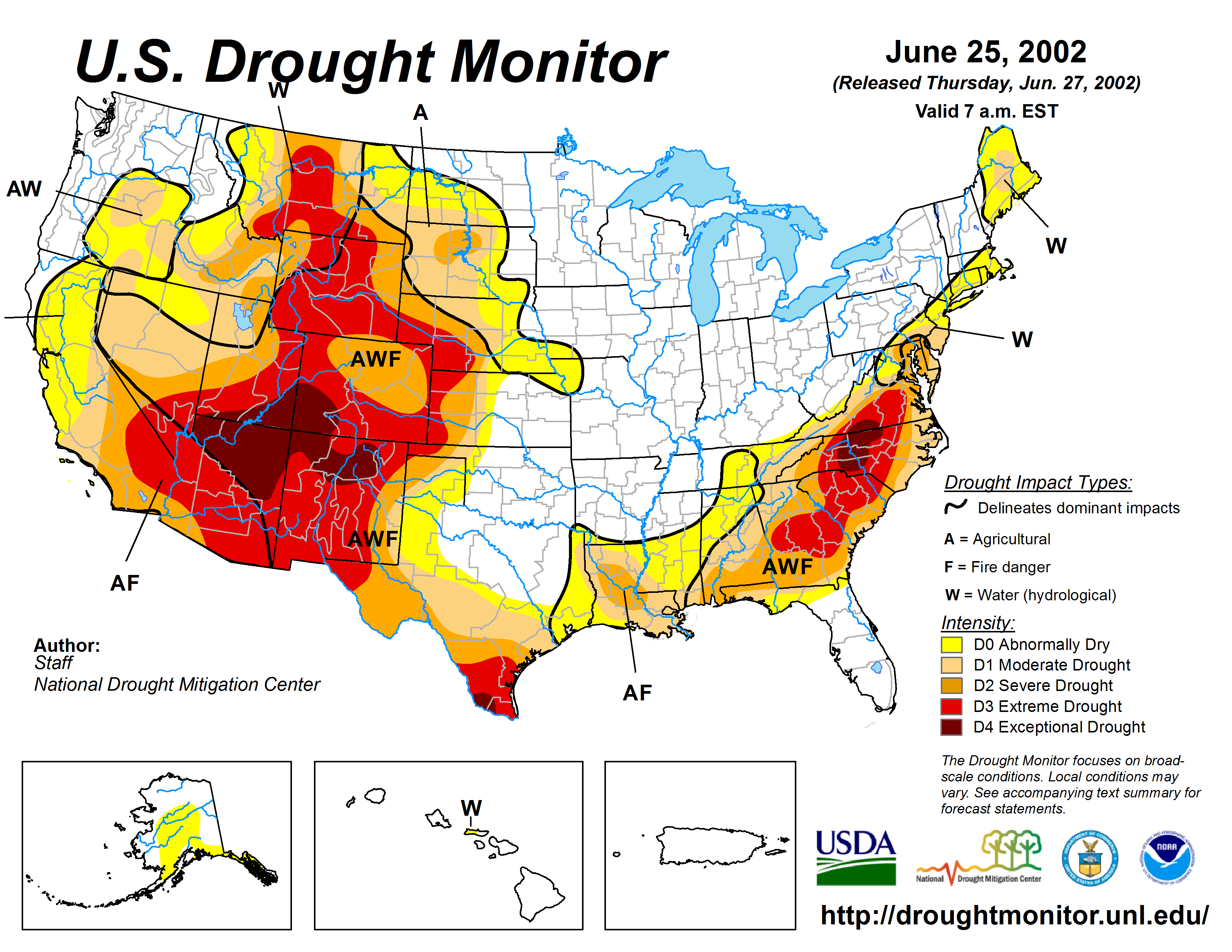
Almost 82 percent of the Intermountain West is in drought, with 8.64 percent in exceptional drought, according to the U.S. Drought Monitor. Colorado is a bit worse. About 83 percent is in drought and 13.35 percent of the state, mostly in the southwest corner, is in exceptional drought.
Stream flows in the southwest portion of the state also are much below normal, according to data from the U.S. Geological Survey. Thirteen streamflow stations between Mesa and Archuleta counties were reported as much below normal compared with historic levels, three as below normal and five as normal.
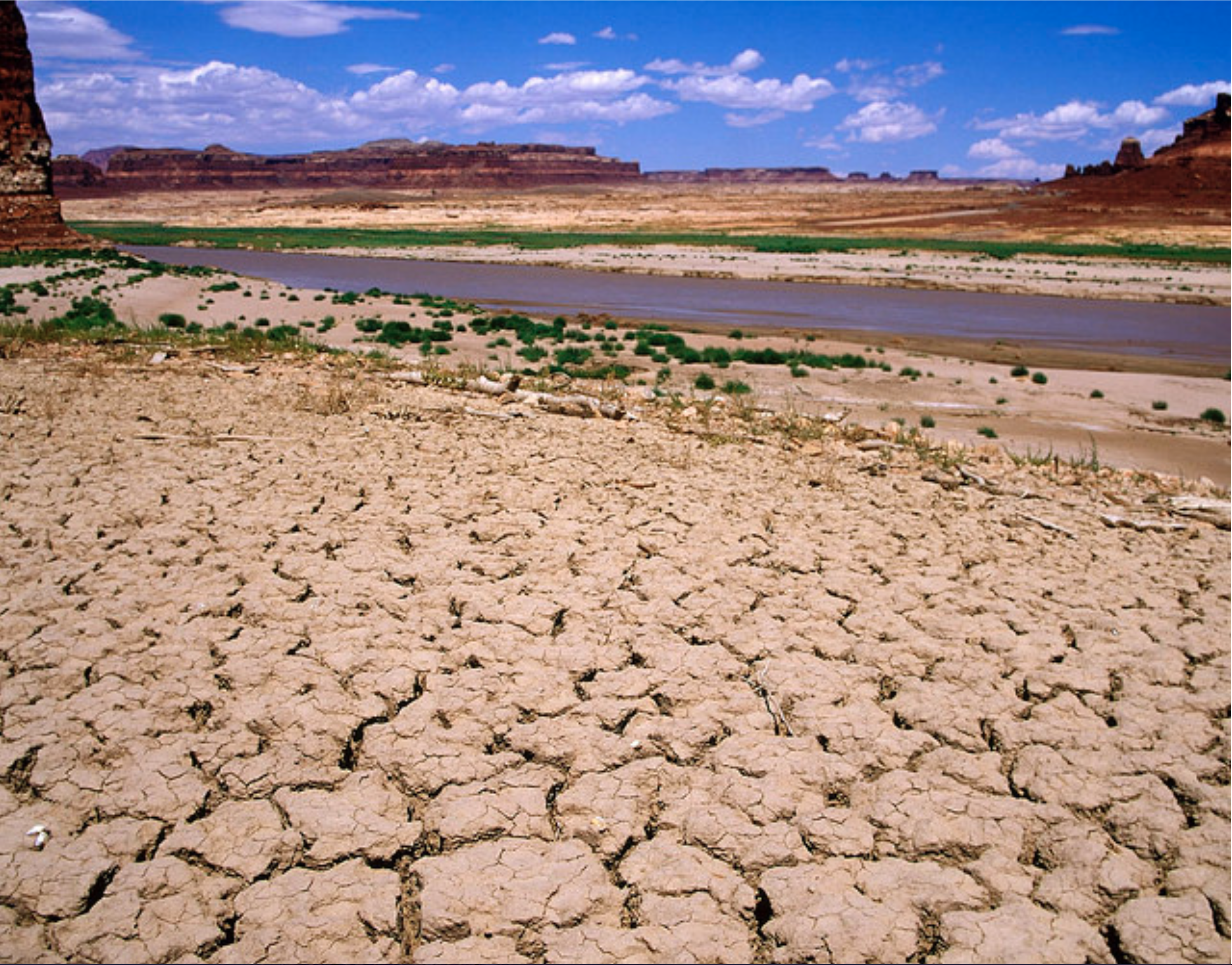
The dearth of water is obvious in Blue Mesa Reservoir, the largest reservoir in Colorado. Driving along U.S. 50, water level lines of years past are etched into the dry reservoir walls. The data paints an even more startling picture: the reservoir is at 43 percent of its average capacity recorded between 1985 and 2016. That measurement puts its November water volume in below the 10th percentile of historic levels.
Downstream, Lake Powell made headlines this year when it dropped to less than half full. This year was the second driest year on record for the major reservoir in Arizona, lagging just behind 2002.
Although eastern Colorado received “great” precipitation events toward the end of the summer and the beginning of the fall, it was not enough to satiate the parched soils, said Fontenot.
“The streams just didn’t get what they need,” he said.
To fully lift the Four Corners out of the drought by June, the region would need to receive 173 percent of normal precipitation, NOAA models show.
Early-season snow raised the snowpack in parts of Colorado to more than 200 percent of normal. Snow has continued to periodically fall, but so has the percent of median snowpack.
As of Nov. 29, the state sat at 117 percent of median snowpack. The northern and eastern part of the state recorded between 125 percent and 151 percent of median, while the San Miguel, Dolores, Animas and San Juan river basins reported 70 percent of median…
“It’s the new normal here, and we have to get used to these trends and cycles where the water situation is more iffy year to year,” Steve Berry, spokesman for Colorado Springs Utilities.
Systemwide, Utilities’ reservoirs are at 74 percent capacity compared with 87 percent capacity this time last year.
In 2002, Mother Nature fired a dry, scorching shot across the bow of the American Southwest, challenging the resiliency of towns, cities, and farms.
Snow had been thin that winter in the Rockies, the source of three-quarters of the Colorado River. A hot, windy spring desiccated what remained. Runoff in the river and its tributaries, which help sustain nearly 40 million people from Denver to San Diego and Los Angeles to Albuquerque, as well as many of the nation’s orchards and vegetable farms, ran at only 25 percent of the average.
The intensity of the drought surpassed anything recorded since American settlement in the late 19th century. It alone galvanized new infrastructure, new policies, and new thinking. But this drought did not just come and go. Despite a few big snow years, river flows in the 21st century still aren’t what they were for much of the last century.
After studying the data, two water researchers recently came to a startling and controversial conclusion: This wasn’t a drought as conventionally understood. Precipitation had declined, but there was more to it. They declared that the warming climate is drawing water into the atmosphere through evaporation, transpiration, and sublimation, causing it to become moister and the land to become drier.
In a 2017 paper, Brad Udall, a senior water and climate research scientist at Colorado State University, and his coauthor, Jonathan Overpeck, the dean of the School for Environment and Sustainability at the University of Michigan, attributed two-thirds of water declines to temperatures rather than precipitation, which they say is now a secondary contributor.
“This is the kind of drought we will have to deal with in the future,” Overpeck said at the Next Gen- eration Water Summit in Santa Fe in April.
From coast to coast, planners and water management professionals have begun to grapple with changes predicted by climate models, some in conjunction with projected population growth. Their challenge is to build resiliency to changing precipitation levels (both higher and lower amounts depending on the area), increased heat nearly everywhere, and more intense rain and weather events.
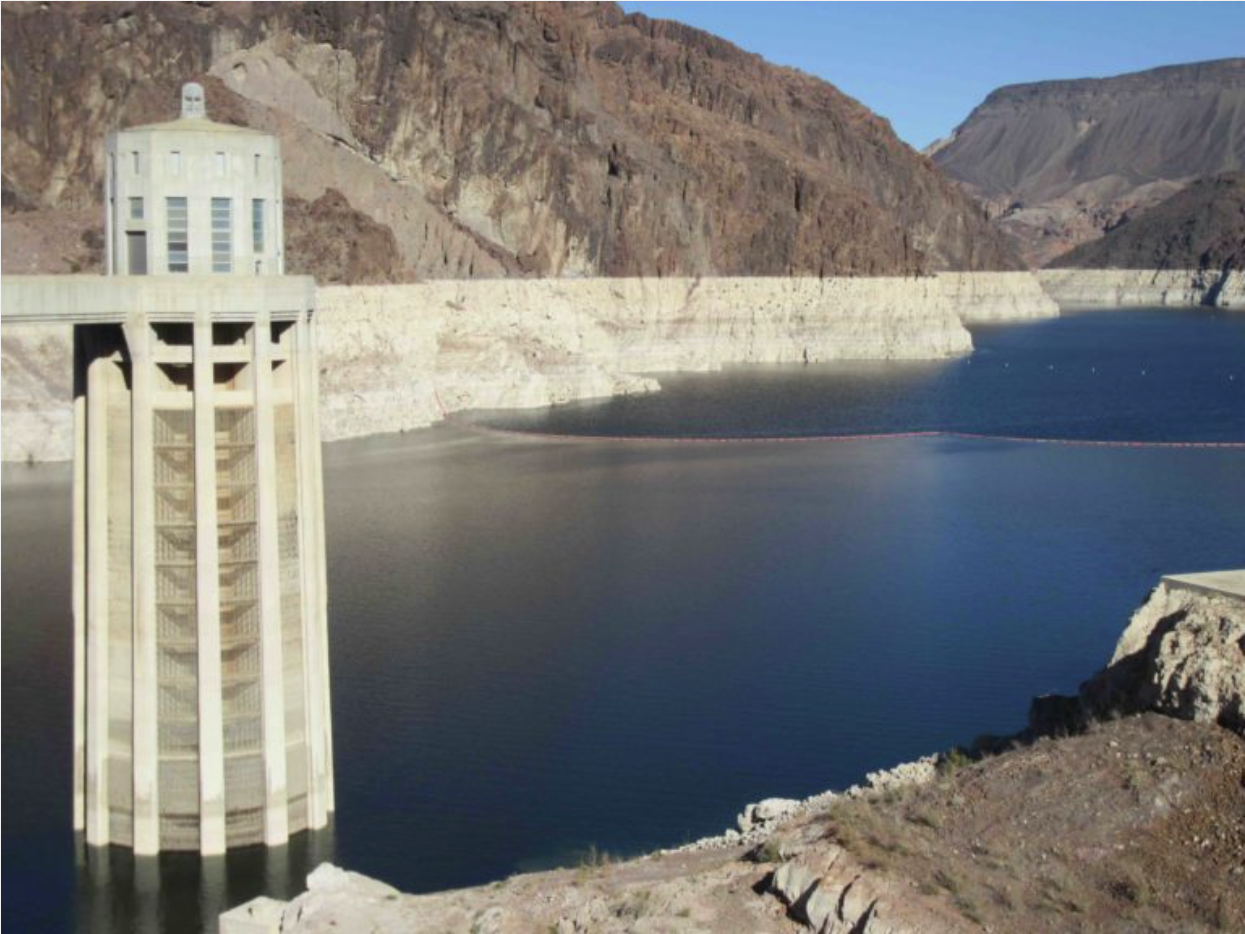
Reservoir levels in Lake Mead continue to decline and were down to 37 percent of capacity recently. December 2015 photo/Allen Best
Below the water line
Just a half-hour from the eternal lights of Las Vegas lies Lake Mead, the largest reservoir in the U.S. There visitors can see the evidence of what Udall and Overpeck contend is a temperature-driven drought. Beaches continue to expand as canyon walls reemerge after being under water for decades. As of June, Mead was 37 percent full—the lowest level since 1937, soon after construction of Hoover Dam was completed.
When it began drawing water from Lake Mead in 1971, Las Vegas’s population was 126,000. Now, the metropolitan area has two million residents and draws 40 million tourists annually. Ninety percent of water for Las Vegas and its suburbs comes from Mead through two tunnels from the reservoir’s mid- dle and higher levels.
Las Vegas Lake Mead intake schematic, courtesy SNWA.
In 2010, plunging reservoir levels spurred the Southern Nevada Water Authority to a greater extreme: a third tunnel that assumes the worst—a reservoir nearly empty. This third bore comes up from underneath the river bed, like the drain of a bathtub. It’s 20 feet wide, large enough to fit a sub- way train, and three miles long. For the sake of comparison, the Hoover Dam, if built today, would cost $840 million. This tunnel, completed in 2015, and a new pumping station that will be completed in 2020, will cost $1.4 billion. That is one of the costs associated with making the Las Vegas Valley more resilient in the face of a hotter, drier future that is more volatile in its extremes.
Climate models describe varied responses in average precipitation across the continental U.S. Changes in the next 20 to 30 years will likely be hard to detect, lost in the noise of natural variability, says Flavio Lehner of the Climate and Global Dynamics Laboratory at the National Center for Atmospheric Research. Sixty to 100 years out, the effects of human activities on the climate might become more obvious, but how much will depend upon whether and how much greenhouse gas emissions are reduced.“If we do hit the climate with a big hammer, meaning a lot of greenhouse gas emissions, then some of the more uncertain climate impacts, like average precipitation, become a bit clearer,” says Lehner.
In some respects, this year is a harbinger: Drought in the Southwest and flooding in the upper Midwest, Great Lakes region, and Northeast are the expected climate responses to increasing global greenhouse gas emissions. The Eastern Seaboard and South, already hit by hurricanes, can expect more rain associated with future storms. Extreme precipitation is projected to increase robustly with warming, while average precipitation will increase with less predictability. Temperature changes are more certain than precipitation and will make droughts and floods both worse, if unevenly so.
An image of the ruins of Chetro Ketl in Chaco Canyon (New Mexico, United States); shown is the complex’s great kiva. By National Park Service (United States) – Chaco Canyon National Historical Park: Photo Gallery, Public Domain, https://commons.wikimedia.org/w/index.php?curid=1536637
Lesser climate changes than what scientists expect in the 21st century have shaken past civilizations to their cores. John Fleck, director of the University of New Mexico Water Resources Program, points to Chaco Canyon, in what is now northwestern New Mexico. It was central to thousands of ancestral Pueblo between 850 and 1250 AD. When extended drought visited in the 1100s and again in the 1200s, the cultural institutions could not withstand the changes. People fled. In short, they lacked sufficient resiliency.
One definition of resiliency, Fleck points out, is the ability of large human and natural systems to undergo major shocks and still retain their basic functions and structures.
Even if Las Vegas is everyone’s favorite city to hate, says Fleck, it must be given credit for sizing up its vulnerability and taking steps to become more resilient. The city has made choices. It has kept the Bellagio fountains, the Venetian’s trompe-l’oeil canals, and Treasure Island’s waterfalls—important elements of Nevada’s economy.
However, in addition to a new reservoir tunnel, the Southern Nevada Water Authority has also spent $200 million to remove 185 million square-feet of lawns, saving 55 gallons per square of grass per year. This program is the primary reason Las Vegas has been able to ratchet down per-capita water use from 199 gallons per day two decades ago to 127 gallons today.
Now, the Southern Nevada Water Authority is taking aim at what officials describe as “purely aesthetic turf.” If the only time people set foot on the grass is to mow it, there’s little reason for it, they say. Already, lawns in front of new houses are prohibited, and those in backyards have been minimized. Rebates of $3 per square feet are offered.
Working together
When people think of water and the arid West, squabbles and chicanery like those that drove the storyline in Jack Nicholson’s Chinatown may come to mind. Fleck believes the stronger theme is of cooperation and collaboration. For example, pilot programs were launched several years ago in the seven Colorado River Basin states, from Wyoming to California, to determine whether voluntary, measurable reductions in the consumption of Colorado River water constitute a feasible and cost-effective approach to partially mitigate impacts of this new, long-term drought.
Incentives for this mitigation are financial and typically involve urban water providers paying farmers and ranchers to use less water by idling their fields, planting less consumptive crops, or altering their irrigation practices. Agriculture uses 50 to 90 percent of water in Southwestern states.
One five-year project now under way in California expects to keep 5,000 acre-feet of water in Lake Mead, the result of $1 million paid to Coachella Valley farmers to convert up to 667 acres of farm- land from flood-furrow irrigation to drip irrigation. For perspective, the average California household uses between one-half and one acre-foot of water per year for indoor and outdoor use.
Gila River watershed. Graphic credit: Wikimedia
Kim Mitchell, the Phoenix-based representative of Western Resource Advocates, cites multi-jurisdictional storage of water in aquifers as another tool. In Arizona, one recent agreement gives Phoenix the right to store 3,800 acre-feet of water from its share of the Colorado River diversion in an aquifer of the Gila River as it flows through the Gila River Indian Community.
This recharge has yielded three miles of a riparian ecosystem. Phoenix can tap the water when needed.
Climate change is not the only driver for these efforts. Arizona has perennially been among the nation’s fastest-growing states, despite its native aridity. Population has quadrupled in the last 50 years, but water use has stayed constant. This is partly because of shifts to water from farms to cities, but also increased efficiency in both. “What I’m hearing now at conferences is the need for the next genera- tion of conservation and reuse efforts,” says Mitchell.
In more arid states, greater attention has been focused on landscaping. In Colorado, 40 percent of total annual urban water use happens outdoors. In Arizona, where precipitation varies between seven to 11 inches annually, 77 inches of water will evapo- rate from a standing pool of water. In Las Vegas, one study found that lawns used 73 gallons per square foot annually, compared to one gallon for yards landscaped with the aid of the U.S. Environmental Protection Agency’s Water-Smart Landscapes program.
Southern California is home to 19 million peo- ple and is gaining 150,000 each year. It draws water from diverse sources, including a quarter from a 242-mile aqueduct from the Colorado River on the Arizona-California border. A major water whole- saler, Metropolitan Water District, chalked up a 36 percent reduction in water use from 1985 to 2015. Much of this, like in Las Vegas, has been done through replacement of water-hogging landscapes.
Bill McDonnell, water efficiency manager for Metropolitan, said at the Santa Fe conference that his budget went from $19 million to $450 million during California’s five years of drought ending in 2016–2017. This money incentivized the removal of 150 million square feet of turf, saving six billion gallons of water annually. Metropolitan, partnering with the California Landscaping Contractors Asso- ciation, held landscaping classes for the public, drawing 75 to 100 people for each class.
Heading east
Water conservation is a theme not just in places of saguaro cacti and mesquite. Water engineering consultant Peter Mayer says utilities have “been terrible” in their forecasts of needed water because they “did not anticipate that demand-management conservation policies would work as well as they have.” National water use per capita peaked in 1990 at about 182 gallons daily and has declined ever since. “It’s now [about 140 gallons per capita daily] the same as it was in 1960,” he says. “This national phenomenon is largely a result of policies.”
In Seattle, said Mayer, the cost of delivering new water supply in 1990 had been estimated at $800 million. On the other hand, policies that nudged consumers to the “soft path” of conservation—reducing water needed for toilets, clothes washers, and other measures—cost $75 million, saving Seattle $725 million. New York established universal metering in 1990 to provide accountability and then pro- vided rebates for more efficient toilets.
Those and other policies have decoupled population growth from increased water use in those and many other cities and states. “That is a significant change,” Mayer says.
Toilets are substantially more efficient than they were 20 years ago, down from 3.75 gallons per flush to 2.6 gallons. Washing machines, which get replaced more frequently than toilets, now use 46 percent less water. Mayer thinks further substantial water savings can be achieved through stanching leaks in residential infrastructure.
Changing behavior is more difficult. The per- capita water use for a shower is 8.3 gallons. “We’re very attached to our showers,” Mayer says.
Even so, he believes only half of potential efficiencies have been realized—which means there is opportunity to further reduce water use as climatic shifts becomes clearer and populations continue to grow.
Water rates can dramatically influence water use, he says. In some places, rates are being used in conjunction with a process called water budgeting. The utility can use GIS mapping and other tools to set a water budget for a house, depending upon the size and the space of the lawn. Then rates can nudge those users to appropriate uses.
Utilities at Irvine, Capistrano, and Ojai in California were the first to adopt this water budget approach in the early 1990s. “It’s a paradigm shift in the way we think about water management,” he says. “You are essentially putting a value on reasonable use. But once you exceed that amount, it gets expensive.”
Getting proactive
Motivations for lowering water use vary across the country. On the East Coast, it more often has to do with wastewater discharges. Pumping and treating water also consume large amounts of energy, which is important for communities intent on reducing greenhouse gas emissions. Drought and population growth motivate others.
“It’s all related,” says Mayer. “It’s getting ourselves more efficient in the urban sector, and that will only help us more in the long run. It has probably helped us today to avoid worse problems. The only downside from the perspective of utilities is the loss of revenue.”
Texas is one of the fastest-growing states in the U.S. From 29.5 million in 2020, the state’s popu- lation is projected to grow to 51 million by 2070. Austin is among the cities expecting to grow, from one million today to four million by century’s end. Even during a drought from 2008 to 2015, people kept coming.
Austin averages 33 inches of rainfall a year, a comparative jungle to the four inches in Las Vegas. But Austin’s water work parallels that of Colorado River Basin cities. Drought in Austin drove urgent responses. Per capita use has dived 35 percent over the last decade.
“We’re using less water than we did 250,000 to 300,000 people ago,” says Daryl Slusher, assistant director of environmental affairs and conservation. The city, site of the famed South by Southwest festival, used policies similar to California’s: rebates for replacement of turf with drought-tolerant landscaping. It also adopted an incremental approach for lawn watering: one day a week for automated systems, three days for manual watering, and no restrictions for drip irrigation systems.
A project called Water Forward, partly assisted by the city’s planning department, has formulated a 100-year vision for Austin for consideration by elected officials that anticipates not only population growth and potential return of drought but also the possibility of a marginally drier climate.
Reuse is also a viable strategy. The 2017 state water plan for Texas identified 42 percent of future water needs as being met through demand manage- ment and reuse. Next year, El Paso expects to begin building a plant to provide a portion of its water sup- ply, the first such permanent facility in the U.S. This is different than the more common indirect potable reuse, where wastewater is first released in an environmental buffer before treatment.
Looking ahead
Elsewhere in the U.S., 12 cities from Portland to Tampa and San Diego to Philadelphia are collaborating to advance water utility climate-change adap- tation. Their partnership, called the Water Utility Climate Alliance, has the stated vision of “climate- resilient water utilities, thriving communities.”
Flooding in Longmont September 14, 2013 via the Longmont Times-Call
Laurna Kaatz of Denver Water, WUCA’s current chair, emphasizes the uncertainties of future precipitation but the likelihood of greater extremes, which will require understanding the different tools and mechanisms to address the range of possible futures. Resiliency planning, she says, doesn’t mean just bouncing back, but planning in ways so that you don’t have to.
Amid the ongoing discussions about water in the face of a changing climate, two recurring themes stand out: The first is the need for partnerships and collaborations, often at a regional scale. The second is the continued role of—and even greater capacity for—increased water efficiency. It’s a dishrag that can continue to be wrung.
Allen Best writes about water, energy and other topics from Denver. His website is mountaintownnews.net.
FromThe Grand Junction Daily Sentinel (Dennis Webb):
The climatological pattern that could contribute to a wetter-than-average winter in Colorado is taking its time becoming an actual thing this season. But the National Oceanic and Atmospheric Administration is still expecting its arrival, hoping that it could help alleviate drought conditions that are particularly severe in the Four Corners region.
That region has been especially dry in recent years, and currently is experiencing the worst drought conditions in the continental United States. It’s ranked as being in exceptional drought, the worst category, with that drought level extending north through Delta and eastern Montrose counties, even crossing into a bit of eastern Mesa County. The rest of Mesa County and the rest of western Colorado are all in lesser stages of drought, with conditions having eased thanks to some fall moisture.
While southwest Colorado also benefited from that moisture, conditions more recently have been drier there. The Natural Resources Conservation Service reported as of Thursday that while statewide snowpack averaged 117 percent of normal, southwest Colorado has fallen below median snowpack, with the Gunnison River Basin at 94 percent, the Upper Rio Grande at 86 percent and the Four Corners basins at just 70 percent. That compares to 133 percent for the Upper Colorado River Basin, 130 percent for the Yampa/White river basins, and around 150 percent for the Arkansas and South Platte basins…
“We still think it will form,” [Mike Halpert] said…
Specifically, the ocean warming needs to alter tropical rainfall patterns, bringing more rain to the central and eastern Pacific and less rain over Indonesia, and it’s that rainfall shift that affects the jet stream and moisture patterns in the United States.
Halpert said he’s expecting such an atmospheric response to happen shortly. Fortunately, he said, in the meantime the short-term forecast over the next few weeks already is for wetter-than-normal conditions. That means a likely wetter-than-average start to winter in the Southwest even before El Niño influences kick in.
Based in good part on that El Niño forecast, the Climate Prediction Center says there are above-average chances for above-normal precipitation in Colorado through March…
It’s also noteworthy that the Climate Prediction Center says there is an above-average chance of warmer-than-normal temperatures this winter in Colorado. Halpert said El Niños used to be associated with colder winters in the southern United States, but in light of a warming climate over the years, forecasters aren’t expecting below-average temperatures this year.
[Royce Fontenot] said the trend of warming temperatures matters when it comes to drought assessment, when taken in context with other factors such as the region and time of year, which can affect things such as levels of evaporation, and of water absorption and release by plants.
[John Berggren[ said that even with an above-average snowpack season, if there is a warm winter and spring, “you can very quickly eliminate those gains … which is unfortunate.”
He said even a weak El Niño is better than no El Niño when it comes to precipitation, particularly in the Four Corners area. That said, “it’s not going to be a gangbusters of a winter, especially with the warmer-than-average temperatures that are expected,” he said.
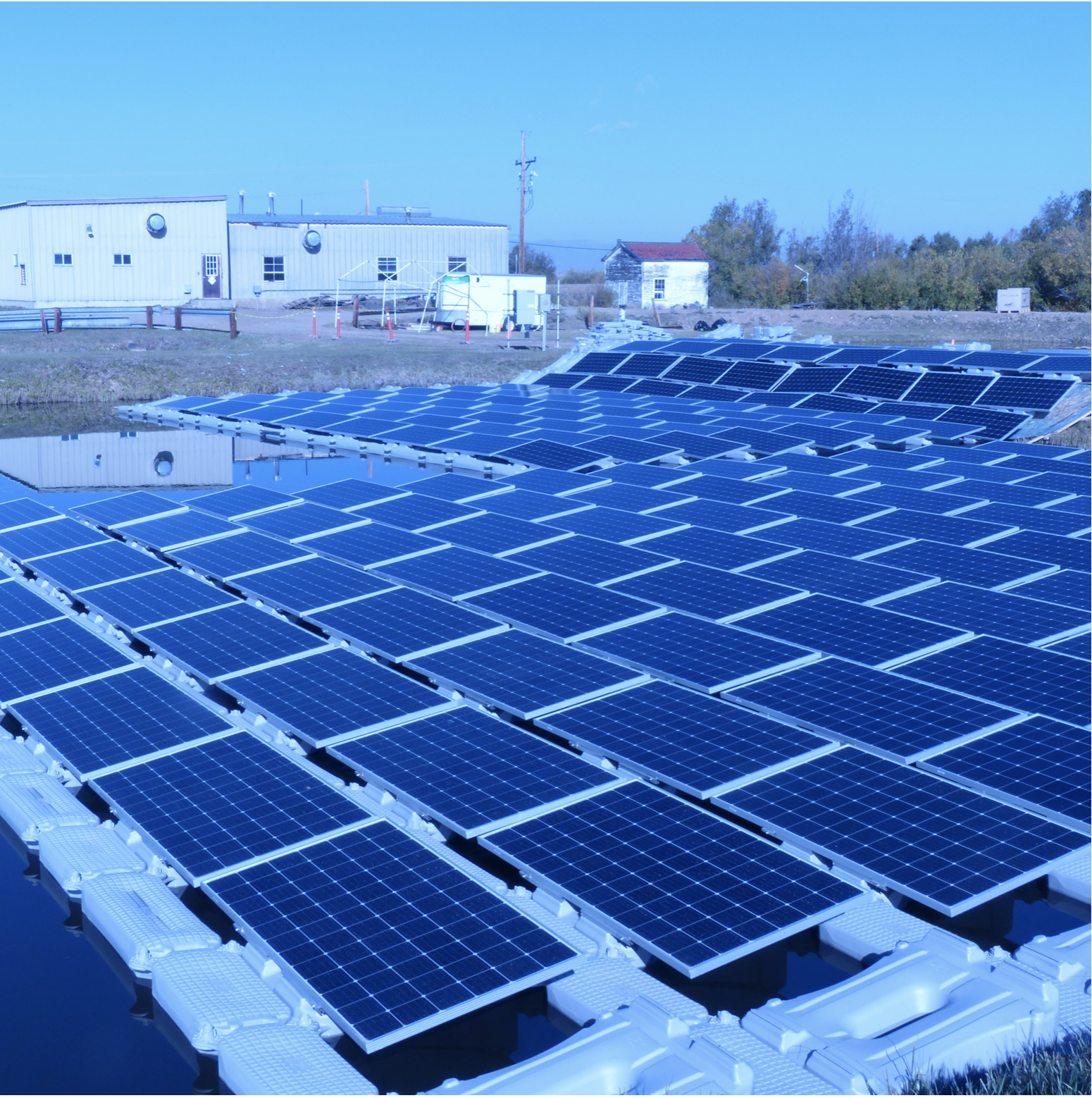
The Energy Information Administration (EIA) recently highlighted a little-discussed benefit of using renewables like wind and solar to produce electricity: Unlike most power sources, they require “almost no water.”
[…]
According to the latest U.S. Geological Survey (USGS) data from 2015, 41 percent of the water used in America is for power generation. The next highest use is irrigation for agriculture, accounting for 37 percent of U.S. water use (and close to two-thirds of that is consumptive).
The Fourth National Climate Assessment — the work of 13 federal agencies and more than 350 scientists, including me — is clear: The Earth is warming faster than at any time in human history, and we’re the ones causing it. Climate change is already affecting people, and the more carbon we produce, the more dangerous the effects over the coming century. Nevertheless, many people continue to believe and propagate some misleading myths. Here are the five I hear most frequently.
MYTH NO. 1 Climate scientists are in it for the money.
When the second volume of the National Climate Assessment was released on Nov. 23, Rick Santorum, a Republican former senator from Pennsylvania, took to CNN to proclaim that climate scientists “are driven by the money that they receive.” Former House majority leader Tom DeLay (R-Tex.) appeared on the network the next day declaring the report to be “made by scientists that get paid to further the politics of global warming.”
I was one of the report’s authors. How much did I earn for the hundreds of hours I spent on it? Nothing. Nearly every day, climate scientists are accused of venality. Our other purported sins include fabricating data, selling out to “big green” — which supposedly tethers our grant money to doom-and-gloom findings — and fanning the flames of hysteria to further our nefarious agenda…
MYTH NO. 2
The climate has changed before. It’s just a natural cycle.
Last fall, when the first volume of the National Climate Assessment was released, White House spokesman Raj Shah responded that “the climate has changed and is always changing.” President Trump himself has embraced this position, claiming that the climate “will change back again.” This line is a popular one with people who dismiss climate change by maintaining that we’ve had ice ages before, as well as warm periods, and so the warming we’re seeing now is just what the Earth has always done…
MYTH NO. 3 Climate scientists are split on whether it’s real.
We often hear that climate scientists are split 50-50 when it comes to whether global warming is occurring. “Each side has their scientists,” Senate Majority Leader Mitch McConnell (R-Ky.) told Politico in 2014. Trump echoed that rhetoric on “60 Minutes” this October, telling Lesley Stahl, “We have scientists that disagree” with human-caused global warming.
In reality, more than 97 percent of climate scientists agree that global warming is happening and that humans are causing it. At least 18 scientific societies in the United States, from the American Geophysical Union to the American Medical Association, have issued official statements on climate change. And it’s been more than 50 years since U.S. scientists first raised the alarm about the dangers of climate change with the president — at the time, Lyndon B. Johnson. The public confusion has been manufactured by industry interests and ideologues to muddy the waters.
MYTH NO. 4
Climate change won’t affect me.
We often think the most widespread myth is that the science isn’t real. But according to public opinion polls by the Yale Program on Climate Change Communication , the most prevalent misconception — one that the majority of us have bought into — is that climate change just doesn’t matter to us…
The effects of climate change are not far off problems for future generations. They are existential problems for everyone alive today.
That’s one big takeaway from the U.S. federal government’s latest roundup of climate science, the National Climate Assessment, now in its fourth iteration…
In a chapter dedicated to climate change effects in the southwest, climate scientists say “with very high confidence” that warm temperatures are reducing the water content of mountain snowpack and the flows of rivers and streams that depend on snowmelt. The chapter’s landing page features a photo of low water levels at the nation’s largest reservoir, Lake Mead outside Las Vegas, Nevada, a near perfect symbol of the region’s ongoing water challenges.
Lake Mead December 2017. Photo credit: Greg Hobbs
Without coming up with new ways to manage water and cut greenhouse gas emissions, the report’s authors say existing gaps between water supplies and demands in the desert southwest will only continue to grow.
Much of the report confirms and reconfirms what scientists already know. Here are some of the biggest takeaways for the southwest, which the report defines as California, Nevada, Arizona, New Mexico, Colorado and Utah:
Figure 25.1: Temperatures increased across almost all of the Southwest region from 1901 to 2016, with the greatest increases in southern California and western Colorado.23 This map shows the difference between 1986–2016 average temperature and 1901–1960 average temperature.23 Source: adapted from Vose et al. 2017.23. Map credit: The National Climate Assessment 2018
1. “Water security in the United States is increasingly in jeopardy.”
That’s the sentence that greets readers of the report’s third chapter, dedicated to exploring how climate change will stress U.S. water infrastructure…
2. Shrinking snowpack likely to continue
Southern Rocky Mountain snowpack in Colorado, Wyoming and Utah supplies the vast majority of river flows in the Colorado River watershed. And it’s becoming increasingly scarce…
3. We know how to adapt. But can we do it fast enough?
Some parts of the southwest are already showing resilience in the face of a warming climate, the report says…
The severity of southwestern water shortages is largely up to us, as the report notes in its section on how confident climate scientists are in their findings: “The actual frequency and duration of water supply disruptions will depend on the preparation of water resource managers with drought and flood plans, the flexibility of water resource managers to implement or change those plans in response to altered circumstances, the availability of funding to make infrastructure more resilient, and the magnitude and frequency of climate extremes.”