

From the report Colorado River Insights, 2025: Dancing With Deadpool (Jonathan Overpeck and Bradley Udall):
- Jonathan Overpeck is a climate scientist and Dean of the School for Environment and Sustainability at the University of Michigan; prior to moving to Michigan, he lived and worked in Colorado and Arizona for over 25 years.
- Bradley Udall is a Senior Water and Climate Research Scientist/Scholar, Colorado Water Center, Colorado State University.
Basin status update
Back in 2017, we published a peer-reviewed research paper (Udall and Overpeck, 2017) asserting that climate warming was a principal cause of the then eighteen-year Colorado River drought, a drought that had already seen a 17% reduction in natural flows of the river. We expressed confidence that warming would continue to eat away at these flows until the warming (due to greenhouse gas emissions, high confidence) ceased and suggested that increases in precipitation would likely not be able to compensate for the long-term impact of rising temperatures. We used the term “Hot Drought” to distinguish this period from the “Dry Droughts in the 20th century. This important concept continues to be researched and confirmed (King et al, 2024, Zhuang et al, 2024). Now, eight years later, as the warming has continued unabated and may be accelerating (Hansen et al, 2025, Ripple et al., 2025), it has become clearer than ever that precipitation declines have also played an important role in causing the worst drought in at least 1200 years (Williams et al., 2022). More troubling, however, is new evidence that human caused climate change is not only driving a steady increase in temperature but is also the main culprit behind the precipitation declines as well.
This is clearly bad news, but there is a silver-lining. But first, let’s review where we are with respect to the unprecedented 21st century Colorado River drought, and the new evidence suggesting the situation is worse than we first thought.
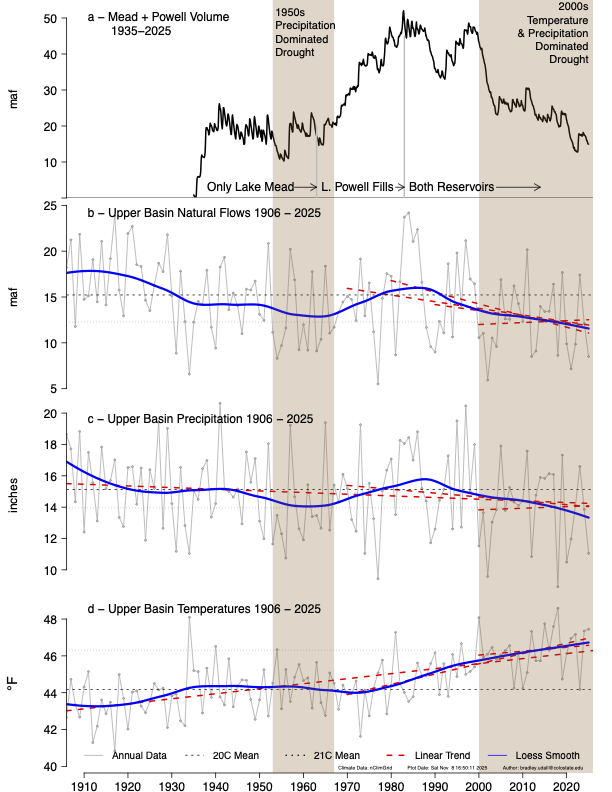
Each year one of us updates a figure3 that was first published in our 2017 paper showing the status of the Colorado River drought and its climate drivers. We’ve included this figure here, updated through the September 30th end of the 2024-25 water year (Figure 1). The combined volume of water stored in Lakes Mead and Powell has continued its decline to less than 15 maf (million acre-feet), the 26-year average naturalized flow of the Colorado River at Lees Ferry is now 12.2 maf, well below the 16.5 maf mainstem apportionments assigned to the seven Colorado River Basin states and Mexico. Critically, the 6 years since 2020 have averaged 10.8 maf/year, the same as the then-unprecedented low flows during 2000-05 at the start of this record-setting drought.
Matching the long slow decline in naturalized flows over the last century has been a similar long slow decline in precipitation in the Upper Basin of the Colorado (Figure 1, Panel C). Superimposed on this long trend are two notable drought periods with lower-than-average precipitation: one in the 1950’s-60’s and now the on-going current drought, at 26-years and counting, a multidecadal “megadrought” and the longest drought in the Colorado River Basin instrumental record. Mirroring the century-long declines in precipitation and naturalized flows is a long-term warming trend that started to accelerate in the 1970’s and that is clearly linked to on-going global warming (Williams et al., 2020, Masson-Delmotte et al., 2021). Whereas the former drought of record, in the 1950’s and 60’s, was defined almost entirely by precipitation deficit (Figure 1, left gray shaded area), the current megadrought is being driven by a precipitation deficit compounded by relentless warming (Figure 1, right gray shaded area).
The impact of a warming climate
As we highlighted in earlier peer-reviewed papers (e.g., Vano et al., 2014, Udall and Overpeck, 2017), warming exacerbates drought in multiple ways. A warming atmosphere can hold progressively more water, and thus as the atmosphere warms it can evaporate more water. At the same time, a warmer atmosphere can cause soils and vegetation to lose more water to the atmosphere via evapotranspiration, especially as the warming atmosphere also causes the growing season in the Upper Basin of the Colorado to become longer (Das et al., 2011; Udall and Overpeck, 2017). Hot, dry springs in the basin bring on early melt and green-up (Hogan and Lundquist, 2024, Lin et al., 2022). Drier soils and vegetation thus mean less water that can eventually end up in the river, and incidentally also explains why the West I experiencing more wildfire (Abatzoglou and Williams, 2016). Atmospheric warming also leads to snow loss, a shorter snow-cover season, and an associated loss of solar radiation reflectivity – this drives further warming and yet more evapotranspiration (Milly and Dunne, 2020; Ban et al., 2023).
Large changes in groundwater supplies in both the Upper and Lower Colorado River Basins have been noted from soil moisture to deeper layers since 2002 (Abdelmohsen et al., 2025, Chandanpurkar et al., 2025). It is becoming increasingly clear that dry summer soils can persist into the fall and winter soaking up snowmelt the following spring thereby reducing runoff (Das et al., 2011, Lapides et al, 2022).
Precipitation declining
Estimates vary, but it appears that up to half of the observed roughly 20% reduction in Colorado flows are likely related to the steadily warming temperatures of the Colorado River headwaters region (Udall and Overpeck, 2017; Xiao et al., 2018; Milly and Dunne, 2020, Bass et al, 2023). Moreover, since 2017 it has become increasingly clear that the other major cause of the flow reductions is a sustained decrease in precipitation (Figure 1, Panel C). Until recently, the big question is whether the observed 7% post-1999 decrease in precipitation relative to the 20th century average was due primarily to natural multidecadal climate variability or human-caused climate change. We now have good reasons to suspect the latter, and this translates to mostly bad news.
Megadrought country
It is now more clear than ever that the southwest United States, including the headwater regions of the Colorado River, is megadrought country. Tree-ring and other paleoclimatic sources reveal that multiple droughts lasting two or more decades took place over the last 2000 years (Meko et al, 2007; Gangopadhyay et al., 2022), and a good case has now been made for the current drought being among the most severe in at least 1200 years in large part because of the unprecedented amplifying effect of warming temperatures during the current sustained period of reduced precipitation (Williams et al., 2020; 2022).
However, there is another important lesson to be gleaned from the rich paleoclimatic record of pre-20th Century droughts and megadroughts. Given that global temperatures were likely significantly cooler prior to the last 50 years then they are now (PAGES 2k Consortium, 2019), it follows that themany long Upper Colorado Basin droughts that took place over the last 2000 years preceding the current drought were likely due much more to precipitation deficits alone. This means that we have good evidence that precipitation deficits exceeding those of the current on-going drought in both magnitude and duration are not rare, and that the current drought could see not just warmer temperatures in the future (a sure bet), but also even larger and longer precipitation deficits. It is thus critical that we consider what is presently causing the precipitation decline in the headwaters region of the Colorado River, and from that get a better sense of what’s most likely ahead. And for motivation, since we wrote our 2017 paper, new evidence has emerged that drought-dominated periods – likely driven mostly by precipitation declines for the reason noted above – as long as 80 years have occurred in the last 2000 years in the Upper Basin of the Colorado River (Gangopadhyay et al., 2022).
The cause of precipitation decline
Could we be in for an even longer period of reduced precipitation than the last quarter. century in the years to decades ahead? The answer depends on knowing the cause of the on-going precipitation decline, and there are two primary possibilities. The first is natural climate variability in the climate system, which can cause periods of lower precipitation to oscillate irregularly with periods of higher precipitation. Thus, if the recent period of low precipitation is due to natural climate variability, there could be periods of greater precipitation returning to the Colorado headwaters, although these wet periods would be increasingly unlikely to offset the drying impact of the steadily increasing temperatures. The second potential cause of on-going precipitation deficit is an anthropogenically-forced trend in precipitation decline due to increasing human emissions of greenhouse gases and reductions in Asian, mostly Chinese, aerosols to the atmosphere.5 Such an anthropogenic trend would likely portend continued low precipitation into the future, in synch with continued warming.
One well-known source of natural variability in precipitation in the Colorado River Basin is decadal and longer variation in the sea-surface temperature patterns of the North and tropical Pacific Ocean, giving rise to what is called the Pacific Decadal Oscillation (PDO). A peer-reviewed research paper just published (Klavans et al., 2025) reviews the scientific literature and notes that decadal and longer variability in the PDO has long been thought to have arisen from atmosphere-ocean interactions internal to the natural climate system and has in turn caused decadal and longer precipitation variability downstream over western North America. The PDO is strongly correlated with La Nina, and both are known to be associated with a dry Southwest US (Seager and Ting, 2017; Lehner et al., 2018; Hoerling et al., 2023, Seager et al., 2023). Klavans et al., 2025 also presents convincing new evidence that anthropogenic forcing in the form of human emissions of greenhouse gases and reductions in atmospheric aerosols is now the primary driver of the same elevated sea-surface temperatures and this forcing is thus the primary cause behind the precipitation decline that has been observed since the start of the on-going Colorado River megadrought. In other words, human-driven climate change has caused the PDO oscillation to lock into its negative dry phase and this situation is likely to persist into the future.
A second new paper (Todd et al., 2025) highlights that higher Northern Hemisphere temperatures from about 11,000 to 6,000 years ago, in this case due to well-understood changes in the Earth’s orbit, caused a negative PDO-like Pacific warming that in turn forced western U.S. precipitation to lock into a multi-millennia-long dry phase. This new research thus provides yet more confidence that the odds will favor lowered precipitation in the Colorado River headwaters for as long as human-caused warming persists. Both new research papers (Todd et al., 2025; Klavans et al., 2025) also note that state-of-the-art climate models underestimate the role of human-caused climate change in driving persistent drought in the region containing the headwaters of the Colorado River. Natural decadal and longer climate variability clearly caused the many droughts and megadroughts of the last 2000 years, but looking ahead today, it appears that human-caused climate change is likely to exert a stronger influence, and this will mean a higher likelihood of continued lower precipitation in the headwaters of the Colorado River into the future.

Conclusion: bad news, good news
To sum it up, since 2017 we now know quite a bit more about how climate change is altering the flows of the Colorado River. Whereas eight years ago we were able to confidently anticipate that human-caused atmospheric warming alone would continue to reduce flows in the river, we now have a better, though still emerging, understanding of how human emissions of greenhouse gases are likely to also cause a continued reduction in precipitation in the headwaters of the Colorado River. Whereas we have known since 2017 that additional future climate warming will cause continued and even larger flow reductions, two new carefully crafted studies strongly suggest we are in for extended dry periods in the Colorado headwaters in the decades ahead.
As we hinted earlier, is important to recognize that the news is not all bad, and there is indeed a silver-lining to our improved understanding of why the natural flows of the Colorado are declining, and what this means for the future. We can say with confidence that human-caused emissions of greenhouse gases are having an increasingly negative impact on the flows of the Colorado River, a river that serves over forty million people and region that has an annual economy in excess of $1.4 trillion (James et al., 2014). This climate change impact will continue to worsen, but because humans cause it, humans can halt it. This is good to know as we work to reduce the greenhouse gas emissions to the atmosphere that are causing the climate change. The Colorado River will benefit.

Literature Cited
Abatzoglou, J. T., & Williams, A. P. (2016). Impact of anthropogenic climate change on wildfire across western US forests. Proceedings of the
National Academy of Sciences, 113(42), 11770–11775. https://doi.org/10.1073/pnas.1607171113
Abdelmohsen, K., Famiglietti, J. S., Ao, Y. Z., Mohajer, B., & Chandanpurkar, H. A. (2025). Declining Freshwater Availability in the Colorado River
Basin Threatens Sustainability of Its Critical Groundwater Supplies. Geophysical Research Letters, 52(10), e2025GL115593. https://doi.org/10.1029/2025GL115593
Ban, Z., Li, D., & Lettenmaier, D. P. (2023). The Increasing Role of Seasonal Rainfall in Western U.S. Summer Streamflow. Geophysical Research
Letters, 50(9), e2023GL102892. https://doi.org/10.1029/2023GL102892
Bass, B., Goldenson, N., Rahimi, S., & Hall, A. (2023). Aridification of Colorado River Basin’s Snowpack Regions Has Driven Water Losses Despite
Ameliorating Effects of Vegetation. Water Resources Research, 59(7), e2022WR033454. https://doi.org/10.1029/2022WR033454
Chandanpurkar, H. A., Famiglietti, J. S., Gopalan, K., Wiese, D. N., Wada, Y., Kakinuma, K., Reager, J. T., & Zhang, F. (2025). Unprecedented
continental drying, shrinking freshwater availability, and increasing land contributions to sea level rise. Science Advances, 11, eadx0298
Das, T., Pierce, D. W., Cayan, D. R., Vano, J. A., & Lettenmaier, D. P. (2011). The importance of warm season warming to western U.S. streamflow
changes: WARM SEASON WARMING STREAMFLOW CHANGES. Geophysical Research Letters, 38(23), https://doi.org/10.1029/2011GL049660
Gangopadhyay, S., Woodhouse, C. A., McCabe, G. J., Routson, C. C., & Meko, D. M. (2022). Tree Rings Reveal Unmatched 2nd Century Drought in
the Colorado River Basin. Geophysical Research Letters, 49(11), e2022GL098781. https://doi.org/10.1029/2022GL098781
Hansen, J. E., Kharecha, P., Sato, M., Tselioudis, G., Kelly, J., Bauer, S. E., Ruedy, R., Jeong, E., Jin, Q., Rignot, E., Velicogna, I., Schoeberl, M. R., Von
Schuckmann, K., Amponsem, J., Cao, J., Keskinen, A., Li, J., & Pokela, A. (2025). Global Warming Has Accelerated: Are the United Nations and the
Public Well-Informed? Environment: Science and Policy for Sustainable Development, 67(1), 6–44. https://doi.org/10.1080/00139157.2025.2434494
Hoerling, M., & Kumar, A. (2003). The Perfect Ocean for Drought. Science, 299(5607), 691–694. https://doi.org/10.1126/science.1079053
Hogan, D., & Lundquist, J. D. (2024). Recent Upper Colorado River Streamflow Declines Driven by Loss of Spring Precipitation. Geophysical
Research Letters, 51(16), e2024GL109826. https://doi.org/10.1029/2024GL109826
IPCC, 2021: Climate Change 2021: The Physical Science Basis. Contribution of Working Group I to the Sixth Assessment Report of the
Intergovernmental Panel on Climate Change [Masson-Delmotte, V., P. Zhai, A. Pirani, S.L. Connors, C. Péan, S. Berger, N. Caud, Y. Chen, L. Goldfarb,
M.I. Gomis, M. Huang, K. Leitzell, E. Lonnoy, J.B.R. Matthews, T.K. Maycock, T. Waterfield, O. Yelekçi, R. Yu, and B. Zhou (eds.)]. Cambridge
University Press, Cambridge, United Kingdom and New York, NY, USA, 2391 pp. doi:10.1017/9781009157896.
James, P. T., Evans, D. A., Madly, E., & Kelly, C. (2014). THE ECONOMIC IMPORTANCE OF THE COLORADO RIVER TO THE BASIN REGION. L.
William Seidman Research Institute, W. P. Carey School of Business, Arizona State University.
King, K. E., Cook, E. R., Anchukaitis, K. J., Cook, B. I., Smerdon, J. E., Seager, R., Harley, G. L., & Spei, B. (2024). Increasing prevalence of hot drought
across western North America since the 16th century. Science Advances, 10(4), eadj4289. https://doi.org/10.1126/sciadv.adj4289
Klavans, J. M., DiNezio, P. N., Clement, A. C., Deser, C., Shanahan, T. M., & Cane, M. A. (2025). Human emissions drive recent trends in North
Pacific climate variations. Nature, 644(8077), 684–692. https://doi.org/10.1038/s41586-025-09368-2
Lapides, D. A., Hahm, W. J., Rempe, D. M., Whiting, J., & Dralle, D. N. (2022). Causes of Missing Snowmelt Following Drought. Geophysical
Research Letters, 49(19), e2022GL100505. https://doi.org/10.1029/2022GL100505
Lehner, F., Deser, C., Simpson, I. R., & Terray, L. (2018). Attributing the U.S. Southwest’s Recent Shift Into Drier Conditions. Geophysical Research
Letters, 45(12), 6251–6261. https://doi.org/10.1029/2018GL078312
Lin, Y., Takano, Y., Gu, Y., Wang, J., Zhao, B., Liou, K., & Fu, R. (2022). Investigation of Springtime Cloud Influence on Regional Climate and Its
Implication in Runoff Decline in Upper Colorado River Basin. Earth and Space Science, 9(1), e2021EA002059. https://doi.org/10.1029/2021EA002059
Meko, D. M., Woodhouse, C. A., Baisan, C. A., Knight, T., Lukas, J. J., Hughes, M. K., & Salzer, M. W. (2007). Medieval drought in the upper Colorado
River Basin. Geophysical Research Letters, 34(10). https://doi.org/10.1029/2007GL029988
Milly, P. C. D., & Dunne, K. A. (2020). Colorado River flow dwindles as warming-driven loss of reflective snow energizes evaporation. Science,
367(6483), 1252–1255. https://doi.org/10.1126/science.aay9187
PAGES 2k Consortium, Neukom, R., Barboza, L. A., Erb, M. P., Shi, F., Emile-Geay, J., Evans, M. N., Franke, J., Kaufman, D. S., Lücke, L., Rehfeld,
K., Schurer, A., Zhu, F., Brönnimann, S., Hakim, G. J., Henley, B. J., Ljungqvist, F. C., McKay, N., Valler, V., & Von Gunten, L. (2019). Consistent
multidecadal variability in global temperature reconstructions and simulations over the Common Era. Nature Geoscience, 12(8), 643–649. https://doi.org/10.1038/s41561-019-0400-0
Ripple, W. J., Wolf, C., Gregg, J. W., Rockström, J., Mann, M. E., Oreskes, N., Lenton, T. M., Rahmstorf, S., Newsome, T. M., Xu, C., Svenning, J.-C.,
Pereira, C. C., Law, B. E., & Crowther, T. W. (2024). The 2024 state of the climate report: Perilous times on planet Earth. BioScience, 74(12),
812–824. https://doi.org/10.1093/biosci/biae087
Seager, R., & Ting, M. (2017). Decadal Drought Variability Over North America: Mechanisms and Predictability. Current Climate Change Reports,
3(2), 141–149. https://doi.org/10.1007/s40641-017-0062-1
Seager, R., Ting, M., Alexander, P., Liu, H., Nakamura, J., Li, C., & Newman, M. (2023). Ocean-forcing of cool season precipitation drives ongoing
and future decadal drought in southwestern North America. Npj Climate and Atmospheric Science, 6(1), 141. https://doi.org/10.1038/s41612-023-00461-9
Todd, V. L., Shanahan, T. M., DiNezio, P. N., Klavans, J. M., Fawcett, P. J., Anderson, R. S., Jiménez-Moreno, G., LeGrande, A. N., Pausata, F. S. R.,
Thompson, A. J., & Zhu, J. (2025). North Pacific ocean–atmosphere responses to Holocene and future warming drive Southwest US drought.
Nature Geoscience, 18(7), 646–652. https://doi.org/10.1038/s41561-025-01726-z
Udall, B., & Overpeck, J. (2017). The twenty-first century Colorado River hot drought and implications for the future. Water Resources Research,
53(3), 2404–2418. https://doi.org/10.1002/2016WR019638
Vano, J. A., Udall, B., Cayan, D. R., Overpeck, J. T., Brekke, L. D., Das, T., Hartmann, H. C., Hidalgo, H. G., Hoerling, M., McCabe, G. J., & others.
(2014). Understanding Uncertainties in Future Colorado River streamflow. Bulletin of the American Meteorological Society, 95(1), 59–78.
Williams, A. P., Cook, B. I., & Smerdon, J. E. (2022). Rapid intensification of the emerging southwestern North American megadrought in 2020–
2021. Nature Climate Change, 12(3), 232–234. https://doi.org/10.1038/s41558-022-01290-z
Williams, A. P., Cook, E. R., Smerdon, J. E., Cook, B. I., Abatzoglou, J. T., Bolles, K., Baek, S. H., Badger, A. M., & Livneh, B. (2020). Large contribution
from anthropogenic warming to an emerging North American megadrought. Science, 368(6488), 314–318. https://doi.org/10.1126/science.aaz9600
Xiao, M., Udall, B., & Lettenmaier, D. P. (2018). On the Causes of Declining Colorado River Streamflows. Water Resources Research, 54(9),
6739–6756. https://doi.org/10.1029/2018WR023153
Zhuang, Y., Fu, R., Lisonbee, J., Sheffield, A. M., Parker, B. A., & Deheza, G. (2024). Anthropogenic warming has ushered in an era of temperature-
dominated droughts in the western United States. Science Advances, 10(45), eadn9389. https://doi.org/10.1126/sciadv.adn9389
Footnotes
3 https://coloradoriverscience.org/Current_conditions#The_Colorado_River_.274-panel_plot.27
4 NOAA’s nClimGrid dataset indicates that over the Upper Colorado River Basin there has been a 7% annual precipitation reduction during 2000-26 compared to 1897-1999. This reduction is not evenly spread over the seasons, however; reductions in the fall (SON), winter (DJF), spring (MAM) and summer (JJA) are 3%, 0%, 11% and 12%, respectively. Fall and winter precipitation for snowpack has thus been close to normal while spring and summer has been much reduced.
5 Sulfate aerosols are emitted in large quantities when sulfur in fossil fuels is burned. These shiny particles can end up high in the atmosphere where they reduce anthropogenic warming by reflecting sunlight. But near the surface their sulfur-based precursors cause serious human health problems and thus many countries in the last few decades have tried and succeeded in reducing these emissions. China, notably, has made great strides in reducing these emissions but the unfortunate side effect is increased warming, especially in the Pacific Ocean downwind. It is believed that this aerosol cleanup (also underway in ocean shipping) is causing at least some of the accelerated global heating now underway including the additional heating in the northern Pacific contributing to precipitation reductions in the Southwest US.
