R.I.P. Lewis H. Entz | Sept. 7, 1931-Dec. 10, 2025 — AlamosaCitizen.com #SanLuisValley #RioGrande

Lewis H. Entz in May 2022. Credit: The Citizen

Click the link to read the article on the Alamosa Citizen website:

December 11, 2025

Longtime public servant and former state senator died December 10, 2025 at 94

Lewis H. Entz was one of those public servants who never stopped serving. The former state legislator was revered up until his death, which came Wednesday evening, December 10, 2025. He was 94.

Entz was Mr. San Luis Valley. Born in Monte Vista and a farmer from Hooper, he represented the Valley in the Colorado House of Representatives for 16 years from 1982-98, and then in 2001 became state senator when he succeeded then-State Sen. Gigi Dennis following her resignation. 

He served in the state senate until 2006, and before any of that served for 14 years as an Alamosa County Commissioner.

“Five young Republicans talked me into running,” he told the Monte Vista Journal of how he got his start in politics.

Even out of office, Entz maintained his public service. Every year he was part of the annual Alamosa Veterans Day Parade as a former U.S. Marine who fought in the Korean War, and was a regular in the Ski-Hi Stampede Parade and all the parades and gatherings across the Valley. 

He was part of the Early Iron Club, which afforded him the opportunity to display his passion of restoring and maintaining vehicles. His baby was his 1943 Ford jeep, which he drove in all the parades year after year.

One of his final meetings was at breakfast in November with state Sen. Cleave Simpson of Alamosa, and former state senators Gigi Dennis and Larry Crowther. It was an occasion to gather together all the former Republican state senators who have represented the San Luis Valley to mingle and enjoy each other’s company.

“So glad we had breakfast together a few weeks ago. Such an honorable public servant, I am so proud to have known him and work with him on important Valley issues,” Simpson said.’

The tributes to Entz on Alamosa Citizen Facebook, which first reported the news of his death, are extensive. “Lew was a great fellow and solid friend of the Upper Arkansas Water Conservancy District. He will be missed,” wrote Ralph Scanga. Wrote Ronald W. Jablonski Jr., “Enjoyed working with Mr. Entz during my time at Rio Grande NF. He was a fair and honest champion for his SLV constituents.”

The lasting question of his legacy is the H in his name, which he always used in life and on the extensive number of legislative bills he authored.

“When my twin sister and I were brought home from the hospital, we went by Homelake. It’s been in my mind ever since,” he told a magazine writer in 2004.

Lewis H. Entz is preceded in death by his wife, Lorie Entz, who passed away Sept. 7, 2014. They married on Nov. 24, 1952. 

He is survived by his wife, Kathryn “Kitty” Bigley-Entz. Funeral arrangements and obituary are pending through Rogers Family Mortuary.

Travis Smith and past Aspinall Award Recipients at the 2017 Aspinall Award Luncheon. L to R: David Robbins; Harold Miskel, Eric wilkinson; Ray Kogovsek; Gale Norton; Lewis Entz; Don Ament, Travis Smith; Hank Brown. Photo credit: Greg Hobbs.

2025: The year the US gave up on #climate, and the world gave up on us — Naveena Sadasivam (Grist.org)

Indigenous climate activists marched on Friday through the conference hall at COP30 in Belem, Brazil, to protest continued fossil fuel exploitation on Indigenous lands. Credit: Bob Berwyn/Inside Climate News

Click the link to read the article on the Grist website (Naveena Sadasivam):

December 12, 2025

While the U.S. sits in self-imposed isolation, the rest of the world, led by China, raced ahead to invest in renewables and commit to climate action

As the year comes to a close, 2025 looks like a turning point in the world’s fight against climate change. Most conspicuously, it was the year the U.S. abandoned the effort. The Trump administration pulled out of the 2015 Paris Agreement, which unites virtually all the world’s countries in a voluntary commitment to halt climate change. And for the first time in the 30-year history of the U.N.’s international climate talks, the U.S. did not send a delegation to the annual conference, COP30, which took place in Belém, Brazil.

The Trump administration’s assault on climate action has been far from symbolic. Over the summer, the president pressed his Republican majority in Congress to gut a Biden-era law that was projected to cut U.S. emissions by roughly a third compared to their peak, putting the country within reach of its Paris Agreement commitments. In the fall, Trump officials used hardball negotiating tactics to stall, if not outright derail, a relatively uncontroversial international plan to decarbonize the heavily polluting global shipping industry. And even though no other country has played a larger role in causing climate change, the U.S. under Trump has cut the vast majority of global climate aid funding, which is intended to help countries that are in the crosshairs of climate change despite doing virtually nothing to cause it. 

It may come as no surprise, then, that other world leaders took barely veiled swipes at Trump at the COP30 climate talks last month. Christiana Figueres, a key architect of the 2015 Paris Agreement and a longtime Costa Rican diplomat, summed up a common sentiment.

Ciao, bambino! You want to leave, leave,” she said before a crowd of reporters, using an Italian phrase that translates “bye-bye, little boy.”

These stark shifts in the U.S. position on climate change, which President Donald Trump has called a “hoax” and “con job,” are only the latest and most visible signs of a deeper shift underway. Historically, the U.S. and other wealthy, high-emitting nations have been cast as the primary drivers of climate action, both because of their outsize responsibility for the crisis and because of the greater resources at their disposal. Over the past decade, however, the hopes that developed countries will prioritize financing both the global energy transition and adaptation measures to protect the world’s most vulnerable countries have been dashed — in part by rightward lurches in domestic politics, external crises like Russia’s invasion of Ukraine, and revolts by wealthy-country voters over cost-of-living concerns.

The resulting message to developing countries has been unmistakable: Help is not on the way.

In the vacuum left behind, a different engine of global climate action has emerged, one not political or diplomatic but industrial. A growing marketplace of green technologies — primarily solar, wind, and batteries — has made the adoption of renewable energy far faster and more cost-effective than almost anyone predicted. The world has dramatically exceeded expectations for solar power generation in particular, producing roughly 8 times more last yearthan in 2015, when the Paris Agreement was signed.

China is largely responsible for the breakneck pace of clean energy growth. It now produces about 60 percent of the world’s wind turbines and 80 percent of solar panels. In the first half of 2025, the country added more than twice as much new solar capacity as the rest of the world combined. As a result of these Chinese-led global energy market changes and other countries’ Paris Agreement pledges, the world is now on a path to see 2.3 to 2.5 degrees Celsius (4.1 to 4.5 degrees Fahrenheit) of warming by 2100, compared to preindustrial temperatures, far lower than the roughly 5 degrees C (9 degrees F) projections expected just 10 years ago. 

These policies can be viewed as a symbol of global cooperation on climate change, but for Chinese leadership, the motivation is primarily economic. That, experts say, may be why they’re working. China’s policies are driving much of the rest of the world’s renewable energy growth. As the cost of solar panels and wind turbines drops year over year, it is enabling other countries, especially in the Global South, to choose cleaner sources of electricity over fossil fuels — and also to purchase some of the world’s cheapest mass-produced electric vehicles. Pakistan, Indonesia, Vietnam, Saudi Arabia, and Malaysia are all expected to see massive increases in solar deployment in the next few years, thanks to their partnerships with Chinese firms. 

“China is going to, over time, create a new narrative and be a much more important driver for global climate action,” said Li Shuo, director of the China climate hub at the Asia Society Policy Institute. Shuo said that the politics-and-rhetoric-driven approach to solving climate change favored by wealthy countries has proved unreliable and largely failed. In its place, a Chinese-style approach that aligns countries’ economic agendas with decarbonizationwill prove to be more successful, he predicted. 

Meanwhile, many countries have begun reorganizing their diplomatic and economic relationships in ways that no longer assume American leadership. That shift accelerated this year in part due to Trump’s decisions to withdraw from the Paris Agreement, to impose tariffs on U.S. allies, and more broadly, to slink away into self-imposed isolation. European countries facing punishing tariffs have looked to deepen trade relationships with ChinaJapan, and other Asian countries. The EU’s new carbon border tax, which applies levies to imports from outside the bloc, will take effect in January. The move was once expected to trigger conflict between the EU and U.S., but is now proceeding without outright support — or strong opposition — from the Trump administration.

African countries, too, are asserting leadership. The continent hosted its own climate summit earlier this year, pledging to raise $50 billion to promote at least 1,000 locally led solutions in energy, agriculture, water, transport, and resilience by 2030. “The continent has moved the conversation from crisis to opportunity, from aid to investment, and from external prescription to African-led,” said Mahamoud Ali Youssouf, chairperson of the African Union Commission. “We have embraced the powerful truth [that] Africa is not a passive recipient of climate solutions, but the actor and architect of these solutions.”

The U.S. void has also allowed China to throw more weight around in international climate negotiations. Although Chinese leadership remained cautious and reserved in the negotiation halls in Belém, the country pushed its agenda on one issue in particular: trade. Since China has invested heavily in renewable energy technology, tariffs on its products could hinder not only its own economic growth but also the world’s energy transition. As a result the final agreement at COP30, which like all other United Nations climate agreements is ultimately non-binding, included language stipulating that unilateral trade measures like tariffs “should not constitute a means of arbitrary or unjustifiable discrimination or a disguised restriction on international trade.”

Calling out tariffs on the first page of the final decision at COP30 would not have been possible if negotiators for the United States had been present, according to Shuo. “China was able to force this issue on the agenda,” he said. 

But Shuo added that other countries are still feeling the gravitational pull of U.S. policies, even as the Trump administration sat out climate talks this year. In Belém last month, the United States’ opposition to the International Maritime Organization’s carbon framework influenced conversations about structuring rules for decarbonizing the shipping industry. And knowing that the U.S. wouldn’t contribute to aid funds shaped climate finance agreements.

In the years to come, though, those pressures may very well fade. As the world pivots in response to a U.S. absence, it may find it has more to gain than expected.


Dancing With Deadpool on the #ColoradoRiver: Edging closer to the Colorado River cliff — Allen Best (BigPivots.com) #COriver #aridification

Click the link to read the article on the Big Pivots website (Allen Best):

December 12, 2025

New ‘book’ explores the evolving thoughts about an increasingly dire situation

To put that into perspective, the Colorado River Compact assumed an average 16.5 million acre-feet at that site, Lees Ferry. The river this century has produced far less. Since 2020, the river flows have declined even more, to an average of 10.8.

September 21, 1923, 9:00 a.m. — Colorado River at Lees Ferry. From right bank on line with Klohr’s house and gage house. Old “Dugway” or inclined gage shows to left of gage house. Gage height 11.05′, discharge 27,000 cfs. Lens 16, time =1/25, camera supported. Photo by G.C. Stevens of the USGS. Source: 1921-1937 Surface Water Records File, Colorado R. @ Lees Ferry, Laguna Niguel Federal Records Center, Accession No. 57-78-0006, Box 2 of 2 , Location No. MB053635.

Might it get worse?

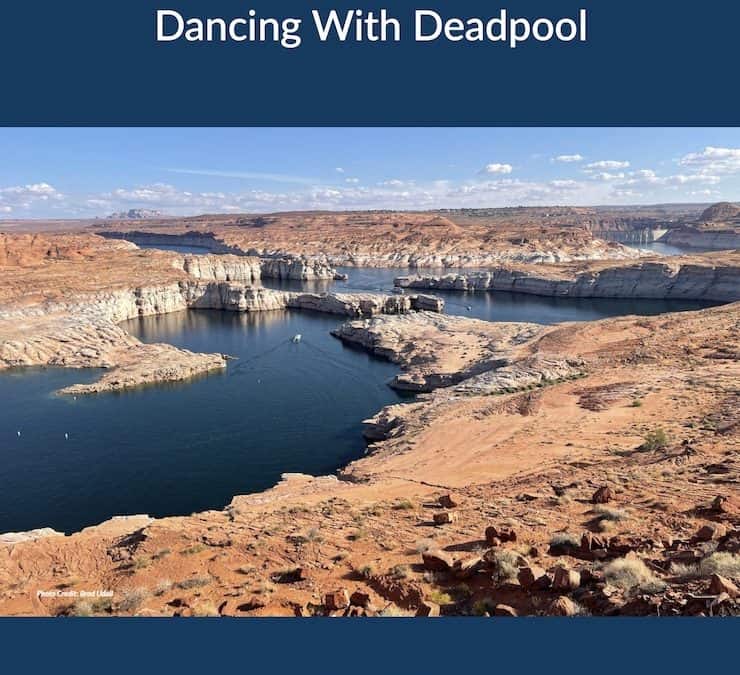
“Dancing With Deadpool,” a new product from the Colorado River Research Group, delivers the short answer.

“Another year or two of low inflows and we will completely blow through the cushions provided by reservoir storage,” says the document’s executive summary. The word “crisis” litters the 64-page production. It has eight chapters written by 22 authors from Colorado and three other Colorado River Basin states.

The Colorado River has fascinated journalists since at least the 1980s. Then, the river was still delivering water to Mexico’s Sea of Cortez but troubles were evident on the horizon. The river now, except for specially engineered releases from upstream dams, disappears entirely after crossing into Mexico.

Since 2022, the Colorado River had become a national story. Empty seats at the annual Colorado River Water Users Association conference in Las Vegas have disappeared, press credentials harder to secure.

The tension even in the last year has grown. The river runoff this year was only 55% of long-term average. The seven basin states remain at an impasse about solutions proportionate to the problem.

“We have now entered a new era: Dancing with Deadpool,” says the report.

Deadpool is the point at which reservoirs can release no water. In 2022, that moment seemed imminent as sandstone walls of Glen Canyon were exposed directly to sunlight after being submerged since shortly after Lake Powell began filling. Then a miracle winter arrived, water levels in the two big reservoirs, Powell and Mead, rose once again, the emergency receded.

Now the crisis is back — and looming larger.

You can scare yourself to death with what-ifs, but we may need something akin to a miracle to avoid full-blown crisis. We cannot have another winter and then runoff like 2002-2003. Or, as several authors point out, runoff like we had in 2025.

As it is, we need another miracle winter, something akin to what diehard Denver Broncos fans remember as “the drive” in a 1987 playoff game. John Elway led his football team 98 yards down the field in Cleveland to tie the game with 37 seconds left. They won in OT.

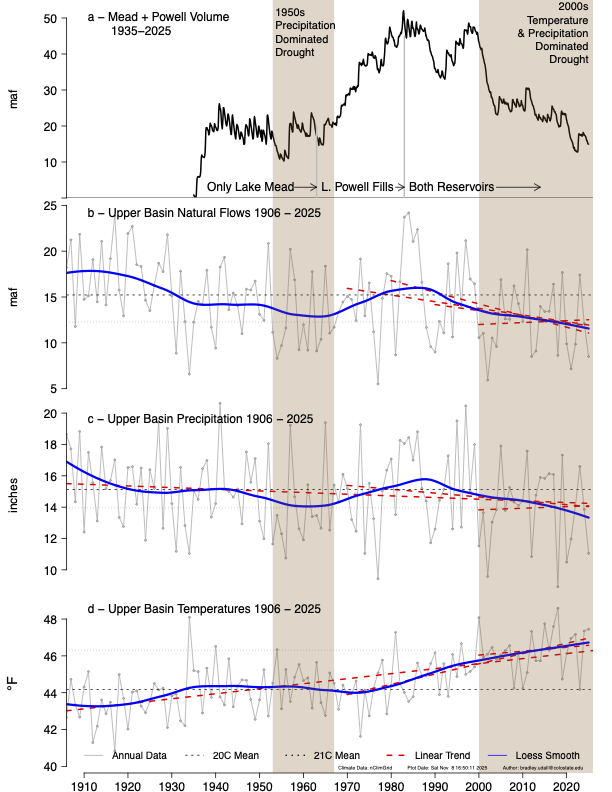
Brad Udall and Jonathan Overpeck warn against too much optimism. Mother Nature can be stingy. She has been in the past, with one drought period as long as 80 years during the last 2,000 years. Now, the evidence grows that our monkeying with Mother Nature has produced this drought.

Udall/Overpeck 4-panel Figure Colorado River temperature/precipitation/natural flows with trend. Lake Mead and Lake Powell storage. Updated through Water Year 2025. Note the tiny points on the annual data so that you can flyspeck the individual years. Credit: Brad Udall

In 2017, Udall and Overpeck issued the results of their study that showed that warming alone was responsible for roughly half of the reduced natural flows of the Colorado River, at that point 17%. They delivered a new phrase: “hot drought” as distinguished from “dry drought.” The warmer temperatures were robbing the Colorado River Basin of water.

Precipitation in the basin has also declined 7% in the 21st century, as compared to the 20th century. In their chapter, Udall from Colorado State and Overpeck now at the University of Michigan (but with a summer cabin in San Miguel County), cite two new studies that together provide evidence “suggesting” complicity of humans. Greenhouse gases explain the declined precipitation, too.

As science is never 100%, Udall and Overpeck use cautious language. The studies, they say, “strongly suggest we are in for extended dry periods in the Colorado headwaters in the decades ahead.”

If there is less water, then isn’t the solution simple? Use less!

Easy to say. And for the last 20 years, efforts have been made to nibble away at uses. Cities have been working to make less water-intensive urban landscapes popular. But the far larger story lies in agriculture.

In Colorado and the three upper basin states, for example, about 70% of all the Colorado River water (after trans-basin diversions for irrigation are accounted for) goes to agriculture. How can ag use less water?

Two of the chapters work on this. A trio of academics from Wyoming and one from Colorado take aim specifically at the upper basin states. “The relevant questions are not whether or when cuts will happen, but how deep will they go, how will they be distributed, and how well can the consequences be mitigated?” they ask.

The four upper-basin researchers argue that evidence already exists for success. With creativity and collaboration, they say, farmers and ranchers can sustain crop and livestock production even as water becomes scarce. They get into the details, talking about adjustments of cow-calf operation, for example, to reduce water-dependent needs.  They call for more research into limited irrigation, crop switching and other practices.

Two other academics, both from Arizona State, take a somewhat broader view, acknowledging the challenge.

“In a landscape of poor choices, in a failing river system in which all solutions are deeply unpopular to some or other powerful constituency, potentially harmful to one community or another or inordinately expensive and founded on unreliable funding, it is at least worth considering another option,” write Kathryn Sorensen and Sarah Porter.

They see cuts of up to 4 million acre-feet in the basin annually being necessary. Again, that’s about 25% of what those who created the Colorado River Compact expected would be annual flows for the seven basin states.

How to get there? They introduce a new concept, “economic water productivity,” a measure of the value of water. Instead of buy and dry programs, they see need for a federally financed effort to pivot uses through incentives to reduce water use on those agricultural lands.

Similar buy-down of high-volume irrigated agriculture is underway in two groundwater depletion areas in Colorado, the San Luis Valley and the Republican River Basin. Some federal money is providing help in the latter basin. They contend federal money will be needed, and lots of it, to pay for this big pivot in the Colorado River Basin. That, they say, would be fitting, because it was federal money that financed the infrastructure for this hydraulic empire.

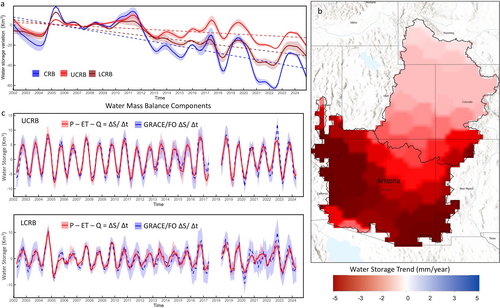
GRACE TWS trend map. (a) The time series of nonseasonal GRACE/FO TWS (km3/year) over UCRB and LCRB for the period (4/2002–10/2024). (b) Spatial variation in TWS trends for the Colorado River Basin for the investigated period (mm/year) (c) Time series comparison of the change in storage ΔS/Δt derived from the water balance equation (Equation 1) and GRACE/FO. ΔS/Δt calculated from GRACE/FO TWS anomalies in km3. The light shading represents uncertainties.

As for groundwater, that part of the Colorado River story has been generally overlooked. A study released several months ago found that nearly two-thirds of storage — both surface and groundwater — lost from 2002 to 2024 in the Colorado River actually came from groundwater depletion, mostly in Arizona.

Whoa!

“Simply shifting unsustainable surface water uses to unsustainable groundwater uses does nothing to address the core mismatch of supplies and demands,” observes Doug Kenney, who directs the Western Water Policy Program at University of Colorado Law School.

Other contributors dissect the complexities of what would seem to be simple, common sense solutions. For example, Eric Kuhn, the former general manager of the Colorado River District, works through the concept of water sharing among the states based on a percentage basis. The Colorado River Compact divides water between the upper and lower basins, a mistake in retrospect although even in 1922, when it was adopted, there had been an argument for using a percentage.

Later, when the upper-basin sates adopted a compact among themselves, they did use a percentage basis.

Kuhn goes deep into the history, as he has done with book-writing (“Science be Dammed,” 2019, with John Fleck) to sort through the thinking of this idea over the last century. It came up again earlier this year as the seven basin states tried to figure out how to share the river given the changed realities. The states, however, could not agree on what percentages should be used for sharing. It may have been just too much of a transformational change for some states to accept, he says.

However, the idea may come back if the stalemate between the upper and lower basins of the Colorado River ends up in the federal courts. Or failing that, what exactly would federal intervention look like? That’s an impolite question, but one of those what-ifs that must be wondered about. (For the record, the water people I know seem to have high regard for people in the Department of Interior in charge of looking after the Colorado River).

The large story here is that the states, with enormous aid from the federal treasury, created the infrastructure and expectations of water that no longer exists and, as per the studies of scientists, will almost certainly not return within the lifetimes of any of us. What, then, should be the federal role in defining the future balance? Once again, might the dismantling of Glen Canyon Dam be such a wild idea after all?

Thoughts in this book will likely be part of the conversations next week in Las Vegas when representatives of the seven basin states gather, as they always do, at the Colorado River Water Uses Association conference. Might a hallway conversation lead to a breakthrough?

Like huge snowstorms in the Rockies and then cool temperatures during runoff, there might be miracles, but I wouldn’t count on it. This deadpool dance might end sooner than anybody actually likes.

Map of the Colorado River drainage basin, created using USGS data. By Shannon1 Creative Commons Attribution-Share Alike 4.0