North Weld County Water District Rate Increase 2026 Among Lowest in Northern #Colorado

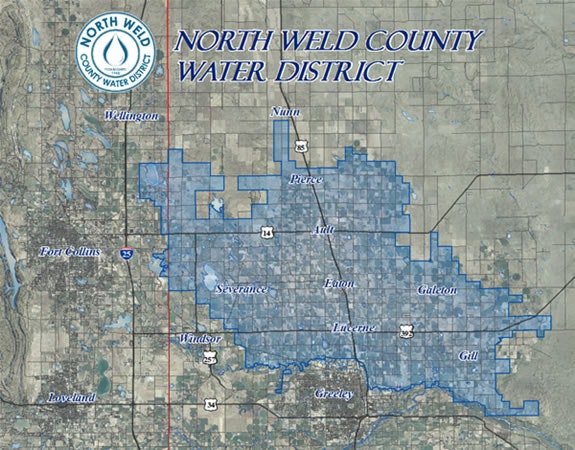
North Weld County Water District Service Area. Graphic via NWCWD.

Here’s the release from the North Weld county Water District:

December 10, 2025

North Weld County Water District implements modest 4% rate increase for 2026  still among lowest in region 

WELD COUNTY, COLORADO (Dec. 10, 2026) –North Weld County Water District (NWCWD) announced a comparatively modest 4 percent rate increase for 2026 – which is less than the previous year and significantly lower than the surrounding region.  

“Maintaining our water service infrastructure continues to be a priority for the district and one that we balance with our fiduciary responsibility to our rate payers,” said Eric Reckentine, General Manager, North Weld County Water District.

A diligent infrastructure improvement plan is highlighted in these key District projects designed to ensure a clean, robust, and affordable water supply:

  • Weld County West Transmission Line: The District will start construction of the Weld County west 42-inch transmission line and new 6 million gallon treated water tank in 2026 with a project cost of $20 million dollars.
  • Eastern Zone Distribution Line: The District will continue construction of the eastern zone 30-inch distribution line with the project’s third phase starting in 2026 and to be completed in 2027.
  • Soldier Canyon Water Treatment Plant Expansion: The SCWTP treatment plant capacity was expanded from 60 million gallons per day to 68 million gallons in 2025. In collaboration with the Soldier Canyon Water Treatment Authority and nearby District partners (such as Fort Collins-Loveland Water District and East Larimer County Water District), NWCWD is finalizing the Soldier Canyon Filter Plant Master Plan, and will begin design on a plant expansion for additional treatment capacity for the District to begin in 2029.

With these improvements, the district says it can meet growth needs well into the future.

“Upgrades to our aging water delivery system allow the District to meet new treatment standards and accommodate the record-breaking growth in Northern Colorado,” Reckentine said. “A stable revenue stream from water rates enables us to accomplish that.”

About North Weld County Water District:

Weld County is the fastest growing in the state.  North Weld County Water District’s cities, residents, and businesses rely on the safe, reliable, and affordable water we have been delivering for over 64 years. The District constantly plans for growing communities, which now span from agricultural to rural to urban, ensuring that all future water needs are met and we can continue to deliver the highest quality water in the growing region for decades to come. To learn more, visit NWCWD.org.

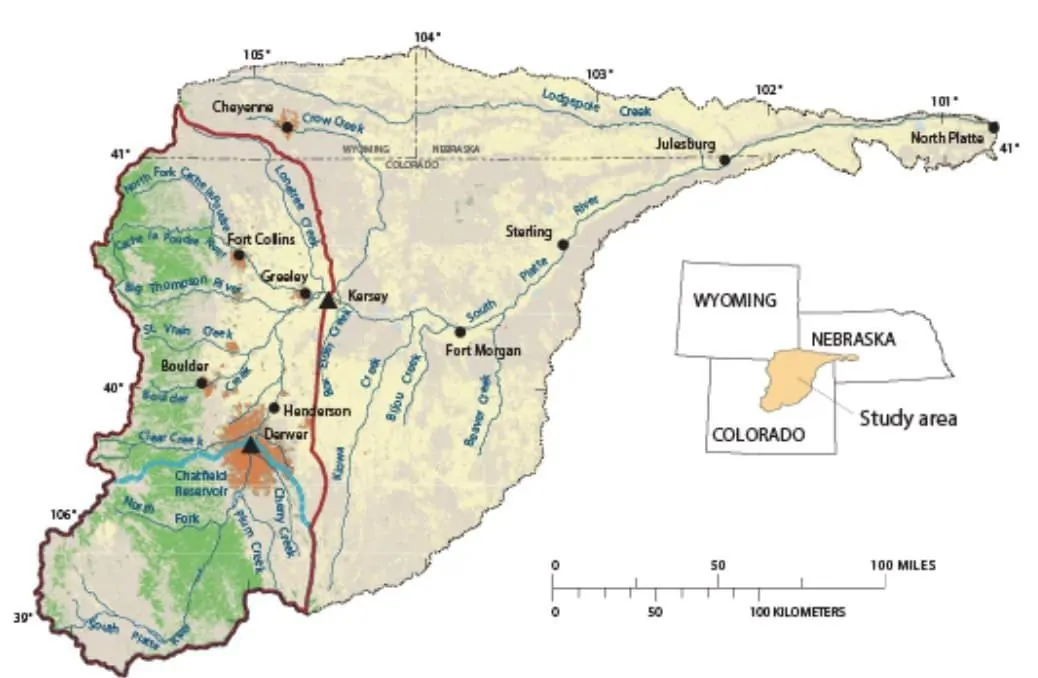
The South Platte River originates in South Park and then wanders northeast, entering Nebraska just a few miles west of Colorado’s northeast corner. The red line here distinguishes the upper South Platte Basin in Colorado from the lower basin. Image: U.S. Geologic Survey.

Federal Water Tap: #ColoradoRiver states have been given less than two months to agree on how to share water cuts from the shrinking river — Brett Walton (circleofblue.org) #COriver #aridification #CRWUA2025

Click the link to read the article on the Circle of Blue website (Brett Walton):

December 22, 2025

The Rundown

  • Colorado River states have been given less than two months to agree on how to share water cuts from the shrinking river.
  • Homeland Security waives environmental laws to speed the construction of a border wall in parts of New Mexico.
  • A federal judge proclaims federal authority over the contentious Line 5 oil pipeline that crosses the Great Lakes.
  • U.S., Mexican governments sign Tijuana River sewage cleanup agreement.
  • The House passes a bill to change environmental reviews for infrastructure permitting.
  • USGS study finds lower water levels in Colorado’s Blue Mesa reservoir the cause of increased toxic algal blooms.

And lastly, a draft EIS for post-2026 Colorado River reservoir operations, when current rules expire, will be published in the coming weeks.

“Let me be clear, cooperation is better than litigation. Litigation consumes time, resources, and relationships. It also increases uncertainty and delays progress. The only certainty around litigation in the Colorado River basin is a bunch of water lawyers are going to be able to put their children and grandchildren through graduate school. There are much better ways to spend several hundred million dollars.” – Scott Cameron, acting commissioner of the Bureau of Reclamation, speaking at the Colorado River Water Users Association conference on December 17, 2025. Cameron encouraged the states to reach an agreement on water cuts and reservoir operating rules instead of suing each other.

By the Numbers

February 14: New Interior Department deadline for the seven Colorado River states to reach an agreement on water cuts and reservoir operations. If the states fail at that, Interior could assert its own authority. There could also be lawsuits. A short-term agreement might be necessary.

The deadline, according to Interior’s Andrea Travnicek, is for several reasons. It gives states time to pass legislation, if necessary. It provides time for consultation with Mexico and the basin’s tribes. And it allows for reservoir operating decisions in 2027 to be set this fall.

“Time is of the essence, and it is time to be able to adjust those stakes, to arrange so compromises can be made,” Travnicek said.

News Briefs

Line 5 Oil Pipeline Court Case
A U.S. district judge ruled that the federal government, not the state of Michigan, has authority over the contentious Line 5 oil pipeline that crosses the Great Lakes at the Straits of Mackinac.

Michigan’s top officials have attempted to shut down Enbridge Energy’s Line 5 since 2020 when Gov. Gretchen Witmer revoked the company’s easement.

In his ruling, Judge Robert Jonker determined that the federal Pipeline Safety Act gives the U.S. government the sole authority over Line 5’s continued operation, the Associated Press reports.

In context: Momentous Court Decisions Near for Line 5 Oil Pipeline

Tijuana River Sewage Pollution Cleanup
U.S. and Mexican representatives signed an agreement that will facilitate the cleanup of chronic sewage pollution in the Tijuana River, a shared waterway.

Line 5 Oil Pipeline Court Case
A U.S. district judge ruled that the federal government, not the state of Michigan, has authority over the contentious Line 5 oil pipeline that crosses the Great Lakes at the Straits of Mackinac.

Michigan’s top officials have attempted to shut down Enbridge Energy’s Line 5 since 2020 when Gov. Gretchen Witmer revoked the company’s easement.

In his ruling, Judge Robert Jonker determined that the federal Pipeline Safety Act gives the U.S. government the sole authority over Line 5’s continued operation, the Associated Press reports.

In context: Momentous Court Decisions Near for Line 5 Oil Pipeline

Tijuana River Sewage Pollution Cleanup
U.S. and Mexican representatives signed an agreement that will facilitate the cleanup of chronic sewage pollution in the Tijuana River, a shared waterway.

Called Minute 333, the agreement outlines actions and sets timelines. A joint work group will assess project engineering and feasibility studies. Mexico will build a wastewater treatment plant by December 2028 and a sediment control basin by winter 2026-27. The agreement also addresses monitoring, planning, and data sharing.

Permitting and Land Use Bills
House Republicans used the week before the holiday break to pass a bill that changes infrastructure permitting processes.

The SPEED Act, which passed with support from 11 Democrats, changes the National Environmental Policy Act and the environmental reviews it requires for major federal projects. It restricts reviews to immediate project impacts, sets timelines, and limits lawsuits.

“On net, these reforms are likely to make it easier to build energy infrastructure in the United States,” asserts the Bipartisan Policy Center.

Border Wall
Kristi Noem, the secretary of the Department of Homeland Security, is waiving environmental laws in order to speed the construction of a border wall in parts of New Mexico near El Paso, Texas.

The affected laws include the Clean Water Act, National Environmental Policy Act, Safe Drinking Water Act, Migratory Bird Conservation Act, and others.

Studies and Reports

Mississippi River Recap
The U.S. Army Corps of Engineers published a December state of the Mississippi River report, noting how drought conditions this year have influenced operations on the country’s largest river system.

The Corps authorized construction of an underwater dam that was completed in October in order to impede the upstream movement of salty water from the Gulf of Mexico.

Harmful Algal Blooms in Colorado Reservoir
Blue Mesa is the largest reservoir in Colorado and is part of the Colorado River basin water storage system.

The U.S. Geological Survey investigated why Blue Mesa has been experiencing toxic algal blooms in recent years. Its report concluded that warmer water temperatures enabled by lower water levels are the likely cause.

The affected laws include the Clean Water Act, National Environmental Policy Act, Safe Drinking Water Act, Migratory Bird Conservation Act, and others.

Studies and Reports

Mississippi River Recap
The U.S. Army Corps of Engineers published a December state of the Mississippi River report, noting how drought conditions this year have influenced operations on the country’s largest river system.

The Corps authorized construction of an underwater dam that was completed in October in order to impede the upstream movement of salty water from the Gulf of Mexico.

Harmful Algal Blooms in Colorado Reservoir
Blue Mesa is the largest reservoir in Colorado and is part of the Colorado River basin water storage system.

The U.S. Geological Survey investigated why Blue Mesa has been experiencing toxic algal blooms in recent years. Its report concluded that warmer water temperatures enabled by lower water levels are the likely cause.

Reducing nutrient inflows is unlikely to help, the researchers said. There are naturally occurring phosphorus inputs and the algae can fix nitrogen from the air.

The best solution might be keeping the reservoir high enough, the report says. That will not be easy in a drying and warming region with competing water demands.

On the Radar

Colorado River Draft EIS Coming Soon
In the coming weeks – in early January if not by the end of the year – the Bureau of Reclamation will publish a draft environmental impact statement for changes to how the big Colorado River reservoirs will be managed.

Reclamation began its environmental review about two and a half years ago. The agency had hoped to slot a seven-state consensus agreement into the document. But since there is no agreement, the document will instead describe a “broad range” of options, said Carly Jerla of Reclamation, who spoke at the Colorado River Water Users Association conference.

The draft will not select a preferred option, Jerla said. Instead that will come in the final version.

“We’ve set up a draft EIS that reflects a range of carefully crafted alternatives to enable the further innovation and the ability of the basin to come to a consensus agreement to be able to adopt in time for the 2027 operations,” Jerla said.

Federal Water Tap is a weekly digest spotting trends in U.S. government water policy. To get more water news, follow Circle of Blue on Twitter and sign up for our newsletter.

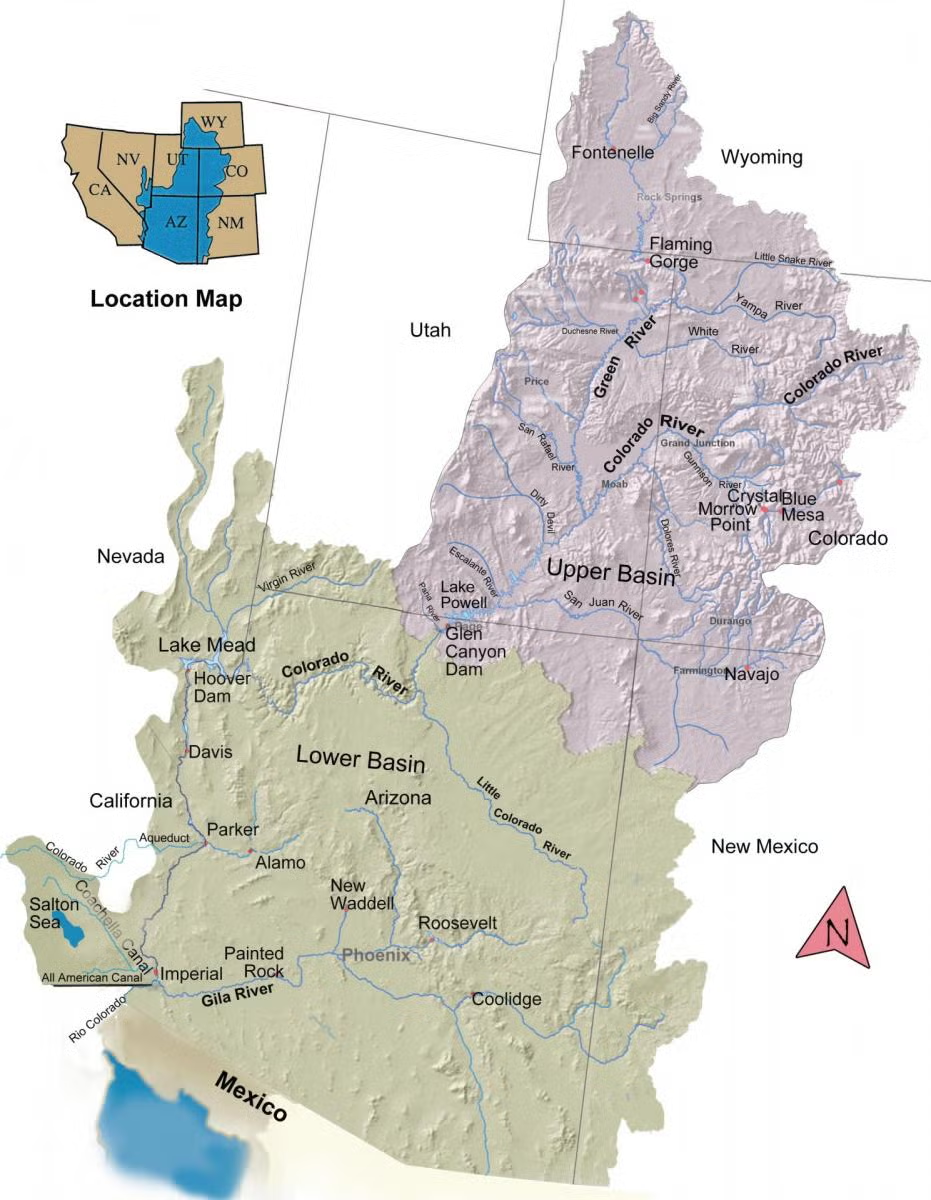
The Colorado River Basin spans seven U.S. states and part of Mexico. Lake Powell, upstream from the Grand Canyon, and Lake Mead, near Las Vegas, are the two principal reservoirs in the Colorado River water-supply system. (Bureau of Reclamation)

#Snowpack news: Skimpy snow makes life worse for skiers — and everyone else — Heather Hansman (High Country News)

Click the link to read the article on the High Country News website (Jr Rodriguez):

December 11, 2025

Last night, I woke up to percussion on the roof. In late November at 7,000 feet in the Rockies, you’d normally look for snow. But yet another predicted storm had petered out and come in as rain instead.

This storm was going to be big, the local weatherman promised, with some places getting up to 6 feet. But then he downgraded the forecast — and downgraded it again. By the time the system moved off to the east, no more than a few inches had fallen in a couple of high places. We’d seen no significant snow, and we were getting closer to the solstice.

Anticipation is a fickle feeling, a jittery mix of adrenaline and hope. Early winter used to make me excited, no matter where I lived in the West. I’d track storms coming in from the Pacific, waiting for Colorado’s high alpine ski resorts to battle to be the first to open or watching the snowline creep lower in the Pacific Northwest.

But lately that anticipation has been subsumed by dread. Now, the forecast hits me with the wrong kind of adrenaline. I get a cramp in my stomach when storms don’t come. Skiing has made me a barometer for winter, and the recent seasons have gone awry as they become increasingly warm and dry. In the past, I was purely excited about winter storms because I envisioned storm-day skiing and soft turns. Now I worry what the lack of snow means for the future.

As a skier, my happiness is tied to weather systems beyond my control. It might be a sick fascination to keep fixating on snowfall, but it keeps my barometer tuned and makes me look for the bigger patterns.

Skiers can be obsessive, ritualistic and superstitious, prone to worrying about upsetting the cosmic order. We joke about praying for snow, even though we know that’s not how nature works. But I still go to pre-season ski-burning bonfires and wash my car in hopes of encouraging snowstorms. What is that but praying?

There are two reasons to wish for snow: the selfish and the sustainable.

I want snowy winters partly so I can ski — so I can enjoy something I’ve done every winter since I was a tiny kid, the thing that makes me feel weightless and fast and connects me to the world around me. But when I compulsively check SNOTEL sites or ski area base depths, I’m also seeing something bigger and watching the patterns evolve.

Skiing might seem superficial, but winter clearly shows that the climate is changing. It’s made tangible through movement, or the lack of it. The things we love show us where our pain points are, and how much we stand to lose, and how little control we have.

My local ski hill pushed back its opening date this year, as did every mountain in Utah — Deer Valley for the first time in its history. Not only was there scant natural snow, it wasn’t even cold enough to make snow. That lack of snow has cascading impacts, especially on workers and communities that depend on winter tourism. But we don’t just profit from snow; it’s also our most solid water supply.

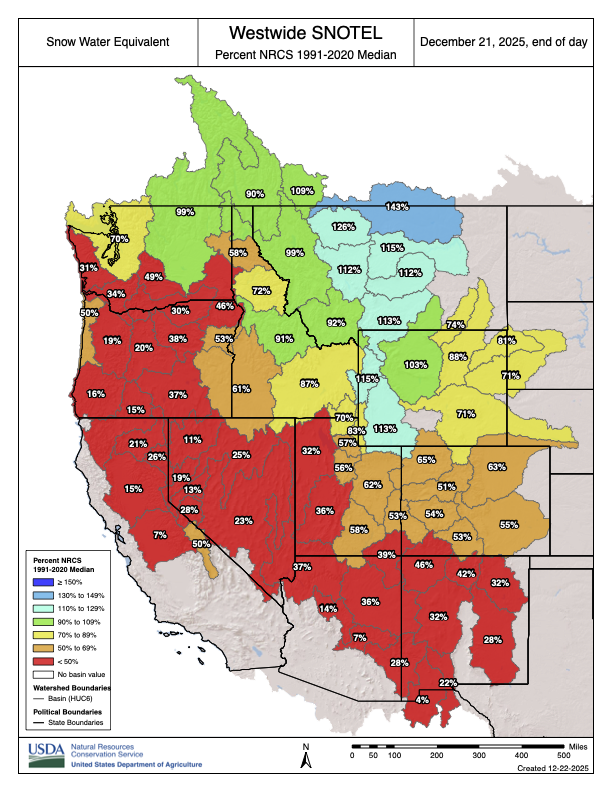
Westwide SNOTEL basin-filled map December 21, 2025.

Nearly every part of the Western U.S. is in drought conditions today. As of December, the National Water and Climate Center’s map of snow-water equivalentis colored red, and most places are less than 50% of average. Snow is our most significant water supply.

Across the West, this slow winter comes after a hot dry summer, when fires crept ever closer to town. Last winter was also dry and skimpy, exacerbating the long-term drought. Ski mountains are haggling over water rights for snowmaking. Lack of snow means increased fire risk and food insecurity, along with entrenched and at times bitter fights over rivers.

We live in a system, and skiing is a specific marker for how that system is changing.

A friend who is a ski guide stopped by the other day, and when I asked him if he was getting anxious about work, he looked north up the valley toward the mountains and grimaced. “I’m not quite worried yet,” he said. Maybe that’s rational, but my worry has already kicked in.

Figure 1. Graph showing active storage in Colorado River basin reservoirs between January 1, 2021, and November 30, 2025. Credit: Jack Schmidt/Center for Colorado River Studies

I look at the shrinking reservoirs and the spreading drought predictions. I remember last winter’s scratchy, icy ski turns and the summer’s lack of monsoons, with fire lurking in the background. I know what it’s like to wait for snow without it ever coming.

I also know that it’s still early in the season. Things could change, storms could stack up and keep coming, even though the National Weather Service is predicting a weak and wavering La Niña. There’s a lot of flexibility in the system. I can look at the sky and still feel some hope. I can’t predict what will happen, I just know what the past has shown me.

So, yes, I am still praying for snow, but for many more reasons and with even more fervor than I did before.

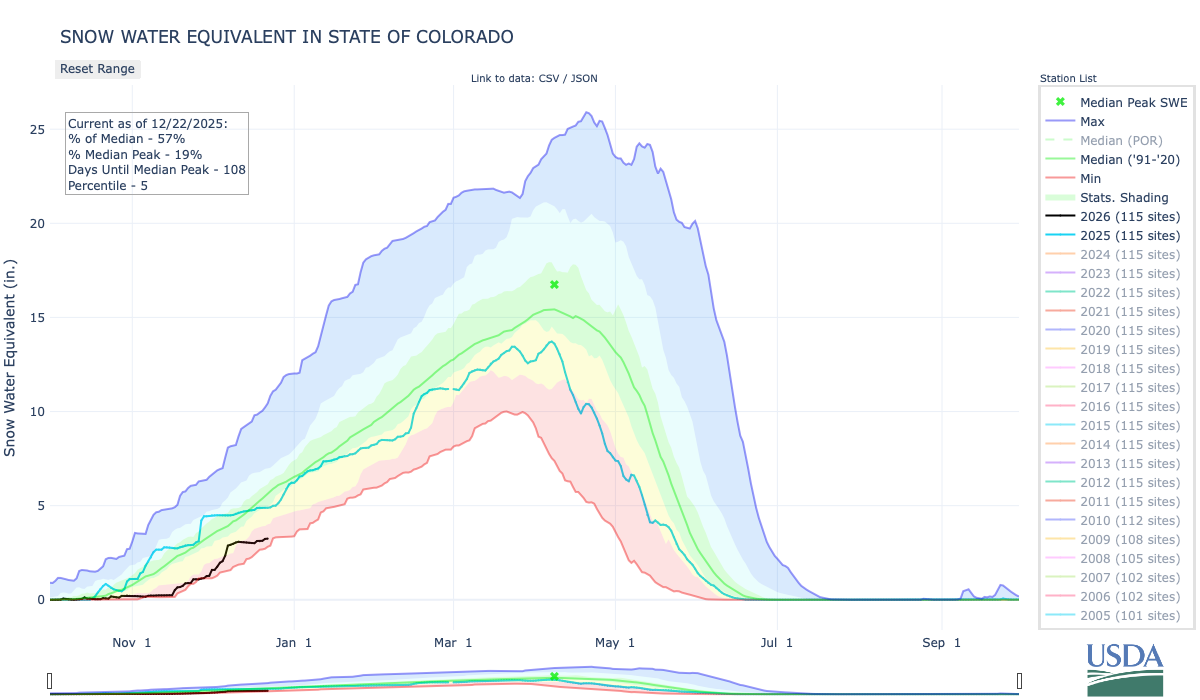
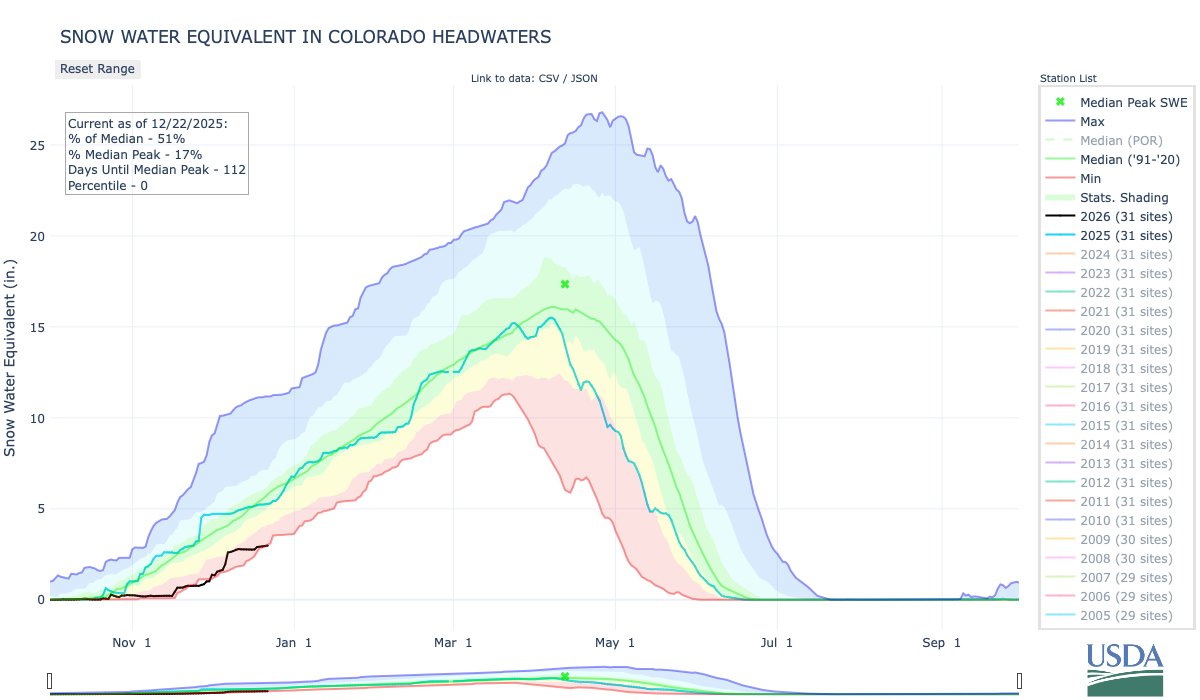
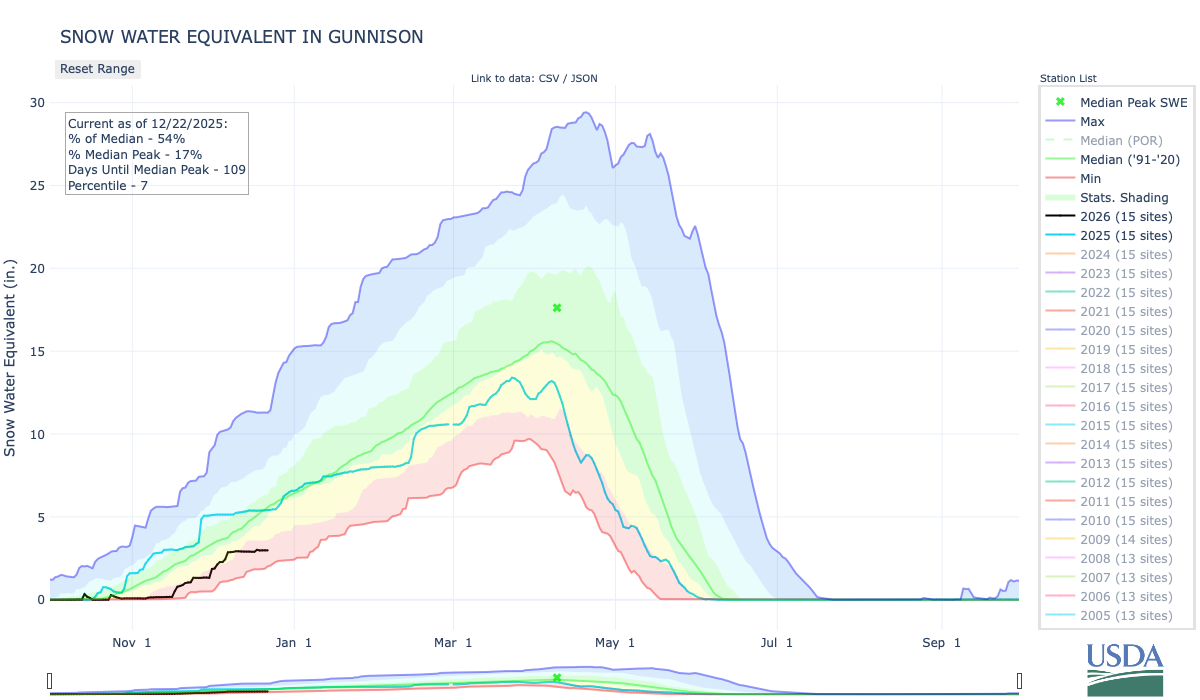
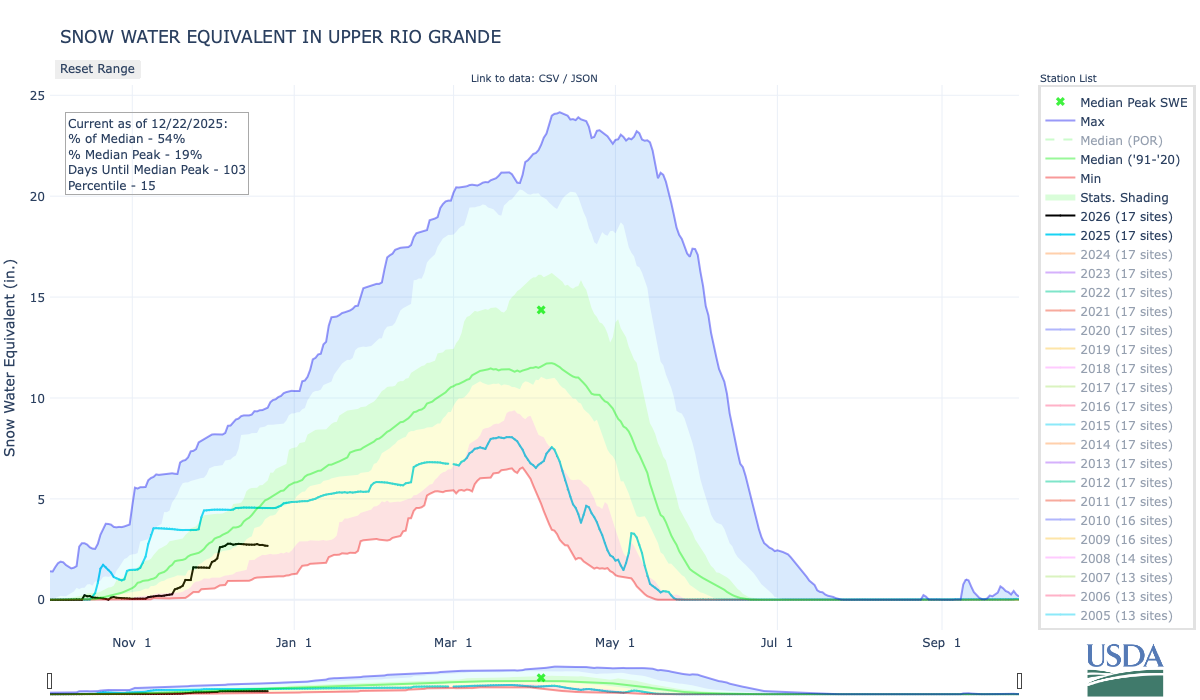
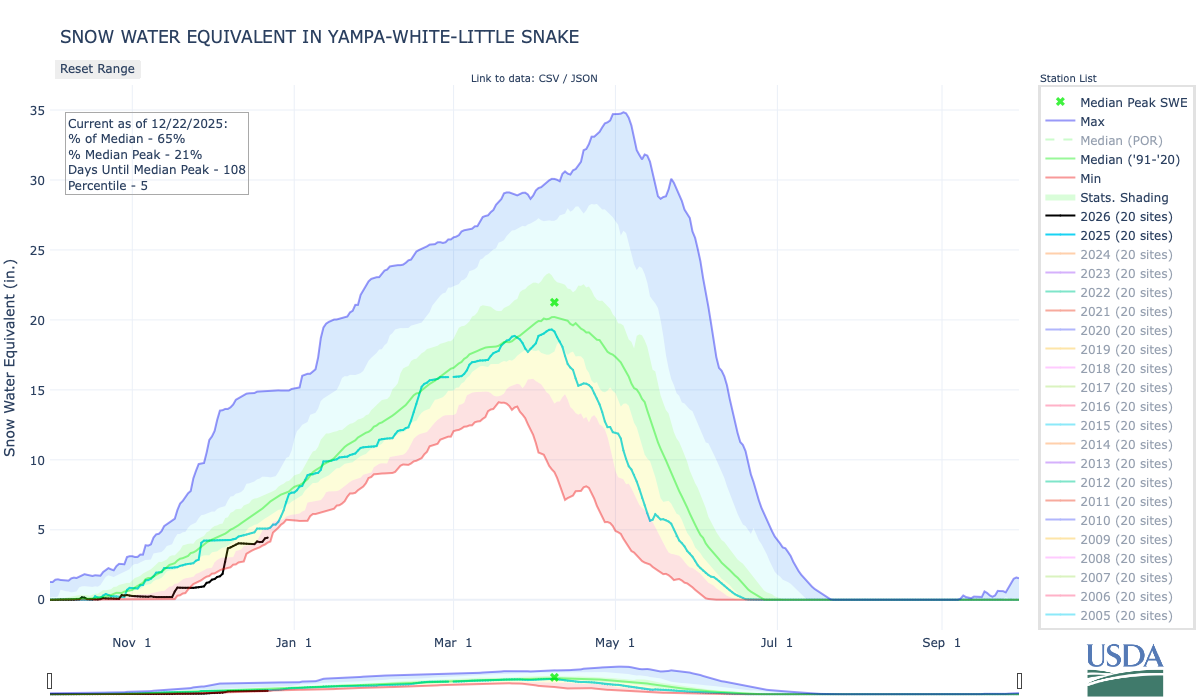
Colorado Snowpack basin-filled map December 21, 2025.

Click the link to explore the interactive graphs on the NRCS website.

#ColoradoRiver water negotiators appear no closer to long-term agreement — The Associated Press #COriver #aridification #CRWUA2025

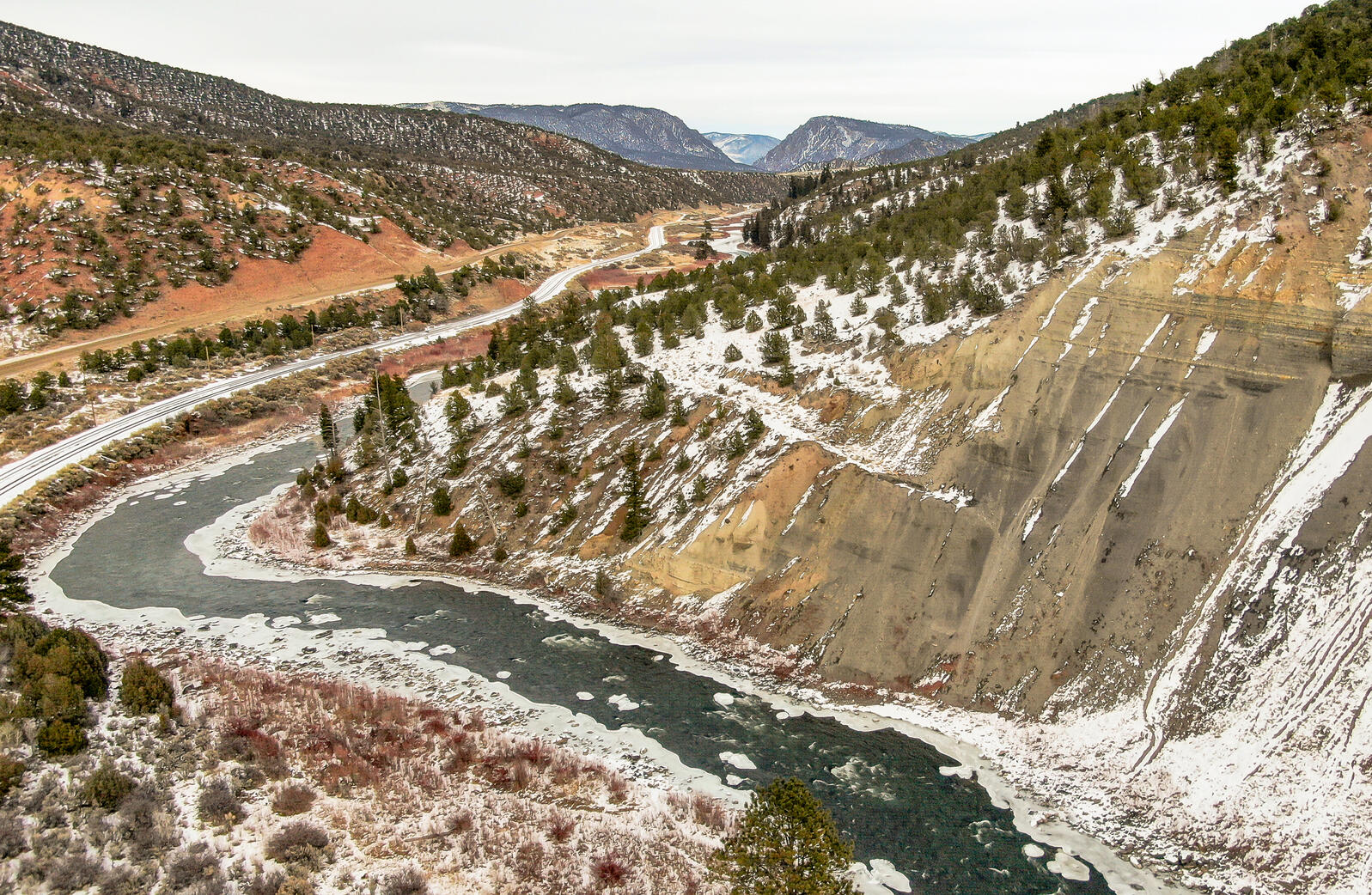
The Colorado River flows through Gore Canyon in Colorado. Photo: Mitch Tobin/The Water Desk

Click the link to read the article on the Associated Press website (Jessica Hill). Here’s an excerpt:

December 18, 2025

The seven states that rely on the Colorado River to supply farms and cities across the U.S. West appear no closer to reaching a consensus on a long-term plan for sharing the dwindling resource. The river’s future was the center of discussions this week at the annual Colorado River Water Users Association conference in Las Vegas, where water leaders from California, Nevada, Arizona, Colorado, New Mexico, Utah and Wyoming gathered alongside federal and tribal officials. It comes after the states blew past a November deadline for a new plan to deal with drought and water shortages after 2026, when current guidelines expire. The U.S. Bureau of Reclamation has set a new deadline of Feb. 14.  Nevada’s lead negotiator said it is unlikely the states will reach agreement that quickly. 

“As we sit here mid-December with a looming February deadline, I don’t see any clear path to a long-term deal, but I do see a path to the possibility of a shorter-term deal to keep us out of court,” John Entsminger of the Southern Nevada Water Authority told The Associated Press.

The Colorado River Basin spans seven U.S. states and part of Mexico. Lake Powell, upstream from the Grand Canyon, and Lake Mead, near Las Vegas, are the two principal reservoirs in the Colorado River water-supply system. (Bureau of Reclamation)

The federal government continues to refrain from coming up with its own solution — preferring the seven basin states reach consensus themselves. If they don’t, a federally imposed plan could leave parties unhappy and result in costly, lengthy litigation. Not only is this water fight between the upper and lower basins, individual municipalities, tribal nations and water agencies have their own stakes in this battle. California, which has the largest share of Colorado River water, has over 200 water agencies alone, each with their own customers.

“It’s a rabbit hole you can dive down in, and it is incredibly complex,” said Noah Garrison, a water researcher at the University of California, Los Angeles.

Lower Basin states pitched a reduction of 1.5 million acre-feet per year to cover a structural deficit that occurs when water evaporates or is absorbed into the ground as it flows downstream. An acre-foot is enough water to supply two to three households a year. But they want to see a similar contribution from the Upper Basin. The Upper Basin states, however, don’t think they should have to make additional cuts because they already don’t use their full share of the water and are legally obligated to send a certain amount of water downstream.

“Our water users feel that pain,” said Estevan López, New Mexico’s representative for the Upper Colorado River Commission.

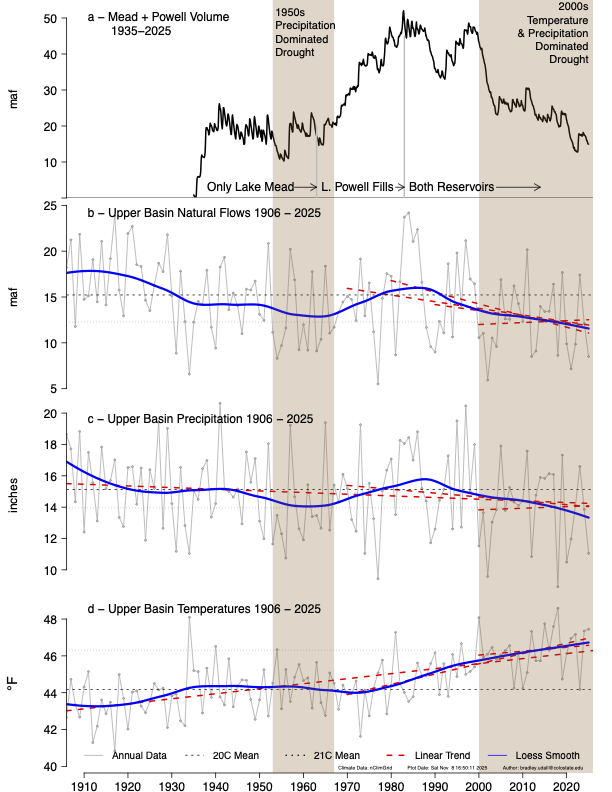
Udall/Overpeck 4-panel Figure Colorado River temperature/precipitation/natural flows with trend. Lake Mead and Lake Powell storage. Updated through Water Year 2025. Note the tiny points on the annual data so that you can flyspeck the individual years. Credit: Brad Udall