Elder pointed to the team’s big win against the New York Giants on Oct. 19, 2025.
“I think most of us thought the Broncos were done in that game after going scoreless for three quarters, but then they had an amazing turnaround in the fourth quarter and came back to win at the last second,” said Nathan Elder, Denver Water’s manager of water supply.
“Let’s hope Mother Nature can do the same as Bo Nix and deliver a big comeback this winter.”
Snowmaking at Keystone Ski Resort on Dec. 31, 2025. Photo credit: Denver Water.
Record low start to the snowpack
Elder said the first three months of the 2025-26 snow season, from Oct. 1 to Dec. 31, 2025, ranked as the driest on record in Denver Water’s water collection area.
The records date back to the winter of 1979-80, when SNOTEL measuring gauges started being used to measure mountain snowpack.
Denver Water’s previous year-ending, record-low snowpack on Dec. 31 occurred during the winter of 1980-81.
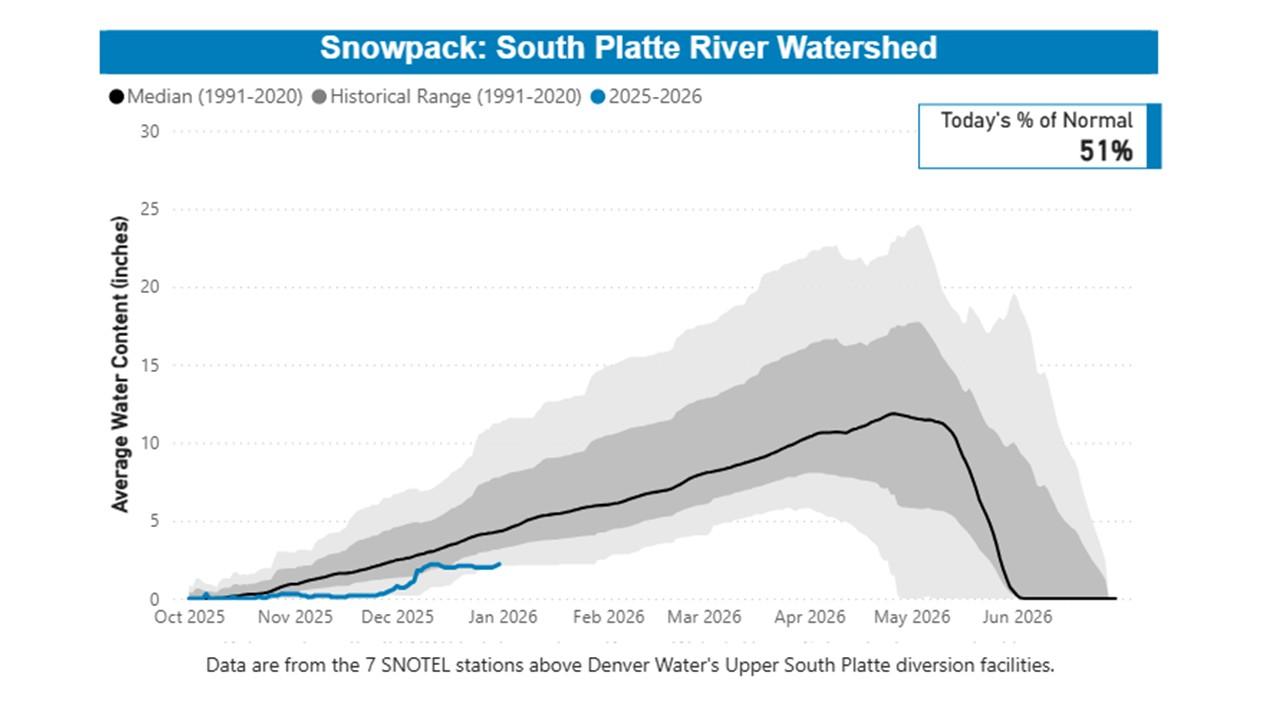
This year, as of Dec. 31, 2025, the snowpack in the South Platte and Colorado river basins where Denver Water collects water stood at 51% and 49% of normal, respectively, according to SNOTEL measurements.
Snowpack in the South Platte River Basin at the end of December 2025 stood at 51% of normal. Image credit: U.S.D.A., Natural Resources Conservation Service.
Snowpack in the Colorado River Basin at the end of December 2025 stood at 49% of normal. Image credit: U.S.D.A., Natural Resources Conservation Service.
The lack of powder days is not only tough on Colorado’s ski resorts, but low snowpack also raises concerns about river levels and our water supply which comes primarily from mountain snow.
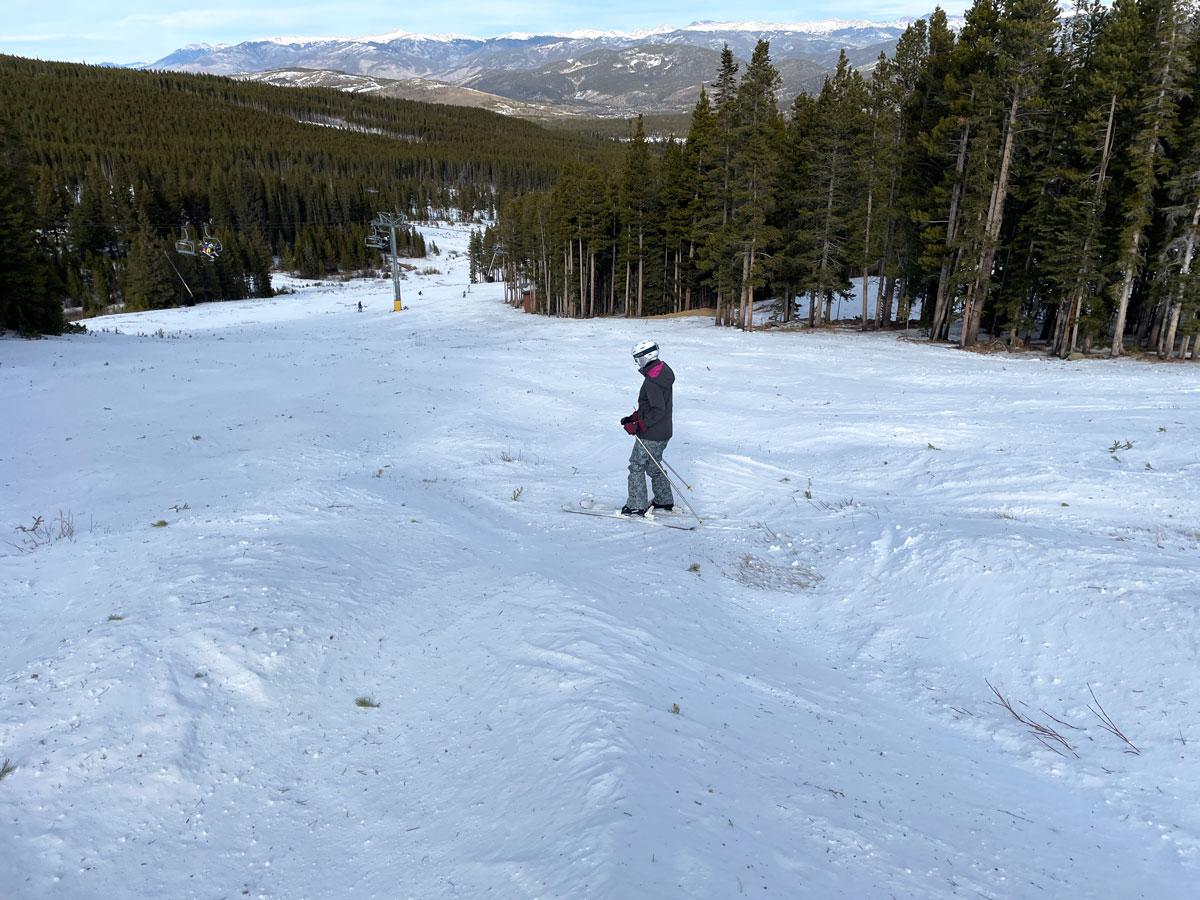
A skier navigates through early season conditions at Breckenridge on Dec. 23, 2025. Photo credit: Denver Water.
“We definitely prefer a snowier start to winter over a dry one,” Elder said.
“But we still have about four months left in the snow accumulation season. We will need a lot of snow to catch up to get back to normal.”
The first three months of the snow season typically account for about 20% of the annual snowpack. The good news is that the snowiest months of March and April are still ahead.
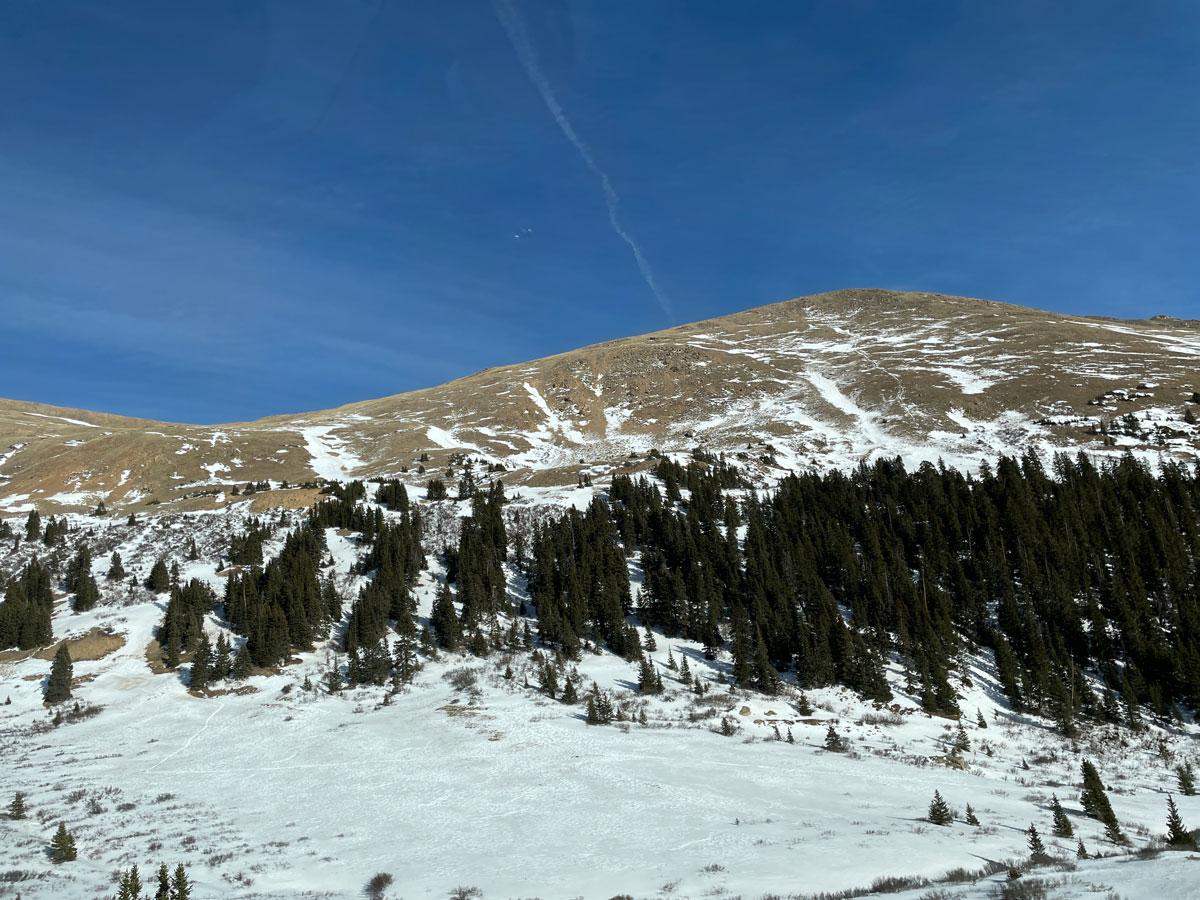
Loveland Pass in Summit County on Dec. 24, 2025. The lack of snow is clearly visible on the higher peaks. Photo credit: Denver Water.
Elder said that along with the low snowfall, strong winds and above-normal temperatures created windy and warm weather, which led to increased sublimation of the snowpack (think of sublimation like evaporation just for snow).
“In mid-December, we actually saw a noticeable drop in the snowpack in the South Platte River Basin, which is very rare for that time of year because it’s usually too cold for snow to melt,” Elder said.
What to expect in 2026?
While unfortunately there’s no crystal ball for snow forecasting, Elder pointed to other years that experienced similarly slow starts to the snowpack for a guess as to where this season could end up.
For Denver Water, snowpack typically peaks in mid-to-late April.
The lowest peak occurred during the winter of 2001-02, when snowpack peaked at just 56% of normal. The second-lowest peak was measured during the winter of 2011-12, when mountain snowpack peaked at 58% of normal.
Both of those seasons started slow and snowfall stayed below normal levels all winter long.
In contrast to those two dismal winters, Elder said the winter of 1999-2000 offers a glimmer of hope.
“That season started slow, but snow came on strong in April and May and we ended up right around normal in terms of peak snowpack by the end of the season,” he said.
Water managers also watch for a couple of big storms that could quickly bolster a lackluster snowpack.
Taking action
Denver Water’s reservoirs are currently at 83% of capacity, which is 4% below average for this time of year.
Dillon Reservoir in Summit County had open water on Dec. 24, 2025, due to warm conditions. The reservoir’s average “ice-in” date is Dec. 24. Photo credit: Denver Water.
Elder said that while the reservoir levels are expected to be in relatively good shape heading into summer, it’s too early to say if there will be any watering restrictions.
“We live in a dry climate with increasingly variable weather patterns, which means all of us need to pitch in to help conserve the precious water supplies that we have,” Elder said.
“Now is a good time to check your faucets and toilets for leaks, and fix any you find inside your home. It’s also a good time to start planning how to remodel your yard this summer to save water outside.”
Denver Water’s website has free tips, including a step-by-step DIY Guide that can help you replace thirsty Kentucky bluegrass with water-smart plants, available at denverwater.org/Conserve.
In 2026, the utility will again be offering customers a limited number of discounts on Resource Central’s popular, water-wise Garden In A Box kits and turf removal.
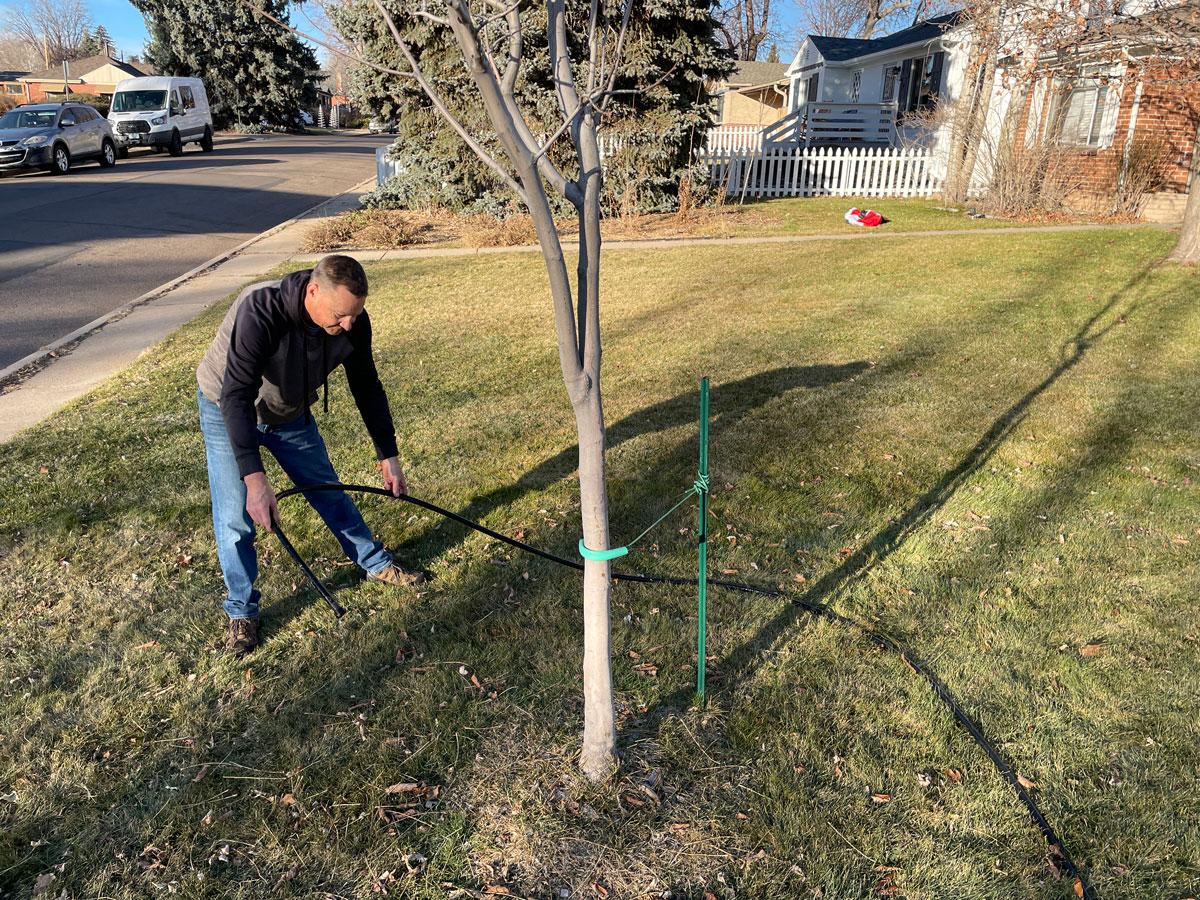
It’s important to water trees and plants during dry periods in the winter months. Soaker hoses are a great way to efficiently water a tree. Photo credit: Denver Water.
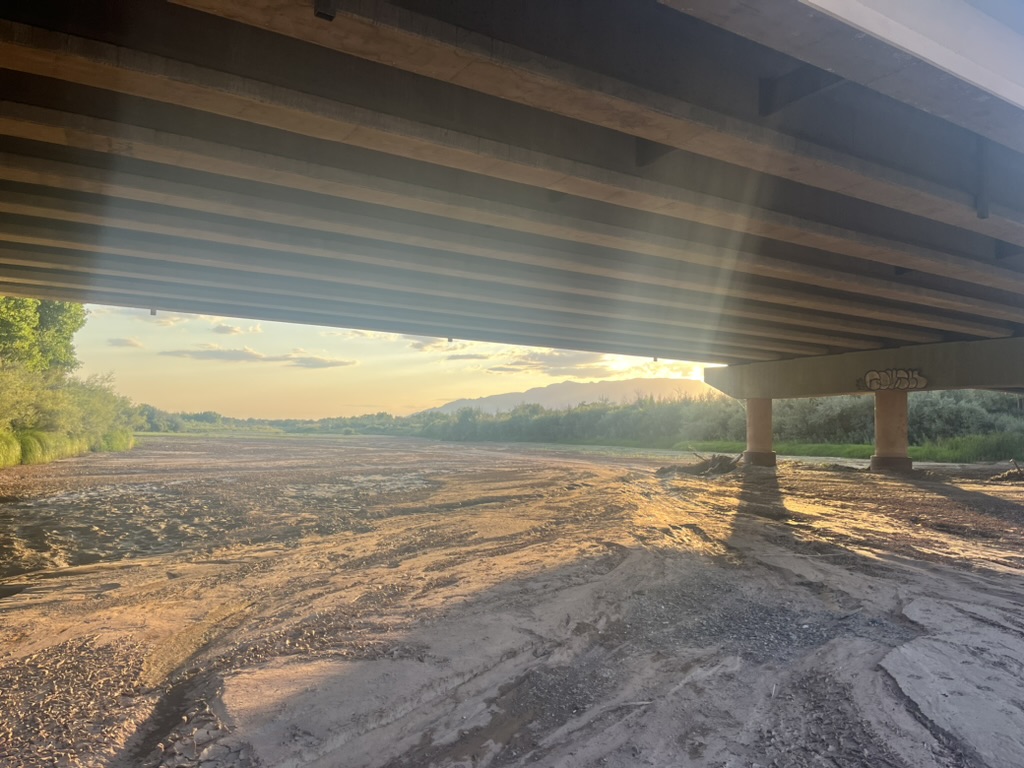
The drying Rio Grande, as shown here in Albuquerque in the summer of 2025. (Laura Paskus for Source NM)
Click the link to read the article on the Source NM website (Laura Paskus):
January 6, 2026
A male house finch belts out his springtime song. Mustard greens have pushed through the loam in my backyard. The hyssop and salvia are greening up, and so are the Mexican sage and globemallow. Sunflowers and poppies are sprouting, and I slept Sunday night with the window cracked open — 38 degrees is usually my threshold for allowing cold air into the room. In the morning, there’s not even a skiff of ice on the birdbath water.
Like many of you, I’ve been walking a fine line between joy and terror this winter.
Oh, it’s so nice to be outside! And I love listening for screech owls and coyotes at night. But these balmy days and nights fill me with dread. They aren’t just omens of a hot, dry year. They also weaken ecosystems and species that rely upon winter. Including humans.
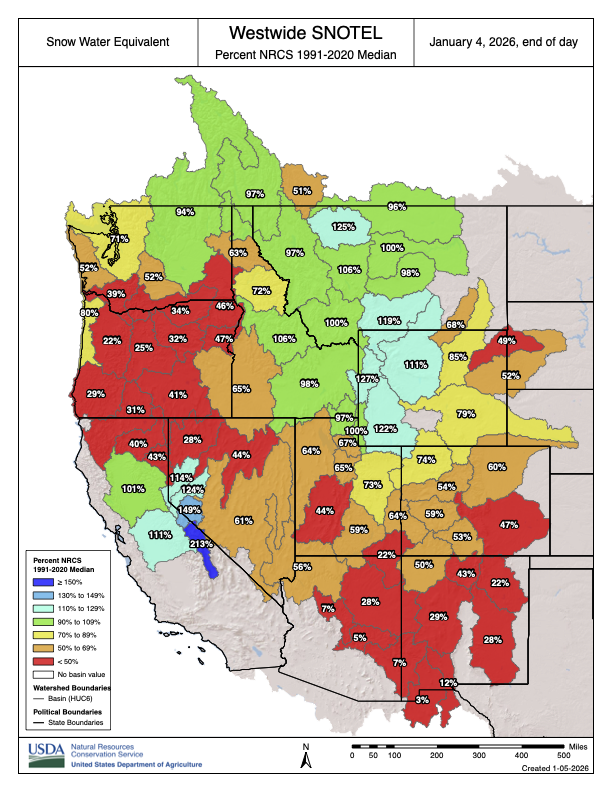
Snowpack across New Mexico is grim. (Do you really want to see the median numbers as of early January? Rio Grande Headwaters in Colorado: 52 percent. Upper Rio Grande in New Mexico: 30. San Juan River Basin: 51. Rio Chama River Basin: 57. Jemez River Basin: 17. Pecos River Basin: 34.) And we’re facing continued La Niña conditions, at least through the next three months.
Meanwhile, New Mexico doesn’t have much in its water savings account; just look at the reservoir numbers from the top of the Rio Chama to the Lower Rio Grande in New Mexico. Heron Reservoir is 7% full; El Vado, 13%; Abiquiu, 58%; Elephant Butte, 8%; and Caballo, 7%.
From this vantage point in early January — with a few decades of warming temperatures, drying rivers, burning forests and aridifying croplands already behind us — it’s clear that human-caused climate change is tightening the noose on a viable future for New Mexicans, and for the wildlife and ecosystems we are bound to, inextricably.
In 2018, the Intergovernmental Panel on Climate Change released a special report, noting that if the Earth’s temperature increased by more than 1.5 degrees Celsius, the climate consequences will be “long-lasting” and “irreversible.” Scientists wrote that human-caused emissions of carbon dioxide would need to “fall by about 45 percent from 2010 levels by 2030, reaching ‘net zero’ by 2050.”
In 2025, the Earth passed the 1.5-degree Celsius threshold. And we’re nowhere near to cutting greenhouse gas emissions by significant levels.
Nothing that’s happening right now should be a surprise — not the melting ice caps nor the drying rivers. We’ve had decades to pivot or at least prepare.
Yet, 60 years after President Lyndon Johnson’s science advisory committee warned that the carbon dioxide humans were sending into the atmosphere would cause changes that could be “deleterious from the point of view of human beings,” in 2025, U.S. Environmental Protection Agency Administrator Lee Zeldin launched the Powering the Great American Comeback Initiative, deregulating industries and “driving a dagger straight into the heart of climate change religion.”
“The Trump administration will treat climate change for what it is, a global physical phenomenon that is a side-effect of building the modern world,” Wright said. “Everything in life involves trade-off.”
The men spearheading the Trump administration’s plans know climate change threatens the lives of billions of people and ecosystems ranging from the sea’s coral reefs to Earth’s mountaintops. And their tradeoffs involve the calculated obliteration of longstanding federal environmental laws, the privatization of public lands and watersheds, and of course, the subversion of climate science. (Not to mention, the waging of illegal wars.) [ed. emphasis mine]
In just a few weeks, New Mexico state legislators will convene for a 30-day session. It’s a fast-paced budget session, which means climate and water won’t top the list of priorities, again. No matter what the mustard greens, house finches, bare mountaintops, and drastically low reservoirs show us.
This winter, temperatures will drop here and there. Some snow will fall. There will be days that feel like winter. But we’re past the point of comforting ourselves that these warm winter temperatures are an anomaly. They are our future.
Decades ago, I rented an attic bedroom in a house in western Colorado from a woman who was kind and angry and trying very hard and battling demons. Because she had taped handwritten quotes inside the kitchen cabinet next to the sink, every time I reached inside, I would read them. There’s one quote from the late Joanna Macy I think of every day.
“The point is not to save people. The point is to create the conditions for the possibility of grace.”
The point right now isn’t to save the planet — or even ourselves or the more-than-human species we rely upon or love. The point is to create the conditions for the possibility of grace. The possibility of a climate-changed future in which all the best and most beautiful things about this Earth haven’t been traded away. [ed. emphasis mine]
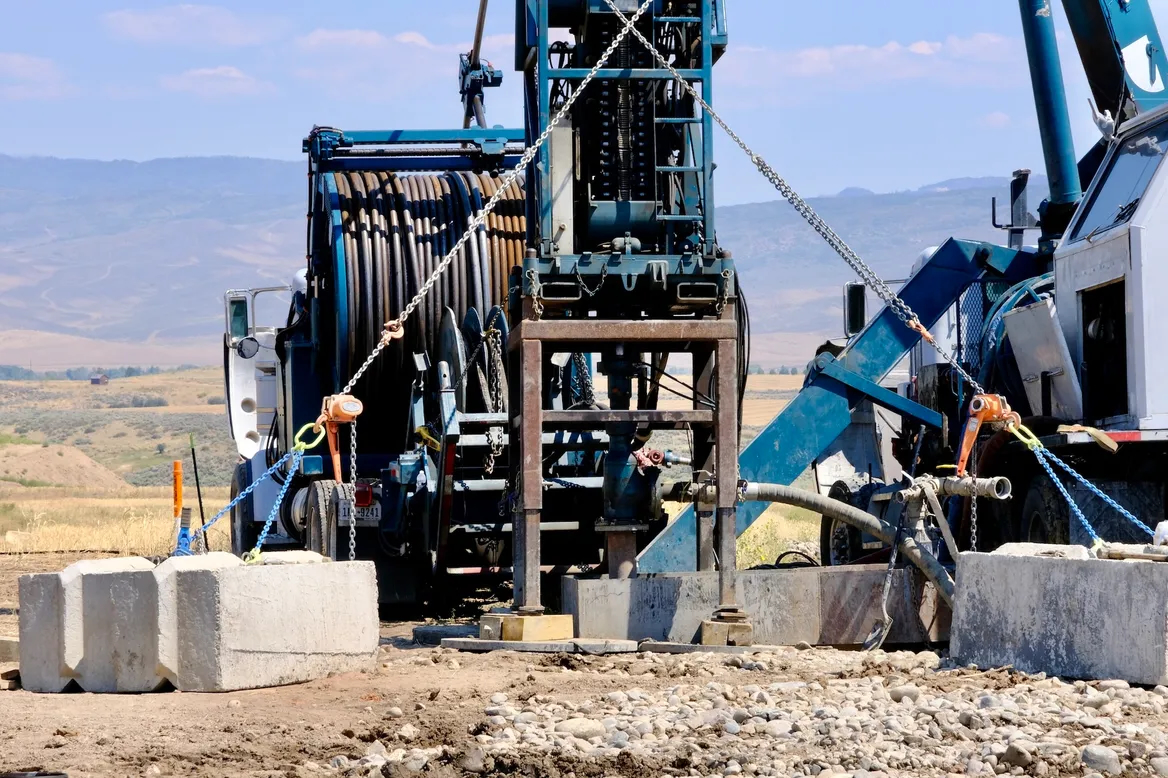
Bedrock Energy’s drilling rig digs a 1,000-foot borehole as part of a geothermal network that’ll keep energy costs low for companies that move into a new Hayden business park. (Alison F. Takemura/Canary Media)
For decades, Dallas Robinson’s family excavation company developed coal mines and power plants in the rugged, fossil-fuel-rich region of northwest Colorado. It was a good business to be in, one that helped hamlets like Hayden grow from outposts to bustling mountain towns — and kept families like Robinson’s rooted in place for generations.
“This area, with the exception of agriculture, was built on oil and gas and coal,” said Robinson, a former town councilor for Hayden.
But that era is coming to a close. Across the United States, bad economics and even worse environmental impacts are driving coal companies out of business. The 441-megawatt coal-burning power plant just outside Hayden is no exception: It’s shutting down by the end of 2028. The Twentymile mine that feeds it is expected to follow.
Coal closures can gut communities like Hayden, a town of about 2,000 people. That story has been playing out for decades, particularly in Appalachia, where coal regions with depressed economies have seen populations decline as people strike out for better opportunities elsewhere. Robinson, a friendly, gregarious guy, fears the same could happen in Hayden.
“I grew up here, so I know everyone,” he said. “It’s hard to see people lose their jobs and have to move away. … These are families that sweat and bled and been through the good and the bad times in small towns like this.”
Struggling American coal towns need an economic rebirth as the fossil-fuel industry fades. Hayden has a vision that, at first, doesn’t sound all that unusual. The town is developing a 58-acre business and industrial park to attract a diverse array of new employers.
The innovative part: companies that move in will get cheap energy bills at a time of surging utility costs. The town is installing tech that’s still uncommon but gaining traction — a geothermal heating-and-cooling system, which will draw energy from 1,000 feet underground.
In short, Hayden is tapping abundant renewable energy to help invigorate its economy. That’s a playbook that could serve other communities looking to rise from the coal dust.
At an all-day event hosted by geothermal drilling startup Bedrock Energy this summer, I saw the ambitious project in progress. Under a blazing sun, a Bedrock drilling rig chewed methodically into the region’s ochre dirt. Once it finished this borehole — one of about 150 — it would feed in a massive spool of black pipe to transfer heat.
Bedrock will complete the project, providing 2 megawatts of thermal energy, in phases, with roughly half the district done in 2026 and the whole job finished by 2028. Along the way, constructed buildings will be able to connect with portions of the district as they’re ready.
“We see it as a long-term bet,” Mathew Mendisco, city manager of Hayden, later told me, describing the town as full of grit and good people. Geothermal energy “is literally so sustainable — like, you could generate those megawatts forever. You’re never going to have to be reliant on the delivery of coal or natural gas. … You drill it on-site, the heat comes out.”
“We disagree on the urgency of addressing climate change, [but] this is something that Chris Wright and I agree on,” Colorado Senator John Hickenlooper (D), a trained geologist, told a packed conference-room crowd on the day of the event. “Geothermal energy has … unbelievable potential to, at scale, create clean energy.”
Charting a post-coal economy
The eventual closure of the Hayden Station coal plant, which has operated for more than half a century, has loomed over the town since Xcel Energy announced an early shutdown in 2021.
The power plant and the mine employ about 240 people. Property taxes from those businesses have historically provided more than half the funding for the town’s fire management and school districts — though that fraction is shrinking thanks to recent efforts to diversify Hayden’s economy, Mendisco said.
Taking into account the other businesses that serve the coal industry and its workers, according to Mendisco, the economic fallout from the closures is projected to be a whopping $319 million per year.
“Really, the highest-paying jobs, the most stable jobs, with the best benefits [and] the best retirement, are in coal and coal-fired power plants,” Robinson said.
Hayden aims for its business park to help the town weather this transition. With 15 lots to be available for purchase, the development is designed to provide more than 70 jobs and help offset a portion of the tax losses from Hayden Station’s closure, according to Mendisco.
“We are not going to sit on our hands and wait for something to come save us,” Mayor Ryan Banks told me at the event.
Companies that move into the business park won’t have a gas bill. They’ll be insulated from fossil-fuel price spikes, like those that occurred in December 2022, when gas prices leapt in the West and customers’ bills skyrocketed by 75% on average from December 2021.
In the Hayden development, businesses will be charged for their energy use by the electric utility and by a geothermal municipal utility that Hayden is forming to oversee the thermal energy network. Rather than forcing customers to pay for the infrastructure upfront, the town will spread out those costs on energy bills over time — like investor-owned utilities do. Unlike a private utility, though, Hayden will take no profit. Mendisco said he expects the geothermal district to cut energy costs by roughly 40%, compared with other heating systems.
Municipally owned geothermal districts are rare in the U.S., but the approach has legs. Pagosa Springs, Colorado, has run its geothermal network since the early 1980s, when it scrambled to combat fuel scarcity during the 1970s oil embargo. New Haven, Connecticut, recently broke ground on a geothermal project for its train station and a new public housing complex. And Ann Arbor, Michigan, has plans to build a geothermal district to help make one neighborhood carbon-neutral.
Hayden’s infrastructure investment is already attracting business owners. An industrial painting company has bought a plot, and so has a regional alcohol distributor, Mendisco said.
One couple is particularly excited to be a part of the town’s clean energy venture. Nate and Steph Yarbrough own DIY off-grid-electrical startup Explorist.Life; renewable power is in the company’s DNA. The Yarbroughs teach people how to put solar panels and batteries on camper vans, boats, and cabins to fuel their outdoor adventures, and Explorist.Life sells the necessary gear.
“When we bought that property, it was largely because of the whole geothermal concept,” Nate Yarbrough told me. “We thought it made a whole bunch of sense with what we do.”
Reducing reliance on hydrocarbons, he noted, is “a good thing for society overall.”
Geothermal tech heats up
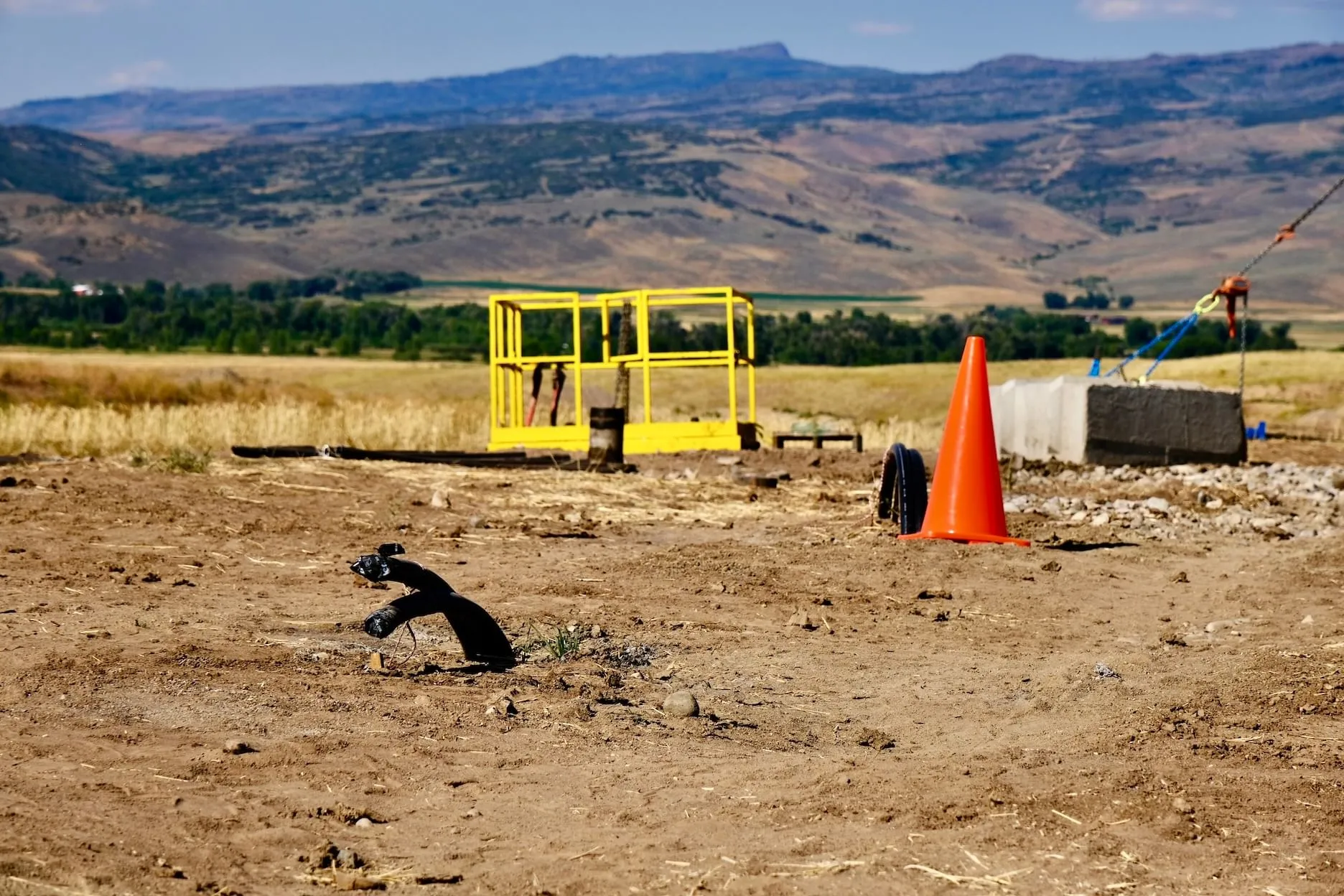
The geothermal network that could transform Hayden’s future is mostly invisible from aboveground. Besides the drilling rig and a trench, the most prominent features I spotted were flexible tubes jutting from the earth like bunny ears.
Those ends of buried U-shaped pipes will eventually connect to a main distribution loop for businesses to hook up to. Throughout the network, pipes will ferry a nontoxic mix of water and glycol — a heat-carrying fluid that electric heat pumps can tap to keep buildings toasty in the winter and chilled in the summer.
As part of Hayden’s geothermal network, a loop of U-shaped pipe will collect constant heat from the earth, no matter how bitter the winter. Its two ends — the only parts visible — will connect to a distribution loop. (Alison F. Takemura/Canary Media)
Despite their superior efficiency, these heat pumps are far less common than the kind that pull from the ambient air, largely due to project cost. Because you have to drill to install a ground-source heat pump, the systems are typically about twice as expensive as air-source heat pumps.
But the underground infrastructure lasts 50 years or more, and the systems pay for themselves in fuel-cost savings more quickly in places that endure frostier temperatures, including Rocky Mountain municipalities like Hayden. Those long-term cost benefits were too attractive to ignore, Mendisco said.
Hayden’s project “is 100% replicable today,” Mendisco told attendees at the event, which included leaders of other mountain towns. Geothermal tech is ready; the money is out there, he added: “You can do this.”
Colorado certainly believes that — and it’s giving first-mover communities a boost.
In October, the state energy office announced $7.3 million in merit-based tax-credit awards for four geothermal projects. Vail is getting nearly $1.8 million for a network, into which the ice arena can dump heat and the library can soak it up. Colorado Springs will use its $5 million award to keep a downtown high school comfortable year-round. Steamboat Springs and a Denver neighborhood will share the rest of the funding.
At least one other northwest Colorado coal community is also getting on board with geothermal. In the prior round of state awards, the energy office granted $58,000 to the town of Craig’s Memorial Regional Health to explore a project for its medical campus.
With dozens of communities warming to the notion, “it’s an exciting time for geothermal in Colorado,” said Bryce Carter, geothermal program manager at the state energy office.
So far, the state has pumped $30.5 million into geothermal developments — with over $27 million going toward heating-and-cooling projects specifically — through its grant and tax-credit programs. The larger tax-credit incentive still has about $13.8 million left in its coffers.
Hayden, for its part, is also taking advantage of the federal tax credits to save up to 50% on the cost of its geothermal district. That includes a 10% bonus credit that the community qualifies for because of its coal legacy. After also accounting for a bonanza of state incentives, the $14-million project will only be $2.2 million, Mendisco said.
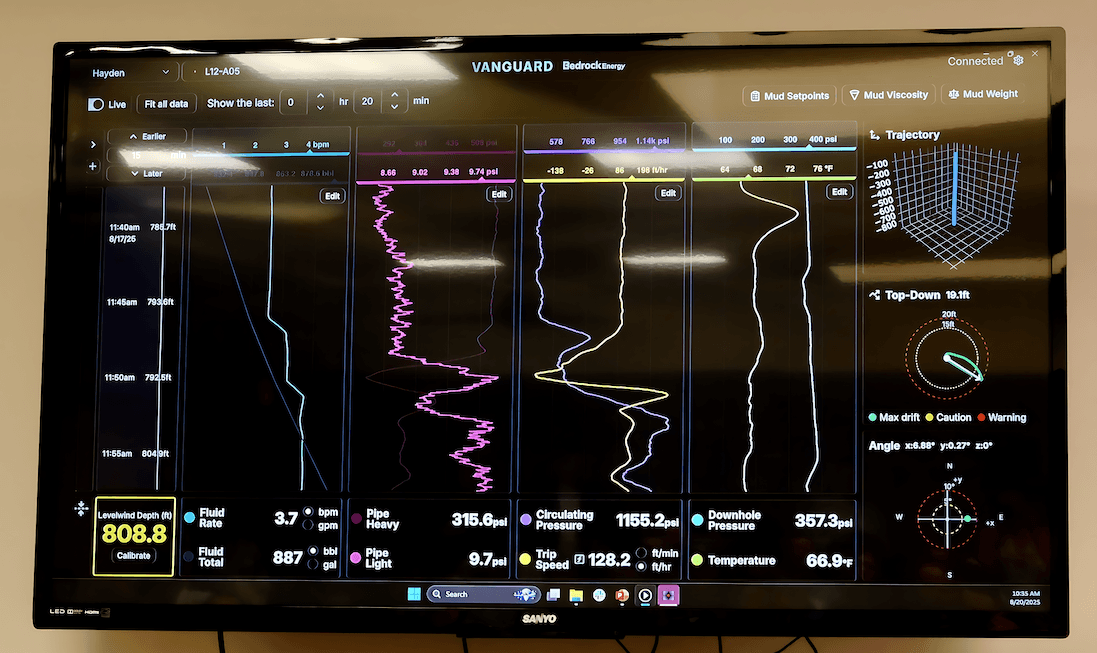
Tech innovation could further improve geothermal’s prospects, even in areas with less generous inducements than Colorado’s. Bedrock Energy, for one, aims to drive down costs by using advanced sensing technology that allows it to see the subsurface and make computationally guided decisions while drilling.
“In Hayden, we have gone from about 25 hours for a 1,000-foot bore to about nine hours for a 1,000-foot bore — in just the last couple of months,” Joselyn Lai, Bedrock’s co-founder and CEO, told me at the event. Overall, the firm’s subsurface construction costs from the first quarter of 2025 to the second quarter fell by about 16%, she noted.
When drilling, Bedrock Energy harnesses a constant stream of data to navigate underground obstacles from boulders to fractures. (Alison F. Takemura/Canary Media)
Hayden is likely just at the start of its geothermal journey. If all goes well with the business park, the town aims to retrofit its municipal buildings with these systems to comply with the state’s climate-pollution limits on big buildings, Mendisco said. Hayden’s community center could be the first to get a geothermal makeover starting in 2027, he added.
Robinson, despite coal’s salience in the region and his family’s legacy in its extraction, believes in Hayden’s vision: Geothermal could be a winner in a post-coal economy. In fact, he’s interested in investing in the geothermal industry and installing a system in a new house he’s building, he said.
“I’ve lived a lot of my life making a living by exploiting natural resources. I understand the value of that — as well as lessening our impact and being able to find new and better,” Robinson said. “This is the next step, right?”
This article was originally published by Canary Media and is republished here as part of Covering Climate Now, a global effort to boost coverage of climate change.
The coal-fired Tri-State Generation and Transmission plant in Craig provides much of the power used in Western Colorado, including in Aspen and Pitkin County. Will Toor, executive director of the Colorado Energy Office has a plan to move the state’s electric grid to 100 percent renewable energy by 2040. Photo credit: Brent Gardner-Smith/Aspen Journalism
Platte River Power Authority’s general manager says he disagrees with a federal order requiring one of the coal plants it owns a stake in to remain open past its scheduled retirement and is waiting to learn what it might cost Fort Collins’ wholesale electricity provider…PRPA is a joint owner of the plant with PacifiCorp, Xcel Energy, Salt River Project and Tri-State Generation and Transmission, which operates the facility. PRPA owns 18% of the Craig 1 and 2 coal units…
The Department of Energy’s emergency order contends there is a shortage of electric energy and facilities in the Western Electricity Coordinating Council Northwest assessment area, which includes Colorado, Idaho, Montana, Oregon, Utah, Washington and Wyoming. The order, signed by Secretary of Energy Chris Wright, states that peak demand in the area is expected to grow 8.5% in the next decade, while many coal plants in the region have been retired, with more retirements planned…Wright cites supply chain issues with building battery storage systems to help replace the energy from those retirements. The emergency order also cited two executive orders from President Donald Trump. One declared a national energy emergency due to “insufficient energy production, transportation, refining, and generation.” The other declares the United States is experiencing an unprecedented surge in electricity demand driven by rapid technological advancements, like the expansion of AI data centers and domestic manufacturing…
But PRPA General Manager and CEO Jason Frisbie says PRPA does not need the Craig 1 unit because it has already replaced the energy that came from it.
“We have planned for the retirement of Craig Unit 1 for nearly a decade and have proactively replaced the capacity and energy from new sources,” Frisbie said in a statement provided to the Coloradoan.
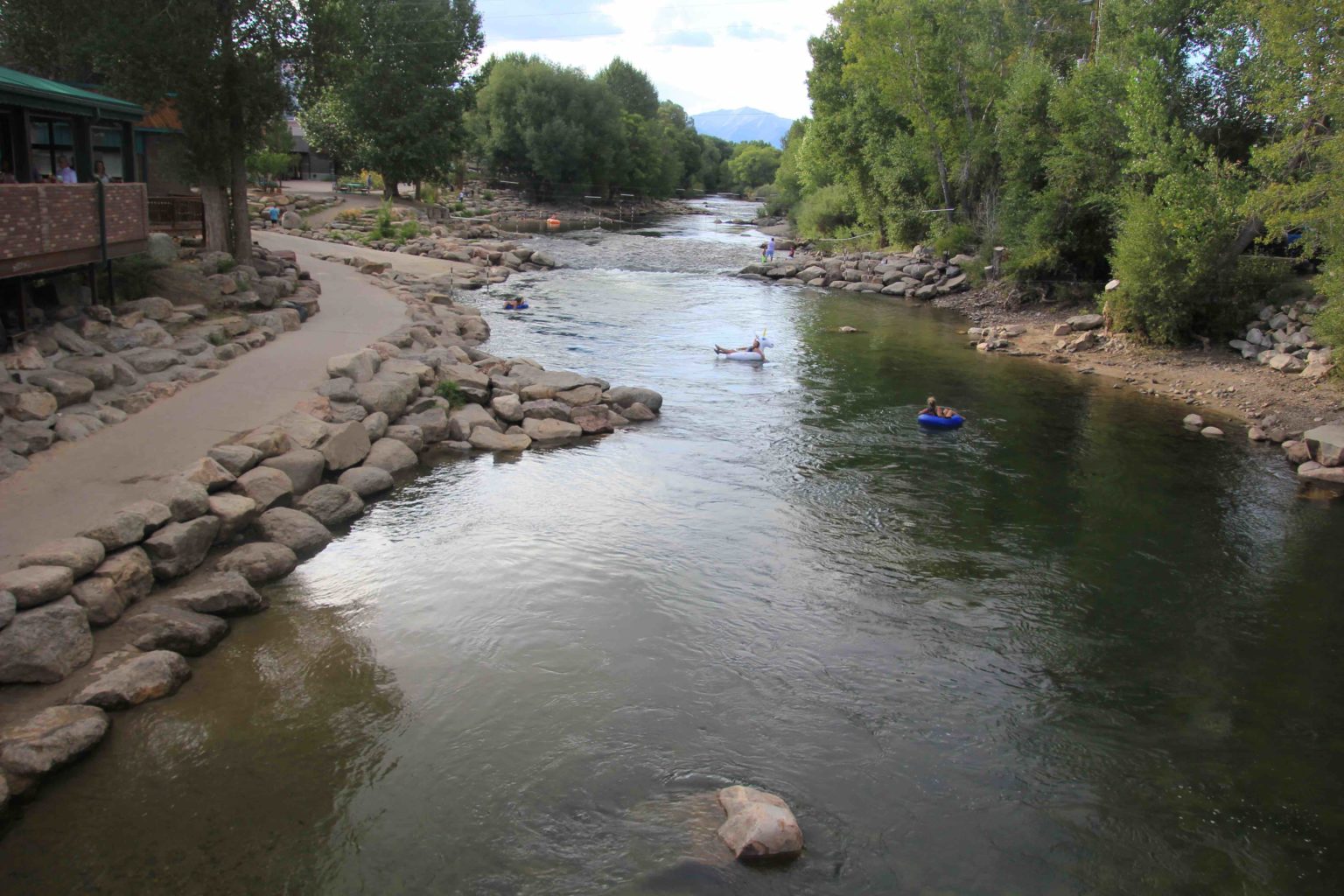
A recent study by Colorado Parks and Wildlife and a Colorado Springs Tribune article by Jonathan Ingraham have raised concerns about the adverse effects certain whitewater parks might have on local fish populations – but local CPW officials said they are pleased to report Salida and Buena Vista’s parks aren’t among them. For Salida’s Scout Wave, CPW collaborated with Mike Harvey’s company to design the fish passage part of the wave, CPW aquatic biologist Alex Townsend said. “It definitely took some forethought.” Though there are examples of whitewater parks that are not built with fish welfare in mind, Townsend said the parks in Salida and Buena Vista are built that way, and other whitewater park designers need to be sure to work with biologists and wildlife experts…
When building the fish passage, they have a gradient that extends a little further than the wave itself, with planned drops and pools below those drops. They also created rough elements, which create vortices for the fish to have flow refuge, he explained, resulting in the fish passage being nowhere near the same velocity as the wave…
Mike Harvey, project manager of Recreation and Engineering Planning, who constructed the Scout Wave and fish passage, said, “We’ve been working with CPW over 15 years. This is not something that is new to us.” In regards to the Tribune article, he said, “It’s a little surprising that this is coming up again,” he said…
Building the fish passage did not require any extra labor on their part, nor was it difficult, he said. “You’re going to set rocks anyway, so you just set them in the configuration that they need.”