
When Rivers Can’t Bounce Back: What Water Bankruptcy Means for #Colorado’s Rivers — Josh Boissevain (Colorado Water Trust)

Dolores River. Photo credit: Colorado Water Trust

Click the link to read the article on the Colorado Water Trust website (Josh Boissevain):

February 13, 2026

A new global water report offers a framework for understanding risk, resilience, and why protecting streamflow is critical now more than ever.

Water management has long depended on the assumption that systems will rebound after stress. New research suggests that, in some places, recovery may no longer be guaranteed and that risk may now be accumulating faster than it can be relieved.

recent report from the United Nations University Institute for Water, Environment and Health introduces a term for this emerging condition: water bankruptcy. The report argues that many human–water systems are now living beyond their hydrological means. We are drawing not only on the water that is replenished each year through snowpack and rainfall, but also borrowing against long-term ‘savings’ stored in aquifers, glaciers, wetlands, soils, and river ecosystems. Over time, that continual drawdown does more than strain sustainability. It degrades the natural capital that makes water available and stabilizes the hydrologic cycle.

The Arkansas River, near Salida, CO. Credit: Ken Lund

When Recovery Can No Longer Be Assumed

Unlike stress or crisis, which assume eventual recovery, water bankruptcy describes a system that has moved beyond short-term disruption into a condition where loss accumulates faster than it can be repaired.

According to the report, the defining features of water bankruptcy are insolvency and irreversibility. Insolvency describes a condition in which a system can continue to function only by drawing down its remaining assets, rather than living within what can be replenished. Irreversibility refers to the loss of natural capital that cannot be fully restored within realistic planning horizons, even if conditions later improve.
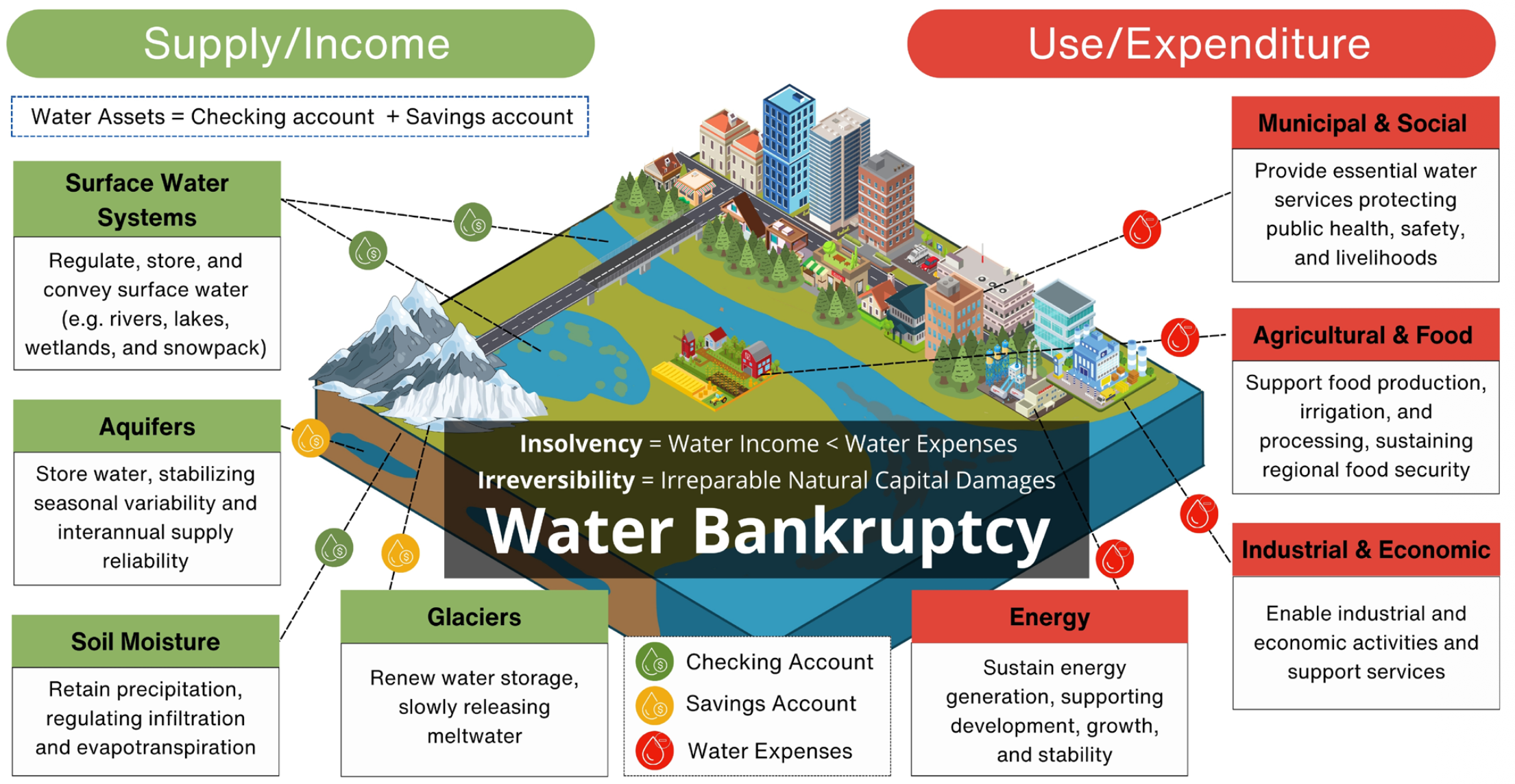
A simple illustration of water income and water expenses in a human–water system. Water bankruptcy is the outcome of both insolvency and irreversibility conditions, i.e., when water use (expenditure) exceeds water supply (renewable and non-renewable assets) for an extended period resulting in irreparable damages to the underlying natural capital that contributes to water production and stability of the hydrological cycle.

UNU-INWEH Report: Madani, K. (2026). Global Water Bankruptcy: Living Beyond Our Hydrological Means in the Post-Crisis Era.

Implicit in this framing is an important insight: water systems falter not only when too much is withdrawn, but when patterns of use become misaligned with the processes that renew and sustain them. When water is consistently removed without regard to its timing, location, or ecological role, the system’s ability to regenerate weakens. The system-scale consequences often appear as instability, loss of function, and shrinking margins for recovery, rather than as immediate shortage. And those consequences affect more than just natural systems; they increase risk for everyone who depends on them.

Colorado Through the Lens of Water Bankruptcy

Across the state, many rivers now experience earlier runoff, longer low-flow seasons, and reduced resilience. In some reaches, the question is no longer whether the river will be stressed in a given year, but whether it will even have enough functional flow, at the right times, to sustain the processes that keep it a river rather than just a delivery canal for downstream consumption.

One of the report’s most useful contributions (and one that might resonate in Colorado) is its emphasis that water availability is not just a quantity problem, but a problem of depleted natural capital. This refers to the physical and ecological conditions that allow water systems to function, replenish, and recover over time. Rivers, aquifers, and ecosystems are not simply “external” values weighed against human needs; they are part of the underlying system that sustains reliable supply. When a river’s ability to do its ecological work is degraded year after year, the system’s capacity to recover shrinks, and management options shrink with 

In that sense, building resilience into our rivers is a form of system-wide risk management. Streamflow protection creates margin—margin for drought, future pressure, and operational uncertainty—by helping rivers retain enough function to recover through dry periods. Seen this way, adding water to streams is not just an ecological goal but a practical investment in long-term system reliability; it treats rivers as essential natural infrastructure rather than as luxuries. Streamflow protection is capital preservation that helps rivers absorb future stress, recover more quickly, and retain the capacity to respond when conditions change. In a system where recovery can no longer be assumed, that margin is essential. Moreover, protecting streamflow today helps preserve the system’s ability to serve future beneficiaries, not just current ones.

The case for streamflow is often strongest when supply is tight. The costs of losing river function are rarely evenly distributed, and they tend to show up first where flexibility is lowest: among junior users, smaller operators, and rural communities with fewer alternatives. Once function is lost, recovery is uncertain, even if water returns later. Supporting streamflow during critical periods can therefore reduce the need for more disruptive and costly interventions later, helping scarcity be managed through foresight rather than crisis.

A view of Willow Creek, a Tributary of the Rio Grande, in Creede, Colorado. The creek is channelized and flows through the central part of town. Credit: Jeffrey Beall

Helping Rivers Helps Us All

This is where the Colorado Water Trust’s work fits. For more than two decades, the Water Trust has worked within Colorado’s prior appropriation system to restore and protect streamflow through voluntary, compensated, and collaborative agreements with water users. The aim is not to recreate historical conditions wholesale. Instead, projects are designed to support rivers through critical periods by adding flow where and when it can help streams move through their natural cycle, maintain function during vulnerable seasons, and reduce the risk of long-term system failure.

On the Upper Colorado River, for example, the Water Trust has partnered with agricultural producers and reservoir operators to temporarily reduce diversions or strategically release stored water during late summer and early fall, when stress is highest and recovery windows are narrowest. These agreements do not resolve long-term imbalances in the watershed. What they do is slow the loss of system capacity. They help the river retain enough function to buffer key habitat, move sediment, regulate temperature, and remain connected through critical reaches.

Seen through the lens of water bankruptcy, this work more closely resembles debt management than debt elimination. It helps preserve the natural capital that remains, keeping options open and reducing the risk that today’s imbalances become tomorrow’s irreversible losses.

The Animas River in early fall, flowing from the mountains, past Durango, and beyond. Credit: Mike McBey

Streamflow restoration is not a substitute for hard conversations about demand, growth, or allocation. It is a complementary tool for managing risk in the meantime. The point here is not to fatalistically diagnose Colorado’s water system as “bankrupt,” but to ask whether the conditions the report describes are becoming more familiar—and what that implies for how we think about risk, resilience, and responsibility in a future where recovery can no longer be assumed. If rivers and snowpack are the foundations of our water system, then maintaining their ability to function is not a luxury. It is a prerequisite for long-term success.

The report itself emphasizes that responding to water bankruptcy requires more than finding new supplies or engineering around scarcity. It calls for protecting and restoring the natural systems that underpin water availability, managing within ecological limits, and prioritizing actions that preserve long-term system function. In that sense, the most effective responses are those that stabilize capacity before losses become irreversible. For Colorado, that insight reinforces the importance of streamflow protection as a practical resilience strategy, and it’s one that helps maintain the functional integrity of rivers even as pressures increase.

For the Colorado Water Trust, that is the core takeaway. Streamflow restoration and protection are not just about helping rivers survive. They are about building the buffers that make Colorado’s entire water system more resilient and more secure.

By prudently “re-investing” today’s water back into the stream, we can help ensure that future Coloradans will inherit capacity. Not crisis.

Colorado Rivers. Credit: Geology.com

Federal Water Tap, February 23, 2026: In Separate Lawsuits EPA Upholds, Rejects Biden-Era Drinking Water Rules — Brett Walton (circleofblue.org)

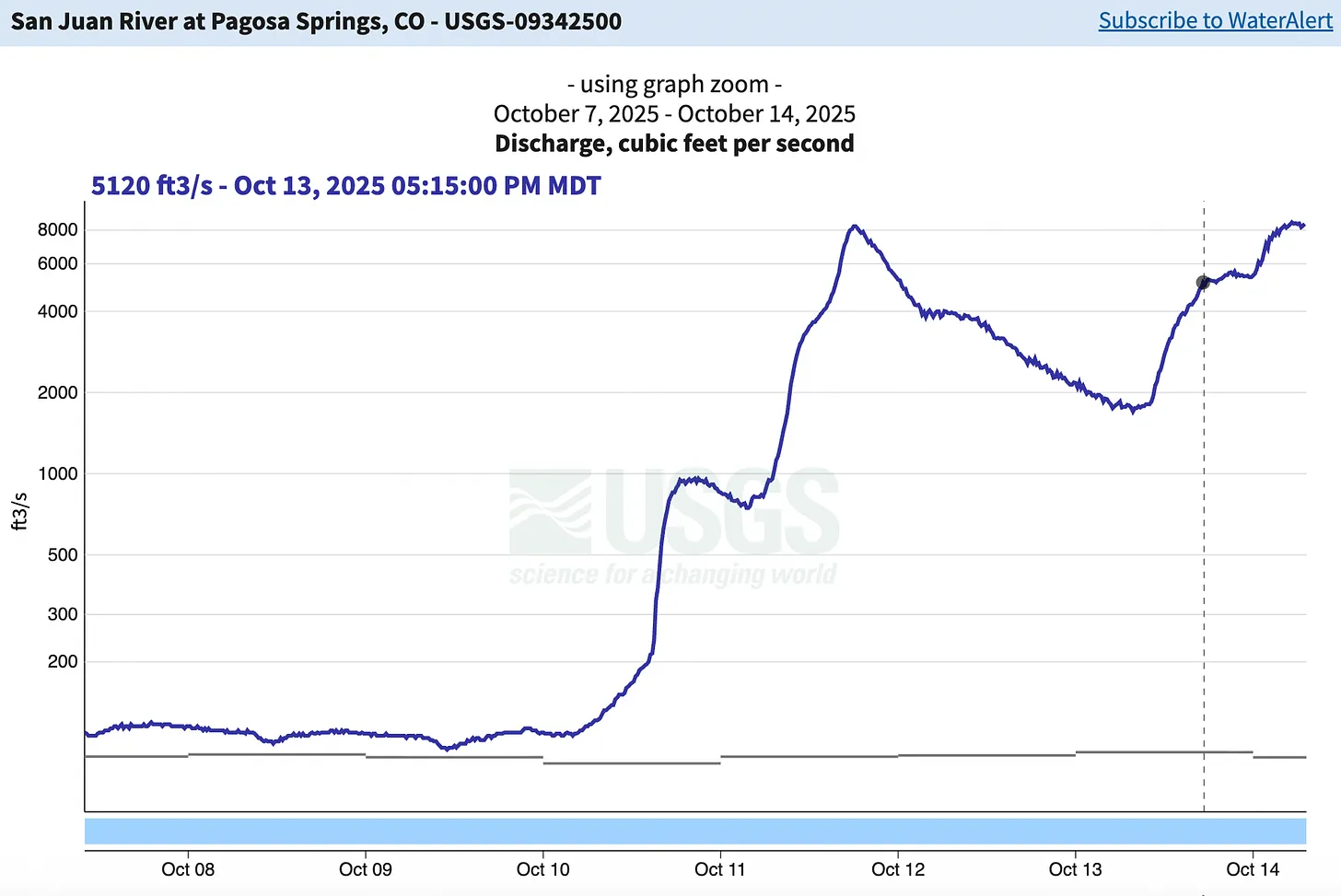
The San Juan River has peaked above 8,000 cfs twice in October 2025, reaching the highest levels seen since the 1927 flood. Source: USGS.

Click the link to read the article on the Circle of Blue website (Brett Walton):

The Rundown

  • EPA asks federal court to pause part of its regulations for PFAS in drinking water.
  • EPA also says it will uphold Biden-era lead pipe replacement requirements.
  • DOE once again orders a Michigan coal plant to continue operating.
  • Congress will hold hearings this week on safe drinking water, water-related legislation, and an Army Corps authorization bill.
  • U.S. Supreme Court will hold oral arguments this week for the Line 5 oil pipeline case.
  • EPA seeks comments on ways to reduce regulatory burden for hazardous substance spill response plans.
  • FEMA continues to be slow in approving disaster declarations in Democratic-led states.

And lastly, the White House promotes domestic phosphorus mining and glyphosate production by conferring “immunity” under the Defense Production Act.

“Consistent with these findings, I find that ensuring robust domestic elemental phosphorus mining and United States-based production of glyphosate-based herbicides is central to American economic and national security. Without immediate Federal action, the United States remains inadequately equipped and vulnerable.” – President Trump’s executive order that grants these activities (phosphorus mining and glyphosate production) immunity from “damages or penalties” for any activity related to the order. The underlying law is the Defense Production Act. Phosphorus and glyphosate are foundational elements of modern American agribusiness. They are in fertilizer and the weedkiller Roundup. But they are also primary water pollutants that contribute to harmful algal blooms or are linked to cancer and other illnesses.

In context: Toxic Terrain

News Briefs

EPA PFAS Lawsuit
The EPA is continuing to make its case in court that the agency’s Biden-era regulation of four PFAS in drinking water should be paused while it works on a new regulation that would officially rescind them, Bloomberg Law reports.

Two of the regulated chemicals – PFOA and PFOS – have standard numerical limits. The four others – PFNA, PFHxS, PFBS, and GenX – would also be regulated as a group, using what’s known as a “hazard index.” This is the first time the agency has used such an approach for drinking water regulation.

The court in January rejected the EPA’s request to vacate the hazard index component. The agency now wants to separate the hazard index from the rest of the litigation.

Two water utility groups – the American Water Works Association and Association of Metropolitan Water Agencies – filed the lawsuit in June 2024 in the U.S. Court of Appeals for the D.C. Circuit.

In the court filing, the agency says that it has drafted a notice of rulemaking to rescind the hazard index and plans to “commence the rulemaking process imminently.”

Lead Pipe Replacement
In a separate lawsuit, the EPA said it would uphold the Biden administration’s 10-year timeline for most cities to replace lead drinking water pipes, the Associated Press reports.

The lawsuit challenging the timeline was also brought by the American Water Works Association, which argued that it was not feasible.

Michigan Coal Plant Operating Order Extended
The Department of Energy once again extended the life of a Michigan coal-fired power plant.

This is the fourth 90-day order to keep the J.H. Campbell Generating Plant operating. The DOE argues that closing the plant is a threat to grid reliability. It is also costing Consumers Energy, the plant owner, a lot of money – at least $80 million through last September. The company will likely recover costs through customer rate increases or surcharges.

Consumers intended to shut down the plant in May 2025.

In context: The Energy Boom Is Coming for Great Lakes Water

Hazardous Spill Response Plans

The EPA, at the prompting of regulated facilities, is considering changing federal requirements for hazardous substance spill plans, which are authorized under the Clean Water Act to guide emergency response in case a large volume of toxic chemicals is released into waterways.

The requirements in questions were established in 2024 during the Biden administration and apply to onshore non-transportation facilities – things like chemical manufacturers, oil and gas operators, gas stations, hospitals.

The agency is seeking comment on whether it should simplify the rules for determining which facilities are required to file response plans. Public comments are due March 20 and can be submitted via www.regulations.gov using docket number EPA-HQ-OLEM-2025-1707.

Studies and Reports

Disaster Declarations and Approvals
FEMA approved a disaster declaration for Louisiana, which the state requested on February 5 following a late-January storm. And it approved a declaration for a Washington, D.C. sewer line that collapsed on January 19.

The federal disaster agency, meanwhile, has rejected or has been slow to approve requests from Democratic-run states. FEMA has not acted on Washington state’s January 21 request.

Arizona and Illinois are appealing requests from last fall that were rejected. Colorado is appealing two requests from January 16 that were denied.

Chinook Salmon Decision
The National Marine Fisheries Service decided against listing the Washington coast segment of Chinook salmon as endangered or threatened, saying the population faces low extinction risk.

This is the result of the agency’s 12-month review, an in-depth assessment of the threats to a species. In response to a petition from the Center for Biological Diversity, the agency had made a preliminary, 90-day decision during the Biden administration that listing the species may be necessary.

Washington coast Chinook salmon spawn north of the Columbia River and west of the Elwha River, a geography that includes the Olympic peninsula.

On the Radar

Line 5 in the U.S. Supreme Court
On February 24, the nation’s high court will hear oral arguments in a case involving the controversial Line 5 oil pipeline that crosses the Straits of Mackinac between lakes Huron and Michigan.

The case centers on a jurisdictional matter: should the lawsuit seeking to shut down the 73-year-old pipeline be heard in state or federal court?

Dana Nessel, the Michigan attorney general, filed the case in state court in 2019 alleging that Enbridge’s continued operation of the pipeline violated state law.

In context: Federal Judge: Michigan Has No Authority to Shut Down Line 5

Colorado River DEIS Comments Due
The Bureau of Reclamation is accepting public comments through March 2 on its draft plan for managing the Colorado River reservoirs after current rules expire at the end of the year.

Submit comments via crbpost2026@usbr.gov.

Congressional Hearings
On February 24, a House Energy and Commerce subcommittee will hold a hearing on safe drinking water in the United States.

Also on February 24, a Senate Energy and Natural Resources subcommittee will discuss 18 water-related bills, including rural water supply systems, snow water forecasting, and water recycling.

There are two hearings this week on the next Water Resources Development Act, the legislation that authorizes Army Corps projects for dams, levees, ports, and ecosystem restoration.

The action starts on February 24 with a House Transportation and Infrastructure subcommittee. The head of the Army Corps will testify, as will the chief of engineers.

Then on February 25, the Senate Committee on Environment and Public Works holds its own hearing.

Federal Water Tap is a weekly digest spotting trends in U.S. government water policy. To get more water news, follow Circle of Blue on Twitter and sign up for our newsletter.