
April 2, 2026
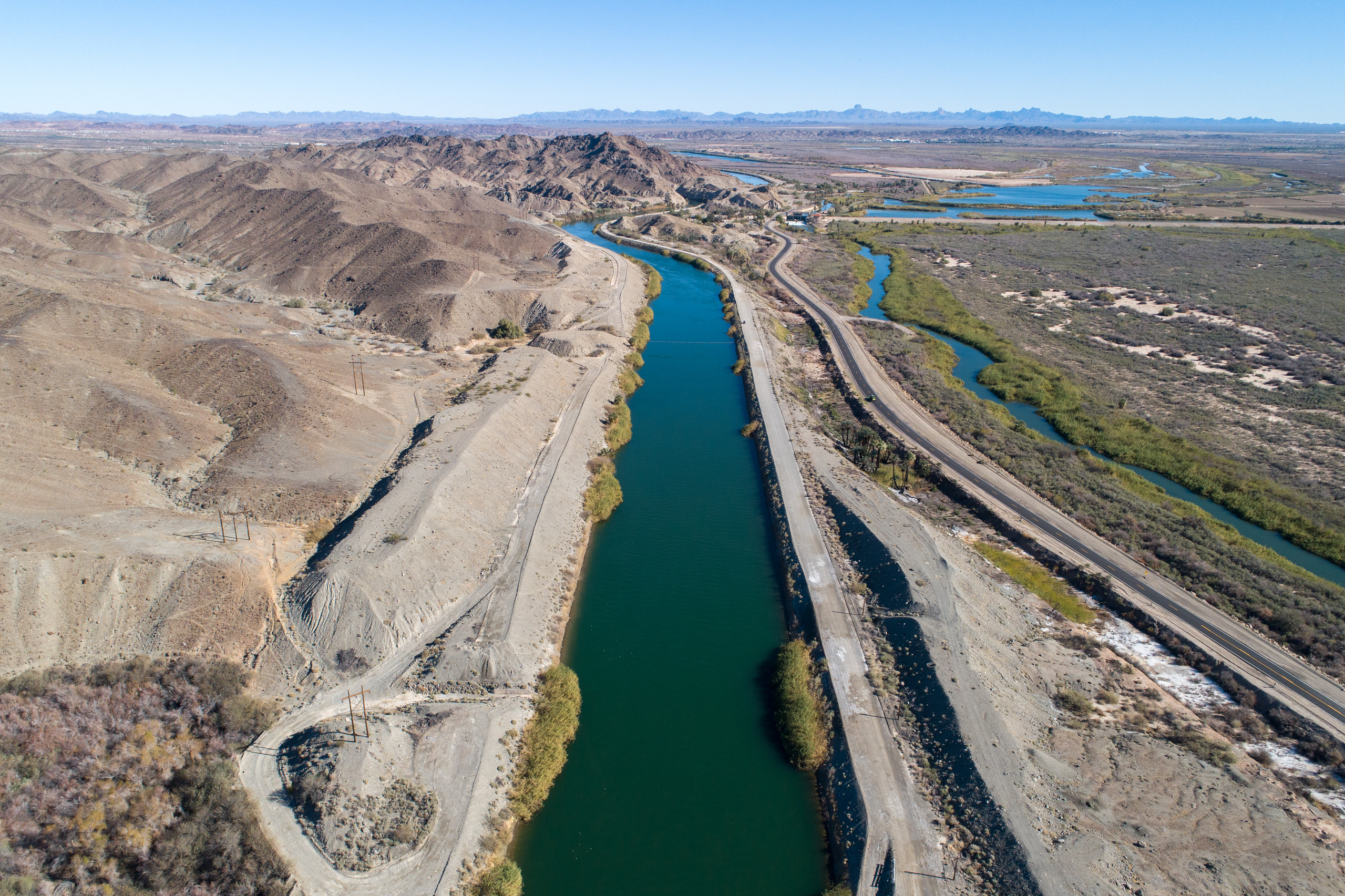
In the southeast corner of California, 300-foot-tall sand dunes rise from a sunbaked landscape dotted with ocotillo and creosote bushes. Summer temperatures here regularly exceed 110 degrees, and annual rainfall is comparable to that of the Sahara Desert. Despite its unforgiving terrain, more than 180,000 residents live in Imperial County, one of the country’s most productive agricultural regions and more recently a magnet for data center development and lithium extraction proposals. This has all been made possible by turn-of-the-20th century canals that carve up the region, supplying it with more than a million gallons of Colorado River water every minute.
“We’ve often called it the lifeblood of Imperial Valley,” said Robert Schettler, a spokesperson for Imperial Irrigation District, the area’s public utility, which manages the region’s over 3,000 miles of drains and canals. “If something were to happen to that river, we would all have to pack up and leave.”
Something is happening to the Colorado River. Over the past century, its average water supply has fallen by nearly a third due to prolonged drought and climate change. Experts predict that decline will continue, threatening cities, tribes and farms that depend on the river’s flow, from Wyoming, Utah, Colorado and New Mexico to Arizona, Nevada and Northern Mexico. Most of the Colorado River’s water starts as snowpack in the Rocky Mountains, but after the American West experienced the warmest winter ever recorded, snow levels are now at historic lows, prompting experts to warn that 2026 may be one of the river’s driest years yet.
That could spell disaster for Imperial County, whose harsh desert landscape of windblown sand and rugged burnt-orange mountains was transformed more than a century ago into productive, gridded farmland dotted with small cities such as Brawley, El Centro and Calexico…Imperial Valley’s agricultural industry consumes by far the largest share of water in the region, about 97% of the 3.1 million acre-feet managed by the Imperial Irrigation District every year…Those ambitious and largely successful conservation efforts have come at a cost. Much of the water used by farmers historically flowed into the nearby Salton Sea, but as farmers have reduced their water use, less runoff has reached the man-made lake, accelerating an existing environmental crisis Over the last three decades, the Salton Sea has shrunk by more than 60 square miles, exposing a dry lakebed laden with pesticides, particulate matter and heavy metals. Those contaminants are carried as dust through the air into nearby communities, contributing to a childhood asthma rate triple that of the national average. Now, farmers such as Brian Strahm, whose family has been growing crops in the area for four generations, are concerned they may have to decrease their water use further. That may prove difficult since farmers have already put in place many efficiency measures, Strahm said…Farmers say cuts could seriously harm the area’s already struggling economy. In addition to being the county with the highest percentage of Latinos in California, Imperial has among the highest unemployment rates of any county in the country, at nearly 19%. For those who do find work, the agricultural industry offers a lifeline, accounting for one out of every six jobs in the region.
