The #416Fire reminds us there’s no escape from #climatechange — @HighCountryNews


The 416 Fire started at about 10 a.m. on June 1, 2018, approximately 10 miles north of Durango, CO. Rocky Mountain Type 1 Incident Management Team is managing the fire. The fire is burning on the west side of State Highway 550 on some private land and on the San Juan National Forest. The fire is burning in grass, brush, and timber. The Weather conditions remain critical and fuels are ideal for significant fire growth. The fire has been very active and continues to burn in rough and inaccessible terrain. Many homes have been evacuated and structure protection is in place. Map via Inciweb

From The High Country News (Jonathan Thompson):

For longtime Southwesterners, this year’s low snowfall and high temperatures bring back memories of 2002, a year that seemed to stand as the region’s come-to-Jesus climate moment. The snow cover was thin to nonexistent, even in the high country. Fields dried up and Lake Powell began its big shrink. Record-breaking fires burned across the region.

But as the warm spring of 2002 moved into a scorching summer, I wasn’t worried. I lived in Silverton, Colorado, at 9,318 feet in elevation, where extreme drought for everyone else just meant a more pleasant summer for us. We could actually barbecue on Memorial Day instead of suffering through a blizzard, ride our bikes up the high passes before July 4, and swim in the Animas River without instantly contracting hypothermia. I believed that Silverton, which at the time was looking for new economic engines after the loss of mining, offered a refuge people would flee to, not from, when climate change manifested elsewhere in the form of drought, fire and desertification.

And so, on an early June afternoon in 2002, while the lowlands broiled, my friends and I sat in the lawn sipping cold beverages and enjoying perfect temperatures in our T-shirts and shorts. It was an uncommon pleasure during any month in Silverton. If this is global warming, I declared, then bring it on.

Just moments later, we noticed what looked like a puffy cumulonimbus cloud rising up in the gap formed by the Animas River gorge. It wasn’t a cloud at all, but a billowing tower of smoke from what would become known as the Missionary Ridge Fire. Over the coming weeks the blaze would eat through 73,000 acres of parched scrub oak, aspen, ponderosa pine and spruce forest, burn 83 structures, and batter the regional economy.

Flash forward to June 2018. Much like the Missionary Ridge Fire, the 416 Fire has been ripping through forests north of Durango since June 1, sending up roiling clouds of smoke and diminishing the air quality for miles around. The current fire was sparked almost exactly 16 years after the former in similar vegetation. This time, though, the flames were no surprise. We knew that the dry winter of 2018 would usher in an explosive fire season, which is not to say that the region took enough precautions.

During the Missionary Ridge Fire, and in its immediate aftermath, Silverton did not become a destination for refugees fleeing fire, heat and drought. To the contrary, despite the fact that the flames never got anywhere near Silverton, the mining-turned-tourist town’s economy took the biggest blow of all the region’s communities.

This year looks to be no different. The Durango & Silverton Narrow Gauge Railroad — the primary artery for delivering tourist dollars to Silverton — has suspended service for the month of June because the coal-fired locomotives are a fire hazard. (In fact, the train is suspected of igniting the 416 Fire, though the official cause remains “unknown.”) One of just two highways connecting Silverton to the outside world has been closed on-and-off due to the fire, further hampering the ability of tourists to get to the town. Now, the Forest Service indefinitely closed the 1.8 million-acre San Juan National Forest, cutting off mountain bike and hiking trails, campgrounds and jeep roads —along with a major revenue stream for the entire region’s outdoor recreation-oriented businesses.

Eventually, the rains will come and the fire danger will diminish and television screens will no longer be alight with images of southwestern Colorado’s forests engulfed by hellish flames. But the pain undoubtedly will resonate through the rest of the summer, just as it did in 2002 after the Missionary Ridge Fire subsided.

Repercussions may still be felt for years to come, too, particularly when it comes to the steam-powered train. In the wake of the 416 Fire, social media has stoked a movement pushing the railroad to switch to diesel locomotives — or not run at all — during times of extreme fire danger, before a blaze can erupt.

Such suggestions spark fervent pushback from train-reliant sectors of the economy and their supporters. Since diesel locomotives lack the authenticity and aesthetic appeal of their steam-powered cousins, they argue, such a switch could result in fewer passengers and less tourism revenue overall. “You must be a complete IDIOT,” says a representative commenter on Facebook. “This town is alive because of that steam train! You must be a transplant trust funder to think we don’t need the train.”

Replace “train” with your local industry of choice — mining, say, or oil and gas drilling — and the exchange repeats one that has resounded around the West for decades. Concerned citizens ask the mining companies to stop polluting the rivers, or the oil companies to plug their methane leaks, or the train to stop spewing sparks, and the industry and its foot soldiers always lash back: Even minor protective measures, they say, could kill the industry and bring down the whole economy with it.

This sort of short-term thinking, of prioritizing today’s bottom line over future environmental or public health, rarely pays off in the long term. Yesterday’s failure to address mining pollution is the Gold King Mine disaster of 2015, and today’s unfettered methane leaks are tomorrow’s climate change-caused water shortage. Today’s yearning for the authenticity of coal-fired locomotives is tomorrow’s economy-obliterating megafire.

Thirty years ago, coal trains could run without consequence through the “asbestos forest” of the San Juan Mountain high country. The drought of 2002, however, woke up the railroad’s owners to a changing world, one in which the ravages of climate change can — and will — affect even a quaint little tourist train and the quaint little town that relies on it. The railroad adjusted accordingly, having a firefighting team follow behind each train to extinguish blazes in their infancy. The 416 Fire — particularly if it is found to have been started by the train — will prove an even more brutal moment of reckoning, a grim reminder that yet more adaptation is needed.

I had my own moment of reckoning following that unusually toasty day back in 2002 when Silverton’s economy went up in smoke for the remainder of that summer. I realized then that Silverton will never become the sanctuary from global warming that I dreamed it would. This year the point is being driven home. There is no sanctuary, not really. In one way or another, the climate catastrophe that we have wrought reaches into every corner of our planet and our lives — even at 9,318 feet.

Jonathan Thompson is a contributing editor at High Country News. He is the author of River of Lost Souls: The Science, Politics, and Greed Behind the Gold King Mine Disaster. This article was first published on June 15, 2018 by The High Country News.

From The Farmington Daily Times:

The 416 Fire near Durango, Colorado, reached 30 percent containment [June 18, 2018] as temperatures rose and humidity dropped.

Firefighters don’t expect the fire to grow above the current 34,161 acres today, but say there’s a potential for things to pick up later this week.

“Much of the fire is now in a state of smoldering and creeping, and active flames have been infrequent,” the 416 Fire team reported in Monday morning’s roundup. “Today, however, starts a weather trend that will quickly dry out fuels and re-elevate fire potential as the week goes on.”

The fire team echoed a statement made Sunday at a community meeting in Durango: the blaze that has burned more than 50 square miles is down, but it isn’t over.
#AnimasRiver: @EPA requests comments for interim plan for SW #Colorado mine clean up

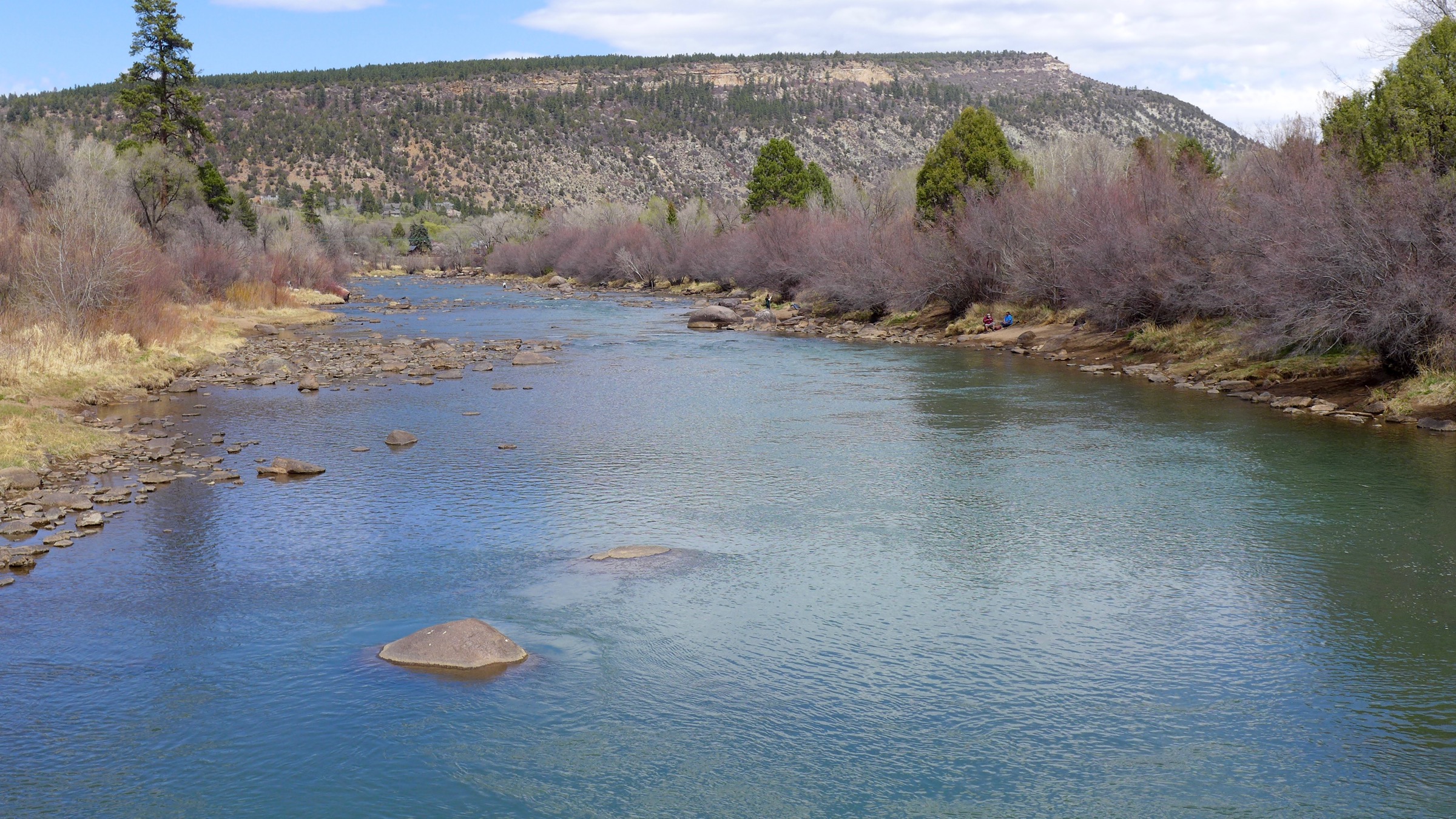
The Animas River in Durango, in Apri, 2018. Photo: Brent Gardner-Smith/Aspen Journalism

From The Associated Press (Dan Elliott):

The interim plan concentrates on controlling or removing contaminants at 26 sites including campgrounds, mine waste piles, ponds and rivers. It will cost about $10 million and take up to five years, the agency said.

Five of the locations are recreation sites where people could be exposed to arsenic or lead, the agency said.

“EPA is interested in expediting cleanup so that we can show improvements in water quality wherever possible,” said Christina Progess, manager of the Superfund project…

The Gold King is not on the list of 26 sites chosen for interim work. The EPA said that’s because a temporary treatment plant was installed two months after the spill and is cleaning up wastewater from the mine.

The Superfund cleanup will eventually cover 48 mining sites, but the EPA said it chose 26 for interim work to reduce human and environmental risks while a long-term solution is studied.

The EPA said the 26 sites have elevated levels of aluminum, cadmium, copper, iron, lead or zinc.

Two of the recreation sites on the list are campgrounds and three are parking areas or locations where people meet for tours, the EPA said. The plan calls for covering mine waste piles and contaminated soil with gravel or plant growth to reduce human exposure and keep the contaminants from being kicked into the air.

The other work includes dredging contaminated sediment from streams and from ponds near mine openings, and digging ditches and berms to keep water from flushing contaminants out of waste piles and into streams.

The EPA is seeking public comment on the plan. The deadline for comments is July 16.

@COParksWildlife closes some state wildlife areas near #Durango; others and state parks remain open #416Fire #BurroFire

From email from Colorado Parks and Wildlife (Joe Lewandowski):

To assist federal and local agencies during the current dangerous fire conditions and recently enacted public land closures, Colorado Parks and Wildlife has announced that some State Wildlife Areas in southwest Colorado are now closed to all public access. But in addition, several other water-based wildlife areas and two state parks remain open to the public.

In and near Durango the Bodo, Perins Peak, Haviland Lake, Devil Creek and Williams Creek state wildlife areas are closed until further notice. In Bayfield the Lion’s Club shooting range, managed by CPW, is also closed.

West of Durango in Dolores and Montezuma Counties, Lone Dome and Fish Creek State Wildlife Areas are also closed.

“We regret having to enact these closures, but we do so in an effort to protect the public and protect natural resources. These measures will also help with compliance to the recent closures enacted by the U.S. Forest Service and La Plata County,” said Adrian Archuleta, a District Wildlife Manager with CPW.

CPW also wants area residents and visitors to know that there are several other State Wildlife Areas and State Parks that remain open for recreation. CPW asks that people comply with any current local fire restrictions so that these areas can remain open for recreation.

The areas that are open include: Echo Canyon SWA in Archuleta County; Pastorious SWA in La Plata County; in Montezuma and Dolores counties — Summit, Puett, Narraguinnep, Totten, Twin Spruce, Dolores River, Joe Moore and Ground Hog Reservoir state wildlife areas.

Also open are Navajo State Park in Archuleta County; and Mancos State Park in Montezuma County. Both parks offer campsites, hiking, fishing and other water recreation.

@EPA finds place near Silverton to store #GoldKingMine sludge #AnimasRiver

The EPA’s wastewater treatment plant near Silverton, Colorado, on Thursday, Oct. 16, 2015 — photo via Grace Hood Colorado Public Radio

From The Durango Herald (Jonathan Romeo):

EPA officials announced last week that the agency has entered an agreement with a property owner who owns the Kittimac Tailings, a historic mine waste pile about six miles northeast of Silverton along County Road 2.

The EPA built a $1.5 million temporary water treatment plant north of Silverton in October, three months after the agency triggered the Gold King Mine blowout, which sent a torrent of mine waste down the Animas and San Juan rivers.

Since, the water-treatment plant has been treating and removing potentially toxic metals out of water that continues to discharge from the Gold King Mine. In April, the EPA said the mine was still leaking 450 gallons a minute.

The water treatment plant adds lime to the mine wastewater to raise the pH of the water so that dissolved metals become solid and can settle in settling ponds – a highly effective process.

The process, however, generates a lot of sludge. EPA has said an estimated 4,600 cubic yards of sludge is generated a year.

The agency had been storing this sludge waste product – which is considered non-hazardous – at the site of the water treatment plant in an area known as Gladstone, about six miles north of Silverton along County Road 110.

The EPA announced this spring, however, room was running out at Gladstone for the sludge…

Scott Fetchenheir, a San Juan County commissioner and former miner, said Wednesday local residents are pleased to learn the EPA found a better solution to the sludge waste issue.

“I think it’s a good idea,” he said. “But it’s almost like this big experiment.”

The EPA has said it will mix the Gold King Mine sludge with mine tailings located at Kittimac.

The EPA believes this will reduce high water content of the sludge, and will allow more efficient management, while at the same time immobilize heavy metals found in the tailings pile…

The EPA said it is conducting a bench-scale testing of the sludge and tailings mixture to ensure the maximum reduction of metals leaching from the tailings. The agency plans to conduct a pilot test of this transfer process for one week in mid-June.

The Kittimac tailings pile for years has been used illegally by dirt bikers and ATVers who have disregarded “no trespassing” signs to ride on the mine waste that looks like a pile of sand. Now that the EPA is using the site, access will be more guarded, Tookey said…

While the short-term problem of where to put the sludge is temporarily solved, Fetchenheir said there remains the larger, more complicated matter at hand: what to do for long-term treatment of the mines draining into Cement Creek, a tributary of the Animas River considered the worst polluter in the headwaters.

While lime treatment plants are effective, they are also expensive to operate ($1 million a year) and have to be run in perpetuity. The EPA has yet to release its plan for long-term treatment options.

“It’s hugely open-ended,” Fetchenheir said. “The true hope is some new technology arrives that removes metals without generating a huge amount of sludge. But I haven’t seen anything like it.”

For now, the EPA said it will transfer the sludge via truck using the County Road 110 bypass. The agency said it hopes to reduce negative impacts, such as noise and dust suppression.

After the pilot test in June, the EPA will resume transferring the sludge to the Kittimac tailings after the tourist season, around early fall, for a duration of about five weeks.

The 416 Fire and memories of 2002 — and 1879 — @JonnyPeace

From Jonathan P. Thompson:

Someone noticed a puffy cumulonimbus cloud rising up in the gap formed by the Animas River gorge and gave a little cheer. Winter and spring had been freakishly dry and warm, and we really could have used the rain. Something was off about the cloud, however, and we all grew quiet. It wasn’t a cloud at all, but a billowing tower of smoke.

That was 2002 and the smoke was from the Missionary Ridge Fire, ignited that afternoon on a slope about 35 miles south of where we sat. Over the coming weeks, the blaze would eat through 73,000 acres of parched scrub oak and aspen and conifer forest along with 83 structures. The local tourism economy, already dampened by the Dotcom bust and the 9/11 attacks of the previous year, was battered. It would be remembered as southwest Colorado’s summer of discontent.

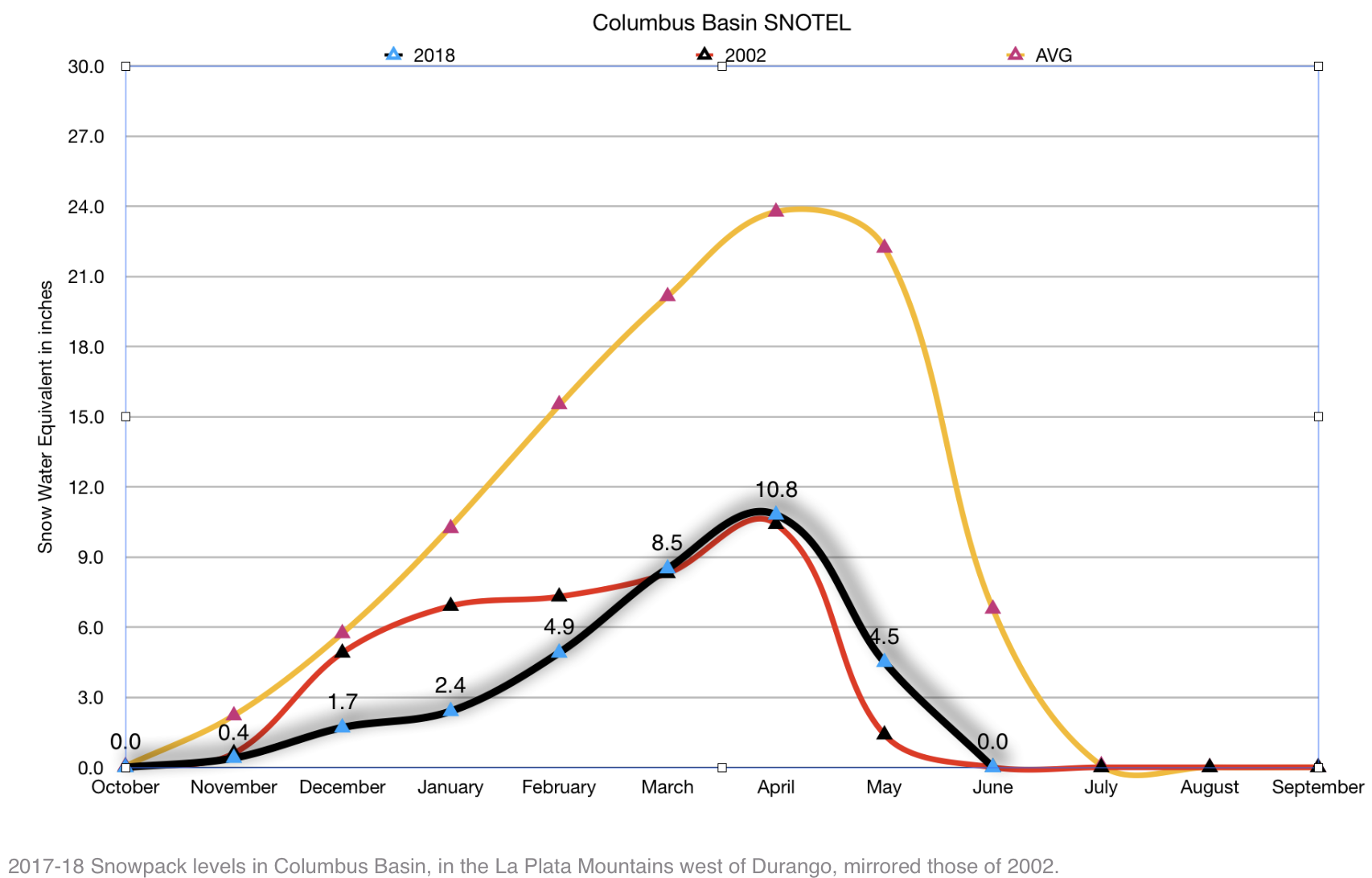
Memories of and comparisons to that summer emerged last week when the 416 Fire broke out just across the valley from where the Missionary Ridge Fire was sparked 16 years earlier. The comparisons, unfortunately, are apt. Precipitation for the 2018 water year (which started Oct. 1, 2017) has thus far mostly mirrored 2002. Flows on the Animas River are slightly better than they were 16 years ago, but only slightly (see accompanying graphs). The conditions are therefore in place for a rerun of that smoky summer.

At this point, however, the 416 Fire does not appear to be a Missionary Ridge repeat, at least in terms of severity. The 2002 blaze was started by an errant spark, possibly from a car’s exhaust pipe, in the early afternoon of June 9, and it had blown up to 6,500 acres within hours. As I write this, the 416 Fire is spreading much more slowly, having charred 2,400 acres — and no homes — after four days of burning. High winds and hot temperatures could change all of that, of course.

The cause of the 416 Fire remains unknown. Embers from the coal-fired narrow gauge train that travels between Durango and Silverton are a fire hazard, yet the US Forest Service has reported the ignition point as being in the right of way of Highway 550, meaning the fire just as easily could have been started by a motorist’s tossed cigarette butt. In any event, the railroad and the tourism economy that depends on it will be affected. Durango & Silverton Narrow Gauge RR officials say they won’t run the train until June 10 at the earliest, and after that will use a diesel locomotive — to the displeasure of authenticity-seeking passengers. (UPDATE 6/6: InciWeb continues to list fire cause as “unknown,” but the coordinates it gives for the fire, and witness accounts, indicate that the fire started near the railroad tracks, not long after the train passed, far from Hwy 550. Also, the D&SNGRR announced on 6/5 that train service will be suspended until at least June 17.)…

It’s certainly too early to guess how big of a blow the 416 Fire — and any other fires to follow — will have on the regional economy. Still, it’s a tough break coming after a thin ski season and at the beginning of what will surely turn out to be a rough one for commercial rafters, with or without any more fires. It’s also a potent reminder that climate change is bad for a lot of things, including the local economy.

While 2018 is shaping up to mirror 2002, it also closely resembles another dry and disastrous time — the summer of 1879. No one was keeping official tabs on the weather or snowpack or streamflows back then, but from anecdotal and newspaper reports, we can gather that the 1878-79 winter was just as dry and warm as 2017-18. And the results were equally smoky: In early June of that year, a blaze broke out a few miles north of where the current 416 Fire is burning. It ended up charring 26,000 acres of relatively high-altitude forests.

To read more about the Lime Creek Burn, and the way it was used in anti-Ute propaganda; the local community’s love/hate relationship with the tourist train; and a heck of a lot more, get a copy of my book, River of Lost Souls: The Science, Politics, and Greed Behind the Gold King Mine Disaster.

From The Durango Herald (Shane Benjamin) via The Cortez Journal:

Federal firefighters have not released the cause of the 416 Fire. A federal wildfire information database, InciWeb, lists the cause as “unknown.” A longitude and latitude entered into the database pinpoints the fire just west of the train tracks in an area where nothing else is around. Chione confirmed that is about where the fire started.

The Durango & Silverton Narrow Gauge Railroad is not taking responsibility for the fire, but that could change based on the outcome of local and federal fire investigations, General Manager John Harper told The Durango Herald on Tuesday…

The U.S. Forest Service in conjunction with the La Plata County Sheriff’s Office and the Bureau of Land Management are conducting the investigation, according to an email sent Tuesday from Cam Hooley, acting spokeswoman for San Juan National Forest.

“A team of trained investigators was on scene as soon as Friday night, the day of ignition,” she wrote in the email to the Herald. “USFS investigators include both local and regional personnel. Because of the size of the fire, the cost of suppression and the impact on the community, the investigation team will take the time needed to conduct a comprehensive and thorough investigation before any determinations are released. No timeline has been given for release of information.”

Chione and his neighbors often spot fires started by the Durango & Silverton Narrow Gauge Railroad. The Meadowridge subdivision, with eight houses, sits only a couple hundred feet east of the train tracks and is located on a steep grade between Hermosa and Rockwood – an area known locally as Shalona Hill.

Locomotives work hard to power up the mountain, and some hot cinders from the coal-fired engine land on the ground and start little fires. A pop car typically follows each train three to five minutes behind the train to look for fires. Five minutes behind the pop car is a water tender that can douse flames, if necessary.

It is not unusual for the train to start spot fires through this section of track, Chione said. In fact, residents are so aware of the fire danger that they converted an old insecticide spray truck into a brush truck that can spray water to help douse the spot fires.

When he sees a fire, Chione typically calls his neighbor, Cres Fleming, who either walks down to the tracks to help extinguish flames, or if the fire is more serious, drives the water truck to the tracks to help douse the blaze.

“I got a call on Friday morning after the second train had come by that there was a small fire at the bend in the tracks,” Fleming said. “I high-tailed it over there with the truck, and as I came up on the railroad tracks, I saw the fire was probably 35 feet up the hill from the tracks. The railroad patrolman was there on his radio, I guess letting dispatch know what was going on. The fire at that point was really too much for his small sprayer that he had on that first pop car.”

Flemming unraveled the hose on his make-shift water truck, but he had a water-pressure problem. By the time the hose was working, the fire had advanced 80 or 90 feet up the hill – beyond the reach of his sprayer.

“It was moving incredibly fast,” Fleming said. “I fired a stream of water and dragged a hose up the hill, which is hard for me because I’m not exactly young any more.

“I feel sort of heartbroken that I just missed putting that fire out because I know it has really caused a lot of problems for a lot of people,” Fleming said. “If I had been there a minute earlier, I think I could have gotten it.”

Native Waters at Risk: Learning to Listen

On April 7, 2016, the Environmental Protection Agency proposed adding the “Bonita Peak Mining District” to the National Priorities List, making it eligible for Superfund. Forty-eight mine portals and tailings piles are “under consideration” to be included. The Gold King Mine will almost certainly be on the final list, as will the nearby American Tunnel. The Mayflower Mill #4 tailings repository, just outside Silverton, is another likely candidate, given that it appears to be leaching large quantities of metals into the Animas River. What Superfund will entail for the area beyond that, and when the actual cleanup will begin, remains unclear.
Eric Baker

From Stanford University: Water in the West (Sibyl Diver):

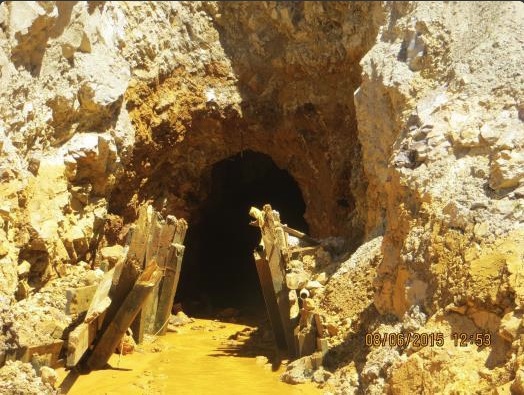
In 2015, 3 million gallons of drainage water came rushing out of the Gold King Mine near Silverton, Colorado, spewing 190 tons of heavy metals and other contaminants into a tributary of the Animas River, which flows into the San Juan River. The U.S. Environmental Protection Agency (EPA), which had been doing some excavation of the passage leading into the mine during an investigation at the site, had triggered pressurized water stored behind a plug at the mine portal. The damage was significant, taking a heavy toll on one community in particular: the Navajo Nation.

“When the spill occurred, it was economically devastating to the region, which is the bread basket of the Navajo Nation,” said Karletta Chief, Assistant Professor of Soil, Water, and Environmental Sciences at the University of Arizona. “It also had a traumatic impact on people. They view the river as the male deity of the Navajo homeland. Seeing it turn yellow really devastated the people.”

Indigenous Knowledge and Water Science

Chief, a hydrologist and a member of the Navajo Nation herself, has spent her career integrating rigorous scientific study with Indigenous knowledge to address urgent water quality problems. Raised in a remote community of Black Mesa, Arizona, where she often served as a translator for her family, Chief went on to receive undergraduate and master’s degrees from Stanford and a PhD from the University of Arizona. Her work on the Navajo Nation on water issues has earned her a place in Stanford’s Multicultural Alumni Hall of Fame.

“I grew up in a tribal community where we were taught to just listen to elders,” says Chief. “When I came to Stanford I had to unlearn that. You were expected to debate your issue, and we are trained to do that as western scientists. You want to interject. A lot of times this is for good reason. Scientists are curious and interested. But it’s important to sit back and just listen.”

Working closely with Navajo Nation community members, Chief focuses on spill response, water quality testing, and supporting local decision-making on key water resource issues.

Water quality is an important issue for the Navajo people, yet access to clean water is a real challenge. More than 8,000 homes on the Navajo reservation do not have access to potable water. Navajo people on the reservation travel an average of 24 miles each way to haul their drinking water. Groundwater contamination and depletion on native lands from mining activities is also a serious concern.
After the Gold King Mine spill, many local Navajo farmers either couldn’t irrigate their fields due to the closure of irrigation intakes or chose not to for fear of contamination. As a result, crop yields were seriously impacted. As many as 2,000 Navajo farmers and ranchers are estimated to have been affected by the spill. Chief, who has been an active force in understanding the Gold King Mine disaster and its impacts, developed a study with tribal members on short-term exposure to mining contaminants.

Typical environmental assessment methodologies do not adequately account for the social and cultural impacts of mining nor integrate Indigenous ways of knowing. “The elders gave us guidance and asked us to incorporate the fundamental Diné (Navajo) philosophy of hózhó,” Chief explains. Sa’ah Naaghái Bik’eh Hózhóón has to do with harmony, restoration, and healing, as well as following the Navajo approach to problem solving.

“I don’t think the EPA considered traditional knowledge in their approach,” says Chief. “In ours, we did this through listening sessions and allowing people to talk and write down their experiences. We had the help of the traditional cultural experts and elders that were involved when we were writing the proposal. This is important because it raises the need to have more accurate ways to do these risk assessments, particularly with Indigenous communities where they use rivers in many more ways than recreation. They revere the river in spiritual ways.”

Community-engaged research also requires communicating scientific findings back to communities in a language and format that is accessible. “When we reported back, we needed the help of cultural experts to make sure that we were doing that effectively,” says Chief. The goal for this work is to support tribal members in using research to make their own assessments, draw their own conclusions, and determine how to heal their community and environment. “Not everyone has gone back to farming,” explains Chief. “But [the research] has definitely helped in answering some questions.”

Communicating the details of spill response to non-English speakers was a challenge. When the Navajo language lacked a word to describe a water contaminant like manganese, Chief and her team worked with traditional knowledge holders and medicine people to name the element. The community outreach “really helped in terms of people understanding what we’re doing and the results that we share; coming back to restoring harmony and healing for the people as a result of this traumatic event,” explained Chief.

To share their results, Chief’s team participated in teach-ins organized by community environmental organizations. They broadcasted their findings over radio forums in Navajo language and presented at various chapter meetings, representing different parts of Navajo Nation.

More recently, Chief has co-organized a conference on Indigenous perspectives on water, with community leaders taking a prominent role. Chief has also developed short 1-2 minute videos that can be streamed in the waiting rooms of hospitals. “When you’re engaging tribes, not everybody is the same. There are different sectors of the tribal community that need to be considered,” says Chief. “It is not always the young people. There are health experts and elders. It is not always the tribal leaders.”

“I am still learning about how to report back to the community,” Chief explains. “There is such a large number of people in different sectors of the Navajo population, so it is a really daunting task to reach out to everybody.”

Responding to the Gold King Mine Spill

Chief is continuing her community-based research with tribal partners. This includes the Navajo Gold King Mine Exposure Project, a household-level biomonitoring initiative to investigate biological accumulation of toxins in community members over time. Initial findings have shown no significant evidence of long-term health impacts from the spill, although the research team did find slightly elevated arsenic levels for Navajo people compared to the general U.S. population. It remains to be seen what these results will look like as time goes on.

Recent investigation by the EPA has also detected elevated lead levels at sites near the mine up to 100 times higher than the danger level for wildlife. There are approximately 5,105 abandoned mines in Colorado, 3,989 in New Mexico, 10,697 in Utah, and 24,183 in Arizona.

“It’s a sleeping giant, and a wake-up call for everybody to act quickly on stabilizing the area and reducing risk in the future,” cautions Chief. “There are thousands of abandoned mines in the region and the risk of a spill like this is really high.”

In 2016, about one year after the Gold King Mine disaster, the EPA added the Bonita Peak Mining District as a Superfund site. The district is made up of 48 mining-related sites including Gold King.

Although the EPA has declared Superfund cleanups a priority the Gold King Mine cleanup remains lingering in the study stages. Meanwhile, the legal fight for fair compensation for the Navajo Nation continues. A ruling in the United States District Court for the District of New Mexico against Environmental Restoration, LLC. (the contract company that excavated the mine and caused the spill) upheld the Nation’s claims of negligence and also upheld their right to seek punitive damages. All of which harkens back to the importance of Chief’s meaningful engagement with Indigenous knowledge in her research. The issue in seeking damages for the Navajo is keeping accurate records and receipts, which may not fully reflect their losses in terms of the cultural importance of the river and surrounding lands.

Chief’s next project supported by a million dollar grant through the National Science Foundation (NSF) Research Traineeship program is to develop a new training program at the University of Arizona. The program, which is currently accepting applications for graduate students, will include learning the fundamentals of energy and water efficiency and a project-based class working with Indigenous communities. The emphasis is on interdisciplinary thinking to encourage “a holistic view of problem solving that is needed to bring water to Native American communities,” says Chief.

One of the principles that the program will cover is the importance of understanding the diversity of Native American tribes. “Across hundreds of tribal communities, they are diverse in many ways,” Chief explains. “Within a tribal community, there are many more ways that the tribal community is diverse. It’s not one size fits fit all. So, when scientists are working with tribal communities it’s important to remember that. We need to make sure that we do not apply other tribal experiences to the tribes we’re working with,” says Chief. “More and more it is really about listening, and especially working with grassroots organizations that are the movers and shakers.”

R.I.P. Steve Fearn

Steve Fearn via the Colorado Water Congress.

Steve Fearn

From Silverton, in the heart of the San Juan Mountains high on the Animas River,
in between Red Mountain Pass and Molas Pass

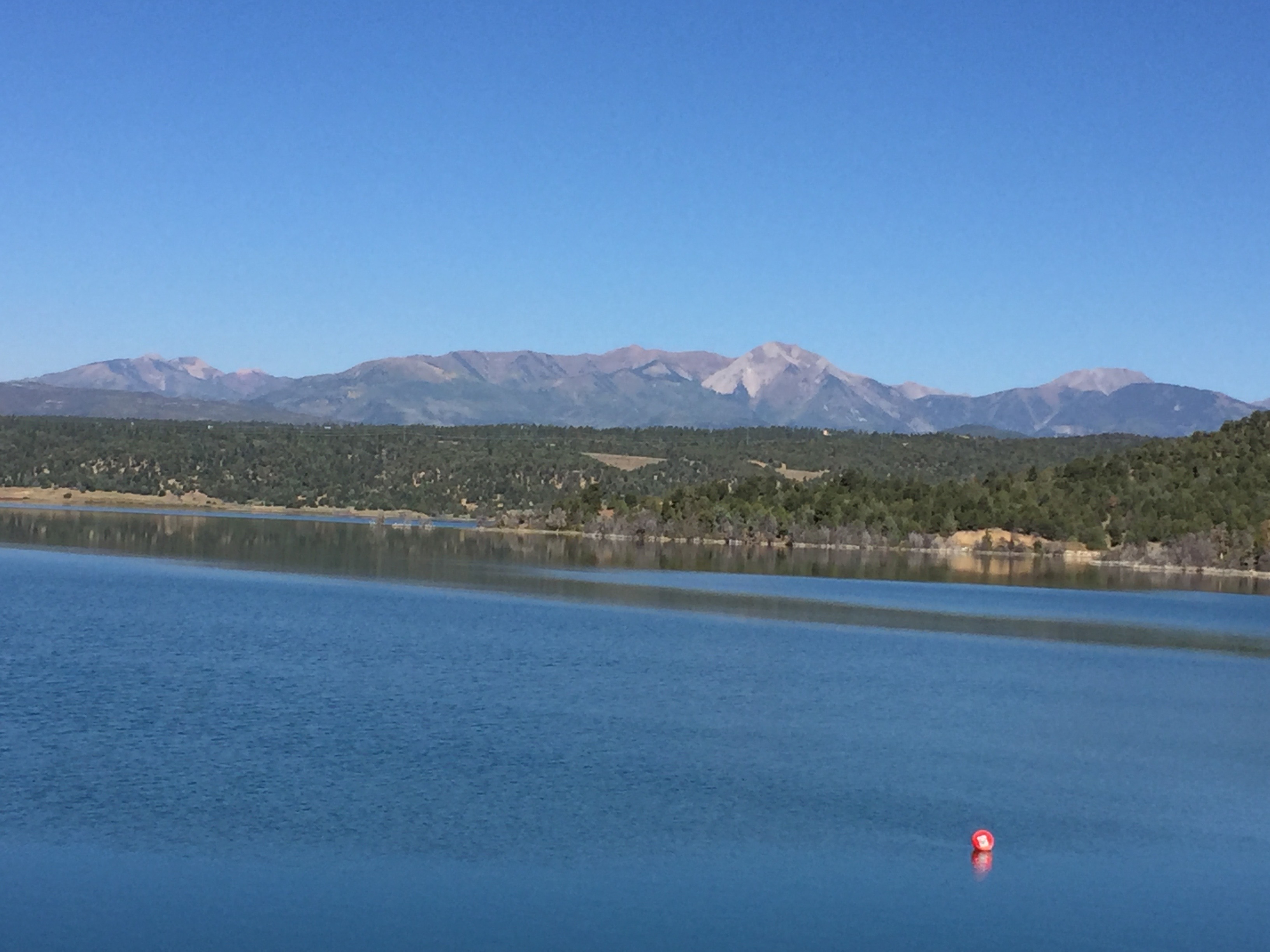
flowing through Durango up into Lake Nighthorse

Steve Fearn represented Southwestern Colorado on the Board of the Colorado
Foundation for Water Education 2011 to 2016

bridging the Great Divide tirelessly.

Sure, steady, a wise and patient counselor, he held and served all of Colorado
in the highest respect.

You are with us, Steve!

Greg Hobbs (April 23, 2018)

Steve Fearn. Photo credit: Greg Hobbs

From The Durango Herald (Jonathan Romeo):

Longtime Silverton resident wanted to bring back mining

Steve Fearn, one of the founders of the Animas River Stakeholders Group who was involved with multiple water boards, and who at one time owned the Gold King Mine, died last week at his home in Silverton. He was 74.

It is believed he died from a dormant strain of malaria that he caught while working at mines in Indonesia in the 1980s, La Plata County Coroner Jann Smith said Monday. An autopsy is scheduled for Thursday.

“I think one of the main things about Steve is that even though he often disagreed with people, he was always looking for some common ground,” said Peter Butler, another founder of the stakeholders group.

Fearn was raised in Boulder and received a civil engineering degree from the University of Colorado-Boulder, according to Bruce Whitehead, executive director of the Southwestern Water Conservation District.

Eventually, Fearn began his career building power plants, and was one of the lead engineers for the Craig Station Power Plant in Craig and the Hayden Generating Station near Steamboat Springs, Butler said.

Eventually, Fearn found his way to the Western Slope in the 1970s, working for a time at the mill for the Idarado Mine in Telluride, Butler said.

However, Fearn planted roots in Silverton when he moved there in the 1970s.

“He did do some work on several of the different mines,” Butler said. “He’s been underground in a few of those mines up there.”

In the early 1990s, after Silverton’s last mine closed and issues over water quality in the Animas River watershed became a growing concern, Fearn and others formed the Animas River Stakeholders Group.

At the time, many people believed the Environmental Protection Agency and the state of Colorado imposed water-quality standards that didn’t take into account natural loading of heavy, potentially toxic metals into the waterways.

The stakeholders group was then tasked with drafting more realistic water-quality goals, and eventually evolved into a group that conducted numerous cleanup projects throughout the watershed.

Butler said there was some level of conflict in the forming of the stakeholders group, as interests were divided among the mining industry and environmentalists.

Former miners even circulated petitions calling for the stakeholders group to get out of town, Butler said.

“He was always the level-headed voice from the mining industry,” Butler said.

Butler credited Fearn with taking the lead on many remediation projects throughout the years, including placing bulkheads on the Kohler Tunnel and the Mogul Mine.

However, critics of the stakeholders group say the group was an attempt to delay an all-out cleanup under the EPA’s Superfund program. While the stakeholders have helped improve water quality in the basin, major pollution sources outside the scope of the group’s purview has held back any major headway in accomplishing goals like restoring aquatic life in the Animas River from Silverton to Durango.

Fearn, over the years, was one of the staunchest opponents to Superfund, arguing the designation would eliminate any chance of mining’s return to Silverton and place a stigma on the town that would hinder tourism.

“He wanted to revive mining … and he didn’t make any bones about it,” said San Juan County Judge Anthony Edwards. “He wanted to bring an economy where people were paid living wages, and he believed mining was the best option for that.”

Fearn himself tried to bring back Silverton’s dying mining industry over the years. In 2000, he purchased the Gold King Mine. He then attempted to get the Pride of the West mill at Howardsville, north of Silverton, back in operation.

Butler said Fearn believed it was better to make mining viable in the U.S., where there is some level of environmental and labor force regulations, rather than other countries without those rules in place.

“He believed you may be doing a lot more damage to the Earth by sending mining to different countries,” Butler said.

However, due to a complex entanglement of lawsuits, Fearn and his mining ventures were foreclosed on around 2004. The Gold King Mine was then purchased by Todd Hennis in 2005.

The EPA in August 2015 caused a mine blowout at the Gold King Mine while working on a cleanup project at the site. The spill released 3 million gallons of mine waste laced with heavy metals into the Animas River.

In fall 2016, the Bonita Peak Mining District Superfund site, which encompasses nearly 50 mining-related sites throughout the Animas watershed, was officially declared a Superfund site.

Fearn was named in a lawsuit filed by New Mexico over the spill. He was not considered a “potentially responsible party” – a term the agency uses for people or companies it regards as financially responsible for a cleanup, EPA said Monday.

Fearn also served on numerous water-related boards. He represented San Juan County on the Southwestern Water Conservation District for 22 years, serving 10 of those years as vice president.

“He was always willing to listen and find solutions,” Whitehead said. “He didn’t just say no, he looked for alternatives and worked hard to do that.”

Butler said Fearn is credited for getting the water conservation district to fund projects that would improve water quality. He also served on the working group that eventually produced the Hermosa Creek Watershed Protection Act.

Fearn was ousted as a representative, however, by San Juan County commissioners in February 2017 after they said Fearn’s representation no longer reflected the county’s values.

“Historically, San Juan County has been largely dominated by mining interests, and Steve Fearn is very much associated with those interests,” county attorney Paul Sunderland said at the time. “But the board’s interests have shifted more toward recreation.”

Whitehead said Fearn was named a director emeritus despite being replaced on the board.

“He will be missed greatly,” Whitehead said. “He was a good guy and a friend.”

Edwards said more information will be forthcoming on a memorial service to be held sometime in May.

Gold King Mine Entrance after blow out on August 5, 2015. Photo via EPA.

Down ‘The River Of Lost Souls’ With Jonathan Thompson — Colorado Public Radio

From Colorado Public Radio (Nathan Heffel). Click through to listen to the interview:

A new book puts the Gold King Mine spill within the long history of mining and pollution in Southwest Colorado.

Jonathan Thompson will be at the Book Bar tonight. I wonder if Denver is a bit of a shock to his system even though he’s a sixth-generation Coloradan?

I am so happy to finally get to finally meet Jonathan. His new book, River of Lost Souls, is an important read. Understanding the industrialization of our state over the years will help us chart a less destructive course.

I loved the passages where Jonathan reminisces about spending time around the Four Corners and in the San Juans. He transports you to those times in your life spent next to the river or exploring what sights the land has to offer. He connects you to the Four Corners in a way that only a son of the San Juans could.

Cement Creek aerial photo — Jonathan Thompson via Twitter

Community groups help ease the anxiety of a superfund listing

One of the many smelters that once operated in the Pueblo area. Photo credit: Environmental Protection Agency

From The Durango Herald (Jonathan Romeo):

The Colorado Smelter processed silver and lead for 25 years before it closed in 1908, leaving behind a toxic footprint that spilled out into the surrounding neighborhoods of Pueblo in southeastern Colorado.

However, it wasn’t until more than a century later that an inspection found lead and arsenic levels posed a risk to residents. An early study area included more than 1,900 potentially affected homes.

The need for a cleanup project was clear, but the community of Pueblo was torn.

Some residents were truly worried about the health effects from lead and arsenic poisoning, while others felt the problem was overblown and a major cleanup project would further strain the community’s struggling economy.

With seemingly no other options, it became apparent the only true path to cleaning up this legacy of pollution was through the Environmental Protection Agency’s hazardous cleanup project – Superfund.

One of the community’s demands from the outset was to have a seat at the table with the EPA and other partners at key moments of decision-making, so the community could guide that process from its perspective.

The people of Pueblo accomplished that by creating, through the EPA’s process, a Community Advisory Group made up of a variety of interested people, residents, landlords, environmental groups and locally elected officials.

‘A need to get diverse interests together’

The situation in Pueblo is eerily similar to Silverton’s and its connection to hard-rock mining, which defined the community a century ago but ultimately left behind a complicated mess.

The small mountain town north of Durango, with a population of about 600, largely opposed a Superfund listing for two decades, fearing it would deter future mining in the region and adversely affect tourism.

However, the path toward a Superfund designation became inevitable after the August 2015 Gold King Mine spill, when an EPA-caused mine blowout released a torrent of waste into the Animas and San Juan rivers, turning them orange.

One of the major selling points in getting Silverton’s support for the Superfund listing was a promise from the EPA that the community, filled with old miners with extensive institutional knowledge, would have a seat at the table.

Scott Fetchenheir, a geologist, former miner and San Juan County commissioner, said that since the Bonita Peak Mining District Superfund was declared in fall 2016, the EPA has made good on this promise…

How CAGs work
For a CAG to be formed, a community simply needs to let EPA employees know they are interested in creating a group.

Then, it’s really up to the residents to decide how many people are in the group (the average CAG has about 15 people) and how often they want to meet.

“It’s community driven, and EPA wouldn’t want to influence how a CAG might organize or represent itself,” said Cynthia Peterson, an EPA spokeswoman who works with the Superfund site near Silverton.

Kristi Celico, an organizer and facilitator for CAGs throughout the country, says the groups are usually effective in walking the line of the variety of demands coming from a community.

“It helps put all those people in a room to help bridge those interests,” she said. “It’s a slow, painful process, but I’ve set up hundreds of (CAGs), and nine out of 10 times, it has a huge impact over time.”

Southwestern Water Conservation District annual seminar draws ~200 folks

No Name Rapid, Class V, mile 10, Upper Animas River, Mountain Waters Rafting.

From The Durango Herald (Patrick Armijo):

The Missionary Ridge Fire in 2002 and the Gold King Mine spill in 2015 brought home just how painful disruptions in the water cycle from drought to human-made hazards can be.

Cathy Metz, director of Parks and Recreation for the city of Durango, voiced that message Friday before about 200 people at the Southwestern Water Conservation District’s annual Water Seminar at the DoubleTree Hotel.

Both the 72,000-acre fire and the spill that tinted the river orange with mine wastewater put the brakes on the whitewater rafting and river recreation economy, which, she said, was estimated in a 2006 study to bring in $19 million annually to Durango’s economy…

Even after the blaze, which destroyed 56 homes and killed a firefighter, the watersheds got hit again after rains funneled debris from the denuded burn area into streams, creeks and rivers.

She noted the snowpack this year remains dangerously similar to conditions in 2002.

On Friday, snowpack in the Dolores, San Miguel, Animas and San Juan river basins was at 44 percent of the 30-year average, according to Colorado SNOTEL.

In August 2015, the city again suffered a blow to its water economy when an Environmental Protection Agency subcontracted crew breached the Gold King Mine, sending 3 million gallons of mine wastewater laced with heavy metals into the Animas River.

“The thing we learned from the spill,” Metz said, “is that this had been occurring for a hundred years, but we didn’t pay attention to it because it wasn’t obvious to us.”

The spill, painful as it was, led to action to begin cleaning the legacy of 19th-century hard-rock mining in the San Juan Mountains that still threatens Southwest Colorado’s watersheds.

A Superfund site, Bonita Peak Mining District, has been established to begin cleanup of mine waste…

Lake Nighthorse, the latest enhancement to quality of life in Southwest Colorado, also directly depends on the health of the water cycle, Metz said.

Recreation on the reservoir, which is about 2 miles southwest of downtown Durango, is expected to generate $12 million annually for Durango’s economy, she said. On Sunday, opening day, she said, the lake attracted 800 people, overburdening the parking lot.

Federal judge consolidates #GoldKingMine lawsuits

This image was taken during the peak outflow from the Gold King Mine spill at 10:57 a.m. Aug. 5. The waste-rock dump can be seen eroding on the right. Federal investigators placed blame for the blowout squarely on engineering errors made by the Environmental Protection Agency’s-contracted company in a 132-page report released Thursday [October 22, 2015]

From The Albuquerque Journal (Maggie Shepard):

A federal judge has centralized four of the lawsuits stemming from the Gold King Mine spill for hearing before a federal court in Albuquerque against the wishes of the state of New Mexico and the Navajo Nation.

Three of the suits were already seated in New Mexico, including those brought by New Mexico, residents of New Mexico and the Navajo Nation. The fourth suit was brought by the state of Utah, which hoped to delay a decision on running all of the lawsuits through the same federal judge.

The New Mexico residents, part of the McDaniel lawsuit, told the U.S. Judicial Panel on Multidistrict Litigation they supported the centralization, according to the panels order issued Wednesday.

“Given the apparent complexity of the factual issues, as well as the potential for significant tag-along activity” centralization is warranted, federal Judge Sarah Vance, chair of the panel, wrote in the order.

The lawsuits target Environmental Restoration LLC, the company working on contract with the Environmental Protection Agency at the Gold King Mine near Silverton, Colo., in 2015 when the mine’s containment system burst and flooded the Animas River with more than 3 million gallons of toxic wastewater, including more than 500 tons of heavy metals.

The company sought to have all of the lawsuits streamlined through one jurisdiction.

But New Mexico and the Navajo Nation had hoped “informal coordination and cooperation” would suffice to keep the lawsuits moving…

The order says the four lawsuits will be heard before Chief Judge William P. Johnson’s federal court in Albuquerque in order to streamline the lawsuits by avoiding “duplicative, complex discovery” and “eliminate the potential for inconsistent ruling on sovereign immunity, government-contractor immunity, and other issues.”

Colorado’s legislature has approved legal action against the company and federal government, but an official lawsuit has not been filed.

Durango wastewater treatment plant on schedule

Durango

From The Durango Herald (Mary Shinn):

The largest construction project in city history, the Santa Rita Water Reclamation Facility, must improve the quality of water returning to the Animas River by March to meet state regulations…

The multi-million-dollar construction project was designed to remove more nutrient pollution from the water and increase the plant’s capacity, he said. New carbon filters are also planned to eliminate the infamous and sickening smell that sometimes permeates Santa Rita Park.

The city is eight months into a 24-month construction schedule, and, thus far, the project is on time and on budget, he said.

The first two major components of the plant – the aeration basin and the blower and chemical building – are scheduled to be finished in March. Those systems will remove nutrients to keep the city in compliance with state regulations, Boysen said.

Heightened levels of the naturally occurring nutrients, nitrogen and phosphorous, can cause algae blooms that reduce oxygen in the water and kill fish, according to the Environmental Protection Agency…

The city contracted Archer Western to upgrade the sewage treatment plant for $54 million and set aside an additional $5 million to cover unforeseen costs, Boysen said in an email.

As of late December, the city had spent about $500,000 of its contingency fund, he said.

“There are always unanticipated issues or unknown conditions that require modifications to the original contract,” Boysen said.

In 2015, voters approved $68 million in debt to fund the plant and additional sewer infrastructure improvements.

To pay off the debt, residents saw three years of double-digit sewer rate increases. In January, rates go up another 3 percent, bringing the average city resident’s monthly sewer bill to $49.94, or about $599 annually. Those who live outside city limits but are connected to the city’s sewer services pay double.

@EPA orders Sunnyside Gold Corporation to conduct groundwater investigation at Bonita Peak Mining District Superfund site

On April 7, 2016, the Environmental Protection Agency proposed adding the “Bonita Peak Mining District” to the National Priorities List, making it eligible for Superfund. Forty-eight mine portals and tailings piles are “under consideration” to be included. The Gold King Mine will almost certainly be on the final list, as will the nearby American Tunnel. The Mayflower Mill #4 tailings repository, just outside Silverton, is another likely candidate, given that it appears to be leaching large quantities of metals into the Animas River. What Superfund will entail for the area beyond that, and when the actual cleanup will begin, remains unclear.
Eric Baker

Here’s the release from the Environmental Protection Agency (Andrew Mutter/Libby Faulk):

The U.S. Environmental Protection Agency (EPA) today issued a unilateral administrative order to Sunnyside Gold Corporation to conduct groundwater investigation activities at the Bonita Peak Mining District Superfund Site (BPMD) in San Juan County, Colo. Sunnyside Gold is a current owner and past operator of the Sunnyside Mine in the BPMD.

“EPA remains committed to advancing the investigation and cleanup of historic mining impacts in the Bonita Peak Mining District,” said EPA Regional Administrator Doug Benevento. “The assessment of groundwater in the area is a fundamental step in identifying effective cleanup options for the site and improving water quality in the upper Animas River watershed.”

EPA issued the order to Sunnyside Gold Corporation to conduct a remedial investigation of the Bonita Peak Groundwater System, designated as Operable Unit 3, within the larger BPMD. EPA is ordering the company to complete this work so the agency can identify surface water impacts from the groundwater system, assess the condition of existing bulkheads associated with the groundwater system, determine the hydrological interconnection of the various underground mine workings, and evaluate potential cleanup options at this portion of the site.

It is anticipated that the RI will be conducted as an iterative fashion using adaptive management principles to identify opportunities for early or interim response actions as information and data is developed during the RI.

EPA’s order requires this work to begin in 2018, with some identified items being completed by the end of the year. The company has an opportunity to request a conference with the EPA to discuss the order before it becomes effective.

Additional background:

The BPMD became a Superfund site on Sept. 9, 2016, when it was added to the National Priorities List. The site consists of historic and ongoing releases from mining operations in three drainages: Mineral Creek, Cement Creek and Upper Animas, which converge into the Animas River near Silverton, Colorado. The site includes 35 mines, seven tunnels, four tailings impoundments and two study areas where additional information is needed to evaluate environmental and human health concerns.

On Dec. 8, 2017, EPA Administrator Scott Pruitt named the BPMD to a list of 21 Superfund sites across the nation which are receiving his immediate and intense attention.

For more information, please visit: http://epa.gov/superfund/bonita-peak.

From The Denver Post (Bruce Finley):

Figuring out where contaminated water flows through a maze of mining tunnels and natural cracks has emerged as a primary challenge for moving forward in one of the most ambitious toxic mining clean ups attempted in the West.

Sunnyside’s properties are included in the 48-site Bonita Peak Mining District cleanup launched in 2016 after the Gold King Mine spill that was accidentally triggered on Aug. 5, 2015 by EPA contractors investigating a collapsed portal…

Local officials have raised concerns that EPA officials are studying the problem to death without getting the actual clean up done.

The EPA on Thursday issued “a unilateral order” to Sunnyside, owned by Canada-based Kinross Corp., “to begin investigation of the Bonita Peak groundwater system,” said Rebecca Thomas, the Superfund project manager.

“We need to understand how water moves through the mining system — not only the man-made structures, the adits and stopes, but also how it moves through natural faults and fissures,” she said. “This is so we can understand how best to improve water quality in the tributaries of the Animas River.”

Sunnyside Gold Corp. will review the order, reclamation operations director Kevin Roach said.

“Sunnyside is not the cause of water quality issues in the Animas River and its activities in the area, including spending $30 million on reclamation over the past 30 years, have resulted in less metals in the Animas basin than would have otherwise been the case,” Roach said. “We are hoping that our remaining assets can be efficiently utilized in timely, proven and effective solutions to improve water quality rather than pointless studies or litigation.”

Farmington: San Juan Water Commission meeting recap

Lake Nighthorse and Durango March 2016 photo via Greg Hobbs.

From The Farmington Daily Times (Hannah Grover):

San Juan Water Commission members have expressed concerns about recreation on one of the region’s larger reservoirs. Lake Nighthorse near Durango, Colorado, was built as part of the Animas-La Plata Project to store water for various entities in the region.

“The purpose of the reservoir is for us, not for recreation,” said Cy Cooper, who represents the city of Farmington on the commission.

The city of Durango, which recently annexed the reservoir, has said the lake will be open to recreational activities, including paddleboarding and kayaking, on April 1. The lake is scheduled to open to motorized watercraft on May 15, though city officials are still working on a plan for regulating that.

Russ Howard, the general manager for the Animas-La Plata Operation, Maintenance and Replacement Association, assured members of the San Juan Water Commission on Wednesday that recreation will not be prioritized ahead of water quality.

“The primary purpose for this project is a drinking water supply, and recreation comes secondary,” Russ Howard said. “We are not going to let recreation interfere with the main, primary purpose of this project.”

As of Monday, Lake Nighthorse was 97 percent full with nearly 112,000 acre-feet of water in it. The reservoir is expected to be 100 percent full by the end of June following 49 days of pumping water from the Animas River.

If local water users, such as the city of Farmington or the city of Aztec, need more drinking water, they can ask for water from Lake Nighthorse to be released into the Animas River. San Juan County water users could request water from Lake Nighthorse if drought conditions put a strain on water resources.

“People just need to realize that the lake is a dead pool if we destroy the viability of the water,” said Jim Dunlap, who represents rural San Juan County water users on the San Juan Water Commission.

Howard said the baseline data is in place so changes in water quality can be detected. He said monitoring will be in place for bacteria like E. Coli and for petroleum byproducts. If either of those are detected, recreation activities could be stopped or reduced.

An oil and gas separator has been installed at the boat ramp parking lot, Howard said. He said any oil or gas that leaks onto the asphalt will run into the separator.

“Regardless of how many rules and regulations you put in place, you’re still going to have the idiots that will have to be dealt with,” Howard said. “The city (of Durango) has assured us and the public that they will manage the idiot factor, but it’s going to be a full-time job.”

Members of the commission also received packets on Wednesday that included graphs and updates about water resources, including snowpack and stream flow data. The data was from organizations including the U.S. Geological Service and the Colorado Basin River Forecast Center.

According to the U.S. Geological Service stream flow data, the Animas River’s flow in February was 47 and 63 percent of average, depending on the location of the gauge. The flow was below the 2002 levels, a year that turned out to be one of the driest on record. The Durango Herald reported this week that the Animas River in Colorado had reached record-low levels for this time of year.

As of Tuesday, the Colorado Basin River Forecast Center was reporting snowpack that was 53 percent of the median snowpack from 1981 until 2010 in the Animas Basin and 58 percent of median in the San Juan Basin.

Drought conditions in the Four Corners region have worsened since the beginning of the year, according to the U.S. Drought Monitor. The monitor also shows that drought conditions in the Four Corners region are worse now than they were at the beginning of March 2002.

#AnimasRiver: U.S. Court of Appeals D.C. Circuit says @EPA followed the rules for Bonita Peak Mining District Superfund designation

From The Durango Herald (Jonathan Romeo):

Judges say EPA followed rules when including mining sites in cleanup area

The U.S. Court of Appeals D.C. Circuit issued the decision Tuesday to deny Sunnyside’s petition, which was filed by the mining company – a “potentially responsible party” in the Superfund cleanup – in December 2016.

Sunnyside had argued that of the 48 mining sites in the upper Animas River watershed the EPA included in the “Bonita Peak Mining District Superfund” site, 29 had not been properly evaluated and should be removed.

Sunnyside owns two of the 29 sites mentioned, including the Sunnyside Mine and the Mayflower tailings.

“We have no objections to there being a Superfund listing,” Sunnyside spokesman Larry Perino previously said. “The petition is only challenging the unlawful listing of sites that were not assessed at all under the EPA’s own Hazard Ranking System.”

Perino did not immediately respond to requests for comment Tuesday afternoon.

However, the U.S. Court of Appeals D.C. Circuit decision says the EPA did act lawfully and within its own protocols in the Superfund process.

In determining whether the mining district around Silverton qualified for a Superfund listing, the EPA scored 19 pollution sources under the agency’s Hazard Ranking System.

Each of the sources received a high enough score that indicated pollution was bad enough to be eligible for a Superfund listing. As a result, EPA proposed the entire mining district, scored and unscored sources, should be listed.

The Bonita Peak Mining District Superfund site was declared in September 2016.

Months later, Sunnyside argued the EPA was wrong to create a Superfund site that had unscored sources, claiming the EPA must score each contributing source of contamination before adding it to the broader Bonita Peak site.

But the court said text of the HRS process “alone is enough to refute this assertion,” which says a Superfund “may include multiple sources and may include the area between sources.”

“The BPMD is a site (comprised) of the 19 scored sources and the areas ‘between’ them, as the HRS explicitly permits,” the court said. “Sunnyside’s mine falls into the category of an ‘area between sources’ and therefore did not need to be scored.”

The court said: “Sunnyside’s real concern became apparent at oral argument. It claims its mine has been fully remediated and had no part in the present pollution of the site, but it may nevertheless be required to pay for some or all of the cleanup.”

Sunnyside Gold is considered the largest “potentially responsible party” in the district – a term the EPA uses for entities it considers financially on the hook for cleanup.

#Snowpack news: South Platte Basin drops to 91% of normal despite recent snowfall

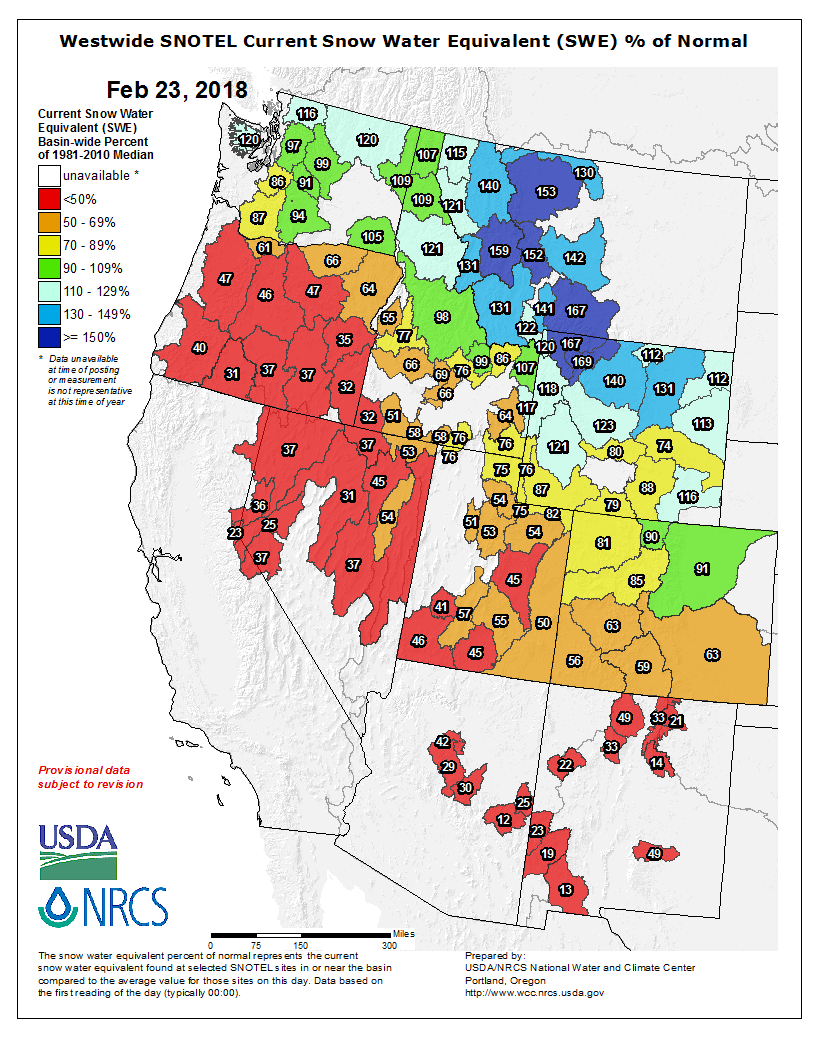
Westwide SNOTEL basin-filled map February 23, 2018 via the NRCS.

From The Independent (Colton Branstetter):

Low snowpack in Southwest Colorado could affect spring runoff and the local economy if levels do not rise.

The Southwest corner of the state’s snow water equivalent is 54 percent of normal, according to recent data from the Natural Resources Conservation Service.

Snow water equivalent measures how much water is in the snowpack and is the standard for keeping track of snowpack, John Andrew Gleason, lecturer of geosciences at Fort Lewis College, said.

A potential downside of the snow water equivalent measurement is that it uses a 30-year moving average, Gleason said. As the years get drier, what is considered normal is drier too.

The Snowpack

The snowpack for 2018 is very low, Gleason said. Currently, the snowpack is lower than in 2002, the driest year on record in southwest Colorado and when the Missionary Ridge Fire happened.

The snow year is already halfway over, Gleason said. However, March and April is when this region generally gets the most snowfall, he said.

“The best thing that could happen is that it’ll snow,” he said

A heavy, wet snow is the best type of snow for the snowpack because it compacts and contains lots of water, he said.

A low snowpack and warm spring can lead to problems during the rest of the year. A colder spring is ideal so that the snow doesn’t melt off too fast, Gleason said.

Warm spring weather has been occurring earlier in the year, Julie Korb, a professor of biology at FLC, said. This dries out vegetation and leads to dangerous wildland fire conditions in the summer and fall, she said.

“In 2002, one of the reasons we had such a bad fire season here was the low snowpack and very little runoff,” Gleason said.

Dust, which decreases the reflectivity of snow, increases the rate of snowmelt in the spring, Gleason said.

As the snow melts and uncovers more exposed ground, there is more potential for wind picking up and carrying dust onto the snow, Gleason said.

Another possible problem is water supply. Reservoirs are currently close to normal, but water managers will drain the reservoirs in preparation for spring run off, Gleason said. It could be a problem if the runoff doesn’t fill the reservoirs back up, he said.

Low snowpack also increases avalanche danger because the snowpack is unstable. This was seen in the January avalanche death of a FLC alumnus, Gleason said.

La Niña

Low snowpack this year can be attributed to the La Niña weather pattern. La Niña years happen when water is cooler in the Pacific Ocean, which sends storms more north of Southwest Colorado, Gleason said.

La Niña years are normal or drier than normal for the Durango area, Gleason said. We are also in the second La Niña year in a row, and the second year tends to be drier, he said.

The perfect storm for this area is a low-pressure storm that sits above us rather than moving east too quickly, Gleason said.

“If you see rains in Los Angeles, and the winds are out of the southwest, that usually will predict a pretty big storm for us,” he said.

Local Economy

The Animas River could see lower flows, impacting rafting and water sport tourism in the summer, Tim Walsworth, Business Improvement District executive director, said.

It is hard to keep track of economic effects of warm winters in real time, Walsworth said. The best indicator of downtown patronage is sales tax, which isn’t immediately available.

Current sales tax figure are only available from last November, he said.

Winter is already a slower time of the year for Durango, Walsworth said.

January and February are usually the slowest tourism months in downtown, Theresa Blake Graven, public relations consultant at the Durango Area Tourism Office, said.

“We’re in a bit of a different situation here in Durango because we’re not like Crested Butte that’s completely dependent on skier tourism,” Graven said. “We have a lot of other stuff going on,” Graven said.

Polar express train bookings were up 10 percent over last year, Christian Robbins, marketing manager at the Durango and Silverton Narrow Gauge Railroad said.

The railroad estimates that 70 percent of the 33,000 passengers come from outside of the area, which leads to money being spent in Durango from lodging and other hospitality, Robbins said.

Downtown Durango’s peak activity occurs in July, and the second-best month is in December, Walsworth said. The winter festival Snowdown can bring needed business to town at the beginning of February, he said.

Snowdown was originally created to bring more more business into town during the slow winter months, Graven said. However, Snowdown tends to bring a more local crowd rather than people from out of town, she said.

From The Cortez Journal (Jim Mimiaga):

[February 20, 2018] A western shift of a high-pressure ridge over the Pacific Ocean is allowing more storms to reach Southwest Colorado, according to the National Weather Service.

The ridge has been blocking winter snowstorms from the northwest from reaching Colorado, but two weeks ago, it moved out of the way, said meteorologist Megan Stackhouse, with the weather service office in Grand Junction…

On Tuesday morning, towns across southwest Colorado woke up to a fresh blanket of snow from Monday’s storm. Dolores registered 4 inches, Cortez had 2 inches, Mancos had 2.7 inches, and Farmington got 1 inch.

Ski areas are celebrating. The Hesperus ski area received 6 inches of fresh powder. In the past 24 hours, 9 inches of snow dumped onto to Telluride, which has seen 2 feet of new snow in the past seven days. Purgatory reported 10 inches yesterday’s storm, with a total of 33 inches of new snow in the past seven days.

Snowpack for the Dolores Basin is gaining ground because of the recent storms, and reached 50 percent of average as of Feb. 20. That is up from 40 percent of average on Feb. 12.

#AnimasRiver: Federal Judge denies contractor’s motion in #GoldKingMine spill

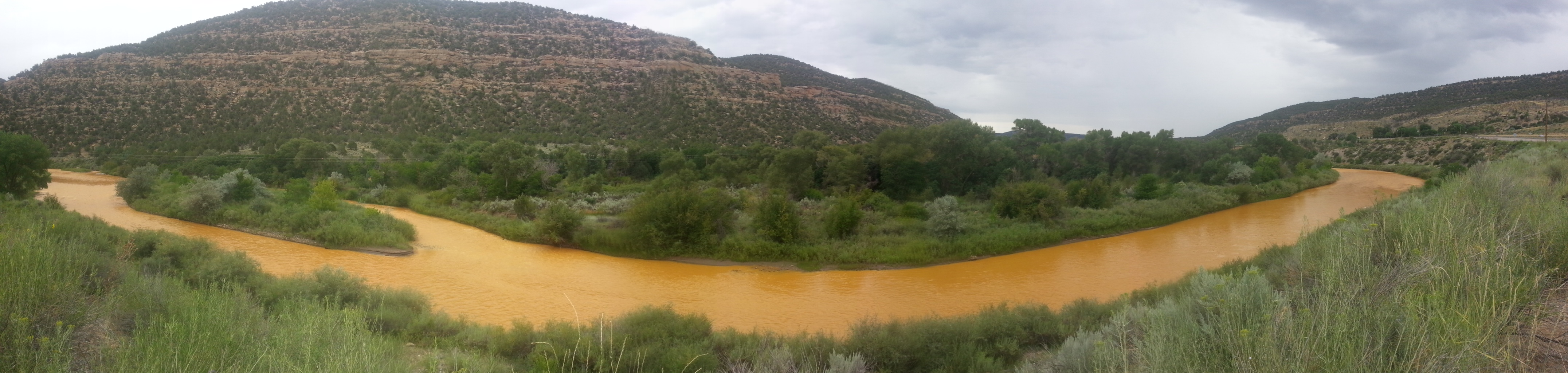
The orange plume flows through the Animas across the Colorado/New Mexico state line the afternoon of Aug. 7, 2015. (Photo by Melissa May, San Juan Soil and Conservation District)

From The Farmington Daily Times (Noel Lyn Smith):

A federal judge in Albuquerque ruled Monday that certain claims can proceed in consolidated civil lawsuits filed against a contractor for the August 2015 Gold King Mine spill.

U.S. District Judge M. Christina Armijo dismissed part of a motion filed by Environmental Restoration LLC, one of the companies contracted by the U.S. Environmental Protection Agency to conduct environmental remediation at the mine.

The St. Louis-based company was among those named in separate lawsuits filed in 2016 by the state of New Mexico and the Navajo Nation.

The state and the tribe claim environmental and economic damages have occurred due to the EPA and its contractors releasing more than three million gallons of acid mine drainage and 880,000 pounds of heavy metals into the Animas River watershed as the result of a breach at the mine.

The state and the tribe are seeking compensation for the claims filed under the Comprehensive Environmental Response, Compensation and Liability Act, or CERCLA.

Environmental Restoration sought to dismiss the complaints and argued it was not liable for damages because it was not an operator, arranger or transporter as defined under CERCLA.

Armijo ruled Environmental Restoration cannot be released from the lawsuit, and the state and the tribe’s claims can proceed.

She also denied the company’s motion to strike the tribe’s request for punitive damages…

New Mexico Attorney General Hector Balderas and New Mexico Environment Department Secretary Butch Tongate issued a joint statement on Wednesday regarding the court decision.

“We are pleased that our lawsuit against EPA’s contractor, Environmental Restoration LLC, will proceed and we look forward to continuing to work alongside the Navajo Nation to recoup the damages done to our environment, cultural sites and our economy,” the statement said.

The tribe called the decision “victorious” in its press release on Wednesday.

@EPA is considering deploying robotic explorers to ascertain conditions in troublesome mines

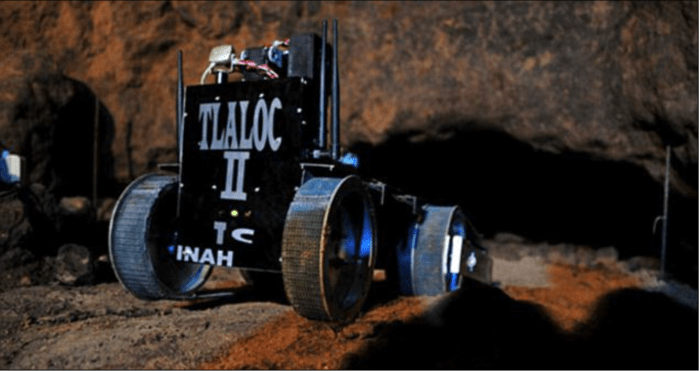
Explorer: This robot may have made a momentous discovery in a 2,000-year-old tunnel in Mexico. Photo credit: DailyMail.com.

From the Associated Press (Dan Elliott) via The Detroit News:

the EPA is considering using robots and other sophisticated technology to help prevent these types of “blowouts” or clean them up if they happen. But first the agency has to find out what’s inside the mines, some of which date to Colorado’s gold rush in the 1860s.

Wastewater containing toxic heavy metals has been spewing from hundreds of inactive mines nationwide for decades, the product of complicated and sometimes poorly understood subterranean flows.

Mining creates tainted water in steps: Blasting out tunnels and processing ore exposes long-buried, sulfur-bearing rocks to oxygen. The sulfur and oxygen mix with natural underground water flows to create sulfuric acid. The acidic water then leaches heavy metals out of the rocks.

To manage and treat the wastewater, the EPA needs a clear idea of what’s inside the mines, some of which penetrate thousands of feet into the mountains. But many old mines are poorly documented.

Investigating with robots would be cheaper, faster and safer than humans.

“You can send a robot into an area that doesn’t have good air quality. You can send a robot into an area that doesn’t have much space,” said Rebecca Thomas, project manager for the EPA’s newly created Gold King Superfund site, officially known as the Bonita Peak Mining District.

Instruments on the robots could map the mines and analyze pollutants in the water.

They would look more like golf carts than the personable robots from “Star Wars” movies. Hao Zhang, an assistant professor of computer science at the Colorado School of Mines, envisions a battery-powered robot about 5 feet long with wheels or tracks to get through collapsing, rubble-strewn tunnels.

Zhang and a team of students demonstrated a smaller robot in a mine west of Denver recently. It purred smoothly along flat tunnel floors but toppled over trying to negotiate a cluttered passage…

A commercial robot modified to explore abandoned mines – including those swamped with acidic wastewater – could cost about $90,000 and take three to four years to develop, Zhang said.

Significant obstacles remain, including finding a way to operate remotely while deep inside a mine, beyond the reach of radio signals. One option is dropping signal-relay devices along the way so the robot stays in touch with operators. Another is designing an autonomous robot that could find its own way.

Researchers also are developing sophisticated computerized maps showing mines in three dimensions. The maps illustrate where the shafts intersect with natural faults and provide clues about how water courses through the mountains.

“It really helps us understand where we have certainty and where we have a lot of uncertainty about what we think’s happening in the subsurface,” said Ian Bowen, an EPA hydrologist. “So it’s a wonderful, wonderful tool.”

The EPA also plans to drill into mines from the surface and lower instruments into the bore holes, measuring the depth, pressure and direction of underground water currents.

Tracing the currents is a challenge because they flow through multiple mines and surface debris. Many tunnels and faults are connected, so blocking one might send water out another.

“You put your finger in the dike here, where’s the water going to come out?” Thomas said.

Once the EPA finishes investigating, it will look at technologies for cleansing the wastewater.

Options range from traditional lime neutralization – which causes the heavy metals dissolved in the water to form particles and drop out – to more unusual techniques that involve introducing microbes.

The choice has consequences for taxpayers. If no company is found financially responsible, the EPA pays the bill for about 10 years and then turns it over to the state. Colorado currently pays about $1 million a year to operate a treatment plant at one Superfund mine. By 2028, it will pay about $5.7 million annually to operate plants at three mines, not including anything at the Bonita Peak site.

The EPA views the Colorado project as a chance for the government and entrepreneurs to take risks and try technology that might be useful elsewhere.

But the agency – already dealing with a distrustful public and critical politicians after triggering the Gold King spill – said any technology deployed in Colorado will be tested first, and the public will have a chance to comment before decisions are made.

On April 7, 2016, the Environmental Protection Agency proposed adding the “Bonita Peak Mining District” to the National Priorities List, making it eligible for Superfund. Forty-eight mine portals and tailings piles are “under consideration” to be included. The Gold King Mine will almost certainly be on the final list, as will the nearby American Tunnel. The Mayflower Mill #4 tailings repository, just outside Silverton, is another likely candidate, given that it appears to be leaching large quantities of metals into the Animas River. What Superfund will entail for the area beyond that, and when the actual cleanup will begin, remains unclear.
Eric Baker

San Juan National Forest Announces Release of the Final Hermosa Creek Watershed Management Plan

Here’s the release from the San Juan National Forest:

The San Juan National Forest has released the Final Hermosa Creek Watershed Management Plan. This is the “go-to” document for how the Hermosa Special Management Area and Wilderness will be managed. This document is different from the Environmental Analysis because it combines the proposed action with recently-signed decisions. It does not contain alternatives that were not chosen or much background information or rationale, which can be found in the EA.

Two travel-themed maps are posted showing new rules for motorized and mechanized (bicycle) uses in the Hermosa Creek watershed. The maps and Final Plan are available in the “Post-Decision” tab on the webpage: https://www.fs.usda.gov/project/?project=43010

For additional information, please contact the Columbine Ranger District at 970-884-2512.

Animas High School chemistry students take a look at surface water and wastewater

Silverton, Colo., lies an at elevation of 9,300 feet in San Juan County, and the Gold King Mine is more than 1,000 feet higher in the valley at the left side of the photo. Photo/Allen Best

From The Durango Herald (Patrick Armijo):

Marilyn Short and Luke Mick are gumshoes of sorts: They’re trying to solve the mystery of why the Animas River near Silverton has more caddisflies than would be expected after the Gold King Mine spill.

Sadie Vance, Abby Allsopp and Faith Mewmaw created an interactive fishing game where anglers using a yardstick converted to a fishing pole can test their luck catching wood cutouts of fish and attendant pollutants and heavy metals found in the Animas River.

Ryan Colley, Chole Walsh and Cole Elliott devised an interactive video game where players can learn how the upgrade to the wastewater-treatment plant at Santa Rita will cleanse the urban waste stream so it can be safely returned to the Animas.

They were among 65 Animas High School juniors in Steve Smith’s chemistry class who plunged into a subject that brings nervous jitters to many a former high-schooler as they delved into the world of ionic and covalent bonds and spectroscopy through the lens of studying water quality.

On Thursday evening at the Powerhouse Science Center, students presented projects from their study of water quality in the Animas River. About 150 people attended.

“Students get exposed to water quality in this town, and this allowed them to look at the issue in a different manner,” Smith said.

The students, he said, spent about two weeks on the projects, and the city of Durango and Mountain Studies Institute partnered with Short during the unit…

Chole, who joined Ryan and Cole in creating a video game based on upgrades to the wastewater-treatment plant at Santa Rita, said the city of Durango helped with research – and even provided a tour.

“We were introduced to how the water-treatment plant works. We were able to ask questions. It really helped me more than a basic lecture,” Chole said of her group’s Santa Rita tour.

The trio’s video game is only in its rudimentary stages, and the students want to develop more levels: As players advance, they gain more knowledge of the chemistry behind processes as wastewater moves through treatment stages before its eventual return to the Animas.

When asked if the trio could, on its own, do the necessary work to complete the video game, Ryan said, “If we had more time, I think we’d get decently close.”

Cole said the chemistry proved relatively easy to understand; the hard part of video game development was getting the game to operate properly on all three members’ laptops.

Marilyn’s study of caddisflies left one big impression: “I was surprised by how much life is in the river that I didn’t even know about.”

“Microinvertebrates are useful in determining water quality,” Luke said, adding he was stumped why the Animas near Silverton has more caddisflies than expected based on its water composition.

“No one really knows what’s up,” he said.

#AnimasRiver: #UT expands lawsuit over the #GoldKingMine spill

Cement Creek photo via the @USGS Twitter feed

From the Associated Press via The Salt Lake Tribune:

Utah has added the U.S. Environmental Protection Agency and a contractor as defendants in the state’s lawsuit over a mine waste spill in Colorado that polluted rivers in three states.

The Utah Attorney General’s Office said Friday it’s still negotiating with the EPA over damages from the spill but filed suit to preserve the state’s legal rights.

The state didn’t explain why it added the contractor, Weston Solutions Inc. Neither the EPA nor Weston Solutions immediately responded to after-hours emails seeking comment.

Utah sued mine owners and other contractors in August seeking unspecified compensation for the 2015 spill at the Gold King Mine.

@USBR Continues Animas-La Plata Project Contract Negotiations with Ute Mountain Ute Tribe

Lake Nighthorse and Durango March 2016 photo via Greg Hobbs.

Here’s the release from the US Bureau of Reclamation (Marc Miller):

The Bureau of Reclamation is continuing negotiations on a proposed repayment contract for the Animas-La Plata Project with the Ute Mountain Ute Indian Tribe for the Tribe’s statutory allocation of project water. The second negotiation meeting is scheduled for Thursday, January 11, 2018, at 1:30 p.m. at the Dolores Water Conservancy District office, 60 Cactus Street, Cortez, CO 81321.

The contract to be negotiated will provide for storage and delivery of project water and provisions for payment of operation and maintenance costs of the project.

All negotiations are open to the public as observers, and the public will have the opportunity to ask questions and offer comments pertaining to the contract during a thirty minute comment period following the negotiation session. The proposed contract and other pertinent documents will be available at the negotiation meeting, or can be obtained on our website at: http://www.usbr.gov/uc/wcao/index.html, under Current Focus or by contacting Marc Miller with Reclamation at 185 Suttle Street, Suite 2, Durango, Colorado, 81303, telephone (970) 385-6541 or e-mail mbmiller@usbr.gov.

#AnimasRiver: #GoldKingMine spill claims drop to $420 million

Animas River through Durango August 9, 2015, after the Gold King Mine spill. Photo credit Grace Hood

From The Luxora Leader:

Farmers, business owners, residents and others initially said they suffered a staggering $1.2 billion in lost income, property damage and personal injuries from the 2015 spill at the Gold King Mine, which tainted rivers in Colorado, New Mexico and Utah.

But the total now appears to be about $420 million. A single law firm that originally filed claims totaling $900 million for a handful of New Mexico property owners told the AP it had lowered their claims to $120 million.

It‘s still uncertain whether the White House and Congress — both now controlled by the GOP — are willing to pay for any of the economic losses, even though Republicans were among the most vocal in demanding the EPA make good on the harm.

Under former President Barack Obama, a Democrat, the EPA said it was prohibited by law from doing so.

Now that they‘re in charge, Republicans have vowed to slash spending on the environment, leaving the prospects for compensation in doubt.

Durango councillors set April 1, 2018 opening for recreation at Lake Nighthorse

Lake Nighthorse August 2017 via the US Bureau of Reclamation.

From The Durango Herald (Mary Shinn):

Durango City Council unanimously committed to opening Lake Nighthorse on April 1 and forming an advisory group to help guide the management of the area…

The advisory group, called the Friends of Lake Nighthorse, would likely include people representing motorized boating, fishing, sailing, city advisory boards, governments involved in the lake and the Quiet Lake Nighthorse Coalition, among others, Parks and Recreation Director Cathy Metz said…

The recommendation from the advisory group go to both the city of Durango and the Bureau of Reclamation, which owns the lake.

Big changes in lake management could require an amendment to the lease agreement with the Bureau of Reclamation, and that could postpone opening of the lake beyond 2018, Metz said.

None of the councilors supported changes that would require a delay, but they did seem interested in responding to the flood of emails and suggestions they received on the issue…

Councilor Sweetie Marbury supported designating hours for motorized and non-motorized use to help accommodate both groups.

Limiting use at the lake could raise some budgetary concerns, City Manager Ron LeBlanc said.

The city and the Bureau of Reclamation agreed to split any budget shortfalls from operating the lake, and the city has only about $153,000 in the general fund that is not already allocated for other uses. The city as already set aside about $400,000 for operating the lake.

A 2010 market assessment found about 32 percent of Lake Nighthorse visitors would be interested in power boating and 33 percent would be interested in nonmotorized boating.

Limiting the uses on the lake or restricting the hours of certain uses on the lake could cut into the revenue the city can earn, he said.

Before the council started its discussion on Lake Nighthorse Jerry Olivier defended motorized use on the lake…

Johnson with the Quiet Lake Nighthorse Coalition, suggested the city consider charging admission to the lake by the person instead of by the carload and to ask residents about the management of the lake in an upcoming Parks and Recreation survey.

Book review: “River of Lost Souls: The Science, Politics, and Greed Behind the #GoldKingMine Disaster” — Jonathan Thompson

From Publisher Weekly:

Mixing reportage, historical inquiry, and personal narrative, environmental journalist Thompson uses the Gold King Mine disaster as the starting point of an investigation into the environmental history of Colorado’s Animas River Valley, stretching back to the beginning of European colonization. In 2015, three million gallons of bright-orange, heavy-metal-tainted water spewed out in a matter of minutes from the defunct Gold King Mine near Silverton, Colo. Though the immediate danger of the toxins passed relatively quickly, it irreparably altered the relationships that the local Diné (Navajo) had with their land. “Our history is a history of pollution,” Thompson writes, detailing the damages caused by even the most primitive forms of mining in a seemingly endless war between mining companies and the humans and wildlife that depend on the water systems near mining sites. Thompson, a southwestern Colorado native, knowledgeably and sensitively addresses ethical questions at the heart of his inquiry, including what it would mean to restore the water system to its precolonial state. He also effortlessly explains the technical elements of this story, such as the complex chemistry of the environmental effects of mining. This is a vivid historical account of the Animas region, and Thompson shines in giving a sense of what it means to love a place that’s been designated a “sacrifice zone.”

Cement Creek aerial photo — Jonathan Thompson via Twitter

Click here to order the book from the Tattered Cover Book Store:

Award-winning investigative environmental journalist Jonathan P. Thompson digs into the science, politics, and greed behind the 2015 Gold King Mine disaster, and unearths a litany of impacts wrought by a century and a half of mining, energy development, and fracking in southwestern Colorado. Amid these harsh realities, Thompson explores how a new generation is setting out to make amends.

As shocking and heartbreaking as the Gold King spill and its aftermath may be, it’s merely the tip of the proverbial iceberg. The disaster itself was the climax of the long and troubled story of the Gold King mine, staked by a Swedish immigrant back in 1887. And it was only the most visible manifestation of a slow-moving, multi-faceted environmental catastrophe that had been unfolding here long before the events of August 5, 2015.

Jonathan Thompson is a native Westerner with deep roots in southwestern Colorado. He has been an environmental journalist focusing on the American West since he signed on as reporter and photographer at the Silverton Standard & the Miner newspaper in 1996. He has worked and written for High Country News for over a decade, serving as editor-in-chief from 2007 to 2010. He was a Ted Scripps fellow in environmental journalism at the University of Colorado in Boulder, and in 2016 he was awarded the Society of Environmental Journalists’ Outstanding Beat Reporting, Small Market. He currently lives in Bulgaria with his wife Wendy and daughters Lydia and Elena.

This image was taken during the peak outflow from the Gold King Mine spill at 10:57 a.m. Aug. 5. The waste-rock dump can be seen eroding on the right. Federal investigators placed blame for the blowout squarely on engineering errors made by the Environmental Protection Agency’s-contracted company in a 132-page report released Thursday [October 22, 2015]

#Snowpack news: Continued dryness in the Four Corners

Westwide SNOTEL basin-filled map December 17, 2017 via the NRCS.

From The Durango Herald (Mia Rupani):

Weather forecasters say the dry conditions may be a sign of what’s to come for much of the winter, which officially starts Thursday. A La Niña weather pattern appears to be shaping up, bringing cold and snow to the Northwest and unusually dry conditions to the southern tier of the U.S.

Meteorologist Andrew Lyons with the National Weather Service in Grand Junction said there has been no recorded precipitation in Durango this month, making it the driest start to December on record.

He said temperatures, too, are continuing to run above average.

“We started off November very dry and warm, and we broke several record highs here and around the state,” Lyons said.

Precipitation levels are recorded at Durango-La Plata County Airport. The National Weather Service recorded 0.13 inches of precipitation for the month of November, more than an inch below what was recorded in November 2016.

Snowpack is 22 percent of average for this time of year for the San Miguel, Dolores, San Juan and Animas basins – the lowest average in the state. Statewide, snowpack is at 52 percent of normal.

The average high temperature for December is 39 degrees, with an average low of 13 degrees. And although most nights have been cold this month with an average of 11 degrees, the days are significantly warmer, with an average of 48 degrees – nine degrees above average…

He said an area of high pressure over the western United States is pushing storms up into Canada and down into the Upper Midwest and East Coast.

And because big snowstorms are memorable, people often forget the dry winters in Durango, he said.

@EPA: Bonita Peak Mining District among Superfund sites targeted for intense and immediate attention. (Hope for funding.)

On April 7, 2016, the Environmental Protection Agency proposed adding the “Bonita Peak Mining District” to the National Priorities List, making it eligible for Superfund. Forty-eight mine portals and tailings piles are “under consideration” to be included. The Gold King Mine will almost certainly be on the final list, as will the nearby American Tunnel. The Mayflower Mill #4 tailings repository, just outside Silverton, is another likely candidate, given that it appears to be leaching large quantities of metals into the Animas River. What Superfund will entail for the area beyond that, and when the actual cleanup will begin, remains unclear.
Eric Baker

Here’s the release from the Environmental Protection Agency (Andrew Mutter/Lisa McClain-Vanderpool):

EPA announces elevation of 21 sites nationwide

Today, the U.S. Environmental Protection Agency released the list of Superfund sites that Administrator Pruitt has targeted for immediate and intense attention. The 21 sites on the list – from across the United States – are in direct response to the Superfund Task Force Recommendations, issued this summer, calling for this list.

“By elevating these sites we are sending a message that EPA is, in fact, restoring its Superfund program to its rightful place at the center of the Agency’s mission,” said EPA Administrator Scott Pruitt. “Getting toxic land sites cleaned up and revitalized is of the utmost importance to the communities across the country that are affected by these sites. I have charged the Superfund Task Force staff to immediately and intently develop plans for each of these sites to ensure they are thoughtfully addressed with urgency. By getting these sites cleaned up, EPA will continue to focus on ways we can directly improve public health and the environment for people across America.”

In Colorado, the Bonita Peak Mining District (BPMD) site is on the Administrator’s Superfund list for emphasis. EPA is currently working with the State of Colorado as well as its federal partners, the U.S. Forest Service and the Bureau of Land Management, to develop a Five-Year Plan that outlines cleanup activities and remediation objectives for the site. EPA is working closely with the local government and community stakeholders to ensure the interests of the community are met.

“We are heavily invested in achieving tangible water quality improvements in the Upper Animas watershed,” said EPA Regional Administrator Doug Benevento. “EPA has a unique responsibility at this site and by placing it on this list we are recognizing that responsibility and ensuring the community that it is going to be a priority.”

While long-term planning continues, EPA is using an adaptive management approach at the site that supports early actions to improve water quality, stabilize mine features and address priority areas that pose a risk to human health. Through his hands-on engagement at the BPMD site, Administrator Pruitt will advance progress on site cleanup without expending additional taxpayer dollars.

“Today’s announcement to include the Bonita Peak Mining District site to the EPA’s Superfund “Emphasis List” is an important step forward,” said Governor John Hickenlooper. “We visited the site with EPA Administrator Pruitt in August and are encouraged by his follow through with resources and support to the agency’s cleanup efforts. This is in addition to other national priority list sites like the Colorado Smelter site in Pueblo, where important EPA cleanup actions also are underway. We look forward to working closely with the EPA, our communities and our Congressional delegation to remediate these sites.”

“Secretary Pruitt assured me when I met with him before his confirmation and when we visited the site in August that the EPA would make the right decision for the people of Southwest Colorado, and I appreciate his agency following through on their promise,” said Senator Cory Gardner. “The Gold King mine spill has had a significant impact on our state and there will continue to be a lot of work done by our elected officials and community. This latest commitment to the Bonita Peak Mining District along with continued attention to Colorado Smelter cleanup actions in Pueblo are important steps in the progress that needs to be made by the EPA at both locations.”

“We applaud the EPA’s decision to prioritize the Bonita Peak Mining District site, and we encourage them to keep working with state officials to secure funding for a local community liaison based in Silverton to improve coordination for the BPMD site among local, state, and federal governments,” said Senator Michael Bennet. “The administration and Congress should also work together to ensure all Superfund sites, including important clean-up efforts underway in Pueblo, have the resources and support they need.”

The Bonita Peak Mining District (BPMD) became a Superfund site on Sept. 9, 2016, when it was added to the National Priorities List. The site consists of historic and ongoing releases from mining operations in three drainages: Mineral Creek, Cement Creek and Upper Animas, which converge into the Animas River near Silverton, Colorado. The site includes 35 mines, seven tunnels, four tailings impoundments and two study areas where additional information is needed to evaluate environmental concerns.

In developing this initial list, EPA considered sites that can benefit from Administrator Pruitt’s direct engagement and have identifiable actions to protect human health and the environment. These are sites requiring timely resolution of specific issues to expedite cleanup and redevelopment efforts. The list is designed to spur action at sites where opportunities exist to act quickly and comprehensively. The Administrator will receive regular updates on each of these sites.

The list is intended to be dynamic. Sites will move on and off the list as appropriate. At times, there may be more or fewer sites based on where the Administrator’s attention and focus is most needed. There is no commitment of additional funding associated with a site’s inclusion on the list.

EPA remains dedicated to addressing risks at all Superfund sites, not just those on the list. The Task Force Recommendations are aimed at expediting cleanup at all Superfund sites and Administrator Pruitt has set the expectation that there will be a renewed focus on accelerating work and progress at all Superfund sites across the country.

The Task Force, whose work is ongoing, has five overarching goals:

  • Expediting cleanup and remediation;
  • Reinvigorating cleanup and reuse efforts by potentially responsible parties;
  • Encouraging private investment to facilitate cleanup and reuse;
  • Promoting redevelopment and community revitalization; and
  • Engaging with partners and stakeholders.
  • The Task Force will provide the public with regular updates as it makes progress on the Administrator’s Emphasis list and other Task Force activities.
    The list of sites can be found here: https://www.epa.gov/superfund/superfund-sites-targeted-immediate-intense-action.

    From The Durango Herald (Mary Shinn):

    Many local and national officials saw the listing as the agency fulfilling commitments it made after the EPA in June 2015 released acid mine drainage into the Animas River watershed.

    “That is exactly what was promised to us when we signed up for the National Priority List,” San Juan County Commissioner Pete McKay said of the recent announcement.

    Sens. Cory Gardner, R-Colorado, and Michael Bennet, D-Colorado, and Gov. John Hickenlooper also supported the announcement.

    While the list is expected to be dynamic, Benevento said the announcement signified a long-term commitment to the area.

    Inclusion on the list is not a commitment of additional funding, according to a news release. But it does place an obligation on the regional administrator to make sure the project manager has the resources that she needs, Benevento said.

    The EPA is working with Colorado, the U.S. Forest Service and the Bureau of Land Management to develop a five-year plan for the Bonita Peak area that outlines cleanup activities and remediation objectives, the release said.

    The site includes 35 mines, seven tunnels, four tailings impoundments and two study areas where additional information is needed to evaluate environmental concerns.

    Project Manager Rebecca Thomas expects human health and aquatic risk assessments to be finished in the spring and some cleanup work to start in the summer.

    San Juan County commissioners McCay and Scott Fetchenhier also said some sites could be cleaned up in the short-term.

    “There are a couple sites with tailings that could be cleaned up pretty quickly,” Fetchenhier said.

    McCay said understanding the flows of polluted water in the Gladstone area and how best to mitigate those is an immediate priority.

    From The Washington Post (Brady Dennis):

    The push is part of Administrator Scott Pruitt’s promise to prioritize the decades-old cleanup program, even as the Trump administration shrinks the size and reach of the EPA. The 21 sites highlighted by the agency span the country, from a former tannery site in New Hampshire to a contaminated landfill from the World War II-era Manhattan Project in St. Louis to an abandoned copper mine in Nevada…

    David Konisky, a political scientist at Indiana University’s School of Public and Environmental Affairs, questioned how EPA put together the list of sites it released Friday.

    “I do find the rationale for inclusion on the list to be strange,” Konisky, who has written extensively about the Superfund program, said in an email. “The EPA selected sites based on the ability of the Administrator to help achieve an upcoming milestone or site-specific action. This strikes me as mostly about creating a credit-claiming opportunity for Pruitt, rather than prioritizing additional resources to sites where communities face the most significant health risks.”

    There are more than 1,300 Superfund sites nationwide, some of which have lingered for years on the EPA’s “national priorities list.” While Pruitt has repeatedly spoken about his focus on the program, calling it “vital” and a “cornerstone” of the EPA’s mission, critics have noted that the Trump administration has proposed slashing the Superfund budget by 30 percent. They also worry that a single-minded focus on speeding up the process at particular sites could result in inadequate cleanups…

    “It’s happy talk,” Nancy Loeb, director of the Environmental Advocacy Center at Northwestern University’s Pritzker School of Law, told The Washington Post in the summer, noting how funding for the program has shrunk over time. “We have Superfund sites, but we don’t have a super fund.”

    Cement Creek aerial photo — Jonathan Thompson via Twitter

    Farmington: #GoldKingMine advisory group meeting Monday, November 27, 2017 #ColoradoRiver #COriver

    This image was taken during the peak outflow from the Gold King Mine spill at 10:57 a.m. Aug. 5. The waste-rock dump can be seen eroding on the right. Federal investigators placed blame for the blowout squarely on engineering errors made by the Environmental Protection Agency’s-contracted company in a 132-page report released Thursday [October 22, 2015]

    From The New Mexico Political Report (Laura Paskus):

    The New Mexico Gold King Mine Spill Citizens’ Advisory Committee will meet Monday evening in Farmington.

    According to the New Mexico Environment Department, the committee includes 11 citizen volunteers from northern New Mexico, including the Navajo Nation, and works with New Mexico’s Long-Term Impact Review Team to monitor and understand the long-term impacts of the 2015 Gold King Mine accident…

    Monday’s meeting will include a presentation on the area’s hydrogeology and geochemistry and provide an opportunity for public comment.

    In May, the team released a long-term monitoring plan for the Animas River.

    In addition to monitoring the impacts of the Gold King Mine spill, the work scientists are doing will help people understand how waste runoff from other mines affects surface and groundwater resources in the area. The work will also help identify how any future releases from abandoned mines might affect the Animas watershed.

    To read the plan click here. You can also find an associated, peer-reviewed study from the New Mexico Bureau of Geology and Mineral Resources here.

    Monday’s meeting will begin at 5:30 and be held in the SUNS Room at San Juan Community College in Farmington. For more information: http://www.NMEDriverwatersafety.org or http://NMENV-Outreach@state.nm.us

    The orange plume flows through the Animas across the Colorado/New Mexico state line the afternoon of Aug. 7, 2015. (Photo by Melissa May, San Juan Soil and Conservation District)

    #AnimasRiver: Lead pollution at Bonita Peak Mining District superfund site

    On April 7, 2016, the Environmental Protection Agency proposed adding the “Bonita Peak Mining District” to the National Priorities List, making it eligible for Superfund. Forty-eight mine portals and tailings piles are “under consideration” to be included. The Gold King Mine will almost certainly be on the final list, as will the nearby American Tunnel. The Mayflower Mill #4 tailings repository, just outside Silverton, is another likely candidate, given that it appears to be leaching large quantities of metals into the Animas River. What Superfund will entail for the area beyond that, and when the actual cleanup will begin, remains unclear.
    Eric Baker

    From The Denver Post (Bruce Finley):

    This lead and dozens of other contaminants are spreading beyond waste-rock piles into surrounding “halos” where they are absorbed by plants and then can be ingested by bugs and transferred from the insects to birds to, ultimately, mammals. EPA officials said tissue samples from deer will be tested to assess ecological harm.

    “You start to understand the scope of the environmental problem and how long this is going to take,” EPA Superfund project chief Rebecca Thomas said after a town hall meeting this week in Silverton. “It is pretty overwhelming.

    “We don’t really have an active mining industry in this state anymore. Yet we still see so many impacts. And we’re just looking at the Bonita Peak Mining District in the San Juan Mountains. Think how much more widespread it is across the Rocky Mountain West. It’s a big problem. It’s going to take many years to solve it — and a lot of money.”

    The lead, measured at concentrations up to 5,000 parts per million, surfaced in the latest round of sampling and study that were spurred by a federal declaration last year of a Superfund environmental disaster linked to the 2015 Gold King Mine spill that turned the Animas River mustard-yellow through three states.

    EPA Administrator Scott Pruitt has said Superfund cleanups will be the EPA’s priority, even as he and other Republicans push to trim the agency’s $8 billion budget, because Americans deserve to have environmental harm fixed as required by law.

    From The Durango Herald (Jonathan Romeo):

    A recent Denver Post article is being called misleading and inaccurate for overstating the risks to wildlife from mine contamination around a Superfund site near Silverton.

    “The statement that EPA crews found that lead is threatening birds and animals is not accurate,” Environmental Protection Agency project manager Rebecca Thomas wrote in an email Friday. “The terrestrial risk assessment is ongoing and no conclusions have been reached.”

    Around 7 p.m. Thursday, The Denver Post sent a “Breaking News Alert” for a story titled “EPA crews working on Gold King cleanup find elevated lead threatening birds, animals and, potentially, people.”

    In the story, the Post draws the conclusion based on a presentation the EPA gave Monday, in which the agency said preliminary sampling of soils around the Superfund site found levels of lead at some locations at 5,000 parts per million.

    The Post said these levels are 100 times higher than “danger thresholds for wildlife.”

    However, EPA had said this data had not been validated.

    “The statement regarding ‘danger thresholds’ for wildlife in The Denver Post story is misleading,” Thomas said. “At this point, we are looking at very conservative screening values in assessing potential risk.”

    San Juan County Commissioner Scott Fetchenheir, a former miner and geologist who is quoted in the Post article, also took issue with the story.

    “I tried to explain that to (the reporter) and he just didn’t get it,” Fetchenheir said. “He had his mind made up there’s going to be lead problems.”

    Durango: Russian Olive mitigation

    Russian Olive

    From The Durango Herald (Mia Rupani):

    Mountain Studies Institute and Southwest Conservation Corps continue to wage war against the Russian olive, an invasive species that chokes out native trees and degrades the quality of the watershed.

    Last year, MSI was awarded a $195,000 grant from the Colorado Water Conservation Board and an additional $52,000 from Colorado Parks and Wildlife for a three-year Russian olive-removal project.

    Removal efforts continued Saturday morning at Animas Valley Elementary and Christ the King Lutheran Church with two saw crews from SCC, and help from Durango Daybreak Rotary Club.

    MSI’s Amanda Kuenzi said the project specifically targets Russian olive trees on private land…

    Originally introduced for ornamental landscaping, the plants are native to East Asia and Russia, and consume nearly 75 gallons of water per day.

    They are considered a “List B noxious weed,” which requires local governments to manage their spread under Colorado state law…

    “Russian olive reduce wildlife habitat, interfere with nutrient cycling and outcompete native species,” Kuenzi said. “The wetlands have been deteriorating in the West because of irrigation practices and water storage. We have to protect these important ecosystems.”

    She said crews will be working on removal efforts through mid-November with about 60 private landowners throughout the Animas River Valley.

    On Saturday, the Rotary Club collected wood from the removal effort for its firewood-distribution project.

    Lake Nighthorse update: Annexation by the City of Durango, completion of recreation infrastructure in the works

    Lake NIghthorse September 19, 2016.

    From The Durango Herald (Mary Shinn):

    …the city of Durango must annex the lake on County Road 210 and finish several construction projects before it’s ready for visitors, said Parks and Recreation Manager Cathy Metz. Durango City Council also needs to address a request to make the lake a no-wake area.

    While there is no exact opening date, the city is targeting April 1, but this will depend on the construction season during the winter, Metz said.

    City staff members have forecast an opening year for the lake in the past, but this time, the city is setting aside funding for operation in its 2018 budget. Lake operation, including staffing and materials, is expected to cost about $478,000, according to the city budget. City staff members will manage the lake and an entrance station where they will inspect boats for invasive species, such as zebra mussels.

    Operational costs not covered by user fees will be split with the U.S. Bureau of Reclamation, Metz said. The cost split with the bureau will include the cost of providing police presence at the lake.

    The city is also planning to finish construction projects, including an overflow parking lot and a breakwater before the lake opens.

    The city has proposed spending $300,000 next year on a breakwater and a courtesy dock. A federal grant will pay for the overflow parking lot, which is in the design stage.

    Efforts to annex the property into the city are also underway. The lake and shoreline need to be within city limits so Durango Police Department can patrol the area…

    The Animas La Plata Operation Maintenance Replacement Association is also discussing how to direct visitors away from areas around the lake where there are archaeological sites and cultural resources…

    While a lot of work remains to be done to open the lake, some construction is finished, including an access road, boat ramp, parking lot and restrooms.

    The entrance station where boats will be inspected is also close to completion, she said.

    The city anticipates charging $5 for a day pass and $50 for an annual pass, she said.

    #NM Environment Dept. & #GoldKingMine Citizens’ Group Meets September 25, 2017

    The orange plume flows through the Animas across the Colorado/New Mexico state line the afternoon of Aug. 7, 2015. (Photo by Melissa May, San Juan Soil and Conservation District)

    From email from the New Mexico Environment Department:

    The New Mexico Gold King Mine Spill Citizens’ Advisory Committee, based out of San Juan County, New Mexico, meets Monday at 5:30 p.m. in the San Juan Community College Student Center – SUNS Room (accessible through the Henderson Fine Arts Building).

    Shannon Manfredi, Coordinator, Animas River Community Forum (ARCF) in Durango will discuss the role of the ARCF and related organizations, membership composition, and issues.

    The Citizens’ Advisory Committee is a group of 11 citizen volunteers from Northern New Mexica, including the Navajo Nation, who provide a forum for public concerns while tracking the scientific long-term monitoring of the Gold King Mine spill’s effects in the state. The CAC works with New Mexico’s Long-Term Impact Review Team established by Governor Susana Martinez to both monitor and discuss with the public the continuing effects of the 2015 mine blowout, caused by the U.S. Environmental Protection Agency, that released three million gallons of mining wastewater laden with 880,000 pounds of metals into the Animas and San Juan River system.

    For more information please visit the New Mexico Environment Department’s Gold King Mine website at https://www.env.nm.gov/river-water-safety/ or send an email to: NMENV-Outreach@state.nm.us

    #AnimasRiver: #GoldKingMine update

    On April 7, 2016, the Environmental Protection Agency proposed adding the “Bonita Peak Mining District” to the National Priorities List, making it eligible for Superfund. Forty-eight mine portals and tailings piles are “under consideration” to be included. The Gold King Mine will almost certainly be on the final list, as will the nearby American Tunnel. The Mayflower Mill #4 tailings repository, just outside Silverton, is another likely candidate, given that it appears to be leaching large quantities of metals into the Animas River. What Superfund will entail for the area beyond that, and when the actual cleanup will begin, remains unclear.
    Eric Baker

    From The Associated Press (Dan Elliott):

    The 12-inch (30-centimeter) valve will regulate wastewater pouring from the Gold King Mine in the San Juan Mountains of southwestern Colorado, where the EPA inadvertently triggered a wastewater spill while excavating at the mine entrance in August 2015…

    The valve will be mounted in a steel-and concrete barrier about 70 feet (20 meters) inside the mine. The barrier will have water-tight access doors so workers and equipment can get deeper into the mine for cleanup and investigation.

    The EPA is also drilling a 170-foot (50-meter) horizontal well into another part of the Gold King to drain any water building up there. That water would be routed through a temporary treatment plant below the mine where wastewater draining from the main entrance is cleaned up.

    The EPA said it can control the flow of wastewater from the new drain to avoid another blowout.

    The documents did not say say how much the work will cost and the EPA did not immediately respond to emails and a phone call Wednesday seeking comment.

    The work is expected to be completed next month.

    Peter Butler, a leader of the volunteer Animas River Stakeholders Group, which works to improve water quality in the area, said he agreed with the EPA’s decision to install the barrier and drainage well.

    “It’s probably a good idea,” he said. “They are showing an abundance of caution.”

    Wastewater has flowed from the Gold King for years, and since the 2015 blowout, it has poured out at a rate of about 500 gallons (1,900 liters) a minute.

    Mine waste flows are unpredictable In the San Juan Mountains, where underground water flows through an interconnected warren of mine tunnels and natural faults.

    Precautions such as the barrier, valve and horizontal drain will make it safer for investigators to enter the mines and try to figure out the water flows, Butler said.

    The Gold King and dozens of other mining-related sites in the region were designated a Superfund district in 2016.

    @USBR Begins Animas-La Plata Project Repayment Negotiations with Ute Mountain Ute Indian Tribe

    Lake Nighthorse August 2017 via the US Bureau of Reclamation.

    Here’s the release from the US Bureau of Reclamation (Marc Miller):

    The Bureau of Reclamation is initiating negotiations on a proposed repayment contract for the Animas-La Plata Project with the Ute Mountain Ute Indian Tribe for the Tribe’s statutory allocation of project water. The first negotiation meeting is scheduled for Wednesday, September 13, 2017, at 1:30 p.m. at the Dolores Water Conservancy District office, 60 Cactus Street, Cortez, CO 81321.

    The contract to be negotiated will provide for storage and delivery of project water and provisions for payment of operation and maintenance costs of the project.

    All negotiations are open to the public as observers, and the public will have the opportunity to ask questions and offer comments pertaining to the contract during a thirty minute comment period following the negotiation session. The proposed contract and other pertinent documents will be available at the negotiation meeting, or can be obtained on our website at: http://www.usbr.gov/uc/wcao/index.html, under Current Focus or by contacting Marc Miller with Reclamation at 185 Suttle Street, Suite 2, Durango, Colorado, 81303, telephone (970) 385-6541 or e-mail mbmiller@usbr.gov.

    @USBR Begins Animas-La Plata Project Repayment Negotiations with Ute Mountain Ute Indian Tribe

    Lake Nighthorse and Durango March 2016 photo via Greg Hobbs.

    Here’s the release from the US Bureau of Reclamation (Marc Miller, Justyn Liff):

    The Bureau of Reclamation is initiating negotiations on a proposed repayment contract for the Animas-La Plata Project with the Ute Mountain Ute Indian Tribe for the Tribe’s statutory allocation of project water. The first negotiation meeting is scheduled for Wednesday, September 13, 2017, at 1:30 p.m. at the Dolores Water Conservancy District office, 60 Cactus Street, Cortez, CO 81321.

    The contract to be negotiated will provide for storage and delivery of project water and provisions for payment of operation and maintenance costs of the project.

    All negotiations are open to the public as observers, and the public will have the opportunity to ask questions and offer comments pertaining to the contract during a thirty minute comment period following the negotiation session. The proposed contract and other pertinent documents will be available at the negotiation meeting, or can be obtained on our website at: http://www.usbr.gov/uc/wcao/index.html, under Current Focus or by contacting Marc Miller with Reclamation at 185 Suttle Street, Suite 2, Durango, Colorado, 81303, telephone (970) 385-6541 or e-mail mbmiller@usbr.gov.

    #Utah #GoldKingMine lawsuit lacks details

    This image was taken during the peak outflow from the Gold King Mine spill at 10:57 a.m. Aug. 5. The waste-rock dump can be seen eroding on the right. Federal investigators placed blame for the blowout squarely on engineering errors made by the Environmental Protection Agency’s-contracted company in a 132-page report released Thursday [October 22, 2015]

    From the Associated Press (Dan Elliot):

    Utah’s $1.9 billion claim against the Environmental Protection Agency for a multi-state mine waste spill says Utah’s water, soil and wildlife were damaged, but it offers no specifics.

    The Utah Attorney General’s Office provided a copy of the claim to The Associated Press Wednesday…

    Utah’s claim from the spill is believed to be the largest of 144 filed under the Federal Tort Claims Act, which allows people to seek government compensation without a lawsuit. The claims seek payment for lost crops, livestock, wages and income and other damages.

    The Navajo Nation filed a claim for $162 million and the state of New Mexico for $130 million. Both have also filed lawsuits against the federal government.

    Utah also filed suit, but it named mine owners and EPA contractors as defendants, not the government.

    The EPA said January it was prevented by law from paying any of the damages under the Tort Claims Act, angering many. EPA Administrator Scott Pruitt, who took over after President Donald Trump assumed office, has said the agency will reconsider at least some of the claims.

    Utah’s claim cites damage to the San Juan River and Lake Powell, a vast reservoir on the Colorado River which the San Juan feeds into. It also cites damage to other waterways, underground water, soil, sediment, wildlife and other, unspecified natural resources.

    It does not say how state officials arrived at the $1.9 billion figure.

    Dan Burton, a spokesman for Attorney General Sean Reyes, said the state’s lawyers came up with the number after consulting with Utah Department of Environmental Quality scientists and others.

    Navajo and #NM lawsuits preclude @EPA review says agency #GoldKingMine

    The orange plume flows through the Animas across the Colorado/New Mexico state line the afternoon of Aug. 7, 2015. (Photo by Melissa May, San Juan Soil and Conservation District)

    From the Associated Press (Dan Elliott) via The Durango Herald:

    In a written statement, the EPA said the law prevents it from reconsidering claims from anyone who has filed suit.

    That could rule out a review of the two largest claims from the 2015 spill in southwestern Colorado, which the EPA inadvertently triggered…

    More than 70 governments, businesses and individuals sought about $420 million in damages under the Federal Tort Claims Act, which is a way to settle without a lawsuit. The Navajos filed claims for $162 million and New Mexico for $130 million.

    New Mexico and the Navajos sued the EPA for damages in federal court…

    President Donald Trump’s appointee to head the agency, Scott Pruitt, pledged during his confirmation hearing he would review that decision. On Friday, the second anniversary of the spill, he announced a new course.

    “A new review is paramount to ensure that those who have, in fact, suffered losses have a fair opportunity to have their claims heard,” he said.

    Monday’s EPA statement appeared to narrow the scope of the review considerably.

    “EPA won’t be able to reconsider a claim once the claimant has sued the U.S. in court, which the state of New Mexico and the Navajo Nation have done,” it said.

    The EPA designated the Gold King and 47 other mining sites in the area a Superfund district and is reviewing options for a cleanup.

    On April 7, 2016, the Environmental Protection Agency proposed adding the “Bonita Peak Mining District” to the National Priorities List, making it eligible for Superfund. Forty-eight mine portals and tailings piles are “under consideration” to be included. The Gold King Mine will almost certainly be on the final list, as will the nearby American Tunnel. The Mayflower Mill #4 tailings repository, just outside Silverton, is another likely candidate, given that it appears to be leaching large quantities of metals into the Animas River. What Superfund will entail for the area beyond that, and when the actual cleanup will begin, remains unclear.
    Eric Baker

    @EPAScottPruitt tours the #GoldKingMine

    On April 7, 2016, the Environmental Protection Agency proposed adding the “Bonita Peak Mining District” to the National Priorities List, making it eligible for Superfund. Forty-eight mine portals and tailings piles are “under consideration” to be included. The Gold King Mine will almost certainly be on the final list, as will the nearby American Tunnel. The Mayflower Mill #4 tailings repository, just outside Silverton, is another likely candidate, given that it appears to be leaching large quantities of metals into the Animas River. What Superfund will entail for the area beyond that, and when the actual cleanup will begin, remains unclear.
    Eric Baker

    From The Denver Post (Jesse Paul):

    Environmental Protection Agency chief Scott Pruitt says his agency “walked away” from Colorado after the Gold King Mine spill under the Obama administration, vowing Friday to make a federal cleanup of the Gold King and other abandoned mines around Silverton a priority…

    Pruitt visited the site Friday with a delegation of Colorado’s top politicians on the eve of the two-year anniversary of the EPA-triggered disaster. He said that he planned to meet with private citizens impacted by the spill, as well as local leaders, to get first-hand information on his agency’s response.

    “I’ve already sent out a letter to all the claimants who have filed claims asking them to resubmit,” Pruitt told The Denver Post in a phone interview ahead of his visit to the Gold King. “Some of those folks I’m sure I’ll meet today, and I’m looking forward to speaking with them directly. Farmers and ranchers, business owners, the recreational activities that occur on the Animas River — all were impacted, and from my perspective it was a wrong that we need to make right.”

    Remediation will take place at the scores of sites that have leeched millions of gallons of heavy metal-laden water from the Gold King and surrounding mines, Pruitt said, despite President Donald Trump’s proposed funding cuts to the EPA’s Superfund cleanup program. Silverton’s leaders have expressed concern about the EPA’s efforts taking too long or being delayed indefinitely.

    “I can absolutely commit that this will be a priority,” Pruitt said. “I’ve shared with Congress that if money is a concern about fulfilling our responsibilities under Superfund, I will advise them.”

    Pruitt said he is working to create a list of 10 Superfund sites — of the more than 1,300 nationwide — for the EPA to focus on.

    “I don’t know yet (if the Gold King and surrounding mines will be on that list),” he said. “We are evaluating all of the sites right now. Either way, it is going to be a priority.”

    From the Associated Press via The Fort Collins Coloradoan:

    The Environmental Protection Agency will reconsider whether to pay farmers, business owners and others in three states for economic losses caused by a mine waste spill that government crews accidentally triggered in 2015, the agency’s leader said Friday during a visit to the site.

    EPA Administrator Scott Pruitt, who toured Gold King Mine with Colorado lawmakers on the eve of the disaster’s second anniversary, said he told people to resubmit claims rejected under the Obama administration. It’s not clear if the agency could pay on its own or how much of the potential payouts would need to be approved by Congress…

    The EPA has designated the area a Superfund site to pay for a broad cleanup…

    Pruitt, who had promised to visit the mine during his confirmation hearing earlier this year, said he has sent letters to people whose claims were rejected by former President Barack Obama’s EPA.

    In January, the agency said federal law prevented it from paying claims because of sovereign immunity, which prohibits most lawsuits against the government…

    It’s uncertain whether the White House and Congress, both controlled by Republicans, are willing to pay for any of the economic losses, although the GOP has been most vocal in demanding the EPA make good.

    It’s not clear how much money would be at stake in a new round of claims.

    Claims for $1.2 billion in lost income, property damage and personal injuries were initially filed with the EPA, but attorneys for some of the larger claimants later reduced the amounts they were seeking. A review by The Associated Press estimated the damages sought at $420 million.

    The EPA has spent more than $31.3 million on the spill, including remediation work, water testing and payments to state, local and tribal agencies.

    The agency said last year it would pay $4.5 million to state, local and tribal governments to cover the cost of their emergency response to the spill, but it rejected $20.4 million in other requests for past and future expenses, again citing federal law.

    From CBS Denver (Rick Sallinger):

    In an interview with CBS4’s Matt Kroeshel, [U.S. Senator Michael] Bennet said, “Having designation as Superfund site is only one step in the process. We need to make sure the resources are put into there to do the remediation that’s required at the site.”

    The environmental mess that flowed from the Gold King Mine could happen again. Its owner Hennis says an adjacent mine is filled with even more toxic liquids.

    When asked, “Could we have another disaster?” Hennis replied, “Absolutely and it would be a thousand times worse than Gold King.”

    […]

    Sen. Gardner echoed that this is not a one time only problem, “Not just Gold King, we are talking about a handful of mines around the West that pose a threat to our environment and our community.”

    CPW: Native cutthroat trout reintroduction program continues in Southwest Colorado

    Colorado Parks and Wildlife staffers prepare native Colorado River cutthroat trout for stocking north of Durango on July 27, 2017.

    Here’s the release from Colorado Parks and Wildlife:

    Restoration of native trout reached another milestone on July 27 when 3,000 Colorado River cutthroat trout were stocked in streams about 30 miles north of Durango by Colorado Parks and Wildlife.

    The restoration project is being done in the Hermosa Creek drainage and is a joint project of CPW and the San Juan National Forest, with assistance from Trout Unlimited. So far, restoration work has been completed on three phases of the project which includes sections of the main stem of Hermosa Creek and East Hermosa Creek. One more phase remains that will take two more years to complete.

    Last week about 50 volunteers helped to distribute the five-inch fish in about three miles of water in East Hermosa Creek, Relay Creek and Sig Creek.

    “Restoring native species is a high priority for Colorado Parks and Wildlife and the Hermosa Creek drainage is an ideal location for pure Colorado River cutthroat trout,” said Jim White, CPW aquatic biologist in Durango who has coordinated the projects. “There are numerous tributaries streams that provide a variety of habitats and safe havens for populations in case of catastrophic events, such as fire, drought or disease.”

    To restore native fish, the U.S. Forest Service has built two barriers on the creeks which block the passage of non-native rainbow and brook trout. Native cutthroats cannot compete with those fish in a stream. Following construction of the barriers, CPW treated the water to kill all fish in the stream. Generally, it takes two years for biologists to confirm that all fish have been eliminated. After that, native fish can be restocked.

    Besides building the barriers, the Forest Service has also made improvements along the streams to improve fish habitat.

    Fish are doing well on the section completed five years ago on Hermosa Creek, White said. A recent survey showed that more than 400 fish per mile now inhabit the creek.

    “We know the fish are reproducing in that section and we are very pleased with what we’re seeing,” White said.

    The last phase of the project will connect East Hermosa Creek with the main stem. The Forest Service is currently building another barrier just below the confluence of the two streams; treating the water to eliminate all fish will be done in 2018 and 2019. By 2020, if all goes as planned, nearly 25 miles of stream in the Hermosa Creek drainage will be home to the native trout.

    Hermosa Creek is an excellent spot for anglers to get off the beaten path for catch-and-release-fishing. Anglers are reminded that fishing in this area is by fly and lure only, and that all cutthroat trout caught in the area must be returned to the water immediately.

    To learn more about CPW’s work to restore native trout throughout the state, go to: http://cpw.state.co.us/learn/Pages/ResearchCutthroatTrout.aspx.

    #Utah sues over #GoldKingMine spill

    On April 7, 2016, the Environmental Protection Agency proposed adding the “Bonita Peak Mining District” to the National Priorities List, making it eligible for Superfund. Forty-eight mine portals and tailings piles are “under consideration” to be included. The Gold King Mine will almost certainly be on the final list, as will the nearby American Tunnel. The Mayflower Mill #4 tailings repository, just outside Silverton, is another likely candidate, given that it appears to be leaching large quantities of metals into the Animas River. What Superfund will entail for the area beyond that, and when the actual cleanup will begin, remains unclear.
    Eric Baker

    From The Deseret News (Amy Joi O’Donoghue):

    In a lawsuit filed in federal court Monday, Reyes asserts the contractor, subcontractor and mine owner — Delaware-based Sunnyside Gold Corp. — failed to take a host of proper precautions to avoid the disastrous breach near Silverton that released 3 million gallons of metals-laden sludge.

    The Utah Department of Environmental Quality is continuing to take water samples from the San Juan River, which was impacted, and Lake Powell, where most of the sludge was deposited.

    While Utah agencies and other entities, such as San Juan County, were compensated by the U.S. Environmental Protection Agency $464,000 for costs related to the initial response, Reyes’ suit asks for punitive damages for the ongoing environmental impacts, stigma associated with the spill and interference with the public’s ability to enjoy the waterways.

    The suit asserts the EPA’s on-site team:

    • Assumed that because the mine was draining it was not under pressure from the contaminated water behind it

    • Didn’t believe it was necessary to test the level or volume of contaminated water from the blockage

    • Did not take a measurement to determine the pressure of the water against the blockage of the adit, or horizontal mine entrance

    Additionally, Reyes’ suit says the on-site team failed to take the precaution of installing a secondary containment system to prevent large quantities of toxic wastewater from reaching the Animas River and did not develop or implement an emergency response plan.

    Although the Occupational Safety and Health Administration, as well as EPA, requires a health and safety plan in conjunction with hazardous waste site operations, the plan in place failed to meet those requirements, the suit asserts.

    On Aug. 5, 2015, the day of the spill, the EPA’s on-site team was performing work on the Level 7 adit, where none of the proper measurements or precautions were taken, according to the lawsuit.

    “Members of the EPA on-site team have given conflicting reports regarding their work. Some believed the objective was to excavate the adit to create an opening. Others believed the objective was to use a backhoe excavator to scratch the earth around the adit,” the suit reads. “On information and belief, this conflict was caused by miscommunication among the EPA on-site team.”

    The suit says the mine blowout continues to pose environmental, economic and other damages to Utah that are not inconsistent with a “national contingency plan,” that will require additional investigation and remediation that will include soil and water testing.

    Although the defendants named in the lawsuit should have known the Gold King Mine presented a “high risk of significant harm to the state of Utah and other downstream communities,” they acted in disregard of those risks, the suit says.

    New Mexico and the Navajo Nation brought lawsuits against the EPA for the spill, and New Mexico also sued Colorado, asserting negligence.

    In late June, the U.S. Supreme Court refused to hear arguments related to the dispute between the states.

    The EPA in January said it would not pay $1.3 billion in claims related to the spill because it is protected by a federal tort law.

    In addition, the agency’s inspector general concluded there was no wrongdoing with the Gold King Mine spill, but also conceded there were no specific standards in place for dealing with a collapsed mine portal.

    Daniel Burton, a spokesman for the Utah Attorney General’s Office, said the state is continuing to negotiate with the EPA to see if a settlement can be reached without the need for litigation.

    The mining district that includes where the breach happened was declared a Superfund Site nearly a year ago, which will accelerate cleanup efforts.

    From the Associated Press (Lindsay Whitehurst) via The Durango Herald:

    Utah wants cleanup compensation and unspecified damages in the 3-million-gallon Gold King Mine spill that was accidentally trigged by EPA contractors in 2015, Utah Attorney General’s Office spokesman Dan Burton said Tuesday.

    Utah hasn’t named a damages amount because it’s still investigating how much it will ultimately cost to clean up its portion of spill that left as much as 880,000 pounds of metals in rivers in Colorado, New Mexico and Utah, Burton said. The metals have settled into riverbeds, where they can get stirred up any rainstorm or heavy snowmelt, state officials have said.

    Total damages from farmers, business owners and residents along the spill’s path have been estimated at $420 million.

    Though Utah was farther away from the epicenter of the spill, contaminants from the blowout have been transported through the San Juan River in southeastern Utah to the vast reservoir of Lake Powell, the lawsuit states…

    The Utah lawsuit filed Monday doesn’t name the EPA. The agency has taken responsibility for the spill and given Utah agencies $464,000 so far to help pay for the cleanup. The state hopes to come to a final settlement with the agency out of court, Burton said.

    Gold King Mine entrance after blowout August 2015

    CPW: Native trout return to Woods Lake

    Woods Lake photo credit Colorado Parks and Wildlife.

    Here’s the release from Colorado Parks and Wildlife:

    Native cutthroat trout are returning to a corner of the San Juan Mountains as part of a conservation project by Colorado Parks and Wildlife.

    On Sept. 20, Parks and Wildlife biologists stocked more than 250 native cutthroat trout in Woods Lake southwest of Telluride. This location was selected because it will provide excellent quality cutthroat habitat: the area is isolated, the water is pristine and barriers protect the lake from non-native fish that live downstream. Once the population is established, the lake will provide the broodstock which will eventually assist in cutthroat conservation efforts throughout the Dolores and Gunnison river basins.

    “This area was populated with native trout before settlers arrived in Colorado, but the fish haven’t been present in, probably, over a half a century,” said Dan Kowalski, an aquatic researcher with Parks and Wildlife in Montrose. “This is one of the few spots in southwest Colorado suitable for this type of restoration project and it will provide a great refuge for this important native fish. This project will help give the cutthroat a long-term foothold in the area, expand their numbers and range, and benefit native trout conservation throughout southwest Colorado.”

    The reintroduced trout were captured from a small stream on the Uncompahgre Plateau earlier in the day and transported by horseback and then by truck to the lake. Wild fish from the small stream will also be spawned in the spring of 2013 so that larger numbers of fish can be introduced to Woods Lake and tributaries, Muddy Creek and Fall Creek, next summer.

    “We’ll do that to give us multiple age classes of fish and to provide good genetic diversity,” Kowalski said.

    Anglers can expect to start catching some cutthroat trout in the summer of 2018 but it will be a couple of years before there are large numbers of older-age fish to catch. Anglers are encouraged to release all fish they catch for the next couple of years to allow the population to grow. Fishing in the lake and streams above is restricted to artificial flies and lures only.

    Cutthroat trout have been eliminated from many rivers and streams in western Colorado due to habitat loss, water quality impacts and the introduction of non-native. The native fish, which has been petitioned for listing as an endangered species, can now be found in only about 14 percent of its historic range in the Rocky Mountain West. This reintroduction project is an effort to restore the native trout to its former habitat, expand the fish’s range and prevent the need for an endangered species listing.

    “Restoring these native fish should be important to all citizens and water users in the basin that depend on our rivers for irrigation and drinking water because a federal listing could affect the state’s management of the species and water use in the basin,” Kowalski said.

    Colorado Parks and Wildlife worked cooperatively with the U.S. Forest Service during the last two summers to remove the non-native fish from Woods Lake and the tributaries.

    Elsewhere in southwest Colorado — and only about 20 miles as the crow flies southeast of Woods Lake — another cutthroat restoration project is ongoing in the upper Hermosa Creek drainage near the Purgatory ski resort in San Juan County. When that project is completed in about five years, more than 20 miles of Hermosa Creek and feeder streams will be home to native cutthroats.

    “Colorado Parks and Wildlife has been working on native trout restoration throughout the state for nearly 30 years and our work will continue,” said John Alves, senior aquatic biologist for the southwest region. “This is truly a long-term effort.”

    To learn more about efforts by Colorado Parks and Wildlife to restore native trout, see:http://wildlife.state.co.us/Research/Aquatic/CutthroatTrout/Pages/CutthroatTrout.aspx.

    Cutthroat trout historic range via Western Trout

    Hermosa Creek cutthroat trout restoration update

    Hermosa Park

    Update: Here’s a photo gallery from The Durango Herald.

    From The Durango Herald (Jonathan Romeo):

    The effort to restore Colorado River cutthroat trout in Hermosa Creek dates back to the early 1990s when wildlife managers used a natural waterfall on the creek’s east fork as a protective barrier.

    Colorado Parks and Wildlife cleared out non-native species of trout – specifically brook, brown and rainbows – using a short-lived, organic poison known as rotenone. And in their place, it released Colorado River cutthroat trout, giving the waterway to the native fish for the first time in probably 100 years.

    The magnitude of the cutthroat’s loss has never been truly quantified, but its range – which once spanned Colorado, New Mexico, Utah and Wyoming – was dramatically reduced, mostly because of habitat loss, overharvesting and competition with non-native species.

    Clay Kampf, a fisheries biologist for the San Juan National Forest, said the best estimates show the Colorado River cutthroat trout is now found in about 14 percent of its historic natural habitat.

    Facing the possibility of the U.S. Fish & Wildlife Service listing the Colorado River cutthroat trout as “endangered,” which would bring a host of restrictive protections, Colorado, Utah and Wyoming entered a three-state agreement to lead an aggressive reintroduction program.

    “It works well for both parties,” said Jim White, an aquatic biologist with Colorado Parks and Wildlife. “This way, the states and local groups have more say in where and how to manage these fish. And it benefits the (Fish & Wildlife Service) because their resources are stretched pretty thin.”

    […]

    In the last decade, the state of Wyoming has restored more than 60 miles of Colorado River cutthroat habitat, with most of that occurring in the upper Green River drainage by the town of Big Piney.

    There, Mark Smith of the Wyoming Game and Fish Department said the population has been struggling since reintroduction. The fish haven’t spawned early enough, he said, which means they don’t grow big enough to survive winter.

    “The turnaround hasn’t been as quick as we would have hoped, but we’re getting there,” Smith said. “We’re certainly making gains and going in the right direction.”

    In Utah, the program has been wildly successful, with hundreds of miles of streams restored with their native species of trout, said Randy Oplinger of the Utah Division of Wildlife Resources.

    Oplinger said Utah has been the most ambitious of the three states, likely because of the fact many projects are located on federal lands managed by agencies open to large-scale restoration efforts.

    This year alone, the department plans to restore 75 miles of cutthroat habitat within the Colorado River basin. And Oplinger said trout populations tend to fair well throughout the river system…

    Hermosa project close to completion
    Once a final barrier is constructed this summer on Hermosa Creek, just below its confluence with the east fork, an effort to dedicate more than 23 miles solely to the cutthroat trout will almost be complete.

    Two decades ago, Hermosa Creek was recognized as an ideal place for a restoration project because of the creek’s outstanding water quality and because of its easy accessibility through Forest Service Road 578, which runs behind Purgatory Resort.

    After the waterfall near Sig Creek Campground was used as a natural blockade from non-native intrusion in the early 1990s, two more human-made barriers were built in 2007 and 2013.

    This summer, the U.S. Forest Service will begin construction on the final barrier at the Hermosa-east fork confluence to safeguard the waters above the blockade for the Colorado River cutthroat.

    CPW’s White said that in the segments of the creek that have already been repopulated with cutthroat, population trends are encouraging. He said a recent sweep a few years ago found about 400 to 600 fish per mile.

    “Populations above 400 fish per mile are usually ranked in the good to excellent category,” White said. “We’ve seen natural reproduction … very shortly after that project on the main stem (of Hermosa) was completed.”

    Protecting the cutthroat
    With a successful stretch of river returned to its native species, wildlife managers are expecting Hermosa Creek to get a lot of use from excited anglers.

    As a result, a strict catch-and-release policy is on that section of river, White said, and there are other measures, such as habitat improvement and limiting bank erosion, that the agencies can take to protect the fish…

    The quest to set right altered habitats continues to have strong cultural and ecological justifications, said Noah Greenwald of the Centers for Biological Diversity.

    “We’re taking away what makes places like Colorado unique and special,” he said. “And we’re likely impacting other species when we replace a native with a non-native. It’s part of this larger extinction crisis.”

    The Hermosa Creek restoration project is a coordinated effort between the U.S. Forest Service and Colorado Parks and Wildlife, as well as Trout Unlimited, which in total have spent more than a $1 million, Kampf said.

    It will take a few more years for the waters upstream of the forthcoming barrier to carry only cutthroats, as non-natives still need to be removed, but Kampf said it will be worth the wait.

    From The Durango Herald editorial board:

    As local anglers, conservationists and wildlife managers get ready to celebrate another milestone in the restoration of Colorado River cutthroat trout to the upper reaches of Hermosa Creek, it is easy to forget that the effort, which dates back to the early 1990s, has its detractors.

    Some local residents, and many long-time summer visitors to the popular area tucked behind Purgatory, think all the fuss over the fish – one of three native Colorado subspecies of trout named for the distinctive crimson slashes found on each side of the lower jaw – has ruined a fine local fishing hole.

    From a short-term point of view, they have a point. The periodic poisoning of the creek to remove non-native trout, the building of barriers to keep non-natives downstream, the stocking of cutthroats and the rules against taking them for the frying pan have sent those seeking a stringer of fish further downstream, or elsewhere.

    In 1992, the Colorado Division of Wildlife applied rotenone above the waterfall on the East Fork; not long after, Colorado River cutthroat were planted in the stream and the fish, estimated to occupy less than 15 percent of its original range on the tributaries of the Green and Colorado rivers, had a toehold in Hermosa headwaters once again.

    It was an important step in the effort to keep the U.S. Fish and Wildlife Service from listing the fish as an endangered species, and mirrored similar restoration efforts on the fish’s native range in Utah and Wyoming.

    Since then, barriers have been built and the process repeated on the main stem upstream of Hotel Draw. With the pending completion this summer of a barrier at the confluence of the East Fork and the main stem, the native-cutthroat-only stretch will soon comprise the largest continuous stretch of Colorado River cutthroat habitat in the state.

    It has been an impressive effort, and like its supporters, we are confident of its future success. Those who remain unimpressed may benefit from a history lesson:

    The same mining and population boom that decimated the cutthroat nearly extirpated Colorado’s elk. In 1912, elk from Wyoming were reintroduced to the state in the same Hermosa Creek drainage. The area remains, as the Denver Post noted in an article three years ago, “a hunter’s paradise, where trophy elk still die of old age.”

    That story, and the Hermosa area’s more recent protected status, bode well for another rebounding native.

    Cutthroat trout historic range via Western Trout

    Local officials travel to D.C. to lobby for Bonita Peak Mining District Superfund site funding

    On April 7, 2016, the Environmental Protection Agency proposed adding the “Bonita Peak Mining District” to the National Priorities List, making it eligible for Superfund. Forty-eight mine portals and tailings piles are “under consideration” to be included. The Gold King Mine will almost certainly be on the final list, as will the nearby American Tunnel. The Mayflower Mill #4 tailings repository, just outside Silverton, is another likely candidate, given that it appears to be leaching large quantities of metals into the Animas River. What Superfund will entail for the area beyond that, and when the actual cleanup will begin, remains unclear.
    Eric Baker

    From The Durango Herald editorial board:

    Good representatives, at every level of government, are willing to go the extra mile.

    In mid-June, Durango City Councilor Dean Brookie, La Plata County Commissioner Brad Blake and San Juan County Commissioner Scott Fetchenhier did just that, both literally and figuratively, by traveling to Washington, D.C. with Ty Churchwell of the Durango office of Trout Unlimited.

    Armed with letters and messages from counties and town councils, chambers of commerce and other Animas River stakeholders, their aim was to meet with Environment Protection Agency director Scott Pruitt. Their goal: to lobby for priority status and adequate funding for the Bonita Peak Mining District Superfund project, now in its investigative stages.

    Heading east, the four were worried. While Pruitt had announced that Superfund projects – there are 1,300 across the country – would be a top priority of the agency under the Trump administration, the preliminary 2018 federal budget released in March showed a 25 percent cut in funding for the program.

    To their chagrin, the first part of the mission failed. Pruitt was out of the country and could not keep his appointment.

    But good representatives are by nature persistent. And optimistic. Instead of a meeting with Pruitt, the four met with eight high-ranking EPA officials and were joined via phone by more staff members in Denver intimately familiar with the Bonita Peak listing.

    Churchwell came away convinced that the cleanup and mitigation of acid mine drainage contaminating the headwaters of the Animas River is at the top of the agency’s list.

    “The response was that Bonita Peak is a stated priority of the EPA,” he said. “We feel confident that the agency is deeply committed.” More proof of that statement is evident in the work now being done. While many Superfund sites sit idle, Churchwell said, the Bonita Peak project is underway.

    That Brookie, Blake and Fetchenhier came away convinced as well is due in no small part to the negative publicity generated by the Gold King Mine spill in August, 2015. The EPA’s role in causing the disaster is well known, and the visitors to Washington were not about to let the agency off the hook. As Brookie reminded EPA staff, “You had your hands on the shovel.”

    That played into the other message the group wanted to convey, Churchwell added, that this project can be the agency’s “opportunity to shine, and demonstrate how a federal agency can respond and do it right.”

    All indications are that the agency agrees.

    Before leaving Washington, the four also met with Sens. Michael Bennet and Cory Gardner and Rep. Scott Tipton to ask the trio for a coordinated and united show of support for the project.

    We are both fortunate and thankful for the efforts made by our local elected officials to ensure the EPA makes good on the promise the Superfund program holds for a restored Animas River watershed.

    Thanks also go to Churchwell for organizing and finding the means to fund the journey; no taxpayer money was used for the trip. In return, he would like to see sustained local interest and community oversight of the project. More opportunities to participate arrive next month with a series of informative meetings followed by a tour of the mining district in September.

    We should all capitalize on the momentum generated by the visit; find details at http://wearetheanimas.com.

    Hermosa Trail to be Impacted by Construction of Fish Barrier

    Proposed Hermosa Creek watershed protection area via The Durango Herald

    Here’s the release from the San Juan National Forest:

    Construction activities will begin in the Hermosa Creek Special Management Area on Monday, July 10, 2017 to erect a fish-migration barrier on Hermosa Creek as part of the ongoing Colorado River Cutthroat Trout Reintroduction Project. Trail users and visitors to the area should expect to encounter delays and closures until October 1, 2017. The barrier is being installed on the main stem of Hermosa Creek downstream of its confluence with the East Fork of Hermosa Creek. About one-half mile of the Hermosa Creek Trail from its northern trailhead must be widened to allow heavy equipment to access the construction site. The trail widening is temporary and will be rehabilitated to the extent possible. Tree removal is expected to be minimal.

    Throughout the construction project, trail users traveling in both directions may encounter temporary delays of up to one hour. Short-term closures lasting up to a full day are also possible, especially when heavy equipment is being moved in and out of the area. No more than four days of closures are expected during the three-month project, but construction schedules are subject to changing conditions. Public notices will be posted when trail closures are expected. The project is not expected to affect fishing, because flows will be bypassed above the construction site; however, some sedimentation is expected downstream. The barrier represents the final and most important phase of the Hermosa Creek Colorado River Cutthroat Trout Reintroduction Project, which began almost 30 years ago. The goal is to protect native cutthroat trout above the barrier from non-native fish located downstream.

    For more information, please contact the Columbine Ranger District at 970 884-2512 or Clay Kampf at 970-884-1403.

    Cutthroat trout historic range via Western Trout

    US Supreme Court declines to hear #GoldKingMine lawsuit, #NM v. #Colorado

    This image was taken during the peak outflow from the Gold King Mine spill at 10:57 a.m. Aug. 5. The waste-rock dump can be seen eroding on the right. Federal investigators placed blame for the blowout squarely on engineering errors made by the Environmental Protection Agency’s-contracted company in a 132-page report released Thursday [October 22, 2015]

    From The Naitional Law Review:

    On June 26, the US Supreme Court denied New Mexico’s petition seeking to institute an original action against Colorado for the 2015 Gold King Mine spill. An original action in the US Supreme Court is a lawsuit between states. Invoking that rarely used procedure, New Mexico sought to hold Colorado liable for the Gold King Mine spill. New Mexico asserted claims under the intricate provisions of the Comprehensive Environmental Response, Compensation, and Liability Act of 1980 (CERCLA) and the Resource Conservation and Recovery Act of 1976 (RCRA). New Mexico also sought analogous relief against Colorado under federal interstate common law.

    Attorneys assisting the State of Colorado, successfully argued that the US Supreme Court should not entertain New Mexico’s novel lawsuit. As explained in Colorado’s briefing, New Mexico’s RCRA claim failed because a CERCLA response action had been initiated to address the relevant hazardous substance release. New Mexico’s CERCLA claim failed, Colorado argued, for a number of reasons, including that once a site is under investigation under CERCLA authority, several of New Mexico’s claims are barred because they would interfere with the CERCLA investigation and remedy decision making. Colorado additionally argued that Congress displaced New Mexico’s putative federal common law claims through its enactment of comprehensive environmental statutes, most importantly the Clean Water Act, but also CERCLA and RCRA. Finally, Colorado’s briefing also explained that Colorado should not be held liable for its regulatory activities in remediating and managing abandoned mines…

    Colorado’s victory at the US Supreme Court protects Congress’s carefully constructed statutory scheme for the effective management and remediation of water pollution across the country. It also protects Colorado’s sovereign ability to remediate abandoned mines.

    On April 7, 2016, the Environmental Protection Agency proposed adding the “Bonita Peak Mining District” to the National Priorities List, making it eligible for Superfund. Forty-eight mine portals and tailings piles are “under consideration” to be included. The Gold King Mine will almost certainly be on the final list, as will the nearby American Tunnel. The Mayflower Mill #4 tailings repository, just outside Silverton, is another likely candidate, given that it appears to be leaching large quantities of metals into the Animas River. What Superfund will entail for the area beyond that, and when the actual cleanup will begin, remains unclear.
    Eric Baker

    Southwestern Water Conservation District annual Water Seminar presentations are now online

    Lake Nighthorse and Durango March 2016 photo via Greg Hobbs.

    Click here to view the presentations. Click here to go to the website:

    Thanks for talking water with us!
    It’s never too late to say thank you for attending the Southwestern Water Conservation District’s 2017 Annual Water Seminar! Just under 200 people gathered in early April to discuss the current funding needs for water-related projects in the state.

    Missed the seminar this year? Fortunately, many of the speakers have generously shared their presentations; click on the button below to view them online. You can also read a short summary of the event in the Durango Herald, “Water conference explores financial solutions.”

    Mark your calendars for the 2018 Annual Water Seminar on Friday, April 6, again at the DoubleTree Hotel in Durango.

    U.S. Supremes pass on #NM #GoldKingMine lawsuit against #Colorado #AnimasRiver

    The orange plume flows through the Animas across the Colorado/New Mexico state line the afternoon of Aug. 7, 2015. (Photo by Melissa May, San Juan Soil and Conservation District)

    From The Albuquerque Journal (Dan Boyd):

    While Colorado’s attorney general cited the ruling as proof the lawsuit should not have been filed, New Mexico Attorney General Hector Balderas indicated the legal fight may not be over yet.

    “The Supreme Court’s ruling only limited the venue in which the state of Colorado can be sued for the harm done to New Mexico children, families and businesses,” AG’s office spokesman James Hallinan said.

    The lawsuit, filed roughly a year ago, alleged Colorado was too lax in its oversight of groundwater contaminated by decades of mining and should be held responsible for the fallout of the Gold King Mine spill.

    The U.S. Supreme Court, on an 8-1 vote, denied a motion to hear the case. The nation’s highest court did not provide a reason for its decision, but has also opted not to intervene in other recent interstate disputes, including a 2016 lawsuit filed by Nebraska and Oklahoma against Colorado’s legal marijuana laws…

    In addition to the lawsuit against Colorado, New Mexico has also filed a lawsuit in federal court against the EPA and the owners of the Gold King Mine that seeks more than $136 million in damages. That amount would include money to pay for economic losses the state attributes to the mine spill, specifically in the tourism, recreation and agriculture sectors.

    From ColoradoPolitics.com (Peter Marcus):

    The New Mexico Attorney General’s Office and the state Environment Department announced last year that it filed a complaint against Colorado with the U.S. Supreme Court. It sought damages and demands that Colorado address problems at draining mines in southwest Colorado.

    Former New Mexico Environment Department Secretary Ryan Flynn alleged that his water quality researchers rejected assertions from Colorado Gov. John Hickenlooper and Colorado environment officials that the Animas River quickly returned to safe pre-event conditions after the August 2015 spill of toxic heavy metals.

    Flynn and attorneys for his department at the time suggested that Colorado is liable for the incident, which spilled 3 million gallons of sludge into the Animas in Durango, turning it a mustard yellow color. The spill fouled rivers in three Western states with arsenic, lead and other heavy metals.

    The EPA acknowledged fault in the spill, in which sludge flowed into creeks and rivers during restoration work at Gold King. The flow headed into the San Juan River in New Mexico and Utah…

    The Supreme Court was an appropriate venue for the case against Colorado, as it involved two states suing each other. But the high court declined to hear arguments in the case, though it did not issue an opinion explaining the decision. Justices Clarence Thomas and Samuel Alito said they would let the lawsuit move forward.

    From The Durango Herald (Jonathan Romeo):

    New Mexico’s petition to hold Colorado responsible for the Gold King Mine spill nearly two years ago was denied Monday by the U.S. Supreme Court.

    “Because it was the EPA and not Colorado that caused the Gold King Mine disaster, I have said from the beginning that New Mexico should not have sued Colorado in the Supreme Court,” Colorado Attorney General Cynthia Coffman said in a prepared statement.

    “Now that my office has won the Supreme Court case, I hope the conversation can focus on the EPA and its promise to take full responsibility for its actions.”

    […]

    In its lawsuit, New Mexico claimed the Gold King spill was the “coup de grâce of two decades of disastrous environmental decision-making by Colorado, for which New Mexico and its citizens are now paying the price.”

    The complaint specifically called out a decision reached by the state of Colorado and Sunnyside Gold Corp. to shut down a water treatment plant in favor of placing bulkheads at the entrance of the American Tunnel, Sunnyside’s drainage point.

    It’s believed among most researchers familiar with the Animas watershed that the bulkheads caused the mine pool of the Sunnyside Mine to back up and cause other mines to discharge acidic water, namely the Gold King.

    Regardless, Coffman, in response to the filed complaint, said she tried to resolve the matter without litigation, calling New Mexico’s lawsuit against the state “unfortunate.”

    “It’s unclear to me how suing Colorado furthers the states’ mutual goal of holding the EPA to its promise to ‘take full responsibility’ for turning our rivers yellow,” she said…

    “The Supreme Court’s ruling only limited the venue in which the State of Colorado can be sued for the harm done to New Mexico children, families and businesses,” James Hallinan, spokesman for New Mexico Attorney General Hector Balderas, said in an emailed statement.

    “Attorney General Balderas will continue to fight for economic, social and environmental justice until New Mexico is compensated appropriately by all parties responsible for the horrific impacts of the Gold King Mine Spill.”

    The Supreme Court’s decision to dismiss New Mexico’s petition is the latest lawsuit to fail in the long line of litigation in the wake of the spill.

    On Jan. 13, the EPA rejected $1.2 billion in claims of damages from private businesses and individuals, citing federal law that encourages “government agencies to take action without the fear of paying damages in the event something went wrong while taking the action.”

    To date, the EPA has spent more than $29 million in response to the Gold King Mine spill, with most of those funds used to stabilize the mine adit and mitigate ongoing acid mine drainage through a temporary water treatment plant, Amy Graham, an agency spokeswoman said Monday.

    A total of $3.7 million has been awarded to state, tribal and local governments for emergency response costs, and another $2 million was provided to states and tribes for water quality monitoring, Graham said.

    From the New Mexico Political Report (Laura Paskus):

    The problem of toxic waste from abandoned mines flowing into rivers isn’t limited to just the Gold King Mine.

    In Colorado alone, more than 200 abandoned mines collectively leak over a million gallons of wastewater every day. The pollution includes things like heavy metals, arsenic and sulfuric acid.

    Last week, the Denver Post reported that EPA officials are trying to stop contamination of the Animas River from the abandoned Red and Bonita Mine, which currently discharges 300-gallons per minute of wastewater into the Animas River…

    There are more than 15,000 abandoned mines across New Mexico, according to the New Mexico Energy, Minerals and Natural Resources Department.

    According to that agency’s website, “The numbers of abandoned mines in the state are so numerous that one can only guess at the quantity. Some of them are small and not considered dangerous. Others are extremely dangerous.”

    James Hallinan, spokesman for New Mexico Attorney General Hector Balderas, emailed a statement:

    “The Supreme Court’s ruling only limited the venue in which the State of Colorado can be sued for the harm done to New Mexico children, families and businesses. Attorney General Balderas will continue to fight for economic, social and environmental justice until New Mexico is compensated appropriately by all parties responsible for the horrific impacts of the Gold King Mine Spill.”

    #AnimasRiver: Bonita Peak Mining District Superfund site update

    From The Durango Herald (Jonathan Romeo):

    This summer will be the first full work season since the Bonita Peak Mining District Superfund site was declared last September, and the Environmental Protection Agency is wasting no time trying to figure out one of the biggest mysteries in the watershed: The American Tunnel.

    EPA hydrologist Ian Bowen said this week the agency plans to drill 500 feet into the San Juan Mountains to install a monitoring well between the second and third bulkheads on the tunnel…

    The American Tunnel, which travels about 11,000 feet, served as a transportation route for ore, as well as a deep drainage, from the vast Sunnyside Mine workings to facilities at Gladstone, north of Silverton.

    When Sunnyside Mine closed for good in 1991, attention turned to what to do with acidic discharges out of the American Tunnel. Sunnyside initially pulled the water into a treatment plant, but ultimately decided with the state of Colorado to install three bulkheads to stem the flow of acid drainage.

    But in recent years, researchers believe the Sunnyside mine pool behind the American Tunnel reached capacity and the water is spilling into other mine networks, such as the Gold King and Red & Bonita…

    The Animas River headwaters are broken into three drainages: Mineral Creek, Cement Creek and the Upper Animas.

    Rebecca Thomas, project manager for the Bonita Peak Mining District Superfund site, has previously said each drainage accounts for about a third of heavy metal loading in the Animas, causing a dead zone of aquatic life on the river from just below Silverton to the Bakers Bridge.

    But many people familiar with the basin say the EPA, which could see massive budget cuts under the Trump administration, should focus on the high-metal content waters of Cement Creek, where 13 of the 48 sites are located…

    Treatment options for the American Tunnel are a great unknown, Bowen said.

    Some have called for a complete draining of the tunnel, which could take decades and cost a lot of money to treat discharges. Others have suggested placing bulkheads on all the mines in the area.

    Bowen said the EPA first needs to understand the hydrology of the area. The new monitoring well that is expected to be installed by August will be a key tool in that effort because it will provide insight on how much water is behind the bulkheads, he said.

    “There’s strong indications that these systems are related, but there’s not enough evidence to say it’s immediately connected,” Bowen said.

    Sunnyside Gold Corp. has long contended there is no connection between the American Tunnel and any other mine networks in the area.

    The American Tunnel drains about 100 gallons of acid mine waste water a minute, which flows right by the EPA’s temporary treatment plant into Cement Creek.

    The temporary treatment plant only takes discharges from the Gold King Mine, which is now at about 620 gallons a minute. The EPA said it may consider treating other mine discharges upon further evaluation.

    From The Farmington Daily Times (Hannah Grover):

    The second annual Conference on Environmental Conditions of the Animas and San Juan Watersheds with Emphasis on the Gold King Mine and Other Mine Waste Issues today at San Juan College also featured other people who have been monitoring conditions in the rivers.

    One challenge for scientists is identifying to what degree metals are naturally occurring in the river and which metals are coming from mines in Colorado.

    Kathleen Sullivan, a U.S. Environmental Protection Agency scientist, said heavy metals released into the river during the Gold King Mine spill likely are no longer in the sediments in the rivers.

    Sullivan said there are naturally high levels of aluminum and iron in the river because of the composition of the bedrock. She said the EPA looked at the ratio of arsenic and lead to aluminum or iron in the river to identify the plume released by the Gold King Mine spill.

    The ratio peaked while the plume was passing through the area…

    She said only a small fraction of the heavy metals released into the river during the spill reached Lake Powell in Utah and Arizona during the immediate aftermath of the spill in August 2015. The rest of the metal was deposited as sediment, but Sullivan said the EPA believes the metals from the Gold King Mine spill are no longer present in the sediment and now have been deposited in Lake Powell.

    Sullivan said the EPA believes the Gold King Mine metals deposited in sediments passed through New Mexico in low levels over three to four weeks during the spring runoff in 2016.

    To test that hypothesis, Sullivan said the EPA took samples during the spring runoff this year. She said the EPA expects to see lower ratios of lead to aluminum in this year’s samples.

    Sullivan said the metals in the plume of acid mine drainage were mainly picked up after the water left the Gold King Mine. She said the water exiting the mine picked up a large amount of metal from a waste pile outside the mine. Sullivan said the EPA is currently in the process of testing that pile.

    During a panel presentation, Bonnie Hopkins, an extension agent for New Mexico State University, said one of the biggest issues still facing the area is the public stigma associated with the spill.

    When Farmington’s Growers Market opened for the 2016 season following the Gold King Mine spill, only three vendors showed up to sell their products. She attributed the small number of farmers selling their products to the stigma surrounding crops grown using water from the Animas River.

    This year, the Growers Market saw improvement. Hopkins said 11 vendors brought crops to the first market of the season earlier this month.

    During a panel discussion, Sullivan said the acid mine drainage from the Gold King Mine is effectively being treated, although drainage from other mines needs to be addressed. She said samples from Cement Creek — which feeds the Animas River — show the water quality is improving.

    Steve Austin, a hydrologist with the Navajo Nation EPA, said community outreach is still needed to communicate that the river water is safe.

    From The Denver Post (Bruce Finley):

    EPA Superfund officials trying to stop toxic mine contamination of the Animas River headwaters are preparing to close an underground dam, aiming to block a 300 gallon-per-minute discharge equal to a Gold King Mine disaster every week.

    Shutting this Red and Bonita Mine bulkhead has emerged as a huge test on mountains here, where miners who penetrated fissures and groundwater pathways left behind the geologic equivalent of Swiss cheese…

    But turning a valve and closing that bulkhead could trigger toxic leaks elsewhere, potentially spreading harm along already-contaminated headwaters. The EPA’s latest water data show widespread aluminum, cadmium, copper, iron and zinc contamination from mining and natural sources at levels too high for fish to survive.

    EPA officials this week told The Denver Post — and assured local leaders — that the agency will use caution at the bulkhead, installed in 2004, and close it gradually next year while monitoring mountainsides for any new leaks. They’ve launched a data-gathering blitz, harnessing the local Mountain Studies Institute, to measure flows from dozens of mine tunnels and more than 97 mountainside seeps and springs.

    “As soon as we feel we have a good handle on what the baseline is, then we’ll close the Red and Bonita bulkhead,” EPA project chief Rebecca Thomas said. “We would do it as a test initially and build up water behind the bulkhead.

    “If we see a change we’re not comfortable with, if it is going to cause any further degradation of water quality, we’ll open up the bulkhead and drain it and treat it,” Thomas said in an interview.

    “We need to understand how water flows before we close it. There are a lot of underground connections. Some are man-made. Some are natural,” she said. “We want to test whether or not closure of the bulkhead would help us improve water quality by stopping continued flow from the Red and Bonita.”

    EPA hydrologist Ian Bowen said environmental gains could be big but emphasized unknowns. For example, the acid-metals muck draining from the Gold King, which is filtered before it mixes into the Animas, increased last year, reaching to 710 gallons per minute. The EPA can treat 1,200 gallons per minute at a plant below that mine.

    Bulkheads also were installed inside Kinross Corp.’s Sunnyside Mine and American Tunnel. EPA crews plan to drill behind those bulkheads to test the pressure of pent-up mine wastewater — to make sure they will hold. American Tunnel bulkheads still leak 100 gallons a minute, and the Mogul Mine, where a bulkhead was installed in 2003, leaks 150 gallons a minute more unfiltered muck into headwaters.

    Stopping the untreated Red and Bonita discharge would mark a first big fix in a Superfund cleanup following the Aug. 5, 2015, Gold King disaster, where an EPA crew accidentally triggered a 3 million gallon spill that turned the Animas mustard-yellow as it moved down the river and eventually reached the Grand Canyon of the Colorado River.

    Installing more bulkheads to trap toxic mine muck inside mountains could mean taxpayers pay less for water cleaning at treatment plants built along headwaters.

    Colorado “agrees with EPA’s plan,” state health department spokesman Warren Smith said.

    Yet challenges loom. Mapping tunnels, fissures, seeps and springs increasingly occupies a legion of researchers and Deere & Ault engineering consultants tapped by the EPA. They anticipated in an April report that closing the Red and Bonita bulkhead would cause toxic overflows elsewhere. And EPA bureaucracy combined with uncertain funding from Congress has delayed a dozen or so other toxic mine Superfund cleanups around Colorado — let alone the tens of thousands of inactive mines contaminating water around the West.

    East of Silverton, above Creede, the EPA’s Superfund cleanup of the Nelson Tunnel and various old mines — declared a national-priority disaster in 2008 — has yet to move beyond studies of tunnels and groundwater.

    EPA officials on Wednesday said the agency “is evaluating the focused feasibility study for the (Creede) site and considering a range of alternatives for the proposed remedy” but that, because the EPA has not picked “a preferred alternative,” funds for cleanup aren’t available…

    EPA crews seem to be working at sampling water and investigating hydrology before closure of the Red and Bonita bulkhead, said Fetchenhier, who is a geologist. “We said: ‘Before you close it, we want the data gathered on every spring, every seep, every tunnel so that you have a baseline. Anytime you put in a bulkhead, there is a chance something could come out someplace else.’ ”

    EPA officials this week convened a forum in Silverton, an in-depth hydrology session with a brain trust of local scientists, mining engineers and others whose collective knowhow, federal officials said, exceeds the agency’s expertise.

    Downriver in Durango, La Plata County leaders acknowledged a strong interest in stopping contamination after decades of enduring the toxic legacy of mining — because clean water is crucial for residents of Colorado and other western states.

    #Utah continues monitoring of the San Juan River #GoldKingMine #AnimasRiver

    On April 7, 2016, the Environmental Protection Agency proposed adding the “Bonita Peak Mining District” to the National Priorities List, making it eligible for Superfund. Forty-eight mine portals and tailings piles are “under consideration” to be included. The Gold King Mine will almost certainly be on the final list, as will the nearby American Tunnel. The Mayflower Mill #4 tailings repository, just outside Silverton, is another likely candidate, given that it appears to be leaching large quantities of metals into the Animas River. What Superfund will entail for the area beyond that, and when the actual cleanup will begin, remains unclear.
    Eric Baker

    From KSL.com (Amy Joi O’Donoghue):

    Erica Gaddis, the newly appointed director of the Utah Division of Water Quality, briefed a committee of lawmakers on the situation during a Tuesday hearing, detailing that 540 tons of heavy metals now rest at the bottom of Lake Powell.

    Testing by the U.S. Environmental Protection Agency revealed that the heavy metal concentrations had all been flushed to Lake Powell by last July, carried along by the currents in the San Juan River.

    Gaddis, who assumes her new role next Monday, said metals such as copper, zinc and aluminum tested above federal standards in 2015 in aquatic life in more than 150 samples. By 2016, only aluminum remained — with counts that exceeded the standard in 126 samples…

    Gaddis told members of the Legislature’s Natural Resources, Agriculture and Environment Appropriations Subcommittee that Utah, the three other states impacted and Native American tribes are working together to monitor long-term impacts.

    That task is complicated given the extent of legacy mining operations in the Bonita Peak Mining District in Colorado, where there are 48 historic mines near Silverton.

    Gaddis pointed out that over the last decade, it’s estimated there have been 877 million gallons of water released, with 8.6 million tons of tailings generated from the life of those mines.

    The Utah Department of Environmental Quality has been reimbursed by the EPA for nearly $464,000 in costs in the initial response and another $212,000 in costs have received preliminary approval by the federal government.

    Gaddis said about $20 million has been appropriated by a congressional act to help Utah, Colorado, New Mexico, Arizona and Native American tribes with long-term monitoring.

    Utah is also keeping its options open for any potential litigation against the EPA regarding the spill, she added.

    Cement Creek aerial photo — Jonathan Thompson via Twitter

    #AnimasRiver: New @EPA rules for working around mines like #GoldKingMine should be final Friday, June 16, 2017

    From the Associated Press (Dan Elliott):

    Like previous investigations, the inspector general’s report said the EPA knew the Gold King — one of scores of inactive mines in the mountains around Silverton, Colorado — posed a risk of a blowout. Even before the Aug. 5, 2015, spill, the mine was spewing out 200 gallons of wastewater per minute, or about 3 million gallons every 10 days, the report said.

    Despite the risk, the EPA had “no specific standards for the level of care to be taken or how to assess a collapsed mine portal,” the report said. It said the EPA gives its employees in charge of such operations, known as on-scene coordinators, wide latitude in deciding how to work on old mines, and that both coordinators assigned to the Gold King were experienced and highly trained.

    The inspector general’s report disputed one key element in a previous review of the Gold King spill, by the U.S. Bureau of Reclamation, which was assigned to conduct an independent, outside assessment of what went wrong.

    The Bureau of Reclamation said the EPA-led crew was attempting to insert a drain pipe through a debris pile blocking the entrance of the mine, and that the on-scene coordinator had pushed that work ahead despite the reservations of the other on-scene coordinator, who was not present that day.

    But the EPA inspector general said the crew was excavating loose rock around the mine entrance to see if the underlying rock was solid, not trying to insert a drain pipe. The inspector general said the crew did only work that had been planned for that day and was not rushing the schedule.”

    From The Denver Post (Bruce Finley):

    Office of Inspector General investigators, working independently within the EPA, found that EPA officials and their contractor were qualified and “had identified concerns about the water level and the potential for blowout of the blockage.”

    The EPA-led team was at the mine not to open it but to evaluate conditions, investigators wrote. “Based on interpretation of mine-site conditions, the lead OSC (on-scene coordinator) did not believe direct testing of water behind the blockage was necessary.”

    Colorado Department of Natural Resources officials had been working with EPA officials at the site, above Silverton in southwestern Colorado. And the group’s work plan included a warning that “conditions may exist that could result in a blowout of the blockages and cause a release of large volumes of contaminated mine waters and sediment from inside the mine, which contain concentrated heavy metals.”

    As the EPA crew and state partners worked at the Gold King, “there was an assumption that because the mine was draining, it was not under pressure. The EPA’s approach…. was to proceed with caution.”

    Investigators said they “found it reasonable that the EPA had not conducted direct testing of the water level or pressure during the removal site evaluation at Gold King by the time of the release on Aug. 5, 2015. This was reasonable because of the interpretation of site conditions by the team, and because of safety risks, engineering challenges, unknown benefits and high costs associated with drilling at the site.”

    The OIG conducts audits aimed at improving the EPA.

    There have been other reviews. EPA leaders and the U.S. Department of Interior Bureau of Reclamation also conducted reviews after the disaster. They recommended improvements to reduce risk of future blowouts at other toxic mines.

    Federal prosecutors also looked into what happened. The U.S. Attorney in Denver declined to press charges after looking at evidence that an EPA employee might have made false statements and violated the Clean Water Act…

    “The OIG identified no additional actions EPA needs to take to address the concerns raised beyond those already identified by the EPA and the Bureau of Reclamation. Thus, no recommendations were made in the report,” OIG spokesman Jeff Lagda said in an emailed response to queries.