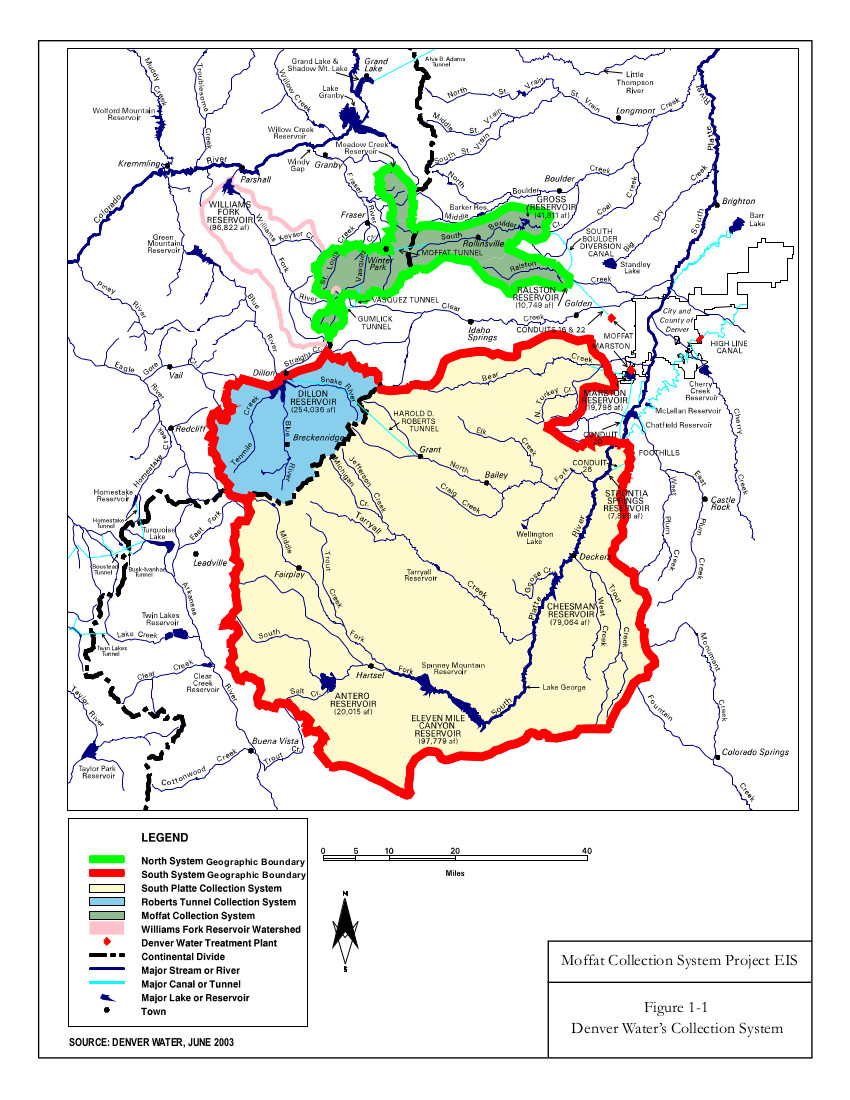
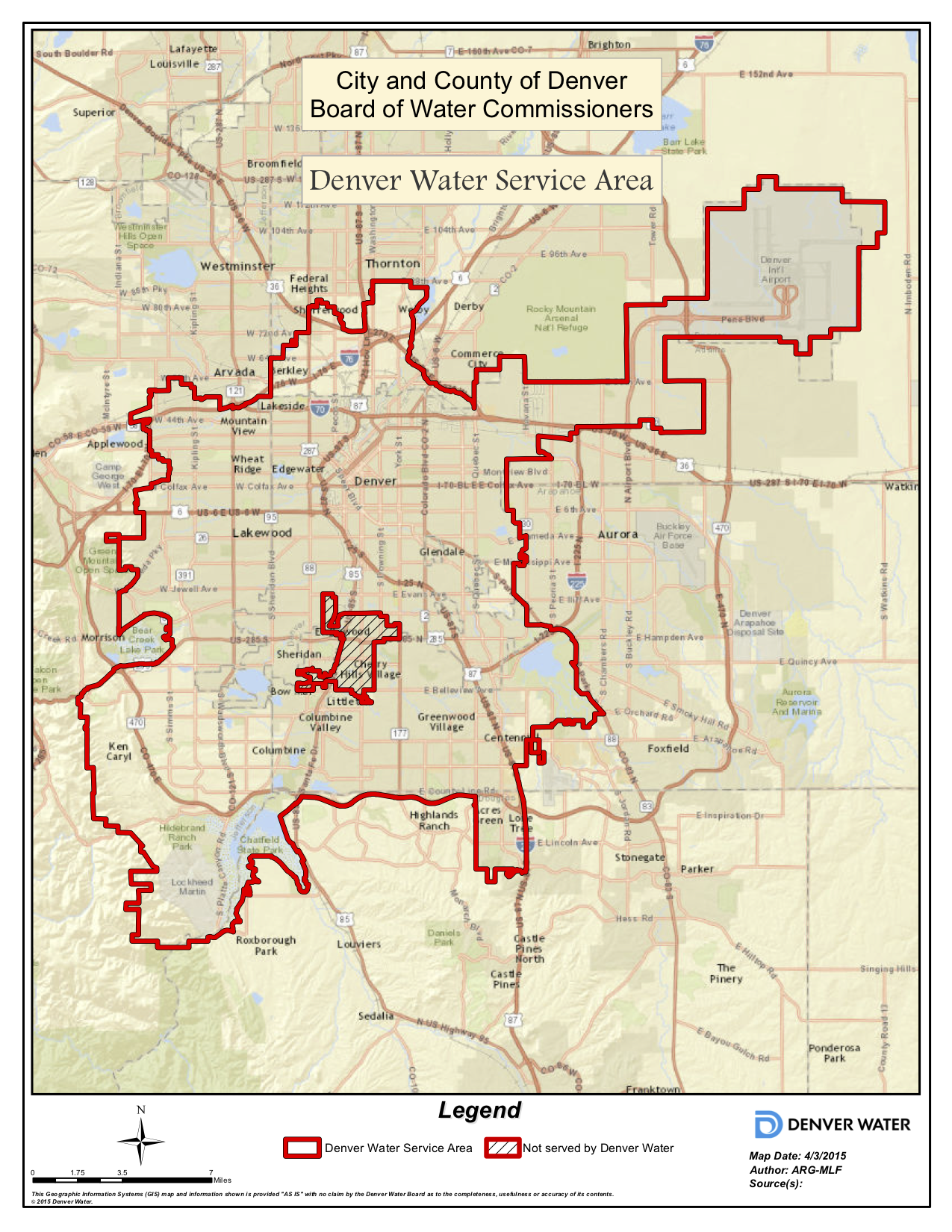
Denver Water’s collection system via the USACE EIS
FromThe Boulder Daily Camera (Charlie Brennan) via The Denver Post:
Boulder County has notified Denver Water it will not process the utility’s land use review application for a Gross Reservoir expansion at the same time it is defending itself in a lawsuit by Denver Water challenging the need to even submit to that procedure.
Denver Water on April 18 filed a lawsuit in Boulder District Court claiming a zoned-land exemption should excuse Denver Water from having to submit to the land use review process for the expansion, which — should it go through — would be the largest construction project in county history.
However, at the same time, Denver Water CEO/manager Jim Lochhead had said the utility was taking the steps to satisfy that county requirement, even while the lawsuit was pending.
“We remain committed to finding a path forward with the county that respects the community’s needs and concerns while allowing the project to proceed, which is why we have initiated the 1041 application process,” Lochhead said at the time…
Denver Water’s bid to participate in that process and simultaneously challenge it legally, however, is not going to work, according to Boulder County.
In a letter to Denver Water dated April 18, Boulder County Land Use Director Dale Case said, “While the County believes it will prevail in litigation, it would not be appropriate for the Land Use Department to proceed with an application under these circumstances.”
It is Case who initially made the determination that Denver Water, although holding a permit for the expansion project from the U.S. Army Corps of Engineers, still needed to submit to the county’s permitting process — a judgment Denver Water already unsuccessfully appealed before the county commissioners on March 14.
“It would be an imprudent expenditure of taxpayer dollars for the County to process an application when the process itself is the subject of a lawsuit,” Case added in his letter. “Accordingly, the Land Use Department will not accept an application for processing until the lawsuit is resolved.”
[…]
Denver Water public documents once showed a 2019 start date on construction, but that is no longer the case, and the lawsuit against Boulder County is not the only legal hurdle to launching the project. In separate courtroom action, a coalition of six environmental groups has sued at U.S. District Court in Denver, challenging the Corps of Engineers’ July 2017 decision to issue its permit for the $464 million (in 2025 dollars) project…
The current Denver Water project timeline now shows 2020 to 2026 for the project’s start to completion.
Denver Water Program Manager Jeff Martin answered Case’s recent letter with an April 29 letter, stating that Denver Water nevertheless intends to submit an application to initiate a land review process, citing the “significant resources” it has already expended in preparing its application in “a good faith effort” to comply with county requirements.
Denver Water also argues that processing the utility’s application should not put a financial strain on the county, because “Denver Water will reimburse Boulder County for its time in considering the application.”
From the Engineering News Record (Thomas F. Armistead):
“In the water-scarce West, there is little to no new water,” says Laura Belanger, water resources and environmental engineer with Western Resource Advocates. “What we’re seeing is a shift to a suite of solutions that make the most of our region’s water resources. So the first line is and always should be conservation, because that’s the most cost-effective thing utilities can do, and it’s also fast.”
[…]
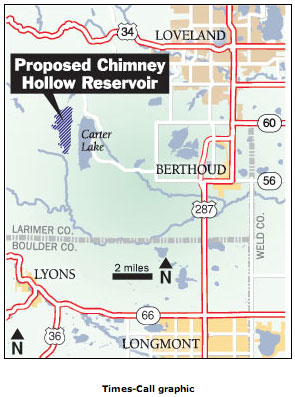
In Colorado’s Front Range, the Northern Colorado Water Conservancy District is accepting qualification statements for construction of Colorado’s tallest new dam in a half-century, with selection of a contractor and notice to proceed by December, says Joe Donnelly, spokesman. The main dam will be a rockfill structure with a hydraulic asphalt core, 360 ft tall and 3,500 ft long at the crest. The dam will impound the 90,000 acre-ft Chimney Hollow Reservoir for the Windy Gap Firming Project. A contract for design was awarded to Stantec in 2016.
The reservoir would store water for 12 municipalities and other water suppliers. The project has support from both public authorities and some environmental advocates. But six environmental groups are contesting the project in federal court because it will divert 30,000 acre-ft annually from the Colorado River, taxing the already challenged flow of that body.
Denver Water is proceeding with the expansion of Gross Reservoir, built in the 1950s with a 1,050-ft-long, 340-ft-tall concrete gravity arch dam impounding 42,000 acre-ft of water. Following 14 years of planning, the U.S. Army Corps of Engineers issued a 404 permit in July 2017, allowing Denver Water to raise the reservoir’s dam 131 ft and expand the reservoir’s capacity to 77,000 acre-ft.
The utility is expanding the reservoir to address a known imbalance in the city’s water system, said Jeff Martin, program manager for the project, in a video on the project’s website. The North System, where Gross Reservoir is located, stores about 30% of the water, and the South System the rest. The imbalance results from differential snowpack runoff on the system’s north and south sides. “This will provide extra insurance and extra reservoir capacity to make sure that we can weather those times when we do have issues in our system,” Martin said…
Some existing storage facilities are being expanded or are having their water reallocated, and regional water sharing also is beginning to grow, Belanger says. She cites the Chatfield Reservoir, built in 1965 on the South Platte River south of Denver for flood control, as an example. The U.S. Army Corps of Engineers determined that up to 20,600 acre-ft of the water can be reallocated to drinking water and industrial supply, agriculture, environmental restoration and other purposes without compromising its flood-control function. Environmental mitigation and modifications are expected to cost about $134 million.
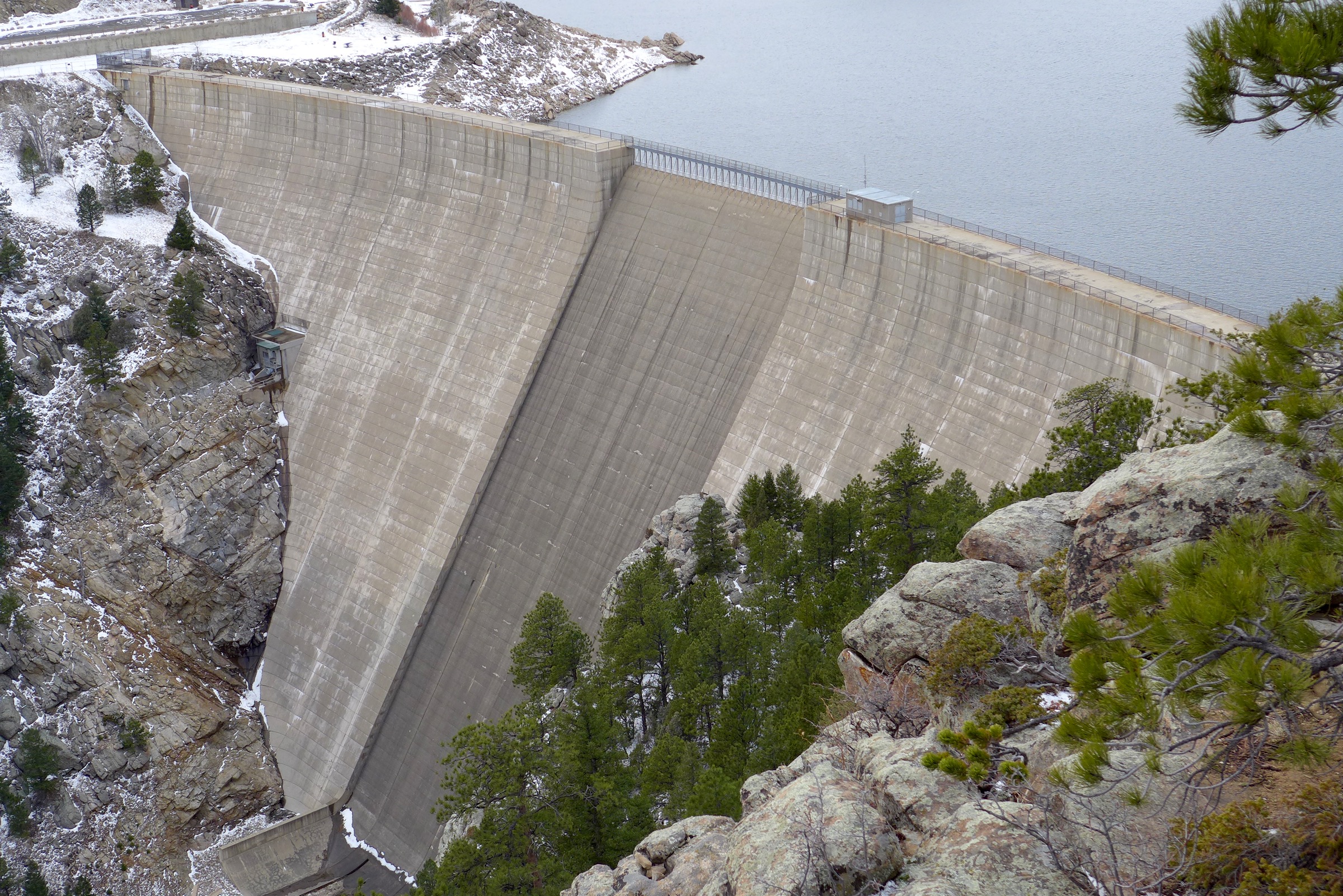
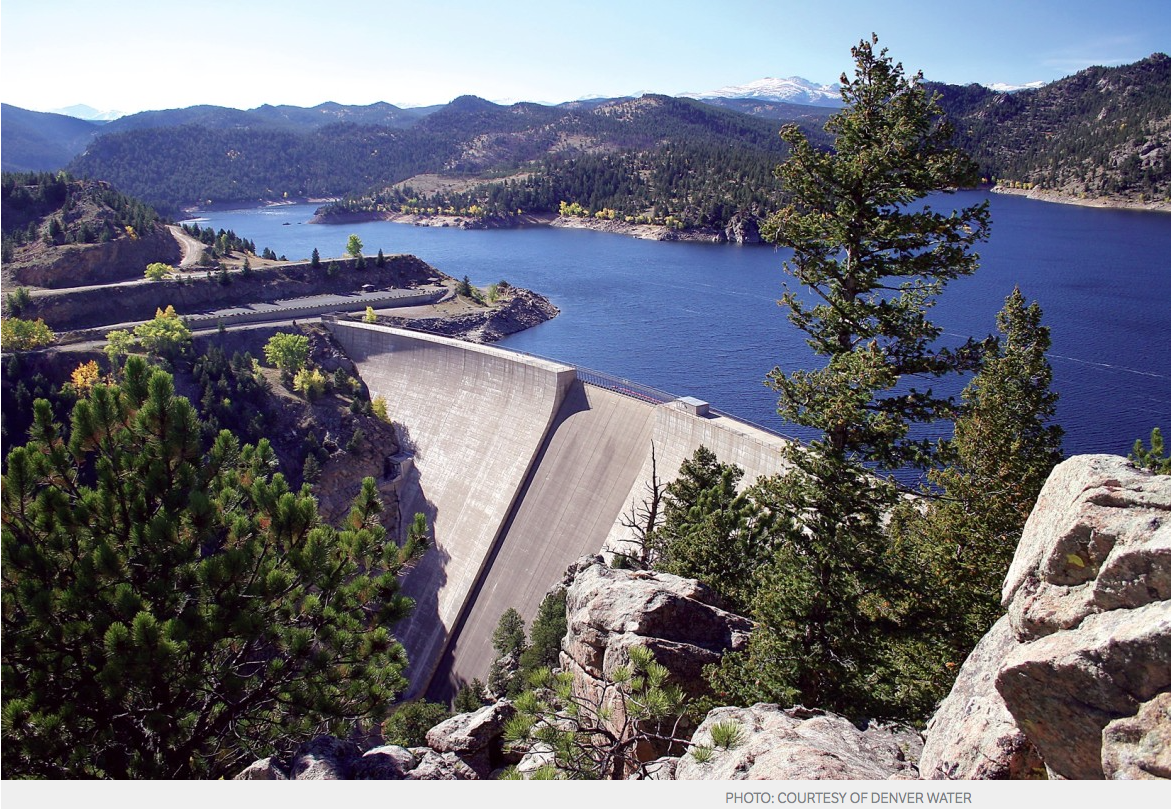
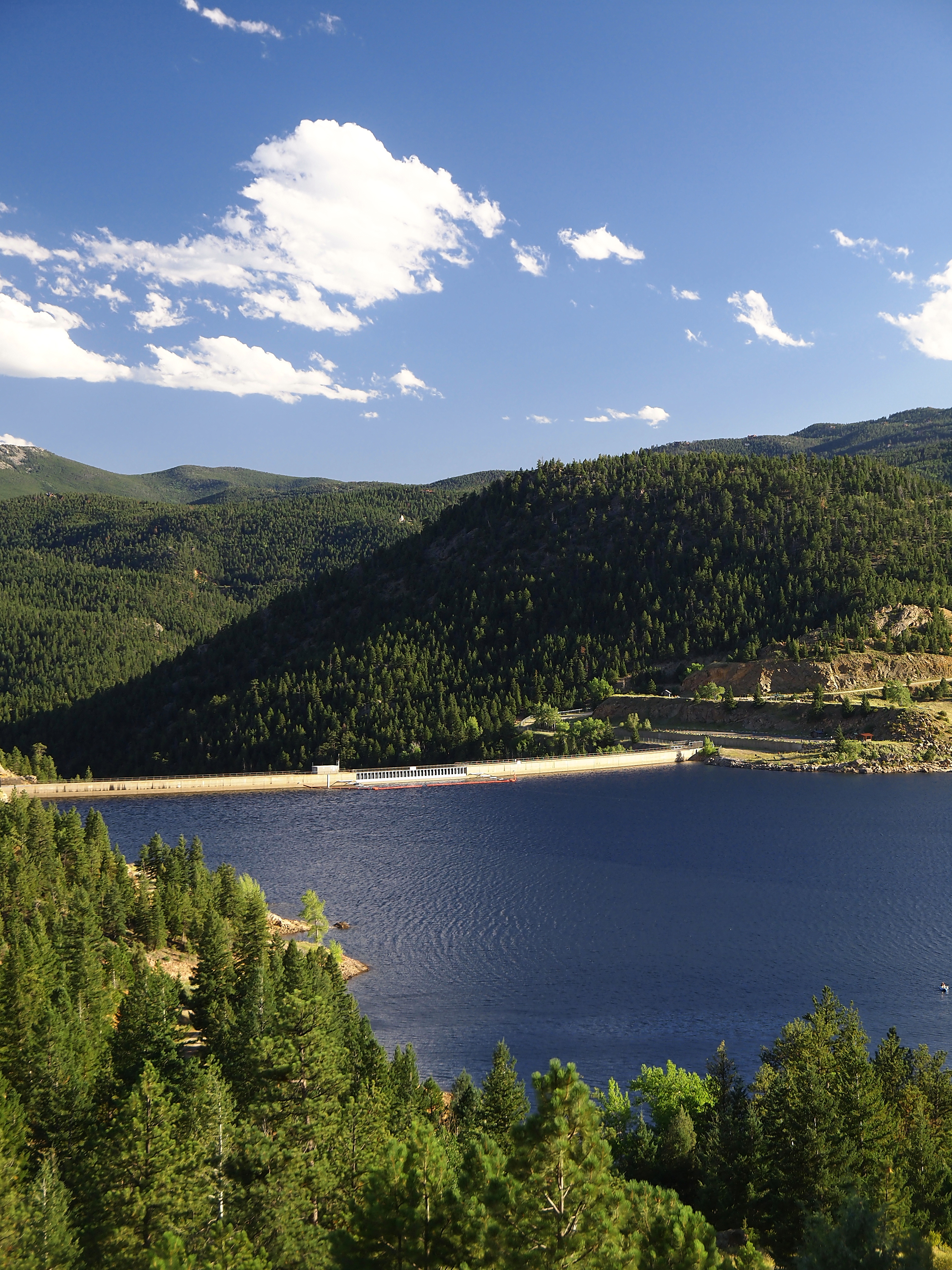
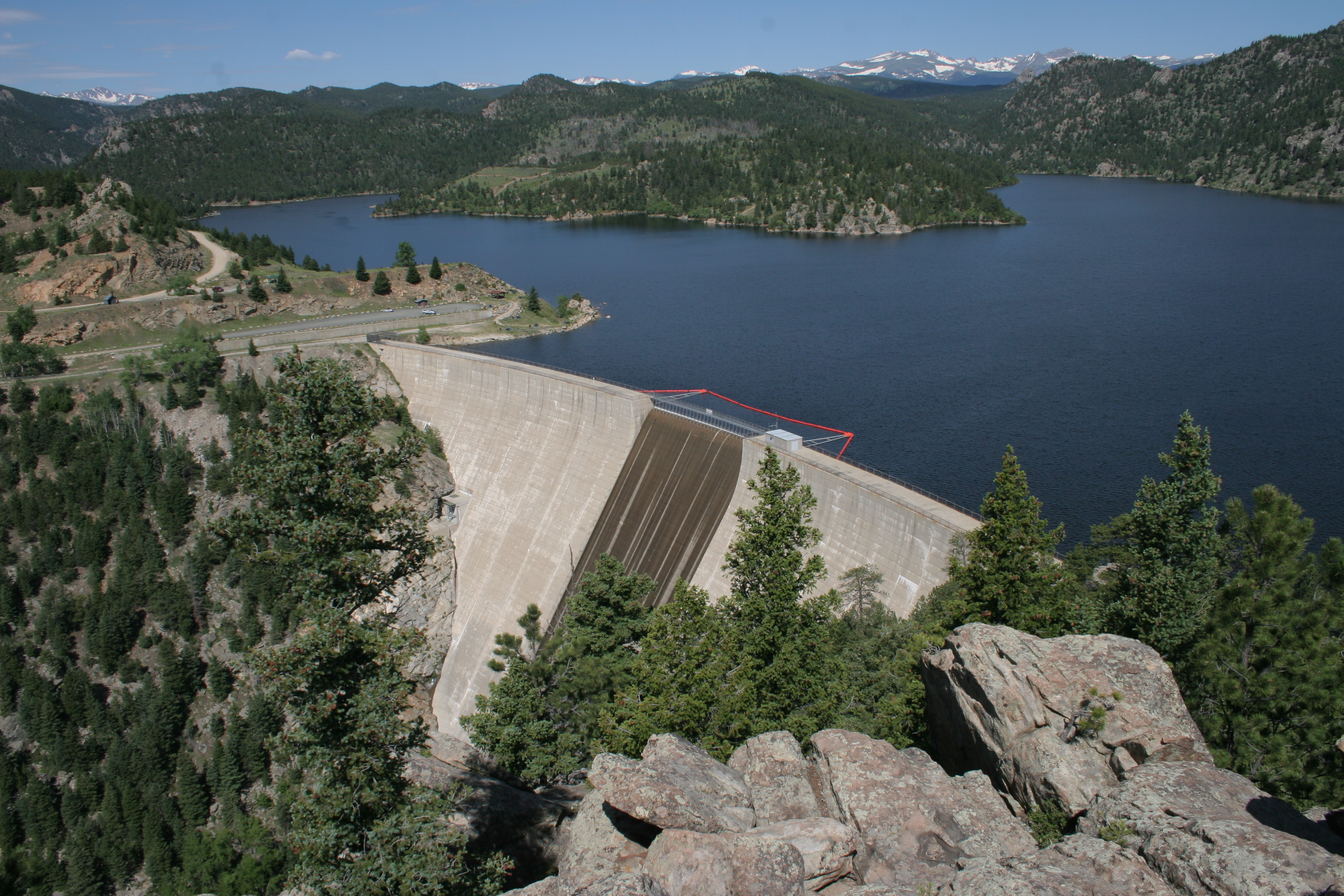
Gross Reservoir, west of Boulder. Photo by Brent Gardner-Smith/Aspen Journalism
Map from Northern Water via the Fort Collins Coloradan.
Full disclosure, I have written articles for the magazine in the past.
Here’s a look at Denver Water’s Moffat Collection System Project and the Boulder County Commissioner’s hearing on 1041 jurisdiction from George Sibley that’s running in Colorado Central Magazine. Click through and read the whole article. Here’s an excerpt:
An interesting thing happened mid-March in Boulder which the media seem to have mostly missed. Commissioners from Grand County showed up at a noisy Boulder County commissioners’ hearing on a West Slope-to-East Slope transmountain water diversion project – to testify on behalf of the project. It is probably the first time ever, in the generally contentious history of Colorado water development, that the people in a basin of origin have supported a transmountain diversion project that people in the basin of destination oppose.
Although this is a story from just beyond our Central Colorado boundaries, it is a story of interest to anyone in the West who is wondering how, or even if, we are going to finally leave the 20th century and venture into the 21st and the Anthropocene Epoch we keep trying to pretend we haven’t brought on ourselves.
The report on the Boulder County hearing sounded like your usual 20th century public hearing on the kind of issue that seems almost structured to pit environmentalists against the developers of something or other – a hearing in which no one has to listen because everyone already knows what everyone else is going to say.
The issue in this case pits the usual Front Range environmental organizations against a public utility that everyone loved to hate through the 20th century, Denver Water (DW). DW wants to enlarge the Gross Dam and Reservoir it built in the 1950s in the foothills near Boulder, to hold some additional water it wants to import from the West Slope – its “Moffat Firming Project” which would bring a third more water on average through its Moffat Tunnel Project from the Fraser and Williams Fork Rivers in the Upper Colorado River watersheds…
For the West Slope and Grand County, DW is both funding and actively participating in planning and executing a Learning by Doing process – essentially, an adaptive management process of active experimentation in learning how to live with less water. Some of it is more conventional work providing funding and expertise to water treatment districts and irrigation districts needing to use less water more efficiently.
But some of it will actually be what strikes me as “creative environmentalism”: Actually reconstructing some streams to function ecologically with a permanent reduction of water – call it “downsizing” the stream to fit the unignorable realities of the future. Channels are narrowed and deepened to cool the waters, helping both the aquatic ecosystem and the human economy of floaters and fishermen; riparian vegetation is planted to shade the stream and stabilize banks; meanders are induced to give a healthy stability and resilience for the foreseeable diminished future. Half a mile of the Fraser near U.S. 40 has been so ‘remodeled’ and is open to public inspection (and fishing). DW has committed millions to this work. (The CRCA can be found online by browsing for the name in full.)
After more than four hours of impassioned pleas from members of the public Thursday night, Boulder County commissioners voted unanimously that Denver Water’s planned expansion of Gross Reservoir must go through the county’s review process.
That vote, affirming an earlier finding by Boulder County Land Use Director Dale Case, now poses a significant challenge for the utility, which serves 1.4 million water users in the Denver metro area — none of them in Boulder County — and claims the project is needed to meet the needs of metro population that’s just going to keep growing.
“I think it’s just critical that local people have their say on this project that affects them the most,” said Boulder County Commissioner Matt Jones, just before the vote was taken…
Denver Water’s plan had been to start construction this year on a project to raise the Gross Reservoir Dam in southwestern Boulder County by 131 feet to a height of 471 feet and to expand the reservoir’s capacity by 77,000 acre-feet.
The cost of the endeavor, said to be the biggest construction project ever contemplated in Boulder County, is now estimated at $464 million (in 2025 dollars) and could take at least six years to complete.
Boulder County Land Use Director Dale Case issued a finding on Oct. 22 that Denver Water’s plans, formally known as the Moffat Collection System Project,were subject to the county’s so-called “1041” review process — that number references the state House bill passed in 1974 allowing local governments to regulate matters of statewide interest through a local permitting process.
Denver Water however, has argued to the contrary.
“We contend that state law exempts the expansion from the 1041 process because it was permitted under local land use codes at the time that the state enacted the law authorizing the 1041 review process,” said Denver Water spokesman Travis Thompson.
Thursday looms as an important day for both proponents and opponents of an expansion at Gross Reservoir, as Boulder County commissioners meet to hear Denver Water officials make the case that the massive project should not be subject to the county review process.
Denver Water, which serves about 1.4 million customers in the Denver metro area, but none in Boulder County, had hoped to start construction this year on a project to raise the Gross Reservoir Dam in southwestern Boulder County by 131 feet to a height of 471 feet and expend the reservoir’s capacity by 77,000 acre-feet.
The project is subject of a federal lawsuit filed by a half-dozen environmental groups, and still must also obtain a licensing amendment at the Federal Energy Regulatory Commission in order to go forward.
Boulder County Land Use Director Dale Case on Oct. 22 issued a finding that Denver Water’s plans were subject to the county’s so-called “1041” review process, a decision Denver Water asked without success for Case to reconsider, before finally appealing the question to the commissioners.
Commissioners will hear Denver Water’s appeal starting 4:30 p.m. Thursday in a public hearing expected to last at least four hours. It will take place in the commissioners’ third-floor hearing room at 1325 Pearl St. in Boulder.
In-person sign-ups to speak will be taken beginning an hour in advance of the hearing, and commissioners are expected to issue a decision that night.
Two lawsuits making their way through the federal court system are challenging two significant water projects in Colorado designed to divert more water from the Colorado, Fraser and Williams Fork river basins in Grand County.
The projects — Northern Colorado Water Conservancy District’s Windy Gap Firming project and Denver Water’s Moffat Collection System Project — would provide a combined firm yield of 48,000 acre-feet of water for the sprawling Front Range.
But environmental groups say government agencies violated the law in the environmental permitting processes of both projects.
“Our biggest claim is that [the agencies] claim they looked at reasonable alternatives [to the projects],” said Gary Wockner, the director of Save the Colorado, the lead plaintiff on both cases. “But they didn’t look at conservation or efficiency. Water providers are trying to go to big water projects first and not the cheaper option of conservation.”
Both Northern and Denver Water say they factored in conservation efforts when they calculated water demand and that even aggressive conservation efforts won´t be enough to meet water demand in the future.
“There are only a few answers for water supply in the future and Windy Gap Firming is one of those options,” said Brad Wind, the general manager of Northern Water. “Without that project, I can’t fathom where we will end up.”
But some water experts say that the state’s use of population growth as one of the major drivers of water demand was flawed.
“As population goes up, water demand continues to go down and it’s been that way for decades,” said Mark Squillace, a water law expert at the University of Colorado Law School.
Denver Water’s collection system via the USACE EIS
Decoupled demand
The phenomenon of increasing populations with declining water use is known as “decoupling,” and it has been happening in nearly every part of Colorado since the 1990s.
Higher efficiency appliances, utility-driven conservation programs and greater citizen awareness of water shortages have all driven the change.
But water managers say the state’s growing urban areas are reaching the point of “demand hardening,” where the additional water that can be conserved will not outweigh the amount needed in the future.
“We have been hearing those kind of stories for a long time and it never happens,” Squillace said. “There are a lot of things that we could still do on the conservation end that would be a lot cheaper [than new infrastructure] and a lot more consistent with the environment that we live in.”
While they differ, the pair of lawsuits being spearheaded by Save the Colorado could both hinge on demand and conservation estimates, and the assumption that additional conservation won’t be sufficient in the future.
Both lawsuits were filed in federal district court and are now awaiting action by a judge to move forward.
The Windy Gap Firming case was filed in October of 2017 against the U.S. Bureau of Reclamation and the U.S. Army Corps of Engineers.
The Moffat Collection System case was filed in December against the Army Corps, the U.S. Interior Department and the U.S. Fish and Wildlife Service.
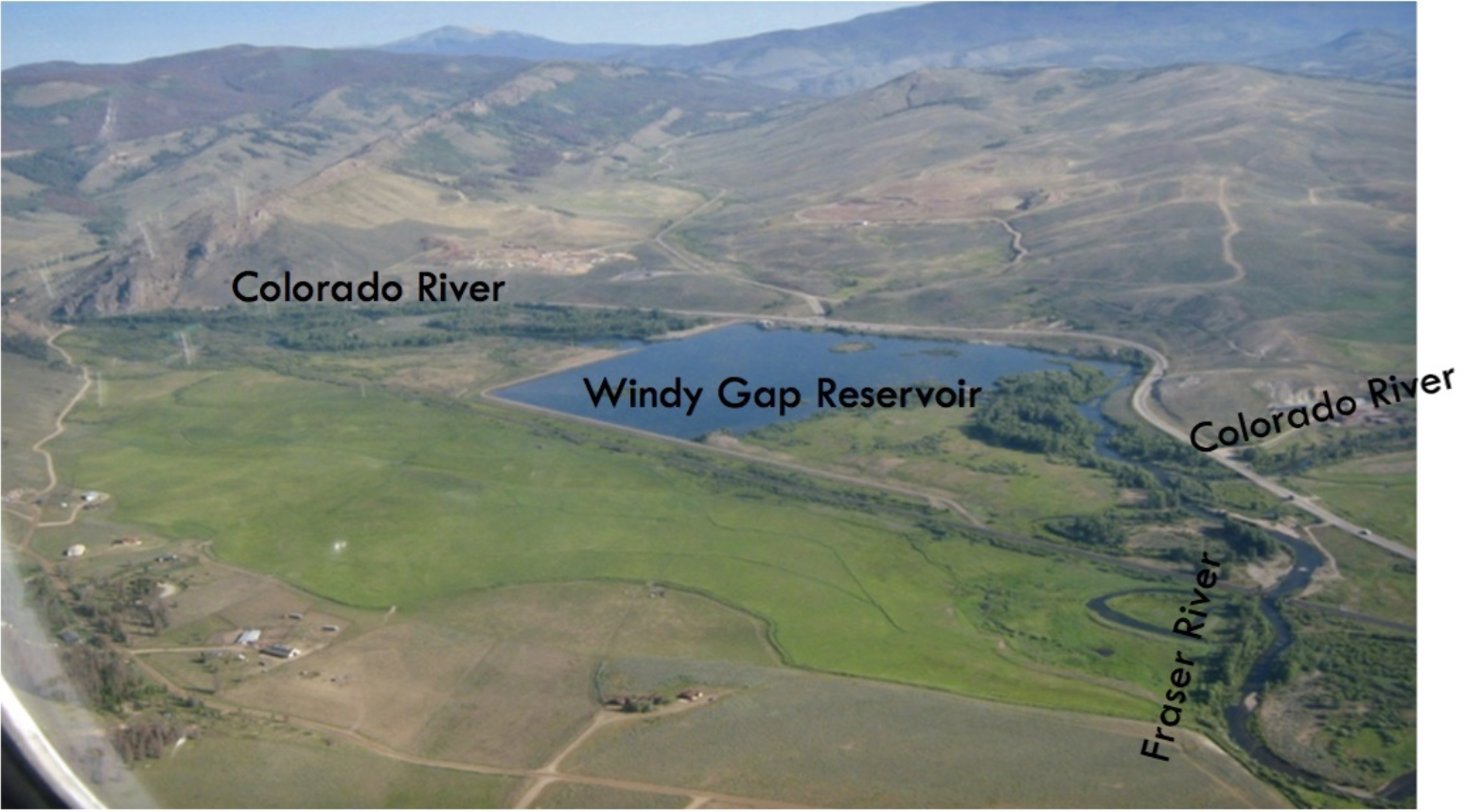
An aerial view of Windy Gap Reservoir, near Granby. The reservoir is on the main stem of the Colorado River, below where the Fraser River flows into the Colorado. Water from Windy Gap is pumped up to Lake Granby and Grand Lake, and then sent to the northern Front Range through the Adams Tunnel.
The projects
Both the Windy Gap and Moffat projects were conceived decades ago to address projected water shortages on Colorado’s Front Range and to add resilience to both Northern and Denver Water’s supplies.
Now estimated to cost about $600 million, the Windy Gap project will include a new 90,000 acre-foot reservoir in western Larimer county called Chimney Hollow Reservoir.
The reservoir is designed to store water from the Colorado and Fraser rivers transported from the Western Slope through the existing infrastructure of the Colorado-Big Thompson project.
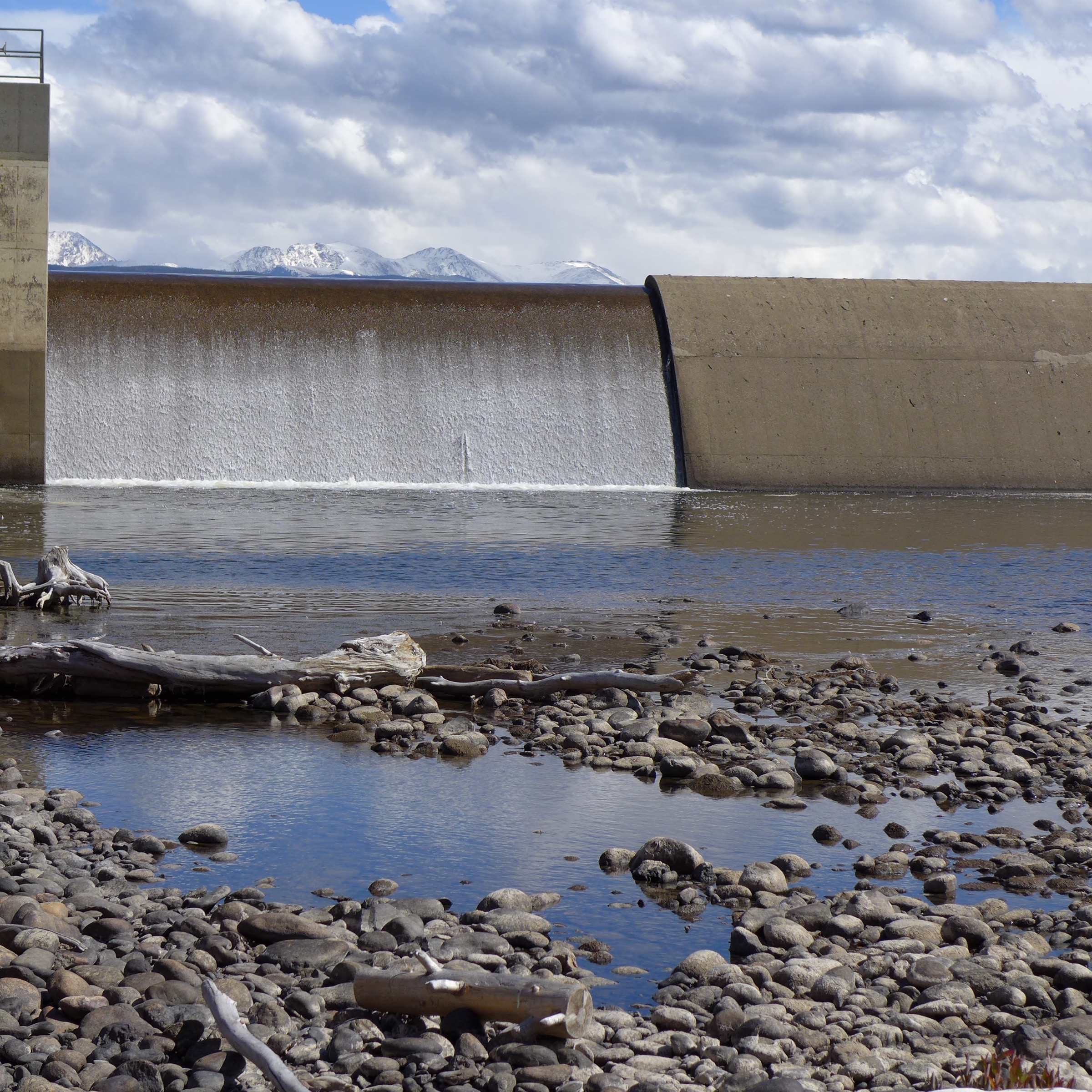
Windy Gap Reservoir, built in 1985, is created by a low river-wide dam across the main stem of the Colorado River, just downstream from where the Fraser River flows in.
The reservoir is relatively small, holding 445-acre feet, but it’s well situated to gather water from the Fraser, pump it up to Lake Granby and Grand Lake, and then send it through the Adams Tunnel under the Continental Divide.
With the Moffat project, Denver Water plans to spend an estimated $464 million in order to expand Gross Reservoir in Boulder County, by raising the height of the dam by 131 feet, in order to store an additional 77,000 acre-feet of water.
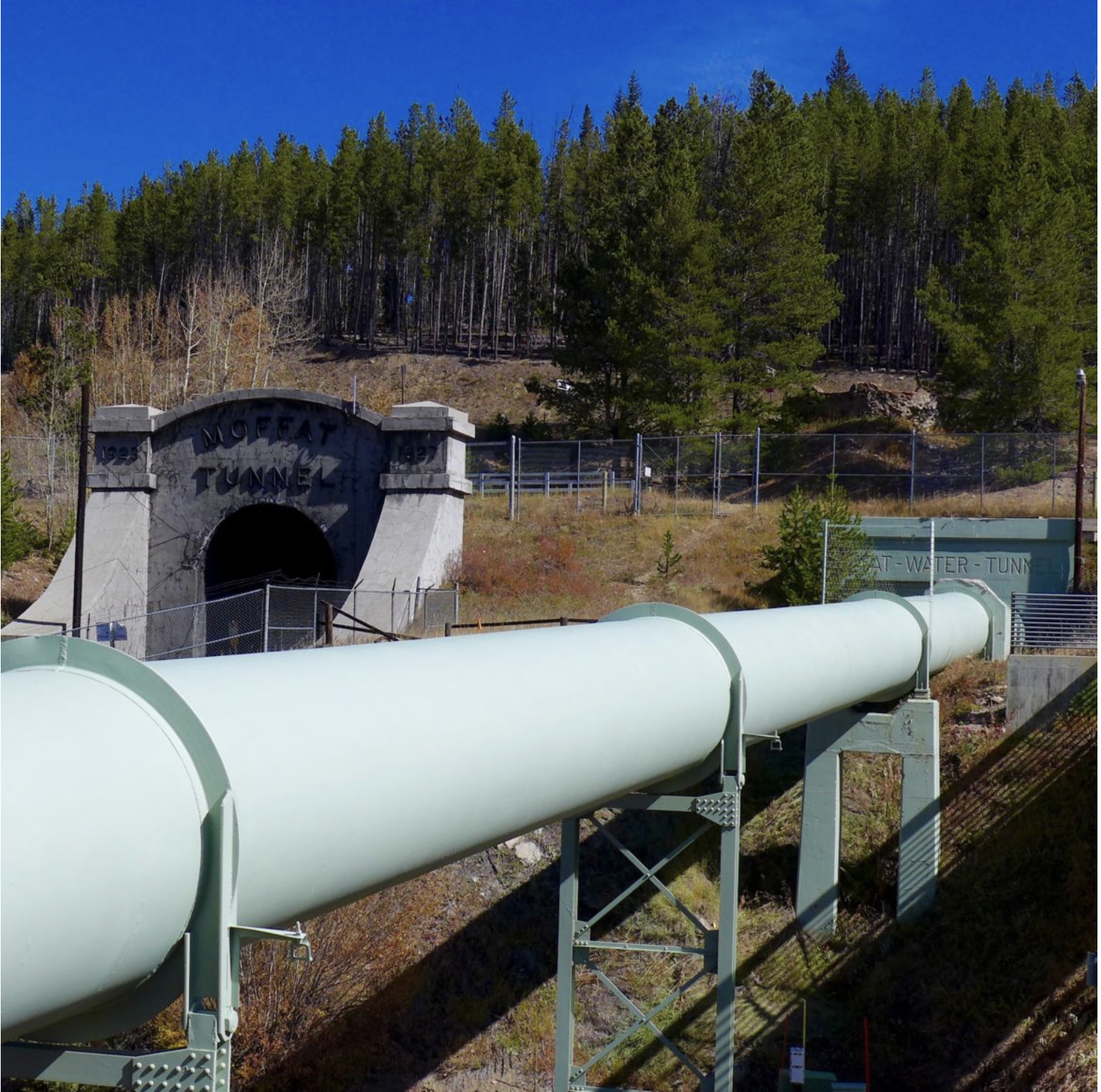
Gross Reservoir is a part of the utility’s existing northern collection system and is filled with water from the headwaters of the Fraser and Williams Fork river basins. The water is moved through a pipeline in the Moffat Tunnel, which runs east through the mountains from the base of the Winter Park ski area.
The upper South Platte River, above the confluence with the North Fork of the South Platte. Photo: Brent Gardner-Smith/Aspen Journalism
The fork not taken
The plans to expand Gross Reservoir started in 1990 after the EPA rejected Denver Water’s plan to build Two Forks Reservoir on the South Platte River.
The EPA’s rejection of Two Forks signaled the end of an era of large dams and forced groups planning large water infrastructure projects to give more consideration to the environmental impacts of their plans.
Following this rebuke, Denver Water turned to the environmental groups that had opposed their project and solicited advice.
Throughout the 1990s, the utility implemented water conservation and recycling programs and started making plans to expand an existing reservoir instead of building a new dam.
“We embarked on the path that the environmental groups suggested. We implemented a conservation program and reduced our demands,” said Jim Lochhead, the CEO and manager of Denver Water. “But you can’t get to zero. We continue to be committed to conservation, but at the end of the day we still need more water.”
In partnership with environmental groups like Western Resource Advocates and Trout Unlimited, Denver Water has agreed to spend $20 million on environmental improvements in watersheds on the Western Slope as part of the Gross Reservoir expansion.
Denver Water has also agreed to a monitoring program that will require them to mitigate any unforeseen environmental problems caused by the project, a compromise between environmental groups and the largest water utility in the state.
“In some sense this project was the development of an alternative from a number of groups,” said Bart Miller, the director of the Healthy Rivers Program at Western Resource Advocates. “In some respect you are putting this in context next to what could happen or could have happened.”
Concerned with having their own projects fail, as Two Forks did, other water managers emulated Denver Water’s strategy.
When Northern Water started planning for the Windy Gap Firming project it also reached out to environmental groups, and ended up committing $23 million to mitigate problems caused by past projects and to make other improvements in the upper Colorado River watershed.
Even though there will be impacts from taking more water from the river, Northern Water says that these “environmental enhancements” will leave the river better off than it would be without the project.
And environmental groups working on the project agree.
“There is a lot of damage on the river that will continue to go on without an intervention,” said Mely Whiting, legal counsel for Trout Unlimited. “This is probably the best shot.”
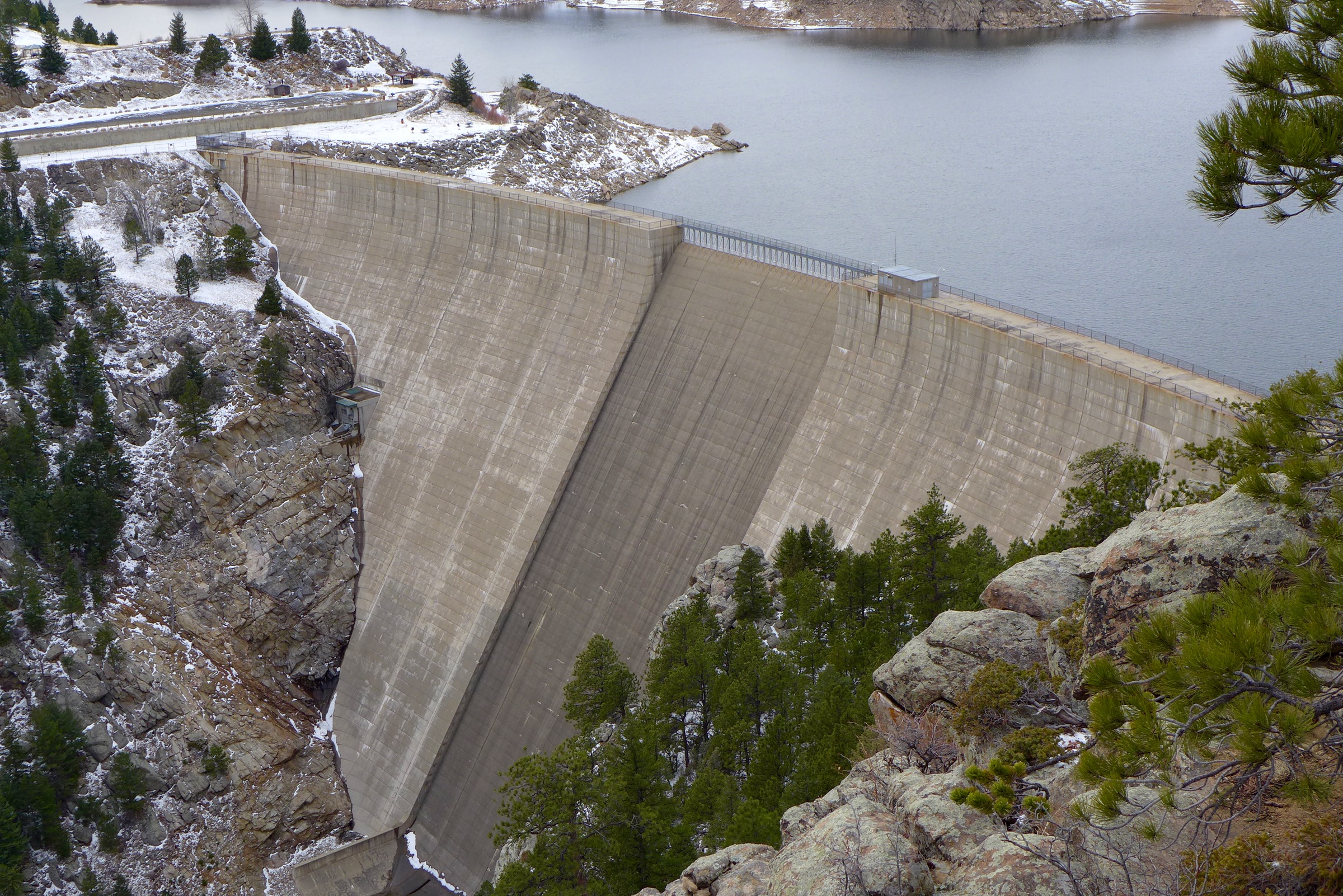
Gross Reservoir in the mountains to the southwest of Boulder. Denver Water hopes to increase the height of the dam 131 feet, to a new height of 471 feet, to store three times as much water, which it says will help it meet increasing demands and to better weather severe droughts.
The lawsuits
While some environmental groups have seen compromise as the best step forward, Save the Colorado and the other plaintiffs in the two lawsuits take a harder stance.
Save the Colorado, in particular, is against any new dams or diversions.
“The river has already been drained enough,” Wockner said. “The mitigation, in our mind, is not consequential.”
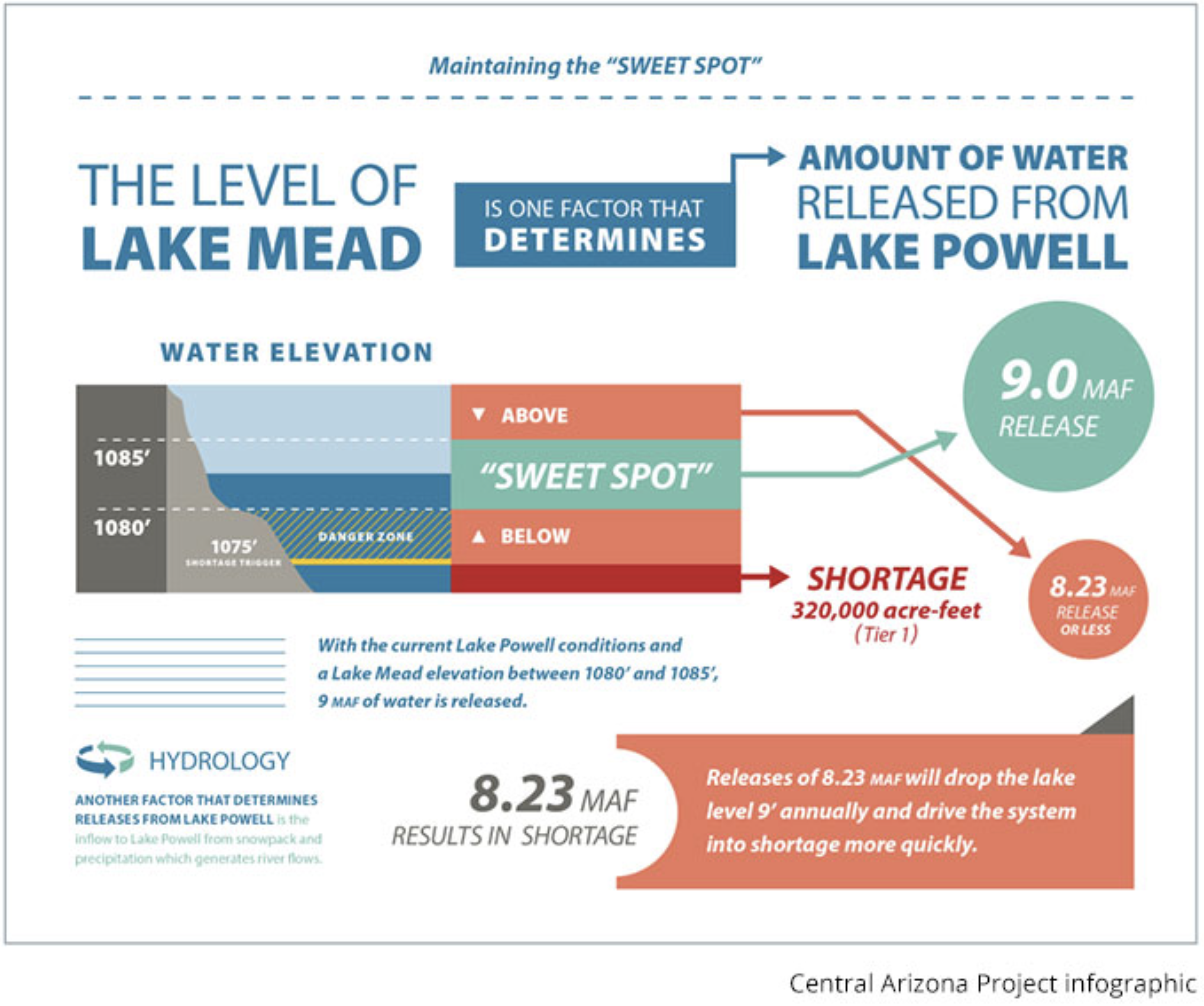
Colorado and the six other states that use Colorado River water are now negotiating a plan to better manage Lake Powell and Lake Mead in response to drought and acidification.
Last week, an engineer from Northern Water told the city council of Loveland that it may have to take a ten percent cut in the water it draws from the headwaters of the Colorado River, sending the water instead to Lake Powell, where water is held before being moved through the Grand Canyon and into Lake Mead for use in California, Arizona and Nevada.
And Northern’s statement did not go unnoticed by the plaintiffs in the Windy Gap and Moffat lawsuits.
“The old guard in water have the default setting that we need to build more reservoirs and we need to find more ways to bring water from the western slope,” said Kevin Lynch, the lawyer representing the environmental groups in the Windy Gap Firming case. “The argument my clients are hoping to make with this case is that that may have made sense in the past but it doesn’t now. We are definitely trying to buck the status quo and change the historical way of doing things.”
Lynch and his team are arguing that the Bureau of Reclamation and the Army Corp of Engineers — the two government agencies being sued in the Windy Gap Firming case — failed to update and independently verify the water demand data used to justify the project.
To back up this allegation, the plaintiffs petitioned the court to include a statistics report in the administrative record.
The report, which looks at water use statistics in communities with stakes in Windy Gap Firming water, showed that their demand projections made back when the agencies conducted their environmental assessments were between 9 and 97 percent higher than the actual water use rates in those areas.
The lawyers in the Moffat Project lawsuit also found that Denver Water used old data from 2002 to project their demands future demands.
The complaint filed by the plaintiffs says that the Army Corps and the Department of the Interior — which are the two agencies being sued in the Moffat case along with the Fish and Wildlife Service — ignored more recent data that was available when they conducted their assessments.
“If they were to use today’s data they would no way be able to justify that they need the water,” said Bill Eubanks, the lawyer for the plaintiffs in the Moffat Project case. “Here we are talking about almost two decades. Two decades where we have seen the most transformative uses of water in a century.”
Both legal teams say that even if the data did reveal a demand for more water, the agencies failed to analyze the alternatives to two large infrastructure projects, including conservation.
Specifically, Wockner and Eubanks both spoke about how a “cash for grass” program — where the government pays people to dry up their lawns — was never analyzed as an alternative. Looking at similar programs in California, they say the same amount of water could be saved, but for less money than either of the two infrastructure projects.
To this claim both Northern Water and Denver Water say that additional conservation measures are already planned for the future, but that they are not enough.
“The state has done a lot of studies for need for water on the Front Range,” said Jeff Drager, Northern Water’s director of engineering and the project manager for the WIndy Gap firming project. “We agree that there can be more conservation, but it won’t be enough to meet our participants needs.”
The pipeline, at the base of the Winter Park ski area, that moves water as part of the existing Moffat Collection System Project. The portal of the railroad tunnel is behind the pipeline, in this view. Photo credit: Brent Gardner-Smith/Aspen Journalism
Looking forward
Due to a long backlog in the court, both lawsuits are unlikely to see their day in court any time soon. According to both lawyers, it could be months or years until the cases are decided. The court’s slow pace could impact the construction of both projects.
Citing the lawsuit, Northern Water delayed bonds to build the project back in August.
Executives at Northern say they are using the time to hammer out the last of the details of the project’s design, but that if the project is delayed it may cause costs to rise or endanger the water supplies of the project’s participants.
Denver Water is still waiting on several permits before they can begin planning construction and is less concerned about a delay. Both Lochhead and Wind say they believe that the projects will go forward once the lawsuits are resolved.
“We feel confident that our permitting processes are on solid ground,” Wind said. “I don’t think there is anyone in this organization at all that has thought this lawsuit would be effective.”
While both Northern Water and Denver Water are confident that their projects will move forward, the plaintiffs in the cases are hoping for an upset that could topple the entire water system in Colorado.
“If we win this case, using this particularly egregious example of inaccurate water demand projections, we think we can set a precedent that would force the state to look at more recent data for different types of projects,” Eubanks said.
State health officials and Colorado’s largest water utilities have agreed for a second time to hit pause on a major lawsuit over how to keep lead out of Denver’s drinking water, citing progress in talks that began last fall.
“The main point is that everyone has rolled up their sleeves and is working hard to come up with the best solution that we can that minimizes the lead that folks will be ingesting in their tap water,” said Ron Falco, safe drinking water program manager at the Colorado Department of Public Health and Environment.
Last April, the City of Aurora, the Metro Wastewater Reclamation District, and the Denver Greenway Foundation sued the Colorado Department of Public Health and Environment to block an order it issued directing Denver Water to install a phosphate-based treatment system to reduce corrosion in old lead pipes. That corrosion can put lead into drinking water in homes and businesses served by lead supply lines and in-house fixtures. Denver Water joined the suit weeks later.
Avoiding lead contamination in drinking water is of paramount importance for water providers and state health officials, as no level is considered safe to ingest. But heightened levels of phosphates in wastewater and irrigation runoff create issues for reservoirs, lakes and streams. This prompted Metro Wastewater and other entities who must treat the phosphate-heavy water to sue, citing damage to the environment and dramatically higher treatment costs.
Denver Water had proposed an alternative, after several years of pilot studies, to use chemicals that would adjust the PH levels of its drinking water, something which the CDPHE determined did not reduce lead corrosion enough to meet the federal standards it is required to uphold.
Among the plaintiffs’ concerns is that phosphate levels in water that is discharged to the South Platte River have to be tightly controlled under provisions of the Clean Water Act. If phosphate levels in treated drinking water rise, wastewater treatment protocols would have to be changed to correct the problem, potentially costing millions of dollars, if not more, according to a report by the Denver-based, nonpartisan Water Research Foundation.
From an environmental perspective, any increased phosphate in the South Platte River makes fighting such things as algae blooms, which are fueled by nutrients including phosphorous, much more difficult and could make the river less habitable for fish.
Denver Water, and other plaintiffs, declined to comment, citing the ongoing litigation. But in a statement, Denver Water Chief Executive Officer Jim Lochhead said, “We are committed to taking the right steps to reduce the risk of lead leaching into water through customers’ plumbing…As we are fully committed to protecting public health, we are also looking for opportunities to minimize downstream impacts from the use of orthophosphate.”
After filing the suit, last summer the parties agreed to engage in talks, placing the lawsuit on hold, giving themselves until last November to agree on a set of treatment protocols.
When that deadline passed, the utilities and the CDPHE requested more time to work, citing progress in the talks. In January, a Denver District Court judge agreed to give everyone until September 20, 2019 to find an acceptable solution.
Under the CDPHE’s original order, Denver must begin using the new treatment protocol by March 20, 2020. To ensure it can meet that deadline, Denver Water is spending $1.2 million to upgrade its water treatment plants so they can implement the new treatment protocols.
Denver is not in violation of the federal law that governs lead in drinking water, but it has been required to monitor and test its system regularly since 2012 after lead was discovered in a small sample of water at some of its customers’ taps.
Lead has continued to appear at taps in some customers’ homes, according to court filings.
Treating lead and copper in water systems is a complex undertaking governed by the federal Lead and Copper Rule. There is no lead in the water supply when it leaves Denver Water’s treatment plants. But it can leach into the supply via corrosion as water passes through lead delivery lines and pipes in older homes. Denver has 58,000 lead service lines in its system and is gradually replacing them. It also advises customers whose homes are serviced by lead lines to use filters to remove any potential contamination.
It is the ongoing concerns about lead that have prompted the state to push for the phosphate treatment, because it reduces lead that reaches customers by 74 percent, compared to less than 50 percent using a PH-based process, according to court filings.
Despite the environmental concerns, the CDPHE maintains that its first job is to protect the health of the thousands of children served by Denver Water in the metro area. Children are most vulnerable to lead contamination.
Falco said he is optimistic that a solution can be found. New pilot studies underway indicate that Denver Water may be able to use roughly one-third the amount of phosphates originally thought were needed and still achieve the same level of lead reduction, CDPHE officials said.
“We have a very engaged group of stakeholders working hard to develop the best solution. This this is going to come to a resolution, certainly by March of 2020. We are going to get there,” Falco said.
Jerd Smith is editor of Fresh Water News. She can be reached at 720-398-6474, via email at jerd@wateredco.org or @jerd_smith.
Colorado officials and regional water managers are poised to start working together on a plan to reduce water use in Colorado, mainly by paying willing irrigators to fallow hayfields, in order to bolster falling water levels in Lake Powell and guard against a compact call on the Colorado River system.
After a series of meetings held last week by the Colorado Water Conservation Board and by Western Slope and Front Range water interests, state officials are now set to begin investigating the feasibility of a “demand management” program that’s “voluntary, temporary and compensated,” and water users and managers throughout Colorado will be asked to help shape the new program.
“Demand management, reduction in consumptive use, is an incredibly threatening concept to Western water users, and certainly to West Slope water users,” Andy Mueller, the general manager of the Colorado River District, told a ballroom full of water professionals Friday during the last day of a three-day Colorado Water Congress meeting here. “Our agricultural community is concerned that what this is really about is taking water from ag and bringing it into urban areas.”
Nonetheless, Mueller said, “this is a time where we have to work collaboratively, with both our urban friends and our rural friends, to figure how we do this together, and how we recognize the values that are important to each of us.”
Mueller also told the Water Congress audience that “the River District is committed to proactively engaging and working with the CWCB and the Front Range to figure out how we can stand up a program that truly protects all of us in this situation. To not do so, to not engage proactively in that conversation, would be irresponsible of every one of us in this room.”
He also laid out the Western Slope’s vision for the program, which centered on sustaining rural communities.
“We want, from a West Slope perspective, our agriculture and our industries and our cities that are going to participate in these programs to have the opportunity to use the water when they need it, and to monetize their assets into a program when they can figure out ways not to use it,” Mueller said.
Demand management is based on the idea that if water that otherwise would be used to grow hay, or turf in suburban settings, can instead be left in the river system to flow into Lake Powell, and into a new regulatory pool of water within the big reservoir, it will help boost water levels in the reservoir, allow for continued hydropower production at Glen Canyon Dam and help the upper-basin states meet their obligations to deliver a minimum amount of water to the lower-basin states under the terms of the Colorado River compact.
A recently concluded four-year test program called the System Conservation Pilot Program paid irrigators in the Upper Colorado River Basin an average of about $200 per acre-foot of conserved consumptive use of water.
Fresh turf, in Thornton, near Denver.
Denver engaged
Jim Lochhead, CEO and manager of Denver Water, was sharing the stage with Mueller on Friday during a panel discussion, after they together had met Thursday with other Front Range water providers in a behind-the-scenes meeting.
Lochhead said the Front Range and the Western Slope are united in their desire to avoid violating the terms of the compact.
“No one wants the result of a situation where we haven’t come together collectively to arrive at a solution,” Lochhead said.
And, he stressed, “Colorado needs to do our part to make sure that the demand-management piece is done in a way that protects all water users in Colorado, East Slope and West Slope.”
“From Denver Water’s perspective, we’re prepared to engage productively, as I’ve indicated many times in the past,” Lochhead said. “We’re prepared to contribute our share of water into a solution that would be collectively agreed to within Colorado and the other upper-basin states, if it is necessary, for our own mutual benefit and survival.”
The state’s emerging demand-management program is tied to the ongoing effort to approve “drought-contingency planning,” or DCP, agreements in the seven states in the Colorado River Basin: Colorado, Utah, Wyoming, New Mexico, California, Arizona and Nevada.
Arizona’s governor on Thursday signed a required piece of state legislation in order to meet a federally imposed deadline, but there are still other DCP agreements that need to be finalized by a new working deadline, March 4. Federal legislation also is required to implement the regional agreements designed to keep both Lake Powell and Lake Mead operating as designed.
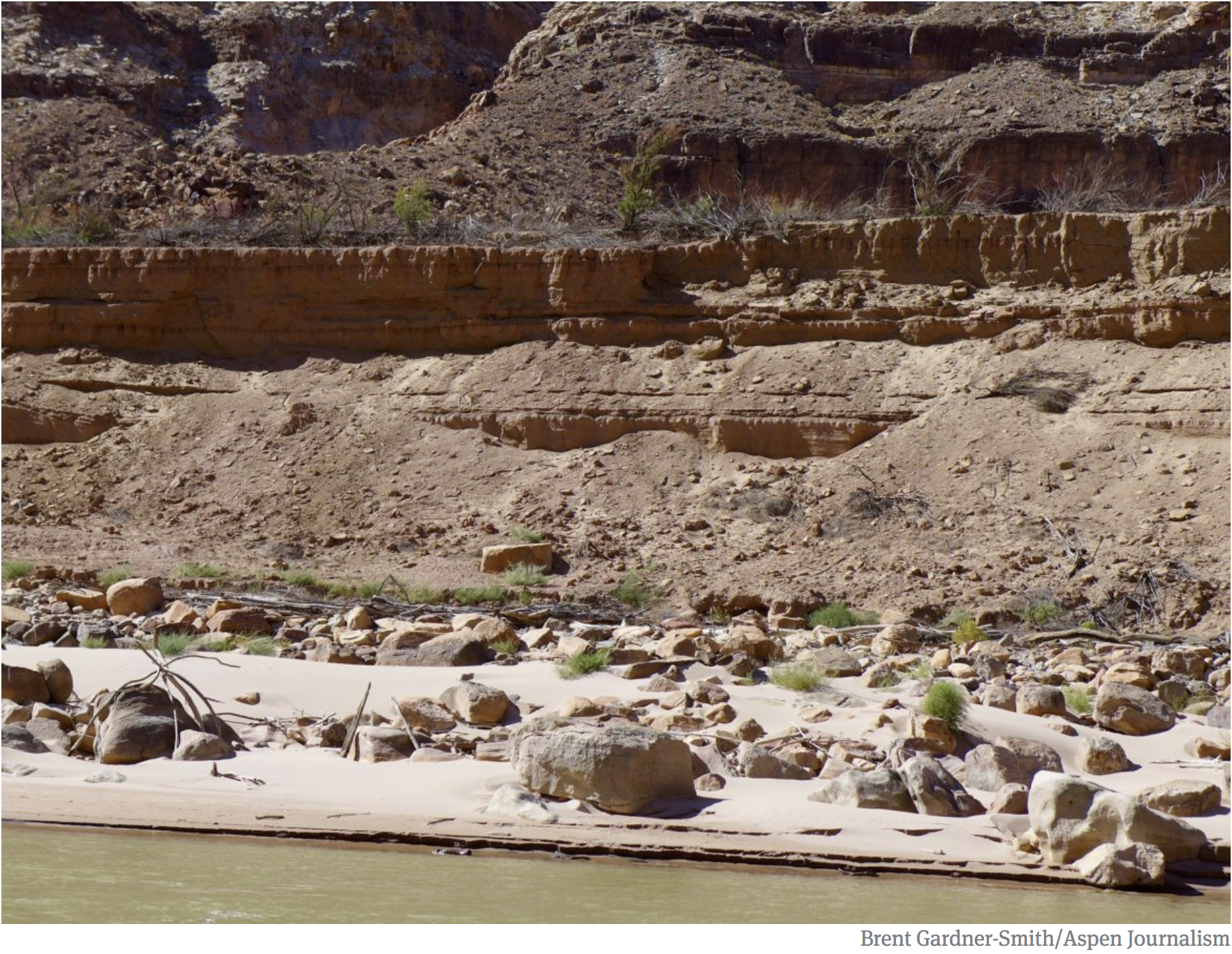
Sand and silt are piling up on the Colorado River above Lake Powell, as water levels continue to fall due to persistent drought and encroaching aridification. Water managers from San Diego to Wyoming are working to find ways to keep the river’s reservoirs, and water delivery systems, functioning.
State investigating
On Tuesday during a regular public meeting held in Westminster, the directors of the Colorado Water Conservation Board indicated they were in support of a staff proposal to form seven different work groups in 2019 to study demand management.
Brent Newman, the CWCB’s interstate, federal and water information section chief, and point person on Colorado River issues, told the agency’s board of directors that the state is not yet starting up a demand-management program; it is only studying the feasibility of doing so.
He also said the state is not studying how a curtailment, or mandatory cutback in water use, would be administered by the state if the Colorado River Compact were to be violated.
Karen Kwon, a first assistant attorney general of Colorado, echoed that stance in her remarks to the CWCB directors Tuesday.
“We are not talking about how we would administer a curtailment,” Kwon said.
Newman and Kwon are proposing that the CWCB set up work groups, staffed by hand-picked experts, to explore a “plethora of issues” raised by demand management, including policy; monitoring and verification; water administration; the environment; economics; funding; and education and outreach.
The staff also proposed to set up a quarterly series of workshops for water users, managers and stakeholders, as well as engaging the state’s basin roundtables, which meet regularly in each of the state’s major river basins, on the issues raised by demand management.
A detailed work plan for the proposed process is to be presented by CWCB staff to the agency’s directors in March.
Editor’s note: Aspen Journalism covers rivers and water in collaboration with The Aspen Times and other newspapers owned by Swift Communications. The Times published this story Feb. 4.
Community members wanting to comment next month at a Boulder County commissioners hearing on whether Denver Water can move forward with an expansion of Gross Reservoir can start signing up next week…
Online sign-ups for the March 14 hearing start Feb. 14, while in-person sign-ups will start an hour before the hearing.
Commissioners plan to continue to take public testimony until all speakers have had an opportunity to comment, according to a news release.
After the public hearing, commissioners will hear Denver Water’s appeal of a decision by the county’s Land Use Department that Denver Water must run the project through what is known as a “1041” review process before construction can begin.
Named for the bill number by which it was enacted in 1974, the 1041 legislation gives local governments the right to control development by agencies beyond their boundaries through a local permitting process.
Denver Water argues the Gross Reservoir expansion is exempt from 1041 requirements. Boulder County claims it is not.
The public hearing will focus on the limited scope of the determination and is not a hearing or decision on the perceived impacts or merits of the reservoir expansion project, according to a news release…
Written comments can be submitted through an online comment form available at bit.ly/GrossDamExpansion. Comments also can be mailed to the Boulder County Commissioners’ Office, P.O. Box 471, Boulder, 80306. Comments need to be received by noon March 12.
CU Boulder researchers harness 35 years of data to uncover responses of a high-elevation reservoir to a warming world
The surface waters of Lake Dillon, a mountain reservoir that supplies water to the the Denver area, have warmed by nearly 5 degrees Fahrenheit (2.5 degrees Celsius) in the last 35 years, which is twice the average warming rate for global lakes. Yet surprisingly, Dillon does not show adverse environmental changes, such as nuisance algal blooms, often associated with warming of lakes. Researchers at the CIRES Center for Limnology, who have just published a multi-decadal study of Lake Dillon, conclude that the lake’s rapid warming and its lack of ecological response to warming are explained by the high elevation of the lake.
“The warming of Lake Dillon is a result of climate change but, in contrast with warm lakes, which respond in undesirable ways to warming, Lake Dillon shows no environmental response to warming, said William Lewis, Director of the CIRES Center for Limnology and lead author of the new paper published today in AGU’s Water Resources Research. “The explanation for the lake’s ecological stability lies in its low temperature, which serves as a buffer against ecological effects of warming.”
Since 1981, Lewis and colleagues in the CIRES Center for Limnology have collected detailed information not only on Lake Dillon’s temperature, but also on its water quality and aquatic life. Full vertical profiles of water temperature document changes in vertical distribution of heat over time. The record shows that warming of tributary water contributes to warming of the lake’s deepest waters.
“The 35-year data set allows us to see the complete warming pattern of the lake,” said James McCutchan, associate director of the Center. Natural events, including droughts and floods, create interannual variation that obscures the effects of climate change over short intervals, whereas multidecadal data sets can show more clearly the effects of climatic warming.
Dillon is the highest lake yet studied for full water column warming, as Lewis and his colleagues note in their paper. The study also is the first to analyze warming in a reservoir, rather than a natural lake.
“Reservoirs can differ fundamentally from other lakes in their response to warming because they often release water from the bottom as well as the top of the water column,” said Lewis. “They can warm not only from the top, in response to solar radiation reaching the surface, but also from the bottom, as tributaries subject to climatic warming replace cold bottom water with progressively warmer tributary water.”
The Lake Dillon study program is sponsored by Denver Water, which uses the water for treatment and delivery to Denver residents, and by the Summit Water Quality Committee, which represents the interests of local residents in preservation of Lake Dillon’s water quality.
As more people build homes in fire-prone areas, and as climate change and other factors increase the frequency of fires, there is a growing risk to life and property throughout the West — and a lesser known risk to the region’s already endangered water supply. At least 65 percent of the public water supply in the Western U.S. comes from fire-prone areas.
Blazes like the Tubb Fire and 2018’s massive Camp and Carr wildfires can expose the drinking water for millions of people to the risk of contamination by toxic chemicals and parasites. Experts are concerned the new scale of wildfires torching urban areas could cause damage to public water supply that isn’t immediately apparent.
“Lots of structures, vehicles, and man-made materials were involved in the Camp and Carr fires and there isn’t a lot of information on how the environment is affected when these materials burn,” said Clint Snyder, assistant executive officer of California’s Central Valley Water Board.
The concern is prompting more intensive water testing programs following wildfires and spurring utility companies to invest in wildfire mitigation projects across the West.
HOUSES IN THE WOODS
One-third of U.S. homes are now built in what’s called wildland-urban interface (WUI) areas, areas near or on land prone to wildfire. It’s the fastest-growing land use type in the continental U.S.
According to U.S. Forest Service data, in just 20 years, new WUI areas grew by more than 46 million acres, covering an area larger than Washington State.
When these homes become wildfire tinder, insulation, roofing and home furnishings release toxins as they go up in flames, creating new sources of water contamination.
In addition to releasing toxins into the water supply, fires kill healthy tree roots. Without the roots, contaminating sediment and ash are flushed by rain into the reservoirs, rivers and lakes that supply cities with drinkable water.
In 2017 the U.S. Geological Survey published a study that predicted wildfires could double the amount of sediment in a third of the largest western watersheds by 2050. In some areas, sediment could increase 1,000 percent, potentially carrying parasites and harmful metals and chemicals with it.
According to representatives at the California State Water Resources Control Board, bacteria and parasite contamination, rather than chemical contamination, are the main worries in the wake of the Camp Fire, which burned 153,000 acres and 19,000 structures north of Sacramento, killing at least 86 people.
In Paradise, the town most affected by the Camp Fire, 22 out of 24 water systems were tested for contamination and cleared at the time of writing this article, but until the remaining two can be confirmed as uncontaminated, a Boil Water Notice, first released on Nov. 9, will remain in effect.
Solomon’s biggest concern is a parasite called cryptosporidium. When bare soil is exposed because vegetation has burned, the sediment that is flushed into water sources often contains spores of the intestinal infection-causing parasite. While a discomfort to healthy people, cryptosporidium can become life-threatening to people who are undergoing chemotherapy, have AIDS, or are elderly.
“Cryptosporidium form spores and that’s a problem because spores are like armored tanks, encasing the pathogen in a way that allows it to invade even significant amounts of chlorine,” said Solomon.
The increased sediment also creates a costly problem for water treatment plants.
Sediment clogs the microfiltration systems that filter parasites in large water treatment systems, requiring expensive clean-ups.
Slopes above Cheesman Reservoir after the Hayman fire photo credit Denver Water.
In 2002, the Hayman Fire cost Colorado utility company Denver Water $27 million, when heavy rains following the fires washed sediment, fallen trees, and man-made debris into the Stronita Springs and Cheeseman Reservoirs. The contaminants had to be filtered out before the water was safe for consumers.
To date, the Tubb Fire is one of California’s starkest examples of post-wildfire water contamination.
Before last year’s larger, deadlier Camp Fire, it was the most destructive California wildfire ever recorded. It burned nearly 37,000 acres, 5,636 homes and businesses, and killed 22 people.
But despite the scope of the blaze, it took a phone call from Gerald Buhrz to alert local authorities to the possibility of water contamination.
“If [he] hadn’t called in to report a chemical smell in the water, we may never have known about it,” said Bennett Horenstein, who was director of Santa Rosa Water during the fire. “It makes me wonder how many times this has happened and gone unreported.”
In total, the City of Santa Rosa had to spend $8 million replacing hydrants, valves, and other water system components in 352 properties, including 1,265 feet of water main.
“What happened in Fountaingrove should be a learning opportunity for water systems nationally,” Horenstein said…
Denver Water, which manages 12 water storage facilities throughout Colorado, announced in January that it’s pledging $16.5 million to the From Forest to Faucets Project, a partnership with the U.S. Forest Service that will protect crucial watersheds from wildfire. Colorado has more than 14 million acres of U.S. National Forest land and almost 90 percent of it is located in watersheds that feed public water supplies.
Officials in Arizona enacted a plan in July that prescribes tree thinning and controlled burns for the three watersheds that feed the C.C. Cragin Reservoir. The project is funded in part by a local utility company called Salt River Project…
“Fire mitigation projects are not just urgent because of the fact that people live near these forests, but the fact that people live downstream from these watersheds,” [Linda Wadleigh] said.
Denver Water is seeking approvals from the U.S. Army Corps of Engineers, the U.S. Fish and Wildlife Service, and the state of Colorado to expand Gross Reservoir, which is southwest of Boulder. The 77,000 acre-foot expansion would help forestall shortages in Denver Water’s water system and offer flood and drought protection, according to Denver Water.
On Wednesday a collection of six environmental advocacy groups – Save the Colorado, the Environmental Group, Wildearth Guardians, Living Rivers, Waterkeeper Alliance Inc. and the Sierra Club – filed a lawsuit in Colorado’s federal district court against the proposed Gross Reservoir Expansion Project, alternately called the Moffat Firming Project…
The legal process surrounding Gross Reservoir has deep significance to Grand County. The county serves as the source for much of the water Denver Water relies upon, which is transported out of the county through the Moffat Tunnel near Winter Park Resort. The county is also party to a collaborative water management group called Learning By Doing. The group looks to improve river habitat in Grand County by conducting environmental water projects and through other means.
The lawsuit filed by the environmental groups does not name Denver Water and instead is directed at the US Army Corps of Engineers, the Department of the Interior and the US Fish and Wildlife Service. The 57-page complaint lays out 32 separate specific claims related to alleged violations of the National Environmental Policy Act, the Clean Water Act and the Endangered Species Act.
The alleged violations claimed by the environmental groups cover a wide range of technical issues related to the formal processes by which large construction projects, such as the Gross Reservoir Expansions, are approved by federal agencies. Many of the claims made by the environmental groups revolve around allegations that the Corps of Engineers, Interior Dept. and US Fish and Wildlife failed to exercise independent judgment related to claims made by Denver Water about the project.
“Denver Water’s proposal to build the largest dam in Colorado history will hurt the 40 million people in six states and two countries who depend on the Colorado River – a critical but disappearing, resource – for their water supply,” said Daniel E. Estrin, general counsel and advocacy director at Waterkeeper Alliance. “Waterkeeper Alliance stands united with our many Colorado River Basin Waterkeepers who are fighting to protect their waterways and their communities from this senseless and destructive water grab.”
For their part officials from Denver Water said the court filing did not surprise them.
“We expected it,” Jim Lochhead, CEO of Denver Water, said. “This is a really critical project for Denver Water. In the last 15 years we have come close to running out of water a couple of time at the north end of the system.”
Lochhead noted that those two incidents came in 2002 and 2013.
While Denver Water is not directly named in the lawsuit Lochhead said the organization will be entering the lawsuit to “provide our own perspective on the adequacy of the approvals.”
“We are confident the federal agencies follow regulations and federal law,” Lochhead said. “I think a court will uphold the findings by those agencies.”
When asked whether he believed Denver Water and the environmental groups who oppose the Gross Reservoir Expansion Project could reach some form of compromise agreement Lochhead answered, saying, “I think their position is pretty clear.”
A suit filed against three U.S. government agencies seeks to stop the expansion of Denver Water’s Gross Reservoir in Boulder County…
Gross Reservoir provides water to 1.4 million Front Range customers. The expansion would divert more water from Colorado River headwater tributaries during wet years. In a nutshell, the project seeks to raise the height of the existing dam by 131 feet; storage capacity would increase by 77,000 acre feet.
The environmental groups who sued say the U.S. government permitting process inadequately evaluated the impact of the large project on streamflows. There are also concerns about how construction would affect wildlife.
“We went above and beyond mitigation of environmental impacts under the permits,” Denver Water CEO Jim Lochhead said. “We sat down with Grand County, Eagle County… and a host of agencies across Western Colorado, and developed a series of environmental enhancements to the streams of Western Colorado.”
Trout Unlimited is one such group that has supported the Gross Reservoir expansion, citing successful stream augmentation programs along the Fraser River…
Revving up the legal gears could pose a setback for Denver Water, which has spent years securing the necessary permits. Now that it has those in place, environmental groups are seeking to stop construction.
Denver Water’s collection system via the USACE EIS
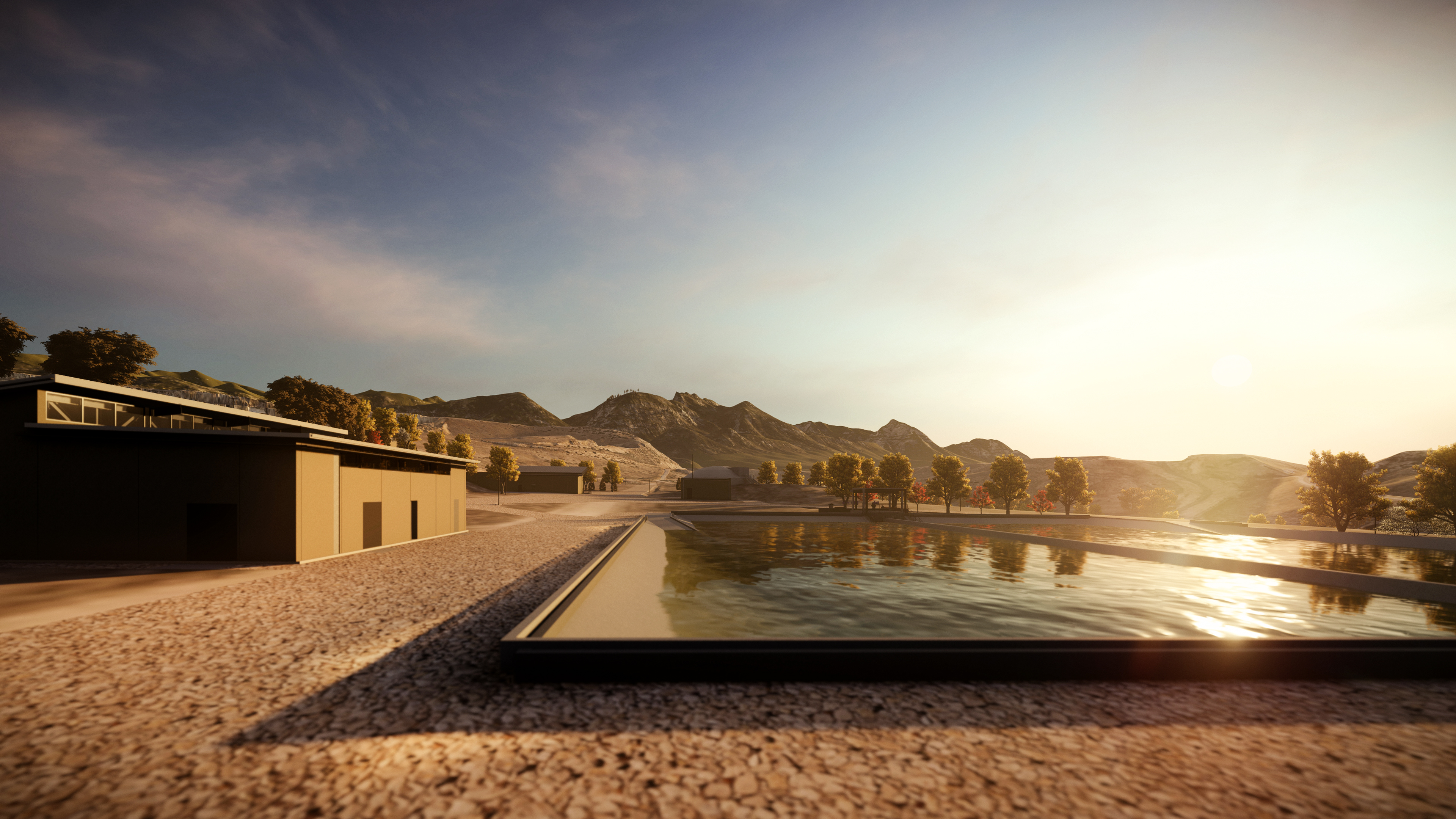
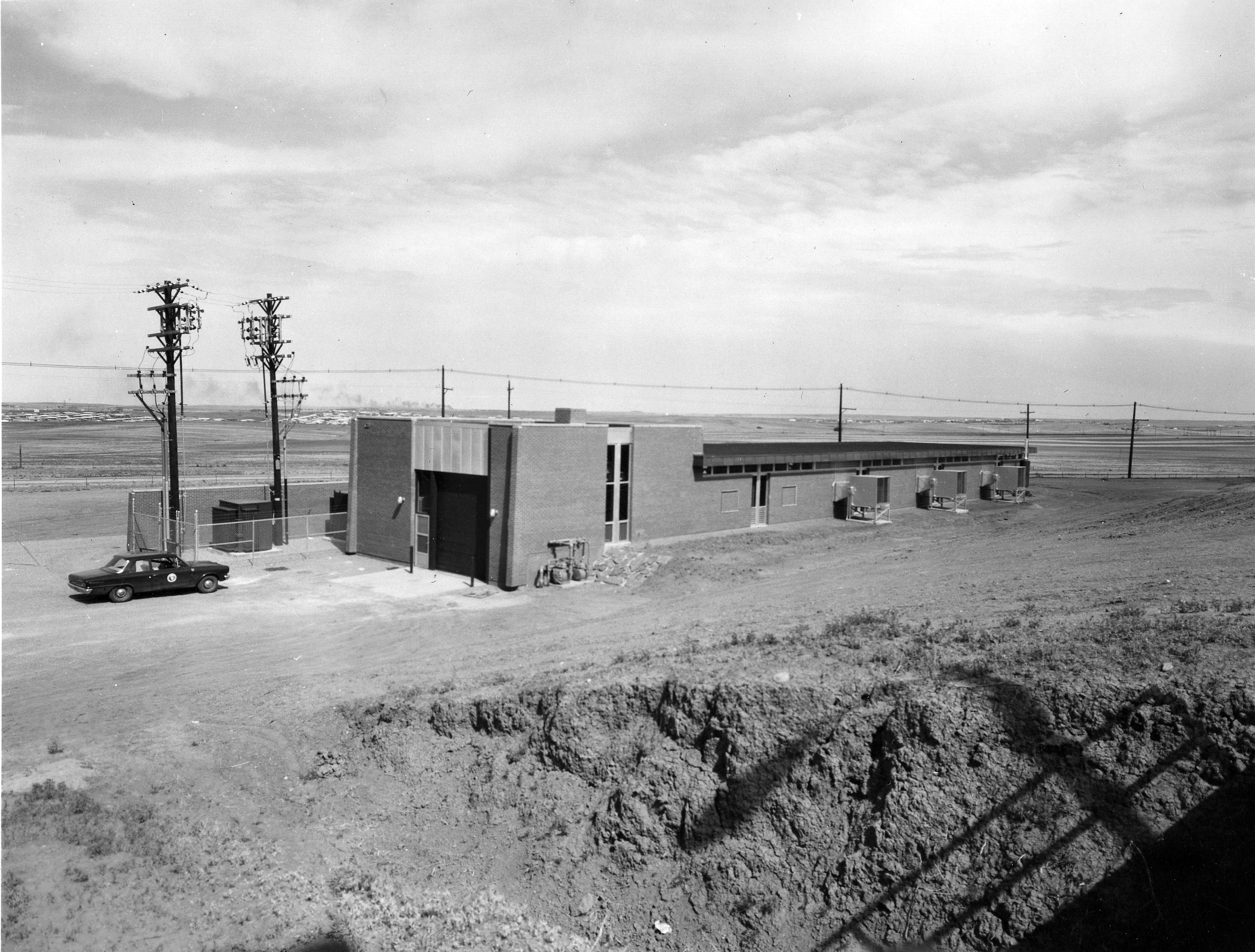
Northwater Treatment Plant — Denver Water is upgrading and modernizing the northern portion of its water system that was built in the 1930s. The utility is building a new water treatment plant, as seen in this rendering, installing a new pipeline, and redeveloping its Moffat Treatment Plant site. Photo credit: Denver Water
Here’s the release from Denver Water (Travis Thompson):
At its meeting today, the Denver Board of Water Commissioners adopted rate changes to fund essential upgrades and new projects to keep Denver Water’s system running smoothly. The new rates take effect Feb. 1, 2019, and monthly bills for most Denver residents will increase by 55 cents if they use water the same as they did in 2018.
“While the cost to maintain and upgrade the water system continues to increase, rapid development inside the city of Denver has brought in more fees from new taps sold, helping to minimize the 2019 rate increase for Denver customers,” said Jim Lochhead, Denver Water CEO/Manager. “The surrounding suburbs, however, had less development than in the past, reducing the amount collected from new tap fees, which means we’ll need to collect more revenue from suburban water rates in 2019.”
Suburban customers who receive water from one of Denver Water’s 65 distributors will see an additional monthly increase added to their volumetric charges. The Denver City Charter requires that suburban customers pay the full cost of service, plus an additional amount. Learn more about how this works: “Why Denver water costs more in the ‘burbs.”
If you live outside Denver and receive water from a distributor under contract with Denver Water, you can expect to see an annual increase between $23 and $41, which is between $1.90 and 3.40 a month (based on an annual use of 102,000 gallons of water).
Pat Fitzgerald, general manager of four Denver Water distributors including the Platte Canyon Water and Sanitation District and chairman of the suburban districts’ Technical Advisory Committee, which reviews Denver Water’s rates annually, provided this statement:
“The advisory committee supports the rate increase. The cost-of-service study used to determine the difference between inside city and outside city customers is fair and reasonable, and the committee had no objections to the results. The expenses are going up, but they’re all projects that are necessary to provide a reliable and safe source of water.”
The major multiyear projects that water rates fund include building a new, state-of-the-art water treatment plant, installing a new 8.5-mile water pipeline to replace a pipeline that was built in the 1930s, expanding Gross Reservoir to provide a more reliable future water supply, constructing a new water quality lab to ensure the highest water quality standards, investing more than $100 million to repair and replace water pipes, and more. There are 158 major projects identified in Denver Water’s five-year, $1.3 billion capital plan.
A customer’s bill is comprised of a fixed charge, which helps ensure Denver Water has more stable revenue to continue the necessary water system upgrades to ensure reliable water service, and a volume rate. The fixed monthly charge — which is tied to meter size — in 2019 is increasing by 55 cents for most residential customers both inside the city and out.
Denver Water’s rate structure includes a three-tiered charge for water use (called the volume rate). To keep water affordable, indoor water use — like for bathing, cooking and flushing toilets — is charged at the lowest rate. Essential indoor water use is determined by averaging the customer’s monthly water use on bills dated from January through March each year. This is called average winter consumption. Water use above the average winter consumption — typically for outdoor watering — is charged at a higher price.
Volume rates for Denver residents will remain the same, but will increase on suburban bills.
Denver Water operates and maintains more than 3,000 miles of pipe — enough to stretch from Los Angeles to New York — as well as 20 dams, 22 pump stations, 30 underground storage tanks, four treatment plants and more. The water provider’s collection system covers more than 4,000 square miles, and it operates facilities in 12 counties in Colorado.
Denver Water does not make a profit or receive tax dollars, and reinvests ratepayers’ money to maintain and upgrade the water system. The utility is funded by water rates, bond sales, cash reserves, hydropower sales and fees for new service (called System Development Charges).
Customers will see more information about 2019 rates in their bills and on Denver Water’s website over the next few months.
Gross Reservoir — The Gross Reservoir Expansion Project will raise the height of the existing dam by 131 feet, which will allow the capacity of the reservoir, pictured, to increase by 77,000 acre-feet. The additional water storage will help prevent future shortfalls during droughts and helps offset an imbalance in Denver Water’s collection system. With this project, Denver Water will provide water to current and future customers while providing environmental benefits to Colorado’s rivers and streams. Photo credit: Denver Water
Water districts in Denver and Santa Fe, New Mexico, plus the town of Ashland, Oregon, meanwhile, are helping fund tree-thinning and other fire-prevention measures in crucial watersheds that supply their water systems.
“There’s always that feeling, even at our municipal government, that we pay our taxes, why aren’t you already doing this?” says Alan Hook, manager of the Santa Fe Municipal Watershed Program. “The community realized how much these fires cost and how much the Forest Service is pouring into [fire] suppression costs. … If we lose this source of supply, we could be in dire straits in the near future.”
Denver Water, for example, owns only 3 percent of the watershed it’s protecting, while the Forest Service holds 54 percent, says Christina Burri, watershed scientist at the utility. But the utility nonetheless agreed to put up $33 million in a 50-50 partnership with the agency, a decision in part prompted by memories of fires in 1996 and 2002 that dumped scorched sediment into water district reservoirs and forced $28 million in repairs and remediation.
“That motivated Denver Water to invest in forest health, to create a healthy forest so we can be proactive against these costs,” Burri says. “It’s important for us to be able to partner to be able to get access to work on these lands and create a healthier condition in these forests, because that’s the source of our water.”
The towns and water districts maintain that the new expenses can easily be absorbed by their budgets. The funds being put forward by Denver Water, for example, account for 1 percent of the utility’s budget overall.
Determination states that Denver Water must obtain a permit under Article 8 – Location & Extent Areas & Activities of State Interest (1041)
Denver Water requested that Boulder County Land Use Director Dale Case determine the applicability of the Boulder County Land Use Code to Denver Water’s proposed expansion of Gross Reservoir.
Denver Water has argued that it is exempt from having to submit its project for Location & Extent Areas & Activities of State Interest (1041) review under Article 8 of the Land Use Code.
Director Case responded to Denver Water on Oct. 22. His determination is that Denver Water’s proposed reservoir expansion project is subject to review under Land Use Code. Before undertaking the project, Denver Water must obtain a permit under Article 8 of the Code.
Denver Water may appeal the decision to the Boulder County Board of Commissioners as provided for under 8-406(B).
Land Use Code Section 8-406 Determination of Whether a Proposed Activity or Development Must go Through the Permit Process states that “The Director shall determine the applicability of Section 8-400 to the conduct of any proposed activity or development. The Director shall make this determination within 10 calendar days after the Director receives a written request from the applicant stating the reasons why the proposed activity or development is not subject to Section 8-400.”
Background
The Board of Water Commissioners for the City and County of Denver, aka “Denver Water,” is in the process of applying for a planned expansion of the Gross Reservoir Dam in southwest Boulder County. While this is not a Boulder County project, the reservoir resides entirely in unincorporated Boulder County.
The Army Corp of Engineers issued its Record of Decision granting Denver Water a federal permit for the project in July 2017. However, before it can commence the project, Denver Water must still receive approval of its hydropower license amendment application from the Federal Energy Regulatory Commission (FERC).
Boulder County has intervened in the FERC application noting many reasons why the county finds the application to be deficient. In its motion to intervene, the county outlined nearly 20 points of contention with the project.
Boulder County has intervened in the FERC application noting many reasons why the county finds the application to be deficient. In its motion to intervene, the county outlined nearly 20 points of contention with the project.
On March 20, 2018, the county responded to FERC’s Supplemental Environmental Assessment, once again pointing out the deficiencies that Boulder County finds in Denver Water’s FERC application and FERC’s environmental assessment of the project.
The county plans to further address impacts and concerns during a county (local) land use review process and has explained to FERC that Denver Water must obtain required county permits before it undertakes the project. Denver Water has not yet applied for a permit under Article 8 of the Boulder County Land Use Code (also known as a 1041 permit).
A 1041 review would allow the Boulder County Planning Commission and the County Commissioners to conduct public hearings and review the application according to the criteria in the Code.
More Information
More information can be viewed on the county’s Gross Reservoir Dam Expansion Proposal information webpage. Also, individuals can sign-up to receive Boulder County-related hearing and meeting announcements concerning the proposed Denver Water Gross Reservoir Expansion Project. You can unsubscribe at any time.
To receive notices about the Gross Reservoir project from Denver Water, look for the “Sign Up for Email Updates” option at the bottom of the page on the Gross Reservoir project website. All notices of meetings, minutes, and updates on the proposed project (also known as the “Moffat Collection System Project”) can be found on Denver Water’s website at https://grossreservoir.org/.
The dam that forms Gross Reservoir, located in the mountains west of Boulder. Photo: Brent Gardner-Smith/Aspen Journalism
Staff at Frisco Bay Marina are trying to keep up with water levels that are dropping about one inch per day.
“And so an inch a day going down means the water line is moving 10 feet out every day, so we have to keep chasing it and moving the docks, which is definitely a lot of work,” said Tom Hogeman, the marina’s general manager…
Hogeman said he hasn’t seen the water this low since 2012 and it will only continue to go down as we head into the fall. The marina is typically open for rentals through mid-October but this year the season could end early.
Denver Water and three other organizations are seeking to overturn a state order that directs Denver to adopt a strict new treatment protocol preventing lead contamination in drinking water.
Denver is not in violation of the federal law that governs lead, but it has been required to monitor and test its system regularly since 2012 after lead was discovered in a small sample of water at some of its customers’ taps.
In March of this year, after Denver completed a series of required tests and studies, the Colorado Department of Public Health and Environment (CDPHE) ordered the utility to implement a treatment protocol that involves adding phosphates to its system. It has until March of 2020 to implement the new process.
Denver, which serves 1.4 million people in the metro area, has proposed instead using an approach that balances the PH levels in its treated water and expands a program replacing lead service lines in the city. Old lead service lines are a common source of lead in drinking water.
Treating lead and copper in water systems is a complex undertaking governed by the federal Lead and Copper Rule. In Denver, for instance, there is no lead in the water supply when it leaves the treatment plant. But it can leach into the supply via corrosion as water passes through lead delivery lines and pipes in older homes. Denver has 58,000 lead service lines in its system. Lead has continued to appear in samples it has taken at some customers’ taps, according to court filings, though not at levels that would constitute a violation of the federal law.
Eighty-six samples taken since 2013 have exceeded 15 micrograms per liter, including one tap sample which measured more than 400 micrograms per liter, according to court filings. The 15-microgram-per-liter benchmark is the level at which utilities must take action, including public education, corrosion studies, additional sampling and possible removal of lead service lines.
In response to the state’s order, the City of Aurora, the Metro Wastewater Reclamation District and the nonprofit Greenway Foundation, which works to protect the South Platte River, sued to overturn it, concerned that additional phosphates will hamper their ability to meet their own water treatment requirements while also hurting water quality in the South Platte. Denver joined the suit in May.
Because Denver Water services numerous other water providers in the metro area and participates in a major South Metro reuse project known as WISE, short for Water Infrastructure and Supply Efficiency, anything that changes the chemical profile of its water affects dozens of communities and the river itself.
Among the plaintiffs’ concerns is that phosphate levels in water that is discharged to the river have to be tightly controlled under provisions of the Clean Water Act. If phosphate levels in domestic water rise, wastewater treatment protocols would have to be changed, potentially costing hundreds of thousands of dollars, if not more, according to a report by the Denver-based, nonpartisan Water Research Foundation.
From an environmental perspective, any increased phosphate in the South Platte River would make fighting such things as algae blooms, which are fueled by nutrients including phosphorous, much more difficult and could make the river less habitable for fish.
But in its statement to the court, the CDPHE said the state’s first job is to protect the health of the thousands of children served by Denver Water in the metro area.
“The addition of orthophosphate will reduce lead at consumers’ taps by approximately 74 percent, as opposed to the cheaper treatment favored by plaintiffs [PH/Alkalinity], which will only reduce levels by less than 50 percent,” CDPHE said in court documents. “This is a significant and important public health difference, particularly because there is no safe level of lead in blood…Even at low levels, a child’s exposure to lead can be harmful.”
How much either treatment may eventually cost Denver Water and others isn’t clear yet, according to state health officials, because it will depend in part on how each process is implemented.
Denver, Aurora and Metro Wastewater declined to comment for this story, citing the pending lawsuit.
The Greenway Foundation did not respond to a request for comment.
In late July, all parties agreed to pause the legal proceedings while they examine water treatment issues as well as the environmental concerns raised by higher levels of phosphorous in Denver Water’s treated water supplies. If a settlement can’t be reached by Nov. 1, the lawsuit will proceed.
Jonathan Cuppett, a research manager at the Water Research Foundation, said other utilities across the country may be asked to re-evaluate their own corrosion control systems under a rewrite of the Lead and Copper Rule underway now at the U.S. Environmental Protection Agency.
The newly proposed federal rule is due out for review later this year or by mid-2019.
Cuppett said the changes may lean toward more phosphate-based treatment for lead contamination. In fact, the EPA issued a statement in March in support of the CDPHE’s order to Denver Water.
“Within the [Lead and Copper Rule] there are a variety of changes that may be made. Depending on what those changes are other utilities may have to evaluate their strategy again or more frequently. And if that is the case, we may see more of this issue where someone is pushing for phosphorous for control for public health, creating a conflict of interest with environmental concerns,” Cuppett said.
Colorado public health officials said they’re hopeful an agreement can be reached, but that they have few options under the federal Safe Water Drinking Act’s Lead and Copper Rule.
“The [Lead and Copper Rule] is a very prescriptive, strict rule,” said Megan Parish, an attorney and policy adviser to CDPHE. “It doesn’t give us a lot of discretion to consider things that Metro Wastewater would have liked us to consider.”
For years, Castle Rock Water has made providing long term, renewable water a priority. Now, a major milestone has been reached and the first drops of WISE water are headed to Town. Join the celebration to help commemorate this accomplishment and take a look at what’s coming up next for water in Castle Rock.
The fun-filled family celebration will be from 4:30 to 6:30 p.m. Friday, June 8. Bring the kids, sunscreen and a great attitude to Gemstone Park, 6148 Sapphire Pointe Blvd., to join the festivities and celebrate the WISE water partnership.
After stakeholders officially cut the ribbon, the community is invited for a festival full of games, food trucks, bump soccer, bounce houses, a foam party, giant bubbles, water colors and more. Plus, get a chance to meet the Most Hydrated Man in Castle Rock.
The celebration will help mark more than 9 years of planning and $50 million in infrastructure to help ensure the community’s strong water future. When the WISE partnership was created, many communities in Colorado were faced with a drought. With limited, non-renewable resources, communities knew they needed to come up with a plan. Regional water providers saw the opportunity to partner in a solution and share in the expense to buy, transport and treat renewable water.
The WISE partnership is an arrangement between Denver Water, Aurora Water and 10 other south metro water providers to import renewable water. Castle Rock is the southernmost community partner.
Castle Rock Water finished the last piece of infrastructure – connecting a pipeline from Outter Marker Road to Ray Waterman Treatment Plant – in late 2017. The first drops of imported WISE water came to Town in late April.
Gross Dam enlargement concept graphic via Denver Water
FromThe Boulder Daily Camera (Lurline Underbrink Curran):
I would like to share why I support Denver Water’s Gross Reservoir Expansion project.
While located in Boulder County, the project obtains the water from Grand County — a county that is currently the most impacted county in the state of Colorado for transbasin diversions. You must wonder why the county and its citizens, stakeholders in the Colorado River Basin, along with Trout Unlimited support this project.
The reason is the Colorado River Cooperative Agreement, which is an historic agreement with statewide environmental benefits which were fought for and gained through sometimes difficult and long negotiations. It has been hailed as a new paradigm and one that will serve as an example of what can be gained when dealing with a finite resource like water. The signatories to this agreement represent the entire Colorado River Basin, and I had the honor of acting as Grand County’s lead negotiator in this agreement. I worked for Grand County for 33 years, retiring as county manager in 2015. I have lived in Grand County over 60 years and have deep roots and interest in the well-being of our waterways.
The environmental benefits gained by Grand County, which include additional flows, river ecosystem improvements, use of Denver Water’s system, participation in an adaptive management process called Learning by Doing, money for river improvements, just to name a few, are necessary to protect and enhance the Fraser and Colorado rivers. Without these benefits, these rivers will continue to degrade, with no hope of recovery or improvement.
Those who oppose the project offer no solutions to the already stressed aquatic environment of the Fraser and Colorado rivers. Through the Learning By Doing format and a public private partnership, partners have already implemented a river project on the Fraser as an example of what can be done. This project immediately produced improvements that were astounding. Colorado Parks and Wildlife can verify this claim. This essential work will not continue without the CRCA.
The impacts that are associated with the construction of the Gross Reservoir Enlargement are substantial and one sympathizes with those who will experience them, but the reality is they will end. Mitigation for the construction impacts can be applied. However, without the CRCA, the impacts to the Fraser and Colorado rivers will continue with no hope of improvement.
The environmental enhancements and mitigation that are part of the CRCA cannot be replicated without the reservoir expansion project, and the loss of these enhancements and mitigation will doom the Fraser and Colorado rivers in Grand County to environmental catastrophe.
Brad Udall, a senior water and climate research scientist at CSU, telling a crowd of water mavens on April 27 in Denver that Colorado faces a drier future, which means more fires. Udall studies the Colorado River basin and says there's been a 20 percent decline in water in the system since 2000.
DENVER – Some heavy hitters were invited by Colorado State University to speak at the inaugural Water in the West Symposium in Denver last week, including U.S. Secretary of Agriculture Sonny Perdue, the prior secretary of agriculture; Tom Vilsack of Iowa; U.S. Sen. Michael Bennett; and Gov. John Hickenlooper.
But the two players likely to have the biggest long-term impact on water in the West — climate change and drought — were escorted to the event at the McNichols Civic Center Building in downtown Denver by Brad Udall, a senior water and climate research scientist at CSU who studies the Colorado River Basin.
Udall’s version of climate change came wearing a T-shirt Udall designed with five “climate basics” listed on it: “It’s warming; It’s us; Experts agree; It’s bad; We can fix it.”
“The outlook is for a much drier Colorado” Udall told an audience of about 400 people on Thursday, which means less water and more fires in the state.
And he noted, “climate change is water change.”
Brad Udall, a climate researcher at CSU, has boiled down his findings to fit on a t-shirt. He told an audience at the inaugural Water in the West Symposium to expect a drier Colorado due to rising temperatures caused by human-induced climate change.
‘Odd and unusual’
Colorado State is preparing to build a new water center in partnership with Denver Waver on the National Western Center campus that’s being developed on the site of the long-running stock show in Denver.
And the symposium was a way of illustrating how one aspect of the new water center will function by bringing people together to talk about water policy and science.
The current 18-year-drought in the Colorado River Basin now has a name: the “Millennium Drought,” and it’s got Udall spooked.
“Something very odd and unusual is going on here,” Udall told the symposium crowd.
He said the period from 2000 to 2017 “is the worst drought in the gauged record” of the Colorado River and that flows have declined an average of 20 percent a year since the turn of the century due to rising temperatures.
It’s also time, Udall said, to consider that “drought” is no longer an apt description for what Colorado is facing, which is really long-term “aridification.”
“‘Drought’ implies we’re going to get out of it,” Udall said.
A slide from Brad Udall's presentation on April 26, 2018 at the CSU Water in the West Symposium. The slide describes the 20 percent drop in Colorado River flows since 2000, a condition Udall expects to also be the case in 2050.U.S. Secretary of Agriculture Sonny Perdue, left, shakes hands with Tom Vilsac, the prior secretary of agriculture, on Friday in Denver during the Water in the West Symposium put on by CSU. Perdue, a Republican, and Vilsac, a Democrat, had a civil and well-informed exchange about water and ag in front of about 400 people.
Insidious issue
Perdue, who was governor of Georgia in 2007 during an extreme drought in that state, said Friday that he learned that drought brings out intense emotions in competing water users.
“Drought is probably one of the most insidious, stressful occasions that I can think of,” Perdue said, in large measures because “you have no idea when it is going to end.”
He acknowledged that water shortages in Georgia are rare compared to Colorado and the West.
“We found ourselves with some of the issues that I know you all are wrestling with, and that is the things that happen between municipalities, agriculture, recreationalists, endangered species, and all those things,” Perdue said.
Perdue, a Republican in President Donald Trump’s cabinet, was interviewed onstage by Vilsack, a Democrat who led the Department of Agriculture under President Barack Obama and is now working with CSU on food and water issues.
The exchange between the two was civil, given the current political climate, and it ended with the two of them reaching out to warmly shake hands and look each other in the eye.
Sen. Michael Bennett (D-Colorado) said Friday at the Water in the West Symposium in Denver that Coloradoans are going to have to trust each other when it comes to water, even if they disagree on things. Bennett also praised Colorado's 2015 state water plan, saying it is a testament to people coming together.
Fire budget
Perdue had also been praised earlier in the day by Sen. Bennett, a Democrat, for Perdue’s help in passing a bill to restore operational funds to the U.S. Forest Service that had been eaten up by the cost of fighting major fires in the West.
Bennett said he’d been working on the issue for nine years and considered both Perdue and Vilsack, for his earlier help on the issue, “heroes of Colorado.”
Bennett also praised the Colorado Water Plan published by the Colorado Water Conservation Board in 2015.
While acknowledging that the plan is “not perfect” and some people find it lacking in details, while others consider it too detailed, Bennett said the plan is a testament to how the state came together over water, “understanding that there is no way we can address this issue if we are at each other’s throats.”
Gov. Hickenlooper leaving the stage Thursday at the Water in the West Symposium in Denver. Hickenlooper, who said he is literally counting the days until his term ends, can count as his legacy the 2015 Colorado Water Plan.
Legacy plan
Gov. Hickenlooper, who signed the executive order in 2013 calling for a state water plan by 2015, spoke to the symposium Thursday, noting that with 259 days to go, he is now actually counting the days until his term of office ends.
He said the water plan, which weighs 4 pounds and took countless meetings over two years to produce, was referred to in the governor’s office during the process as “the colossal exercise.”
Regardless of what one thinks of the plan itself, the governor’s water-planning process did result in a working agreement between water interests on Colorado’s Front Range and Western Slope over a future potential new transmountain diversion under the Continental Divide.
Senior water mangers from both the Front Range and West Slope praised that agreement, or “conceptual framework,” as recently as April 18 at a regional water meeting in Grand Junction.
Given this year’s low snowpack, Hickenlooper also said Thursday the state was now “drawing up the paperwork” to activate the second stage of the state’s drought management plan.
Editor’s note: Aspen Journalism is covering rivers and water in collaboration with The Aspen Times, which published this story on Monday, April 30, 2018, and with the Glenwood Springs Post Independent, which published the story on Tuesday, May 1, 2018, the Vail Daily, which published the story on May 1, 2018, and the Summit Daily News, which published it on May 1, 2018.
After four states and Denver’s municipal water agency wrote letters accusing Arizona’s largest water provider of manipulating the Colorado River system to advantage itself, a former general manager of the Southern Nevada Water Authority lashed Arizona as a “bad actor.” An official at the water authority said this week that the utility was taking the concerns seriously.
Pat Mulroy, the water authority’s former general manager, offered a sharp critique of the Arizona utility — the Central Arizona Water Conservation District (CAWCD) — in an interview with The Nevada Independent. She said the utility’s actions had made it a “bad actor” on the river, adding that she believed the claims that CAWCD was manipulating the system to the detriment of other users. She said the fight plays into the internal power struggle within Arizona.
“They are willing to let the entire Colorado River system crash in order to win this parochial battle against the state,” Mulroy said. “It’s illogical… But that’s where they’re headed.”
In a letter Monday, Denver Water said it would end funding for a conservation program in 2019 if CAWCD did not alter its actions. The Southern Nevada agency, which manages water throughout Clark County, also funds the program.
No decision has been made about whether it will pull funding too. A spokesman said that the authority will take a “wait and see” approach to evaluate whether to fund the program next year. Colby Pellegrino, who manages the authority’s Colorado River supply, said the Denver Water letter was significant. Through Lake Mead, Southern Nevada gets about 90 percent of its drinking water from the river.
“We need to take Denver’s concerns seriously,” she said in an interview.
The funding in question is for a pilot program designed to conserve water in Lake Mead and Lake Powell, an attempt to prop up the elevation of the two major interconnected reservoirs in the Colorado River system. The Colorado River is split into two basins, an Upper Basin and a Lower Basin. The Lower Basin states of Arizona, California and Nevada pull their water from Lake Mead. Both basins have an interest in keeping their respective reservoirs above critical elevations that trigger losses in hydropower production and shortages in their water deliveries.
The Upper Basin states of Colorado, New Mexico, Utah and Wyoming are concerned that the CAWCD is manipulating supply and demand, to take more water from their reservoir, Lake Powell, than is appropriate for a system that is over-stressed and runs through an increasingly arid region. Even Arizona state officials have spoken out against CAWCD, which is locked in an internal battle with the Arizona Department of Water Resources, an arm of the governor’s office.
Mulroy applauded the Upper Basin for writing its letter, saying she hoped it would put pressure on Arizona water managers to settle their fighting, one of the factors holding up a drought plan.
Denver Water raised concerns in an April 16 letter over perceived “manipulation of water demands” by the Central Arizona Water Conservancy District, which manages the Central Arizona Project. CAP’s system of canals feeds Colorado River Water to Arizona farms and the cities of Phoenix and Tucson.
In the letter, Denver Water CEO/manager Jim Lochhead called into question recent CAP statements about a so-called “sweet spot” in Lake Mead. CAP water managers are publicly discussing keeping measurement levels within a specific range in the lower Colorado River Basin reservoir so more water will come from Lake Powell upstream.
Lochhead said those actions jeopardize millions spent by his agency to conserve Colorado River water upstream. Denver Water gets about half of what it needs from the river, and has invested in recent years in the Colorado River Conservation Program, which pays state farmers and ranchers to conserve Colorado River water as the entire basin struggles to manage the effects of an 18-year drought.
Denver Water is prepared to terminate our funding of the program after we meet our obligations in 2018…unless the [Central Arizona Water Conservancy District] is able to verifiably establish it has ceased all actions to manipulate demands and is fully participating in aggressive conservation measures along with other entities in Arizona,” the letter said.
In an interview, Lochhead said actions by Arizona water managers “undermines both the investment that Denver Water has made in this program and it undermines the conservation efforts that are being made by water users in the upper basin including in Western Colorado.”
For its part, the Arizona district said it will contact Denver Water officials and can’t comment now.
More Unusual Steps
Denver Water’s missive isn’t the first warning received by the Central Arizona Water Conservancy District. Just three days before Denver’s communique, the Upper Colorado River Commission sent its own strongly worded dispatch to Arizona Department of Water Resources chief Tom Buschatzke.
“[The Central Arizona Water Conservation District’s] goal appears to be to delay agreement on drought plans in order to take advantage of what it terms the ‘sweet spot’ by drawing ‘bonus water’ from Lake Powell… characterizations indicate that CAWCD intends to disregard the basin’s dire situation at the expense of Lake Powell and all other basin states,” the commission wrote.
Detailed Colorado River Basin map via the U.S. Bureau of Reclamation.
Upper Colorado River Commissioner James Eklund signed the letter along with representatives from New Mexico, Wyoming and Utah. He said it was “an unusual step to see language like this in a letter from one state to another. That said, we feel like it was timely and the situation warranted the letter.”
For Eklund, the crux of the issue is one water district in Arizona “maximizing one interest over the interest of the entire basin.”
“We assumed good faith dealing and when we saw something that suggested a contrary message or policy being adopted by the district in Arizona,” Eklund continued. “That’s when we decided we have to bring them back into the fold, into the herd, and get them back at the negotiating table.”
“It raises important questions about actions taken by Central Arizona Water Conservation District that threaten to blow up the collaborative effort that we have been enjoying on the Colorado River for the last 20 years,” Arizona Department of Water Resources Director Tom Buschatzke told KJZZ in Phoenix.
Commissioners for the Upper Colorado River sent a letter late last week to Arizona Department of Water Resources Director Tom Buschatzke. In the letter, they specifically criticized a water management strategy of the Central Arizona Water Conservation District (CAWCD).
Here’s what the upper basin doesn’t like: the CAWCD aims to keep Lake Mead at a so-called “sweet spot.” If the level of the lake stays in that range, then under current agreements, more water comes down from Lake Powell.
The Commissioners’ letter expressed deep concern that CAWCD “intends to disregard the basin’s dire situation at the expense of Lake Powell and all other basin states.” Don Ostler, executive director of the Upper Colorado River Commission, said bluntly in an interview. “That kind of manipulation is unacceptable to the Upper Basin.”
The letter echoed an argument long made by Buschatzke.
“It raises important questions about actions taken by Central Arizona Water Conservation District that threaten to blow up the collaborative effort that we have been enjoying on the Colorado River for the last 20 years,” he said.
A statement from the CAWCD, in part, said, “We are surprised and disappointed to have received a letter from the Upper Colorado River Commission questioning CAWCD’s intentions in leaving water in Lake Mead. We have been reaching out to our partners in the Upper Basin, hoping to clarify apparent misunderstandings, and to facilitate in-person, collaborative discussions aimed at finding solutions that will benefit the communities and environment served by this mighty river.”
CAWCD also reminded people of the water the agency has conserved on behalf of Lake Mead, “at a significant cost to CAP water users in terms of water and water rates.” CAWCD runs the Central Arizona Project canal system, which delivers water to the Phoenix and Tuscon areas.
The Upper Colorado River Commissioners also urged Arizona to get its internal house in order so all seven states and Mexico can plan for long-term drought.
“The seven Colorado River Basin states and Mexico are connected at the hip in this river,” Ostler said. “And what is going on with regards to one state, its failure to make progress, is having an effect on all seven states.”
Buschatzke and Gov. Doug Ducey are trying to get big-ticket water legislation through the state Capitol this year. But time is running out on the legislative session.
“It’s unfortunate that what we view as their internal dysfunction within Arizona has cause frankly damage within the water community on the Colorado River,” Mueller said.
Mueller wants to see Interior review whether the CAP’s water diversions are in compliance with Colorado River water law.
“It deserves looking at and will require some federal action probably,” he said, adding that the Arizona water district’s actions go beyond a “friendly water dispute.” — Andy Mueller
The Central Arizona Aqueduct delivers water from the Colorado River to underground aquifers in southern Arizona. UT researcher Bridget Scanlon recommends more water storage projects like the aqueduct to help protect against variability in the river’s water supply. U.S. Bureau of Reclamation.
Central Arizona water managers, facing backlash from other Colorado River users for allegedly undercutting regional conservation efforts, will visit Utah later this month aiming to smooth relations across a region struggling to agree on a way to save a key water supply…
CAP General Manager Ted Cooke initially shot back that his agency was following the rules and manipulating nothing. But as the week progressed, CAP asked for an audience and planned an April 30 meeting with the Upper Colorado Basin Commission in Salt Lake City.
“We reached out to (commissioners) individually, and they said, ‘How about we hear you all at once?’” CAP spokeswoman Crystal Thompson said.
An official with the commission representing Wyoming, Colorado, Utah and New Mexico water interests confirmed they are scheduling a private meeting to discuss the conflict…
The Arizona Department of Water Resources and Gov. Doug Ducey have sought but so far failed to secure legislative authority to hold back some of the water the CAP delivers from Lake Mead as part of the state’s offering for a regional conservation agreement. That water would come from Arizona tribes and other users who would willingly store it in the Southwest’s largest reservoir rather than taking their full legal share each year.
CAP, which traditionally has sold excess water to users or groundwater storage projects, objected and argued that keeping too much water in Lake Mead could hurt the state. That’s because federal rules for balancing the levels of Lake Mead and its upstream counterpart, Lake Powell, call for releasing more water from Powell if Mead hovers near a level that would trigger a shortage and mandate cutbacks in use.
Under a formula set by the state and the U.S. Interior Department, Lake Powell will send 9 million acre-feet to Lake Mead this year to prevent shortage, rather than the 8.23 million acre-feet it would send under normal river conditions. Each acre-foot is about 326,000 gallons and is enough to serve about two households for a year.
Conserving enough to prevent a shortage but not so much as to slow the flow from Lake Powell represents a “sweet spot,” CAP argued, in language that has now alarmed upstream water officials.
A CAP graphic circulated among water managers set off the criticism. It depicted Lake Mead’s “sweet spot” as being around elevation 1,080 to 1,085 feet above sea level, or 5 to10 feet above the level that would trigger mandated cutbacks for Arizona water users.
CAP’s “manipulation of demands in order to take advantage of the supposed ‘sweet spot’ in Lake Powell water releases undermines (regional conservation), and is unacceptable,” Denver Water CEO James Lochhead wrote.
He said his agency would cease funding conservation measures by farms and other users if CAP doesn’t embrace “aggressive conservation measures along with other entities in Arizona.”
CAP has participated in Colorado River conservation, and has argued that without its actions in recent years Lake Mead would already be in shortage mode. Critics have argued it’s not enough, and that another dry winter like the last one could end the “bonus” that Lake Powell is sending downstream.
Current projections for this spring’s runoff suggest Lake Powell will drop 30 feet this year and end up just 7 feet above the level that would mandate reductions from normal releases into Lake Mead and start a cycle of shortage.
If that happens, the reduced flows could leave Lake Mead vulnerable to declines that would impose steeper reductions on Arizona consumption.
Buschatzke worried that the letters from upstream interests might signal a lawsuit that could upend years of efforts at working across state lines to protect reservoir levels. The shortage triggers and reservoir operating plans are based largely on a 2007 agreement negotiated among the seven river states.
“For the last 10 years we’ve been on the collaborative path,” he said. “This threatens to send us back down the parochial path.”
He called on CAP to heed the message and negotiate a way to keep more water in Lake Mead. That would require an interim, interagency agreement about some of the authority the state has sought from the Legislature, until the governor can get a bill passed this year or next.
Arizona faces more severe cutbacks if it ignores interstate collaboration and lets the reservoir keep dropping. Those cuts would initially affect central Arizona farmers and groundwater banking efforts in the next two years, but urban users and developers could suffer if the depletion gets worse.
Buschatzke cautioned Arizonans against getting defensive about criticism from upstream states. Doing so and refusing to conserve more could leave the state in a bad spot, he said.
“I hope it doesn’t result in some folks in Arizona saying, ‘Man, they’re ganging up on us, we better hunker down,’” he said.
CAP officials will decline further comment to avoid undermining the planned Salt Lake City talks, Thompson said.
After expressing their frustration privately for weeks, negotiators for four Colorado River Basin states sent a strongly worded letter to Arizona water managers on Friday, singling out the actions of one state agency as “threaten[ing] the water supply for nearly 40 million people.”
In the letter, the Upper Colorado River Commission said those actions could threaten efforts to conserve water and prevent Lake Mead from going into shortage for as long as possible. It could, they wrote, also undermine a decade of broader collaboration intended to avoid costly litigation between Colorado River users.
In a second letter released on Monday, Denver Water told the Arizona water agency — the Central Arizona Project — that it is prepared to pull conservation funding because CAP’s actions “severely compromise the trust and cooperation that has allowed us to develop [the program].”
The mounting pressure on CAP, which is operated by the Central Arizona Water Conservation District (CAWCD), comes as the agency is engaged in a fight within Arizona over how to manage the state’s Colorado River water. At issue is whether the Central Arizona Project, which delivers water to Tucson and Phoenix, is gaming a set of guidelines intended to balance the river’s reservoirs during times of drought. The Arizona Department of Water Resources, an arm of the governor’s office, has criticized CAP’s strategy for months and now other Colorado River users are piling on, warning the agency to stop before it jeopardizes delicate negotiations over drought planning.
In response to the letters on Monday, Arizona’s top water official doubled down on his criticism. Tom Buschatzke, who directs the Arizona Department of Water Resources, said he shared some concerns in the letter and agreed CAP was manipulating the system to get more water from the Upper Basin.
“I have huge concerns that the unilateral actions of CAWCD are threatening the regional and binational [drought] plans… that will benefit and protect Lake Mead,” Buschatzke said on Monday in response to the two letters.
In a statement, CAP said it was “surprised and disappointed to have received a letter from the Upper Colorado River Commission questioning CAWCD’s intentions in leaving water in Lake Mead. We have been reaching out to our partners in the Upper Basin, hoping to clarify apparent misunderstandings, and to facilitate in-person, collaborative discussions aimed at finding solutions that will benefit the communities and environment served by this mighty river.”
What’s going on here
The Colorado River is split into an upper and a lower basin with two main reservoirs in each division — Lake Powell and Lake Mead. Under the 1922 Colorado River Compact, the Upper Basin states of Colorado, New Mexico, Wyoming and Utah are obligated to release a certain amount of Lake Powell water for the Lower Basin states of Arizona, California and Nevada.
On top of that, the Upper Basin has agreed, in recent years, to send “bonus water” to Lake Mead if it is at a low elevation relative to Lake Powell. The dispute with CAP is about the “bonus water.” Recently, CAP has advocated in presentations for keeping Lake Mead at a “sweet spot” — high enough to avoid a shortage but low enough to get “extra water” from Lake Powell.
This creates a political issue for the Upper Basin. It wants to store water in Lake Powell and boost the reservoir’s elevations. That way it can ensure full deliveries to the Lower Basin in dry years and continue producing hydropower.
CAP is undermining efforts to keep water in Lake Powell, the letters argue, by adjusting how it orders water from Lake Mead (CAP’s general manager Ted Cooke defended this practice on Twitter last week as placing its “water order wisely”).
The letter signed by representatives for all the Upper Basin states calls CAP’s action a “strategy to intentionally maximize demands within the Central Arizona Project to induce larger than normal releases from Lake Powell.” The “goal,” they wrote on Friday, “appears to be to delay agreement on drought plans in order to take advantage of what it terms the ‘sweet spot.’”
Denver Water called it “unacceptable.” The municipal agency said that it would cancel funding for a Colorado River conservation program in the Upper Basin unless CAP “is able to verifiably establish it has ceased all actions to manipulate demands and is fully participating in aggressive conservation.”
In recent months, Cooke has defended CAP’s decisions. CAP’s supporters see the actions as a water agency acting in its own interests. Cooke argued that it would be counterproductive to store more water in Lake Mead because that could boost its elevation so much that the Lower Basin would forgo any “bonus water.” Arizona would take the steepest cuts during a shortage. He has said the best thing to do is to get as much water from Powell as the current rules allow and use it to mitigate a shortage.
The agency that runs the $4 billion Central Arizona Project is being accused of manipulating Colorado River reservoirs’ operations to suck out more water for its Tucson, Phoenix and Pinal County customers.
The accusation came in two letters in the past few days from representatives of four Upper Colorado River Basin states, the federal government and the Denver Water Dept. They say CAP’s approach threatens a Western water supply serving nearly 40 million people. It also threatens the harmony that has marked relations among the seven basin states since they approved guidelines to run the Colorado River’s reservoirs in 2007, they say.
Under criticism is CAP’s practice of limiting how much river water it conserves each year, in order to prop up Lake Mead’s declining reservoir levels. The CAP has resisted pressure from other water agencies in Arizona to boost its conservation beyond about 200,000 acre-feet a year, enough to cover that many football fields a foot deep.
CAP says that’s because as Lakes Mead and Powell are managed under the 2007 guidelines, conserving too much, or “overconserving” as CAP officials put it in the past, could reduce water releases from Powell to Mead. That would trigger shortages and cutbacks in water deliveries to Arizona users. CAP brings drinking water to Tucson and Phoenix and irrigation water to Pinal County via a 336-mile-long canal.
That stance irks the Upper Colorado commission, representing the Upper Basin states of Colorado, Utah, New Mexico and Wyoming and the U.S. government.
Last Friday, commissioners wrote that the Central Arizona Water Conservation District — a three-county water district running CAP — “intends to disregard the basin’s dire situation at the expense of Lake Powell and the other basin states.” CAP is trying to “maximize demands” to get larger water releases from Powell, said the letter to Arizona Department of Water Resources Director Tom Buschatzke.
Officials of the CAP water district responded in a statement, “We are surprised and disappointed to have received a letter from the Upper Colorado River Commission questioning CAWCD’s intentions in leaving water in Lake Mead.” On Twitter, CAP general manager Ted Cooke recently said the agency places its water order wisely, following federal guidelines…
Since 2014, CAP and its partners reduced water use enough to be able to leave more than 850,000 acre-feet in Mead, the statement said…
In its letter, the Upper Colorado commission noted that because of a high water release expected from Powell this year and continued low snowpack and poor river runoff, Powell is expected to drop 30 feet in the next year. If these conditions persist, CAP’s efforts to boost water releases from Powell could make future reservoir conditions worse and trigger more severe shortages in the long term, the letter said…
The letters were triggered by a graphic recently posted on CAP’s website, saying the agency has maintained a “sweet spot” for Lake Mead’s water levels.
By that, it means conservation has kept Lake Mead high enough to avoid a shortage, but not so high as to cause the federal government to release only 8.23 million acre-feet of water each year — the customary average annual delivery from Powell to Mead. Instead, the feds have released 9 million acre-feet each of the past four years.
The graphic, which the agency took down after it generated controversy, made Lake Mead’s level appear to be a bigger factor in determining water releases than the weather, which others disagree with.
The Upper Colorado commission and Denver Water are also concerned that this conflict threatens an interstate program in which the feds, Lower Basin water agencies and Denver Water pay farmers and other users to use less water, with the savings held in Mead.
This program has saved about 139,000 acre-feet of river water. But Denver Water is prepared to end its support of the conservation program unless, among other things, CAP can show “it has ceased all actions to manipulate demands and is fully participating in aggressive conservation measures,” Denver Water chief Jim Lochhead wrote to the CAP…
Paul Orme, an attorney for four irrigation districts in Central Arizona, said he continues to support CAP. Farmers will be the first to lose water during a shortage and they’re more interested in year-to-year releases, Orme said.
“What they are doing is permitted under the (2007) guidelines,” Orme said, referring to the CAP. “I know the Upper Basin says they’re not in the spirit of the guidelines, but they’re in the letter of the guidelines.”
Here’s what the upper basin doesn’t like: the CAWCD aims to keep Lake Mead at a so-called “sweet spot.” If the level of the lake stays in that range, then under current agreements, more water comes down from Lake Powell.
The Commissioners’ letter expressed deep concern that CAWCD “intends to disregard the basin’s dire situation at the expense of Lake Powell and all other basin states.” Don Ostler, executive director of the Upper Colorado River Commission, said bluntly in an interview. “That kind of manipulation is unacceptable to the Upper Basin.”
[…]
CAWCD also reminded people of the water the agency has conserved on behalf of Lake Mead, “at a significant cost to CAP water users in terms of water and water rates.” CAWCD runs the Central Arizona Project canal system, which delivers water to the Phoenix and Tuscon areas…
The Upper Colorado River Commissioners also urged Arizona to get its internal house in order so all seven states and Mexico can plan for long-term drought.
“The seven Colorado River Basin states and Mexico are connected at the hip in this river,” Ostler said. “And what is going on with regards to one state, its failure to make progress, is having an effect on all seven states.”
Buschatzke and Gov. Doug Ducey are trying to get big-ticket water legislation through the state Capitol this year. But time is running out on the legislative session.
Click here to read Denver Water’s letter to the Central Arizona Project:
Denver Water today joined state leaders in the Upper Colorado River Basin with a letter accusing the managers of the Central Arizona Project of manipulating water orders to get more water out of the Upper Basin’s reservoir at Lake Powell. The actions of the CAP’s managers “several compromise the trust and cooperation” needed to solve Colorado River problems, the letter from Denver Water’s Jim Lochhead said.
Citing the success of Denver Water’s conservation efforts since it first issued its “purpose and need” statement for the project, and the fact that no service shortfall has yet materialized for its 1.4 million customers in the metro area, Boulder County Attorney Ben Pearlman said that based on prior environmental reviews, “Boulder County does not believe Denver Water has shown that the project’s purpose and need have been met and the FERC must deny Denver Water’s application to amend its permit.”
[…]
“We don’t think they have undertaken the duty they have (under federal environmental law) to analyze this problem thoroughly,” [Conrad] Lattes said…
Denver Water officials on Friday answered back by reasserting the project’s merits.
“The Gross Reservoir Expansion project represents an enormous amount of work, input and collaboration to ensure it is done in the most responsible way possible,” Jim Lochhead, Denver Water CEO/manager said in a statement. “And Denver Water will continue to develop noise, transportation and tree removal plans with input from stakeholders to minimize the impacts to Boulder County and its residents.”
At least seven major new reservoirs and water diversion projects are being planned in Colorado, which had a population of 5.6 million in 2017. Many would continue the controversial practice of diverting water across the Rocky Mountains from the state’s Western Slope, where the majority of Colorado’s precipitation falls, to its more arid Front Range, where people are flocking to Denver, Boulder, Fort Collins, Longmont and increasingly sprawling suburbs.
The water projects have been inspired partly by the Colorado Water Plan, an effort by Governor John Hickenlooper to solve a projected water deficit of 560,000 acre-feet by 2050, or enough to serve more than 1 million households. The plan calls for 400,000 acre-feet of new water storage and an equal amount of water conservation.
The plan is only two years old. But critics say it has prioritized gray infrastructure – new dams, pipelines and pumps – over green projects like water conservation and sustainable land use…
The state water plan does not recommend any specific water development projects. But Hickenlooper has personally endorsed several of them. He also appointed all the voting members of the Colorado Water Conservation Board, the entity that oversees the Water Plan and awards grants for water projects.
Greg Johnson, chief of water supply planning at the Water Conservation Board, said the state’s plan emphasizes conservation just as much as new water supply projects. But he said the latter may be more more pressing in some cases.
“Some of the bigger projects that are in permitting right now are helping meet really critical supply needs that a lot of those faster-growing northern Front Range suburbs have, where they’ve got new developments going up all over the place,” Johnson said. “They have maybe a 10- or 15-year horizon to get some of those things done.”
One of the water developments endorsed by the governor won a $90 million loan in 2017 from the Water Conservation Board – the largest loan in the board’s history. Known as the Windy Gap Firming Project, it proposes a new reservoir called the Chimney Hollow Reservoir near Longmont to store Colorado River water diverted through an existing tunnel under the Continental Divide.
The loan covers nearly one-fourth of total costs for the project, which is proposed by the Northern Colorado Water Conservancy District.
As its name implies, the project is intended to “firm up” existing Colorado River water rights held by a dozen Front Range cities. The cities already draw on these water rights, but can’t fully tap them in some years because of storage limitations. The new 90,000 acre-foot reservoir will solve this problem and allow them to divert the river almost every year.
The project would result in diverting 30,000 acre-feet more water out of the Colorado River every year than is currently diverted…
Other major projects in the works include the Moffat Collection System, a plan by Denver Water to expand Gross Reservoir to hold 77,000 acre-feet of additional diversions from Colorado River headwaters streams; and the White River Storage Project, a proposal for a new reservoir of up to 90,000 acre-feet in the northwest corner of the state, near the town of Rangely…
Greg Silkensen, a spokesman for the Northern Colorado Water Conservancy District, said the Windy Gap project is vital to many fast-growing Front Range communities that have lower-priority water rights.
“The Colorado economy is just crazy. Everybody and their brother is moving here,” Silkensen said. “There is a great deal of environmental mitigation that will go forward if the project is built. There’s going to be a lot of benefit to the Upper Colorado River if it does go through.”
Those projects include stream habitat restoration in the Colorado River and water quality improvements in Grand Lake, part of the existing Western Slope diversion system.
Boulder County is an intervenor in this action and offers the following comments on the Supplemental Environmental Assessment (EA) issued by the FERC’s staff on February 6, 2018, related to the Gross Reservoir Hydroelectric Project (FERC Project No. 2035-099).
As detailed below, Boulder County continues to object to the FERC issuing Denver Water’s requested license amendment. The FERC staffhas failed to address significant issues related to the project; as a result, approval by the FERC is premature and would result in negative and unnecessary impacts on the residents and natural resources of Boulder County.
The EA analyzes only those potential environmental effects of oe·nver Water’s proposal to expand Gross Dam and Reservoir which were not addressed in the 2014 Final EIS prepared by the Army Corps ofEngineers (Corps). The FERC’s staffreviewed the EA, made a finding of no significant impact, and recommended approval by the Commission, as mitigated by environmental measures discussed in the EA.
This approach is flawed because ofthe resulting narrow scope ofthe EA, the lack ofspecificity related to adoption of mitigation measures for project impacts, and the FERC staffs wholesale and unquestioning adoption of the Army Corps of Engineer’s Final Environmental Impact Statement (FEIS), which FEIS was completed on April 25, 2014, and for which a Record of Decision was issued on July 6, 2017. The FERC should determine that both the FEIS and the EA fail to meet the standards ofthe National Environmental Policy Act (NEPA) and therefore reject staff’s unreasonable approach.
Gross Dam enlargement concept graphic via Denver Water
Moffat Collection System Project/Windy Gap Firming Project via the Boulder Daily Camera
Gross Reservoir has a surface area of 418 acres. Once the Gross Reservoir Expansion Project is completed an additional 424 acres will be added to the reservoirâs surface area.
The dam that forms Gross Reservoir, located in the mountains west of Boulder. Photo: Brent Gardner-Smith/Aspen Journalism
Gross Reservoir in the mountains to the southwest of Boulder. Denver Water hopes to increase the height of the dam 131 feet, to a new height of 471 feet, to store three times as much water, which it says will help it meet increasing demands and to better weather severe droughts.
The Federal Energy Regulatory Commission, which is weighing a Denver Water request to raise the Gross Reservoir Dam, expand the reservoir and amend its hydroelectric license for the utility, issued a supplemental environmental assessment of the plans Feb. 6. At that time, the commission set a 30-day window for public comment on the document, set to expire March 8.
Save the Colorado and The Environmental Group of Coal Creek Canyon, through Boulder attorney Mike Chiropolos, and, separately, WildEarth Guardians, filed requests to extend that comment period by 60 days.
“Upon consideration, we find that a 30-day extension is warranted,” the commission’s secretary notified parties in a letter on Tuesday. Comments on that supplemental environmental assessment are now due to FERC by April 9…
Tim Guenthner and his wife, Beverly Kurtz, who live in the Lakeshore Park neighborhood on the north side of the reservoir, have studied issues around the proposed project for years.
Guenthner, with his background in engineering, has concerns about environmental, quality of life and safety considerations relating to Denver Water’s plans for development of an on-site quarry at Osprey Point, as well as the use of roller-compacted concrete to enlarge the dam. That’s a technique that he says has never been applied to a dam project at so great a scale. Previously, a dam raise of 117 feet at San Vicente Reservoir in San Diego County was the highest using this technique — not only in the United States, but the world…
The couple, who are part of The Environmental Group of Coal Creek Canyon, urge those interested in learning more about the $380 million Denver Water project to attend a meeting at 3:30 p.m. Sunday at the Coal Creek Canyon Improvement Association Community Center located at 31528 Coal Creek Canyon Road. The session will be used to plan social media campaigns and educate the public about the project’s current status and implications.
2018 is the centennial year. Click here to go to their website:
Everyone in Colorado shares in the beauty of our water and in the responsibility for taking good care of it. Because water doesn’t just sustain our bodies, it nourishes our state’s agriculture, industry, recreation, tourism, and environment.
In 2018, Denver Water celebrates its 100th anniversary — a milestone that will usher in a new century of innovation and foresight to preserve and protect our water supply for generations to come.
We have some impressive stories in our past: The longest underground tunnel in the world, the tallest dam in the world, even a project built with a blast from President Calvin Coolidge. But between those remarkable engineering feats, we’ve built something unparalleled: A system that delivers safe, clean water to a quarter of all Coloradans.
Water pioneers knew Denver had potential to be a world-class city, but it couldn’t do much without a reliable water source. In Denver’s early years, multiple water companies fought, collapsed and merged trying to provide water to the growing city. But nobody stayed for long. That was until 1918, when residents voted to establish Denver Water, supplying the city “with water for all uses and purposes.” That progressive move paved the way for 100 years of stable water service, foresight we value now more than ever.
A century later, there are new trails to blaze. And our legacy is only beginning. We’re expanding a dam, undergoing a planning process to guide our water system for 50 years, modernizing our north system and using revolutionary sustainability practices in our new operations complex. We’re proud of our century of service to the Denver-metro area, and we’ll continue to build on our impressive legacy long into the future.
As we enter our next century of service, we’re facing new challenges with innovation, hard work and grit, never swaying from our original pursuit to manage and improve the complex system entrusted to us. We stand by and thank our fellow citizens who are also good stewards of water, our life-giving, finite resource. Past, present and future: our commitment to water runs deep.
Chronic ingestion of molybdenum can cause diarrhea, stunted growth, infertility, low birth weights and gout
Colorado health officials on Wednesday ignored state scientists and delayed for two years a decision on a mining giant’s push to weaken statewide limits on molybdenum pollution of streams, including a creek flowing into Dillon Reservoir, Denver’s drinking water supply.
Denver Water contends that Climax Molybdenum’s campaign to jack up molybdenum pollution limits 43 times higher than at present could cost ratepayers up to $600 million for expansion of a water treatment plant. Trace amounts of molybdenum — below a health advisory level — already flow out of Denver taps.
But Colorado Department of Public Health and Environment officials and federal Environmental Protection Agency officials on Wednesday rescheduled a Dec. 12 molybdenum rule hearing for November 2019.
A CDPHE hearing officer said the delay will allow time for industry-financed studies to move through a peer-review process and for the Agency for Toxic Substances and Disease Registry to make decisions on molybdenum toxicity. A “temporary modification” that currently allows elevated molybdenum pollution from the Climax Mine was extended this year through 2018, and CDPHE officials at Wednesday’s meeting opened the possibility it could be extended again.
CDPHE scientists opposed the delay. The scientists, Denver Water and a coalition of mountain towns have opposed the push by Climax to allow more molybdenum pollution of Tenmile Creek, which flows down from the Climax Mine above Leadville into Dillon Reservoir, where water flows out through a tunnel to Denver and the upper Colorado River Basin. CDPHE water-quality scientists have determined that molybdenum pollution at the proposed new limits would kill fish and could hurt people…
Denver Water treatment plants cannot remove molybdenum, and expanding one plant to do that would cost from $480 million to $600 million, utility officials said in documents filed to the CDPHE.
Those costs ultimately would hit ratepayers, the 1.4 million people who rely on Denver Water for their domestic water supply. The molybdenum pollution from Tenmile Creek that reaches Denver facilities today is “below the human health advisory levels,” Denver Water spokeswoman Stacy Chesney said.
“We’d likely exceed the human health advisory standard if that (new limit) were to become the statewide water quality standard. … Currently, the concentrations in Tenmile Creek have not been at a high enough concentration that would result in an exceedance of the human health advisory level, so an extension of the ‘temporary modification’ for molybdenum is acceptable,” Chesney said.
A subsidiary of the $46 billion mining giant Freeport-McMoRan, Climax Molybdenum runs the Climax Mine, which was closed for 25 years and reopened in 2012. This led to elevated molybdenum pollution at levels up to 2,500 ppb, 10 times higher than the current statewide limit. The “temporary modification” granted by CDPHE water commissioners, and extended this year, allows this elevated pollution through December 2018…
EPA officials recently said a molybdenum pollution limit as high as 10,000 ppb could be sufficient. But EPA scientists previously have advised lower limits.
“Denver Water’s current position is that the molybdenum limit should be based on scientific evidence. While Climax Molybdenum Company has presented scientific studies in support of its proposed standard, the studies fail to account for the effect high molybdenum concentrations will have on individuals with a copper deficiency,” Chesney said. “Because we do not know how high molybdenum concentrations will affect people with copper deficiencies, and EPA has not modified the Human Health Advisory for molybdenum to correspond with Climax’s proposed standard, the (state water quality control) commission should decline to increase the molybdenum standard to the level proposed by Climax.”
A coalition of mountain towns also is fighting the proposed higher limits for molybdenum pollution of waterways.
“Because of scientific uncertainty regarding the effects of varying molybdenum concentrations on human health, the commission should decline to make the changes that Climax Molybdenum Company has proposed in the statewide molybdenum standards,” Frisco attorney Jennifer DiLalla said. “The town’s primary goal is ensuring that any action the commission may take with respect to molydenum standards is protective of the health of those who live and work and play in Frisco.”
$100 million Hillcrest project concludes a decade of improvements to underground reservoirs and pumping stations.
When it comes to storing water, Denver’s picturesque mountain reservoirs get all the glory.
Less visible, but just as important, are the 30 underground storage tanks in 18 locations around the metro area, each storing anywhere from 2.5 million to 25 million gallons of water, delivered from one of Denver Water’s three drinking water treatment plants.
In 2011, Denver Water embarked on a decade-long transformation project that began with the expansion of the Lone Tree underground storage site. Three projects later, those efforts will culminate in 2020 when we complete a $100-million overhaul of the Hillcrest water storage facility in southeast Denver.
Hillcrest was born in the late 1950s and early 1960s, when Denver Water built a state-of-the-art storage and pumping facility to replace several small, temporary pumping stations.
Much has changed in 50-plus years, and with increased water demands from the ever-booming Denver metro area, particularly southeast of town, it was time for a makeover.
The existing pumping station at Hillcrest was completed June 19, 1964.
Since early-2016, Denver Water has worked to replace Hillcrest’s two existing 15-million-gallon rectangular storage tanks with three 15-million-gallon, circular, “post-tensioned” concrete tanks…
The new tanks will sit slightly south of the existing tanks and will be buried up to their roofs, which will be visible.
In addition to the new tanks, the Hillcrest pumping station — one of 22 in the Denver Water distribution system — is getting its own upgrade.
Beyond Hillcrest, Denver Water plans to spend $1.25 billion on 143 capital improvement projects throughout the water system over the next five years.
Those projects include a $400 million state-of-the-art water treatment plant north of Golden, upgrades to the dam at Ralston Reservoir and replacement of a major water delivery pipeline in Jefferson County.
That small increase helps us make big system upgrades, ensure water reliability and plan for future needs.
Nobody likes to pay a bill.
No matter how much you like a service or how essential it may be, handing over your hard-earned money to somebody else — particularly if that bill often increases from year to year — is never fun.
But when it comes to your water bill, the simple fact is the cost of running a complex water system continues to rise. Your bill helps to maintain and upgrade a vast infrastructure that allows us to collect, treat and deliver safe, reliable water, while also providing for essential fire protection services.
You’ll see some slight increases in your water bill starting March 1, 2018.
The Federal Energy Regulatory Commission is expected to rule early next year on what would be the biggest public works project in Boulder County history, exceeding the original construction of the Gross Reservoir Dam, which was completed in 1954.
The tree removal plan outlined in Denver Water’s FERC application states that all trees and their associated debris on about 430 acres along 12.5 miles of shoreline will have to be removed in the course of the expansion, which is envisioned as being completed by 2025.
Denver Water spokeswoman Stacy Chesney said the agency has estimated that “the density of the forest ranges from approximately 150 to 1,800 trees per acre. Based on these initial plans, we estimate up to 650,000 trees will need to be removed in the area surrounding Gross Reservoir.”
In a recent interview, Denver Water President Jim Lochhead vowed that every aspect of the project’s completion is being designed and executed with an eye toward mitigation of its impacts on the high country environment and those who depend on it for their recreation or call it home.
“We recognize that this is a major construction project and it has adverse impacts to the community,” said Lochhead, whose utility serves 1.4 million in Denver and many of its suburbs — but not Boulder County.
“We are trying to understand exactly what those impacts are, and see what the needs of the community are, and do everything we can to help address them.”
Referencing project manager Jeff Martin, Lochhead said, “Whether it’s traffic, hauling on the roads, whether it’s noise associated with the quarry, whether it’s the tree removal issues, it’s Jeff’s job to make sure it goes in a way that we’re doing the best that we can by the local community.”
Martin said: “We recognize the brutal aspects of the project. We don’t want to hide from those. That’s not our objective.”
Stressing that Denver Water intends to factor the concerns of reservoir neighbors into its planning of what’s officially known as the Moffat Collection System Project, Martin said, “We look forward to getting that feedback, seeing how we can make it into the most palatable project we can, and turn it into, maybe not reducing all the impacts, but for the greater good, reducing them as much as we can.”
[…]
A 48-page plan for the required tree removal prepared by Denver Water describes a mix of ponderosa pine, Douglas fir and Rocky Mountain juniper.
According to data the agency compiled in 2005, most of the trees at that time were 20 to 50 feet high, with a breast-high diameter ranging from 4 to 14 inches.
“Because of the topography, e.g., very steep slopes, rock outcrops, etc., several more complex tree removal (logging) systems will need to be used, and some temporary roads will need to be constructed to remove the trees,” the plan states.
It estimates that 50,000 tons of forest biomass are expected to be produced during the required clearing for the expansion of Gross Reservoir, which is to see its dam raised by 131 feet, expanding the reservoir’s capacity by 77,000 acre feet to a total storage capacity of 118,811 acre feet.
While noting that, “Traditionally, most of the slash would have been piled and burned in place,” the plan acknowledges that, “Today, burning large quantities of forest residue, in close proximity to residential areas, is problematic in the extreme.”
Allen Owen, Boulder District forester for the Colorado State Forest Service — a contracted forest resource management partner to Denver Water through the Forests to Faucets program — said he had been unaware of the number of trees Denver Water is planning to pull out of the Gross Reservoir area, or that it will involve the leveling of all growth on 430 acres of shoreline.
He doubts it would actually reach the 650,000 figure.
“That would mean 1,500 trees per acre over the entire 430-acre unit, and I know that’s not the case,” he said. “The stand densities vary all around the perimeter of the shoreline. There are areas that are nothing but solid rock, with no vegetation on it, to units that may have those number of trees. But there are not that many trees over the entire 430 acres. The number seems high.”
Owen expects state foresters will be involved in plotting how the trees’ removal proceeds.
“It’s something way beyond the ability of the Colorado State Forest Service,” he said. “I would consider that a big logging job, on very steep slopes, with very poor access. It is going to be very difficult, at best.”
Martin discussed three different potential scenarios, including removal by truck, burning and burial of felled lumber, or some combination of those strategies.
In cases where trees are located on small rock bluffs, Denver Water’s current removal plan notes, “the use of helicopter may be necessary.”
Denver Water believes new emerging technologies may pose options for removal that weren’t contemplated when its plan was authored.
“One of the things we’ve committed to is developing a process with public input … going out and getting some public input and some stakeholder input and that includes the U.S. Forest Service, the Colorado state forester and Boulder County, and developing some concepts … and then seeing what fits best for the community from there, and then moving forward with the plan,” Martin said…
Denver Water points to steps it is taking to mitigate the effects of construction wherever possible, and also emphasizes measures that it contends offers some in Boulder County a benefit. Lochhead and Martin touted the provision of a 5,000-square-foot environmental pool in the expanded reservoir, to be available for replenishing South Boulder Creek for the benefit of both Boulder and Lafayette at times when it is running dangerously low.
“That’s kind of a neat partnership there,” Lochhead said.
That does not mean that Boulder supports the Gross Reservoir expansion — but nor does it oppose it.
“Boulder has a neutral position on the overall expansion,” said Boulder’s source water administrator, Joanna Bloom.
“If the project somehow falls apart, then Boulder will continue to try to establish the streamflows on South Boulder Creek through other means,” Bloom said…
Boulder County’s stance on the expansion is more complicated.
The county filed extensive comments on both the draft and final environmental impact statements in the Army Corps of Engineers’ review process, and doesn’t agree that the EIS adequately addressed “the myriad of impacts” that would result for Boulder County and its citizens.
On March 23, the county filed an unopposed motion to intervene in the FERC approval process. One of the points the county addressed at length in that intervention relates to tree removal — and its arguments are based on the presumption of a far more modest, but still significant, removal of trees, at a total of 200,000.
“County roads (Flagstaff Road, Magnolia Road and others) are windy with low volume residential traffic and would be inappropriate for use by trucks hauling trees,” the county argued.
“In addition, it may not be possible to safely navigate SH 72 with trucks full of trees. These heavily laden trucks will cause damage to the roads and present safety concerns for road users.”
Moreover, the county contends Denver Water’s project must come through its land use review process, while the utility maintains that the county’s role is superseded by the FERC review process.
Until that conflict is resolved, the county is tempering its remarks, pro or con, on the Gross Reservoir project, so that it will not be seen as having prejudged any application Denver Water might make in the future through the county’s land review process.
Martin recalled that Denver Water worked extensively with Boulder County in 2012 exploring a potential intergovernmental agreement to facilitate the reservoir expansion.
While such a pact was ultimately rejected by Boulder County commissioners by a 3-0 vote, Martin said, “What we did receive was a lot of information from Boulder County and the public on how we need to shape the project in order to meet the needs of both the community and Boulder County.”
However, independent of the environmentalists’ planned federal lawsuit, there might be a need for another judge to sort out the critical question of whether Denver Water’s plans for tree removal and many other aspects of its reservoir expansion must pass through the county’s land use review process.
“I would say that it is likely that it will take litigation, because neither party is willing to give up its position,” said Conrad Lattes, assistant county attorney for Boulder County. “We need some neutral third party to decide this for us.”
However, on a warm and sunny day back before the chill of approaching winter descended on Colorado’s high country, Denver Water’s brass were flush with optimism.
Martin said that for Denver Water, it’s not just about getting the project done.
“We’re also looking at the social responsibility,” he said, “making sure that when it’s said and done, that we did it in the right way; that we could look back and say we did everything within reason and practicality to make this really the most environmentally, socially responsible project we can.”
Gross Dam enlargement concept graphic via Denver Water
CDPHE scientists warn Climax Mine molybdenum may pose health risk, oppose company push to raise statewide pollution limit
The Colorado Department of Public Health and Environment water-quality scientists said, in a recommendation to state commissioners, that Climax Molybdenum’s proposed hike “would be acutely lethal to aquatic life” and probably not protective of people.
A Climax report on molybdenum exposures in Colorado “demonstrates that current levels of molybdenum in drinking water may pose a public health risk to communities downstream” of the mine, CDPHE scientists said in filings reviewed by The Denver Post.
State data show molybdenum discharges from the Climax Mine above Leadville in recent years increased to levels 10 times higher than the current statewide limit of 210 parts per billion. CDPHE water-quality control commissioners granted Climax a “temporary modification.” When it expired, the commissioners extended the modification to provide more time to complete a study of molybdenum.
CDPHE officials Tuesday declined to discuss this issue.
Federal Environmental Protection Agency officials, who oversee Colorado’s compliance with the Clean Water Act, informed state commissioners last week that the EPA would allow a limit higher than what Climax Molybdenum is proposing, according to a document filed Friday.
A regional EPA spokesman issued a prepared statement saying the EPA’s filing is “preliminary,” confirming that “our initial review indicates that the proposed standard would protect water supply uses,” but declined to further discuss this issue
State commissioners often follow EPA guidance in setting pollution limits sufficient to protect people while accounting for variability and uncertainty…
Climax officials cited three rat studies the company helped fund in asking CDPHE to relax the statewide water quality limit for molybdenum in streams used for domestic water to 9,000 ppb billion from 210 ppb. Climax also wants limits for waterways used for agricultural irrigation raised to 1,000 ppb from 160 ppb.
EPA recommendations submitted to the CDPHE said a molybdenum limit for streams tapped for drinking water of 10,000 ppb “would be protective … and consistent with Clean Water Act requirements.” However, EPA regional officials said in the document filed Friday that they would not object if Colorado’s commission “chooses to be more conservative and adopts a more stringent table value standard of 9,000 ug/L (ppb) as proposed by Climax Molybdenum Company.”
The EPA “must review and act upon any revised standards once they are adopted by the commission for them to be in effect under the Clean Water Act,” the agency’s statement said. “If the commission chooses to retain current standards, EPA will not have an approval or disapproval role.”
[…]
The CDPHE scientists submitted their recommendation Friday to state commissioners, who are scheduled to deal with the matter in December.
Denver Water is opposing the push for a looser statewide limit, along with downstream communities including Frisco, the Copper Mountain resort and people to the west along the Eagle River…
Denver Water treatment plants lack the capacity to remove molybdenum, which in trace amounts can be healthy. While data on human toxicity is limited, chronic ingestion of molybdenum can cause diarrhea, stunted growth, infertility, low birth weights and gout, and can also affect the lungs, kidneys and liver.
Climax officials have told state water quality commissioners their proposal “is not based on any intent or need to increase molybdenum in Climax discharges, and, in particular, Climax does not intend to change its mining or water treatment process in a manner that would cause an increase in the historical discharge of molybdenum into Tenmile Creek.”
Freeport-McMoRan subsidiary Climax Molybdenum has asked the Colorado Department of Public Health and Environment to relax the water quality limit for molybdenum in streams used for domestic water statewide to 9,000 parts per million from 210 ppm. It also wants the limits for waterways tapped for agricultural irrigation raised to 1,000 ppm from 160 ppm.
The change could cut water-treatment costs at the company’s open-pit Climax Mine above Leadville, where the company produced about 16 million pounds of molybdenum in 2016, down from 23 million pounds in 2015…
“The standard proposed by Climax based on studies it completed on laboratory animals do not appear to adequately extrapolate to human health impacts,” said Tom Roode, the utility’s chief of operations and maintenance. “While the increased discharge may save costs at the mine, it has the potential to increase treatment costs at Denver Water’s treatment plants.”
Denver’s water treatment plants lack the capacity to remove molybdenum, which in trace amounts can be healthy. While data on human toxicity is limited, chronic ingestion of molybdenum can cause diarrhea, stunted growth, infertility, low birth weights and gout, and can also affect the lungs, kidneys and liver.
“Our position is that the molybdenum standard should be based on sound science quantifying human health impacts,” Roode said.
At the mine atop Fremont Pass, Climax discharges molybdenum into Tenmile Creek, which flows into Dillon Reservoir.
County Water Quality Specialist Katherine Morris and Assistant County Manager Ed Moyer delved into a proposal the county received from Climax Molybdenum, a subsidiary of Freeport-McMoRan and operators of the Henderson Mill and Mine complex, to change state regulations regarding allowable molybdenum concentrations in water. The decision to change the standard is under the purview of the state’s Water Quality Control Commission, not Grand County.
According to information provided by Morris and Moyer, the state commission is set to decide on the issue at a hearing on Dec. 12.
The standards for allowable molybdenum are set by the state and changes to those standards can impact both drinking water and agricultural water uses. Climax is proposing increasing the allowable standard for molybdenum concentrations in domestic drinking water from 210 micrograms per liter to 9,000 micrograms per liter. They are also seeking an increase in allowable molybdenum levels in agriculture water, from 160 micrograms to 1,000 micrograms.
County Commissioner Rich Cimino indicated he was not supportive of Climax’s proposed increases.
“The standard is the standard, and safety is safety, why would we relax it?” Cimino asked rhetorically.
County Commissioner Merrit Linke echoed Cimino’s comments.
“These are factors of what, 20, to change the standard?” Linke asked. “I don’t think we are going there. If it was a little bit, if it was going from say 210 to 300 maybe that is justifiable, but factors of 40, I don’t think so. No, would be the answer for me.”
No reason for the proposed increase was discussed during the meeting.
WINDY GAP RESERVIOR BYPASS PROJECT COST SET AT OVER $15 MILLION
A review of the Windy Gap Reservoir modification and connectivity channel was also on the agenda Tuesday.
Moyer highlighted that the application for an amended decree and bypass water rights has been submitted to the appropriate water court by Northern Water and the Colorado River District.
Value engineering has been performed on the project, which helped lower the anticipated infrastructure costs of the bypass by roughly $1 million. After adding in approximately $1.4 million for NEPA permitting, monitoring and administration, the total cost of the bypass project is set at $15.6 million.
Moyer informed commissioners that funding for the project is still about $5 million short.
“We have ongoing efforts for fundraising,” Moyer said, highlighting several tours conducted in the last month with prospective foundations, such as the Walton Family Foundation, which toured the project site in late September. Moyer will attend a funding meeting for the project at Denver Water facilities this week and has more follow-up meetings next week.
Moyer also provided a brief update on the ongoing Learning By Doing adaptive management process of which Grand County is a party.
Denver Water’s collection system via the USACE EIS
A winter wonderland in Winter Park, Colorado, near the west portal of the Moffat Tunnel, which delivers water from the Fraser and Williams Fork River basins, under the Continental Divide and on to the Moffat Treatment Plant in Lakewood, Colorado. Photo credit: Denver Water. (Photo taken in winter of 2016-2017.)
The stretch of the Fraser River will be reconfigured to have a narrower, deeper stream channel to improve aquatic life.
Members of Learning By Doing tour the Fraser Flats on Sept. 27, 2016. Photo credit: Denver Water
Fish in the Fraser River have struggled because there was too little water for the riparian area that had been created by natural flows. Segments have now been mechanically manipulated to be more narrow. Photo/Allen Best.
The meadow along the Fraser River, about 70 miles northwest of Denver, with Byers Peak in the background. 2007photo/Allen Best –
Kirk Klancke Erica Stock Fraser River. Photo credit: Bob Berwyn
The plan includes environmental enhancements and protections to ensure the Fraser River will be better off with the Moffat Project than without it.
Fishing the Fraser River
Fraser Colorado
Denver Water’s collection system via the USACE EIS
The Fraser Flats Habitat Project is a cooperative venture conducted by Learning By Doing, an amalgamation of local water stakeholders who several years ago formed a committee in an effort to increase cooperation and decrease litigation between Front Range water diverters, local governments and High Country conservation groups. The Fraser Flats Project is the group’s pilot project, restoring a roughly one-mile section of the Fraser River.
Work on the project, which was conducted on a section of the Fraser River between Fraser and Tabernash, wrapped up in late September and the members of Learning By Doing are, to put it mildly, thrilled with the success of the project.
“We are elated,” said Mely Whiting, legal counsel for Trout Unlimited. “This is amazing. The biomass [in the river] has more than tripled, just from last year, and only in the matter of a couple of weeks since the project was completed.”
Denver Water Environmental Scientist Jessica Alexander explained the intention of the project.
“To start, we wanted to improve the habitat of the river for fish and aquatic insects,” Alexander said. “We saw problems with the way the river channel looked and behaved before the project and we wanted to improve those things, to provide more habitat.”
Alexander went on to explain that the Fraser River channel was too wide and shallow to provide good habitat and resulted in high sedimentation in the river rocks that are essential to development of bug life, which in turn serves as base of the food web within the river. Additionally there was little large vegetation on the river banks at the project site, resulting in river bank erosion and higher stream temperatures due to lack of a shade canopy.
To fix these problems work on the project centered on a few key areas. Project organizers wanted to deepen and narrow the river’s main channel, allowing the water that does flow down the Fraser to flow deeper and faster, helping clear sediment out of river rocks. Additionally they planted roughly 2,500 willows and cottonwoods on the river’s banks, to address erosion and shade concerns.
The project got underway last fall as Learning By Doing secured permits for the project and conducted design work. In May this year about 150 local local and regional volunteers spent two days harvesting and planting willows and cottonwoods along the banks of the Fraser in the project area.
Over the summer and fall contracting firm Freestone Aquatics, specializing in aquatic habitat restoration, conducted the physical work of narrowing and deepening the river channel…
The total cost of the project was roughly $200,000. The cost was broken down between several stakeholders including the Colorado River District, Northern Water, Trout Unlimited, and more. Denver Water pitched in roughly $50,000 and the project received a Fishing is Fun grant from Colorado Parks and Wildlife. Moving forward Learning By Doing is looking at a few different projects in Grand County and is trying to decide which project it will tackle next.
For decades, the Fraser River in Colorado’s Grand County has turned into a trickle every fall as the snowmelt that powers the river dissipates. The low flows have led to warmer water temperatures and less wildlife.
That changed this year, at least along a short stretch of the Fraser. And it’s due to an unusual partnership that includes Denver Water, which diverts most of the river to the Front Range, and Trout Unlimited, which has fought for decades to protect it. The group, dubbed Learning by Doing, focused its efforts on nearly a mile of the river near Tabernash. Work wrapped up on the $200,000 project earlier this fall.
“I had man tears when I saw this for the first time,” said Kirk Klancke, president of the Colorado River Headwaters Chapter of Trout Unlimited. “It was very emotional to see the river look healthier than it has in the 47 years I’ve lived there.”
Now, instead of a wide shallow creek, the low-flow Fraser River drops into a narrow channel that allows to run deeper, faster and colder. That led to a nearly immediate rebound in the fish population, according to a preliminary assessment by Colorado Parks and Wildlife.
“We found about a four-fold increase in trout population,” said Jon Ewert, an aquatic biologist at CPW who surveyed the river both before and after the project was finished. “It was pretty exciting to see that.”
Ewert was cautious not to get too far ahead of his data. He plans to survey the fish population again next year to see if they reproduce like he hopes they will. But he says he’s very encouraged by what he’s seen so far.
Klancke credits cooperation by Denver Water, Trout Unlimited, Grand County and others for this initial success. Before his Trout Unlimited days, Klancke said he was “radical” in his opposition to the diversion of water to the Front Range. He even used to urinate in diversion ditches, he told me last year. He’s since changed his tactics.
“Working with the people who have impacts on your river is far more effective than trying to fight them, or just trying to stop them,” he said.
Denver’s project to ensure at least some water for fish in a 40-mile urban stretch of the South Platte River — even during the winter low-flow months when people practically drain it — is gaining momentum.
A fundraising goal has been met to buy space in Chatfield Reservoir, southwest of Denver, to store an “environmental pool” of water – about 500 acre-feet (163 million gallons), Denver Water officials confirmed last week.
Starting next year, state aquatic biologists plan to release that water strategically, concentrating on 65 or so low-flow days each year. The South Platte still will be one of the world’s most tightly controlled rivers, unable to be a natural river that meanders through a flood plain moving sediment…
Water releases will begin “after the completion of the Chatfield Reallocation Project,” Denver Water officials said, with the water moving from Chatfield through a Colorado Parks and Wildlife fish hatchery. Fish grown there, including rainbow trout, may be used to stock river pools where fish currently struggle to reproduce on their own.
Storing water at Chatfield, built for flood control but now in the process of “reallocation” for water supply, costs $7,500 per acre-foot (325,851 gallons). Denver Water officials agreed to spend $1.8 million and match 19 contributions made by metro county and municipal governments, the Greenway Foundation and the Walton Family Foundation. “The pledge drive was successful and complete,” Denver Water spokeswoman Stacy Chesney said…
The Colorado Water Conservation Board will serve as the owner of the water held in Chatfield for environmental purposes. Water rights owned by the agricultural Central Colorado Water Conservancy District are being used to create that pool.
Aquatic biologists say that, by putting more water into the river, river managers can mimic natural flows, lost after the channelization of the Platte following a ruinous 1965 flood that destroyed structures built in the floodplain.
In February 2014, Jim Lochhead (left) stood with James Eklund, Colorado Water Conservation Board director, and Karen Stiegelmeier, Summit County Commissioner, to celebrate the Colorado River Cooperative Agreement.
“The Denver metro area wouldn’t be here but for those with the vision of being able to provide a secure, safe, healthy water supply to its people — it’s a responsibility that we take pretty seriously here as an organization,” Lochhead said.
And he worries about how the West’s codified system of legacy water rights — where the oldest rights are the strongest — is not flexible enough to deal with a changing climate.
“Our biggest challenge is climate change and what a warming climate does to the environment,” Lochhead said.
“One way to think about it is that the climate, and everything affected by it, is moving north. If you — pick a number — look 20 years, 30, 40 years into the future, the Denver climate may look more like Pueblo. In 100 years it may look more like the climate in Albuquerque today,” he said.
Such a change has dramatic impacts on the weather — and the water that comes with it.
Colorado’s water supply depends on a healthy mountain [snowpack] — with the winter’s cold holding the water in deep storage until the spring runoff. But weather changes could change snow patterns. It may rain more, or less. Higher temperatures could mean more water lost to evaporation. The trees, bushes and environment that dominate mountain valleys now may be different in the future.
“Yet we have a water right allocation system that is based on the notion that the future will look like the past,” Lochhead said.
“In 1890, a farmer in the South Platte River basin said, ‘I need this much water’ to irrigate the crops that he had at the time, based on the technology at the time, which was open ditches, and that water right still sits there today — yet everything under the water right is changing and shifting,” he said.
Caring for the environment surrounding the water also is crucial to long-term water quality and supply, especially for Denver Water’s network of streams, dams and pipelines supply span the Continental Divide.
“We have a responsibility for environmental stewardship in how we operate at Denver Water,” Lochhead said.
“If we mess up the river, what does that do for our future customers? We just destroyed our future water supply. So it’s our responsiblity to maintain the water quality and the enviroment, because the river, the environment, is part of our infrastructure.”
Freddie Botur walking across rocks that form the diversion structure at his headgates on Cottonwood Creek, a tributary of the Green River. Botur was paid to let water flow past these headgates and down the river system toward Lake Powell.
PINEDALE, WYO. – When Freddie Botur, 45, whose ranch spans 72,000 acres outside of Pinedale, Wyoming, first heard about a program that was paying ranchers to let water run down the river instead of irrigating with it, he was skeptical. But Nick Walrath, a project coordinator for Trout Unlimited, told him he’d receive about $200 for every acre-foot of water saved by not watering hay on his Cottonwood Ranch.
For Botur, it would mean over $240,000 for fallowing just over 1,700 acres of hayfields for the latter half of the summer of 2015, letting 1,202 acre-feet of water run past his headgate on Cottonwood and Muddy Creeks, tributaries of the Green River, instead of to his fields.
“Oh my God,” he thought, “this is insane.”
Botur, talkative and athletic, was wearing mirrored sunglasses and a cowboy hat when we met in June outside a cluster of old homestead buildings on the family ranch that he operates at the foot of the lofty peaks of the Wyoming Range. For Wyoming ranchers, he explained, the kind of money he received for not growing hay represented as much as a third of their annual revenue.
The money-for-water program that Botur signed up for was a pilot program, launched in 2014 by the four largest municipal water providers in the Colorado River basin along with the Bureau of Reclamation. The goal: See how complicated it would be to pay ranchers to use less water on their fields and instead let the water flow down the Green, Colorado, and San Juan rivers to Lake Powell and Lake Mead, the two biggest water storage buckets in the Colorado River system.
The result: After three years, the initiative, known as the “System Conservation Pilot Program,” proved popular with skeptical ranchers like Botur, but water officials called a halt to the program after this year until they work out some big challenges. Their task will not be easy.
But as climate change alters the hydrology of the Colorado River Basin, water planners are searching for ways to adapt a system of century-old water laws to a new reality. If they’re successful, a revamped “system conservation program” could be one way to reshape water management for a hotter, drier West.
Freddie Botur in his home on his ranch near Pinedale, Wyo.
Long drought
The year 2014 marked a new level of urgency for water managers along the Colorado River. In July, Lake Mead, the nation’s largest reservoir, dipped to its lowest level since it was filled in 1937. Upstream, Lake Powell was also in bad shape.
Since 2000, a long-term drought had gripped much of the Colorado River Basin and the storage pool of both reservoirs had shrunk to less than half their capacity. For the first time, federal authorities decreased the amount of water that flows into Lake Mead from Lake Powell. And officials from the Bureau of Reclamation said there was a 50-50 chance that by 2015 Lake Mead’s water will be rationed to states downstream.
That, too, had never happened before.
Most alarming, however, were the climate models suggesting that the drought was a harbinger of a future marked by rising temperatures — a future in which city water providers could not depend on what’s left in the Colorado River to meet demands.
For water officials in the Upper Colorado Basin states — Colorado, Utah, Wyoming, and New Mexico — the ongoing drought posed an additional threat. If they failed to deliver the mandatory volume of water from Lake Powell to Lake Mead, as required by the law, the Lower Basin states of Arizona, Nevada, and California could make a “compact call” for their water, forcing the upper basin to stop diverting post-1922 water rights from the Colorado River.
“The cutbacks would go very deep,” says Eric Kuhn, the general manager of the Colorado River Water Conservation District.
In Colorado, for instance, the transmountain diversions that pipe water from the western side of the Rockies to the drier eastern side could be limited or stopped altogether. If that happened, Front Range cities —where more than 4 million people live —could lose up to 50 percent of their water supply.
And yet, water officials had barely discussed how such a scenario might be avoided.
If both Lake Mead and Lake Powell dropped significantly and Upper Basin states faced a compact call on the river, officials had few options to keep it at bay, said James Eklund, the former director of the Colorado Water Conservation Board who is now an attorney with Squire Patton Boggs in Denver. As the drought worsened, officials came to an uncomfortable conclusion, said Eklund: “If it gets really bad, we had no plan.”
Lake Powell, September 2014.
The beginning of a crisis
When the first inkling of future water shortages emerged during the 2002 drought, Eklund, who serves on the Upper Colorado River Commission, and other water planners in the Upper Basin, asked the Bureau of Reclamation to model the reservoir levels in Mead and Powell using drier hydrology. The results confirmed what many already knew: They needed to plan for a lot less water in the Colorado River.
A few ideas emerged.
They could release water from Upper Basin reservoirs to keep Mead and Powell full. They could keep cloud seeding, which may help a bit. And they could keep removing the tamarisk from the banks of the Colorado and Green rivers, and that also may help a little. Still, Eklund, said, it felt like they were “just nibbling” at the problem.
Eklund, a fifth-generation Coloradan whose parents operate a ranch near Grand Junction, grew worried. If Lake Powell dropped to so-called “dead pool” levels, the turbines that generate electricity through the Hoover Dam would stop spinning. Without that power, millions of people across the Southwest would see their electric bills skyrocket and the hydro revenue that now pays for environmental programs along the Colorado River like salinity control and fish recovery programs would disappear.
In the Lower Basin too, water managers were growing more and more alarmed at the severity of the drought. The year 2002 showed them how fast reservoirs could shrink, said John Entsminger, the general manager of the Southern Nevada Water Authority, which delivers water to Las Vegas and its surrounding urban areas. “That was the wakeup call,” he said.
The Green River, near Pinedale, Wyo. The river meets the upper Colorado River in Canyonlands National Park and then the combined rivers flow into Lake Powell.
Using the water
Both cities and ranchers in the seven states served by the Colorado River have grown increasingly dependent on the river over the last century, even as the amount of water in the system is falling. That scarcity has created a complex, often fraught relationship between municipal water providers and irrigators, with cities often buying ranches for their water rights, a practice known as “buy and dry.” They do so from willing sellers, but the remaining ranchers don’t see a benefit and the permanent removal of water from land in a community can bring unwanted change.
A similarly tense relationship exists between officials in the Lower Basin and ranchers in the Upper Basin. Fears of Southern California or Las Vegas taking someone’s water are culturally ingrained in ranching communities in Colorado and Wyoming. And in Colorado, a longstanding feud exists between the rural western side of the Rocky Mountains, which has most of the state’s water, and the Front Range, where the majority of the people live.
But the severity of the ongoing dry spell has helped drive a new spirit of collaboration among the Colorado River’s competing factions. Over the years, water officials, environmentalists, and irrigators began meeting in conferences, on river trips, in hotel bars and coffee shops, choosing negotiation and trust over potential court battles — in the hopes of avoiding a potential “compact call.”
A map of the Upper Colorado River Basin.
Seeding an idea
One such meeting occurred over a dinner that Eklund hosted for water managers from the basin states and officials from the Bureau of Reclamation and the Interior Department at Denver’s posh Palace Arms restaurant. On the agenda: negotiating Minute 319, a bi-national water-sharing agreement with Mexico, and ways to coordinate drought contingency plans among the upper and lower basin.
“It was one of those key moments where we could have gone off and done our own thing,” Eklund said. “But there was so much more that we could get out of it if we did things together.”
In the Lower Basin, cities like Las Vegas had invested millions in water-efficiency efforts like paying homeowners to get rid of their lawns, imposing strict water restrictions on golf courses, and reusing almost all wastewater. But Lake Mead continued to shrink and Entsminger, whose Las Vegas service area derives 90 percent of its drinking water from the reservoir, grew increasingly worried.
San Diego and Los Angeles had been paying farmers in the Palo Verde and Imperial valleys to lease their water on a temporary basis for years – a program that helped meet urban needs without drying up farms. If that strategy could work for California, Entsminger thought, it could also work for other parts of the Colorado River Basin.
The seeds of that idea emerged one day in 2013 during a brainstorming session in Hermosa Beach, California, with Jeffrey Kightlinger, the general manager of the Metropolitan Water District of Southern California, Chuck Cullom, manager of Colorado River programs for the Central Arizona Project, and Jim Lochhead, the CEO of Denver Water. Together, they came up with what would become the System Conservation Pilot Program, which they hoped would strike a balance between their need to avoid a catastrophic water shortage and farmers’ reticence toward selling off their water rights.
Entsminger and the other municipal water managers brought the idea to officials from the Upper Basin states along with the Bureau of Reclamation. In total, they pooled a $15 million fund to compensate people throughout the Colorado River basin for using less water. The program targeted ranchers and farmers — who own the vast majority of water rights on the river — but municipalities could apply too.
It would be temporary and it would be voluntary — and every gallon of water saved would go not to any one state or city, but directly back to the river itself. “No one had done that before,” recalls Entsminger, “you’re investing money and no one’s name is on it.”
Dennis Schroeder, in one of the hayfields on his large ranch near Pinedale, WY.
A grand experiment
The pilot program worked by soliciting proposals from individuals who volunteered to leave a portion of their water rights unused by letting the water run past their headgates and down their local section of river toward Lake Powell.
Applicants submitted a proposal describing their intended conservation activities, which were then reviewed by program administrators to ensure the proposals would actually leave more water in the Colorado River system.
For instance, low priority water rights — those dated after 1922 — were unlikely to yield much benefit since during dry years since junior water users must stop diverting to allow those with senior water rights their full claim amount.
In total, the four municipal water providers contributed $8 million to fund the program, with an additional $3 million from the Bureau of Reclamation. The fund was spread among projects in all seven Colorado River basin states and when the third year finishes up this fall, according to Michelle Garrison, who managed the program contracts for the Upper Colorado River Commission, it will have left an expected 21,590 acre-feet in the Upper Basin (and almost 98,000 acre-feet in the Lower Basin).
True, it is just a drop in the bucket for Lake Powell, which stores water from the Upper Basin of the Colorado River and had 15,020,378 acre-feet in it as of August 27, but it was the principle, and the experience, behind the System Conservation Program, that may prove most important.
“Nobody really knew how it would go,” said Cory Toye, the Wyoming water project director for Trout Unlimited, about the pilot program.
Would farmers and ranchers in the Upper Colorado River basin even agree to participate? For many of them, wary of the legacy of “water grabs” by big cities, accepting money from Las Vegas or Denver would be a form of betrayal to their communities and their culture.
Among Dennis Schroeder’s friends in the Pinedale, Wyo., ranching community there were fears that the program was actually a secret plot to take away ranchers’ water rights. And when Schroeder, who ranches on 355 acres of high desert, decided to participate, he heard from a few of them – fear-mongering mostly, he said, recalling one rancher’s warning: “Once you do that you’ll never get it back.”
Yet Schroeder understood there was a trade-off in participating — turning off his irrigation water early meant he lost out on some hay production — but when he did the math, the deal offered by the pilot program made sense to him. He participated for the first two years, receiving almost $15,000 each year for turning off his irrigation water in mid-July on 81 acres of land, letting 74 acre-feet of water remain in Pine Creek, a tributary of the Green River, which flows into the Colorado.
Entsminger knew they would have to tread carefully, that convincing Western ranchers and farmers that Las Vegas was “here to help” would not be easy. The program architects agreed that it would not look good if Lower Basin water managers were seen as paying for Upper Basin water, so the two basins used the funding separately.
Money from Denver Water and the Bureau of Reclamation would only fund projects in the Upper Basin while funding from the other municipalities along with the Bureau was reserved for projects in the Lower Basin.
“We were all sensitive,” Eklund said. “We didn’t want anyone to be able to point to money from Vegas or Phoenix going to fallow fields in the Upper Basin.”
To help navigate those cultural sensitivities Eklund and the other program architects also relied on partnerships with Trout Unlimited and The Nature Conservancy. Their staff members would be the messengers, reaching out to irrigation districts and individual farmers with whom they had already worked hard to establish good working relationships.
Jackson Ramsay on his ranch.
Overcoming skepticism
For Jackson Ramsay, 25, a fifth-generation rancher from Rock Springs, Wyo., such a relationship with Trout Unlimited proved critical to his eventual support for the pilot program. When Trout Unlimited’s Walrath told Ramsay and his two brothers about the program, their first thought was, “What’s the catch?”
“We were kind of skeptical just because there are so many crazy things happening with government programs,” he told me one afternoon in June at a Starbucks in Rock Springs, before mentioning a rancher he knew who got in trouble with the Environmental Protection Agency for building a pond on his property.
Rock Springs is a resource town, surrounded by a honeycomb of old coalmines, the world’s biggest reserve of sodium carbonate, and the huge Jonah gas field. Most locals, said Ramsay, believe that land should be used for multiple purposes and are wary of environmental regulations that might hinder agriculture or extractive industries.
“We like coal, we like gas, we like oil, and we like ag,” Ramsay said. Green groups, he added, not so much.
Jackson and his brothers first met Walrath seven years ago.
“When Nick told us who he worked for,” Ramsay recalled, “we were kind of like, ‘Trout Unlimited — that sounds a lot like ‘Sierra Club.’ What do you guys want?’”
But after Walrath offered to replace a headgate that had washed out during a flood, making it better for fish – a project they could not afford on their own – the Ramsay brothers came around to working with a “green group.” Later, Trout Unlimited dug a pipeline to their irrigation ditch to protect it from future floods and the relationship was sealed.
When Walrath told them about the System Conservation Program, the Ramsays did some research and decided to apply because it made good financial sense. Ultimately, they didn’t qualify for the pilot program because their fields had not been in production for long enough, but Ramsay told me that they would if the opportunity to participate arose again.
Jackson Ramsay, leaning against a headgate on his ranch. The headgate was improved with the help of Trout Unlimited.
Proven popular
As the pilot program matured, ranchers and farmers saw a unique opportunity: the ability to diversify their income by marketing their water rights in a way that hasn’t been available before.
The first year it ran, in 2015, the pilot program saw 15 applications. The second year, there were 32, and by last year, for the 2017 irrigation season, there were 47 applications.
“The third year we were shocked by the number of applicants,” said Garrison.
The numbers showed that with the right incentives, ranchers and farmers were much more receptive to helping cities avert a water crisis than any of the program architects had thought.
For hay and crops, the going rate was around $200 to $250 per acre-foot mostly for split-season irrigation projects — irrigating only at certain times, or stopping altogether on a certain date.
In Colorado, some participants used the program as an opportunity to transition into organic farming, which requires a three-year hiatus from pesticide spraying, while others fallowed certain fields for an entire season.
Near the town of Olathe, between Delta and Montrose, Colo., David Harold farms 700 acres of hay, sweet corn, and other vegetables.
He learned about the pilot program from a farmer-led coalition called No Chico Brush — named after the woody desert plants that covered vast swaths of land in southwestern Colorado before irrigated agriculture arrived in the late 1800s.
The group came together in 2013, a time when farmers in the Lower Gunnison River Basin worried that the ongoing drought might put an end to irrigated agriculture in their region and began researching water efficiency methods for farms.
“I had learned a lot about water rights and I didn’t feel threatened,” Harold said.
For Harold, the program made switching to drip irrigation much easier financially. In the past, he had struggled to improve his irrigation efficiency while growing crops at the same time, but participating in the pilot program provided him with some extra income.
Not everyone shared that perspective, however.
When other farmers learned Harold was signing up, several told him that they thought it was a terrible thing; that it was another form of “buy and dry”; that they would never do it. Others, he said — especially those farmers who were struggling financially — were more receptive.
Harold participated for one year, but with his new irrigation system in place, it did not make economic sense for him to continue participating. Still, he believes the pilot program was a worthwhile experiment in figuring out how to value water.
A pedestrian bridge over the lower Gunnison River, not far downstream from Olathe, Colo. The Gunnison meets the Colorado River in Grand Junction.The confluence of the Green River, to the right, and the Colorado River, left, in October 2016. Most of the water left in rivers and streams by the System Conservation Pilot Program is headed for this point, directly above Lake Powell.
Water down the river
The program helped water managers figure out something essential as well, says Eklund. In an emergency drought scenario, when the usual conservation methods have been exhausted, when upstream reservoirs have been drained, and water levels in Lake Powell are still falling, what else can they do?
“How much water can we shove down the river in an emergency – how much money do we need to have ready to go?” Eklund said.
But to turn the pilot program into something permanent, Eklund and representatives from the other basin states have some big questions to resolve.
For instance, should farmers be compensated for the historical value of water used on their fields or the full potential usage guaranteed by their water right? What if someone like Harold had decided to plant alfalfa instead of sweet corn, which takes half as much water? How much should that contract be worth?
How can the program scale to include many participants? How can the contracting process for hundreds of irrigators be effectively managed, as it’s resource-intensive if done one-by-one as it was the past three years, when 56 contracts were produced and signed.
Water law, in some states, poses another hurdle. If farmers use less water than their allotment, they could risk losing some of their water rights.
In the future, Garrison hopes to see other states adopt legislation like Colorado has, where enrollment in approved conservation programs mean changes in water use cannot cause a farmer to lose a portion of his water right.
There is also the question of how to ensure the saved water actually, physically, gets to Lake Powell and Lake Mead, as downstream users are free to divert water in the river consistent with their water rights—whether it was destined for Lake Powell under the system conservation pilot program or not.
It’s what Garrison and others call the “shepherding problem.” In other words, how can the water be securely delivered, or shepherded, to Lake Powell without being diverted along the way?
But the hardest question to answer is also the one that proponents are reluctant to even ask: Is it even worth it?
As Gary Wockner, the director of the river conservation group Save the Colorado, pointed out, the same government agencies supporting the pilot program are also supporting new dam and diversion projects in Colorado, Wyoming, and Utah, that, if completed, would drain a further 250,000 acre-feet from the Colorado River system.
“If the fundamental premise is to stabilize Lake Powell, the last thing you’d want to do is permit new projects to take more water out of the river,” Wockner said. “You could spend millions leasing water from farmers and just barely break even.”
For Eklund, that apparent contradiction is part of a balancing act between the need to avoid future shortages on the Colorado River and protect Upper Basin states’ legal right to develop more water — if it’s available.
This year, heavy snows in the Rocky Mountains helped offset the years of persistent drought throughout the Colorado River Basin, but new research shows that rising temperatures will increase the frequency and severity of future droughts.
Just how much climate change will reduce the Colorado’s flow remains uncertain, but the pilot program at least made one thing clear: Ranchers and farmers are open, despite some negative social pressure, to take good money from metropolitan water providers and in exchange, leave some water in the river.
Cottonwood Creek, a tributary of the Green River, as it flows through Freddie Botur’s ranch. The boulders in the river were installed to help create fish habitat and improve the ranch’s irrigation system.
Other values
Last May, Botur left his ranch near Pinedale and traveled to Washington, D.C., along with several other ranchers who had participated in the pilot program, and Toye, from Trout Unlimited, to help secure more federal funding and support for the program’s future.
The trip was a whirlwind, with 12 meetings in two days, including one in Utah Sen. Mike Lee’s office where they were served Utah’s official state snack of Jell-O with marshmallows.
In two years, Botur had gone from skeptic to lobbyist. Faced with looming water shortages, it was better, he believed, to have a voluntary program that rewards people for doing what you want, instead of regulation forcing people to do something they don’t want.
Botur shut his water off even earlier than his contract required and other ranchers he knew did too. Water conservation was one value, but there were other values that the program supported and that Botur believed in — conservation of wildlife habitat, fisheries, and overall watershed health. Not to mention the value in avoiding future conflicts that will likely arise from population and climate conditions.
“It’s more than just money,” he said.
Editor’s note: Aspen Journalism collaborated with High Country News on this story. HCN published the story on its website on Wednesday, Aug. 30, 2017.
Here’s an interview with Jim Lochhead from Cathy Proctor and The Denver Business Journal. Click through and read the whole thing. Here’s an excerpt:
As metro Denver grows, what’s the outlook for its water supply? We went to the source to ask.
Denver Water is the state’s biggest water utility, ensuring that 1.4 million customers in Denver and many surrounding suburbs have enough clean water for drinking, showering, cooking and yard watering.
Jim Lochhead was appointed its CEO and manager in 2010, after working for decades as a lawyer negotiating water rights and uses across the nation.
He sat down with me to talk about Denver’s water future. Here are some highlights.
What challenges lie ahead?
We’re doing an integrated resource plan, a 50-year look ahead to the challenges we face and how we face them — but it’s scenario planning, rather than math. Before, we looked at the past and how much water was available, figured how many people there would be in the future and did the math. But saying “we just need to get more water” doesn’t work anymore. The future will not look like the past for a number of reasons.
On the supply side, there may be more extended droughts, greater severity of weather events, and a warming climate. For demand, we’ve seen demand dropping due to our campaign for water conservation, but it’s also through more efficient fixtures and more density in the city — which means more efficiency.
Economics plans a part to, we could have economic downturns or just chug along, or the millennials moving into the downtown apartments might move to the suburbs. We’re creating different scenarios for all that.
WISE System Map via the South Metro Water Supply Authority
Here’s the release from the WISE Project:
Denver, Aurora and South Metro region connect water systems to maximize efficiencies
DENVER, Aug. 16, 2017 – One of the most exciting water projects in Colorado’s history is now live. After years of planning and development of critical infrastructure, water deliveries have begun for the Water Infrastructure and Supply Efficiency Partnership, known as WISE.
“This is a significant new chapter in Colorado’s water history,” said John Stulp, special policy advisor to Gov. John Hickenlooper on water and chairman of the state’s Interbasin Compact Committee. “With the start of WISE deliveries, we are ushering in a new era of regional collaboration and partnership for the benefit of current and future generations in the Denver metropolitan area.”
WISE is a regional water supply project that combines available water supplies and system capacities among Denver Water, Aurora Water and the South Metro WISE Authority, which consists of 10 water providers serving Douglas and Arapahoe counties. Participating South Metro communities include Highlands Ranch, Parker and Castle Rock, among others.
“The state water plan identified regional collaboration and partnerships as key to a secure water future for Colorado,” said Lisa Darling, executive director of the South Metro WISE Authority. “WISE is a perfect example of the benefits that can come from such an approach.”
The innovative regional partnership is one of the first of its kind in the West and a major component to the region’s cooperative efforts to address long-term water supply needs. The WISE project has garnered unprecedented statewide support for its collaborative approach, which draws a stark contrast to water feuds of the past.
WISE allows the participating water entities to share existing water supplies, infrastructure and other assets in the South Platte River basin in ways that are mutually beneficial.
For communities in the South Metro region, WISE provides an additional source of renewable and reliable water supply and helps to reduce historical reliance on nonrenewable groundwater. Since the early 2000s, the region has made tremendous progress transitioning to a renewable water supply while ramping up conservation efforts.
For Denver, WISE adds a new emergency supply and creates more system flexibility, while allowing Denver Water to use water imported from the Colorado River multiple times for multiple purposes. For Aurora, WISE creates revenue that helps stabilize rates for municipal customers while creating added value from existing water and infrastructure.
“WISE promotes the efficient use of water through full utilization of existing resources,” said Denver Water CEO Jim Lochhead. “Through this project, we’ve created a sustainable water supply without having to divert additional water out of mountain streams.”
“This is a positive development for Colorado’s water community,” Aurora Mayor Steve Hogan said. “It is critically important that water utilities and providers are working together to meet Colorado’s water needs, and I commend this partnership.”
By reusing water imported from the Colorado River through Denver Water’s water rights, the project provides a new sustainable supply without additional Colorado River diversions. A portion of the WISE water rate also goes to the Colorado River District to support river enhancements within the Colorado River basin.
In 2015 WISE became the first water infrastructure project ever to receive funding from Basin Roundtables — groups of regional water leaders who help shape statewide water policy — across the state because of the example it set of regional cooperation. It also received financial support from the Colorado Water Conservation Board.
“The WISE Partnership is a great example of communities working together to creatively address the water demands of Colorado’s growing Front Range,” said Laura Belanger, water resources engineer with Western Resource Advocates. “We commend the project partners for successfully implementing this innovative and flexible project that utilizes existing infrastructure to share water supplies between communities, increasing reuse, and helping keep Colorado rivers healthy and flowing.”
Others expressing public support of the project include Gov. Hickenlooper; U.S. Sen. Cory Gardner; U.S. Reps. Ed Perlmutter and Mike Coffman; and David Nickum, executive director of Colorado Trout Unlimited.
Since finalizing the WISE delivery agreement in 2013, WISE members have been hard at work putting in place the infrastructure and processes that will allow the parties across the Denver metro area to combine water supplies and system capacities.
Work included:
· Purchasing a 20-mile pipeline to carry water from Aurora to Denver and South Metro;
· Building a new water tank near E-470 and Smoky Hill Road;
· Connecting an array of existing underground pipelines; and
· Developing a new computer system that enables up-to-the-minute coordination between all entities.
The plan includes environmental enhancements and protections to ensure the Fraser River will be better off with the Moffat Project than without it.
Here’s a guest column from Kirk Klancke that’s running in the Boulder Daily Camera:
As a long-time resident of Grand County, I’ve been disappointed by recent articles in the Camera about the Moffat Firming Project permit and especially about the west slope implications of the project. Coverage has been misleading in highlighting potential negative environmental impacts while ignoring the stream habitat improvements and flow benefits in the permit that will actually improve the health of the Upper Colorado River system.
It’s important for readers to get the total picture in weighing the environmental impacts of the project.
Trout Unlimited is also a group “dedicated to protecting and restoring the Colorado River” — and we’ve spent more than a decade closely following the proposed Moffat project and working to protect the Upper Colorado. Then, a couple years ago, TU helped negotiate a settlement with Denver Water and local stakeholders in Grand County that included tough permit requirements that we believe will best protect the Upper Colorado and Fraser Rivers.
It’s true that the Moffat project will increase total diversions from the Colorado headwaters. But the project will also provide significant help to rivers and streams currently impacted by transmountain diversions, including streams diverted to meet Boulder’s water supply (through the Windy Gap project). Under terms of their permit, Denver Water must undertake mitigation and enhancement measures that will actually improve the health of streams.
For instance, as part of its commitments, Denver Water will manage diversions to help provide needed flushing flows on the Fraser and its tributaries, complete habitat and native trout restoration work in the Williams Fork basin, and contribute funds toward projects like the Fraser Flats restoration project that is already underway to improve stream and riparian habitat.
Most significantly, Denver Water will participate in an ongoing adaptive management program called “Learning by Doing” through which Denver, Grand County, Trout Unlimited and other local stakeholders are cooperating to apply mitigation and enhancement resources, monitor river and watershed conditions and make adjustments to achieve the best results over time. These efforts were launched even before Denver received their federal approvals.
While my efforts have focused on Grand County, I know that Denver Water has looked for partnerships on the east slope as well. For example, as part of the project, they will provide 5,000 acre-feet of storage in the enlarged reservoir for Boulder and Lafayette to use in providing in-stream flows at critical times, to keep downstream stretches of South Boulder Creek healthy and flowing.
Denver Water’s plans to enlarge Gross Reservoir certainly will have significant impacts on Boulder County, including disruption to lives and property around the reservoir area during construction — but these are mostly temporary impacts. It’s important to look at the project’s long-term benefits to our rivers and streams as well as to our water security.
For years I saw Denver Water as my community’s public enemy number one. But in recent times Denver Water has demonstrated a willingness to work as a partner to keep the Upper Colorado River healthy. This collaboration among stakeholders represents the best opportunity to protect and preserve the Upper Colorado River into the future.
The U.S. Army of Corps of Engineers officially threw its support behind the proposed expansion of Denver Water-owned Gross Reservoir, aka the Moffat Collection System Project, to triple capacity of the storage facility this past Friday. The review process has been nearly a decade and a half in the making as the Front Range tries to keep pace with population and expected water consumption growth by pulling more of the resource off the Colorado River in headwater communities along the Western Slope.
Just to reach the milestone and obtain buy-in from the region, Denver Water spent six years in negotiations with Summit, Grand and Eagle counties and 14 other stakeholders, as well as several other subsidiary entities. The result was the Colorado River Cooperative Agreement, which gave way to the impacted counties accepting the terms to allow the metro area’s municipal water agency to remove water to which it already owned the rights.
“While some may say 14 years is too long, I believe complicated issues deserve thorough study,” Jim Lochhead, Denver Water CEO and manager, said in a news release. “In accordance with other agreements we’ve implemented along the way, Denver Water will provide millions of dollars to improve watershed health in the critical Colorado and South Platte River Basins. The project enjoys broad, bipartisan support from lawmakers, major environmental groups, chambers of commerce and water interests on both sides of the Continental Divide.”
An environmental group that does not share in the reverie, however, is Save The Colorado, a nonprofit water advocacy organization against the project to divert 15,000 more acre-feet of water from the Colorado River…
Save The Colorado’s attorneys are presently reviewing the Army Corps’ record of decision in anticipation of a suit to be filed in federal district court in Denver as part of a larger coalition that may include Boulder homeowners who live around the reservoir’s perimeter. A requested injunction may be part of the legal strategy should Denver Water begin construction on the 131-foot heightening of the existing 340-foot dam wall if a few other smaller-scale permits are secured, but the aim is preventing it from ever coming to fruition.
“Our goal is stop the project, not slow it down,” said [Gary] Wockner…
Summit’s Board of County Commissioners believes the complex deal is a fair one, considering what the area’s water future may have looked like without it in place. Aside from other considerations to keep Denver Water’s appetite in check in the years to come, $11 million in cash — $2 million of which has already been paid — will ultimately be split evenly among the county government and its four major towns of Breckenridge, Dillon, Frisco and Silverthorne for future water and other environmental enhancement projects.
Various county entities, including Summit’s four ski resorts, also stand to receive access to a combined 1,700 acre-feet (approaching 570 millions of gallons) of water annually not previously available out of Denver Water-owned Dillon Reservoir. Grand County is to receive $6 million in payments upon the bypassing of possible legal barriers and final execution of all permits, on top of additional water and adaptive management assistance, while Eagle received some legal assurances of its own.
“This agreement provides for our economy, our environment, our way of life and are things we could have never gotten had we fought Denver Water in court,” said County Commissioner Thomas Davidson. “Denver Water already had these water rights, and that was something we from the Western Slope had to keep reminding ourselves of. Each side had to give up or give in on things they felt very passionately about not wanting to give up.”
With some exceptions, the compromise also better defines Denver Water’s service area to help prevent the expansion of those boundaries and the thirst for even more regional waters. The agency has committed to maintaining conservation activities and increasing reuse of water from the Blue River to reduce the need for more Western Slope water as part of these efforts. A guarantee to hold Dillon Reservoir at an accepted level for ideal aesthetic and recreational purposes from June 18 to Labor Day is a guarantee written into the agreement as well.
With the Army Corps’ endorsement as follow up to a prior certification granted by the Colorado Water Quality Control Division, Denver Water next needs a few remaining approvals from the Federal Energy Regulatory Commission, U.S. Forest Service and most likely a permit from Boulder’s Board of County Commissioners.
Denver Water is seeking approvals from the U.S. Army Corps of Engineers, the U.S. Fish and Wildlife Service, and the state of Colorado to expand Gross Reservoir, which is southwest of Boulder. The 77,000 acre-foot expansion would help forestall shortages in Denver Water’s water system and offer flood and drought protection, according to Denver Water.
Denver Water CEO Jim Lochhead said the project, which was approved late Friday, was important to add balance and resiliency to the agency’s system. The dam expansion still needs approval from the Federal Energy Regulatory Commission to increase its hydropower capacity.
“It’s been a long haul,” Denver Water Board President Paula Herzmark said of Friday’s decision. “We are just ecstatic, just elated that this permit is now in place and we can begin. To have the insurance that we’re going to have this additional source of supply as our community grows.”
[…]
Colorado Trout Unlimited was happy with the news. The group has been working with Denver Water to make the project environmentally friendly, Trout Unlimited counsel Mely Whiting said.
The project includes an environmental pool to divert water to streams that need it. It also led to the Learning By Doing Cooperative Effort that brings together groups to monitor stream conditions and quickly take action when needed. Denver Water is also giving about $25 million to Grand County and other counties for environmental advancements…
Lochhead countered that the extra water will be needed as current conservation efforts won’t be enough to cover the growing population and effects of climate change. He added that Denver Water has been working with environmental groups and local and federal governments since the start to not just mitigate damage, but rather improve rivers.
Lochhead acknowledged that the five years of construction will be hefty, especially the three years of intensive concrete placing. He said Denver Water worked with the local residents to mitigate impacts and said an onsite quarry will be built to reduce truck trips.
“With a warming climate and with growth and other issues in our system, we need to make sure that our system is resilient in the long term,” he said.
Denver Water finally has a key permit that it needed to begin raising Gross Dam, located in the foothills northwest of Denver. The purpose is to triple the amount of water that can be stored there, including greater volumes of water diverted from the Winter Park area.
But the city still needs several more federal permits and may get caught in a legal fight. Unlike some water battles of the past, however, this one will come from elsewhere along the Front Range…
Denver Water has been working on this plan since the great drought of 2002 caused city water officials to realize the vulnerabilities of their system. The agency provides water not only to Denver, but many suburbs — altogether about a quarter of all Colorado residents.
“While some may say 14 years is too long, I believe complicated issues deserve thorough study,” said Jim Lochhead, Denver Water chief executive.
Denver has diverted water from the Fraser River and its tributaries since 1936 through the pioneer bore of a railroad tunnel under the Continental Divide. The water is impounded at Gross Dam. The dam already stands 340 feet tall, and Denver wants to raise the dam another 131 feet, to accommodate increased diversions.
Grand County, whose water will be diverted, has not opposed the project…
These diversions were mostly engineered in the 1930s. “Denver had a vision; we had none,” summarized Lurline Curran, who is the now-retired county manager of Grand County, at a water conference about a decade ago.
This time, Grand County sat down with Denver and brokered a deal. Denver gets more water, but it also agrees to work with Trout Unlimited and other local groups to try to take the water in ways that are least impactful to fish and other components of the ecosystem.
The Gross Reservoir Expansion Project will add 77,000 total acre feet — 72,000 for Denver Water use and 5,000 for an environmental pool that provides additional water for South Boulder Creek during low-flow periods — nearly tripling reservoir capacity.
Here’s the release from Denver Water (Stacy Chesney):
Army Corps of Engineers issues record of decision and 404 Permit
Following 14 years of careful study, evaluation and deliberation, the Army Corps of Engineers has approved Denver Water’s request to raise Gross Dam in Boulder County. The additional water stored in Gross Reservoir will help prevent future shortfalls during droughts and helps offset an imbalance in Denver Water’s collection system.
The approval comes in the form of a record of decision and 404 Permit — two documents required by the federal government as part of the National Environmental Policy Act.
“Denver Water appreciates the Corps’ dedication and commitment to careful study of the anticipated impacts of this project,” said Denver Water CEO Jim Lochhead. “We will complete this project responsibly, as evidenced by our actions during the public process and the resulting robust environmental protections we’ve agreed to along the way. We’re proud to be doing the right thing.”
The existing dam was built in the early 1950s and was designed to be expanded in the future to increase water storage capacity. The Gross Reservoir Expansion Project approval completes this original vision.
“Issuance of this permit will unlock significant resources that will allow us to do good things for the river and the environment,” said Mely Whiting, counsel for Trout Unlimited.
In accordance with existing agreements, including the Colorado River Cooperative Agreement and Grand County’s Learning By Doing, and conditions in the 404 Permit, Denver Water will provide millions of dollars to improve watershed health in the critical Colorado and South Platte River Basins. Lochhead said these commitments are one reason that last year Colorado Department of Public Health and Environment found that the project will have a “net environmental benefit” on the state.
The project has earned key endorsements from Gov. Hickenlooper, state and federal lawmakers, major environmental groups, local mayors and city councils, chambers of commerce and economic development corporations, county elected officials and water interests on both sides of the divide.
“The next milestone we anticipate is approval by the Federal Energy Regulatory Commission of Denver Water’s hydropower license amendment application at some point next year,” said Jeff Martin, Gross Reservoir Expansion program manager. “In the meantime, Denver Water continues to make significant investments in setting a firm foundation for the project’s overall success by recently hiring Black and Veatch as the owner’s representative. We are also in the process of procuring a design engineer.”
Preconstruction activities, including dam design and geotechnical work, are expected to begin in 2018. The entire project is expected to be completed in 2025.