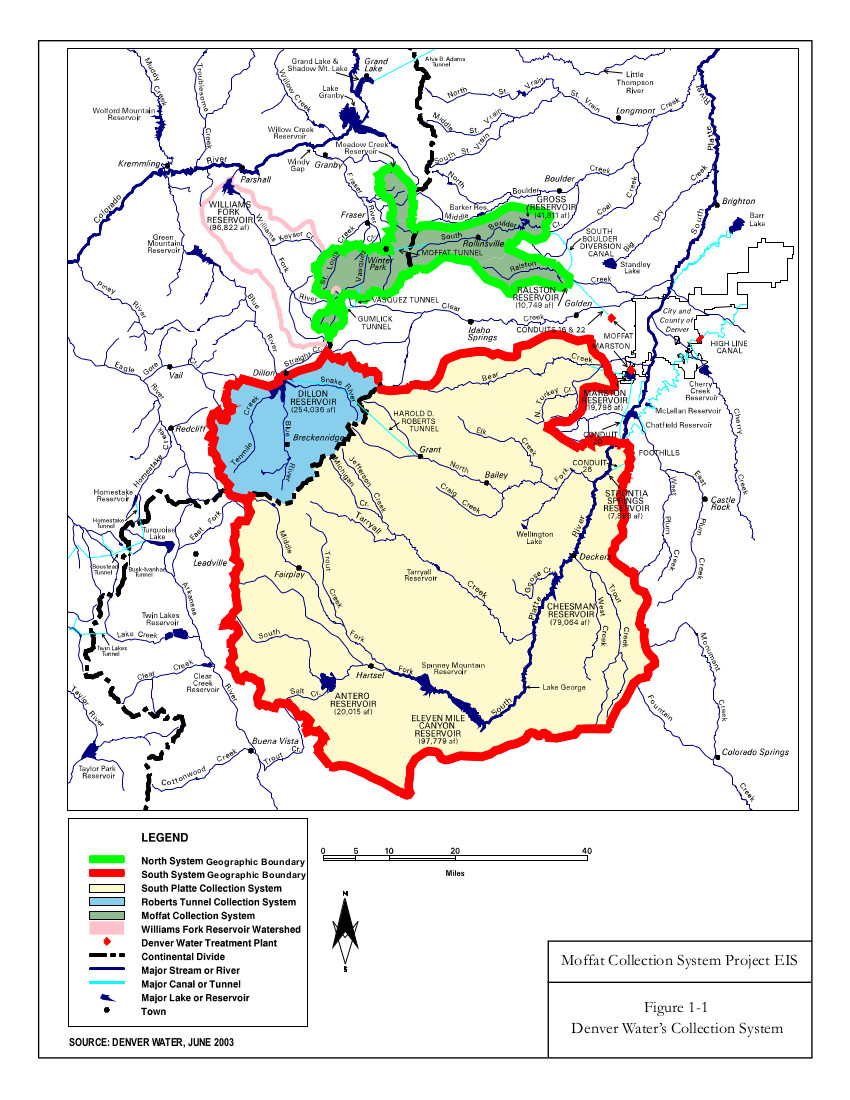
Water is flowing through parts of the 71-mile High Line Canal for the first time since May 2015. Denver Water is sending water down the canal from the South Platte River after replacing a 130-year-old diversion dam in Waterton Canyon.
In 2015, Colorado experienced a high spring runoff that destroyed the dam sitting 1.5 miles up the canyon. The wooden structure built between 1880 and 1883 washed away in the runoff. Denver Water successfully replaced the High Line Canal diversion structure in 2016.
Denver Water typically only runs water to the canal, with an 1879 water right, periodically from April to October. The water runs depend on the availability of South Platte River water and demand from irrigation customers. With the new dam complete, Denver Water is able to send water to the canal once again with the current conditions…
The High Line Canal starts in Douglas County at Waterton Canyon and runs to Green Valley Ranch in northeast Denver. The path of the canal falls within one mile of hundreds of thousands of residents.
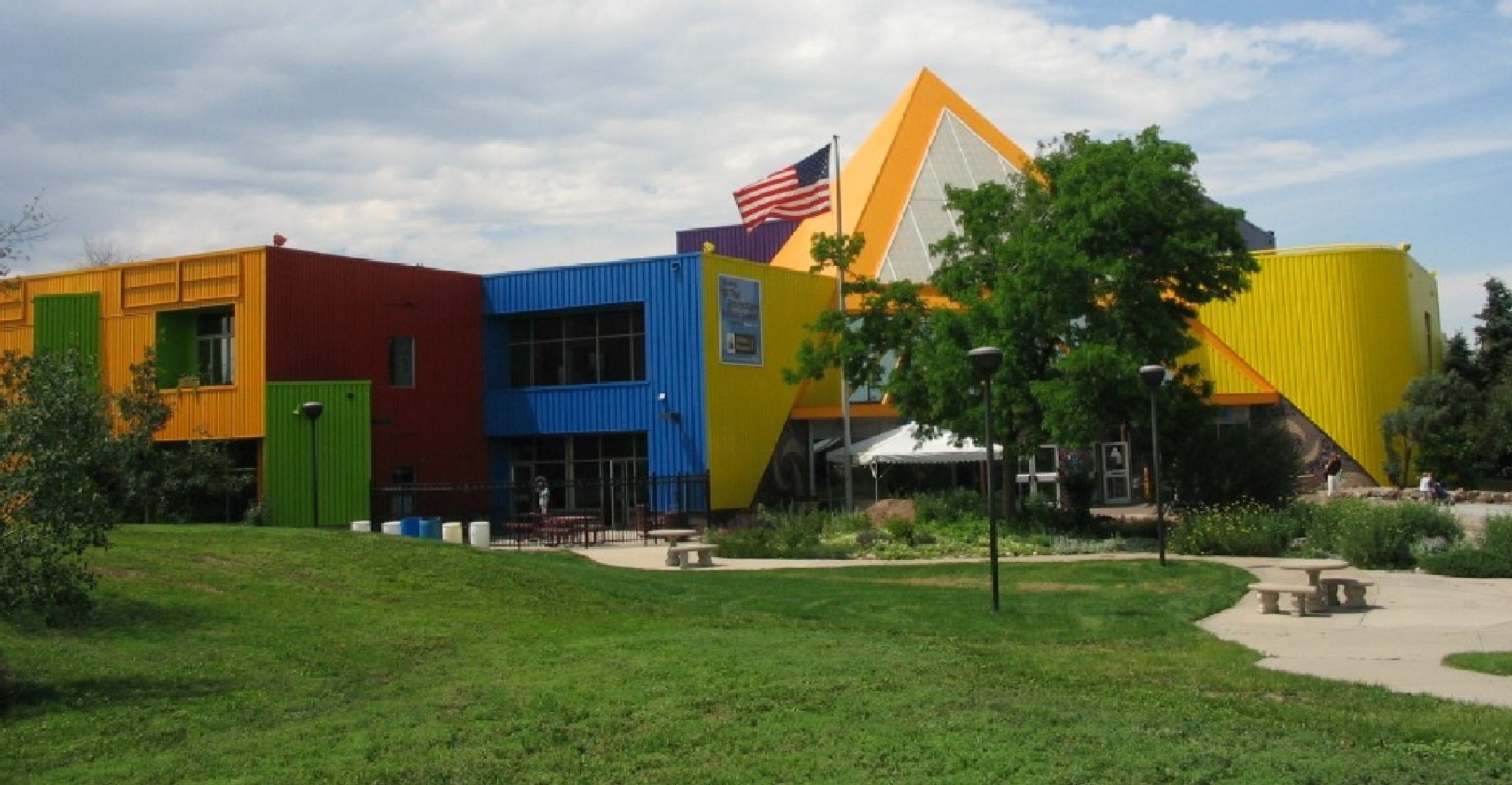
First established in a converted school bus 1973, the Children’s Museum of Denver opened its current building in 1984 and completed a substantial expansion in 2015. The hands-on, interactive exhibits are targeted toward newborn through eight-year-olds. The museum also offers a café, shop, school programs, field trips, and birthday party hosting. Photo credit TheClio.com.
Click here to read the newsletter. Here’s an excerpt:
Denver Water is partnering with Children’s Museum of Denver at Marsico Campus to bring you WATER — a 2,200-square-foot hands-in water laboratory that shows how people interact with water.
Our customers can experience the exhibit at a discounted rate from May 8 to 14.
Present your March or April bill at the museum and receive $1 off admission for each family member and 5 percent off gift shop purchases.
From triggering a thunderstorm to flushing a larger-than-life toilet, the exhibit provides opportunities for children and adults to experiment with water in everyday, yet remarkable ways.
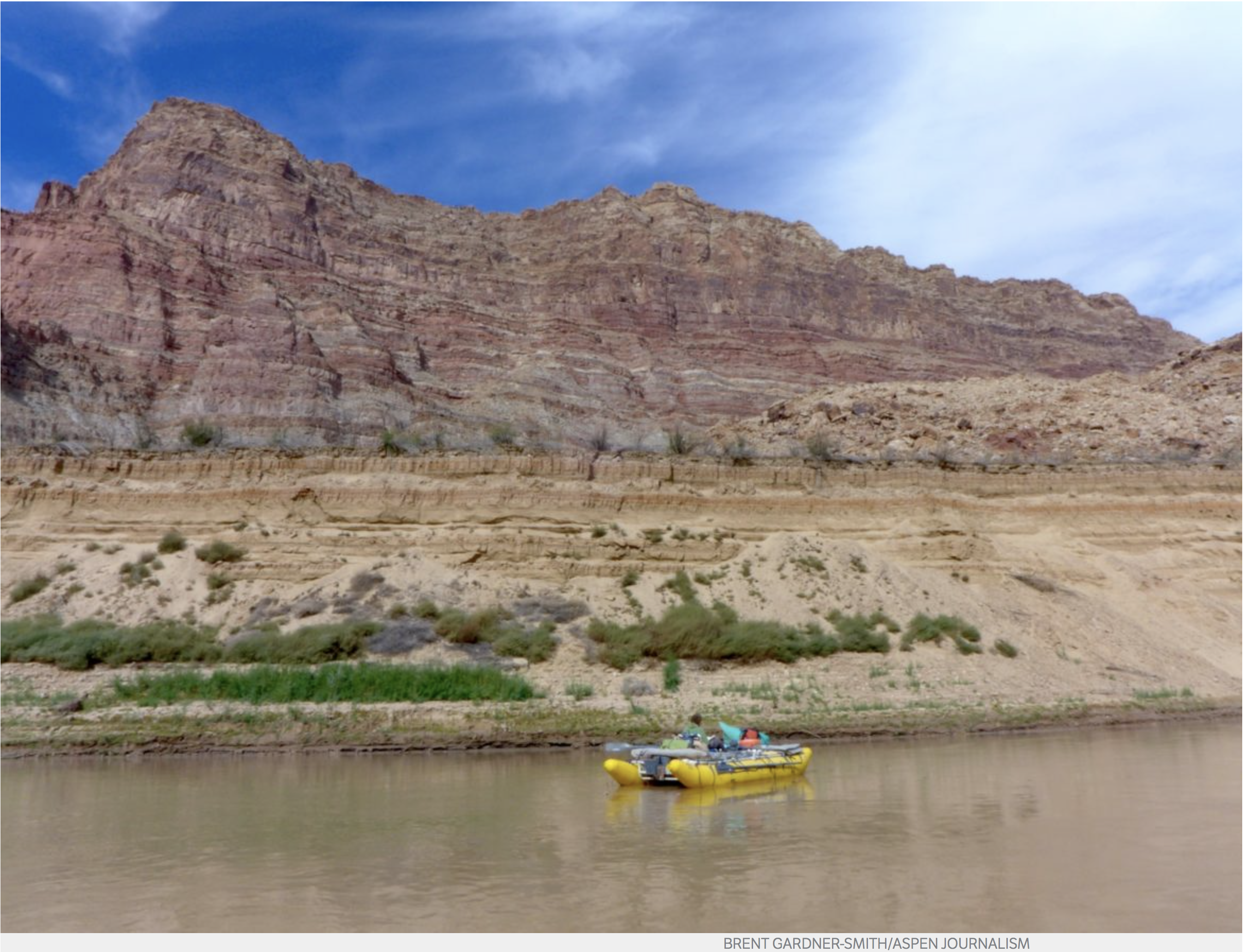
A raft floats past silt walls left on the Colorado River and revealed by dropping levels in Lake Powell, in October 2016. A risk study being undertaken by West Slope water interests wants to know who might have to someday divert less water to keep Lake Powell operational. Photo credit Brent Gardner-Smith.
GREELEY — A funding request for a West Slope water study to figure out how to keep enough water in Lake Powell became a hot potato last week and was tossed back and forth across Colorado’s Continental Divide.
Officials from four West Slope basin roundtables and two water conservation districts had asked the Colorado Water Conservation Board to contribute $40,000 toward the $100,000 cost of the second phase of a study looking into potential changes to regional water use during a severe drought.
But the chairs of three East Slope roundtables told the directors of the CWCB they didn’t feel comfortable with the first phase of the study or how the second phase was shaping up.
They recommended to the CWCB directors that they deny state money for the second phase. And if they did fund the study, to include a disclaimer saying it did not represent the views of the state.
The CWCB directors, meeting in Greeley last week, were suddenly caught between fractious basin roundtables, which have been praised in the past for their collaborative work on the 2015 Colorado Water Plan.
“There was a fuss,” Russ George, who represents the Colorado River basin on the CWCB, told the members of the Colorado basin roundtable in Glenwood Springs on Monday. “We’re of course sitting in periods of, probably, continuous shortages, continuous draw downs of the big reservoirs. I think everyone is as edgy as ever.
“It bothered us all to see that controversy just erupt,” George also said of the study request. “The touchiness still exists, even though we’ve made enormous progress in the last 10 and 12 years, as we all know, in working together and making decisions.”
After a flurry of last-minute negotiating, the CWCB directors voted March 24 to approve the requested $40,000 in state funding, but also agreed to the East Slope’s request to include a disclaimer in the study’s scope of work: “This work product is solely that of the applicants and the applicants do not claim that it represents the views or interests of the state of Colorado.”
Patricia Wells, a CWCB director representing the city and county of Denver, and who is general counsel for Denver Water, said of the study, “This isn’t the state’s position on anything. And it really belongs to the West Slope roundtables to help them make some decisions.”
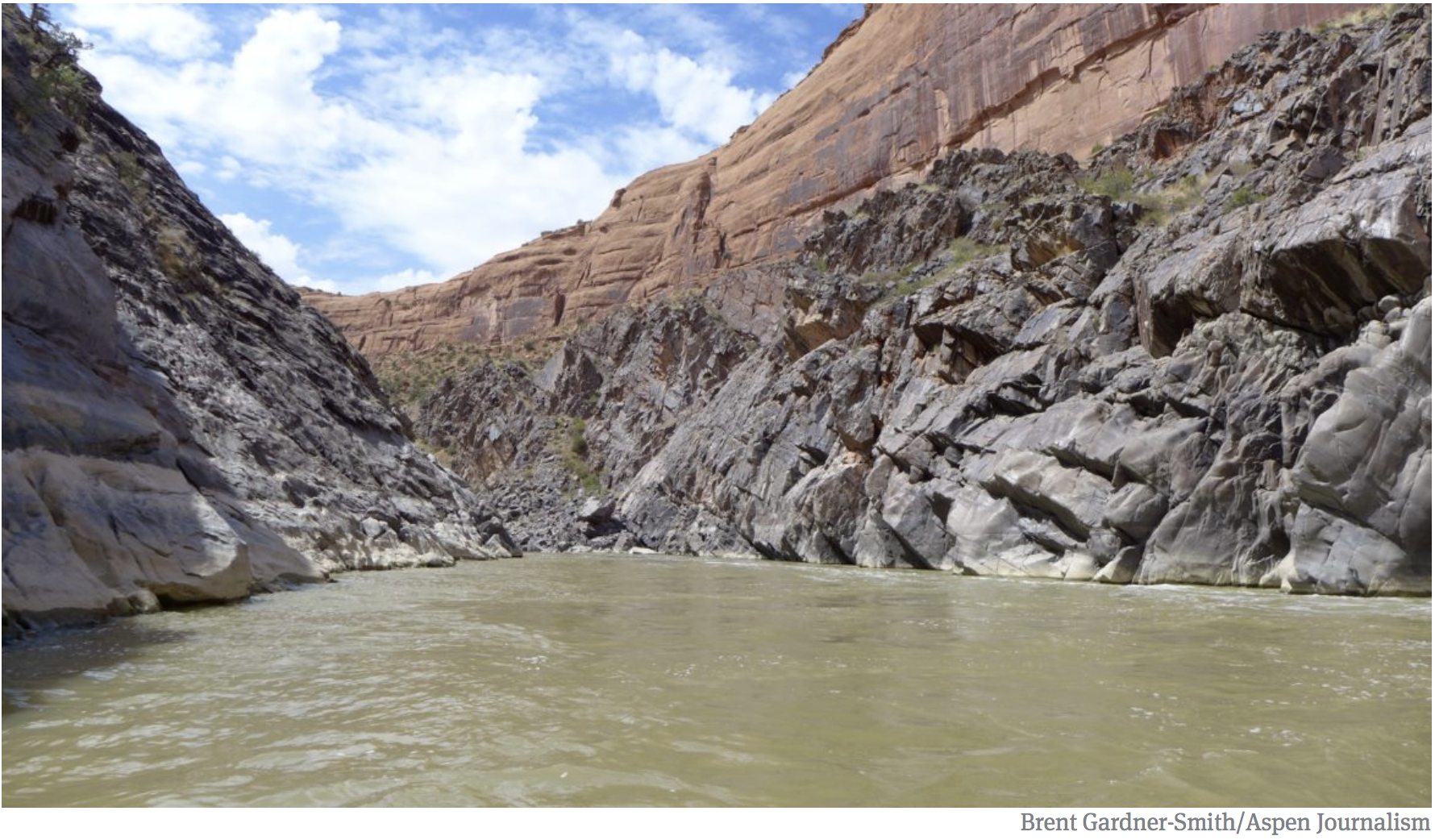
Much of the water that leaves Colorado bound for Lake Powell passes through Westwater Canyon. An ongoing study suggests that in the face of a severe drought, not enough water is left in the Colorado River basin to keep Lake Powell high enough, or Westwater wet enough. Photo credit Brent Gardner-Smith.
Divide emerges
The Colorado, Gunnison, Southwest, and Yampa/White/Green basin roundtables had recently all approved spending $10,000 from their allotments of state funds on what’s known as the risk study, and then sent a joint funding application for $40,000 to the CWCB directors, who must approve all roundtable grants.
And four western roundtables were being supported by another $30,000 each from the Colorado River Water Conservation District in Glenwood Springs and the Southwestern Water Conservation District in Durango.
Meanwhile, on the East Slope, the chairs of the South Platte, Metro, and Arkansas roundtables were united in their call for the CWCB to distance the state from the study.
“The East Slope roundtables strongly recommend that CWCB only be involved if it is part of an equal management partnership between all affected regions and the state,” a March 20 letter to the CWCB said.
The letter said the study should not be “biased toward any particular regional interests,” noting that “the discretion to define the modeling runs and their assumptions is retained by the Colorado River Water Conservation District,” which represents 15 West Slope counties.
The East Slope also said that the myriad assumptions used in the study’s hydraulic modeling would “afford great latitude to reflect certain desires and points of view that in turn implicate state water policy and East Slope interests.”
After the vote, Barbara Biggs, the chair of the Metro roundtable, which includes Denver and neighboring cities, told the CWCB directors that the decision to fund the study, even with the disclaimer, may not satisfy everybody.
“I’ll be very honest,” Biggs said. “I suspect I will not be welcomed with hugs and kisses by all of the members of my roundtable. I think they were hoping for more.”
Of chief concern to both east and west interests is the potential for a new transmountain diversion that would move more water to the East Slope.
“This is not a water availability study, but there are real limits on how much Colorado River water Colorado can consume without causing an unacceptable risk to existing users,” said a March 23 letter to the CWCB signed by the four West Slope roundtable chairs and the directors of the two conservation districts.
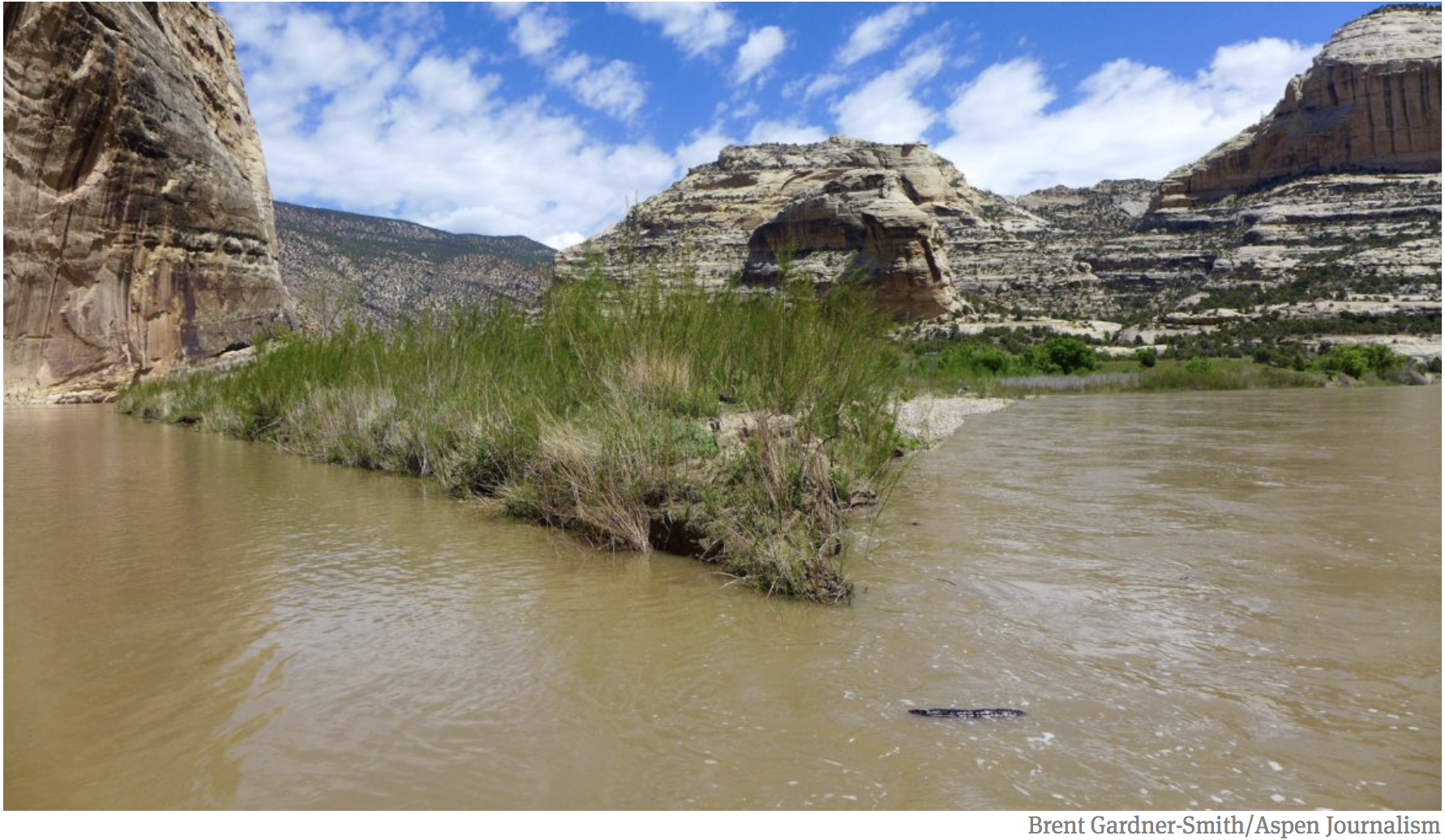
The confluence of the Green and Yampa rivers in 2016. How much water reaches this point, bound for Lake Powell, has implications across the West and Colorado, and an ongoing water study might suggest how to manage water in a severe drought. Photo credit Brent Gardner-Smith.
Risk ahead
Underlying the tension over the second phase of the study are the results of the first phase, which cost $52,000 and included $32,000 in state money from the CWCB.
“Droughts similar to those in the recent past could cause Lake Powell to, within a few years, drop to levels that jeopardize Glen Canyon Dam’s ability to generate electricity, and create a risk that the Upper Colorado River Basin would be unable to meet its delivery obligations under the 2007 Interim Guidelines and potentially the Colorado River Compact,” the grant application to the CWCB said, summarizing the study’s phase one findings.
It also said “the higher the consumptive use in the Upper Basin going forward, the greater the risk to all water users.”
One option being studied in the face of a severe-but-short drought is to send water to Lake Powell from large upstream reservoirs on the Green, Gunnison, and San Juan rivers.
But in a prolonged drought, “demand management” is also going to be necessary, the study indicated. Which means someone is going to have to divert less water and let if flow to Lake Powell.
“The intent of phase two is to further quantify the risks to water users in Colorado, by evaluating a number of scenarios with a variety of assumptions regarding the timing, location, volume and administrative requirements that could be imposed in order to make up a (Lake) Powell deficit,” the grant application stated.
The use of the word “imposed” did not likely escape notice on the Front Range.
After last week’s CWCB vote on the study, Wells from Denver said the second phase of the study did not need to be collaborative, and that the West Slope could explore water management scenarios on its own.
But she cautioned about wielding the results of the study as a weapon.
“If the modeling is used externally as a weapon in negotiations, as proof of something to the other states in the Colorado basin, then it’s a problem,” Wells said. But if it is not used that way, she said, then “the East Slope won’t have to be worried, and they won’t have to try to tear it down.”
Eric Kuhn, the director of the Colorado River District and the primary mover behind the risk study, described the outcome of the grant process as “good news,” as least in regard to the funding being approved and the study progressing to a second phase.
“The thought this time was that this one really does need to be focused with the West Slope,” Kuhn said. “The East Slope wanted to sort of participate at a higher level, at a management level. Our concern was we didn’t want the East Slope to interfere with the questions that the roundtables might have, in doing that.”
Kuhn also said the study, which is expected to be complete in the fall, would be done in “an open and transparent way.”
“If the East Slope is participating in it, if they are observing, we’re going to address them like we do everyone else, which is all input and all bodies are welcome to this open process,” he said.
Editor’s note: Aspen Journalism is collaborating with the Glenwood Springs Post Independent, Aspen Times, Vail Daily and Summit Daily News on coverage of rivers and water in the upper Colorado River basin. More at http://www.aspenjournalism.org.
From the Walton Family Foundation via The Villager:
The Walton Family Foundation has provided $400,000 in support of The Greenway Foundation and Denver Water pledge drive for the environmental pool at Chatfield Reservoir. If the pledge drive is successful, the foundation’s funding will purchase of 45 acre-feet of storage in the reservoir.
The pledge drive, announced last August, will add 500 acre-feet of environmental storage at Chatfield Reservoir through a community coalition. Denver Water has committed nearly $2 million to fund the purchase of 250 acre-feet of storage space in Chatfield — if The Greenway Foundation can raise the funds necessary to match that amount.
Ted Kowalski, who leads the Colorado River Initiative for the Walton Family Foundation, stated: “The foundation focuses on developing sustainable water management practices for the Colorado River basin. This innovative project pairs agricultural water users located downstream on the South Platte River with holders of existing storage located upstream at Chatfield Reservoir, to benefit both parties and the intervening riparian environment of the South Platte River. This could be a model for use throughout the Colorado River basin, and other basins.”
The 500 acre-feet of water would be added to the 1,600 acre-feet for an environmental pool being developed by Colorado Parks and Wildlife and the Colorado Water Conservation Board through the Chatfield Reallocation Project, for a total of 2,100 feet of storage.
The environmental pool will be set aside for releases of water that will provide environmental and water quality benefits to the South Platte River below Chatfield during low-flow periods of the year when additional stream flow levels are critically needed.
In addition to the commitment from the Walton Family Foundation for the 45 acre-feet of storage, the grant to The Greenway Foundation also provides funding for the creation of a management plan to maximize the effectiveness of the water releases to the South Platte River.
“The Greenway Foundation is grateful for the very generous grant from the Walton Family Foundation as well as Denver Water’s commitment for support through the fundraising challenge” said Jeff Shoemaker, The Greenway Foundation’s executive director. “Contributions to the environmental pool are a one-time only cost for environmental, water quality, and recreational benefits that will last for generations.”
The Greenway Foundation has secured the following additional commitments toward meeting the challenge grant from Denver Water:
City and County of Denver – 50 acre-feet
The Greenway Foundation – 10 acre-feet
The Colorado Parks Foundation – 10 acre-feet
Shoemaker Family – 10 acre-feet
Rinehart Family – 1 acre-foot
Capitol Representatives – 1 acre-foot
Total to date (to match Denver Water challenge): 82 acre-feet
Arapahoe County Open Spaces Program and the cities along the South Platte River within Arapahoe County are also actively working to make a contribution to purchase 50 acre-feet to the environmental pool. The jurisdictions collaborate as members of the South Platte Working Group, which is seeking to make funding commitments by the end of this year.
“Our goal is to enhance efforts to improve the urban reach of the South Platte River, helping to ultimately create a fishable river right in the heart of Denver,” said Denver Water CEO Jim Lochhead. “We believe that with the commitment of the community, this river that has been ignored can be healthy and beautiful to help ensure Denver remains a vibrant, exciting city.”
Outreach and engagement efforts are also underway with numerous additional public and private entities and individuals to secure the remaining support needed to meet the Denver Water challenge. The goal is to have commitments for the full 250 acre-feet by the end of August 2017.
The environmental pool storage will be filled by a water right owned by the Central Colorado Water Conservancy District, a major agricultural district downstream from Denver. Releases from the environmental pool will flow through the Denver metro area, providing environmental, recreational and water quality benefits, and then be used by Central for agriculture. Every drop of water in the environmental pool will provide multiple benefits.
The environmental pool is part of the overall Chatfield Reservoir Reallocation Project which, when completed in 2019, will allow for an additional 20,600 acre-feet to be stored in the reservoir.
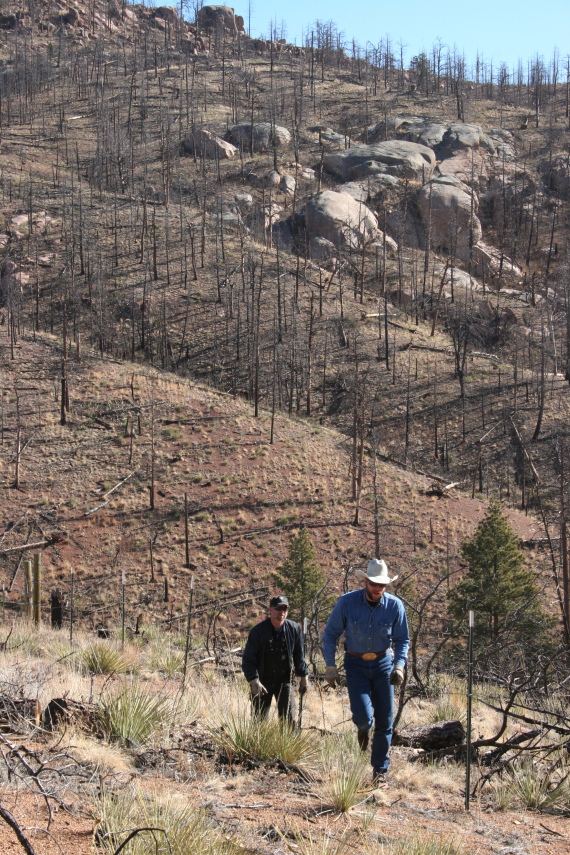
Denver Water is teaming up with federal and state forest services to take care of water sheds and keep drinking water clean.
That means logging dead trees in some of the areas around Denver Water reservoirs.
The company says it’s about health forests and clean water.
“The purpose of these treatments is not simply to plant trees and create a more forested area, but it is to create a more resilient ecosystem so that when fires do occur, they’re not occurring at the catastrophic level that will significantly impact our facilities,” said Denver Water CEO Jim Lochhead.
The agencies started working together in 2010 after some wildfires broke out including the Hayman Fire.
The “Forests to Faucets” deal signed by Denver Water, the Colorado State Forest Service, Natural Resources Conservation Service and U.S. Forest Service builds on a $33 million 2010 initiative that led to thinning on 48,000 acres of public land, utility officials said.
“We’ve seen tremendous results during the first five years of this partnership and we are excited to now expand the program to include private lands,” Denver Water manager Jim Lochhead said.
Logging contractors enlisted in the effort clear trees from beetle-ravaged forests where large wildfires and erosion threaten water supplies. Denver Water officials have said investing in forest health helps avoid having to un-clog reservoirs and water delivery systems later at far greater cost.
Water providers increasingly get involved in forest health because, with bug-infested trees dead and dying on millions of acres, weakened soils can erode, especially after fire and heavy rain. This means more sediment slumping into streams, rivers and reservoirs.
The idea is to reduce risks of large wildfires by creating spaces between trees in forests.
Federal forest service regional director Brian Ferebee called the partnership with Denver Water “trend-setting.”
“Together we will proactively work to conserve, maintain and restore watersheds, ecosystems and the services they provide Americans,” Ferebee said in a prepared statement.
The agreement renews partnership work Denver Water initiated in 2010 aimed at reducing the risk of catastrophic wildfires.
New restoration and “wildfire fuels reduction” projects will be done on more than 40,000 acres of watershed deemed critical, according to a U.S. Forest Service announcement.
Denver Water manager Jim Lochhead, U.S. Forest Service regional director Brian Ferebee, Colorado State Forest Service director Mike Lester and Natural Resources Conservation Service director Clint Evan were to sign the latest deal Monday in Denver at the History Colorado Center.
The forest health work has involved clearing trees from beetle-ravaged forests where fire and erosion increasingly threaten water supplies. Lochhead has said investing in forest health helps avoid having to deal with the problem later at a much greater cost.
Water providers have ventured into forest management work because, with bug-infested trees dead and dying on millions of acres of Western forests, weakened soils can erode, especially after fire and heavy rain, releasing sediment into streams, rivers and reservoirs.
After the Buffalo Creek Fire, Denver Water had to spend $30 million dredging and unclogging the city’s Strontia Springs reservoir. An estimated 625,000 cubic yards of sediment from surrounding mountainsides, enough to cover a football field 200 feet high, slumped into the reservoir.
Federal officials have warned repeatedly in recent years that the nation’s forests are threatened like never before. The previous forest health work plan called for thinning 6,000 acres of dense forest near Denver Water’s Dillon reservoir. Denver Water and the Forest Service each contributed about $16.5 million for the work. The forest health deals create work for logging contractors.
Colorado River headwaters tributary in Rocky Mountain National Park photo via Greg Hobbs.
Here’s a guest column from Paul Bruchez that is running in Steamboat Today:
A few years ago, I saw an opportunity to fix the irrigation problems while also improving river and wildlife habitat. My family’s ranch is in one of the most intact traditional agricultural communities remaining in Colorado. Like most ranchers, we’re independent folks — but in a pinch, we know we can count on each other.
Our neighbors came together and agreed on the need for action. Our group of 11 private ranches and the Bureau of Land Management, the irrigators of lands in the vicinity of Kremmling, received a couple of grants for a pilot project to restore a riffle/pool structure on a stretch of the river. It was an exciting start.
But I quickly realized that, given the scale of the problems, we needed to think bigger.
We worked with a variety of partners — Trout Unlimited, American Rivers, the Colorado Basin Roundtable, the Colorado Water Conservation Board, Grand County government, Northern Water, Denver Water, Colorado Parks and Wildlife, the Upper Colorado River Alliance, the Colorado River District and other river stakeholders — to put together an ambitious proposal for restoring a significant stretch of the Upper Colorado River.
In December, the U.S. Department of Agriculture’s Natural Resources Conservation Service recognized that big vision, awarding ILVK and our partners $7.75 million under the Regional Conservation Partnership Program to improve irrigation systems and reverse the decline in water quality and fish habitat in the headwaters of the Colorado River.
This funding is an amazing win for all Coloradans, because a healthy Colorado River sustains all our lives.
The Colorado River Headwaters Project will install several innovative instream structures designed to improve water levels for irrigation, while enhancing critical river habitat by rebuilding riffles and pool structure. A crucial piece will be restoring approximately one mile of the Colorado River’s former channel, currently inundated by Windy Gap Reservoir. This ambitious bypass project will reconnect the river — for the first time in decades — and improve river habitat in the headwaters area.
When fully implemented, the Headwaters Project will directly benefit more than 30 miles of the Colorado River and 4,500 acres of irrigated lands and make available up to 11,000 acre-feet of water to improve the river during low-flow conditions.
What have I learned from this project? That the interests of agriculture producers can align with the interests of conservation groups, state agencies, water providers and other river users. It’s not just the waters of the Colorado River that are connected — so are the people who depend on it.
The Colorado River flows through all of our lives. By working together, we can find smart, creative solutions that keep the Colorado healthy and working for all of us.
Paul Bruchez is a rancher who lives near Kremling.
Denver Water, which serves 1.4 million people in the city and county of Denver and surrounding communities, is currently waiting for a permitting decision to be issued by the U.S. Army Corps of Engineers on its proposed expansion of Gross Reservoir, located in southwestern Boulder County.
The USFS has filed extensive past comments critical of the Gross Reservoir project, but now says all of its concerns about that project have been resolved.
Critics, however, point to a five-year, $4.5 million contract providing Denver Water funding for the original Forsythe project as well as numerous other Colorado forest management efforts — talks are now underway for a new five-year pact for Denver Water to help subsidize projects, including Forsythe II — and they challenge the level of transparency surrounding that wildlands management initiative.
Denver Water touts its relationship with the Forest Service on its website, billed since 2010 as the “From Forests to Faucets” program. That partnership called for Denver Water from 2010 to 2015 to match a $16.5 million investment from the Forest Service, for a total of $33 million, for forest treatment projects seen as critical to protecting water supplies and water quality.
A memorandum of understanding was signed by Denver Water in December for a similar new agreement between the two, setting up a new one-to-one matching effort totaling another $33 million, to cover 2017 to 2021.
The Colorado State Forest Service was also a partner to the previous pact, and will be to its successor, along with the Natural Resources Conservation Service.
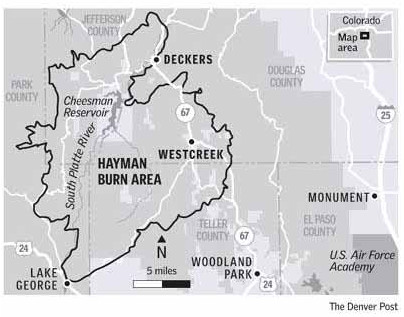
Colorado saw a dramatic example of the healthy forests-healthy water link following the June 2002 Hayman fire, which filled Cheesman Reservoir — the oldest reservoir in the Denver Water system — with mud, ash and other debris.
Denver Water was forced to spend more than $27 million on water quality treatment, sediment and debris removal, reclamation techniques and infrastructure projects in the wake of the Hayman Fire and the 1996 Buffalo Creek Fire, according to Denver Water spokesman Travis Thompson.
But Magnolia-area resident David Bahr sees the Denver Water-USFS relationship as “absolutely” representing a conflict of interest, specifically as it applies to the controversial Forsythe projects in western Boulder County.
“How can it not be?” Bahr asked. “The fact that (USFA) employees and goods are being paid for by Denver Water means that if they weren’t doing this, those employees wouldn’t be getting paid. The Forest Service has to be aware of this, so it has to influence any decisions that they make.”
Vivian Long, president of the Magnolia Forest Group, has long been vocal in opposition to the original Forsythe project and its planned successor, Forsythe II, which calls for thinning and controlled burns on 2,855 acres of national forest land within the nearly 19,000-acre project area, to be carried out over 10 to 15 years.
“While they’re saying, ‘We’re taking money from Denver Water, but they have no input on what we do,’ I don’t know if that’s true or not,” Long said. “When we have asked about them taking money from Denver Water, they have tried to either downplay it, or deny, or just say they don’t know anything about it. So we’re left wondering, whose opinion is more important here: the public’s or Denver Water?”
Paperwork documenting the Denver Water-USFS relationship was obtained by Magnolia Forest Group member Teagen Blakey through Colorado Open Records Act requests…
Forsythe II critics point out that in March 2010, the Forest Service filed 142 pages of comments on the Gross Reservoir project with the Corps of Engineers highlighting many concerns, including the adequacy of Denver Water’s consideration for habitat and wildlife issues in the Arapaho and Roosevelt National Forests.
That same year, the Forest Service signed off on the five-year operating plan for Denver Water to pitch in $4,479,251 toward improving forest and watershed health on national forest lands in numerous Colorado watersheds designated as Denver Water “Zones of Concern,” including the St. Vrain Watershed, home to Gross Reservoir.
To date, $660,000 of that Denver Water money has gone toward Forsythe work, according to Arapaho & Roosevelt National Forests spokeswoman Tammy Williams.
On Oct. 17, the Forest Service and Denver Water agreed on a lengthy agreement settling any concerns over Gross Reservoir, which it states “resolves all issues raised by the Forest Service during the consultation process” relating to the Gross Reservoir expansion
Clark Chapman, vice president of the Magnolia Forest Group, is among those wondering why the Forest Service is seeming now to soft-pedal habitat concerns around both Forsythe II and Gross Reservoir…
Tammy Williams, the USFS spokeswoman, said there is no conflict of interest inherent in Denver Water’s pushing for Gross Reservoir and funding Forsythe forest work at the same time.
“Gross Reservoir was independently analyzed and considered separate and apart from the Forsythe II project,” she wrote in an email. “These projects are being proposed by different agencies, these are independent processes, with independent timelines and different decision makers.”
[…]
The western half of Gross Reservoir, as it is currently configured, is encompassed by the southeastern corner of the Forsythe II project area. But despite their proximity, the Forest Service maintains that its evaluation of Forsythe II is not influenced by its relationship with Denver Water.
For decades, the [Colorado River] has fed growing cities from Denver to Los Angeles. A lot of the produce in supermarkets across the country was grown with Colorado River water. But with climate change, and severe drought, the river is reaching a crisis point, and communities at each end of it are reacting very differently…
The problem is that Colorado’s population will nearly double by 2050. Future residents will need more water. Denver Water CEO Jim Lochhead says more storage is part of the solution. It’s also an insurance policy against future drought.
“From Denver Water’s perspective, if we can’t provide clean, reliable, sustainable water 100 years from now to our customers, we’re not doing our job,” Lochhead says.
Demand for Colorado River water is already stretched thin. So it may sound crazy that places like Colorado and Wyoming want to develop more water projects. Legally, that’s something they are entitled to do.
Wyoming is studying whether to store more water from a Colorado River tributary. “We feel we have some room to grow, but we understand that growth comes with risk,” says Pat Tyrrell, who oversees Wyoming’s water rights.
Risk because in 10 or 20 years there may not be enough water to fill up expanded reservoirs. A 16-year drought has dramatically decreased water supply even as demand keeps growing. And climate change could make this picture worse.
It makes Tyrrell’s job feel impossible.
“You understand the reality today of a low water supply,” he says. “You also know that you’re going to have permit applications coming in to develop more water. What do you do?”
Tyrrell says that as long as water is available, Wyoming will very likely keep finding new ways to store it. But a future with less water is coming.
In California, that future of cutbacks has already arrived. The water that started in Colorado flows more than 1,000 miles to greater Los Angeles.
So even in the sixth year of California’s drought, some lawns are still green.
“Slowly but surely, the entire supply on Colorado River has become less reliable,” says Jeffrey Kightlinger, who manages the Metropolitan Water District in Southern California. He notes that the water level in Lake Mead, the biggest reservoir on the river, has been plummeting.
An official shortage could be declared next winter. “And that’ll be a historic moment,” Kightlinger says.
It’s never happened before. Arizona and Nevada would be forced to cut back on how much water they draw from the river. California would be spared that fate, because it has senior water rights. So you wouldn’t expect to hear what Kightlinger says next.
“We are having voluntary discussions with Arizona and Nevada about what we would do proactively to help,” he says.
California could help by giving up water before it has to, between 5 percent and 8 percent of its supply. Kightlinger isn’t offering this out of the goodness of his heart; if Lake Mead drops too low, the federal government could step in and reallocate all the water, including California’s.
“We all realize if we model the future and we build in climate change, we could be in a world of hurt if we do nothing,” Kightlinger says.
This idea of cooperation is somewhat revolutionary after years of lawsuits and bad blood.
Recently, farmer Steve Benson was checking on one of his alfalfa fields near the Mexican border. “We know there’s a target on our back in the Imperial Valley for the amount of water we use,” he says.
This valley produces two-thirds of the country’s vegetables in the winter — with water from the Colorado River.
In fact, for decades, California used more than its legal share of the river and had to cut back in 2003. This area, the Imperial Irrigation District, took the painful step of transferring some of its water to cities like San Diego.
Bruce Kuhn voted on that water transfer as a board member of the district. “It was the single hardest decision I have ever made in my life,” he says.
Kuhn ended up casting the deciding vote to share water, which meant some farmers have had to fallow their land.
“It cost me some friends,” he says. “I mean, we still talk but it isn’t the same.”
Soon, Kuhn may have to make another painful decision about whether California should give up water to Arizona and Nevada. With an emergency shortage looming, Kuhn may have no choice.
Colorado’s economy depends on water: where it is, where the people who need it live and work, who has rights to it. Fights over those needs are a core part of the state’s history, and they tend to follow a pattern. So in some ways, the fight over the Fraser River in Colorado’s Grand County is familiar.
Denver Water holds unused water rights on the river, which starts in the shadow of Berthoud Pass and courses down the western side of the Continental Divide past Winter Park, Fraser and Tabernash to join the Colorado River outside of Granby.
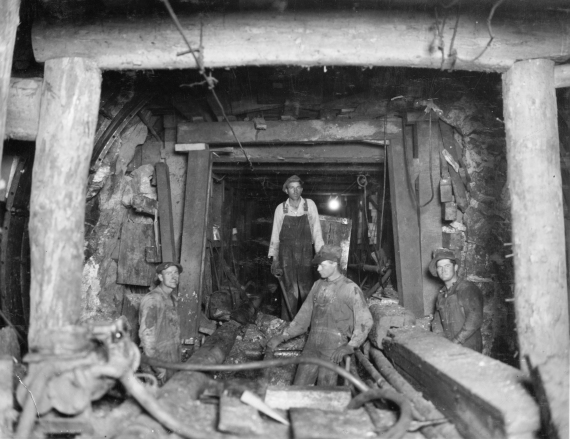
Workers pose for a photo in the Moffat Water Tunnel in this 1930 photo.
The agency, looking at the booming population and economy in Denver, now wants to exercise those rights. That means taking more water from the river, piping it under the Indian Peaks and sending it into Gross Reservoir near Boulder.
Some conservationists and environmental groups are crying foul, saying that the river has already been overtaxed (about 60 percent of its existing flow is already diverted to slake Denver’s growing thirst) and it’s time to let the river alone.
But the fight’s pattern is taking some unfamiliar twists and turns. Influential groups like Trout Unlimited and American Rivers, who’ve historically fought diversion projects, support this one. In exchange, Denver Water says it will will help protect and enhance what’s left of the Fraser River.
That compromise has fractured traditional lines in Colorado’s conservation and environmental advocacy community, and fostered new alliances. While these organizations more or less agree on their ultimate goal — to protect and restore the environment — the strategies they use are very different. The big question that divides them: When to compromise?
Denver Water Extends An Olive Branch
Decades ago, environmentalists were not at the top of list of Denver Water’s concerns when it would try to build dams and add capacity. In the 1980s, environmental groups pushed back on a huge proposed dam called Two Forks.
“[Denver Water] told us in so many words: ‘We’re the experts. You’re little environmentalists. Get out of the way,’ ” Dan Luecke, then head of Environmental Defense Fund’s Rocky Mountain office, told High Country News in 2000.
Then, in 1990, an EPA veto torpedoed the project at the last minute.
“That was really a turning point for our organization,” said Kevin Urie, a scientist who’s worked for Denver Water for nearly 30 years. “I think we realized with the veto of Two Forks that we needed to think about things differently.”
He believes that while Denver Water has long taken environmental impacts into consideration with its plans, it didn’t engage with local stakeholders — like conservation and environmental groups and Western Slope governments — until after the Two Forks project died.
There’s a demographic change underway as well: Many of the Denver metro area’s new residents also want to play in Western Slope rivers on the weekends. That has pushed Denver Water leadership to put a larger emphasis on environmental stewardship, Urie said.
But all those new residents still need water. Denver Water delivers water to about 1.4 million people across the metro, about double what it did some 60 years ago. Conservation efforts have kept overall demand relatively low in recent years. But with more people moving to Denver every day, Denver Water expects its demand to rise 37 percent by 2032 from 2002 levels.
The Fraser River is key to Denver Water’s plan to head off a shortfall in the relatively near future. The agency wants to divert half of the remaining flows from the Fraser and its tributaries through the Moffat Tunnel to Gross Reservoir near Boulder. (The proposed expansion of Gross has started its own fight, which CPR News’ Grace Hood chronicled last month.) It would be treated at the agency’s plant in Lakewood, and eventually delivered to customers across the metro.
The agency expects to have all of its necessary permits by 2018 and construction could begin in 2019 or 2020. But to get those permits, Denver Water has agreed to be part of a group that includes Grand County officials and environmentalists called “Learning by Doing.” These different players are often at odds when it comes to water issues.
Urie said Denver Water’s participation shows its desire to do right by the environment and local stakeholders. They’ve helped fund an ambitious project that will engineer the Fraser River’s flow on a nearly mile-long stretch between Fraser and Tabernash, squeezing it to make it narrower, deeper and colder — and thus healthier.
But is that what’s best for the river?
Urie thought about that question for a minute, and then chose his words carefully:
“Clearly the system would be better if we weren’t using the water resources for other uses. But that’s not the scenario we are dealing with,” Urie said.
Trout Unlimited Sees Opportunity
The Fraser River project’s biggest booster is Kirk Klancke, president of the Colorado River Headwaters Chapter of Trout Unlimited. For him personally, it’s a way to help a river that he’s lived near and played in for 45 years.
“I can’t talk about it without getting all emotional. My life’s been spent on this river,” he said.
He sees it as a chance to restore a part of the river popular with anglers called the Fraser Flats. Here, the brush-lined river levels out after tumbling through the pine forests of Berthoud Pass.
His playground is popular with others, too. Grand County is a short one- to two-hour drive from Denver. From fly fishing to alpine and nordic skiing to snowmobiling, it’s a tourist-based economy. And in Klancke’s eyes, all of that rests on the health of its water.
He’s watched the river dwindle and get warmer as more water has been pulled out of it. And that’s changed how his family has used it. When his children were young, they could stay in the river for only a minute or two.
“They’d come out and their lips would be purple and they’d be squealing,” Klancke said. “Now I throw my grandchildren in the river and they’re not in a hurry to get out. We spend up to an hour in a pool in the river.”
He’s watched this river that means so much to him get sicker and sicker; warm, shallow channels aren’t suitable for native fish and bugs. For years, he blamed the deteriorating environment on the Front Range and its water managers.
“I was a little radical because I urinated in diversion ditches. It’s about all I knew to do. I’ve matured quite a bit since then,” he said.
His turning point came when he got involved with Trout Unlimited.
“I loved their approach,” he said. “They were able to look at it in someone else’s shoes, which is what all mature people do. And then, move forward with opening up conversation.”
Such conversations are what led to the Fraser Flats project, Klancke said. When flows are low, like they were this fall, the river is shallow as it stretches across its native bed. The new channel will allow the river to recede and stay deeper — and cooler.
Essentially, that stretch of river will be turned into a creek. On its face, downsizing a river doesn’t sound like a big victory for environmentalists. But that’s not how Klancke looks at it. During peak flows in the spring, Klancke points out, the river will be nearly just as wild as it is now.
And moreover, Denver Water has to stay involved in the Learning by Doing group. So if environmental issues arise down the road, Klancke said the agency will be there to help solve them.
Is it a compromise? Yes, Klancke admits. But water managers own water rights in the upper Colorado Basin that they’ll use — with or without his blessing. The right to divert water for “beneficial uses” is enshrined in the Colorado Constitution.
“We have to face reality here,” Klancke said. “There is no more mighty Upper Colorado. There’s only keeping what’s left healthy.” [ed. emphasis mine]
WildEarth Guardians Stakes Out Moral High Ground
Like Klancke, Jen Pelz, wild river program director for WildEarth Guardians, has had her own evolution in thought toward environmental causes. Earlier in her career, she was a water lawyer in Denver who represented clients like the city of Pueblo that were taking water from Western Slope rivers.
But eventually she felt a pull toward environmental advocacy. Pelz credits that with childhood days spent on the banks of a tributary to the Rio Grande in New Mexico.
“It was kind of the place that I could go just be myself,” she said. “I developed a really strong connection to the river there.”
She was drawn to the confrontational, no-holds-barred approach used by WildEarth Guardians. The group is known for its headline-grabbing lawsuits. Most recently they sued the federal government over haze in Western Colorado and leases to coal mines.
The approach seems to be working, at least by WildEarth Guardian’s measure. The haze lawsuit ended in an agreement where a coal mine and coal-fired power plant in Nucla, south of Grand Junction, will shut down in the next six years. A power plant in Craig, Colorado will shut down one of its units too.
“We’re willing to not be liked by the general public, or by particular industries,” Pelz said. “And I think it takes that kind of moral integrity and just knowing where you stand on the issues, to really push the envelope.” [ed. emphasis mine]
Pelz is not interested in compromise on the Fraser River. She faults Trout Unlimited for starting negotiations at the wrong place. In her view, the baseline shouldn’t be where the river is now with about 60 percent of it being diverted. The conversation needs to start with the river at its natural flows, she said.
“The harm has already been done,” Pelz said.
If the Fraser River is going to be saved, she says, it’ll happen by letting more water back into the river — not by taking more out. As the climate warms, she says the river will need all the help it can get.
“Let’s start dealing with it now. Let’s have that hard conversation now, not 50 years from now when there’s no water left to have a conversation about,” she says.
Pelz says her organization, and another group called Save the Colorado, are considering litigation once final permits are approved. That could happen in 2018.
Such tactics doesn’t make Pelz a lot of friends. She said she’s been ostracized from her former clique of water lawyers. It’s hard for her to get meetings with government regulators.
WildEarth Guardians’ relationship with the greater environmental community is similarly strained. She said Denver Water is more willing to meet with environmentalists now because they’ve softened. And she’s upset with what Trout Unlimited has become in the eyes of regulators.
“Trout Unlimited has been deemed by Denver Water and the state of Colorado as being the environmental voice,” Pelz said. “They get invited to the table because they have this role in communities, which I don’t think is a bad thing, but they don’t necessarily represent all of the different interests in the environmental community.”
As a result, she said, groups like hers are being left out of the conversation.
“They don’t talk to us. They don’t ask us what we think. And I’ve called them. And I’ve had meetings with them. I’ve asked them what they think. And they’ve told me they don’t like our approach. And I understand that. But I think that it works both ways.”
Pelz said it can be hard to be out “towing the left line.” Everybody likes to be liked, she said. But she’s decided that over the long run, her methods are what will make a difference. To do anything else would be surrender.
“I don’t want to have to explain to my kids that I gave up the fight for this river that is the namesake of our state, the state they were born in, because I was willing to compromise,” she said. “We may not win, but damn we are going to try.”
American Rivers Finds Room To Maneuver
When Matt Rice, Colorado River basin director for American Rivers took the job a few years ago, he made the decision to put aside his dreams for what he really wanted. Instead, he focuses on what he thinks he can actually pull off.
“In a perfect world, I’d like to see all the wild rivers in this country and in this state flowing freely and filled with fish, doing what rivers should do,” Rice said. “It’s not realistic.”
But he acknowledges that groups like WildEarth Guardians can make his job easier at times. When Guardians files a lawsuit and makes a bunch of people mad, a group like his can step in and talk with state regulators and businesses. Guardians essentially provides cover for groups closer to the political center, he said.
“Their advocacy pushes everybody, not just conservation organizations, kind of further to the left. And I think that’s good,” Rice said.
But there’s a downside. Lawsuits and sharply worded press releases can sting, and are not easily forgotten. And Rice worries that aggressive tactics from far-left groups lead to skeptical parties like ranchers or Front Range water managers lumping all environmentalists together.
“That has the potential to undermine the progress we’re making,” he said.
Looking To The Future
A screenshot from the website for Colorado’s Water Plan.
With the publication of last year’s Colorado Water Plan, a first for the state, officials are trying to turn the page on Colorado’s long fight over water. The plan, which officials describe as a roadmap to sustainability, stresses collaboration between competing interests and conservation of the increasingly precious resource.
“Now is the time to rethink how we can be more efficient,” Gov. John Hickenlooper said at the water plan’s introduction in November 2015.
Diverting more water should be the last-possible solution, Hickenlooper said. That’s welcome news to environmentalists like Matt Rice of American Rivers.
Rice said they are supportive of the Fraser River diversion plan for the same reasons Trout Unlimited is, though they aren’t part of the Learning by Doing group. But he hopes the Fraser diversion, and another major project in the works called Windy Gap, are the last trans-mountain diversion projects.
There just isn’t enough water on the Western Slope, he said. And if another one comes up, Rice said they’ll fight it with everything they have.
“We’re kind of at the cliff right now in the Colorado River Basin,” he said.
Collaboration and compromise will certainly be part of environmentalism’s future in Colorado. But as groups like WildEarth Guardians continue to find success in the courts, the advocacy ecosystem has room for other strategies too.
FromThe Grand Junction Daily Sentinel (Dennis Webb):
The head of the Colorado River District is defending an ongoing water study from Front Range concerns about its intent and possible regional bias.
Eric Kuhn, the district’s general manager, says while Front Range water interests view the project as a water supply study, that’s not the case.
“It was a how-should-we-be-prepared-for-another-drought study,” he said Monday in providing an update to the Colorado Basin Roundtable water group.
The first phase of a study undertaken by the four Western Slope river basin roundtables, with the leadership of the river district and Southwestern Water Conservation District, found that another severe drought such as the one in the early 2000s could cause enough of a drop in Lake Powell to jeopardize Glen Canyon Dam’s ability to generate electricity. It also could create a risk of Colorado and other Upper Colorado River Basin states being unable to meet their downstream water delivery obligations under a 1922 interstate compact and under guidelines established in 2007. That could result in a cutback in Upper Basin water uses.
The Western Slope is now planning a second phase of the study that would cost about $90,000. The goal is to further quantify the drought risks to water users in the state by looking at use-reduction scenarios for making up for a deficit of water in Powell.
Four Western Slope roundtables are asking the Colorado Water Conservation Board for $10,000 apiece, or $40,000 total, for the study’s second phase, with the river district and Southwest district splitting the difference. But Jim Lochhead, chief executive officer and manager of Denver Water and president of the Front Range Water Council utilities group, has written a letter arguing that such a study would be best conducted at a statewide or Upper Colorado River Basin level, “with all interested water users represented, rather than by particular sub regions or individual roundtables.”
Some of the proposed involuntary water-use curtailment alternatives in the study’s second phase “potentially favor limited special interests,” Lochhead wrote, stressing the need instead for a state-led discussion that considers all interests.
He also voiced the council’s concern that assumptions used in phase one “may be creating biased impressions regarding the amount of the remaining developable water” in the Colorado River Basin, and that phase one may be viewed by some outside the state “as representative of the State of Colorado’s position on remaining developable water.”
How much of that water remains to be developed is a sensitive issue for the Western Slope, where most of Colorado’s water originates, and for the Front Range, which diverts a substantial amount of Colorado River water and wants to divert more.
Kuhn says the study is simply intended to contribute toward developing a collaborative program for avoiding Colorado River compact problems for existing uses and some reasonable amount of new uses on the Western Slope. Collaboration aimed at heading off such curtailments on use due to interstate obligations was identified in the new state water plan as one of seven principles for guiding any discussions of new transmountain diversions out of the river basin.
The CWCB’s director, James Eklund, has agreed to head up meetings aimed at resolving Front Range concerns about the study and its funding. Kuhn said he sees the result being that the state has a bigger say in the study’s scope of work, not that it takes over the study altogether.
Colorado transmountain diversions via the State Engineer’s office
The old ecological and political order is crumbling. When calculations are complete, 2016 will be the hottest year on record, surpassing a mark set one year ago. The oceans are rising at an increasing rate. In the American West, it is too warm and dry this month for snow, delaying the accumulation of a natural water reserve that cities, farms, and fisheries rely on during the summer. Politics are no less turbulent. After the U.S. election, domestic regulations affecting energy development, infrastructure spending, and water supplies are in flux. Allies in the struggle to slow global carbon pollution ponder America’s commitment to the Paris Agreement, which went into effect earlier this month.
To navigate the peril, managers need to understand the concept of “deep uncertainty,” argues Robert Lempert, the president of the Society for Decision Making Under Deep Uncertainty, whose mission is to help leaders make better decisions for water, energy, and food systems in a time of rapid environmental and social change.
Uncertainty implies that managers know the potential outcomes of their actions and the probability that they occur. Think of flipping a coin. The result of any particular toss is unknown — but the potential outcomes and the probabilities are not. Fifty percent chance of heads, fifty percent chance of tails.
Formed last December after three years of workshops, the society holds its first official conference on November 16 and 17 in Washington, D.C.
Deep uncertainty acknowledges a dynamic system where inputs — such as rainfall or economic growth or regulations — are changing or unknown. Water utility plans, for instance. These documents often look decades ahead. Actions today — building a desalination plant or increasing the size of a reservoir — will resonate for a generation or more. The deep uncertainty method is about planning for multiple possible futures and finding comfort in complex decisions that may need to be revised.
“Even today, particularly consequential things can surprise you,” Lempert told Circle of Blue the day after Donald Trump was elected U.S. president.
Laurna Kaatz photo credit Aspen Global Change Institute.
Whatever the Future May Hold
Denver Water is one of the utilities that uses deep uncertainty tools in its planning. Laurna Kaatz, a climate scientist and Denver Water’s adaptation program manager, helped form the society and is one of its “practitioners” — those who make decisions at public agencies.
About one-third of society members are utility planners or managers, like Kaatz. The others are academics or they have a foot in both worlds. Their professional backgrounds are diverse: energy utilities, insurance groups, economists, computer modeling whizzes. The founding organizations include the World Bank, RAND Corporation, and TU Delft, a university in the Netherlands. Both Kaatz and Lempert, who is a scientist at the RAND Corporation, a research group that often advises the U.S. government, said the rainbow of expertise is fertile ground for new ideas. The group’s name springs from a talk by the Nobel Prize-winning economist Kenneth Arrow, Lempert said.
The society’s main objective is to develop tools for better decisions, especially for water. The old water planning model, Kaatz explained, was retrospective. It looked backward at demand and extended that line forward. Many utilities soon found that they had wildly overestimated. On a graph, these projections look like a porcupine: forecasted demand lines pointing sharply upward, like the quills, while actual demand is flat or slopes downward along the spine.
In the past utilities simply built bigger canals and larger reservoirs to buffer against drought. Now those options are rarely the first choice. They are costly and there is not enough water. “We need to be more clever,” Lempert says.
The deep uncertainty analysis unfurls in stages. First, a utility outlines a water supply plan. That plan is put to a stress test by running it through computer model simulations with various assumptions for rainfall, temperature, population growth, regulatory changes, and more. The simulations help identify the conditions under which the plan does not meet water supply targets. What if a there is a drought more severe than the worst on record? What if the economy tanks? How do urban development patterns influence demand? These simulations lead to scenarios, which describe potential future conditions. The UN climate panel does this for carbon emissions. Military leaders do this to test their response to conflict.
“We want to be prepared for the future as best as possible, whatever that future is,” Kaatz said. Scenario planning allows utilities to ask questions that, in the past, would have been viewed as unusual for a utility to consider. For Denver Water this is a series of social values questions. How will the relationship to water change? Will residents not want lawns? Will they demand more density and thus required less outdoor water?
Based on its deep uncertainty analysis, Denver Water is investigating storing water in aquifers for later recovery, Kaatz said. The utility had not considered this option before the analysis.
Lempert says that the deep uncertainty methods are not yet widespread among water utilities, but the ideas are gaining ground. He has worked with a diverse group: on Louisiana’s coastal restoration plan; on sea-level rise and saltwater intrusion with South Florida utilities; and on water supply plans for Southern California utilities.
Denver Water had its wakeup call in 2002 when a severe wildfire charred nearly 80,000 acres of forest above Cheesman reservoir, owned by the utility. The severity of the burn was the worst in seven centuries, according to a U.S. Forest Service assessment. When the rains returned, ash and debris were flushed into the city’s raw water supply. Denver Water spent $US 27 million to dredge two reservoirs and restore the watershed.
“We didn’t anticipate a drought and forest fire that bad,” Kaatz recalled. “It caused us to step back and say, ‘Let’s look into different approaches.’”
Given Denver’s experience, Kaatz wonders what leads utilities down a new path, whether calamity and crisis are necessary for managers to take action. A topic of conversation this week at the conference, no doubt.
Denver Water utility officials will ask city water commissioners on [November 16, 2016] to increase rates enough to raise an additional $7 million for a proposed 2017 annual budget of $431.6 million — up 12 percent from the current budget.
The $7 million from higher bills for Denver Water’s 1.4 million customers would fund projects such as modernizing water-cleaning plants, replacing aging pipes and making sure underground water storage tanks don’t leak.
“Denver Water needs to be able to continue to collect, treat and deliver safe, reliable water to our customers,” utility spokeswoman Stacy Chesney said. Higher rates “will allow us to continue improving our water system while ensuring essential water use remains affordable for our customers.”
The water commissioners are scheduled to vote on the rate hikes Dec. 14. The higher rates would kick in around April 2017.
Total water use by Denver Water customers, including factories and businesses, has decreased by 20 percent since 2001 despite a 15 percent increase in the number of customers, according to utility data.
This week, Denver Water officials said they have re-calculated residential water use and determined that their customers use about 90 gallons a day per person. Denver residents used about 120 gallons per person in 2001. Denver has emerged as a leader among western cities pushing conservation to avoid running dry amid a regional boom in population growth and development.
“Water conservation has been a cost-effective way to extend our supplies,” Chesney said. “Customers are using less water, but our population is growing. Our rate structure is aimed at balancing conservation, affordability and revenue stability.”
How much Denver residents pay still will depend on the amount of water they use and whether they receive water directly from Denver Water pipelines or from contracted suburban water distributors.
Next year, the U.S. Army Corps of Engineers is expected to decide whether to issue a permit to triple the capacity of Gross Reservoir in the Rocky Mountain foothills, with additional shipments of about 18,000 acre feet of water a year from the Colorado River watershed. An acre foot is enough water to meet the annual needs of an average family of five.
That is one of the last regulatory barriers for utility Denver Water’s $380 million project, for which district officials say they hope to break ground in 2019 to help ensure local water supplies.
“We have an obligation to supply water,” said Jeff Martin, Denver Water’s manager of the project, as he stood recently atop a 340-foot concrete dam that is to be raised by 131 feet under the plan. “It’s not an option to not have water.”
[…]
The Corps of Engineers is expected to decide next year on a proposed new “Windy Gap” project in Colorado, which would divert up to another 30,000 acre feet a year to the Front Range, the heavily populated area where the Rocky Mountains rise up from the plains.
In addition, more than 200,000 acre feet would be diverted for proposed projects in Utah and Wyoming…
Water officials in California and other lower basin states say they aren’t overly concerned about more diversions upstream, because a 1922 compact requires the upper basin states to deliver them about 7.5 million acre feet a year, or one half the river flow set aside for human use north of the U.S.-Mexico border. Much of that water is stockpiled in Lake Powell on the Arizona-Utah border.
With the Colorado running much lower than when the compact was signed, water experts say there is less water to divert.
“So long as their development doesn’t impinge on their release to us, that is their business,” said Chuck Cullom, a program manager at the Central Arizona Project in Phoenix, which pulls from the river and stands to lose a fifth of its deliveries if a shortage is declared on the Colorado. “If it falls below that, then they would have to figure out how to manage their demand.”
Don Ostler, executive director of the Upper Colorado River Commission, which oversees use of the river in the upper basin states of Colorado, Utah, Wyoming and New Mexico, agreed that new diversions increase the risk of shortages.
“The more you develop, the more a severe drought can affect you,” said Mr. Ostler. “But we are able to live with a certain amount of shortage.”
In Denver, water officials don’t feel they have much choice but to seek more Colorado water.
In 2002, tons of sediment from a forest fire clogged one of Denver Water’s reservoirs during a drought. “We came close to running out of water in the northern end of our system,” said Jim Lochhead, chief executive officer of Denver Water, a utility that serves 1.4 million people.
That crisis helped prompt the district in 2003 to undertake the Gross Reservoir expansion, which would store more water from an existing tunnel that transfers Colorado River water from the west side of the Continental Divide.
Denver officials pledged to only take the water in wet years and release more into streams when it is dry—measures that drew praise from some conservationists…
Gov. John Hickenlooper in July gave the state’s approval, calling the dam’s expansion vital. “The state’s responsibility is to ensure we do the right thing for Colorado’s future,” the Democratic governor said at the time, “and this project is vital infrastructure for our economy and the environment.”
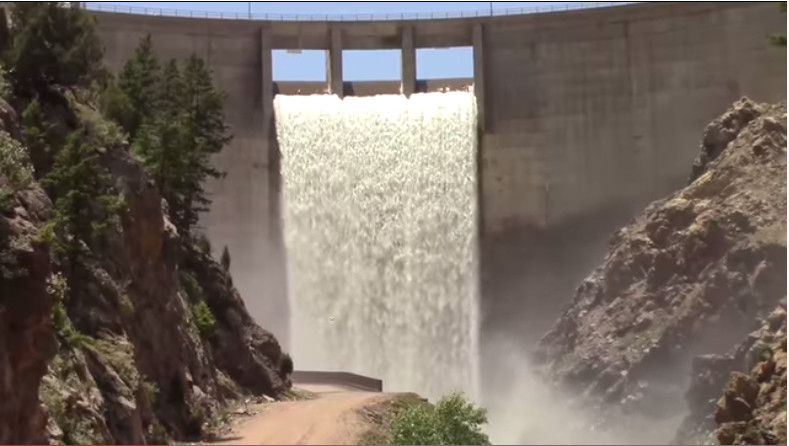
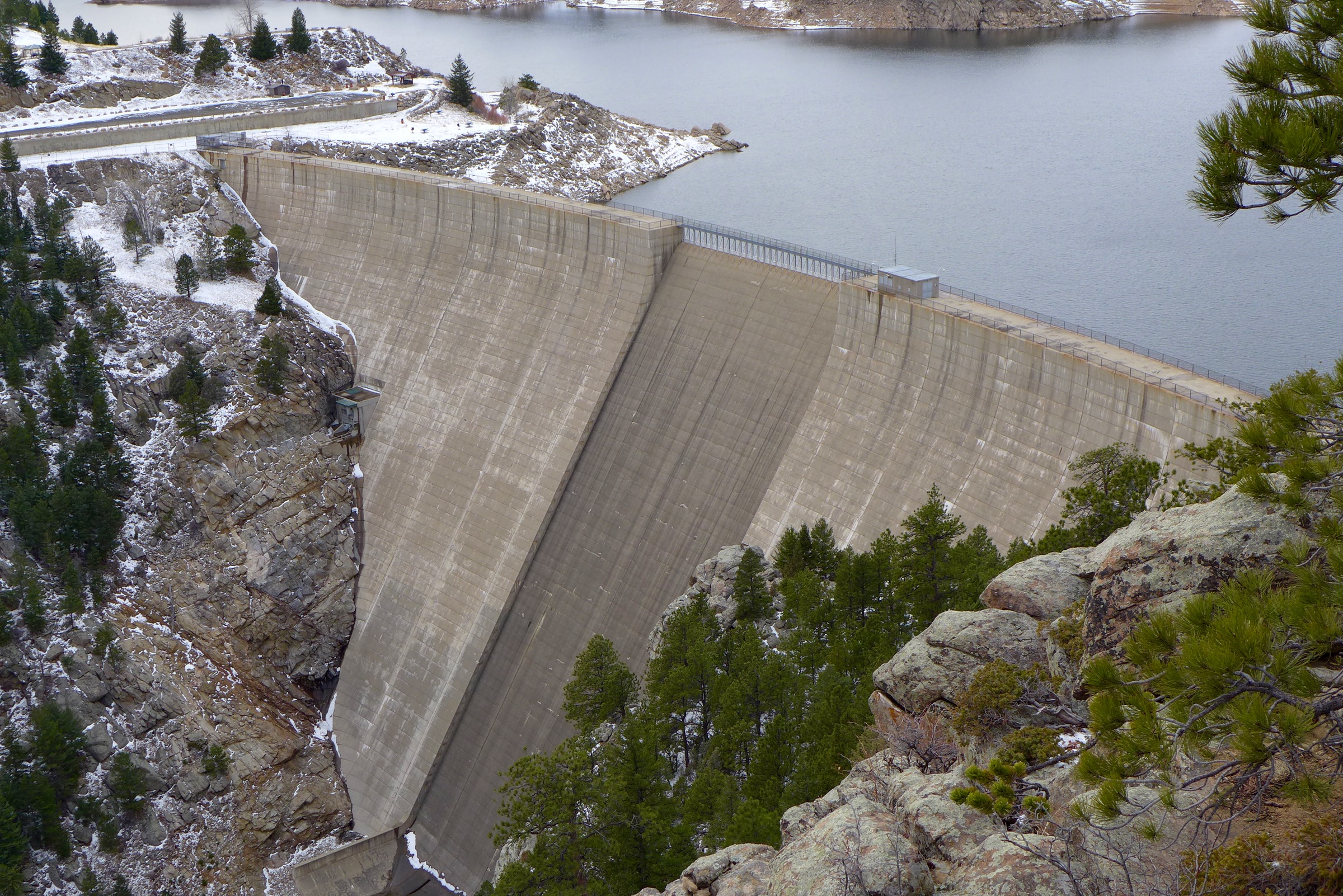
The dam that forms Gross Reservoir, located in the mountains west of Boulder. Photo: Brent Gardner-Smith/Aspen Journalism
Chatfield was built for flood control by the U.S. Army Corps of Engineers, after the 1965 South Platte River flood. During drought, Chatfield water can be pumped to our Marston treatment plant to supplement drinking water supplies. Only water from Denver Water is currently stored behind the dam, even though the dam is federally owned. Colorado State Parks leases the land and oversees park operations.
Chatfield is used for water exchanges to trade downstream users with rights to the water, which allows Denver Water to keep water in the mountain locations of our reservoir system.
Chatfield provides recreational benefits beyond the obvious. In addition to preserving levels for recreation, we use the reservoir to capture water released from Strontia Springs Reservoir. These flows keep the river at optimum levels to support Waterton Canyon’s trout fishery.
Chatfield is about to take on even more responsibility. The Chatfield Storage Reallocation Project will increase water levels by about 12 feet. But this won’t be Denver’s water. Instead, it will help meet demands for growing Front Range communities and downstream farmers. Denver Water will still maintain its original storage pool in the reservoir. The Chatfield Reservoir Mitigation Company also is working with state agencies to develop a plan for a storage “pool” within the reservoir for the environment.
Orr Manufacturing Vertical Impact Sprinkler circa 1928 via the Irrigation Museum
Click here to read the newsletter. Here’s an excerpt:
Summer’s heat is off, and so are sprinklers — if you want to prevent costly damage when the first freeze falls. Winterize your irrigation system, hoses and spigots now by clearing them of any water.
Since Colorado winters can also bring periods of tepid temperatures and dry skies, trees and shrubs may still need watering. If you must water, do so the efficient way: by hand, applying water only where it’s needed.
Here are other ways to get your yard ready to weather the winter:
Mow. Late-season mowing helps reduce the risk of mold and other diseases. Try to get in one last cut before the next snow flies.
Mulch. With one easy step, you can both “rake” and bag while benefiting your yard. Just keep the bag off your mower and mulch the leaves into the grass.
Make plans. Start prepping next year’s garden. Consider saving water the tasty, health-conscious way by growing vegetables instead of grass. If you need inspiration, check out this customer’s veggie box haven.
You’ll reap the benefits of your prep work when the next growing season springs. (In the meantime, know that we’re employing some forward thinking on customers’ behalf.)
Looking up the Colorado River as it flows through Horseshoe Bend, just east of downtown Glenwood Springs. The site is one of three where Glenwood Springs seeks to build a whitewater park. The city is now in the process of obtaining a water right for the parks but has yet to reach agreements with Aurora and Colorado Springs about the proposed water rights.
GLENWOOD SPRINGS – The city of Glenwood Springs is making progress toward securing a recreational water right for three potential whitewater parks on the Colorado River, but it has yet to come to terms with Aurora, Colorado Springs and the Colorado Water Conservation Board.
In kayaking terms, it could be said the city has greased close to a dozen Class II and III rapids so far since it started its run through water court in 2013. And it’s recently made it cleanly through a Class IV hole called “Denver Water.” But it is now facing two gnarly Class V rapids called “Homestake” and “CWCB.”
Aurora and Colorado Springs are co-owners of the Homestake Project, which includes a reservoir on Homestake Creek in the upper Eagle River basin that holds 43,300 acre-feet of water.
The water is stored and then shipped through the Homestake Tunnel to Turquoise Reservoir and on to the two Front Range cities, which also hold conditional water rights in the Homestake Project that could allow for development of more water.
The two cities, acting jointly as Homestake Partners, have told the water court and the Colorado Water Conservation Board (CWCB) that Glenwood Springs is claiming more water than it needs for a valid recreational experience.
And they say Glenwood Springs’ proposed water right for the parks would prevent the additional development of more water-supply projects in the upper Colorado River basin within Colorado.
“Glenwood’s proposed RICD [recreational in-channel diversion] would unilaterally foreclose development in the Colorado River basin above Glenwood, affecting users both in the basin and on the Front Range,” Aurora and Colorado Springs told the water court in June 2015. “This will result in further ‘buy and dry’ of agricultural water rights, and could in addition motivate West Slope users to make trans-basin diversions from other river basins, such as the Yampa and Gunnison.”
Looking up the Colorado River as it flows past the No Name rest stop on I-70. The site is one of three locations for potential whitewater parks that the city of Glenwood Springs is seeking a water right for.
Seeking flow
Glenwood Springs has filed for a single water right tied to “three proposed boating parks” to be known as the No Name, Horseshoe Bend and Two Rivers whitewater parks. Each park would include two wave-producing structures.
The whitewater parks would be able to call for between 1,250 cubic feet per second of water from April 1 to Sept. 30, for 2,500 cfs between June 8 and July 23, and for 4,000 cfs for five days between June 30 and July 6.
The ability for Glenwood to call for 1,250 cfs doesn’t seem to be much of an issue in the case, as that’s the same amount of water that the Shoshone hydropower plant upstream of the proposed whitewater parks has been calling downriver since 1902.
But flows of 2,500 and 4,000 cfs are apparently a different matter.
“We see nothing substantiating that there is any demand for water-based recreational experiences beyond those that are already available in view of the current stream regimen,” wrote attorneys for Homestake in 2014.
Yet the city has so far managed to file signed stipulations in water court with Denver Water, Ute Water Conservancy District, Orchard Mesa Irrigation District, Grand Valley Water Users Association, Ute Water Conservancy District, Glenwood Hot Springs Lodge and Pool, Bureau of Land Management and Colorado Dept. of Transportation.
The most recent of those agreements approved in Div. 5 water court in Glenwood Springs was with CDOT on July 25 and with Denver Water on May 31.
The agreement with Denver Water includes a provision where Glenwood Springs will not oppose a future, and as yet undefined, project to develop an additional 20,000 acre-feet of diversions from the West Slope, as contemplated in the 2013 Colorado River Cooperative Agreement, or CRCA, which Glenwood Springs signed.
“We’ve just agreed that we’re not going to have our water right impede that project once it’s defined and agreed to by the signatories of the CRCA,” said Mark Hamilton of Holland and Hart, the attorney representing Glenwood Springs in the case (2013CW3109).
Glenwood Springs has also reached conceptual agreements with the Colorado River District, West Divide Water Conservancy District and the town of Gypsum, but has yet to file signed stipulation agreements with the court.
Also in the case, but in support of Glenwood Springs’ application, are American Whitewater, Western Resource Advocates, and Grand County.
“We’ve made a really diligent specific effort to address a whole variety of concerns from a whole bunch of different people,” Hamilton said. “We’re making every effort to get there, but until Homestake and CWCB come to rest, we can’t assure anybody we still don’t need to have some kind of hearing in front of Judge Boyd.”
Judge James Boyd oversees water court proceedings in Div. 5 water court. The city’s application is still before the water court referee, who works with opposing parties to see if settlements can be reached before referring the case to the judge.
The referee has given the parties at least until Oct. 27 to see if agreements can be reached, but extensions of time are not usually hard to obtain.
Hamilton is set to meet on Sept. 8 with representatives from Aurora and Colorado Springs in another effort to reach an agreement. It will be the fourth such meeting since February.
Joe Stibrich, the water resources policy manager for Aurora Water and a member of the board of the Homestake Steering Committee, said last week he couldn’t discuss the ongoing settlement negotiations, but did say Aurora and Homestake Partners were working in good faith.
He also said, however, that the concerns already articulated by the two cities to the court and CWCB are still outstanding.
A view from the Pitkin County end of Homestake Reservoir, located on Homestake Creek, a tributary of the upper Eagle River.
Carving out the MOU
Aurora and Colorado Springs are both parties to the Eagle River Memorandum of Understanding, which is tied to the Homestake Reservoir and Tunnel.
The 1998 agreement allows for a new water supply project in the upper Eagle River basin that would provide 10,000 acre-feet of water for a variety of West Slope entities and 20,000 acre-feet for Aurora and Colorado Springs.
Such a project is now being actively studied, and may include a new dam on lower Homestake Creek that would flood complex wetlands.
Hamilton put a clause in the draft water rights decree that Glenwood Springs “shall not use the RICD water rights as a basis to oppose” projects described in the Eagle River MOU.
“That’s something that we offered up without even having a settlement agreement with them,” Hamilton said. “It was my initial shot at trying to draft a ruling that I though would address their concerns. And so I would envision that any additional settlement terms would be laid on top of what we’ve already put in there.”
There is likely more than the Eagle River MOU of interest to Aurora and Colorado Springs.
In 2012, the two cities told the BLM and USFS, in comment letters regarding potential Wild and Scenic designation on a section of the Colorado River, that “as much as 86,400 acre feet of water supplies may be developed by completion of the Homestake Project” and that “Aurora and Colorado Springs plan to develop the remaining portions of Homestake Project.”
Looking up the Colorado River toward Glenwood Springs at Two Rivers Park, where the city of Glenwood may someday build a whitewater park. The city has been working since 2013 on securing a recreational water right for three such parks on the river.
The CWCB
Even if an agreement can be worked out with Aurora and Colorado Springs, Glenwood Springs will still need to come to terms with the Colorado Water Conservation Board, which recommended in June 2015 that the water court deny the city’s RICD filing.
The CWCB is charged by the state legislature with reviewing proposed RICDs and then making a recommendation to the water court.
When it came to Glenwood’s filing, the CWCB board of directors concluded in an 8-to-1 vote that it would “impair Colorado’s ability to fully develop its compact entitlements” and would not promote “the maximum beneficial use of water” in the state.
The state agency also directed its staff to oppose Glenwood’s filing in water court.
It’s not clear at this point how Judge Boyd might handle the recommendation-to-deny from the CWCB, or if Glenwood Springs might be able to get the CWCB to change its stance opposing the proposed water right.
“If we reach settlements with Homestake it’s possible that the CWCB would then reconsider and change its recommendations,” Hamilton said.
When it comes to reaching terms with Aurora and Colorado Springs, Hamilton said he remains “optimistic.”
“There is diligent ongoing discussion on all sides and good faith efforts being made,” he said. “And if it fails, it fails, and we’ll go to Judge Boyd and start setting deadlines and dealing with things more formally. But I think everybody is giving it a fair shot and seeing if we can get there shy of that.”
Editor’s note: Aspen Journalism and the Aspen Daily News are collaborating on coverage of rivers and water. The Daily News published this story on Monday, Sept. 5, 2016.
The South Platte River typically all but vanishes as it passes through Denver’s industrial neighborhood north of downtown, downstream of the Burlington Ditch diversion, near the Cherokee power plant. Photo/Allen Best
The Denver Water and Colorado Parks and Wildlife officials said they’ve obtained 2,100 acre-feet of water that they will use strictly for environmental purposes…
“We’re trying to make the South Platte the best it can be for this city. … It’s not going to be like a Danube,” Denver Water manager Jim Lochhead said. “We can make it what it is, which is a plains river that creates an appreciation of the connection to water in this city. The city would not exist without that water supply.”
The idea is that putting more water into the Platte at the southwestern edge of metro Denver will mimic long-lost natural flows, to the extent possible given the channelization of the Platte after the 1965 flood that destroyed buildings in the floodplain. More water also would help a fish hatchery where state wildlife workers breed rainbow trout.
For more than two decades, Denver conservationists have worked at reviving the Platte corridor, building cycling-oriented pathways and riverside parks. It’s been complicated because metro Denver grew up around the river and, for more than a century, people exploited it as a sewer with industrial plants and discharge pipes draining into the water. Now as kayakers, surfers, skaters, waders and others flock to the river, city leaders face rising demands for more water, cleaner water and wildlife.
But just beyond Denver, farmers await every drop of the treated wastewater metro users put back in the Platte, water used to grow food. There’s so much demand for South Platte water across booming northeastern Colorado that parts of the river run dry.
By 2018, project leaders say, new environmental flows from Chatfield will keep that from happening — and create curves and pools favoring aquatic bugs and fish.
“Now we’ve got some water so that we can start to build the river back to being a natural-looking river. It is limited. The river won’t have access to the true floodplain. But we can build smaller floodplain ditches so that the river will look more like a sinuous river coming through Denver,” CPW senior aquatic biologist Ken Kehmeier said.
“The water will be used mostly during the low-flow times of the year,” the 65 or so days when water rights holders have the ability to dry up sections of the river, Kehmeier said.
“It will mean water stays in the river downstream of Chatfield, including the hatchery. That’s where the trout will come from. And brown trout in the river now, with this extra water, will be able to reproduce naturally.”
Lining up storage for the water proved crucial. Denver Water has committed to work with the Greenway Foundation to buy space for 500 acre-feet in an enlarged Chatfield Reservoir. This water adds to 1,600 acre-feet of water to be used only for environmental purposes that federal engineers required as “mitigation” for Colorado’s repurposing of the reservoir from flood control to water supply. The 500 acre-feet would be owned by the Central Colorado Water Conservancy District, a downstream agricultural entity, which agreed to pay annual operational and maintenance costs.
Storing water in Chatfield costs $7,500 an acre-foot, Denver Water officials said. They’ll spend $2 million to buy storage space, on the condition the Greenway Foundation does the same…
This push to put more clean water in the Platte through Denver coincides with broader environmental efforts. Federal, state and city engineers have been mulling possibilities for restoring other metro waterways, for which the U.S. Army Corps of Engineers has dangled possible funding.
I’m at the conference getting ready for the first session: Leading the way with direct potable reuse in Colorado. Panel with moderator Doug Kemper (Colorado Water Congress), Myron Nealey (Denver Water), John Rehring (Carollo Engineers).
CWC has an iPhone app up at the app store. Search for CWC and scroll down to CWC Summer Conference.
Nice bike ride up the Yampa River from my campsite west of town. The Sheraton Steamboat Springs lets you check your bike and park it in a room out of the elements.
Considering the Denver region is growing by an average of 4,500 new residents per month, a large sector of the population likely doesn’t remember the catastrophic 2002 drought. The most severe water shortage since the Dust Bowl, snowpack and soil moisture were at all-time lows, and we remained in a dry period until 2006. Luckily, with water restrictions in place, we never actually ran out of water—we just got really close.
“We realized that we had an immediate need to correct a vulnerability in our system,” Denver Water CEO Jim Lochhead says. That’s when Denver Water started planning the Gross Reservoir Expansion Project, and after more than a decade of negotiations, the project (which was recently endorsed by Gov. John Hickenlooper) is underway.
But will it be enough? The short answer is yes—as long as Denverites work on strengthening their water conservation practices. Lochhead was pleased to note that when a storm comes through the Mile High City, there is a noticeable drop in outdoor water use, because well-informed residents are turning off their sprinkler systems. Denver residents have managed to reduce water consumption by more than 20 percent in the last 15 years, even with a 15 percent increase in population, according to Lochhead.
The decrease is not enough to mitigate the risk of drought, however. As Colorado’s largest water utility, the Denver Water system is made up of two collection systems—the Northern and the South Platte—and they are incredibly imbalanced. About 80 percent of the water comes from the south system, leaving the north very vulnerable to low rainfall or wildfires. During the notable dry years of 2002 and 2013, clients in the north end were lucky their taps continued to flow.
“We were literally only one drought away from a major problem in our system,” Lochhead says, noting that as recently as 2013, the system was virtually out of water in the north-end.
Orr Manufacturing Vertical Impact Sprinkler circa 1928 via the Irrigation Museum
Click here to read the article. Here’s an excerpt:
This summer has been a hot one, but the sizzle doesn’t have to burn out your water-wise mindset.
Here are recommended lawn watering times for August:
Fixed spray heads: 14 minutes per zone
Rotary/high-efficiency nozzles: 34 minutes per zone
Rotor heads: 27 minutes per zone
Manual sprinklers: 20 minutes per zone
On watering days — limited by the rules to no more than three a week — you can make each minute matter by cycling and soaking. Water when the time is right, which is easy if you remember that time never falls between 10 a.m. and 6 p.m.
Water only when your lawn needs a drink. Besides wasting water — and your money — overwatering can lead to weeds, disease and dreaded fungus.
And here’s a hot tip for smart savings indoors: Our rebates changed this year, so be sure to look up which toilets qualify for rebates before you buy. Only WaterSense-labeled toilets averaging 1.1 gallons or less per flush qualify for a $150 rebate. With a little bit of research, you and your new rebate-worthy throne can rule the world of efficiency.