Jim Lochhead, the CEO and manager of Denver Water, said Tuesday that building new dams in the Colorado River basin is not at the top of his to-do list. Nor, for that matter, is drying up farms to provide water for Colorado’s growing cities.
But he says Colorado still needs to have hard conversations about how to flexibly manage its water. In particular, he wants farmers to be able to share water with Denver and other cities without worrying that they may lose their water rights.
Speaking at the annual Western Water Symposium at Colorado State University, Lochhead credited the 2015 Colorado Water Plan as being a useful “compendium of the issues” but said it highlighted relatively easy solutions without fully addressing the harder challenges.
“I don’t think the solution is $20 billion of new water projects for Colorado, but that’s an easy thing to go look for,” said Lochhead, head of the state’s largest water utility that supplies 1.4 million people, and stores nearly 40 percent of its water in Summit County’s Dillon Reservoir.
A coordinated plan is needed, Lochhead said.
“We’re not there yet with the state water plan to develop any kind of coordinated principle vision for the future, much less how to get there,” he said.
Lochhead, who took the helm of Denver Water in 2010, described Colorado’s historical approach to water as a zero-sum game where there had to be a winner and a loser.
That zero-sum game lost its moorings in the second half of 20th century as a result of new federal and state laws, court decisions and political fights, Lochhead said.
He said that two decades have brought more collaboration between diverse interests, including those on both sides of the Continental Divide, and it is reflected in such projects as Wolford Mountain Reservoir near Kremmling.
Both Denver Water and the Colorado River Water Conservation District have an interest in Wolford Reservoir, with Denver Water on track to soon own 40 percent of the water in the reservoir. The water has many benefits, among them providing late-summer water to meet needs of four endangered fish species in the Colorado River near Grand Junction.
Another collaborative effort has been launched in the Winter Park area. There, Denver plans to increase diversions from the Fraser and Williams Fork rivers, but is doing so with the blessing of local authorities, thanks to a collaborative “learning by doing” effort in Grand County that seeks to reduce streamflow impacts from both new and existing diversions.
But Lochhead believes Colorado must still dramatically change its water allocation methods as it faces population growth. Demographers project that Colorado’s 5.4 million population will double within a few decades. If we seek to provide the water for the additional residents the way we provided for the first 5 million, he said, “we won’t like the outcome very well.”
Gore Canyon rafting via Blogspot.com
The river itself
A second challenge is the Colorado River itself, the fountain that supplies at least part of the water for 40 million people, from corn farms in northeastern Colorado to San Diego. And despite some good snow years, the two big reservoirs on the lower Colorado River, Lake Powell and Lake Mead, are both low enough to keep a ballroom full of water experts up at night.
It could get worse. And, according to projections of climate models, it likely will.
Laurna Kaatz, an in-house climate expert at Denver Water, recently told the Metro basin roundtable it’s still not clear if it will be hotter and drier, or hotter and wetter in Colorado in the future, but there is little doubt it will be hotter.
More major dams on the Colorado River are not the solution, Lochhead said. Evaporative losses would result in more loss than gain, he said, although he did allow for the possibility of relatively small dams.
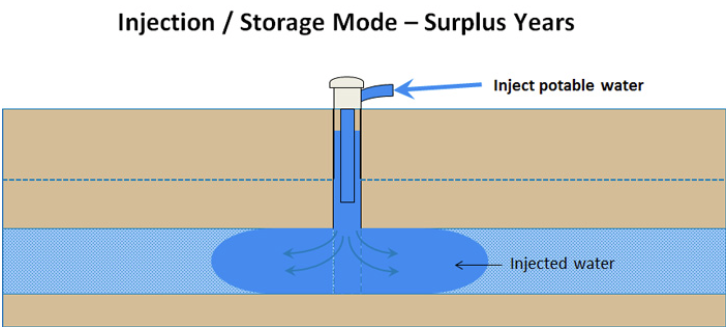
Denver Water is, however, studying the potential for putting water into aquifers beneath the city, creating underground storage — storage that could, in theory, hold water from the Western Slope.
And Denver Water is looking to store up to an additional 15,000 acre-feet of Western Slope water in an expanded Gross Reservoir, southwest of Boulder. The $360 million project seeks to raise the elevation of the dam by 131 feet, which would increase the capacity of the reservoir by 77,000 acre-feet, bringing it up to 119,000 acre-feet.
Flexibility needed
Lochhead said that Colorado needs more flexible water management options that allow for greater sharing of the resource.
About 85 percent of water in Colorado is used by agriculture and ranchers and farmers tend to have the oldest and most senior water rights.
Water rights are private, said Lochhead, “but you can’t really do anything with that property right except what you are currently doing with it unless you go to water court. And by going to water court you put that entire water right at risk.”
In Colorado’s water courts, objections to changes in uses of water rights are often filed. The process can be lengthy and expensive for those seeking to make changes.
“You need a safe process where you don’t have to put your water right at risk, and you understand that you don’t have to spend years negotiating,” he said.
And Lochhead thinks Colorado also needs another conversation about conservation, where the emphasis is not about sacrifice but about innovation.
Denver Water intends to demonstrate what is possible as it redevelops its 35-acre headquarters campus along Interstate 25 near downtown Denver. There, planners think they can reduce demand for potable water by more than 50 percent.
In water reuse, said Lochhead, Colorado is “way behind the curve” as compared to some world cities, including Amsterdam and Sydney.
Editor’s note: Aspen Journalism and the Aspen Daily News are collaborating on the coverage of water and rivers. The Daily News published this story on Friday, July 29, 2016.
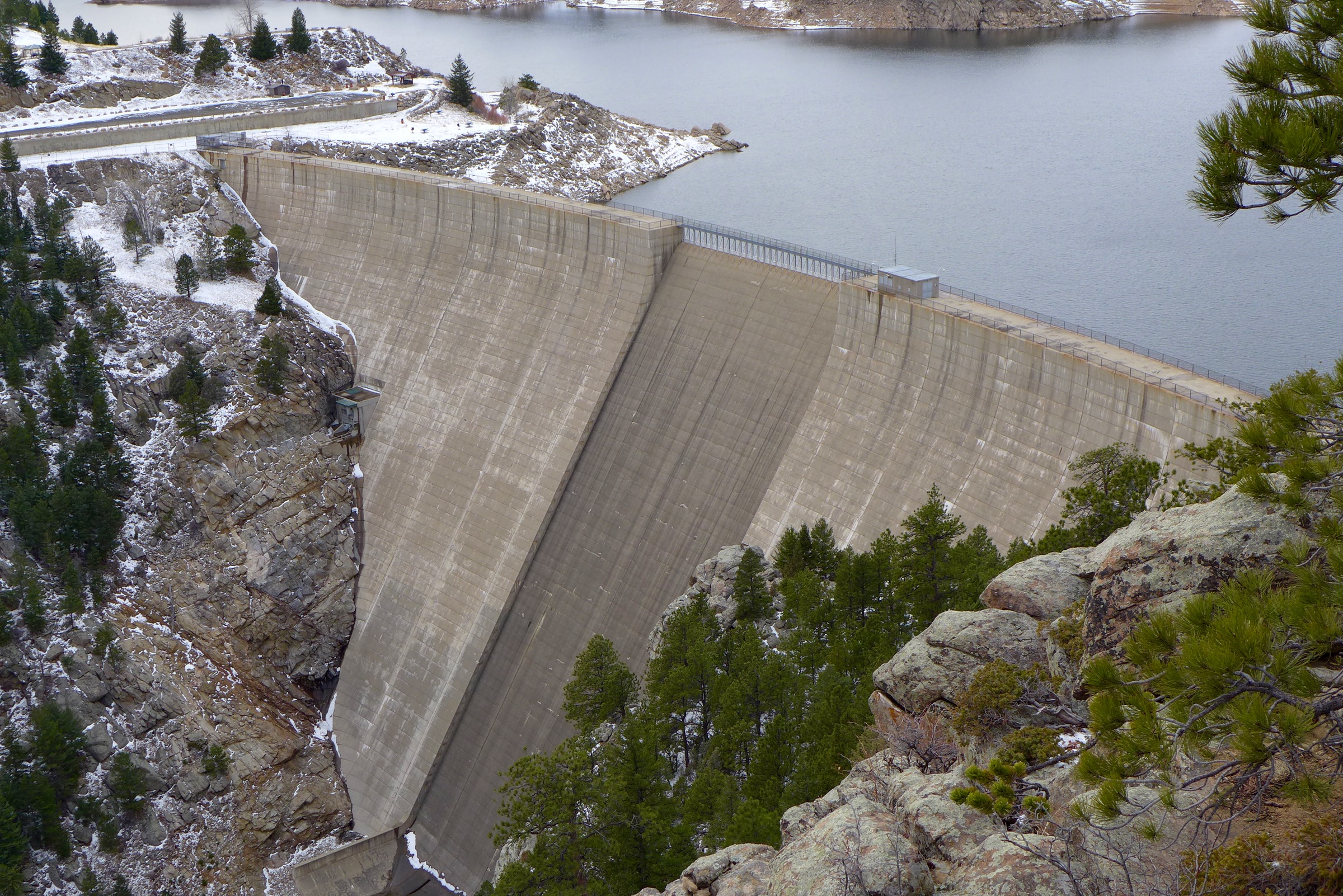
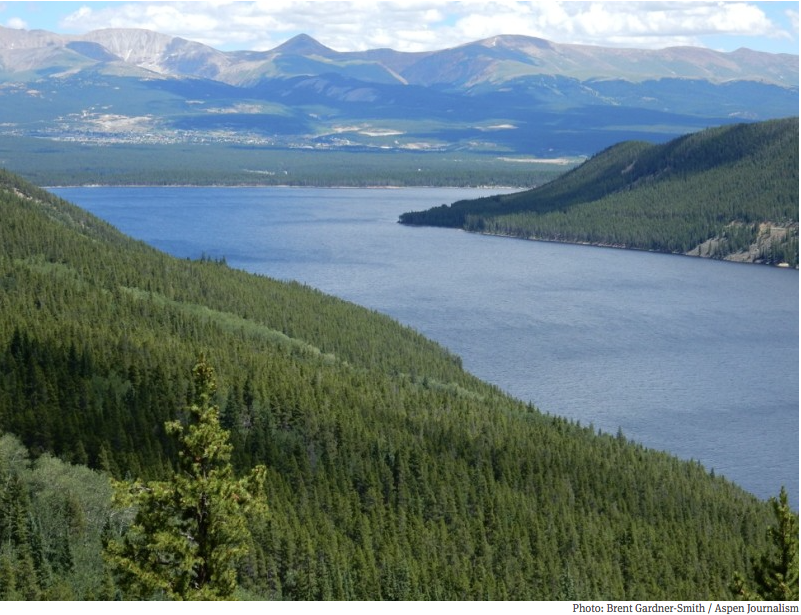
Eleven Mile Canyon Reservoir, completed in 1932, is the second largest storage facility in Denver Water’s system and one of the largest bodies of water on Coloradoâs East Slope. Photo via Denver Water.
Click here to read the newsletter. Here’s an excerpt:
Denver Water has 20 dams, and some are more than 100 years old. We conduct our own internal dam evaluations and also take part in state and federal inspections, which include checking for any mechanical issues and changes in seepage over time.
We also actively work to maintain and improve dams. Two of Denver Water’s oldest earthen dams (Antero, 1909, and Marston, 1902) have been undergoing safety upgrades.
Concrete dams are expected to last 200 years, and we aim to maintain them so they can safely last even longer. Built in 1932, Eleven Mile had its annual state and internal inspection in May, when the dam received a standard “satisfactory” rating.
With proper maintenance, we can expect this 84-year-old architectural marvel to last well beyond the next century.
The Vasquez Canal Project is a multi-year multi-million dollar project that continues efforts by Denver Water to improve existing water diversion infrastructure. Work on the Vasquez Canal Project focuses on removing sections of the existing Vasquez Canal and replacing removed sections with a 114-inch diameter concrete reinforced pipe.
Work on the project has occurred in previous year with Denver Water replacing between 5,000 and 6,000 feet of the Vasquez Canal over the past two decades. Officials from Denver Water say they plan to replace about 2,000 feet of the Vasquez Canal in 2016, leaving roughly 15,000 feet to be replaced in the future.
Officials from Denver Water did not provide an overall projected cost on the project pointing out that, “funding allocation for this project is reassessed annually”. In previous year the project averaged around $750,000 per year in costs. Future projected cost estimates on the Vasquez Canal Project total between two to three million dollars annually.
Monies used for the project come directly from Denver Water which is funding operation, as it does all operational and capital projects, through water rate fees, bond sales, cash reserves, hydropower sales and system development charges for new services.
Work on the Vasquez Canal Project consists primarily of excavation and earth moving to facilitate the canal upgrade. “Crews will demolish the old concrete liner and covers, excavate the area and install the new 114-inch pipe, piece by piece,” stated Denver Water Communication Specialist Jimmy Luthye. Luthye explained Denver Water plans to, “work aggressively to complete this project in the next few years in an effort to replace aging infrastructure and improve the safety and strength of the entire water system.”
Ames Construction is the contractor of record for the project. For the past 20 years though, as previous sections of the Vasquez Canal have been replaced, employees of Denver Water performed the upgrade work. According to Denver Water this is the first year work on the project has been contracted out.
The Arapaho National Forest prepared an environmental assessment of the Vasquez Canal Project. All construction work on the project is being conducted entirely on National Forest System Lands. According to Denver Water that environmental assessment determined, “there would be no significant environmental impacts.” Officials from Denver Water went on to state, “They approved the project along with required best management practices, design criteria and monitoring designed to protect the area during construction.”
The Vasquez Canal is part of Denver Water’s historic water diversion network that brings mountain runoff to the Front Range and Denver Metro area. The original canal was completed in the late 1930s. According to Denver Water, information on the original construction of the canal is fairly limited but officials from the municipal water supplier stated, “we suspect that some of it (Vasquez Canal) was originally dug by hand because the canal had to be cut into the side of a steep mountain… making it difficult for machines to access.”
In the late 1950s Denver Water covered the originally open Vasquez Canal, effectively creating a tunnel. A drought during the early 1950s prompted the action, which was intended to mitigate evaporation as water traveled through the diversion system.
Water utilized by the Denver Water’s diversion system follows a zigzagging path of infrastructure as it descends from snowmelt in the high Rockies to homes along the Front Range.
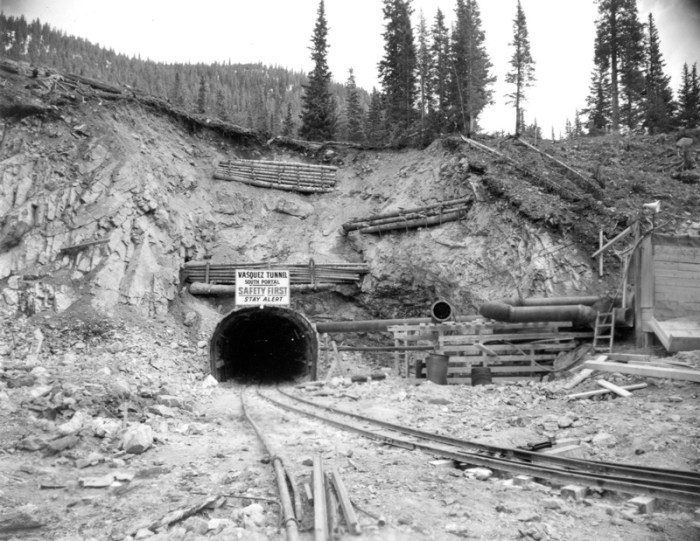
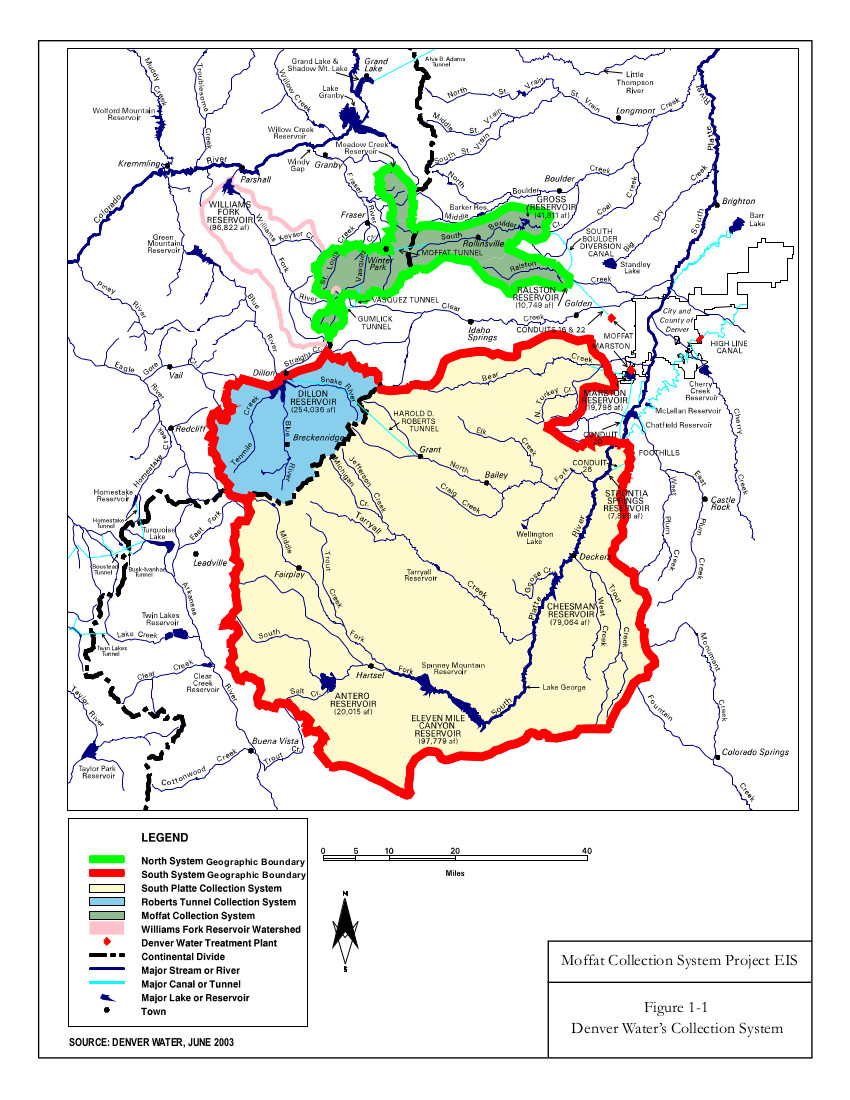
Diversion structures in the Upper Williams Fork River send water through the Gumlick Tunnel, formerly known as the Jones Pass Tunnel, where the water passes under the Continental Divide. From there water travels through the Vasquez Tunnel, which brings the water back through to the other side of the Continental Divide, where it enters into Grand County and Vasquez Creek. The water is then diverted through the Moffat Tunnel back under the Continental Divide for a final time and into South Boulder Creek, feeding into Gross Reservoir, a major water storage reservoir for Denver Water.
Colorado transmountain diversions via the University of Colorado
A truck drives out to Ritschard Dam, which forms Wolford Reservoir, on July 13, 2016. The dam has settled 2 feet downward and moved 8 inches horizontally since being built in 1995.
KREMMLING – Denver Water has taken steps to distance itself from a recent risk assessment of Ritschard Dam, which forms Wolford Reservoir five miles north of Kremmling.
The 21-year-old dam has found to be moving slightly and settling more than normal and a risk analysis workshop was held in February by a group of experts assembled by the Colorado River District, which owns the dam and reservoir.
After the risk workshop John Currier, the chief engineer for the River District, wrote a memo to the district’s board saying “a key conclusion” of a consultant review board is that “the dam is safe” and “there is no need for immediate action.”
Currier also wrote in his April 7 memo that the “key parties and participants” in the February risk workshop “included 1) the State Dam Safety Branch, 2) Denver Water, 3) our consultant review board, 4) our engineer, AECOM and 5) River District staff.”
But on May 2, Robert Mahoney, the director of engineering for Denver Water, sent Currier a letter critical of his April memo.
“In the memorandum, you characterize Denver Water as a ‘risk estimator’ and an active participant during the workshop,” Mahoney wrote. “Denver Water takes exception to these characterizations. At no time did Denver Water participate in the workshop as a risk estimator, nor was it ever invited to participate as a risk estimator on the panel.”
Mahoney also said that Denver Water “disagrees with characterizations in the memorandum implying that Denver Water was an active participant and that we concluded and agreed with the findings of the risk estimators. Denver Water’s role in attending the workshop was that of a concerned observer.”
Currier included the letter from Denver Water in a July 7 memo to the River District board. The memo and the letter were made public this week when the public agenda was released for the district’s July 20 board meeting in Glenwood Springs.
Mahoney raised other concerns in his letter as well.
“Based on our observations, the workshop and your memorandum only addressed the probability of a dam failure consequence,” Mahoney wrote. “While the probability of a dam failure appears low, dam failure is not the only potential adverse impact of concern to Denver Water. The probability of cracking in the core of the dam, which could reduce storage capacity, has a much greater range of uncertainty.”
Denver Water currently leases 40 percent of the water in Wolford Reservoir from the River District.
The reservoir can store 66,000 acre-feet of water and on July 14 the dam was holding back 65,240 acre-feet.
When its lease expires at the end of 2020, Denver Water is slated to become a part owner of the water in the reservoir.
“The River District will convey ownership, use and control of 40 percent of storage space and water right in Wolford Reservoir to Denver Water,” according to Jimmy Luthye, a communications specialist with Denver Water who checked Friday on the status of Denver Water’s stake in the facility.
As Jim Pokrandt, director of community affairs at the Colorado River District put it on Friday, “Denver Water currently holds a 40 percent lease. After 2019, it will be a 40 percent owner.”
The upstream side of Ritschard Dam, which forms Wolford Reservoir.
Dam has issues
In his letter, Mahoney also suggested that developing a plan to fix the dam would be “beneficial.”
“According to Mr. Dick Davidson (of AECOM), cracking of the core has a 50 percent annual probability of occurrence starting in 20 years (the time criteria set for the workshop and probability estimation),” Mahoney wrote. “Given this uncertainty, it would be beneficial to develop plans now to remediate Ritschard Dam in the event of a crack.
“Further, based on the information presented at the workshop, Denver Water does not agree that Ritschard Dam is functioning as designed because no dam is designed to function with the degree of movement observed at Ritschard Dam to date.
“As addressed in the April 27, 2016 letter from Bill McCormick, chief of the Dam Safety Branch of the state engineer’s office, Ritschard Dam is in the category ‘of dams with significant issues’ and is on ‘an abnormal trend,'” Mahoney wrote.
Ritschard Dam is 122 feet tall, 1,910 feet wide, and sits across Muddy Creek, which flows into the Colorado River east of Gore Canyon. It was built for the River District in 1995 at a cost of $42 million by D.H. Blattner and Sons of Minnesota.
The dam has an impermeable clay core that is covered on both the upstream and downstream sides with rock fill, including shale rock excavated on site during construction.
In 2008, engineers working for the river district noticed the dam had settled downward by a foot-and-a-half, instead of the expected normal settling of one foot.
They decided to install monitoring equipment, including inclinometers, which measure slope angles.
Engineers for the river district have since installed an increasingly sophisticated array of monitoring devices. And they’ve verified that the dam has settled over 2 feet downward.
The dam has also moved horizontally, by 8 inches, at a location about 40 to 50 feet from the top of the dam.
Mike May, an engineer with AECOM, told the river district board in January 2015 that because of “poorly compacted rock fill,” the dam’s rocky outer shells are still moving, especially the downstream shell, and that the clay core of the dam, which is somewhat elastic, is also moving.
While the dam does not have “a global stability problem,” May said the concern is that if enough movement occurs, it could cause cracks in the clay core.
Water could then find its way into those cracks, start transporting material and widening the cracks, and the dam could eventually be at risk of failing.
Ritschard Dam, which creates Wolford Reservoir on Muddy Creek north of Kremmling, is moving slightly but steadily. The Colorado River District expects rehabilitation of the dam to be expensive.
Abnormal behavior
McCormick, in his April 27 letter referenced by Mahoney, also included Denver Water as part of the risk assessment group.
“At the conclusion of the meeting it was the opinion of the participants, CRD, AECOM, risk analysis consultants John Smart and Larry Von Thun, Colorado Dam Safety and Denver Water that the risk of sudden failure of the dam by any of the failure modes analyzed was remote,” McCormick wrote. “It was also agreed that given that determination the need to continue to actively pursue physical modifications to the dam was not warranted at this time.”
McCormick also said that the results of the risk analysis session “now allow the Colorado River District and Colorado Dam Safety Branch to return to more normal reservoir operations with confidence that public safety is not being compromised.”
However, McCormick also noted that “due to the remaining uncertainty of the deformation behavior we agreed that Ritschard can only be classified as ‘conditionally satisfactory’ and that continuing action with respect to monitoring and observations is required by Colorado River District to operate the reservoir as planned.”
In his letter, McCormick cited a presentation at the risk workshop by Dr. Gavin Hunter, a professor at the University of New South Wales who has researched deformation behavior in 130 embankment dams.
Gavin compared the magnitude of the settlement observed at Ritschard dam with other dams in his data set.
“The displacement observed at Ritschard exceeds the majority of the dams studied, with only half the available data,” McCormick wrote. “Dr. Hunter describes this as ‘an abnormal trend.'”
McCormick also noted that Gavin’s research on the amount of settlement at Ritschard put it in the “region of dams with significant issues” category.
As such, McCormick said the River District should develop a plan for remediation work on the dam.
“We would encourage the Colorado River District to fully appreciate the abnormal and as yet not fully understood behavior of Ritschard dam and put an appropriate timeline on the ‘foreseeable future,’ McCormick wrote. “Based on the analyses done to date one could reasonably anticipate that remediation work will be necessary at some point in the future. We strongly encourage the Colorado River District to continue to plan for such remediation to avoid undue pressure on the operation of that facility as might be caused by a sudden change in the dam’s performance.”
McCormick said Friday that a workshop to develop an “action plan” has been set for the third week of August.
A detail of the rock outer shell on the downstream side of Ritschard Dam.
Long odds
In his April 4 memo, Currier of the River District had written that the district’s analysis indicated that risk of failure of the dam from deformation was 1 in 100 million, while the risk of the dam failing by a “probable maximum flood” causing overtopping – a standard measure of risk – was one in a million.
He also explained why monitoring the dam’s movement was a better approach than trying to stop the dam from moving.
“With the dam failure risk so low, even with twice the current deformation, the estimators concluded that there is really no compelling technical or health, safety and welfare reason to embark on a remediation plan,” Currier wrote. “In fact, from a ‘do no harm’ perspective continued monitoring is equally if not more preferable to active remediation.
“While remediation might put to rest some nagging uneasiness about on-going deformation and when it might end, there is no absolute certainty that it would or should allay that uneasiness.
“In essence, remediation might replace one known uncertainty with a new, unknown, uncertainty. All dam owners are faced with some level of future uncertainty, we just happen to be keenly aware of it by virtue of extensive monitoring and investigation,” Currier wrote.
And in his July 7 memo sent to the River District board, Currier said an additional inclinometer has recently been installed at the toe of the dam to track movement, and that he would be sending Mahoney of Denver Water “a short response clarifying a few matters and inviting Denver’s continued involvement and expertise in the deformation issues.”
Here’s the release from the High Line Canal Conservancy:
The High Line Canal Conservancy, which is dedicated to preserving the recreational and environmental future of the High Line Canal, announced the dates and locations in Denver and Aurora for “Chapter Two: A Fork in the Road,” a series of community open houses dedicated to shaping the future of the High Line Canal. The goal of the open houses is to develop a shared vision for what the Canal could become. We have come to a fork in the road: what are the risks for the Canal’s current trajectory? What can be done to better preserve, protect, and enhance the Canal’s future?
“We believe the future of the Canal should be shaped by the 11 distinct communities through which it travels,” said Harriet Crittenden LaMair, executive director of the High Line Canal Conservancy. “We developed these open houses so that anyone can drop in at any point during the scheduled time frame to share ideas and better understand the current issues facing the Canal.”
The High Line Canal Conservancy team will share feedback based on what they’ve heard so far and will be looking for feedback on potential ideas to preserve, protect and enhance the Canal. Friends and neighbors are welcome!
The dates and locations of the interactive open houses are:
Wednesday, July 20, from 11am-1:30 p.m. at the Expo Recreation Center
10955 E. Exposition Ave., Aurora CO 80012
Wednesday, July 20, from 4-8 p.m. at Eloise May Library
1471 S. Parker Rd., Denver CO 80231
Thursday, July 21, from 4-8 p.m. at Eisenhower Recreation Center
4300 E. Dartmouth Ave., Denver CO 80222
All three sessions will be identical, so guests are invited to attend the event most convenient to them and stop by for as long as they would like.
Here’s how to stay updated on High Line Canal project updates:
Help us spread the word: Please invite your friends and neighbors to participate too!
ABOUT THE HIGH LINE CANAL CONSERVANCY
The High Line Canal Conservancy was formed in 2014 by a passionate coalition of private citizens to provide leadership and harness the region’s commitment to protecting the future of the High Line Canal. With support from each jurisdiction and in partnership with Denver Water, the Conservancy is connecting stakeholders in support of comprehensive planning to ensure that the Canal is protected and enhanced for future generations. For more information, please visit http://www.highlinecanal.org.
Denver Water’s collection system via the USACE EIS
FromThe Grand Junction Daily Sentinel (Dennis Webb):
A proposal to divert Colorado River water to Denver recently has won the endorsement of Gov. John Hickenlooper and the approval of the Colorado Department of Public Health and Environment.
But Denver Water’s Gross Reservoir expansion project may be just as notable for its general lack of opposition west of the Continental Divide. That’s thanks to a wide-ranging agreement, effective in 2013, in which Denver Water obtained concessions including a promise that numerous Western Slope parties to the agreement wouldn’t oppose the expansion project. In return, Denver Water made a number of commitments to the Western Slope.
Now Western Slope interests are working on a similar agreement with Northern Water and others on what’s called the Windy Gap Firming Project, which would store Colorado River water in a proposed Boulder County reservoir.
These approaches represent a far cry from how the Western Slope used to respond to transmountain diversion proposals.
“This is the new paradigm. It’s not the old school. In the old school it was like … we’ll see you in court,” said Jim Pokrandt of the Colorado River District, a party to the 2013 Denver Water deal.
For Denver Water, what’s called the Colorado River Cooperative Agreement provided greater certainty for its customers through means such as resolving longtime disputes regarding West Slope water. For the Western Slope, the deal meant dozens of obligations by Denver Water, such as millions of dollars in monetary payments to various entities, protections of Colorado River flows and water quality, a commitment to further water conservation and reuse efforts by Denver Water customers, and a provision aimed at helping assure maintenance of historic flows in the Colorado River even when the Shoshone Power Plant in Glenwood Canyon is not operating. That hydroelectric plant has a senior right helping control flows in the river.
Another key point in that deal is a promise that Denver Water and its customers won’t try to further develop Colorado River water without agreement from the river district and affected counties.
The cooperative agreement has 18 signatories but more than 40 partners, primarily West Slope governments, water conservation and irrigation districts, and utilities. Among them are the Ute Water Conservancy District and multiple irrigation districts in Mesa County.
Pokrandt said the 2013 deal is a win-win for both sides of the Continental Divide.
“That said, yes, more water would be moving east” if the Gross Reservoir project proceeds, he said.
The project, also sometimes called the Moffat Collection System Project, would nearly triple the capacity of the Boulder County reservoir. Denver Water is targeting water in the Fraser River, a tributary of the Colorado.
“Right now there are some periods of time when Gross Reservoir is full at its current size and their water rights are in priority but they can’t take any more water,” Pokrandt said.
The project has an estimated cost of $380 million, and Denver Water hopes to obtain the remaining major permits by the end of next year. CDPHE in June certified that the project complied with state water quality standards, and Hickenlooper endorsed it last week.
“The state’s responsibility is to ensure we do the right thing for Colorado’s future, and this project is vital infrastructure for our economy and the environment,” Hickenlooper said in a news release. “The partnerships and collaboration between Denver Water, the West Slope and conservation organizations associated with this project are just what the Colorado Water Plan is all about.”
That recently adopted plan in some respects took its lead from the Denver Water/Western Slope deal in seeking to address the state’s future water needs in a cooperative rather than confrontational manner statewide.
Pokrandt conceded that not everyone loves the Gross Reservoir proposal…
Trout Unlimited takes a more positive view of the Gross Reservoir project, pointing to its inclusion of a “Learning by Doing” program requiring monitoring of the health of the Fraser River and adjusting operations as needed. The Gross Reservoir proposal envisions drawing water from the Western Slope in wetter years and seasons, but providing the Colorado River watershed with extra water during low flow periods and investing in restoration projects.
“Moreover, Denver Water has entered into partnerships on the Front Range to ensure that the project alleviates chronic low-flow problems in South Boulder Creek. Both sides of the Divide benefit,” David Nickum, executive director of Colorado Trout Unlimited, said in a news release…
Denver Water Chief Executive Officer Jim Lochhead said in a news release, “The Denver metropolitan area is tied to the economic and environmental health of the rest of the state, and Denver Water is committed to undertake this project in a way that enhances Colorado’s values.”
Pokrandt said Western Slope water interests face the reality that under the state Constitution the right to appropriate water shall not be denied if the water can be put to beneficial use and a party can obtain the necessary financing and permitting.
“There’s not a legal stance to say no, so that’s why the river district was even formed in 1937, was to negotiate these things, because no is not an answer in the legal arena because of the Colorado Constitution,” he said.
When it comes to water rights, Pokrandt said, “in the Colorado Constitution, the Continental Divide doesn’t exist.”
This formal backing completes the state’s environmental reviews for the Moffat project, 13 years in the making, clearing the way for construction — if remaining federal permits are issued. Denver Water and opponents from Western Slope towns and nature groups reached a compromise aimed at enabling more population growth while off-setting environmental harm.
It is a key infrastructure project that will add reliability to public water supplies and protect the environment, Gov. John Hickenlooper wrote in a letter to Denver Water manager Jim Lochhead.
It “aligns with the key elements of Colorado’s Water Plan,” Hickenlooper wrote. “Denver Water and its partners further our shared vision for a secure and sustainable water future while assuring a net environmental benefit in a new era of cooperation.”
Denver would siphon 10,000 acre-feet a year, on average, more water out of Colorado River headwaters, conveying it eastward under the Continental Divide through a tunnel for more than 20 miles to an expanded Gross Reservoir southwest of Boulder. By raising that reservoir’s existing 340-foot dam to 471 feet, the project would increase today’s 41,811 acre-feet storage capacity by 77,000 acre-feet — more than doubling the surface area of the reservoir…
For more than a decade, Denver Water has been seeking permits, including federal approval for construction affecting wetlands and to generate hydro-electricity at the dam.
“During dry years, we won’t be diverting water. It is a relatively small amount of water. … It is a water supply that Colorado is entitled to develop,” Lochhead said in an interview.
The increased storage capacity “allows us to take water in wet times and carry it over through drought periods. It gives us operational flexibility on the Western Slope. … Having this additional storage enables that flexibility.”
Colorado leaders’ formal endorsement follows a recent Colorado Department of Public Health and Environment decision to issue a water quality permit for the project, certifying no water quality standards will be violated. Hickenlooper has directed state officials to work with federal water and energy regulators to expedite issuance of other permits. Denver Water officials said they expect to have all permits by the end of 2017, start construction 2019 and finish by 2024…
…Trout Unlimited and other conservation groups call the project a realistic compromise considering the rapid population growth along Colorado’s Front Range.
“If the state needs to develop more water, they need to do it in a less-damaging, more responsible way — as opposed to going to the pristine headwaters of the South Platte River, which is what the Two Forks project was going to do,” TU attorney Mely Whiting said.
“We’ve put things in place that will make Denver Water be a steward of the river,” Whiting said. The agreement hashed out between Denver Water and conservationists “does not specifically say they have to tweak the flows to help the environment. It does say they have to monitor, for water temperature and macroinvertebrates. And if there’s a problem, they are responsible for figuring out why and they need to do something about it. It does not say exactly what they have to do but they have to fix any problem.”
Gross Dam enlargement concept graphic via Denver Water
Gov. John Hickenlooper has officially endorsed a project to expand Boulder County’s Gross Reservoir, a move he hopes will improve Colorado’s water capacity for the next several decades.
The endorsement was considered a formality; Hickenlooper wrote to President Barack Obama four years ago, asking for the president’s help in speeding up the process for Gross and other water projects.
Colorado is predicted to face a gap of more than one million acre-feet of water by 2050, according to a 2010 estimate that many believe may be on the low end. One acre-foot of water is the amount of water it would take to cover the field at Mile High Stadium from endzone to endzone with one foot of water. That’s 325,851 gallons of water. The average family of four uses about half an acre–foot of water per year.
Hickenlooper couldn’t give his formal okay for the expansion of the reservoir, which is northwest of Eldorado Springs, until the state’s Department of Public Health and Environment had completed its review that certifies the project would comply with state water quality standards.
At 41,811 acre feet, Gross is among the state’s smallest reservoirs. It’s operated by Denver Water, supplied by water coming from the Fraser River on the west side of the Continental Divide through the Moffat Tunnel.
The expansion would allow the reservoir to collect another 18,000 acre-feet of water, enough to supply 72,000 more households per year. The estimated cost is about $380 million, which includes design, management, permitting, mitigation and construction.
The Gross expansion has been in the works for more than 13 years, with its first permits applied for in 2003. If all goes according to plan, the permitting process will be completed in 2017,with construction to begin in 2019 or 2020. The reservoir could be fully filled by 2025, according to Denver Water spokesman Travis Thompson.
In his letter to Denver Water, Hickenlooper called the Gross project key to serving more than 25 percent of the state’s population. It will “add reliability to our public water supply, and provide environmental benefits to both the East and West Slopes of Colorado,” he said.
Aye, there’s the rub: the Western Slope, whose residents fear that anything that will divert more water from the Western Slope to the Eastern Slope will cut into their water supplies. They also worry that more diversions of Colorado River water will make it more difficult to satisfy multi-state compacts with southwestern states that rely on water from the Colorado River, of which the Fraser is a tributary.
But Jim Lochhead, head of Denver Water, told The Colorado Independent that any further diversions will require buy-in from folks on the Western Slope.
It’s part of an arrangement between Denver Water and 17 Western Slope water providers that has been in development for the past six years, Lochhead said. “We’ve worked extensively with the West Slope to develop the Colorado River cooperative agreement,” which will make the environment and economy of Western Colorado better off, he said.
The agreement addresses impacts of Denver Water projects in Grand, Summit and other counties, all the way to the Colorado-Utah border.
Lochhead hopes the Gross Reservoir project will be a model for cooperation, with benefits for both sides of the Continental Divide.
And the cost? The budget for the agreement starts at $25 million and goes up from there. That first funding goes to Summit and Grand counties for enhancement projects, which includes improved water supply for Winter Park, Keystone and Breckenridge ski areas. Lochhead said the locals will figure out exactly how to spend the money, and that Denver Water isn’t dictating what those counties will do with it beyond setting some parameters for protection of watersheds, the area of land that drains to a particular body of water.
Denver Water has also committed to making improvements to the Shoshone Power Plant on the Colorado River near Glenwood Springs, and improvements to wastewater treatment plants all the way to the western state line to enhance area water quality.
“We have an extensive list of commitments to partner with the Western Slope, to do the right thing,” Lochhead said.
The Gross Reservoir expansion is critical to Denver Water’s future needs, as Lochhead sees it, because its improved capacity will allow the water utility to operate its system with more flexibility. That’s most important for Denver Water’s attention to environmental concerns, both on the Western Slope and for South Boulder Creek, which flows out of Gross Reservoir.
“The state’s responsibility is to ensure we do the right thing for Colorado’s future, and this project is vital infrastructure for our economy and the environment,” Hickenlooper said in a statement today. “The partnerships and collaboration between Denver Water, the West Slope and conservation organizations associated with this project are just what the Colorado Water Plan is all about.”
Added Lochhead in a statement Wednesday: “The Denver metropolitan area is tied to the economic and environmental health of the rest of the state, and Denver Water is committed to undertake this project in a way that enhances Colorado’s values.”
The dam that forms Gross Reservoir, located in the mountains west of Boulder. Photo: Brent Gardner-Smith/Aspen Journalism
The dam that forms Gross Reservoir, located in the mountains west of Boulder. Photo: Brent Gardner-Smith/Aspen Journalism
Here’s the release from Denver Water (Stacy Chesney/Travis Thompson):
Colorado Gov. John Hickenlooper has officially endorsed Denver Water’s proposed Gross Reservoir Expansion Project as a model for achieving a balanced approach to environmental protection and water supply development through an inclusive and collaborative public process.
The endorsement follows the Colorado Department of Public Health and Environment’s issuance of a Section 401 Water Quality Certification on June 23, 2016, which ensures compliance with state water quality standards. The certification confirms that Denver Water’s commitment to extensive mitigation and enhancement measures for the project will result in a net environmental benefit.
“The state’s responsibility is to ensure we do the right thing for Colorado’s future, and this project is vital infrastructure for our economy and the environment,” said Colorado Gov. John Hickenlooper. “The partnerships and collaboration between Denver Water, the West Slope and conservation organizations associated with this project are just what the Colorado Water Plan is all about.”
The Gross Reservoir Expansion Project — also known as the Moffat Collection System Project — will strengthen Denver Water’s system against drought and climate change by nearly tripling the capacity of Gross Reservoir, located in Boulder County.
“Colorado is a growing and dynamic state,” said Denver Water CEO Jim Lochhead. “Denver Water has the critical responsibility to sustain over 25 percent of the state’s population and the majority of our economy for decades to come.”
Since 2003, Denver Water has been involved in federal, state and local permitting processes to evaluate the proposed project and develop ways to not only mitigate identified impacts, but also to enhance the aquatic environment and the economy of Colorado. The 401 certification — one of the major regulatory requirements — recognizes and builds upon other existing Denver Water agreements such as the landmark Colorado River Cooperative Agreement, Learning by Doing cooperative effort and the Grand County Mitigation and Enhancement Coordination Plan.
“The Denver metropolitan area is tied to the economic and environmental health of the rest of the state, and Denver Water is committed to undertake this project in a way that enhances Colorado’s values,” said Lochhead.
Denver Water expects to secure all of the major permits for the project by the end of 2017. The estimated cost of the project is about $380 million, which includes design, management, permitting, mitigation and construction.
Visit http://grossreservoir.org to read more about the project and http://denverwaterblog.org for videos with voices from a few of the many project supporters including, Gov. Hickenlooper, Western Resource Advocates, Trout Unlimited, Colorado Water Conservation Board and Colorado Parks and Wildlife.
Click here to read the newsletter. Here’s an excerpt:
A large refill: Antero Reservoir filling as dam rehab project makes progress
Last year, we emptied Antero Reservoir to clear the way for significant repairs to the 100-year-old dam.
Despite harsh weather conditions and unpredictable construction challenges, we expect to complete the project earlier than originally expected.
Crews recently finished installing a barrier wall inside the dam, and this summer they’re focusing on building the new spillway. With this timeline in place, we can expect to finish construction by the end of 2017.
This spring we started refilling the reservoir, which — depending on snowpack and other conditions — will be fully operational by 2018.
“There is no safe level of lead in drinking water. The EPA says the recommended level is zero,” said Denver Water spokesperson Melissa Elliott.
She emphasized that lead is not present in the mountain streams and reservoirs of Colorado, nor is lead present when water leaves Denver Water’s treatment plants. However, thousands of older Denver homes have lead service lines, which can leach small amounts of lead into residents’ water…
Denver water says every year it collects more than 35,000 samples from older Denver-area homes and invariably finds homes with elevated lead levels in the water. Typically, homes built before 1950 were constructed with lead water lines.
Nobody really knows how many homes in the Denver metro area have lead service lines or where they are. But beginning in March, Denver Water began taking a more aggressive, proactive approach to addressing the problem of lead service lines.
Prior to March, if Denver Water discovered lead service lines through a leak or construction, the agency would replace the lead line that went from the water main to the customer’s meter. The agency would then recommend the property owner replace the rest of the lead service line which runs from the meter into the home. That replacement could cost anywhere from $3,000 to $10,000.
Now though, Denver Water is replacing the lead service line from the meter to the home at no cost to the property owner when the utility discovers lead pipes during construction projects or leaks.
“We decided through an abundance of caution with our customers being very engaged in the issue of lead, and our policies evolving, that we would go ahead and do a full lead service line replacement when they encountered them during construction,” said Elliott.
That’s what CBS4 came across recently as Denver Water excavated and replaced lead lines to homes in a west Denver neighborhood. The agency was replacing the lead line all the way into the home of Brandeis Sperandeo, saving him thousands of dollars…
Johnny Roybal, a water distribution foreman for Denver Water working in that part of the city, told CBS4 “Denver Water is doing it as a courtesy to get the lead out.”
He said that when his crew determines there are lead lines running into a home, they provide information to the homeowner about steps to take, including running water from the tap for three minutes to flush the system before drinking.
Denver Water says in 2015 it replaced approximately 600 lead service lines and anticipates at least the same number in 2016.
“The Flint situation lays bare this simple fact: Our communities will be safer in the long run with no lead service lines in the ground. We’re not waiting for the new regulations,” Denver Water CEO Jim Lochhead said.
The American Water Works Association estimates there are 6.1 million lead service lines still in use in the U.S. and removal would cost an estimated $30 billion.
“As a community and as a broader society, we need to have a serious discussion on how we get the lead out,” said Lockheed.
Click here to read the newsletter. Here’s an excerpt:
Search for ‘hot spots’ reveals new approach to repairs
Even if there isn’t a major disruption when a water pipe breaks under the road, there will likely be hassles when it’s time to fix it.
Knowing emergency repairs can be a headache — especially when they happen in front of your home — Denver Water is always looking for ways to improve the repair process.
As part of Denver Water’s program to track and examine infrastructure conditions and needs, we recently analyzed about 630 breaks in our service area since 2013. Using locations, type of pipes, installation years and other data, we pinpointed “hot spots” with at-risk water mains.
These spots include neighborhoods on the west end of Centennial that have experienced 18 breaks in two years, over a 12-mile span. That’s more than three times the number of breaks as the rest of our service area. So we seized this opportunity to devise a new scheme. Instead of only upgrading pieces of “bad” pipe speckled throughout the water distribution system, the pipe replacement team can concentrate efforts on one area.
This spring crews began taking the new approach, which will replace about 60,000 feet of pipe throughout the targeted 12-mile zone east of South Broadway along Arapahoe Road over the next two years.
Knowing the work is cumbersome for the short term, crews are coordinating their efforts and communicating with residents before the disruptions occur.
The reward? Denver Water anticipates this new strategy will allow us to concentrate our resources on larger areas, which should reduce the odds of a main break in a community where we just worked.
Click here to go to the website. Here’s an excerpt:
The Grand County Learning By Doing Cooperative Effort (LBD) is a unique partnership of East and West Slope water stakeholders in Colorado.
LBD emerged from the Colorado River Cooperative Agreement, a five-year negotiation that became effective in 2013 and will be fully implemented with the successful construction of the Moffat Collection System and Windy Gap Firming Project. The agreement establishes a long-term partnership between Denver Water and Colorado’s West Slope, including several water utilities, nonprofit organizations and government agencies.
A Governance Committee oversees the LBD activities, with one voting member from each of these organizations:
Colorado Parks and Wildlife
Colorado River District
Denver Water
Grand County
Middle Park Water Conservancy District
Northern Colorado Water Conservancy District
Trout Unlimited
A Technical Committee, made up of representatives from the Governance organizations, as well as government agencies, regional water utilities and other partners, advises on LBD efforts and activities.
Here’s the release from Denver Water (Stacy Chesney/Travis Thompson):
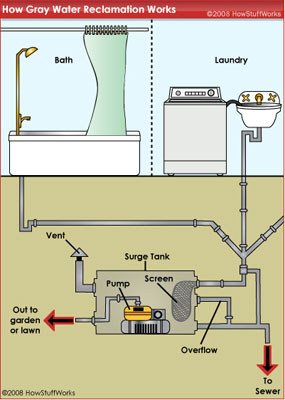
Denver Water CEO Jim Lochhead’s statement in response to Denver City Council’s ordinance to allow graywater use:
“Water conservation has been key to ensuring we meet the needs of future generations, and it’s time that as a city and state we take additional steps to embrace an integrated, sustainable approach to urban water management. Using the right quality water for the right use is a critical step in a sustainable water future for Colorado, and this step by the Denver City Council shows the kind of progressive action we need to be taking to make sure we have enough water to meet our future needs. We applaud the leadership of the city of Denver in taking this important step.”
This view of Moffat Treatment Plant’s corridor was taken in 1939. Photo via @DenverWater.
Click here to read the newsletter. Here’s an excerpt:
Tour a water treatment plant
Learn how water is treated by taking a FREE tour at one of Denver Water’s treatment plants:
Denver Water’s Recycling Plant treats effluent from Metro Wastewater to a nonpotable standard for industrial and irrigation uses. The facility, which opened in 2004, is the largest of its kind in Colorado. Tours are available from 1 to 3 p.m. on May 6 and Oct. 7.
Moffat Treatment Plant treats West Slope water brought through the Moffat Tunnel and Gross Reservoir for delivery into Denver Water’s distribution system. Tours are available from 1 to 3 p.m. on June 3 and Sept. 9.
Marston Treatment Plant treats South Platte River and Roberts Tunnel water for distribution throughout the metro service area. Tours are available from 1 to 3 p.m. on July 8 and Aug. 5.
Tours are limited to 25 people. Participants must be 18 or older and request a spot at least two weeks in advance.
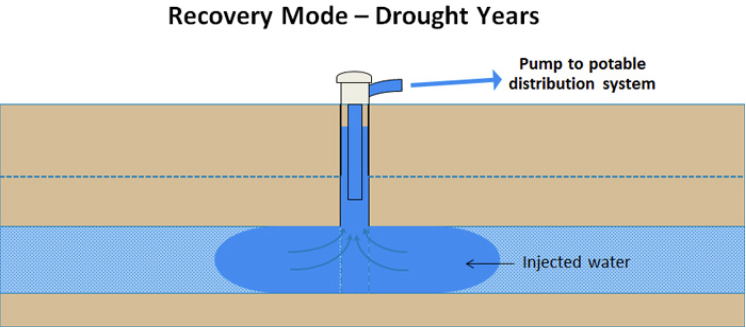
We think of reservoirs as bodies of water, places created by dams where you can go sailing or fishing. Denver Water is investigating whether Denver’s future reservoirs will lie several hundred feet below the feet of its customers in aquifers called the Arapahoe and Laramie-Fox Hills.
Aquifer recharge has been used in many places as a way to store water. Arizona, for example, stores water for Las Vegas in an innovative partnership as well as water for its own use. In metropolitan Denver, the Centennial Water and Sanitation District, which serves Highlands Ranch, has also been pumping water into an aquifer, for withdrawal when needed. Others in the Denver area have also used it, with various degrees of success.
Denver has 17 reservoirs already able to store a combined maximum of 690,000 acre-feet. The adequacy of that storage is challenged by the uncertainties posed by the changing climate and continued population growth, said Bob Peters, a water resource engineer with Denver Water, speaking at a National Groundwater Association conference in Denver on April 25. Among the options now being studied is whether the aquifers underlying the city could also provide storage.
The city is bisected by the South Platte River. For most of the year, the river is over-appropriated, meaning there is no new water to be claimed. Furthermore, many of Denver’s existing rights from the South Platte are junior, meaning Denver might be left short in years of little snow or rain.
In a PowerPoint presentation, Peters also showed a variety of scenarios, all depicting gaps between needs and supplies. Denver is pursuing stepped-up conservation and greater reuse.
Denver also wants to divert more water from the Colorado River Basin through its Moffat Tunnel delivery system near Winter Park. That Moffat system expansion would include raising the height of Gross Dam, located southwest of Boulder, by 125 feet, nearly tripling the capacity of the reservoir. Denver has not received final authorization from the U.S. Army Corps of Engineers.
Aquifer storage might also play a role in Denver’s future. Pumping water underground results in no evaporation, Peters said, requires fewer permits, and has less of an environmental footprint. Plus, it’s less costly than above-ground storage and can be done in small increments, unlike dams.
Challenges include figuring out where to put wells in urban areas, questions about the quality of water to be injected, and uncertainty about how much the water can later be recovered.
“We know it’s feasible. The question is whether it will work for Denver Water,” said Cortney Brand, of Leonard Rice Engineers, a consulting group.
Brand outlined Denver’s aquifers. The Arapahoe Basin is 500 to 2,100 feet thick, but the water-bearing sands of that formation are only 150 to 250 feet thick and not necessarily in one seam. The water-bearing sands of the Fox Hills has average thickness of 382 feet. These are averages for wells logged within Denver, but the city is only 2.5 percent of the much broader Denver Basin.
But the understanding of what lies underneath is not as sharp as those figures might suggest. To get a clearly image of the ability of the aquifers in specific areas to store water, three or more wells are being drilled this year.
With those additional wells, he said, engineers expect that they can deliver designs and cost estimates of a pilot project for an aquifer storage and recovery project by the end of 2016.
How much storage might these wells provide? The study intends to answer that question, but Denver Water’s website suggests that nobody should expect a quick Dillion Reservoir. One recharge sit could store an estimated 20 to 150 acre-feet of water per year. That compares with the 7,863 acre-feet stored by Denver’s smallest surface reservoir, Strontia Springs.
Looking up the Colorado River from the mouth of the Roaring Fork River. One of three proposed whitewater parks would be built in the river just upstream of the pedestrian bridge.
By Brent Gardner-Smith, Aspen Journalism
GLENWOOD SPRINGS — In its effort to secure water rights for three proposed whitewater parks on the Colorado River, the city of Glenwood Springs has reached formal or conceptual agreements with a list of opposing parties in the water court case, including Denver Water, but it’s still facing opposition from Aurora and Colorado Springs.
“We have a number of parties that have already settled,” said Mark Hamilton, an attorney with Holland and Hart representing Glenwood. “And while there are still some significant question marks, we think the process so far has been productive and continues to be productive.”
Since December 2013, the city has been seeking a recreational in-channel diversion (RICD) water right tied to three whitewater parks on the popular Grizzly-to-Two Rivers section of the Colorado River, at No Name, Horseshoe Bend and the upper end of Two Rivers Park.
The two wave-forming structures in each of the three whitewater parks would operate under a common water right that could call for 1,250 cubic feet per second of water from April 1 to Sept. 30, 2,500 cfs of water for up to 41 days between April 30 and July 23, and 4,000 cfs on five consecutive days sometime between June 30 and July 6.
The 1,250 cfs level is the same as the senior water right tied to the Shoshone hydropower plant, which is upstream from the three proposed whitewater parks. Glenwood officials have previously said, however, that 2,500 cfs is a better level for boating and floating than 1,250 cfs, and the city wants the flows of 4,000 cfs for five days around the Fourth of July to hold expert whitewater competitions.
But Aurora and Colorado Springs, both as individual cities, and together as the Homestake Partners, have told the water court that Glenwood is seeking more water than it needs.
“Glenwood has ignored the law limiting a RICD to the minimum flow necessary for a reasonable recreation experience, and instead has reverse-engineered its proposed RICD to tie up half the flow of the mainstem of the Colorado River,” the Front Range cities said in a June 2015 statement filed with the court.
And the cities, which own conditional water rights upstream of Glenwood, said that the city’s proposed water right “would dramatically and adversely affect the future of water use in the Colorado River drainage, if not the entire state.”
Hamilton has met twice this year with representatives of Aurora and Colorado Springs, most recently on April 22 in Denver, to see if a deal can be worked out on how much water is appropriate.
“We’re talking,” said Joe Stibrich, the water resources policy manager at Aurora Water. “But, we’ll see where it goes.”
“There are ongoing negotiations and discussions that seem to be productive at this time,” said Kevin Lusk, principal engineer at Colorado Springs Utilities. “Whether or not we can reach agreement, of course, is really up to how those discussions go.”
A status conference with the water court referee is set for June 23. The referee could then decide to send the application up to James Boyd, the judge who hears Division 5 water court cases in Glenwood Springs, or the parties in the case could ask for more time to keep talking before heading to trial.
“We are actively communicating with Colorado Springs and Aurora concerning the possible development of additional call reduction provisions in order to protect future yield to their systems,” Hamilton said. “And we remain hopeful that a stipulated decree may be able to be entered after completion of these ongoing negotiations.”
Glenwood has recently worked out a “call reduction provision” with Denver Water.
“There has been a lot of progress on our end with the RICD discussions,” said Travis Thompson, a senior media coordinator at Denver Water. “In fact, in the collaborative spirit of the Colorado River Cooperative Agreement (CRCA), Denver Water has agreed to allow Glenwood Springs to exceed 1,250 cfs under certain conditions.”
In the CRCA, signed in 2013, Denver Water agreed not to oppose a future recreational water right application if it did not seek flows greater than 1,250 cfs. But given that Glenwood is also seeking 46 days at 2,500 cfs and five days at 4,000 cfs, above the relatively consistent flow of 1,250 cfs, Denver did file a statement of opposition in this case.
Glenwood and Denver have now agreed that Glenwood would reduce its call for the whitewater parks to 1,250 cfs if continuing to call at a higher rate, such as 2,500 cfs, would limit a potential future water project that is described in the CRCA as providing 20,000 acre-feet to the East Slope.
Staff at Denver Water approved such an agreement with Glenwood on March 9, according to Thompson, and Hamilton said a copy would soon be filed with the court.
A map filed by the city of Glenwood Springs showing the locations of three proposed whitewater parks. The city is seeking non-consumptive recreational in-channel diversion (RICD) rights tied to six rock structures built in the river, two in each of the three parks.
Other opposers
Glenwood enjoys the support of three “opposers” in the case: American Whitewater, Western Resource Advocates and Grand County, as the entities have filed statements “of opposition in support,” which is an option in Colorado’s water courts.
And Glenwood has now filed formal agreements in water court that it has reached with five other true opposers with a range of issues: Glenwood Springs Hot Springs & Lodge Pool, Inc., BLM, Grand Valley Water Users Association, Orchard Mesa Irrigation District, and Ute Water Conservancy District.
The Glenwood Hot Springs Lodge & Pool is concerned about the project disrupting the deep Leadville limestone aquifer that provides its hot water.
But they’ve reached an agreement with the city that allows them to review construction plans for the wave structures at the Two Rivers Park location and requires the city to monitor the resulting wave structures for five years to watch for scouring of the riverbed, among other provisions.
And an agreement between Glenwood and the BLM was filed with the court in June 2015. It says that if the city needs to cross BLM property to create a whitewater park in Horseshoe Bend then the city will go through the required federal land use process.
The city has also signed a memorandum of understanding with CDOT that moves issues coming from the use of land at the No Name rest area on I-70 out of water court and into a future potential land-use application.
“One of the conditions is that the city will have to work with CDOT as they move forward with building the whitewater park, as the (No Name) location falls in CDOT right-of-way,” said Tracy Trulove, a communications manager for CDOT. The agreement has yet to be filed with the court.
A graphic presented to the Glenwood Springs city council in December showing the size and timing of the city's water right application on the Colorado River. The large dark blue block at the bottom represents a seasonal base line flow of 1,250 cfs. The smaller block on top represents 41 days at 2,500, the narrow dark blue spike is 5 days at 4,000 cfs.
District support
The city is also close to finalizing agreements with the Colorado River District, the town of Gypsum, and the West Divide Water Conservancy District, according to Hamilton.
Peter Fleming, general counsel for the Colorado River District, which represents 15 West Slope counties, said staff at the district is now comfortable with proposed settlement language in the Glenwood case.
And he said once the district’s initial goals in a RICD case are met, the district often stays in the case on the side of the applicants “in order to support the right of its constituents to use water for recreational purposes that will support and/or enhance the local economy.”
“We anticipate that such participation may be necessary in the Glenwood Springs RICD case,” Fleming said.
At the end of the list of opposers is the Colorado Water Conservation Board, a state agency whose board of directors in June 2015 recommended against the proposed RICD after concluding it would “impair Colorado’s ability to fully develop its compact entitlements” and would not promote “the maximum beneficial use of water” in the state.
“While we stand by our initial decision on this RICD, we’re encouraged that the applicants are actively seeking resolution with stakeholders and hope they will resolve the issues we raised,” James Eklund, director of the Colorado Water Conservation Board, said this week.
Eklund said the CWCB staff will likely reconsider Glenwood’s proposal after it has reached agreements with other opposing parties in the case, and if staff is satisfied, bring the proposed decree back to the board.
“Water for recreation in Glenwood Springs and around Colorado is essential and we want to make sure all RICDs strike the right legal, design, and safety balance,” Eklund said.
Editor’s note: Aspen Journalism and the Aspen Daily News are collaborating on coverage of water and rivers in Colorado. The Daily News published this story on Saturday, April 30, 2016.
LOVELAND – Mike King, the new director of planning for Denver Water, said at a recent meeting that beyond additional transmountain diversions through the Moffatt Tunnel into an expanded Gross Reservoir near Boulder, Denver Water doesn’t have other Western Slope projects on its radar.
King served as executive director of Colorado’s Department of Natural Resources from 2010 until January of this year, when he took the planning director job with Denver Water.
After speaking to a luncheon crowd of close to 200 at the Northern Water Conservancy District’s spring water users meeting in Loveland on April 13, King was asked from the audience “How much more water does Denver Water need from the Western Slope?”
“I think if we get Gross Reservoir approved, the answer is for the foreseeable future, you know, we need to do that first,” King said.
King is a native of Montrose, son of a water attorney, and has a journalism degree from CU Boulder, a law degree from the University of Denver, a master’s in public administration from CU Denver and 23 years of state government experience.
“And I can tell you that the reality is, whether it is from a permitting perspective or a regulatory perspective, the West Slope is going to be a very difficult place,” King continued. “If there is water available, it is going to be a last resort. And I so think that the answer is, that won’t be on our radar.”
Denver Water is seeking federal approval to raise the dam that forms Gross Reservoir, in the mountains west of Boulder, by 131 feet. That would store an additional 77,000 acre-feet of water and bring the reservoir capacity to 118,811 acre-feet. Ruedi Reservoir, by comparison, holds 102,373 acre-feet.
The $360 million project would provide 18,000 acre-feet of firm yield to Denver Water’s system and result in an additional 15,000 acre-feet of water being diverted from the West Slope each year. On average, Denver Water’s 1.3 million customers use about 125,000 acre-feet of West Slope water each year.
The water to fill an expanded Gross Reservoir would mainly come from tributaries of the Fraser and Williams Fork rivers, via the Moffat Tunnel, near Winter Park.
Beyond the Gross Reservoir project, King explained that any future Denver Water projects on the West Slope would need to fit within the confines of the Colorado River Cooperative Agreement, signed by Denver Water and 17 West Slope entities in 2013.
The CRCA, says that “if there is more water, it only comes after the West Slope says they agree with it and it makes sense,” King said. “That sets the bar so incredibly high and gives them the ultimate ability to say, ‘This is good for the West Slope.’
“And so I just don’t think Denver Water is going to be looking to the West Slope,” King continued. “I think anybody who manages natural resources, and water in particular, will never say ‘never’ to anything, but I think it is certainly not on our radar.”
Not on Denver Water’s radar, perhaps, but it is worth noting that Denver Water is the only major Front Range water provider to have signed the cooperative agreement with the West Slope.
When asked what he thought of King’s remarks about West Slope water, Eric Kuhn, the general manager of the Colorado River District said he thought the comments reflect “the concept that if Denver takes more water from the West Slope it could undermine the security/reliability of what they already take.”
Kuhn’s comment relates to the possibility that if Denver Water diverts too much water from the Western Slope, it could help trigger a compact call from the lower basin states, which could pinch Denver’s transmountain supply of water.
Editor’s note: Above is a recording of Mike King, the director of planning for Denver Water, speaking after lunch in front of about 200 people at Northern Water’s spring water users meeting, a public meeting held at The Ranch event center in Loveland on Wednesday, April 13, 2016. The recording, made by Aspen Journalism, begins shortly after King had begun his remarks. It is 26:34 in length. At 8:20, King discusses the development of the Colorado Water Plan. At 22:40, King answers a question about the governor’s endorsement of the Windy Gap project and another phrased as “How much more water does Denver Water need from the Western Slope?”)
A buoyant crowd
Earlier in the meeting engineers from Northern Water — which supplies water to cities and farms from Broomfield to Fort Collins — told the mix of water providers and water users from northeastern Colorado that they could expect an average spring runoff this year, both from the South Platte and the Colorado Rivers.
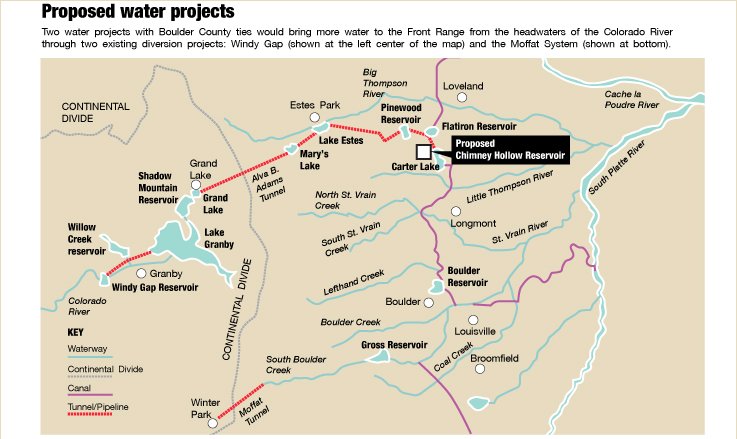
They were also told that Northern Water was making progress on its two biggest projects: the Windy Gap Firming Project, which includes construction of Chimney Hollow Reservoir near Berthoud; and NISP, the Northern Integrated Supply Project.
NISP includes two new reservoirs, Glade and Galeton, to be filled with East Slope water from the Cache La Poudre River, which runs through Fort Collins and into the South Platte River.
Just before lunch, John Stulp, the special policy advisor on water to Gov. John Hickenlooper, read a surprise letter from the governor endorsing the Windy Gap project, which would divert an additional 9,000 acre-feet of water each year, on average, from the upper Colorado River and send it through a tunnel toward Chimney Hollow.
Windy Gap is part of the Colorado-Big Thompson Project, which diverts on average 260,000 acre-feet a year from the Western Slope.
The Windy Gap project does include environmental mitigation measures for the sake of the Colorado River, and has approval from the required state agencies and Grand County, but it still needs a permit from the U.S. Army Corps of Engineers.
Looking east toward the Chimney Hollow Reservoir site, which is just this side of the red ridge. On the other side is Carter Lake Reservoir and beyond that, the Loveland area.A graphic from Northern Water showing the lay out of Windy Gap Firming Project.
A political risk
After lunch, King shared some insights from his old job as head of the state’s department of natural resources.
“I think it’s important that you understand what the development of the state water plan looked like from the governor’s perspective and the state’s perspective,” King told his audience.
As head of DNR, King had oversight over the Colorado Water Conservation Board, which was specifically tasked by the governor in late 2013 to produce the state’s first-ever water plan, and to do so in just two years.
King said that he, Stulp and the governor knew that a water plan in Colorado could be “the place where political careers went to die.”
“So the thing we had to make sure that came out of this, knowing that we weren’t going to solve the state’s water issues in two years, was that we had to do this in a manner that politically, this was viewed as a big win, and that future governors and future elected officials would say, ‘We need to do this again and we need to continue this discussion,’” King said.
“Not because the governor needed a political win,” King added, “but because to have the next stage of the water plan, to have the discussion in five years, you can’t have an albatross around this, and I think we were able to do that, and so we’re very proud of that.
“If we had a political mushroom cloud, no one would have ever touched the Colorado Water Plan again,” King continued. “That meant we aimed a little bit lower than maybe we would have liked, and I’ve gotten this at Denver Water, talking about lost opportunities in the Colorado Water Plan. Maybe we did aim just a little bit lower than we should have.”
King said the state was not able to “reconcile the inherent conflicts” in the various basin implementation plans, or BIPs, that were put together by regional basin roundtables as part of the water planning process.
And he acknowledged that the plan has been criticized for not including a specific list of water projects supported by the state, and for reading more like a statement of problems and values than a working plan.
“One of things that has been driven home to me time and time again in the two months that I’ve been at Denver Water is that planning is not something you do every five or six years,” King said. “Planning is a continuous process.”
King also said that there were some “tremendous successes” in the water plan, including the basin implantation plans, or BIPs, even though they sometimes conflicted.
“We got BIPs from every single basin,” King said. “The basins turned over their cards and said ‘This is what we need.’ So now we have a major step forward.”
Other plan elements
King said other successes in the Colorado Water Plan include the stated goal of conserving 400,000 acre-feet of water by 2050 and a nod to changing land use planning in Colorado.
King said tying land use to water availability “was something we never discussed in Colorado because it infringed on local control and it was just kind of a boogieman in the room.”
But he pointed out that “the vast majority of the basin implementation plans said, expressly, ‘We need to have this discussion’ and ‘We need to start tying land use to water availability,’” King said. “That’s a good thing. That’s a major step forward.”
When it comes to land use and Denver Water, King said driving down the per capita use remained a high priority and that if Denver proper grows, it is going to grow up through taller buildings, not by sprawling outward.
King also said Denver Water was working to manage, and plan for, the already apparent effects of climate change, especially as spring runoff is now coming earlier than it used to.
“We know that the flows are coming earlier, we know that the runoff is coming earlier,” King said, noting that reality is causing Denver Water to plan for different scenarios and ask questions about storage and late summer deliveries of water.
“For us, the most immediate thing is, is that we know it’s getting warmer,” King said. “In the last 20 years we’ve seen that, the way the [run offs] are coming earlier. We know we’ve had catastrophic events that are incredibly difficult for us to manage. And so we’re trying to work through that.”
Editor’s note: Aspen Journalism, the Aspen Daily News and Coyote Gulch are collaborating on coverage of rivers and water. The Daily News published this story on Wednesday, April 20, 2016.
Environmentalists are rallying support for a renewed fight against a long-standing proposal from Denver Water to nearly triple the capacity of Gross Reservoir by diverting from the Colorado River Basin…
Before a group of about 30 Monday night at Shine Restaurant and Gathering Place, the directors of two non-profits united in the fight against the expansion — Save the Colorado River and The Environmental Group — made presentations alleging impropriety on Denver Water’s part and soliciting donations to a legal fund.
“They’ve been working on their decision, and we assume, feel very strongly, that (Army Corps) will issue the permit,” said Chris Garre, President of The Environmental Group, which is based in Coal Creek Canyon. “As soon as that happens, the clock starts ticking.”
The Colorado River, the presenters said, is the most dammed and diverted on the planet. At the Colorado River Delta, there is no longer water, and there is concern that an expansion of Gross Reservoir would see some creeks and tributaries drained at the 80 percent level, with some “zero flow” dry days.
An expansion of Gross Reservoir, which is a roughly 25-minute drive west from Boulder on Flagstaff Road, would have a significant local impact. In fact, it would be the biggest construction project in Boulder County history, and would likely take about four or five years to complete.
The proposal seeks to increase the height of the dam by 131 feet, and would require the clearing of about 200,000 trees…
“Caring for the environment,” Garre added, “particularly those who live in the environment, in the forest, is crucial to your experience in Boulder County. This has never been addressed by Denver Water. It’s been ignored.”
While the universal downsides such major construction — noise and temporary aesthetic downgrade, among others — aren’t up for debate, Denver Water tells a very different story about the project.
The public agency that serves 1.3 million people in the Denver metro area gets about 80 percent of its water from the South Platte River System, and another 20 percent from Moffat, a smaller clump up north. Expanding Gross Reservoir and thereby Moffat, Denver Water says, will help balance the existing 80/20 split.
“This imbalance makes the system vulnerable to catastrophic events, such as the Buffalo Creek and Hayman fires, which caused massive sediment runoff into reservoirs on the south side of our system,” the agency published on its website.
During times of severe drought, the argument continues, “We run the risk of running out of water on the north end of our system,” which would primarily impact customers in northwest Denver, Arvada and Westminster.
Denver Water also maintains that as the Front Range continues to be one of the country’s fastest-growing areas, a shortfall in water supply is imminent unless addressed through projects like the one pitched for Gross Reservoir.
Click here to read the newsletter. Here’s an excerpt:
New rate structure in effect
Beginning April 1, your water bill reflects Denver Water’s new rate structure. This new structure will begin to shift our revenue from such a heavy reliance on usage to a more stable fixed fee over the next few years, which means that future rate increases will be less subject to bigger jumps because of unpredictable weather.
Residential customers will continue to be charged on a tiered structure — the more you use, the more you pay. Now, however, the rate structure is based on three tiers instead of four. The first and least expensive tier is based on indoor use. This rate is calculated by averaging your monthly water consumption reflected on January, February and March bills each year (beginning in 2016), which is a way of determining indoor water use (also known as your average winter consumption).
Because the majority of our single family residential customers’ indoor water use is 5,000 gallons or less in the winter months, the minimum average winter consumption allowance is 5,000 gallons, and the maximum is 15,000 gallons. The minimum helps ensure customers aren’t penalized for low water usage in the winter.
Each month, the amount of water you use up to your average winter consumption in tier 1 will be charged at the lowest rate. In tier 2, customers will be allotted 15,000 gallons in addition to their average winter consumption — what it takes to water an average-sized yard efficiently — for outdoor use, which falls into a higher-priced tier. Any use above that will fall into the third, highest-priced tier.
Fixed monthly charge
For residential customers, the fixed monthly charge has increased to $8.79 each month. The fixed monthly charge varies by meter size, but the majority of single-family residential customers have 3/4-inch meters.
The costs to collect, store, treat and deliver water are expenses that have to be paid regardless of the amount of water customers use every year. No matter how much water customers use, we still need to maintain and operate more than 3,000 miles of pipe, 19 reservoirs, 22 pump stations, 30 underground storage tanks, four treatment plants and much more.
Wait — don’t irrigate!
When it comes to lawn watering, April is too early to go automatic. Set aside plans to program your sprinkler system for later months, when the ground is less likely to retain wintertime moisture.
But you can still dig in and start preparing for the planting season.
Here’s how:
Start from the bottom up and aerate your lawn. If you can, aerate after a rain or snow shower provides moisture, which helps prepare soil for the process.
Then take a top-down approach by checking the height and width of your trees, shrubs and perennials.
Prune any overgrowth — which makes excellent compost when shredded.
Watch your mail for a detailed explanation on Denver Water’s summer watering rules, which go into effect May 1.
Save water, get a rebate
Here’s a simple springtime project that pays off: earn a rebate for installing a new water-efficient toilet.
We offer rebates of up to $150 for purchasing a WaterSense-labeled toilet that uses an average of 1.1 gallons per flush or less. WaterSense is a national program that makes it easy to choose quality products that use less water. Makes sense to us!
Orr Manufacturing Vertical Impact Sprinkler circa 1928 via the Irrigation Museum
During the next few years, two major installations will take shape in Denver that will seek to inform urban development of the future, including the use of water.
Along I-25, jut southwest of downtown, Denver Water has already started redeveloping its administrative campus. Most of the buildings there are more than 50 years old, but the water agency also sees it as an opportunity with the $195 million redevelopment to demonstrate the technology and concepts of the future.
Jim Lochhead — photo via Westword (Alan Prendergast)
With all that it has planned said Jim Lochhead, the chief executive of Denver Water, the agency thinks it can reduce the amount of water needed for the campus by 50 percent. The agency, he said, is embracing “total reuse.”
The other project to keep an eye on within Denver is at the Coliseum and Western Stock Show complex along I-70 north of downtown Denver. With state backing, the aging complex will be redeveloped by Denver in concert with Colorado State University using cutting-edge building technologies but also minimal water uses.
Denver and the West have entered a new era that recognizes limits. Lochhead, in a recent presentation at the Rocky Mountain Land Use Institute. During the 25 years of the conference there has been an “extraordinary remarkable transition in the paradigm of water,” he said.
In the first half of the 20th century, water developers, commonly called “water buffaloes,” encountered little opposition to their work. But after World War II, they “really ran into this new world that they didn’t understand,” said Lochhead.
The South Platte River typically all but vanishes as it passes through Denver’s industrial neighborhood north of downtown, downstream of the Burlington Ditch diversion, near the Cherokee power plant. Photo/Allen Best
The buffaloes understood water development in ways that were both monolithic and linear. Major cities and other agencies developed water, and they just ran over the opposition. Their development was linear, in that they just expected to do one more project after another. Their attitude, he said, was “if we run out of water, we’ll just get more.”
Lochhead identified a pivotal change in the 1950s, when a proposal to dam the Yampa River at Echo Park in northwest Colorado was fought by environmental groups and conservationists such as Wallace Stegner.
“They really didn’t see the first signs of the world shifting from under them as the Sierra Club was able to defeat construction of the dam in Echo Park,” he said. The water buffaloes didn’t see what was coming as Congress adopted the Wilderness Act and then a raft of environmental legislation. They didn’t see it when Jimmy Carter issued his “hit list” of federally funded reclamation projects in 1977, which effectively became the end of the era of dam building.
In Colorado, according to Lochhead, the pivot came in the early 1990s, when Two Forks Dam was defeated. It was a stern rebuke to the thinking of Colorado’s water developers, who believed if “just only they could get one more big water project.”
Denver, in the 21st century, has been part of the new wave of thinking. This has been evident most clearly in the plans to enlarge Gross Reservoir, southwest of Boulder. The increased water will come from stepped-up diversions from across the Continental Divide, in the Fraser and Williams Fork valleys, at the head of the Colorado River.
At first glance, this looks like business as usual. But this project has been different. Nobody questioned Denver’s right to the water under Colorado water law. But Denver at the outset admitted that there were other considerations, especially when the streams were already nearly tapped out. With the increased diversions, up to 80 percent of the flows of the Fraser River will be diverted.
West portal Moffat Water Tunnel
The plan worked out after lengthy negotiations between Denver Water representatives and those from Grand County and the Western Slope is complex. What is pertinent is that some of the major environmental groups, most notably Trout Unlimited, endorsed the settlement. And here’s a key principle:
When diversions occur will matter equally, or even more so, than how much is diverted.
Lochhead also pointed to the need for partnerships with irrigators downstream on the South Platte River. Denver has pledged to step up the reuse of the water it imports from the Western Slope, and it is entitled, by law, to use that water to extinction. Using the water to extinction, however, means less water for those downstream.
“We will have to have partnerships in how we deal with those impacts,” said Lochhead.
Also speaking on the same panel at the Rocky Mountain Land Use institute was Lawrence McDonnell, an adjunct professor of water law at the University of Colorado. The broad change in the West in the last quarter-century has been a small shift of water from agricultural produce to municipal uses, to accommodate rapid population growth. In the eight states, population grew 60 percent from 1990 to 2010, with most of that growth occurring on urban areas.
“Leadership has to come from cities,” he said, and it has. Growth has occurred “in ways that often resulted in far less per-capita water use.”
From the Glenwood Springs Post Independent (Hannah Holm):
A recent Bureau of Reclamation report projects that Western river basins, including the Colorado Basin, are likely to experience a 7-27 percent decline in spring streamflows during this century.
The bureau’s 2016 SECURE Water Act Report to Congress, which can be found at http://usbr.gov/climate/secure/, is just the latest to warn of reduced streamflows in our region as temperatures climb.
The Colorado River Basin has already experienced more than a decade in which more water has been pulled out of rivers and streams for farms and cities than has come back in through rain and snow. As a result, water levels in Lake Mead and Lake Powell have begun to approach critical levels. For Mead, that means dropping too low to reliably meet demands. For Powell, that means dropping too low to generate hydropower and meet downstream obligations.
One of the efforts to head off this looming crisis is the System Conservation Pilot Program, which pays for voluntary, temporary water use reductions. This program, funded by major cities and other water suppliers that rely on Colorado River Basin water, was initiated in 2014 to test the feasibility of voluntary, compensated measures to curtail water use in order to prop up water levels in lakes Powell and Mead. Details on the program can be found at http://bit.ly/1UUSbIC.
Farmers and ranchers in western Colorado are among those who have participated and are considering participating in the program. Agricultural approaches tried so far include foregoing irrigation for part of a season, fallowing ground, leasing water and converting to lower water use crops. Some of these farmers recently met with program funders, researchers and supporters to discuss how the program is working.
The group included representatives of Denver Water, the Colorado Water Conservation Board, Colorado Division of Water Resources, the Nature Conservancy, Trout Unlimited, the Colorado River District, Colorado State University and Colorado Mesa University.
On the positive side, being paid to temporarily fallow land or reduce water use can provide money and time to upgrade aging headgates or other irrigation infrastructure, improve soil health or explore alternative crops.
Some farmers are hoping to use the program to receive income while transitioning ground from conventional to certified organic production, a three-year process that can lead to long-term economic benefits for the farmer. Farmers also like the opportunity to take the lead in figuring out how they could get by with less water, since there is concern that they may have to do so in the future. State law provides that participants in approved conservation programs will not have their water rights diminished as a result.
On the other hand, the first year of the pilot revealed many logistical hurdles to increasing flows into Lake Powell by paying farmers and ranchers to use less water. One major problem is how to ensure that saved water makes it to Lake Powell without being picked up by another water user that was previously short.
A related issue has so far hobbled attempts to lease water under the program. How can you lease water to an undefined recipient for an undefined use? According to some interpretations, this doesn’t square well with Colorado water law.
How to recognize the full value of agricultural water was also discussed. In addition to the need to compensate producers for forgone crop sales, concern was expressed about the impact of reduced production on farmworkers, implement dealers and the community at large. And how can you make sure that temporary water use reductions to get through a crisis really stay temporary, and don’t just permanently transfer that use elsewhere, from farms to cities? The fact that some cities are also participating in the program by reducing their water withdrawals or treating and returning wastewater helps address this concern, but doesn’t eliminate it.
The amount of water saved through the system conservation program so far is miniscule in relation to the amount needed to significantly reduce the risk of the reservoirs hitting critical lows. With all the issues involved with implementing the program and the growing demand for water, a major concern is whether this mechanism will ever be able to move enough water to really make a difference. Meeting participants noted that resolving the legal and logistical challenges, as well as building community understanding and acceptance of the program, are preconditions for scaling it up.
Avoiding critically low levels in Lakes Mead and Powell will require either significantly more action to reduce water demands or a lot more snow in the mountains. As of March 1, the 2016 water year inflows into Lake Powell were forecast to be 83 percent of average. That’s not terrible year, but it’s also not good enough to take the pressure off water users to control demand.
A major milestone in implementing the Colorado River Cooperative Agreement was reached last week when the water court signed a decree to secure and preserve environmental water flows in the Fraser, Williams Fork and Colorado rivers.
The decree protects releases of 2,000 acre-feet of water made available from Denver Water’s Moffat Collection System and Williams Fork Reservoir to preserve and improve the aquatic environment in the Fraser and Colorado rivers all the way through Grand County — a continuous stream reach of 73 miles — and beyond.
“This is truly a unique transbasin collaborative and milestone that provides the additional environmental flows on the Fraser River as contemplated by the CRCA,” said Grand County Board of County Commissioners Chairman Jane Tollett.
Once the Gross Reservoir Expansion Project is complete, Denver Water will be able to provide more water for county streams by delivering water to the Fraser River Basin at diversion points along its system, and by releasing water from Williams Fork Reservoir to the Colorado River.
The decree also provides for the delivery of 375 acre-feet to a number of Grand County water users for municipal and snowmaking purposes. If the water is not needed for those purposes, it can be added to the water being provided for environmental benefit.
The decree represents the most recent success in meeting the agreements outlined in the CRCA.
“In only a few short years since the CRCA went into effect, we’re already seeing that through collaboration, we can help improve the health of the Fraser and Colorado rivers,” said Jim Lochhead, Denver Water CEO/manager. “This decree is another step in ensuring that we are prepared to fully implement the CRCA conditions as they become effective.”
In 2014, Denver Water made a payment of $1.95 million to Grand County for two water supply projects. The Jim Creek Bypass and Pipeline, which Winter Park Water and Sanitation District is already designing, will help protect water quality at its water treatment plant in low-flow periods, and provide system flexibility. And, the Fraser River Pump Station, Pipeline and Discovery Park Pond project, pays for much-needed improvements that will help stabilize the business of Winter Park Resort and other businesses in the upper Fraser Valley.
“The CWCB is extremely pleased to be able to work with Grand County and Denver Water to implement this important agreement,” said James Eklund, director of the Colorado Water Conservation Board. “This is a great example of how effective the state’s Instream Flow Program can be in the context of multipurpose projects.”
The CRCA ushers in a new era of cooperation between Denver Water, West Slope entities and conservation groups to create a spirit of cooperation instead of litigation over water resources through “Learning By Doing,” a monitoring and adaptive management program with the goal of maintaining, and where possible, improving the health of Colorado River headwater streams in Grand County.
“Thanks to the Learning by Doing framework, we’re finding ways to maintain healthy flows for fish and wildlife in the Upper Colorado,” said Mely Whiting, counsel for Trout Unlimited. “We’re learning — by doing — that collaboration and cooperation can help ensure the health of our rivers while meeting other diverse needs, like municipal water. These flows will make a real difference for the river and for Grand County’s important recreation economy.”
Partner contact info:
Grand County: Ed Moyer, emoyer@co.grand.us, 970-725-3102
Denver Water: Travis Thompson, travis.thompson@denverwater.org, 303-628-6700
Colorado Water Conservation Board: Linda Bassi, Linda.bassi@state.co.us, 303-866-3441 ext. 3204
Trout Unlimited: Mely Whiting, MWhiting@tu.org, 720-375-3961
A state water judge has signed off on a deal between Denver Water and Grand County to leave 651 million gallons of water a year that otherwise would be diverted in headwaters of the Colorado River.
That water would be left each year for the purpose of improving stream health — habitat for fish and other wildlife — once Denver completes its Moffat Project to divert more water under the Continental Divide to the heavily populated Front Range.
Denver Water officials said the water, at least 2,000-acre feet, is enough to sustain 5,000 metro households each year.
State water judge James Boyd signed the decree last week.
The deal was done under the Colorado River Cooperative Agreement, finalized in 2013 between Denver and western slope communities, to try to balance growing urban demands with environmental needs.
Colorado’s Water Conservation Board would protect the water left in streams and use it to preserve natural conditions.
Denver Water manager Jim Lochhead said the deal shows Denver is prepared to fully implement the agreement.
Grand County authorities could not be reached for comment.
Under the agreement, Denver Water must conserve and recycle water and transfer up to 45,000 acre-feet a year in treated wastewater to suburbs on the condition that the suburbs agree not to pursue their own diversion projects and pay a surcharge. Western Slope communities, not including Grand County, would drop opposition to Denver’s Moffat Project.
Gross Reservoir in the mountains to the southwest of Boulder. Denver Water hopes to increase the height of the dam 131 feet, to a new height of 471 feet, to store three times as much water, which it says will help it meet increasing demands and to better weather severe droughts.
Gross Dam enlargement concept graphic via Denver Water
Gross Dam
Workers pose for a photo in the Moffat Water Tunnel in this 1930 photo.
West portal Moffat Water Tunnel
South Boulder Creek near the East Portal of the Moffat Tunnel via Jason Lee Davis
Moffat Collection System Project/Windy Gap Firming Project via the Boulder Daily Camera
Here’s the release from Colorado Trout Unlimited (Randy Schofield):
Trout Unlimited has awarded Denver Water, the Denver metro area’s largest water utility, its 2016 River Stewardship Award, recognizing the utility’s leadership in urban water conservation and its collaborative efforts with Trout Unlimited and other stakeholders to promote river health in the Upper Colorado River and South Platte basins. TU presented the award at its annual River Stewardship Gala http://coloradotu.org/2016/02/2016-river-stewardship-gala/ Thursday evening at Mile High Station in Denver.
“We’re recognizing the fact that, 25 years after the divisive Two Forks Dam battle, Denver has engaged former adversaries as partners in a shared 21st Century effort for river stewardship,” said David Nickum, executive director of Colorado Trout Unlimited. “That’s a remarkable and encouraging sign of progress in protecting the rivers that help sustain Colorado’s wildlife, communities and recreation economy.”
Denver Water provides water supply to approximately 25 percent of Colorado’s population with less than 2 percent of all the water used in the state and has been a leader in advancing water conservation, with customers reducing water use by more than 20 percent over the past 10 years, despite a 10 percent increase in population.
Denver has also established new collaborative relationships with the West Slope and with conservation groups, including TU, to help improve river conditions in the Colorado River headwaters through “Learning By Doing https://denverwaterblog.org/2016/01/27/ending-a-rocky-mountain-family-feud/,” a monitoring and adaptive management program with the goal of maintaining, and where possible, improving the health of Colorado River headwater streams in Grand County http://coloradotu.org/2014/07/moffat-agreement-whats-in-it-for-the-river/. Under LBD, Denver has agreed to promote flexibility in their operations to deliver flows when and where they are most needed to minimize river impacts, as well as invest in restoration projects to help improve stream habitat and water quality.
The LBD partnerships follow similar collaborative efforts in the South Platte River through the South Platte Protection Plan, which emerged as a locally developed alternative to Wild and Scenic designations being considered for segments on the South Platte River upstream of Denver. For nearly 12 years, the Plan has promoted collaboration among water suppliers, local governments, recreationists and conservationists – including flow management, an endowment to support investment in
river-related values, and partnerships for water quality and watershed health. Development of the Plan also inspired the creation of the Coalition for the Upper South Platte, a group that has helped direct millions of dollars into watershed restoration efforts including post-Hayman fire recovery projects.
“In the years since the Two Forks veto, Denver Water has truly changed its culture,” said Nickum. “Rather than looking at conservationists and the West Slope as enemies to be defeated, they have engaged those parties as allies in conserving the watersheds we all share. Colorado TU is pleased to recognize Denver Water for its leadership in promoting partnerships that not only supply water to Denver citizens, but also promote stewardship of Colorado’s rivers as well.”
“Part of what makes Colorado an amazing state are our great cities, variety of recreational opportunities and beautiful natural environment. Denver Water is committed to continuing to collaboratively work together with partners from all sectors to keep our rivers healthy,” said Jim Lochhead, Denver Water CEO/manager. “We’re honored to receive the 2016 River Stewardship Award from Trout Unlimited and look forward to continuing our work with them in the future.”
Denver Water CEO Jim Lochhead, left, receives award from CTU executive director David Nickum
The Upper Colorado River system and the Fraser/Williams Fork rivers
provide important aquatic habitat and serve as a critical municipal,
agricultural, recreational and industrial water supply for the state as
a whole. A substantial percentage of the native flows of the Colorado,
Fraser and Williams Fork rivers is currently diverted for Front Range
water supply projects, and as a result, the health of the rivers has
declined over the years. Two projects will divert additional native
flows from these rivers across the Continental Divide to meet growing
municipal needs of the Front Range: the Windy Gap Firming Project and
the Moffat Collection System Project. Although these two projects
triggered conflicts between West Slope and East Slope entities, years of
negotiation produced the 2012 Colorado River Cooperative Agreement
(CRCA), which establishes a long‐term partnership between Denver Water
and the West Slope. The CRCA is a framework for numerous actions to
benefit water supply, water quality, recreation, and the environment on
both sides of the Continental Divide. The LBD Cooperative Effort emerged
from the CRCA.
Here’s an in-depth look at a fallowing experiment on the Carpenter Ranch in the Yampa Valley from Tom Ross writing in Steamboat Today. Click through and read the whole thing. Here’s an excerpt:
Beginning in 2015, the Nature Conservancy committed four hay fields comprising 197 acres at the Carpenter Ranch to a multi-state pilot project conceived to determine how irrigated hay fields in the region would respond to being temporarily left fallow in order to leave more water flowing in the Yampa River. The stronger summer flows would support habitat and help to replenish the vast reservoirs of the Southwest that supply water to cities in Arizona, Nevada and Southern California.
The ranch is among five pilot sites in Colorado and five in Wyoming to make up the Colorado River System Conservation Program.
The Conservancy’s Yampa River Project Director Geoff Blakeslee told Steamboat Today in August 2015 that the water project essentially involves a water transfer plan that could someday allow ag water users to be compensated for temporarily taking water off their land to be used elsewhere.
“It’s very much an exploratory project,” Blakeslee said last year. “We’re doing what we call a split-season fallowing of four fields on Carpenter Ranch just to help with information gathering — what are the impacts to the ranch? What are the impacts to the river?”
It’s understood that the short-term consequences may be a smaller hay harvest that could support fewer cattle. But there are also benefits in the program that flow to the ranchers.
The $11 million program to conserve water is funded by water providers in Las Vegas, Los Angeles and the Central Arizona Water Conservation District.
The Yampa River flows through the Carpenter Ranch. Photo courtesy of John Fielder from his new book, “Colorado’s Yampa River: Free Flowing & Wild from the Flat Tops to the Green.” — via The Mountain Town News
Strontia Springs Reservoir started spilling on May 2, 2015.
Click here to read the newsletter. Here’s an excerpt:
Count after count, statistics show Colorado’s population is booming. And with all those new people, the pressures on our water system are bigger than ever.
“We don’t know what’s going to happen down the road, but as a water provider, we need to be prepared for a number of different scenarios,” said Greg Fisher, Denver Water manager of demand planning.
Denver Water plans not just for population growth, but also for climate change, economic variability, changes in environmental attitudes, changes in water-use patterns, government regulations, new industries, droughts and more.
Last year was a perfect example of why it’s so difficult to predict future water consumption. We recorded the lowest demand for water since 1970, despite a population increase of 400,000 people. We also saw wild weather swings, with record-high precipitation for a watering season that also happened to end with the warmest September in our records.
With half a million more people expected in the metro area by 2040, our planners are taking an “all-in” approach that includes conservation, water reuse and development of new water supplies.
With assurances Denver would not be coming after San Luis Valley water in the near future, the Rio Grande Roundtable this week approved $10,000 to support a south metro Denver area water project.
The decision was not unanimous, however, with opposing votes coming from Juanita Martinez, who represents Costilla County water groups, Ron Brink, who is an Alamosa County representative on the roundtable, and Gene Farish, attorney for multiple municipalities in the Valley.
Sixteen other members of the roundtable voted to support the WISE (Water, Infrastructure and Supply Efficiency) Project with $10,000 from the funds allocated to the Rio Grande Basin. The other basin roundtable boards throughout the state have financially supported the project, which will recycle water from the Denver and Aurora water systems to south metro water providers and their customers.
The treatment plant for the project will cost about $6.5 million. The south metro water providers have already purchased pipeline to transport water from the Denver and Aurora systems to southern metro areas like Highlands Ranch and Castle Rock.
Eric Hecox, executive director of the South Metro Water Supply Authority, made the initial presentation for the $10,000 request to the roundtable in January and made the formal request to the board this week. He said this project would reduce the draw on nonrenewable groundwater resources that have traditionally supplied the southern metro communities.
He said the project would also reduce the metro areas’ need to look to agricultural transfers or other basins for water supplies.
Hecox stressed that the water providers he represented were not after Valley water, and if they did look to other water sources outside of Denver, it would be the Colorado River system or South Platte, not the Rio Grande system.
It’s been proposed to move San Luis Valley water in the past,” he said. “There’s water projects proposed . We have not had any discussions with them. Our members have not had any discussions with them. The planning work we are doing is looking at basin solutions in the South Platte Basin or other partnerships with has support from throughout the state.
She said even though the basin might only be providing $10,000, “what you are getting is a lot more good will for yourselves “you are getting a good standing.”
She explained to Hecox that irrigating in the area she represents is still accomplished through shovels and opening irrigation ditches, and although she was fascinated by this project , which would use “left over discarded water,” she was skeptical about it.
She said she was opposed to the motion for funding, and everyone she spoke to in her county told her to not even consider it. She pointed to the Arkansas Valley where farmland has been dried up so people in the Denver area can have nice lawns and golf courses.
“It’s almost like a ghost town driving through there. It’s sad and it breaks everybody’s heart,” she said. “It’s even hard to talk about.”
Brink, who also voted against the funding, said the Denver area does not even recognize the Valley “except when they want some money or water.”
He added, “I am totally against this.”
Hecox said the project was not asking much money from the basin roundtables across the state, but one of the reasons for seeking some support from them Denver.”
Martinez said if the metro water group had no interest in the Valley’s water, then it must water “our good name” to show that it was to show cross-basin cooperation. He added that the metro water providers were trying to find solutions that would use renewable supplies, such as those from Denver and Aurora, rather than continuing to deplete nonrenewable supplies. He said the communities served by the south metro providers have also implemented significant amounts of conservation programs.
“That will go on and continue to reduce outside irrigation in south metro,” he said.
He said conservation efforts have reduced per capita water use by 30 percent over the last 10-15 years.
Rio Grande Water Conservation District Manager Steve Vandiver said he had raised concerns about supporting this project when it was initially presented, and the concern about “completing the loop” that would make it easier to export Valley water to the Denver area was still a concern of his.
However, he said after speaking further with Hecox, he believed the metro water authority had the Valley’s best interest in mind.
“They have convinced me that the project as it exists today is going to delay the need for outside supplies outside of the South Platte Basin,” he said.
Roundtable member Dale Pizel said, “There’s obviously some distrust between the San Luis Valley and the Front Range, for good reason, because we have been beaten up pretty good and had to fight off some pretty serious battles, but if we don’t solve Denver’s water problem, it’s going to keep coming back, “They are going to keep coming after our water.”
He said the Valley water leaders needed to put their distrust aside and help Denver and the Front Range solve their water problems so they don’t come after the Valley’s water.
Roundtable member Judy Lopez agreed. She commended the Denver area water providers for working together to address their water needs among themselves .
Vandiver said this project would be built whether or not it receives the Valley’s support. He wanted the minutes to reflect that the Valley supported the project with some reservation and concerns.
“We do this with some trepidation but want to support these efficiencies and conservation efforts on the Front Range to try to keep the monkey off our back as long as we can,” he said.
Rio Grande River Basin via the Colorado Geologic Survey
Click here to read the newsletter. Here’s an excerpt:
Just add water for learning fun
Kids play in water vortices. Exhibit features also include a rainstorm and thunder-maker; water tower; waterwheel; geysers; a larger than-life toilet; and river system.
The new exhibit is made possible in part by Denver Water, and will provide multiple opportunities for children and adults to experiment with and discover water in everyday, yet remarkable ways. Exhibit features include a rainstorm and thunder-maker; water tower; waterwheel; vortices; geysers; a larger-than-life toilet; and a river system.
“Denver Water is very excited to be a part of the Children’s Museum expansion,” said Matt Bond, Denver Water Youth Education manager. “To us, the WATER exhibit is the perfect place for kids and adults to learn about water in a truly experiential way and to make memories together. Water is so precious, especially in Colorado, and educating children early helps make them smart, responsible water users forever.”
Drive around Grand County for a little while and you’ll notice our profusion of bumper stickers with slogans admonishing you to “Save the Fraser River”.
For many folks in the valley their bumper stickers are a sign of solidarity but for others such statements are more than mere words, they represents a visceral call to action. The issues and obstacles that confront the Fraser River are deeply rooted and solutions can be difficult to agree on, let alone implement. The Fraser River and its tributaries experience what is called an altered flow regime, meaning the natural stream flows of the river have been altered. According to Kirk Klancke, President of the Colorado River Headwaters Chapter of Trout Unlimited located in Grand County, currently around 60 percent of the native flows of the Fraser River are diverted out of the valley.
“One of the problems is the stream bed is native but the flows are not,” Klancke said. “Over half are diverted out of the Fraser valley. When you have diminished flows like that the stream loses its velocity. The river needs enough velocity to flush sediment out of the rocks on the bottom.That is where the macroinvertebrate life is.”
Macroinvertebrate life, or bugs, live within the voids in the rocks on the bottom of the river, Klancke said. As the river loses its velocity the flows are not able to flush the sediment out from the rocks and the amount of bug habitat is diminished, which has a corresponding effect on the amount of bug life on the river. The amount of bug life on the river has a direct correlation to the amount of fish within the river.
The reduced native stream flows also have a strong impact on the temperature levels within the streams and rivers. “When you have diminished flows the stream becomes wide and shallow and it heats up in ways it never did before,” said Klancke. “Seventy degrees is the limit trout can withstand. We are seeing temps in some places higher than that.”
In an effort to address both of these issues several western slope interests along with eastern slope diverters such as Denver Water have partnered together to form a group called Learning by Doing. Learning by Doing is a cooperative group that seeks to address the environmental impact concerns of Grand County organizations while still providing sustained diversion of water to the Front Range. The group has been developing project ideas and in the fall of 2016 they expect to begin a large rechanneling project on the Fraser River called the Fraser Flats Habitat Project.
Project organizers are planning to rechannel approximately half a mile of the Fraser River on the Fraser Flats, just outside of the Town of Fraser. The works is being done on a section of the river owned by Devil’s Thumb Ranch. So far around $100,000 have been raised to fund the project with roughly half of those funds coming from Denver Water and the other half coming from Devil’s Thumb Ranch. Trout Unlimited also has a $5,000 grant they will apply to the project, allowing for an additional 135 feet of rechanneling.
“The idea of rechanneling is to match the stream bed to the stream flows,” said Klancke. “We create a channel within a channel.”
In the simplest terms the rechanneling work is accomplished by physically digging a deeper channel within the center of the existing streambed where water can recede to at low flow times. The new channel provides a deeper and narrower pathway for the stream to follow, increasing the velocity of water while also decreasing temperatures. The work must be performed carefully so as not to damage the natural streambed either. The native streambed remains essential for allowing larger flows of water during spring runoff. Along with digging a new channel within the Fraser River workers will also move and adjust rocks to create a healthy ratio of riffles to pools within the river.
The collaborative project is the first from the Learning by Doing group and represents a very exciting step forward for people like Klancke who spoke highly of Denver Water and that organizations willingness to engage in the process and work to further the proposed actions. Denver Water CEO/Manager Jim Lochhead echoed his views.
“The most exciting aspect to this project is that all the parties to Learning by Doing are beginning work before it is technically required under the Colorado River Cooperative Agreement,” Lochhead stated. “This is due in large part to the partnerships and relationships that have developed over the past few years, and the value we place on the environmental resources in Grand County. We don’t want to lose momentum, and the fact that Devil’s Thumb Ranch, Trout Unlimited and others in the county have stepped up to move this effort forward is a great indication of our common commitment. We look forward to continuing to work with our partners to enhance the health of the aquatic environment in Grand County.”
Learning by Doing plans to put the rechanneling project out for bidding in mid Jan. and hope to have a contractor chosen by the end of Feb. Work on the project is expected to begin in the fall of 2016.
Eisenhower fishing “little boy falls” in 1955 in Maine.
Denver Water’s collection system via the USACE EIS
West portal Moffat Water Tunnel
Macro Invertebrates via Little Pend Oreille Wildlife Refuge Water Quality Research
Colorado River Basin in Colorado via the Colorado Geological Survey
Directional drilling from one well site via the National Science Foundation
Here’s an interview with Mike King who is moving on from the Colorado Department of Natural Resources to Denver Water, from Bente Birkeland reporting for KUNC. Click through and listen to the whole interview. Here’s an excerpt:
Mike King, the executive director of Colorado’s Department of Natural Resources, is leaving the position at the end of January 2016 to become Denver Water’s new director of planning. Statehouse reporter Bente Birkeland sat down with him to talk about the future of the oil and gas and the state’s hydraulic fracturing debate, and his time heading the agency.
[…]
On Advice For His Successor
“I hope you’re heart is strong. This is a position where you take a lot of criticism. You have to come in with a dose of humility and also a strong sense of right and wrong and know that people are not going to agree with you at every turn. That’s the hardest thing, is knowing that you’re making people mad.”
FromThe Grand Junction Daily Sentinel (Charles Ashby):
After nearly six years on the job, Mike King is leaving the Colorado Department of Natural Resources.
The Montrose native who has headed the department since Gov. John Hickenlooper came into office in 2010 announced Thursday that he was trading in that job for one some Western Slope folks might find, well, somewhat interesting.
He’s to be the new director of planning at Denver Water.
In his new job, King is to oversee Denver Water’s long-range planning for treated and raw water supplies, demand and supply management, water rights, environmental compliance, watershed management and climate change preparations.
“As the son of a West Slope water lawyer and a Wayne Aspinall Democrat, this is a new time and Denver Water is a different organization than back in the day,” King said. “They’ve been moving in the right direction, and I look forward to helping them get there. They’re about as progressive as any agency I can imagine, so it’s all good.”
King added, however, that people should watch what he does and hold him accountable for it.
Hickenlooper, who said he’s still looking for a replacement, praised King for all the work he’s done during his administration, including helping to devise a statewide water plan and working on compromises on oil and gas drilling practices.
During his time on the job, King also helped Hickenlooper merge the department’s parks and wildlife divisions, and helped devise Colorado’s roadless rule with the U.S. Forest Service.
“Mike brokered the oil and gas task force, helped create the state’s first-ever water plan and recently launched Colorado Beautiful, the most ambitious trails and recreation expansion in a decade,” Hickenlooper said. “His ability to balance industry and conservation concerns is unparalleled.”
Several groups have praised King for the job he’s done leading the department.
“During that time, he oversaw important natural resource projects,” said Pete Maysmith, executive director of Conservation Colorado. “We have appreciated Mike’s sophisticated understanding of these very complex issues and support on environmental priorities, such as protection of the Roan Plateau, negotiation of a strong sage grouse plan and advocacy on behalf of the in-stream flow program.”
King, who has worked at the department for about a decade under several executive directors before becoming one himself, said he was pleased with what he’s accomplished, but that it was time to move on.
“I put my heart and soul into it and moved the ball,” he said. “We’ve done incredible things with the water plan, the Rio Grande cooperative agreement, and watched Denver Water reach agreement with the Colorado River cooperative, so we’ve made some incredible progress on water.”
Water advocates have repeatedly clamored for recognition that climate adaptation is about shifting hydrological cycles. In Paris, they are beginning to see results. But Paris is not where adaptation will take place. Fortifying modern society against the destructive potential of a new climate falls on the shoulders of public officials in countless cities, counties, and districts in countries rich and poor. In Denver and Dallas just as in Delhi and Dhaka.
Water managers have much to think about, and the considerations vary by region. Indian cities are still trying to provide 24-hours-a-day water service to their citizens, while American counterparts are encouraging residents to use less. Still, one issue more than any other is likely to dominate the water adaption discussion in the coming decades: storage. That is, how to smooth out climate irregularities into a reliable, steady water supply.
Storage is a “huge topic,” says Peter Gleick, president of the Pacific Institute, a research group. Huge, because the stakes are so high. There are billions of dollars in public and private investment and engineering contracts in play. California voters, for instance, approved $US 2.7 billion last year to spend on storage projects. There is potential conflict between old practices and new ideas. Dams and reservoirs are the tried-and-true storage method. A suite of alternatives is available but they have been tested in only a few parts of the world.
The questions are many: build new dams, increase the capacity of existing facilities, or change how they are managed? Emphasize small dams or large ones or none at all? Is underground storage an option? Where are the best locations? Must laws and policies be altered? How does conservation fit in? The questions are not only a matter of engineering. They also reflect deep and serious debates about social, environmental, economic, and political values.
Dams Set the Stage
In the beginning all storage was natural. Groundwater reserves were built up over millennia. Lakes formed and reformed. Domestic and economic life was molded on the seasonal cycles of rain, snow, and heat.
Soon enough, the demands of the modern era overwhelmed the natural order, in the United States in particular but also in other large economies. For settlements to grow into cities and pioneer farm plots into vast commercial enterprises, the need for regular and predictable water supplies was an urgent matter.
Manmade reservoirs were the answer. An era of dam building began in earnest in the United States in the 1930s. Fifty years later reservoir storage capacity had increased by a factor of 10. China, India, South Africa, and other countries followed. Worldwide, dams radically altered watershed ecology, drove millions from their homes, and became flashpoints for environmental and social justice movements.
Despite the drawbacks, reservoir storage helps in several ways. It provides a long-term buffer against extended drought. Dams in the Colorado River Basin, for example, hold four times the river’s average annual flow. Storage also protects communities against floods. The Portland, Oregon, waterfront would be washed away every few decades if not for the dozens of dams upstream on the Columbia River in British Columbia, Idaho, Montana, and Washington.
Storage is a critical issue today because natural systems are faltering. Groundwater reserves are being drained. Mountain snowpack is shrinking and melting sooner, leading to drier conditions later in the summer. A U.S. Geological Survey study published last month found that the peak spring river flows in the northern U.S. plains moved one to two weeks earlier over the last century.
“Climate change is going to destroy snowpack storage,” Gleick told Circle of Blue. A large body of scientific research supports the claim. Watersheds in the American West, southern Europe, the Middle East, and Central Asia that supply 2 billion people face declines in snow storage, according to a study published last month in the journal Environmental Research Letters. The snow season for several basins in the American West could shrink by two months by 2050, according to a 2014 University of Idaho study.
No single action will replace the storage that will be lost, according to Paul Fleming, manager of the climate and sustainability group at Seattle Public Utilities. That means communities must discuss the menu of options and agree on the order that works for them.
“It’s fair to say that any decision on storage needs to be rooted in the values of the location and of the people who reside there,” Fleming told Circle of Blue. Fleming was also a lead author for the adaptation chapter of the 2014 National Climate Assessment. “It’s important to think of storage not in isolation but as part of an overall strategy.”
Some regions need more storage than others — places that rely primarily on natural storage and are more exposed to the whims of weather.
“There are places where we’ve under-invested in surface storage,” Gleick said, mentioning sub-Saharan Africa as one such area. “These are places where there is a higher risk of drought and flood because they don’t have the protection that reservoirs provide.”
Dams need not be the behemoth structures that flourished in the last century and continue to be built today. Small dams can slow down rivers that are swollen from a heavy rain, hold back the water, and allow it to soak into the soil. The 2015 Stockholm Water Prize, considered the Nobel for water, went to Rajendra Singh for using such methods to restore groundwater tables in India. Singh’s organization has helped build or inspire the construction of more than 8,600 johads, or small earthen dams, in his home state of Rajasthan in the last two decades…
Using Old Dams In New Ways
Communities are also adapting by renovating old dams. Denver officials want to raise the height of Gross Reservoir, to boost storage capacity. Officials in Washington state plan to link two reservoirs in the Yakima River Basin by pipeline, to maximize storage.
Gleick points to Folsom Dam as another example of how an existing reservoir can be retrofitted to match a new climate reality. The dam, on the American River, east of Sacramento, was completed in 1956 and is operated by the federal Bureau of Reclamation. Like all dams that trap snowmelt to limit flood damage, Folsom is operated according to a set of formulas called rule curves. The curves tell managers when to transition from flood control mode, when reservoirs are emptied, to water storage mode. The shift happens in the spring, but decisions are often made with old data, Gleick said.
“We have to change those curves to reflect that the nature of storms is changing,” Gleick said.
Louis Moore, Bureau of Reclamation spokesman, told Circle of Blue that Folsom’s rule curves have been updated and that there are ongoing discussions about additional changes, to match new conditions. Paul Fleming said that Seattle is also changing how it manages its reservoirs.
Rule curves are an operational change. Reclamation is also altering Folsom’s physical structure. The agency is collaborating with the U.S. Army Corps of Engineers on a $US 900 million upgrade to the dam’s spillway. This will allow managers to dump water more quickly during a flood and thus store more water behind the dam.
Gross Dam enlargement concept graphic via Denver Water
Looking back, some of the 2015 highlights include:
A glorious rig. We placed a temporary siphon in Dillon Dam’s Morning Glory Spillway, and it was a glowing success. The siphon kept water flowing out of Dillon Reservoir, so fishing and boating could continue during the months crews worked to upgrade the facilities below the surface.
Liquid knowledge. We made magic happen in May, when we called on water professionals from throughout the state to share a dose of knowledge with more than 1,200 sixthgraders at the second annual Denver Metro Water Festival.
Strontia Springs Reservoir started spilling on May 2.
Bountiful fills and spills. May showers brought enough precipitation to set new records at three of our reservoirs, and a fourth saw its second-highest water levels in history. Then we got the thrill of seeing reservoirs spill, which is a beautiful thing when it comes to water supply. Water-wise weather watchers. May marked the second wettest month Denver-area residents have seen in 40 years. And customers clearly kept their eyes on the skies instead of watering blindly. Their decision to leave sprinklers off saved more than 2 billion gallons of water. Water use was the lowest since 1961 — when the population count was half a million people less than today.
From the Centennial Citizen (Paul Donahue and Eric Hecox):
Is our water future secure?
It’s a question on the minds of many in Castle Rock and the entire south metro Denver region — and for good reason. After all, water is what makes our outstanding quality of life possible. If we want future generations to enjoy our communities as we do, we must ensure they have access to a secure and sustainable water supply that meets their future needs.
From conversations throughout the region, we know Castle Rock residents and those in the entire south metro area understand the critical role water plays in delivering the quality of life we desire for our children, in addition to supporting property values, job creation and economic growth.
We know residents are aware the region historically has relied too heavily on declining groundwater supplies and must diversify its supply for long-term sustainability. We know they view water as a top priority for the region and support an all-of-the-above approach that includes conservation and reuse, storage and new renewable supplies.
We also know Castle Rock residents as well as residents across the south metro area value partnership among leaders throughout the region to get the job done in the most economically responsible manner. Working together to secure water rights, build infrastructure and efficiently use storage space helps spread the costs and the benefits to customers throughout the region.
The answer to the question on people’s minds is not clear-cut. While our region is on the path to delivering a secure water future for generations to come, this effort is ongoing and will require continued support from our communities to see it through to the end.
The good news is that we have a plan, and we are executing that plan.
Thanks to innovative conservation approaches, the region has seen a 30 percent decrease in per capita water use since 2000. That means the typical south metro household or business, including those in Castle Rock, is using 30 percent less water than just 15 years ago. Declines in the region’s underground aquifers — historically the main water source for the region — have slowed considerably in that same time period, a testament to efforts across the region to diversify water supplies and maximize efficiency through reuse.
At the same time, major new water infrastructure projects are coming online throughout the region that bring new renewable supplies, storage capacity and reuse capabilities. These include the WISE (Water Infrastructure and Supply Efficiency) Partnership with Denver Water, Aurora and several other regional organizations including Castle Rock Water, the Chatfield Reallocation Project, Rueter-Hess Reservoir, the Northern Project and Castle Rock’s Plum Creek Purification Facility, to name a few.
The 13 members that make up the South Metro Water Supply Authority provide water to 80 percent of Douglas County and 10 percent of Arapahoe County. Together, they are partnering among each other as well as with local government leadership and water entities across the region and state to execute their plan to secure a sustainable water future for the region.
Since becoming a member of the South Metro Water Supply Authority, Castle Rock Water has helped lead implementation of the WISE project, new water storage reservoir projects and other regional renewable water supply efforts. WISE water will be available to Castle Rock residents by 2017 and even earlier for some of the other South Metro residents. A project like WISE represents as much as 10 percent of the renewable water needed for both current and future residents in Castle Rock.
The members of the South Metro Water Supply Authority, including Castle Rock, each have long-term water plans. Through partnerships, these projects are made possible by sharing in the needed investments and other resources when completing the time-consuming task of acquiring additional renewable water and building the required infrastructure.
This collaboration is supported by the state and is in line with the Colorado Water Plan. This regional support has been critical in providing feasible strategies to ensure water for future generations.
Is our water future secure? No, not yet. But we’re well on our way to getting there.
Paul Donahue is the mayor of Castle Rock and has served on the town council for eight years. Eric Hecox is the director of the South Metro Water Supply Authority, a regional water authority made up of 13 water provider members that collectively serve more than 300,000 residents as well as businesses in the south metro Denver area. South Metro Water’s membership spans much of Douglas County and parts of Arapahoe County, including Castle Rock, Highlands Ranch, Parker and Castle Pines.
South Metro Water Supply Authority boundaries
WISE System Map via the South Metro Water Supply Authority
Chatfield Watershed via the Chatfield Watershed Authority
From the Glenwood Springs Post Independent (Brent Gardner-Smith):
The Colorado Water Plan set to be released Nov. 19 will include a goal of developing 400,000 acre-feet of additional water storage in Colorado and a corresponding goal of reducing water use in the state by 400,000 acre-feet.
“The gap between supply and demand that we are forecasting is 560,000 acre feet by 2050, and if you add up 400,000 acre feet in conservation and 400,000 acre feet in storage, we zero out the gap,” said James Eklund, the director of the Colorado Water Conservation Board, which has been preparing the water plan for the last two years.
“And,” Eklund said, “while we are not saying which specific projects are going to have to come on line, we are saying that as an entire state we’ve got to work the problem of the gap from both the supply side and the demand side.”
Eklund said the goal of developing 400,000 acre-feet of additional water storage by 2050 was realistic.
As examples, Eklund cited, without officially endorsing, the proposed Moffat, Windy Gap and NISP projects, all of which are under review and include expanded reservoir storage.
Gross Reservoir, southwest of Boulder, is proposed to be enlarged to hold an additional 77,000 acre-feet of water as part of the expansion of the Moffat Collection System.
The proposed Chimney Hollow Reservoir, part of the Windy Gap Firming Project, would add 90,000 acre-feet of storage southwest of Loveland.
The proposed Glade and Galeton reservoirs, which are at the core of NISP, or the Northern Integrated Supply Project, would add 170,000 and 45,000 acre feet of new storage, respectively, near Fort Collins.
And the planned expansion of Chatfield Reservoir, south of Denver, of which the CWCB is an official sponsor, would add 20,600 acre-feet of storage.
In all, that’s 402,600 acre-feet of proposed additional storage on the Front Range.
“We think the projects on the books are going to get us most of the way there,” Eklund said. “So I don’t see the storage goal as pie-in-the-sky. And I don’t see it requiring some really big nasty project that somebody has been worrying about emerging.”
W. SLOPE NEEDS STORAGE
He also pointed to the growing potential to store water in underground aquifers near Denver as an additional opportunity. And, he noted, the Front Range “does not have a copyright on the idea of more storage.”
“The Western Slope needs more storage, too,” Eklund said. “They have gaps, municipal and industrial supply and demand gaps, just the like the folks on the Front Range. “
But the storage projects now in process may not be enough, or happen fast enough, for many Front Range water providers and planners, at least judging by the comment letters sent to the CWCB on the draft water plan by a Sept. 17 deadline.
Colorado Springs Utilities, in a Sept. 17 comment letter, told the CWCB it was “disappointed with the relative lack of discussion on storage” in the water plan.
“While we appreciate the plan’s focus on enlarging existing storage, we believe more attention should be paid to developing storage of all types, e.g., on-channel storage, off-channel storage, gravel pit storage, etc.,” wrote M. Patrick Wells, the managing engineer for water resource planning for CSU.
“The plan should include an affirmative statement that it is state policy to develop additional storage,” Wells said. “This cannot be stressed enough, and Colorado needs to do as much as it can to secure as much additional storage of all types within its borders as is possible.”
‘STRETCH GOAL’
The city of Westminster, which sits between Denver and Boulder, “believes that many of the components of the water plan will be successful only if there is the political will to create more water storage, including identifying new storage locations, expanding existing storage and encouraging regional storage solutions,” Westminster Mayor Herb Atchison wrote in a Sept. 17 letter.
And John Kaufman, the general manager of Centennial Water and Sanitation District, which serves customers south of Denver, told the CWCB “more storage, particularly on the East Slope of the Continental Divide, is needed. And creative ways to bring more West Slope water to the East Slope should be explored in a manner that also benefits West-Slope interests.”
Kaufman also said in his Sept. 17 letter that the water plan “will not achieve full success if conservation is viewed as the keystone of the plan.”
While there is abundant enthusiasm for additional storage among Front Range water providers, there is less support for, and even belief in, the CWCB’s goal of conserving an additional 400,000 acre-feet, which has been dubbed a “stretch goal” during the development of the water plan.
Aurora Water, for example, questioned the assumptions used by CWCB in reaching its 400,000 acre-foot goal.
Joe Stibrich, Aurora Water’s water resources policy manager told the CWCB in a Sept. 17 letter he understood CWCB added up 154,000 acre-feet of potential “passive conservation” savings, 166,000 acre-feet of “active conservation” savings, and 80,000 acre-feet of “aspirational stretch” savings to reach its goal.
Stibrich said “additional work is needed to validate the numbers” and that it would be more useful to “define potential saving in a range” such as 320,000 to 400,000 acre-feet.
And he said CWCB should make sure people know its “stretch goal” is just aspirational.
“By its very nature, a stretch goal is aspirational and is not achievable under current policies and with existing technology and programs,” Stibrich said.
CONSERVATION LIMITS?
And the Front Range Water Council, made up of the largest water providers in Colorado, told the CWCB that reaching the conservation goal couldn’t be expected to come before new storage.
“The plan should reject the notion that project approvals should be contingent of first meeting any sort of conservation goals or targets,” the letter from the council said. “Passive and active conservation savings occurs over time as a result of technological innovation, education, market penetration and other factors and as a result, does not naturally lend itself to being ‘sequenced’ ahead of other water supply options. “
Burt Knight, Greeley’s director of water and sewer, bluntly warned against relying on conservation.
“We cannot conserve our way out of the anticipated gap, and the conservation mandates proposed in this draft could have a domino effect on our environment, our economy, our public health and our quality of life,” Knight wrote.
Offering another perspective, Richard Van Gytenbeek, the outreach coordinator for Trout Unlimited’s Colorado Water Project, said the state should go beyond the 400,000 acre-foot goal in the plan and set a goal of saving 460,000 acre-feet.
“A stretch goal, by its very definition, should be aggressive and go beyond what we know we can do using the types of strategies already in place,” Van Gytenbeek told the CWCB in a Sept 17 letter. “Colorado needs to be aggressive and discover how far we truly can go in water efficiency.”
And in addition to the full-throated call for more storage in the comment letters to the CWCB, there are also words of caution about new dams and reservoirs.
“Reservoirs can provide beneficial stream flows downstream, but they can also do the opposite,” said Ken Neubecker, the assistant director for the Colorado River Program at American Rivers, in a Sept. 14 comment letter.
While Neubecker concedes that additional water storage “must be considered,” he told the CWCB ”we must also recognize that politically such storage will be difficult.”
“It is easy for politicians and roundtables to demand more storage,” Neubecker said, “until they identify the specific ‘backyard’ they want to fill, the source they wish to deplete and the existing uses they intend to deprive.”
Aspen Journalism is collaborating with the Glenwood Springs Post Independent and The Aspen Times on coverage of water and rivers in Colorado. More at http://www.aspenjournalism.org.
Gross Dam enlargement concept graphic via Denver Water
Site of proposed Chimney Hollow Reservoir — Windy Gap Firming Project via the Longmont Times-Call
Proposed reallocation pool — Graphic/USACE
Northern Integrated Supply Project via The Denver Post
A group of Front Range water providers have told the Colorado Water Conservation Board to stop denigrating lawns and civic landscapes in the Colorado Water Plan, while at the same time, Western Slope organizations are telling cities to use less water to grow grass.
“Urban dwellers are entitled to a ‘reasonable recreational experience’ in the environment in which they reside,” the Front Range Water Council wrote in a Sept. 15 letter about the water plan.
“This includes adequate irrigation supplies for yards, public parks, recreation fields, open space, etc.,” the council said. “Many urban citizens, including those of limited economic means or physical limitations, or those who simply are not kayakers, fisherman, backpackers or skiers, engage in enjoyable outdoor recreational activities ‘in their own backyard.’”
The members of the Front Range Water Council are Aurora Water, Colorado Springs Utilities, Denver Water, Northern Water, the Pueblo Board of Water Works, the Southeastern Water Conservancy District and the Twin Lakes Reservoir and Canal Co.
The deadline for comments on the draft water plan was Sept. 17. The finished document is to be released Nov. 19 at a CWCB meeting in Denver.
Colorado Springs Utilities also sent its own letter to the CWCB, signed by M. Patrick Wells, the managing engineer for water resource planning for the utility.
“Many city dwellers value their city parks, ball fields, and backyards just as much as the scenic rivers or bucolic valleys, and they enjoy their urban environment far more often,” Wells said in his Sept. 17 letter.
But Ken Nuebecker, the associate director of the Colorado river program at American Rivers, walked across the Front Range’s lawn argument in his own comment letter to the CWCB on Sept. 14.
“While parks, ball fields and the urban forest have their place, we need to make sure that these engineered areas, which can easily be rebuilt, are not ‘protected’ at the expense of far more complex rivers systems which are not so easily ‘rebuilt,’” Neubecker said.
But lawns can lead people to nature, and to rivers, Wells told the CWCB.
“How can we expect current and future generations of citizens in urban areas to understand or appreciate the value of locally grown food in the lower Arkansas Valley or the importance of healthy rivers on the West Slope if they do not have healthy, sustainable outdoor spaces of their own to first make a connection with nature,” Wells wrote.
Wells also said “there remains too much focus on curbing outdoor water use” which “currently accounts for less than 4% of Colorado’s total water use.”
However, Andre Wille, the chair of the Pitkin County Healthy Rivers and Streams Board, suggested to the CWCB that healthy rivers may be a higher priority for many than lush lawns.
“Truly, no Coloradan believes our water supply should be satisfied by sacrificing our quality of life or the very natural environment that has brought so many of us here and supports at numerous levels our state’s vibrant and growing economy,” Wille said in an Sept. 15 letter to CWCB.
This sign, on the irrigated lawn outside the Aspen music tent, could well sum up how Front Range and Western Slope water organizations view each other.
The dissing of summer lawns
Denver Water CEO Jim Lochhead told the CWCB that the tone of the draft water plan was overly negative in regard to outdoor urban water uses.
“The assumption and tone of the plan that municipal use (particularly the roughly 3% of the state’s water use that supports urban landscaping) is somehow wasteful or less valuable than other uses of water needs to be removed and replaced with language that is respectful of all uses of water that are done in an efficient manner,” said Lochhead in a Sept. 17 letter.
Wells of Colorado Springs Utilities also said the tone of the first section of the water plan was “anti-growth and anti-city.”
“If the plan is to reflect the values of the citizens of Colorado, it must recognize and validate the values clearly espoused by the silent millions in the state who have voluntarily chosen the municipal lifestyle of single family residences with a reasonable amount of bluegrass lawn,” Wells wrote.
But the vision of a new wave of “silent millions” enjoying thirsty lawns on the Front Range creates apprehension on the West Slope.
The Roaring Fork Conservancy, which works to protect the heavily-diverted Roaring Fork River watershed, told that the CWCB that “outdoor water use is an area ripe for major conservation gains.”
“While Roaring Fork Conservancy doesn’t insist lawns are a thing of the past, local land use codes ought to mandate green infrastructure and water-efficient native landscaping in new development, and incentivize conversion for existing development,” said Rick Lofaro, the conservancy’s executive director, in a Sept. 17 letter to the CWCB.
And the Colorado River Basin Roundtable, which meets in Glenwood Springs under the auspices of the CWCB, took an even stronger stance on suburban lawns and civic landscapes.
“It has been said that municipal outdoor irrigation is but three percent of the state’s water use,’ the roundtable said in its Sept. 17 comments. “Outdoor water use, however, is roughly 50 percent of municipal demands in the irrigation season. In totality, it is the municipal gap – most often described as 500,000 acre-feet — that is driving the water plan. A high conservation level closes better than 90 percent of the gap.”
Denver Water’s Lochhead comes at it from the other side of the fence.
“Denver Water serves almost a quarter of the state’s population using less than two percent of all the water used in Colorado,” Lochhead told the CWCB. “Even if we eliminated all outdoor water use (approximately half of our total water demands), we would only make a one percent change in the State’s water usage.”
Meanwhile, the Colorado River District, which represents 15 counties on Colorado’s Western Slope, acknowledged the Front Range’s sensitivity about its lawns and civic landscaping.
“The River District does not wish to ‘demonize, lawn grass, the district told the CWCB in an unsigned memo on Sept. 17. “However, outdoor landscaping is by far the greatest, single consumptive use of municipal water supplies. Accordingly, the plan must include specific, measurable goals for turf-related conservation.”
Enjoying a recreational experience on grass.
Lawns aside, more water
And while Front Range water utilities tend not to intertwine their defense of lawns with a call for new water supplies, most of their letters do include direct calls for more water storage projects – new dams and reservoirs – and new transmountain diversions.
The Front Range Water Council told the CWCB that the water plan must “emphasize the need for ‘new’ storage as well as the expansion of existing facilities, and the state must advocate for policies that advance this end.”
Denver Water’’s Lochhead said that “conservation alone will not be enough to close the gap. Additional storage will be required to allow us to manage water efficiently and for multiple benefits.”
And Wells of Colorado Springs Utilities told the CWCB, somewhat deeper in its letter than the section about the virtue of lawns, that “the final plan should contain a definitive statement that a new transmountain diversion will be constructed, even if no formal concept has been proposed. Any plan that fails to include a section on new supply development … cannot be considered a comprehensive, strategic vision for meeting Colorado’s future water needs.”
Editor’s note: Aspen Journalism is collaborating with The Aspen Times and the Glenwood Springs Post Independent on the coverage of statewide water issues and the development of the Colorado Water Plan. The Post Indy ran a version of this story on Tuesday, Oct. 3, 2015.
WISE Project map via Denver Water FromThe Denver Post (Eric Hecox and Diane Hoppe):
After decades of drawing down nonrenewable groundwater aquifers, the region of 300,000 people spanning most of Douglas County and some of Arapahoe County is transitioning to sustainable supplies. This provides much-needed security to future generations hoping to call south Denver home.
The latest success came last month when a first-of-its-kind partnership among the metro region’s three major water entities — Denver Water, Aurora Water and South Metro Water Supply Authority — received unprecedented statewide support.
The Water Infrastructure and Supply Efficiency (WISE) project now stands alone as the only water project in Colorado to receive funding from basin roundtables across the state. The Colorado Water Conservation Board, the state of Colorado’s lead agency on water, also provided grant money in support of WISE.
The reason for the broad support lies in the collaborative approach that has been the hallmark of South Metro Water’s plans. WISE is widely seen as a way for a growing part of the metro area to cooperatively help solve some of its own water supply issues…
When WISE water deliveries begin in 2016, some of Colorado’s fastest-growing communities will receive a new sustainable water supply. Participating South Metro members include Highlands Ranch (served by Centennial Water), Cottonwood, Dominion, Inverness, Meridian, Parker, Pinery Water, Rangeview, Stonegate and Castle Rock.
At the same time, Denver Water will receive a new back-up supply, and Aurora Water will receive funding to help offset costs of its Prairie Waters project.
WISE is a significant part of South Metro’s plan for a sustainable water future. Combined with other infrastructure investments in supply, storage and reuse, and aggressive conservation efforts that have seen per capita use drop by 30 percent in the past decade, we are witnessing a seismic transition.
In 2003, the Rocky Mountain News ran an explosive three-day series, “Running Dry,” on what many perceived as a looming water crisis in the south metro region. At the time, aquifers in some parts of the region were being drawn down at a rate of about 30 feet per year and the vast majority of the region’s water came from nonrenewable sources. A year later, local water providers joined together to create the South Metro Water Supply Authority and started creating the plan that is being executed now.
Today, annual aquifer declines are one-sixth of what they used to be and continue to decrease. And while areas such as Highlands Ranch are already mostly renewable, the region as a whole is on track to receive the majority of its supplies from renewable sources by 2020.
That’s remarkable headway in a short period of time given the complexities of water planning.
The region still has more work ahead. But given the progress to date and with continuing support for South Metro Water’s plans and projects, we can feel confident in predicting that the days of alarming headlines around the south metro region’s water future are in the past.
Eric Hecox is the director of the South Metro Water Supply Authority. Diane Hoppe is a former state representative and current chair of the Colorado Water Conservation Board.
Denver Water is hosting two Public Availability Sessions this week to encourage residents in the area of Gross Reservoir to come and meet with Denver Water staff to address questions about DW’s Gross Reservoir Expansion Project.
Location: Coal Creek Canyon Community Center
31528 CO-72, Golden, CO 80403
While not sponsored by Boulder County, the county has offered to spread the word about the meetings as a way for county residents to come have their questions and concerns addressed by Denver Water staff. As one Denver Water official has stated, “We’re very hopeful that this availability session format allows us to talk more directly with individuals about their concerns.”
Gross Dam enlargement concept graphic via Denver Water
Gross Dam
Workers pose for a photo in the Moffat Water Tunnel in this 1930 photo.
West portal Moffat Water Tunnel
The plan includes environmental enhancements and protections to ensure the Fraser River will be better off with the Moffat Project than without it.
Denver Water’s collection system via the USACE EIS
South Boulder Creek near the East Portal of the Moffat Tunnel via Jason Lee Davis
Moffat Collection System Project/Windy Gap Firming Project via the Boulder Daily Camera
WISE System Map via the South Metro Water Supply Authority
Here’s the release from the South Metro Water Supply Authority (Russ Rizzo):
The WISE water project today received unprecedented statewide support, becoming the first water infrastructure project in Colorado to receive funding from Basin Roundtables across the state.
The Colorado Water Conservation Board approved $905,000 in state and regional grant funding for the WISE (Water Infrastructure and Supply Efficiency) project, including funds from seven of the state’s nine Basin Roundtables.
“We are excited and grateful for the broad, statewide support for this important project,” said Eric Hecox, executive director of the South Metro Water Supply Authority, which represents 13 water providers comprising most of Douglas County and a portion of Arapahoe County. “This is a significant part of our region’s plan to transition to a more secure and sustainable water supply, and benefits of WISE extend throughout the region and to the West Slope.”
WISE is a partnership among Aurora Water, Denver Water and South Metro Water to combine available water supplies and system capacities to create a sustainable new water supply. Aurora and Denver will provide fully treated water to South Metro Water on a permanent basis. WISE also will enable Denver Water to access its supplies during periods when it needs to. All of this will be accomplished while allowing Aurora to continue to meet its customers’ current and future needs.
“This project is reflective of the regional and statewide collaboration the State Water Plan calls for to meet the future water needs of Coloradans,” said former State Representative Diane Hoppe, chair of the Colorado Water Conservation Board. “The broad financial support from Basin Roundtables across the state reflects the cooperation and smart approach that the Denver metro area’s leading water providers have taken.”
The Basin Roundtables, created in 2005 with the Colorado Water for the 21st Century Act, represent each of the state’s eight major river basins and the Denver metropolitan area. The grants are part of the state’s Water Supply Reserve Accounts program that assists Colorado water users in addressing their critical water supply issues and interests.
Roundtables that have committed funds to WISE so far include:
Metro Basin Roundtable
South Platte Basin Roundtable
North Platte Basin Roundtable
Colorado Basin Roundtable
Arkansas Basin Roundtable
Gunnison Basin Roundtable
Yampa/White/Green Basin Roundtable
“The Colorado Basin applauds the WISE participants for their forward thinking and collaborative approach,” said Jim Pokrandt, chair of the Colorado Basin Roundtable, which includes Grand Junction and Glenwood Springs. “WISE benefits not just the Front Range but the West Slope as well. The project enables the metro region to re-use its trans-mountain supplies, thereby reducing the need to look to other regions for water supply. In addition, the WISE agreement is an integral part of the Colorado River Cooperative Agreement under which the West Slope receives funding to help meet our water project and environmental needs.”
Construction on the WISE project began in June and will continue into 2016. When WISE begins delivering water in 2016:
●The South Denver Metro area will receive a significant new renewable water supply;
●Denver will receive a new backup water supply;
●Aurora will receive funding from partners to help offset its Prairie Waters Project costs and stabilize water rates; and
●The West Slope will receive new funding, managed by the Colorado River Water Conservation District, for water supply, watershed and water quality projects.
Securing a Sustainable Water Supply for South Metro Denver
South Metro Water and its 13 water provider members are executing a plan to transition to renewable supplies. The plan focuses on three areas: conservation and efficiency; infrastructure investment; and partnership among local and regional water suppliers.
The region has made tremendous progress over the past decade, reducing per capita water use by more than 30 percent and adding new renewable water supplies and storage capacity that have significantly decreased reliance on nonrenewable groundwater.
For details on the WISE project as well as South Metro Water’s plan to transition to renewable water supplies, visit http://www.southmetrowater.org.
Its central administration building at its 34.6-acre campus southeast of downtown, between West Sixth and West 12th avenues just east of the freight railroad tracks, pre-dates the computer age.
Jim Lochhead, Denver Water’s CEO, says the administration is the “nerve center” of the organization, and “in the ‘70s, when we built this building there were no computers — now there are.”
The average age of the buildings on the campus is 55 years old, and one of the buildings is 130 years old — an old pump station now converted into a conference center.
So when Denver Water decided that it needed to upgrade for the 21st century, the biggest question was whether the agency should leave its historic location, or stay, Lochhead said.
After a review, the decision was that it was more cost efficient to stay, he told the Denver Business Journal.
So Denver Water is embarking on a four-year, $195 million redevelopment of the campus — and in the process building a showcase for state-of-the-art energy and sustainable water conservation practices, Lochhead said.
Construction is slated to begin in January 2016 and finish in the summer of 2019…
Denver Water has hired Trammell Crow, a real estate developer; Mortenson Construction, which will be the prime general contractor; and RNL Design, which will be the prime architect on the project.
Money to pay for the project will come from the agency’s capital fund, which is supported with bonds that are repaid using revenues from water sales to customers, he said.
Construction will focus first on consolidating equipment, warehouse and maintenance buildings on the north side of the property into new, dedicated buildings on the southern edge of the property, near the Sixth Avenue side. The new administration center will be on the north side of the property, along West 12th Avenue.
Lochhead said Denver Water hopes the new administration center will be certified as LEED Platinum, the highest certification under the Leadership in Energy & Environmental Design program overseen by the U.S. Green Building Council for buildings that have taken steps to cut water and energy usage at the site.
Lochhead said Denver Water wants the new campus to demonstrate state-of-the-art water conservation techniques, including the capture, treatment and reuse rainwater to irrigate landscape on the site.
That will require the agency to seek a water right for the rainwater from the state’s water courts, he said.
Also, the agency wants to build a mini-water treatment plant to collect and treat water used at the new administration building — and reuse that water, such as from toilets and sinks, for irrigation purposes.
And Lochhead said plans also are in the works to tap into a Denver Water pipeline along West 12th Avenue and couple it with a geothermal heating and cooling system for the new administration building.
After the water is piped through the building to heat it or cool it, depending on the weather, the water will be sent back to the larger pipeline for use by customers, he said.
“We want to be financially responsible and we also have a commitment to sustainability, we’re building a campus that will be here for decades, with the water and energy use that mirrors that sustainability,” he said. “These are concepts that we can prove out and others can use.”
On the revitalized campus, graywater, the gently used water from sinks, clothes washers and showers, will be treated and reused in toilets and irrigation, where potable water isn’t necessary.
Stormwater runoff will be minimized and collected for reuse in irrigation. Rainwater will be harvested.
A geothermal well system, tied into a water conduit on 12th Avenue, will allow the utility to “extract energy from our own drinking water,” Lochhead said.
An “eco machine” in the new administration building’s lobby will look like a greenhouse but will be a working biotreatment system, treating wastewater on-site for irrigation or discharge into the South Platte River.
“We think we can be at the cutting edge, to help prove out a lot of the technology and sustainability concepts that can be replicated at other major developments in the city,” Lochhead said.
Marston water level during construction Click here to read the newsletter. Here’s an excerpt:
Major project in southwest Denver wraps up
Denver Water is wrapping up a major project to improve water quality and dam safety at Marston Forebay, the reservoir that feeds into Marston Treatment Plant.
The $12.5 million project, which began in mid-2014, included building a new outlet works on the north side of the forebay. The new outlet is a tower structure designed to draw water from various levels of the reservoir instead of just one, which will allow operators to send the highest-quality water to the treatment plant.
The project also included:
Constructing a platform for the outlet, connected to the dam by a new access bridge.
Excavating an underwater channel for moving water to the base of the outlet.
Removing outlet towers and aging pipes that passed through the north dam.
Reconstructing the north dam’s embankment.
Installing upgraded electrical systems and measurement devices.
Improving the site by installing new pipes, connections and a drain line.
To access the site, crews had to lower Marston’s level by 25 feet, which also allowed us to make improvements to the south dam before we began refilling the reservoir in June 2015. Learn more about the project.
A rusted sign at the bottom of Waterton Canyon tells the story of what was once the hub of Denver Water’s treatment — via Denver Water FromThe Colorado Statesman (Marianne Woodland):
Kassler was a company town, and the company was Denver Water.
The town, named for Edwin Stebbins Kassler, one of the board members of the private company that preceded Denver Water, was established in 1901 as one of the first filtration plants for water coming from the South Platte River through Waterton Canyon.
When Denver was founded, along the banks of the South Platte River and Cherry Creek, residents got their water directly from the river or from riverside wells. But that wasn’t the best, or cleanest way to get water. People bathed in it and washed their clothes in it and, as the city grew, the river began to fill with industrial waste. In addition, as more and more residents moved to Denver, the river could no longer provide enough water for residents, especially during a drought.
The solution came at the turn of the 20th Century: go upstream on the Platte, into Platte Canyon, now known as Waterton Canyon. To clean the water, the private company that eventually became Denver Water built the first “English slow-sand treatment system” west of the Mississippi, at Kassler, which could filter up to 50 million gallons of water a day.
Construction on the Kassler system began in 1901. But its distance from Denver, and the fact it had to be in operation around the clock, meant workers needed to be close by. Thus was born the town of Kassler. Workers built a boarding house, a bunkhouse, and eight single-family rental cottages, since it wasn’t only single men who worked at Kassler. They also built an administration building, a barn for the horses and a blacksmith, a schoolhouse with room for eight grades, and something called a measuring house, where engineers governed how much water was pouring down the pipes.
Water was filtered through four sand “beds,” or “cribs,” totaling a bit more than 10 acres. The sand was layered on top of gravel, with pipes beneath. There were cast-iron pipes, still in use today, and wood-stave pipes, which looked barrels, but without ends. Water would flow through the sand, removing particulates, then through gravel and into perforated pipes and then on to Denver in ditches.
Workers had to manually remove silt that emerged from the water and into the sand, labor Geist described as “back-breaking,” though by the 1950s, tractors had taken over cleaning the silt.
Working at Kassler was sometimes a family affair, according to Geist. Generations worked there, with jobs passing down from one generation to the next. One family, the Swans, were among the first to live at the town and also among the last to live there, when the plant was decommissioned in 1985. The last house still standing in Kassler was once their home.
Today, what remains of Kassler is the administration building, the Swan House, and the barn, all used for educational tours. Geist said Denver Water is putting together a plan, based on input from the community, to determine whether the buildings will be restored, set up as a museum, or used some other way.
The final presentation in the series “Colorado’s Water Stories” is 7-8 p.m. Aug. 18 at the History Colorado Center, 1200 Broadway, in Denver. It’s a chance to meet the people behind the Living West exhibit and hear their stories about water and its importance to the state. The event is free.
Anti-fluoridation activists blitzed the Denver Water Board on Wednesday, pressing their case that adding fluoride to water to cut cavities is harmful “mass medication.”
“Why should we impose it on people?” Fluoride Action Network director Paul Connett said.
Denver is the latest target of a campaign that in the past five years has persuaded 200 cities worldwide — including Snowmass Village, Pagosa Springs, Palisade and Montrose — to stop adding fluoride to water.
Water board members told the roughly 130 activists who packed a hearing that they are reviewing current practices and will make a decision by Aug. 26.
The campaign run by FAN and “We Are Change Colorado” has gained enough traction that Colorado public health director Larry Wolk and Gov. John Hickenlooper launched a counter-attack before the hearing. They issued a statement recommending that all communities add fluoride to water supplies.
Today about 72 percent of Coloradans on municipal systems receive water containing natural or added fluoride…
Activists contend fluoride is “neurotoxic” and weakens bones. They say children are grossly over-exposed. Too much sugar, not lack of fluoride, is the problem, Connett said. They denounced government assertions that fluoride is necessary to prevent tooth decay as propaganda…
In April, federal health officials changed the national standard for the first time since 1962, citing recent studies finding people get fluoride from other sources such as toothpaste. Instead of a range between 0.7 and 1.2 milligrams per liter, the feds now recommend a concentration of 0.7 milligrams per liter.
State dental director Katya Mauritson cited a 2005 state study that found adding fluoride saves residents $61 a year for dental care at a cost of less than $2 per customer to utilities.
The dam that forms Homestake Reservoir on Homestake Creek, a tributary of the Eagle River. An agreement allows for more water to be developed as part of this transmountain diversion project.
James Eklund, the director of the Colorado Water Conservation Board, invoked his Western Slope heritage at a “Summit on the Colorado Water Plan” hosted Saturday in Rifle by the Garfield County commissioners.
“The mantra I grew up with in Plateau Valley was not one more drop of water will be moved from this side of the state to the other,” said Eklund, whose mother’s family has been ranching in the Plateau Creek valley near Collbran since the 1880s.
Eklund was speaking to a room of about 50 people, including representatives from 14 Western Slope counties, all of whom had been invited by the Garfield County commissioners for a four-hour meeting.
The commissioners’ stated goal for the meeting was to develop a unified voice from the Western Slope stating that “no more water” be diverted to the Front Range.
“That argument had been made, probably by my great-grandparents, my grandparents and my parents,” Eklund said. “And I know there are a lot of people who still want to make that argument today, and I get that. But it has not done us well on the Western Slope.
“That argument has gotten us to were we are now, 500,000 to 600,000 acre feet of water moving from the west to the east. So I guess the status quo is not West Slope-friendly. We need something different. We need a different path. And these seven points provides that different path.”
The “seven points” form the basis of a “draft conceptual framework” for future negotiations regarding a potential transmountain diversion in Colorado.
The framework is the result of the ongoing statewide water-supply planning process that Eklund is overseeing in his role at the CWCB.
Eklund took the helm two years ago at the CWCB after serving as Gov. John Hickenlooper’s senior deputy legal counsel, and he’s been leading the effort to produce the state’s first water plan, which is due on the governor’s desk in December.
The second draft of the plan includes the seven points, even though the Colorado River Basin Roundtable, which meets monthly in Glenwood Springs under the auspices of the CWCB, is still on the record as opposing their inclusion in the water plan. That could change after its meeting on Monday.
The outflow of the Bousted Tunnel just above Turquoise Reservoir near Leadville. The tunnel moves water from tributaries of the Roaring Fork and Fryingpan rivers under the Continental Divide for use by Front Range cities, and Pitkin County officials have concerns that more water will someday be sent through it.
Not legally binding
The “seven points” seeks to define the issues the Western Slope likely has with more water flowing east under the Continental Divide, and especially how a new transmountain diversion could hasten a demand from California for Colorado’s water under the 1922 Colorado River Compact.
“The seven points are uniquely helpful to Western Slope interests because if you tick through them, they are statements that the Front Range doesn’t necessarily have to make,” Eklund said in response to a question. “If these were legally binding, the Western Slope would benefit.”
Under Colorado water law a Front Range water provider, say, can file for a right to move water to the east, and a local county or water district might have little recourse other than perhaps to fight the effort through a permitting process.
But Eklund said the points in the “conceptual framework” could be invoked by the broader Western Slope when negotiating a new transmountain diversion.
As such, a diverter might at least have to acknowledge that water may not be available in dry years, that the diversion shouldn’t exacerbate efforts to forestall a compact call, that other water options on the Front Range, including increased conservation, should be developed first, that a new transmountain diversion shouldn’t preclude future growth on the Western Slope, and that the environmental resiliency of the donor river would need to be addressed.
“We’re just better off with them than without them,” Eklund said of the seven points.
The downstream face of the dam that forms Homestake Reservoir on Homestake Creek, a tributary of the upper Eagle River. A tunnel moves water from Homestake Reservoir to Turquoise Reservoir, near Leadville.
A cap on the Colorado?
Eric Kuhn, the general manager of the Colorado River District, which is based in Glenwood Springs and represents 15 Western Slope counties, told the attendees that three existing agreements effectively cap how much more water can be diverted from the upper Colorado River and its tributaries above Glenwood Springs.
The Colorado Water Cooperative Agreement, which was signed in 2013 by 18 entities, allows Denver Water to develop another 18,000 acre-feet from the Fraser River as part of the Moffat, or Gross Reservoir, project, but it also includes a provision that would restrict other participating Front Range water providers from developing water from the upper Colorado River.
A second agreement will allow Northern Water to move another 30,000 acre feet of water out of the Colorado River through its Windy Gap facilities, but Northern has agreed that if it develops future projects, it will have to do so in a cooperative manner with West Slope interests.
And a third agreement known as the Eagle River Memorandum of Understanding will allow Aurora and Colorado Springs to develop another 20,000 acre feet of water as part of the Homestake project in the Eagle River basin, but will also provide 10,000 acre feet for Western Slope use.
“So effectively these three agreements, in effect, cap what you’re going to see above Glenwood Springs,” Kuhn said.
The Moffat, Windy Gap and Eagle River projects are not subject to the “seven points” in the conceptual agreement, and neither is the water that could be taken by the full use of these and other existing transmountain projects.
“So when you add all that up, there is an additional 100,000 to 150,000 acre-feet of consumptive use already in existing projects,” Kuhn said.
But beyond that, Kuhn said Front Range water providers desire security and want to avoid a compact call, just as the Western Slope does.
“We’ve been cussing and discussing transmountain diversions for 85 years,” Kuhn added, noting that the Colorado Constitution does not allow the Western Slope to simply say “no” to Front Range water developers.
“So, the framework is an agenda,” Kuhn said, referring to the “seven points.” “It’s not the law, but it is a good agenda to keep us on track. It includes important new concepts, like avoiding over development and protecting existing uses.”
rquoise Reservoir, which stores water brought under the Continental Divide from the Eagle, Fryingpan and Roaring Fork river headwaters.
Vet other projects too?
Rachel Richards, a Pitkin County commissioner, told the attendees that she would like to see more water projects than just new transmountain diversions be subject to the seven points.
As part of the state’s water-supply planning efforts, state officials have designated a list of projects as already “identified projects and processes,” or IPPs, which are not subject to the seven points.
“We would like to see the same environmental standards, and community buy-in standards, applied to increasing existing transmountain diversions or IPPs,” Richards said, noting that the “IPPs” seem to be wearing a halo.
“They need to go through just as much vetting for concern of the communities as a new transmountain diversion would, and we’re probably going to see a lot more of them first,” she said.
At the end of the four-hour summit on the statewide water plan, Garfield County Commissioner Mike Sampson said he still had “real concerns” about the long-term viability of Western Slope agriculture and industry in the face of growth on the Front Range, but he offered some support for the seven points.
“I think the seven points is probably a good starting position,” Sampson said.
He also said Garfield County would make some edits to a draft position paper it hopes will be adopted by other Western Slope counties.
On Saturday, the draft paper said “the elected county commissioners on the Western Slope of Colorado stand united in opposing any more major, transmountain diversions or major changes in operation of existing projects unless agreed to by all of the county(s) from which water would be diverted.”
But Sampson was advised, and agreed, that it might be productive to reframe that key statement to articulate what the Western Slope would support, not what it would oppose.
Editor’s note: Aspen Journalism is collaborating with the Glenwood Springs Post Independent and The Aspen Times on coverage of rivers and water. The Post published this story online on July 25, 2015.
A pilot program that would leave some of Pueblo’s water on the Western Slope — for a fee — was approved by the Pueblo Board of Water Works Tuesday.
The program would pay Pueblo Water about $400,000 over the next two years to leave 600 acre-feet (195 million gallons) in the Colorado River basin. It’s part of an $11 million pilot project to test tools that could be part of a Colorado River drought conservancy plan.
The program is sponsored by the Upper Colorado River Commission, Bureau of Reclamation, Southern Nevada Water Authority, Denver Water, Central Arizona Water Conservation District and the Metropolitan Water District of Southern California.
About $2.75 million is set aside for conservation programs in the Upper Colorado states, which are Colorado, New Mexico, Utah and Wyoming. Pueblo would contribute the water in a fairly painless way by shutting down the diversion of the Ewing Ditch, which brings water into the Arkansas River basin from Piney Gulch in the Eagle River basin.
The diversion is one of the oldest in the state, constructed in 1880 at Tennessee Pass.
The diversion ditch originally was dug by the Otero Canal and was purchased in 1954 by Pueblo Water. It delivers an average of about 920 acre-feet, but in wet years like this one, not all of the water is taken.
Pueblo’s storage accounts are full this year, with 52,174 acre-feet in storage, equivalent to two years of potable water use in the city. Pueblo’s total water use annually, including raw water leases and other obligations, is usually 70,000-80,000 acre-feet.
Typically, about 14,700 acre-feet would be brought across the Continental Divide, but this year, only about 5,760 acre-feet has arrived from all transmountain sources.
“There’s no place to put it,” Water Resources Manager Alan Ward told the water board this week. “It’s close to as much as we’ve ever had in storage.”
The Ewing Ditch contribution is about 37 percent of average this year, similar to Twin Lakes, which was shut down when the reservoir near Leadville reached capacity in May. Pueblo Water brought over 71 percent of its Busk-Ivanhoe water even though it was trying not to take any, Ward said.