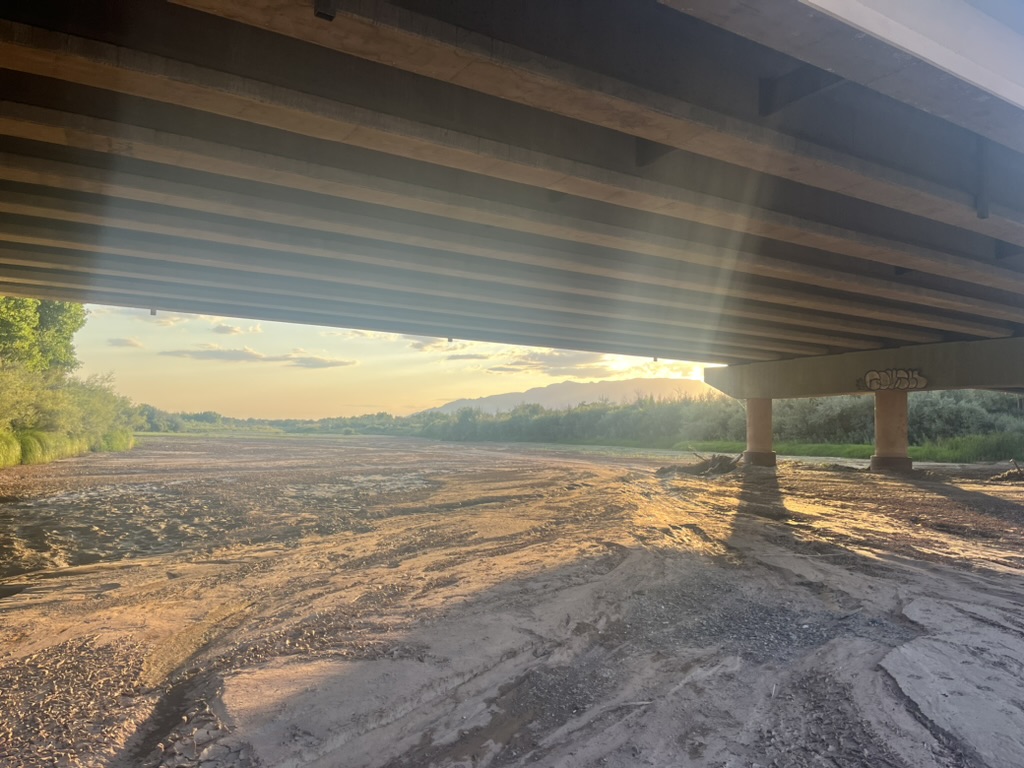
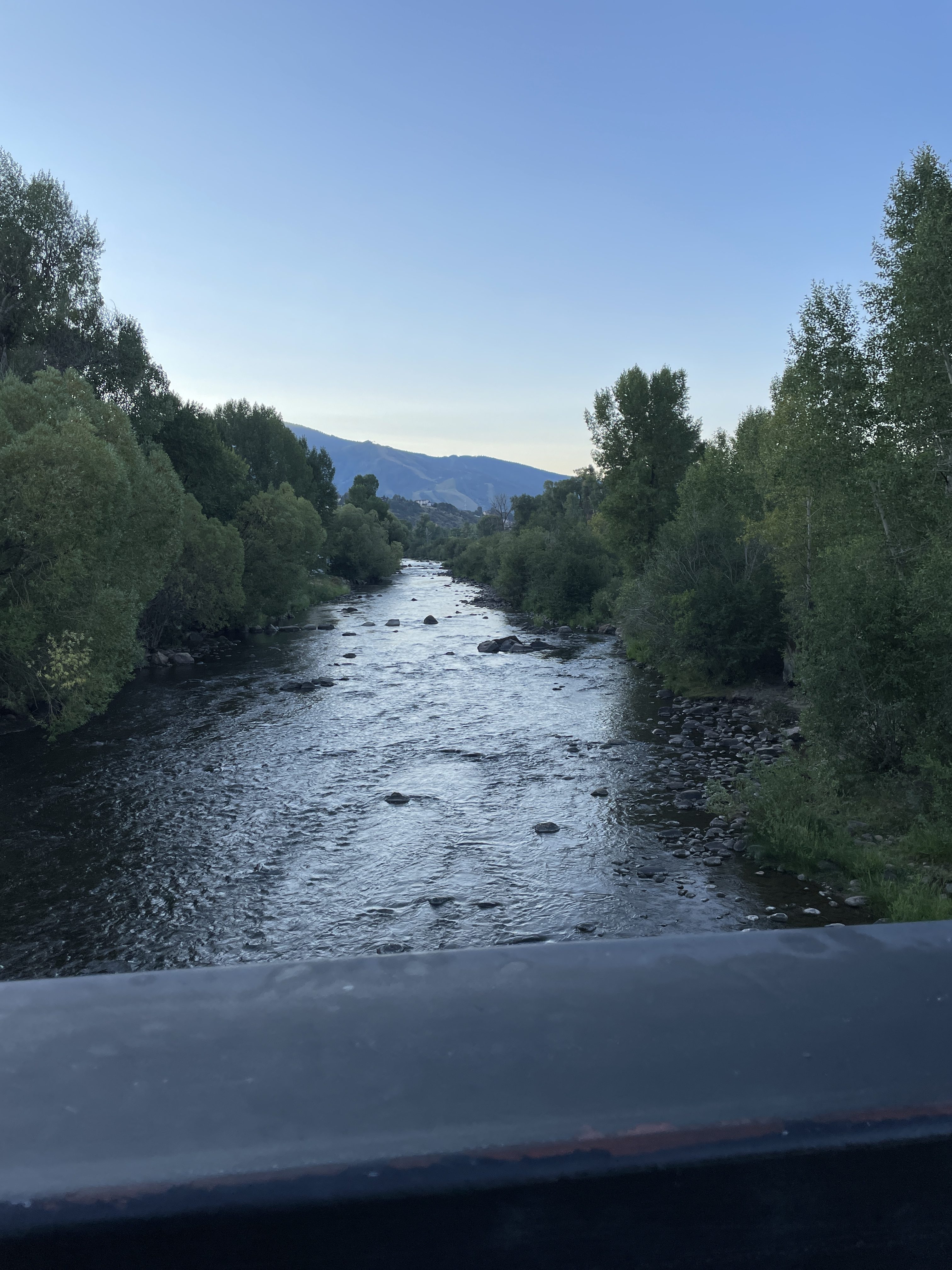
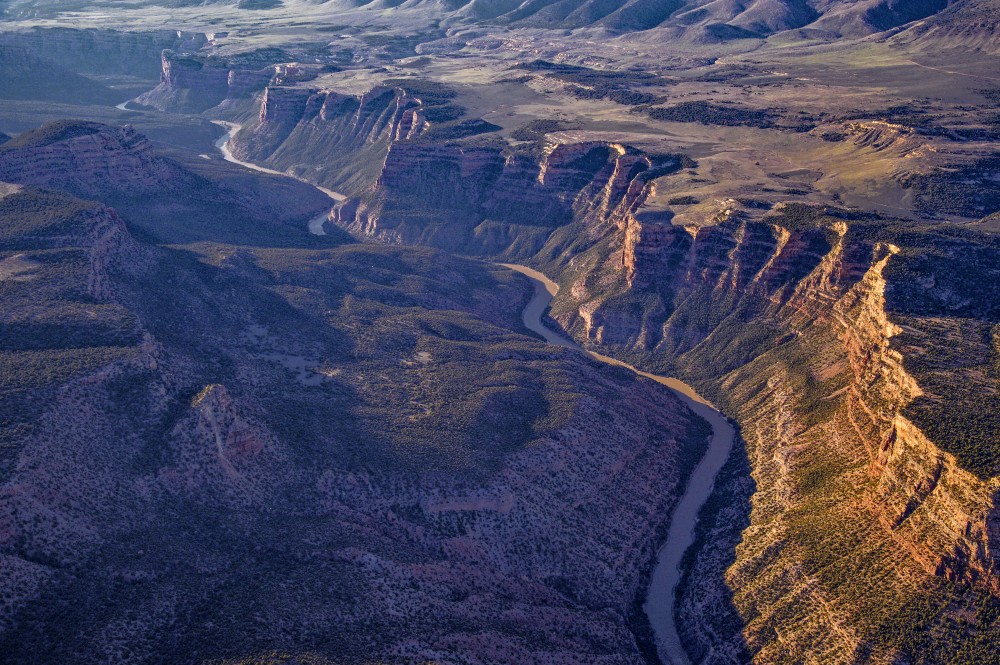
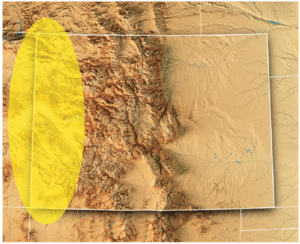
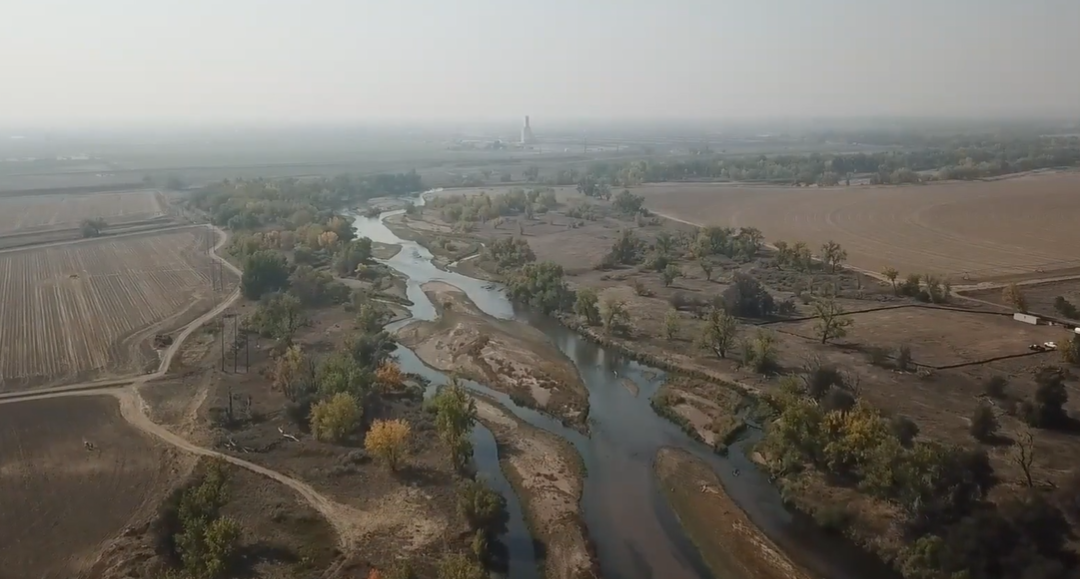
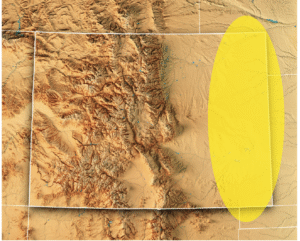
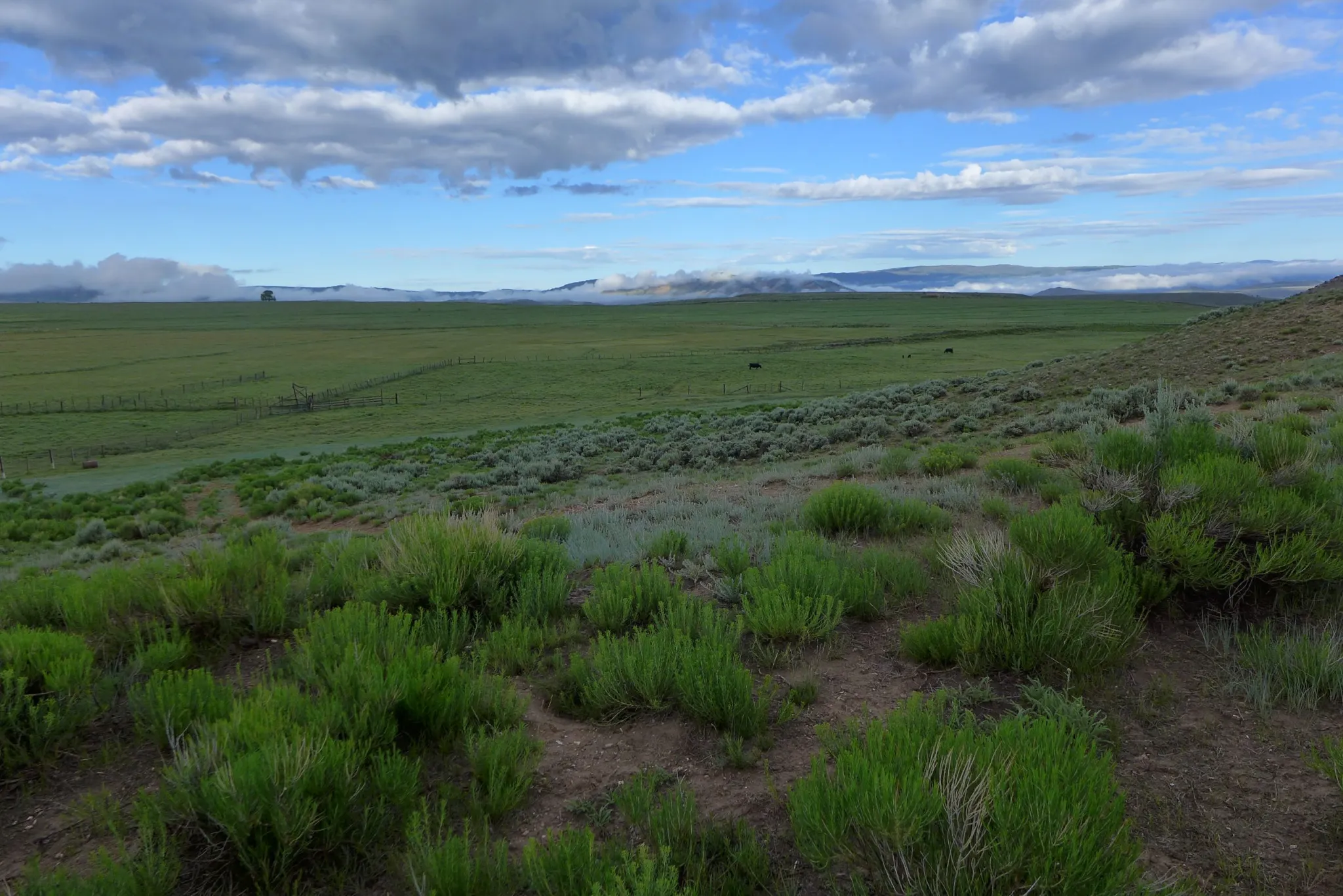
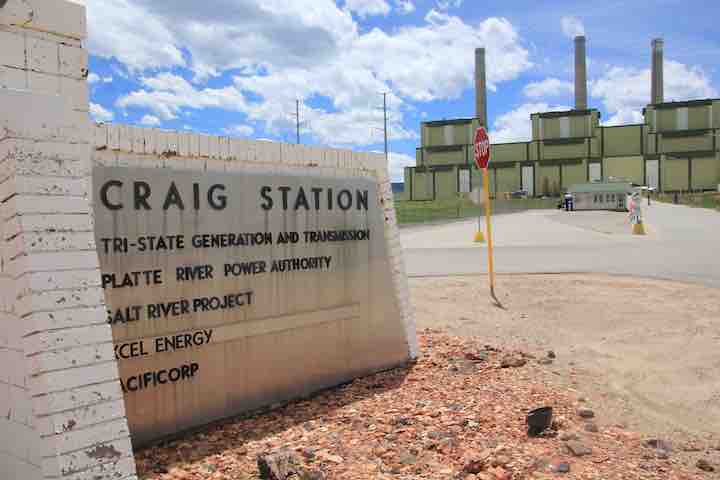
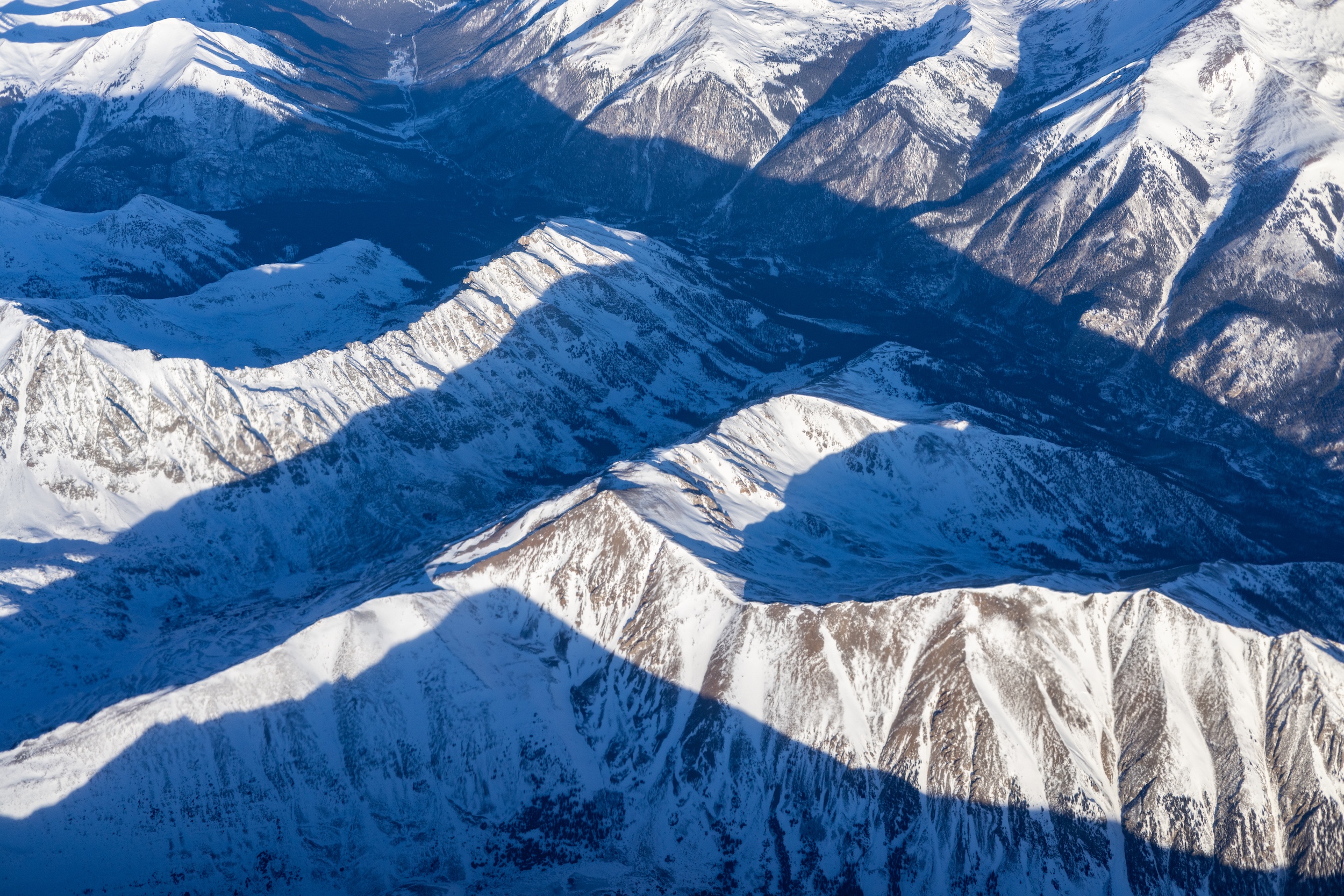
By now everybody’s sick and tired of the term “Dead Pool”. But what about reaches? Last summer as I was driving from Denver to Grand Junction I was horrified to see that the Mighty Colorado that had been flowing outside my left window had suddenly dried up, completely. This was nine miles east of Glenwood Springs. The view of the dessicated riverbed reminded me of a scene from a post-apocalyptic movie.
The culprit of course was the Shoshone Hydroelectric Generating Station which diverts 1250 cfs from a diversion at Hanging Lake, then returns that water 2-1/2 miles downstream after it’s been used to drive the plant’s hydroelectric turbines.
As the name implies Grand Junction’s “15 mile reach” is much longer. In the late summer a full 15-miles of dry river bottom can be seen along the I-70 beginning at the Cameo Diversion Dam and ending 15 miles downstream at the confluence of the Gunnison River. The Cameo Diversion Dam supplies 1.2 million acre feet of river water annually to irrigate Grand Valley farms, then returns about half of that water to the Colorado river at a variety of points downstream.
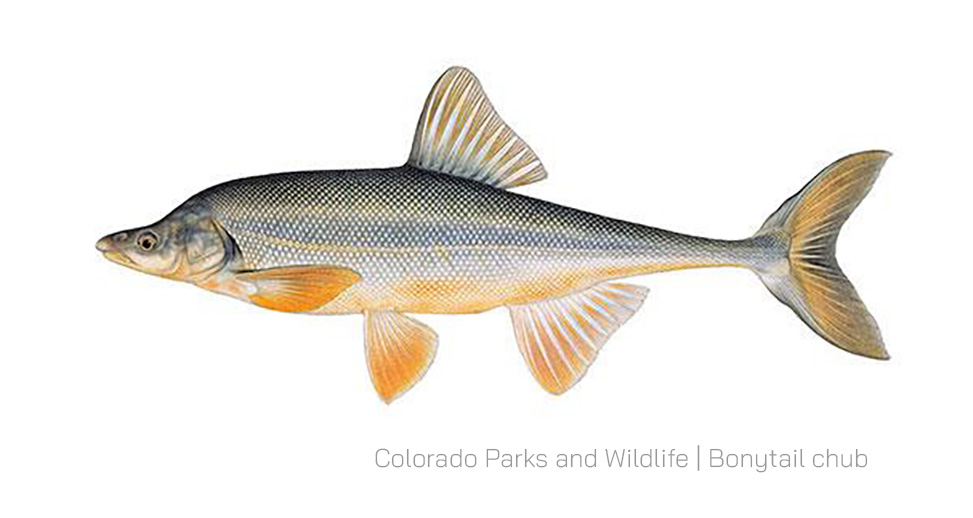
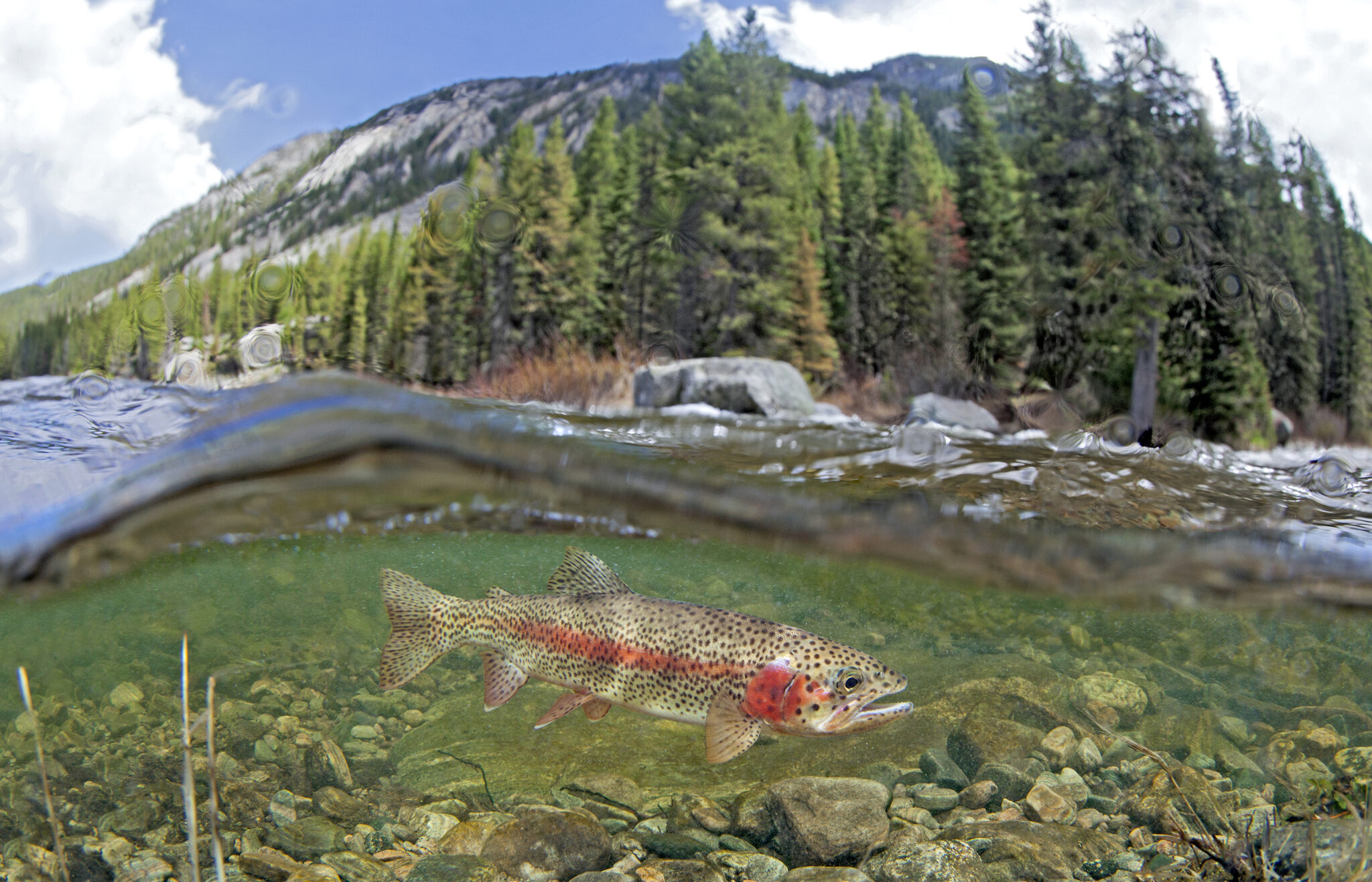
Not surprising these dry patches are hell for native fish, at least four of which are on the verge of extinction. The Bonytail – which has no wild populations left, the Colorado Pikeminnow, the Razorback Sucker, and the Humpback Chub, are all critically imperiled due to habitat loss from dams and competition from non- native species.
Gratefully one organization has ponied up to keep the water flowing. The Colorado Water Trust uses donations from people like me to buy water from sources that are upstream of these reaches in order to maintain a limited amount of water flow, year round. It may not be much but they’re hoping it’s enough to keep these fish, and many other aquatic species alive through the summer.
I can’t help but wonder whether those who are responsible for managing the river couldn’t do more to balance its many uses in order to ensure that the river’s ecological health isn’t left hanging by such a fragile thread.
Click the link to read the article on the USGS website:
Aqueducts move water
June 5, 2018
If you live in an area where ample rain falls all year, you won’t see many aqueducts like the ones pictured here. But there are many areas of the world, such as the western United States, where much less rainfall occurs and it may only occur during certain times of the year. Large cities and communities in the dry areas need lots of water, and nature doesn’t always supply it to them.
The California Aqueduct, San Joaquin Valley, California. Sources/Usage: Public Domain. View Media Details
Some parts of the western U.S. do have ample water supplies, though. So, some states have developed ways of moving water from the place of ample supply to the thirsty areas. Engineers have built aqueducts, or canals, to move water, sometimes many hundreds of miles. Actually, aqueducts aren’t a high-tech modern invention—the ancient Romans had aqueducts to bring water from the mountains above Rome, Italy to the city.
Can you see something about the aqueduct picture above that causes some water to be lost in transit? In all environments, but especially In places where the climate is hot and dry, a certain portion of the water flowing in the aqueduct is bound to evaporate. It would be more efficient to cover the aqueduct to stop loss by evaporation, but the cost of covering it must be weighed against the value of the evaporated water.
Aqueducts were popular in ancient Rome
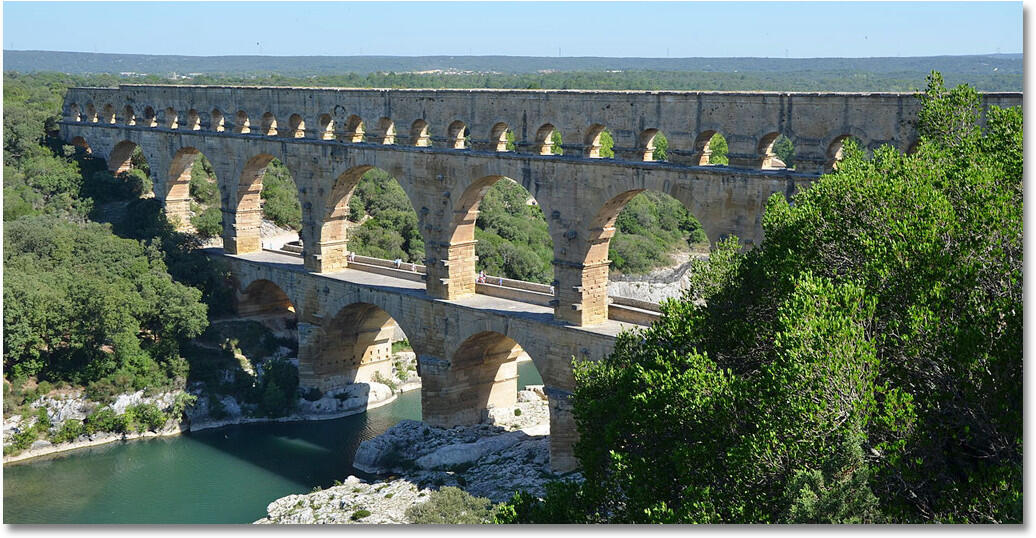
Below is a picture of the Roman aqueduct at Pont du Gard, crossing the Gard River in southern France. The aqueduct was used to supply water to the town on Nimes, which is about 30 miles from the Mediterranean Sea. Although the water ended up in the baths and homes in Nîmes, it originated about 12 miles away in higher elevations to the north. The total length of the aqueduct was about 31 miles, though, considering its winding journey.
There is even a Roman aqueduct that is still functioning and bringing water to some of Rome’s fountains. The Acqua Vergine, built in 19 B.C., has been restored several time, but lives on as a functioning aqueduct.
Roman aqueduct at Pont du Gard, crossing the Gard River in southern France. Credit: Carole Raddato, Creative Commons
Aqueducts were not the Roman’s choice for water-delivery systems, as they would use buried pipes when possible (much easier to bury a pipe than build an above-ground system). Although aqueducts use gravity to move water, the engineering feats of the Romans are shown in that the vertical drop from the highlands source to Nîmes is only 56 feet. Yet, that was enough to move water over 30 miles. And, if you think you can see the aqueduct in this picture “leaning” to one side, it is a illusion, as the vertical drop is only 1 inch for the 1,500 foot length. It is estimated that the aqueduct supplied the city with around 200,000,000 liters (44,000,000 imperial gallons) of water a day, and water took nearly 27 hours to flow from the source to the city. (Source: Wikipedia)
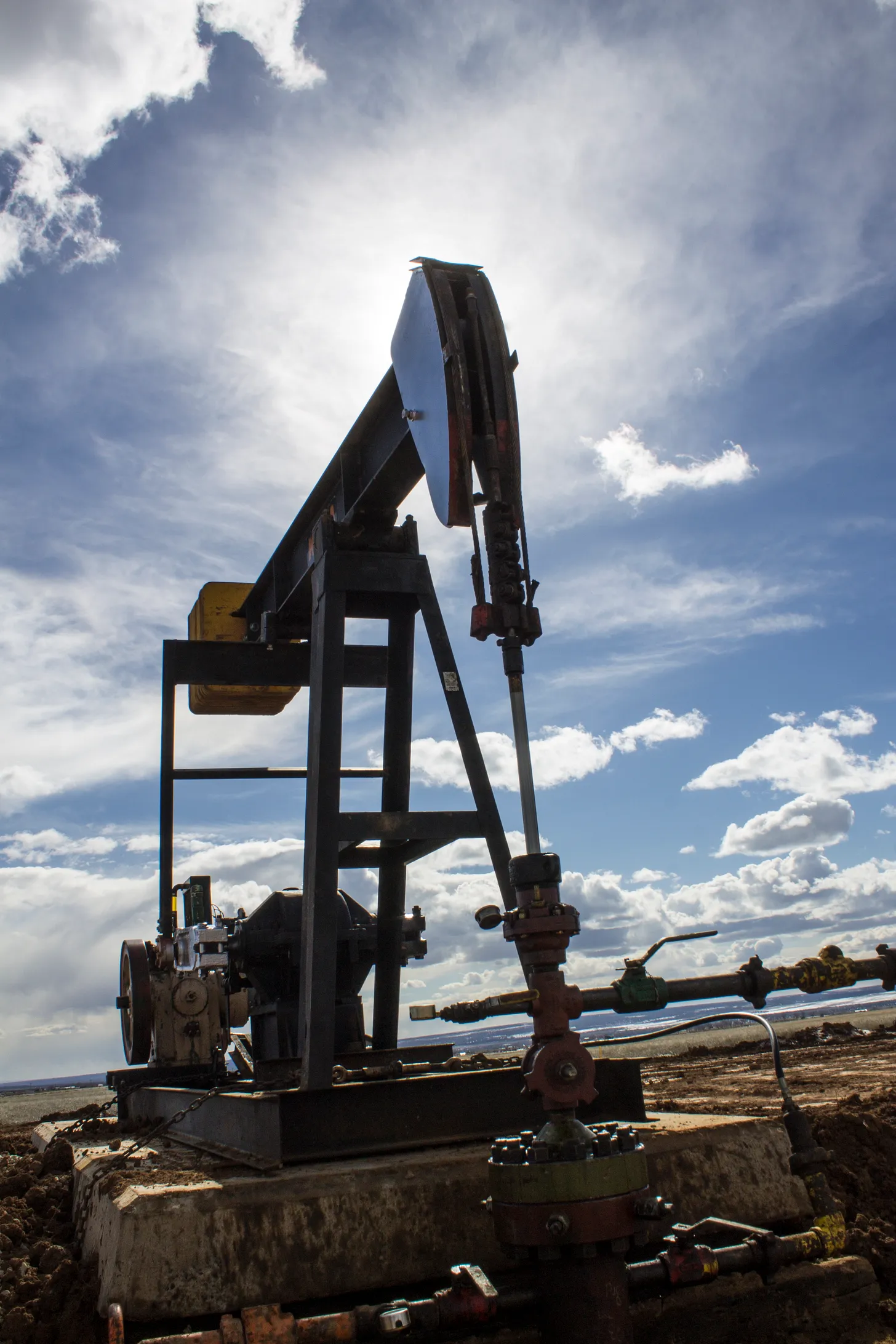
While Donald Trump seems to think he coined terms like “Drill, Baby, Drill,” the fact is, they’ve been around for a long, long time. This sign appeared at the 2008 Democratic National Convention in Denver. While Republican candidate John McCain and his VP candidate Sarah Palin were most vocally calling for increased drilling, the Democrats were also getting behind the nascent “fracking” revolution and touting natural gas as a cleaner bridge fuel from coal to solar and wind. And the so-called shale oil and gas drilling boom took off during the Obama administration. Jonathan P. Thompson photo.
Donald Trump made a lot of promises on the campaign trail: If elected, he would bring down the cost of groceries (a word that seemed new to him), he would secure the borders, he would end all of the wars on day one, and he would unleash the oil companies so they could “drill, baby, drill” and secure “energy dominance.”
Groceries are still expensive, “border security” is now MAGA-speak for federal agents gunning down innocent bystanders, and not only are the wars still raging, but the administration’s newly named “Department of War” has bombed Iran, Nigeria, and Venezuela, and is now threatening to invade Greenland and even Mexico.
In fact, the only war that Trump can take credit for ending was Biden’s “war” on energy. And that’s only because the “war” didn’t exist in the first place! It was and remains a figment of the GOP’s imagination.
Still, the administration did live up to at least one promise: It used a fabricated “energy emergency” to help increase extractive corporations’ profit margins by rolling back environmental protections, handing out drilling permits like candy at a parade, fast-tracking various mine and oil and gas infrastructure permits, and offering oodles of public land to energy companies.
But has it really achieve the stated goal, to establish “energy dominance” — i.e. boost production, bring down prices, and end oil imports?
Maybe the data will help us figure that one out …
Leasing
As I think we’ve established, the Biden administration did not wage a war on energy or even oil and gas. In fact, under Biden, the nation became the world’s largest oil producer, the largest exporter of liquefied natural gas, and so on, while also fast-tracking solar, wind, and transmission projects on federal lands.
Biden’s Interior Department did, however, put up some guardrails aimed at protecting some public lands. While it leased out parcels in the Permian Basin without restraint, it also refrained from putting some more sensitive parcels up for auction in more sensitive areas with limited oil and gas production.
The Trump administration has been far more friendly to oil and gas companies looking to bolster their land-holding portfolios, not only offering up hundreds of thousands of acres, but then putting them up for auction a second time if the first round didn’t attract enough bids.
328,000 acres: Amount of public land and minerals the BLM leased to oil and gas companies between Jan. 20 and Dec. 31, 2025. This brought in about $356 million in revenue.
$327 million: Amount a single oil and gas lease sale for 31 parcels, mostly in New Mexico’s Permian Basin, brought in this January, a record per-acre high average bid amount.
0: Number of bids received for 23 offered oil and gas lease parcels in Colorado in January. The sale was a “replacement” sale held after the initial auction failed to attract enough bids.
Drilling Permits
President Trump’s BLM issued an average of 909 permits to drill per month during the first year of his second term. This is almost triple the monthly average for Biden’s administration.
Environmentalists often attacked Biden for issuing more drilling permits for public lands than Trump did during his first administration. The comparison was dumb, but whatever. Trump apparently didn’t like Biden’s apparent energy dominance, so he struck back by issuing more than 5,000 drilling permits last year, far exceeding the Biden administration’s monthly and yearly averages.
1,124: Number of drilling permits the BLM issued to EOG Resources in 2025, mostly in the Permian Basin. That compares to 755 for XTO Permian and XTO Energy; 293 for Anschutz Exploration; 503 to Devon Energy; 338 to OXY USA; 241 to Matador Production; 119 to Chevron; 106 to Middle Fork Energy Uinta; and 80 to ConocoPhillips.
95: Number of drilling permits the BLM’s Farmington Field Office issued in 2025, to Hilcorp, Logos, SIMCOE, DJR Operating, and other companies. While this pales in comparison to the Permian Basin, it is a marked increase from recent years.
8: Number of drilling permits the BLM’s Moab Field Office issued in 2025.
100: Approximate number of drill rigs operating in all of New Mexico during any given week of 2025.
8,949: Number of approved federal drilling permits held by oil and gas companies that were available to drill as of Jan. 2, 2026. That is to say, they have the permits, but haven’t yet used them.
Production
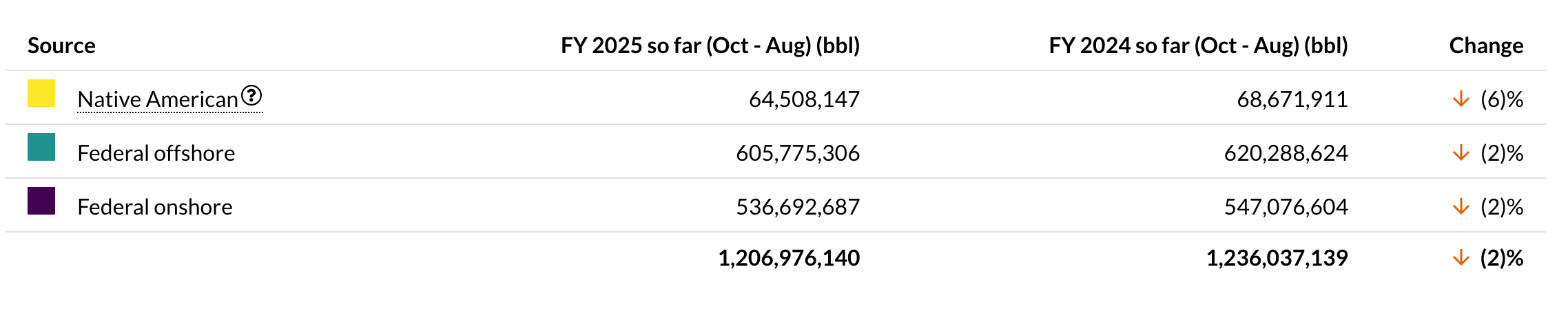
During the past year, domestic crude oil production continued to increase month-to-month, but at a slower rate than it had previously. Oil production on federal lands was down about 2% from fiscal year 2024. This is mostly due to industry’s lack of enthusiasm for more drilling, thanks to a combination of low oil prices and higher expenses due to inflation and tariffs on steel and other equipment. So much for drill, baby, drill.
Oil production from federal and tribal nation lands was down for fiscal year 2025 as of August. Source: U.S. Department of the Interior.
7.9 million: Barrels of crude oil per day the U.S. was importing from other countries in December 2025. That’s marginally less than a year earlier.
2.1 million barrels/day: Net crude oil imports (imports minus exports) to the U.S. in December 2025.
Idle Wells
*GSI/OSI: Gas or oil wells oil well that are capable of producing but have not produced during the production month.
I find this to be, perhaps, the most telling chart of all. It shows the number of idle wells on federal mineral leases (which includes public lands and split-estate private lands) by Western state. A lot of the wells have just been wrung dry and have been abandoned and need to be plugged and reclaimed, probably at the taxpayer’s expense.
Still others, the ones in the GSI (non-producing gas completion) and OSI (non-producing oil completion) columns, are officially capable of producing oil and gas, it’s just that for one reason or another they aren’t producing currently. Dozens of the GSI/OSI wells in Wyoming, for example, are owned by bankrupt companies that were unable to offload them to someone else.
This brings up a question: If we are indeed in an “energy emergency,” as the Trump administration has declared, shouldn’t we be pumping all of the oil and gas from existing wells that we possibly can before issuing thousands of new drilling permits, most of which aren’t even being used?
Let me answer that one: We’re not in an energy emergency.
🗺️ Messing with Maps 🧭
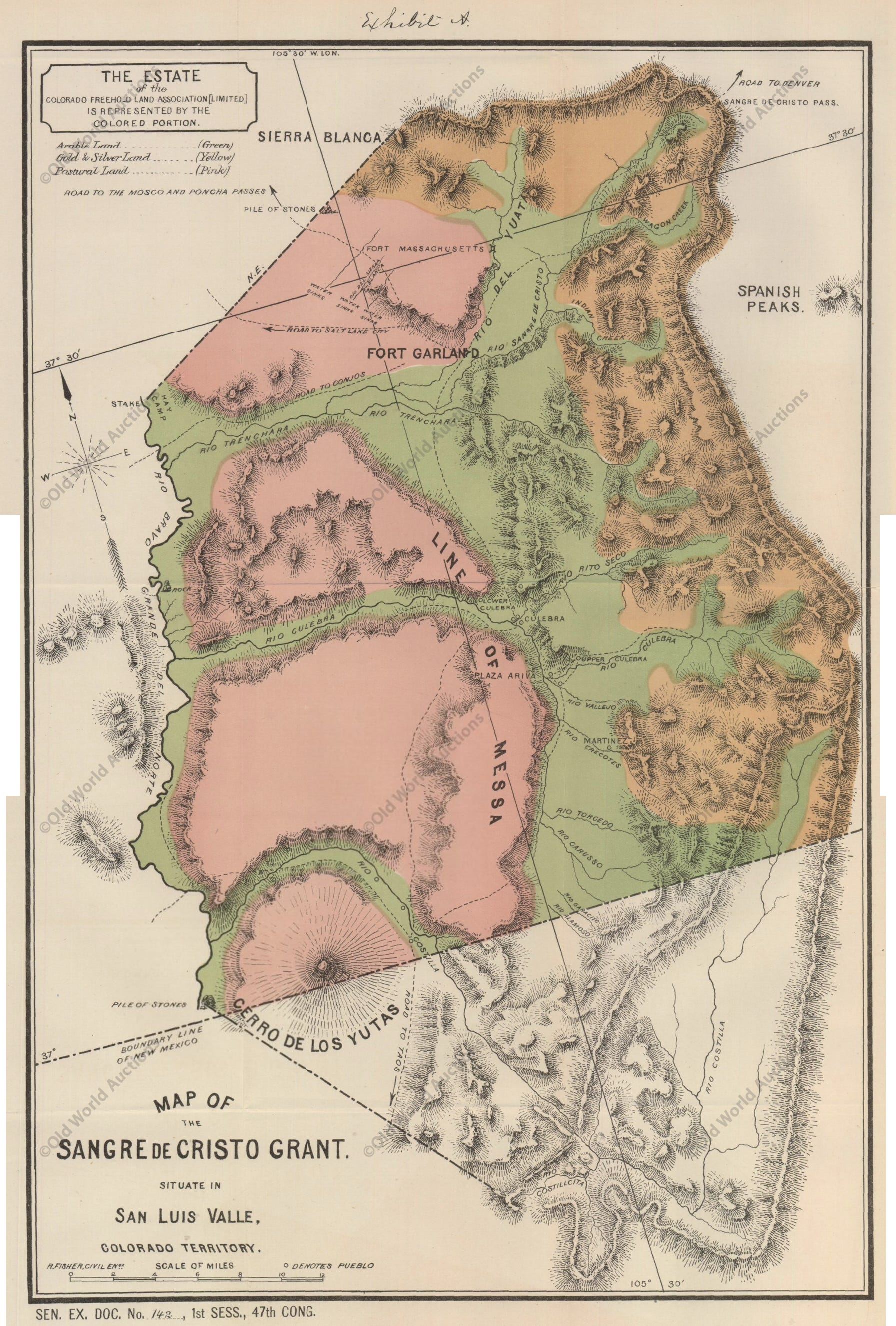
I came across this cool old map of the Sangre de Cristo land grant while perusing the Green Fire Times’ tribute to Malcolm Ebright, who was a land grant community advocate and historian. In order to get a high-res version I had to, um, copy this from an online auction site (thus the watermarks). I don’t have much to say about it, except it’s a pretty cool map of a very cool area.
The energy transition was not meant to be a main topic when world leaders and negotiators met at the 2025 United Nations climate summit, COP30, in November in Belém, Brazil. But it took center stage from the start to the very end, bringing attention to the real-world geopolitical energy debate underway and the stakes at hand.
Brazilian President Luiz Inácio Lula da Silva began the conference by calling for the creation of a formal road map, essentially a strategic process in which countries could participate to “overcome dependence on fossil fuels.” It would take the global decision to transition away from fossil fuels from words to action.
Brazilian President Luiz Inácio Lula da Silva speaks at COP30, where he promoted the idea of a road map to help the world speed up its transition from fossil fuels to clean energy. AP Photo/Andre Penner)
More than 80 countries said they supported the idea, ranging from vulnerable small island nations like Vanuatu that are losing land and lives from sea level rise and more intense storms, to countries like Kenya that see business opportunities in clean energy, to Australia, a large fossil-fuel-producing country.
I was in Belém for COP30, and I follow developments closely as former special climate envoy and head of delegation for Germany and senior fellow at the Fletcher School at Tufts University. The fight over whether there should even be a road map shows how much countries that depend on fossil fuels are working to slow down the transition, and how others are positioning themselves to benefit from the growth of renewables. And it is a key area to watch in 2026.
The battle between electro-states and petro-states
Brazilian diplomat and COP30 President André Aranha Corrêa do Lago has committed to lead an effort in 2026 to create two road maps: one on halting and reversing deforestation and another on transitioning away from fossil fuels in energy systems in a just, orderly and equitable manner.
What those road maps will look like is still unclear. They are likely to be centered on a process for countries to discuss and debate how to reverse deforestation and phase out fossil fuels.
Over the coming months, Corrêa plans to convene high-level meetings among global leaders, including fossil fuel producers and consumers, international organizations, industries, workers, scholars and advocacy groups.
For the road map to both be accepted and be useful, the process will need to address the global market issues of supply and demand, as well as equity. For example, in some fossil fuel-producing countries, oil, gas or coal revenues are the main source of income. What can the road ahead look like for those countries that will need to diversify their economies?
Nigeria’s Bodo community is suing Renaissance Africa Energy Company Limited, an oil consortium that acquired Shell’s Nigerian subsidiary, over two major oil spills in the Niger Delta in 2008. Shell admitted liability and settled with the community in 2014, committing to cleanup efforts. However, the Bodo community has been critical of the quality and transparency of Shell’s cleanup, and is seeking further damages and remediation. Here, activists protest the company’s actions. Leon Neal/Getty Images
Oil exports consistently provide the bulk of Nigeria’s revenue, accounting for around 80% to over 90% of total government revenue and foreign exchange earnings. At the same time, roughly 39% of Nigeria’s population has no access to electricity, which is the highest proportion of people without electricity of any nation. And Nigeria possesses abundant renewable energy resources across the country, which are largely untapped: solar, hydro, geothermal and wind, providing new opportunities.
What a road map might look like
In Belém, representatives talked about creating a road map that would be science-based and aligned with the Paris climate agreement, and would include various pathways to achieve a just transition for fossil-fuel-dependent regions.
Some inspiration for helping fossil-fuel-producing countries transition to cleaner energy could come from Brazil and Norway.
In Brazil, Lula asked his ministries to prepare guidelines for developing a road map for gradually reducing Brazil’s dependency on fossil fuels and find a way to financially support the changes.
His decree specifically mentions creating an energy transition fund, which could be supported by government revenues from oil and gas exploration. While Brazil supports moving away from fossil fuels, it is also still a large oil producer and recently approved new exploratory drilling near the mouth of the Amazon River.
Norway, a major oil and gas producer, is establishing a formal transition commission to study and plan its economy’s shift away from fossil fuels, particularly focusing on how the workforce and the natural resources of Norway can be used more effectively to create new and different jobs.
Both countries are just getting started, but their work could help point the way for other countries and inform a global road map process.
In the U.S., the Trump administration has made clear through its policymaking and diplomacy that it is pursuing the opposite approach: to keep fossil fuels as the main energy source for decades to come.
The International Energy Agency still expects to see renewable energy grow faster than any other major energy source in all scenarios going forward, as renewable energy’s lower costs make it an attractive option in many countries. Globally, the agency expects investment in renewable energy in 2025 to be twice that of fossil fuels.
At the same time, however, fossil fuel investments are also rising with fast-growing energy demand.
The IEA’s World Energy Outlook described a surge in new funding for liquefied natural gas, or LNG, projects in 2025. It now expects a 50% increase in global LNG supply by 2030, about half of that from the U.S. However, the World Energy Outlook notes that “questions still linger about where all the new LNG will go” once it’s produced.
What to watch for
The Belém road map dialogue and how it balances countries’ needs will reflect on the world’s ability to handle climate change.
Corrêa plans to report on its progress at the next annual U.N. climate conference, COP31, in late 2026. The conference will be hosted by Turkey, but Australia, which supported the call for a road map, will be leading the negotiations.
With more time to discuss and prepare, COP31 may just bring a transition away from fossil fuels back into the global negotiations.
Jennifer Morgan, Senior Fellow, Center for International Environment and Resource Policy and Climate Policy Lab, Tufts University
Incorporating instream flow uses into municipal water supply planning efforts can provide numerous public benefits. This article discusses the framework and opportunity for collaborative instream flow protection in municipal water supply operations.
Colorado’s instream flow program is a dynamic approach to protecting the natural environment that encourages practical and creative solutions to evolving environmental concerns. While water rights typically involve diverting water from the stream, the instream flow program protects water in the stream. Environmental values associated with instream flow uses can work synergistically with municipal water supply operations to realize several public benefits, such as improved water quality, riparian health, urban cooling, resiliency, recreational opportunities, and aesthetic value. As illustrated by the examples discussed later in this article, the instream flow program can facilitate cooperative agreements with municipal water providers for shared beneficial use of our state’s most precious resource.
Water Rights and the Prior Appropriation Doctrine in Colorado
The prior appropriation doctrine governs the ownership and use of water and water rights in Colorado. In simple terms, the prior appropriation system is described as “first in time, first in right.” A water user that has demonstrated an intent to put water to beneficial use first has a vested and prior right to use water in that amount against subsequent water users. This system developed out of necessity during the colonial expansion westward and was influenced by Spanish settlers and early miners to allocate water in the arid environment of Colorado, as an alternative to the more common riparian system of water rights based on land ownership abutting water ways.1
The prior appropriation doctrine has been enshrined in the Colorado Constitution. Article XVI, § 5 dedicates water in Colorado as public property for use by the people, subject to appropriation, and § 6 gives the right to appropriate water for beneficial use in priority.2 The 1969 Water Rights Determination and Administration Act (1969 Act) provides the legal framework for surface and tributary ground water distribution and use under the prior appropriation doctrine.3
An appropriation of a water right under the 1969 Act, as originally codified, meant “the diversion of a certain portion of the waters of the state and the application of the same to a beneficial use.”4 Similarly, beneficial uses were limited to diversions of water from the stream system for extractive uses such as domestic or municipal, irrigation, and manufacturing or industrial activities.5 Environmental uses of water, including instream flows, were not initially addressed in the 1969 Act but were later incorporated through amendments.6
Colorado Instream Flow Program
The Colorado Water Conservation Board (CWCB) was first established by the Colorado legislature in 1937 to protect and develop Colorado’s water resources for the benefit of present and future generations.7 It was not until the national environmental movement in the late 1960s, however, that discussions regarding the value of instream flows and role of the CWCB in the protection of such flows began to garner serious attention and focus.8 In 1973, those discussions culminated in the passage of SB 97 to create the Colorado Instream Flow and Natural Lake Level Program.9 SB 97 was unprecedented at the time and amended the 1969 Act to define beneficial use of a water right to include use by the CWCB for protection of stream flows within a specified reach without a diversion of water from the stream.10
Under the instream flow program, the CWCB has exclusive authority to hold a water right for instream flow uses in Colorado and may appropriate water rights or acquire existing water rights for instream flow, provided that it determines that such water rights are necessary to preserve or improve the natural environment to a reasonable degree.11 Since the program’s inception, the CWCB has appropriated nearly 1,700 instream flow rights across 9,700 miles of stream and completed over 35 water acquisition transactions.12
The General Assembly has reinforced and expanded the CWCB’s ability to acquire water rights for instream flow purposes on several occasions.13 Acquiring and changing senior water rights for instream flows in over-appropriated systems can add great value by preserving the priority date, and therefore the availability, of the water for greater instream flow protection.14 Acquisitions can be donated to or purchased by the CWCB, and the statutory language specifically anticipates potential acquisitions from governmental entities, like municipalities.15 Other free-market developments to the Colorado instream flow program enacted by the state legislature over the years include streamlined processes for loans of water rights for instream flow use, instream flow protection for mitigation releases, and stream flow augmentation plans.16 These developments provide additional opportunities for water users, including municipalities, to participate in the program in support of instream flows.
In addition to implementing the instream flow program, the CWCB is tasked with creating the Colorado Water Plan, which addresses the state’s water challenges through collaborative water planning, including expanded opportunities for instream flow protection.17
Case Studies Along the Front Range
The instream flow program provides reasonable protection of the environment for benefit of the public and is emphasized in the Colorado Water Plan as a balanced approach to addressing environmental needs in the face of climate change.18 Similarly, municipal water service providers, acting in the interest of their respective jurisdictions, must often balance water supply with other public interests. Municipal water projects and water supply planning efforts can be designed to address multiple needs and related uncertainties across a jurisdiction, informed by integrated planning efforts. The various public interests typically considered by municipalities may align with instream flow protection in many respects. The Colorado Water Plan includes several policy considerations that highlight this potential overlap between municipal water interests and instream flows.19
Fundamentally, the Colorado Water Plan encourages a holistic, collaborative approach to water management that balances multiple uses and benefits to meet water shortages throughout the state.20As competition for water resources in Colorado becomes more pronounced with increased demands and costs, the benefits of water sharing and collaboration will also likely increase.21 The Colorado Water Plan focuses on thriving watersheds as an action area to support stream health, recreational uses, resiliency, erosion control, and water quality, all of which provide tangible benefits to municipal water service providers.22 Accordingly, more water in the stream system for instream flows can be a natural complement to a municipality seeking to balance growing water demands with related public interests. The following examples demonstrate how instream flow uses can benefit municipal water supply, and vice versa, to realize this balance in a meaningful way.
Boulder Creek Instream Flow Project
The Boulder Creek instream flow project is a long-standing cooperative project that has been operating in Boulder County for almost 35 years. This project has operated successfully due in large part to the partnership between the City of Boulder and the CWCB and their collaboration with neighboring water users in Boulder County to support environmental stream flows and other uses in the creek.
In the early 1990s, Boulder donated a suite of valuable senior water rights to the CWCB to establish a year-round instream flow program on North Boulder and Boulder Creeks.23 The acquisition was memorialized in a series of donation agreements between Boulder and the CWCB pursuant to CRS § 37-92-102(3), following certain legislative amendments throughout the 1980s that clarified and enhanced the CWCB’s acquisition authority for instream flows.24 Boulder and the CWCB, as co-applicants, also received a water court decree to change the use of the donated rights to include instream flow uses for the project.25
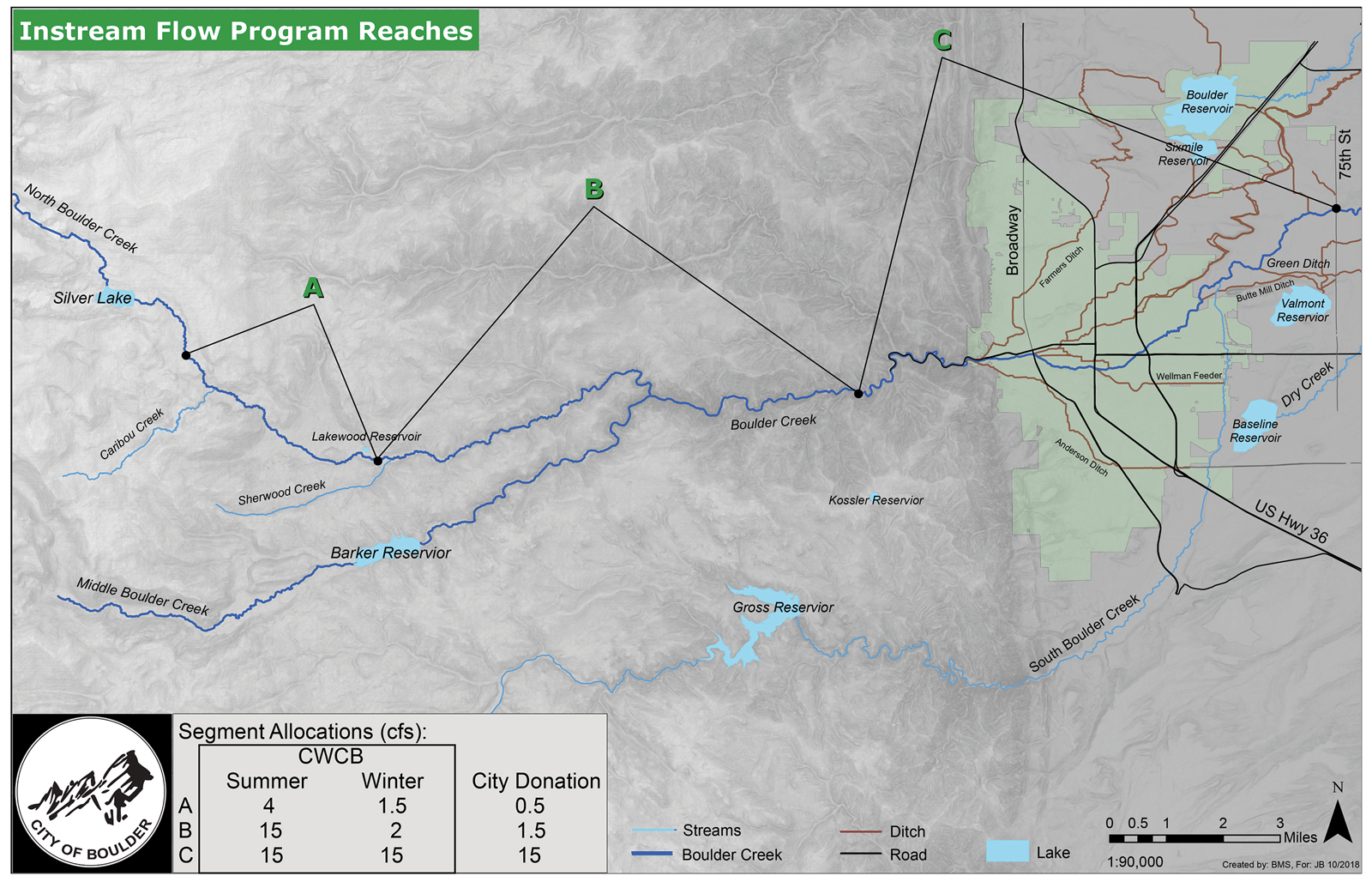
Figure 1. Map depicting locations of instream flow protected reaches along Boulder Creek. Image created by the City of Boulder (Oct. 2018).
The Boulder Creek instream flow project protects three segments from below the Silver Lake Reservoir near the headwaters of North Boulder Creek down to 75th Street in Boulder County (see fig. 1). The donated rights include reservoir releases, bypassed diversions, and changed irrigation ditch shares to support instream flows throughout the year. As part of its donation to the CWCB, Boulder retained the right to use water available under the donated rights (1) for municipal purposes under certain conditions, including drought and emergency conditions in its municipal water supply operations; (2) for municipal purposes anytime they are not needed to meet instream flow amounts; and (3) for beneficial reuse downstream of the protected reaches.26This provides operational flexibility for the city’s municipal water supply while also supporting instream flow uses by the CWCB in most years. Its participation in the Boulder Creek instream flow program has also helped the city address US Forest Service regulatory requirements for bypasses related to its diversions from North Boulder Creek as part of federal permitting for one of its raw water pipelines.27
The City of Boulder has a long-standing environmental ethos that incorporates instream flows into its water supply planning and operations. Boulder’s water supply planning documents from the 1980s identified the goal of supporting instream flows in Boulder Creek to enhance aquatic and riparian ecosystems, reflecting city planners’ prediction that dry-up periods in the creek would become more severe and frequent with increased water demands.28 Subsequent Boulder water supply and land use planning documents have included similar goals focused on balancing instream flows and environmental preservation with municipal water demands and operations, and emphasizing the connection between stream health and reliable drinking water supplies.29
Because the protected stream segments run through the Boulder city limits, and extend both above and below the city, the project benefits water quality, riparian health, and resiliency in the Boulder municipal watershed and water system operations and provides additional environmental benefits to the larger Boulder County community.
Gross Reservoir Environmental Pool Project
The cities of Boulder and Lafayette entered into an intergovernmental agreement in 2010 with Denver Water to establish a 5,000 acre-foot environmental pool in an enlarged Gross Reservoir to augment stream flows in South Boulder Creek.30 Boulder recognized the need to address low flows on South Boulder Creek as a key goal in its planning documents and identified Denver Water’s planned expansion of Gross Reservoir as an opportunity to use upstream storage to establish a robust instream flow program. Lafayette similarly identified Gross Reservoir for potential water storage in its water rights decrees, providing both a water supply and environmental benefit to its operations. The parties proactively agreed to cooperate to mitigate the reservoir expansion’s impacts to aquatic resources in the South Boulder Creek basin by creating and operating the environmental pool.31
Coordinated with municipal water system operations, releases from the environmental pool will allow Boulder and Lafayette to store their decreed water rights for later release to meet specific target flows below Gross Reservoir in South Boulder Creek throughout the year. The segments identified for the target flows include Gross Reservoir to South Boulder Road (Upper Segment, depicted as segments 1 and 2 in fig. 2) and South Boulder Road to the confluence with Boulder Creek (Lower Segment, depicted as segment 3 in fig. 2).32 The agreement also includes provisions to address emergencies such as extended drought or an unexpected problem with water storage, conveyance, or treatment infrastructure to allow for flexibility in operations to meet both target flows and municipal needs.
Boulder’s releases from the environmental pool are protected as instream flows according to a Water Delivery Agreement with the CWCB dated September 9, 2019, and a water court decree entered for Boulder, Lafayette, and the CWCB.33 Water released by Boulder to meet the target flows will be protected for instream flow uses to the extent that such flows do not exceed the amounts that CWCB has determined to be appropriate to preserve the natural environment to a reasonable degree in South Boulder Creek. Boulder’s target flow releases will support CWCB’s existing appropriated instream flow rights up to the specified amounts (see fig. 2). Boulder may then redivert the water downstream of the protected reaches for its municipal uses.
The environmental pool will provide permanent, dedicated storage for water rights owned by Boulder and Lafayette to be released to enhance stream flows in South Boulder Creek prior to downstream uses for municipal purposes by the parties. These operations provide added flexibility, resiliency, and redundancy to the cities’ respective water supply systems. In turn, the enhanced stream flows will benefit 17.3 miles of South Boulder Creek, including Eldorado Canyon State Park, South Boulder Creek Natural Area, and City of Boulder open space lands, and will support native fish populations and riparian and wetland habitats.
Figure 2. Map depicting target flows and reaches for enhanced stream flows on South Boulder Creek. Image created by the City of Boulder (Aug. 7, 2018).
Poudre Flows Project
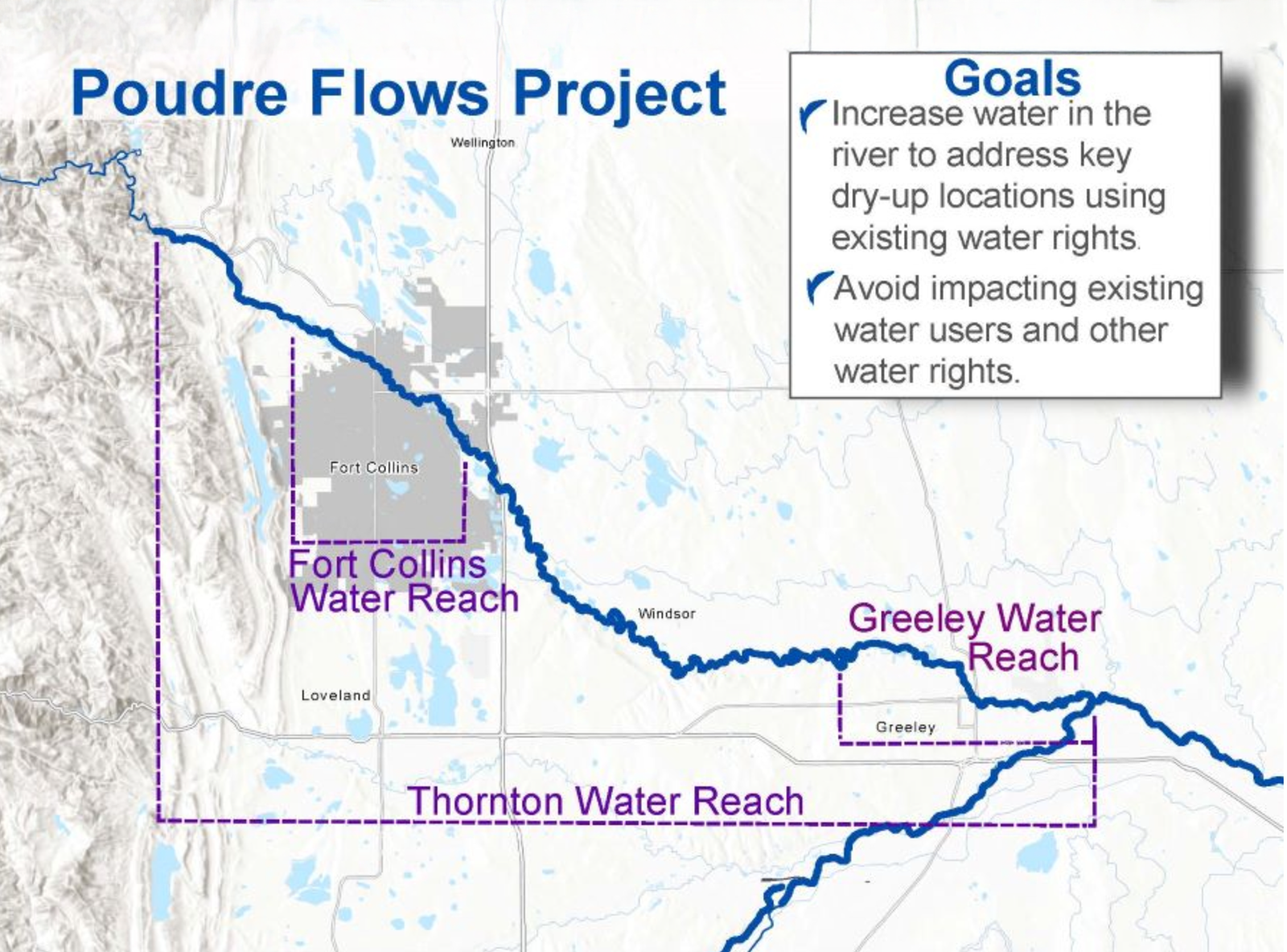
The Poudre Flows Project is the first stream flow augmentation plan developed pursuant to CRS § 37-92-102(4.5).34 It is a partnership amongst the CWCB; municipalities of Fort Collins, Thornton, and Greeley; Colorado Water Trust; Northern Colorado Water Conservancy District; Cache la Poudre Water Users Association; and Colorado Parks and Wildlife. The project will augment stream flows through a 52-mile reach of the Cache la Poudre River, with an overarching goal to improve river health (see fig. 3).35 The concept was first envisioned as part of the Poudre Runs Through It working group, a collaborative group of diverse partners and stakeholders in the Poudre River.36 The City of Fort Collins planning priorities incorporate similar goals, including to “[p]rotect community water systems in an integrated way to ensure resilient water resources and healthy watersheds.”37
The project anticipates that the CWCB, through agreements with water right owners, including Fort Collins and Greeley, will use previously changed and quantified water rights owned by these municipalities and potentially others to augment stream flows in six segments of the Poudre River spanning from Canyon Gage to the confluence with the South Platte River.38 Besides the instream flow protection of the environment to a reasonable degree, project partners have identified numerous additional benefits such as connectivity for fish passage and decreased temperatures and nutrient concentrations, all while avoiding impacts to existing water rights and operations.39
By integrating water supply planning with a holistic approach to water development and management that provides multiple public benefits, municipalities can become strong partners with the CWCB. Together, they can help protect instream flows and balance growing water demands and future uncertainties with the environmental values that make Colorado a beautiful place to live.
1. See generallyCoffin v. Left Hand Ditch Co., 6 Colo. 443, 447 (Colo. 1882).
2. Colo. Const. Art. XVI, §§ 5–6. See also Colo. River Water Conservation Dist. v. CWCB, 594 P.2d 570, 573 (Colo. 1979) (“The reason and thrust for this provision was to negate any thought that Colorado would follow the riparian doctrine in the acquisition and use of water.”).
9. SB 97, 49th Gen. Assemb., Reg. Sess. (Colo. 1973). See CRS § 37-92-102(3).
10. Bassi, supra note 6 at 398. See also Colo. River Water Conservation Dist., 594 P.2d at 576. SB 97 was carefully drafted to provide environmental protection through the CWCB, as a fiduciary to the public, without inviting riparian rights for adjacent landowners. Id. The Colorado Supreme Court reiterated this important distinction in St. Jude Co. v. Roaring Fork Club, LLC, 351 P. 3d 442 (Colo. 2015), ruling that a diversion from a steam for private instream flows is a “forbidden right” contrary to the prior appropriation doctrine; only the CWCB, with strict limitations identified by the general assembly, can hold an instream flow right for the benefit of the public. Id. at 451.
11. CRS § 37-92-102(3) (The CWCB is “vested with exclusive authority, on behalf of the people of the state of Colorado, to appropriate . . . such waters of natural streams . . . as the board determines may be required for minimum streamflows . . . to preserve the natural environment to a reasonable degree.” The board also may acquire water rights “in such amount as the board determines is appropriate for streamflows . . . to preserve or improve the natural environment to a reasonable degree.”). Legislation enacted in 2002 expanded the Colorado instream flow program to provide that water rights may also be used by the CWCB to improve the natural environment (and not just for preservation purposes). Bassi, supra note 6 at 391.
14. Id. at 406. The Colorado Water Trust was formed in 2001 to support Colorado’s instream flow program by promoting voluntary, market-based efforts to restore stream flows in Colorado’s rivers. The Water Trust has been instrumental in facilitating and streamlining the acquisition of water rights from willing partners for use by the CWCB. Seehttps://coloradowatertrust.org.
16. See generally CRS §§ 37-83-105, 37-92-102(8), 37-92-102(4.5).
17. The Colorado Water Plan was adopted by the CWCB in 2023 as a framework for decision-making to address water challenges and build resiliency in the state. The 2023 Water Plan is an update to the first iteration of the plan released in 2015. Seehttps://cwcb.colorado.gov/colorado-water-plan.
18. SeeSt. Jude Co., 351 P. 3d at 449 (in its use of water for instream flows, the CWCB has a “‘statutory fiduciary duty’ to the people . . . to both protect the environment and appropriate only the minimum amount of water necessary to do so . . . .”).
20. See id. at 217–19, 231, 233 (“All areas of the Water Plan are interconnected, and projects need to consider multi-purpose, multi-benefit solutions.”).
21. See id. at 217 (“Multi-purpose projects better address water supply challenges across municipal, agricultural, environmental, and recreation sectors as they occur.”).
22. See id. at 181, 204–07 (stream health and related environmental benefits can enhance municipal supply or improve the quality of life in urban areas).
23. See Decree, In re Application for Water Rts. of the Colo. Water Conservation Bd. on Behalf of the State of Colo. and Water Rts. of the City of Boulder, No. 90CW193 (Colo. Water Div. 1, Dec. 20, 1993).
30. See Decree, In re Application for Water Rts. of City of Lafayette, City of Boulder, and Colo. Water Conservation Bd. in Boulder Cnty., No. 17CW3212 (Colo. Water Div. 1, Feb. 11, 2021). The author represented the City of Boulder in Case No. 17CW3212 and was involved in prosecuting the case and negotiating the underlying agreement with CWCB.
31. Denver Water’s enlargement of Gross Reservoir is the subject of pending litigation.
32. The target flows and target reaches are based on previously collected data and analysis by Colorado Parks and Wildlife using the R2Cross method, which supported CWCB’s previous instream flow appropriations.
38. See Application, In reApplication for Water Rts. of Cache La Poudre Water Users Ass’n, City of Fort Collins, City of Greeley, Colo. Water Tr., N. Colo. Water Conservancy Dist., City of Thornton and Colo. Water Conservation Bd. in Larimer and Weld Cntys., No. 21CW3056 (Colo. Water Div. 1 Apr. 29, 2021).
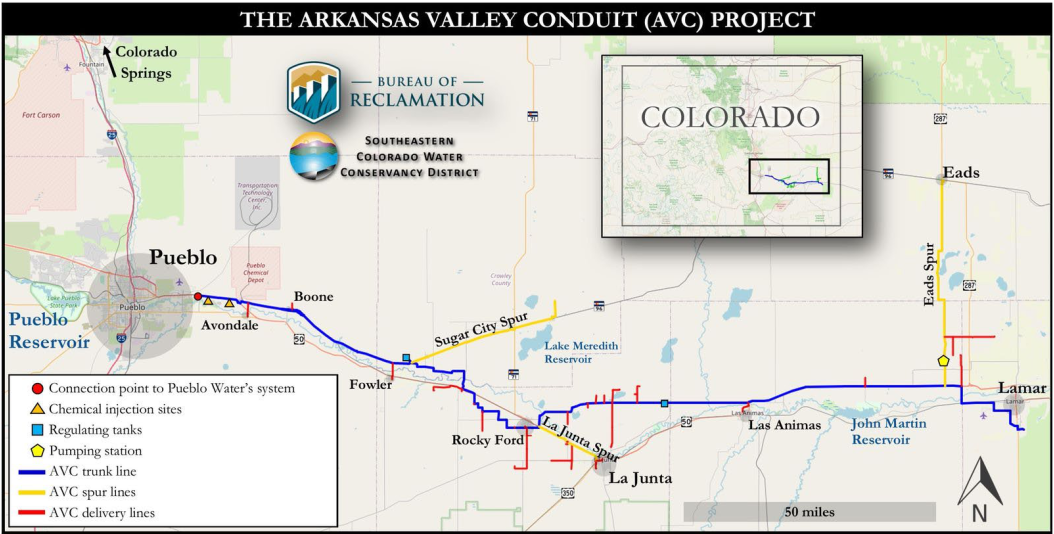
After Coloradan U.S. House Reps. Lauren Boebert and Jeff Hurd saw their Finish the Arkansas Valley Conduit Act approved unanimously by Congress in December, they were stunned when President Donald Trump — once a proponent of the project — vetoed it…After the rejection of the legislation sponsored by Boebert, the former 3rd Congressional District representative and co-sponsored by Hurd, the district’s current representative, they sought a rare move for Congressional Republicans in the Trump era: a veto override that could have defied the president. A vote on the veto override was held in the House on Thursday, needing two-thirds of voters to vote “yes” to pass. It ultimately failed with 249 “yes” votes and 176 “no” votes, with one “present” vote, around 8% short of the threshold for passage. All 213 Democrats voted to back the override, while 36 Republicans backed the override but 176 did not. Five Republicans did not vote…
Boebert’s bill, H.R. 131, would have provided communities in the region more time and flexibility to repay the federal government by extending repayment periods and lowering interest rates. In his veto decision, Trump cited financial concerns, but on the House floor, both Boebert and Hurd emphasized that the bill would not expand the project, authorize new construction or increase federal share. Per Boebert, the U.S. Bureau of Reclamation found that Arkansas Valley drinking water has such high levels of radium, uranium and other pollutant contamination that people in the area could see the cost of drinking water triple without this legislation.
“Contrary to what the veto message states, my bill does not authorize any additional federal funding. It simply modifies the repayment terms for small rural communities in my district so they’re able to afford their 35% cost share of the project that they are statutorily obligated to repay,” Boebert said…
Hurd said that rural Colorado and rural America voted “overwhelmingly” for Trump because they didn’t want to be forgotten by the government, adding, “They expected Washington to keep its word, not abandon them midway.” He also expressed concern about the precedent a failed veto override would set, not just for the rest of Trump’s term but moving forward on Capitol Hill. This was a similar, though less alarmingly phrased, point as Neguse earlier stating, “No state is safe from political retaliation.”
Arkansas Valley Conduit map via the Southeastern Colorado Water Conservancy District (Chris Woodka) June 2021.
Click the link to read the article on the Pagosa Springs Sun website (Clayton Chaney and Randi Pierce). Here’s an excerpt:
January 7, 2026
Snowpack and stream flow
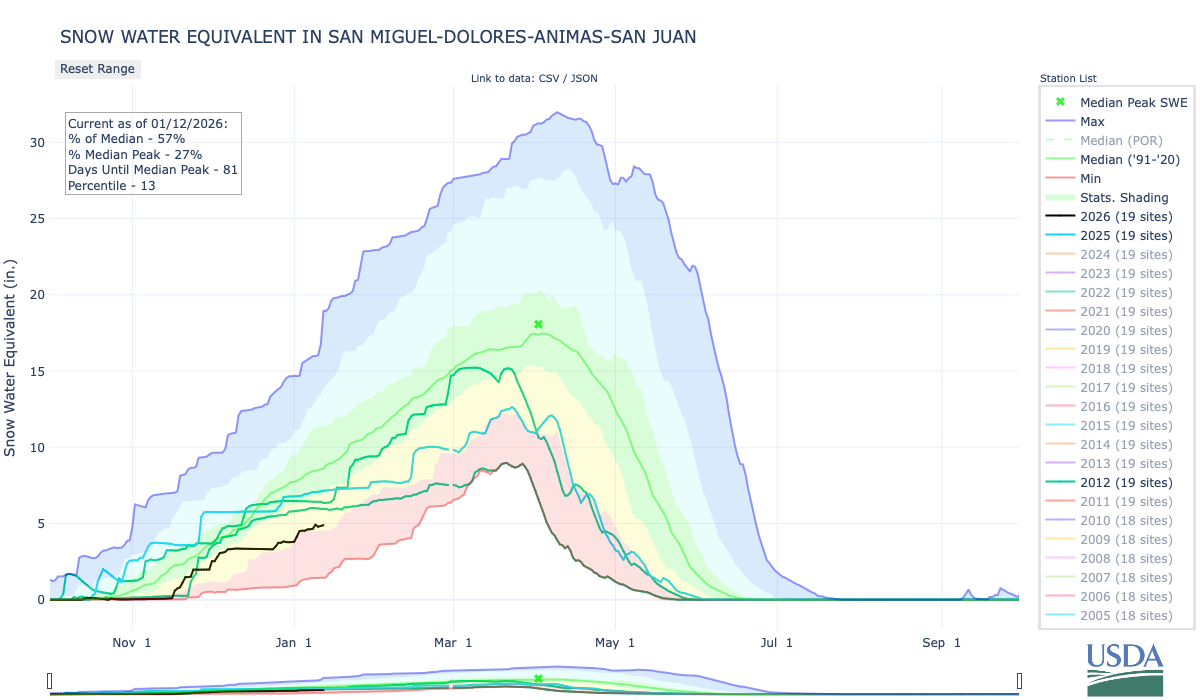
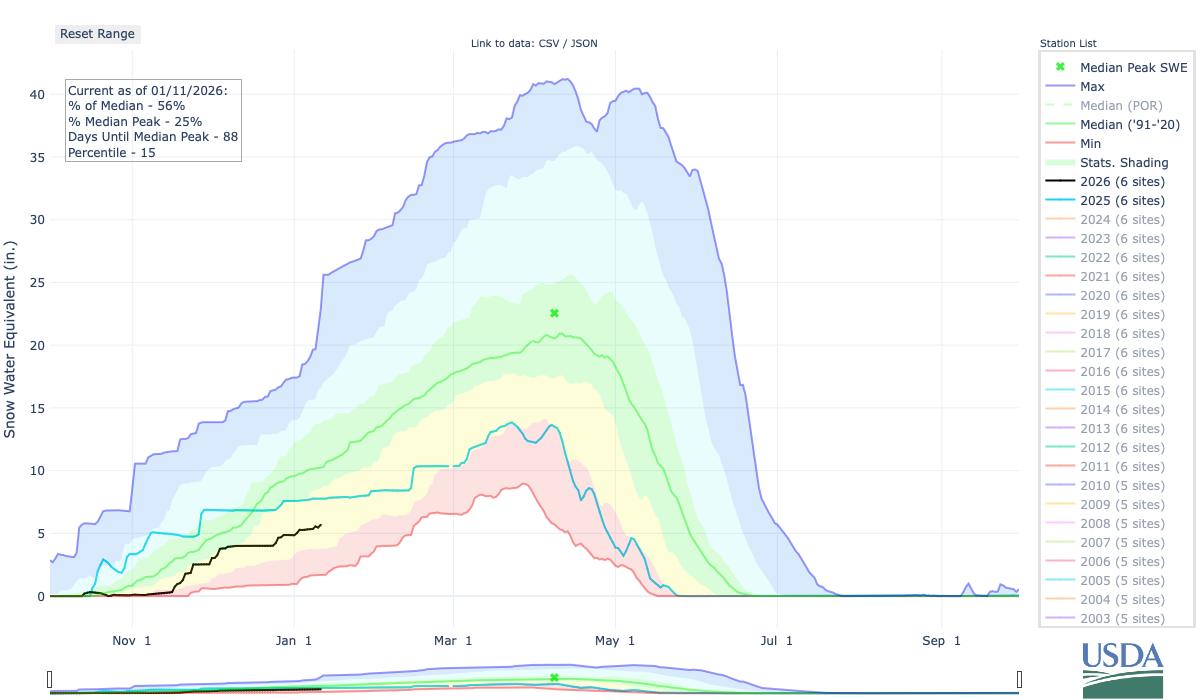
According to data from the Natural Resource Conservation Services (NRCS), as of 1 p.m. on Wednesday, Jan. 7, the Wolf Creek Pass site at 10,930 feet had a snow water equivalent of 7.6 inches, compared to that date’s median of 15.5 inches. This is up from the Dec. 31, 2025, report of 7 inches. The current amount is 49 percent of that date’s median snow water equivalent…The San Miguel, Dolores, Animas and San Juan River basins were measured to be at 49 percent of its 30-year median snowpack as of December 31, 2025, and at 56 percent on January 7, 2026…
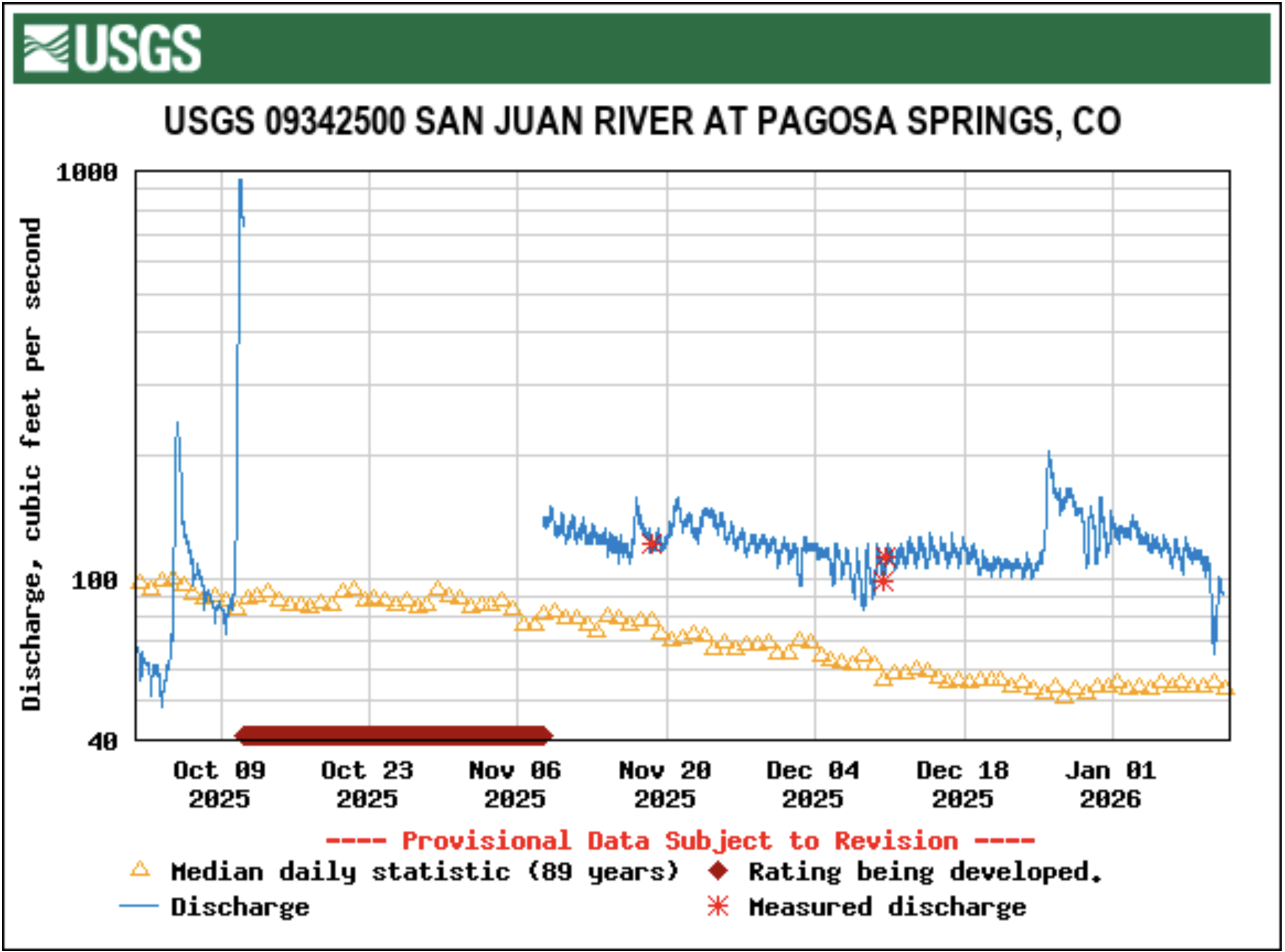
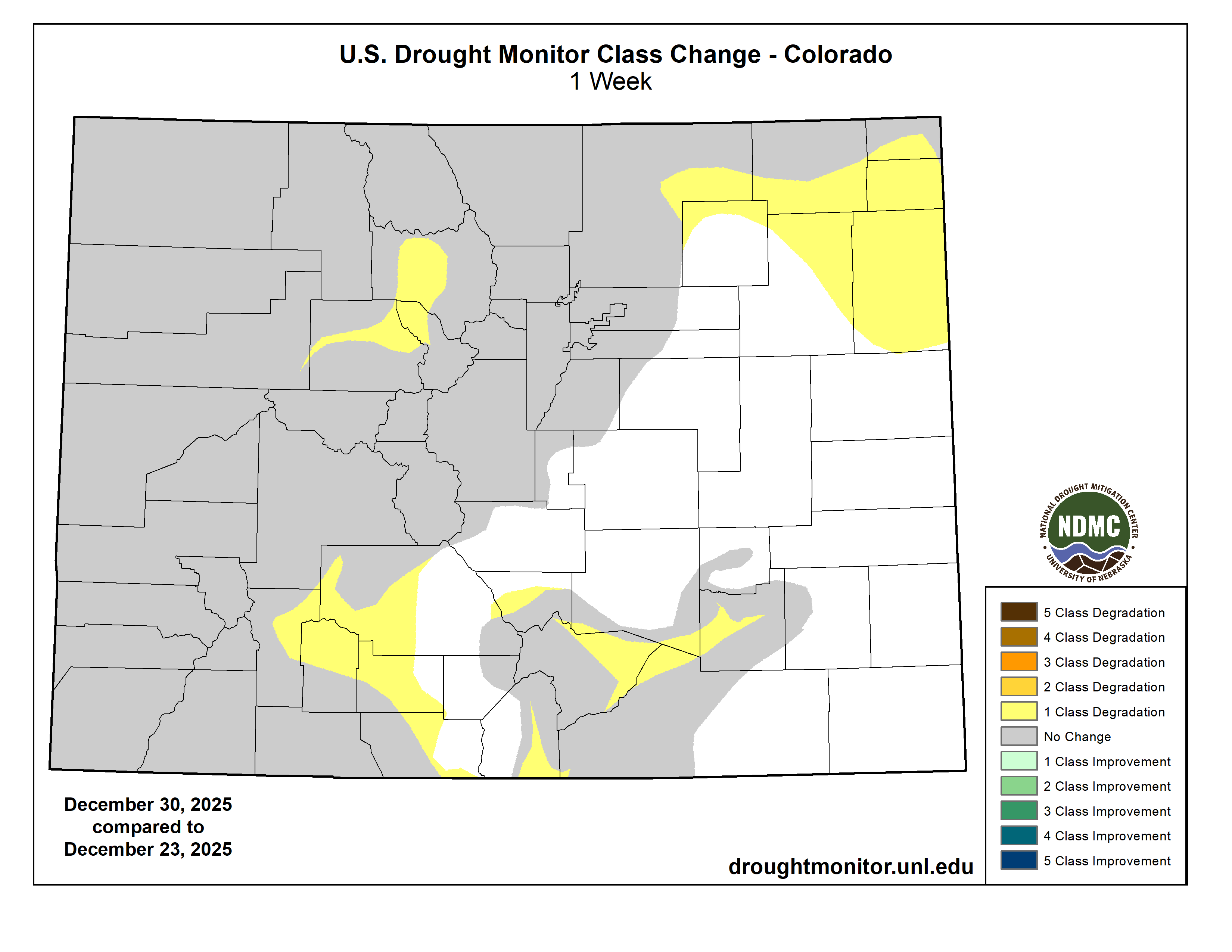
In Pagosa Springs, U.S. Geological Survey for the San Juan River at Pagosa Springs has showed record flows multiple times since the start of the year. For example, at 9 a.m. on Jan. 2, the river was running at 128 cubic feet per second (cfs), which compares to a median of 53 cfs and a previous high of 118 in 1986. At 11 a.m. on Jan. 5, the river was running at 119 cfs, which compares to a median for that date of 54.5 cfs and a previous max value of 116 in 1987. By 11 a.m. on Wednesday, Jan. 7, the river was flowing at 111 cfs. The Jan. 7 median is 55, and the record high is 116 cfs, which was recorded in 1987. According to the U.S. Drought Monitor’s most recent map released on Dec. 31, 2025, 100 percent of Archuleta County is in an “abnormally dry” drought stage.
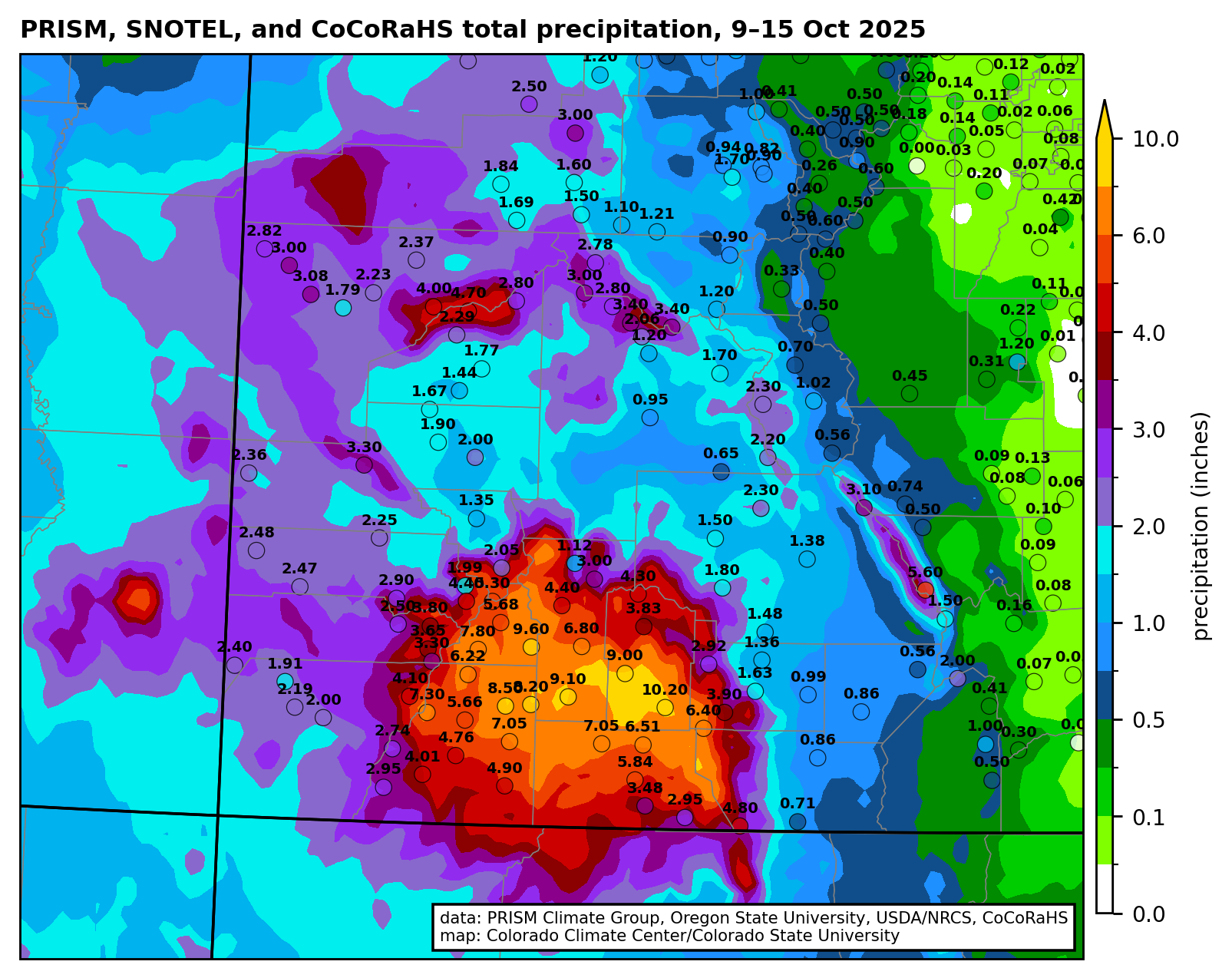
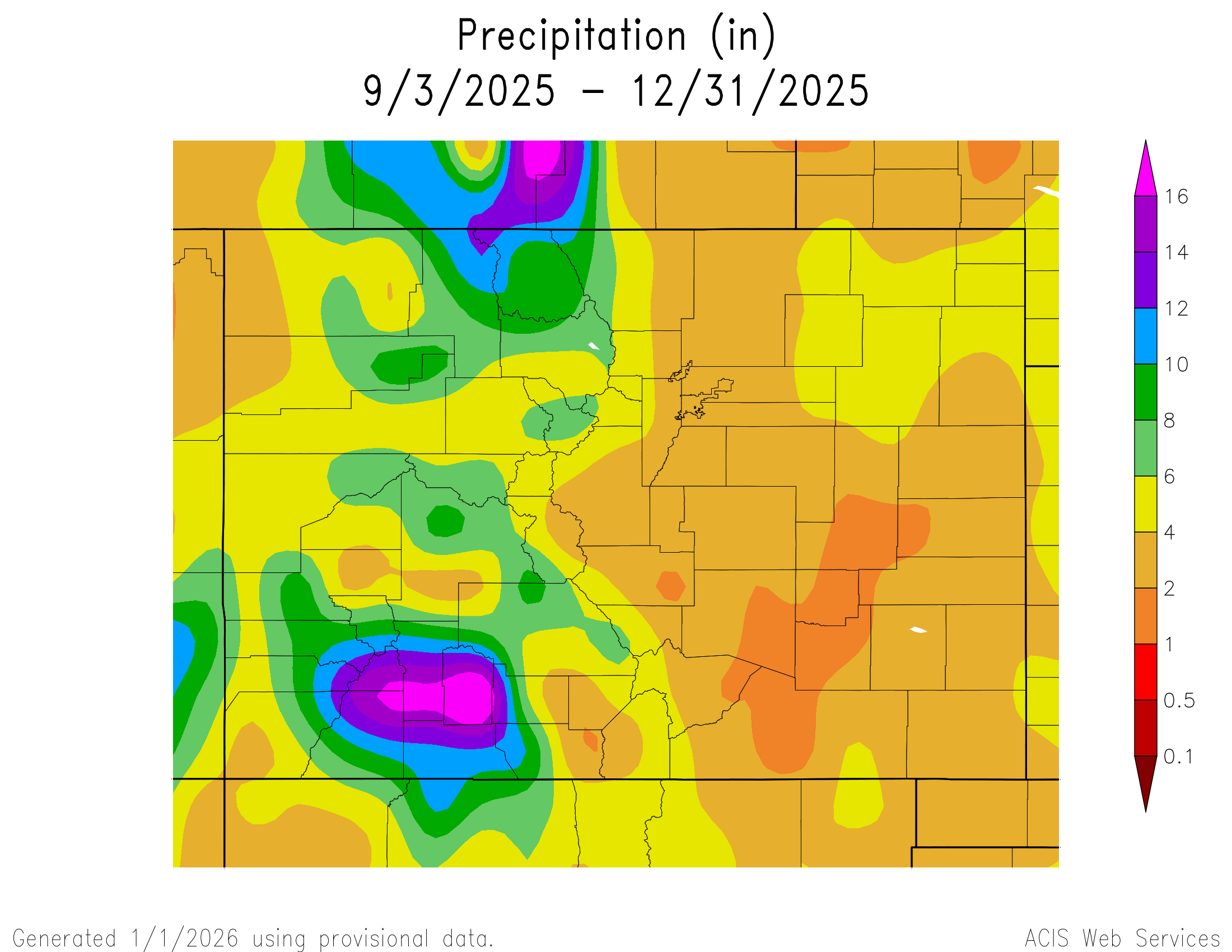
Total precipitation (inches) from 9-15 October 2025 with gridded data from the PRISM Climate Group and observations from the Community Collaborative Rain, Hail, and Snow (CoCoRaHS) network.
On January 6, 2026 Town of Pagosa Springs staff informed the Pagosa Springs Town Council about the town’s ongoing flood recovery funding efforts in the wake of the Federal Emergency Management Agency’s (FEMA’s) denial of the town’s request for $5.7 million to aid cleanup efforts. Development Director James Dickhoff and Projects Manager Kyle Rickert were both on hand to walk the council through various other funding opportunities, with Dickhoff stating, “We are not counting on FEMA money to come through to us” after the denial on Dec. 21, 2025. Dickhoff stated that staff just wanted to inform the council “on where we are at” regarding the town’s relief funding efforts from the October 2025 flooding…
The total project cost of river cleanup and restoration following the October flood event is estimated to be just shy of $6 million, stated Town Manager David Harris in correspondence. Rickert explained that, with the FEMA funding off the table, the town is pursuing several state grants, and possibly a state loan, as well as two other federal funding programs. Dickhoff added that if the town wanted to pursue “the loan opportunity through the Colorado Water Conservation Board (CWCB),” the council would need to put it before the voters in an upcoming spring election to be legally eligible to take out the loan…
Rickert explained that the federal Emergency Watershed Protection had awarded the town about $3.3 million and the Colorado Office of Emergency Management awarded $463,504 in funds. These funds will go toward embankment stabilizations near the Pagosa Springs History Museum and near 6th Street, pedestrian bridge abutment stabilization at Centennial Park, restoring the River Center ponds, as well as Apache Street bridge repairs and log jam removals, all coming with a total project price tag of $4,178,038, the slideshow states…
He added, “The river is an important part of our tourism portfolio and we need to get it cleaned up” and make it safe for those recreating in the river before summer hits. Rickert then informed the council about a Colorado Parks and Wildlife (CPW) Fishing is Fun grant that the town has requested in the amount of $328,603. This grant would go toward dredging the River Center ponds, a headgate replacement at Pond #1 (the east pond), ditch restoration, debris and sediment removal upstream of town limits to the future 1st Street pedestrian bridge, as well as rebuilding rock structures in the same area. Rickert noted that the town was also awarded $15,000 from History Colorado Emergency Grant for its ongoing efforts to stabilize the river bank near the museum…One or possibly two water gauge stations would give the town an estimated two hours of warning time as water levels rise during another flood event, providing historic data as part of the U.S. Geological Survey monitoring system, she noted. This grant application would be due by Jan. 31, so she asked the council to pass a resolution supporting the CWCB river gauge grant, which the council passed unanimously.
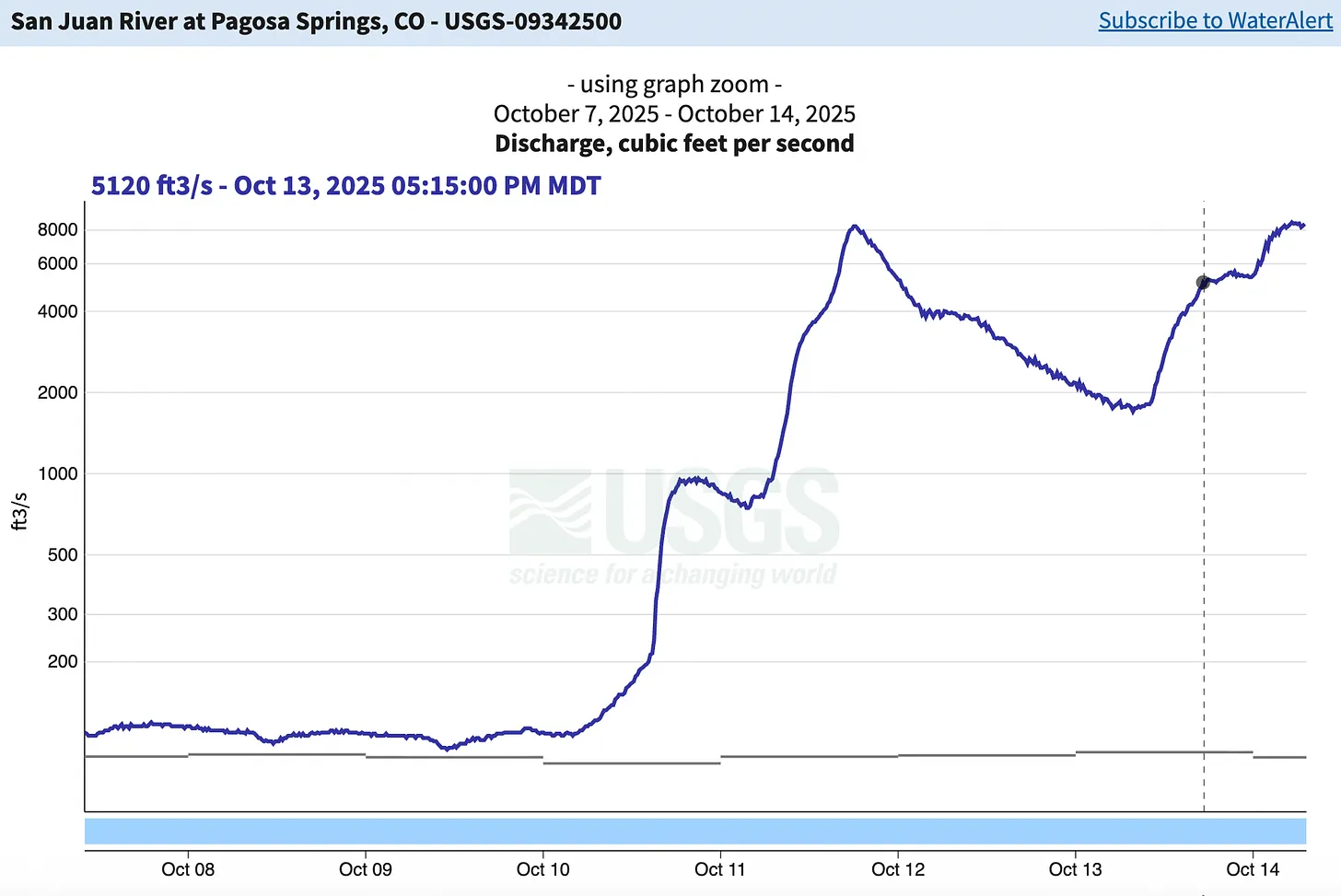
The San Juan River has peaked above 8,000 cfs twice in the last several days, reaching the highest levels seen since the 1927 flood. Source: USGS.
Five years ago today, President Donald Trump incited an angry mob of his followers to attack the nation’s Capitol building in an attempt to overturn the presidential election that he had just lost. He was trying to launch a coup to overthrow America’s democracy. At the time, many of us expected him to be impeached, and maybe even go to jail for this deplorable act. Little could we have guessed that just half a decade later he’d not only be President once again, but would actually be succeeding in his bid to dismantle democracy, and would be doing it with the tacit and explicit support of Congress, the Supreme Court, and his many supporters who don’t seem to be bothered by his cognitive decline, authoritarianism, broken promises, lies, close association with a convicted sex trafficker and pedophile, disregard for the Constitution, and reckless tinkering with the U.S. economy, international affairs, and his constituents’ well-being.
The administration’s invasion of Venezuela is simply the latest, most egregious example. The military went in, lit up Caracas with explosives and gunfire, killed civilians, kidnapped the nation’s leader (who, admittedly, was a nasty authoritarian), and sowed chaos, all without authorization from Congress. The reason? Trump himself says it was to turn the country’s vast oil reserves over to American corporations, which donated generously to Trump’s campaign. But Trump and his minions were equally motivated by the need to stroke Trump’s fragile ego — which has taken a beating thanks to other failures and low approval ratings, and to distract from his ubiquity in the Epstein files (which the DOJ has yet to release as Congress ordered it to do). Don’t be surprised if they invade Greenland or Cuba or even Mexico, next, as stupid as such a scenario might be.
But let’s focus on the oil factor, since that’s the one that’s most likely to trickle down into the Land Desk beat.
Venezuela has a lot of oil, reportedly the largest proved reserves in the world, and it’s mostly made up of heavy, sour crude (more on this in a minute). It’s currently not extracting very much of that oil, for various reasons (the U.S. produces about 20 times more per day than Venezuela). Trump is encouraging American oil companies to go to Venezuela and develop the oil fields and upgrade the infrastructure. This will take time and money, and it’s not clear that petroleum corporations will be interested in this kind of investment while oil prices are low (as they are, currently). Prices are low because demand and supply are more or less balanced, meaning the world doesn’t really need Venezuelan’s oil — at least not now.
Like fine wine, oil is imbued with terroir. That is, its composition varies depending on where it’s from. Most U.S.-produced oil is tight (from tight shales), light (low density), sweet (low sulfur content) crude that requires less processing than heavy (dense), sour (high sulfur) crude. Thing is, many Gulf Coast refineries were constructed before the shale revolution and are equipped to process heavy, sour crude, like the kind that comes from Venezuela. So there is a domestic demand for the stuff.
The active drilling rig count, the most accurate indicator of oil and gas activity, remains stagnant, despite Trump’s call to “drill, baby, drill,” thanks to persistently low oil and gas prices. If Venezuelan oil production increases — and that remains a big “if” — it could further deflate crude prices and dampen enthusiasm for domestic drilling. Source: Baker Hughes
If and when Venezuelan production increases, it will add supply to both the global and domestic markets, which could bring prices down even further. That will lower the cost of driving American gas guzzlers around, and increase greenhouse gas emissions and other pollutants, but it will also reduce incentives to drill new wells, which could ease industry pressure on public lands in the U.S. In the meantime, the Trump administration continues to issue drilling permits at a blistering rate, even though companies aren’t all that interested in using them.
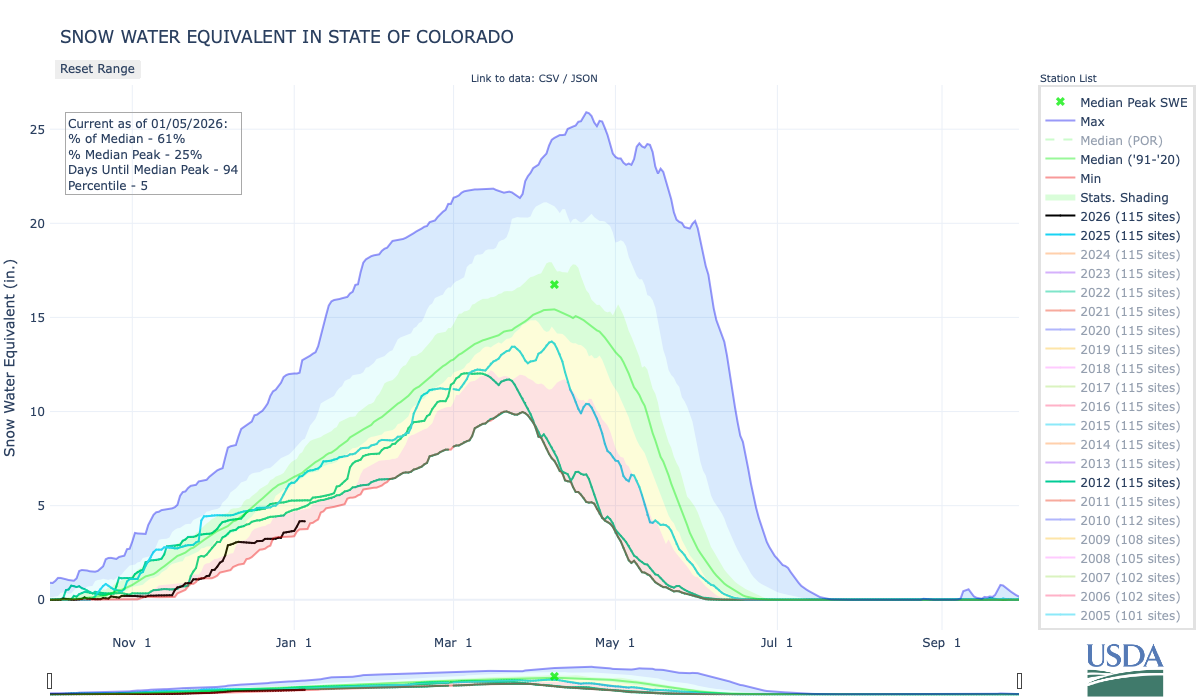
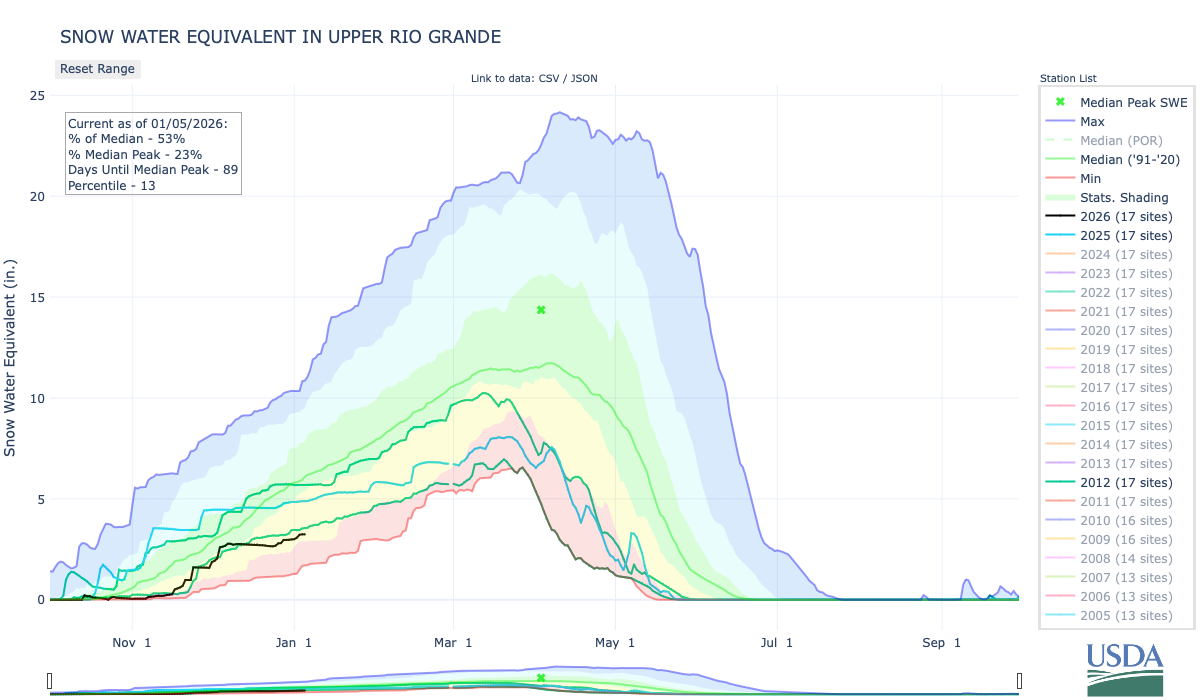
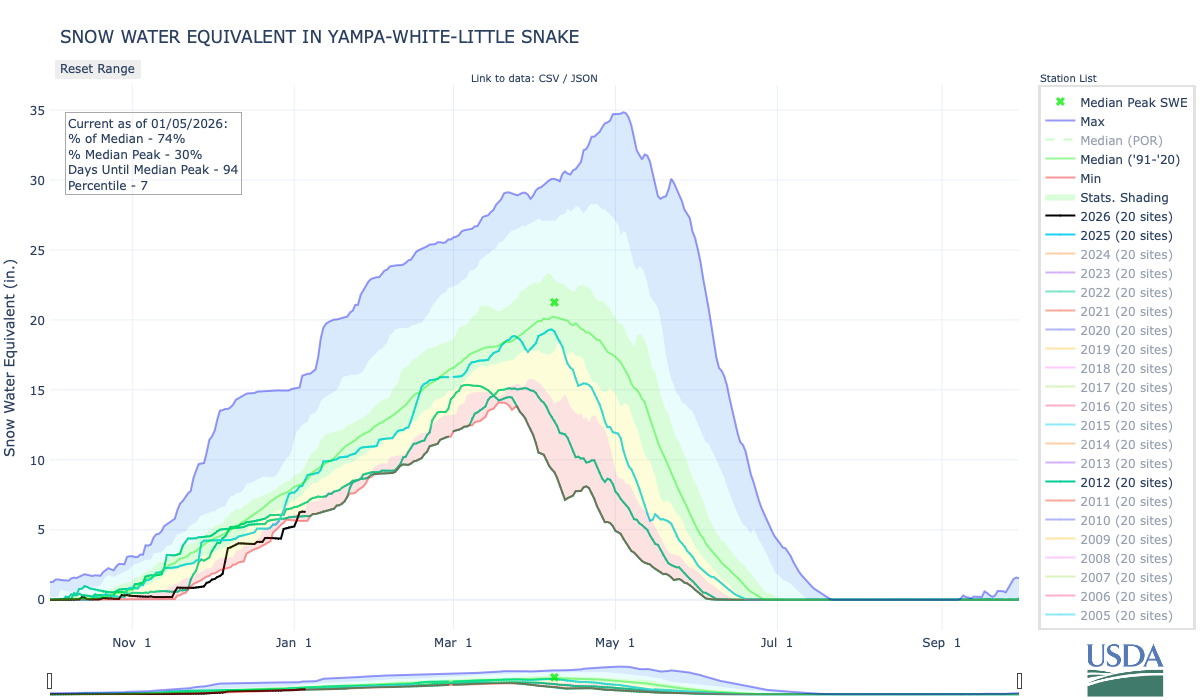
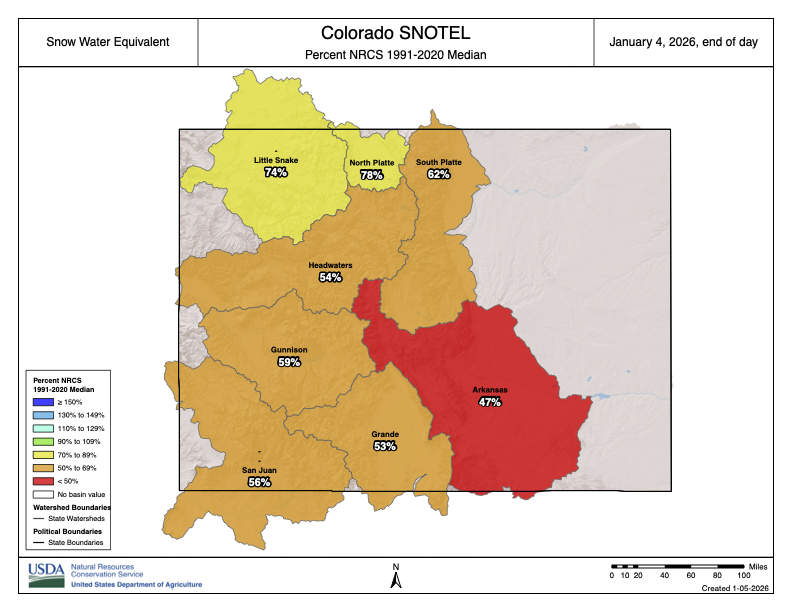
Last week, the Durango Herald quoted a National Weather Service meteorologist as saying that the snowpack in the southwestern part of the state was “not too bad.” I guess that depends on your definition of “not too bad.” Because it sure as heck isn’t looking good!
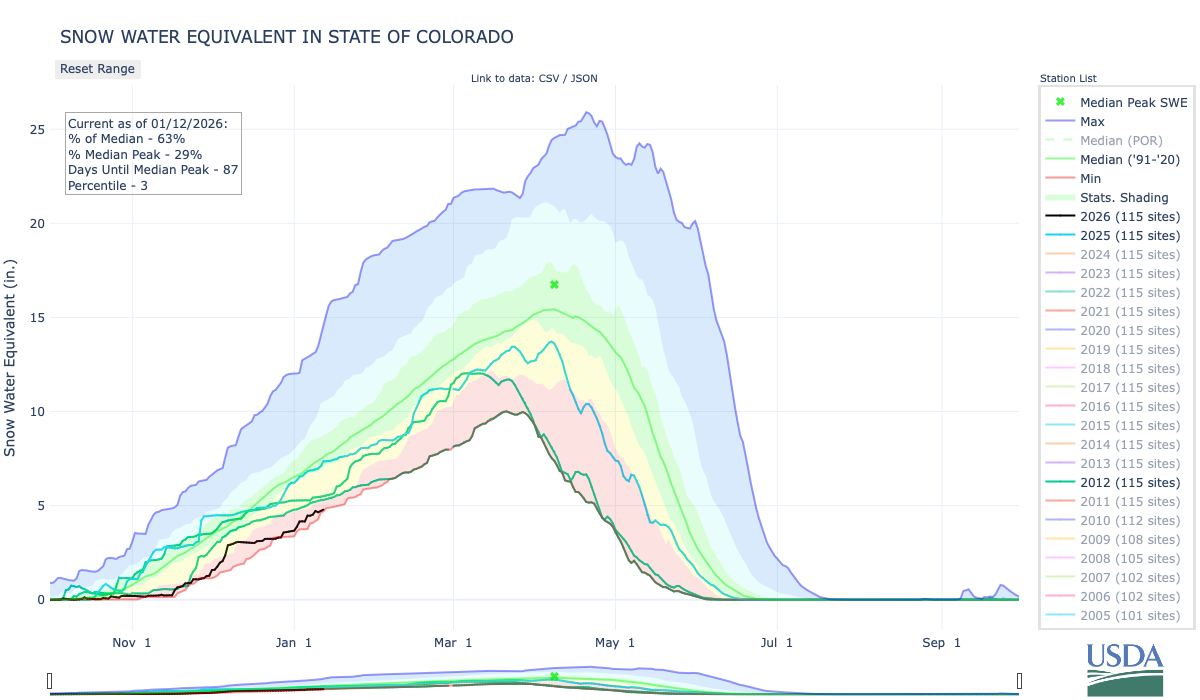
Red Mountain Pass has about half as much snow as it normally does this time of year. Only 1990, 2000, and 2018 rivaled this year for meagre snow levels. Source: NRCS.
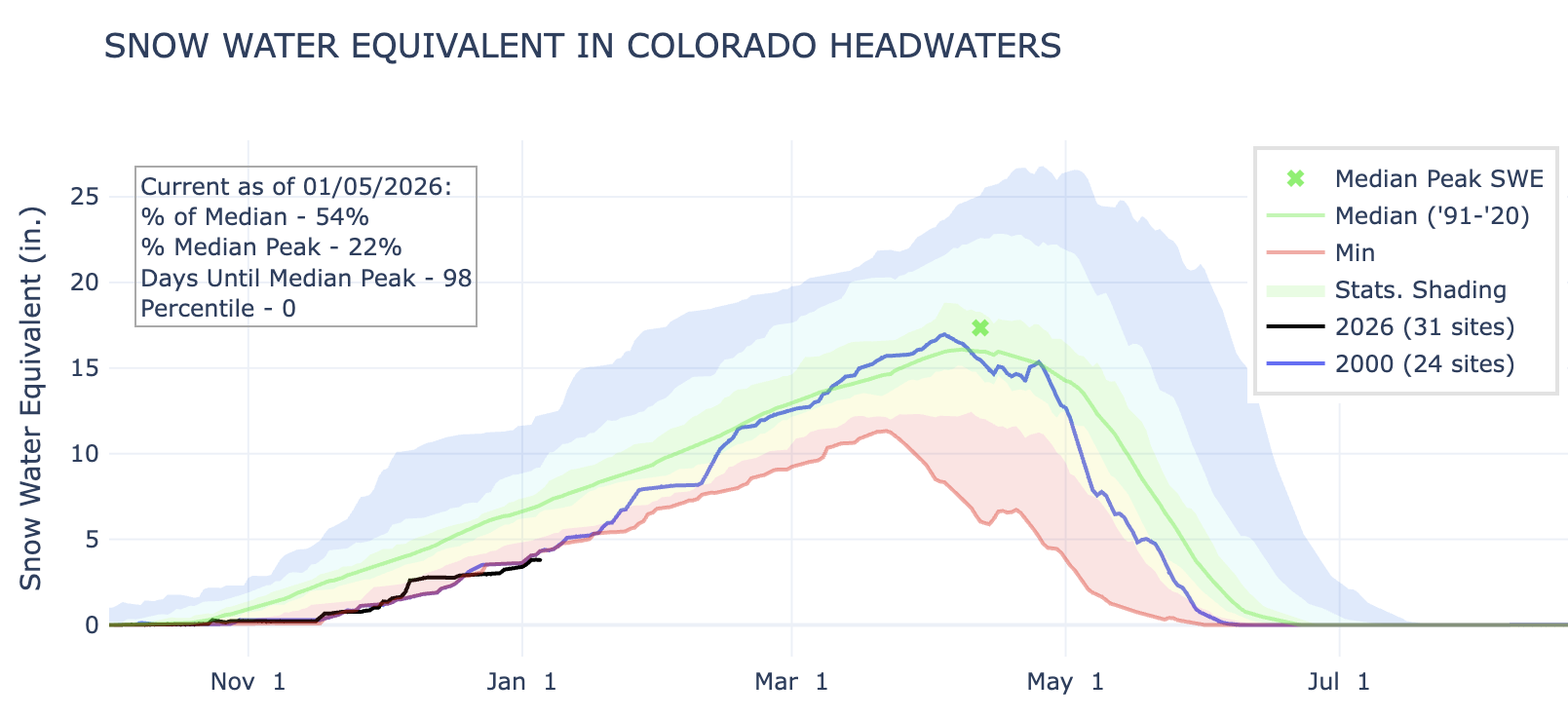
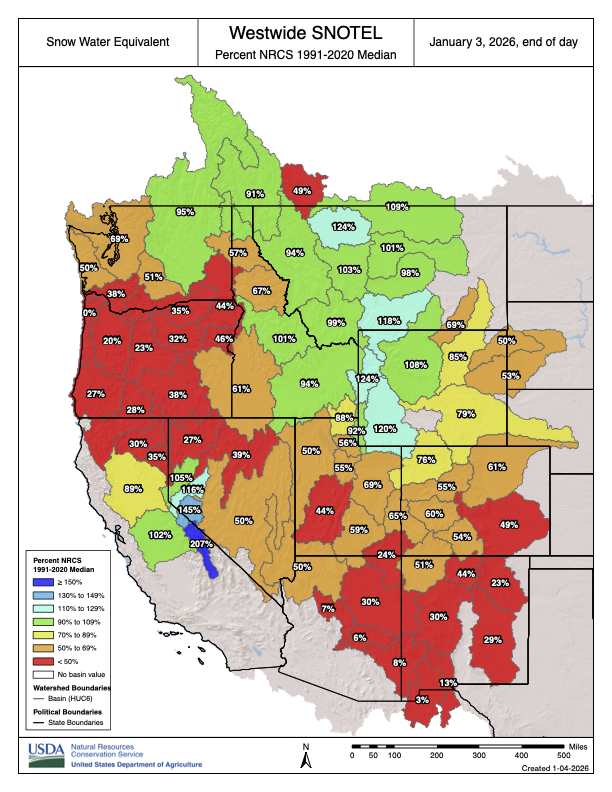
The San Juan Mountain snowpack levels are currently at about 50% of normal for the first week of January, and they are tied for third lowest snowpack level on record for this date. That’s not “too bad,” it’s downright dismal. And snow cover is even more meagre in other parts of the state: The Colorado River’s headwaters SNOTEL station is experiencing the lowest snowpack since it started recording in 1986.
No bueno! Source: NRCS.
Still, it may be too early for snow lovers to abandon hope altogether, since a full recovery would not be unprecedented. Take the winter of 1989-90, when the early January snowpack was even worse than it is now. It was my first year in college, and when I came home for Christmas we played volleyball and went hiking in the mostly bare La Plata Mountains instead of going sledding or skiing. (At the time it seemed downright apocalyptic, since it followed the unusually wet 1980s, when snow would pile up in Durango and halt car traffic and turn the streets into nordic ski tracks.) But that March the snows finally came and continued into May, leading to some nice spring skiing and a decent spring runoff. The snowpack of 95-96 followed a similar pattern, as did 1999-2000.
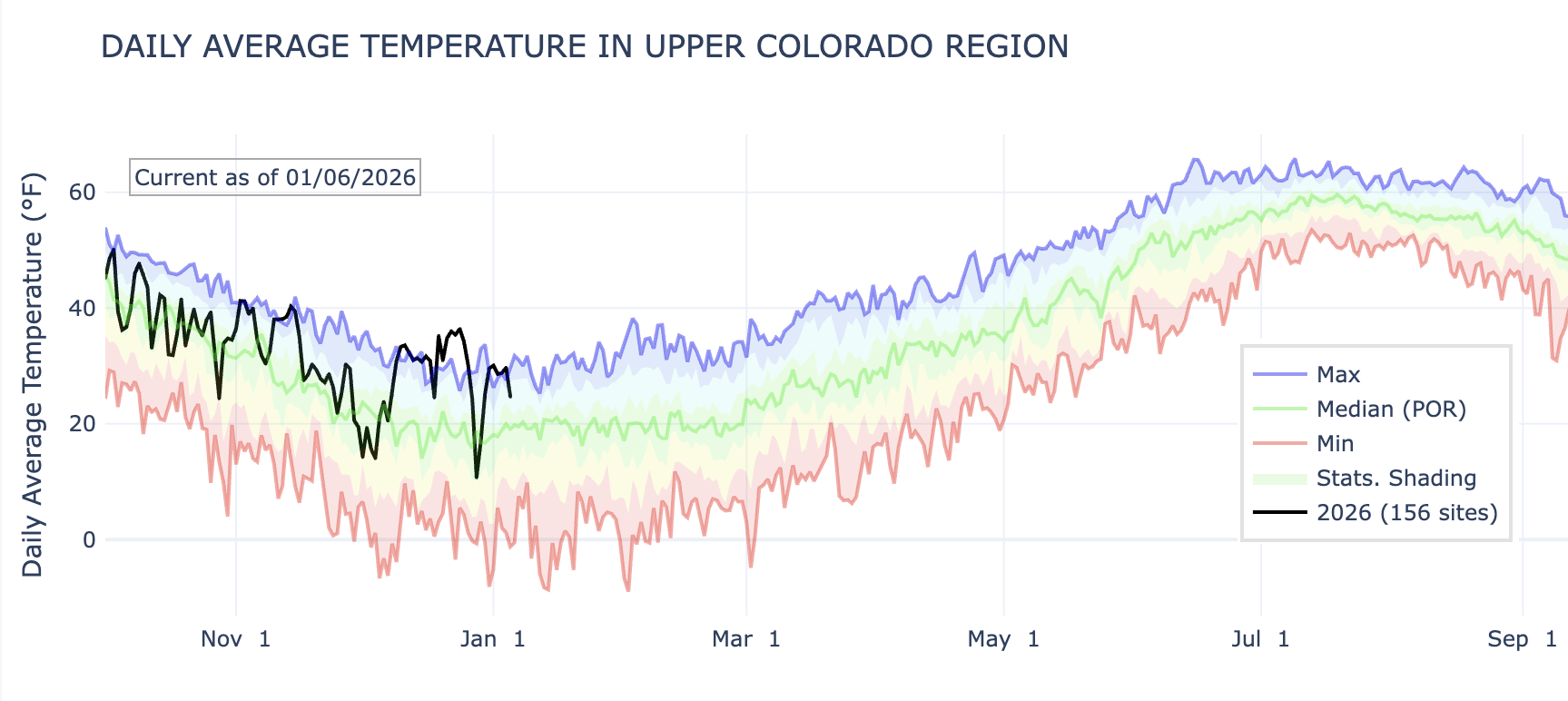
During those years, however, the lack of snow was caused by a lack of precipitation. This year, it’s the result of a combination of light winter precipitation and unusually warm temperatures throughout December and early January. A recovery will require not only more snowfall, but also cooler temperatures, making the outlook a little grimmer.
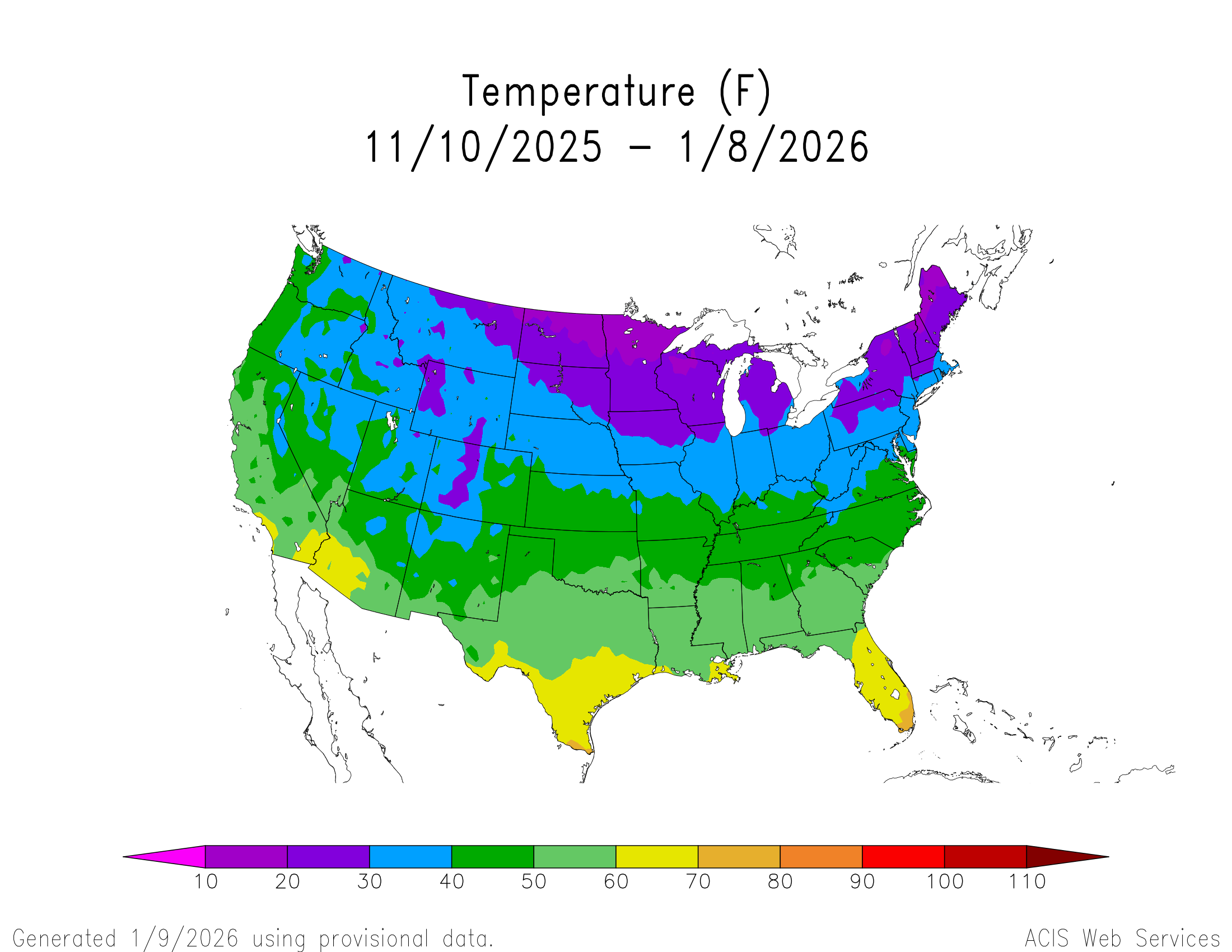
The Upper Colorado River region has experienced some of its highest daily average temperatures on record this winter. On Christmas Eve, the daily average was a whopping 18° F higher than the median for that day. Source: NRCS.
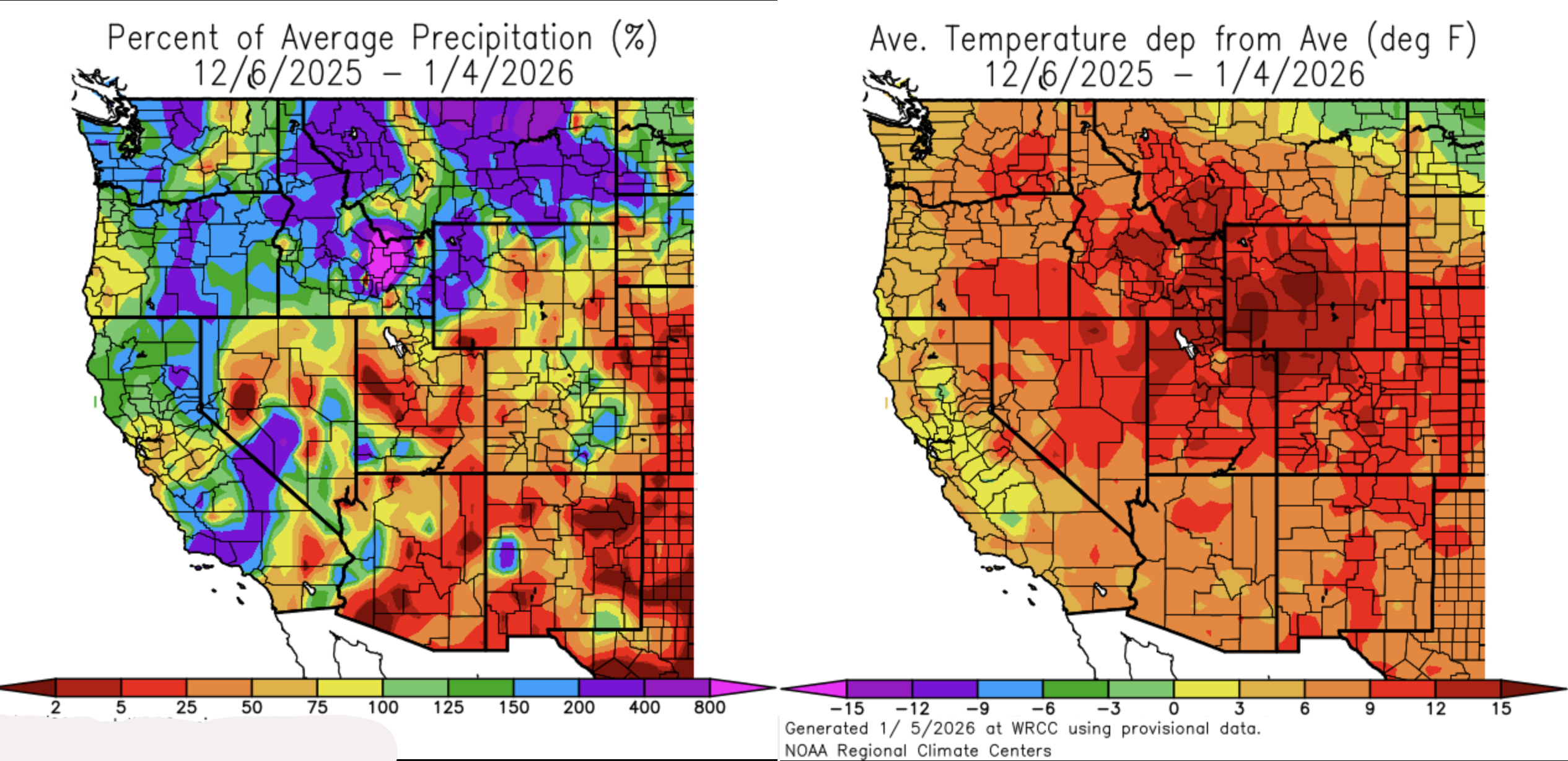
Parts of the West were hit with five or six times as much precipitation than normal in December, but temperatures were above normal almost everywhere, too, diminishing snowpack. Source: Western Regional Climate Center.
The Phillips Bench SNOTEL station near Teton Pass, Wyoming, shows how the atmospheric rivers have helped the snowpack their rebound.
As of mid-December, the snow drought covered most of the West, but a series of atmospheric rivers pounded the West Coast and the Northern Rockies, bringing snow to higher elevations and more northern latitudes (and big rain and flooding to California). Heavy, wet snow piled up on Teton Pass near Jackson, Wyoming, bringing snow water equivalent levels from far below average to above normal for this date. Road crews triggered a huge avalanche that covered the highway in about 30 feet of snow. And, after the skies cleared, a couple of backcountry skiers triggered a slide near Teton Pass; one of the skiers was caught, buried, and killed. It was the nation’s second avalanche-related fatality this season. A few days later, two Mammoth Mountain ski patrollers were caught in a slide while doing avalanche mitigation work and one of them died.
🗺️ Messing with Maps 🧭
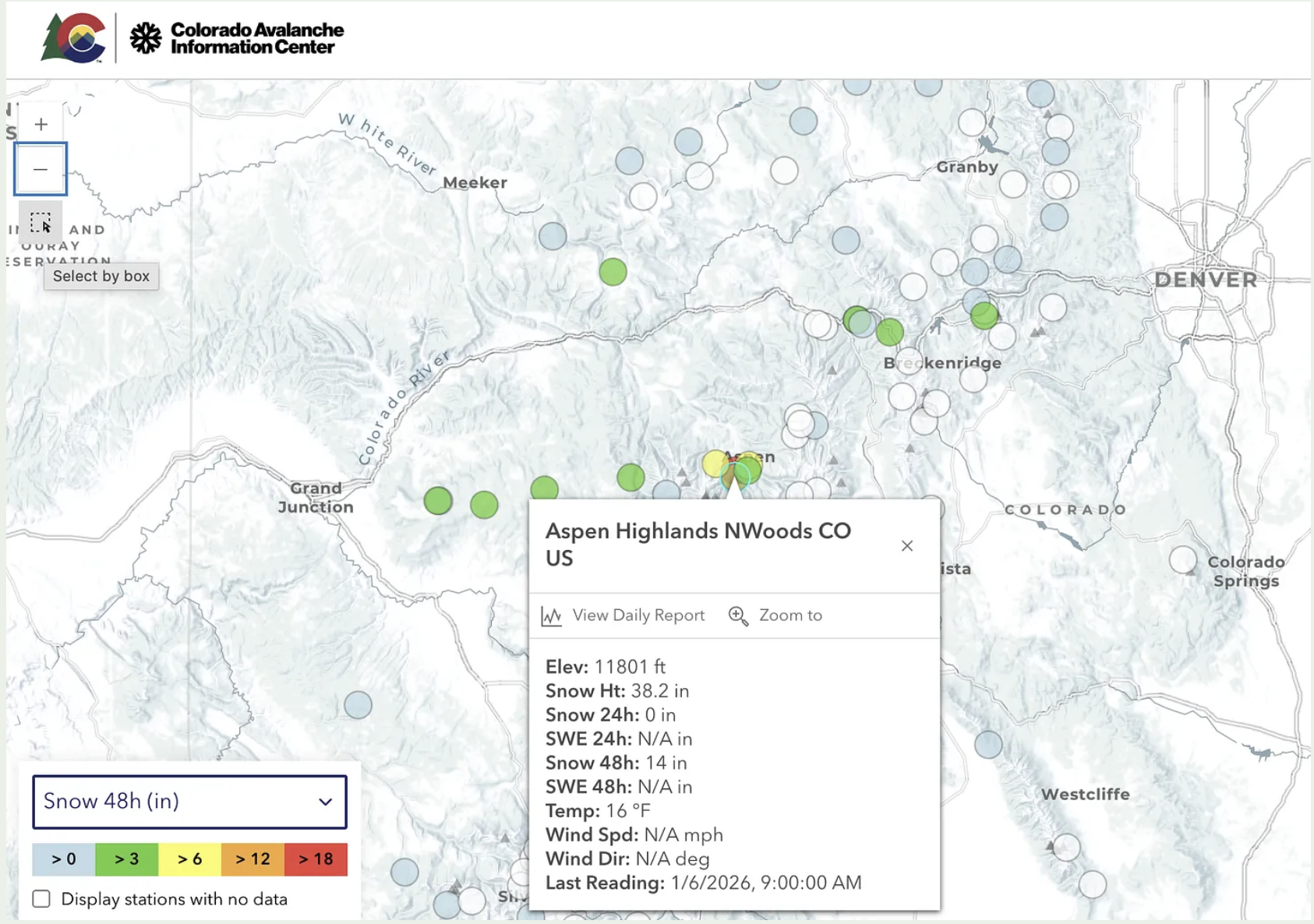
Now for a little New Year’s treat for all of you weather/map nerds: The Colorado Avalanche Information Center has launched an interactive map that shows 24-hour and 48-hour snowfall and snow water equivalents at various locations across the state’s mountains, letting you see at a click where the good powder is and isn’t. You can click on each station and get all the details, including current temperature and snow depth.
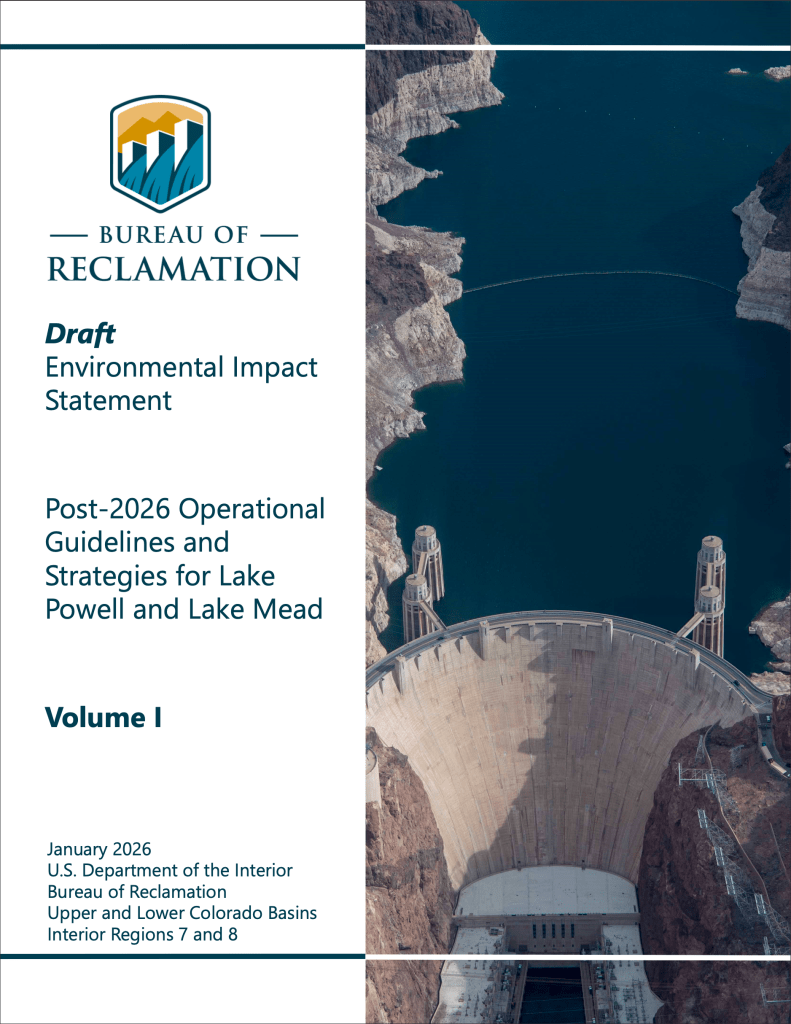
The Bureau of Reclamation today released a draft Environmental Impact Statement evaluating a range of operational alternatives for managing of Colorado River reservoirs after 2026, when the current operating agreements expire. The draft EIS evaluates a broad range of potential operating strategies. It does not designate a preferred alternative, ensuring flexibility for a potential collective agreement.
Prolonged drought conditions over the past 25 years, combined with forecasts for continued dry conditions, have made development of future operating guidelines for the Colorado River particularly challenging.
“The Department of the Interior is moving forward with this process to ensure environmental compliance is in place so operations can continue without interruption when the current guidelines expire,” Assistant Secretary – Water and Science Andrea Travnicek said. “The river and the 40 million people who depend on it cannot wait. In the face of an ongoing severe drought, inaction is not an option.”
The draft EIS evaluates a broad range of operational alternatives for post-2026 reservoir management informed through input and extensive collaborative engagement with stakeholders, including the seven basin states, tribes, conservation organizations, other federal agencies, other Basin water users, and the public. It includes the following alternatives that capture operational elements and potential environmental impacts:
No Action
Basic Coordination
Enhanced Coordination
Maximum Operational Flexibility
Supply Driven
The document will be published in the Federal Register on January 16, 2026, initiating a 45-day comment period that will end on March 2, 2026. The draft EIS and additional information on the alternatives are available on Reclamation’s website.
“Given the importance of a consensus-based approach to operations for the stability of the system, Reclamation has not yet identified a preferred alternative,” said Acting Commissioner Scott Cameron. “However, Reclamation anticipates that when an agreement is reached, it will incorporate elements or variations of these five alternatives and will be fully analyzed in the Final EIS enabling the sustainable and effective management of the Colorado River.”
The Colorado River provides water for more than 40 million people and fuels hydropower resources in seven states. It serves as a vital resource for 30 Tribal Nations and two Mexican states, sustaining 5.5 million acres of farmland and agricultural communities throughout the West, while also supporting critical ecosystems and protecting endangered species.
The Draft EIS addresses only domestic river operations. A separate binational process addressing water deliveries to Mexico is underway and the Department is committed to continued collaboration with the Republic of Mexico. The Department will conduct all necessary and appropriate discussions regarding post-2026 operations and implementation of the 1944 Water Treaty with Mexico through the International Boundary and Water Commission in consultation with the Department of State.
To provide certainty for communities, tribes, and water users, a decision regarding operations after 2026 will be made prior to October 1, 2026 – the start of the 2027 water year.
Photo shows Lake Mead with a water elevation of 1078. Credit: USBR
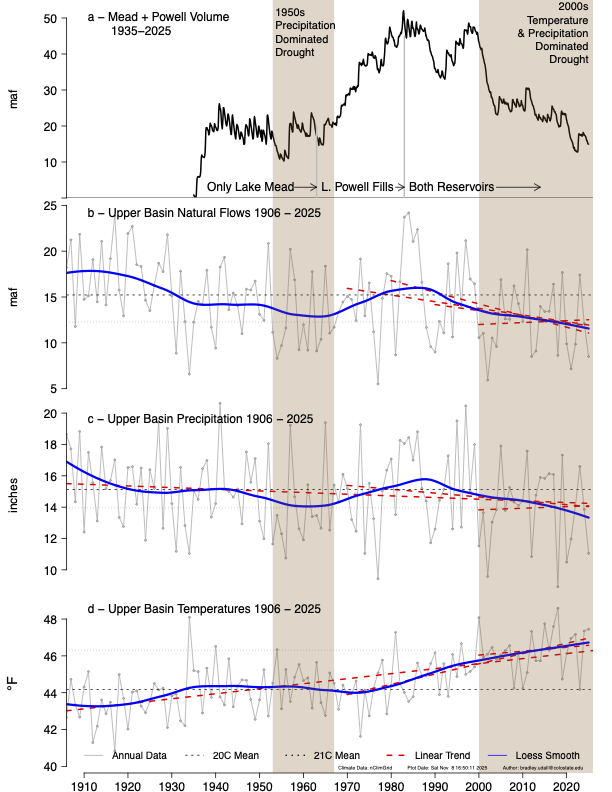
Udall/Overpeck 4-panel Figure Colorado River temperature/precipitation/natural flows with trend. Lake Mead and Lake Powell storage. Updated through Water Year 2025. Note the tiny points on the annual data so that you can flyspeck the individual years. Credit: Brad Udall
The consensus-based effort to develop new rules to manage the Colorado River system hasn’t worked – it’s time for a new approach
Federal leadership and the credible threat of managing reservoirs to protect the system is that new approach
Missing Deadlines
Way back at the end of the last century, at the annual Colorado River conference in Vegas, Marc Reisner repeated the Margaret Thatcher quote that consensus is the absence of leadership. On Veterans Day, the seven Colorado River basin states missed yet another deadline to reach consensus on a conceptual plan for managing the shrinking Colorado River after the current rules expire in 2026. Valentine’s Day marks the next holiday deadline, this time for a detailed plan, but multiple missed deadlines give no indication that the states will reach consensus then, either.
The basin state negotiators have met for years behind closed doors, without success. It’s time for a new approach. Aggressive federal intervention and the credible threat of a federally-imposed Colorado River management plan would offer political cover – or a political imperative – for the negotiators. The credible threat of a federal plan would give the negotiators the space to compromise without having to do so unilaterally and then being accused of not protecting their state’s interests.
But federal leadership alone is not enough – it must be coupled with a plausible federal plan that compels the states to act and can meet the magnitude of the ongoing crisis. As the Department of the Interior announced in its 6/15/2023 press release, the purpose of and need for the post-2026 guidelines is “to develop future operating guidelines and strategies to protect the stability and sustainability of the Colorado River.” To date, the development of the post-2026 guidelines has prioritized routine operations of Glen Canyon and Hoover dams over the system as a whole, a focus inconsistent with the magnitude and urgency of the problem. Prioritizing routine dam operations and hydropower generation over water delivery and environmental protection elevates the tool over the task. Seeking to preserve routine operations of the dams while imposing draconian cuts on water users is not a path to resilience and precludes alternatives that would help stabilize the system.
The Plan
Instead, by early next year, the Secretary should announce that Interior will implement a federal plan incorporating the following elements:
As a condition precedent, the Lower Basin states agree not to place a “compact call” for the duration of the agreement.
Implement annual Lower Basin water use reductions for the following calendar year based on total system contents on August 1:
75% – 60%: cuts to Lower Basin water uses increasing from 0 to 1.5 MAF<60% – 38%: static cut to Lower Basin water uses of 1.5 MAF<38% – 23%: increasing cuts to Lower Basin water uses of up to 3.0 MAF total
below 23% of total system contents – cut Lower Basin water uses to the minimum required to protect human health and safety and satisfy present perfected rights
If the Lower Basin states do not satisfy the condition precedent in #3 above, Reclamation limits Lower Basin deliveries to the minimum required to satisfy present perfected rights when total system contents are <75%.
Recover water stored in federal Upper Basin reservoirs unless the Upper Basin states reduce annual water use based on total system contents:
<34% – 23%: Assuming the first 0.25 MAF “reduction” would be contributed by the elimination of Powell’s evaporative losses and gains from Glen Canyon bank storage, reduce Upper Basin water uses up to 0.65 MAF
below 23% of total system contents – limit total Upper Basin water uses to 3.56 MAF (the minimum volume reported this century)
Expand the pool of parties eligible to create Intentionally Created Surplus (ICS) beyond existing Colorado River contractors, to include water agencies and other entities with agreements to use Colorado River water.
Eliminate the existing limits on the total quantity of Extraordinary Conservation ICS and DCP ICS that may be accumulated in ICS and DCP ICS accounts, while maintaining existing limits on delivery of such water.
Fully mitigate the on-stream and off-stream community and environmental impacts of the water use reductions identified above.
After a three-year phase-in period, condition Colorado River diversions on a clear “reasonable and beneficial use” standard predicated on existing best practices for water efficiency, including but not limited to the examples listed below (state(s) that already have such standards):
Require removal of non-functional turf grass (California, Nevada)
Incentivize landscape conversion and turf removal statewide (California, Colorado, Utah)
Adopt stronger efficiency standards for plumbing and equipment (Colorado, California, and Nevada)
Require urban utilities to report distribution system leakage, and to meet standards for reducing water losses (California)
Require all new urban landscapes to be water-efficient (California)
Require metering of landscape irrigation turnouts (Utah)
Ensure that existing buildings are water-efficient when they are sold or leased (Los Angeles, San Diego)
Require agricultural water deliveries to be metered and priced at least in part by volume (California)
Many of the elements listed above raise important questions about federal authorities, accounting and data challenges, the roles and obligations of state water officials to implement coordinated actions in-state, water access for disadvantaged communities, environmental compliance, and potential economic and social costs, among others. For each item listed, many details will need to be refined. Similarly, the plan’s duration will need to be determined. But as temperatures again climb into the high 40s in the Rockies near the Colorado River’s headwaters (in mid-December!), drying soils and reducing next year’s runoff, and the National Weather Service issues red flag fire warnings for Colorado’s Front Range, the need for bold action is clear.
The Dominy Bypass
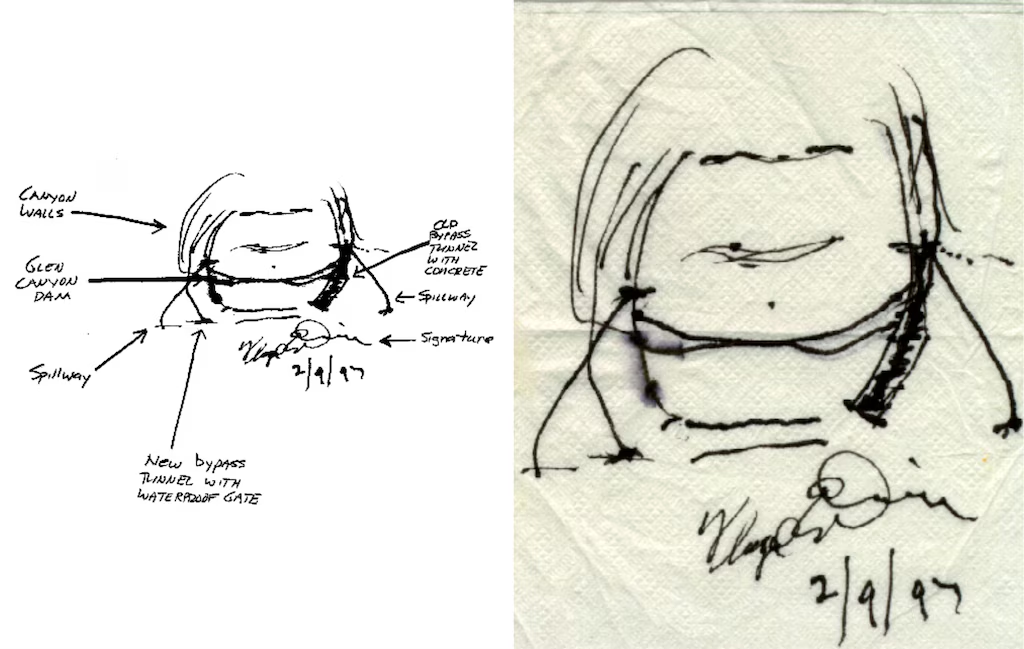
Recovering water stored in Lake Powell will require the construction of new bypass tunnels around Glen Canyon Dam. Former Reclamation Commissioner Floyd Dominy sketched the design of such tunnels almost thirty years ago (see image). Such tunnels would enable the recovery of about 5.6 MAF of water stored below the minimum power pool elevation – more water than the Upper Basin states consume each year. Current operating rules and the scope of the current planning process effectively treat this massive volume of water as “dead storage” – a luxury the system can no longer afford. After Reclamation constructs the bypass tunnels, water recovery should be timed to maximize environmental and recreational benefits in the Grand Canyon.
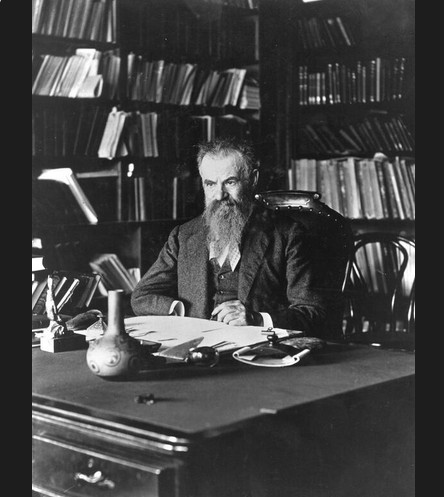
John Wesley Powell at his desk—same desk used by the USGS Director today via the USGS
Running the River
Almost 160 years ago, John Wesley Powell – the reservoir’s namesake – demonstrated bold leadership, going where no (white) man had gone before. With leadership and a clear goal, he charted a route through the Colorado River’s iconic canyons. Now is the time for more bold leadership, a clear goal, and a plan to get there.
About the author
Michael Cohen. Photo credit: Pacific Institute
Since 1998, Michael Cohen’s work with the Pacific Institute has focused on water use in the Colorado River basin and delta region and the management and revitalization of the Salton Sea ecosystem. Michael received a B.A. in Government from Cornell University and has a Master’s degree in Geography, with a concentration in Resources and Environmental Quality, from San Diego State University.
Map of the Colorado River drainage basin, created using USGS data. By Shannon1 Creative Commons Attribution-Share Alike 4.0
Arkansas Valley Conduit map via the Southeastern Colorado Water Conservancy District (Chris Woodka) June 2021.
Click the link to read the article on The Denver Post website (Kevin Freking and Nick Coltrain ). Here’s an excerpt:
January 8, 2026
Rep. Lauren Boebert, who sponsored bill, pushed president in November to release Jeffrey Epstein files
The U.S. House refused Thursday to override President Donald Trump’s vetoes of two low-profile bills — including one that would help pay for a water pipeline in Colorado — as Republicans stuck with the president despite their prior support for the measures. Congress can override a veto with support from two-thirds of the members of the House and the Senate. The threshold is rarely reached. In this case, Republicans opted to avoid a fight in an election year over bills with little national significance, with most GOP members voting to sustain the vetoes. The two vetoes were the first of Trump’s second term. One bill was designed to help local communities finance the construction of a pipeline to provide water to tens of thousands in southeastern Colorado. The other designated a site in Everglades National Park as a part of the Miccosukee Indian Reservation…
On the Colorado bill, 35 Republicans sided with Democrats in voting for an override — with all members of the state’s delegation from both parties supporting an override. On the Florida bill, only 24 Republicans voted for the override. The White House did not issue any veto threats prior to passage of the bills, so Trump’s scathing comments in his recent veto message came as a surprise to sponsors of the legislation. Ultimately, his vetoes had the effect of punishing backers who had opposed the president’s positions on other issues. The water pipeline bill came from Republican Rep. Lauren Boebert of Colorado, a longtime Trump ally who broke with the president in November to release files on convicted sex offender Jeffrey Epstein. The bill to give the Miccosukee Tribe of Indians more control of some of its tribal lands would have benefited one of the groups that sued the administration over an immigration detention center known as “Alligator Alcatraz.”
It doesn’t matter if you’re a full-time ski bum, a longtime resident, or a first time visitor — the ramifications of the distressing 2025-26 winter on the Western Slope impacts everyone. The combination of unseasonably warm temperatures and jarring lack of snow has created a perfect storm — or lack thereof — and will continue to impact agriculture, recreation, and potable water for over 30 million people long after the 2025-26 winter concludes. Brendon Langenhuizen, the Director of Technical Advocacy for the Colorado River Water Conservation District, compared the snowpack to a reservoir but said the extreme heat is detracting from the benefits of a natural reserve.
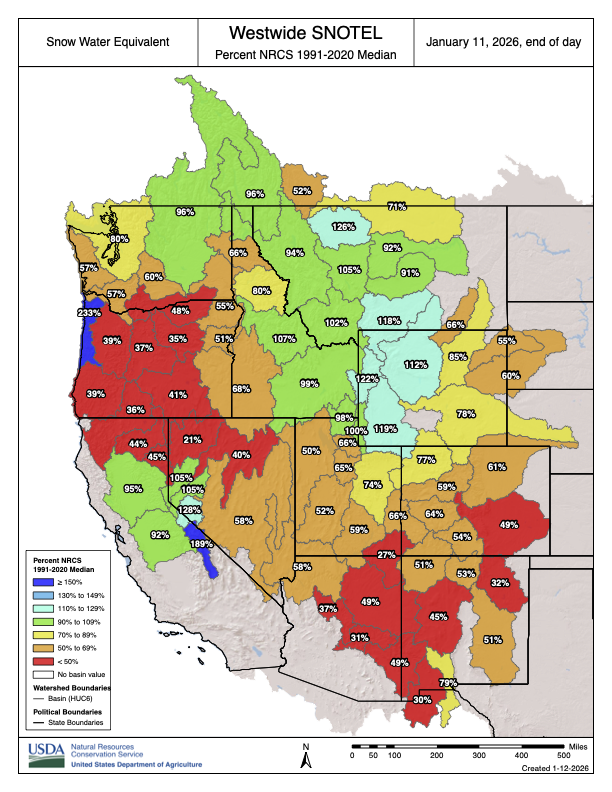
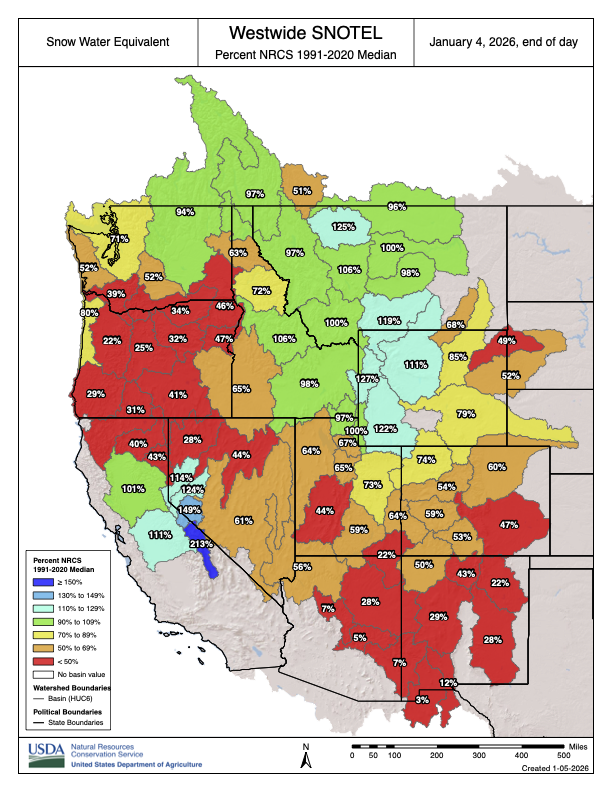
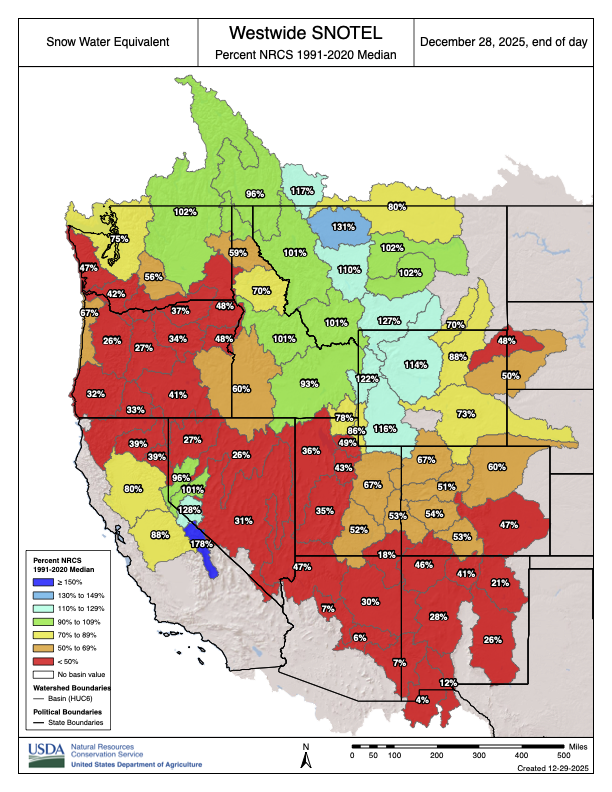
Westwide SNOTEL basin-filled map January 8, 2026.
“How warm it’s been has been a concern for me, because snowpack is really a big reservoir for us,” he said. “You can hold that water for the warmer times of the year and then it slowly runs off or melts into the deltas and then comes back into the rivers later in the summer when we need it for crops and water temperatures and recreation.
“If we have these really warm temps continuing, it just diminishes the snowpack and we can’t hold as much snow into the spring — making it so even if we had the moisture, we wouldn’t be able to hold it.”
[…]
According to a Colorado Climate Center graph, parts of Colorado experienced some temperatures exceeding averages by double digits during the first week of January. The graph shows all of Garfield County experienced average temperatures at least eight degrees hotter than average, with northern Garfield County facing average temperatures at least 12 degrees hotter than average. He continued to explain that there was already evidence of a fast runoff, using the Dotsero marker on the Colorado River as reference…Although the area has finally experienced some precipitation since the calendar flipped to 2026, the temperatures aren’t letting a solid base build in the higher alpines – further threatening the snowpack. Walter admitted that every little bit helps, but doesn’t think the recent storms were enough to move the needle, especially since the forecast dries out after Thursday night.
As guests ski and ride down Schoolmarm, a stretch of beginner-friendly terrain at Keystone Resort in Colorado, they are treated to views of Dillon Reservoir nearly the whole way down. More eagle-eyed skiers and riders will notice that snowmaking machines line the run’s three miles, which spans from summit to base.
On a sunny, cloudless November day, it’s one of the resort’s only accessible ski runs with much of the credit going to those machines.
“It gives pretty much everybody the ability to ski here on day one,” said Kate Schifani, the resort’s senior director of mountain operations. She says Keystone is super focused on that early opening day.
“We are the first resort in the country to open,” she said, referring to the 2025 season. “So we put a lot of stock in what we can do early-season, and having great snowmaking helps us do that.”
It’s a familiar problem for Rocky Mountain ski resorts over the last 20 years, which have become increasingly prone to scant early season snow. [ed. emphasis mine] Many have chosen to stick with their traditional opening days near the Thanksgiving holiday and take the gamble that snow might arrive in time. To match their guests’ demands for skiable acreage amid a warming climate, resorts are doubling down on snowmaking technology and acquiring the water rights needed to make it happen.
Winter is off to a slow start across the West this year. Snowpack is below average in every major river basin across the entire region. That’s a concern for ski resorts, many of which have delayed their opening days. That includes Jackson Hole in Wyoming, Alta in Utah, and Beaver Creek, just down the highway from Keystone.
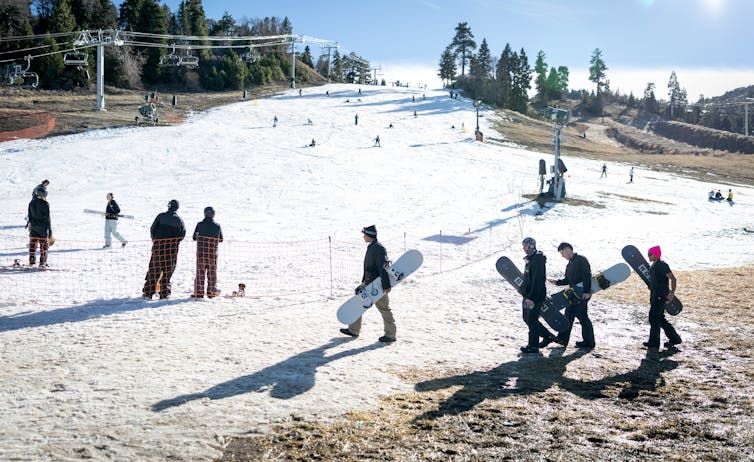
Human-caused climate change has changed the way precipitation falls in the mountains, especially in autumn. As more early season storm clouds bring rain instead of snow, resorts are increasingly relying on snowmaking to give their guests the ability to ski at all.
But this year, it wasn’t just a lack of snow that caused resorts headaches. November was warm as well, which also affects snowmaking operations. Throughout the Upper Colorado River Basin, temperatures were anywhere from five to eight degrees above average, with much of Utah setting records. Denver logged its warmest November day ever this year.
Schifani said ideally, snowmaking happens when it’s colder than 28 degrees.
“So it’s 32.7 degrees right now,” she said, checking the temperature on a monitor attached to one of the snow guns at the top of the River Run gondola. “So we’re just a little too warm for snowmaking.”
Keystone made upgrades to its snowmaking system in 2019, so all of its guns are relatively new. Each one has a weather system built into it, detecting temperature and relative humidity. They’re all automated, so when it finally drops below 28 degrees, the guns turn on with a loud rumble.
“This gun will know as it gets colder, we can add more water, we can make more snow,” Schifani explained. “As it gets warmer, we cut back on the water, we make a little bit less snow until it gets too warm for us to make snow at all.”
Once it’s cold enough, man-made snow takes about two parts compressed air and one part water. Unlike other uses in the West that transport water over long distances to sprawling cities or faraway farm fields, snowmaking keeps water close to where it originated.
Steven Fassnacht, a professor of snow hydrology at Colorado State University, said that about 80% of the water used in snowmaking goes back into the watershed it came from.
“[Ski resorts] are taking water out of the river, out of a reservoir … and they’re putting it on the mountain and they’re storing it somewhere different for the winter,” he said. “So the actual use, we call it consumptive use, the amount of water that leaves the system is relatively small.”
But that use still matters in a region where every drop of water is accounted for. Fassnacht said it will matter even more as the region’s climate gets warmer and drier, and as competition for water ramps up.
“In drier conditions, maybe that water use — possibly, likely — that consumptive use is actually going to increase,” he said. “And it may be harder to actually get that water out of the system to put on the mountains.”
Ski areas’ water usage can get contentious. Telluride Resort is currently in a dispute with the town of Mountain Village over its water use, and a federal court recently dismissed a lawsuit from Purgatory, a resort near Durango, over accessing decades-old groundwater rights on Forest Service land.
Chris Cushing is a principal with the consulting firm SE Group, which works on mountain planning for resorts across the country.
He recently worked with Deer Valley in Utah on a massive expansion: the resort added ten new chairlifts and doubled its skiable terrain, which it plans to open this season — with a state of the art snowmaking system.
“It’s just massive, it’s literally building a new ski resort,” he said of the expansion, which is called East Village.
Cushing says the expansion was only possible because the land acquired by Deer Valley already had water rights allocated to it — a calculation many other resorts he works with are having to factor in their plans as well.
“Absolutely the first question I ask is, ‘what’s your water situation?’” he said.
Long-term drought means ski resorts aren’t just in the game of acquiring new supplies, but also how to make the water they do have go further.
In 2023, Keystone added a new chairlift, providing skiers and riders easier access to its Bergman Bowl, which used to be an area only hikers could reach. Schifani says the resort expanded its snowmaking system to blanket that area at will too.
“But for perspective, that didn’t take any more water than we had previously used because we just got better at using what we already have,” she said.
It’s not yet clear what this winter will bring for the ski industry, but resorts, like other water users across the West, will have to prepare for the reality of doing more with less.
This story was produced in partnership with The Water Desk at the University of Colorado Boulder Center for Environmental Journalism.
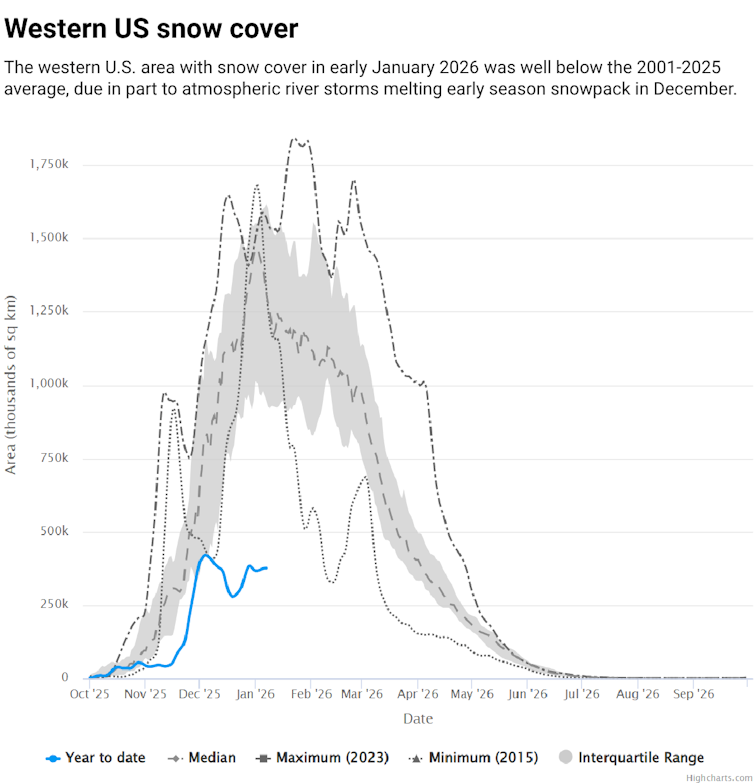
Much of the western U.S. has started 2026 in the midst of a snow drought. That might sound surprising, given the record precipitation from atmospheric rivers hitting the region in recent weeks, but those storms were actually part of the problem.
To understand this year’s snow drought – and why conditions like this are a growing concern for western water supplies – let’s look at what a snow drought is and what happened when atmospheric river storms arrived in December.
It can also create water supply problems the following summer. The West’s mountain snowpack has historically been a dependable natural reservoir of water, providing fresh water to downstream farms, orchards and cities as it slowly melts. The U.S. Geological Survey estimates that up to 75% of the region’s annual water supply depends on snowmelt.
Snowpack is typically measured by the amount of water it contains, or snow water equivalent. The numbers show each location’s snowpack compared to its average for the date. While still early, much of the West was in snow drought as 2026 began. Natural Resources Conservation Service
Snow drought is different from other types of drought because its defining characteristic is lack of water in a specific form – snow – but not necessarily the lack of water, per se. A region can be in a snow drought during times of normal or even above-normal precipitation if temperatures are warm enough that precipitation falls as rain when snow would normally be expected.
This form of snow drought – known as a warm snow drought – is becoming more prevalent as the climate warms, and it’s what parts of the West have been seeing so far this winter.
How an atmospheric river worsened the snow drought
Washington state saw the risks in early December 2025 when a major atmospheric river storm dumped record precipitation in parts of the Pacific Northwest. Up to 24 inches fell in the Cascade Mountains between Dec. 1 and Dec. 15. The Center for Western Weather and Water Extremes at Scripps Oceanographic Institute documented reports of flooding, landslides and damage to several highways that could take months to repair. Five stream gauges in the region reached record flood levels, and 16 others exceeded “major flood” status.
Yet, the storm paradoxically left the region’s water supplies worse off in its wake.
The reason was the double-whammy nature of the event: a large, mostly rainstorm occurring against the backdrop of an uncharacteristically warm autumn across the western U.S.
Vehicles were stranded as floodwater in a swollen river broke a levee in Pacific, Wash., in December 2025. Brandon Bell/Getty Images
Atmospheric rivers act like a conveyor belt, carrying water from warm, tropical regions. The December storm and the region’s warm temperatures conspired to produce a large rainfall event, with snow mostly limited to areas above 9,000 feet in elevation, according to data from the Center for Western Weather and Water Extremes.
The rainfall melted a significant amount of snow in mountain watersheds, which contributed to the flooding in Washington state. The melting also decreased the amount of water stored in the snowpack by about 50% in the Yakima River Basin over the course of that event.
Fortunately, it’s still early in the 2026 winter season. The West’s major snow accumulation months are generally from now until March, and the western snowpack could recover.
More snow has since fallen in the Yakima River Basin, which has made up the snow water storage it lost during the December storm, although it was still well below historical norms in early January 2026.
Scientists and water resource managers are working on ways to better predict snow drought and its effects several weeks to months ahead. Researchers are also seeking to better understand how individual storms produce rain and snow so that we can improve snowpack forecasting – a theme of recent work by my research group.
As temperatures warm and snow droughts become more common, this research will be essential to help water resources managers, winter sports industries and everyone else who relies on snow to prepare for the future.
U.S. Senators John Hickenlooper and Michael Bennet issued the following statement after President Trump vetoed their bipartisan Finish the Arkansas Valley Conduit Act:
“Nothing says ‘Make America Great Again’ like denying 50,000 rural Coloradans access to clean, affordable drinking water. President Trump’s first veto of his second term blocks a bipartisan bill that both the House and Senate passed unanimously, costs taxpayers nothing, and delivers safe, reliable water to rural communities that overwhelmingly supported him. Trump’s attacks on Southern Colorado are politics at its worst—putting personal and political grievances ahead of Americans. Southeastern Coloradans were promised the completion of the Arkansas Valley Conduit more than 60 years ago. With this veto, President Trump broke that promise and demonstrated exactly why so many Americans are fed up with Washington. We will keep fighting to make sure rural Coloradans get the clean drinking water they were promised.”
Arkansas Valley Conduit map via the Southeastern Colorado Water Conservancy District (Chris Woodka) June 2021.
Synopsis: La Niña persists, followed by a 75% chance of a transition to ENSO-neutral during January-March 2026. ENSO-neutral is likely through at least Northern Hemisphere late spring 2026.
In December 2025, La Niña was reflected in the continuation of below-average sea surface temperatures (SSTs) across the east-central and eastern equatorial Pacific Ocean. The latest weekly Niño-3.4 index value was -0.5°C, with the Niño-3 and Niño-1+2 indices remaining cooler at -0.8°C and -0.7°C, respectively. The equatorial subsurface temperature index (average from 180°-100°W) became slightly positive, reflecting the expansion of above-average temperatures from the western to the east-central Pacific at depth. Atmospheric anomalies across the tropical Pacific Ocean remained consistent with La Niña. For most of the month, easterly wind anomalies were present over the central equatorial Pacific, and upper-level westerly wind anomalies continued across the equatorial Pacific. Enhanced convection persisted over Indonesia and suppressed convection strengthened near the Date Line. The equatorial Southern Oscillation index was positive. Collectively, the coupled ocean-atmosphere system remains consistent with La Niña.
The IRI multi-model predictions indicate ENSO-neutral will emerge during January-March (JFM) 2026. In conjunction with the North American Multi-Model Ensemble, the team favors ENSO-neutral to develop during JFM 2026. Even after equatorial Pacific SSTs transition to ENSO-neutral, La Niña may still have some lingering influence through the early Northern Hemisphere spring 2026 (e.g., CPC’s seasonal outlooks). For longer forecast horizons, there are growing chances of El Niño, though there remains uncertainty given the lower accuracy of model forecasts through the spring. In summary, La Niña persists, followed by a 75% chance of a transition to ENSO-neutral during January-March 2026. ENSO-neutral is likely through at least Northern Hemisphere late spring 2026.
The past week featured above-normal temperatures across much of the western half of the U.S. Areas west of the Mississippi River generally experienced near- to above-normal temperatures, with portions of the northern Rocky Mountains running 15–20°F above normal for the week. These warm conditions favored rain over snow, which is critical for winter water supply in the West, and many locations continue to experience a slow start to the snow season.
In contrast, cooler-than-normal temperatures dominated the Florida Peninsula, with departures of 5–10°F below normal across southern Florida. Below-normal temperatures were also widespread from the Upper Midwest into the Northeast and Mid-Atlantic, where departures of 5°F or more below normal were common. Parts of New England were particularly cold, with temperatures 10–15°F below normal.
Outside of the West, above-normal precipitation was limited to pockets of the Southeast, Florida, and the Upper Midwest. Much of the West recorded more than 100% of normal precipitation for the week, with large portions of California receiving over 200% of normal…
Warmer-than-normal temperatures dominated the region, with departures exceeding 15°F above normal across parts of western Nebraska, western Kansas, northeast Colorado, Wyoming, and southeast Montana. Precipitation was minimal, with the greatest totals confined to northeastern North Dakota.
The continued warm and dry winter has resulted in some areas experiencing their driest start to winter on record. Abnormally dry conditions expanded across southern Nebraska and northeast Kansas, as well as southeast Kansas, where moderate drought also increased. Moderate and severe drought expanded across southeast Wyoming, western Nebraska, northeast Colorado, and southeast Colorado…
Colorado Drought Monitor one week change map ending January 6, 2026.
The largest positive temperature departures occurred in the West, with areas from central Montana into western Wyoming and northwest Colorado experiencing temperatures more than 15°F above normal. These warm conditions pushed snow to higher elevations and increased rainfall at lower elevations. While many areas received above-normal precipitation, snowpack remains critically low, and significant snow drought persists across numerous mountain ranges, including the Cascades, Oregon’s Blue Mountains, Idaho’s Bitterroot Range, and the central Rocky Mountains of Colorado.
It was a wet week for much of the region, with nearly all of California recording above-normal precipitation, along with much of Nevada and western Arizona. Above-normal precipitation also occurred across eastern Washington and Oregon, Idaho, western Utah, and Montana. Severe and extreme drought improved across northern Montana, with additional improvement to moderate drought in the southwest part of the state.
Continued wet conditions led to improvements in moderate and severe drought across Nevada, Arizona, eastern Oregon and Washington, and the Idaho Panhandle. Abnormally dry conditions expanded across northeast New Mexico, while extreme and exceptional drought expanded across central Colorado. Extreme drought was removed from southwest Wyoming, and moderate drought improved across western Wyoming. In Washington, abnormally dry conditions were adjusted to reflect recent precipitation while also accounting for persistent snow drought in the Cascades…
Nearly the entire region was dry, with only isolated precipitation observed in Mississippi and southwest Tennessee. Temperatures were above normal across most areas, with portions of the Texas and Oklahoma panhandles running more than 12°F above normal.
Drought conditions deteriorated across every state in the region. Moderate drought expanded across northern and southern Mississippi. Central and eastern Tennessee saw expansion of moderate and severe drought, while moderate drought increased in western Tennessee. Moderate and severe drought expanded across much of Louisiana and southern and western Arkansas. Severe drought expanded in northeast and northwest Arkansas and into northeast Oklahoma. Severe and extreme drought spread from southwest into central Oklahoma, while moderate drought continued to fill in across eastern Oklahoma.
Across Texas, moderate drought and abnormally dry conditions expanded over much of the Panhandle, while moderate and severe drought grew across east Texas and coastal southeast Texas. Drought conditions continued to intensify in far south Texas…
Looking Ahead
Over the next five to seven days, the pattern over the continental U.S. appears to be active with many areas showing a strong probability of precipitation. Areas from the Central Plains into the Midwest and Great Lakes areas are anticipated to receive up to an inch of precipitation. Further south, areas from Louisiana northeast into Kentucky are expected to receive the greatest amount of precipitation with several inches expected. From the Pacific Northwest into the Rocky Mountains and Southwest, widespread precipitation is anticipated. The driest areas are expected to be over the northern Great Plains, California, central and southern Texas and from the Carolinas into the Florida peninsula. Temperatures are expected to remain warmer than normal over much of the country. Only the areas along the southern tier of the U.S. will be near to below normal. The warmest departures are expected over the central to northern Plains, with some areas of Montana predicted to be 10-15 °F above normal.
The 6-10 day outlooks show that the likelihood of above-normal temperatures is projected over almost the entire U.S., with the exception of the Southeast and south Texas. The greatest chances of above-normal temperatures are over the West Coast, as well as the northern Plains and northern Rocky Mountains. The best chances of below-normal precipitation are over the Western U.S. and into the southern Plains. Above-normal chances of above-normal precipitation are anticipated over the central to northern Plains, Florida and along the coast of the Carolinas, as well as Alaska and Hawaii.
US Drought Monitor one week change map ending January 6, 2026.
Click the link to read the discussion on the CBRFC website:
The Colorado Basin River Forecast Center (CBRFC) geographic forecast area includes the Upper Colorado River Basin (UCRB), Lower Colorado River Basin (LCRB), and Eastern Great Basin (GB).
Water Supply Forecasts
January 1 water supply forecasts are generally well below normal and summarized in the figure and table below. Snowpack and soil moisture are the primary hydrologic conditions that impact the water supply outlook, while future weather is the primary source of forecast uncertainty.
January 1, 2026 seasonal water supply forecast summary.
Water Year Weather
The 2025–26 winter season has thus far featured record-setting warmth and limited precipitation, driven
by a persistent high-pressure ridge over the CBRFC area. Most of the major climate sites in and around the CBRFC area experienced their warmest (e.g. Salt Lake City, Phoenix, Tucson, Las Vegas, Pocatello) — or second warmest (e.g. Flagstaff, Grand Junction, Denver) — December on record. An active northern stream riding over the ridge has delivered above average precipitation to the northern fringes of the UCRB and GB, but given the warm maritime influence, snow accumulation has remained unimpressive.
The water year as a whole tells a different story. In October, several rounds of heavy rain tied to decaying tropical storms brought record flooding to portions of AZ, southern UT, and southwest CO — making it one of the wettest Octobers on record. November brought continued above average precipitation to the LCRB, but well below average precipitation was observed elsewhere. Water year 2026 precipitation is summarized in the figure and table below.
Water year 2026 precipitation summary.
Snowpack Conditions
UCRB January 1 snow water equivalent (SWE) conditions are highly variable and range between 35–100% of normal. Storm systems this winter have been warmer than normal with high snow levels resulting in much of the precipitation falling as rain rather than snow. SWE conditions are very poor across most of the UCRB, with numerous SNOTEL stations across western CO reporting January 1 SWE values at or near record low. The exception is the Upper Green headwaters, where SWE is near to above normal. UCRB January 1 snow covered area is around 28% of the 2001–2025 median, which is the lowest on record dating back to 2001. 1 LCRB January 1 SWE conditions are at or near record low across much of southwest UT, central AZ, and west-central NM.
GB January 1 SWE conditions are also very poor, ranging between 25–65% of normal. SWE at the majority of SNOTEL stations across UT are below the 10th percentile, with several stations reporting record low January 1 SWE. January 1 snow covered area across UT is record low at just 15% of the 2001-2025 median.1 SWE conditions are summarized in the figure and table below.
Left: January 1, 2026 SWE – NRCS SNOTEL observed (squares) and CBRFC hydrologic model. Right: CBRFC hydrologic model SWE condition summary.
Soil Moisture
CBRFC hydrologic model fall (antecedent) soil moisture conditions impact water supply forecasts and the efficiency of spring runoff. Basins with above average soil moisture conditions can be expected to experience more efficient runoff from rainfall or snowmelt while basins with below average soil moisture conditions can be expected to have lower runoff efficiency until soil moisture deficits are fulfilled. The timing and magnitude of spring runoff is impacted by snowpack conditions, spring weather, and soil moisture conditions.
Soil moisture conditions heading into the 2026 spring runoff season are below normal across most areas as a result of warmer and drier than normal weather during the 2025 water year. Water year 2025 precipitation was around 80% of average across the UCRB and GB and around 60% of average across the LCRB. The least favorable soil moisture conditions exist across central UT and the Colorado River headwaters. Soil moisture conditions across southwest CO and central AZ are exceptions, where very wet October–November weather led to improved soil moisture that is near or above average. CBRFC hydrologic model soil moisture conditions are shown in the figures below.
November 2025 CBRFC hydrologic model soil moisture conditions – as a percent of the 1991–2020 average (left) and compared to November 2024 (right).
Upcoming Weather
After a cold and somewhat snowy system sweeps through the CBRFC area this week, high pressure looks to dominate the region for the foreseeable future, which will suppress any chances for significant precipitation. The 7-day precipitation forecast and the Climate Prediction Center (CPC) 8–14 day temperature and precipitation outlooks are shown in the figures below.
7-day precipitation forecast for January 7–13, 2026.
Climate Prediction Center precipitation probability forecast for January 15–21, 2026.
Climate Prediction Center temperature probability forecast for January 15–21, 2026.
References
1. Rittger, K., Lenard, S.J.P., Palomaki, R.T., Stephenson, L. (2026). Snow Today. Boulder, Colorado USA. National Snow and Ice Data Center. Data source: MODIS/Terra/SPIRES.
Elder pointed to the team’s big win against the New York Giants on Oct. 19, 2025.
“I think most of us thought the Broncos were done in that game after going scoreless for three quarters, but then they had an amazing turnaround in the fourth quarter and came back to win at the last second,” said Nathan Elder, Denver Water’s manager of water supply.
“Let’s hope Mother Nature can do the same as Bo Nix and deliver a big comeback this winter.”
Snowmaking at Keystone Ski Resort on Dec. 31, 2025. Photo credit: Denver Water.
Record low start to the snowpack
Elder said the first three months of the 2025-26 snow season, from Oct. 1 to Dec. 31, 2025, ranked as the driest on record in Denver Water’s water collection area.
The records date back to the winter of 1979-80, when SNOTEL measuring gauges started being used to measure mountain snowpack.
Denver Water’s previous year-ending, record-low snowpack on Dec. 31 occurred during the winter of 1980-81.
This year, as of Dec. 31, 2025, the snowpack in the South Platte and Colorado river basins where Denver Water collects water stood at 51% and 49% of normal, respectively, according to SNOTEL measurements.
Snowpack in the South Platte River Basin at the end of December 2025 stood at 51% of normal. Image credit: U.S.D.A., Natural Resources Conservation Service.
Snowpack in the Colorado River Basin at the end of December 2025 stood at 49% of normal. Image credit: U.S.D.A., Natural Resources Conservation Service.
The lack of powder days is not only tough on Colorado’s ski resorts, but low snowpack also raises concerns about river levels and our water supply which comes primarily from mountain snow.
A skier navigates through early season conditions at Breckenridge on Dec. 23, 2025. Photo credit: Denver Water.
“We definitely prefer a snowier start to winter over a dry one,” Elder said.
“But we still have about four months left in the snow accumulation season. We will need a lot of snow to catch up to get back to normal.”
The first three months of the snow season typically account for about 20% of the annual snowpack. The good news is that the snowiest months of March and April are still ahead.
Loveland Pass in Summit County on Dec. 24, 2025. The lack of snow is clearly visible on the higher peaks. Photo credit: Denver Water.
Elder said that along with the low snowfall, strong winds and above-normal temperatures created windy and warm weather, which led to increased sublimation of the snowpack (think of sublimation like evaporation just for snow).
“In mid-December, we actually saw a noticeable drop in the snowpack in the South Platte River Basin, which is very rare for that time of year because it’s usually too cold for snow to melt,” Elder said.
What to expect in 2026?
While unfortunately there’s no crystal ball for snow forecasting, Elder pointed to other years that experienced similarly slow starts to the snowpack for a guess as to where this season could end up.
For Denver Water, snowpack typically peaks in mid-to-late April.
The lowest peak occurred during the winter of 2001-02, when snowpack peaked at just 56% of normal. The second-lowest peak was measured during the winter of 2011-12, when mountain snowpack peaked at 58% of normal.
Both of those seasons started slow and snowfall stayed below normal levels all winter long.
In contrast to those two dismal winters, Elder said the winter of 1999-2000 offers a glimmer of hope.
“That season started slow, but snow came on strong in April and May and we ended up right around normal in terms of peak snowpack by the end of the season,” he said.
Water managers also watch for a couple of big storms that could quickly bolster a lackluster snowpack.
Taking action
Denver Water’s reservoirs are currently at 83% of capacity, which is 4% below average for this time of year.
Dillon Reservoir in Summit County had open water on Dec. 24, 2025, due to warm conditions. The reservoir’s average “ice-in” date is Dec. 24. Photo credit: Denver Water.
Elder said that while the reservoir levels are expected to be in relatively good shape heading into summer, it’s too early to say if there will be any watering restrictions.
“We live in a dry climate with increasingly variable weather patterns, which means all of us need to pitch in to help conserve the precious water supplies that we have,” Elder said.
“Now is a good time to check your faucets and toilets for leaks, and fix any you find inside your home. It’s also a good time to start planning how to remodel your yard this summer to save water outside.”
Denver Water’s website has free tips, including a step-by-step DIY Guide that can help you replace thirsty Kentucky bluegrass with water-smart plants, available at denverwater.org/Conserve.
In 2026, the utility will again be offering customers a limited number of discounts on Resource Central’s popular, water-wise Garden In A Box kits and turf removal.
It’s important to water trees and plants during dry periods in the winter months. Soaker hoses are a great way to efficiently water a tree. Photo credit: Denver Water.
The drying Rio Grande, as shown here in Albuquerque in the summer of 2025. (Laura Paskus for Source NM)
Click the link to read the article on the Source NM website (Laura Paskus):
January 6, 2026
A male house finch belts out his springtime song. Mustard greens have pushed through the loam in my backyard. The hyssop and salvia are greening up, and so are the Mexican sage and globemallow. Sunflowers and poppies are sprouting, and I slept Sunday night with the window cracked open — 38 degrees is usually my threshold for allowing cold air into the room. In the morning, there’s not even a skiff of ice on the birdbath water.
Like many of you, I’ve been walking a fine line between joy and terror this winter.
Oh, it’s so nice to be outside! And I love listening for screech owls and coyotes at night. But these balmy days and nights fill me with dread. They aren’t just omens of a hot, dry year. They also weaken ecosystems and species that rely upon winter. Including humans.
Snowpack across New Mexico is grim. (Do you really want to see the median numbers as of early January? Rio Grande Headwaters in Colorado: 52 percent. Upper Rio Grande in New Mexico: 30. San Juan River Basin: 51. Rio Chama River Basin: 57. Jemez River Basin: 17. Pecos River Basin: 34.) And we’re facing continued La Niña conditions, at least through the next three months.
Meanwhile, New Mexico doesn’t have much in its water savings account; just look at the reservoir numbers from the top of the Rio Chama to the Lower Rio Grande in New Mexico. Heron Reservoir is 7% full; El Vado, 13%; Abiquiu, 58%; Elephant Butte, 8%; and Caballo, 7%.
From this vantage point in early January — with a few decades of warming temperatures, drying rivers, burning forests and aridifying croplands already behind us — it’s clear that human-caused climate change is tightening the noose on a viable future for New Mexicans, and for the wildlife and ecosystems we are bound to, inextricably.
In 2018, the Intergovernmental Panel on Climate Change released a special report, noting that if the Earth’s temperature increased by more than 1.5 degrees Celsius, the climate consequences will be “long-lasting” and “irreversible.” Scientists wrote that human-caused emissions of carbon dioxide would need to “fall by about 45 percent from 2010 levels by 2030, reaching ‘net zero’ by 2050.”
In 2025, the Earth passed the 1.5-degree Celsius threshold. And we’re nowhere near to cutting greenhouse gas emissions by significant levels.
Nothing that’s happening right now should be a surprise — not the melting ice caps nor the drying rivers. We’ve had decades to pivot or at least prepare.
Yet, 60 years after President Lyndon Johnson’s science advisory committee warned that the carbon dioxide humans were sending into the atmosphere would cause changes that could be “deleterious from the point of view of human beings,” in 2025, U.S. Environmental Protection Agency Administrator Lee Zeldin launched the Powering the Great American Comeback Initiative, deregulating industries and “driving a dagger straight into the heart of climate change religion.”
“The Trump administration will treat climate change for what it is, a global physical phenomenon that is a side-effect of building the modern world,” Wright said. “Everything in life involves trade-off.”
The men spearheading the Trump administration’s plans know climate change threatens the lives of billions of people and ecosystems ranging from the sea’s coral reefs to Earth’s mountaintops. And their tradeoffs involve the calculated obliteration of longstanding federal environmental laws, the privatization of public lands and watersheds, and of course, the subversion of climate science. (Not to mention, the waging of illegal wars.) [ed. emphasis mine]
In just a few weeks, New Mexico state legislators will convene for a 30-day session. It’s a fast-paced budget session, which means climate and water won’t top the list of priorities, again. No matter what the mustard greens, house finches, bare mountaintops, and drastically low reservoirs show us.
This winter, temperatures will drop here and there. Some snow will fall. There will be days that feel like winter. But we’re past the point of comforting ourselves that these warm winter temperatures are an anomaly. They are our future.
Decades ago, I rented an attic bedroom in a house in western Colorado from a woman who was kind and angry and trying very hard and battling demons. Because she had taped handwritten quotes inside the kitchen cabinet next to the sink, every time I reached inside, I would read them. There’s one quote from the late Joanna Macy I think of every day.
“The point is not to save people. The point is to create the conditions for the possibility of grace.”
The point right now isn’t to save the planet — or even ourselves or the more-than-human species we rely upon or love. The point is to create the conditions for the possibility of grace. The possibility of a climate-changed future in which all the best and most beautiful things about this Earth haven’t been traded away. [ed. emphasis mine]
Bedrock Energy’s drilling rig digs a 1,000-foot borehole as part of a geothermal network that’ll keep energy costs low for companies that move into a new Hayden business park. (Alison F. Takemura/Canary Media)
For decades, Dallas Robinson’s family excavation company developed coal mines and power plants in the rugged, fossil-fuel-rich region of northwest Colorado. It was a good business to be in, one that helped hamlets like Hayden grow from outposts to bustling mountain towns — and kept families like Robinson’s rooted in place for generations.
“This area, with the exception of agriculture, was built on oil and gas and coal,” said Robinson, a former town councilor for Hayden.
But that era is coming to a close. Across the United States, bad economics and even worse environmental impacts are driving coal companies out of business. The 441-megawatt coal-burning power plant just outside Hayden is no exception: It’s shutting down by the end of 2028. The Twentymile mine that feeds it is expected to follow.
Coal closures can gut communities like Hayden, a town of about 2,000 people. That story has been playing out for decades, particularly in Appalachia, where coal regions with depressed economies have seen populations decline as people strike out for better opportunities elsewhere. Robinson, a friendly, gregarious guy, fears the same could happen in Hayden.
“I grew up here, so I know everyone,” he said. “It’s hard to see people lose their jobs and have to move away. … These are families that sweat and bled and been through the good and the bad times in small towns like this.”
Struggling American coal towns need an economic rebirth as the fossil-fuel industry fades. Hayden has a vision that, at first, doesn’t sound all that unusual. The town is developing a 58-acre business and industrial park to attract a diverse array of new employers.
The innovative part: companies that move in will get cheap energy bills at a time of surging utility costs. The town is installing tech that’s still uncommon but gaining traction — a geothermal heating-and-cooling system, which will draw energy from 1,000 feet underground.
In short, Hayden is tapping abundant renewable energy to help invigorate its economy. That’s a playbook that could serve other communities looking to rise from the coal dust.
At an all-day event hosted by geothermal drilling startup Bedrock Energy this summer, I saw the ambitious project in progress. Under a blazing sun, a Bedrock drilling rig chewed methodically into the region’s ochre dirt. Once it finished this borehole — one of about 150 — it would feed in a massive spool of black pipe to transfer heat.
Bedrock will complete the project, providing 2 megawatts of thermal energy, in phases, with roughly half the district done in 2026 and the whole job finished by 2028. Along the way, constructed buildings will be able to connect with portions of the district as they’re ready.
“We see it as a long-term bet,” Mathew Mendisco, city manager of Hayden, later told me, describing the town as full of grit and good people. Geothermal energy “is literally so sustainable — like, you could generate those megawatts forever. You’re never going to have to be reliant on the delivery of coal or natural gas. … You drill it on-site, the heat comes out.”
“We disagree on the urgency of addressing climate change, [but] this is something that Chris Wright and I agree on,” Colorado Senator John Hickenlooper (D), a trained geologist, told a packed conference-room crowd on the day of the event. “Geothermal energy has … unbelievable potential to, at scale, create clean energy.”
Charting a post-coal economy
The eventual closure of the Hayden Station coal plant, which has operated for more than half a century, has loomed over the town since Xcel Energy announced an early shutdown in 2021.
The power plant and the mine employ about 240 people. Property taxes from those businesses have historically provided more than half the funding for the town’s fire management and school districts — though that fraction is shrinking thanks to recent efforts to diversify Hayden’s economy, Mendisco said.
Taking into account the other businesses that serve the coal industry and its workers, according to Mendisco, the economic fallout from the closures is projected to be a whopping $319 million per year.
“Really, the highest-paying jobs, the most stable jobs, with the best benefits [and] the best retirement, are in coal and coal-fired power plants,” Robinson said.
Hayden aims for its business park to help the town weather this transition. With 15 lots to be available for purchase, the development is designed to provide more than 70 jobs and help offset a portion of the tax losses from Hayden Station’s closure, according to Mendisco.
“We are not going to sit on our hands and wait for something to come save us,” Mayor Ryan Banks told me at the event.
Companies that move into the business park won’t have a gas bill. They’ll be insulated from fossil-fuel price spikes, like those that occurred in December 2022, when gas prices leapt in the West and customers’ bills skyrocketed by 75% on average from December 2021.
In the Hayden development, businesses will be charged for their energy use by the electric utility and by a geothermal municipal utility that Hayden is forming to oversee the thermal energy network. Rather than forcing customers to pay for the infrastructure upfront, the town will spread out those costs on energy bills over time — like investor-owned utilities do. Unlike a private utility, though, Hayden will take no profit. Mendisco said he expects the geothermal district to cut energy costs by roughly 40%, compared with other heating systems.
Municipally owned geothermal districts are rare in the U.S., but the approach has legs. Pagosa Springs, Colorado, has run its geothermal network since the early 1980s, when it scrambled to combat fuel scarcity during the 1970s oil embargo. New Haven, Connecticut, recently broke ground on a geothermal project for its train station and a new public housing complex. And Ann Arbor, Michigan, has plans to build a geothermal district to help make one neighborhood carbon-neutral.
Hayden’s infrastructure investment is already attracting business owners. An industrial painting company has bought a plot, and so has a regional alcohol distributor, Mendisco said.
One couple is particularly excited to be a part of the town’s clean energy venture. Nate and Steph Yarbrough own DIY off-grid-electrical startup Explorist.Life; renewable power is in the company’s DNA. The Yarbroughs teach people how to put solar panels and batteries on camper vans, boats, and cabins to fuel their outdoor adventures, and Explorist.Life sells the necessary gear.
“When we bought that property, it was largely because of the whole geothermal concept,” Nate Yarbrough told me. “We thought it made a whole bunch of sense with what we do.”
Reducing reliance on hydrocarbons, he noted, is “a good thing for society overall.”
Geothermal tech heats up
The geothermal network that could transform Hayden’s future is mostly invisible from aboveground. Besides the drilling rig and a trench, the most prominent features I spotted were flexible tubes jutting from the earth like bunny ears.
Those ends of buried U-shaped pipes will eventually connect to a main distribution loop for businesses to hook up to. Throughout the network, pipes will ferry a nontoxic mix of water and glycol — a heat-carrying fluid that electric heat pumps can tap to keep buildings toasty in the winter and chilled in the summer.
As part of Hayden’s geothermal network, a loop of U-shaped pipe will collect constant heat from the earth, no matter how bitter the winter. Its two ends — the only parts visible — will connect to a distribution loop. (Alison F. Takemura/Canary Media)
Despite their superior efficiency, these heat pumps are far less common than the kind that pull from the ambient air, largely due to project cost. Because you have to drill to install a ground-source heat pump, the systems are typically about twice as expensive as air-source heat pumps.
But the underground infrastructure lasts 50 years or more, and the systems pay for themselves in fuel-cost savings more quickly in places that endure frostier temperatures, including Rocky Mountain municipalities like Hayden. Those long-term cost benefits were too attractive to ignore, Mendisco said.
Hayden’s project “is 100% replicable today,” Mendisco told attendees at the event, which included leaders of other mountain towns. Geothermal tech is ready; the money is out there, he added: “You can do this.”
Colorado certainly believes that — and it’s giving first-mover communities a boost.
In October, the state energy office announced $7.3 million in merit-based tax-credit awards for four geothermal projects. Vail is getting nearly $1.8 million for a network, into which the ice arena can dump heat and the library can soak it up. Colorado Springs will use its $5 million award to keep a downtown high school comfortable year-round. Steamboat Springs and a Denver neighborhood will share the rest of the funding.
At least one other northwest Colorado coal community is also getting on board with geothermal. In the prior round of state awards, the energy office granted $58,000 to the town of Craig’s Memorial Regional Health to explore a project for its medical campus.
With dozens of communities warming to the notion, “it’s an exciting time for geothermal in Colorado,” said Bryce Carter, geothermal program manager at the state energy office.
So far, the state has pumped $30.5 million into geothermal developments — with over $27 million going toward heating-and-cooling projects specifically — through its grant and tax-credit programs. The larger tax-credit incentive still has about $13.8 million left in its coffers.
Hayden, for its part, is also taking advantage of the federal tax credits to save up to 50% on the cost of its geothermal district. That includes a 10% bonus credit that the community qualifies for because of its coal legacy. After also accounting for a bonanza of state incentives, the $14-million project will only be $2.2 million, Mendisco said.
Tech innovation could further improve geothermal’s prospects, even in areas with less generous inducements than Colorado’s. Bedrock Energy, for one, aims to drive down costs by using advanced sensing technology that allows it to see the subsurface and make computationally guided decisions while drilling.
“In Hayden, we have gone from about 25 hours for a 1,000-foot bore to about nine hours for a 1,000-foot bore — in just the last couple of months,” Joselyn Lai, Bedrock’s co-founder and CEO, told me at the event. Overall, the firm’s subsurface construction costs from the first quarter of 2025 to the second quarter fell by about 16%, she noted.
When drilling, Bedrock Energy harnesses a constant stream of data to navigate underground obstacles from boulders to fractures. (Alison F. Takemura/Canary Media)
Hayden is likely just at the start of its geothermal journey. If all goes well with the business park, the town aims to retrofit its municipal buildings with these systems to comply with the state’s climate-pollution limits on big buildings, Mendisco said. Hayden’s community center could be the first to get a geothermal makeover starting in 2027, he added.
Robinson, despite coal’s salience in the region and his family’s legacy in its extraction, believes in Hayden’s vision: Geothermal could be a winner in a post-coal economy. In fact, he’s interested in investing in the geothermal industry and installing a system in a new house he’s building, he said.
“I’ve lived a lot of my life making a living by exploiting natural resources. I understand the value of that — as well as lessening our impact and being able to find new and better,” Robinson said. “This is the next step, right?”
This article was originally published by Canary Media and is republished here as part of Covering Climate Now, a global effort to boost coverage of climate change.
The coal-fired Tri-State Generation and Transmission plant in Craig provides much of the power used in Western Colorado, including in Aspen and Pitkin County. Will Toor, executive director of the Colorado Energy Office has a plan to move the state’s electric grid to 100 percent renewable energy by 2040. Photo credit: Brent Gardner-Smith/Aspen Journalism
Platte River Power Authority’s general manager says he disagrees with a federal order requiring one of the coal plants it owns a stake in to remain open past its scheduled retirement and is waiting to learn what it might cost Fort Collins’ wholesale electricity provider…PRPA is a joint owner of the plant with PacifiCorp, Xcel Energy, Salt River Project and Tri-State Generation and Transmission, which operates the facility. PRPA owns 18% of the Craig 1 and 2 coal units…
The Department of Energy’s emergency order contends there is a shortage of electric energy and facilities in the Western Electricity Coordinating Council Northwest assessment area, which includes Colorado, Idaho, Montana, Oregon, Utah, Washington and Wyoming. The order, signed by Secretary of Energy Chris Wright, states that peak demand in the area is expected to grow 8.5% in the next decade, while many coal plants in the region have been retired, with more retirements planned…Wright cites supply chain issues with building battery storage systems to help replace the energy from those retirements. The emergency order also cited two executive orders from President Donald Trump. One declared a national energy emergency due to “insufficient energy production, transportation, refining, and generation.” The other declares the United States is experiencing an unprecedented surge in electricity demand driven by rapid technological advancements, like the expansion of AI data centers and domestic manufacturing…
But PRPA General Manager and CEO Jason Frisbie says PRPA does not need the Craig 1 unit because it has already replaced the energy that came from it.
“We have planned for the retirement of Craig Unit 1 for nearly a decade and have proactively replaced the capacity and energy from new sources,” Frisbie said in a statement provided to the Coloradoan.
A recent study by Colorado Parks and Wildlife and a Colorado Springs Tribune article by Jonathan Ingraham have raised concerns about the adverse effects certain whitewater parks might have on local fish populations – but local CPW officials said they are pleased to report Salida and Buena Vista’s parks aren’t among them. For Salida’s Scout Wave, CPW collaborated with Mike Harvey’s company to design the fish passage part of the wave, CPW aquatic biologist Alex Townsend said. “It definitely took some forethought.” Though there are examples of whitewater parks that are not built with fish welfare in mind, Townsend said the parks in Salida and Buena Vista are built that way, and other whitewater park designers need to be sure to work with biologists and wildlife experts…
When building the fish passage, they have a gradient that extends a little further than the wave itself, with planned drops and pools below those drops. They also created rough elements, which create vortices for the fish to have flow refuge, he explained, resulting in the fish passage being nowhere near the same velocity as the wave…
Mike Harvey, project manager of Recreation and Engineering Planning, who constructed the Scout Wave and fish passage, said, “We’ve been working with CPW over 15 years. This is not something that is new to us.” In regards to the Tribune article, he said, “It’s a little surprising that this is coming up again,” he said…
Building the fish passage did not require any extra labor on their part, nor was it difficult, he said. “You’re going to set rocks anyway, so you just set them in the configuration that they need.”
Karen Budd-Falen, the No. 3 at the Interior Department, didn’t disclose a $3.5 million water-rights contract between her husband and the developers of a Nevada mine, records show.
A high-ranking official in the Interior Department is drawing scrutiny from ethics experts because she failed to disclose her family’s financial interest in the nation’s largest lithium mine that had been approved by her agency, according to state and federal records. In 2018 Frank Falen sold water from a family ranch in northern Nevada to Lithium Nevada Corp., a subsidiary of Lithium Americas, for $3.5 million. The company was planning a $2.2 billion lithium mine nearby called Thacker Pass, and lithium mining requires significant amounts of water. The mine needed a permit from the Interior Department, where Mr. Falen’s wife, Karen Budd-Falen, worked as the deputy solicitor responsible for wildlife from 2018 until 2021. She returned to the agency last year and is now the associate deputy secretary, the third highest-ranking position. Mr. Falen’s sale of his water rights also depended on the mine getting a permit from the Interior Department. Without it, Lithium Nevada Corp. could have terminated its deal with him…In November 2019, about two years before the agency approved the mine, Ms. Budd-Falen met with Lithium Americas executives over lunch in the cafeteria at the Interior Department.
Tim Crowley, a spokesman for Lithium Americas, said executives did not discuss the mine or pending environmental reviews with Ms. Budd-Falen. “We haven’t worked directly with Karen Budd-Falen related to Lithium Americas,” he said in an email, “nor have we ever met with her in a formal capacity regarding our project.”
Ms. Budd-Falen did not respond to questions for this article. Her husband, who was not at the lunch, characterized it in a telephone interview as a social occasion, not a work meeting. He said his wife knew few details about the water contract and may not have known that the company was seeking approval from the Interior Department.
The Western United States just had its warmest December in recorded history, and likely the warmest in many thousands of years. pic.twitter.com/QrY4KKLsJ7
Click the link to read the article on the Sky-Hi News website (Ryan Spencer). Here’s an excerpt:
January 5, 2026
Across Colorado, this past December was among the hottest ever recorded. Both Denver and Grand Junction recorded their second-hottest December on record, according to the National Weather Service. Steamboat Springs, where the period of record dates to 1893, had its hottest December ever, averaging about 30 degrees through the month.
Dillon townsite prior to construction of Dillon Reservoir via Denver Water
In Dillon, where the period of record dates back to 1910, this past December was also the second-warmest on record, with a monthly average temperature about 28 degrees, about one degree cooler than 1980, which was the hottest December…At one weather station in Vail, temperatures averaged about 26 degrees Fahrenheit last month, making the hottest December recorded in the period of record that dates back to 1985. In Aspen, the average monthly temperature in December was 30 degrees, compared to the normal average monthly temperature of about 22 degrees for that month…
Westwide SNOTEL basin-filled map January 4, 2026.
Across the state, the snowpack was also at or near record lows in several river basins, including those where popular ski resorts are located. Statewide, the sat at 59% of the 30-year median as of Friday, ranking in at the 5th percentile, meaning that 95% of years on record had more snow at this time. The Roaring Fork Basin and the Yampa River Basin both ranked in at the 3rd percentile. Meanwhile, the Eagle River Basin and the Colorado-Kremmling to Glenwood Springs Basin both came in at the zeroth percentile, meaning that the snowpack is the worst on record.
Colorado Drought Monitor map December 30, 2025.
With low amounts of precipitation and hot weather, drought conditions continue to sweep over the Western Slope, according to the most recent U.S. Drought Monitor map. Substantial portions of Eagle and Pitkin counties are now facing exceptional and extreme drought. Extreme drought has also pushed into Grand County, while the rest of Northwestern Colorado is facing moderate to severe drought.
A mayfly loving trout — speckled, shiny and perfectly hand-sized for that Instagram hero shot. A five-foot-long torpedo of a predator, capable of powering through floodwaters and migrating hundreds of miles. A three-inch minnow, living only a couple of years and content with life in a small pool in an ephemeral creek. Which fish is the true Colorado native?
The answer is all of them. A state with waterways as diverse as Colorado’s has naturally produced a diverse assortment of native fish to match. We have cutthroat trout, lovers of pristine, high-elevation streams on both sides of the Continental Divide. Large, long-lived species like Colorado pikeminnow and humpback chub fight their way through the whitewater of the Western Slope. Tiny brassy minnows and redbelly dace ply the shallow, sandy creeks of the Eastern Plains. Each is adapted to its own ecological niche, body and behavior tailored to its particular home waters and the other aquatic creatures that evolved alongside it.
Humans have dramatically altered this delicate balance in a very short time span. While some native populations still thrive, many others struggle as their habitats and predators have changed. Starting a couple of hundred years ago, mining pollution, overfishing, and haphazard stocking of non-native fish led some Colorado species to plummet, or even go extinct. Today, native fish still grapple with climate change, dams, water diversions, and competition with invasive species. But humans are also working to turn back the clock and restore these native species. Follow along on this tour of Colorado’s waterways, meeting our home-state fish — and learning what it takes to help them endure.
Headwaters
On the Yampa River Core Trail during my bicycle commute to the Colorado Water Congress’ 2025 Summer Conference August 21, 2025.
The headwaters region is the realm of the cutthroat trout. Credit: Water Education Colorado
Let’s begin where the rivers do: high in the Rocky Mountains, where clean, cold streams form and flow downhill, eventually feeding the state’s largest rivers. This is the realm of Colorado’s poster fish, the cutthroat trout. Colorful, beautiful and beloved by anglers, cutthroats — recognizable by the iconic red slash markings under the jaw that give the species its name — live in the headwaters of almost every river basin in the state. Cutthroat trout are at home where there’s oxygenated water, gravelly bars for spawning, and good vegetative cover on stream banks.
“Cutthroat trout” isn’t just one type of fish in Colorado, but rather, six. There’s the greenback cutthroat trout, originally from the South Platte River Basin on the east side of the Divide. The yellowfin cutthroat came from the Arkansas River Basin, but is now considered extinct. Moving southwest, the Rio Grande cutthroat rose from the Rio Grande Basin. Then, on the Western Slope, the Colorado River cutthroat is further divided into three lineages: the Green River lineage, found in the Green, White and Yampa rivers; the Uncompahgre lineage, of the Dolores, Gunnison and Upper Colorado rivers; and the San Juan lineage, of the San Juan River Basin.
That’s not to say the average angler — or indeed, the average fish biologist — can tell the cutthroats apart just by looking at them. Nor can they be identified based on where they’re caught these days. Humans, from regular people trying to create new fishing opportunities to professional fisheries managers, spent much of the last couple of centuries moving cutthroats around the state with little understanding of the differences between subspecies. “It’s really hard to put the genie back in the bottle once that happens,” says Jim White, southwest senior aquatic biologist for Colorado Parks and Wildlife (CPW). “One of the great mysteries in cutthroat trout distributions was, what went where? What did these river basins look like before we started widespread stocking of cutthroats and non-natives?”
Biologists didn’t know the answer until 2012, when a landmark study led by University of Colorado Boulder researchers conducted DNA analysis on museum fish specimens gathered at the beginning of European contact with the West. Those results confirmed the existence of the six genetically distinct types of cutthroat — five previously known to science, and one brand-new one, the San Juan lineage trout. The study speculated that San Juan cutthroats had also gone extinct, but CPW biologists had to be sure. “We beat the bushes, surveyed all the populations, and conducted molecular tests on fin clips from all known cutthroat trout populations in the San Juan Basin,” says Kevin Rogers, CPW aquatic research scientist and co-author on the 2012 genetic study. “Indeed, there were about a half-dozen populations that [matched] the fish that had been collected in the mid- to late 1800s.”
One thing all five remaining Colorado cutthroat varieties have in common is a reduction in the amount of habitat they occupy. The state’s cutthroats are now relegated to just 12% of their historical habitat on the high end, down to half a percent on the low end, says Boyd Wright, native aquatic species coordinator with CPW. “Most of the lower elevations have been invaded by non-native trout, so cutthroats are persisting only in the headwaters,” Rogers says. Greenback cutthroats are federally listed as threatened, and Rio Grande and Colorado River cutthroats (occupying just 12% and 11% of their historic habitat, respectively) are state species of special concern. The culprits? What began with pollution, overharvesting and the stocking of non-native fish in the era of Western colonization continues today.
Non-native fish pose a major threat to native cutthroats, particularly the brown, brook and rainbow trout that have been stocked statewide and now thrive in Colorado’s waters. “To sum it up, there’s hybridization, there’s predation, and there’s competition,” White says. “All of those three things can interact to disadvantage our native fish populations.” Rainbow and cutthroat trout can breed, resulting in the hybrid cutbow. Non-native trout sometimes even eat the natives. They also compete with cutthroats for food, and often win. Brook and brown trout spawn in the fall and hatch in the spring — so when the cutthroat fry hatch in late summer, their non-native rivals have already had several months to grow bigger.
Climate change isn’t helping. “We have the two ugly stepchildren that come along with a changing climate: drought and wildfire,” Rogers notes. “The toll wildfire can take on cutthroat is substantial. The debris flows that invariably happen afterward can wipe out populations.” Drought can also lower or dry up streams, further contracting ranges.
But CPW and partner organizations like the U.S. Fish and Wildlife Service are actively working to conserve Colorado’s native cutthroats. Biologists raise the trout in hatcheries for stocking back in their native streams, but there’s a lot more to it than that. First, managers must prep the waterways by removing non-native trout, often by poisoning with natural fish toxicants, a process that can take years. Any present pathogens, like whirling disease, must be eradicated. Managers also have to make sure non-native fish can’t reinvade the stream, usually by building a barrier, like a waterfall. Despite the difficulty and expense, the state is actively working on recovery projects for all five cutthroat varieties. “That’s what we’re about, trying to preserve diversity for future generations to enjoy,” Rogers says.
Desert Rivers
The Yampa River winds through towering cliffs on its journey west to meet the Green River in Dinosaur National Monument. Photo Credit: Dave Showalter
Credit: Water Education Colorado
As the mountain streams follow gravity into the western lowlands, they flow into larger networks: Rivers like the Yampa, White and Animas feed the desert arteries of the Green and San Juan, and these, together with the Gunnison, Dolores and others join the Colorado. The entire basin touches seven states, from Wyoming and Colorado up north to Arizona and California in the southwest.
The cold swift headwaters give way to rivers that historically swung between huge springtime floods and slow, turbid flatwater. And the trout give way to large, long-lived fish with bodies suited to big water and wild rapids.
Just over a dozen fish species evolved with the chops to survive in the larger rivers within the Colorado River system. Three of them, called just “the three species” by biologists, are the flannelmouth sucker, bluehead sucker, and roundtail chub. These omnivorous swimmers persist in today’s rivers, though managers keep a close eye on conserving their populations so that they don’t go the way of four other native species.
These four — all federally listed as endangered or threatened — have struggled in the face of drastic, human-caused changes to their habitats. The bonytail, a large-finned, skinny-tailed omnivore, is the worst off, with no sustainable wild populations left. Its relative, the humpback chub, sports a pronounced bump behind its head, all the better to stabilize the fish in whitewater. Its populations have stayed stable over the past few years, with most of them found near the Grand Canyon, and the species was downlisted from endangered to threatened in 2021. The Colorado pikeminnow, a powerful swimmer shaped like a missile, is the largest minnow in North America. It can migrate 200 miles annually and lives 40 years or more. Its numbers are slowly increasing in the Upper Colorado and San Juan subbasins, but are declining in the Green River. And the razorback sucker, a bug- and plankton-eater, features a similar keel behind its head that helps it maneuver through high flows.
All four populations have crashed in response to human water use and reduced water availability resulting from drought and climate change, which has altered the habitats they once inhabited. “We have cross-basin diversions that feed water from the Western Slope over to the Front Range,” says Jenn Logan, native aquatic species manager for CPW. “We don’t have the volume of water that we used to see in the spring. With dams and water going into ditches and filling reservoirs, runoff is nowhere near where it used to be. We don’t have sandbars formed in the way that we used to, and these systems relied on sediment to form complex habitats.” Not only that, but dams change water temperature, with released water alternately cooling or warming the river downstream depending on where in the reservoir it comes from. And of course, they form a physical barrier for fish that evolved migrating through a huge, interconnected river system.
Then there’s the non-native interlopers — primarily smallmouth bass, northern pike, walleye, and green sunfish — all introduced, either purposely or accidentally, by humans looking for expanded angling opportunities. “They’re predatory species — they get in the river and can really compete with and consume the native fish in the Colorado River,” says Josh Nehring, deputy assistant director, aquatic branch, of the CPW fish management team. All have found happy homes in the modern Colorado River Basin with its dams, reservoirs and warmer waters.
But just as in the mountain streams, fisheries managers on the Western Slope are working aggressively to protect the natives. The Upper Colorado River Endangered Fish Recovery Program and the San Juan River Basin Recovery Implementation Program oversee the recovery of the four fish species listed as threatened or endangered. The recovery programs are coalitions of water users, federal, state and tribal agencies, plus nonprofits and energy organizations. They take steps like installing nets at the edge of reservoirs to keep non-natives contained and stocking sterile non-native fish in reservoirs to keep them from establishing a population if they do get out. Other work looks like electrofishing stretches of river — that is, introducing a current that stuns fish in the water — and physically removing the non-natives, leaving the native fish to recover and swim another day; and gillnetting northern pike in their springtime spawning habitats. Water managers go so far as to recontour river channels on the upper Yampa to cut off access to northern pike’s spawning wetlands.
Dam management is another useful tool for both helping native fish and disadvantaging the non-natives. The Upper Colorado River Endangered Fish Recovery Program works with the U.S. Bureau of Reclamation at Utah’s Flaming Gorge Dam on the Green River on timed releases — releasing water when biologists detect the year’s razorback sucker larvae “to attempt to move them down to their wetland habitats,” Logan says. They’ll release water to disrupt smallmouth bass nesting, when possible. And in the Lower Basin downstream of Lake Powell, managers have begun releasing cooler water specifically to make the Colorado River there less hospitable to smallmouth bass. As long-term drought has dropped water levels in Lake Powell, “We’ve been seeing increases in water temperature releases coming through the dam,” says Ryan Mann, aquatic research program manager for the Arizona Game and Fish Department. Some smallmouth bass made their way into the river below the dam in years past, but the water had been cold enough to keep them from reproducing. But in 2022, biologists found baby bass. Last summer’s cold-water releases prevented widespread spawning, and managers may continue them into the future.
Today’s Colorado River Basin is a radically different place than in centuries past, and, “Unless there’s some amazing technology that comes along to remove all non-native fish or a way to return flows to historic conditions we’re not going to be able to move [major river systems] back to native fish,” Nehring says. But that doesn’t mean those species are doomed. CPW and its partners are actively raising threatened species in hatcheries and reintroducing them to targeted habitats. “We’re really focusing on the tributaries, to keep the natives alive in enough areas where we know they’ll persist,” Nehring says.
Eastern Plains
Here at the confluence of the Big Thompson and South Platte rivers near Greeley, a new conservation effort is underway. It restores wetlands and creates mitigation credits that developers can buy to meet their obligations under the federal Clean Water Act to offset any damage to rivers and wetlands they have caused. Credit: Westervelt Ecological Services
Credit: Water Education Colorado
As alpine streams flow east, they meander through Front Range cities, then spread across the arid plains. The water warms, rocky beds grow sandy, and habitats shrink as creeks dry up seasonally. Waters dominated by a single species explode with different fish. “We’ve got this melting pot of biological diversity along the transition zone,” says Wright. “You go from historically a one-species profile in the mountains to more than 28 as you go farther east. These [plains] are very harsh, unpredictable environments.”
The fish that evolved to thrive on the plains, from the region’s western edges in Colorado out into Kansas, Oklahoma and Nebraska, are largely the opposite of the big, long-lived species on the Western Slope. They’re a few inches long, live just a couple of years, and reproduce early. These fish are used to biding their time in small pools until rain or spring runoff reconnects the intermittent creeks, finally allowing them a change of scenery.
But the Eastern Plains haven’t escaped the challenges affecting Colorado’s other rivers — its native fish are struggling, too. “Most of our plains fishes are declining or locally extinct because of habitat modification or loss,” says Ashley Ficke, fisheries ecologist with engineering firm GEI Consultants. Humans have diverted water to farms and municipalities, redirected streams into straight channels lacking habitat complexity, and even drained some waters completely. That hits fish like the plains minnow particularly hard, as its semi-buoyant eggs float vast distances between spawning grounds and ideal nursery habitat. “It needs vast portions of unfragmented stream habitat,” Wright says. “We’ve really lost that in Colorado, and that’s a big reason why they’re very rare.”
As elsewhere in the state, though, fish managers are working to replenish the swimmers of the plains. At a hatchery in Alamosa, CPW breeds 12 rare native fish, half of them eastern species: plains minnow, suckermouth minnow, northern and southern redbelly dace, Arkansas darter, and common shiner. “We’re working with private landowners that have streams or ponds that would be suitable for these native fish, working with them to maintain or improve that habitat, and stocking those waters with the native fish,” Nehring says. By preserving and restoring enough of the plains’ stream habitats, managers hope to give back sufficient waters for these little fish to persist.
In May of 2023, the Supreme Court handed down a decision that significantly limited the scope of the Clean Water Act, undoing protections that safeguarded the nation’s waters for over 50 years. Specifically, it erased critical protections for tens of millions of acres of wetlands, threatening the clean drinking water sources for millions of Americans.
While the Biden administration amended rules to comply with the Supreme Court ruling, the Trump administration recently released a new draft rule that would go further than even the Supreme Court in limiting what waters can be protected.
Nooksack River, Washington | Brett Baunton
The Clean Water Act’s definition of “Waters of the United States” (WOTUS) is core to defining what waters are protected and which aren’t. Unfortunately, the Trump Administration’s newly proposed WOTUS rule would roll back protections for vast areas of wetlands and river tributaries. It’s estimated that close to 80% of America’s remaining wetlands would lose Clean Water Act protections. As written, the rule would leave many waterways vulnerable to pollution, degradation, and destruction, threatening water quality and community resilience across the country.
Blanca Wetlands, Colorado BLM-managed ACEC Blanca Wetlands is a network of lakes, ponds, marshes and wet meadows designated for its recreation and wetland values. The BLM Colorado and its partners have made strides in preserving, restoring and managing the area to provide rich and diverse habitats for wildlife and the public. To visit or get more information, see: http://www.blm.gov/co/st/en/fo/slvfo/blanca_wetlands.html. By Bureau of Land Management – Blanca Wetlands Area of Critical Environmental Concern, Colorado, Public Domain, https://commons.wikimedia.org/w/index.php?curid=42089248
Here are our top four concerns with the new WOTUS proposal
1. The rule requires streams and wetlands to have surface water “at least during the wet season” in order to qualify for protection. But it never defines what the wet season actually is.
What this means for rivers: Wet seasons vary dramatically from region to region, and without a clear, science-based definition, many healthy and ecologically important streams risk being excluded.
2. Narrow definitions and expanded exemptions shrink the scope of protected waters.
What this means for rivers: By redefining “tributary” to include only streams with year-round or steady “wet-season” flow, and expanding exemptions for wastewater and waste-treatment systems, the new rule would eliminate protections for many intermittent streams and man-made infrastructure that function like natural streams, opening the door to more unregulated pollution. Many rivers in the Southwest only flow for part of the year. This updated definition would put many of these rivers at risk.
3. The rule suggests any artificial or natural break in flow cuts off upstream protection.
What this means for rivers: Under the proposed rule, a culvert, pipe, stormwater channel, or short dry stretch can sever jurisdiction. This means upstream waters that feed larger rivers may no longer be protected, allowing pollution to still flow into nominally protected rivers and streams.
4. The rule significantly eliminates wetland protections by requiring “wetlands” to physically touch a protected water and maintain surface water through the wet season.
What this means for rivers: The new definition excludes many wetlands, which naturally store floodwater, filter pollutants, and safeguard communities. This puts the drinking water for millions at risk and increases the risks of flooding for many communities.
The health of our rivers depends on the small streams and wetlands that feed them. By discarding science, narrowing long‑standing definitions, and creating confusing jurisdictional tests, the Trump Administration’s proposed WOTUS rule risks undoing decades of progress toward cleaner, safer water. America’s rivers—and the communities that depend on them—deserve better.
These rollbacks will put our waterways and the life that depends on them in jeopardy. The public comment period to speak up and defend clean water protections is open until January 5. Please take action today and send a letter to the EPA urging them to keep the current definition of Waters of the United States in place!
Ephemeral streams are streams that do not always flow. They are above the groundwater reservoir and appear after precipitation in the area. Via Socratic.org
An absolutely enormous swath of the western United States, with the notable exception of the California Central Valley, just obliterated its record for the warmest December period.
Temperature records across this entire half of the continent has been jack-hammered and replaced. pic.twitter.com/rNgVMvItnw
I’ve added the lines for 2025, 2012, and 2002 to the snow water equivalent graphs below (for Colorado). 2002 doesn’t show up in the legend but it is the line that generally follows the minimum on record.
Colorado snowpack basin-filled map January 4, 2026.
Colorado State University researcher Perry Cabot talks to a group about forage crops at the Fruita field station. Cabot studies the effects of irrigation withdrawal and forage crops that use less water. CREDIT: HEATHER SACKETT/ASPEN JOURNALISM
The findings of recent water-conservation studies on the Western Slope could have implications for lawmakers and water managers as they plan for a future with less water.
Researchers from Colorado State University have found that removing irrigation water from high-elevation grass pastures for an entire season could have long-lasting effects and may not conserve much water compared with lower-elevation crops. Western Slope water users prefer conservation programs that don’t require them to withhold water for the entire irrigation season, and having the Front Range simultaneously reduce its water use may persuade more people to participate. Researchers also found that water users who are resistant to conservation programs don’t feel much individual responsibility to contribute to what is a Colorado River basinwide water shortage.
“It’s not a simple economic calculus to get somebody to the table and get them to sign a contract for a conservation agreement,” said Seth Mason, a Carbondale-based hydrologist and one of the researchers. “It involves a lot of nuance. It involves a lot of thinking about tradeoffs.”
Udall/Overpeck 4-panel Figure Colorado River temperature/precipitation/natural flows with trend. Lake Mead and Lake Powell storage. Updated through Water Year 2025. Note the tiny points on the annual data so that you can flyspeck the individual years. Credit: Brad Udall
Over the past 25 years, a historic drought and the effects of climate change have robbed the Colorado River of its flows, meaning there is increasing competition for a dwindling resource. In 2022, water levels in Lake Powell fell to their lowest point ever, prompting federal officials to call on the seven states that share the river for unprecedented levels of water conservation.
The Upper Basin states (Colorado, New Mexico, Utah and Wyoming) have experimented for the past decade with pilot programs that pay agricultural water users to voluntarily and temporarily cut back by not irrigating some of their fields for a season or part of a season.
The most recent program was the federally funded System Conservation Pilot Program, which ran in the Upper Basin in 2023 and 2024, and saved about 100,000 acre-feet of water at a cost of $45 million. The Upper Basin has been facing mounting pressure to cut back on its use, and although some type of future conservation program seems certain, Upper Basin officials say conservation must be voluntary, not mandatory.
Despite dabbling in these pilot conservation programs, Upper Basin water managers have resisted calls for cuts, saying their water users already suffer shortages in dry years and blaming the plummeting reservoirs on the Lower Basin states (California, Nevada and Arizona). Plus, the Upper Basin has never used its entire allocation of 7.5 million acre-feet a year promised to it under the 1922 Colorado River Compact, while the Lower Basin uses more than its fair share.
Sketches by Floyd Dominy show the way he’d end the Glen Canyon Dam. From the article “Floyd Dominy built the Glen Canyon Dam, then he sketched its end on a napkin” on the Salt Lake Tribune website
But as climate change continues to fuel shortages, makes a mockery of century-old agreements and pushes Colorado River management into crisis mode, the Upper Basin can no longer avoid scrutiny about how it uses water.
“We need a stable system in order to protect rivers,” said Matt Rice, director of the Southwest region at environmental group American Rivers, which helped fund and conduct the research. “(Upper Basin conservation) is not a silver bullet. But it’s an important contributing factor, it’s politically important and it’s inevitable.”
Researchers from Colorado State University used this monitoring station to track water use on fields near Kremmling. Researchers have found that Western Slope water users are more likely to participate in conservation programs if there is a corresponding Front Range match in water use reduction. CREDIT: HEATHER SACKETT/ASPEN JOURNALISM
Findings
Papers by the researchers outline how water savings on Colorado’s high-elevation grass pastures — which represent the majority of irrigated acres on the Western Slope — are much less than on lower-elevation fields with other annual crops. Elevation can be thought of as a proxy for temperature; fewer frost-free days means a shorter growing season and less water use by the plants.
“Our results suggest that to get the equivalent conserved consumptive-use benefit that you might achieve on one acre of cornfield in Delta would require five acres of grass pasture if you were up near Granby, for example,” said Mason, who is a doctoral candidate at CSU. “This is a pretty important constraint as we’re thinking about what it means to do conservation in different locations across the West Slope.”
In addition to the science of water savings, Mason’s research also looked at the social aspects of how water users decide to participate in conservation programs. He surveyed 573 agricultural water users across the Western Slope and found that attitudes toward conservation and tendencies toward risk aversion — not just how much money was offered — played a role in participation.
Many who said they would not participate had a low sense of individual responsibility to act and a limited sense of agency that they could meaningfully contribute to a basinwide problem.
If you don’t pay attention to the attitudes of water users, you could end up with an overly rosy picture of the likelihood of participation, Mason said.
“It may do well to think less about how you optimize conservation contracts on price and do more thinking about how you might structure public outreach campaigns to change hearts and minds, how you might shift language as a policymaker,” he said. “A lot of the commentary that we hear around us is that maybe this isn’t our problem, that this is the Lower Basin’s problem. [ed. emphasis mine] The more you hear that, the less likely you are to internalize a notion of responsibility.”
Mason also found that a corresponding reduction in Front Range water use may boost participation by Western Slope water users. The fact that Front Range water providers take about 500,000 acre-feet annually from the headwaters of the Colorado River is a sore spot for many on the Western Slope, who feel the growth of Front Range cities has come at their expense. These transmountain diversions can leave Western Slope streams depleted.
Western Slope water users often describe feeling as if they have a target on their back as the quickest and easiest place to find water savings.
“I think they tend to be appreciative of notions that have some element of burden sharing built into them,” Mason said. “So they aren’t the only ones being looked at to contribute as part of a solution to a problem.”
Perry Cabot, a CSU researcher who studies the effects of irrigation withdrawal and forage crops that use less water, headed up a study on fields near Kremmling to see what happens when they aren’t irrigated for a full season or part of a season. The findings showed that fields where irrigation water was removed for the entire season produced less hay, even several years after full irrigation was resumed. Fields where water was removed for only part of the season had minimal yield loss and faster recovery.
“In the full season, you can have a three-year legacy effect, so that’s where the risk really comes in if you’re a producer participating in these programs,” Cabot said. “For three years after, you’re not getting paid even though you’ve diminished that yield.”
At the CSU research station in Fruita, Cabot is studying a legume called sainfoin, a forage crop and potentially an alternative to grass or alfalfa. He said sainfoin shows promise as a drought-tolerant crop that can be cut early in the season, allowing producers to have their cake and eat it too: They could maintain the income from growing a crop, avoid some of the worst impacts of a full-season fallowing, and still participate in a partial-season conservation program.
“I’d like to see flexible options that allow us to think about conservation happening on fields that still have green stuff out there,” Cabot said.
This field near Kremmling participated in an early study on the effects of removing irrigation water. Researchers found the effects of full-season fallowing can have lasting impacts. CREDIT: HEATHER SACKETT/ASPEN JOURNALISM
Part of the solution
The Glenwood Springs-based Colorado River Water Conservation District has been one of the loudest voices weighing in on conservation in recent years, helping to fund Cabot’s and Mason’s studies, as well as conducting its own. The River District, which represents 15 counties on the Western Slope, is not a fan of conservation programs, but it has long accepted their inevitability. It has advocated for local control and strict guidelines around a program’s implementation to avoid negative impacts to rural agricultural communities.
River District General Manager Andy Mueller said there is still a lot of resistance to a conservation program in Colorado — especially if the saved water is being used downstream to fuel the growth of residential subdivisions, computer-chip factories and data centers in Arizona. In addition to wanting the Front Range to share their pain, Western Slope water users don’t want to make sacrifices for the benefit of the Lower Basin. [ed. emphasis mine]
“They want to be part of the solution, but they don’t want to suffer so that others can thrive,” Mueller said. “That’s what I keep hearing over and over again from our producers on the ground: They are willing to step up, but they want everybody to step up with them.”
Water experts agree Upper Basin conservation is not a quick solution that will keep the system from crashing. Complicated questions remain about how to make sure the conserved water gets to Lake Powell and how a program would be funded.
And as recent studies show, the tricky social issues that influence program participation, multiseason impacts to fields when water is removed and the scant water savings from high-elevation pastures mean the state may struggle to contribute a meaningful amount of water to the Colorado River system through a conservation program.
“If the dry conditions continue, it’s hard to produce the volumes of water that make a difference in that system,” Mueller said. “But are we willing to try? Absolutely. It has to be done really carefully.”
Map of the Colorado River drainage basin, created using USGS data. By Shannon1 Creative Commons Attribution-Share Alike 4.0
All it takes is a quick step outside to confirm that, so far, winter in La Plata County – and across much of Southwest Colorado – is unseasonably warm. Durango set record-breaking highs on Dec. 24 and Dec. 25, when the temperature climbed to 60 degrees, 5 degrees warmer than previous records for those dates, according to in-town data from the National Weather Service. The warm temperatures have been accompanied by a drier-than-normal December and scarce early season snowfall. While it has impacted and raised concerns across sectors like cattle ranchers, water management and tourism – sectors largely dependent on winter weather – no one is throwing out hope for a good winter. [ed. emphasis mine]
Local businesses have been impacted by the weather differently – good or bad, dependent on the seasonal recreation it sells. Scant snowfall is bad news for powder hounds, and bad business for ski shops that depend on winter recreation business…And while ski-related businesses wait for snow, Durango’s fishing industry has seen increased activity, as warmer temperatures keep rivers accessible later into the season…If warm, dry conditions persist long-term, Glenn said, the outlook could shift. Low river levels and heightened wildfire risk would pose serious challenges for the fishing industry in future seasons…
For the region’s ranching community, winter precipitation is closely tied to long-term water security. Low snowpack can mean less water available once irrigation ditches reopen in the spring. Although the warm weather has limited snowfall so far, heavy rains in the fall helped replenish local reservoirs, providing some reassurance heading into summer, said Wayne Jefferies, president of the Archuleta Cattlemen’s Society…Lemon and Vallecito reservoirs are now nearly three-quarters full – a significant improvement from projections at the end of last summer…
Colorado Drought Monitor map December 30, 2025.
Still, Jefferies said a lack of snowfall remains concerning. If dry conditions persist into early 2026, reservoir levels alone may not be enough to offset reduced snowmelt. Ranchers – who often joke that they are “grass farmers” – rely heavily on snowmelt to recharge underground moisture that supports healthy forage growth. Beneath the surface, soil and gravel layers act like a sponge, [Wayne] Jefferies said. Snowmelt is needed to saturate that sponge before irrigation water and rain can effectively reach grasses. Without sufficient snow and spring runoff, those underground layers remain dry, he said. When irrigation begins, much of the water is absorbed below ground, leaving less available for grasses to grow. The result can be weaker forage, reduced grazing capacity and added strain on ranching operations. Jefferies added this isn’t new. Southwest Colorado has experienced persistent drought conditions for much of the past two decades, punctuated by only brief periods of relief…
Water managers, meanwhile, are entering winter in a stronger position than usual thanks to the fall floods. The October flooding caused reservoirs to rise rapidly. Vallecito Reservoir, which stores water for the Pine River Irrigation District, rose 25 feet in just a few days, said Ken Beck, PRID superintendent. The surplus of water reserves after a dry summer is a good buffer for next year, and has eased the stress of relying solely on winter precipitation, Beck said, although water supply is always subject to some degree of uncertainty.
Arkansas Valley Conduit map via the Southeastern Colorado Water Conservancy District (Chris Woodka) June 2021.
Click the link to read the article on The Denver Post website (Nick Coltrain). Here’s an excerpt:
December 31, 2025
House Resolution 131, sponsored by U.S. Rep. Lauren Boebert and U.S. Sen. Michael Bennet, both of Colorado, sought to jumpstart a project that has languished since 1962. The bill, one of two vetoed by Trump on Tuesday, would extend the repayment period for the project and lower the interest rate. It passed both chambers of Congress by voice vote earlier this year…Trump, who has recently lashed out at Colorado for a slew of grievances, cited the project’s $1.3 billion price tag and said it was supposed to be paid for by local municipalities — not the federal government — in his veto statement…
9News first reported the veto. In a statement to the news station, Boebert said, “If this administration wants to make its legacy blocking projects that deliver water to rural Americans, that’s on them.” She also told the network that she hopes “this veto has nothing to do with political retaliation for calling out corruption and demanding accountability. Americans deserve leadership that puts people over politics.”
Boebert, a Republican representing Colorado’s 4th Congressional District and a longtime ally of the president, recently broke with him by voting to mandate the release of the so-called Epstein files, a trove of documents about the notorious sex criminal with longtime ties to Trump. Trump has also singled out Colorado for retribution over the state’s imprisonment of former Mesa County Clerk Tina Peters.
Chris Woodka, senior policy and issues manager at the Southeastern Colorado Water Conservancy District, which is overseeing the project, said his team is working with Colorado’s congressional delegation on next steps.
Arkansas Valley Conduit map via the Southeastern Colorado Water Conservancy District (Chris Woodka) June 2021.
Click the link to read the article on the Associated Press website (Michelle l. Price and Meg Kinnard). Here’s an excerpt:
President Donald Trump issued the first vetoes of his second term on Tuesday, rejecting two low-profile bipartisan bills, a move that had the effect of punishing backers who had opposed the president’s positions on other issues. Trump vetoed drinking water pipeline legislation from Republican Rep. Lauren Boebert of Colorado, a longtime ally who broke with the president in November to release files on convicted sex offender Jeffrey Epstein. He also vetoed legislation that would have given the Miccosukee Tribe of Indians of Florida more control of some of its tribal lands. The tribe was among groups suing the administration over an immigration detention center in the Everglades known as “ Alligator Alcatraz.” Both bills had bipartisan support and had been noncontroversial until the White House announced Trump’s vetoes Tuesday night…
Trump did not allude to Boebert in his veto of her legislation, but raised concerns about the cost of the water pipeline at the heart of that bill. Boebert, one of four House Republicans who sided with House Democrats early on to force the release of the Epstein files, shared a statement on social media suggesting that the veto may have been “political retaliation.” Boebert’s legislation, the “Finish the Arkansas Valley Conduit Act,” aimed to improve access to clean drinking water in eastern Colorado.
Soil food web. Credit: USDA Natural Resources Conservation Service (NRCS)
Click the link to read the article on The Denver Post website (Elise Schmelzer). Here’s an excerpt:
Colorado farmers plant tens of millions of corn seeds every year, nearly every one of them covered in a thin layer of insecticide. The neonicotinoids used in the coatings protect the seed from pests in the soil and, as the crop matures, the chemical is absorbed into the plant’s tissue, where it continues to paralyze and kill insects that chomp on the crop. Farmers say the insecticide is necessary, but growing concerns about its impact on crucial pollinator species and the wider environment are prompting a push in Colorado for more regulation of the widely used class of chemicals. Environmental advocates plan to seek a bill in the state legislature in 2026 that would limit their use in hopes of protecting pollinators and water quality. While a draft bill has not yet been made public, the environmental groups working on it said the legislation would ban the use of neonicotinoids without prior approval by inspectors overseen by the Colorado Department of Agriculture.
Chris Wright has argued that energy scarcity poses a greater threat to quality of life than climate change. Here, he speaks to reporters in April 2025 while Martin Keller, then the director of NREL, looks on. Photo/Allen Best. Top image/National Laboratory of the Rockies.
Following the Trump administration’s last-minute invocation of an energy “emergency” to order a Colorado coal plant to postpone its scheduled retirement, the electricity provider that co-owns the plant is warning that the high costs of continuing to operate it will be shouldered by Colorado utility customers.
Located in Moffat County, Craig Generating Station’s 446-megawatt Unit 1 had been scheduled to go offline on Dec. 31, 2025, part of a wave of coal retirements planned across Colorado through 2030. But an emergency order issued Dec. 30 by the Department of Energy requires the plant to “take all measures necessary to ensure that Craig Unit 1 is available to operate” until at least March 30, 2026.
Tri-State Generation and Transmission Association, co-owner of Craig Generating Station, said in a press release that the “additional investments in operations, repairs, maintenance and, potentially, fuel supply” required by the order will raise costs for the plant’s customers, which include dozens of electric utilities and rural co-ops. Unit 1 was already offline due to a mechanical failure on Dec. 19, Tri-State said.
“We are continuing to review the order to determine what this means for Craig Station employees and operations, and the financial impacts,” said Tri-State CEO Duane Highley. “As a not-for-profit cooperative, our membership will bear the costs of compliance with this order unless we can identify a method to share costs with those in the region. There is not a clear path for doing so, but we will continue to evaluate our options.”
The five-page DOE order, signed by Energy Secretary Chris Wright, cites “growing resource adequacy concerns” as justification for the move, which followed similar actions in Indiana and Washington.
Shortly after taking office last year, President Donald Trump declared a “national energy emergency” in an executive order blasted by environmental advocates as a pretext for advancing the interests of fossil-fuel companies. Despite the declaration’s stated concerns about “insufficient energy production,” the administration has continued to cancel and delay major wind and solar projects.
An analysis released in December by the Sierra Club estimated that keeping Craig’s Unit 1 open for 90 days would cost ratepayers at least $20 million. Critics of the administration anticipate that the DOE’s orders will continue to be renewed every 90 days under the authority granted to the department by Federal Power Act, raising costs by $85 million to $150 million annually.
“Keeping this dirty and outdated coal plant online will harm the health of surrounding communities and hurt all of our pocketbooks,” said Michael Hiatt of environmental group Earthjustice. “This unlawful order will benefit no one but the struggling coal industry.”
The DOE order comes amid a series of Trump administration actions targeting Colorado that are widely viewed as retaliation for the ongoing incarceration of Trump ally and former Mesa County Clerk Tina Peters, who was convicted on felony charges for her role in a breach of her own office’s secure election equipment in 2021.
Colorado U.S. Sen. Michael Bennet voted to confirm Wright, a former Denver oil executive, as Trump’s pick for Energy Secretary in January 2025, calling Wright “passionate about strengthening America’s energy independence and lowering costs for Colorado families.” In a statement Wednesday, Bennet, a Democrat who is running for Colorado governor, said he was “disappointed but not surprised by this continued revenge tour.”
“The DOE order is the latest in a string of attacks against Colorado, because we refuse to bend to the President,” Bennet said. “President Trump continues to take out his personal and political grievances on Coloradans who are already struggling to make ends meet.”
The three units of Craig Station were constructed from 1974 to 1984. Photo credit: Allen Best/Big Pivots
🚨🚨🚨 2025 finished in the top 10 for warmest year on record in the Contiguous U.S. (1895-present). For most of the areas from the Rocky Mountains westward, it was a top 5 warmest year. No areas had a historically cool year.
Above: The Colorado River in the Grand Canyon. Future water flows through the canyon are now highly uncertain due to complications from a very low water level in Lake Powell upstream of the canyon, and concerns about the structural integrity of the lowest dam outlets at Glen Canyon Dam. This situation threatens the water security of major cities and highly productive farmland, and imperils extraordinary freshwater ecosystems. Photo by Brian Richter
‘Sustainability’ is a foundational tenet of modern natural resource management. The concept of sustainable development gained global recognition in 1987 when the United Nations’ Brundtland Commission published its report on Our Common Future, in which sustainable development was defined as “meeting the needs of the present without compromising the ability of future generations to meet their own needs.” In simple terms, this means avoiding the depletion of natural resources and loss of species over time.
Brian Richter
Our research group has just published our third detailed assessment of water resources management in three major river basins in the western United States. Our three studies — focusing on the Colorado River, the Great Salt Lake basin, and the Rio Grande-Bravo — clearly document that water managers and political leaders are failing in their efforts to manage these water resources for long-term sustainability, meaning that they have not balanced water consumption with natural replenishment from snowmelt runoff, rainfall, and aquifer recharge. As a result, reservoir and groundwater levels are falling, rivers are shriveling, and numerous endangered species are in great jeopardy. The livelihoods and well-being of tens of millions of people dependent on these water systems, along with the extraordinary ecological systems and species sustained by these waters, are now at great risk.
As a Native American friend said recently, “our world is out of balance.”
These systemic failures share a common history with hundreds of other stressed river basins and aquifers around the planet. For thousands of years, the human populations dependent on each water source were small enough that water consumed for human endeavors had little to no impact on water sources and associated ecosystems, i.e., their use of water was ‘renewable’ and ‘sustainable.’ But over the course of the 20th century, the growth of human populations and associated food needs grew rapidly — largely without constraint or control — to the point of consuming all of the renewable annual water supplies in many river basins, including the three we studied. Then as we entered into the 21st century, climate warming began reducing the replenishment of rivers, lakes, and aquifers. The balance between water consumption and replenishment became overweighted on the consumption side as the replenishment side got lighter. Our world went out of balance.
The Risks of Continued Imbalance Are Very Frightening
The potential consequences of this imbalance are nothing short of horrific and dangerous in the three basins we studied. Here are some of the highlights from our trilogy of recent papers:
Colorado River “Beginnings”. Photo: Brent Gardner-Smith/Aspen Journalism
Colorado River Basin: Since 2000, more water has been consumed than replenished in this basin in three out of every four years, on average. These recurring deficits in the basin’s annual water budget has been offset by depleting water stored in the basin’s reservoirs and aquifers, analogous to pulling money out of a savings account to make up for overdrafts in a checking account. As a result, the basin’s two biggest reservoirs — Lake Powell and Lake Mead — are now 70% empty. There is great concern that if the water level in Lake Powell drops below 3490′ elevation (see graph below), it could become physically impossible to release sufficient water through the Grand Canyon to meet the water needs of ~30 million people downstream. In a worst case scenario, the volume of water flowing out of Glen Canyon Dam could intermittently shrink to a trickle if the dam’s managers determine that continuous use of the lowest river outlets is too structurally risky and releases into the Grand Canyon must be drastically reduced. This calamity would further imperil unique freshwater ecosystems and wipe out the $50 million/year whitewater rafting industry in the Grand Canyon. We estimate that average annual water consumption needs to be reduced immediately by at least 13% below the recent 20-year average to rebalance water consumption with natural replenishment in this basin.
Credit: Sustainable Waters
Sunset from the western shore of Antelope Island State Park, Great Salt Lake, Utah, United States.. Sunset viewed from White Rock Bay, on the western shore of Antelope Island. Carrington Island is visible in the distance. By Ccmdav – Own work, Public Domain, https://commons.wikimedia.org/w/index.php?curid=2032320
Great Salt Lake Basin: The lake has lost nearly half of its volume since 2000, dramatically shrinking the area of the lake’s surface and exposing extensive salt flats around the lake’s perimeter. Those salty soils are loaded with toxic heavy metals including arsenic, lead, and mercury. Recurring high winds blow that dangerous dust into the nostrils and lungs of more than two million people living in the Salt Lake City area. Brine shrimp living in the lake also suffer at low lake levels due to extreme salinity, greatly reducing the food supply for more than 10 million migratory birds along the Pacific Flyway and decimating production of brine shrimp eggs that are a critical feed source for the world’s aquaculture industry. The reduced evaporation from a shrinking lake also impacts the formation of storm clouds that drop the “world’s greatest snow” onto the Wasatch Mountains, site of the upcoming 2034 Winter Olympics. Water consumption in the basin needs to be rapidly reduced by 21% to stabilize the lake.
Credit: Sustainable Waters
Rio Grande, Colorado | National Park Service
Rio Grande-Bravo: Reservoir storage in this large international basin is now three-quarters empty. New Mexico’s reservoirs hold only 13% of their capacity, presenting a “Day Zero” scenario in which the remaining reservoir storage could be wiped out in just one or two more bad water years. This has created heated political conflict: New Mexico has been failing to deliver the volume of water it owes to Texas under the Rio Grande Compact, and Mexico has been unable to deliver sufficient water to the US under the terms of an international water treaty. Also of great concern is plundering of the vast groundwater reserves in the basin that has accelerated as surface water supplies have run short (see map of groundwater depletion below). Only half of the water being consumed for human endeavors in this basin is sustained by natural replenishment; the other half depends on unsustainably depleting reservoirs and groundwater aquifers and drying the river.
Credit: Sustainable Waters
Governance Failures
The response to these crises has been woefully inadequate. Instead of addressing these imbalances at the scale and speed necessary to avert catastrophe, political leaders and water managers have been unable or unwilling to mobilize sufficient corrective actions to rebalance these water budgets. From my observations, there are multiple interacting causes of these governance failures:
There is continuing belief among many political leaders and water users that more bountiful replenishment years in the future will restore the massive accumulated deficits in reservoir and aquifer volumes. This belief runs contrary to the evidence of 25+ years of declining water trends and many scientific assessments warning that replenishment will continue to decline due to climate warming and aridification.
Water users have not been adequately or truthfully educated about the potential consequences of continued depletion of reservoirs and aquifers, and the rapid rate at which risks are increasing. The lack of honest communication and misunderstanding of pending dangers perpetuates complacency and inaction. What is needed is full and honest disclosure about the degree to which water consumption is out of balance with replenishment, and which water users and economic sectors are at great risk from deepening water shortages in future years.
Fearing hostile reaction to any mandated cutbacks in water consumption, political leaders lack the will to force or incentivize the actions required to rebalance consumption with (diminishing) replenishment. There are no plans in the three basins described above for correcting imbalances at the necessary scale and speed. Legislative appropriations to address these crises have been orders of magnitude smaller than what is needed. These meager appropriations serve to placate the general public by giving the impression that responsible actions are being taken, serving as a smoke screen hiding the monstrous dangers on the horizon.
Instead of facing the reality that consumption needs to be speedily reduced, water managers continue to flout pipe dreams for augmenting water supplies such as long distance water importation schemes (bring water from the Great Lakes! bring water from the Yukon!), or desalinating ocean water, or recycling water ‘produced’ from oil and gas fracking operations. There is no truthful reporting of how much additional water can be secured by these schemes, how much that water will cost, and who will be able to afford it. Irrigated agriculture is by far the dominant water consumer in the three basins we studied, but there is no way that farmers are going to be able to afford these water augmentation dreams.
The Way Forward: Sustainability Principles
Throughout my career I’ve always said that one should not deliver criticism without also offering solutions. In my Chasing Water book I outlined seven principles for sustainable water management.
I continue to believe in this recipe for water sustainability. But I need to offer some important clarifications:
Principle #1 is arguably the most important. Given that water consumed on farms is typically much greater than is consumed in cities, it is critically important to meaningfully engage farmers in water planning because they will bear the greatest burden of any limitations placed on water consumption. They can bring their best ideas forward, and in doing so help to ensure that water plans address both their concerns and their abilities to adapt. But it is essential that any water plans be built upon an honest and technically credible assessment of how much water will be available in the future.
Principles #2 and #3 should not be permanent, static volumes. Under a changing climate, the imposed limits need to be adaptive to changing water availability; during wet periods more water can be consumed, but lesser volumes should be allocated during dry times. I believe that the best way to do this is to set a 5-year fixed volume (a “cap“) on annual consumption based on an average of how much water has been available in the recent 5 years, and then allocate portions or shares of that volume to each user (i.e., to each geopolitical unit, community, or individual water user). The cap volume needs to be updated every five years. I like a 5-year adaptive cap because it gives water users enough time to plan and implement changing allocations while not allowing any overconsumption to cause severe problems before readjusting the cap.
Principle #6 acknowledges the reality that water conservation measures can be costly for both rural and urban users, and can impact the profitability of farms. Subsidization of these expenses or losses will be essential in rebalancing these water systems for sustainability, enabling both urban and rural communities to transition to lower water use as rapidly as possible, and with least economic and social impact. The price tags may seem exorbitant or impossible at first blush, but the costs of continued unsustainable water use will be much, much greater.
Principle #7 requires investment in continuously monitoring reservoir, aquifer, and river levels, and enforcement of water allocations. One of the most important indicators of management performance is whether reservoir or aquifer levels or annual river flow volumes are declining. If this is the case, allocations need to be adjusted until balance returns.
Passing the Torch to a New Generation
Today is my retirement day.
In my Chasing Water book, I mused about the fact that when I was born in 1956, the western US was in the grips of one of the longest and most severe droughts in American history. It seems fitting to have spent my professional life focusing on water scarcity and environmental flows.
But I now find it quite depressing to acknowledge that our society has still not become any better at sustainable water management. Many river basins, including the three summarized above, are now facing their most dangerous crises.
When I was teaching water sustainability at the university level, I would point out to my students that in my birth year of 1956 virtually all of the Colorado River’s water was being consumed. Why we allowed greater and greater use of water in that river basin for another half-century continues to astonish and bewilder me to this day. Why is our species so incapable of recognizing clear and present dangers and so inept at responding accordingly?
But I leave you eternally hopeful. The students that I’ve taught, and the many younger adults I’ve met through my work in more than 40 countries, have the intellect and the passion to bend the arc of water management back towards sustainability, if we give them the chance. I urge them to take up this charge, to find ways to gain positions of authority and power to lead toward better days ahead.
I’ll leave these next generations with one bit of advice: The management of water cannot remain solely in the hands of hydrologists and engineers and economists. We need legions of young new professionals that understand social science, political science, behavioral science. And we need artists.
After all, managing water is about people, and the human spirit.
A beaver dam analog in Rocky Mountain National Park’s Kawuneeche Valley. Photo by Eric Brown, courtesy of Northern Water
Click the link to read the article on The Denver Post website (Elise Schmelzer). Here’s an excerpt:
December 30, 2025
High in the mountains west of Fort Collins, teams of scientists and engineers are pretending to be beavers.
They may not be swimming or chewing trees, but researchers with the U.S. Forest Service and Colorado State University are building [beaver dam analogs] in burn scars to study how wetlands created by the dams impact ecosystem restoration and water quality after wildfires. The research led by Tim Fegel is some of the first of its kind, he said. Scientists have studied how meadow and wetland restoration affects wildlife habitat, but there’s been little exploration of how wetlands created by beaver dams could change water quality post-wildfire, said Fegel, a biogeochemistry lab manager with the Forest Service who is leading the project.
“It’s kind of a brave new world for us with this type of work,” said Fegel, who is also a doctoral candidate at Colorado State University.
Wildfires destabilize soils and make them less capable of absorbing rain and snowmelt, resulting in higher runoffs and increased flood probability. High volumes of water, combined with a lack of vegetation roots to hold soil in place, mean that more sediment and debris travel downstream, impacting water quality and water treatment systems.
A burnt sign on Larimer County Road 103 near Chambers Lake. The fire started in the area near Cameron Peak, which it is named after. The fire burned over 200,000 acres during its three-month run. Photo courtesy of Kate Stahla via the University of Northern Colorado
Five years ago, the Cameron Peak and East Troublesome wildfires ripped through Colorado’s northern mountains, charring more than 620 square miles across watersheds that provide water for hundreds of thousands of people who live along the Front Range. That’s where Fegel and other researchers think the [beaver dam analogs] can help. Fegel hopes the work will provide land managers and water utilities with more data and, potentially, another water-quality tool. The team installed beaver-style dams across the Cache la Poudre and Willow Creek watersheds — both burned in the 2020 wildfires — to help slow water flow and instead spread the water over a floodplain. Engineers designed the dams, which are generally made of large logs hammered into the earth with branches and other material.
Ash and silt pollute the Cache la Poudre River after the High Park Fire September 2012. Photo credit: USDA
The snow-to-liquid ratio (SLR) and its inverse, snow density, are crucial for forecasting snowfall in numerical weather prediction models and for estimating snow water equivalent (SWE) on the ground using remote sensing. SLR also varies widely in space and time, making it challenging to forecast accurately, particularly in the heterogenous terrain and climate of the mountains of the western United States. This study utilizes high-quality, manually collected measurements of new snowfall and new SWE from 14 mountainous sites across the region to build multiple linear regression (MLR) and random forest (RF) algorithms to predict SLR as a function of atmospheric variables. When an MLR algorithm is trained on a simple combination of wind speed and temperature from either the ERA5 reanalysis, the GFS, or the High-Resolution Rapid Refresh (HRRR), it predicts SLR with considerably more skill than existing SLR prediction methods. When a more extensive set of variables is considered, the skill improves further. The variables used to achieve the most skillful prediction of SLR are temperature, wind speed, relative humidity, specific humidity, maximum solar altitude angle during the observing period, convective available potential energy (CAPE), and HRRR quantitative precipitation forecast (QPF). When an RF algorithm is trained using these variables, it can predict SLR with R2 = 0.43 and mean absolute error (MAE) = 2.94. For the existing SLR prediction techniques currently used in operations, R2 ranges from 0.04 to 0.23 and MAE ranges from 4.01 to 9.45. Therefore, the algorithms built in this paper can drastically improve SLR prediction over the mountains of the western United States.
Craig Station. Photo credit: Allen Best/Big Pivots
Click the link to read the article on the Big Pivots website (Allen Best):
December 31, 2025
Trump orders Craig coal unit planned for retirement to stay open. But it so happens the unit is broken. Ludicrous says Polis team. Sierra Club challenges basis for emergency declaration.
It was no surprise. Tri-State Generation and Transmission has said for at least three months that it expected to get orders from the Trump administration to continue operating a coal-burning unit at Craig, in northwest Colorado, beyond its scheduled retirement on Dec. 31, 2025.
The order was posted at 6 p.m. MST Tuesday. Citing emergency authority claimed by President Donald Trump, Energy Secretary Chris Wright ordered the coal unit to remain in operation through March 2026. The order cited a sudden increase in demand for electricity, or a shortage of generation capacity.
The irony of the order is that it was issued when the 427-megawatt unit was out of operation, according to a statement issued by the office of Colorado Gov. Jared Polis.
“Ludicrously, the coal plant isn’t even operational right now, meaning repairs — to the tune of millions of dollars — just to get it running, all on the backs of rural Colorado ratepayers!” Polis said.
“Going backwards is an attempt to force local communities to foot the bill to extend plant operations and will cost energy consumers more. Today’s action flies in the face of this careful planning, is inconsistent with market forces, and will hurt Coloradans.”
The Polis team estimated continued operations would cost tens of millions of dollars “to keep a coal plant open that is broken and not needed.”
Tri-State, in a statement on Wednesday morning, explained that the unit “went into an outage” on Dec. 19, 2025, due to a mechanical failure of a valve. “Tri-State and the other co-owners will need to take the necessary steps to repair the valve in a timely manner,” the statement said.
“Tri-State has a policy of 100% compliance, and we will work with Unit 1 co-owners, and federal and state governments to determine the most cost-effective path to that end,” said Duane Highley, Tri-State CEO. “We are continuing to review the order to determine what this means for Craig Station employees and operations, and the financial impacts. As a not-for-profit cooperative, our membership will bear the costs of compliance with this order unless we can identify a method to share costs with those in the region. There is not a clear path for doing so, but we will continue to evaluate our options.”
As a result of the order, retaining Unit 1 will likely require additional investments in operations, repairs, maintenance and, potentially, fuel supply, all factors increasing costs, Tri-State said. “Tri-State is continuing to review the order to determine how best to comply while limiting the costs to its members, and the impacts to its employees and operations.”
Highley told Big Pivots in October that the wholesale supplier for cooperatives in Colorado and three other states did not need the electrical production at this time, as it is actually producing more than it needs.
Wright, in his order, No. 202-25-14, cited several justifications.
One justification was a 2024 report by the Western Electricity Coordinating Council that forecast growth of 8.5% in peak demand during the next decade in Colorado and several adjoining states.
The order also said that Tri-State and its co-owners — Fort Collins-based Platte River Power Authority, Phoenix-based Salt River Project, Salt Lake City-based PacifiCorp., and Denver-based Xcel Energy — “take all measures necessary” to ensure that Craig Unit 1 is available to operate at the direction of either Western Area Power Administration in its role as a balancing authority or the Southwest Power Pool West in its role as the reliability coordinator.
The Sierra Club emphasized the cost of operating Craig No. 1. It cited a recent report by Grid Strategies that found operating the unit past the retirement deadline will cost the plant owners $85 million per year. This is distinct from repairs that may be necessary.
“Trump is playing politics with coal,” said Margaret Kran-Annexstein, director of the Colorado chapter, in a statement issued shortly after the order was posted.
Matthew Gerhart, the senior attorney for the Sierra Club at its Denver office, had even stronger language in an interview with Big Pivots.
“I think this order is a joke even by this administration’s standards,” he said. “This is quite clearly just a political move. None of the documents they cite even come close to saying there is an emergency.”
Wright’s order cited the 2025-2026 Winter Reliability Assessment issued by the North America Electric Reliability Corporation. That report in November noted total and net internal demand increases of almost 1% driven primarily by data centers and commercial and industrial customer growth. Even so, the operating reserve margins in the Rocky Mountain were expected to be met before imports in all winter scenarios.
That being said, Xcel Energy almost a year ago began expressing concerns about resource adequacy.
Gerhart also found fault with Wright’s order that the unit be available to operate at the direction of the Southwest Power Pool West in its role as the reliability coordinator. SPP exists, but not the configuration — a regional transmission organization — that would allow SPP to do this, he said. SPP has a day-ahead market and also a balancing market but not the apparatus set up to manage the operation of Craig No. 1, he said.
Will Toor, director of the Colorado Energy Office, also pointed to the report from the North America Reliability Corporation that found no short-term or long-term elevated reliability risks in the Rocky Mountain region,
“These orders will take money out of the pockets of Colorado ratepayers, and especially harm rural communities across the West who could be forced to absorb the unnecessary excess costs required to keep this plant operational,” he said. “The Trump administration is engaging in Soviet-style central planning, driven by ideology rather than the realities of the electric grid, that will drive dirtier air and higher electric rates across our state. These orders are unlawful and will not improve energy security in Colorado or the region.”
Trump has claimed authority to order coal plants remain in operation under the Federal Power Act. That nearly century-old law explicitly gives presidents authority to order electrical plants to operate under duress of war or weather emergencies. Since last April, Trump has sought to expand the power, citing emergencies caused by concerns about resource adequacy. The concerns, he has said, result from retiring fossil fuel and nuclear plants, dramatic growth in demand, and the intermittency of renewables.
U.S. Sen. Michael Bennet, a gubernatorial candidate, also pushed back: “The DOE order is the latest in a string of attacks against Colorado, because we refuse to bend to the President. President Trump continues to take out his personal and political grievances on Coloradans who are already struggling to make ends meet. Federal intervention like this makes long-term planning impossible – this is not how you operate a business, plan an electric grid, or help a community stay prosperous. I am disappointed but not surprised by this continued revenge tour.”
Wright’s order said that 417.3 megawatts of coal-fired generating capacity across six units at three locations have retired in Colorado since 2019. It cited the Western Electricity Coordinating Council. “Looking forward, by 2029, about 3,700 megawatts of coal-fired generating capacity in Colorado is scheduled to be retired.” The order said that during that time, 675.6 megawatts of natural gas-fired generating capacity in Colorado will retire as well.
Wind turbines near Pawnee Buttes in northeastern Colorado. Photo/Allen Best
In 2025, wind accounted for over 5,300 megawatts of Colorado’s electricity generating capacity, the order noted.
Wright’s order described wind as intermittent. Of course, coal can be intermittent, too. That has been demonstrated repeatedly at Pueblo, particularly in the case of Comanche 3. The coal unit went down again in August and is not expected to be restored into operation until June 2026. In its absence, Xcel asked — and the Polis administration agreed — that Comanche 2 would not be retired this month, as had been planned for several years.
As for Craig No. 1, its retirement was planned in an agreement reached almost a decade ago. Air quality standards in Rocky Mountain National Park and other national parks and wilderness areas are being violated in part because of emissions from the unit. The regional haze standards were federally created and state enforced. The agreement with the Colordo Air Quality Control Commission was reached in 2016.
Tri-State’s electric resource plan of 2023 showed adequate resources to maintain reliability on Tri-State’s system following the retirement of Craig No. 1 as well as two other units at Craig Station that are scheduled to close in 2028. Unit 2, which Tri-State owns with its other partners in Unit 1, has a capacity of 410 megawatts. Tri-State owns 100% of Unit 3, which has a capacity of 448 megawatts. The three units were constructed and went on line in the late 1970s and early 1980s.
Colorado River water could enable a pumped storage hydropower project intended to make the region’s electric grid more resilient.
KEY POINTS
One of the longest-duration pumped storage hydropower projects in the country is proposed for Navajo Nation land in the Four Corners region.
The project received a $7.1 million Department of Energy grant this year for feasibility studies.
Pumped storage hydropower is the largest form of energy storage in the U.S.
Standing in a breezy parking lot on Navajo land in the state’s far northwest corner, Tom Taylor looked toward the western horizon and then upwards at the furrowed mass of the Carrizo Mountains less than 10 miles away.
If all goes to plan, the infrastructure that could one day spill from the mountain’s flanks and through its core will become an essential piece of the region’s electric grid, able to store surplus electricity from renewable energy and other power sources for when it is needed later.
Fighting the wind that chilly November morning, Taylor used both hands to pin a detailed map against the hood of his Porsche Macan. A jumble of dashed lines and blue splotches representing proposed power lines, reservoirs, a water-supply pipeline, and access roads were printed atop the real-world geography on display in front of us.
“This will be a battery that lasts a long time,” Taylor said, holding tightly to the map.
JOAN CARSTENSEN
The project is the $5 billion Carrizo Four Corners Pumped Storage Hydro Center, which is designed to be one of the largest long-duration energy storage projects in the country. Pumped storage moves water between two reservoirs at different elevations. Water is pumped uphill when excess electricity is available and released to generate electricity when power demand warrants it.
Taylor, a former mayor of Farmington and a state House representative from 2000 to 2014, is employed by Kinetic Power, the three-person, Santa Fe-based outfit behind the Carrizo proposal. The company sees the project as a way to make the region’s electric grid more durable and cost-effective, not only by smoothing the intermittent nature of wind and solar but also as a bulwark against energy emergencies like the winter storm in 2021 that caused blackouts and 246 deaths in Texas. The twinned reservoirs, using water sourced from a Colorado River tributary nearby, would have the capacity to generate 1,500 megawatts over 70 hours – a form of battery that could provide the equivalent output of a large nuclear plant for nearly three days.
“We believe that the key is delivering economic value,” said Thomas Conroy, Kinetic Power’s co-founder, who has four decades of experience developing energy projects.
What seems straightforward when placing lines on a map is much less so in three dimensions. Carrizo Four Corners, which is still in the exploratory stage and is at least five years away from breaking ground, has nearly as many questions as answers at this point. What is the geology within the Carrizo Mountains? Will it support a 3,300-foot-deep shaft, a subterranean powerhouse, and dam abutments? How will drought affect the water supply? What cultural sites and wildlife might be at risk from construction? What are the power market dynamics?
Answering those questions is the goal of a $7.1 million, two-and-a-half-year Department of Energy grant that Kinetic and its six university and research partners secured in August. (The state of New Mexico and the research partners are also contributing $7.1 million.) On the political side, will future Navajo administrations feel as favorably toward Carrizo as current president Buu Nygren?
The technical questions are but one piece of an ambitious project that touches many of the most pressing questions about natural resources in the American West today: energy development, water use, and the relationship between federal law and tribal law.
Connecting Water and Energy
Though the details are still to be worked out, the project can be described in broad strokes.
The Federal Energy Regulatory Commission, which oversees federal hydropower licensing, granted Kinetic a preliminary permit in 2021. In February 2025 FERC extended the permit, which allows for site investigations but no construction work, for another four years.
The company envisions two “off-channel” reservoirs that would not dam a flowing river. The lower reservoir will be near Beclabito. The upper, in the high reaches of the Carrizo Mountains. Both are on Navajo land, but on different sides of the Arizona-New Mexico border.
The powerhouse that holds the electricity-generating turbines will be located underground, some 3,300 feet below the upper reservoir. Some of the longest pumped storage tunnels in the country will be required to connect the reservoirs and the powerhouse.
Despite the geotechnical challenges, Conroy is particularly enthused by the site, which he said is the most optimal in Arizona and New Mexico – and possibly the entire country – to locate a pumped storage hydropower project.
The site stands out for four reasons, he said. It is near existing transmission corridors and grid connections due to the region’s legacy of enormous coal-fired power plants. And it will have a comparatively low capital cost for the energy it will produce.
The other two reasons relate to water. Because of the extreme height differential between the upper and lower reservoirs – almost three Empire State Buildings – less water will be required to produce a unit of energy than for reservoirs with a gentler gradient. And because the upper reservoir site is a deep canyon, surface area and thus evaporation will be minimized.
“Water is just top of mind here in the Southwest,” Conroy said. “And our project is as water-efficient as can be made.”
Water to fill the reservoirs would be drawn from the San Juan River, a tributary of the Colorado, via pipeline. The water would come from the Navajo Nation’s San Juan rights, which have been quantified but are not fully used.
How much water? In its FERC permit application, Kinetic estimated that the initial fill, which will take one and a half to two years, would require 38,300 acre-feet. To cover subsequent evaporation losses, the reservoirs would need to be topped up with 2,635 acre-feet per year. Those numbers will be refined in the feasibility studies.
“It’s what, about 1,300 acres of corn?” Taylor said, doing a rough mental calculation of the equivalent water consumption for the annual evaporation loss. “I think this is more valuable than 1,300 acres of corn.”
Saving for Tomorrow
So far the project has threaded the federal government’s fraught energy politics. The Trump administration is hostile to wind and solar, which in their eyes reek of liberal values. Two water-based technologies – hydropower and geothermal – have escaped condemnation and are listed in the administration’s energy dominance documents. The DOE grant that Carrizo secured is a holdover from the Biden administration’s infrastructure bill, which provided up to $10 million for feasibility studies for pumped storage projects that would store renewable energy generated on tribal lands.
Storage is the holy grail of renewable energy. Human civilization has advanced, from the dawn of agriculture to the artificial intelligence revolution today, by being able to carry a surplus from one season and one year to the next. So it is with wind and solar. To maximize their utility and counteract their intermittent nature, engineers have been searching for cost-effective ways to store energy when the sun shines and when the wind blows for the days when neither of those things happen.
“If you want to improve the resiliency of the system, you either build more firm capacity instead of more renewable, or you build longer storage,” said Fengyu Wang, a New Mexico State University assistant professor who is the principal investigator for the DOE grant.
Storage has taken many forms. Some are fantastic mechanical configurations – lifting heavy objects and dropping them, or forcing air into caverns and releasing it. Thermal options use molten salt to trap the sun’s heat. The most familiar are batteries, which leverage chemical energy. But the most common, at least in the U.S., is pumped storage hydropower.
The 43 pumped storage facilities in the U.S. represent the bulk of the country’s utility-scale energy storage. They accounted for 88 percent of the total in 2024, according to Oak Ridge National Laboratory. That is changing quickly, however, as more battery storage comes online. The share for pumped storage was 96 percent in 2022.
Still, long-duration storage is where pumped storage shines. According to Oak Ridge, the median battery storage is two hours. For pumped storage, it is 12 hours. Longer duration provides more buffer, not only from day to day but also season to season.
In that regard, Carrizo would signify a huge leap. The only comparable pumped storage project under consideration in the U.S. is Cat Creek, in Idaho. Even though its duration is 121 hours, its generating capacity is less than half, at 720 megawatts.
Carrizo will have a different use case than other U.S. pumped storage projects, Conroy said. Many facilities have one customer and one generator. A nuclear plant, for instance, might be paired with a pumped storage system so that the nuclear plant can run continuously.
For Carrizo, there might be a consortium of utilities that have multiple generating sources feeding into this project and moving the water uphill. They would take delivery of that power across a large region with different climatic conditions and different needs for when and how they use the stored power. That means operating the facility will be more complicated than a traditional pumped storage project. One thing is certain, Conroy said: the Navajo will have an equity stake.
Tribal Outlook
Caution on the part of the Navajo would be understandable. The tribe’s lands have long been the center of energy developments with environmentally ruinous but economically helpful outcomes.
Uranium mining to fuel the Manhattan Project and then the nation’s reactors polluted rivers and groundwater, as did the coal mines that fed Four Corners Power Plant and the now-shuttered Navajo Generating Station and San Juan Generating Station. On the other hand, these developments provided employment and income. Navajo Mine, which supplies Four Corners Power Plant, accounts for about 35 percent of the Navajo Nation’s general fund.
Navajo and other tribal lands in the Four Corners region have been the target for a handful of pumped storage proposals in recent years. The Navajo Nation opposed three projects proposed for the Little Colorado River watershed, which were either withdrawn by the developer or denied a permit by FERC. Two other projects – Carrizo and Sweetwater, both using San Juan River water – are still in development. Sweetwater, a smaller project with eight hours duration, is being co-developed with the Ute Mountain Ute Tribe. A third project, Western Navajo Pumped Storage, which would be located near the former Navajo Generating Station, received a FERC preliminary permit in August.
Carrizo has not run into the same level of opposition as the other proposals. In part that is due to the proposed use of the San Juan River instead of groundwater, said Erika Pirotte, an assistant attorney general in the Navajo Nation’s water rights unit. Many Navajo communities rely on groundwater, and using it for pumped storage was viewed as unreasonable.
The lack of strong opposition is also because of Kinetic’s engagement with the Navajo Nation. The company has held meetings with the Beclabito, Red Valley, and Teec Nos Pos chapters, in addition to meetings with Navajo Nation agencies and Buu Nygren, the Navajo Nation president. Kinetic has a memorandum of understanding with Nygren, who also signed a letter of support for the project’s DOE grant application.
“We have the support of the council,” Conroy said. “We have a very high level of support from the president, and he is just extraordinarily interested in this project and seeing that it moves forward.”
From the Navajo perspective, what is interesting are the “ancillary benefits” that could come from the water supply pipeline, Pirotte said. Once the reservoirs are filled and the pipeline’s full capacity is not needed, the extra space could be repurposed for tribal water supply uses.
“That’s why the feasibility studies are really important for the Nation, because they help us understand to what extent Navajo Nation resources would be used for the project,” Pirotte said.
None of this is immediately around the corner, Conroy cautions. The DOE grant extends for more than two years. The FERC permitting process could be another two to four years. With Congress and the Trump administration talking about faster permitting and better coordination, that timeline is a best guess.
And then there is the question of tribal authority in the permitting process, not just for the Carrizo project but for other such developments. Will FERC abide by its 2024 stance that preliminary permits for hydropower projects on tribal lands require tribal consent? The Trump administration would like to see that policy scrapped. If FERC approves a project must a tribe assent to all the associated infrastructure? Will the Navajo be allowed to conduct reviews and issue permits?
And then there is construction, the biggest component. That will take four to six years, Conroy said.
Even on an ambitious timeline, Carrizo is not operating until the mid-2030s.
“I’m 77,” Taylor said. “I probably won’t see it.”
This story was produced by Circle of Blue, in partnership with The Water Desk at the University of Colorado Boulder’s Center for Environmental Journalism.
Map of the San Juan River, a tributary of the Colorado River, in Arizona, Colorado, New Mexico and Utah, USA. Made using USGS National Map data. By Shannon1 – Own work, CC BY-SA 4.0, https://commons.wikimedia.org/w/index.php?curid=47456307
This week, a massive heat dome settled over the central and southern United States, creating unprecedented warmth for the holiday week. This high-pressure system shattered daily high-temperature records, with readings soaring 15 to 35 degrees above average across the region. Numerous daily records were broken between December 24 and December 27, contributing to what was forecast to be the warmest Christmas Day on record for the contiguous U.S. The weather pattern snapped violently late in the weekend as a powerful winter cyclone swept eastward from the Plains between December 27 and 29. This system drove a sharp cold front through the South, causing temperatures to plummet from record highs to near freezing overnight. Simultaneously, the storm unleashed severe winter conditions across the Upper Midwest and Great Lakes, delivering blizzard conditions and up to two feet of snow near Lake Superior, alongside significant ice accumulations that snarled travel in parts of the Northeast. Precipitation was near- to below-normal for much of the country, while much of the West, and parts of the Midwest and Northeast observed above-normal precipitation during this week. The West Coast was a notable exception where a strong atmospheric river brought heavy precipitation to most of California, dumping over 10 inches of rain in some areas and several feet of new snow in the mountains…
Warmer-than-average temperatures dominated the High Plains this week, with departures ranging up to +25 degrees F above normal, while near- to below-normal temperatures were observed along northern portions of the region. Precipitation varied across the region, with most areas reporting near- to below-normal totals. Western Wyoming was the exception, where weekly precipitation totals were 200% to 600% of normal. Consequently, severe drought (D2) was removed from western Wyoming, while moderate drought (D1) and abnormal dryness (D0) improved. Conditions were drier on the east side of the state, justifying the expansion of abnormal dryness in those areas. The majority of the southern half of the High Plains observed temperatures 10 to 20 degrees above normal for the week, while precipitation totals were reported to be 25% or less of normal. Extreme drought (D3) expanded in central Colorado, while moderate drought (D1) expanded in southern Colorado, across northern portions of Nebraska, and in southeast Kansas. Abnormal dryness (D0) expanded across northeast Colorado, southern and northern portions of Nebraska, and in southeast Kansas…
Colorado Drought Monitor one week change map ending December 30, 2025.
Temperatures were above normal across much of the West this week, while below-normal temperatures were observed along parts of the West Coast and in northern Montana. For the week, temperature departures ranged from -10 degrees F below normal in northern Montana to +25 degrees F above normal in parts of Nevada and Utah. Precipitation varied across the region, with beneficial amounts falling across much of the southwest and parts of the north. Over the past 14 days, much of the West has received 2 to 20+ inches of precipitation, with departures ranging from +1 to +8 inches above normal (150% to 800% of normal). This above-normal precipitation justified the removal of extreme drought (D3) from the Washington-Idaho-Oregon border and reduced severe drought (D2) coverage in northern Montana. Moderate to severe drought (D1-D2) conditions improved in portions of Washington, Idaho, Montana, Nevada, and southern Arizona, while moderate drought (D1) was removed in western Washington and improved in north-central Oregon and central Arizona. Abnormal dryness (D0) was removed from southern California and improved across northern portions of the region. Conversely, conditions were drier than normal across interior and eastern portions of the region. Lack of precipitation and growing deficits resulted in the expansion of severe drought (D2) in western Utah, while moderate drought (D1) and abnormal dryness (D0) expanded in central Nevada this week…
Below-normal precipitation and above-normal temperatures dominated the South this week, resulting in widespread drought degradation across the region. Temperatures were above normal for the entire region, with departures ranging from +5 degrees F to +25 degrees F. Dry conditions also persisted, with monthly rainfall totals ranging from 1 to 5 inches below normal (5% to 25% of normal) for December. Extreme drought (D3) expanded in central Texas, while severe drought (D2) was introduced or expanded in southeast Oklahoma, southeast Texas, west-central Louisiana, eastern Tennessee, parts of central Texas, and northeast Arkansas. Moderate drought (D1) and abnormal dryness (D0) expanded across much of the region…
Looking Ahead
During the next five days (December 30, 2025–January 3, 2026), a highly amplified pattern will create a sharp divide across the Continental U.S. An upper-level ridge situated over the West Coast will keep conditions initially quieter there, while a broad trough east of the Mississippi River will usher in cold air and active winter weather to the eastern states. A strong low-pressure system exiting the Northeast will leave behind blustery conditions and significant lake-effect snow, particularly downwind of the Great Lakes where accumulations of 1-2 feet are possible in Upstate New York. As the week progresses, a reinforcing cold front will sweep through the East on Thursday, maintaining the chill and snow chances, while the western ridge will begin to move inland. This split flow will result in a notable temperature dichotomy across the country. Below-average temperatures will grip the region from the Northern Plains to the East Coast, with the coldest conditions centered on the Upper Midwest where highs in the single digits and subzero overnight lows are expected. Dangerous wind chills may affect the central Gulf Coast and Southeast early in the period. Conversely, much of the West and High Plains will experience above-average warmth. By Thursday and Friday, the weather pattern will shift in the West as Pacific systems move in, bringing rain and mountain snow back to the coast, with potential heavy precipitation in Southern California and snow in the Sierra Nevada.
The Climate Prediction Center’s 6-10 day outlook (valid January 4–8, 2026) favors above-normal precipitation across Hawaii, the Pacific Coast and parts of the interior West, Alaska, and in parts of northern Plains and New England. Below-normal precipitation is favored from the central and southern Plains into portions of the Ohio Valley. Probabilities for above-normal temperatures are increased across most of the U.S., including most of Hawaii, while below-normal temperatures are favored across most of Alaska and much of the Northeast.
US Drought Monitor one week change map ending December 30, 2025.
Despite the escalating threats to rivers, this past year brought real progress worth celebrating. To highlight the positive strides being made across the country, we’ve curated a list of 10 exciting wins for rivers, community safety, people, and wildlife. From proposed Wild and Scenic protections for nearly 100 miles of the Gallatin and Madison rivers, to major investments in river restoration and wildfire resilience in California, and stronger permit safeguards for the Rappahannock River, 2025 proved to be a year of meaningful breakthroughs for waterways nationwide.
In no particular order, here’s a snapshot of 10 of our biggest river wins of 2025:
Secured major wins for America’s Most Endangered Rivers® of 2025
Our 2025 America’s Most Endangered Rivers® report ranked the Tijuana River #2 due to toxic pollution threatening border communities. This designation, developed with partners Surfrider Foundation and Un Mar de Colores, helped catalyze swift federal action. Within three months of the April report release, American Rivers and others were invited to meet with EPA Administrator Lee Zeldin in southern California, which helped build momentum for a landmark agreementbetween the United States and Mexico to address the ongoing public health crisis. This demonstrates how strategic advocacy, combined with persistent community leadership, drives solutions for rivers and their communities.
The Rappahannock River’s designation as one of America’s Most Endangered Rivers® of 2025 brought crucial national attention to the threats facing Virginia’s longest free-flowing river. But this spotlight did more than raise awareness; it galvanized action that delivered tangible results. Working alongside our dedicated partners, The Friends of the Rappahannock, the Rappahannock Tribe, and the Southern Environmental Law Center, we achieved a significant victory for the river and the communities that depend on it. This collaborative effort secured permit changes for a proposed data center, banning industrial cooling withdrawals and reducing drought withdrawals by millions of gallons.
Mobilized action to protect Public Lands and Roadless Areas
The Trump administration is looking to rescind the Roadless Rule, which protects clean water and wildlife habitat by preventing road construction and timber harvest on roughly 45 million acres of national forests. This would be a significant setback (100,000 river miles) to our goal of protecting one million miles of rivers. Our team is making sure decision makers understand the impacts to clean drinking water supplies and we are mobilizing our supporters (we’ve collected more than 10,000 signatures so far) in support of these important river protections.
Rainbow trout in the Gallatin River, Montana.
Safeguarding Montana’s Gallatin and Madison Rivers
Rep. Ryan Zinke (MT) introduced the Greater Yellowstone Recreation Enhancement and Tourism Act (GYREAT Act) – Wild and Scenic legislation to protect nearly 100 miles of the Gallatin and Madison rivers and their tributaries in southwestern Montana. This legislation was developed through collaboration with American Rivers and our partners. If passed, these protections would create a vital corridor linking the rivers of Yellowstone National Park to the headwaters of the Missouri River.
Defending healthy rivers and Tribal sovereignty
American Rivers helped rally national, regional, and local partners in urging the Department of Transportation to protect aquatic connectivity programs — efforts that restore fish passage, reconnect rivers and wetlands, and replace outdated culverts and road crossings. The joint comment letter was signed by 140 groups — including Tribes, anglers, businesses, universities, research institutions, conservation organizations, community leaders, agencies, faith groups, and planners — all united for healthier, more connected waterways.
Additionally, when the Department of Energy urged the Federal Energy Regulatory Commission to roll back its 2024 policy protecting Tribal sovereignty in hydropower permitting, American Rivers acted fast. Working with Tribal attorneys, Native networks, and partner organizations, we mobilized national opposition and filed formal comments — demonstrating our deep commitment to Tribal leadership and ensuring healthy rivers. We’ll continue working alongside Tribal partners to ensure these protections remain strong.
Restoring mountain meadows in California
American Rivers is a key member of The Sierra Meadows Partnership, a coalition of environmental organizations working together to restore 30,000 acres of mountain meadows by 2030. These meadows act as natural sponges that store water, improve drought resilience, and provide essential wildlife habitat. Through this collaborative effort, we successfully secured a $24.7 million block grant from the Wildlife Conservation Board to support our restoration work.
Restored Wilson Ranch Meadow, California | Allison Hacker
Advanced critical protections for New Mexico’s waterways
After naming New Mexico’s waterways #1 on America’s Most Endangered Rivers® of 2024 list, we’re celebrating significant wins across the state. In the Pecos watershed — home to elk, black bears, Rio Grande cutthroat trout, and generations-old acequia farms — the Department of Interior paused new mining claims across 165,000 acres while pursuing longer-term protections. Through advocacy with our partners, we helped secure Outstanding National Resource Waters protection for over 250 miles of rivers across five watersheds, including the Rio Grande. And now, Senator Heinrich (NM) and the All Pueblo Council of Governors are championing protection of the Caja del Rio — a 107,000-acre landscape along the Rio Grande and Santa Fe rivers that holds deep cultural significance for Puebloan and Hispanic communities while supporting diverse wildlife.
Furthering community safety through dam awareness
American Rivers spoke on panels and hosted webinars addressing the deadly threat of low head dams, generating hundreds of participants from across the dam removal and safety industries. A low head dam is a human-made structure that spans the full width of a river and is designed to allow water to continuously flow over it, creating a dangerous hydraulic and earning them the nickname “drowning machines.” Our educational workshops brought together leading experts to discuss solutions for addressing these public safety hazards while advancing river restoration solutions.
Building momentum for dam removal across the Northeast
American Rivers is celebrating a wave of funding that will free multiple rivers across the Northeast. We were awarded $220,000 to remove the Yopp Pond dam on the Fourmile River in Connecticut — the first barrier blocking this coastal river that drains to Long Island Sound. Fisheries biologists note this removal will be transformational for alewife runs in this critical watershed. Additionally, New Hampshire Fish and Game committed $150,000 to support two strategic dam removals: North Branch Gale dam in the Upper Connecticut River watershed and Mead Brook dam in the Contoocook River watershed. Both dams impact excellent cold-water habitat and are scheduled for removal in 2026. Additionally, the Davis Conservation Foundation granted $20,000 for our hydropower relicensing work in Maine.
Defended Idaho’s Salmon River
Along with our partners at Advocates for the West and coalition members in Idaho, American Rivers and our Action Fund filed a lawsuit against the Forest Service to prevent a massive open-pit gold mine at the headwaters of the South Fork Salmon River. This important waterway is a national treasure that provides critical spawning habitat for the longest-distance, high-elevation salmon migration on Earth, as well as world-class whitewater recreation and fishing. It has been listed as one of America’s Most Endangered Rivers® for three consecutive years.
Improved wildfire resilience in California
American Rivers and our partner, Terra Fuego Resources Foundation, completed prescribed fire burns on 160 acres as part of a 570-acre fuel reduction and prescribed fire project — a critical effort to protect the South Yuba River and the communities of Nevada City and Grass Valley from catastrophic wildfire. In a major boost for river restoration, the California Wildlife Conservation Board approved nearly $5 million to launch the Pickel Meadow Restoration Project on the West Walker River. Construction begins this summer, marking an exciting next chapter for this important watershed.
Created by Imgur user Fejetlenfej , a geographer and GIS analyst with a ‘lifelong passion for beautiful maps.’ It highlights the massive expanse of river basins across the country – in particular, those which feed the Mississippi River, in pink.
Click the link to read the article on the AZCentral website (Debra Utacia Krol). Here’s an excerpt:
December 29, 2025
Key Points
A new intertribal land trust has acquired 10,000 acres of land along the Klamath River from former dam operator PacifiCorp.
The land transfer is a key step in restoring the river basin’s ecosystem following the removal of four dams.
Indigenous values and traditional practices will guide the restoration of the land, which includes important salmon habitat.
Another milestone in restoring the Klamath River Basin has been reached. A new land trust received title to land on Dec. 22 that includes important salmon habitat and lands upstream of and adjacent to four now-removed dams and the shallow reservoirs that impeded fish and nurtured deadly algae in northern California and southern Oregon. The Klamath Indigenous Land Trust was formed by a coalition of members from four basin tribes after the historic 2002 fish kill to remove the dams as the beginning of a long-term effort to restore health to one of the West’s most imperiled rivers. PacifiCorp, the previous landowner and former hydropower operator, agreed to sell 10,000 acres to the land trust to return stewardship to the tribes who fought for decades to remove the dams as the first step in river recovery. Indigenous values and millennial-long practices which once made the basin one of the West Coast’s largest salmon habitats will direct the job of restoring the ecology of the area, which is the size of West Virginia. The Catena Foundation, the Community Foundation of New Jersey and an anonymous donor provided the funding for the purchase, which is one of the largest such purchases by an Indigenous-led land trust to date…
“Dam removal allowed the salmon to return home,” said Molli Myers, the land trust’s board president and member of the Karuk Tribe. “Returning these lands to Indigenous care ensures that home will be a place where they can flourish and recover.”
“PacifiCorp is pleased to see these lands transition to a stewardship model that honors their cultural and ecological significance,” said Ryan Flynn, president of Pacific Power, the division of PacifiCorp that serves customers in the Northwest.
Workers raise dam 109 feet in 2025. Next year’s goal: Reaching the top.
The Denver Water team working on Gross Dam in Boulder County is celebrating a successful year after the dam raise is 95% complete.
“In 2025, we raised the height of the dam by 109 feet above the original structure,” said Jeff Martin, Denver Water’s program manager for the Gross Reservoir Expansion Project. “We have 22 feet left to go to reach the new height and we’re on track to reach that in 2026.”
The dam-raising aspect of the Gross Reservoir Expansion Project wrapped up for the season on Nov. 14, due to the drop in temperatures. The project is designed to nearly triple the water storage capacity of Gross Reservoir.
In 2025, workers raised the height of Gross Dam by 109 feet. The final 22 feet will be completed in 2026 to reach the dam’s new height of 471 feet. Photo credit: Denver Water.
“We have to stop placing roller-compacted concrete when the temperatures drop below freezing,” said Casey Dick, deputy program manager for the Gross Reservoir Expansion Project.
“To prepare for winter, we put blankets on top of the new concrete to keep it from getting too cold. That’s because if the concrete freezes while it is still curing, it can lead to a weakened final product.”
Work associated with the dam raise will resume in spring 2026, when the weather warms up enough to complete the final 22 feet.
Protective “blankets” were placed on top of the dam to insulate the new concrete, so it does not fully cure over the cold, winter months. Photo credit: Denver Water.
Once that work is complete, the dam will be 471 feet tall, which is 131 feet higher than the original. The completed dam also will be longer across its crest, or top. The original crest was 1,050 feet long; the higher dam will have a crest that stretches 2,040 feet from one side of the canyon to the other.
This year marked the second year of dam raising construction work at Gross.
As of December 2025, workers had placed more than 730,000 cubic yards of concrete. To put that in perspective, Empower Stadium at Mile High, where the Denver Broncos play their home football games, required just 29,000 cubic yards of concrete to build, about 4% of the concrete placed so far on Gross Dam.
Protective “blankets” were placed on top of the dam to insulate the new concrete, so it does not fully cure over the cold, winter months. Photo credit: Denver Water.
Roller-compacted concrete is a special mix of concrete that allows crews to place it on the dam and then spread it out. The concrete is firm enough to be able to drive machinery on top of it. The process is a fast and efficient method of raising the dam. During the construction work, crews raised the height of the dam by about 1 foot per day.
Construction crews use GPS technology and survey equipment to keep track of how high they’ve raised the dam.
“The way we keep track of the elevation gain is that the bulldozers are equipped with GPS-grade control technology, which ensures that each layer of concrete is spread to the correct thickness,” Dick said.
“Once the concrete is rolled and vibrated into place, each layer ends up being 1 foot thick. It’s then checked by surveyors with their equipment to verify the exact elevation.”
The bulldozers are equipped with GPS-grade control technology to monitor the height of the concrete as it is spread across the top of the dam and keep track of the elevation. Photo credit: Denver Water.
Work won’t completely stop over the winter.
Mechanical and pipe work will be done inside the dam, and crews will build a stilling basin at the base of the dam. The basin’s function is to slow the speed of water coming down the dam’s spillway and safely redirect the water into South Boulder Creek.
Work on the stilling basin at the base of the dam will continue over the winter. The stilling basin is designed to slow the flow of water coming down the spillway and channel it into the creek. Photo credit: Denver Water.
“This season was a huge success, and our team met a ton of challenges in raising Gross Dam,” Martin said. “We had legal challenges and adverse weather challenges. We also had wildfire safety operation challenges that shut down our power supply up here. Despite all those setbacks, the dedicated team of 500 men and women rose to the challenge. I’d just like to thank everybody who committed themselves to this project and helped us make 2025 a success.”
Jeff Martin, Denver Water’s program manager for the Gross Reservoir Expansion Project, stands at the south side of the dam. Once completed, the dam will reach up to white line on the rock wall. Photo credit: Denver Water.
Aerial view of the snowpack in the San Juan Mountains of southwest Colorado on Dec. 3, 2021. Scientists and water managers use a variety of methods to monitor the snowpack, which supplies most of the water flowing in many Western streams and rivers. Photo by Mitch Tobin/The Water Desk.
A controversial recent study highlights an old truth about the American West’s snowpack: it’s difficult to measure—and just as hard to forecast how much of its water will ultimately reach tens of millions of people and vast swaths of farmland.
Water managers have increasingly turned to aircraft that use lasers to gauge the snowpack across entire basins. But the Aug. 15 scientific paper argues for a less expensive strategy: focusing new monitoring efforts on a select number of locations known as “hotspots” that excel at predicting how much water will run off from the snowpack—a frozen reservoir that can change dramatically over short distances.
Snowfall rates vary widely with elevation, and the amount of water locked in falling snowflakes shifts from storm to storm.
On the ground, snow accumulation depends on the wind, the forest canopy overhead, the exposure to the sun and the amount of dust that lands on the snowpack. Even a homeowner armed with a ruler can find very different snow depths depending on where they poke in their backyard.
For water providers, knowing how much water is stored in the snowpack is essential. In much of the West, snowmelt supplies most of the runoff that flows through streams, rivers, reservoirs, irrigation canals and household faucets.
If water managers overestimate the snowpack, their customers can be left high and dry later in the year. But if analysts underestimate streamflows, reservoirs can fill faster than expected—raising the risk of disastrous flooding.
With climate change making the snowpack less reliable and redefining what “normal” means, the pressure on forecasters is intensifying in a rapidly growing region with a well-documented gap between water supply and demand. Even a perfect knowledge of the snowpack’s water content doesn’t guarantee accurate streamflow projections because factors such as soil moisture, groundwater levels and late-season weather cloud the picture.
Karl Wetlaufer (NRCS), explaining the use of a Federal Snow Sampler, SnowEx, February 17, 2017.
Scientists and water managers, aware of the high stakes, began formally measuring the snowpack to make water forecasts more than a century ago. They selected key locations in the high country, plunged hollow metal tubes into the snow and weighed the extracted cores to calculate the water content—a technique still used extensively today.
During the late 20th century, officials installed hundreds of automated stations across the West’s watersheds as part of the SNOTEL network. These sites use “snow pillows” to measure the weight of the overlying snow and estimate its water content. Forecasters then correlate these long-term snow records with historical streamflows to predict a basin’s water supply.
In the 21st century, airborne snow surveys have expanded rapidly. Aircraft equipped with lidar—a laser-based technology—precisely map the snow depth across entire watersheds while an onboard spectrometer scans the snowpack’s reflectivity. Snow depth is determined by subtracting lidar readings taken when snow is absent from those taken when snow is present. Scientists combine those measurements with estimates and observations of snow density to calculate the water content, known as the snow water equivalent.
Satellites also provide valuable data on the snowpack, especially its extent on the ground, but reliably measuring snow water equivalent from space remains elusive. Clouds and forests can also obscure or complicate a satellite’s view.
Four ways scientists monitor the snowpack. Clockwise from upper left: a manual snow-course survey (California Department of Water Resources); an automated SNOTEL station (Mitch Tobin/The Water Desk); an illustration of a satellite carrying the MODIS instrument (NASA); and airborne mapping (NASA).
While technologies that estimate an entire watershed’s snowpack are on the rise, the recent hotspots study argues that water forecasters could gain crucial insights by targeting future monitoring at a limited set of locations.
The authors say these 62-acre hotspots not only are strong predictors of how much water will run off in the spring and summer, but also could be more cost-effective than mapping the snowpack across a whole watershed using aircraft. That approach has become more common due to the work of Airborne Snow Observatories, Inc. (ASO), a company that spun out of research at NASA’s Jet Propulsion Laboratory.
“The greatest gains in water supply prediction come from leveraging existing stations and expanding snow measurements to the right places, rather than everywhere,” the authors write in Communications Earth & Environment.
But in the tight-knit world of Western snow science, the paper has sparked pushback from supporters of airborne snow monitoring.
Jeff Deems, a co-founder of ASO, said the paper is a “statistical curiosity” and criticized both its methodology and the conclusions it draws about snowpack monitoring.
“Our datasets have become the gold standard, the benchmark against which others are evaluated,” Deems said.
The Colorado Airborne Snow Measurement (CASM) program produced a strongly worded critique of the study, which used a proxy for the ASO data, rather than actual measurements from aircraft.
“Although this paper is published in a well-known journal, it makes unsupported, misleading and editorialized claims about the cost, value, and performance of airborne lidar for streamflow forecasting,” said the rebuttal from CASM, a group of stakeholders whose planning team includes ASO, water providers, the Colorado Water Conservation Board (CWCB) and other organizations. “The authors make a series of critical logic and analysis errors which when combined with their over-broad conclusions result in a very misleading paper.”
But study co-author Cam Wobus wrote in an email that the paper “might have struck a nerve” because “it showed that wall to wall measurement of snow may not be needed to create more accurate water supply forecasts, which ASO could have perceived as a threat to their business model.”
Despite the sharp differences among snow researchers, experts agree there’s no silver bullet for monitoring the snowpack or predicting streamflows. As warming temperatures and evolving storm patterns continue to transform the snowpack, both old-school methods and newer technologies will be needed to better manage the region’s scarce water resources.
“Snowpack estimation and streamflow forecasting is a vast and unsolved field of research,” the CWCB wrote in response to questions from The Water Desk.
Although CWCB’s logo was included at the bottom of CASM’s rebuttal, the agency said in an email that the document “should not be misconstrued as an official position statement” and that “CWCB has acted as a funding and coordination partner” to CASM.
An airborne survey created this map of snow depth for Colorado’s Maroon Bells on April 9, 2024. Source: ASO.
Searching for snowpack hotspots
The hotspots study set out to test an intuitive idea: in high-elevation watersheds, the snowpack in certain locations can be especially useful for predicting streamflow.
“There are places within drainage basins that, if you train your water-supply forecast on the snow record in those locations, you’ll have a better forecast than if you use the basin average,” said co-author Eric Small, a professor of geological sciences at the University of Colorado Boulder.
“If you think about a drainage basin, there’s going to be places in that drainage basin where there’s not a lot of snow, or there’s not much connection between the snowmelt and the runoff,” Small said. “There’s going to be other places in the basin where there is a lot of snow and a lot of connectivity between the snowmelt and the runoff. So it should not be a surprise that there’s locations within a basin that are more predictive of this seasonal water supply.”
In general, locations with the deepest, most persistent snow are more likely to be hotspots.
“Anyone who’s seen a basin in Colorado and sees the south-facing slopes that are bare of snow and the north-facing slopes that have snow three feet deep in the springtime recognizes that once you take an average across all of that, the stuff on the south-facing slopes isn’t going to matter at all,” said Wobus, a principal at CK Blueshift, LLC, a consulting firm that works on water and climate issues.
“It’s silly to fly an entire basin if 30% of that basin doesn’t have any snow on it, so that’s an easy fix right there,” Wobus said.
While hotspots typically accumulate lots of snow, what’s happening beneath the snowpack is just as important. “The hotspots are locations where there’s both a lot of water, and when it melts, a large fraction of that water would get into the stream,” Small said.
Hotspots tend to have shallow or relatively stable groundwater storage and soil moisture levels that don’t vary year to year.
“The hotspots are places where there’s either enough snow or minimal enough variations in storage that the water is getting to the stream and the water is getting to the stream at the right timescale,” Small said.
Each basin may have numerous hotspots. “The hotspots weren’t unicorns,” Small said. “There were many possible hotspots. We had an objective measure to choose the official hotspot in the paper, but you could have chosen many other locations that were also predictive.”
Once a hotspot is identified, the authors outline several potential ways to tap its predictive power. One option is to add a new SNOTEL station at the site, although that may not be feasible because of the terrain or land protections. Another possibility is to use remote sensing from a plane or a drone. The authors write that one or two flight paths that observe the hotspot could gather data “at a substantially lower cost than more conventional wall-to-wall basin coverage.”
Even recreationists could help gather data from snowpack hotspots. “You could use citizen science to do it. You could send a bunch of backcountry skiers out to your location for fun, give them an app,” Small said. “They’re probably already going there. If you saw where people were skiing, they would probably have mapped out the hotspots already.”
Map: Mitch Tobin/The Water Desk • Source: Natural Resources Conservation Service • Created with Datawrapper
A shortcut, or a statistical trap?
Critics of the hotspots paper agree that some parts of a watershed can carry more predictive weight for streamflows than others.
“It’s not a new concept, and it’s a very seductive one. It’s essentially the premise behind the SNOTEL network,” Deems said.
But to some scientists who dispute the study, hotspots can hide as much as they reveal—and potentially mislead water managers as the West’s climate evolves and as the hydrology of high-country landscapes is reshaped by disturbances, such as the increasing frequency of wildfires.
“Even if they did everything right—found these hotspots—the likelihood of them retaining the same statistical predictive power going forward is essentially nil,” Deems said.
The rebuttals to the paper have challenged both its analysis and the real-world implications the authors infer from their results.
Noah Molotch, a professor of geography at the University of Colorado Boulder and director of the Mountain Hydrology Group at the Institute of Arctic and Alpine Research, said “the study doesn’t accurately portray the direction that water managers have been moving for a couple of decades now.”
“My concern there is that it takes us further down the path of being blind to the spatial patterns that govern water supply and that can lead to surprises for water managers,” Molotch said.
Although the hotspots study has implications for airborne snowpack monitoring, the paper didn’t analyze data gathered by aircraft, which has been collected only in select watersheds and over a shorter time period than the authors examined.
Instead, one of the ways the researchers probed the snowpack in 390 basins in the West was to combine satellite data from 2001 to 2023 with historical weather data. The satellite images, collected by the MODIS instruments aboard two NASA spacecraft, show the fraction of each pixel covered by snow and the reflectivity of the snowpack, among other metrics. Each pixel is a square with 500-meter (1,640-foot) edges.
The authors argue that this type of data serves as a reasonable “proxy” for the basin-wide estimates that could be obtained from prospective satellite missions and current airborne monitoring. Small said five different datasets were examined, and all showed similar results.
But the CASM critique argues that the proxy dataset has “a demonstrated average error of 35% (ranging from 20-60%)” when compared to airborne lidar, and its much coarser resolution further limits its utility.
The paper’s authors “make the assertion that that dataset has been shown to be accurate and, in their language, therefore serves as a reliable proxy for airborne lidar,” Deems said. “That assertion is incorrect, and that undercuts the entire rest of the paper, sadly.”
Deems said the study used the date of snow disappearance to back-calculate how much snow was there while also “blending in an atmospheric model precipitation product, which is highly uncertain.”
By contrast, Deems said, ASO creates “a highly accurate map of snow depth throughout the watershed,” which is then paired with estimates of snow density informed by SNOTEL measurements and hand-dug snow pits. What emerges, he said, is a basin-scale estimate of snow water equivalent that’s within about 1% of the actual volume.
“That’s better than we can measure streamflow,” Deems said.
A video from Colorado’s Northern Water explains how the utility uses ASO data.
Clashes over the merits of datasets are grist for the academic mill, but critics raise a broader concern: the paper takes a retrospective look at snowpack-streamflow relationships in an age of extreme weather and shifting baselines.
Scientists have an awkward name for this pivotal issue: “stationarity.” In simple terms, it’s the assumption that the past is a reliable guide to the future. But just as mutual-fund disclaimers warn that past performance is no guarantee of future returns, climate change is making historical patterns less trustworthy.
Storm tracks are migrating. Warmer temperatures mean more winter rain and less snow. Rising evaporation rates are drying out soils. And both the timing and volume of runoff are in flux as the weather changes and high-elevation wildfires remake watersheds.
The hotspots strategy, according to the CASM rebuttal, “does not test whether those sites remain predictive under shifting climate conditions or extreme events” and “what looks like a hotspot in the historical record may fail under current or future conditions.”
What to do with hotspots?
On a practical level, the hotspots paper argues that snow researchers and water managers could mine these locations for essential data by installing additional SNOTEL stations or using remote sensing. But critics say several big hurdles stand in the way of implementation, many of which are acknowledged in the study.
First, a hotspot with 500-meter edges covers nearly 2.7 million square feet, but the snowpack may vary greatly within that footprint. Where in that area should a new SNOTEL monitoring station go? Cost is another concern. “Installing and maintaining a station is not cheap either—$100,000 easily between gear and personnel time and maintenance,” Deems said.
Second, terrain and land-use rules can make installation impractical or illegal. “In many cases, it’s going to be impossible to put a station there, either because it’s sloped and the snow pillows don’t work on slopes, or because it’s in the wilderness or in avalanche terrain or something like that,” Deems said. Drone flights—another potential monitoring tool—are also prohibited in federal wilderness and face their own logistical challenges.
Third, any new station only generates data going forward. It doesn’t provide the long historical record that water managers need to train their models and make streamflow predictions. “It’s not going to be useful until you probably get about 30 years of data,” Molotch said, “and then let’s think about how much the climate may have changed over those three decades.”
The components in a typical SNOTEL station. Source: Natural Resources Conservation Service.
At its core, the dispute over hotspots reflects a long-standing divide in hydrology. One camp relies on statistically based approaches, such as using a select number of “index” sites to measure the snowpack and predict streamflow based on historical records. Another paradigm favors physically based methods that employ the laws of physics to account for the coming and going of water molecules in a basin, such as using aircraft to map the snowpack.
“Historically, we’ve increasingly been moving toward physically based approaches in hydrology,” Molotch said. “At some point, we may have a complete passing of the baton toward physically based approaches. I don’t know if and when that will be in our future, but I think that that is the way that things are migrating over time.”
Small said that ASO data “will give you the total number of water molecules in a basin” if you accept their snow density model, but that’s only part of the story. To predict streamflow, forecasters must account for other factors, including how much water is lost to the atmosphere when it evaporates, transpires from plants or converts directly from ice to water vapor, a process known as sublimation. Soil moisture and groundwater levels also shape the hydrologic cycle.
“The total volume of water in the snowpack is not hugely predictive of streamflow compared to what you get from the hotspots, and that has to be the case,” Small said. “If you have any variations in the basin from evapotranspiration or soil moisture storage or groundwater storage—that has to be the outcome. And I think we probably should have said that in the first sentence of the paper.”
Using an “all of the above” approach
Denver Water describes the snowpack in the mountains west of the city as the utility’s biggest reservoir. To supply its 1.5 million customers, Denver Water uses a variety of techniques to track the snowpack, including manual measurements, automated SNOTEL stations, ASO flights above key watersheds and satellite data that is blended into reports that Molotch and colleagues generate at the University of Colorado Boulder.
“We take an all of the above approach,” said Taylor Winchell, climate change adaptation program lead at Denver Water. “We think that all of these systems really have their place and are all important in giving us the full picture of the snowpack that we’re hoping to gather to help us make confident decisions.”
Each type of snow monitoring has its benefits and limitations. “They each fill a gap that the other doesn’t,” Winchell said.
The SNOTEL system, for example, can provide hourly or daily readings of the snowpack and offers long historical records, but it only measures conditions at a single point. The stations also tend to sit in mid-elevation clearings that are easy to access, so they don’t necessarily reflect the diversity of the West’s terrain and overlying snowpack.
“We often don’t have measurements at those higher elevations, and it kind of leaves a blind spot in our understanding of the snowpack,” Winchell said.
Westwide SNOTEL basin-filled map December 28, 2025.
Like many water providers in the West, Denver Water has been grappling with a growing mismatch between snowpack levels and the amount of water that eventually reaches streams and rivers in the spring and summer.
“We just don’t quite expect the same amount of streamflow production nowadays as we would’ve historically with similar levels of snowpack,” Winchell said, noting the influence of soil moisture levels, evaporation and sublimation. “We can’t go off the same assumptions that we might’ve had in the past, and so every year it creates this kind of new and intensified challenge to understand how the snowpack is going to translate into streamflow.”
Denver Water has used ASO data since 2019 and spent an average of about $200,000 per year on the airborne surveys. That first year, ASO surveyed the watershed around Dillon Reservoir—a linchpin in the utility’s supply that collects runoff west of the Continental Divide so that it can be pumped through a 23-mile tunnel bored beneath the Rocky Mountains and reach the east side of the Divide, where most of Colorado’s population lives.
“With those flights, we saw kind of immediately the high value of this information for our decision-making processes,” Winchell said. ASO found the snowpack was bigger than what Denver Water expected, Winchell said, so the utility “immediately increased outflows from Dillon Reservoir so that we’d be able to capture that snowpack without flooding downstream of the reservoir.”
ASO’s high-resolution data is valuable for Denver Water because it “fills in the gaps between those station measurements,” Winchell said.
In the large watersheds that supply the utility, “you can have storms and snow patterns that are quite different from one side of the watershed to the other, and you might have different diversion systems in each part of that watershed,” Winchell said. “You might have had a forest fire in one part of the watershed that impacts the snowmelt within that sub-watershed. So really being able to have that detailed picture of the full watershed, we do find value in that.”
But the cost of airborne surveys remains a critical issue.
“It’s still been a struggle year over year to get the funding needed even to fly what we see as the baseline number of useful flights,” Winchell said. “There’s still a lot of room for both adding additional flights in watersheds that are already being flown, as well as conducting ASO flights in watersheds throughout the state that don’t currently have ASO flights.”
Costs versus benefits
In Colorado, CASM was formed in part to secure additional funding to expand ASO flights above the state. CASM’s annual budget in 2025 was $4.5 million, with state funding accounting for 52% and the rest from federal, local and other sources.
The U.S. House of Representatives recently passed bipartisan legislation that would reauthorize and update the federal Snow Water Supply Forecasting Program “to incorporate modern technologies, including LiDAR and satellite imagery, to improve the accuracy of snowpack and water-supply predictions,” according to sponsor Jeff Hurd, R-Colo.
Backers of airborne surveys acknowledge that flights aren’t cheap—two flights over a basin can cost a couple of hundred thousand dollars per year—but they say the data can generate far greater benefits. A more precise read on the snowpack can prevent flooding and allow water managers to devote excess supplies to groundwater recharge. Conversely, advance warning of shortages can help avoid disruptions for both agricultural and urban water users.
“The value of these data can be off the charts,” Deems said, with some case studies from California showing a return on investment between 50 and 200 to one.
In the headwaters of Northern California’s Feather River, which supplies the California State Water Project, Deems said ASO’s data improved water management. In 2021, the year before ASO’s flights began, water managers “thought they had a decent snowpack,” Deems said, but they had to dramatically scale back allocations, eventually to zero, “because the water just didn’t show up,” causing significant impacts to farmers and other water users.
“The following year, we started flying in the Feather River,” Deems said. “Our February flight showed that they had half the water they thought they had, so it looked like essentially a repeat of the prior year, except this time they knew about it in February, rather than finding out about it when the water didn’t show up at the stream gauge in July.”
Dillon Reservoir supplies water to Denver and releases water into the Blue River which feeds into the Colorado River.
The future of snowpack monitoring
Looking ahead, the stakes are only growing for snowpack monitoring and streamflow forecasting as the climate warms and the West continues to add new water users.
Despite their varying views, snow experts agree that a diversity of approaches will be needed in the foreseeable future. The hotspots study authors see value in the ASO flights, and backers of airborne surveys would like to see more SNOTEL stations.
“We are first in line to advocate for more observations, especially if they can be in environments that are different than the current set of observations covers,” Deems said.
The question, Wobus said, is “how do we use combinations of advanced monitoring technologies like lidar and satellite observations and things like that in a framework that will help you improve water supply forecasts without having to measure everything?”
“There’s a lot of room to improve the economics of snow monitoring,” Wobus said. “If we’re talking about the difference between flying every basin once a year and getting total coverage at a cost of, let’s say $10 million a year for the state of Colorado, versus adding a few more SNOTEL stations in a few places where you really need it—there’s a lot of real estate in between those two things.”
Left to right, Jack Hannaford, Robert Miller, Chief of the Snow Survey Office for the California Department of Water Resources and helicopter pilot Harry Rodgers conduct the monthly snow survey near Loon Lake reservoir in the Eldorado National Forest in El Dorado County. A helicopter was used to access the remote location in the Sierra Nevada Mountains. Photo taken March 9, 1960. Vince R. Arrant / California Department of Water Resources
When ASO maps the snowpack in an entire basin, its aircraft flies back and forth in a pattern often likened to mowing a lawn. Small and Wobus said that one way to save money would be to do more limited flights and use machine learning—a type of artificial intelligence—to extrapolate the results.
“If you fly one strip and combine that with a machine-learning model, you can get like 98% of the way there, and you can save a whole boatload of money,” Wobus said. “You could just fly a straight line across the state of Colorado and then turn around and fly back and get almost as much information as you’re getting by flying like a lawnmower back and forth across the basin.”
But some backers of airborne mapping are skeptical.
“That would be bringing a lack of confidence back into the system, and that’s a difficult thing to ask a water manager to accept, especially after we’ve shown what’s possible,” Deems said.
Drones have also become part of snow hydrologists’ toolbox. While the hotspots paper argues that using lidar technology mounted on drones would be less costly than flying large aircraft, that approach “does not reflect the logistical and financial realities of operating such a program in Colorado’s mountain environments,” according to CWCB.
“Drone-based lidar systems require extensive permitting, frequent flights due to limited range and battery life, and highly trained operators to meet accuracy standards comparable to crewed aircraft,” CWCB wrote. “No program currently exists with the resources, planning, or data management structure to deploy drone surveys at the basin scale needed for operational water forecasting.”
For many snow hydrologists, the holy grail would be to launch a dedicated satellite that could look down from space and estimate the water content of the snowpack around the planet using, for example, microwave sensors. But that’s literally a heavy lift.
“There’s lots in the works,” Deems said. “But the global solution is pretty elusive, and folks have been trying to do this for decades.”
The technology exists today to measure snow water equivalent with a satellite, “but not everywhere and not all the time,” Molotch said. One major obstacle is that satellite monitoring may not work when the snowpack is wet, which is especially vexing in the warmer, maritime snowpacks near the West Coast.
“Snowpack conditions in the Sierra Nevada of California can be wet at any time of year between storms when the sun’s out and it starts to warm up,” Molotch said. “As the climate warms, we would expect that snow wetness will be increasingly problematic for microwave remote-sensing techniques. But I think on the positive side, if we’re able to make snow water equivalent measurements in some locations, that helps us provide information for models that can fill in the gaps.”
In July, NASA and India’s space agency launched NISAR, a new radar satellite built to track how Earth’s surface is evolving. While not dedicated to monitoring the snowpack, the mission will measure changes in snow, glaciers, sea ice, ice sheets and permafrost. Operating day or night, NISAR’s signals can penetrate clouds, and the satellite will observe nearly the entire Earth’s surface twice every 12 days.
Illustration of the new NISAR satellite. Spacecraft hold promise for measuring the West’s snowpack but face challenges of their own. Source: NASA.
The NISAR mission “introduces a promising avenue for cost-effective, large-scale snow depth and snow water equivalent” estimates, according to a January study in Frontiers in Remote Sensing. A 2024 paper in Geophysical Research Letters concluded that NISAR offers a “promising path toward global snowpack monitoring.” While errors increase in forests with a denser canopy, the 2024 study said the satellite “may be feasible for snowpack monitoring in sparse to moderate forest cover.”
What research and data would deepen understanding of the snowpack in the future?
“Where to begin?” Winchell said with a laugh.
In addition to having more manual measurements, more SNOTEL stations, more ASO flights and even a citizen-science effort, Winchell said better knowledge of snowpack temperatures would be helpful to Denver Water because that “provides a really strong indication of when the snowpack is ready to melt.” Additional soil moisture data could also improve the utility’s forecasts of how the snowpack translates into streamflows.
“The field of snowpack research is just a crucial field with really lots of exciting work ahead, especially as these new, really high-value, high-accuracy datasets are coming into play,” Winchell said. “I think decades into the future we’ll wonder how people really went about managing the snowpack water supplies without this information.”
Aerial view of the Rocky Mountain snowpack over central Colorado on Dec. 3, 2024. Photo by Mitch Tobin/The Water Desk.
This story was produced and distributed by The Water Desk at the University of Colorado Boulder’s Center for Environmental Journalism.
Editor’s note: Two of the co-authors of the hotspots paper and one of the critics of the study are affiliated with the University of Colorado Boulder. The Water Desk is also based at the University of Colorado Boulder but operates as an editorially independent journalism initiativeand is solely responsible for its content.