Under pressure to provide water for drinking and irrigation, people around the globe are trying to figure out how to save, conserve and reuse water in a variety of ways, including reusing treated sewage wastewater and removing valuable salts from seawater.
But for all the clean water they may produce, those processes, as well as water-intensive industries like mining, manufacturing and energy production, inevitably leave behind a type of liquid called brine: water that contains high concentrations of salt, metals and other contaminants. I’m working on getting the water out of that potential source, too.
However, most of these methods require strict environmental protections and monitoring strategies to reduce harm to the environment.
For instance, the extremely high salt content in brine from desalination plants can kill fish or drive them away, as has happened increasingly since the 1980s off the coast of Bahrain.
Brine injected into the earth in Oklahoma, including into wells used for hydraulic fracking of oil and natural gas, was one of several factors that led to a 40-fold increase in earthquake activity in the five-year period from 2008 to 2013, as compared to the preceding 31 years. And wastewater has been documented to leak from the underground wells up to the surface as well.
Researchers like me are increasingly exploring brine’s potential not as waste but as a source of water – and of valuable materials, such as sodium, lithium, magnesium and calcium.
Currently, the most effective brine reclamation methods use heat and pressure to boil the water out of brine, capturing the water as vapor and leaving the metals and salts behind as solids. But those systems are expensive to build, energy-intensive to run and physically large.
Other treatment methods come with unique trade-offs. Electrodialysis uses electricity to pull salt and charged particles out of water through special membranes, separating cleaner water from a more concentrated salty stream. This process works best when the water is already relatively clean, because dirt, oils and minerals can quickly clog or damage the membranes, reducing the performance of the equipment.
Membrane distillation, in contrast, heats water so that only water vapor passes through a water-repelling membrane, leaving salts and other contaminants behind. While effective in principle, this approach can be slow, energy-intensive and expensive, limiting its use at larger scale.
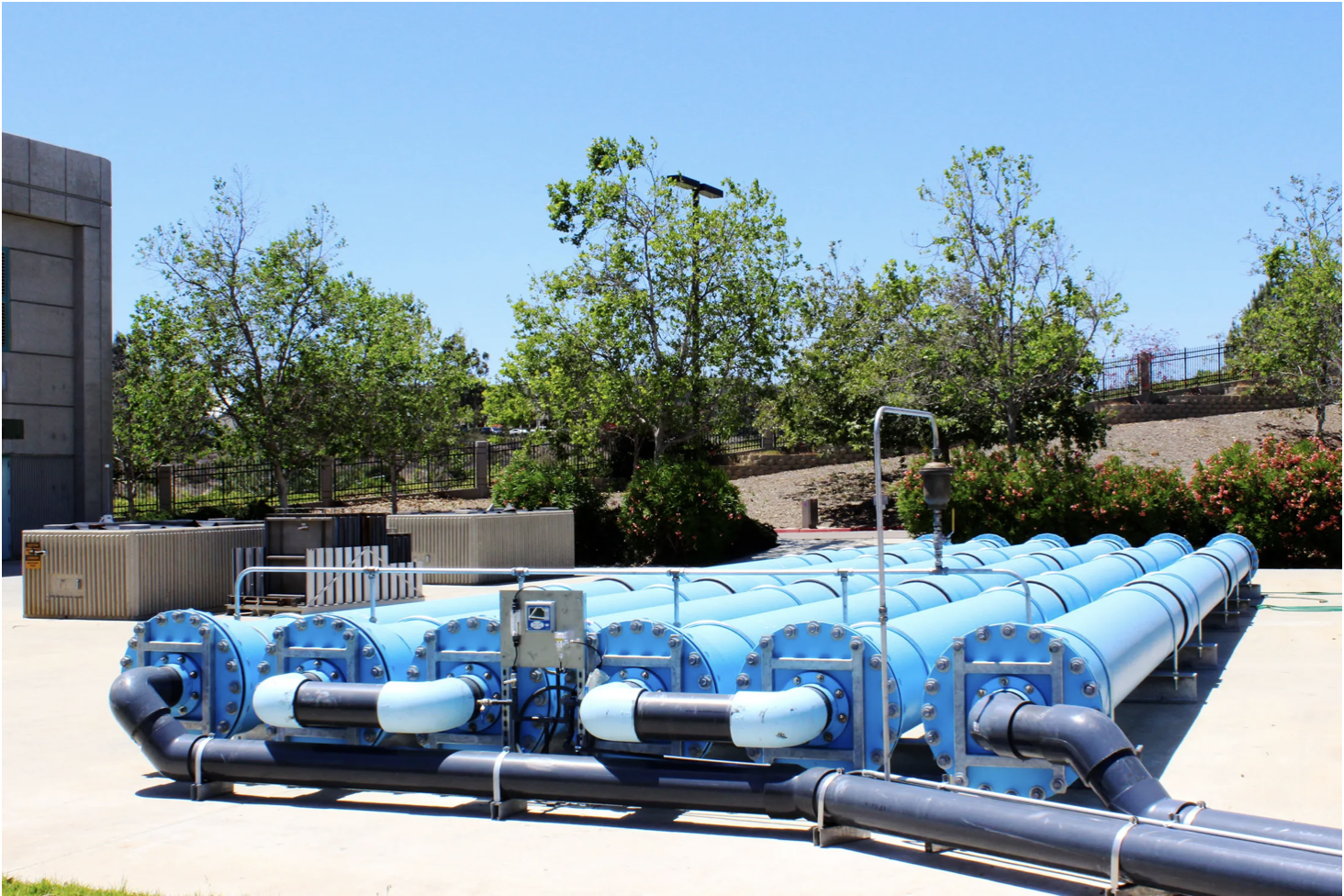
A trailer containing a small water reclamation system. Mervin XuYang Lim, CC BY-SA
A look at smaller, decentralized systems
Smaller systems can be effective, with lower initial costs and quicker start-up processes.
At the University of Arizona, I am leading the testing of a six-step brine reclamation system known as STREAM – for Separation, Treatment, Recovery via Electrochemistry and Membrane – to continuously reclaim municipal brine, which is salty water left over from sewage treatment.
The system combines conventional methods such as ultrafiltration, which removes particles and microbes using fine filters, and reverse osmosis, which removes dissolved salts by forcing water through a dense membrane, alongside an electrolytic cell – a method not typically employed in water treatment.
Our previous study showed that we can recover usable quantities of chemicals such as sodium hydroxide and hydrochloric acid at one-sixth the cost of purchasing them commercially. And our initial calculations indicated the integrated system can reclaim as much as 90% of the water, greatly reducing the volume of what remains to be disposed. The cleaned water in turn is suitable for drinking after final disinfection using ultraviolet or chlorine.
We are currently building a larger pilot system in Tucson for further study by researchers. We hope to learn if we can use this system to reclaim other sources of brine and study its efficacy in eliminating viruses and bacteria for human consumption.
Click the link to read “This Week in Water” from the H2ORadio website. Here’s an excerpt:
August 10, 2024
Last week, President Trump said he wants to impose a 100 percent tariff on imports of semiconductors and chips—but would exempt companies that make them in the United States. Details on a prospective policy were scarce—and also missing in the proposal are plans to address a concern vexing the industry—where’s all the water going to come from to manufacture chips in the U.S.?
A single fabrication facility, or fab, can use tens of millions of gallons of tap water per day, which is cleaned to become “ultrapure” by removing any particles or salts that could damage the chips. Currently, the ultrapure water is used only once to make chips. The wastewater is used to cool the buildings, which get very hot, or in scrubbers that “shower off” gases and other chemical contaminants used in the manufacturing process.
Several U.S. fabs are currently located in water-stressed areas such as Arizona, so can adding more plants in the country be achieved sustainably? Professor Paul Westerhoff at Arizona State University’s School of Sustainable Engineering and the Built Environment told H2O Radio that fabs can be sustainable but would require companies to invest in ways to recycle water to continuously bring it back to an ultrapure state to avoid tapping into local supplies.
He and his colleagues are researching what reuse technologies and policies would be necessary to make facilitates “water neutral” or at least close to it, some of which would include protecting the watersheds where manufacturers operate.
Another problem in growing the semiconductor industry in the U.S. is climate change. Making semiconductors is energy intensive, so manufacturers would need to switch to renewables instead of fossil fuels to be sustainable. Otherwise, as global temperatures rise and severe droughts increase, the water upon which fabs rely may not be there when they’re ready.
The House budget, though not as severe as the White House’s, proposes a 25 percent cut to the main source of federal funding for local water systems.
Senate approves Trump’s $9.4 billion in cuts to public broadcasting and foreign aid.
Other water bills in Congress include tribal water infrastructure funding, sinkhole monitoring, microplastics, and Great Lakes fisheries.
Bureau of Reclamation announces $200 million for water recycling projects in two western states.
EPA delays requirements to monitor groundwater at coal ash dumps.
Before taking summer break, Congress will hold hearings this week on fossil fuel pipeline safety, rising electricity demand, FEMA improvement, and NEPA reviews.
And lastly, Congress’s watchdog finds NRCS could improve its dam safety approach.
“While requests greatly exceeded the funding available for projects, we did our best to provide some funding for all eligible projects given the impact these dollars will have in communities across the country.” Rep. Mike Simpson (R-ID), speaking about water infrastructure earmarks in his committee’s 2026 budget proposal.
By the Numbers
$200 Million: Bureau of Reclamation funding announced for two water reuse projects in the western states. Phoenix will receive $179 million for its North Gateway project, which will produce 8 million gallons of recycled water a day. Washington County Water Conservancy District, which encompasses high-growth St. George in southwest Utah, will see more than $20 million for its regional recycled water system. The final cost for that system is expected at more than $1 billion.
News Briefs
House Proposes Water Cuts In its draft fiscal year 2026 budget, a House Appropriations subcommittee proposes a 25 percent combined cut to the state revolving funds, the main source of federal funding for local water systems.
The Drinking Water State Revolving Fund would be funded at $895 million, down from $1.1 billion. The Clean Water State Revolving Fund, which is for sewer and stormwater projects, would be funded at $1.2 billion, compared to $1.6 billion in 2025.
Though not as deep as President Trump’s proposal of a 90 percent cut, the budget proposal still drew criticism from water utility groups, who would prefer federal assistance be maintained or increased.
Combined, half of the appropriated funds would be redirected as earmarks to specific projects. This action pulls money out of circulation in the revolving funds, which grow as utilities repay interest. Water groups worry that if Congress continues down this path of carving out earmarks from the revolving funds the viability of the funds will be at risk.
Delaying Coal Ash Compliance The EPA granted states and utilities more time to meet federal rules for cleaning up waste pits at coal-fired power plants that pollute groundwater and rivers.
Groundwater monitoring requirements will not be mandatory until August 2029, according to the new timeline. It is a 15-month extension.
Senate Approves Foreign Aid, Public Broadcasting Cuts Joining the House, the Senate endorsed the president’s desire to cut $9.4 billion in already approved spending on public broadcasting and foreign aid.
Reuters details the on-the-ground fallout from U.S. foreign aid cuts, documenting 21 water projects that were abandoned before completion.
Other Water Bills in Congress Besides the budget, members introduced bills on microplastics, tribal water access, and sinkholes.
Representatives from Florida and Oregon introduced a bipartisan bill in both chambers that would require a federal study on the damage to human health from microplastics in food and water.
The House Natural Resources Committee approved a bill to reauthorize a federal research program for Great Lakes fisheries.
The House passed a bill to establish within the U.S. Geological Survey a sinkhole mapping and risk assessment program.
Democrats in the House and Senate introduced the Tribal Access to Clean Water Act, a bill that would increase funding authorizations for a number of federal programs that invest in water infrastructure and technical assistance on tribal lands. The largest chunk would be directed to the Indian Health Service, authorized at $500 million annually through 2030 for sanitation facilities. Even if the bill were to pass, Congress would still need to appropriate the money.
Studies and Reports
Dam Safety The Government Accountability Office reviewed the Natural Resources Conservation Service’s approach to dam safety.
The report found that NRCS could improve in several areas. For one, the agency does not monitor completion of dam inspections with its local project sponsors.
Also, the agency is missing data on the condition of the dams, even those that are rated high-hazard and threaten lives and property downstream if they fail.
NRCS helped to plan, design, and construct nearly 12,000 dams.
On the Radar
Congressional Hearings A few hearings on tap this week before the representatives take summer break.
On July 22, the House Natural Resources Committee will hold a hearing on NEPA reviews, which agencies are beginning to shorten.
That same day, a House Energy and Commerce subcommittee will hold a hearing on fossil fuel pipeline safety. This week marks the 15th anniversary of one of the nation’s largest inland oil spills. In July 2010, an Enbridge pipeline ruptured near Marshall, Michigan, spilling more than 843,000 gallons of oil into local waterways.
Also on July 22, the House Appropriations Committee will vote on the fiscal year 2026 budget bill for EPA and Interior.
Cybersecurity Webinar for Water Utilities The EPA and the federal government’s cybersecurity agency will hold a free webinar for water utilities on cybersecurity vulnerabilities.
The webinar is July 24 at 2:00 p.m. Eastern. Register here.
Federal Water Tap is a weekly digest spotting trends in U.S. government water policy. To get more water news, follow Circle of Blue on Twitter and sign up for our newsletter.
The 40 million or so people who rely on the Colorado River for drinking, bathing, irrigating, cooling data centers or power plants, or filling their swimming pools with have a problem. The amount of water being pulled out of the river for all of this stuff exceeds the amount of water that’s actually in the river — at least during most years in the last couple decades. And on the rare exception that supply exceeds demand, the surplus does little to dent the deficit, resulting in perennially low reservoir levels and chronically high water-manager stress levels.
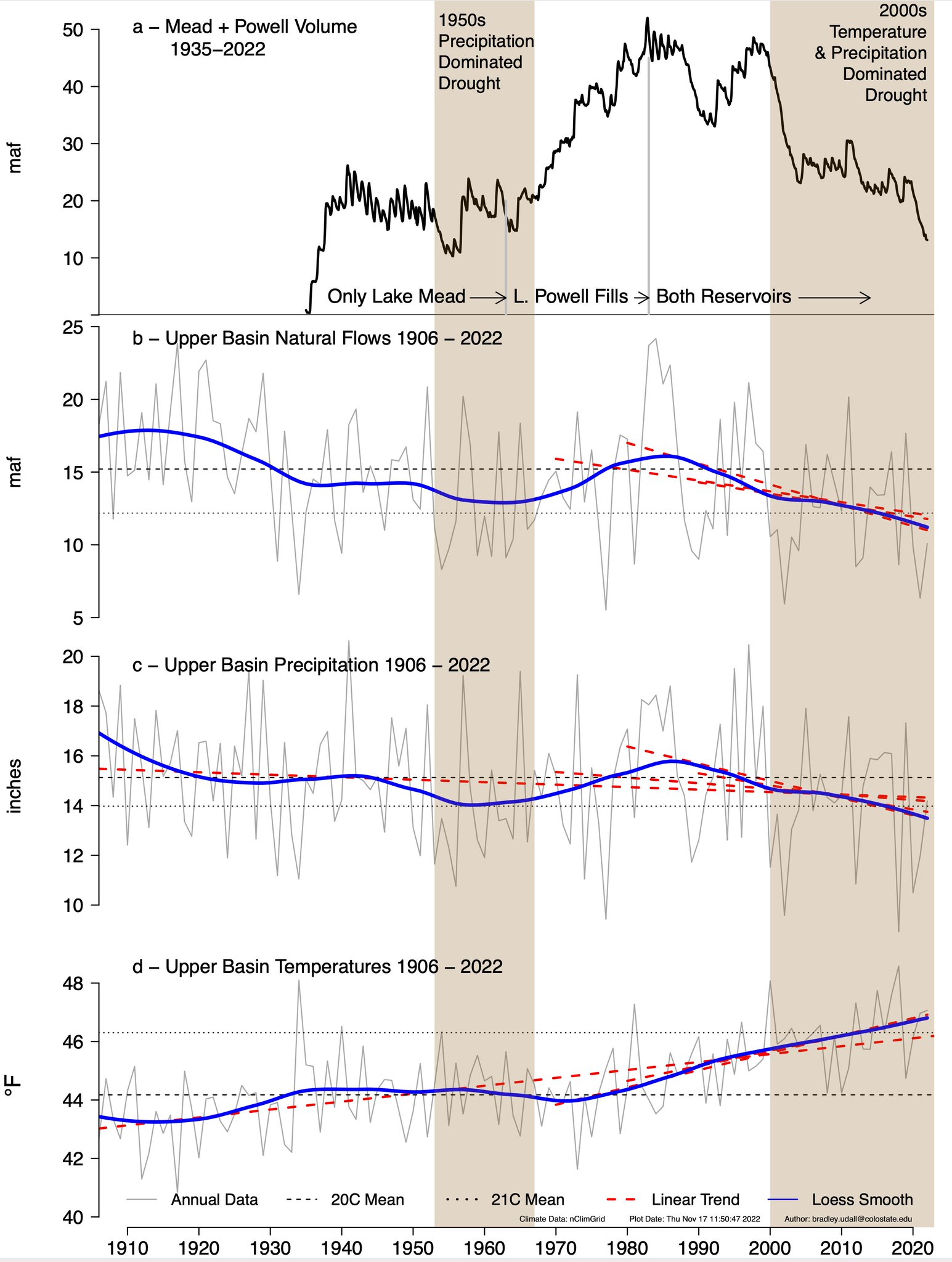
Udall/Overpeck 4-panel Figure Colorado River temperature/precipitation/natural flows with trend. Lake Mead and Lake Powell storage. Updated through Water Year 2024. Credit: Brad Udall
There is exactly one way out of this mess: The collective users simply need to use less.
Yet while the solution may be simple, it’s not exactly easy to carry out. That’s in part because people keep moving to the region, increasing demand. Plus, as the climate warms, we need more water to keep the crops or the grass or ourselves from drying up, making cutting consumption difficult and even dangerous.
An even bigger obstacle to reducing use is the societal urge to try to solve problems by consuming more, building more, and doing more (see the rise of the “Abundance” movement among American liberals). Using less goes directly against that urge (see Trump’s recent executive order titled: Maintaining Acceptable Water Pressure in Showerheads). That inclination drives the slew of schemes to try to produce more water, whether its by building dams, throwing dynamite into the sky, seeding clouds, desalinating seawater, or draining the Great Lakes and piping the water across the nation and over mountains to water Palm Springs golf courses. While it’s true that dams have given folks a bit more time to find a solution, building more of them now — with the exception of stormwater capture basins — won’t do any good (since even existing reservoirs are far from full).
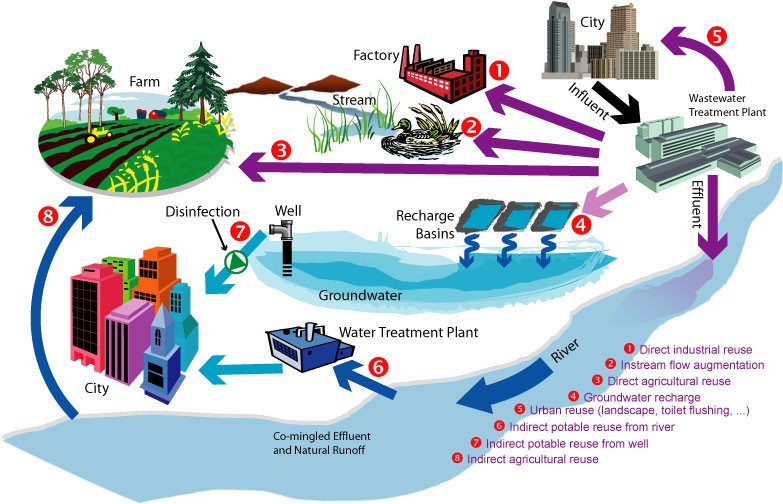
But there is one thing we can do more of to help us consume less: recycling. While the idea of recycling water inspires turn-off terms like “toilet to tap,” the practice is actually quite common in the Colorado River states. (And, really, if you live downstream from any other community, you are probably drinking the upstream towns’ recycled wastewater, though that isn’t counted as recycling, per se.)
A new report out of UCLA’s Institute of the Environment & Sustainability gives the rundown on wastewater recycling in the Colorado River Basin, and reveals that Arizona and Nevada are way ahead of the Upper Basin when it comes to reusing water, yet still have room for improvement. And it finds that if all of the Colorado River states aside from Arizona and Nevada were to increase wastewater reuse by 50%, they would free up some 1.3 million acre-feet of water per year, which is about one-third of the way to the 4 million acre-feet of cuts deemed necessary.
To be clear, not all water recycling is “toilet to tap.” In fact, most is not. In Las Vegas, for example, treated effluent is used to irrigate golf courses, and it’s also returned back to Lake Mead, which is then credited against Nevada’s water allotment. And in Arizona, treated wastewater from the Phoenix-area is used for steam production and cooling at the Palo Verde nuclear plant (which evaporates a whopping 45,000 gallons of water per minute), and treated effluent is used to “recharge” groundwater aquifers (eventually ending up in taps).
While recycled water can be used to irrigate crops, you can’t really recycle irrigation water. That fact, in a way, is why Nevada is the leader in Colorado River water-recycling: Almost all of its allocation from the river goes to the Las Vegas metro area for public supply/domestic use, with virtually none of it going to irrigate crops. That means most of the water eventually goes into the sewer system, making it available for recycling. And that, in turn, makes it easier to slash water use in cities than on farms, further throwing off the balance between agricultural use and municipal use, and putting more pressure on farmers to either sell out or become more efficient, which has. Its own drawbacks.
Water recycling can have unintended side effects, too. While it’s nice that Palo Verde doesn’t rely on freshwater, the 72,000 acre-feet of recycled water it uses per year all evaporates — it is a zero water-discharge plant — meaning it does not soak into aquifers or otherwise benefit ecosystems, as it would if it were used to water parks or was discharged back into the Gila River. And, water treatment is highly energy-intensive, so the more water you want to recycle, the more power you’ll need.
Ultimately, using less water in the first place is going to be necessary. But recycling what we do use could help.
Senator Beck Basin on March 31. This is near Red Mountain Pass, one of the few SNOTEL sites in the San Juan Mountains that had a near normal snowpack on April 1. Andy Gleason photo.
⛈️ Wacky Weather Watch⚡️
In the days following my April 1 snowpack update, the snowpack updated itself, with a nice storm bolstering snow water equivalent levels by up to two inches in some places. But it was closely followed by an unusually warm spell, which erased all of the gains and then some. What that means is a relatively paltry spring runoff for many of the Upper Colorado River Basin streams, with water levels likely peaking earlier and at lower levels than in 2021. How much earlier and lower depends on how warm or cool (and dry or wet) the rest of the spring is, but at this point it’s safe to say it won’t be a big water year for irrigators or boaters.
I’m especially worried about the Upper San Juan River and the Rio Grande, both of which have their headwaters in the southeast San Juan Mountains, which are running close to empty, snow-wise. Yes, Wolf Creek got pounded by the April 6-9 storms, but it has also experienced some abnormally high average temperatures over the last several days — the average temperature in the Rio Grande Headwaters on April 12 was 45.5° F, compared to the median for that date of 32°. If that continues, what little snow is left will mostly be gone within weeks.
Meanwhile, the high temperature in Tucson and Phoenix, neither of which have received more than a hint of precipitation during the last eight months, exceeded 100° F on April 11, setting new daily records and further desiccating the soil.
It may seem a bit early, but I think it’s time to start predicting peak runoffs for Four Corners area rivers. I’ll start with the Animas, which I’m pessimistically predicting will peak on May 17 at 2,950 cubic-feet per-second, based on previous years’ snowpacks and peak runoffs. I say “pessimistic” because if I’m right, it would only be the fourth time this century that the Animas peaked below 3,000 cfs. Here’s hoping I’m wrong.
Waste rock from the Sunday Mine Complex near Slick Rock, Colorado. Jonathan P. Thompson photo.
⛏️ Mining Monitor ⛏️
Is the uranium mining renaissance upon us? I don’t think so. But the industry’s zombified carcass is beginning to twitch — figuratively speaking, of course. The stirrings include:
A couple of weeks ago, the Energy Information Administration crowed that U.S. uranium production last year was the highest in six years. That sounds huge, right? Really, it’s not: Production was virtually zero from 2019 to 2023, making last year’s total of 676,939 pounds look pretty good. But as recently as 2014 — which was not boom times, by any means — production was nearly 5 million pounds. The big 2024 producers were in-situ recovery operations in Wyoming and Texas, as well as Energy Fuels’ White Mesa Mill in southeastern Utah. It should be noted, however, that the White Mesa Mill’s production was not from the company’s mines, but from its “alternate feed program,” which is to say it extracted uranium from other folks’ waste streams.
Energy Fuels is now producing ore at its Pinyon Plain Mine near the Grand Canyon and hauling it by truck across the Navajo Nation to the White Mesa Mill. The company says it plans on beginning production and shipment at its La Sal and Pandora Mines as well. This represents the first conventional ore production in the U.S. in years.
Western Uranium & Vanadium says Energy Fuels has agreed to purchase up to 25,000 short tons of uranium ore from WU&V’s Sunday Mine complex near Slick Rock, Colorado, in the Uravan Uranium Belt. They plan to begin shipping later this year.
Meanwhile, there is plenty of noise around a potential nuclear renaissance, as tech giants look to promised advanced and small modular reactors to power their electricity-guzzling data centers. But there are no reactors yet. I tallied some of that talk for High Country News.
📸 Parting Shot 🎞️
McElmo Car. Jonathan P. Thompson photo-illustration.
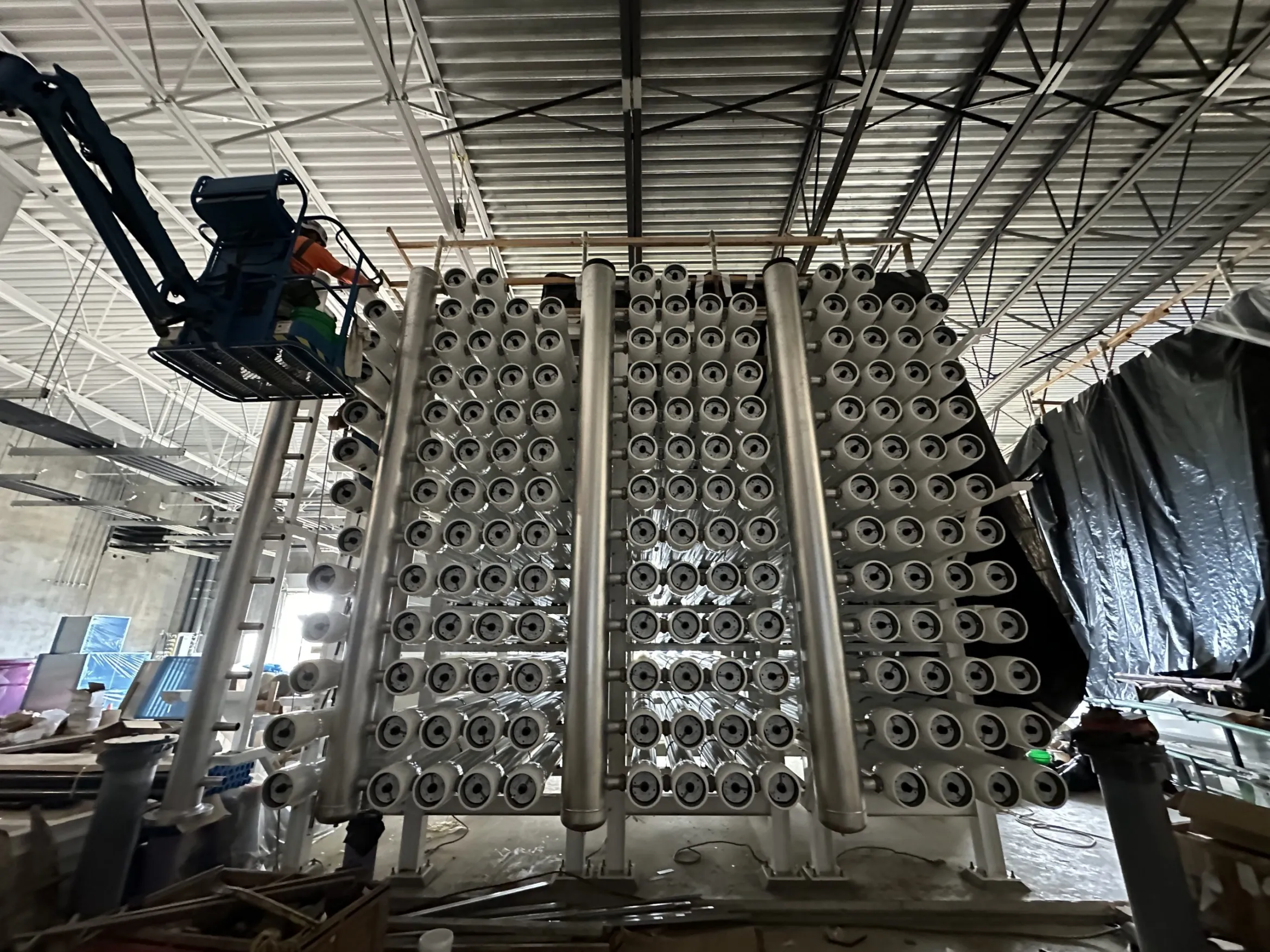
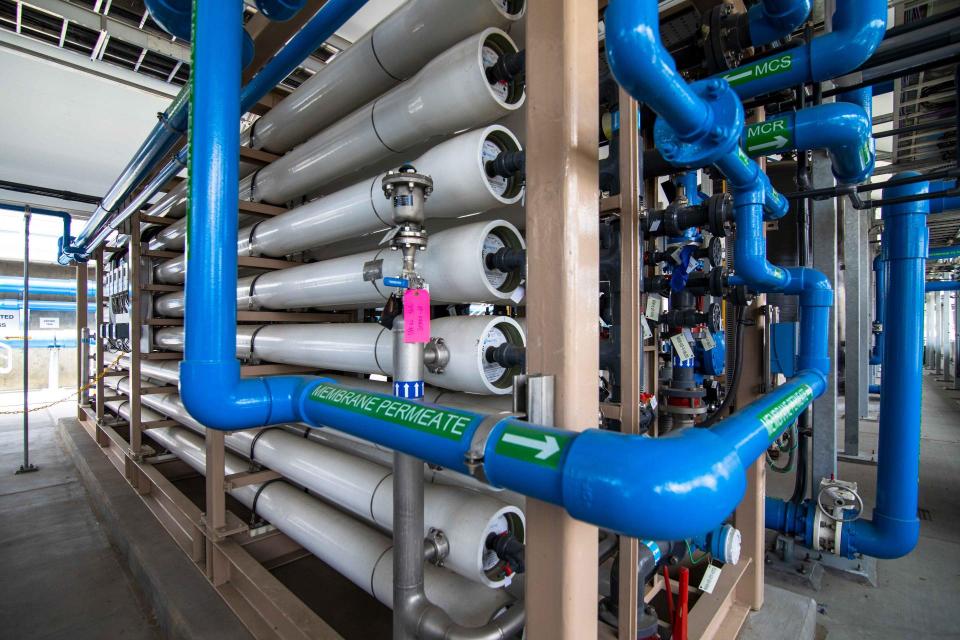
The recently opened PUR Water facility in Oceanside turns blackwater into potable water, or toilet to tap as it was once called, by pumping it into the ground then filtering it through a warehouse full of white filtration tubes. The colored pipes represent the different types of water at different stages. his facility in Oceanside, California turns recycled water into potable water by running it through filtration tubes. TED WOOD
Click the link to read the article on the Grist website (Matt Simon):
April 11, 2025
If you were to drink improperly recycled toilet water, it could really hurt you — but probably not in the way you’re thinking. Advanced purification technology so thoroughly cleans wastewater of feces and other contaminants that it also strips out natural minerals, which the treatment facility then has to add back in. If it didn’t, that purified water would imperil you by sucking those minerals out of your body as it moves through your internal plumbing.
So if it’s perfectly safe to consume recycled toilet water, why aren’t Americans living in parched western states drinking more of it? A new report from researchers at the University of California, Los Angeles, and the Natural Resources Defense Council finds that seven western states that rely on the Colorado River are on average recycling just a quarter of their water, even as they fight each other and Indigenous tribes for access to the river amid worsening droughts. Populations are also booming in the Southwest, meaning there’s less water for more people.
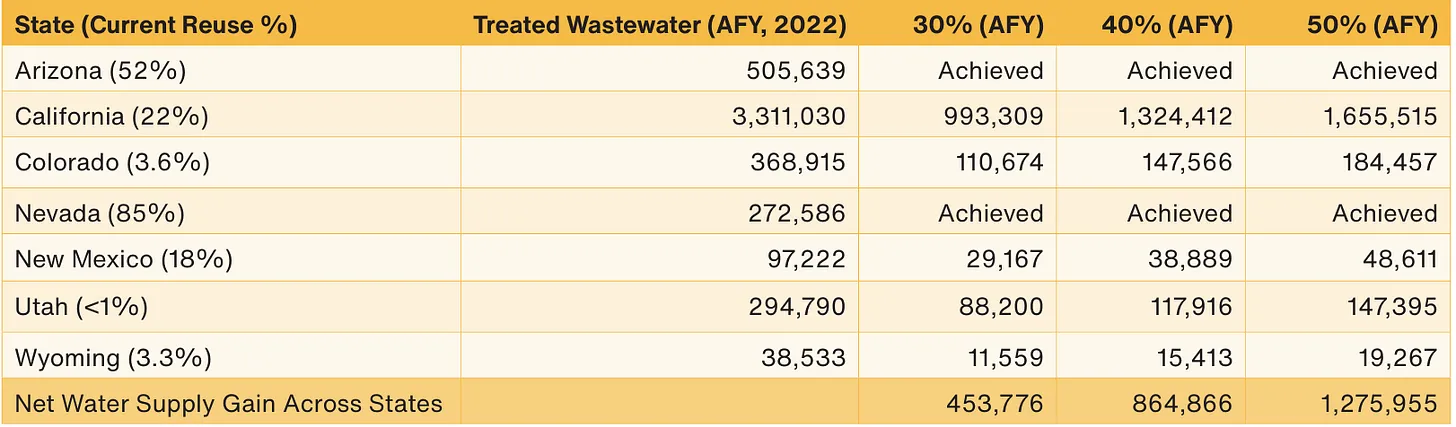
The report finds that states are recycling wildly different proportions of their water. On the high end, Nevada reuses 85 percent, followed by Arizona at 52 percent. But other states lag far behind, including California (22 percent) and New Mexico (18 percent), with Colorado and Wyoming at less than 4 percent and Utah recycling next to nothing.
“Overall, we are not doing nearly enough to develop wastewater recycling in the seven states that are part of the Colorado River Basin,” said Noah Garrison, a water researcher at UCLA and co-author of the report. “We’re going to have a 2 million to 4 million acre-foot per year shortage in the amount of water that we’ve promised to be delivered from the Colorado River.” (An acre-foot is what it would take to cover an acre of land in a foot of water, equal to 326,000 gallons.)
The report found that if the states other than high-achieving Nevada and Arizona increased their wastewater reuse to 50 percent, they’d boost water availability by 1.3 million acre-feet every year. Experts think that it’s not a question of whether states need to reuse more toilet water but how quickly they can build the infrastructure as droughts worsen and populations swell.
At the same time, states need to redouble efforts to reduce their demand for water, experts say. The Southern Nevada Water Authority, for example, provides cash rebates for homeowners to replace their water-demanding lawns with natural landscaping, stocking them with native plants that flourish without sprinklers. Between conserving water and recycling more of it, western states have to renegotiate their relationship with the increasingly precious resource.
“It’s unbelievable to me that people don’t recognize that the answer is: You’re not going to get more water,” said John Helly, a researcher at the Scripps Institution of Oceanography who wasn’t involved in the report. “We’ve lulled ourselves into this sense of complacency about the criticality of water and it’s just starting to dawn on people that this is a serious problem.”
Yet the report notes that states vary significantly in their development and regulation of water recycling. For one, they treat wastewater to varying levels of purity. To get it ultra pure for drinking, human waste and other solids are removed before the water is treated with ozone to kill bacteria and viruses. Next the water is forced through fine membranes to catch other particles. A facility then hits the liquid with UV light, killing off any microbes that might remain, and adds back those missing minerals.
That process is expensive, however, as building a wastewater-treatment facility itself is costly, and it takes a lot of electricity to pump the water hard enough to get it through the filters. Alternatively, some water agencies will treat wastewater and pump the liquid underground into aquifers, where the earth filters it further. To use the water for golf courses and nonedible crops, they treat wastewater less extensively.
Absent guidance from the federal government, every state goes about this differently, with their own regulations for how clean water needs to be for potable or nonpotable use. Nevada, which receives an average of just 10 inches of rainfall a year, has an environmental division that issues permits for water reuse and oversees quality standards, along with a state fund that bankrolls projects. “It is a costly enterprise, and we really do need to see states and the federal government developing new funding streams or revenue streams in order to develop wastewater treatment,” Garrison said. “This is a readily available, permanent supply of water.”
Wastewater recycling can happen at a much smaller scale, too. A company called Epic Cleantec, based in San Francisco, makes a miniature treatment facility that fits inside high-rises. It pumps recycled water back into the units for non-potable use like filling toilets. While it takes many years to build a large treatment facility, these smaller systems come online in a matter of months and can reuse up to 95 percent of a building’s water.
Epic Cleantec says its systems and municipal plants can work in tandem as a sort of distributed network of wastewater recycling. “In the same way that we do with energy, where it’s not just on-site rooftop solar and large energy plants, it’s both of them together creating a more resilient system,” said Aaron Tartakovsky, Epic Cleantec’s CEO and co-founder. “To use a water pun, I think there’s a lot of untapped potential here.”
Click the link to read the report on the UCLA website (Noah Garrison, Lauren Stack, Jessica McKay, and Mark Gold). Here’s the executive summary:
The impacts of climate change and prolonged drought on water scarcity in the Western United States have accelerated since the end of the 20th century. The Colorado River has been strained by a history of excessive withdrawals and long-term drought. Increasingly less water is available across the seven Colorado River Basin states—Arizona, California, Colorado, Nevada, New Mexico, Utah, and Wyoming—for natural ecosystems and the 40 million people that rely, in part or in whole, on its diverted flows to cities and farms. Faced with this challenge, the importance of recycled water at a large scale has never been greater. Water recycling of treated municipal wastewater is a cost-effective source of reliable, sustainable water supply; people shower, flush toilets, and wash clothes and dishes on a regular basis even in times of fluctuating water availability, and these waste flows go to publicly owned treatment works (POTWs) in urban areas.
To assess the current state of water recycling across the Colorado River Basin and its affected states, UCLA Institute of the Environment and Sustainability, in partnership with Natural Resources Defense Council, has investigated water recycling progress and policy development across the seven states in the basin. We analyzed the amount of water entering municipal wastewater treatment plants treating an average of greater than 1 million gallons per day across the 2022 calendar year, the amount these plants reclaim or reuse, and the amount they discharge back into the environment. Our analysis demonstrates that while individual treatment facilities, cities, or even regions may be making substantial progress toward water sustainability, most basin states are falling well short of their potential to reuse wastewater. Overall, the Colorado River Basin states are missing opportunities to ensure a safe, sustainable, climate-resilient supply of water in a hotter, drier future.
While across the Colorado River Basin, an average of 26% of municipal wastewater from POTWs was recycled, there are striking differences between states that are prioritizing reuse and those that are falling behind. Arizona (reusing 52% of treated wastewater) and Nevada (as much as 85%) deserve accolades for their efforts to develop the recycled water supply. California, which produces by far the largest volume of wastewater, only recycled 22% of its treated wastewater in 2022. Of the remaining four states, New Mexico recycles a similarly modest 18%, and Colorado (3.6%), Utah (less than 1%), and Wyoming (3.4%), for a variety of state-specific reasons, have made little to no progress to date on reusing meaningful volumes of treated wastewater. Further and distinct breaks appear to exist between efforts and progress made by states in the lower Colorado River Basin (Arizona, California, and Nevada) and those of the upper basin (Colorado, New Mexico, Utah, and Wyoming). In 2022, the upper basin states as a whole recycled less than 5% of their assessed influent, as compared to more than 30% for the lower basin. (See Figure EX-1 for state-by-state results of our analysis.)
Figure EX-1. Volume of municipal wastewater effluent vs. current reuse by state across the Colorado River Basin for 2022. Totals include figures for the whole state, not only for wastewater generated in the Colorado River watershed. Credit: UCLA
In addition to the lack of progress on wastewater reuse, the overall lack of data on wastewater recycling, including volume, level of treatment, and end use of the recycled water is also glaring. California maintains the most comprehensive database of recycled water, including its end uses, through the California Open Data Portal (see SWRCB, 2022). While we were able to gather data directly from individual wastewater treatment facilities in other states, determining how much water is being recycled was a significant challenge, and determining how much recycled water is ultimately directed to municipal, agricultural, or industrial users was often limited to qualitative description, if information was available at all.
All of the state results have been achieved in the absence of strong federal recycled water policy or any federal regulation. The lack of federal support for or consistency among state programs has hampered efforts and stands as a significant impediment to further growth of recycled water use. Promoting consistent and growing national water reuse will require action at both the federal and state level.
To this end, through our investigation we have developed a set of recommendations for the U.S. Environmental Protection Agency (EPA) and other federal and state partners and stakeholders. Additional detail and guidance for these recommendations is presented in the main report body and conclusions. These recommendations include the following:
Within two years, EPA, working with state partners, water agencies, and nongovernmental organizations, should develop a model state program and ordinance for recycling of municipal wastewater with minimum elements.
EPA should improve data acquisition and management, including developing guidance for standardized facility-level reporting and state data sharing, to ensure availability of information and comparability of data between states.
EPA should further develop and disseminate the latest science and technical information on treatment processes and pathogen risk assessment for different sources of water and reuse applications.
In partnership with the states, EPA should develop wastewater reuse goals and timelines.
EPA—working with other federal agencies including the Bureau of Reclamation and the Departments of Agriculture, Energy, and Defense—should develop and implement funding strategies beyond those already in existence, including furthering the Pilot Program for Alternative Water Source grants.
In addition, our analysis uncovered that, across the Colorado Basin states, inconsistency between programs and overall lack of state-level oversight or even awareness of wastewater recycling efforts in several states is alarming. Recommended improvements needed at the state level for those states without these programs include:
Work with local water reclamation or reuse agencies to develop funding strategies to meet targets for 30%, 40%, or 50% goals.
Work with EPA to establish numeric targets for wastewater reuse for each state, with timelines and interim goals. Figure EX-2 provides a breakdown of the total water supply that would be made available for each state with targeted goals of 30%, 40% or 50% reuse by 2040, a number already exceeded by two of the basin states.
Improve data acquisition and management, as well as reporting requirements where applicable, for wastewater treatment facilities and wastewater reuse operations.
Conduct assessments of current state legal and regulatory requirements to identify barriers to wastewater reuse and develop formal state policies for overcoming those barriers.
Overall, substantial action needs to be taken to achieve sustainable water management across the Colorado River Basin. Better use of climate modeling, water pricing that does not encourage waste and unreasonable use, stronger water conservation and efficiency programs and requirements for agricultural and urban users, enhanced stormwater capture, greater and longer-term cutbacks in Colorado River water withdrawals, and, critically, a substantial increase in water reuse all must be embraced as climate resiliency solutions.
Figure EX-2. Recycled water volume created for each state at targeted reuse percentage of 30%, 40%, and 50%of the state’s total wastewater influent, with net increase in overall potential available water supply. Credit: UCLA
As shown in Figure EX-2, if the Colorado Basin states other than Arizona and Nevada were to increase wastewater reuse to even 40% of treated influent it could increase current recycled water availability by nearly 900,000 acre-feet per year (AFY) over current efforts. Reuse of 50% of influent would increase water availability by nearly 1.3 million AFY. This represent a significant percentage of the projected shortfall on the Colorado River, and a rsolution that should be pursued aggressively to ensure sustainable management of the river.
Map of the Colorado River drainage basin, created using USGS data. By Shannon1 Creative Commons Attribution-Share Alike 4.0
Rupam Soni, MWD’s community-relations team manager, gives a tour of MWD’s Pure Water Southern California demonstration facility. MWD is hoping to soon use recycled wastewater, known as direct potable reuse, to augment its supplies from the Colorado River.
CREDIT: HEATHER SACKETT/ASPEN JOURNALISM
Click the link to read the article on the LAInst.com website (Erin Stone). Here’s an excerpt:
October 7, 2024
This month, statewide regulations for what’s technically called “direct potable reuse” went into effect. The rules allow wastewater — yes, the water that goes down the drain or is flushed down the toilet — to be treated to drinkable standards then distributed directly to homes and businesses. Mickey Chaudhuri, treatment and water quality manager for the Metropolitan Water District of Southern California (MWD), said the new rules are “a gamechanger.”
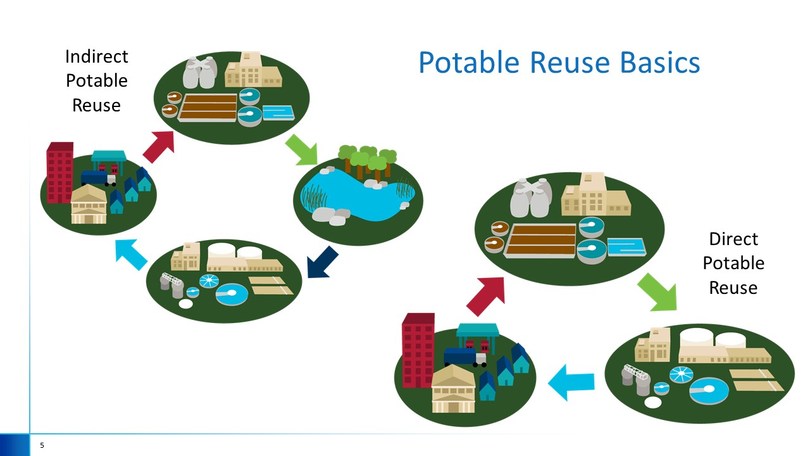
Previously, California law only allowed “indirect potable reuse,” which is what the Fountain Valley facility does — highly treated wastewater is injected underground into an aquifer, where further, natural filtration occurs. Then that water is put into the pipelines to our homes and businesses. Direct potable reuse, which is what these newly effective regulations are about, skips that step where the water is injected into groundwater basins. Instead, the highly treated sewage water goes directly to drinking water treatment plants and then is distributed…ecause these new regulations allow recycled water to be put directly into the local water system, more cities can recycle water for drinking that don’t happen to have an underground basin, or don’t have enough space in groundwater basins because of past pollution, which is the case for cities such as L.A. and Santa Monica.
The science behind the city of San Diego’s multibillion dollar effort to recycle wastewater into drinking water.
Try driving up Morena Boulevard in Mission Valley, or north through Bay Park and Clairemont, and chances are you’ll be bottlenecked by an army of orange traffic cones demarking a huge construction project that will consume northern San Diego for years to come.
The city of San Diego is currently building a massive wastewater-to-drinking water recycling system – but it must tear up the streets to do it. The new pipe route tunnels from Morena Pump Station near the San Diego International Airport, then 10 miles north to University City and then another 8 miles to Miramar Reservoir, the final stop for all our transformed toilet water.
But wait – why is San Diego drinking its own sewage in the first place? And how is that even possible?
That’s why San Diego is very proud of its recycling project, called Pure Water, which will turn 42 million gallons of wastewater into 34 million gallons of drinking water per day once the first phase is complete around 2027. But the project is actually a compromise the city made after years of wrangling over sewage, of which unlike drinkable water, the city often has too much.
A bit of history: In the 1930s, San Diego dumped its sewage into San Diego Bay which began to corrode the hulls of Navy ships and drove tourists away. In 1963, the city, with support from neighboring cities, opened the Point Loma Wastewater Treatment Plant which cleaned wastewater one way, but soon fell short of what the 1972 Clean Water Act required.
San Diego was on the hook to make billions of dollars in upgrades to Point Loma, even though it argued dumping treated wastewater should be OK because, as the saying goes, “the solution to pollution is dilution.” Congress agreed to give the city a pass on the Clean Water Act requirements for a decade until it failed to reapply for a waiver, setting off a wave of litigation. That’s about the time San Diego offered to do something different: Make its wastewater drinkable.
Filtration membranes at the city of San Diego’s new wastewater-to-drinking water facility on June 11, 2024. / MacKenzie Elmer
That seemed to settle qualms from environmentalists angered by Point Loma’s ocean pollution and the feds that were upset over continued Clean Water Act waivers. And here we are.
Pure Water officials told me the water produced on the other side of the multi-step recycling process is so clean, the city must add minerals back in at the end. And there’s the added bonus of San Diego having to buy less imported water – one of the city’s biggest monthly bills. Pure Water is supposed to provide over half the city’s water needs when it’s complete.
So instead of billions in upgrades to Point Loma, the city’s spending billions on Pure Water, about $1.5 billion just for the first of its two phases.
Beyond the miles of new pipeline and pumps yet to be built to round out the system, an expansion of the existing North City Water Reclamation Facility in Miramar is the heart of the purification process. Juan Guerreiro, the director of the city of San Diego’s Public Utilities Department, gave me and our social media journalist, Bella Ross, a tour of the construction.
The North City reclamation plant, and its sister plant in South Bay, were built about 25 years ago to divert some of the waste being sent to Point Loma, clean it, and use it for irrigation. The massive expansion effort is underway while the North City plant is still doing its 24/7 job.
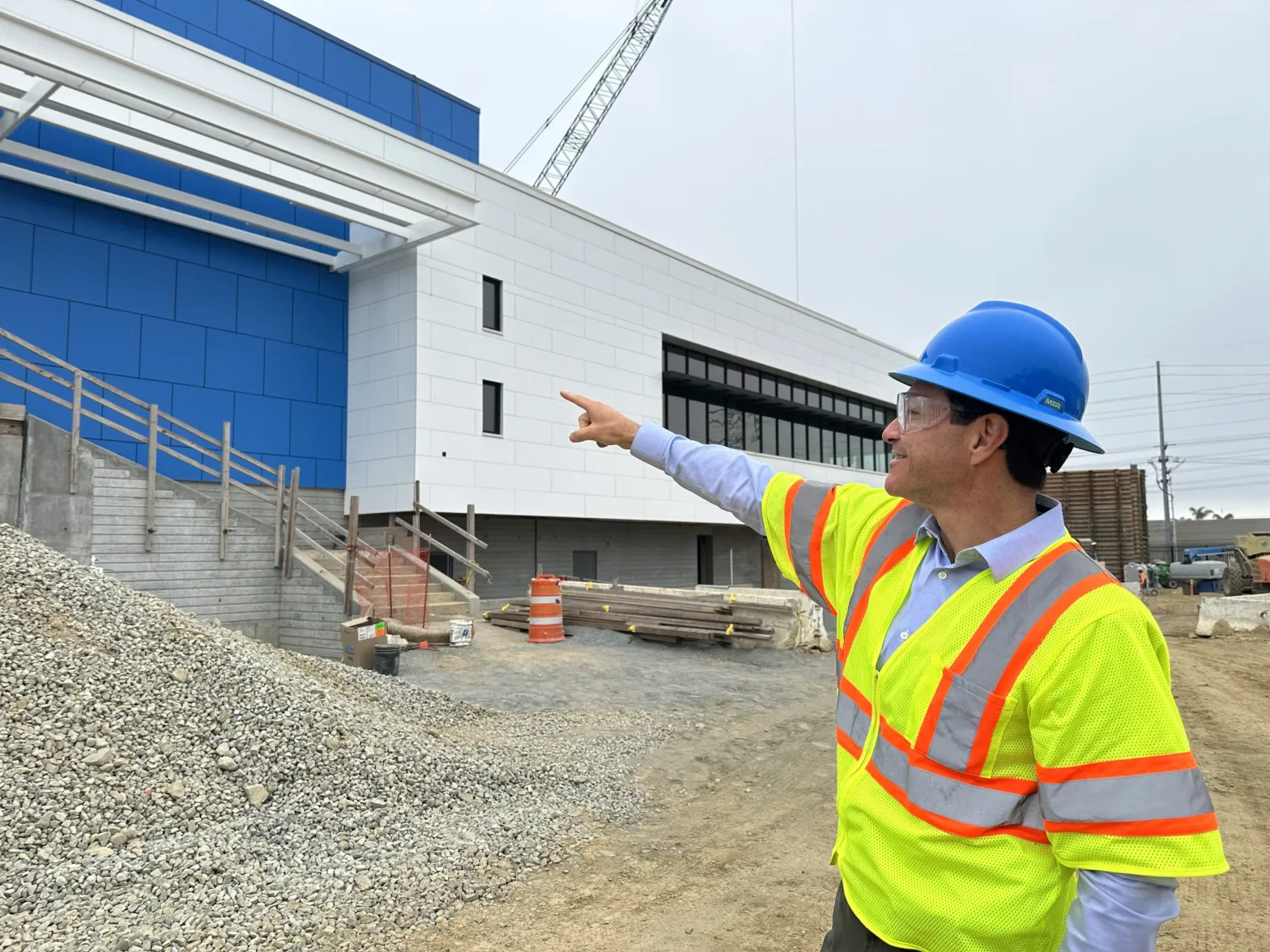
Juan Guerreiro, the director of the city of San Diego’s Public Utilities Department, points to the new Pure Water North City facility under construction on June 11, 2024. / MacKenzie Elmer
“It’s like open heart surgery. You’re running the plant producing recycled water while it’s being expanded,” Guerreiro said.
That plant already strains out all the solids, adds bacteria to eat up bad gunk, chlorinates and then runs water through coal filters – like a big Brita filtration system. You could probably drink the end product, but it wouldn’t pass California’s drinking water standards. Pure Water adds five extra treatment steps, including shooting every water molecule through a filter membrane with pores that are 500,000 times smaller than a human hair.
After all that energy-intensive cleaning, the city dumps the purified water in the Miramar Reservoir where San Diego stores much of its untreated drinking water already. But wait, isn’t it kind of a shame to dump that extra-purified water into a reservoir filled with yet untreated drinking water, then treat it again?
In an abundance of caution, California requires the treated wastewater-turned-drinking water be stored in an “environmental buffer” like a reservoir or an underground aquifer, instead of pumping it straight to public taps. It’s a kind of “just in case” measure for a lot of these new recycling projects. Orange County built a similar wastewater-to-drinking water system in 2008 that injects the treated water into underground aquifers. San Diego doesn’t have many aquifers so the next best buffer is the reservoir.
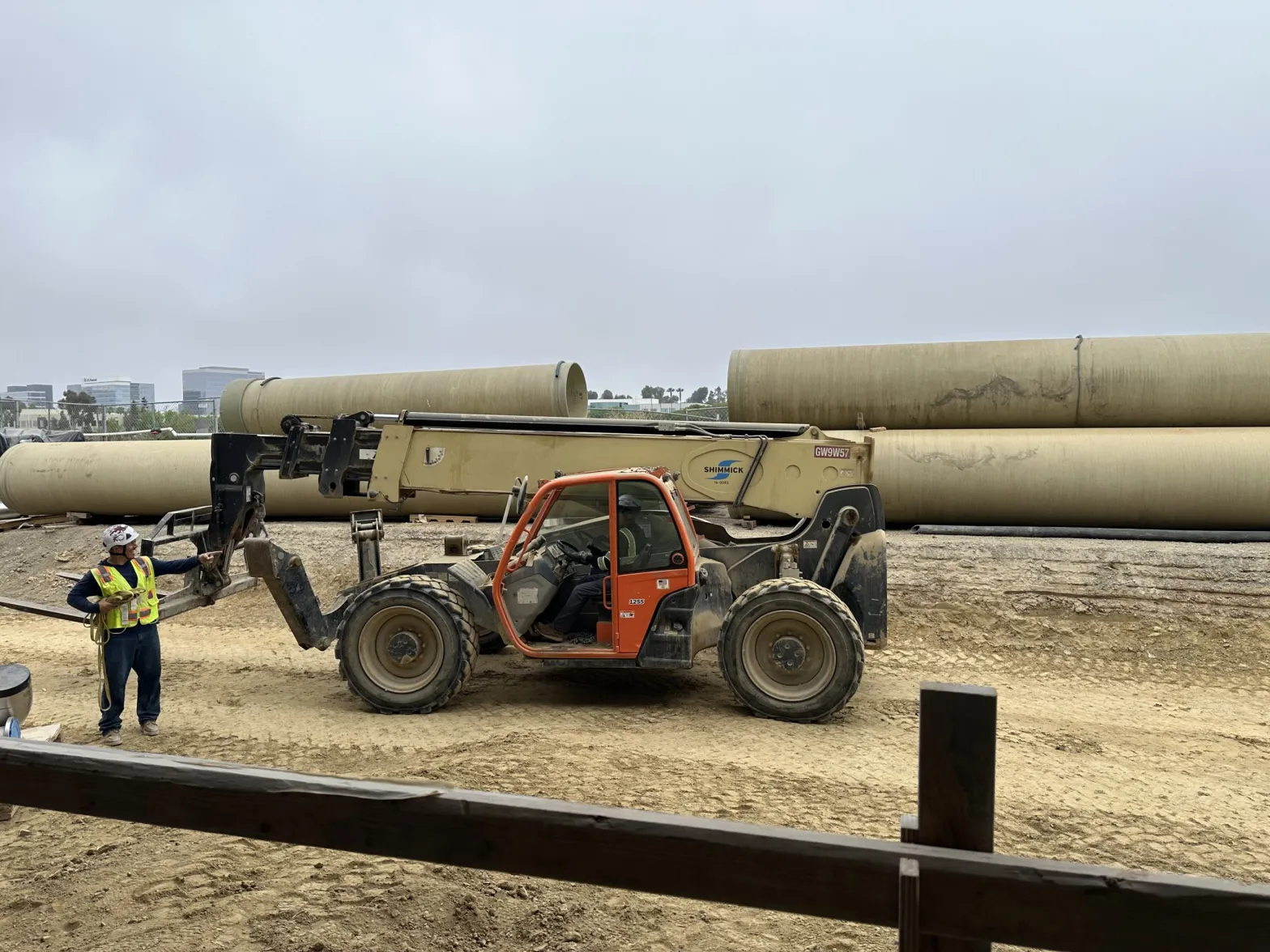
City of San Diego digging a megatrench to transport treated water from its new Pure Water facility on June 11, 2024. / MacKenzie Elmer
Building Pure Water is a massive undertaking that involves building what officials called a “mega trench” artery connecting the North City Reclamation facility and the new Pure Water facility underneath Eastgate Mall road. But the city is also building a Pure Water education center on site to cure any skeptics of their suspicion of the process.
Now, students, don your lab goggles and learn how Pure Water is done:
How it works now: Someone in the city of San Diego flushes their toilet. The waste flows through pipes in a building then out to the street into a large sewer main. Eventually it hits a pump station which shoots the sewage to its traditional final destination: The Point Loma Wastewater Treatment Plant.
How it will work once Pure Water is complete: Everything is the same at the start, except a new pump station off Morena Boulevard and north of Interstate 8 will be responsible for diverting 32 million gallons of wastewater away from Point Loma and sending it northward to the reclamation plant.
Workers erect a massive retaining wall at the city of San Diego’s new Pure Water facility on June 11, 2024. / MacKenzie Elmer
Once it makes its miles-long journey to the plant, the sewage moves through the first steps of a typical treatment process, starting with what’s called primary. That phase gets rid of the most obvious gross stuff. The water sits still in a settling tank so fats, oils, grease and plastic float to the top where that gunk is skimmed off and sent to disposal. Organic solids (fecal matter, etc.) sink to the bottom and separate from the water.
That water is not ready to drink yet. Its next stop is secondary treatment, where the wastewater moves into huge concrete bathtubs and pumped through with air and microbes that eat up a lot of the organic stuff still floating around. The microbes burp out ammonia, carbon dioxide gases and water. If that bacteria begins to die during this process, it’s a signal to treatment plant staff that something toxic and unusual may have been illegally dumped into the sewage system. (That happened once back in 2016 when a port-a-potty company called Diamond Enviornmental Services got caught dumping its outhouse contents into the city’s wastewater system. The FBI raided the company’s offices. Some of its executives got prison time.)
The wastewater moves to more settling tanks where that well-fed bacteria clump together, die and sink to the bottom. Cleaner water remains at the top inch of the surface, which then flows out onto the city’s prized Pure Water, five-step purification process – and reportedly exceed — drinking water standards.
The reclaimed water first goes through ozone and biologically active carbon filtration. Any pharmaceuticals or personal care products one might worry survived the primary and secondary treatment get broken down by ozone and become food for additional biology in the carbon filter. Ozone, when dissolved in water, turns into a kind of biocide that kills bacteria, parasites, viruses and other bad stuff.
By this stage, the water is ready to be shot at high speed through a membrane filter, which looks like a large PVC pipe filled with straws that contain ultra-small pores. The idea is any microscopic grime or grit still floating around won’t be able to make it through those pores.
Juan Guerreiro, director of the city’s Public Utilities Department, holds a piece of the new Pure Water filtration system at the North City Water Reclamation Facility in Miramar. Ally Berenter and Anna Vacchi Hill with the city of San Diego on June 11, 2024. / MacKenzie Elmer
Next, the water goes through reverse osmosis, another kind of filter with even smaller pores, about the size of a water molecule. This helps remove any excess salts or minerals. “The water that comes through reverse osmosis is some of the cleanest we’ve seen compared to distilled water quality,” said Doug Campbell, the assistant director of the city’s Public Utilities Department’s wastewater branch. It cleans the water so well, Campbell said, minerals must be added back to the water later.
A filtration membrane that’s part of the city of San Diego’s wastewater-to-drinking water system called Pure Water on June 11, 2024. / MacKenzie Elmer
There’s one more step, the water gets flashed by ultraviolet light at the most lethal wavelength for germs or microorganisms. “UV light is really good at harming organic things. So if any viruses, parasites or bacteria make it through the other steps, then the UV light will quickly destroy it,” said Campbell said.
Click the link to read the article on the Sky-Hi News website (Elliot Wenzler). Here’s an excerpt:
April 8, 2024
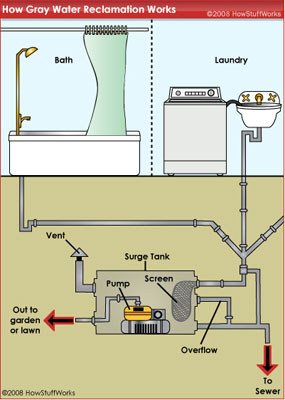
Conservationists point to graywater uses as a way to cut down on water consumption in the West
A bill that would allow graywater systems to be included in new homes throughout Colorado received rare unanimous approval from the Colorado House on Friday…The bipartisan House Bill 2024-1362 (Measures to Incentivize Graywater Use) is sponsored by Rep. Meghan Lukens, D-Steamboat Springs, and Rep. Marc Catlin, R-Montrose, Sen. Dylan Roberts, D-Frisco, and Sen. Cleave Simpson, R-Alamosa…Currently, local governments are permitted to opt into graywater programs. Under the bill, the whole state would be automatically allowed to include graywater systems in new constructions, but local governments could choose to opt their community out…
Since the state gave initial approval for local governments to opt into graywater programs in 2013, only six jurisdictions have chosen to do so including Pitkin County, Grand Junction, Denver, Castle Rock, Fort Collins, Broomfield and Golden. If approved by the Senate and signed by the governor, the bill would go into effect at the start of 2026.
Graywater is mentioned in the Colorado Water Plan as a possible tool for the state to meet current and future water needs. It notes there are challenges with the technology, including the effort of retrofitting existing buildings with the systems. It also includes a “general lack of interest on the part of local governments to enact local graywater ordinances,” a “lack of interest from developers” and “concerns that property owners could be resistant to operating and maintaining a graywater system within their residences” as challenges.
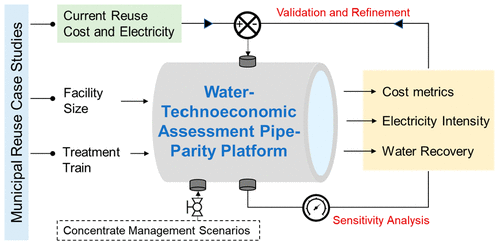
Graphic credit: ACS Publications article “Cost and Energy Metrics for Municipal Water Reuse”
Click the link to access the article on the ACS Publications website (Daniel E. Giammar*, David M. Greene, Anushka Mishrra, Nalini Rao, Joshua B. Sperling, Michael Talmadge, Ariel Miara, Kurban A. Sitterley, Alana Wilson, Sertac Akar, Parthiv Kurup, Jennifer R. Stokes-Draut, and Katie Coughlin). Here’s the abstract:
Municipal water reuse can contribute to a circular water economy in different contexts and with various treatment trains. This study synthesized information regarding the current technological and regulatory statuses of municipal reuse. It provides process-level information on cost and energy metrics for three potable reuse and one nonpotable reuse case studies using the new Water Techno-economic Assessment Pipe-Parity Platform (WaterTAP3). WaterTAP3 enabled comparisons of cost and energy metrics for different treatment trains and for different alternative water sources consistently with a common platform. A carbon-based treatment train has both a lower calculated levelized cost of water (LCOW) ($0.40/m3) and electricity intensity (0.30 kWh/m3) than a reverse osmosis (RO)-based treatment train ($0.54/m3 and 0.84 kWh/m3). In comparing LCOW and energy intensity for water production from municipal reuse, brackish water, and seawater based on the largest facilities of each type in the United States, municipal reuse had a lower LCOW and electricity than seawater but higher values than for production from brackish water. For a small (2.0 million gallon per day) inland RO-based municipal reuse facility, WaterTAP3 evaluated different deep well injection and zero liquid discharge (ZLD) scenarios for management of RO concentrate. Adding ZLD to a facility that currently allows surface discharge of concentrate would approximately double the LCOW. For all four case studies, LCOW is most sensitive to changes in weighted average cost of capital, on-stream capacity, and plant life. Baseline assessments, pipe parity metrics, and scenario analyses can inform greater observability and understanding of reuse adoption and the potential for cost-effective and energy-efficient reuse.
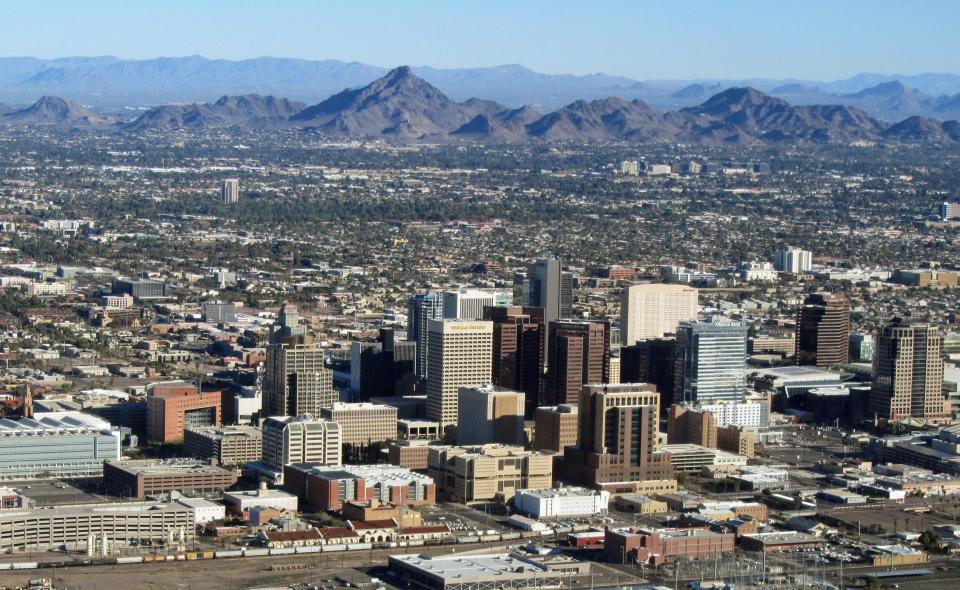
Long-term drought and dwindling Colorado River supplies have Phoenix urgently pursuing highly treated sewage as a drinking water supply. Source: Wikimedia Commons
Phoenix, Southern California betting on purified sewage to fill drinking water needs.
After more than two decades of drought, water utilities serving the largest urban regions in the arid Southwest are embracing a drought-proof source of drinking water long considered a supply of last resort: purified sewage.
Water supplies have tightened to the point that Phoenix and the water supplier for 19 million Southern California residents are racing to adopt an expensive technology called “direct potable reuse” or “advanced purification” to reduce their reliance on imported water from the dwindling Colorado River.
“[Utilities] see that the river is overallocated, and they see that the climate is changing,” said Kathryn Sorensen, former director of Phoenix Water Services Department. “They’re looking at this and understanding that the river supply is highly variable and extremely uncertain in the future.”
The Colorado River that sustains nearly 40 million people and more than 4 million acres of cropland across seven states is shrinking because of climate change and overuse. The river’s flows have declined approximately 20 percent over the past century, and a more than two-decade drought that began at the turn of this century has pushed the system to its limits.
With so much at stake, cities dependent on the river are strengthening water conservation measures and pursuing new sources of water with urgency.
Phoenix is quickly advancing plans to purify its wastewater for household use in the expectation of state regulators’ approval.
The city’s water agency is drafting blueprints, securing funding and crafting communication strategies to assure customers that drinking recycled water is safe and necessary in the face of prolonged droughts and climate change.
Communities in California could see major advances in wastewater reuse in the near future. State regulators on Dec. 19 unanimously approved groundbreaking rules that will allow cities for the first time to pipe highly purified sewage water directly into drinking water supplies.
“This will help the state live up to commitments to reduce our dependency on the Colorado River,” the State Water Resources Control Board chair Joaquin Esquivel said before casting his vote of approval.
Metropolitan Water District of Southern California, which relies on the Colorado River for about 20 percent of its supply, is hoping to launch one of the state’s first direct potable reuse projects. It has plans well underway to build one of the world’s largest wastewater purification plants and expects to release the project’s environmental review next year.
“We can’t be dependent on hydrology, we have to manage our own fate,” said Adel Hagekhalil, Metropolitan’s general manager. “The future is about recycling and reuse.”
At full scale, Metropolitan’s plant would produce 150 million gallons of purified water each day, enough for roughly 400,000 Southern California households.
On Shaky Ground
Finding a new local, reliable water supply is critical for Arizona as more than a third of its water comes from the over-committed Colorado River. The search has become more pressing in recent years as Arizona has sustained cuts to its river supply.
Adel Hagekhalil
Under a drought deal with other states that rely on the river, Arizona this year took a 21 percent reduction – or about six times the amount of water the city of Tucson uses annually – with another round of cuts looming next year.
The inconsistent river supply is a major concern for Phoenix, the state’s most populous city and its capital. Though Arizona farmers and tribes bore the brunt of the recent Colorado River reductions, there’s a chance future cuts will be spread to cities under the next set of river operating rules that take effect in 2027. The revisions are under negotiation by the federal government, Mexico, tribes and the seven Western states that use the river.
The Phoenix metropolitan area has grown rapidly over the last 23 years despite the drought, augmenting its river supply with groundwater. But the underground stores alone won’t sustain the region. Groundwater is also in great demand. Earlier this year Arizona Governor Katie Hobbs halted new permits for homes planned in areas of the state where groundwater is the only source of potable water.
“I will not bury my head in the sand, cut corners, or put short-term interests over the state’s long-term economic growth,” Hobbs said of her decision last June.
A Drought-Proof Source
Phoenix, the nation’s fifth-largest city, believes it can replace some of what it draws from the Colorado River and pumps from underground by recycling water that’s flushed down sinks, showers, toilets and washing machines.
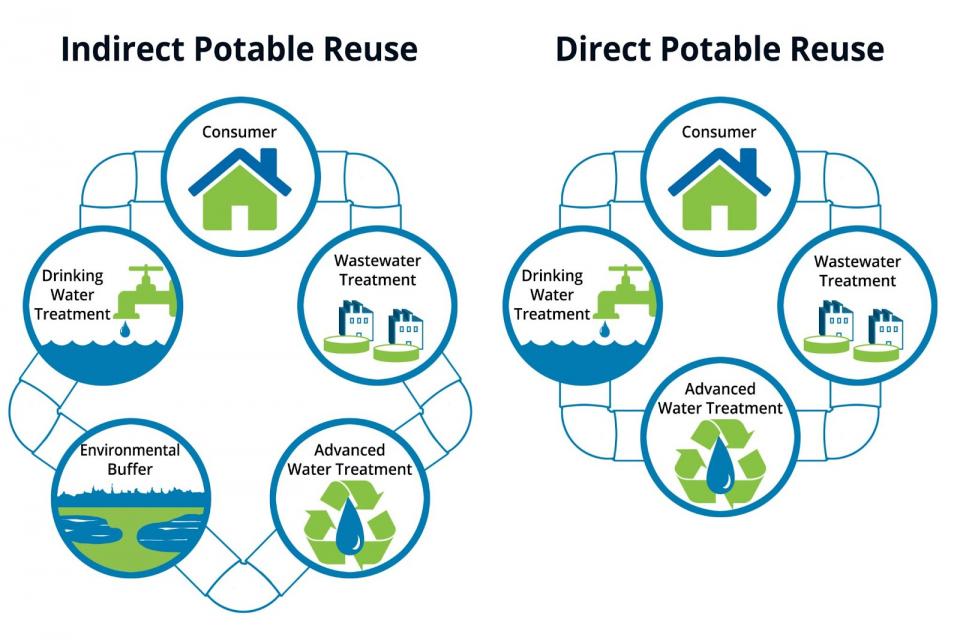
Starting clockwise from the consumer, the diagrams illustrate the conventional (left) and new (right) methods of treating wastewater to drinking water standards. Source: Wikimedia Commons
The allure of direct potable reuse or “advanced water purification,” is its ability to quickly get highly treated wastewater into the drinking water supply. The method treats wastewater through a three-step purification process involving membrane bioreactors, reverse osmosis and ultraviolet light disinfection and adds it to a drinking water source without going through an environmental buffer.
The method also promises to be energy efficient. A 2021 study found that putting recycled water directly into the water supply requires far less power than long-distance water transfers or seawater desalination.
A more widely used water recycling method known as “indirect potable reuse” requires treated wastewater to first go through an environmental barrier such as an aquifer where it is filtered naturally through layers of sand and gravel. The water is then pumped from the ground and treated again before entering the drinking water supply.
Orange County pioneered the technology in the early 1970s to increase its drinking water supply and replenish aquifers along the Southern California coast as a barrier to seawater intrusion. The county water district operates the world’s largest plant of its kind.
Direct potable reuse has been used sparingly in parts of rural Texas, but Phoenix is looking to do it on a mass scale. And the city is wasting little time: The Phoenix City Council recently committed $30 million toward retrofitting a shuttered water recycling operation for advanced purification, even though Arizona regulators have yet to finalize rules for the technology.
Nazario Prieto, assistant director of Phoenix’s wastewater division, said the closed Cave Creek Reclamation Plant in north Phoenix is a perfect candidate for direct potable reuse as it’s near a facility that treats Colorado River water. A short pipeline could connect the two plants, allowing the recycled product to be blended with the Colorado River supply.
“This is going to play a big role in our water resources portfolio, especially with the uncertainty on the Colorado River,” Prieto said. “Water’s precious here in the desert and this is a sustainable resource that keeps coming to us in the form of wastewater.”
Phoenix is also exploring the construction of a larger, regional wastewater plant to serve Scottsdale, Tempe, Glendale, Mesa and other cities in the metropolitan area. A regional plant would be able to treat up to 80 million gallons of effluent per day and if built to full capacity, the regional and Cave Creek plants combined could supply about 20 percent of Phoenix’s yearly potable water needs.
The Arizona Department of Environmental Quality expects to issue final direct potable reuse rules by the end of 2024 and begin accepting applications for permits in 2025. It estimates recycled water could stream out of taps as soon as 2027.
Rendering of Phoenix’s proposed Cave Creek direct potable reuse project. Source: City of Phoenix
The massive wastewater recycling plant proposed for Southern California cities has also gained momentum in recent years due to dry conditions across its two key water sources, the Sierra Nevada and the Colorado River Basin. And Southern California is getting some funding help from its neighbors.
Water agencies in Arizona and Nevada are helping to pay for Metropolitan’s project in exchange for to-be-determined slices of Metropolitan’s Colorado River supply. The proposed plant would be built in Los Angeles and could produce up to 150 million gallons of potable water a day, enough to serve more than 500,000 households.
California’s newly adopted rules on direct potable reuse are expected to take effect in April, following a review by the state Office of Administrative Law. From there, Metropolitan would be able to present its plans to the state water board for approval.
The Yuck Factor
Water agencies are moving swiftly to bolster their scarce Colorado River supplies with recycled water, but first, they must convince customers and politicians that drinking water originating from sewage is safe and worth the treatment cost.
Overcoming the so-called “yuck factor” could be a challenge for some utilities, though a recent direct potable reuse survey by the Arizona Department of Environmental Quality found an appetite for the technology. A strong majority — 70 percent of respondents — said they would be “very likely” or “somewhat likely” to drink recycled wastewater. Some of the more skeptical responses included, “It sounds miraculous, but I would be suspicious,” “How will it taste?,” and “Is it safe for pregnant women?”
Phoenix’s Prieto said the city is crafting a public relations blueprint and giving presentations about the technology to a variety of different business and community groups. He said the initial response has been mostly positive.
“Some people thought we were already doing [direct potable reuse],” he said. “We’re hopeful that we can gain the public’s support and that they will see its safe and the best quality water provided anywhere in the city.”
Beer is another tool being used to overcome the yuck factor.
Lucrative craft beer competitions have been held in Arizona that require participants to use recycled wastewater, while Pima County has created a mobile trailer that treats effluent on site at breweries and provides clean water for brewing. Several Arizona and California breweries are now selling beer made with wastewater.
Kathryn Sorensen
Once Arizona and California approve direct potable reuse regulations, water suppliers will have to figure out how to fund the technology.
Phoenix estimates its Cave Creek project will cost approximately $300 million and that a larger regional plant could cost more than $2 billion.
The final price tag for Metropolitan’s project could top $4 billion by the time it’s finished. Both water suppliers are hoping to tap into state and federal grants to offset some of the cost to their ratepayers.
Major cities are likely to become the first adopters of the technology, but the goal is for rural towns to eventually implement it as well.
Recycled water could be a solution in areas that are burdened by poor groundwater quality or those that don’t have access to surface water. The Arizona Department of Environmental Quality said interest in the technology has broadened to smaller cities.
While adopting the recycling technology isn’t cheap, creating a new water source that alleviates pressure on both the Colorado River and aquifers may be priceless.
“It’s one of the biggest and most important tools,” said Sorensen, who is now director of research at the Kyl Center for Water Policy at Arizona State University. “It is absolutely critical to our water future.”
Know someone who wants to stay connected to water in the West? Encourage them to sign up for Western Water and follow us on Twitter, LinkedIn, Facebook and Instagram.
WASHINGTON – The Biden-Harris administration today announced next steps in the Administration’s efforts to protect the stability and sustainability of the Colorado River System and strengthen water security in the West. The Department of the Interior’s Bureau of Reclamation released a revised draft Supplemental Environmental Impact Statement (SEIS) as part of the ongoing, collaborative effort to update the current interim operating guidelines for the near-term operation of Glen Canyon and Hoover Dams to address the ongoing drought and impacts from the climate crisis.
In order to protect Glen Canyon and Hoover Dam operations, system integrity, and public health and safety through 2026 – at which point the current interim guidelines expire – an initial draft SEIS was released in April 2023. Following a historic consensus-based proposal secured by the Biden-Harris administration in partnership with states – which committed to measures to conserve at least 3 million-acre-feet (maf) of system water through the end of 2026 enabled by funding from President Biden’s Investing in America agenda – Reclamation temporarily withdrew the draft SEIS to allow for consideration of the new proposal.
Today’s revised draft SEIS includes two key updates: the Lower Basin states’ proposal as an action alternative, as well as improved hydrology and more recent hydrologic data. The release of the revised draft SEIS initiates a 45-day public comment period.
“Throughout the past year, our partners in the seven Basin states have demonstrated leadership and unity of purpose in helping achieve the substantial water conservation necessary to sustain the Colorado River System through 2026,” said Deputy Secretary Tommy Beaudreau, who led negotiations on behalf of the Administration. “Thanks to their efforts and historic funding from President Biden’s Investing in America agenda, we have staved off the immediate possibility of the System’s reservoirs from falling to critically low elevations that would threaten water deliveries and power production.”
“The Colorado River Basin’s reservoirs, including its two largest storage reservoirs Lake Powell and Lake Mead, remain at historically low levels. Today’s advancement protects the system in the near-term while we continue to develop long-term, sustainable plans to combat the climate-driven realities facing the Basin,” said Reclamation Commissioner Camille Calimlim Touton. “As we move forward in this process, supported by historic investments from the President’s Investing in America agenda, we are also working to ensure we have long-term tools and strategies in place to help guide the next era of the Colorado River Basin.”
Key Components of Revised Draft SEIS
Reclamation conducted updated modeling analyses using June 2023 hydrology for the No Action Alternative, Action Alternatives 1 and 2 from the initial draft SEIS, and the Lower Division proposal. The results of that modeling indicate that the risk of reaching critical elevations at Lake Powell and Lake Mead has been reduced substantially. As a result of the commitment to record volumes of conservation in the Basin and recent hydrology, the chance of falling below critical elevations was reduced to eight percent at Lake Powell and four percent at Lake Mead through 2026. However, elevations in these reservoirs remain historically low and conservation measures like those outlined by the Lower Division proposal will still be necessary to ensure continued water delivery to communities and to protect the long-term sustainability of the Colorado River System.
Based on these modeling results, Reclamation will continue the SEIS process with detailed consideration of the No Action Alternative and the Lower Division Proposal. The revised SEIS designates the Lower Division Proposal as the Proposed Action. Alternatives 1 and 2 from the initial SEIS were considered but eliminated from detailed analysis.
Historic Funding from Investing in America Agenda
President Biden’s Investing in America agenda is integral to the efforts to increase near-term water conservation, build long term system efficiency, and prevent the Colorado River System’s reservoirs from falling to critically low elevations that would threaten water deliveries and power production. Because of this funding, conservation efforts have already benefited the system this year.
This includes eight new System Conservation Implementation Agreements in Arizona that will commit water entities in the Tucson and Phoenix metro areas to conserve up to 140,000-acre feet of water in Lake Mead in 2023, and up to 393,000-acre feet through 2025. Reclamation is working with its partners to finalize additional agreements. These agreements are part of the 3 maf of system conservation commitments made by the Lower Basin states, 2.3 maf of which will be compensated through funding from the Inflation Reduction Act, which invests a total of $4.6 billion to address the historic drought across the West.
Through the Bipartisan Infrastructure Law, Reclamation is also investing another $8.3 billion over five years for water infrastructure projects, including water purification and reuse, water storage and conveyance, desalination and dam safety.
To date, the Interior Department has announced the following investments for Colorado River Basin states, which will yield hundreds of thousands of acre-feet of water savings each year once these projects are complete:
$281 million for 21 water recycling projects that are expected to increase annual water capacity by 127,000 acre-feet annually;
$71 million for 32 drought resiliency projects to expand access to water through groundwater storage, rainwater harvesting, aquifer recharge and water treatment;
$50 million over the next five years to improve key water infrastructure and enhance drought-related data collection across the Upper Colorado River Basin; and
The process announced today is separate from the recently announced efforts to protect the Colorado River Basin starting in 2027. The revised draft SEIS released today would inform Reclamation’s ongoing efforts to set interim guidelines through the end of 2026; the post-2026 planning process advanced last week will develop guidelines for when the current interim guidelines expire.
Updated Colorado River 4-Panel plot thru Water Year 2022 showing reservoirs, flows, temperatures and precipitation. All trends are in the wrong direction. Since original 2017 plot, conditions have deteriorated significantly. Brad Udall via Twitter: https://twitter.com/bradudall/status/1593316262041436160
Click the link to read the release on the Reclamation website (Chelsea Kennedy):
The Bureau of Reclamation awarded funding for 15 projects under the Desalination and Water Purification Research program. The research projects are innovative solutions that seek to reduce water treatment costs and improve performance.
“Developing new technologies that can treat currently unusable water will help communities worldwide,” said Research and Development Program Manager Ken Nowak. “These technologies have the potential to increase water supply flexibility under the risks of climate change and drought.”
The Desalination and Water Purification Research Program provides financial assistance for advanced water treatment research and development, leading to improved technologies for developing water supply from non-traditional waters, including seawater, brackish groundwater, and municipal wastewater, among others.
In addition to the $4 million in federal funding provided for selected projects, recipients have committed an additional $3 million of non-federal cost share to further support these research efforts.
Alabama
University of Alabama ($249,966 federal funding, $499,932 total project cost) : Engineering Sustainable Solvents for Brine Desalination. This project seeks to improve solvent performance in temperature swing solvent extraction for brine desalination through experimental and computational techniques.
California
Pacifica Water Solutions, LLC ($350,000 federal funding, $700,000 total project cost): Field Pilot Testing Electrically Conducting Nanofiltration and Reverse Osmosis Membranes. This project will field test innovative anti-scaling and antifouling electrically conducting desalination membranes against commercial membranes for reverse osmosis concentrate minimization and produced water applications.
University of California, Riverside ($250,000 federal funding, $390,754 total project cost): Development of a Novel Vacuum-ultraviolet Photochemical System for Treatment of Nitrate and Per Fluorinated Substances from Inland Desalination Brine. This project will test a novel laboratory-scale vacuum ultraviolet light-driven photochemical process for treatment of nitrate and perfluoroalkyl substances (PFASs) from inland desalination brine.
Colorado
University of Colorado ($592,703 federal funding, $756,246 total project cost): Concentrate Minimization: Pilot Testing of Improved Static Mixer Crystallizers. This project will perform pilot scale testing and evaluation of improved in-line, static mixer elements to accelerate the desupersaturation of reverse osmosis desalination brine.
University of Colorado ($250,000 federal funding, $396,501 total project cost): Robust Surface Patterned Membranes for Membrane Distillation of High Salinity Brine with High Efficiency. This project aims to develop and test scalable, robust, surface-patterned microporous membranes that are designed for a membrane distillation process treating highly concentrated brines.
Mickley & Associates LLC ($111,500 federal funding, $234,150 total project cost): Brine Mining. The project will gather, analyze, and synthesize information from the literature, websites, and interviews to bring clarity to many issues involving brine mining, such as potential benefits, feasibility, applicable technologies, recoverable compounds, and more.
Indiana
Purdue University ($250,000 federal funding, $465,799 total project cost): Batch Counterflow Reverse Osmosis. This project will develop lab-scale demonstration of batch counterflow reverse osmosis to achieve high recovery and efficiency and develop a fundamental understanding of fouling kinetics for the process.
Massachusetts
Tufts University ($249,994 federal funding, $407,733 total project cost): New Fouling-Resistant, Anti-Microbial Membranes for Pretreatment. This project aims to develop and demonstrate ultrafiltration pretreatment membranes that resist organic fouling and biofouling through dual mechanisms, manufactured through a novel scalable manufacturing process.
Minnesota
University of Minnesota ($249,853 federal funding, $249,853 total project cost): Crystallization Kinetics: Toward the Useful Separation of Salts in Enhanced Evaporation Systems. This project seeks to leverage the research team’s detailed understanding of the spatial and temporal temperature variation and brine evaporation behavior in enhanced evaporation systems to intentionally, and selectively, precipitate salt in distinct locations for collection and reuse.
New Mexico
New Mexico Institute of Mining and Technology ($249,896 federal funding, $499,792 total project cost): Advanced Hybrid Membrane Process for Simultaneous Recovery of Clean Water and Lithium from High Salinity Brines. This project seeks to develop an innovative hybrid membrane process for simultaneous recovery of clean water and lithium from high-salinity brines.
Pennsylvania
Temple University ($250,000 federal funding, $500,972 total project cost): Synergistic Integration of Electroactive Forward Osmosis and Microbial Desalination Cells for Energy-Neutral Desalination. The goal of this project is to develop an energy-neutral seawater desalination system by integrating electroactive forward osmosis and microbial desalination cells.
Tennessee
Vanderbilt University ($250,000 federal funding, $518,463 total project cost): Selective Removal and Degradation of PFAS via Cyclic Adsorption-electrooxidation on Conductive Functionalized Cu-MOF-aminated-GO. This project aims to develop a fundamentally new approach to selectively remove PFAS from water using a metal organic framework and degrade it to ensure complete removal.
Texas
William Marsh Rice University ($250,000 federal funding, $332,842 total project cost): Ion Exchange Membranes with Tunable Monovalent Ion Permselectivity to Maximize Water Recovery in Desalination. This project seeks to improve the performance of electrodialysis technologies by developing ion exchange membranes with tunable ion permeability and permselectivity for desalination applications.
Freese and Nichols, Inc. ($231,710 federal funding, $539,945 total project cost): Strategies for Gaining Pathogen Removal Credit for Reverse Osmosis in Potable Reuse in Texas (and Beyond). This project will facilitate the identification and evaluation of strategies for gaining pathogen removal credit for reverse osmosis in potable reuse applications in Texas and beyond.
Virginia
George Mason University ($250,000 federal funding, $500,203 total project cost): Engineering Spatial Wood Carbon Scaffolds with Nanocellulose Fillers for Water Deionization. This project seeks to create an innovative and energy-efficient capacitive deionization process with the help of biomass-based advanced porous structures for water desalination and purification.
For more information on Reclamation’s Desalination and Water Purification Research Program visit www.usbr.gov/research/dwpr.
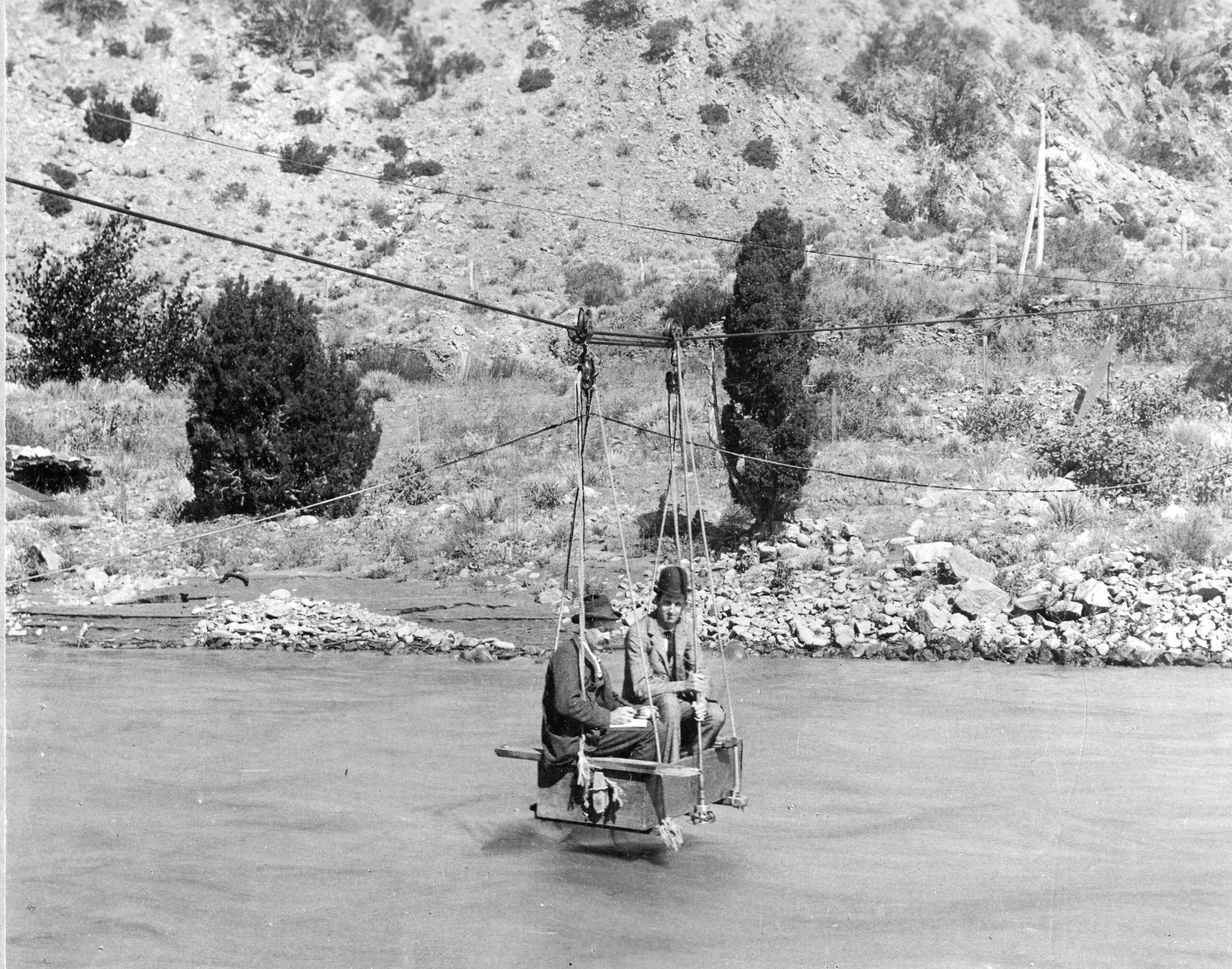
Just another day on the job in 1890 – Measuring the velocity of streams in a cable-suspended, stream-gaging car on the Arkansas River in Colorado. Photo credit: USGS
Here’s the releasee from the Arkansas River Basin Water Forum (Joe Stone):
The premier water event in Colorado’s largest river basin happens Tuesday and Wednesday, April 25-26, in Colorado Springs. The 27th Arkansas River Basin Water Forum will feature discussions and presentations on “Facing the Future Together” delivered by top water experts in Colorado and the Ark Basin.
Tuesday’s keynote speaker will be Kelly Romero-Heaney, assistant director of water policy for Colorado’s Department of Natural Resources. Kelly has over 20 years of diverse experience in natural resource issues, having worked as a consultant, hydrologist, environmental specialist and wildland firefighter. In her current position she advises top executives at DNR, the Division of Water Resources and the Colorado Water Conservation Board about water policy issues and legislation.
Rachel Zancanella will deliver Wednesday’s keynote address. Rachel was promoted to Division 2 (Arkansas River Basin) engineer in December 2022 following Bill Tyner’s retirement. She has held multiple positions with DWR, ranging from deputy water commissioner to water resources engineer and lead assistant division engineer. Prior to joining DWR, Rachel worked as a water resources engineer in the private sector.
Mornings at the Water Forum will feature presentations on topics like projects in El Paso County to meet future demand for water, technological advances in snow measurement, transforming landscapes to conserve water, and PFAS mitigation in drinking water supplies.
After lunch, attendees can choose from several tours and field trips. Tuesday afternoon will feature:
A field trip to explore aquifer recharge and water reuse in El Paso County.
A tour of the Mesa Garden, a demonstration garden for water-wise landscapes.
A tour of Fountain Creek that will highlight the importance of Plains fish conservation and visit streamgages managed by DWR and the U.S. Geological Survey.
Wednesday afternoon opportunities include:
A tour highlighting pioneering work in PFAS mitigation using strong base anion ion exchange resin.
A filed trip to Colorado Springs Utilities to see how non-potable water is being reused.
An Art and Ale tour that will feature murals created through the Storm Drain Art Project followed by a visit to a Fountain Creek Watershed District Brewshed Alliance brewery.
Since 1995, the Ark River Basin Water Forum has served the basin by encouraging education and dialogue about water, the state’s most valuable resource, and this year’s Forum will take place at the Doubletree by Hilton.
The Forum remains a very good value:
Two-day full registration, including lunches – $300.
One-day registration, either Tuesday or Wednesday, including lunch – $150.
Percolation and Runoff networking dinner – $20 (all proceeds support the ARBWF Scholarship Fund).
The real fun begins at 5 p.m. Tuesday with Percolation and Runoff, a casual networking event that raises money for the Forum’s college scholarship fund. The $20 cost includes dinner, drinks and entertaining conversation.
To register for the Forum, go to arbwf.org. For more information, contact Jean Van Pelt, Forum manager, at arbwf1994@gmail.com.
Following a visit to the Gila River Indian Community, Deputy Secretary of the Interior Tommy Beaudreau, Senior Advisor to the President and White House Infrastructure Implementation Coordinator Mitch Landrieu, and Deputy Bureau of Reclamation Commissioner David Palumbo announced up to $233 million in historic funding and conservation agreements to help the Gila River Indian Community and water users across the Colorado River Basin protect the stability and sustainability of the Colorado River System. They were joined by federal, state, local and Tribal leaders.
The visit is part of the Biden-Harris administration’s Investing in America tour to highlight the opportunities that the Bipartisan Infrastructure Law and Inflation Reduction Act are creating. Combined, these laws represent the largest investments in climate resilience in the nation’s history and provide unprecedented resources to support the Administration’s comprehensive, government-wide approach to make Western communities more resilient to drought and climate change.
“Through the Bipartisan Infrastructure Law and Inflation Reduction Act, we have historic, once-in-a-generation investments to expand access to clean drinking water for families, farmers and Tribes,” said Deputy Secretary Beaudreau. “In the wake of record drought throughout the West, safeguarding Tribal access to water resources could not be more critical. These types of agreements will support Tribal communities through essential water infrastructure projects and support water conservation in the Colorado River System.”
“Water is a sacred resource and crucial to ensuring the health, safety and empowerment of Tribal communities,” said Deputy Commissioner Palumbo. “The Bureau of Reclamation is hard at work to support projects that have long awaited this kind of funding — projects that are integral to protecting the Colorado River System and the communities that rely on it. By working together, we can ensure the longevity of the basin.”
The Gila River Indian Community will receive $50 million in funding from the Inflation Reduction Act via the Lower Colorado River Basin System Conservation and Efficiency Program, which will help finance a system conservation agreement to protect Colorado River reservoir storage volumes amid persistent climate change-driven drought conditions. This conservation initiative will result in nearly 2 feet of elevation in Lake Mead for the benefit of the Colorado River System. The agreement also includes the creation of up to 125,000 acre-feet of system conservation water in both 2024 and 2025, with an investment of an additional $50 million for each additional year. This is among the first allocations for a system conservation agreement from the Lower Colorado River Basin System Conservation and Efficiency Program.
In October 2022, the Department announced the creation of the Lower Colorado River Basin System Conservation and Efficiency Program to help increase water conservation, improve water efficiency, and prevent the System’s reservoirs from falling to critically low elevations that would threaten water deliveries and power production.
In addition, the Department announced $83 million for the Gila River Indian Community’s Reclaimed Water Pipeline Project to expand water reuse and increase Colorado River water conservation. The project will provide a physical connection of reclaimed water to Pima-Maricopa Irrigation Project facilities. When completed, the project will provide up to 20,000 acre-feet annually for system conservation with a minimum of 78,000 acre-feet committed to remain Lake Mead. Funding for the pipeline project comes from the Bipartisan Infrastructure Law and annual appropriations.
The Bipartisan Infrastructure Law including $8.3 billion for Reclamation water infrastructure projects over five years to advance drought resilience and expand access to clean water for families, farmers and wildlife. The investment will repair aging water delivery systems, secure dams, complete rural water projects, and protect aquatic ecosystems. The Inflation Reduction Act is investing another $4.6 billion to address Western drought.
More information on the Administration’s all-of-government effort to support the Colorado River Basin is available via a White House fact sheet.
Gila River. Photo credit: Dennis O’Keefe via American Rivers
Click the link to read “Arizona tribe will receive millions in federal payouts for water conservation” on the KUNC website (Alex Hager). Here’s an excerpt:
The Gila River Indian Community will conserve 125,000 acre-feet of water and receive $50 million from the Inflation Reduction Act in exchange. The tribe has the option to do so again in 2024 and 2025, receiving another $50 million in each additional year. That water will stay in Lake Mead, the nation’s largest reservoir, where historically-low water levels threaten hydropower production within the Hoover Dam, and have raised concerns about the reservoir’s long-term ability to provide water to millions of people in cities such as Phoenix, Las Vegas and Los Angeles. Those payments would break down to $400 per acre-foot of water…
The tribe will also receive $83 million from the Bipartisan Infrastructure Law to expand water reuse efforts. It will fund a reclaimed water pipeline that, when completed, will add up to 20,000 acre-feet annually for system conservation with a minimum of 78,000 acre-feet committed to remain Lake Mead…Sarah Porter, director of the Kyl Center for Water Policy at Arizona State University, cautioned that funding sent to the Gila River Indian Community is not necessarily indicative that the federal water conservation program is working at a broader level.
“It doesn’t say as much as we might hope,” Porter said, “Because this program is competing with current commodity prices. I have asked a few growers who have the opportunity to participate if they will, and it’s clear that the high price of different agricultural commodities is getting in the way. The Gila River Indian community is in a unique position to participate.”
[…]
Current guidelines for the Colorado River are set to expire in 2026, and states are expected to negotiate a new set of rules for how it’s shared. As climate change shrinks supplies, state and federal governments have assembled a patchwork of short-term conservation agreements to chip away at demand and prevent catastrophe before then.
Aurora is planning an expansion to its innovative Prairie Waters project with the help of a $5 million federal grant, a project that city staffers say could recover enough water to support thousands of homes. The grant, which the federal government says the city is likely to receive, would be used toward the $11.5 million undertaking of digging a new pump station and radial well, which would draw water from below the South Platte River.
“Drought has been something we’re needing to tackle and handle more and more as the years go on, and so having this resource come from the South Platte instead of the mountains is definitely a drought resiliency component,” said Aurora Water staffer Justin Montes, who applied for the federal grant…
Radial wells consist of a single vertical shaft ending in multiple horizontal shafts that radiate outward like the spokes of a wheel. The radial well and pump station would be part of an expansion to the Prairie Waters project including another radial well that the city plans to dig in 2024. Aurora Water representatives say the entire expansion has the potential to double the water recovered by the project, which uses wells dug near the South Platte River to collect water that has been absorbed and naturally filtered by the riverbank. By the time water is collected by the wells, it has already passed through hundreds of feet of sediment beneath the South Platte, filtering out pathogens, organic chemicals and other contaminants. Montes said the process can also filter out debris introduced by wildfires.
The Las Vegas Wash is the primary channel through which the Las Vegas Valley’s excess water returns to Lake Mead. Contributing approximately 2 percent of the water in Lake Mead, the water flowing through the Wash consists of urban runoff, shallow groundwater, storm water and releases from the valley’s four water reclamation facilities. Photo credit: Southern Nevada Water Authority
Click the link to read the article on The Denver Post website (Conrad Swanson). Here’s an excerpt:
Even when water is scarce, “people still flush their toilets,” former U.S. Bureau of Reclamation Commissioner Dan Beard said.
This story is one part of a broader series about ways to save water from the drying Colorado River. See the full project here.
We all use the bathroom, clean our clothes, wash our dishes, take showers or baths, why not collect that water and reuse it? It’s already happening around the world and it’s a technology that’s proven to work.
Graywater system schematic.
Water providers can collect what’s called grey water from sinks, bathtubs, showers and laundry machines or even sewage, called blackwater, and treat it for reuse. Fort Collins began allowing grey water systems to be installed in the new buildings this summer and that water can be used to flush toilets or for below-ground irrigation. Mayor Jeni Arndt said using that water twice, whenever possible, is the responsible thing to do. She acknowledged that the approach might only save a few gallons per home each day but everything counts, plus the approach is a good way to encourage residents to think more sustainably about their water use…In some cases, the water can be treated and transformed back into drinking water. But it’s even easier to use the water again for non-potable purposes like irrigating crops, watering lawns, recharging groundwater sources and industrial uses, depending on how thoroughly it’s treated. Unlike desalination plants, Beard said water treatment plants could be built for much less money and within the span of a year or two. So they’re relatively quick and effective and a wise way to care for the water that’s already in use…
Plus, Jay Famiglietti, director of the Global Institute for Water Security at the University of Saskatchewan, said there’s only ever going to be so much water available for reuse.
“It’s driven by your supply of human waste,” he said. “That’s as much as you’re going to get.”
Filtration pipes at Metropolitan Water District of Southern California’s wastewater recycling demonstration plant. (Source: Metropolitan Water District of Southern California)
Colorado regulators, after years of study, negotiations and testing, approved a new rule that clears the way for drinking treated wastewater this week, one of only a handful of states in the country to do so.
The action came in a unanimous vote of the Colorado Water Quality Control Commission Oct. 11.
Direct potable reuse (DPR) involves sophisticated filtering and disinfection of sewage water for drinking water purposes, with no environmental buffer, such as a wetland or river, between the wastewater treatment plant and drinking water treatment plant. That water is then sent out through the city’s drinking water system.
Colorado joins Ohio, South Carolina and New Mexico in setting up a regulated DPR system, with California, Florida and Arizona working to develop a similar regulatory scheme, according to Laura Belanger, a water reuse specialist and policy advisor at Western Resource Advocates.
Ron Falco, safe drinking water program manager for the Colorado Department of Public Health and Environment (CDPHE), said the new regulation would provide communities across the state important access to a new, safe source of drinking water, a critical factor in a water-short state.
“This is going to be a need in Colorado and we want to be prepared,” he said. “Can DPR be done safely? Our answer to that is yes.”
Aurora has had a reuse system in place for more than a decade that also uses treated wastewater. But Aurora’s water is treated and released from the wastewater treatment plant into the South Platte River, where it flows through the river’s alluvial aquifer, before Aurora pumps it out through groundwater wells. Aurora then mixes it with raw mountain water before treating it and distributing it to customers. That practice is known as indirect potable reuse — there’s an environmental buffer between the wastewater plant and the drinking water plant, in Aurora’s case, that’s the river. Indirect potable reuse is used by several big cities nationwide, including San Diego.
Graphic by Chas Chamberlin, Source: Western Resource Advocates
Under Colorado’s new regulation, water providers will be required to show they have the technical, managerial and financial resources needed to successfully treat wastewater.
Communities will also be required to show how they will remove contaminants in their watersheds before the water reaches rivers and streams.
Wastewater intended for drinking will require extensive disinfection and filtration, among other techniques, all of which are intended to eliminate pathogens like viruses and bacteria, and remove drugs and chemicals to safe and/or non-detectable levels, according to CDPHE.
And any community that seeks to add treated wastewater to its drinking water system will have to set up extensive public communication programs to show the public its process and to help educate residents about this new water source.
Communities will also have to collect a year’s worth of wastewater samples and prove that they can be successfully treated to meet the new standards.
Western Resource Advocates’ Belanger, who has long advocated for the use of DPR, said the approval has been a long time coming and is cause for celebration.
“We believe DPR is a very important water supply for our communities now and into the future. We feel [this new regulation] is robust and protective of public health.”
But key to tapping the new water source will be helping the public get over the “ick factor,” officials said.
Jason Rogers, vice chair of the Water Quality Control Commission who is also Commerce City’s director of community development, said public outreach should be carefully monitored to ensure it is actually reaching people in all communities and that it is being well-received.
“When thinking about that public meeting, where does it occur? People in some of these communities may have a high reliance on multi-modal transportation, it may not allow for that meaningful engagement,” Rogers said. “And if it isn’t being well received, we need to have them go out and do more public engagement.”
With a mega drought continuing to grip the Colorado River Basin and other Western regions, Colorado’s multi-year process to develop a sturdy new drinking water regulation drew widespread attention, said Tyson Ingels, the head drinking water engineer at the state’s Water Quality Control Division.
Ingels said Utah and Arizona participated in Colorado’s work sessions, demonstrating the interest in what could become an important new water source in the West. Arizona is just now kicking off its own rulemaking process, Ingels said, and Utah, while not yet regulating DPR, has seen a handful of communities proposing to use DPR.
Colorado’s rulemaking process, which dates back to 2015, was at times fractious, with water providers and wastewater operators concerned that the proposed regulation would interfere with what they’re doing already and could add burdensome costs to efforts to develop new water sources.
Ingels said the addition of a third-party facilitator was essential to resolving everyone’s concerns.
Jeni Arndt, a former lawmaker who also serves on the water quality commission, said finalizing the groundbreaking new regulation signaled an important step forward in navigating difficult public policy issues. [Editor’s note: Arndt is a former board member of Water Education Colorado, which sponsors Fresh Water News.]
“Gone are the days when we were struggling to come to agreement,” Arndt said. “I’m very excited to move forward into a new era.”
On Tuesday, several water utilities spoke in favor of the new regulation, including the Cherokee Metropolitan District, Castle Rock, and the City of Aurora.
Matt Benak, Castle Rock’s water resources manager, said the regulation will give his town the certainty it needs to move forward developing new water supplies. “DPR is a critical tool for sustainable water resources. Creating this regulation will allow water providers like us to plan and to potentially implement DPR,” he said.
Tuesday’s approval was contingent on fixing minor clerical errors in the regulation. Commissioners will give final formal approval of the regulation at its November meeting.
Jerd Smith is editor of Fresh Water News. She can be reached at 720-398-6474, via email at jerd@wateredco.org or @jerd_smith.
Denver Botanic Gardens was live-Tweeting from the summit yesterday. Here’s their Twitter feed. (They did not use the hash tag #shed22.)
Here’s the link to the #shed22 Twitter stream. I am always blown away at the insight and awareness displayed by others around me at theses events.
Denver Botanic Gardens is a great venue for the summit. If you need to get up and walk around to clear your mind you can take in the sights of the gardens.
Metropolitan Water District’s advanced water treatment demonstration plant in Carson. (Source: Metropolitan Water District of Southern California)
Metropolitan Water District’s wastewater recycling project draws support from Arizona and Nevada, which hope to gain a share of metropolitan’s river supply
Momentum is building for a unique interstate deal that aims to transform wastewater from Southern California homes and business into relief for the stressed Colorado River. The collaborative effort to add resiliency to a river suffering from overuse, drought and climate change is being shaped across state lines by some of the West’s largest water agencies.
Southern California’s giant wholesaler, Metropolitan Water District, claims a multi-billion-dollar water recycling proposal will not only create a new local source for its 19 million customers, but allow it to share part of its Colorado River supply with other parched river partners already facing their own cutbacks. To advance what would become the nation’s largest wastewater recycling facility, Metropolitan is securing financial aid from other major Colorado River users in Nevada and Arizona in return for giving them portions of its river supply. Amid critically low reservoir levels and the first-ever shortage declaration on the Colorado River, water managers and experts are touting the interstate deal as a prime example of the team effort required to safeguard the future of this iconic Southwestern river and the people who rely on it.
“It’s a really interesting and innovative approach around partnerships,” said Heather Cooley, research director with the Pacific Institute, an Oakland-based water policy center. “Something we haven’t yet seen.”
Thus far the project appears long on support, but there are some potential impediments, such as whether the next set of river operating guidelines due in place by 2026 will allow the partners’ proposed long-term interstate water exchanges. Additionally, California regulators must clear the way for Metropolitan and others in the state to put the recycled supply directly into the drinking water system.
Drought in the Colorado River Basin has pushed the water level in Lake Mead, Southern Nevada’s main water source, to a historic low. (Source: Southern Nevada Water Authority)
Aid for the Struggling Colorado
Metropolitan pitched the ambitious wastewater recycling proposal more than a decade ago, but the project gained steam recently amid increasingly dry conditions across two of its key water sources in California’s Sierra Nevada and Colorado River Basin. Water interests along the lower Colorado River Basin have for several years discussed how they might augment the river’s shrinking flows. As it turned out, the Lower Basin’s next potential augmentation project is being hatched more than 200 miles away near the coast of California.
Southern Nevada Water Authority, the Central Arizona Project and the Arizona Department of Water Resources have agreed to spend up to a combined $12 million to assist Metropolitan with environmental review, almost half of the total planning cost. If the project isn’t built, or if operating agreements aren’t finalized, Metropolitan would refund the agencies’ contributions. However, if the Nevada and Arizona agencies stay on to help build the final project, they will gain to-be-determined slices of Metropolitan’s annual share of Colorado River water.
The partnering agencies are currently grappling with major cuts to their own Colorado River supply, and more are on the horizon.
Last summer, the Bureau of Reclamation declared a first-ever shortage in the Lower Colorado Basin, requiring Arizona to slash its annual take of the river by 18 percent and Nevada by 7 percent in 2022. But the mandated cuts have done little to protect water levels at the river’s two main reservoirs, Lake Mead and Lake Powell, and now federal officials are on the verge of implementing a fresh round of unprecedented reductions that stand to affect supply for the Lower Basin states.
Metropolitan’s assistant general manager calls the deal a win-win for Southern California and the Southwest.
“The idea of the program is that in return for their co-investment to make this facility a reality, we would back off some of our Colorado supply,” Deven Upadhyay said. “It becomes one component of potential augmentation on the river to help others out.”
Boosting Water Security
At full capacity, Metropolitan’s wastewater recycling plant could produce up to 168,000 acre-feet a year. However, Upadhyay said Metropolitan doesn’t plan to make a corresponding amount of its river share available to the out-of-state investors.
But gaining even a sliver of Metropolitan’s Colorado River supply could boost water security for arid Arizona and Nevada.
“We’re at a point in this Basin where we can’t afford to not look at reasonable ideas,” said Colby Pellegrino, deputy general manager of resources for the Southern Nevada Water Authority.
Contract details haven’t been finalized but Pellegrino estimates SNWA could secure between 25,000-35,000 additional acre-feet annually, or around 10 percent of its yearly river apportionment. In Las Vegas, one acre-foot of water is enough to serve two households for more than a year, though officials are continually striving to reduce per capita water use.
Meanwhile SNWA, which relies heavily on Lake Mead to serve its more than 2 million customers in the fast-growing Las Vegas area, appears wholly interested in seeing the project through. It has already earmarked up to $750 million for Metropolitan’s proposal or other recycling projects. Such a major investment would require a long-term operating contract potentially in the 20- to 30-year range, Pellegrino said.
The partnership also figures to afford some long-term water security for Arizona, which takes the biggest hit of any state when shortages are declared on the Colorado River. Currently Arizona is grappling with how to cut 512,000 acre-feet and it faces further reductions if Lake Mead’s elevation drops below 1,045 feet and a Tier 2 shortage is triggered, a scenario the Bureau of Reclamation projects could happen by May 2023.
Gaining reliable access to Metropolitan’s river allotment could help Arizona address growing demand from municipal and industrial users, said Sarah Porter, director of the Kyl Center for Water Policy at Arizona State University. Porter applauded the multi-state collaboration, saying the recycling project and other augmentation ideas, like a proposed binational desalination plant along the Sea of Cortez in Mexico, could add flexibility to a system that serves 40 million people from Denver to San Diego and irrigates more than 4 million acres of farmland.
“It’s a huge amount of water,” Porter said of the potential yield of Metropolitan’s project for urban Southern California. “That’s one more community that relies on the Colorado River that has another degree of resilience.”
Graphic showing how purified wastewater is expected to flow to various locations in urban Southern California. Water from Metropolitan Water District’s Advanced Water Treatment Plant would flow to various sites for use in replenishing groundwater or delivery to water treatment plants for distribution to ultimate users. (Source: Metropolitan Water District of Southern California)
A Promising Leap in Reuse
California already has a rich legacy of turning wastewater into high-quality water suitable for a variety of uses including agricultural, groundwater recharge and outdoor irrigation. In 2020 the state used more than 700,000 acre-feet in recycled water, much of it going to golf courses, farms and some indirect potable uses. But experts say California can greatly expand the output through a recycling technology Metropolitan is currently ginning up support for.
Filtration pipes at Metropolitan Water District of Southern California’s wastewater recycling demonstration plant. (Source: Metropolitan Water District of Southern California)
Direct potable reuse, however, is not currently permitted in California, but the State Water Resources Control Board is expected to finalize regulations by December 2023. To prove to regulators and the public that the process is safe and viable, Metropolitan has been compiling water quality data from a demonstration facility in Carson since 2019.
The technology is a great match with a county like Los Angeles where most of the treated wastewater currently goes into the ocean, said Cooley, with the Pacific Institute. With imported water becoming increasingly unreliable, she said it was critical for Southern California to pursue new recycling projects, noting the region currently reuses only 29 percent of its effluent.
“There are lots of opportunities if we start thinking outside the box more and really look beyond individual agency service areas,” Cooley said. “We’re going to have to do more of that to address the challenges that we now face.”
Once California gives the green light, Metropolitan says it will build a facility near the demonstration facility in Carson that could produce up to 150 million gallons a day of potable water or enough to serve more than 500,000 households, using wastewater from a nearby plant operated by the Los Angeles County Sanitation Districts. Purified water from the new recycling plant would be delivered to four of the region’s groundwater basins for later use and two of Metropolitan’s existing treatment plants via approximately 60 miles of new pipelines for further distribution in its service area.
Metropolitan Water District’s advanced water treatment demonstration plant in Carson. (Source: Metropolitan Water District of Southern California)
Overcoming Sticker Shock
Neither construction nor the new water will be cheap.
In 2018 Metropolitan pegged construction costs at $3.4 billion, but inflation could spike the final price tag to $4 billion by the 2032 projected completion date. As for water prices, Metropolitan currently charges its member agencies around $1,100 per acre-foot of treated water; the new supply will likely run more than $1,800 per acre-foot.
Upadhyay, the Metropolitan official, downplayed the difference by saying cost concerns are relatively minor compared to the damaging effects climate change is having on the Colorado River and Sierra Nevada watersheds it relies on for imported water. He added the agency is hoping to reduce the impact on member agencies with contributions from the out-of-state partners. In addition, it has asked the California Legislature to contribute $500 million. Metropolitan also is exploring the possibility of similar partnerships with users of California’s State Water Project, but no contracts have been signed, Upadhyay said.
“It’s not like we can go out and acquire more imported supply,” Upadhyay said. “Going forward, we really need to be looking here at home.”
That sentiment is shared among some agricultural interests in the basin, including Bart Fisher, vice president of the Palo Verde Irrigation District Board of Trustees. Fisher, who farms on the west side of the Colorado River near Blythe, Calif., called urban water recycling efforts the “wave of the future” and noted Palo Verde farmers have been utilizing water reuse techniques for decades.
“These urban projects have major implications for the Lower Basin,” he said. “It will alleviate some of the pressure we are feeling.”
Finding Ways to Work Together
It’s unclear whether current operating guidelines for the river allow the sort of interstate exchange being proposed. But the partners say the concept shares ties with the intent of previously enacted conservation programs like the 2007 Intentionally Created Surplus, a water banking program intended to boost storage in Lake Mead. They hope guidance for interstate exchanges will be explicitly included in the next set of river operating guidelines that have to be finalized by 2026.
“It would behoove all of us to have a candid conversation in the renegotiations about that, make sure we have the rules spelled out,” said Pellegrino, SNWA deputy general manager.
The 20-plus year megadrought is forcing all users in the Lower Basin to get creative in developing ways to stretch their shares of the Colorado River. And the clock is ticking.
Last month water levels at Lake Powell fell to a historic low and are still hovering near the minimum elevation level at which Glen Canyon Dam can generate electricity for more than 5 million homes and businesses across the West. The Bureau of Reclamation expects the combined storage at Lake Powell and Lake Mead to drop below 30 percent by late 2022 due to declining inflows of runoff.
Metropolitan’s wastewater recycling plant won’t cure all the Lower Basin’s myriad water troubles. But Colorado River veterans say the proposal is a welcome sign of progress, nonetheless.
“It’s good to see this multi-state collaboration and that’s what we do need,” said Porter, with Arizona State’s Kyl Center. “It’s better for everyone if we can find these ways to work together.”
Reach Writer Nick Cahill at ncahill@watereducation.org, and Editor Doug Beeman at dbeeman@watereducation.org.
Click the link to read the report on the EPA website. Here’s the executive summary:
Collaboration is the gateway to greatness. Recycled water can be a safe and reliable water supply, but to develop it the agencies responsible for managing water, wastewater, and stormwater must work together. In the United States, this type of cooperation is inhibited by the challenge of aligning missions and allocating responsibilities and costs among separate organizations. Collaboration is also complicated by complex regulations, operational details, and a utility’s natural inclination to maintain independent control of all projects within their jurisdictions.
Recycling wastewater effluent, stormwater, and other impaired sources is an essential element of an integrated, resilient, and sustainable water supply. However, the dominant institutional arrangements in the United States (and most other nations) today constitute a patchwork approach to water resource management. Water utilities and wastewater agencies created years ago in response to historical needs now operate as distinct entities, each with its own legal mandate, service area, professional staff, management team and personality, governance and public oversight structure, regulatory and technological challenges, and financial and economic constraints. While these institutions were well-suited to solve last century’s water problems, they are less able to address today’s challenges that require integrated water management—including water reuse.
Despite this fragmented institutional landscape, many agencies have found ways to work together to create successful regional water reuse programs. By focusing on their common interests and forging durable working agreements, they have joined together to create “virtual” water utilities adding recycled water to their portfolio of supplies to complete the water cycle and achieve greater resilience for their communities. While the challenges are great, these examples of successful partnerships around the United States offer many important lessons.
The National Water Reuse Action Plan Action Item 2.16 was initiated to support the development of multi-agency water reuse programs by identifying “challenges, opportunities and models for interagency collaboration.” This project consists of 1) a framework for evaluating interagency relationships in the water sector (including an annotated bibliography); 2) five case studies of multi-agency reuse projects in the United States; and 3) a summary of “lessons learned,” references, and exercises to help agencies develop more productive collaborations.
We’re partnering with GreenLatinos to spread the word about water reuse in Colorado, and how you can get involved in a proposed regulation. As the population in the state of Colorado increases, so do the demands on water resources. A variety of strategies are being implemented across the state to address projected gaps in water supply, and direct potable reuse (DPR) is one of those strategies. Join GreenLatinos and CDPHE to learn more about the technology and safe practice of DPR, and find out how you can get involved.
As climate change ravages the West, water recycling will become essential, and folks will have to overcome the “ick” factor.PHOTOGRAPH: CITY OF SAN DIEGO
ON A DUSTY hilltop in San Diego, the drinking water of the future courses through a wildly complicated and very loud jumble of tanks, pipes, and cylinders. Here at the North City Water Reclamation Plant, very not-drinkable wastewater is turned into a liquid so pure it would actually wreak havoc on your body if you imbibed it without further treatment.
First the system hits the wastewater with ozone, which destroys bacteria and viruses. Then it pumps the water through filters packed with coal granules that trap organic solids. Next, the water passes through fine membranes that snag any remaining solids and microbes. “The pores are so small, you can’t see them except with a really powerful microscope,” says Amy Dorman, deputy director of Pure Water San Diego, the city’s initiative to reduce its reliance on water imported from afar. “Basically, they only allow the water molecules to get through.”
But to be extra sure, the next step blasts the water with UV light, to obliterate any microbes and other trace contaminants. The end result is water in its purest form—too pure, in fact. The last phase is “conditioning” the liquid by adding minerals back to it. Without that, the water would leach the copper out of pipes. If you drank it, it’d soak up your electrolytes like a sponge.
If that all sounds like a rather convoluted way to get drinking water, that’s because the American West is facing a rather convoluted climate crisis. San Diego—and the rest of Southern California—have historically relied on water from Northern California and the Colorado River. But they’ve always been at the end of the line. The river hydrates 40 million other people in Colorado, Wyoming, Utah, Arizona, Nevada, and New Mexico, and it is withering under a historic drought, a harbinger of even worse water scarcity to come as the climate warms.
So San Diego has to figure out how to do more with less water. The Pure Water program aims to provide more than 40 percent of the city’s water from local sources by the year 2035 by reusing water recycled from homes and businesses. (That means water that has flowed through sinks, showers, toilets, and washing machines.) “We’re diversifying the portfolio,” says Todd Gloria, San Diego’s mayor. “We’re heavily dependent upon water that comes from very far away, and that’s a problem that we have to address.”
The water passes through membranes in these tubes. PHOTOGRAPH: CITY OF SAN DIEGO
[…]
The water-recycling revolution is just getting going in San Diego, but its proponents hope it will ripple across the American West. In June, legislators in the US House of Representatives introduced a bill that would funnel $750 million into water recycling projects in 17 western states through 2027. (The bill hasn’t made it past committee.) “This is beginning to be our new normal—88 percent of the West is under some degree of drought,” Representative Susie Lee (D-Nevada) told WIRED in July. “Lake Mead is at the lowest level it has been at since the Hoover Dam was constructed. And the Colorado River has been in a drought for more than two decades.”
The technology to recycle water on a large scale already exists—it’s been around for half a century, in fact. But the problem is that it can cost billions to build a recycling facility, and you can’t just copy-paste a particular plan from one municipality to the next. The North City Water Reclamation Plant has been experimenting with different kinds of filtering membranes because not all water is the same. For example, the mineral content of the water flowing into the San Diego facility is distinct from what operators might be working with in New York. Recycling plants also cost a pretty penny to run, since pumping lots of water through fine membranes requires significant pressure. But then again, it also takes a lot of energy to pump water from northern areas to Southern California.
From Metropolitan Water District via Smart Water Magazine:
Building on increased collaboration on the Colorado River, water agencies in Southern California and Arizona have forged a new partnership to advance development of one of the largest water recycling plants in the country – a project that would help restore balance to the over-stressed river.
Through an agreement approved Tuesday [October 12, 2021] by Metropolitan Water District’s Board of Directors, the Central Arizona Project and Arizona Department of Water Resources will contribute up to $6 million to environmental planning of the Regional Recycled Water Program, a project to purify treated wastewater to produce a new, drought-proof water supply for Southern California. Southern Nevada Water Authority signed a similar agreement with Metropolitan earlier this year.
If fully developed, the $3.4 billion project would produce up to 150 million gallons daily, enough to serve more than 500,000 homes.
“This project could help the entire Southwest. We know that eliminating the supply-demand imbalance that threatens the Colorado River will take both reducing demand, through conservation, and adding new supplies, like recycled water,” Metropolitan General Manager Adel Hagekhalil said. “That’s why our partners in the Lower Basin are interested in helping us develop the project.”
The initial investment from Arizona could lead to a long-term agreement with the agencies to help fund the project’s construction and operation – helping offset the project’s significant cost for Metropolitan – in exchange for Colorado River water, Hagekhalil said. But more research and planning must be conducted before such a long-term partnership could be developed, he added.
Environmental planning work on the project began last year and will take approximately three years, at a cost of about $30 million. The work, including a Program Environmental Impact Report and engineering and technical studies, will help determine the value and feasibility of developing the full-scale project.
Under the new agreement, the Central Arizona Project will contribute $5 million and the Arizona Department of Water Resources will contribute $1 million to this planning work.
“We are eager to further our partnership with the Metropolitan Water District to collaboratively explore and develop opportunities to improve the long-term reliability and resiliency of our shared resource – the Colorado River,” said Central Arizona Project General Manager Ted Cooke.
The latest agreement reinforces the long-standing commitment between California and Arizona to work together to develop solutions on the Colorado River, including supply augmentation, conservation and storage. This partnership, together with Metropolitan’s collaboration with Nevada, will be critical as the Colorado River Basin states begin to create new operating guidelines for the river. The current guidelines are set to expire in 2025.
“Increasing the reuse of recycled water is critical to augmenting water supplies and creating a more resilient Colorado River,” said Arizona Department of Water Resources Director Tom Buschatzke.
Expanding the value of the Regional Recycled Water Program to the entire Southwest could also help earn federal financial support for the project.
High up on Colorado’s Independence Pass, a narrow, winding road weaves through the evergreens and across mountain streams, up and over the Continental Divide at more than 10,000 feet. At one point that road crosses a canal.
It’s easy to miss if you’re not looking for it, but that canal is part of water infrastructure that makes life on Colorado’s Front Range possible.
The state has a geographical mismatch between where water shows up and where much of the population has settled.
“Wherever you are in this state, you’re either at the source of the drinking water supply, you’re in the middle of the drinking water supply, or you’re at the end of the tap,” said Christina Medved, outreach director at Roaring Fork Conservancy. “So on the Western slope, we are at the source of the water.”
About 80% of Colorado’s water falls on the western side of the state. Much of it is high-mountain snow and rain that eventually trickles down into streams and rivers like the ones on Independence Pass.
But about 80% of Colorado’s people live on the east side of the mountains. Because of gravity, that water doesn’t flow to them naturally. Instead, Colorado’s heavily-populated Front Range relies on a massive plumbing system to keep drinking water flowing to its taps.
Colorado transmountain diversions via the State Engineer’s office
For a century and a half, engineers have carved up the mountains with tunnels and canals that pipe water across the state through trans-mountain diversions. Some of that infrastructure is nestled near the high-alpine headwaters of the Roaring Fork River, which eventually flows through Aspen and Glenwood Springs on its way to the Colorado River. Near Lost Man reservoir, a dam and tunnel create a juncture between water that will follow that natural path westward to the Colorado, and water that will be diverted eastward through the mountains and onto cities such as Colorado Springs.
A tunnel through the mountains draws in water that will pass through two reservoirs and the Arkansas River on its way to the southern portion of the Front Range. Water diverted from the Colorado River basin, through trans-mountain diversions, makes up 60 to 70% of the water used by Colorado Springs. Denver, Greeley, Fort Collins and smaller municipalities on the Front Range also rely heavily on Western Slope water.
And these kinds of set ups aren’t confined to Colorado. Similar systems bring water to big cities all across the region. Salt Lake City, Albuquerque and Los Angeles rely on canals and tunnels to ship faraway water into their pipes. New ones are in the works on the Front Range and in southern Utah.
But these systems aren’t without critics.
Water from the Roaring Fork River basin heading east out of the end of the Twin Lakes Tunnel (June 2016), which is operated by the Twin Lakes Reservoir and Canal Co., a member of the Front Range Water Council. Photo: Brent Gardner-Smith/Aspen Journalism
“When you first learn about it, the concept of a trans-mountain diversion is crazy,” said Andy Mueller, general manager of the Colorado River Water Conservation District. “It seems wrong. It seems antithetical to the health of the river. And I have to say all of that’s true.”
His organization was set up in the 1930s to oppose these diversions and ensure that there is enough water for people on the Western side of the state…
The issue is, contemporary environmental values aren’t written into the West’s water law. Instead, water use is defined by regulations written when Colorado first became a state in the 1800s. The rules say that if you have rights to use water, it doesn’t matter if you want to use it hundreds of miles away from its source – even if that requires miles of cross-mountain plumbing to do so.
Colorado Drought Monitor map July 13, 2021.
At this moment, there is less water to pull from in every part of the state. The Front Range escaped from drought after steady spring rains, but those high-mountain areas that usually provide a dependable source of water for all of Colorado are experiencing a different fate. The western slope is deep in the second year of drought conditions, leaving snowpack and river flows lower than they should be.
Mueller thinks that only sharpens the need for the Front Range to curtail its water use. Although they retain the legal right to use a certain amount of water, he’s asking them to use less – which he says will promote the health of rivers and their ecosystems west of the divide.
The ditch that moves water from Lost Man Reservoir to Grizzly Reservoir and then under the Divide to the South Fork of Lake Creek and the Arkansas River.
On the Front Range, those on the receiving end of diversions say they are listening to their western counterparts when they put up distress signals during particularly critical times. They also say deliberate conservation work is paying off in the longer term. Nathan Elder, water supply manager for Denver Water, said over the past two decades, per capita water use in his district is down by 22%.
“Everyone in Colorado needs to decrease their use,” he said…
Amid tension between demands for water on both sides, exacerbated by extreme drought conditions, is the fact that there is not much of an alternative. Colorado’s water system is built to accommodate the fact that the majority of its people and the majority of its water are far from each other. Without fundamental changes to the bedrock of water law, those asking for water will have to work within a system built on trans-mountain diversions…
Some contingency planning – within the reality of a diversion-centric system – is already in place. In Colorado Springs, which receives some of the flow diverted from the top of Independence Pass, re-use practices are helping the city get more mileage out of the water it’s apportioned.
Graphic credit: Water Education Colorado
Abby Ortega, water resources manager for Colorado Springs Utilities, said reused water accounts for 26% of the city’s total portfolio and the city relies heavily on storage to get through dry years like this one.
Brad Udall: Here’s the latest version of my 4-Panel plot thru Water Year (Oct-Sep) of 2019 of the #coriver big reservoirs, natural flows, precipitation, and temperature. Data goes back or 1906 (or 1935 for reservoirs.) This updates previous work with @GreatLakesPeck
But climate change threatens to increase the frequency and intensity of droughts, which has water managers on edge and looking more intently at ways to maximize what’s available.
“Every water planner in the state has some worry with the rapidly declining hydrology on the Colorado river,” Ortega said.
Much of the groundwater pumped up from the Denver basin in northern and central El Paso County flows down Monument or Fountain creeks, never to be seen again after it’s been used and treated once.
Colorado Springs Utilities, Monument and six groundwater districts want to see that water returned back to homes and businesses to be reused and to help ease the pressure on groundwater.
The groundwater that’s already flowed through showers, sinks and toilets once could potentially be treated and reused twice, and that could help the diminishing aquifer last longer, said Jenny Bishop, a senior project engineer with the water resources group within Colorado Springs Utilities.
Reusing the water could reduce the amount of fresh groundwater that must be pumped annually, limit the need for new wells, give districts more time to pursue additional water rights and make the most of a finite resource, she said. The deeper groundwater in El Paso County is not replenished by rain or other natural sources.
Denver Basin Aquifer System graphic credit USGS.
While Colorado Springs Utilities does not rely on Denver basin groundwater, future water reuse projects identified by an ongoing study involving Monument and the groundwater districts could rely on Utilities infrastructure. In recent years, Utilities has also started to focus more on effective water use across the county.
Utilities “recognizes that long-term water security for the Pikes Peak region depends on the efficient use and reuse of reusable water supplies,” Bishop said.
The Pikes Peak Regional Water Authority Regional Water Reuse Study is going to determine how and where groundwater could be diverted from Monument or Fountain creeks and returned to the water providers. It’s possible the water could be diverted below Colorado Springs and may require new water storage, such as a reservoir or a tank, she said.
Larger projects that could serve multiple water providers, such as Tri-View and Forest Lakes metro districts, are expected to be efficient, Bishop said. The study could also recommend more than one project to recapture water, she said.
Not all of the groundwater that is pumped up from the ground will be available for reuse, because some of it goes into outdoor irrigation, some is used up by thirsty residents, some is lost in the treatment process and some is lost to evaporation in the creeks, among other points of loss. But the water returned to districts could be substantial…
Study participants
The following water providers are participating the water reuse study although not all of them would benefit from groundwater flowing back to be used again. Some are interested in portions of the project like additional water storage
Woodmoor Water and Sanitation District
Town of Monument
Triview Metropolitan District
Forest Lakes Metropolitan District
Cherokee Metropolitan District
Donala Water and Sanitation District
Security Water District
Colorado Springs Utilities…
The $100,000 study to identify the projects that would allow the most water reuse may be finished by the end of the year. The document is expected to project cost estimates for construction and operation of the projects. The work could include new water storage, such as reservoirs.
Funding, permitting and designing the projects is expected to take a few years as well, Bishop said.
Like millions of teens around the world, my daughter enjoys long showers. Unlike many fathers of teens, however, I see a bright side to the family water bill.
We’re not just taking showers. We’re growing grapes.
Our family lives in Israel, the international capital of water recycling, where nearly 90% of our supply is used more than once. In our area of southern Israel, that means the water flowing down our home drain is used on nearby farms to grow some of the tastiest table grapes on Earth. Turns out my daughter is a friend of agriculture.
Ari Goldfarb via Kando.com
All over the globe, climate change is turning fresh water into an increasingly precious commodity. Many countries and regions suffer from extended drought. Rising temperatures increase evaporation from reservoirs. Snow falls less and melts sooner on mountains. And rising sea levels increase saltwater intrusion contamination in fresh water wells along coastal communities.
The worldwide fresh water supply crunch comes as the Earth’s population grows by more than 80 million people per year.
With increasing demand for water and a jeopardized supply, communities increasingly are turning to recycling technologies to stretch and make the most efficient use of existing water supplies. Critical to this is having a clear understanding of the quality of the water coming into any treatment plant before it is recycled.
The greatest reuse per capita is happening in arid Middle Eastern countries such as Israel, Qatar, and Kuwait, though the No. 1 recycler of water by volume is the United States. The leading states for water recycling are Florida, California, Texas, Arizona, Nevada, and Colorado.
In Orange County, California, engineers found it’s 15% cheaper to recycle water than to buy new supplies from rivers and reservoirs.
But what about the yuck factor?
The most important thing to remember is: No matter the water source — untrammeled mountain spring, or the river mouth of a major industrial city — it all must pass stringent health and safety tests before reaching your tap. In fact, recycled water often faces tougher quality control tests than river or lake water. Water reuse is safe.
Another key point is that we’ve been relying on recycled water for years without realizing it. In the Southwestern United States, stream water in places like the Rio Grande and Colorado River is typically used several times before it ever reaches the ocean. (The demands on the Colorado River are so great from Colorado to Mexico that it sometimes does not contain enough water to reach the sea.) The same water used by cities near the headwaters is used again and again downstream by farmers for irrigation.
Few people have second thoughts about using the same air as someone else. Why think about water differently?
It’s important to remember that the vast majority of water, whether recycled or first-use, does not go to the tap for drinking. It’s for growing crops, irrigating parks and golf courses, and watering lawns. In many places where water is scarce, it’s possible, and often economical, to set up two separate water systems, one for outdoor and one for indoor potable use.
Almost every city using recycled water in the U.S. sends the treated supply outside. Some cities pump recycled water underground to replenish aquifers. Most, however, reuse the water as an irrigation supply for farming or landscaping. One advantage of using recycled water outdoors: natural cleansing processes via vegetation, bacteria, and UV radiation do for free what would be more costly industrial processes in water treatment plants.
The reality is that water on this planet exists in a closed loop on a closed cycle. There is a limited amount of this precious resource, and the double-whammy of climate change and population growth are putting extra pressure on the supplies we have.
Water is too valuable to waste. In fact, it’s so valuable that we should use it again and again.
Ari Goldfarb is CEO of Kando, an Israel-based company, providing data-driven wastewater management solutions to help cities worldwide keep rivers and oceans cleaner while stimulating the reuse of water. Kando is affiliated with the Israel-Colorado Innovation Fund which invests in and connects Israeli entrepreneurs with U.S. markets through Innosphere Ventures, a Colorado technology incubator.
The South Platte River runs by a utility plant near I-25 in Denver. The South Platte River runs by an electricity plant near I-25 in Denver. A project proposed by the South Platte Regional Opportunities Water Group would allow Front Range water managers to maximize the reuse of Colorado River water. Photo credit: Lindsay Fendt/Aspen Journalism FromAspen Journalism (Lindsay Fendt):
A multibillion-dollar reservoir and pipeline project may one day pull more than 50,000 acre-feet of water per year from the South Platte River before it reaches Nebraska. That’s more than 16 billion gallons of water, enough to fill 25,000 Olympic-sized swimming pools.
The possible project is laid out in a new report from the South Platte Regional Opportunities Water Group, or SPROWG, a group of water managers from the Front Range. If built, the project would enable Front Range water managers to repeatedly reuse water diverted from the Colorado River, something Western Slope water managers have long encouraged and see as a welcome shift.
Colorado transmountain diversions via the State Engineer’s office
“There is a lot of fully reusable water that makes its way down the South Platte,” said Eric Kuhn, a retired manager of the Colorado River Water Conservation District who now writes about Colorado River issues. “This is something that people on the Western Slope have been trying to encourage for probably 70 years.”
The group used a $350,000 grant from the Colorado Water Conservation Board and the South Platte Basin and Metro Basin roundtables to complete the year-long study, which was released in March. The group members hope the project could help close a water-supply gap of as much as 540,000 acre-feet that the state is projecting for the South Platte River basin by 2050.
Since the 1930s, Front Range water planners have looked west to bolster their water supplies. An elaborate series of reservoirs, underground tunnels and pipelines now conveys about 400,000 acre-feet of water annually from the Colorado River headwaters to the South Platte basin.
Water is diverted from the Colorado, Fraser, Blue, Eagle, Fryingpan and Roaring Fork rivers in Grand, Summit, Eagle and Pitkin counties and sent under the Continental Divide to the South Platte basin.
Large projects on the South Platte were previously written off due to the high costs of water treatment, but as the cost and controversy surrounding transmountain diversions have grown, a project such as SPROWG — which would have seemed expensive decades ago — is now on par with most other supplies of water. Depending on which concept configuration is used and whether the water will need to be treated, building the project would cost between $1.2 billion and $3.4 billion to build.
The South Platte River runs near a farm in Henderson, Colorado, northeast of Denver. Henderson is the site of one of the possible reservoirs for the regional water project proposed by SPROWG. Photo credit: Lindsay Fendt/Aspen Journalism
Use to extinction
Each of SPROWG’s storage concepts would capture stormwater and native South Platte water during wet years. While the project would not be used to store water from existing or future transmountain diversions, it would capture water from the Colorado River that made its way back to the river as a return flow after being used elsewhere within the basin.
“SPROWG is not intended to store supplies from an existing or new transmountain diversion project (though it will provide a means to utilize unused reusable return flows from transmountain diversions),” the report said.
Once water is transferred over the mountains to the Front Range, it can legally be used to extinction, meaning that it can return to the river as runoff, be recaptured and be used again perpetually. By decree, certain volumes of Colorado River water can only be reused within a certain area, something the SPROWG project would need to ensure.
“If they are going to take the water in the first place, they should make sure they are reusing that water to the full extent possible,” said Andy Mueller, general manager of the Colorado River Water Conservation District, which was formed in 1937 to protect Western Slope water.
Although the SPROWG project does not require more water from the Western Slope, it is not considered a replacement supply for any of the existing water that the region takes from the Colorado River system. Despite the continued need of existing transmountain diversions, Mueller sees the project as an acknowledgement by at least some on the Front Range that the Colorado River is no longer a feasible option for future water supplies.
“I think there are a number of operators of Front Range systems that recognize that the Colorado River system has hit its limit,” he said.
While Western Slope water managers interviewed for this story were all generally supportive of the project, the Colorado Basin Roundtable, which represents different water districts and users within the basin, has not yet taken a formal opinion on it.
Conceptual projects outlined by SPROWG will allow water managers to reuse Colorado River water. Three of the four project alternatives include an approximately 80-mile pump-and-pipeline system that would move water from a reservoir in Balzac, northeast of Denver, uphill to the metro area. Graphic credit: SPROWG
Conceptual project
The concepts outlined in the report are still far from a fully formed project, as no steps have been taken toward permitting, acquiring land or even identifying a user for the water. But SPROWG members hope that the analysis could be the first step toward a basinwide water project, a cooperative effort not typical of other large water projects.
“It just seems like something that we need to do, organizing the basin and helping the basin function as efficiently as possible,” said Matt Lindburg, SPROWG’s senior engineering consultant. “It will definitely be a project and concept that folks want to pursue.”
The report analyzed four possible storage and pipeline configurations that would collect agricultural water returned to the lower South Platte as runoff from the region’s farms, and then pump it back to the Denver metro area.
Three of the four project alternatives include an approximately 80-mile pump-and-pipeline system that would move water from a reservoir in Balzac, northeast of Denver, uphill to the metro area. The pipeline would allow the metro area to reuse some water that it already returned to the river as runoff or through water-treatment plants. The conceptual reservoirs could store between 220,000 and 409,000 acre-feet of water.
The idea to design a basinwide water project came from conclusions in the South Platte Storage Study, a 2018 analysis of basin-water supplies that was funded by the Colorado legislature.
That study found that the state was sending an average of 293,000 acre-feet more water down the South Platte and into Nebraska than what is required by the South Platte River Compact, an agreement between the two states that governs how much water Colorado is able to take from the river.
The SPROWG project would be designed to capture some of this water while remaining within the confines of the compact. The report suggested that water could be reused rather than the basin continuing to rely on either Western Slope or agricultural water.
In recent decades, agriculture along the South Platte has been the other main source of water for growing municipalities. Municipal governments buy out farms with senior water rights and dry up the fields, sending the water to the cities.
“This is probably the only other option on the table,” said Joe Frank, general manager of the Lower South Platte Water Conservancy District. “We want to do as much as we can to minimize the pressure on those other sources of water.”
The report also shows that the cost of the water from the projects would be consistent with other projects in the region — between $18,400 and $22,600 per acre-foot for untreated water and between $33,600 and $43,200 for treated water.
Whether cities will need additional South Platte water in the future, some of it is already spoken for. In March, 600,000 cranes — 80% of the world population — will visit an 80-mile stretch of the mainstem of the Platte River in Nebraska, where the birds fatten up on grain before a long migration north. Water flowing in the river makes this spectacle possible.
Even if the SPROWG concept were built, it would need to work within the confines of the Platte River Recovery Program, which was created to help protect these cranes and other endangered species on the river.
The recovery program, which secured additional water and land for habitat, has led to a dramatic increase in the population of endangered birds during migration season in Nebraska. SPROWG’s designers say they would work within the program, timing reservoir releases and saving water for specific ecological needs, but the report does not include a full environmental analysis.
Aspen Journalism is a 501(c)(3) nonprofit organization covering water and rivers in collaboration with The Aspen Times and Swift Communications newspapers. This story ran in the April 25 edition of The Aspen Times.
For decades, Colorado has been recycling water for landscaping purposes. More recent has been indirect potable reuse, where treated wastewater flows through an environmental buffer, such as a river, before being extracted for further treatment to make it suitable for drinking and other domestic uses.
Now, Colorado and several other water-stressed states are moving toward direct potable reuse. “Widespread development of potable reuse will be an important facet of closing the future water supply-demand gap,” said the Colorado Water Plan, published in 2015 in Chapter 6.3.2, the Water Supply Management-Reuse chapter, which includes information on reuse beginning on page 6-75.
Potable reuse most certainly won’t be a cure-all for Colorado’s water shortages. It’s just one potential tool in a kit, applicable for specialized settings. But wide adoption of direct potable reuse relies, at least in part, on adoption of state standards governing treatment processes and monitoring protocols. Read about it in “Purified” from our Fall 2018 issue of Headwaters magazine, which focused on water reuse.
Is Colorado working on state regulations to govern direct potable reuse?
Yes. A new report, crafted by a National Water Research Institute-organized panel of reuse experts, details potential Colorado Department of Public Health and Environment regulations for direct potable reuse (DPR), which isn’t addressed in current regulations.
The report is part of WateReuse Colorado’s efforts to follow up on the water plan, which said Colorado needed a clear regulatory framework on reuse if reuse is to help address the future water supply-demand gap.
Getting this framework in place will give utilities the certainty they need to pursue DPR, which is critical for optimizing supplies they already have, says Laura Belanger from Western Resource Advocates.
Read what the report says and next steps in Colorado in the story “Getting Closer to Governing Direct Potable Reuse” from the new Spring 2020 issue of Headwaters magazine.
How does reuse optimize water supplies?
Check out the graphic below to conceptualize the multiplying effect of reuse:
Graphic credit: Water Education Colorado
Is water reuse on the rise?
In February, 2019, WEco offered a webinar exploring this question. Watch it to hear local experts discuss why more communities are turning toward water reuse and what regulations, policies, or other next steps need to fall into place for water recycling to grow. Watch it here</a
The Colorado Water Conservation Board, the primary water-policy agency for the state, met last week in Westminster, and afterward I had dinner with a friend. The friend, who has long worked in the environmental advocacy space, spoke of some matter before the board, and added this: “Twenty years ago this conversation never would have happened.”
Water politics in Colorado have undergone a Big Pivot. As the century turned, environmental issues had made inroads into the conversation, but water development remained a dominant theme. Then came the drought of 2002, which more or less changed everything. So has the growing realization of how the changing climate will impact the already over-extended resources of the Colorado River.
Instead of a deep, deep bucket, to be returned to again and again, the Colorado River has become more or less an empty bucket.
Jeff Tejral. Photo via The Mountain Town News
Those realizations were evident in a panel discussion at the Colorado Water Congress about water conservation and efficiency. Jeff Tejral, representing Denver Water, spoke to the “changes over the last 20 years” that have caused Denver Water and other water utilities to embrace new water-saving technology and altered choices about outdoor water use.
Denver Water literally invented the word xeriscaping. That was before the big, big drought or the understandings of climate change as a big, big deal. Twenty years ago, the Colorado Water Congress would never have hosted panels on climate change. This year it had several.
Tejral pointed to the growth in Denver, the skyscrapers now omnipresent in yet another boom cycle, one that has lifted the city’s population over 700,000 and which will likely soon move the metropolitan area’s population above 3 million. That growth argues for continued attention to water efficiency and conservation, as Denver—a key provider for many of its suburbs—has limited opportunities for development of new supplies. “The other part of it is climate change,” he said. “That means water change.”
Denver Water has partnered with a company called Greyter Water Systems on a pilot project involving 40 homes at Stapleton likely to begin in June or July. It involves new plumbing but also water reuse, not for potable purposes but for non-potable purposes. John Bell, a co-founder of the company, who was also on the panel, explained that his company’s technology allows water to be treated within the house and put to appropriate uses there at minimal cost.
“It makes no sense to flush a toilet with perfectly good drinking water, and now with Greyter, you don’t have to,” he said.
For decades Denver has had a reuse program. Sewage water treated to high standards is applied to golf courses and other landscaping purposes. Because of the requirements for separate pipes—always purple, to indicate the water is not good for drinking—its use is somewhat limited.
A proposal has been moving though the Colorado Department of Public Health rule-making process for several years now that would expand use of greywater and set requirements for direct potable reuse. The pilot project at Stapleton would appear to be part of that slow-moving process.
Greyter Water Systems, meanwhile, has been forging partnerships with homebuilders, the U.S. Department of Defense, and others in several small projects.
“It seems like 40 homes in Colorado is a small step,” said Tejral, “but a lot of learning will come out of that, which will open the door for the next 400, and then the next 4,000.”
Colorado transmountain diversions via the State Engineer’s office
There are limits to this, however, as water cannot be recycled unless it’s imported into a basin. Water users downstream depend upon releases of water from upstream. Water in the South Platte River Basin is estimated to have 6 or 7 uses before it gets to Nebraska.
In the Eagle River Valley, the streams gush with runoff from the Gore and Sawatch ranges, but there can be pinches during years of drought. That area, said Linn Brooks, who directs the Eagle River Water and Sanitation Districts, has a population of between 35,000 and 60,000 between Vail and Wolcott, “depending where we are during our tourist year.”
Water efficiency programs can make a big difference in what flows in the local creeks and rivers. Brooks pointed to 2018, a year of exceptionally low snowfall. New technologies and policies that put tools into the hands of customers reduced water use 30% during a one-month pinch, resulting in 8 cubic feet per second more water flowing in local creeks and rivers. During that time, Gore Creek was running 16 cfs through Vail. It flows into the Eagle River, which was running 25 cfs. “So saving 8 cfs was really significant,” she said.
Many of Eagle Valley’s efficiency programs focus on outdoor water use. That is because the water delivery for summer outdoor use drives the most capacity investment and delivery expenses. “Really, that is the most expensive water that we provide,” Brooks said.
Tap fees and monthly billings have been adjusted to reflect those costs. One concept embraced by Eagle River Water and Sanitation is called water budgeting. “Our hope is that water budgeting will continue to increase the downward trend of water use per customer that we’ve had for the last 20 years for at least another 10 years,” she said.
Linn Brooks. Photo via The Mountain Town News
Eagle River also has tried to incentivize good design. The district negotiates with real estate developers based on the water treatment capacity their projects will require. “That is a way to get them to build more water-efficient projects, especially on the outdoors side,” explained Brooks. “When we execute these agreements, we put water limits on them. If they go over that, we charge them more for their tap fee. That can be a pretty big cost. We don’t like to do that, but we have found that in those few cases where new developments go over their water limits, we have gone back to them and said, we might have to reassess the water tap fees, but what we really want you to do is stay within your water budget.” That tactic, she added, has usually worked.
In this concept of water budgeting, she said, “I don’t think we have even begun to scrape the surface of the potential.”
Outdoor water use has also been a focal point of efforts by Northern Colorado Water Conservancy District, the agency created to deliver water to customers from the trans-mountain diversion at Grand Lake. Municipalities from Broomfield and Boulder north to Fort Collins and Greeley, even Fort Morgan, get water from the diversion.
Frank Kinder was recently hired away from Colorado Springs Utilities to become the full-time water efficiency point person for Northern. Part of the agency’s effort is to introduce the idea that wall to wall turf need not be installed for a pleasing landscape. Instead, Northern pushes the idea of hybrid landscapes and also introduces alternatives for tricky areas that are hard to irrigate. The ultimate goal falls under the heading of “smiles per gallon.” Some of the district’s thinking can be seen in the xeriscaping displays at Northern’s office complex in Berthoud.
Kevin Reidy, who directs water conservation efforts for the Colorado Water Conservation Board, said the Colorado Water Plan posited a goal of reducing water use by 400,000 acre-feet. Don’t get caught up in that precise number, he advised. “It’s really about trying to figure out a more stable water future for our cities,” he said.
Readers might well be confused by an agency named “water conservation” having an employee with the title of “water conservation specialist.” The story here seems to be that the word conservation has changed over time. In 1937, when the agency was created, water conservation to most people meant creating dams and other infrastructure to prevent the water from flowing downhill. Now, conservation means doing as much or more with less.
On why Eagle River Water takes aim at outdoor use
The amount of water used outdoors is generally twice that used for indoor purposes, and only about 15% to 40% of water used outdoors makes its way back to local waterways.
None of this water is returned to local streams through a wastewater plant. Most of the water is consumed by plant needs or evaporation; what is leftover percolates through the ground and may eventually make its way to a local stream.
— From the Eagle River Water website
This was originally published in the Feb. 18, 2020, issue of Big Pivots.
Some Colorado River water users in 2020 will begin taking voluntary reductions to protect the water elevation level at Lake Mead. (Source: Bureau of Reclamation)
The Southern Nevada Water Authority has expressed interest in helping finance a wastewater reuse project being pursued by Southern California’s municipal wholesale water provider.
The goal: To free up Colorado River water.
The concept looks something like this. If the Metropolitan Water District of Southern California (MWD) could recycle a portion of its water, it could reduce its overall consumption of Colorado River water stored at Lake Mead. In turn, the water authority would help fund the project in exchange for additional water that MWD would be able to leave in the reservoir because of it.
Such a project is in the early stages, and it could take at least a decade to build out. Still, the water authority and MWD are actively discussing a potential partnership. John Entsminger, the water authority’s general manager, said he hoped there would be a preliminary deal next spring…
If the project moves forward, it would cost about $3.4 billion, recycling water for about $1,800 per acre-foot, Hasencamp said. It has not yet been determined what Nevada’s financial contribution would be. The project would still need to be approved by both the water district’s full board the MWD board.
The project is similar to other water-swapping proposals. Minute 323, a binational agreement between the United States and Mexico, tasked a working group with studying desalination plants. New supplies would allow Colorado River users to more easily exchange water at Lake Mead.
Indirect potable reuse, or IPR: releasing highly treated reclaimed water into an environmental buffer such as a surface water reservoir or an aquifer—that is later withdrawn and treated for potable use. This also arguably includes de facto IPR, where source waters are impacted by upstream wastewater discharges from other utilities. Since many cities are downstream of other cities along rivers, de facto IPR is very common. Direct potable reuse, or DPR: drawing highly treated effluent from a water reclamation facility and sending it directly to a drinking water plant for treatment. This differs from IPR by not having the environmental buffer, like an aquifer or reservoir, between the wastewater discharge and the drinking water intake.
Click here to read the paper (Caroline E. Scruggs, Claudia B. Pratesi & John R. Fleck). Here’s the abstract:
Direct potable reuse (DPR) can improve reliability of water supplies by generating drinking water from wastewater, but communities have consistently opposed DPR more than other forms of reuse. Using interview data regarding DPR projects in five inland communities, this study fills gaps in the literature with an analysis of factors influencing acceptance of DPR. While scholars have recommended public processes used to implement non-potable and indirect potable reuse projects, there is little-to-no documentation about whether and how they have been used to implement DPR projects. Further, previous research has focused on large coastal cities. Counter to previous recommendations, we found minimal public deliberation of reuse options and public education/outreach occurring post-project conception. Findings suggest that direct experience with water scarcity, community smallness, and governance strongly influence DPR acceptance. With few DPR facilities worldwide, this new knowledge is useful to water planners who are interested in the feasibility of DPR in inland areas.
Colorado School of Mines celebrated today the grand opening of a new 10,000-square-foot research facility in Denver that will pave the way for greater collaboration with industry, government and academia to tackle one of the biggest challenges facing society today – access to clean water.
The WE2ST (Water-Energy Education, Science and Technology) Water Technology Hub will accommodate large-scale research focused on developing innovative treatment technologies for produced water from oil, gas and mineral production, groundwater contaminated with emerging contaminants (including toxic poly- and perfluoroalkyl substances), saline and hypersaline streams, municipal water, wastewater and more — leading to sustainable water reuse.
“Colorado School of Mines was founded almost 150 years ago to help industry grow and thrive and since those early years, solving water and wastewater treatment challenges have been a key part of its research mission,” said Stefanie Tompkins, vice president of research and technology transfer. “As we approach our next 150 years, we want to continue to be a go-to place for the use-inspired research and innovation needed for society’s big challenges. This new facility is an important step in that direction, allowing our amazing researchers – in partnership with other research institutions, industry and government – to bridge the gap between lab-scale and commercial-scale water treatment technologies.”
Located off Interstate 70 and Quebec Street in Denver, the WE2ST Hub includes full analytical and wet labs for water analysis, a fabrication facility and a flexible research bay, with capacity for 30,000 gallons of water and rail line access for bringing in those water samples from anywhere in the U.S.
The industrial facility was previously operated by NGL Energy Partners, a midstream oil and gas company, which donated the entirety of the facility’s equipment to Mines, a gift valued at approximately $800,000.
“For over a decade, NGL Energy Partners has been treating oilfield waste water, creating clean water for use in irrigation, municipal and industrial applications, and, in addition, returning substantial amounts of clean water to the surface for beneficial use,” CEO H. Michael Krimbill said. “We are proud to be a part of this project and look forward to an ongoing collaboration with Colorado School of Mines through serving as a partner to assist in efforts to pilot and commercialize innovations that flow from the WE2ST Water Technology Hub.”
A gift of $1.5 million from the Colorado-based ZOMA Foundation will seed the facility’s operations and support several undergraduate and graduate research fellowships.
“ZOMA is excited to support the WE2ST Water Technology Hub and hopes the facility can help accelerate innovations that improve access to clean water and further sustainable water reuse,” said Luis Duarte, chief philanthropic officer of ZOMALAB.
The hub’s inaugural projects include a U.S. Department of Energy-funded collaboration with UCLA on solar desalination and a smaller project in collaboration with the National Renewable Energy Laboratory on hydrokinetic – or ocean wave – energy desalination. The hub is also one of the core research facilities of NAWI, the National Alliance for Water Innovation. Dr. James Rosenblum, a former postdoctoral fellow at CU Boulder and staff scientist at Jacobs Engineering, will oversee daily operations of the facility.
“We want to thank NGL Energy Partners and the ZOMA Foundation for their help in making possible a facility of this size dedicated to developing innovative technologies for the treatment and reuse of municipal and industrial wastewater,” said Tzahi Cath, director of the WE2ST Water Technology Hub and professor of civil and environmental engineering at Mines.
“To better partner with industry and municipalities and help them solve the real-world water treatment challenges they face, we needed more space than is typically available on a college campus,” Rosenblum said. “We’re excited to get to work at a much larger scale than ever before.”
Click here to go to the Colorado Legislature website to read the bill:
Concerning the point of compliance related to the treatment process involved in treating reclaimed domestic wastewater for indoor nonpotable uses within a building where the general public can access plumbing fixtures that are used to deliver the reclaimed domestic wastewater.
SESSION: 2019 Regular Session
SUBJECTS: Natural Resources & Environment Water
BILL SUMMARY
In 2018, the general assembly authorized the use of reclaimed domestic wastewater for irrigation of food crops and industrial hemp and for toilet flushing if, at the point of compliance in the water treatment process, the reclaimed domestic wastewater met certain water quality standards.
The bill authorizes the water quality control commission (commission) to adopt rules requiring a point of compliance for disinfection residual related to the treatment process for reclaimed domestic wastewater used for toilet flushing within a building where the general public can access the plumbing fixtures used to deliver the reclaimed domestic wastewater. If the commission adopts the rules, the rules must establish a point of compliance for disinfection residual at a single location between where reclaimed domestic wastewater is delivered to the occupied premises and before the water is distributed for use in the occupied premises.
More than three years after state health officials okayed the use of so-called graywater in homes and businesses [HB13-1044 (Authorize Graywater Use)], the public has shown no interest in using it, a fact that has baffled water conservation advocates and government officials.
“Unfortunately it’s had very little impact,” said Jon Novick, an environmental public health administrator for the City of Denver.
The Colorado Department of Public Health and Environment approved Regulation 86, as it is known, in May of 2015. It requires that counties opt into the program, creating their own standards and enforcement mechanisms. But Denver, which adopted the rule in 2016, and Pitkin, which adopted it nearly a year ago, are the only two of Colorado’s 64 counties that have chosen to do this. And despite the two counties’ enthusiasm for water conservation, neither the homeowners nor the businesses they serve have sought permits seeking to capture graywater for a second-time use.
Graywater flows out of bathroom sinks, tubs, showers and clothes washers. Nearly half of water used in homes on average goes to these purposes. Reusing it would generate significant water savings, something health officials and water conservation advocates say is critical as Colorado faces escalating water demands—and potential shortfalls— due to population growth, drought and climate change.
Under Regulation 86, homeowners and businesses can capture graywater and then use it to flush toilets and urinals and to water lawns if those lawns have subsurface irrigation systems. Graywater cannot be used in above-ground sprinkler systems.
Graywater is different than recycled water because it requires little treatment. Recycled water, on the other hand, is heavily treated before it is reused because it contains waste water from toilets and other sources.
Brandie Honeycutt is an environmental protection specialist with the Colorado Department of Public Health and Environment. She said it’s important that the regulation be widely adopted. To that end the state is planning a series of meetings in the first quarter of this year to examine how the program might be changed to broaden its appeal.
Colorado is among 20 states nationwide that allow use of graywater, according to Berkeley, Calif.-based GrayWater Action.
But Colorado’s Reg. 86 has numerous requirements, in some cases making it more burdensome than it is in other states. To use graywater indoors, for example, a home or office needs a dual plumbing system, with one set of pipes carrying treated drinking water, and the other set carrying graywater. Even new developments in Colorado don’t typically incorporate these dual-pipe systems, because they are expensive.
And retrofitting older homes and buildings is costly as well, Honeycutt said.
“You’re never going to see this in old construction because you would have to do a whole lot of rework,” Honeycutt said.
In addition, under the regulation, graywater has to be disinfected and cannot be stored for more than 24 hours.
Douglas County is among the dozens of counties statewide who have opted not to adopt the new rule. Officials there declined to comment on that decision, however a statement on the county’s website cited high costs, possible exposure to pathogens, as well as difficulty enforcing the rules as reasons for their decision not to allow the program in the county.
But those concerns did not prevent Pitkin County from moving forward with the new rule.
“We recognize that a number of other counties haven’t adopted [Reg. 86],” said Kurt Dahl, Pitkin County’s environmental health manager. “Being a leader [in water conservation] we thought it was important to go ahead and adopt them. But since we don’t have any takers, we’re going to have to regroup and see how to move this forward.”
Denver’s Novick and Dahl have several ideas they believe will help the graywater program catch on.
Among them is a tweak that would allow an innovative toilet system — one that doesn’t require dual-piping — to be used. Often seen in other states, the new toilets have a direct connection to a sink, so that once someone finishes washing his or her hands, for instance, the water flows into the toilet tank so that it can be reused for flushing.
This new-age loo eliminates the need for a separate tank to store graywater for toilet flushing, something now required under Reg. 86.
Another idea is to create a grant program that would provide low-interest loans or rebates to encourage homeowners and businesses to install these new toilets and sub-surface irrigation systems.
Similar programs exist to encourage installation of solar energy systems and other green technologies.
“We really need folks to install graywater systems so we can start to prove that they are not going to be a risk to public health,” Novick said. “This will increase the state’s comfort level and then we can come up with other technologies to use. We really want to see this program work.”
Jerd Smith is editor of Fresh Water News. She can be reached at 720-398-6474, via email at jerd@wateredco.org or @jerd_smith.
A group called the South Platte Regional Opportunities Working Group, or SPROWG, is proposing to store 175,000 acre-feet of water in a series of reservoirs on the South Platte River, from north of Denver to the Morgan County line. The project also includes a long pipeline to pump water from the river back to the metro area to be cleaned and re-used. Graphic credit: CWCB via Aspen Journalism
Conceptual project would capture and store flows before they cross into Nebraska.
Colorado is expected to add 3 million new residents by 2050, and many of them will likely settle along the northern Front Range. That growth will spur a massive mismatch between water supply and demand—a gap of roughly 500,000 acre-feet per year by midcentury, according to Colorado’s Water Plan. Since 2015, a group of Front Range water providers called the South Platte Regional Opportunity Working Group (SPROWG) has been looking for ways to bridge that future gap through collaborative multi-purpose water projects, without diverting more water from Colorado’s Western Slope or drying up eastern Colorado farmland in the process.
“[This is] about making our water systems as efficient as we possibly can, and then seeing how large the remaining supply gap is and what the next steps will be,” says Lisa Darling, executive director of the South Metro Water Supply Authority, a member of SPROWG, and president of Water Education Colorado’s board.
Along with South Metro, SPROWG includes representatives from Denver Water, Aurora Water, the Northern Colorado Water Conservancy District, the St. Vrain and Left Hand Water Conservancy District, the North Sterling Irrigation District and the Lower South Platte Water Conservancy District. The group is seeking to capitalize on a surplus of untapped reusable water in the lower South Platte River near the Nebraska border, which accumulates there through return flows from the Denver Metro area and farms upstream. According to the South Platte Storage Study, an effort funded by the Colorado legislature and completed in early 2018, Colorado sent an annual median volume of 293,000 acre-feet more water to Nebraska than the South Platte River Compact requires between 1996 and 2015. SPROWG aims to enable the reuse and exchange of more of that water before it leaves the state.
“The central problem is that [future] demand will largely materialize in growing communities located roughly along the north-south axis of Interstate 25, while data and modeling tell us that available water supplies in the basin generally occur much further downstream where the river traverses the plains,” says Doug Robotham, a consultant who helped initiate SPROWG and facilitates the group’s discussions.
The conceptual project that SPROWG is now pursuing would remedy that mismatch through the creation of about 175,000 acre-feet of new water storage in three locations: 50,000 acre-feet near Henderson, 100,000 acre-feet downstream near Kersey, and 25,000 acre-feet further east near Snyder. The concept could also involve the construction of a pipeline from the Snyder-area reservoir back to the South Platte River north of Denver. This would enable the storage, reuse and exchange of several types of water, including native South Platte River flows in wet years, and legally reusable water supplies. Reusable supplies include transbasin diversion water, unconnected well water, and other sources imported into the South Platte system.
SPROWG’s analysis suggests the concept would generate 54,600 acre-feet of dependable “firm yield” every year. That’s only about one-tenth of the South Platte Basin’s looming water supply gap, but Joe Frank of the Lower South Platte Water Conservancy District says the concept would have added benefits for farmers and ranchers in eastern Colorado.
“It provides a viable alternative to buy and dry that has and continues to threaten lands within our boundaries,” says Frank. The economies of many eastern Colorado towns are dependent on irrigated agriculture and will suffer if acres are removed from production by cities acquiring agricultural water to support growth, Frank says.
Much research remains before SPROWG’s concept solidifies into an actual water project. SPROWG partners recently received $155,000 in funding from the Metro and South Platte Basin roundtables, and at press time they were waiting on approval for an additional $195,000 from the Colorado Water Conservation Board’s Water Supply Reserve Account. Over the next year, they’ll use those funds, together with $120,000 of their own money, to hone in on which municipal, agricultural and recreational water users could benefit from the SPROWG concept. They’ll also study how the concept would be funded and governed, and the exact size and location of the proposed storage facilities and water reuse pipeline.
Click here to read the whole issue of Headwaters and while you are there become a member and support water education in Colorado.
Here’s the release from Colorado Springs Utilities:
Board extends offer for CEO
In an open session on Sept. 17, the Utilities Board unanimously voted to extend an offer to Aram Benyamin to be the next Chief Executive Officer (CEO) of Colorado Springs Utilities.
Nearly 130 candidates from across the United States submitted their resumes for consideration. In June, the Utilities Board reviewed the top candidates and determined which candidates should complete advanced screening. In July, the Board reviewed the information and selected seven candidates to proceed as semifinalists.
Over the last few weeks, the full Utilities Board conducted seven semi-finalist interviews with internal and external candidates. Deliberations on who would be moving on as finalists were concluded prior to the Aug. 22 Board meeting.
As part of the process, there were opportunities for employees and the public to meet the CEO finalists and provide feedback to the Board. The Utilities Board incorporated the feedback they received from employees and the public and considered the information as they interviewed the candidates.
Aram Benyamin, P.E.
General Manager of Energy Supply
Colorado Springs Utilities
Aram Benyamin currently serves as the General Manager of the Energy Supply Department at Colorado Springs Utilities.
Prior to Colorado Springs Utilities, Mr. Benyamin was the Senior Assistant General Manager, head of the Los Angeles Department of Water and Power’s (LADWP) power system, the nation’s largest municipal utility.
At LADWP, Mr. Benyamin was responsible for 4,000 employees with an annual budget of $3.9 billion, serving more than four million residents of Los Angeles.
LADWP’s power system spans over four states. It includes 7,327 megawatts of generation capacity, 3,507 miles of high-voltage 500, 230 and 138 kV AC transmission lines, two 900 miles of 500 kV DC lines and a 465 square mile area of overhead and underground power distribution network.
Mr. Benyamin is a Professional Engineer and has a bachelor’s of science degree in engineering from California State University, Los Angeles. He also has a master’s degree in business administration (MBA) from University of La Verne and a master’s degree in public of administration (MPA) from California State University, Northridge.
He has also earned a Certificate, Senior Executives in State and Local Government, Harvard University, Kennedy School of Government; Certificate, Executive Business Management Program, University of California Los Angeles (UCLA), Anderson School of Management; Certificate, Engineering and Technical Management, UCLA; Certificate, Business Management Program, UCLA; Certificate, Leadership for the 21st Century, UCLA; Certificate, Total Quality Management, UCLA; Certificate, Construction Management, UCLA.
Mr. Benyamin’s current and past board member and trustee affiliations include YMCA Downtown Colorado Springs Board Member, Armenian General Benevolent Union, Worldwide District Committee Board Member, Boys and Girls Scouts commissioner, troop committee member and volunteer, Trustee of Joint Safety and Training Institutes, Southern California Public Power Association board member, Large Public Power Council board member and California Municipal Utilities Association board member.
Monday, Sept. 17, the Colorado Springs Utilities Board voted to offer the energy supply general manager, Aram Benyamin, a contract as the new CEO of the $2 billion enterprise.
Benyamin would replace Jerry Forte, who retired in May after more than 12 years as CEO.
He came to Utilities in 2015 from Los Angeles Department of Water and Power after he was ousted the previous year due to his close association with the electrical workers union, according to media reports. He also had supported the challenger of Eric Garcetti, who was elected as mayor.
Benyamin tells the Independent that he will accept the offer, although details are being worked out, including the salary. Forte was paid $447,175 a year.
Benyamin will take his cues on major policy issues from the Utilities Board but does have thoughts on power supply, water rights and other issues involving the four services offered by Utilities: water, wastewater, electricity and gas.
He says he hopes to see more options emerge for Drake Power Plant, a downtown coal-fired plant that’s been targeted for retirement in 2035. That’s way too late, according to some residents who have pushed for an earlier decommissioning date…
Utilities has been slower than some to embrace solar and wind, because of the price point, but Benyamin says prices are going down. “Every time we put out an RFP [request for proposals] the prices are less,” he says, adding that renewables will play a key role in replacing Drake’s generation capacity, which at present provides a quarter to a third of the city’s power.
While sources are studied, he says the city is moving ahead with “rewiring the system” to prepare for shutting down the plant. But he predicted a new source of generation will be necessary.
Though he acknowledged he’s not fully versed in Utilities’ water issues, he says it’s his goal to “serve the city first.”
“Any resources we have we need to prioritize them to the need of the city today and the future growth and then decide what level of support we can give to anybody else,” he says.
The Utilities Policy Advisory Committee earlier this year called for lowering the cost of water and wastewater service for outsiders — notably bedroom communities outside the city limits which are running lower on water or face water contamination issues.
Benyamin also says he’s open to further studying reuse of water. “Any chance we have to recycle water or use gray water for irrigation or any other use that would take pressure off our supplies, that’s always a great idea to look into,” he says.
“My short-term vision is to take a look at the organization and kind of recalibrate the vision of what a public utility should be and how a public utility should fit into the vision of the city itself,” Benyamin said.
Long-term goals include identifying what fuel changes Utilities will face and examining the water supply and transmission, he said.
Benyamin said he wants to insert leadership that will boost revenues while maintaining competitive rates. He also foresees increasing renewable energy production and energy storage.
“Renewables and storage are the trend of the future,” he said. “That’s where we’re going.”
Technology for storage and renewable energy, such as wind and solar, are becoming more efficient and affordable, Benyamin said. Combining those two factors with improved distribution of electricity will enable Utilities to be more versatile, he said.
The coal-fired Martin Drake Power Plant downtown is to be closed no later than 2035, but Benyamin said that date could be moved up significantly with more technology, storage and transmission options.
Colorado Springs with the Front Range in background. Photo credit Wikipedia.
Aurora’s futuristic recycled water project — Prairie Waters— is running at full-tilt for the first time in its eight-year history, a move designed to make the city’s water supplies last longer in the face of severe drought conditions.
“We’re pushing it as hard as we can,” said Greg Baker, a spokesman for Aurora Water.
In February, as mountain snows failed to accumulate, Baker said the city began mobilizing to ramp up plant operations, knowing its reservoirs would likely not fill this summer. “We were very worried.”
By April, Prairie Waters was running at full speed, generating 9.7 million gallons a day (MGD), up from 5.1 MGD last summer, a 90 percent increase in production.
“We could possibly push it to 10 MGD,” said Ann Malinaro, a chemist and treatment specialist with Prairie Waters, “but we consider 9.7 MGD full capacity.”
[…]
“Prairie Waters was huge, not just in terms of volume, but also because it’s really helped us advance as a state in accepting potable [drinkable] reused water,” Belanger said. “Historically, there has been a yuck factor. But Prairie Waters has helped folks understand how systems can be designed so they are safe and effective.” [Laura Belanger]
Twenty-five Colorado cities, including Denver, Colorado Springs, Fort Collins and Louisville, operate recycled water facilities, according to the Colorado Department of Public Health and Environment, but that water is used primarily to water parks, golf courses and to help cool power plants, among other nonpotable, or non-drinkable, uses.
But Aurora, faced with fast-growth and a shortage of water, realized more than a decade ago that reusing its existing supplies and treating them to drinking water standards was the only way to ensure it could provide enough water for its citizens.
Completed in 2010, the Prairie Waters Project recaptures treated wastewater from the South Platte River and transports it back to Aurora through a series of underground wells and pipelines. As the water makes its 34-mile journey from a point near Brighton back to the metro area through subsurface sand and gravel formations, it undergoes several rounds of natural cleansing.
Once it reaches the Prairie Waters treatment facility near Aurora Reservoir, it runs through a series of high-tech purification processes using carbon filters, UV light and chlorine, among other chemicals. Then, before it is delivered to homes, the reused water is mixed with the city’s other supplies, which derive from relatively clean mountain snowmelt that is carried down from the mountains.
The Mussel-free Colorado Act came from the interim water resources review committee and was signed into law by Gov. John Hickenlooper on April 23.
Since they were first found in a lake outside of Detroit in 1988, zebra and quagga mussels have become a huge problem for waterways in the eastern half of the United States, particularly the Great Lakes.
Sightings have been rare in Colorado but they have happened: at Lake Pueblo in 2008, at Green Mountain Reservoir in 2016 and in March outside of Grand Junction. In 2017, according to the state Division of Parks and Wildlife, 25 boats were found contaminated with mussels, up from 22 boats in 2016. Those boats had all come from other states, with Lake Powell in Arizona and Lake Havasu in California as the places where the mussels most likely came from…
Fears that the nuisance could to do to Colorado’s water system what it’s done to systems back east prompted lawmakers to ramp up the state’s aquatic nuisance detection program, which has been underfunded for years.
Under House Bill 1008 — the mussel-free law — beginning January 1, Colorado residents will pay $25 for an aquatic nuisance stamp for their boats in addition to the boat registration free. Non-residents will pay $50 to use their motorboats or sailboats in state waterways.
The fee is expected to raise $2.2 million that will help Colorado Parks and Wildlife keep boat inspection sites open for longer hours and for a longer season. Doug Kreiger of CPW told the interim water committee last year that budget cutbacks have meant boaters could avoid inspections, such as putting their boats in reservoirs on private land or at the public ramps when inspectors aren’t available.
The law also will allow the division to recoup the cost of decontaminating boats that show up with mussels attached to boat or boat motors, anchors, anchor ropes, fishing gear, and boat trailers.
The water committee also carried two of the recycled water bills: to allow recycled water to be used for industrial hemp and for irrigating marijuana crops.
Recycling water — the process for treating water and then reusing it — isn’t new in Colorado; it’s been a part of irrigation for agriculture for years. But it’s gaining new attention, thanks in part to the state water plan. It noted that 25 utilities, mostly on the Eastern Slope, are already treating and recycling non-potable water and would look for additional ways for using recycled water as a way of addressing Colorado’s looming water shortage, with a goal of finding 170,000 acre-feet through recycling.
The water plan cites as an example the Colorado Springs utility, which uses recycled water for irrigation at golf courses, parks and other properties, as well as for cooling towers at local power plants. The utility reported in 2016 that reuse saves one billion gallons of drinking water every year.
Senate Bill 38, signed into law on April 28, would add industrial hemp on the list of approved crops irrigated with recycled domestic wastewater and in accordance with existing water rights. Industrial hemp is a crop that under the bill could not be used for food production.
Sen. Don Coram of Montrose, the bill sponsor, explained that hemp is a high-protein crop, higher than alfalfa, and that it poses no risk to cattle, for example. The bill was supported by the Colorado Water Rights Association, the Colorado Water Congress and the hemp industry.
The bill was amended to address concerns about water quality.
The bill allowing recycled water for irrigation of marijuana — House Bill 1053 — wasn’t as lucky and died in the Senate Finance Committee, at the request of its sponsor. The marijuana industry opposed the bill, based on concerns that the law would require cultivators to use recycled water that could contain pesticides that cannot by law used on cannabis plants.
Would you use recycled water to flush toilets? Colorado law changed a couple of years ago to allow developers to build greywater systems in new homes, but left out existing homes and businesses.
House Bill 1069, signed on April 30, would let businesses and multifamily residences, such as apartments, condos and townhomes, to flush toilets with recycled domestic wastewater. The state’s plumbing code is changed under the law, and toilet plumbing would have to be retrofitted to accommodate the rerouting of recycled water.
The General Assembly also changed state law on water quality to allow recycled water to be used to irrigate food crops, but only if that water meets the water quality standards for commercial crops under the Food and Drug Administration’s Food Safety Modernization Act. That bill was signed into law on April 28.
The law does not apply to big agriculture, according to the sponsor, Democratic Rep. Jeni Arndt of Fort Collins. She said the intention is to use recycled water to replace drinking water that is used to irrigate indoor grows;l community gardens; community-supported agriculture, usually farms of one acre or less; and other forms of urban agriculture.
Finally, the General Assembly put another $7 million toward implementing the state water plan. Under Senate Bill 218, $3 million would go toward developing additional storage, recharging aquifers and dredging existing reservoirs to add capacity; $1 million for agricultural projects; $1 million for grants that would implement long-term strategies for conservation, land use and drought planning; $500,000 for grants on water education and $1.5 million for environmental and recreation projects. That bill was signed into law on May 30.
On June 19, the interim water resources review committee is scheduled to meet in Denver to review a study commissioned in 2016 to look for new or enhanced water storage opportunities along the South Platte River, primarily in northeastern Colorado.
The West faces a water supply gap, and the reasons are simple. Our quickly growing cities and towns are adding demands on our already stretched water supplies. Water reuse can help us fill the gap.
So what is water reuse and why is it important? First, it’s important to understand the difference between the two primary types of reuse: potable and non-potable reuse. Many states in the West currently allow for non-potable – or purple pipe – reuse for things like landscape irrigation, industrial purposes, commercial laundries, and fire protection, among other things. But a majority of purple pipe reuse is for outdoor landscape irrigation which really only benefits us during irrigation months (less than half of the year). But with potable reuse – where water is treated to very high quality standards to ensure it’s safe and often blended with other supplies – that water can be used anytime, anywhere and for anything. Potable reuse helps stretch supplies and meet more demand with the same volume of water. And it doesn’t require an entirely separate set of pipes (purple) to deliver it.
Western Resource Advocates is working with water utilities, local and state agencies, and other organizations to help increase water reuse around the West to address this growing problem. In Colorado specifically, WRA is working with a diverse group of stakeholders to help develop regulations for direct potable reuse and advance legislation to increase reuse to help the state’s water supplies. Recycled water has been used for decades in Colorado and states across the nation and has long been proven to be a safe, cost-effective tool for additional water supply. In fact, the State of the Rockies Poll found that 78% of westerners “support using our current water supply more wisely by encouraging more conservation and increasing water recycling.“
Currently, WRA and our partners are working to advance four bills in the Colorado legislature that would allow recycled water to be used for:
toilet flushing
marijuana cultivation
edible crop and community garden irrigation
growth of industrial hemp
Other states, like Florida, Washington, Oregon, and Idaho, currently allow for recycled water to be used for toilet flushing and edible crop irrigation, and have successfully supplemented their water supplies this way. Colorado’s Water Plan also specifically calls for state agencies to identify how the state can foster increased reuse to help address growing demands, and these initiatives are a great step in that direction. By embracing water reuse for these applications and others we can help bolster our stretched water supplies, and work to help, shrink the gap between those supplies and the demands of our growing cities and towns. Water reuse, in concert with other water-smart tools and strategies, can help us provide for our communities while also protecting our beloved rivers and lakes, keeping them healthy and preserving the quality of life that they afford for all of us.
The West faces a water supply gap, and the reasons are simple. Our quickly growing cities and towns are adding demands on our already stretched water supplies. Water reuse can help us fill the gap.
So what is water reuse and why is it important? First, it’s important to understand the difference between the two primary types of reuse: potable and non-potable reuse. Many states in the West currently allow for non-potable – or purple pipe – reuse for things like landscape irrigation, industrial purposes, commercial laundries, and fire protection, among other things. But a majority of purple pipe reuse is for outdoor landscape irrigation which really only benefits us during irrigation months (less than half of the year). But with potable reuse – where water is treated to very high quality standards to ensure it’s safe and often blended with other supplies – that water can be used anytime, anywhere and for anything. Potable reuse helps stretch supplies and meet more demand with the same volume of water. And it doesn’t require an entirely separate set of pipes (purple) to deliver it.
Western Resource Advocates is working with water utilities, local and state agencies, and other organizations to help increase water reuse around the West to address this growing problem. In Colorado specifically, WRA is working with a diverse group of stakeholders to help develop regulations for direct potable reuse and advance legislation to increase reuse to help the state’s water supplies. Recycled water has been used for decades in Colorado and states across the nation and has long been proven to be a safe, cost-effective tool for additional water supply. In fact, the State of the Rockies Poll found that 78% of westerners “support using our current water supply more wisely by encouraging more conservation and increasing water recycling.“
Currently, WRA and our partners are working to advance four bills in the Colorado legislature that would allow recycled water to be used for:
toilet flushing,
marijuana cultivation,
edible crop and community garden irrigation, and
growth of industrial hemp.
Other states, like Florida, Washington, Oregon, and Idaho, currently allow for recycled water to be used for toilet flushing and edible crop irrigation, and have successfully supplemented their water supplies this way. Colorado’s Water Plan also specifically calls for state agencies to identify how the state can foster increased reuse to help address growing demands, and these initiatives are a great step in that direction. By embracing water reuse for these applications and others we can help bolster our stretched water supplies, and work to help shrink the gap between those supplies and the demands of our growing cities and towns. Water reuse, in concert with other water-smart tools and strategies, can help us provide for our communities while also protecting our beloved rivers and lakes, keeping them healthy and preserving the quality of life that they afford for all of us.
Colorado’s next big source of drinking water may be recycling and reusing what customers flush down the drain.
That’s the idea behind a cutting-edge demonstration project set up at Denver Water’s recycling plant on York Street in north Denver.
A group of engineering companies and water policy groups set up the project, which has been running since January, to show that metro-area water that normally would be treated and sent down the South Platte River could be captured and cleaned to the point where it’s safe to drink…
Some of Colorado’s water providers have recycled water for reuse — mostly for irrigation purposes — for more than 50 years, said Laura Belanger, a water engineer with Boulder-based Western Resource Advocates, a policy group.
But the demonstration project takes the recycling to the next step — treating water via a five-step process to a level where it’s safe to drink.
The equipment, which can treat up to 15 gallons per minute, mimics nature’s water-cleaning ability but does it much, much faster. A gallon can pass through the system in less than 30 minutes, said Austa Parker, a water reuse technologist with Carollo.
Water that’s passed through the Metro Waste Water treatment plant and destined for the South Platte River is passed through the system.
The system involves using ozone, filters and microfilters that are 100 narrower than a human hair. Activated charcoal and ultraviolet light also are part of the process at the demonstration plant…
The demonstration system is unique in that it doesn’t produce an extremely salty brine that requires its own disposal process, she said.
Interest in recycling water and using it inside homes is growing across Colorado, Belanger said.
The Colorado Water Plan, adopted in 2015, called for recycling more water.
And a group of utilities, state health officials and water recycling enthusiasts are exploring issues around using and drinking recycled water with an eye toward crafting new state-level regulations, Belanger said.
The cost of building and equipping such a treatment plant depends on many variables, including the quality of the source water and the type of treatment it needs, she said.
But a recycling plant is cost-competitive when compared to the costs of obtaining and transporting new water supplies, she said.
Xylem Inc. (NYSE: XYL) has been engaged as a water technology solutions provider to the PureWater Colorado Demonstration Project, which aims to demonstrate direct potable reuse (DPR) as a safe, reliable and sustainable drinking water source. Denver Water has partnered with Carollo Engineers, WateReuse Colorado (WRCO) and Xylem on the project which is located at the Denver Water Recycling Plant and will run during the month of April this year. Some of the water produced will be used to brew beer to raise awareness among the general public about this water purification process.
Water reuse is part of Colorado’s Water Plan to reduce the amount of water diverted from rivers and streams, creating a sustainable, efficient way to extend the state’s water supplies.
Steve Green, Business Development Manager, Xylem said, “We are very excited to be part of this forward-looking, important project that aims to promote a sustainable, reliable and safe drinking water treatment process. It is crucial that we implement sustainable solutions, like water reuse, to meet future water needs. We hope that this demonstration will help to raise awareness and understanding among the local population and community leaders about how DPR can help to provide for their water needs now and in the future.”
A range of Xylem’s solutions including a Wedeco MiPRO advanced oxidation process (AOP) pilot system and a Leopold granulated activated carbon (GAC) filter pilot will be used in the project which features a unique treatment train that avoids the use of reverse-osmosis (RO) membranes and their associated high capital and operating costs as well as brine disposal.
John Rehring, Vice President, Carollo Engineers said, “As national leaders in water reuse, we were happy to partner with Xylem to demonstrate the use of advanced technologies – an extension of our efforts to develop a regulatory framework, and public outreach activities specific to Colorado.”
Xylem is a frontrunner in the field of water reuse technology, providing advanced solutions and expertise to reuse applications across the US, as well as globally. In California for example, Xylem’s Wedeco MiPRO advanced oxidation processes (AOP) is operating at Los Angeles Sanitation’s Terminal Island Water Reclamation Plant. The customized solution is the first greenfield AOP design using ultraviolet light with chlorine – a significant innovation to make water reuse more sustainable and cost-effective.
Last year Xylem signed a multi-year commitment (2017-2019) to support Water Environment Research Foundation (WE&RF) research into water reuse, building on a previous three-year research partnership and solidifying Xylem’s commitment to advancing the use of recycled water. Internationally, Xylem works together with the IVL Swedish Environmental Research Institute and the Singapore Public Utilities Board (PUB) to progress water reuse.
Map of the Los Angeles River watershed via Wikimedia.
Here’s the abstract for the recently released study:
This report assesses the potential to improve water quality standards while integrating complementary One Water Management practices that can increase potential local water supplies for the City of Los Angeles (the City). This final report summarizes the current practices and future opportunities at the City-owned Water Reclamation Plants and underlying groundwater basins and highlights the importance of considering all aspects of integrated water management even when dealing with water quality or supply-focused projects.
Implementing watershed-scale best management practice programs to meet stormwater permit requirements will significantly improve water quality in all watersheds. However, additional mechanisms such as increasing Low Impact Development implementation and comprehensive source tracking and source control mechanisms will be required to potentially eliminate water quality exceedances. There are multiple efforts occurring in the City and the region to increase the recharge of recycled water into the ground and the volumes of remediated groundwater extracted.
This research further assessed the impacts of potential water supply portfolios, with greater volumes of locally-supplied water, on GHG emissions and energy needs of supplying LA’s water. Conservation will be another powerful tool to decrease our dependence on imported water. This research demonstrates the complex interrelationships between all aspects of urban water management, including, for example, stormwater management and local water supply.
FromAspen Journalism (Brent Gardner-Smith) via the The Aspen Times:
Pitkin County is now the second county in Colorado that can issue permits for graywater systems that allow some household water to be reused to irrigate lawns and flush toilets.
Graywater is defined by both the county and the state as water coming from bathtubs, showers, bathroom sinks and washing machines. It does not include water from toilets, urinals, kitchen sinks, dishwashers or non-laundry utility sinks, which is often called blackwater.
The city and county of Denver was the first to adopt a similar permitting process in 2016, and did so after the state approved guiding regulations in 2015. The Pitkin County commissioners unanimously approved an ordinance last week that sets up the county’s permitting process, which is voluntary.
The city of Aspen also is considering adopting a graywater permitting system to complement its recently adopted water-efficient landscaping regulations.
Kurt Dahl, the county’s environmental health manager, said a 1999 statewide study found that typical indoor residential uses amounted to 69 gallons of water per person per day, and of that 28 gallons is graywater as defined by the state.
Graywater systems work by diverting household water away from its normal course — toward septic tanks and sewage systems — and into another set of pipes and storage tanks, where it sits until it is reused.
If the water is used for irrigation, the water must be filtered before storage and then, optimally, pumped out into a subsurface drip irrigation system. It cannot be applied via sprinklers.
If graywater is used to flush toilets, it must be disinfected and dyed before being sent to a toilet.
Single-family households can store up to 400 gallons of water a day in a tank for either irrigation or toilet flushing, and multi-family and commercial entities can store up to 2,000 gallons a day.
Graywater systems require double-piping of plumbing systems, which can be expensive to install in existing homes, and so may be better suited, at least economically, to new construction projects.
Brett Icenogle, the engineering section manager at the Colorado Department of Public Health, said Friday he was happy to see Pitkin County adopt a graywater permitting process, and he hopes other jurisdictions follow suit, even if current public demand seems low today.
“We don’t want to wait until there is a water shortage to put regulations in place,” Icenogle said.
The local permitting process begins with the county’s environmental health department, and also requires plumbing and building permits. If used for irrigation, it may also require a state water right.
Dahl served on a group that developed the state’s regulations, and he’d like to see other uses added to the state’s list, such as fire suppression.
“I want to get this to the point where using graywater is an option for everyone,” Dahl said.
Aspen Journalism is collaborating with The Aspen Times on coverage or rivers and water. More at http://www.aspenjournalism.org.
After more than three years of severe drought, Cape Town, a city of nearly 4 million people, is running out of water. “Day Zero”—the day city officials estimate the water system will be unable to provide drinking water for the taps—is less than three months away, and substantial rains are not expected before then.
In response, city managers have imposed a series of increasingly severe water-use restrictions to cut demand and are working to find emergency sources of supply, but it is difficult to see how a cutoff can be avoided. People will not die of thirst: Emergency water will be brought in for basic needs. But the social, economic, and political disruptions caused by a water cutoff will be unprecedented.
Cape Town is not alone. California, São Paulo, Australia, the eastern Mediterranean, and other regions have all recently suffered through severe droughts and water crises.
Short-term droughts and water shortages aren’t new. Under normal circumstances, cities can respond by temporarily cutting water waste. But circumstances aren’t normal anymore. More and more major cities will face their own Day Zero unless we fundamentally change the way water is managed and used.
The growing water crisis is the result of three factors. First, more and more regions of the world are reaching “peak water” limits, where all accessible, renewable water has been spoken for and no traditional new supplies are available. Second, urban populations and economies are expanding rapidly, putting additional pressures on limited water supplies and increasing competition with agricultural water users. And third, the very climate of the planet is changing because of human activities such as burning fossil fuels, affecting all aspects of our water systems, including the demand for water and the frequency and intensity of extreme events like floods and droughts.
Where these three factors combine, urban water crises explode.
The good news is that there are two key solutions to making our cities more resilient to water crises and disruptions: Reduce water demand and find new non-traditional sources of water supply.
Reducing demand means improving the efficiency of water use and changing water-using behaviors to reduce immediate needs. The first option includes installing efficient irrigation technology, replacing inefficient toilets, showerheads, washing machines, and dishwashers, and eliminating leaks. The second option includes cutting outdoor landscape water use and replacing water-intensive gardens, taking shorter showers, flushing toilets less often, and eliminating luxury water uses like private swimming pools.
The potential for these two approaches to reduce demand is enormous. During the severe drought in Australia from 2000 to 2009, urban water efficiency measures saved more water at lower cost and greater speed than traditional supply options, like tapping rivers and groundwater. During the drought, water demand dropped 60% in South East Queensland through a combination of investments in water efficiency programs and restrictions on outdoor water use. California urban water use was cut by over 25% during the 2012-2016 drought through similar indoor and outdoor efficiency programs, and there is much potential for even greater savings.
There are new supply options available too, even in regions where traditional sources are tapped out. South Africa has long pioneered the restoration of watersheds by removing invasive species like blue gum, wattles, and the vine kudzu, and increasing water flows in rivers. Artificially enhancing groundwater replenishment can increase the storage of water far more effectively than building new surface reservoirs. Wastewater treatment and reuse turns what used to be considered a liability into a valuable resource.
Cape Town currently only treats and reuses 5% of its wastewater—up until now they haven’t thought they had the need—and could greatly expand treatment and reuse. Just next door to South Africa in Namibia, the city of Windhoek has been reusing treated wastewater for decades. About 40% of Singapore’s total water demand is now being met with high-quality treated wastewater. California currently reuses about 15% of its wastewater and has the potential to greatly expand reuse in coming years. And when less costly options have been exhausted, seawater desalination offers a way to provide drought-proof supply.
It will rain again in Cape Town, and the emergency responses implemented over the next few months will be relaxed. But water problems are not going to disappear until we consistently and comprehensively change the way we think about and manage water. Peak water limits will be felt in more and more regions as traditional sources of water are tapped out. Urban areas will continue to expand. Global climate changes will accelerate and worsen, especially if we delay the transition to clean energy. The sooner we accept these facts, the sooner every city can move to manage water in a more sustainable fashion, postponing or even eliminating the risk of their own Day Zero.
San Francisco is helping to grow adoption of onsite nonpotable water reuse systems by requiring them in large new buildings. Now there is interest in a statewide regulation to streamline permitting while ensuring health and safety.
IN DOWNTOWN SAN Francisco, a mixed-use 800ft tower nearing completion at 181 Fremont St. features a water treatment system that will provide 5,000 gallons a day of recycled water captured from the building to be used for toilet flushing and irrigation. That will help save an estimated 1.3 million gallons of potable water a year.
Just down the street, the recently expanded Moscone Conference Center has installed a system to collect and treat foundation drainage, otherwise known as “nuisance groundwater,” that will be used for toilet flushing and irrigation as well by the city’s Department of Public Works for street cleaning.
Both buildings are among 82 proposed or completed projects in San Francisco that are using decentralized, onsite water-recycling systems to capture and reuse water that would otherwise flow down the drain or run off rooftops to city sewers or into the San Francisco Bay. The treated water that’s captured isn’t used for drinking, but for nonpotable purposes such as flushing toilets and urinals, irrigating landscapes, supplying cooling systems and even generating steam power. In commercial buildings, about 95 percent of water used is generally for nonpotable purposes. In multifamily residential buildings, it’s 50 percent.
As interest in recycled water grows in California and across the United States, more building professionals are considering these decentralized systems. Up until now, a lack of health and safety regulations at the national and state levels has made the permitting process tricky and slow going. But bottom-up pressure may help create needed regulations…
This process would be easier for communities if there were established health and safety standards from the state for onsite nonpotable reuse, but so far they’re lacking.
“We think that from our perspective, if there is clear guidance and regulations that the state establishes, it would make it easier for communities that want to pursue local programs to oversee and manage decentralized water systems,” said Kyle Pickett, managing principal at Urban Fabrick.
Those regulations could be on the way, but how long it will take is unclear…
While there are no national or state regulations for onsite nonpotable reuse yet, there is a growing community of professionals sharing resources and expertise. SFPUC’s Kehoe chairs a National Blue Ribbon Commission for Onsite Nonpotable Water Systems, which recently produced a guidebook on water quality standards and management of onsite reuse systems. The commission was established by the U.S. Water Alliance, and it convenes more than 30 water and health professionals from across the country…
Other efforts are underway, too. Urban Fabrick’s nonprofit arm, the William J. Worthen Foundation, will be releasing a practice guide on January 19 aimed at giving design professionals information about onsite reuse…
“We don’t do nearly enough water recycling in California, honestly, it’s embarrassing how far behind we are compared to Australia, Israel and other places with very arid environments,” said Wiener. “We have a long-term structural water shortage and we need to modernize our water system and drag it out of the 1850s. Water recycling is a critical aspect of modernizing our water system.”
In drought-prone states like California, Colorado and others, every drop of water is precious. A newly published national report provides comprehensive guidelines for innovative water-saving techniques, with Colorado State University expertise playing a key role.
Sybil Sharvelle, Associate Professor of Civil and Environmental Engineering, Colorado State University, September 10, 2015
Sybil Sharvelle, associate professor in the Department of Civil Engineering and co-leader of CSU’s One Water Solutions Institute, recently chaired a national committee of experts who wrote the new guidelines. They call for safe, cost-effective expansion of water reuse systems in commercial and multi-residential buildings, as well as municipal districts.
The new “Risk-Based Framework for the Development of Public Health Guidance for Decentralized Non-Potable Water Systems” outlines how to design reliable, efficient and safe building-scale water reuse systems. Such systems aren’t yet widespread, and thanks to the committee’s efforts, municipalities now have guidance to provide developers with regulations, and a consistent approach to projects. A non-potable water program was pioneered in the City of San Francisco several years ago, with a handful of projects coming online in recent years.
Recycled water for non-potable uses
Decentralized non-potable water systems use various local water sources and extend to the building, neighborhood or district scale. The report focused on these complex, multi-use systems that go beyond the single residential scale, Sharvelle explained.
The water systems can use graywater, blackwater, wastewater, roof runoff or stormwater that is collected onsite. This water can then be used for non-potable applications like flushing toilets, running laundry machines or irrigation.
“These systems are up and coming,” Sharvelle said. “More and more developers are wanting to do them, and systems have popped up here and there, but everything to date has been case by case.”
Sharvelle, who previously served on a National Research Council panel providing analysis of stormwater and graywater for recycling, chaired the national committee, funded by the Water Environment and Reuse Foundation. The committee created guidelines for protecting public health as decentralized non-potable water systems come online. The guidelines included a microbial risk assessment to determine pathogen reduction targets that was based on new U.S. EPA research.
“The critical thing here is that developers are wanting to build buildings that are off-the-grid with efficient and sustainable use of resources,” Sharvelle said. “And aside from that, there is the benefit of reduced water use in buildings. Water savings of around 50 percent are easily achieved through these systems. It’s a great way to diversify the portfolio of water sources in a city, in a way that’s not infrastructure-intensive for utilities.”
CSU’s interdisciplinary One Water Solutions Institute connects CSU expertise and research to the most pressing water challenges of today.
Water reuse via GlobalWarming.com.
Here’s the release from the US Bureau of Reclamation (Peter Soeth):
Bureau of Reclamation Funding Goes to Six Authorized Projects, Thirteen Feasibility Studies and Four Research Studies in California, Kansas, Nevada, Oklahoma, Texas, Utah and Washington
U.S. Secretary of the Interior Ryan Zinke today announced that the Bureau of Reclamation awarded $23,619,391 to communities in seven states for planning, designing and constructing water recycling and re-use projects; developing feasibility studies; and researching desalination and water recycling projects. The funding is part of the Title XVI Water Reclamation and Reuse program.
“This funding provides essential tools for stretching limited water supplies by helping communities reclaim and reuse wastewater and impaired ground or surface waters,” said Secretary Zinke. “These tools are just part of the toolkit for bridging the gap between water supply and demand and thus making water supplies more drought-resistant. In addition to this funding, Reclamation is actively supporting state and local partners in their efforts to boost water storage capacity. ”
Title XVI Authorized Projects are authorized by Congress and receive funding for planning, design and/or construction activities on a project-specific basis. Six projects will receive $20,980,129. They are:
City of Pasadena Water and Power Department (California), Pasadena Non-Potable Water Project, Phase I, $2,000,000
City of San Diego (California), San Diego Area Water Reclamation Program, $4,200,000
Hi-Desert Water District (California), Hi-Desert District Wastewater Reclamation Project, $4,000,000
Inland Empire Utilities Agency (California), Lower Chino Dairy Area Desalination and Reclamation Project, $5,199,536
Padre Dam Municipal Water District (California), San Diego Area Water Reclamation Program, $3,900,000
Santa Clara Valley Water District (California), South Santa Clara County Recycled Water Project, $1,680,593
Title XVI Feasibility Studies are for entities that would like to develop new water reclamation and reuse feasibility studies. Thirteen projects will receive $1,791,561. They are:
City of Ada Public Works Authority (Oklahoma), Reuse Feasibility Study for the City of Ada, Oklahoma, $136,193
City of Bartlesville (Oklahoma), Feasibility Study to Augment Bartlesville Water Supply with Drought-Resilient Reclaimed Water, $150,000
City of Garden City (Kansas), Strategic Plan for Reuse Effluent Water Resources in Garden City, Kansas, and Vicinity, $65,368
City of Quincy (Washington), Quincy 1 Water Resource Management Improvement Feasibility Study for Comprehensive Wastewater Reuse and Water Supply Project, $150,000
El Paso Water Utilities – Public Services Board (Texas), Aquifer Storage-Recovery with Reclaimed Water to Preserve Hueco Bolson using Enhanced Arroyo Infiltration for Wetlands, and Secondary Reducing Local Power Plant Reclaimed Water Demand, $150,000
Kitsap County (Washington), Feasibility Study for a comprehensive water reuse project at the Kitsap County Kingston Wastewater Treatment Plant, $150,000.
Las Virgenes Municipal Water District (California), Pure Water Project Las Virgenes Municipal Water District, $150,000
North Alamo Water Supply Corporation (Texas), Feasibility Study of Energy-Efficient Alternatives for Brackish Groundwater Desalination for the North Alamo Water Supply Corporation, $90,000
Oklahoma Water Resources Board (Oklahoma), Feasibility Study of Potential Impacts of Select Alternative Produced Water Management and Reuse Scenarios, $150,000
Soquel Creek Water District (California), Pure Water Soquel – Replenishing Mid-County Groundwater with Groundwater with Purified Recycled Water, $150,000
Valley Center Municipal Water District (California), Lower Moosa Canyon Wastewater Recycling, Reuse, and sub-regional Brine Disposal Project, $150,000
Washoe County (Nevada), Northern Nevada Indirect Potable Reuse Feasibility Study, $150,000
Weber Basin Water Conservancy District (Utah), Weber Basin Water Conservancy District Reuse Feasibility Study, $150,000
The Title XVI Program will provide funding for research to establish or expand water reuse markets, improve or expand existing water reuse facilities, and streamline the implementation of clean water technology at new facilities. Four projects will receive $847,701. They are:
City of San Diego (California), Demonstrating Innovative Control of Biological Fouling of Microfiltration/Ultrafiltration and Reverse Osmosis Membranes and Enhanced Chemical and Energy Efficiency in Potable Water, $300,000
City of San Diego (California), Site-Specific Analytical Testing of RO Brine Impacts to the Treatment Process, $48,526
Kansas Water Office (Kansas), Pilot Test Project for Produced Water near Hardtner, Kansas, $199,175
Las Virgenes Municipal Water District (California), Pure Water Project Las Virgenes-Truinfo Demonstration Project, $300,000
Reclamation provides funding through the Title XVI Water Reclamation and Reuse Program for projects that reclaim and reuse municipal, industrial, domestic or agricultural wastewater and naturally impaired ground or surface waters. Reclaimed water can be used for a variety of purposes, such as environmental restoration, fish and wildlife, groundwater recharge, municipal, domestic, industrial, agricultural, power generation or recreation.
Since 1992, Title XVI funding has been used to provide communities with new sources of clean water, while promoting water and energy efficiency and environmental stewardship. In that time, approximately $672 million in federal funding has been leveraged with non-federal funding to implement more than $3.3 billion in water reuse improvements.