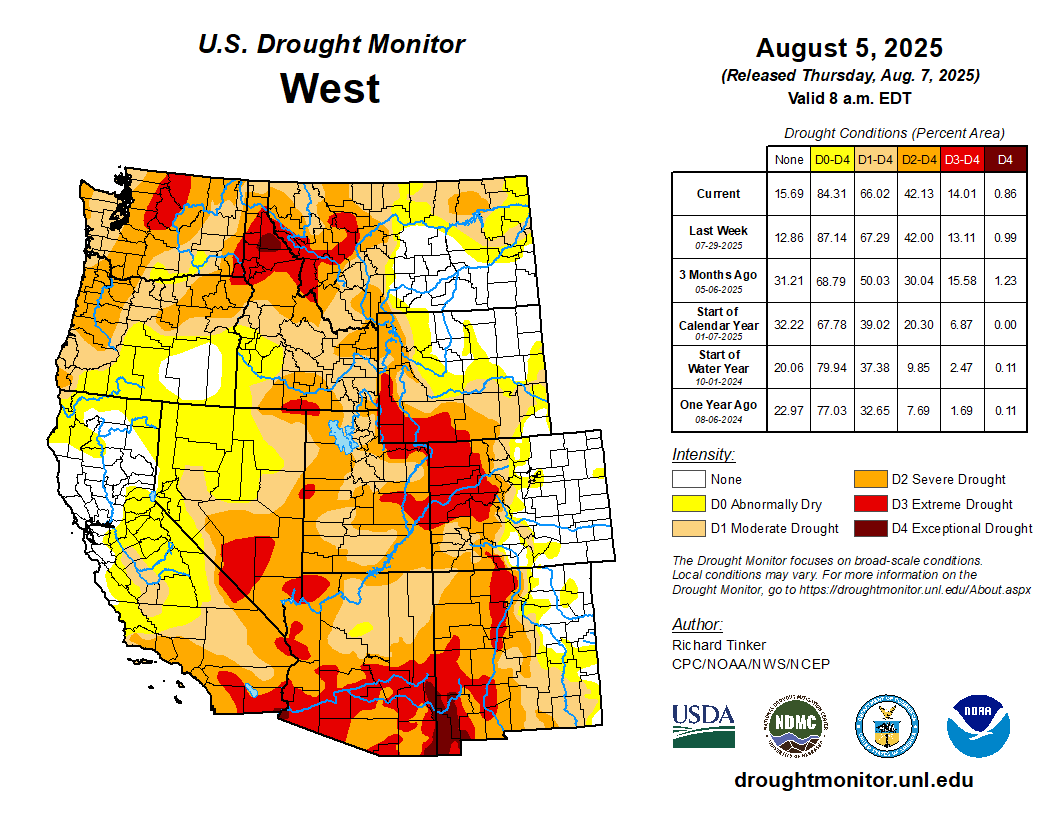
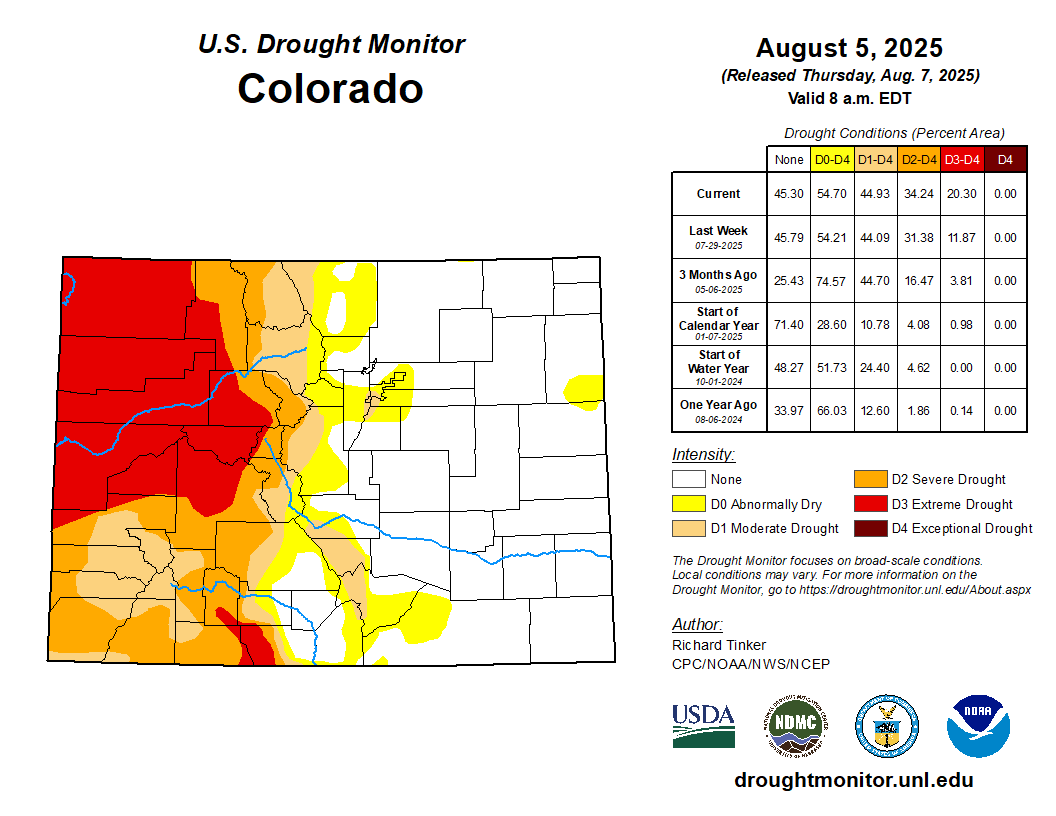
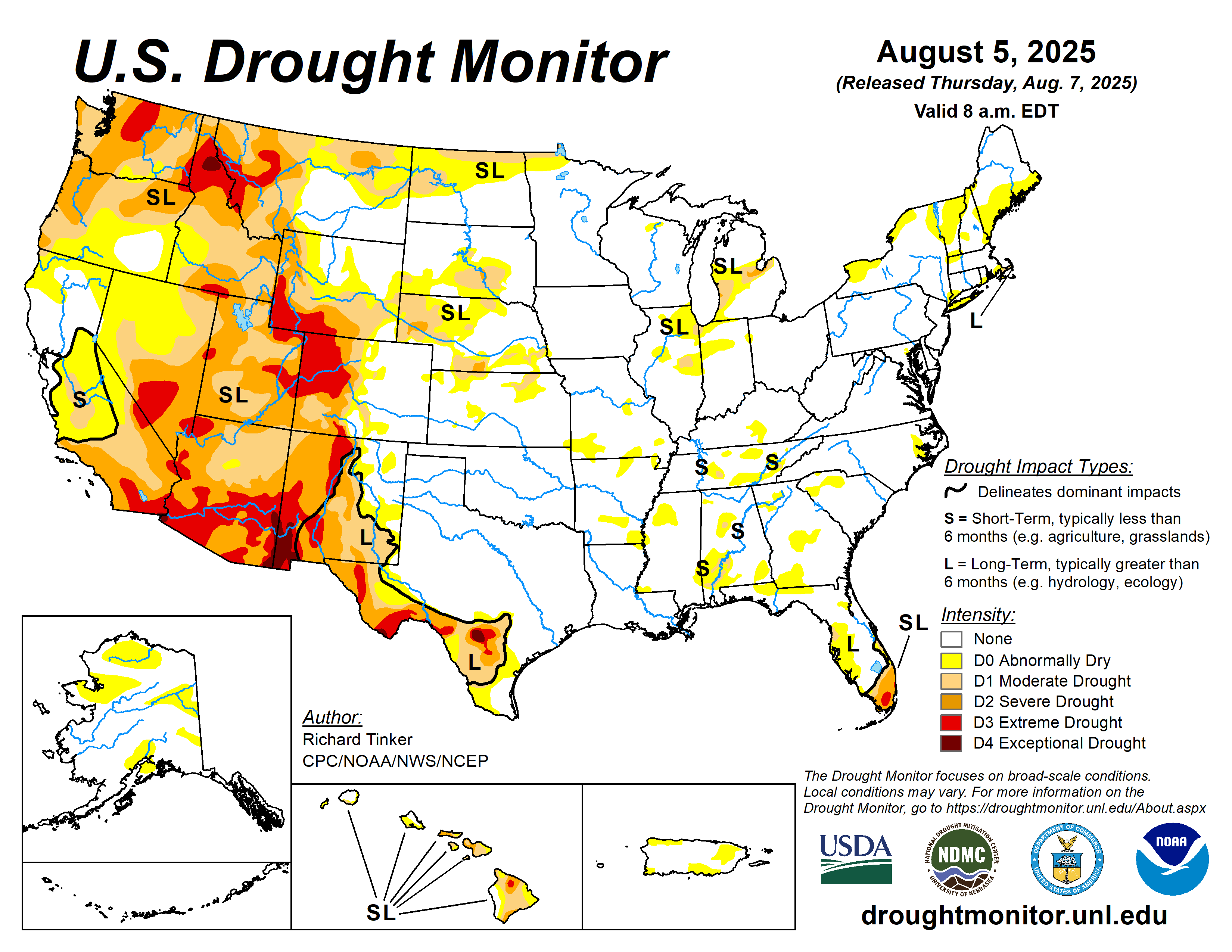
#Drought news August 7, 2025: A solid swath of moderate drought (D1) or worse covers most of S. and W. #Wyoming and the western half of #Colorado, with severe drought (D2) covering a large part of this region, and extreme drought (D3) noted in a sizeable portion of west-central and northwestern Colorado

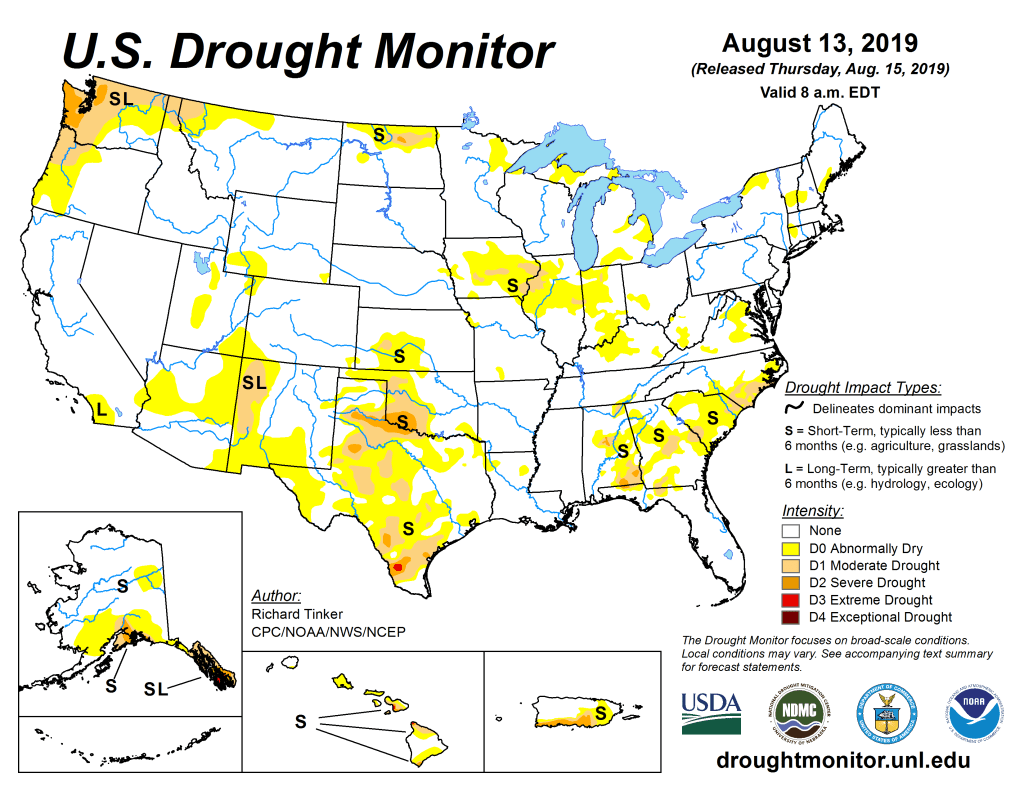
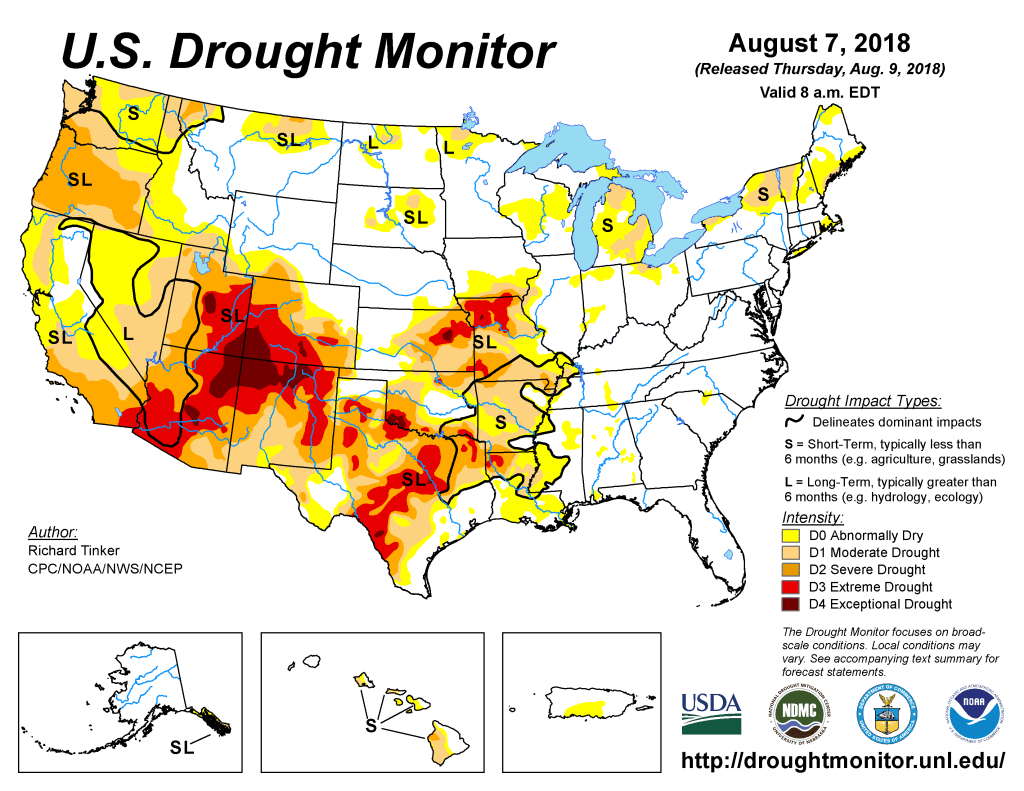
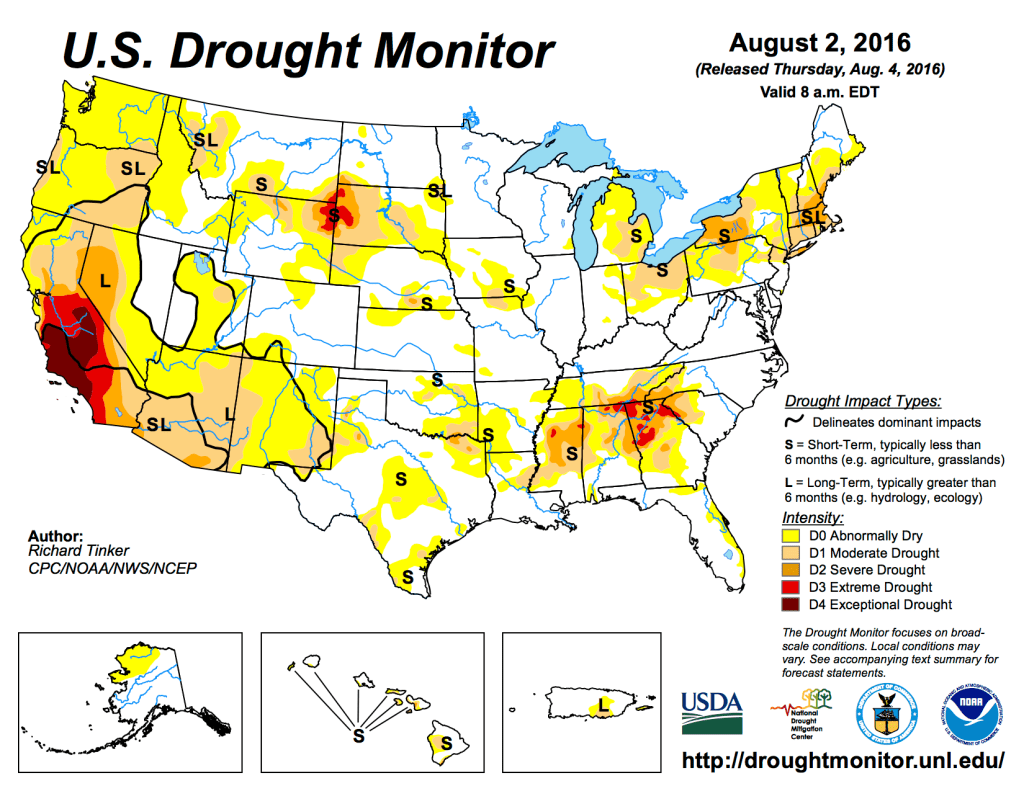
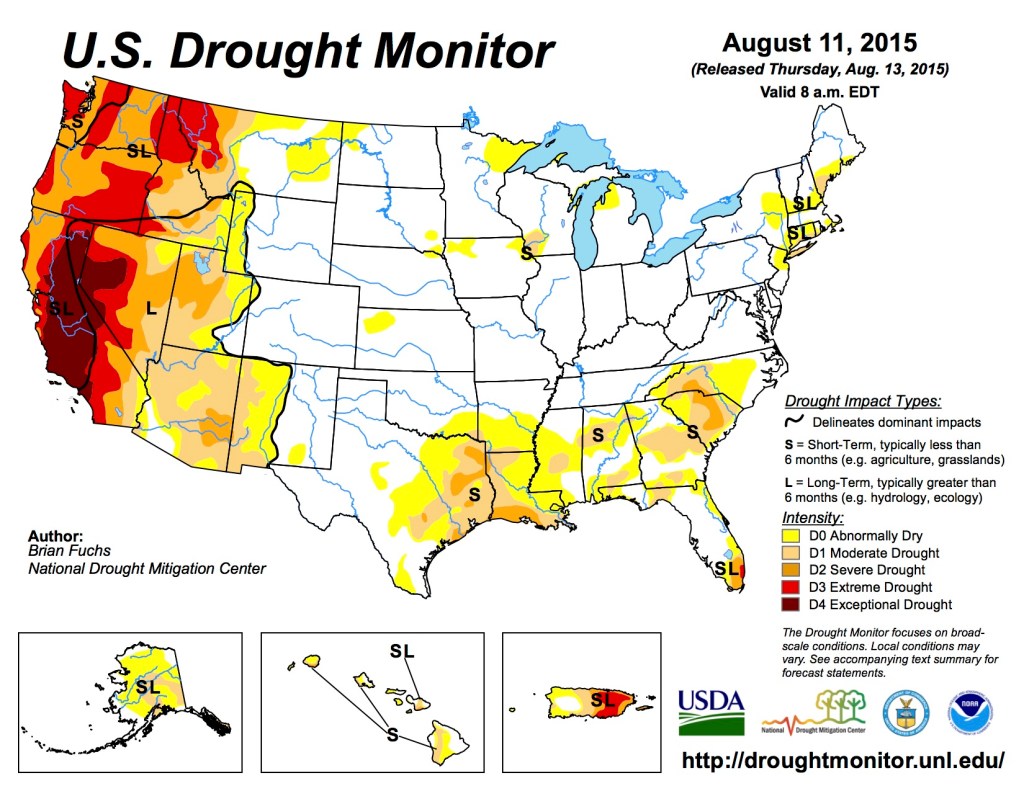
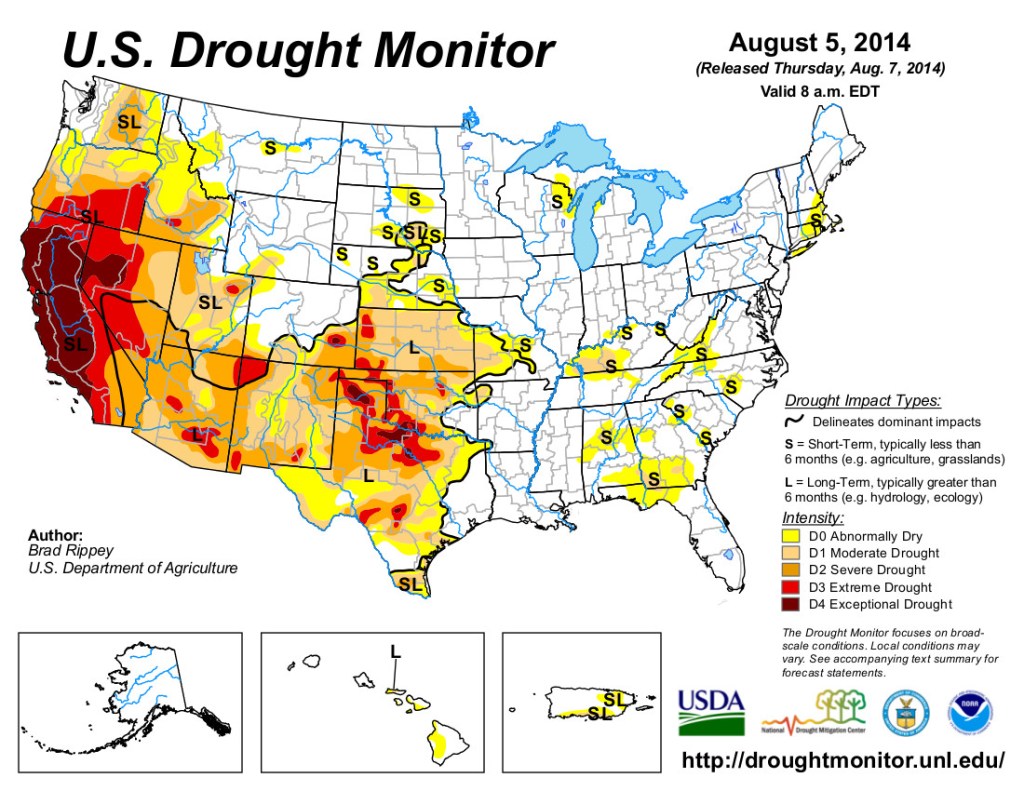
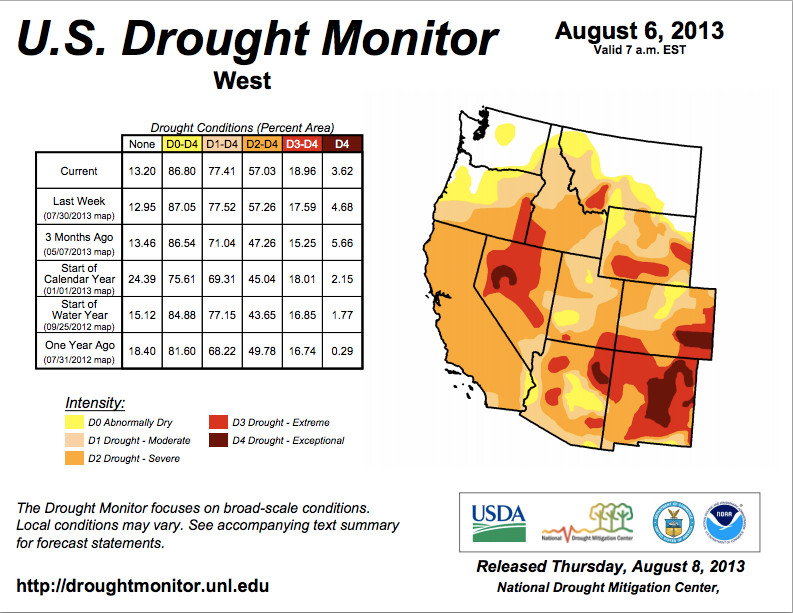
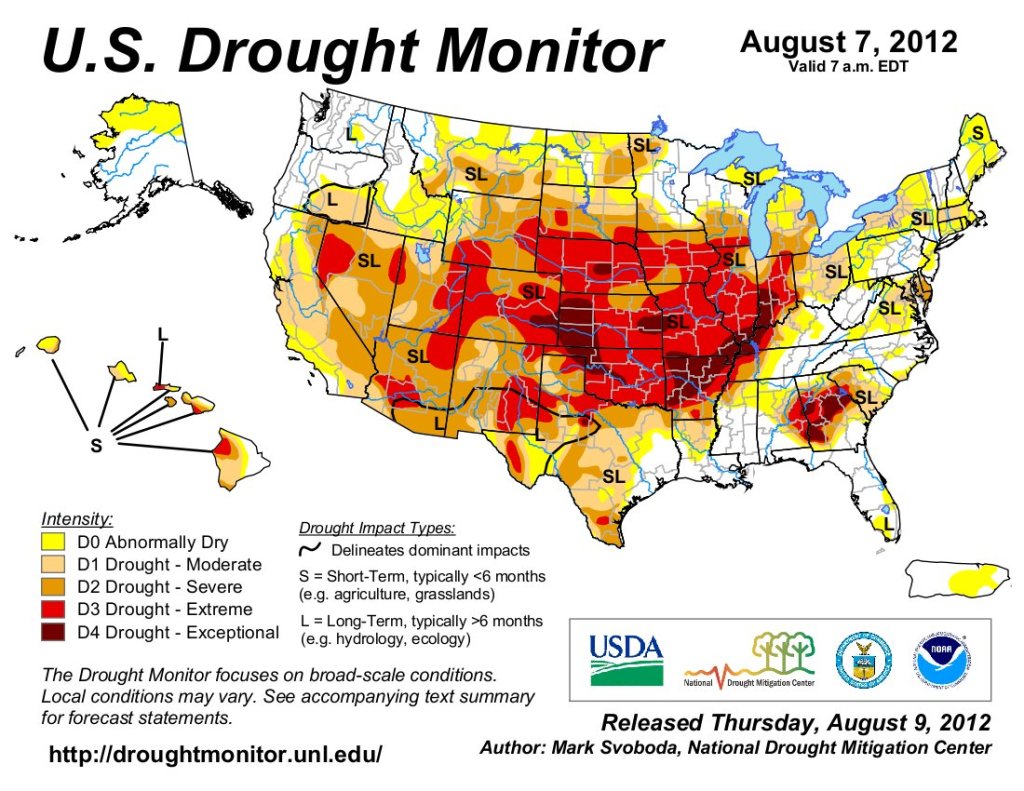
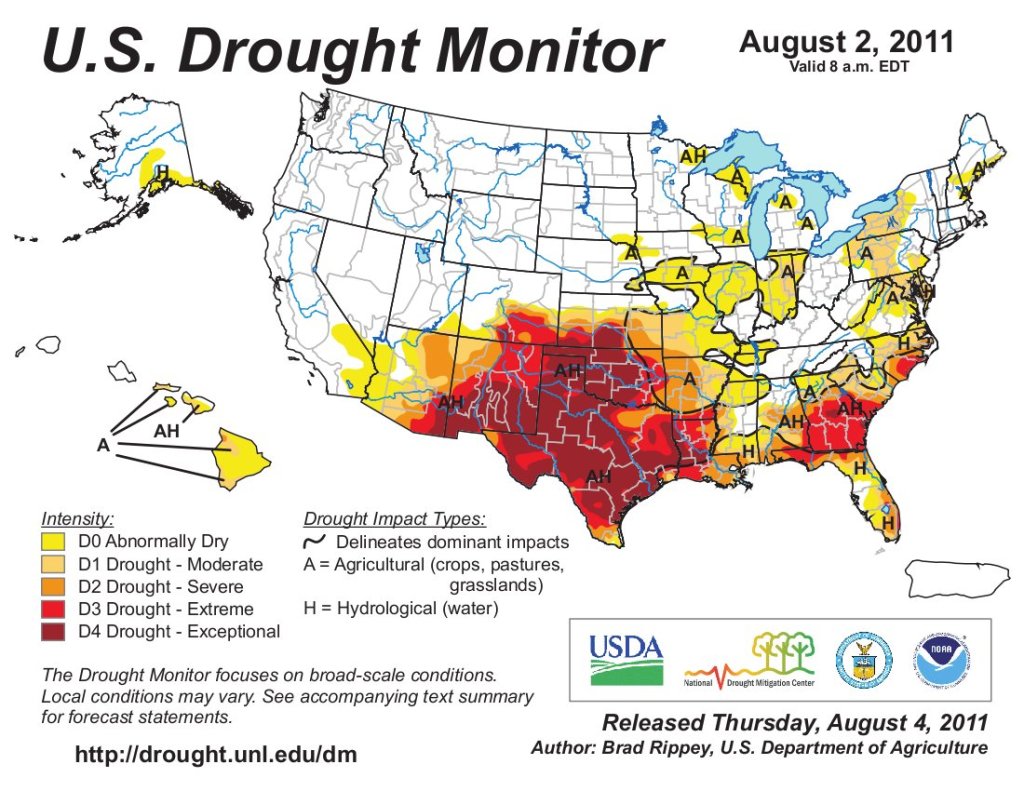
Click on a thumbnail graphic to view a gallery of drought data from the US Drought Monitor website.
Click the link to go to the US Drought Monitor website. Here’s an excerpt:

This Week’s Drought Summary

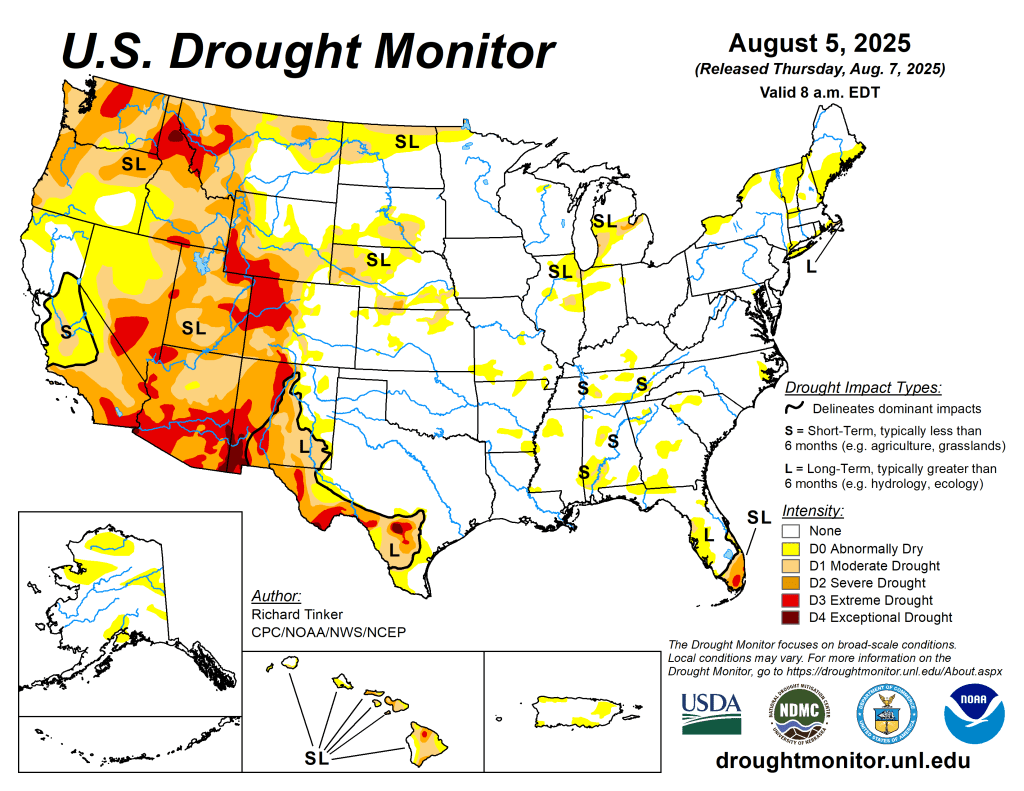
It was a week with a lot of change noted in areas of dryness and drought across the U.S. Heavy to locally excessive rainfall engendered broad areas of improvement in much of the Southeast, the lower Great Lakes Region, the central and northern Great Plains, and many locations across the High Plains and adjacent southern Rockies. Meanwhile, continued subnormal precipitation and episodes of unusually hot weather, low humidity, and high winds led to large areas of deterioration in the central and northern Rockies. Also, emerging short-term precipitation deficits led to the introduction of scattered areas of abnormal dryness (D0) over parts of the Middle and Lower Mississippi Valley, the Tennessee Valley, and near the western foothills of the western Appalachians. A few spots of deterioration were also introduced in western portions of the Southeast (where typical summer shower and thunderstorm activity has been less robust than usual) and Southwest (where subnormal monsoonal rains have been observed)…

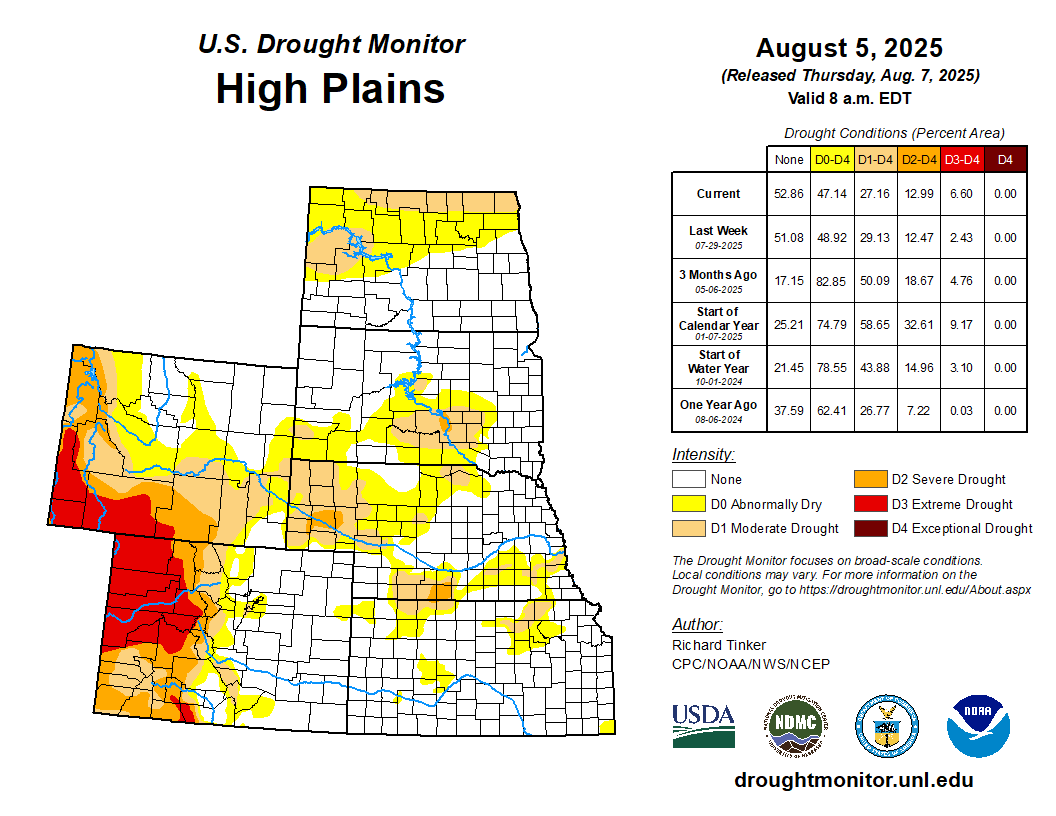
High Plains

Rainfall varied in intensity across the High Plains Region, with abundant rainfall amounts falling on a large part of the Plains while lesser, subnormal totals were observed in the higher elevations farther west. A similar pattern has been observed periodically for several weeks now, resulting in significantly worse conditions in the western part of the region than farther east. A solid swath of moderate drought (D1) or worse covers most of southern and western Wyoming and the western half of Colorado, with severe drought (D2) covering a large part of this region, and extreme drought (D3) noted in a sizeable portion of west-central and northwestern Colorado. This represents a significant increase in the extend of D2 and D3 coverage compared to last week. In contrast, another wet week led to a continued reduction in the coverage of the abnormal dryness (D0) to locally severe drought (D2) over the Great Plains. A broken pattern of heavy rainfall – with upwards of 3 inches reported in spots – prevailed from northern Kansas through much of the Dakotas, although higher amounts were more common in some areas than others. The improvements left severe drought confined to part of south-central Nebraska and adjacent Kansas, southwestern Nebraska, and a small area in south-central South Dakota. Moderate drought (D1) coverage also decreased, mainly across Nebraska and a few adjacent locations in the far eastern sections of Colorado and Wyoming. The USDA reported short or very short subsoil moisture across about one-third of Colorado and two-thirds of Wyoming. In addition, 17 percent of the Colorado corn crop was in poor or very poor condition, and drier weather earlier in the summer has left one-third of the Nebraska oat crop in poor or very poor condition…
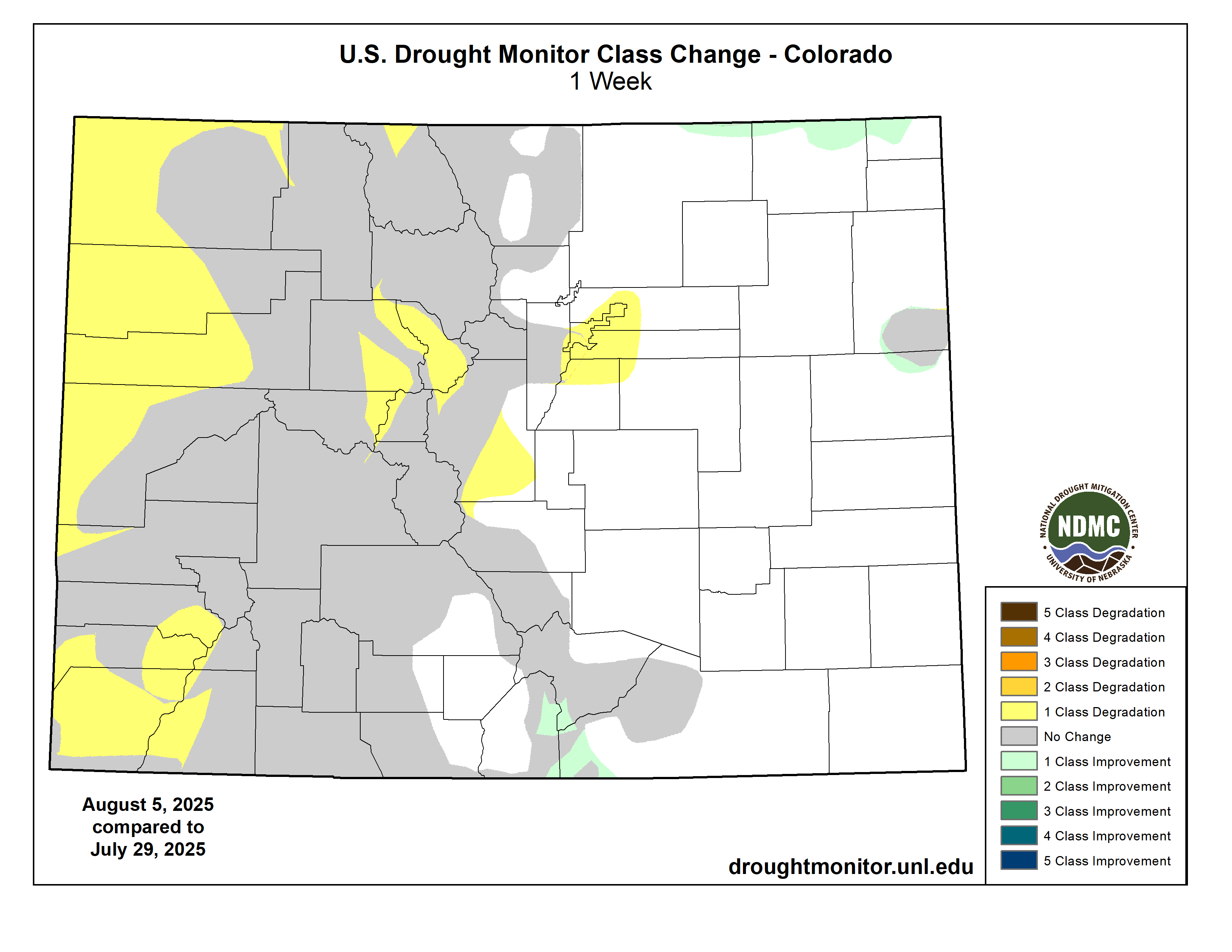
Colorado Drought Monitor one week change map ending August 5, 2025.

West

Heavy precipitation prompted significant areas of improvement across the southeastern and northern sections of the West Region, but hot and dry weather has caused dryness and drought to intensify in central parts of the Region, across Utah, eastern Nevada, and northeastern Arizona (similar to the situation in western parts of Colorado and Wyoming). Reports of 2 or more inches of rain were fairly common across southeastern and north-central through northwestern Montana as well as northeastern New Mexico, with lesser amounts in other parts of these states. These rains brought 2-week totals to between 2 and 5 inches in much of New Mexico and Montana, with locally higher totals, especially in north-central Montana and northeastern New Mexico. This prompted broad improvements through both states, but even so, areas that missed most of the rain in these states remained entrenched in drought. Exceptional drought (D4) persisted in part of southwestern New Mexico, and extreme drought (D3) remained across north-central and southwestern parts of the state, along with a significant swath of west-central Montana. Moderate to severe drought still affected a large part of the remainders of these states despite improvements, and only the southeastern quarter of Montana and northeastern New Mexico have completely emerged from any designation of dryness or drought. Farther west, showery weather has occurred periodically for the past few weeks in central and eastern Oregon, leading to a reduction in the coverage of dryness and drought there. Across central parts of the West Region from eastern Nevada through Utah, rainfall has been far less generous, and drought either persisted or deteriorated here. The entire region is experiencing at least moderate drought at this point, with widespread D2 conditions across eastern and western Utah, and adjacent Nevada. Some expansion of extreme drought (D3) occurred in east-central and northeastern Utah, where conditions have been similar to those observed across western parts of Colorado and Wyoming. Elsewhere, no changes were observed, and broad areas of drought remained entrenched. USDA reports that 50 percent of the Barley crop and 48 percent of the spring wheat crop in Washington was in poor or very poor condition, as were 26 percent of the barley crop and 47 percent of spring wheat in Montana. In addition, 90 percent of Nevada rangeland was in poor or very poor condition…

South

Outside southern and western Texas, not much dryness or drought has been observed across the South Region. But after a few relatively dry weeks, short-term precipitation shortfalls have developed in portions of Arkansas and Tennessee, leading to the introduction of a few patches of abnormal dryness (D0) in areas of significant 30-day rainfall shortages and near- to below-normal 60-day totals. A much larger proportion of these two states report 30-day precipitation deficits, but above-normal 60-day totals precluded more expansive D0 development this week, although the situation will need to be monitored going forward. In Tennessee, some patches of abnormal dryness and isolated moderate drought (D0 and D1) was assessed last week. In the easternmost parts of the state, heavy rains engendered a bit of improvement, but the burgeoning dryness farther west allowed a few additional spots of moderate drought to develop. To the west, rainfall was sufficient to end the fledgling area of abnormal dryness in southwestern Oklahoma, but more widespread and intense drought continued to cover large parts of western and southern Texas. Moderate to heavy rainfall was observed over parts of the drought-affected region, leading to some improvement in the Big Bend and along the northern fringe of the region. Substantial rainfall evaded areas farther to the south, however, allowing for some expansion of D0 and D1 conditions in the southernmost parts of the state. Since early May, rainfall totals exceed 3 inches in portions of south-central Texas, and approach 6 inches in part of the Big Bend. Despite recent improvement in much of the state, however, a small patch of exceptional drought (D4) persisted in upper South Texas, and severe drought continued in adjacent areas as well as parts of the Rio Grande Valley and Big Bend. But despite recent drought improvement, 22 percent of the Texas cotton crop and 48 percent of its oat crop was in poor to very poor conditions, according to USDA.
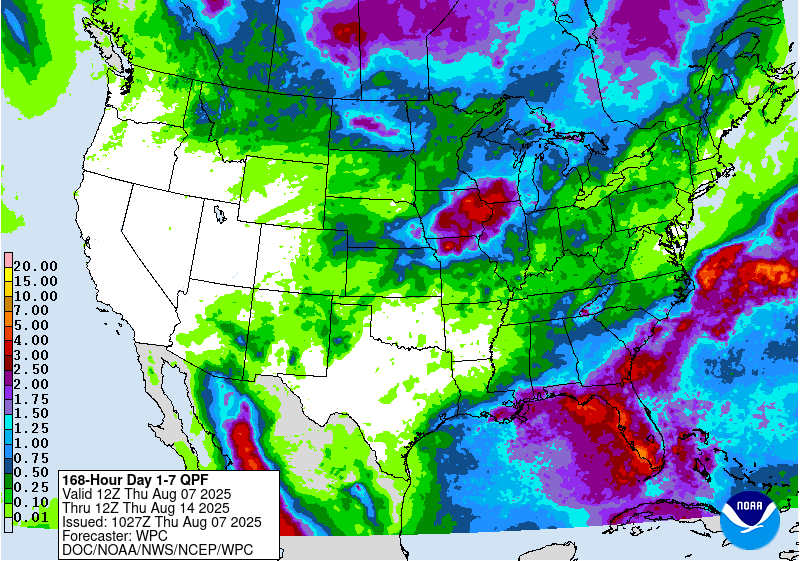
Looking Ahead

From August 7 to 11, an area of showers and thunderstorms off the Southeastern Coast may develop into a tropical system according to the National Hurricane Center, but this is far from certain. Any organized system is expected to remain off the East Coast, but early in the period the disorganized convection is expected to impact the South Atlantic Coastline. Generally 1 to locally over 3 inches of rain are forecast for coastal sections of South Carolina, Georgia, and northern Florida while similar amounts are forecast along the central and eastern Gulf Coast, and much of the Florida Peninsula. Between 1 and 3 inches are anticipated near a frontal system stretching from the Middle Mississippi Valley into the Great Lakes Region, and amounts in the lower part of that range are forecast in scattered parts of the central and northern Plains. Moderate amounts of several tenths to around an inch should fall in many areas from the Upper Mississippi Valley into the Northern Intermountain West, portions of the central Plains, and areas near the Southeastern and Gulf Coasts. Light precipitation is possible in parts of the central and eastern Four Corners States, the central Ohio Valley, the southern Appalachians, the mid-Atlantic, and upper New England. Other areas are expecting little if any precipitation. Meanwhile a cooler than normal but moderating air mass should allow temperatures to average near or slightly below normal in the Southeast and mid-Atlantic while daily highs should average a few degrees below normal in and around the northern High Plains. In most other locations, temperatures should average a little above normal as above-normal temperatures begin to slowly cover most of the Contiguous States. The greatest positive temperature departures are expected where above-normal temperatures have already settled in, specifically parts of the interior West and the Northeast, where highs will average 6 to 12 deg. F in spots.

The Climate Prediction Center’s 6-10 day outlook (valid August 12-16, 2025) features significant uncertainty in the precipitation outlook. Odds for above-normal precipitation exceeding 40 percent across most of Alaska outside the northeast and southwest sections, and nowhere else. There are, however, fairly broad areas with slightly enhanced chances (33 to 40 percent) for wetter than normal wetter; specifically, the remainder of Alaska, the northern tier of the Contiguous 48 States, the Sonoran Desert, the eastern Great Plains, the Mississippi and Ohio Valleys, the Great Lakes Region, the upper Southeast, the mid-Atlantic, and inland sections of the Northeast and New England. Drier than normal conditions are slightly favored in the Great Basin and adjacent sections of the Rockies and Pacific Northwest. There is more certainty in the temperature forecast, with above-normal temperatures favored across a large part of the Contiguous States, and Hawaii. The best odds (over 70 percent) cover the Northeast and New England while the central West Coast, parts of the Four Corners States, the eastern Great Lakes, the mid-Atlantic, the coastal Southeast, and the Florida Peninsula have 60 to 70 percent chances for unusually high temperatures. Only Alaska and the northern High Plains are not areas where warmer than normal conditions are favored. In fact, subnormal temperatures are favored over most of Alaska, with odds topping 60 percent in northwestern parts of the state.
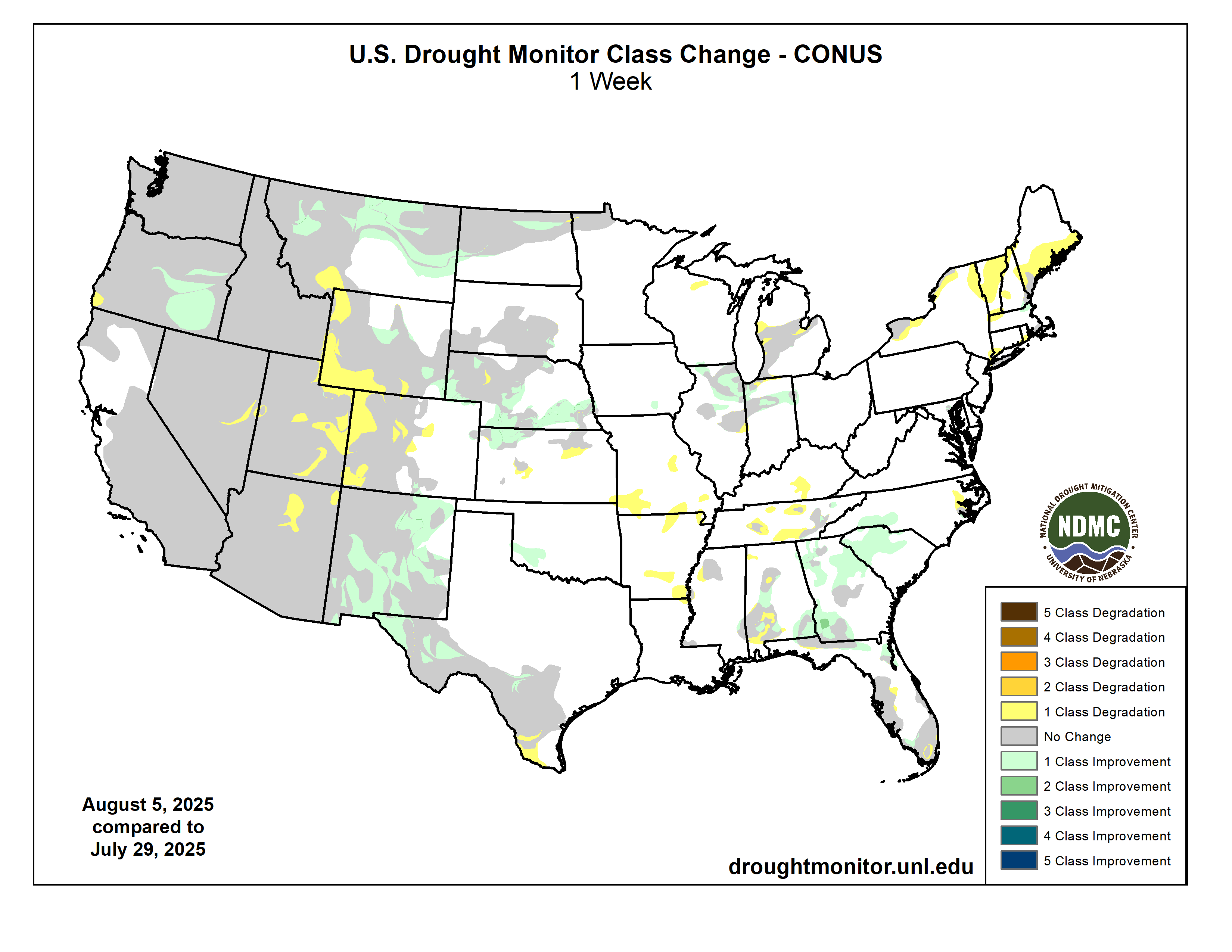
US Drought Monitor one week change map ending August 5, 2025.

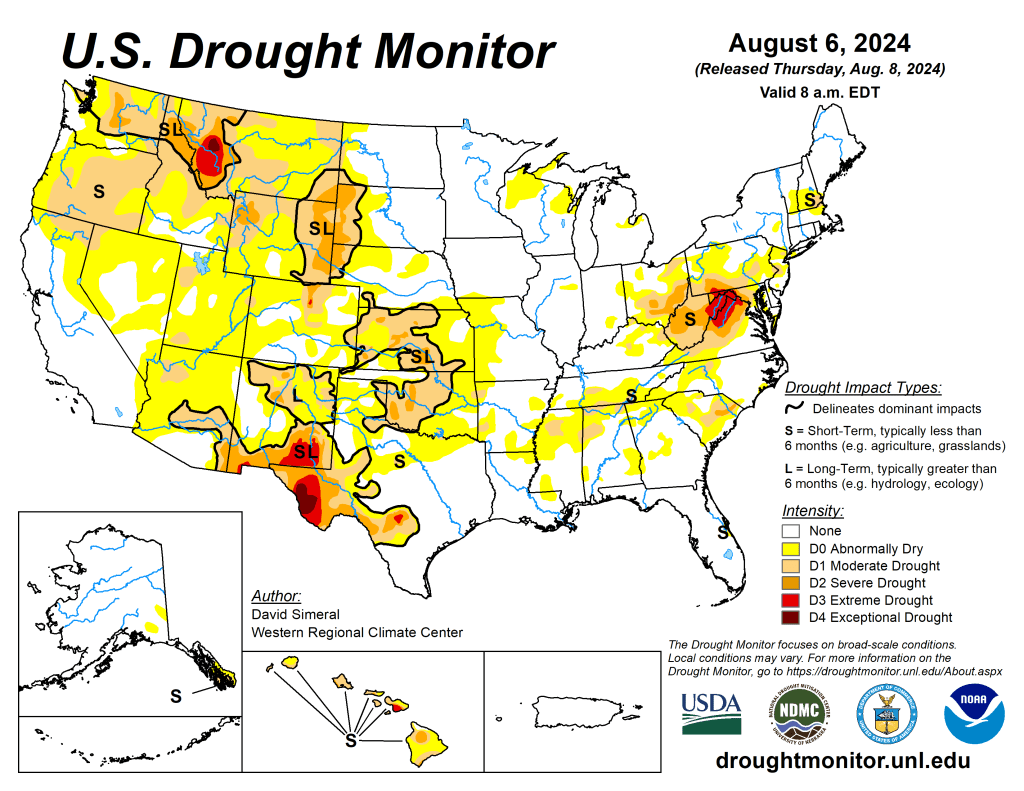
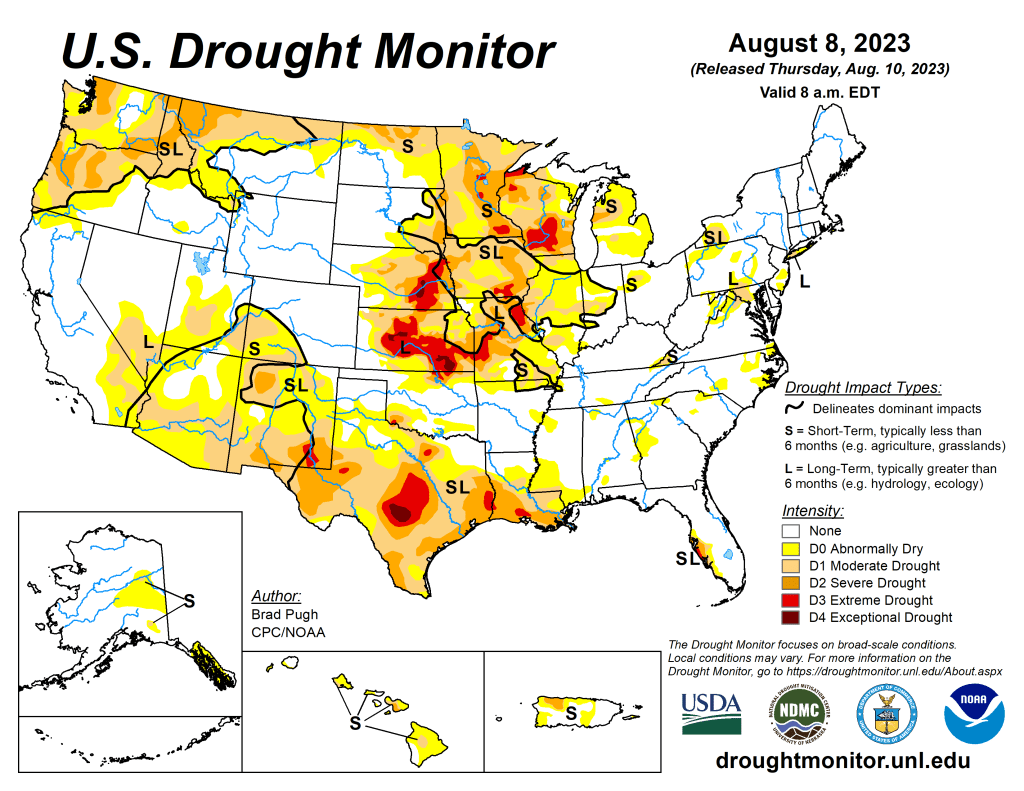
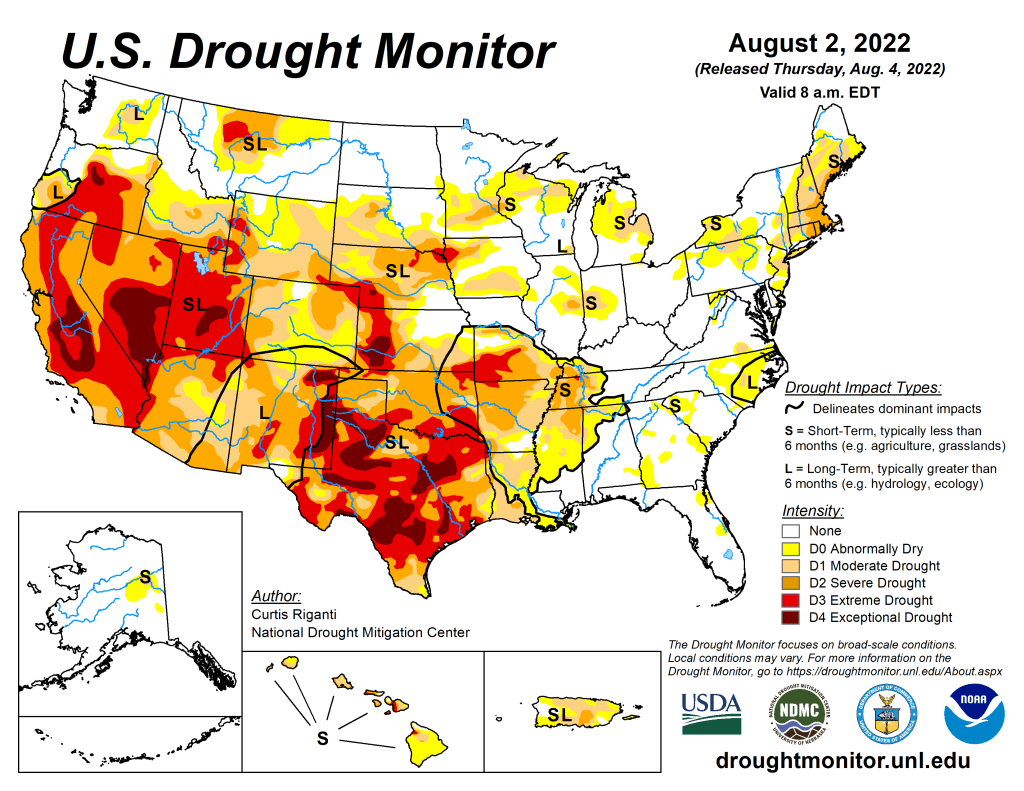
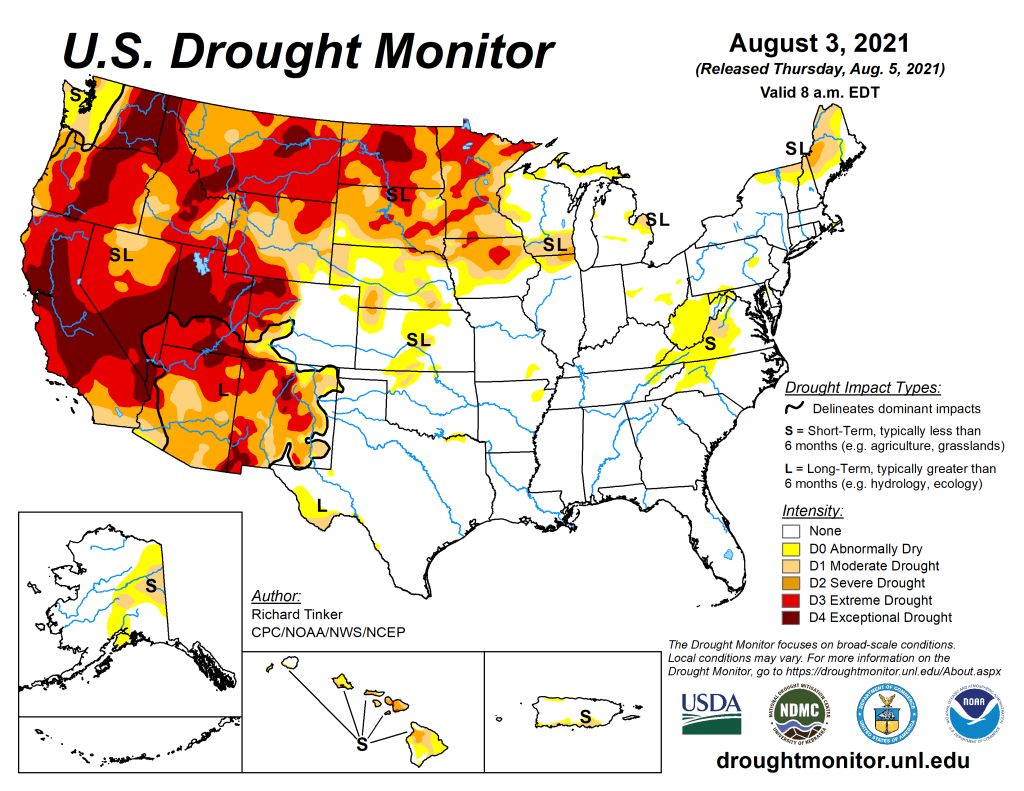
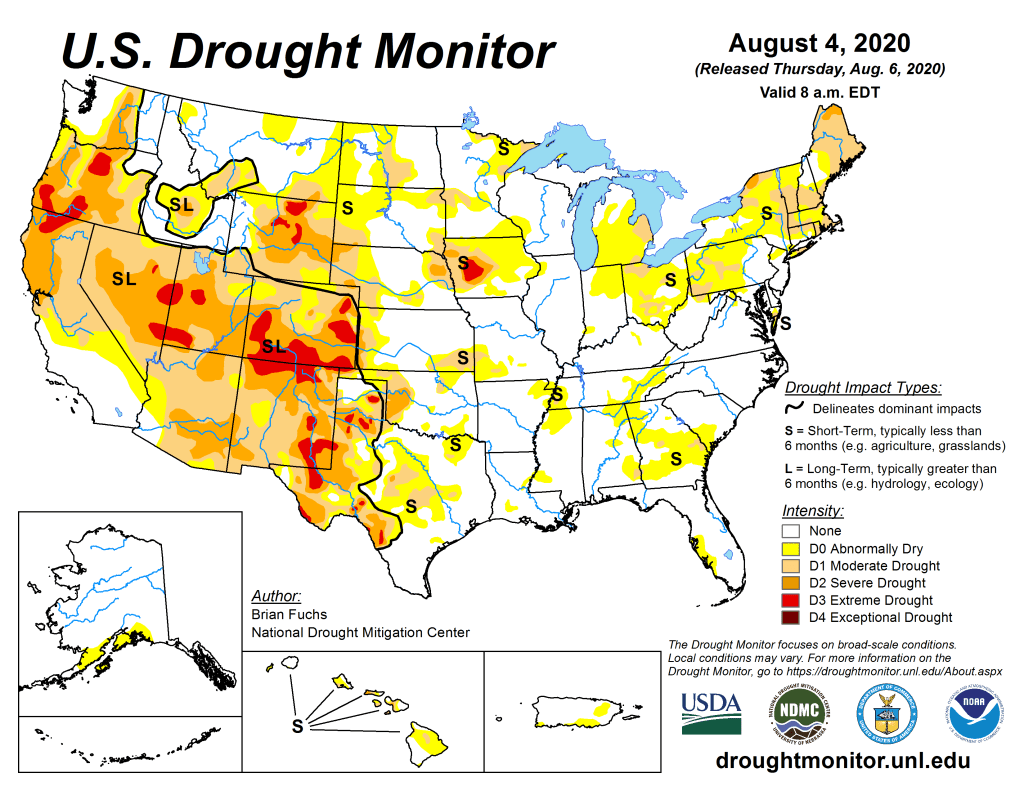
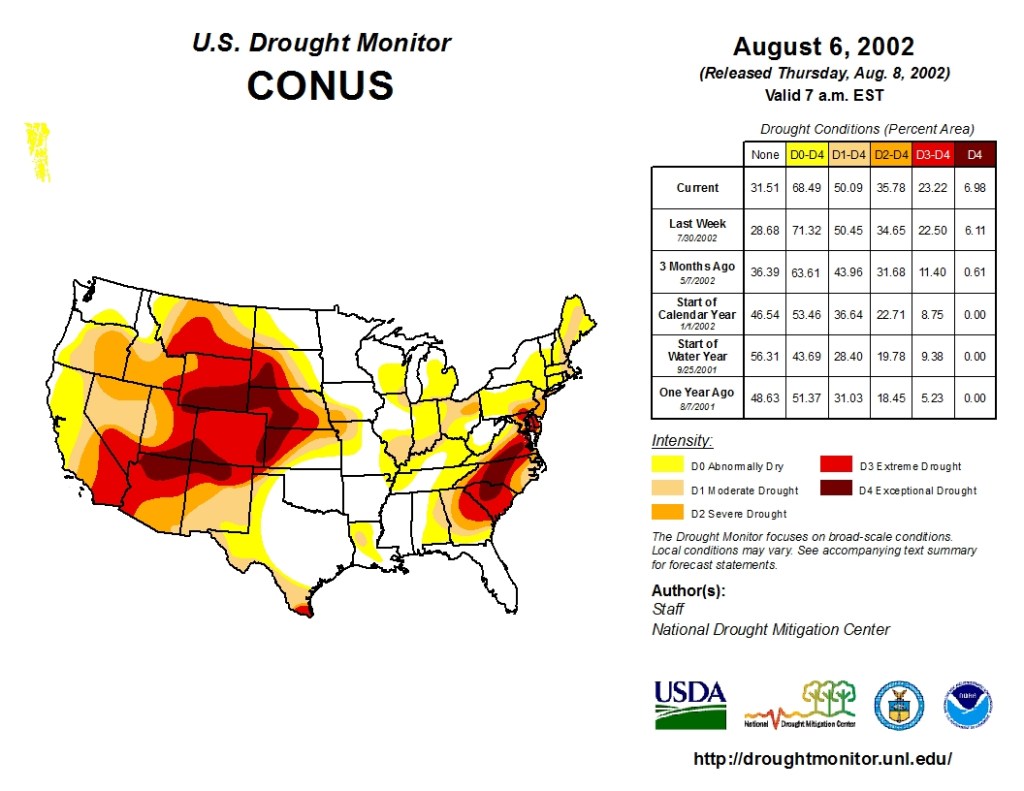
Just for grins here’s a slideshow of early August US Drought Monitor maps for the past few years (including 2002).
Western Slope wildfires already add up to #Colorado’s worst fire year since 2020 — Chase Woodruff (ColoradoNewsline.com)

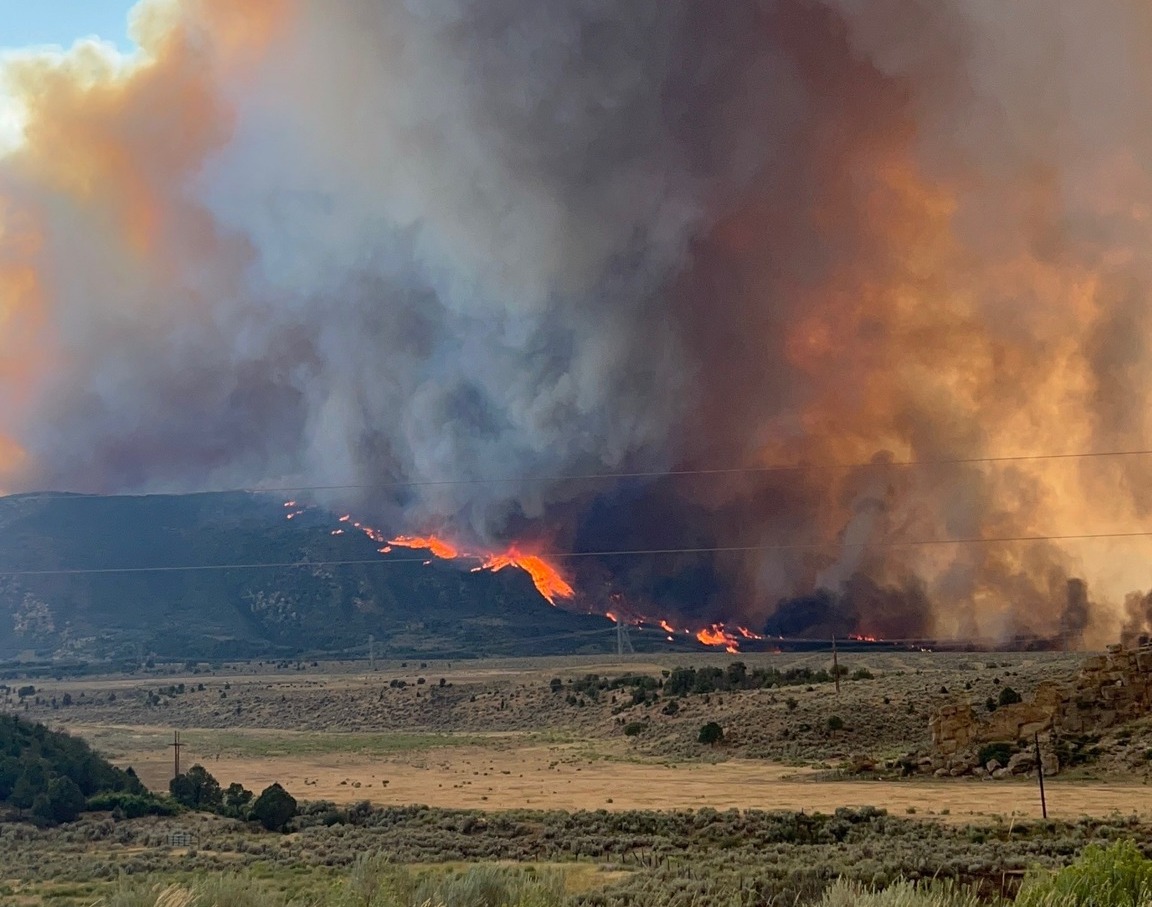
The Lee Fire near Meeker is pictured from Colorado Highway 13 on Aug. 5, 2025. (Rio Blanco County Sheriff’s Office)

Click the link to read the article on the Colorado Newsline website (Chase Woodruff):

August 6, 2025

High winds and extreme drought conditions in northwest Colorado have fueled the rapid growth of two wildfires this week near Meeker in Rio Blanco County, where firefighting crews say they’re prioritizing structure protection with ā€œlimited resourcesā€ on hand.

The Lee Fire, west of Meeker, nearly doubled in size Tuesday and has now burned 22,497 acres, predominantly on Bureau of Land Management land south of Colorado Highway 13. About 20 miles to the east, the Elk Fire is estimated at 8,304 acres in size. Both fires are believed to have been started by lightning strikes on Aug. 2.

Jeramy Dietz, operations section chief with the Rocky Mountain Incident Management Team responding to both fires, said in a video update Wednesday that crews are developing plans ā€œbased on our highest values at risk, with our limited resources that we have on hand.ā€

With the latest growth, the estimated area burned in Colorado by 11 major wildfires in 2025 now stands at 64,196 acres, according to federal data. That doesn’t include smaller fires suppressed by state and local first responders, but it already makes for the state’s worst fire year since 2020, when multiple historic blazes burned a record-setting 625,357 acres, according toĀ National Interagency Fire CenterĀ data.

Other large Colorado fires this summer include the Turner Gulch Fire, which has burned over 24,000 acres east of Gateway, near the Colorado-Utah border, and is currently 49% contained; and the 4,232-acre South Rim Fire, which has forced the closure of parts of Black Canyon of the Gunnison National Park and is estimated at 52% containment.

Drought conditions classified as ā€œsevereā€ or ā€œextremeā€ currently extend across the majority of Colorado’s western half, according to the U.S. Drought Monitor. A critical fire weather advisory for western Colorado and several neighboring states has been issued by the Rocky Mountain Area Coordination Center, a Denver-based branch of the NIFC, and will remain in place through at least mid-August.

ā€œAfter a dry winter with minimal snowpack fuel moistures are well below normal, and much of the region is under severe to extreme drought,ā€ the agency warns. ā€œExtreme fire behavior marked by rapid spread, torching, and resistance to control is being driven by critically dry … fuels, and drought-stressed brush and trees. As heat intensifies and fuel moistures decline further, fire potential will remain elevated across the area.ā€

Colorado public health officials have issued health advisories for wildfire smoke in 17 counties across the state, including the Denver area and the northern Front Range. People ā€œwith heart disease, respiratory illnesses, the very young, and older adultsā€ are advised to limit outdoor activities.

Due to climate change, much of Colorado has grown hotter and drier in recent decades, increasing wildfire risk. The three largest wildfires in Colorado history all occurred in 2020, and the state’s 20 biggest fires on record have all occurred in the past 20 years. Rising levels of greenhouse gases, mostly the result of fossil-fuel combustion, have caused much of the Western Slope to warm by an average of more than 4 degrees Fahrenheit above pre-industrial levels, and the region’s current ā€œmegadroughtā€ is its worst dry spell in at least 1,200 years.

First-ever airborne toxin detected in Western Hemisphere — Daniel Katz, Ellie Browne, and Stephanie Maltarich (University of #Colorado #Boulder)

Click the link to read the release on the University of Colorado website (Daniel Katz, Ellie Browne, and Stephanie Maltarich):

June 9, 2025

Once in a while, scientific research resembles detective work. Researchers head into the field with a hypothesis and high hopes of finding specific results, but sometimes, there’s a twist in the story that requires a deeper dive into the data.

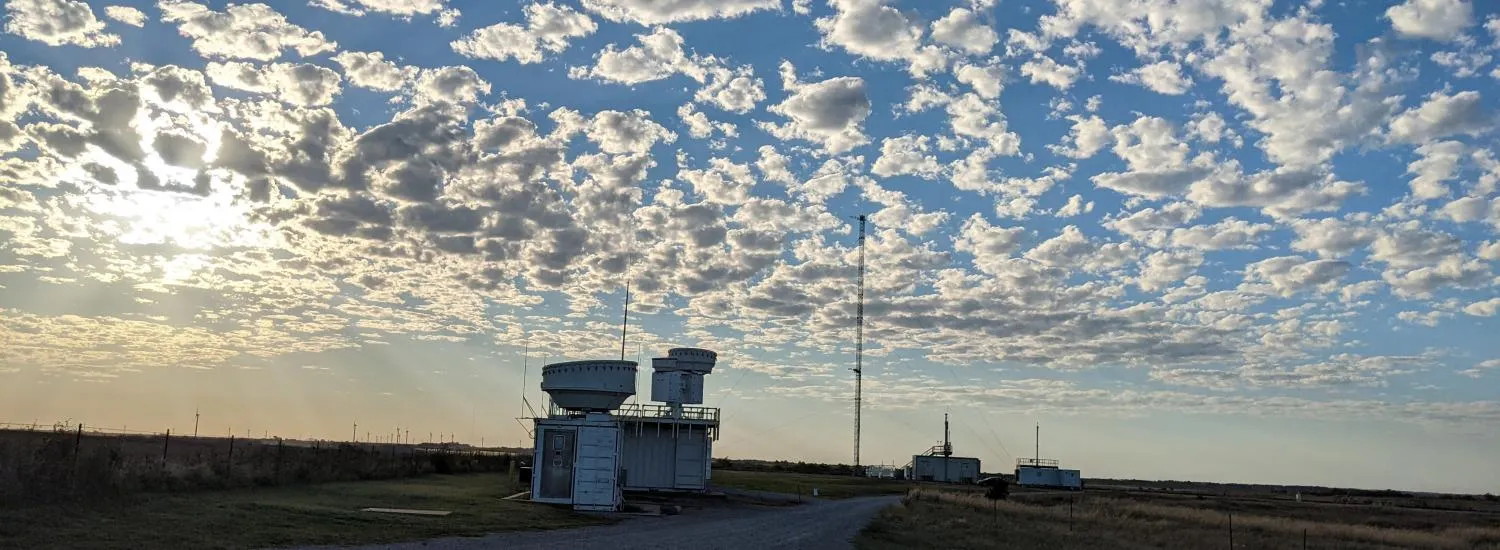
That was the case for CU Boulder researchers who led a field campaign in an agricultural region of Oklahoma. Using a high-tech instrument to measure how aerosol particles form and grow in the atmosphere, they stumbled upon something unexpected: the first-ever airborne measurements of Medium Chain Chlorinated Paraffins (MCCPs), a kind of toxic organic pollutant, in the Western Hemisphere. Their results published today in ACS Environmental Au.

ā€œIt’s very exciting as a scientist to find something unexpected like this that we weren’t looking for,ā€ said Daniel Katz, CU Boulder chemistry PhD student and lead author of the study. ā€œWe’re starting to learn more about this toxic, organic pollutant that we know is out there, and which we need to understand better.ā€ 

MCCPs are currently under consideration for regulation by the Stockholm Convention, a global treaty to protect human health from long-standing and widespread chemicals. While the toxic pollutants have been measured in Antarctica and Asia, researchers haven’t been sure how to document them in the Western Hemisphere’s atmosphere until now. 

MCCPs are used in fluids for metal working and in the construction of PVC and textiles. They are often found in wastewater and as a result, can end up in biosolid fertilizer, also called sewage sludge, which is created when liquid is removed from wastewater in a treatment plant. In Oklahoma, researchers suspect the MCCPs they identified came from biosolid fertilizer in the fields near where they set up their instrument.

ā€œWhen sewage sludges are spread across the fields, those toxic compounds could be released into the air,ā€ Katz said. ā€œWe can’t show directly that that’s happening, but we think it’s a reasonable way that they could be winding up in the air. Sewage sludge fertilizers have been shown to release similar compounds.ā€

MCCPs little cousins, Short Chain Chlorinated Paraffins (SCCPs), are currently regulated by the Stockholm Convention, and since 2009, by the EPA here in the United States. Regulation came after studies found the toxic pollutants, which travel far and last a long time in the atmosphere, were harmful to human health. But researchers hypothesize that the regulation of SCCPs may have increased MCCPs in the environment. 

ā€œWe always have these unintended consequences of regulation, where you regulate something, and then there’s still a need for the products that those were in,ā€ said Ellie Browne, CU Boulder chemistry professor, CIRES Fellow, and co-author of the study. ā€œSo they get replaced by something.ā€ 

Using a nitrate chemical ionization mass spectrometer, which allows scientists to identify chemical compounds in the air, the team measured air at the agricultural site 24 hours a day for one month. As Katz cataloged the data, he documented the different isotopic patterns in the compounds. The compounds measured by the team had distinct patterns, and he noticed new patterns that he immediately identified as different from the known chemical compounds. With some additional research, he identified them as chlorinated paraffins found in MCCPs.

Katz says the makeup of MCCPs are similar to PFAS, long-lasting toxic chemicals that break down slowly over time. Known as ā€œforever chemicals,ā€ their presence in soils recently led the Oklahoma Senate to ban biosolid fertilizer

Now that researchers know how to measure MCCPs, the next step might be to measure the pollutants at different times throughout the year to understand how levels change each season. Many unknowns surrounding MCCPs remain, and there’s much more to learn about their environmental impacts. 

ā€œWe identified them, but we still don’t know exactly what they do when they are in the atmosphere, and they need to be investigated further,ā€ Katz said. ā€œI think it’s important that we continue to have governmental agencies that are capable of evaluating the science and regulating these chemicals as necessary for public health and safety.ā€

Uranium Company Receives #Wyoming’s First Fast-Tracked Mining Permits — Jake Bolster (InsideClimateNews.org)

Inside Uranium Energy Corp.’s Irigaray Central Processing Plant located in Wyoming’s Powder River Basin. Credit: Uranium Energy Corp.

Click the link to read the article on the Inside Climate News website (Jake Bolster):

August 6, 2025

The state could eventually host the nation’s largest uranium production facility to use two different mining methods. Environmentalists worry that expedited permitting in the nuclear sector could threaten ā€œsafety, environmental quality and public trust.ā€

Uranium Energy Corp.’s Sweetwater uranium project has become the first mining proposal in Wyoming to be fast-tracked under President Donald Trump’s March executive order to increase U.S. mineral production. 

The company announced Aug. 5 that it planned to expand its uranium mining operations in Wyoming’s Red Desert as a result of the expedited permitting process. The federal government expects to post a permitting timetable for the project by Aug. 15.

Through other executive orders, the dismantling of environmental regulations and the spending bill congressional Republicans passed in July, the second Trump administration has made it easier for extractive industries to receive permits for mining on public lands. Trump has classified uranium as a ā€œcritical mineralā€ for the U.S., which imported 99 percent of its fuel for nuclear energy in 2023, according to data from the U.S. Energy Information Administration.

John Burrows, energy and climate policy director at the Wyoming Outdoor Council, saw the fast-tracking news as evidence of a pattern in the state’s nascent nuclear industry. 

ā€œAcross the nuclear supply chain we’re seeing permits getting expedited and we’re having concerns around safety, environmental quality and public trust,ā€ he said. 

Last month, the U.S. Nuclear Regulatory Commission accelerated its review of an advanced nuclear reactor being built in Kemmerer, Wyoming, with an end-of-year completion goal. TerraPower, the company behind the new technology, was co-founded by billionaire Bill Gates.

Uranium Energy’s Sweetwater permits were fast-tracked by the Federal Permitting Improvement Steering Council. Trump’s March executive order required the executive director of the council to publish such projects on a special dashboard.

ā€œI am excited to welcome the Sweetwater Complex to the FAST-41 transparency dashboard in support of President Trump’s goal of unlocking America’s mineral resources,ā€ said Emily Domenech, the council’s executive director, in a statement accompanying Uranium Energy’s announcement. ā€œThe uranium that this project can produce would be game-changing for our nation as we work to reduce our reliance on Russia and China, strengthen our national and economic security, and reestablish a robust domestic supply chain of nuclear fuel.ā€

The Federal Permitting Improvement Steering Council was established in 2015 under President Barack Obama and made permanent by President Joe Biden’s Infrastructure Investment and Jobs Act in 2021. 

Pictorial representation of the In situ uranium mining process. Graphic credit: (source: Heathgate Resources)

If approved, Uranium Energy expects to begin ā€œin-situā€ uranium mining within its permit boundaries. The process involves leaching uranium from underground rock and does less surface disturbance than conventional strip-mining methods. The company already operates conventional uranium mines in Wyoming but wants to expand its claim to include nearby areas it says are suitable for in-situ retrieval methods. 

ā€œThis will provide the Company unrivaled flexibility to scale production across the Great Divide Basin,ā€ Amir Adnani, Uranium Energy’s president and CEO, said in an email.

If Uranium Energy receives its permits, which could still take years, the company said its Sweetwater facility will become the largest in the United States capable of processing both conventionally and in-situ-mined uranium. Its current licensed production capacity at the Sweetwater facility is 4.1 million pounds of uranium annually, the company said.

National parks are key conservation areas for wildlife and naturalĀ resources

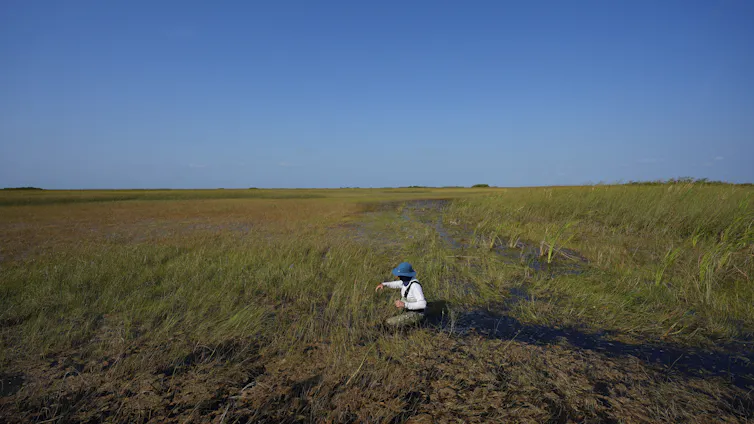
A researcher collects water samples in Everglades National Park in Florida to monitor ecosystem health. AP Photo/Rebecca Blackwell

Sarah Diaz, Coastal Carolina University and Linda Lane, Coastal Carolina University

The United States’ national parks have an inherent contradiction. The federal law that created the National Park Service says the agency – and the parks – must ā€œconserve the scenery and the natural and historic objects and the wildlife … unimpaired for the enjoyment of future generations.ā€

That means both protecting fragile wild places and making sure people can visit them. Much of the public focus on the parks is about recreation and enjoyment, but the parks are extremely important places for research and conservation efforts.

These places contain a wide range of sensitive and striking environments: volcanoes, glaciers, sand dunes, marshlands, ocean ecosystems, forests and deserts. And these areas face a broad variety of conservation challenges, including the effects of climate change, the perils of popularity driving crowds to some places, and the Trump administration’s reductions to park service staff and funding.

As scholars of recreation who study the national parks and teach a course on them, we have seen the park service make parks far more than just recreational opportunities. They are living laboratories where researchers – park service personnel and others – study nature across wide-ranging ecosystems and apply what they learn to inform public and private conservation efforts around the country.

A group of wolves on a snowy landscape.
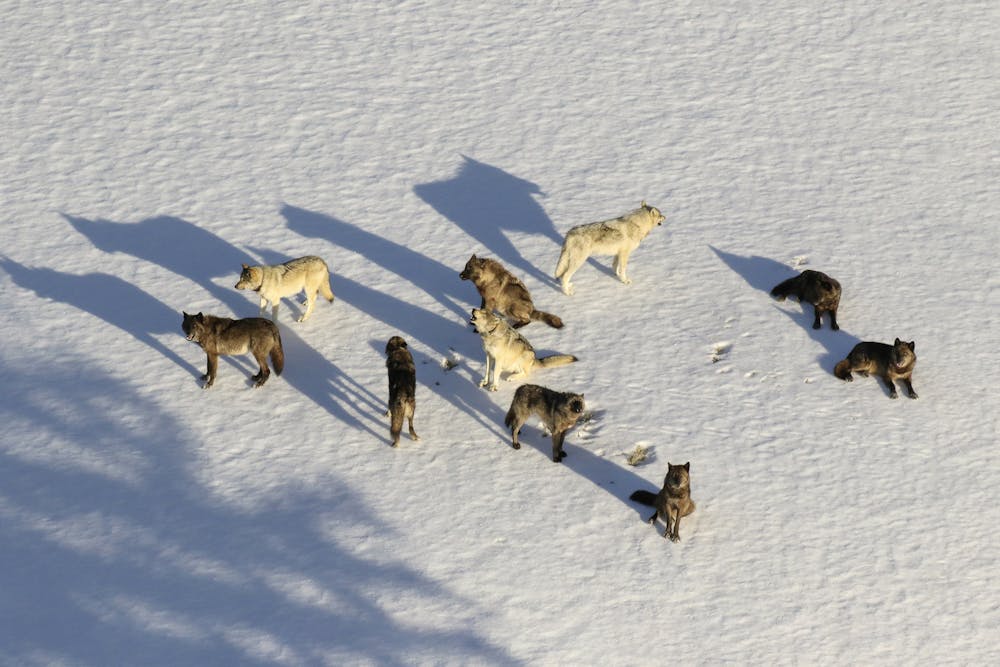
Gray wolves, long native to the Yellowstone area, were reintroduced to the national park in the mid-1990s and have helped the entire ecosystem flourish since. National Park Service via AP

Returning wolves to Yellowstone

One of the best known outcomes of conservation research in park service history is still playing out in the nation’s first national park, Yellowstone.

Gray wolves once roamed the forests and mountains, but government-sanctioned eradication efforts to protect livestock in the late 1800s and early 1900s hunted them to near extinction in the lower 48 states by the mid-20th century. In 1974, the federal government declared that gray wolves needed the protections of the Endangered Species Act.

Research in the park found that the ecosystem required wolves as apex predators to maintain a healthy balance in nature.

In the mid-1990s, an effort began to reintroduce gray wolves to Yellowstone National Park. The project brought 41 wolves from Canada to the park. The wolves reproduced and became the basis of a Yellowstone-based population that has numbered as many as 120 and in December 2024 was estimated at 108.

The return of wolves has not only drawn visitors hoping to see these beautiful and powerful predators, but their return has also triggered what scholars call a ā€œtrophic cascade,ā€ in which the wolves decrease elk numbers, which in turn has allowed willow and aspen trees to survive to maturity and restore dense groves of vegetation across the park.

Increased vegetation in turn led to beaver population increases as well as ecosystem changes brought by their water management and engineering skills. Songbirds also came back, now that they could find shade and shelter in trees near water and food sources.

A bear climbs a tree.
Since the establishment of Great Smoky Mountains National Park in 1934, black bear populations have rebounded in the park. Great Smoky Mountains National Park via AP

Black bear protection in the Great Smoky Mountains

Great Smoky Mountains National Park is the most biologically diverse park in the country, with over 19,000 species documented and another 80,000 to 100,000 species believed to be present. However, the forests of the Appalachian Mountains were nearly completely clear-cut in the late 1800s and early 20th century, during the early era of the logging industry in the region.

Because their habitat was destroyed, and because they were hunted, black bears were nearly eradicated. By 1934, when Great Smoky Mountains National Park was designated, there were only an estimated 100 bears left in the region. Under the park’s protection, the population rebounded to an estimated 1,900 bears in and around the park in 2025.

Much like the gray wolves in Yellowstone, bears are essential to the health of this ecosystem by preying on other animals, scavenging carcasses and dispersing seeds.

Water preservation in the Everglades

The Everglades are a vast subtropical ecosystem located in southern Florida. They provide drinking water and irrigation to millions of people across the state, help control storm flooding and are home to dozens of federally threatened and endangered species such as the Florida panther and American alligator.

When Everglades National Park was created in 1947, it was the first time a U.S. national park had been established to protect a natural resource for more than just its scenic value.

As agriculture and surrounding urban development continue to pollute this natural resource, park professionals and partner organizations have focused on improving habitat restoration, both for the wildlife and for humans’ water quality.

A large tawny cat springs across an area of gravel and grass.
A Florida panther, rescued as a kitten, is released into the wild in the Everglades in 2013. AP Photo/J Pat Carter

Inspiring future generations

To us, perhaps the most important work in the national parks involves young people. Research shows that visiting, exploring and understanding the parks and their ecosystems can foster deep connections with natural spaces and encourage younger generations to take up the mantle of stewardship of the parks and the environment as a whole.

With their help, the parks – and the landscapes, resources and beauty they protect– can be preserved for the benefit of nature and humans, in the parks and far beyond their boundaries.

Sarah Diaz, Associate Professor of Recreation and Sport Management, Coastal Carolina University and Linda Lane, Principal Lecturer of Recreation and Sport Management, Coastal Carolina University

This article is republished from The Conversation under a Creative Commons license. Read the original article.