Coyote Gulch on the Yampa River Core Trail August 2022 during the Colorado Water Congress Summer Conference.
I’m heading over to Steamboat Springs for the CWC 2025 Summer Conference “Conservation: Meeting Demands, Managing Responsibly”. Follow along on my BlueSky feed: https://bsky.app/profile/coyotegulch.bsky.social. I also hope to get a few posts up here at Coyote Gulch.
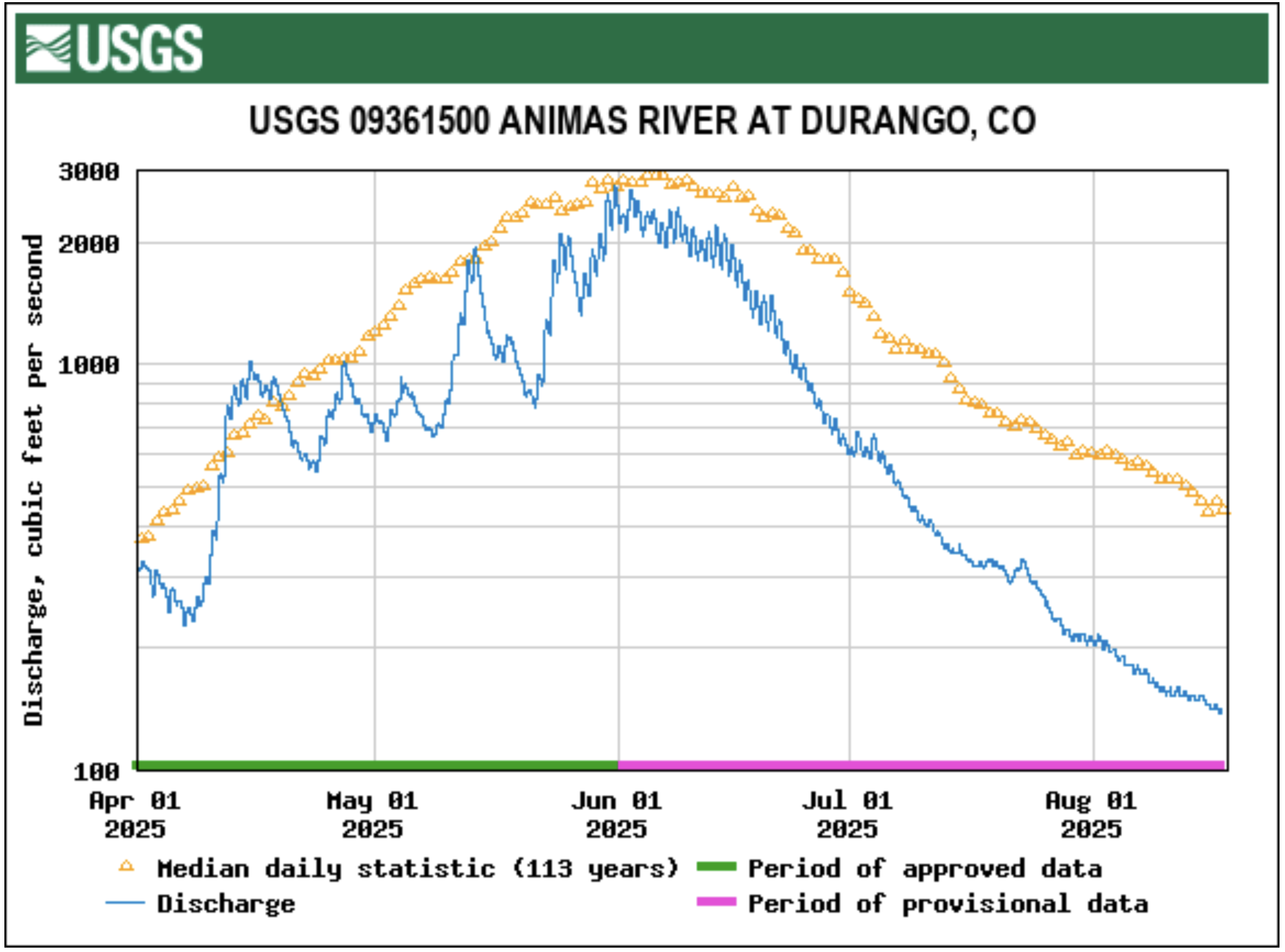
As of Tuesday, the Animas River was running noticeably low – at 35% normalcy for this time of year, according to a recent SnoFlo report. According to U.S. Geological Survey data, the streamflow on Tuesday was at 153 cubic feet per second, and its gauge height was measured at 2.17 feet. Last week, the flow sat around 199 cfs, with the water height resting near the 2.24-foot level, representing a small piece of a larger decline seen historically across the river’s history…
Aquatic wildlife can be impacted by low river levels, said John Livingston, spokesman with Colorado Parks and Wildlife. One effect of low water levels is an overgrowth of riverbed vegetation. Algae, in an attempt to get closer to the sun, may grow thicker and taller than usual, Livingston said. In the Animas River, blue-green algae blooms, also called cyanobacterial harmful algal blooms, are the most likely culprits of this overgrowth, he said.
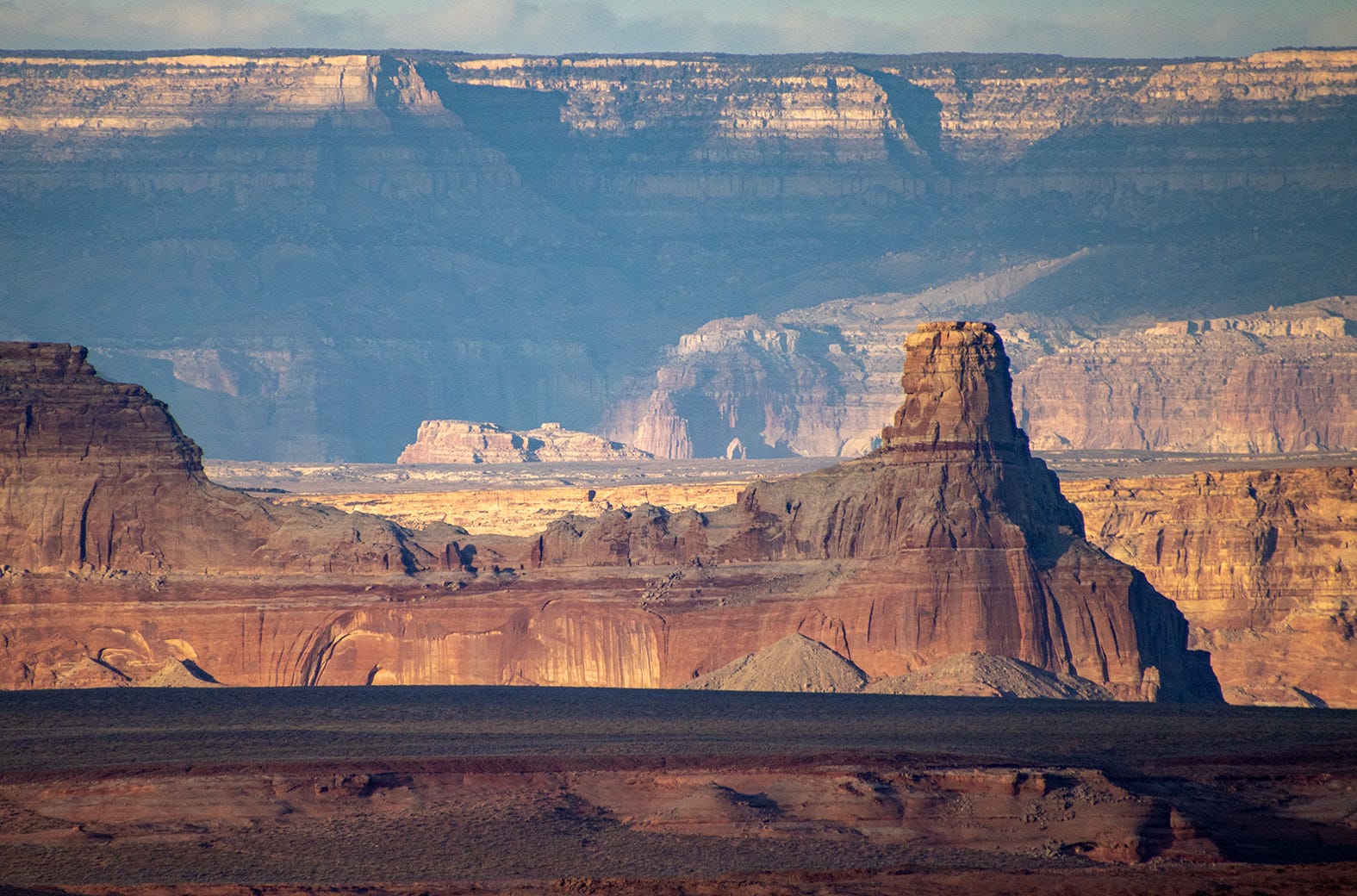
Late light on Glen Canyon rock formations. Jonathan P. Thompson photo.
August 1, 2025
When I was in college and my friends all went to study abroad, I attended a field study program run by The Sierra Institute, an outpost of the University of California, Santa Cruz. Over the course of an academic quarter, we learned about four California ecosystems by studying in them: the Mojave Desert, the Big Sur coast, the High Sierra and the Klamath Mountains. Along the way we hiked and camped and read and wrote and took turns with cooking, cleanup, fire tending and latrine duty.
“Nature, Philosophy and Religion” was the course title and our area of inquiry. We studied the thinkers and spiritual traditions that have been concerned with the splendor of nature, the sustenance humans get from it, and our mutual symbiosis. We considered our own obligations as individuals and as a species. Rather than a distant place and foreign language, we immersed ourselves in the ways that humans live with, steward and find holiness in the natural world.
These are not values I see reflected in today’s political discourse. Our government is working to cancel any programs aimed at sustainability. Elected and appointed officials are erasing climate data and defunding climate action. They are seeking to sell and develop public land and ignoring, at great risk, the ways humans depend on healthy natural systems. They have no interest in the ethics of their policies: who or what will be impacted, and how. Any deference to the land and its creatures — canceled!
Jennifer Sahn, editor-in-chief. Photo credit: High Country News
If everyone could do an extended field study program, could be exposed to natural wonder and experience close-knit community, perhaps the idea of having a responsibility toward the Earth, each other and future generations would be more widely understood and accepted. If you’ve haven’t learned why it’s important to respect and preserve natural systems, how would you understand that you have a choice, at this very moment, to be on the side of life — all life — and against the denigration and desecration of habitats and wild places, the last refugia where humans are required to show restraint. At High Country News, we side with life.
Sadly, after 40 years of running field programs in the backcountry, The Sierra Institute closed in 2015. A post on its Facebook page read, “It is something of a mystery as to why over the last decade the programs became more and more difficult to fill, but it is likely due to a broader cultural change than merely a miscalculation of how to advertise and promote.” The broader cultural change we so desperately need is one in which people believe in the value of nature because they have experienced it and want to continue experiencing it, and because they want those experiences to be available to future generations.
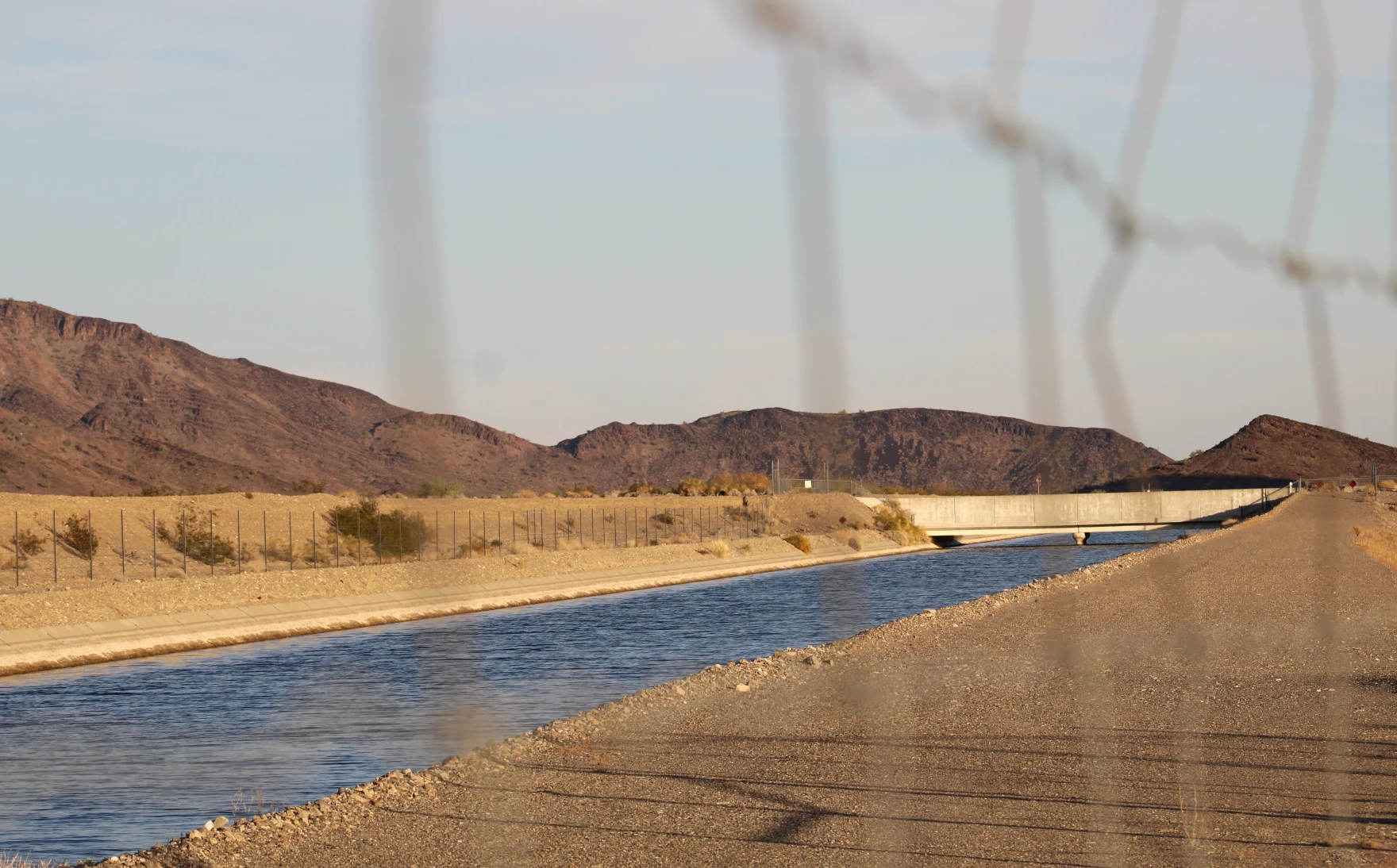
Colorado River water flows through La Paz County, Arizona on August 6, 2025. The Central Arizona Project is among the agencies facing cutbacks on water supply while the river is under shortage conditions. Alex Hager/KUNC
Click the link to read the article on the KUNC website (Alex Hager):
August 15, 2025
This story is part of ongoing coverage of water in the West, produced by KUNC in Colorado and supported by the Walton Family Foundation. KUNC is solely responsible for its editorial coverage.
The latest projections for the Colorado River are out, and they paint a picture of more dry conditions and dropping reservoirs.
The river supplies water to nearly 40 million people across the Southwest, and it’s stretched thin by climate change and steady demand. New data from the Bureau of Reclamation shows low inflows and dropping water levels at the nation’s two largest reservoirs – Lake Powell and Lake Mead. This is just the latest bad news in the midst of a megadrought going back more than two decades.
Projected Lake Mead end-of-month physical elevations from the latest 24-Month Study inflow scenarios.
Projected Lake Powell end-of-month physical elevations from the latest 24-Month Study inflow scenarios.
The river will enter 2026 in a “Tier 1 Shortage,” under which Arizona and Nevada will face mandatory cutbacks to their water supply. While they put some water users in an uncomfortable pinch, those cutbacks aren’t raising the same alarm bells they once did. Dry conditions and water reductions have become a sort of new normal. Shortage conditions for the lower Colorado River basin were first declared in 2021, and have been in place since.
On the ground, the agencies that have to deal with these cutbacks seem to be adapting. Major water users tout their conservation efforts. The towns and cities that are most likely to face permanent reductions to their water use are putting hundreds of millions of dollars into systems that will steel them against smaller water deliveries in the future.
This 2023 diagram shows the tubes through which Lake Powell’s fish can pass through to the section of the Colorado River that flows through the Grand Canyon. Credit: USGS and Reclamation 2023
Meanwhile, further upstream, dropping levels at Lake Powell are creating a near-term crisis. The new federal water data shows the reservoir ending this year only 27% full. If it drops much lower, the reservoir could fall below the pipes which allow water to flow through hydropower generators inside the dam – jeopardizing electricity generation for about five million people across seven states. The new data shows that could happen as soon as November 2026.
The back of Glen Canyon Dam circa 1964, not long after the reservoir had begun filling up. Here the water level is above dead pool, meaning water can be released via the river outlets, but it is below minimum power pool, so water cannot yet enter the penstocks to generate electricity. Bureau of Reclamation photo. Annotations: Jonathan P. Thompson
Policymakers who can shape the region’s long-term response to dry conditions have been facing mounting calls for action. They are under pressure to come up with new rules for managing the river in the long-term before the current guidelines expire in 2026.
Cynthia Campbell, who directs a water policy research center at Arizona State University, said instead of urgently working on a long-term plan, those policymakers seem to have spent the past few years “gambling” on the idea that water might come back and reverse the crisis at major reservoirs.
“If they were betting on that,” she said, “Then they’re losing, because it is continuing to march on. Mother Nature is continuing to march on, and we’re continuing to see declines in the system.”
While some small glimmers of hope have emerged from negotiations, water managers from the seven states that use the Colorado River seem stuck at an impasse.
“We have yet to see any courage in the sense of making choices that will bolster long-term system reliability,” said Campbell, who formerly served as a top water lawyer for the city of Phoenix. “There seems to be an unwillingness on the collected parties to do that, and that is not good news.”
Climate scientists say the river’s dry conditions are unlikely to turn around anytime soon. A warming, drying climate is sapping the region of its water at every turn, and significant reductions to demand are likely the only solution to that new reality.