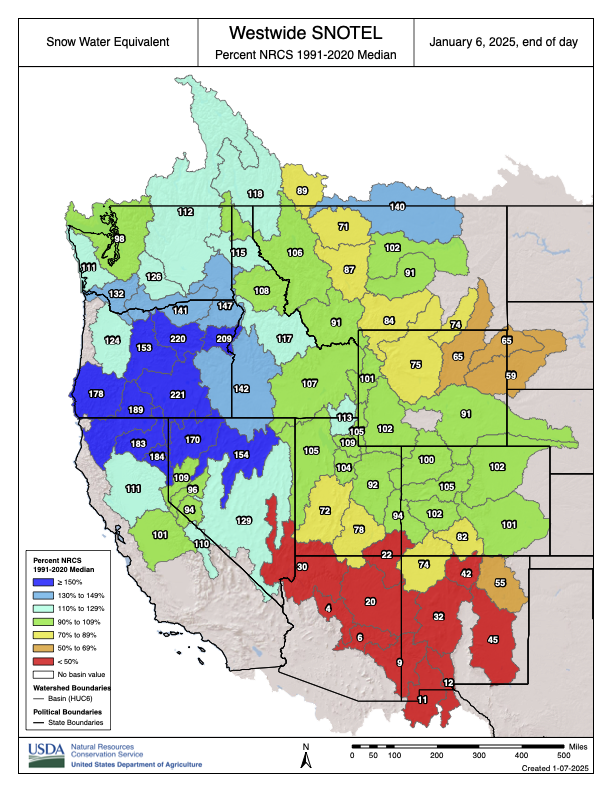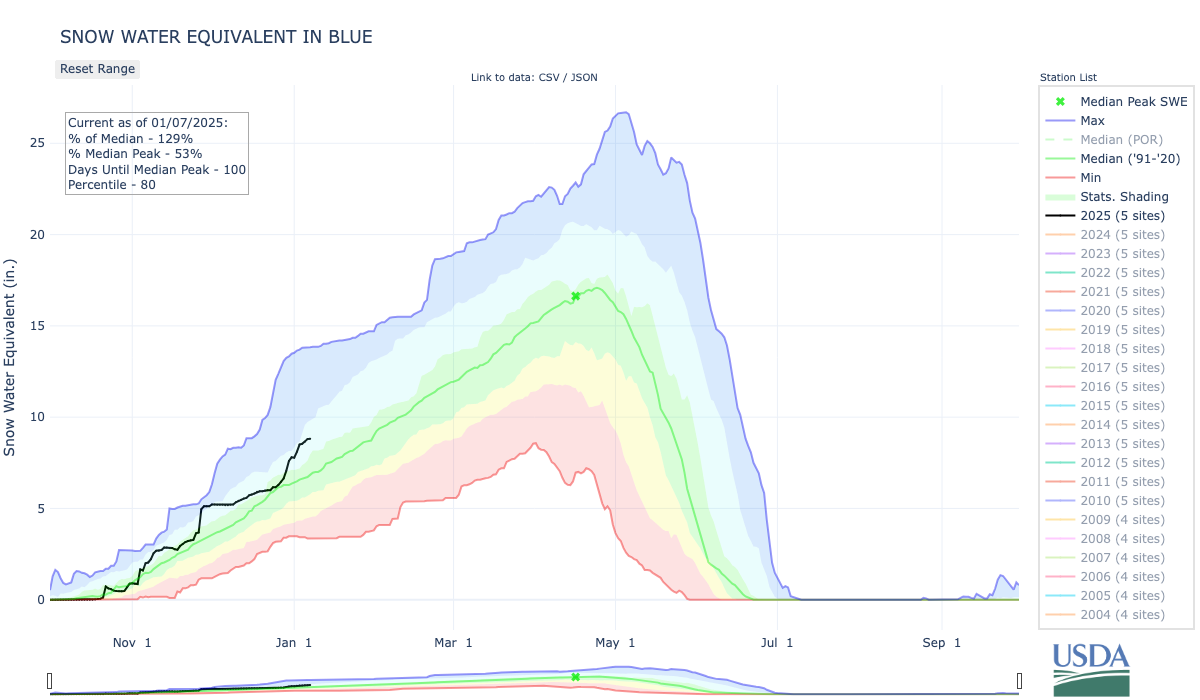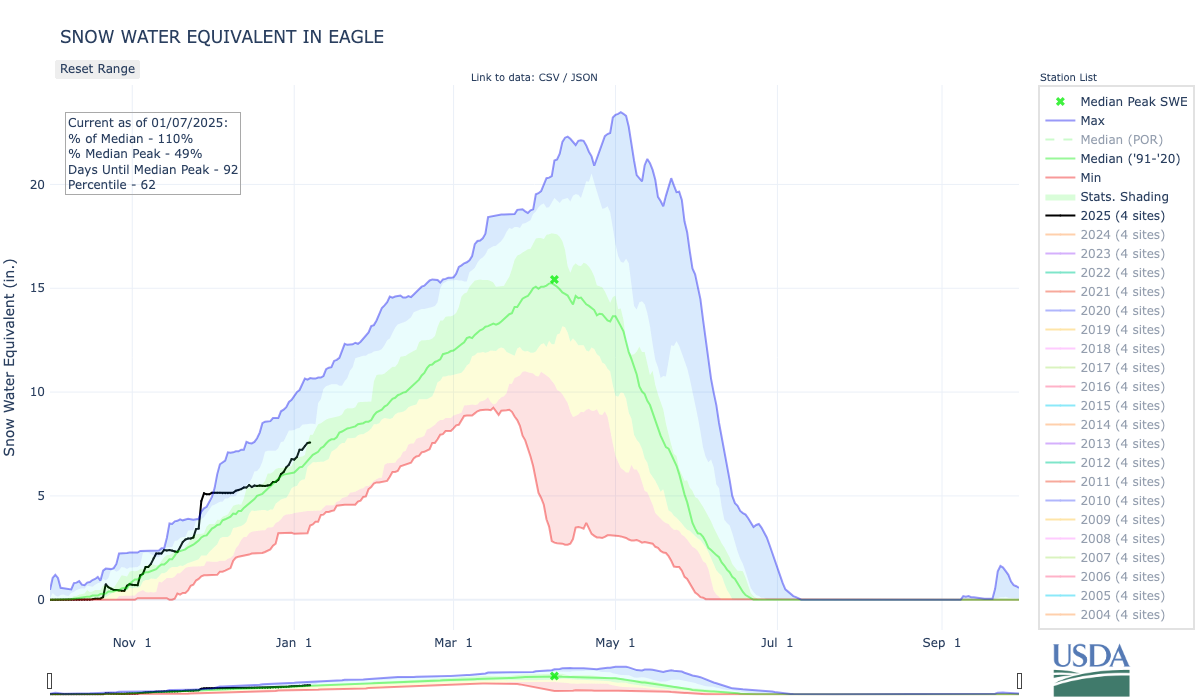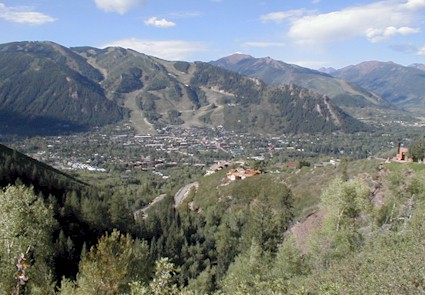
No quick fix for #Aspen #drought conditions — The Aspen Daily News

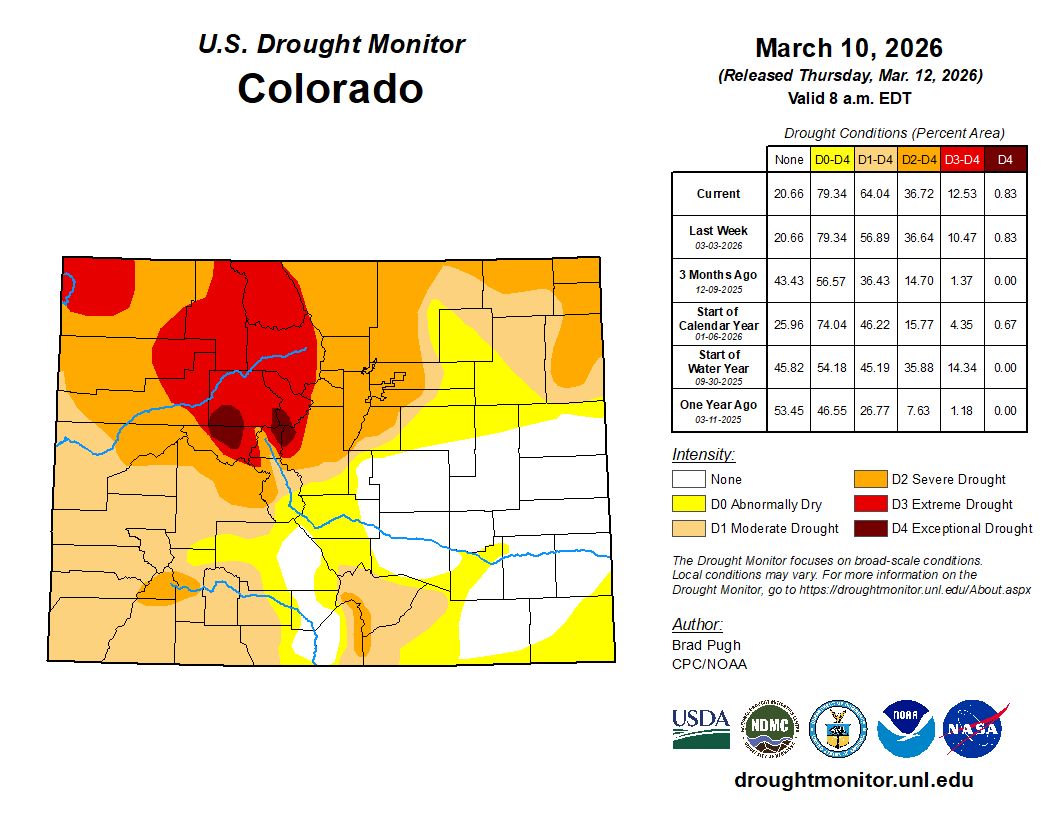
West Drought Monitor map November 25, 2025.

Click the link to read the article on the Aspen Daily News website (Lucy Peterson). Here’s an excerpt:

November 18, 2025

The city of Aspen’s drought response committee is recommending the city maintain a stage 2 water shortage that was declared in August. Monsoonal moisture and cooler temperatures that came since Aspen City Council activated the stage 2 restrictions have helped drought conditions, but not changed them, according to an information memo sent to city council this week. As of Nov. 6, Aspen and Pitkin County remained in severe and extreme drought categories, according to the U.S. Drought Monitor.

“Pitkin County has experienced its second driest year to date (January — September 2025) in 131 years of record with a precipitation deficit of 6.84 inches from normal,” the memo states. 

Data collected from a National Weather Service station at the city’s water treatment facility recorded 1.52 inches of rain in August and 1.89 inches of rain in September. It brought the city’s precipitation deficit to 3.43 inches. Water demand typically decreases in Aspen during the winter when irrigation systems are turned off, but it is when streams are at their lowest point in the year, according to the memo. Councilman John Doyle, a staunch supporter of water conservation, said restrictions are especially important now as ski seasons get shorter and less snow falls…The stage 2 water shortage declaration came two months after the city declared a stage 1 water shortage with a goal to cut overall water consumption by 10% within city limits. Well below-average stream flows led the city to enact the second stage of water shortage, which represents severe drought conditions…The city relies primarily on streamflow from Castle and Maroon creeks for its water supply. It depends on consistent release of water from snowmelt. The city’s stage 2 water restrictions are mandatory. Watering of any lawn, garden, landscaped area, tree, shrub or other plant is prohibited from 9 a.m. to 6 p.m. Household watering schedules are also mandatory.

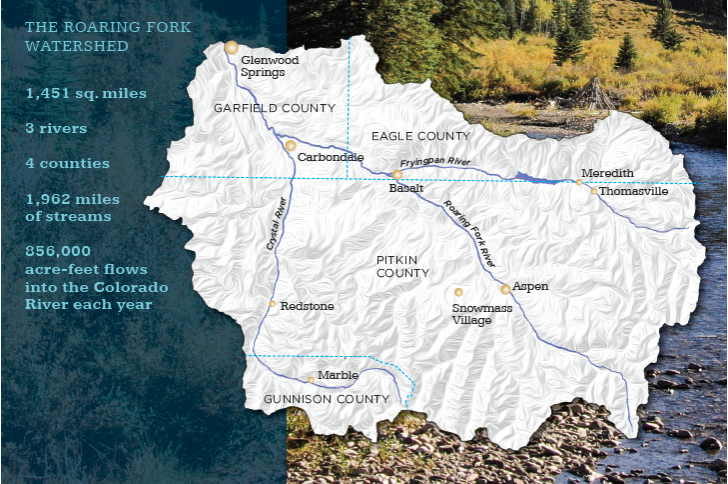
Map of the Roaring Fork River drainage basin in western Colorado, USA. Made using USGS data. By Shannon1 – Own work, CC BY-SA 4.0, https://commons.wikimedia.org/w/index.php?curid=69290878

#Colorado Parks and Wildlife continues increased zebra mussel sampling on the #ColoradoRiver with multi-agency effort

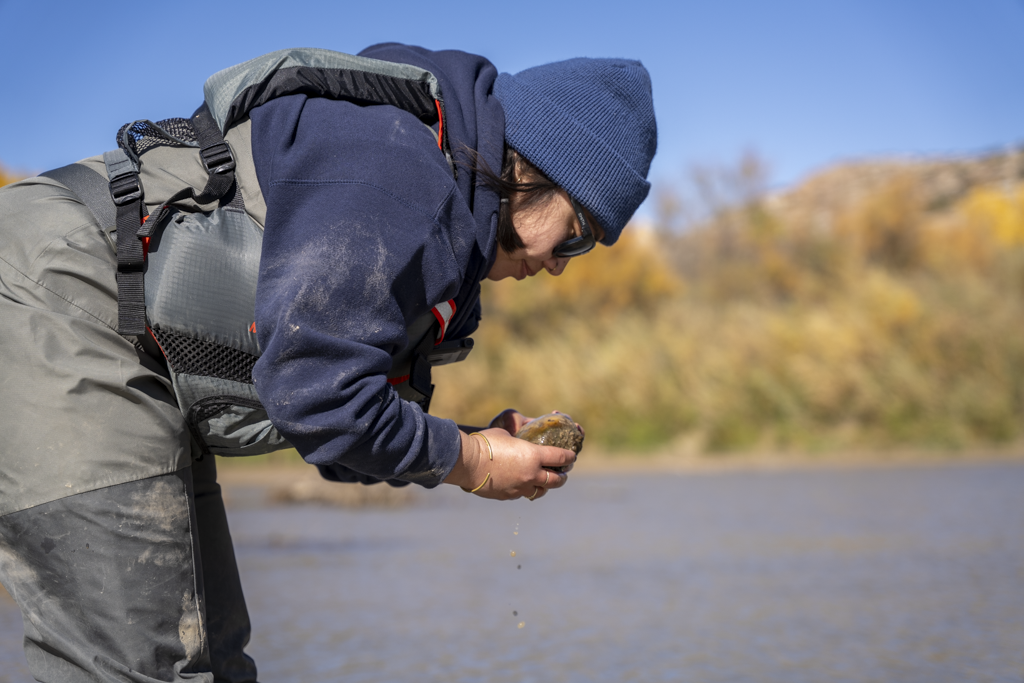
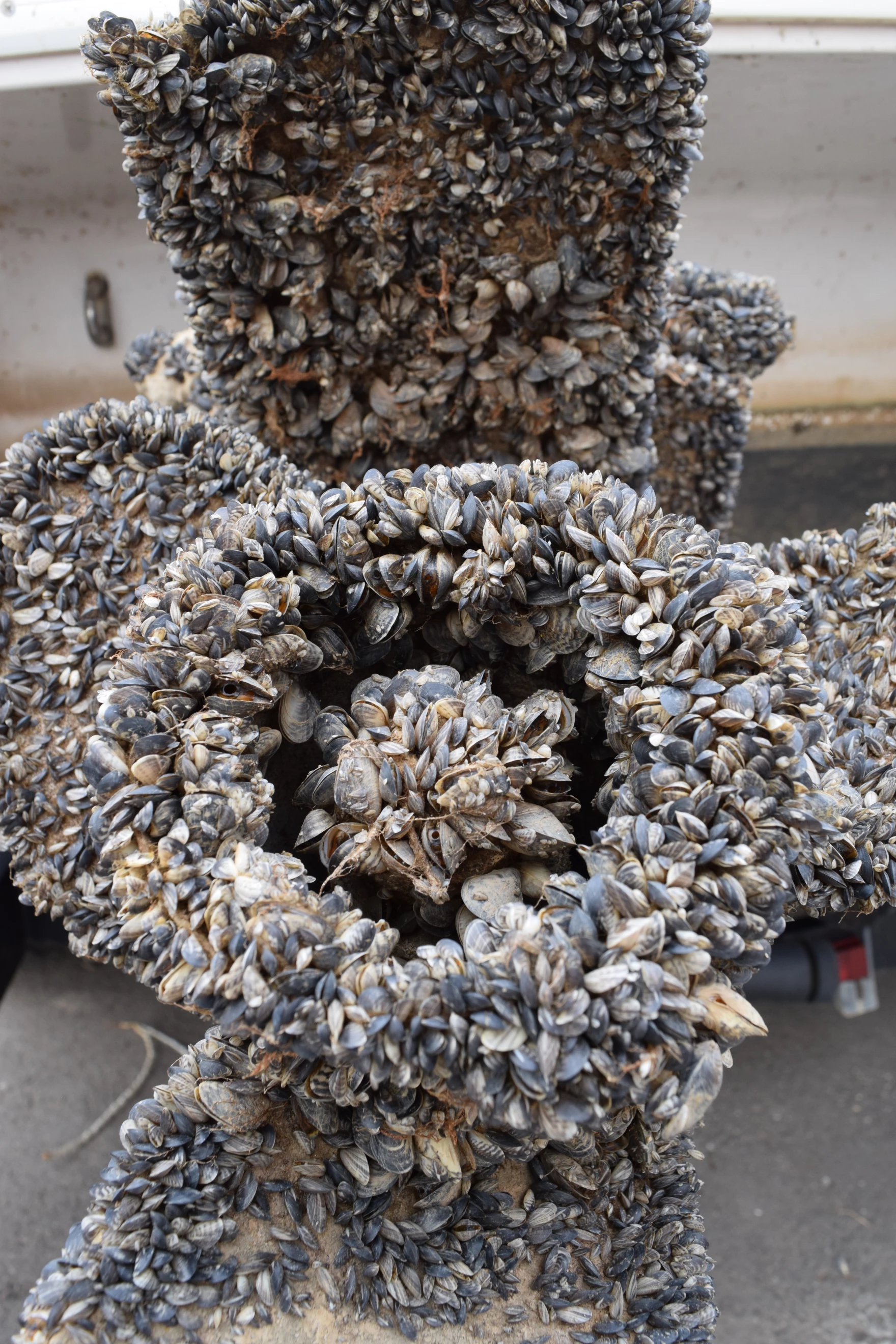
A Colorado Parks and Wildlife Aquatic Nuisance Species staff member looks for adult zebra mussels on a rock from the Colorado River on Oct. 29. That day, over 70 individuals from Parks and Wildlife and its partner agencies and groups searched Western Slope rivers for signs of zebra mussels. Colorado Parks and Wildlife/Courtesy Photo

Click the link to read the article on the Colorado Parks & Wildlife website (Rachael Gonzales):

November 13, 2025

GRAND JUNCTION, Colo. — On Oct. 29, over 70 people from multiple partner agencies and groups joined Colorado Parks and Wildlife (CPW) for a one-day sampling effort on the Colorado River. From the headwaters in Grand County to Westwater, Utah, volunteers from nine agencies spent the day floating the river in search of adult zebra mussels. 

Similar surveys were conducted on the Eagle and Roaring Fork rivers, as well as the tail end of the Gunnison River near the confluence of the Colorado River. 

The rivers were divided into smaller sections to simplify the identification of potential zebra mussel habitat and maximize the amount of surveying that could be done in each section. Stopping at points along the way, teams conducted shoreline surveys by inspecting rocks and other hard surfaces where zebra mussels may attach. 

Staff and volunteers sampled approximately 200 locations, covering over 200 miles between the four rivers. 

Through this sampling effort, CPW  confirmed a single adult zebra mussel in the Colorado River near Rifle. During surveys following the large-scale effort, CPW Aquatic Nuisance Species (ANS) staff discovered additional adult zebra mussels within Glenwood Canyon.

With these new findings, the Colorado River is now considered infested from the confluence of the Eagle River down to the Colorado-Utah border. 

“Although it is disappointing to have found additional zebra mussels in the Colorado River,”  said Robert Walters, CPW’s Invasive Species Program Manager, “this survey achieved its primary objective of gaining a more comprehensive understanding of the extent of the zebra mussel population in western Colorado.”

To date, no zebra mussels — adult or veliger — have been found in the Colorado River upstream of the confluence with the Eagle River.

Mudsnails next to a coin. Adult mudsnails are about the size of a grain of rice. Photo credit: City of Boulder

As a result of the one-day sampling effort, CPW also confirmed the presence of New Zealand mudsnails in the Roaring Fork River. While New Zealand mudsnails have previously been identified in the Colorado, Gunnison and Eagle rivers, this is the first time they have been detected in the Roaring Fork River.

“We could not have pulled off such a massive effort without our partners. These partnerships are instrumental in the continued protection of Colorado’s aquatic resources and infrastructure from invasive mussels,” said Walters.

CPW would like to thank the following agencies and groups who also participated in the one-day sampling effort, in addition to our federal partners at the U.S. Fish and Wildlife Service and Bureau of Reclamation:

  • City of Grand Junction
  • Eagle County
  • Mesa County
  • Orchard Mesa Irrigation District
  • Roaring Fork Conservancy
  • Utah Department of Natural Resources

“It’s not just our federal, state and local partners that play a role in understanding the extent of zebra mussels in the Valley, but also the general public,” Walters continued. “That is why we are continuing to ask for the public’s help.”

If you own a pond or lake that utilizes water from the Colorado River or Grand Junction area canal systems, CPW would like to sample your body of water. You can request sampling of your body of water by CPW staff at Invasive.Species@state.co.us.

In addition to privately owned ponds and lakes, CPW also encourages those who use water pulled from the Colorado River and find any evidence of mussels or clams to send photos to the above email for identification. It is extremely important to accurately report the location in these reports for follow-up surveying.

CPW will continue sampling through Thanksgiving, focusing on smaller ponds in the Grand Valley.

Prevent the spread: Be a Pain in the ANS
Simple actions like cleaning, draining and drying your motorized and hand-launched vessels — including paddleboards and kayaks — and angling gear after you leave the water can make a big difference to protect Colorado’s waters.

Learn more about how you can prevent the spread of aquatic nuisance species and tips to properly clean, drain and dry your boating and fishing gear by visiting our website. Tips for anglers and a map of CPW’s new gear and watercraft cleaning stations are available here.

Colorado Rivers. Credit: Geology.com

Ute traditions inform water #conservation in the Shining Mountains — The Sopris Sun

“As a people, we value water,” says Lorelei Cloud. “We know that water is sacred. We also know that water is alive. It has a spirit.” Photo Credit: Hans Hollenbeck

Click the link to read the article on The Sopris Sun website (Annalise Grueter). Here’s an excerpt:

November 12, 2025

“If we take care of that water, we know that water is going to take care of us,” stated Lorelei Cloud, who has spent a lifetime advocating for water conservation and access. Cloud, a former vice chairman of the Southern Ute tribe, was also the first tribal member on record to serve on the Colorado Water Conservation Board.  On Thursday, Nov. 6, The Arts Campus at Willits (TACAW) hosted Cloud and a fellow trustee of The Nature Conservancy (TNC) Colorado, Johnny Le Coq, for a presentation on their respective backgrounds and water conservation work. The event, sponsored by Roaring Fork Conservancy and TNC, was a special installment of the Brooksher Watershed Institute. Lawyer Ramsey Kropf, who has decades of experience in representing Indian water rights cases in the Colorado and Klamath River basins, emceed.

After some brief introductions, Cloud opened the evening by sharing the history of her people. The Roaring Fork Valley is part of ancestral Ute territories. Though the Utes, who referred to themselves as “Nuche,” or “the people,” and called their home the “Shining Mountains,” were seasonally nomadic before the arrival of colonial miners, Cloud shared that her people do not have a traditional migration story as some Indigenous peoples do. What the Nuche have is a creation story that ties them intrinsically to the soaring peaks and waterways of the Colorado Rocky Mountains.  Cloud explained that the seasonal nomadic moves of the Nuche were not considered to be migration but normal shifts, demonstrating respect and care for the ecosystems…

“We believe that we are one and the same with nature,” Cloud said, elaborating that other species and even elements like water are akin to souls.

Federal land and Indian reservations in Colorado

Protecting the peak on the #CrystalRiver: Scientists studying tree rings as first step toward instream-flow safeguards — Heather Sackett (AspenJounalism.org)

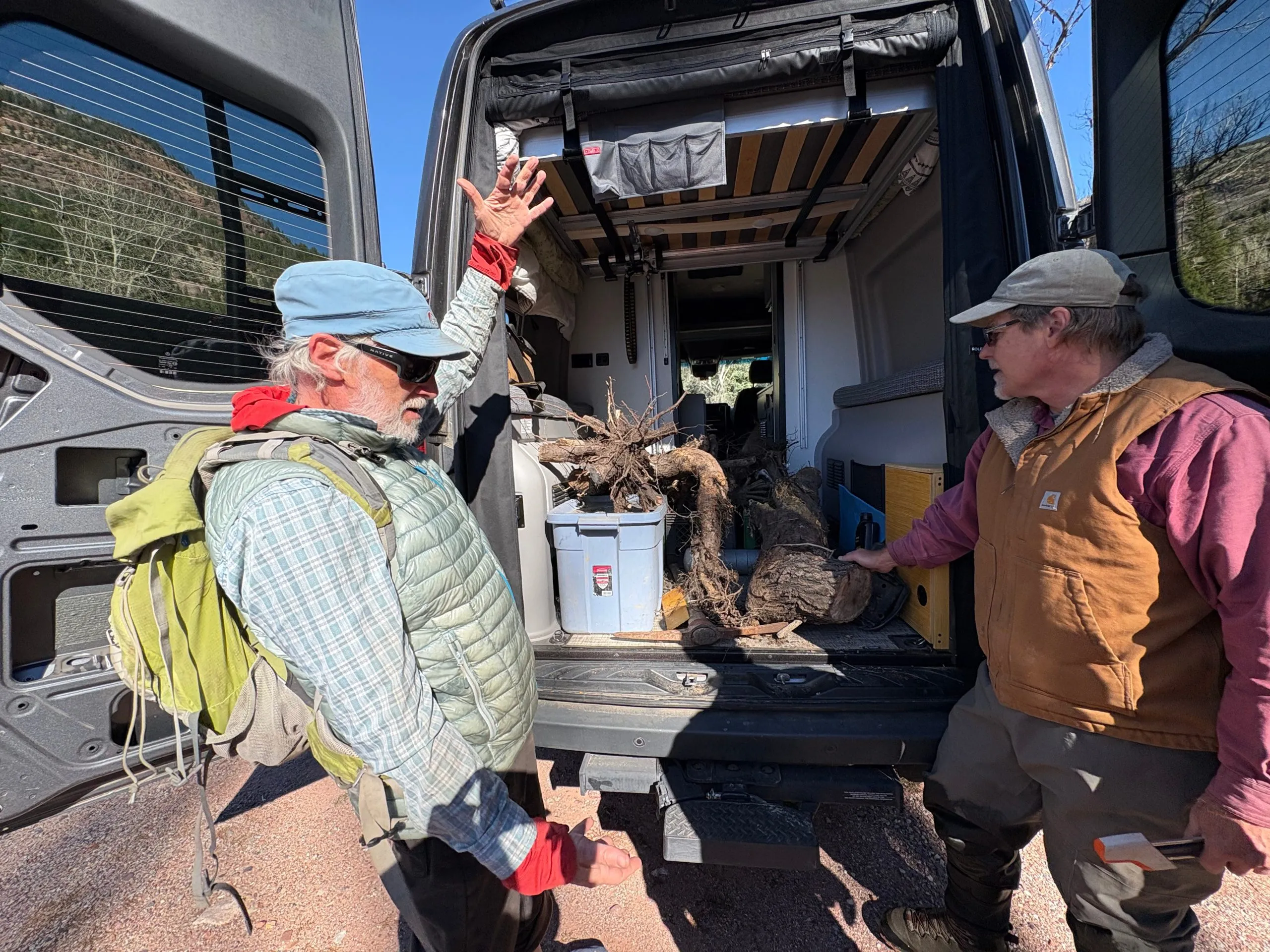
Riparian ecologists David Cooper, left, and David Merritt take stock of the tree root crowns collected from the banks of the Crystal River the last week in October. They will take the trunks back to the lab in Fort Collins to study the tree rings, the first step in understanding how floods impact riparian vegetation. CREDIT: HEATHER SACKETT/ASPEN JOURNALISM

Click the link to read the article on the Aspen Journalism website (Heather Sackett):

October 31, 2025

Over three sunny-but-cool October days, a team of scientists and volunteers dug up and hauled away the root crowns of trees along the Crystal River, a first step toward a potential strategy to protect flows on one of the last free-flowing rivers in Colorado.

David Cooper, a senior researcher on wetland and riparian ecology at Colorado State University, studies how spring floods affect riparian vegetation. His van was full of the tree samples that he would take back to the lab in Fort Collins to study their rings. 

“We want to know the year the plant was established because once we know the year the plant was established, then we could relate that to the flow record that’s recorded by gauges,” Cooper said. “Then we can speak to the role of floods, which is important for the public to understand and for river managers to understand.”

The banks of the Crystal just upstream from Redstone are lined with narrowleaf cottonwood and blue spruce. Cottonwoods in particular need the rushing flows of spring runoff for their seeds to germinate and have evolved to disperse their seeds just after the high point of snowmelt each year. The seeds, carried along the wind by a bit of fluff, land in the bare, wet, mineral soil of streambanks where some of them take root. 

Peter Brown with Rocky Mountain Tree Ring Research takes a core sample from a tree on the banks of the Crystal River. A type of instream flow water right that protects peak flows could help maintain spring floods, which are essential for growing new cottonwoods. CREDIT: HEATHER SACKETT/ASPEN JOURNALISM

Cooper’s work, which is estimated to cost $26,300, was commissioned by a subcommittee of the Crystal River Wild and Scenic and Other Alternatives Feasibility Steering Committee, which is looking at different tools that could be used to protect the river. The Crystal, which flows about 40 miles from its headwaters in the Maroon Bells-Snowmass Wilderness through the towns of Marble, Redstone and Carbondale before its confluence with the Roaring Fork, is one Colorado’s last undammed major rivers.

Environmental and recreation advocates and local municipalities, as well as many residents of the Crystal River Valley, have long sought to protect the river from future dams and diversions — infrastructure projects that have left many other Western Slope rivers depleted. 

Those who want to protect the Crystal River have for the past few years been exploring the best ways to do that. Although proponents say a federal Wild and Scenic designation would do the best job of protecting the river, that has been met with resistance from some property owners, leading the steering committee to explore other options, in addition to pursuing Wild and Scenic. 

Scientists dug up this root crown next to the Crystal River in order to study the tree rings and how they relate to flood years. The Crystal River Wild and Scenic Instream Flow Subcommittee is looking at how to protect spring peak flows in the river. CREDIT: HEATHER SACKETT/ASPEN JOURNALISM

Instream-flow subcommittee

After a year’s worth of meetings with a facilitator, the steering committee chose to pursue three potential ways forward: a “peaking” instream-flow water right; an intergovernmental agreement; and a federal Wild and Scenic designation. None of the methods would preclude the others; there could eventually be layers of protections for the Crystal. 

The instream-flow subcommittee, which includes representatives from American Whitewater, and local governments and residents, is exploring how to keep water in the river by using the Colorado Water Conservation Board’s instream-flow program. 

The CWCB is the only entity allowed to hold water rights that keep water in rivers and are designed to preserve the natural environment to a reasonable degree. A “peaking” instream-flow water right would keep in the stream all of the water not claimed by someone else during years with high spring runoff, thereby maintaining these periodic floods, which are essential for growing new cottonwoods.

The idea is that if these peak spring flows are already spoken for by the environment, they can’t be claimed by future reservoir projects, which also tend to capture water at the height of spring runoff and store it for use later in the year. 

“If you want to be a little more objective about it, it’s an argument for or against floods and natural river processes,” said David Merritt, a riparian ecologist and former instream flow coordinator for the U.S. Forest Service who has worked on other instream-flow projects around the state. “The dam goes in, it’s going to interrupt that and you’ll end up with a different ecosystem.”

If there is less water available to develop, it could make a particular river less attractive for building a reservoir, said Laura Belanger, a senior policy adviser with Western Resource Advocates. The environmental nonprofit has worked on these types of peak instream-flow projects in the Gunnison River basin.

“Infrastructure is expensive, so you need to get a certain yield out of it,” Belanger said. “That could potentially make a project not be cost effective and not have sufficient yield to be pursued. … Around the state, so much water is already claimed, and so, for a lot of new reservoir projects, the peak is the only thing that’s available.”

So far, this tool for protecting the peak is little used, but there are three recent examples on streams that drain the Uncompahgre Plateau: Cottonwood Creek, Monitor Creek and Potter Creek. In 2024, these three creeks secured an instream-flow water right for their spring peak flows in years with high runoff. All three still allow for some amount of future water development. 

“They don’t kick in every year; they’re definitely unique,” Belanger said. “It doesn’t kick in until you hit a certain high flow and then it protects the hydrograph all the way up and then back down to a certain value.”

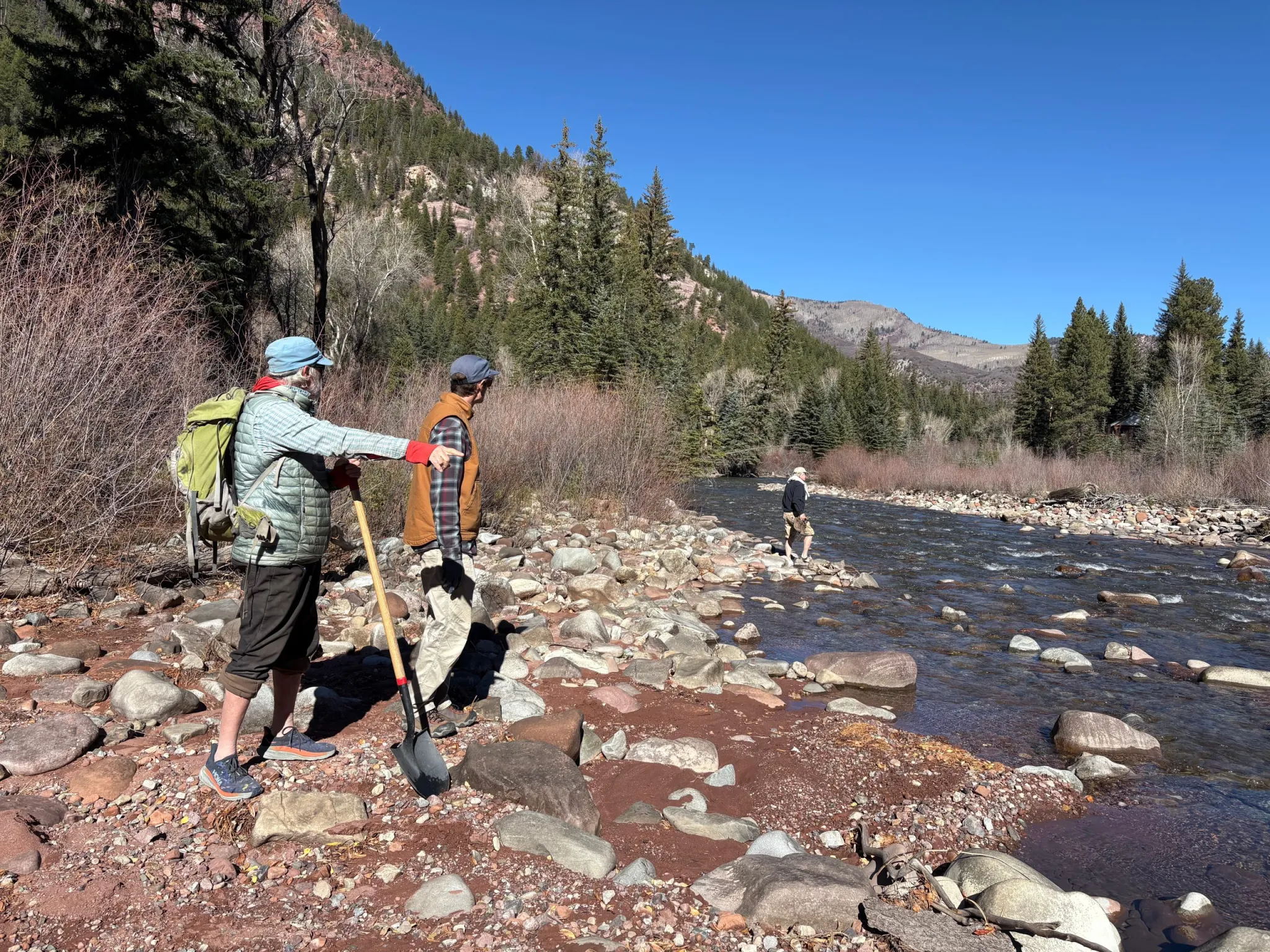
Wetland and riparian ecologist David Cooper, left, and campaign director at Wilderness Workshop Michael Gorman look for the best place to cross the Crystal River. Scientists and volunteers collected tree root crowns from the riverbanks the last week of October, the first step in understanding how floods impact riparian vegetation. CREDIT: HEATHER SACKETT/ASPEN JOURNALISM

Subcommittee still looking at Wild and Scenic

The steering committee’s work, including the tree-ring study, is funded by Pitkin County Healthy Rivers, by the Mighty Arrow Family Foundation, and in-kind donations from Western Resource Advocates and American Whitewater. But the majority of the funding – $99,699 according to Hattie Johnson, southern Rockies restoration director with American Whitewater and member of the instream flow and Wild and Scenic subcommittees – is through the state’s Wild and Scenic Rivers Fund.

The CWCB generally advocates for using state mechanisms such as the instream-flow program to protect rivers because it would rather avoid a federal Wild and Scenic designation. With increasing competition for dwindling water supplies, the state has been reluctant to support Wild and Scenic designations, which could lock up water and prevent it from being developed in the future. 

The U.S. Forest Service determined in the 1980s that portions of the Crystal River were eligible for designation under the Wild & Scenic River Act, which seeks to preserve, in a free-flowing condition, rivers with outstandingly remarkable scenic, recreational, geologic, fish and wildlife, historic, and cultural values. Wild and Scenic experts say the “teeth” of the designation comes from an outright prohibition on federal funding or licensing of any new Federal Energy Regulatory Commission-permitted dam. A designation would also require review of federally assisted water resource projects.

Any designation would take place upstream from the big agricultural diversions on the lower portion of the river near Carbondale. 

The subcommittee that is still looking at a Wild and Scenic designation has hired a facilitator team from the Keystone Policy Center to help the group produce a report of its findings at a cost of about $45,000. And the instream-flow subcommittee has also hired Ecological Resource Consultants to do a sediment-impacts study, which is set to begin before winter and is estimated to cost about $30,000.

Wild and Scenic subcommittee chair Michael Gorman said members have taken a deep dive into policy and legislation, and have learned a lot from stakeholders along the river. 

“We’ve got more work to do and we’re excited to have the skilled facilitators at Keystone to help us compile what we’ve learned about how Wild and Scenic legislation ties into our specific priorities on the Crystal River,” Gorman said in a prepared statement. “We look forward to having a report that we can share with our community and inform future discussions.” 

Map of the Roaring Fork River drainage basin in western Colorado, USA. Made using USGS data. By Shannon1 – Own work, CC BY-SA 4.0, https://commons.wikimedia.org/w/index.php?curid=69290878

#SnowmassVillage’s wilderness water source poses unique wildfire risk: Pristine supply reliant on #EastSnowmassCreek is at once a blessing and a liability — Elizabeth Stewart-Severy (AspenJournalism.org)

The intake structure for the Snowmass Water and Sanitation District sits about 20 feet downstream of the Maroon Bells-Snowmass Wilderness Area boundary along East Snowmass Creek. The proximity to the wilderness area is beneficial for water quality but complicates wildfire planning efforts. Photo credit: Aspen Journalism

Click the link to read the article on the Aspen Journalism website (Elizabeth Stewart-Severy):

October 22, 2025

If Snowmass Village ran an ad for its tap water, it might feature snow-covered, pristine high peaks above the town. Winter snowflakes gather on Baldy and Willoughby mountains and trickle through alpine tundra and conifer forests into East Snowmass Creek, where icy clear water tumbles past the U.S. Forest Service Wilderness Area sign. Snow to the river to the village’s faucets.  In real life, after the water is diverted from East Snowmass Creek — just about 20 feet downstream from the boundary of the Maroon Bells-Snowmass Wilderness area — it makes a quick detour through the town of Snowmass Village’s filtration systems at the water-treatment facility on Fanny Hill. (The ad might as well include smiling skiers.) 

“We get our water basically from a super-pristine source, so we’re literally drinking out of the mountain stream,” said Darrell Smith, water resources manager for Snowmass Water and Sanitation. 

There are clear benefits to having a water supply come directly from wilderness, especially in terms of water quality. But it also means that the town is limited in how it can mitigate risks arising in a protected landscape from natural disasters such as wildfire and postfire flooding, debris flows and erosion. 

The Roaring Fork Valley Wildfire Collaborative is leading work on a Wildfire Ready Action Plan (WRAP) for the Roaring Fork watershed that can help local communities identify the risks of and prepare for these postfire hazards. 

With a goal to make the Roaring Fork Valley more wildfire resilient, the collaborative is also undertaking several large-scale wildfire mitigation projects that aim to reduce the risk of wildfire near communities and critical infrastructure. The nonprofit recently secured a grant for $850,000 from the Colorado Division of Homeland Security and Emergency Management to complete wildfire-mitigation work in Snowmass Village. 

The town of Snowmass Village and the wildfire collaborative hired Hussam Mahmoud, a wildfire risk expert, to complete advanced modeling work that will identify the homes and areas that are most at risk, how a fire might spread in the village and the most effective mitigation strategies. 

The recent grant will enable work to begin on key projects as soon as the modeling work is completed, as soon as this spring, according to Angie Davlin, executive director of the Roaring Fork Valley Wildfire Collaborative.  

Alongside such mitigation work aimed at preventing wildfire from reaching communities, the collaborative is working to ensure that if a fire occurs, there’s a proactive plan for recovery and reducing damage to infrastructure. That’s the focus of WRAP.

During a September tour of key sites in the watershed, engineers with Wright Water Engineers heard from local stakeholders about infrastructure systems and provided updates on data collection and highlighted some key areas — such as in Snowmass Village — that might be susceptible to postfire hazards. 

“There are some quite vulnerable systems in the Roaring Fork Valley — Snowmass being at the very top of that list — that really need some advance planning,” said Natalie Collar, senior hydrologist with Wright Water Engineers and who is heading up the report. 

Collar and engineer Madison Witterschein presented initial mapping results that illustrate postfire risks and hazards, and the message for Snowmass Water was clear.  

“You need a plan prefire,” Witterschein told a group gathered at the Snowmass Water and Sanitation District’s office in Snowmass Village. “Especially with the wilderness area, if there was a fire, there’s not much you can do after. You have to have a plan before it starts.” 

Darrell Smith, water resources manager for Snowmass Water and Sanitation, discusses Snowmass Village’s water infrastructure and vulnerabilities as part of the Roaring Fork Valley Wildfire Collaborative’s work to create a Wildfire Ready Action Plan for the valley. CREDIT: ELIZABETH STEWART-SEVERY/ASPEN JOURNALISM

One-source water supply in Snowmass 

Kit Hamby, director of Snowmass Water and Sanitation, said about 96% of Snowmass Village’s water is gravity-fed from the roughly 6-square-mile watershed of East Snowmass Creek, which is nestled in the Maroon Bells-Snowmass Wilderness Area. 

Such designated wilderness areas receive the highest protection under federal law, the 1964 Wilderness Act, which requires that land is managed for preservation, such that it “generally appears to have been affected primarily by the forces of nature, with the imprint of man’s work substantially unnoticeable.” 

The water that comes from East Snowmass Creek is also primarily untouched by contaminants; the 2024 annual water-quality report shows contaminant levels far below limits set by the Environmental Protection Agency across the board. 

“There’s not much above us other than elk and marmot, some bear,” Smith told the group assembled to discuss WRAP. “It doesn’t mean you want to drink out of the stream, for obvious reasons, but from an industrial or commercial standpoint, there’s nothing happening upstream from us.”

There is both a bubbling spring and a mountain stream in the East Snowmass Creek valley, and each contributes to turbidity — or suspended material — in the water supply. Much of the turbidity is caused by high oxygen content in the water and can be a challenge for the filtration system. 

“In the summertime, during runoff, our filters are needing to be backwashed a lot, just because of entrained air in the water. Those bubbles become barriers to filtration in our water-treatment plant,” Smith said. “We have to take the water, reverse the flow, send it back through the filter, get the filters to kind of burp, essentially, and then it all settles back and we run again.”

A second intake system brings water from Snowmass Creek, which is below the confluence of East Snowmass Creek and the mainstem near the base of the Campground chairlift on Snowmass Ski Area. Because that diversion is downstream of the confluence of the streams, any pollutants from East Snowmass would also be present there, though somewhat diluted by the addition of Snowmass Creek. 

That water is pumped up over a hill into Ziegler Reservoir, which holds about 82 million gallons of water and is primarily used for irrigation and snowmaking purposes. 

Snowmass Water and Sanitation has three possible sources to provide water to Snowmass Village, but about 96 percent of the water comes from the East Snowmass Creek watershed, marked in blue. Water from Brush Creek, marked in purple, is high in turbidity and rarely used. Water pulled from Snowmass Creek can be pumped to either Ziegler Reservoir or to the water treatment facility on Fanny Hill. CREDIT: COURTESY OF DARRELL SMITH

There is an additional intake on Snowmass Ski Area; Snowmass Water and Sanitation can divert from the west fork of Brush Creek, but it isn’t often used because of poor quality due to the geography of the area. That stream comes down from the Cirque zone on the ski area and has high levels of sediment from the clay soils, according to Hamby. 

Hamby, Smith and others at Snowmass Water have long known there are vulnerabilities for the system that relies so heavily on one drainage for its water. A wildfire in the East Snowmass Creek valley could raise myriad issues, some of which are reflected in challenges the utility has seen through other natural disasters and weather events. 

Avalanches, including a large one that came down Garrett Peak in 2019, have left downed trees and lots of debris that has the potential to cause issues. 

“I was concerned that it would change the water quality, though it didn’t,” Hamby said. “As some of the timber degrades and decomposes, it releases the heavy metals that are contained in the timber.”

This can also happen to downed timber after a wildfire. 

Even large rain events can cause turbidity that is difficult for the system’s filtration systems to manage. 

“That alone can deliver a slug of turbidity down the water course that means we have to turn off a particular intake and just draw from one of the others,” Smith said. 

In these types of instances, Snowmass Water and Sanitation can turn to the storage in Ziegler Reservoir. Smith noted that it is rare that the water authority draws entirely from the reservoir because of taste and odor issues that can arise from algae growth in the hot summer months. 

“We’re very fortunate to have Ziegler, and I personally believe it needs to be expanded,” Hamby said. “Ziegler is one of our strengths. Very few communities have 80 million gallons stored above the water treatment plan that could be gravity-fed to supply the town and also used to fight wildfire.” 

The aftermath of a significant wildfire in the Snowmass area would present major challenges. The same filters that struggle to manage turbidity from sediment or oxygen bubbles after a heavy rain could be overcome by ash, runoff, pollutants or debris after a fire or rain following the burn. 

“We don’t have a lot that we can do to prevent it,” Smith said.  

If the utility were unable to use native streams, Smith said, Ziegler Reservoir could provide between three and six weeks of water to the town, a number that could probably be extended with water restrictions. 

But still, Smith said, “It’s a short term tool, and a partial tool. I don’t think it’s really designed as an exclusive source. That’s not the goal.”

East Snowmass Creek runs through the Maroon Bells-Snowmass Wilderness Area; the creek provides the vast majority of Snowmass Village’s water supply. CREDIT: COURTESY OF DARRELL SMITH

Postfire debris-flow danger compounded by wilderness area

Although WRAP is still in the data-gathering phase, Wright Water Engineers has completed drafts of maps that show the likelihood of a postfire debris flow and the volume of debris that those might produce. 

There are several drainages around the Roaring Fork watershed that show a high likelihood of postwildfire debris flows, given a hard rain that would happen, on average, every two years. That includes the lower basin of East Snowmass Creek, where Snowmass Water’s headgate sits. 

“A debris flow from a side drainage could come in and impact your headgate, could destroy it,” Witterschein said. “If there was enough material, it could be completely demolished, or it could be blocked with material.”

Wright Water Engineers, which expects to complete the analysis work by the end of this year, recommends actions for predisaster planning and mitigation this spring. But it’s already clear to Collar that some best-practices to mitigate risk might be off the table for Snowmass Village. 

“There is, at least for Snowmass, very little we can prescribe because they are so high up in the watershed,” Collar said, and because so much of the drainage area is wilderness.

The Colorado Water Conservation Board, which provides funding for Wildfire Ready Action Plans, lists several possible measures to help protect water infrastructure in the aftermath of a wildfire, such as setback levees, debris nets and planned overflow channels. Those interventions are typically spread out upstream from critical infrastructure, but in the case of Snowmass Water and Sanitation, everything upstream of the intake structure is in a wilderness area. 

Such postfire projects would need to go through the Forest Service’s minimum requirements analysis to ensure that there are no other less-impactful actions that could be taken, according to former White River National Forest Supervisor Scott Fitzwilliams. He said temporary actions, like nets that stabilize a hillside for a few years until vegetation regrows, have a better chance of approval than permanent structures.

In planning for postfire impacts, Collar said the community may need to rely on steps to take outside the wilderness area. 

“They might be stuck to installing a debris basin right before their intake, versus having more distributed best-management practices,” Collar said. 

Past assessments of Snowmass Water’s infrastructure have yielded a recommendation that the utility upgrade its filter system, Hamby said. Such work would be costly, and Hamby estimated Snowmass Water might revisit the issue in five to 10 years. 

Because of the location of Snowmass Village — up so high in the watershed, with one primary source — Collar said it’s particularly important to plan ahead. 

“It’s not uncommon to have a population that is vulnerable to destruction of the water supply after a wildfire,” Collar said. “But it’s a bit unique to have someone positioned so high up in the watershed where it’s a long straw that you’d have to install to get to another source of water.” 

In the event of an emergency, Snowmass Water and Sanitation does have some existing water rights on the Roaring Fork River, but no infrastructure in place to utilize that water, which would need to be pumped about 1,400 vertical feet and about 5 miles up the valley to reach the treatment facility. 

Any kind of protective project would take time, from a filtration system to a debris catchment basin or a new water-supply line.

“Truly just from a time perspective,” Collar said, “thinking through these things and installing some of these projects before a wildfire occurs is the best way to get a project that’s designed well, that’s not installed in an emergency rush and that has adequate funding.”  

Map of the Roaring Fork River drainage basin in western Colorado, USA. Made using USGS data. By Shannon1 – Own work, CC BY-SA 4.0, https://commons.wikimedia.org/w/index.php?curid=69290878

Boaters, anglers want clarity around public access to Colorado’s streams: Coalition wants lawmakers to consider right to float and to wade — Heather Sackett (AspenJournalism.org)

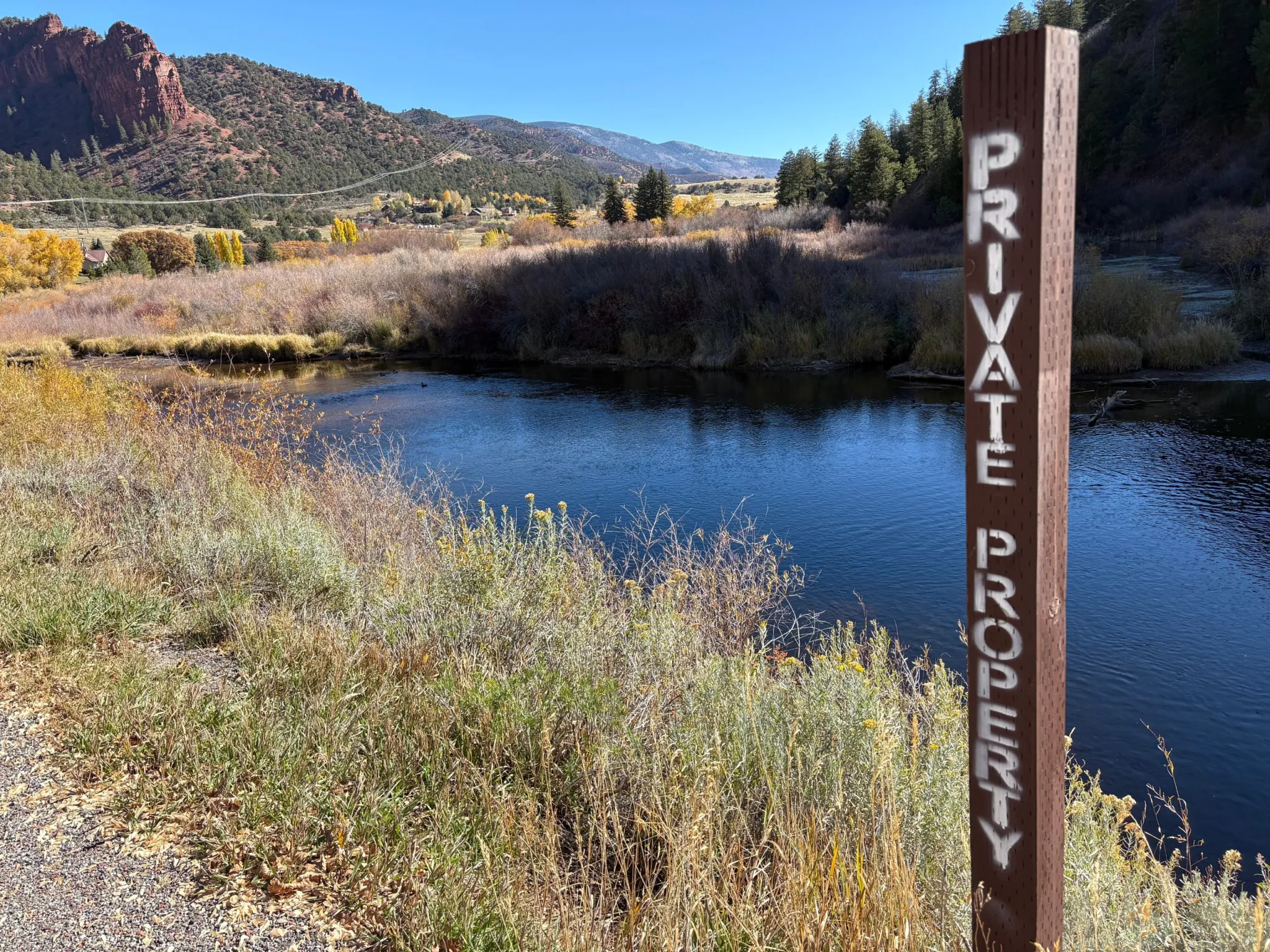
No trespassing signs line a section of the Fryingpan River flowing through private property upstream of Basalt. The Fryingpan is a popular stream for anglers, though public access is limited. CREDIT: HEATHER SACKETT/ASPEN JOURNALISM

Click the link to read the article on the Aspen Journalism website (Heather Sackett):

October 22, 2025

A group of recreation advocates are hoping Colorado lawmakers will settle the state’s legal gray area surrounding public river access. The Colorado Stream Access Coalition is fighting for the public’s right to use the state’s waterways for recreation, a right they say is guaranteed in the Colorado Constitution. 

“Our position is that under the Colorado Constitution, it’s always been understood that there was a public easement,” said Mark Squillace, a law professor at the University of Colorado Boulder and an expert on water and natural resources policy. “And if there’s a public easement, even though it’s private property, the public gets to use it. We would like to see legislation that basically guarantees the right to both wade and float through private property.” 

Squillace was referring to a clause in the state constitution that declares all unappropriated water in every natural stream to be the property of the public and dedicated to the use of the people of the state.

Kestrel Kunz, southern Rockies protection director at American Whitewater, testified at the Water Resources Committee in August, asking legislators to guarantee public access to rivers for all Coloradans, while respecting landowners’ property rights. Kunz said American Whitewater gets regular reports of conflicts between boaters and property owners.

American Whitewater is seeking legal public protections for boating on Colorado’s rivers, to portage around hazards and to scout when needed.

“Colorado offers no clarity, no protection and no certainty for landowners or the public,” Kunz said. “That lack of clarity is dangerous.”

The issue of stream access highlights a basic tension in Colorado’s laws and values: Are rivers just another category of property that can be privately owned and fenced off? Or are they so central to the state’s culture, identity and outdoor recreation economy that they should be considered public resources open to public use?

“There are a lot of very wealthy landowners in this state that are strongly opposed to the public having any rights in what they consider to be their rivers,” Squillace said. “And we don’t believe they own the rivers. We think those are public resources that should be held in common for all the people to use.”

Paddlers float through North Star Nature Preserve on the Roaring Fork River upstream of Aspen. Some river access advocates want the state to clarify the right of boaters to touch the beds and banks of streams, and the ability to portage and scout for safety. CREDIT: HEATHER SACKETT/ASPEN JOURNALISM

The public’s right to use waterways was codified in a 19th century U.S. Supreme Court decision that said states own the beds of “navigable” rivers, meaning rivers that were used for commerce at the time of statehood. But Colorado does not consider any of its rivers to be navigable, meaning the streambeds belong not to the state — and therefore the public — but to adjacent property owners. A 1979 Colorado Supreme Court decision in People v. Emmert ruled on the side of property owners, saying that the public could not float through private property. 

A subsequent Colorado attorney general opinion said boaters can float through private property, and as long as they don’t touch the streambed or banks, they won’t be charged with criminal trespass. But stream-access supporters say this informal policy needs to be clarified into law and should also make allowances for boater safety. 

Kent Vertrees, a board member and staffer for Friends of the Yampa, said any new law should make it OK for people to get out of their boats to scout hazards and rapids, and portage around obstacles without fear of getting in legal trouble or being harassed by landowners. 

“If there is a new tree that’s fallen or something that’s blocking such as a fence, I believe I can get out of the river to safely get around,” he said. “All I’m doing is portaging for this safety element. And that’s the gray area that needs to be figured out.”

Vida Dillard, president of the Roaring Fork Kayak Club, agrees. Her organization is part of the coalition supporting clarity around stream-access laws. The club, which has 53 active memberships, focuses on improving access to the sport for everyone, especially beginners. She said situations such as helping a swimmer or scouting could cause tensions with landowners, and that uncertainty disproportionately affects newcomers to kayaking.

“We teach our students to scout hazards and make really conservative choices,” she said. “And if you’re afraid you’re going to be trespassing or have a confrontation, it might make you less likely to hike out or make choices on the river that you need to make to be safe.”

Private property signs line a section of the Fryingpan River upstream of Basalt. Some advocacy groups a pushing for more public river access for anglers. CREDIT: HEATHER SACKETT/ASPEN JOURNALISM

Wading into murky waters

According to Squillace, stream access is ripe for legislation because of the case of Roger Hill, a fly fisherman on the Arkansas River, which thrust the issue into the national spotlight. 

Hill had baseball-size rocks thrown at him by a property owner and later sued the state on the basis that he believed the river was navigable when Colorado became a state in 1876, and therefore the streambed he was standing on while casting his line was public. But the Colorado Supreme Court ruled in June 2023 that Hill had no legal standing in the case. 

“I think it reflects the controversial nature of this issue,” Squillace said. “I think maybe the court was trying to duck the hard question of finally declaring that maybe the Arkansas River is navigable, in fact, and so should be open to public access.”

Coalition members will have to address a widening schism in their membership: those who think any new legislation should include the right of anglers, such as Hill, to wade and those who think it should remain more narrowly focused on the right to float. Some see the right to wade as an additional, expanded use and is where some landowners draw the line. 

American Whitewater recently left the coalition and together with Colorado Whitewater and the American Canoe Association, is pursuing legislation that would grant just the right to float. Vertrees said the right to float and the right to wade are two separate issues that shouldn’t be lumped together. 

“I personally cannot support [the right to wade] because I believe it will tank the whole thing,” he said. “I just personally believe that it’s going to be hard to do them both at once.”

Anglers want to be able to walk up and down a streambed to fish, but only after entering the river through a public access point and not trespassing across private property to get there. This right to wade is particularly relevant to the Fryingpan River, which is a popular Gold Medal trout fishery where only about half of the river below Ruedi Reservoir is public and no trespassing signs line stretches of the waterway.

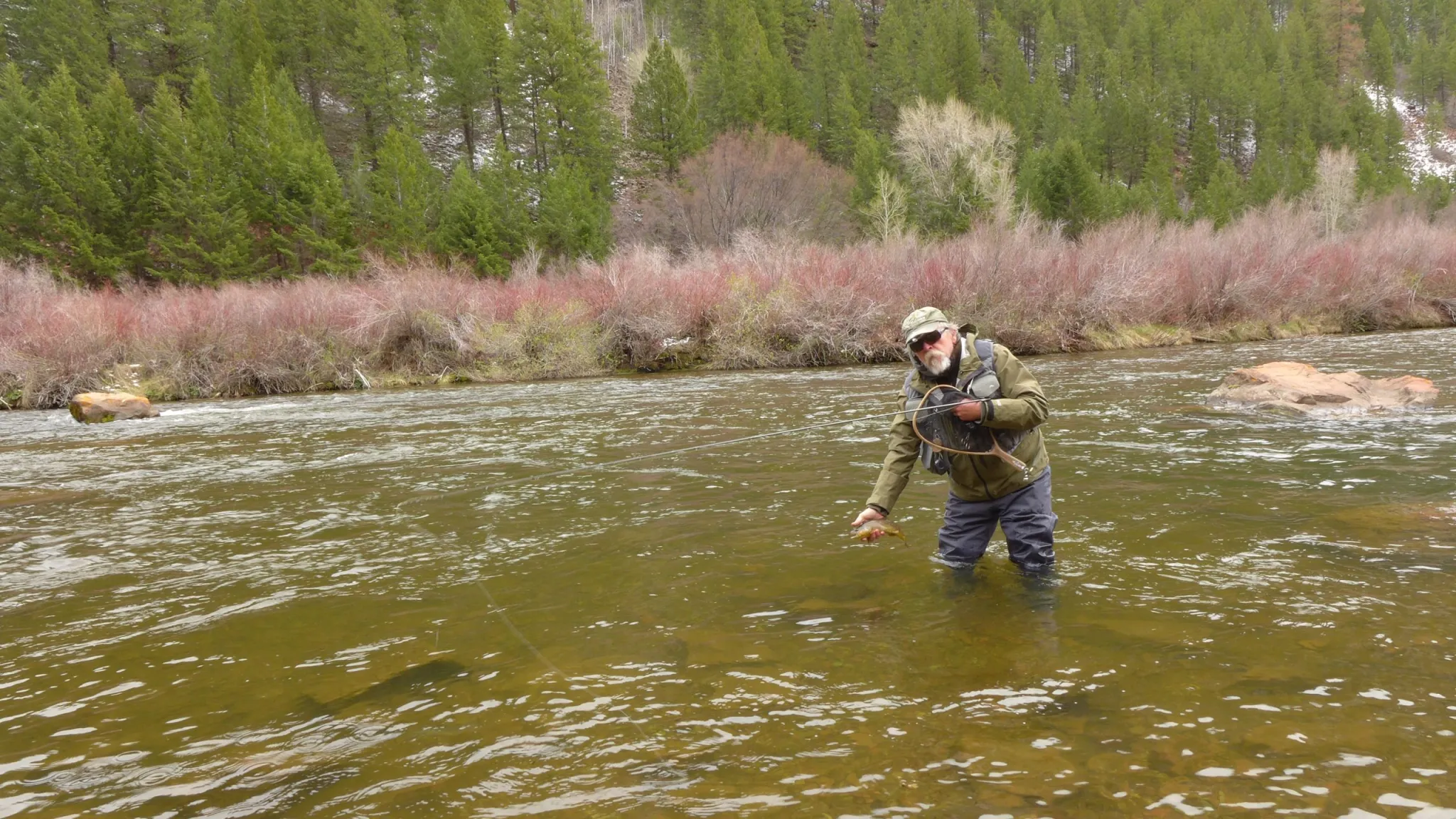
Bill Nein, of Salida, prepares to release a brown trout he caught back into the Fryingpan River. Some river access proponents want the state to clarify rules regarding public use of streambeds and banks for fishing. CREDIT: HEATHER SACKETT/ASPEN JOURNALISM

More education needed

Opponents of a law expanding access say that this is a private property issue and that landowners have the right to exclude others from their property. Garin Vorthmann testified on behalf of the Colorado Farm Bureau at the Water Resources Committee meeting in August. She said she was also working with a broad coalition of landowners, private businesses and real estate agents.

“Depriving a landowner of the right to exclude people from their private property without just compensation is considered a taking,” she told lawmakers. “Legislation that would change the ownership of the bed or bank to be public or owned by the state obligates the government to provide just compensation to the landowner and will embroil the state in expensive litigation.”

Other experts say addressing this issue through legislation might only make it worse. A report released in September by the conservative-leaning Common Sense Institute said that “the path to clarification is fraught with innumerable bad outcomes where both sides and ultimately the state of Colorado will be worse off than they are now” and that “attempts by either side to expand those rights at the expense of the other are likely to create more problems than they solve.”

Greg Walcher, former director of the Colorado Department of Natural Resources and co-author of the report, said a better approach would be a public education campaign so that boaters know exactly where they are allowed to float: through land that is already owned by the state or federal government and therefore public. The study notes the importance of rivers to Colorado’s outdoor recreation economy, and the millions that the Great Outdoors Colorado (GOCO) grant program has invested in stream access and conservation projects in recent years. 

“The floating industry has become huge in Colorado, so we need to find a solution,” Walcher said. “And part of that is making sure people understand where they can and can’t float.”

Proponents of stream access agree that education is important, and to that end, Steamboat Springs-based advocacy organization and content studio Rig to Flip is releasing a short film by Cody Perry called “Common Waters,” which features the Hill case and outlines the issue as they see it: that Colorado is one of the worst states for providing public access to streams, and in a place that prides itself on an outdoor lifestyle, increased access and clarity on the rules are needed. 

With proponents still hashing out differing options on what a policy proposal should call for, any new legislation for the 2026 session won’t be introduced by the Water Resources and Agricultural Review Committee, but there’s still a chance lawmakers could take it up. Coalition members say they are continuing to meet with stakeholders and figuring out the best way forward.

“At American Whitewater, we believe that people are really only going to protect the resource if they have the opportunity to explore that place and understand and experience a river,” Kunz said. “So our hope is that by allowing people to access these rivers in Colorado that we will ensure future generations of river stewards.”

Colorado Rivers. Credit: Geology.com

Two hundred fish died in Grizzly Reservoir from toxic metals. Climate change is to blame — #Aspen Public Radio

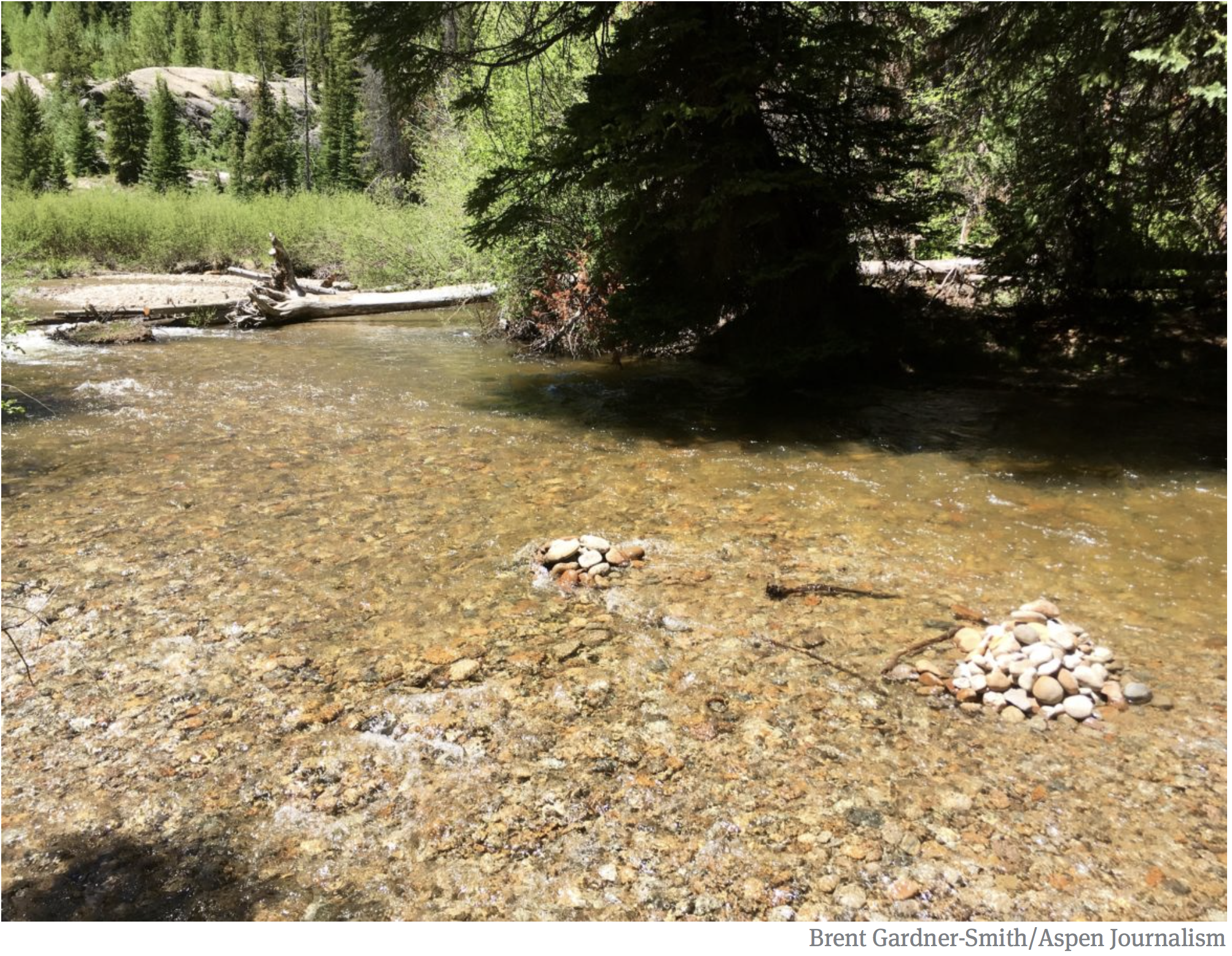
Lincoln Creek, just above its confluence with the Roaring Fork River, on June 14, 2017. Passersby had left rock piles in the clear, warm, and shallow stream.

Click the link to read the article on the Aspen Public Radio website (Michael Fanelli). Here’s an excerpt:

September 9, 2025

About 200 fish were found dead on Aug. 18 on the banks of Grizzly Reservoir, a popular fishing and camping site near Aspen. Colorado Parks and Wildlife officials determined that naturally occurring metals had become toxic for rainbow trout the agency had stocked in the reservoir. Kendall Bakich, an aquatic biologist with CPW, is part of a team measuring the concentration of metals in the reservoir. She said this new metal toxicity is part of a growing trend.

“I would probably say across the world, but certainly across North America, there’s rivers that are becoming more impacted by heavy metals from natural sources, due to climate change,” Bakich said.

Human-caused climate change has led to warming temperatures and drought, increasing the concentration of naturally occurring metals in bodies of water and creating deadly conditions for fish. Bakich said the main culprit in this case was copper, to which fish are especially sensitive. That copper comes from a body of heavy metals at the top of Lincoln Creek, which feeds into Grizzly Reservoir and eventually into the Roaring Fork River.

Map of the Roaring Fork River drainage basin in western Colorado, USA. Made using USGS data. By Shannon1 – Own work, CC BY-SA 4.0, https://commons.wikimedia.org/w/index.php?curid=69290878

‘You need to have a fair bit of data’: Officials expand testing in search for answers on #LincolnCreek contamination — Heather Sackett (AspenJournalism.org) #RoaringForkRiver

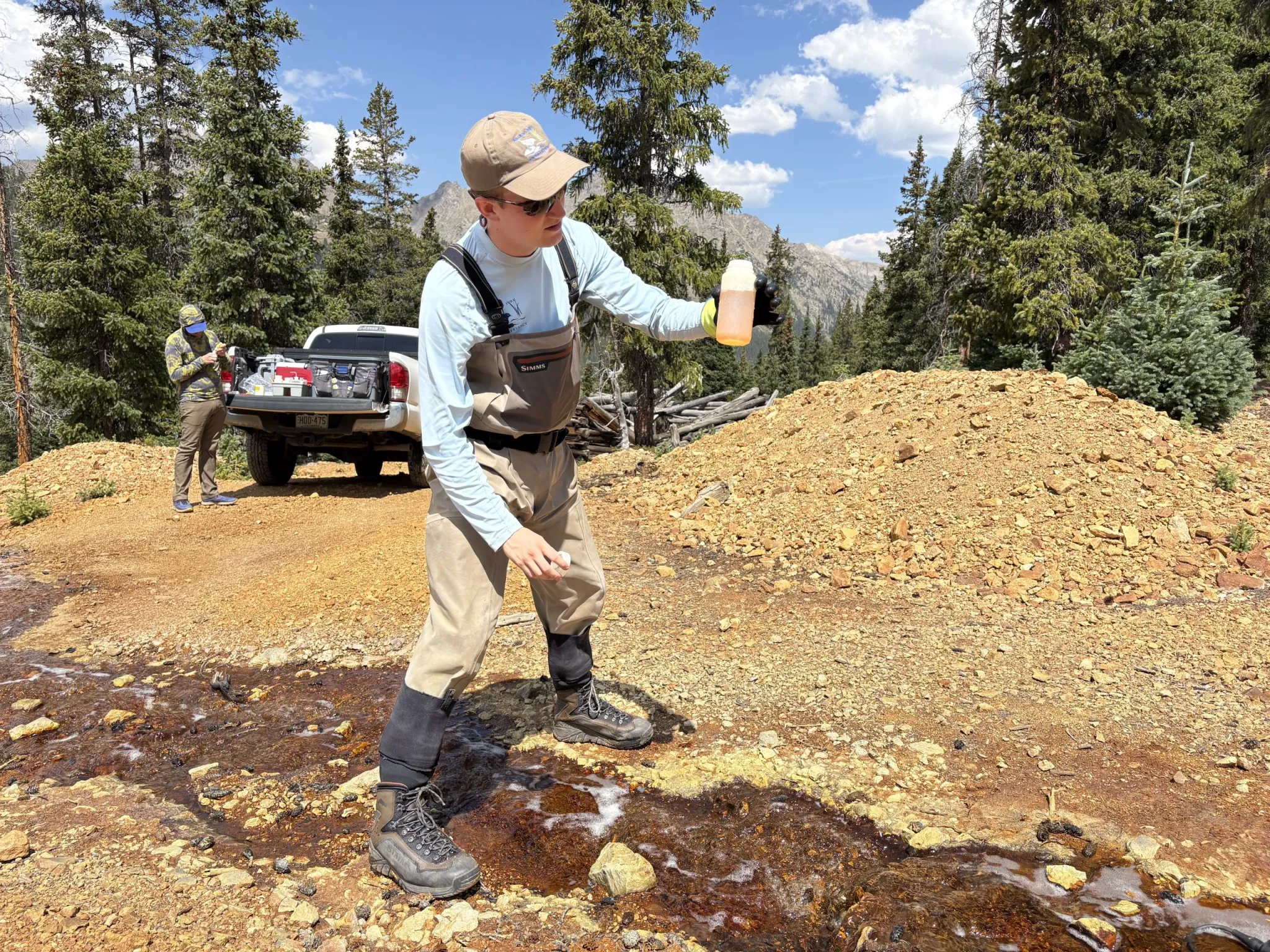
From left, Bryan Daugherty with Pitkin County Environmental Health, Matthew Anderson and Chad Rudow, both with the Roaring Fork Conservancy. The three spent Wednesday, Aug. 13 taking water quality samples at 14 sites from Lincoln Creek, the Ruby Mine outflow and the mineralized tributary. CREDIT: HEATHER SACKETT/ASPEN JOURNALISM

Click the link to read the article on the Aspen Journalism website (Heather Sackett):

August 15, 2025

High above Aspen at 11,400 feet, past the ghost town of Ruby, at the end of a rough dirt road surrounded by willows and ramshackle cabins, Lincoln Creek runs clean and clear.

The mountain stream is barely more than a trickle at its headwaters, but it still supports fish that dart and hide in the cool shadows. But just a few hundred yards downstream, the creek begins to turn foul. 

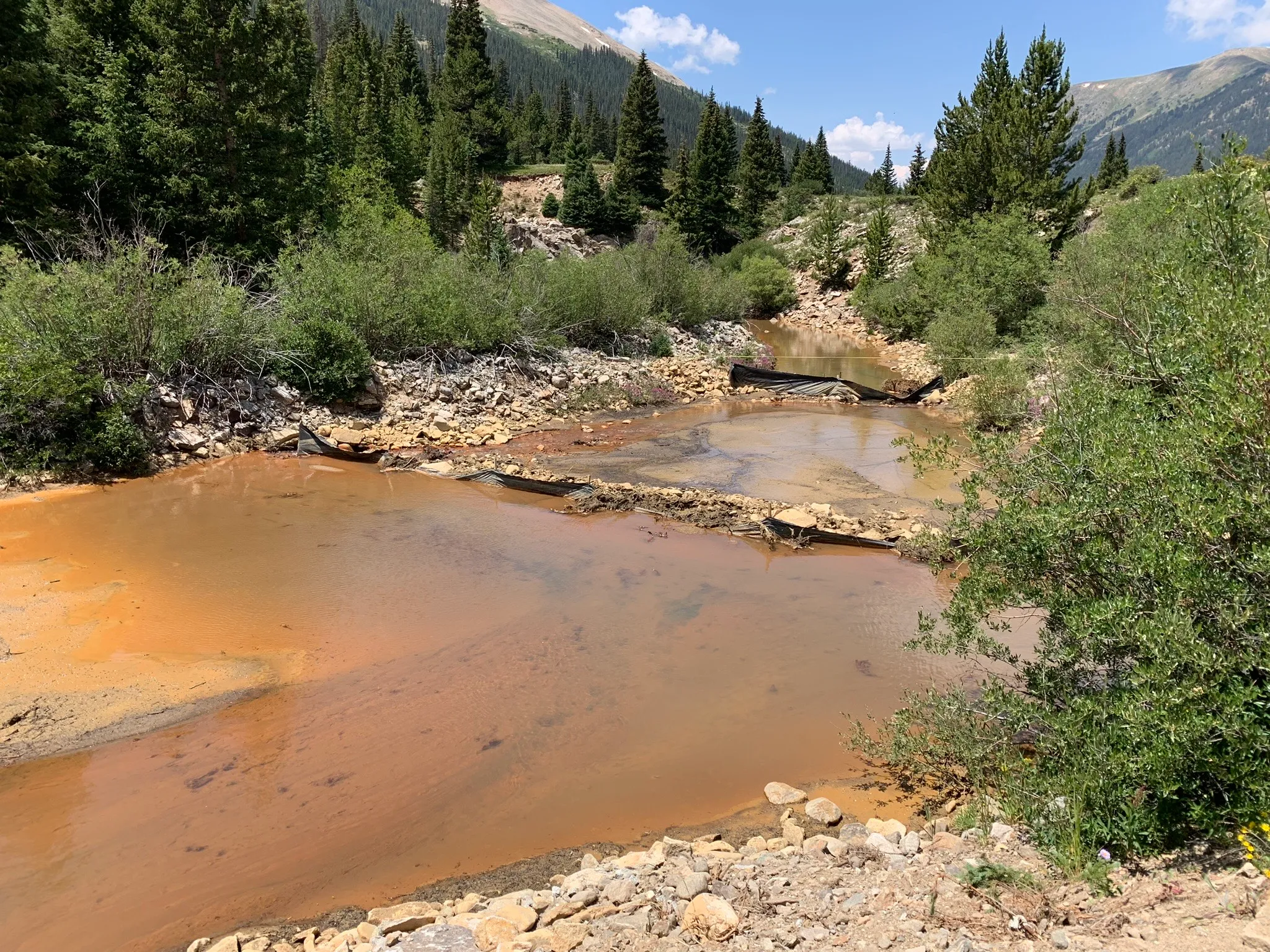
First by what appears to be a small tributary or groundwater that flows into the creek and leaves a white residue on the rocks, an indication of aluminum. Then comes the runoff from the abandoned Ruby Mine, which leaves a hardened orange crust on the ground where it joins the creek. Just downstream of the mine is the site where experts say the majority of the aluminum, copper, zinc and iron contamination is entering Lincoln Creek: the “mineralized tributary.”

Although it’s hard to pinpoint the exact source — the entire mountainside above the creek on the east side is stained orange, suggesting the widespread presence of metals — a group of scientists, government officials and local nonprofits are ramping up efforts to better understand the workings of the Lincoln Creek watershed and what can be done to improve its water quality. 

On Wednesday [August 13, 2025], a team from the Roaring Fork Conservancy and Pitkin County spent the day collecting water quality samples from Lincoln Creek, the Ruby Mine discharge, the mineralized tributary and points downstream. It was the third time this summer scientists have collected water samples from the creek, and it is part of an overall effort with Colorado Parks and Wildlife and University of Colorado Boulder to test and monitor the area. 

“I think one of our big goals is really to continue to fill in the data,” said Chad Rudow, water quality program manager with the Roaring Fork Conservancy. “As I like to tell people, science takes time. To even apply statistical analysis to it, you need to have a fair bit of data.”

Matthew Anderson, left, a water quality technician with the Roaring Fork Conservancy, and Bryan Daugherty with Pitkin County Environmental Health take samples from Lincoln Creek on Aug. 13, 2025. The creek has such high concentrations of some metals that it is toxic to aquatic life. CREDIT: HEATHER SACKETT/ASPEN JOURNALISM

Local residents, government agencies and environmental groups have long been concerned about Lincoln Creek, which, according to a report from the Environmental Protection Agency, is toxic to aquatic life. The tributary of the Roaring Fork River has been under increased scrutiny in recent years as fish kills and discoloration of the water downstream of Grizzly Reservoir have become more frequent. 

“We’re worried about the aquatic health of the river,” said Bryan Daugherty, environmental health specialist with Pitkin County. “There certainly could be human impacts if it got really bad, but at this point it’s really the aquatic life that we’re concerned with.”

Since early 2024, the ad hoc Lincoln Creek Workgroup has been meeting to figure out what to do about the contaminated creek. Bolstered by a state grant of $100,000, the group is increasing water quality testing. The team of scientists has grown the number of testing sites this year from seven to 14 and are focusing current efforts on what’s happening above Grizzly Reservoir. 

Pitkin County Healthy Rivers, whose mission is to maintain and improve water quality and quantity in the Roaring Fork River basin, is playing a crucial role by securing grant money and working with consultant LRE Water on phase II of the data collection and modeling project, which will cost $207,000. Colorado Parks and Wildlife staff have also set up conductivity loggers, which measure how well water conducts electricity, and trail cameras to take photos of Lincoln Creek. 

“It’s definitely a team effort with a lot of different groups playing an important role in adding different pieces to the overall puzzle,” Rudow said. 

The uppermost reaches of Lincoln Creek run clean and clear, and support aquatic life. Just a few hundred yards downstream, metals contamination begins to enter the creek. CREDIT: HEATHER SACKETT/ASPEN JOURNALISM
The outflow from the Ruby Mine produces an orange crust on the ground. The mine drainage flows into Lincoln Creek. CREDIT: HEATHER SACKETT/ASPEN JOURNALISM

Highly acidic concentrations

The process of metals leaching into streams can be both naturally occurring and caused by mining activities. In both cases, sulfide minerals in rock come into contact with oxygen and water, producing sulfuric acid. The acid can then leach the metals out of the rock and into a stream, a process known as acid rock drainage, which is happening in other mountainous regions of Colorado and around the West.

Prior to mining, snowmelt and rain seep into natural cracks and fractures, eventually emerging as a freshwater spring (usually). Graphic credit: Jonathan Thompson

The metals concentrations from acid rock drainage seems to be increasing in recent years and may be exacerbated by climate change as temperatures rise. But because the vast majority — 98.5% of the copper, according to the EPA report — of the contamination is from natural sources and not related to the Ruby Mine, the EPA is not authorized to clean it up. That leaves local and state agencies, and nonprofit organizations to fill the gap.

Wednesday’s testing revealed a pH of 7.29 on the upper reaches of Lincoln Creek (7 is considered neutral); 6.4 below the Ruby Mine and 3.2 below the confluence of the mineralized tributary. The pH scale is logarithmic, meaning a decrease of one whole number equals a 10-fold increase in acidity. 

“The highly acidic concentrations that we’re seeing up here is part of the process that’s speeding up mobilizing the metals from the rock into the stream system,” Rudow said.

Scientists also collected data about dissolved oxygen, water temperature and salinity. The water samples are then shipped to a lab in Fort Collins, which tests for metals concentrations.

Rudow and others also used Wednesday’s trip to the high alpine as a chance to scout spots for an upcoming synoptic survey. At the request of LRE, scientists will pick a day this fall to take water quality samples and flow measurements at points along the entire length of the creek to better understand the sources of contamination. But only year-round tributaries — not seasonal snow-fed seeps — will be included.

“We’re pushing that into September because what we really want to focus on for that project is those year-round streams that are coming into Lincoln Creek,” Rudow said. “(LRE) is going to take all of this data and ultimately build a model to show what’s going on in the creek and how these different inputs are influencing the creek.”

Water quality sampling in 2024 focused on Grizzly Reservoir and points downstream to better understand the impacts of a dam repair project. Last summer the reservoir was drained for work on the dam, and a slug of sediment-laden, orange-colored water was released downstream, alarming Aspen residents. 

Matthew Anderson, a water quality technician with the Roaring Fork Conservancy, takes a sample of water from the mineralized tributary on Aug. 13, 2025. Experts have determined this is a major source of the metals contamination on Lincoln Creek. CREDIT: HEATHER SACKETT/ASPEN JOURNALISM
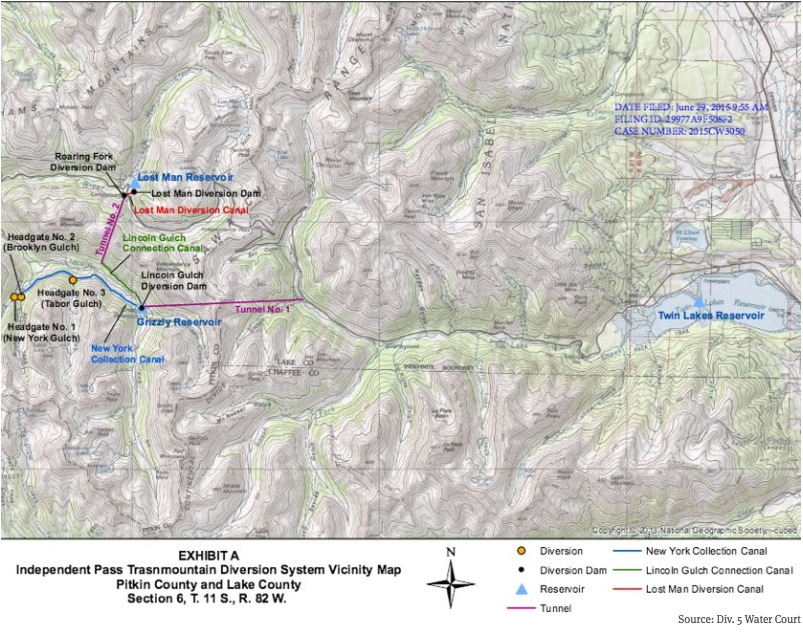
Grizzly Reservoir, a forebay that collects water to send through the Twin Lakes Tunnel to the Front Range, sits in the middle of the Lincoln Creek watershed and connects water users on both sides of the Continental Divide. The reservoir was drained during the summer of 2024 so the dam could get a new face. CREDIT: HEATHER SACKETT/ASPEN JOURNALISM

Both sides of the divide

The water quality issues on Lincoln Creek bind together water users on both sides of the Continental Divide. Lincoln Creek feeds into the Twin Lakes Reservoir and Canal Company’s transmountain diversion system, in which Grizzly Reservoir is used as a collection pond before sending water through the Twin Lakes Tunnel to the Front Range, where it is used primarily in cities, including for drinking water. Colorado Springs Utilities owns about 55% of the water in the Twin Lakes system, while about 35% goes to the Pueblo area. 

A map of the Independence Pass Transmountain Diversion System, as submitted to Div. 5 Water Court by Twin Lakes Reservoir and Canal Co.

Twin Lakes President Alan Ward, who also works as a water resources manager for Pueblo Water, is a member of the Lincoln Creek workgroup. Each organization contributed $5,000 toward the LRE Phase II work. 

Ward said next summer Grizzly Reservoir will be drained again so Twin Lakes can work on the damaged outlet works that release water downstream to Lincoln Creek. To avoid another sediment release, the company will create a small basin with cofferdams where the last 10-12 acre-feet at the bottom of the reservoir can settle out before sending it downstream or through the Twin Lakes Tunnel.

Ward said impacts to drinking water aren’t much of a concern for the east side of the divide because the water from Lincoln Creek is diluted by the 141,000-acre-foot Twin Lakes Reservoir, which stores water from multiple sources. 

“I think for us the concerns are more on Lincoln Creek itself because Grizzly Reservoir is right in the middle of it,” Ward said. “We just want to stay really engaged on this to figure out the water quality issues and how they impact Grizzly Reservoir itself and if there are ways to mitigate the problem.”

Map of the Roaring Fork River drainage basin in western Colorado, USA. Made using USGS data. By Shannon1 – Own work, CC BY-SA 4.0, https://commons.wikimedia.org/w/index.php?curid=69290878

Low river flows trigger calls, closures, stressed fish: 15-mile reach of #ColoradoRiver hasn’t met target fish flows since July 9 — Heather Sackett (AspenJournalism.org) #COriver #aridification

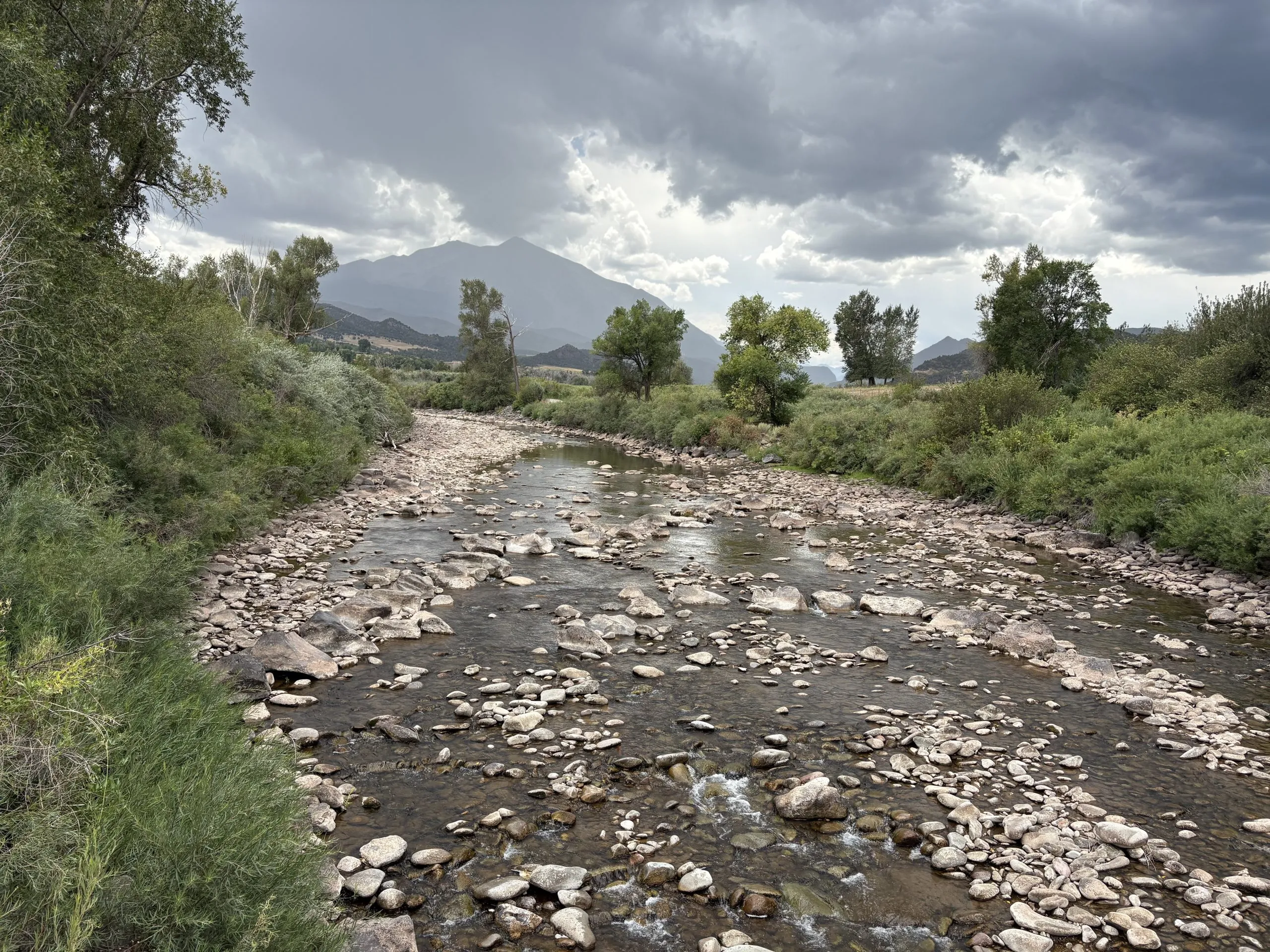
The Crystal River was running under 8 cfs on Aug. 24, 2025. This section of river is downstream of big agricultural diversions and ditches owned and maintained by the Town of Carbondale. CREDIT: HEATHER SACKETT/ASPEN JOURNALISM

Click the link to read the article on the Aspen Journalism website (Heather Sackett):

August 27, 2025

Streamflows on the Western Slope have plummeted over the last month, sending water managers scrambling to boost flows for endangered fish and ranking it among the driest years in recent history.

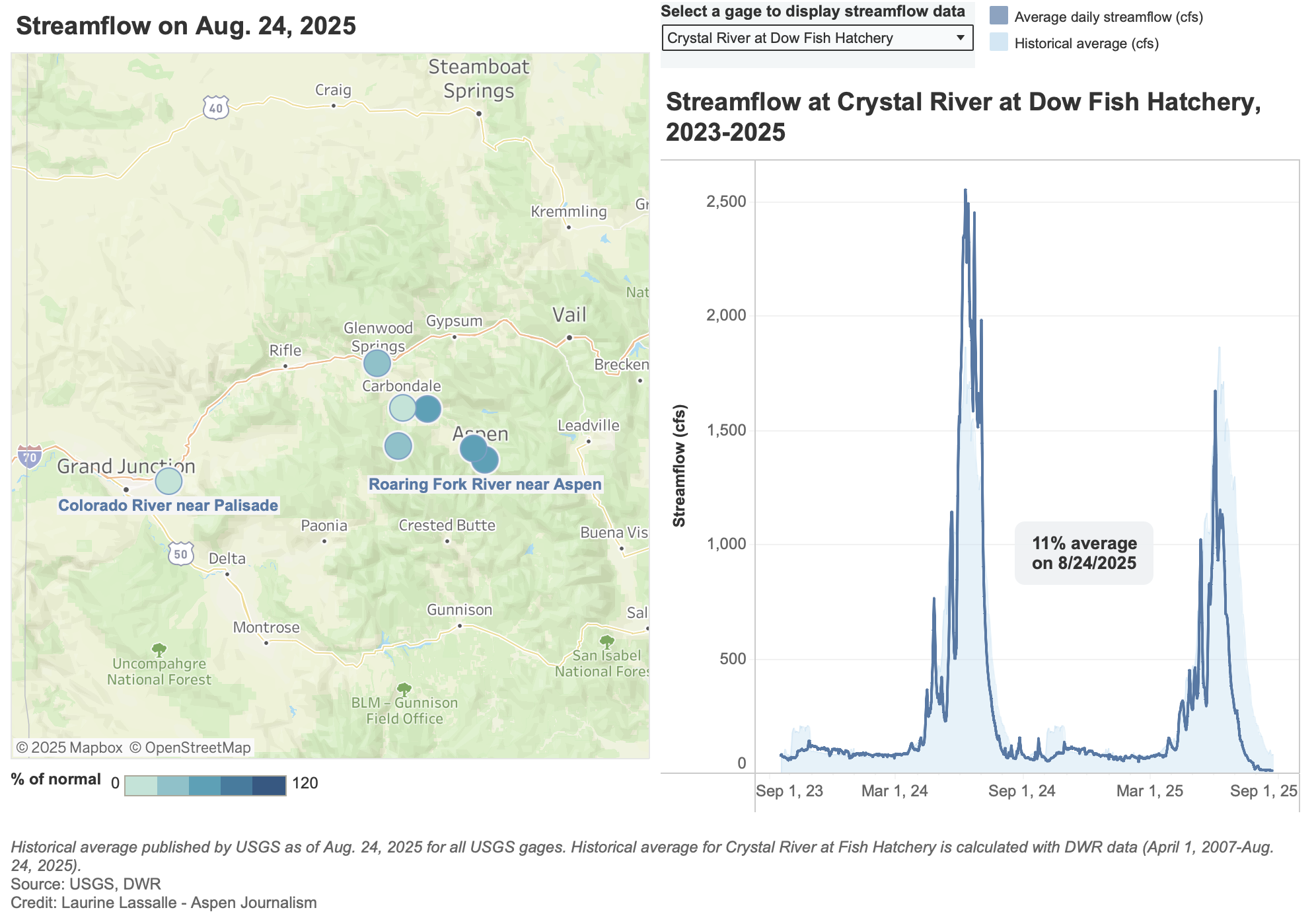
According to the Natural Resources Conservation Service, the Roaring Fork River basin ended the month of July at 28% of average streamflows. The Colorado River headwaters was at 42% of average; the Gunnison River basin was at 34% of average and rivers in the White/Yampa/Green River basin in the northwest corner of the state were running at 24% of average. Prior to this week’s rains, the Crystal River near the Colorado Parks and Wildlife fish hatchery was running at 7.5 cfs, or 10% of average.

“We’ve been seeing pretty widespread well-below-normal flows across the entire upper Colorado River basin due to extremely dry conditions starting back in December,” said Cody Moser, a senior hydrologist with the Colorado Basin River Forecast Center.

For most of August, the Crystal River near fish hatchery was running at less than 15 cfs. These extremely low conditions plus water temperatures above 71 degrees Fahrenheit, prompted CPW to implement on Aug. 15 a full-day voluntary fishing closure on the Crystal from mile marker 64 on Highway 133 to the confluence with the Roaring Fork. This section of the Crystal is downstream from big agricultural diversions and ditches owned and operated by the town of Carbondale.

The upper Roaring Fork River and its tributaries are also suffering the consequences of low flows. On Aug. 25 the Colorado Water Conservation Board placed a call for the minimum instream flow on a seven-mile section of the Roaring Fork through Aspen, between Difficult and Maroon creeks. The call was released the next day after rain boosted flows above the 32 cfs minimum amount. 

The CWCB is the only entity in the state allowed to hold instream flow water rights, which are intended to preserve the natural environment to a reasonable degree. It’s not uncommon for the CWCB to place calls for this stretch in late summer and it did so in other years, including 2012, 2018, 2020, 2021 and 2022. 

Low flows have also affected recreation at the North Star Nature Preserve, a popular area for paddle boarders east of Aspen. On July 24, Pitkin County implemented a voluntary float closure — asking people to launch at South Gate instead of Wildwood — which occurs when the river falls below 60 cfs.

“At low water levels, users are at risk of touching bottom, which could damage the riparian habitat and would be considered trespassing,” a Pitkin County official said in an email.

Before this week’s rainfall, the Roaring Fork above Aspen hovered around 30 cfs.

Streamflows across the Western Slope are often at some of their lowest points of the year during the late summer and early fall when snowmelt has waned and irrigators are still drawing from streams. But this summer’s lack of precipitation and low soil moisture were the main drivers of dry streams. Much of the Western Slope is in extreme or exceptional drought, according to the U.S. Drought Monitor.

“The biggest factor is the dry spring conditions and layered on top of them a much drier than normal summer,” said Peter Goble, assistant state climatologist. “We will be watching those base flows but also soil moisture levels as we go into fall and early winter to see if those pick back up.”

Dry soils that suck up snowmelt before it makes it to streams can mean a normal snowpack translates into below-normal runoff.

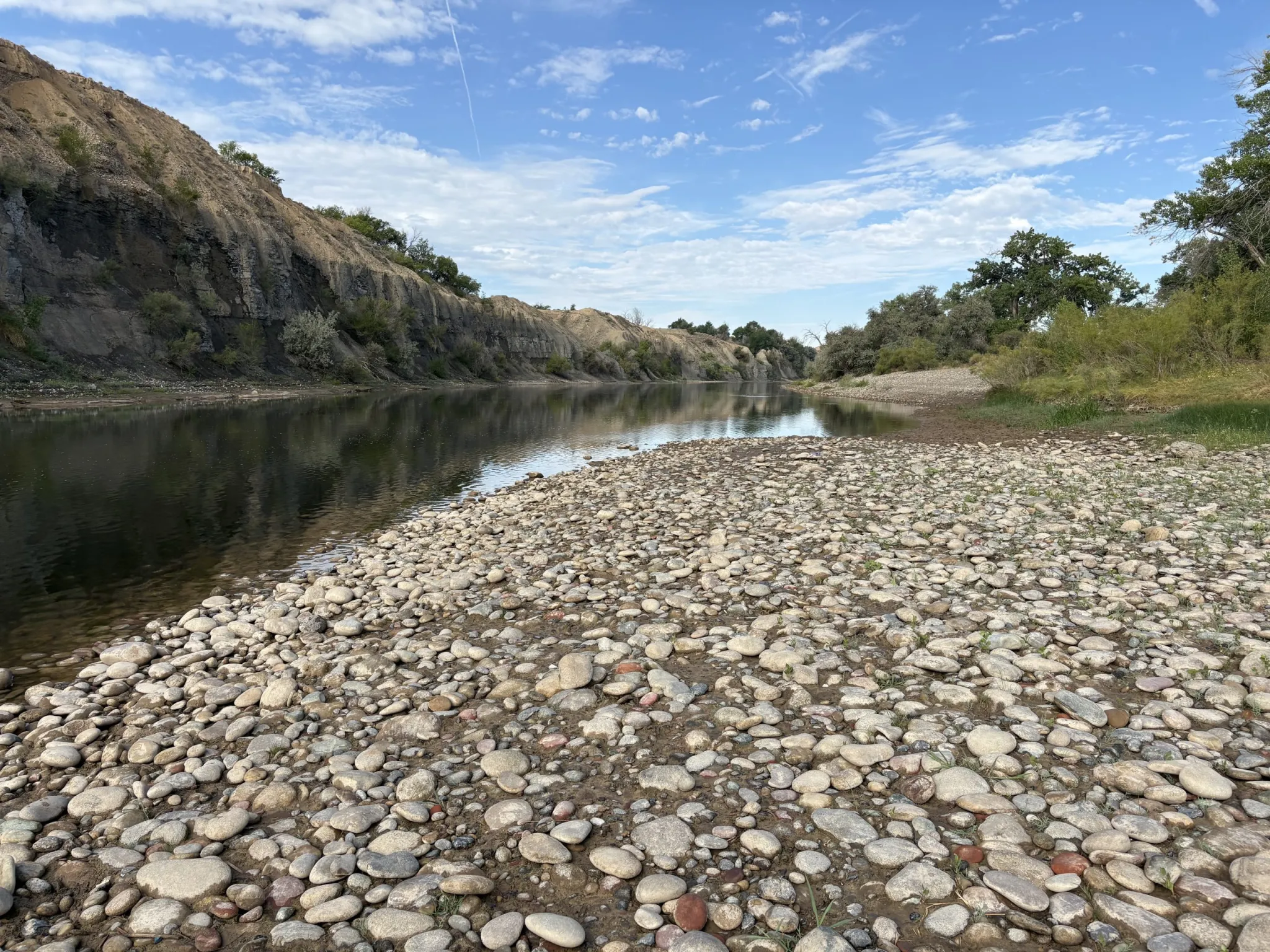
This section of the Colorado River at the boat launch near Corn Lake dipped to around 150 cfs in lake August. Known as the 15-mile reach, this stretch of river should have at least 810 cfs to meet the needs of endangered fish. CREDIT: HEATHER SACKETT/ASPEN JOURNALISM

Stressed out fish

Another area hard hit by low flows is the 15-mile reach of the Colorado River between Palisade and the confluence with the Gunnison River. The chronically dry section is home to multiple endangered fish species and is downstream from some of the biggest agricultural diversions from the Colorado River in the state. Each year water managers work together to time voluntary releases from upstream reservoirs to boost late-season flows for the fish. 

But even with many entities working with the Upper Colorado River Endangered Fish Recovery Program, a 2022 memo from the U.S. Fish and Wildlife Service found that during the irrigation season of dry years, flows did not meet the 810 cfs target 39% of the time. 

This year, flows have not been above 810 cfs since July 9. And although flows in the 15-mile reach have been climbing since Aug. 23, — up to about 650 cfs on Aug. 27 — nearly all the water in the reach before this week’s rain was attributable to upstream reservoir releases specifically intended for endangered fish. Without releases for the recovery program, flows in the 15-mile reach could have dipped as low as 30 to 50 cfs.

“From my standpoint it’s amazing how a dry year just makes it really hard to get down even a third of that flow target,” said Bart Miller, healthy rivers director with Western Resource Advocates. “It’s a challenging time for water users, but a super challenging time for fish. For the fish it’s a huge stressor.”

This map shows the 15-mile reach of the Colorado River near Grand Junction, home to four species of endangered fish. Map credit: CWCB

This year there was about 29,175 acre-feet earmarked for endangered fish, according to a presentation by program staff. But by Sept. 1 nearly all this water was scheduled to be used up. The nonprofit Colorado Water Trust has stepped in to lease an additional 5,000 acre-feet out of Ruedi Reservoir. The water is owned by the town of Palisade, the Colorado River Water Conservation District and QB Energy. The releases of about 100 cfs are projected to begin Aug. 27 and continue through mid-October, said Danielle Snyder, a water resources specialist with the Colorado Water Trust. 

“This particular stretch is very critical for the health of the ecosystem,” Snyder said. “We saw a lot of benefit for both the community and the environment and we thought this would be a great opportunity given we have the capacity and funds to provide water to that region.”

The CWCB will also lease an additional 2,350 acre-feet for fish flows.

Locally dwindling streamflows have big implications downstream. Projections released earlier this month from the U.S. Bureau of Reclamation show the nation’s two largest reservoirs — Lake Powell and Lake Mead — continuing to drop. Lake Powell could drop below the level needed to make hydropower by late 2026. As proof of how dry the month of July was across the basin, inflow to Lake Powell was just 12% of normal. 

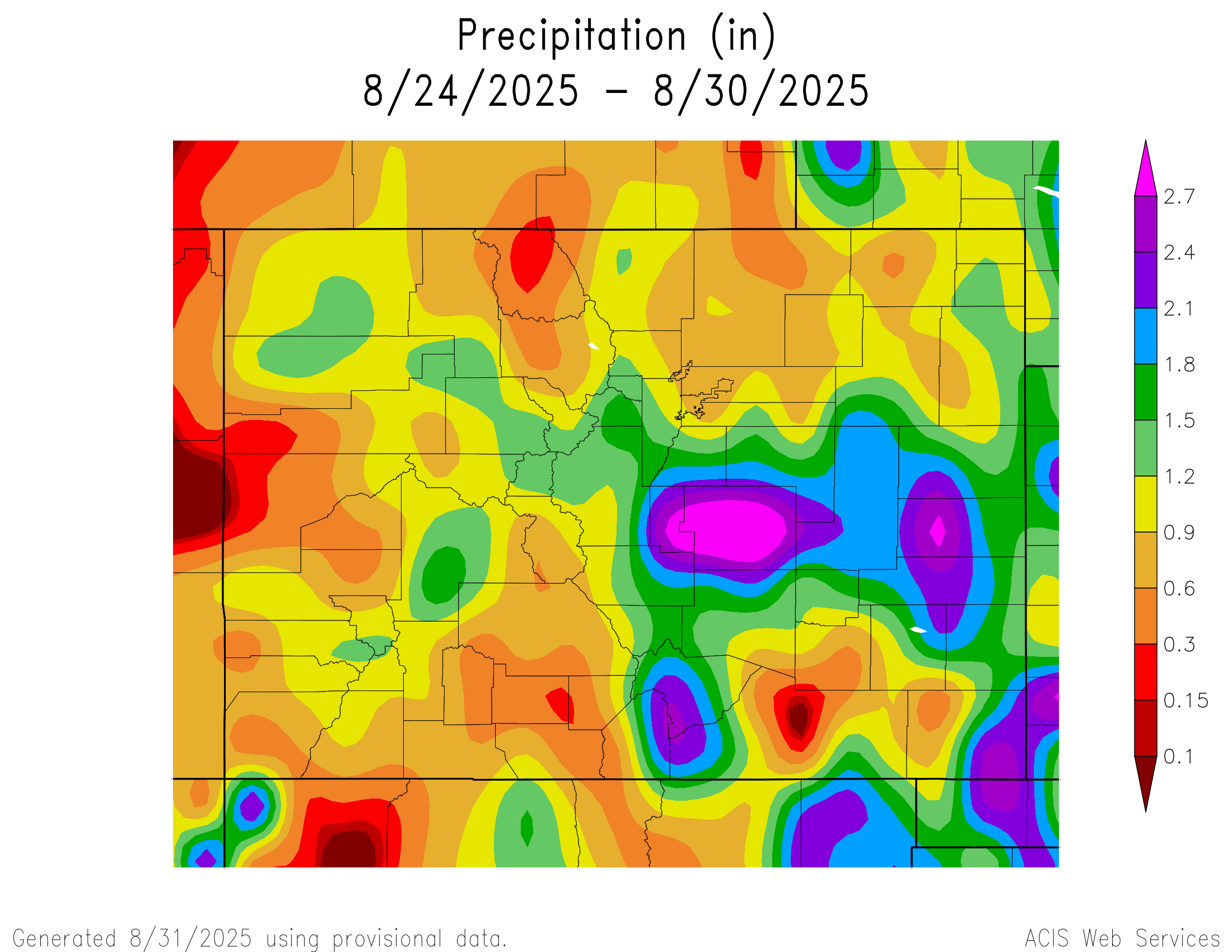
One bright spot in an otherwise bleak forecast is that parts of the Western Slope are finally seeing some relief from the hot and dry summer with rain this week. But it probably won’t be enough to make up for the months-long lack of precipitation.

“We have been dry for six-plus months so I don’t imagine it will have a significant impact long term, but it’s nice to finally see some precipitation in the forecast and observed over the last day or two,” Moser said. 

Map of the Roaring Fork River drainage basin in western Colorado, USA. Made using USGS data. By Shannon1 – Own work, CC BY-SA 4.0, https://commons.wikimedia.org/w/index.php?curid=69290878

A river of worry through Garfield County as drought worsens — #GlenwoodSprings Post-Independent

Click the link to read the article on the Glenwood Springs Independent website (Jaymin Kanzer). Here’s an excerpt:

August 25, 2025

Whether its potable water, agricultural needs, or recreation, seven different states between Colorado and the Pacific Ocean actively rely on the water that flows through Garfield County. Yet with consistently increasing yearly temperatures, decreasing yearly snowpacks, and constant threat of wildfires — the health of the legendary watershed has never been more important. The Colorado, Roaring Fork, Crystal, and Frying Pan Rivers all have individual and unique impacts that stretch from the local economy to produce and amenities…Following a “mixed” winter resulting in the lowest snowpack seen in 10 years, it was not unexpected that riverflows would fail to hit an 80-year median this summer season. But a dramatically dry summer took a bad situation and made it worse.

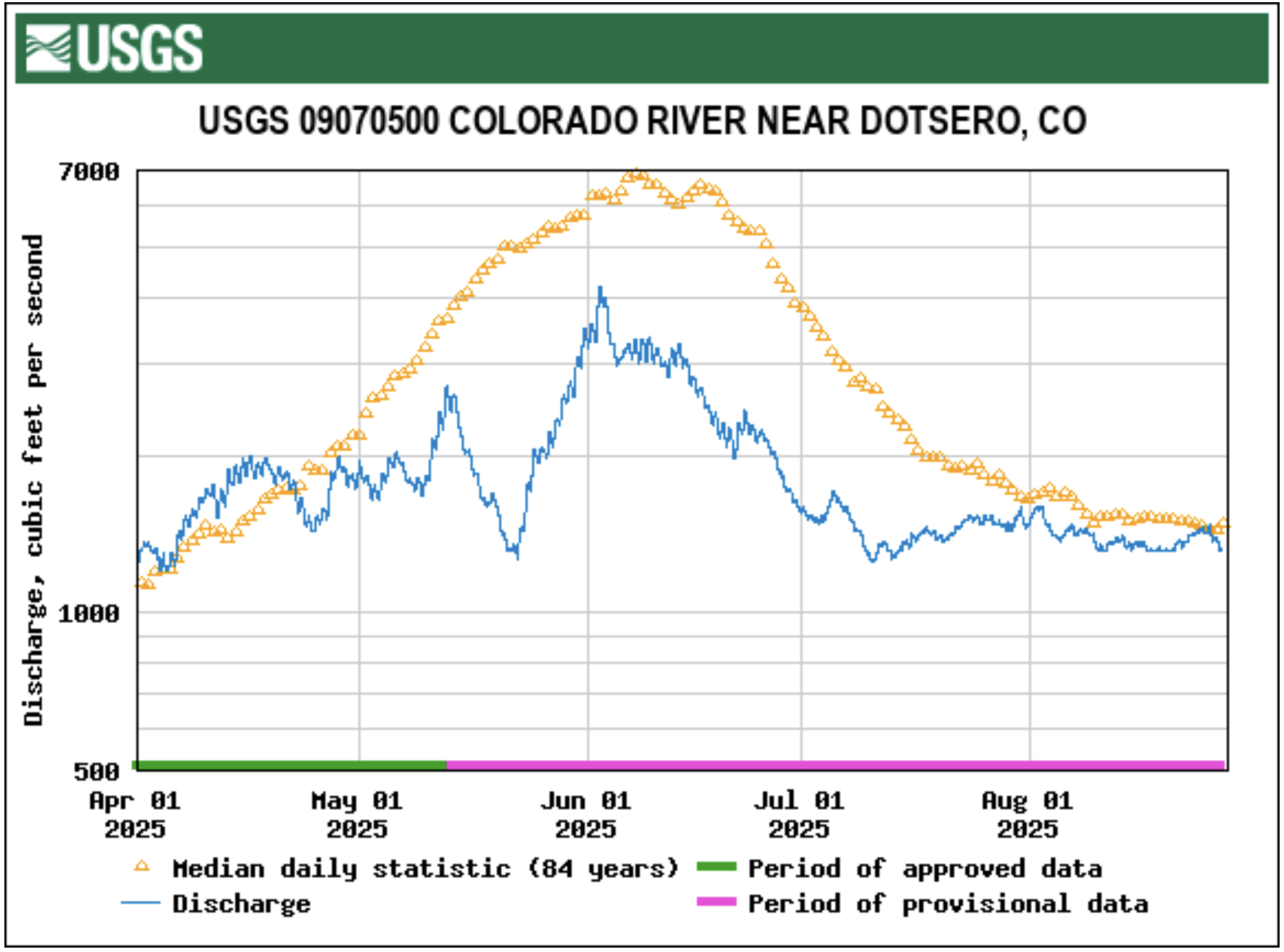
In 2025, the Colorado River peaked barely above 4,000 Cubic Feet per Second (CFS), measured by the United States Geological Survey near Dotsero. The 4,120 CFS peak on June 3 fell far short of the median of 6,200 CFS (1940-2025)…[Brendon] Langenhuizen said he was more concerned about the near-nonexistent monsoonal season this summer — and its implications for what future monsoon seasons could look like.

“The monsoons just aren’t really coming in like they were forecasted to three months ago,” he said. 

He explained that the supplement of heavy rains in the higher alpine can both briefly reinvigorate the tributaries and provide much needed assistance to the ranching community.

“(The peak) means that it’s just a drier year,” Langenhuizen said. “I think that not getting those monsoons — which haven’t shown up yet — is really what has put us into this situation. We had average snowfall to lower yield, which put us into this dry category of year, and we haven’t had those monsoons that bolster those flows later throughout the late summer months.” 

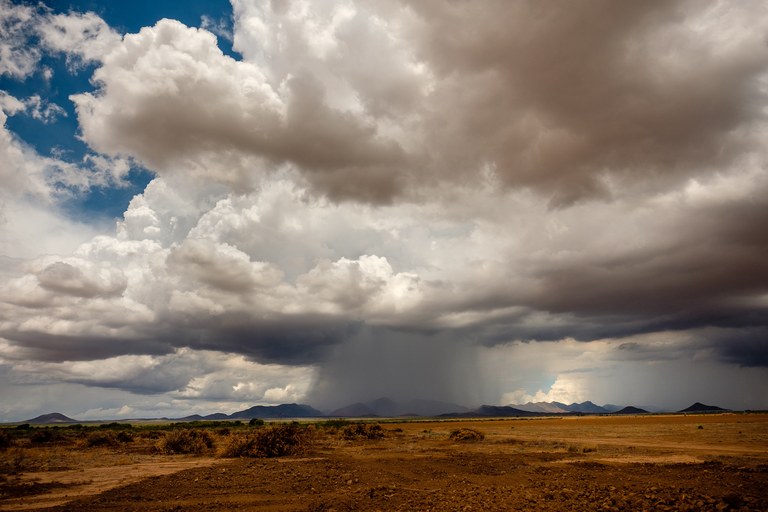
Monsoon storm near Tucson 2021. Image credit: Roberto (Bear) Guerra/High Country News

Becoming the #WhiteRiver National Forest: Cherished public lands forged in a progression of exploration, exploitation and preservation — Paul Anderson (AspenJournalism.org)

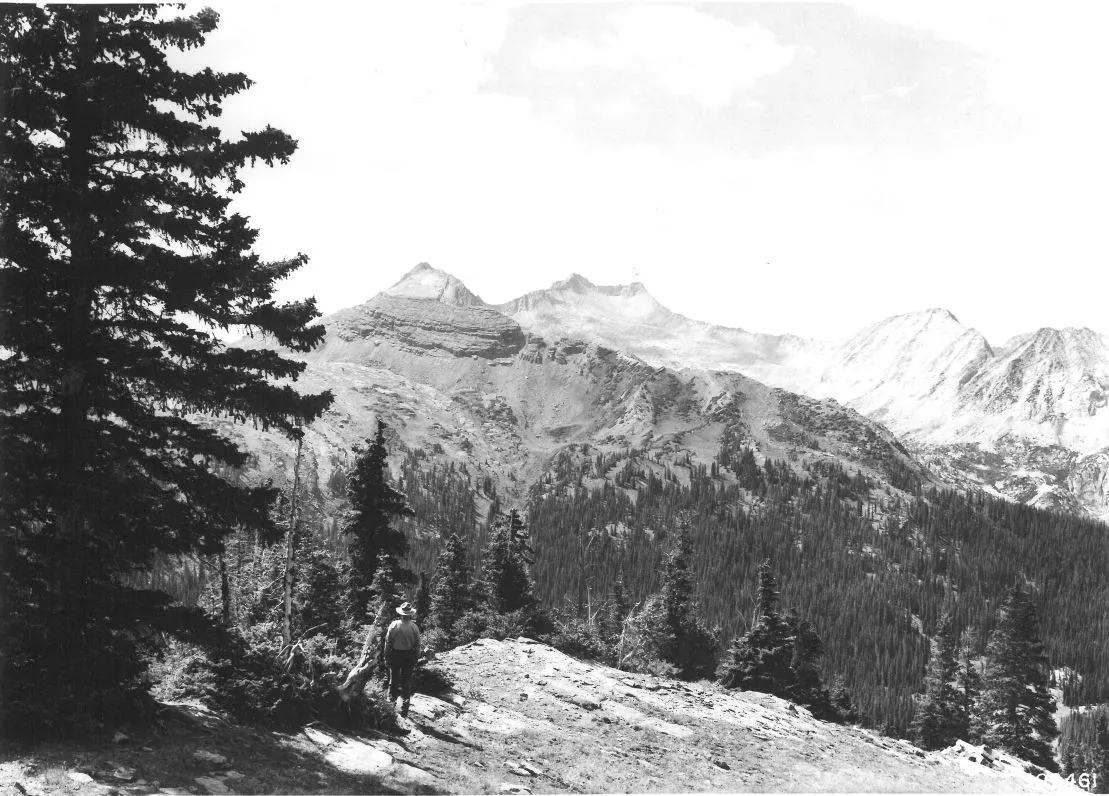
An undated historic photo shows the U.S. Forest Service ranger near the Mount of the Holy Cross. Before the turn of the 20th century, public lands lacked formal protection. “Nowhere has the strength and vitality of America been better reflected in the last 100 years than in the evolution of the National Forest System,” a forest official wrote in 1990. CREDIT: U.S. FOREST SERVICE

Click the link to read the article on the Aspen Journalism website (Paul Anderson):

August 9, 2025

Editor’s note: This story is part two of a three-part series examining the notion of public lands, both in the United States and in our region. Part one looks at the earliest expressions of the commons in territories that would become the United States. Parts two and three look at the history and legacy of what is now the White River National Forest. 

The evolution of the White River National Forest (WRNF) in just over a century mirrors the settlement of the American West — from an unregulated, free-for-all wilderness to strategically managed industrial tourism and sustainable, extractive industries. As the WRNF formed, it refined its management purview over user groups as they expanded from traditional timber and ranching to the ski areas, recreation sites and wilderness terrain that define the forest today.

Beginning with its original designation as a forest reserve in 1891, forest management was besieged by militant factions that argued against any management at all. This was an era when user groups included homestead farmers, fiercely independent ranchers and opportunistic loggers. Shrill denunciations and blatant noncompliance often occurred with these original land claimants who argued that public lands should be designated for those who came first and that its uses should be for what was best for them alone. Only as the forest adapted to changing times and needs did the multiuse mandate create opportunities and protections for all.

A prime example was Fred Light, a traditional rancher in the Roaring Fork Valley from the 1880s who at first resented the overlay of federal control over lands where he and other ranchers had grazed their cattle with no oversight and no fees. Light later came to appreciate the forest as it protected his interests from other users who threatened to overrun grazing lands, usurp water from the range or, in other ways, impinge on grazing entitlements. Light’s shift in temperament and his eventual willingness to follow forest regulations reflected a growing, if reluctant, acceptance that management principles are essential for all forest users to ensure equal access to the public commons.

Light’s transformation spread to other users as complexities arose around the need for sustainability. As a result, the forest mission grew into the broader interpretation of what is the best and highest use for all. This egalitarian approach required a deep and pragmatic exploration of values and resources that led to accommodating conflicting interests.

In the early days of the WRNF, however, forestry officials were immersed in countless disputes and occasional violent conflicts. Rangers were harassed, beaten and fired upon as they performed their duties according to the evolving directives of forest administrators. Juggling over the ensuing decades the utilitarian and esoteric aspects of this remarkably diverse topography of mountains, valleys, meadows, forests and rock-and-ice alpine splendor has required scientifically based and diplomatically advanced regulations to avoid the impacts of overgrazing, timber clear-cutting, mining, overcrowded recreation and other issues yet to surface.

Through it all, the WRNF remains public land — 2.3 million acres (3,593.75 square miles) of the most visited national forest in the United States, stewarded by rangers trained with the necessary skills of backwoodsmen, diplomats, defenders, peacemakers, resource managers and ecologists.

The story of the WRNF is therefore a weave of time and place, and of a people for whom the forest is both an economic lifeblood and a battleground for conservation and preservation. For many, the forest is a place of sacred, cherished, iconic and legacy landscapes in which any and all visitors may experience and celebrate the power and splendor of pristine nature.

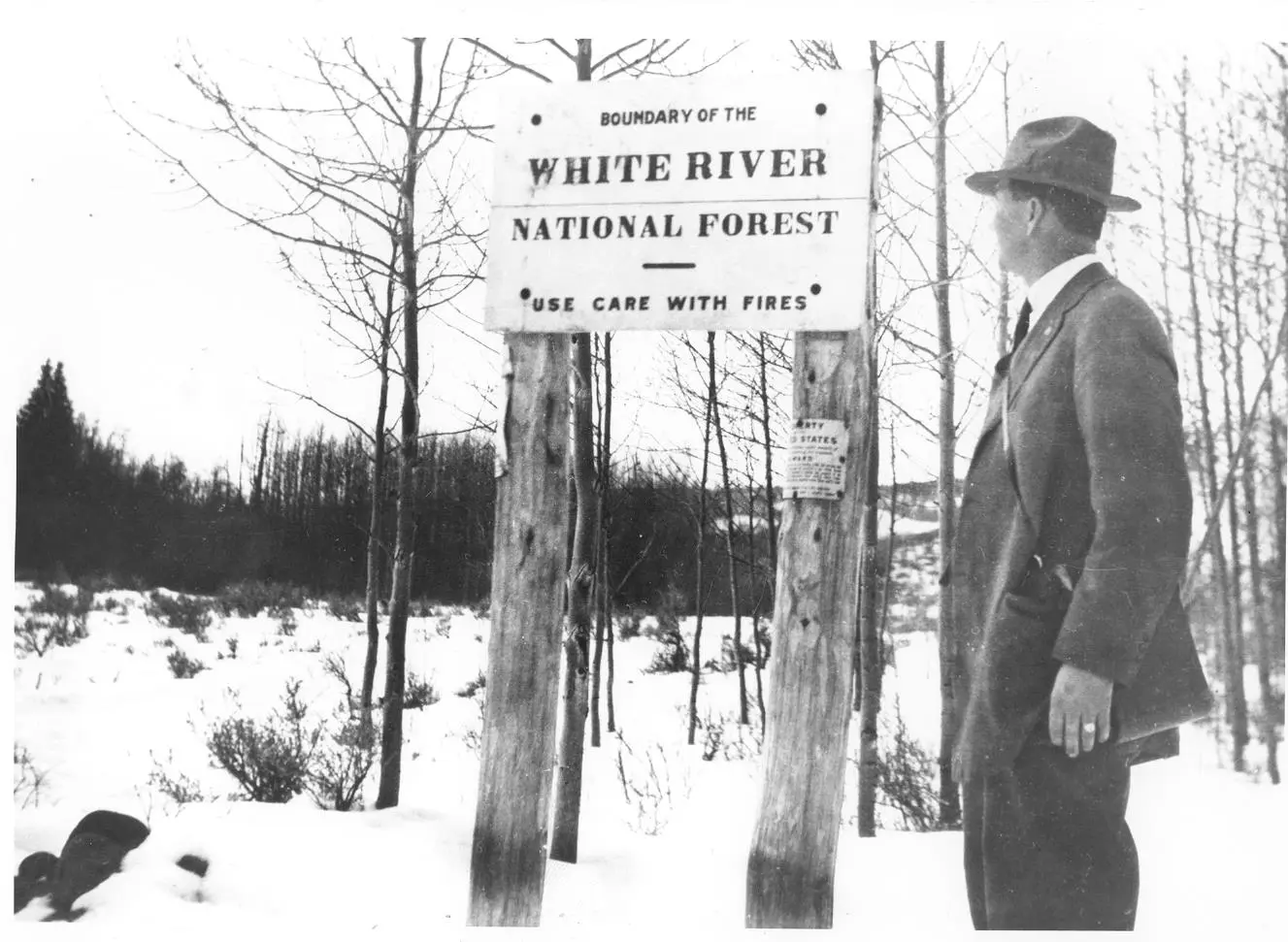
The White River Plateau Timber Land Reserve, the second federal forest reserve to be created, came into existence in 1891 and has evolved into the White River National Forest we know today as the most visited national forest in the country. Its management purview reflects two centuries of tension between exploitation and preservation for the greater good. CREDIT: U.S. FOREST SERVICE
Snowmass Mountain is shown in a historic U.S. Forest Service photo. The architecture of the White River National Forest was determined by vast and nearly incomprehensible geologic forces that shaped the mountain landscapes we see today. CREDIT: U.S. FOREST SERVICE

Public lands with no protection

In a foreword to Justine Irwin’s unpublished manuscript “White River National Forest: A Centennial History,” Thomas Hoots, the WRNF supervisor in 1990, led off with a crucial observation: “Before the turn of the century, the public lands were without a protector.” The national commons was being plundered and exploited by whoever got there first. Such was the opportunism that was rampant during the fever of westward expansion marked by Manifest Destiny and a willful disregard to impose limits on human agency.

This land hunger was described the following way by Gifford Pinchot, chief of the U.S. Forest Service from 1898 to 1910 and one of America’s original wise use conservationists: “There is no hunger like land hunger, and no object for which men are more ready to use unfair and desperate means than the acquisition of land.”

Pinchot led a growing advocacy for conservation of national resources against great odds as they lobbied for protection of federal lands from the unbridled influences of capitalistic greed.

Richard A. Ballinger, secretary of the interior from 1909-11, clearly defined a prevailing view: “You chaps who are in favor of this conservation program are all wrong. In my opinion, the proper course to take with regard to [the public domain] is to divide it up among the big corporations and the people who know how to make money out of it.”

Thanks to those with clearer vision for a public lands legacy for America, the world and for future generations, Ballinger’s idea did not come to fruition. And yet such has been the message from the transactional Trump administration as the monetization of public lands offers yet again the potential for financial gain.

Thirty-five years ago, Hoots described a different ethic: “The nation’s leadership recognized this dilemma and so began the long climb towards public land and resource management as we know it today. Nowhere has the strength and vitality of America been better reflected in the last 100 years than in the evolution of the National Forest System.”

Gifford Pinchot portrait via the Forest History Society

The WRNF is an integral part of that system. It is also a stellar example of a forest that has withstood numerous threats and, despite many compromises toward achieving the multiple-use mandate, has retained the conservation principles that has made it one of the most successful stories of land management in the United States. “The strength of our nation,” concluded Hoots on the centennial of the WRNF, “demands nothing less of the stewards of these public resources.”

Federal forest management dates to 1876 when Congress created the office of special agent in the U.S. Department of Agriculture to assess the quality and conditions of forests in the United States. In 1881, the department expanded the office into the Division of Forestry. A decade later, Congress passed the Forest Reserve Act of 1891, authorizing the president to designate public lands in the West into what were then called “forest reserves.”

Enter what would become the White River National Forest, the preliminary boundaries of which were drawn on federal maps under the direction of administrators in Washington, D.C. These long-distance planners for a realm of national treasures gazed over mountainous regions whose value they could only speculate, but which they reasoned were valuable in ways other than extractive, fast-buck profits measured only in capital gains for the few.

Responsibility for these reserves fell under the Department of the Interior until 1905 when President Theodore Roosevelt transferred their care to the Department of Agriculture’s new division: the U.S. Forest Service. Pinchot led this agency as its first chief, charged with caring for the newly renamed public commons.

The WRNF was created as the White River Plateau Timber Land Reserve on Oct. 16, 1891, by President Benjamin Harrison. This reserve was the second oldest in the newly conceived forest system, after a reserve established east of Yellowstone National Park, which two decades earlier became the country’s first national park. The WRNF would become the largest forest in Colorado when, in 1945, it absorbed the Holy Cross National Forest, created as a reserve in 1905. This newly defined national forest was a priority because it was being exploited with unsustainable resource extraction. It soon earned a place of immeasurable importance in the mosaic of public lands designated across the rugged western United States.

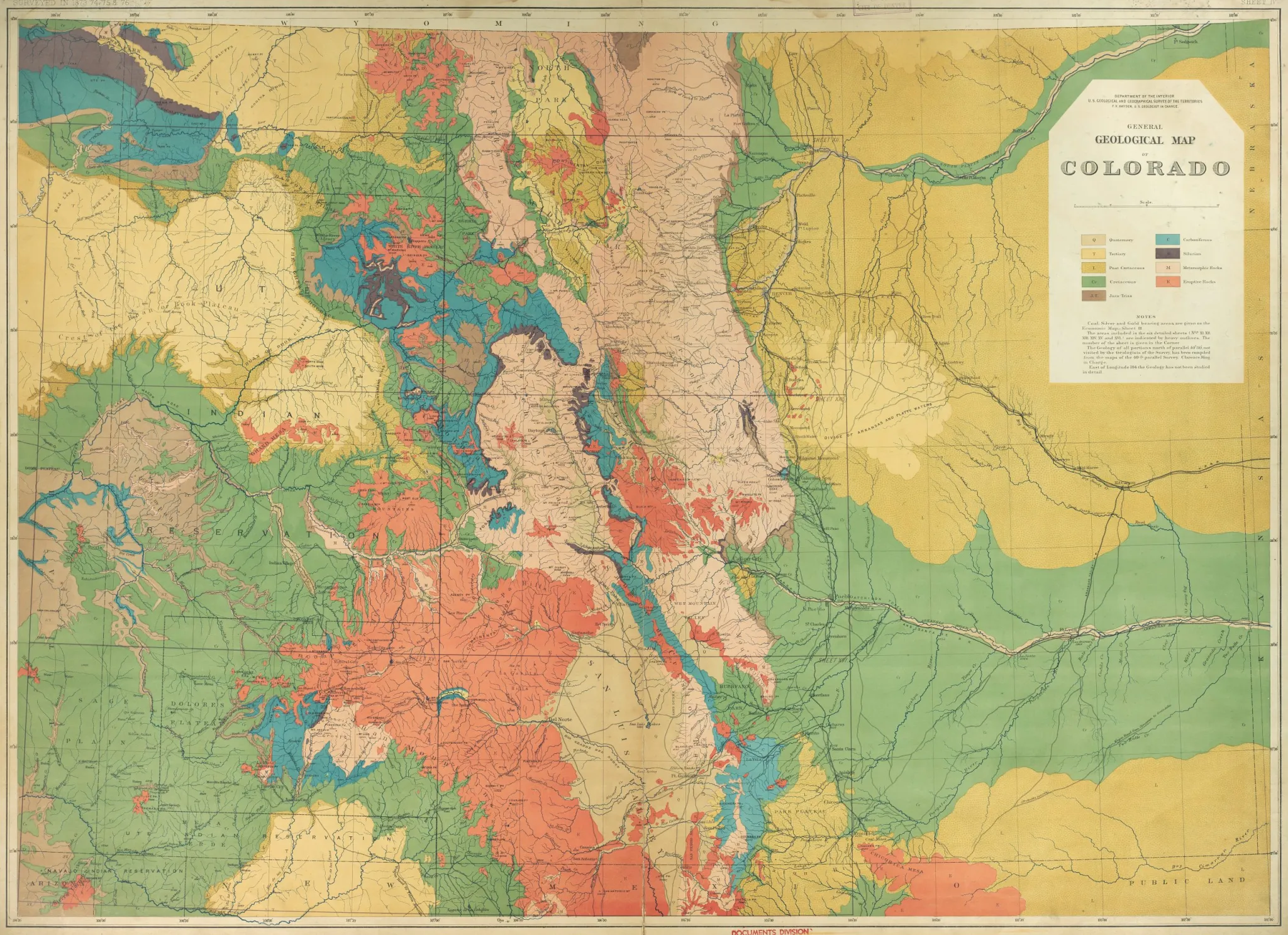
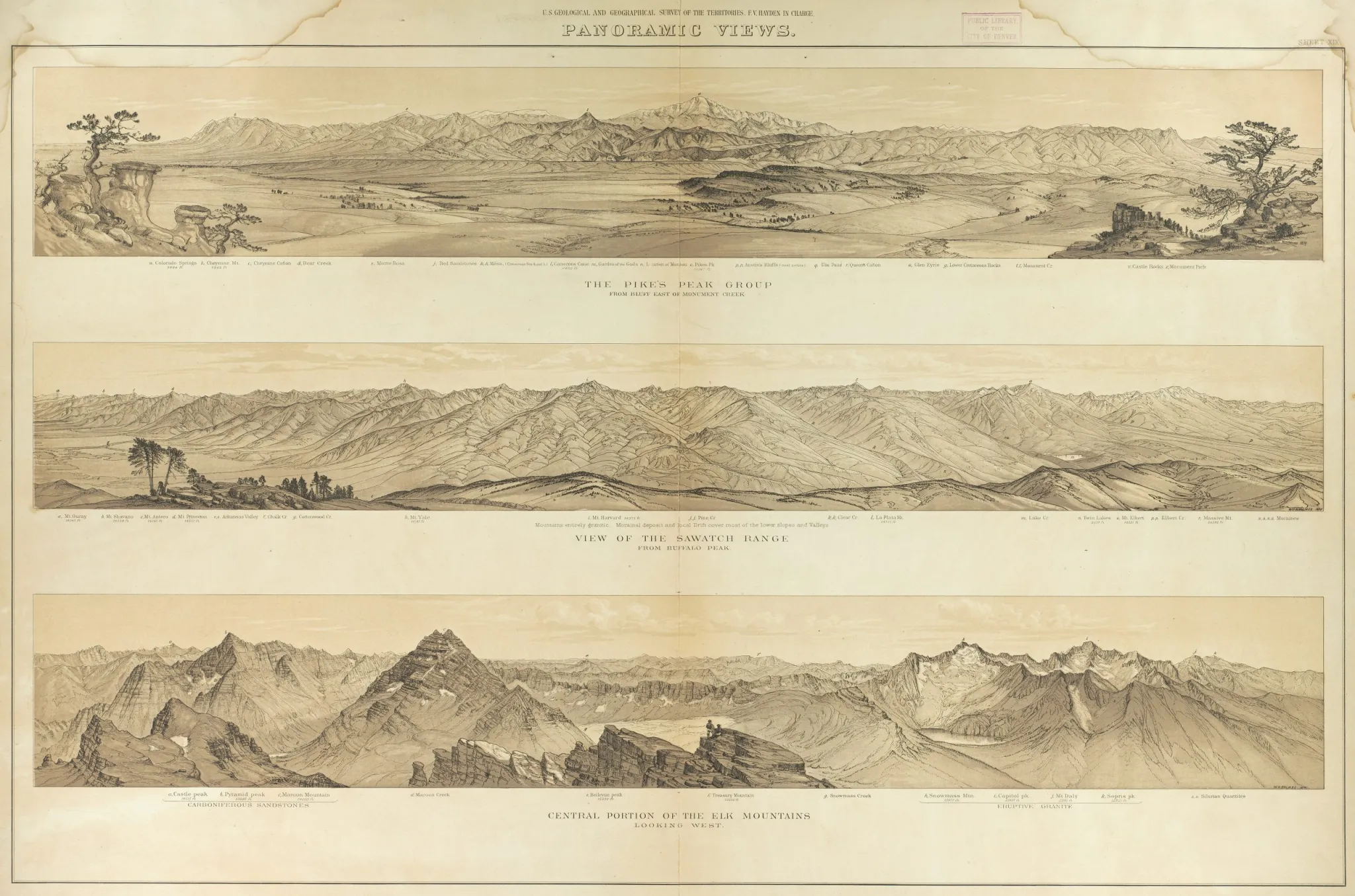
A geologic map of Colorado, produced by the survey team led by Ferdinand Hayden in 1873-74, helped draw prospectors to the mountains. CREDIT: DENVER PUBLIC LIBRARY

Nature laid the foundation

The architecture of the WRNF was determined by vast and nearly incomprehensible geologic forces that shaped the mountain landscapes we see today. Precambrian granite is the bedrock that was heaved up, twisted, broken, eroded and later covered with beds of sandstone and, later still, covered with an inland seaway that stretched from Mexico to Canada.

That seaway propagated plant and marine life-forms that speak to a far-different climate and ecology than today and that would eventually, under enormous pressure, form into huge coal deposits. This Cretaceous Seaway then gave rise to new landscapes as several major uplifts shed the accumulated water into major river systems and began building the mountain peaks rising from the bedrock floor. The uplifting, some from magma upwelling, brought metals and minerals to the surface where they were dissolved in super-heated groundwater and conveyed in solution into bedrock faults and fissures where they precipitated out at concentration. This formed the veins that gold and silver miners would later extract through labyrinthine tunnels and shafts.

Glaciation sculpted the finishing touches on the landscape by paring mountains into ragged escarpments and precipitous arêtes, and gouging deep U-shaped valleys where glacial runoff cut deeper still in the V-shaped drainages that we see today. Nature’s work is never complete, and so the mountains and valleys continue to be formed by erosion and an almost immeasurable continued uplifting from energies emanating from Earth’s depths.

Then biology stepped in and established an overlay of life, the flora and fauna that we see today inhabiting the niches where they are genetically suited to proliferate and thrive. These are the desert scrublands, grassy meadows, mixed forests and lichen-covered alpine terrain comprising a half-dozen life zones and multiple ecosystems that give the WRNF the diversity that characterizes a healthy and vibrant ecology.

The forest is home to one of the largest mule deer herds  and one of the largest elk herds in the nation, as well as bighorn sheep, mountain goats, black bears, mountain lions, snowshoe hare, marmot, porcupine, badger, marten, ground squirrels and chipmunks, hundreds of bird types, and thousands of plant species in a veritable Garden of Eden of biodiversity.

But the human stories are what capture our imaginations, as noted in Irwin’s WRNF Centennial History; the people of the forest have differed greatly in their relationship to it: “Some have loved her, some have abused her, some have hated her, but all have made her what she is today.”

A map shows the route of the 1776 Dominguez-Escalante expedition, led by two Spanish priests trying to find a way from Santa Fe to California. They reached Utah Lake before turning back, becoming the first Europeans to explore a vast portion of what would later become Colorado and Utah. CREDIT: WIKIMEDIA COMMONS

The first Europeans

The first Europeans to visit the region of the WRNF and enter the traditional homelands of the native Utes were Spanish Franciscan friars Fray Silvestre Velez de Escalante and Fray Francisco Atanasio Dominguez. The two explorers and their party left Santa Fe on an ambitious exploratory mission to find an overland route to the Roman Catholic mission in Monterey, in what later became California. They ventured into the Western wilderness in July 1776, the same year the American colonies declared independence from British rule.

After traversing what is now northern New Mexico and southwest Colorado, the party traveled north, eventually passing through the Paonia area and Muddy Creek. They met the Colorado River near Divide and Mamm creeks along the Grand Hogback, a diagonal sawtooth range near Silt and New Castle. With Ute guides, they crossed the White and Green rivers, making it as far as what is now known as Utah Lake along the Wasatch Front, where they encountered a thriving indigenous community. With winter approaching, the party turned back toward Santa Fe and faced starvation as they struggled to cross the Colorado River at a location now flooded by Lake Powell, but all made it back alive.

The Louisiana Purchase of 1803 opened the door to more exploration, this from the east where a few adventuresome parties reached Colorado’s Front Range. The towering Rockies were considered too severe an obstacle to pass through, except for freelancing traders and trappers who knew no bounds and no limits in their pursuit of trade and beaver pelts.

A French trapper, Antoine Robidoux, was perhaps the first Anglo to trap in the White River in 1825, harvesting beaver pelts from Trappers Lake on the north side of the Flat Tops. The Yampa Valley, to the north, became widely visited by mountain men such as Jim Bridger, Kit Carson and Jedediah Smith.

John Fremont, an Army officer and explorer, took part in an 1845 journey that crossed Tennessee Pass from the Arkansas River basin and then followed the White River into Utah. Credit: Wikimedia Commons

The seizing of Texas from Mexico in 1836 by Sam Houston stretched the promising Western U.S. boundaries, inviting more visitation as manifest destiny became a divine entitlement for Western settlement and provided a God-given mandate to force out native peoples and exploit the land and its many resources.

In 1845, John Fremont, guided by Carson, crossed Tennessee Pass from the Arkansas Valley and along the White River to Utah. With the announcement that gold had been discovered in California, streams of fortune-seekers flowed west through Colorado, many of whom recognized the grazing potential of verdant mountain valleys well-watered by rolling streams and rivers. After striking out on California gold, some returned to what would, in 1876, become Colorado to farm and raise cattle. The discovery of gold along Cherry Creek, near today’s Denver, made Colorado a hot new prospect in 1859, popularizing this mostly unmapped territory.

The next year, 1860, Capt. Richard Sopris, for whom Mount Sopris is named, prospected the Roaring Fork Valley with a party of 14. In journals, it was mentioned that they stopped to take in the soothing waters of Yampa Hot Springs at today’s Glenwood Springs. The Homestead Act was passed by Congress in 1862, encouraging more western migration and providing a relief valve for growing national tensions during the Civil War.

Official U.S. survey teams were sent west to report on resources and tribal relations. Foremost among them was John Wesley Powell, a Civil War veteran who had lost his right arm in the Battle of Shiloh, but it didn’t impede him from exploring the Green, Yampa, White and Colorado rivers. By the early 1870s, cattlemen began grazing their herds in Brown’s Park and the Meeker area in what would become northern Colorado.

As permanent settlements became established, some officials in the federal government became aware that Western lands had no protective management. They garnered congressional funding for a particularly seasoned survey team under the leadership of Ferdinand Vandeveer Hayden, who would later win acclaim for surveying Yellowstone. Hayden’s 1873-74 visits to the Gunnison Country, the Roaring Fork Valley and the White River produced maps that would later draw hordes of mining prospectors into Ute lands in the late 1870s.

The Hayden Survey produced detailed drawings of multiple mountainscapes across Colorado, including these depictions of Pikes Peak, the Sawatch Range and Elk Range. CREDIT: DENVER PUBLIC LIBRARY

Hayden and his “Rover Boys,” including renowned photographer and artist William Henry Jackson and geographer Henry Gannett, for whom the highest peak in Wyoming is named, summited, triangulated, mapped and named most of the major peaks that we know and climb today. The scientific acumen that this team provided was monumental in their understanding of geology, flora and fauna. Hayden correctly referred to the Elk Mountains as an example of an “eruptive range” and a “geologic jumble” for the upheavals he recognized. Described as “tall, slender, with soft brown hair and blue eyes,” Hayden, a consummate geologist, was given a nickname by the Utes that translated to “crazy man who runs around picking up rocks.”

A letter from Rover Boy J.T. Gardner to his daughter in New York state characterized what must have been a crowning moment in history to witness a pure wilderness: “We are in full tide of successful career camping almost every night at 11,000 or 12,000 feet and climbing peaks 14,000 feet and over, their tops overlooking crested ridges and grand rock-walled amphitheaters where old glaciers were born, I cannot tell you how I am enjoying this wonderful region. … What a sweet sight. … The terrible grandeur around me here where life is represented by the grim bears crawling along the edges of perpetual snow fields or the mountain sheep scaling the shattered crags.”

In a later letter, Gardner described the party’s discovery of Mount of the Holy Cross where a horizontal ridge and vertical couloir form a snow-filled cross. “We are undoubtedly the first who have ever reached this peak. I do not feel in the least over-fatigued and am very well and strong.” Enduring an early-winter storm, Gardner wrote: “On this climb I wore four heavy shirts and a thick buckskin coat. The snow blew so that I had to wear spectacles to protect the eyes.”

Hayden spent 20 days nursing a sick member of the party at the base of Mount Sopris while his party explored the Crystal River Valley, with Jackson photographing it all. Unfortunately for history, Jackson’s load-bearing mule stumbled and fell into the Crystal River, breaking the glass plate negatives. All photographic documentation from that portion of the survey was lost.

Nonetheless, Hayden’s Atlas of Colorado was published by the U.S. Department of the Interior in 1877, featuring six finely drawn resource maps identifying forests, pastures, croplands, and regions of coal, gold and silver. These geologic maps became a spur for treasure-seekers eager to flood into Ute lands. And there lay the age-old conflict between European trespass on the Western Slope of Colorado still controlled by the Utes under treaties, later broken, that were doomed at keeping the peace.

This story, and Aspen Journalism’s ongoing coverage of challenges facing local public lands, is supported by a grant from the Fund for Investigative Journalism.

Map of the Roaring Fork River drainage basin in western Colorado, USA. Made using USGS data. By Shannon1 – Own work, CC BY-SA 4.0, https://commons.wikimedia.org/w/index.php?curid=69290878

The Runoff | Dismal flows, funding thaws & big decisions ahead — Heather Sackett (The Runoff)

Roaring Fork River 2024. Credit: Heather Sackett/Aspen Journalism

Click the link to read the newsletter on the Aspen Journalism website (Heather Sackett):

June 20, 2025

Dismal spring runoff worse than forecast

Peak river flows have come and gone on the Western Slope, with most rivers seeing below normal peaks and currently running well below last year’s levels. According to Aspen Journalism’s real time local streamflow tracker, streams are flowing at 42-63% of normal in the Roaring Fork Watershed.

Streamflows peaked on June 3 or June 4 with the Roaring Fork River flowing as much as 3,050 cfs at Glenwood Springs, which was 87% of average peak flow, and the Colorado River running up to 11,400 cfs near the stateline the next day, which was 64% of normal.As of June 18, the Colorado River is running at about 4,370 cfs at Glenwood Springs, or 43% of average, down from 5,640 cfs last week and from last year’s 13,000 cfs, while the Colorado flowed at 5,360 cfs near the Colorado-Utah stateline, or 33% of average.For more river data, check out Aspen Journalism’s streamflow tracker.According to the National Resources Conservation Service’s June 1 Water Supply Outlook report, statewide snowmelt was tracking about 10 days earlier than average and the streamflow forecasts for all Western Slope basins were below average and down from the April forecasts. 

The low streamflows are sure to affect reservoir levels. According to a June 11 update from Tim Miller, a hydrologist with the Bureau of Reclamation, Ruedi Reservoir on the Fryingpan River is no longer forecast to fill. The seasonal inflow forecast for June is 66% of average, a 34,000-acre-foot drop from the April forecast. Miller said the plan is to keep releases to a minimum until the third week in July when the Cameo call is expected to come on. The Aspen Yacht Club boat ramp should be useable through the end of August. 

According to the June forecasts from Reclamation, spring runoff into Lake Powell is forecast to be 45% of average, down from April’s forecast of 67%. Lake Powell is currently about 33% full. 

Map of the Roaring Fork River drainage basin in western Colorado, USA. Made using USGS data. By Shannon1 – Own work, CC BY-SA 4.0, https://commons.wikimedia.org/w/index.php?curid=69290878

#Aspen reaffirms plans for new reservoirs with water court filings: Five potential sites remain; effort to add more locations falls short of deadline — Heather Sackett (AspenJournalism.org)

This land in Woody Creek is owned by the city of Aspen and is a potential site for a reservoir. On May 30, the city reaffirmed its plans to build water storage with two water court filings. CREDIT: HEATHER SACKETT/ASPEN JOURNALISM

Click the link to read the article on the Aspen Journalism website (Heather Sackett):

June 7, 2025

The city of Aspen is reaffirming its plans to build reservoirs to store water from Castle and Maroon creeks — but where they might be built has still not been decided.

On May 30, attorneys for the city filed two applications in water court: a diligence application detailing the actions Aspen has taken toward developing the rights over the past six years and an application to change the original locations of the reservoirs. After a water court process, which saw 10 groups oppose the reservoirs, Aspen in 2019 agreed to modify the rights and move the proposed reservoirs out of Castle and Maroon valleys. 

The city has previously identified five potential locations for reservoirs: on land the city owns in Woody Creek; Vagneur Gravel Quarry; and three underground sites — the Aspen Golf Course, Cozy Point Ranch and Zoline Open Space. 

“I think the city would try and prioritize sites that we own already, or those that have larger and contiguous areas and focus on those, but I think a lot of it will come down to the feasibility and constructability, and those sites that might have the least impact as well,” said Erin Loughlin Molliconi, Aspen’s utilities director. 

Aspen has what’s known as conditional storage rights for up to 8,500 acre-feet of water from Castle and Maroon creeks, which it could store in one or more locations. Conditional water rights allow a water rights owner to save their place in line while they work toward developing the rights. 

Since first claiming the rights in 1965, the city every six years filed little-noticed diligence applications to maintain them. But the city’s 2016 diligence filing brought statements of opposition from 10 parties: the U.S. Forest Service, Pitkin County, American Rivers, Western Resource Advocates, Trout Unlimited, Wilderness Workshop and four private-property owners — two who owned land in the Maroon Creek Valley and two who owned land in the Castle Creek Valley.

The location of the potential Maroon Creek Reservoir. Photo credit: Brent Gardner-Smith/Aspen Journalism

The Maroon Creek Reservoir would have had a dam 155 feet tall and would have held 4,567 acre-feet of water in a pristine location in view of the Maroon Bells. The reservoir would have flooded 85 acres of U.S. Forest Service land, including some in the Maroon Bells-Snowmass Wilderness.

The Castle Creek Reservoir would have had a dam 170 feet tall and would have held 9,062 acre-feet of water. The reservoir would have flooded 120 acres on both private and USFS lands, including a small area in the wilderness.

After settling with the opposing parties, Aspen’s total storage rights were winnowed to 8,500 acre-feet, and the city is now required to find a new site or sites to build storage buckets.

Conditional water storage rights that have not yet been developed — such as Aspen’s — are held by many cities, water conservancy districts and fossil fuel companies across the Western Slope.

Five new potential reservoir sites

Besides the five previously identified sites where the city might want to move its potential water storage, officials had been seeking to add five new reservoir sites to the change case, but ultimately they did not include them. In a March 28 letter to opposersin the 2016 case, the city requested approval to include Thomas Reservoir, Marolt Open Space, Snowmass Reservoir, Ziegler Reservoir and Wildcat Reservoir in the list of potential locations. 

According to the settlements with opposers, the city needs written approval from the opposers to add any new potential reservoir locations, other than the previously identified five (Woody Creek, Vagneur Gravel Quarry, Aspen Golf Course, Cozy Point Ranch and Zoline Open Space). Aspen did not get that approval from all of the opposers for all of the locations before the May 30 water court filing deadline.

“We can say that some parties did approve of sites,” Molliconi said. “We just didn’t get all parties to approve of all sites.”

Molliconi said the city chose the five additional sites because they already have existing reservoirs or ponds.

“It would be better to get either a partnership with an existing site or enlarge an existing site,” Molliconi said.

It is unclear if the city will pursue adding any of the five new sites to a future proposal. In an emailed statement, officials said they would “continue to respect and honor the stipulations and conditions of other stakeholders in this process.”

“The city intends to maintain site flexibility because we can’t perfectly predict future demands,” the statement said. “We feel it is our responsibility to continue analyses and stakeholder conversations for storage given the need for resource resiliency, storage and demand gaps, and other beneficial uses.”

Bill Hegberg is the association president of Wildcat Ranch, a residential subdivision outside of Snowmass Village. He said he had talked with city officials about including in their plans Wildcat Reservoir, a 1,100-acre-foot lake on Wildcat Creek, a tributary of Snowmass Creek.

“It doesn’t really work when we’ve got a lake that’s a recreation amenity,” Hegberg said. “We aren’t available for that.” 

Aspen officials did not provide additional information on how reservoirs in the Brush Creek and Snowmass Creek drainages could be used to provide water to the city.

Environmental conservation organization American Rivers was one of the opposers Aspen settled with in 2019. Matt Rice, American Rivers’ southwest regional director, said the organization couldn’t sign off on the five additional new locations until Aspen provided more information. 

“We can’t in good faith approve Aspen’s very vague plans,” Rice said. “But we are not trying to throw up unnecessary roadblocks. They just need to do a little bit more work on that and we can have this discussion in six years, especially if they provide us a longer timeline to get our approval.”

Every six years, holders of conditional water rights must file what’s known as a diligence application with the state’s water court, proving that they still have a need for the water, that they have taken substantial steps toward putting the water to use and that they “can and will” eventually use the water. They must essentially prove they are not speculating and hoarding water rights that they won’t soon use. 

According to the water court filings, the city says the following things count as diligence over the past six years: It has spent about $310,000 to investigate the 10 potential reservoir locations; it has spent $300,000 on attorneys fees to “defend” its water rights; and it has continued to improve, operate and maintain its water systems that serve Aspen residents.

The Aspen municipal golf course, which sits between Castle and Maroon creeks. The golf course is one potential site the city of Aspen is considering for underground water storage. CREDIT: BRENT GARDNER-SMITH/ASPEN JOURNALISM

Storage is part of Aspen’s Integrated Water Resource Plan, which was completed in 2021and lays out options for meeting increasing water demands in a hotter and drier future. In addition to storage, the IWRP options include nonpotable reuse; groundwater wells; using Hunter Creek as a water source; enhanced water conservation; and drought restrictions.

“I think that [IWRP] is part of the reason why keeping these water rights alive was important, too, for the supply and demand,” Molliconi said. 

According to the plan, which uses estimates of population growth and climate change to make projections 50 years into the future, the worst water shortages could occur in two consecutively dry years and be about 2,300 acre-feet total over the course of both years.

In recent years, Aspen has worked at reducing customers’ water use — especially outdoor water use — with increased public outreach, a landscape ordinance, automated metering and tiered water use rates. The city has also stepped up the monitoring of snowpack and streamflow by funding a new SNOTEL site at the headwaters of Castle Creek and Airborne Snow Observatory flights that measure snowpack from planes using light detection and ranging, or lidar. 

Steve Hunter, Aspen’s utilities resource manager, said he plans to recommend to City Council on June 10 that the city move into a Stage 1 water shortage declaration, which aims to reduce water use by 10% through voluntary conservation. 

Now that the applications are filed, anyone who might want to oppose the city’s plans has 60 days to file a statement of opposition. The 10 original opposers in the case agreed not to fight the city’s efforts to move the rights to the five alternative locations for 20 years. 

If the city’s change case is approved, officials would still need land-use and permitting approval to build any eventual new water-storage reservoir and associated infrastructure. 

Aspen Journalism is supported by a community nonprofit grant from the city of Aspen.

Aspen Journalism is a nonprofit, investigative news organization covering water, environment, social justice and more. Visit http://aspenjournalism.org.

Low #snowpack leading to an early — and very low — peak runoff for #RoaringForkRiver — #Aspen Times

Map of the Roaring Fork River drainage basin in western Colorado, USA. Made using USGS data. By Shannon1 – Own work, CC BY-SA 4.0, https://commons.wikimedia.org/w/index.php?curid=69290878

Click the link to read the article on the Aspen Times website (Westley Crouch). Here’s an excerpt:

May 20, 2025

The central mountains of Colorado, including Aspen, are currently experiencing a snowpack that is only 42% of the seasonal average, a dramatic shortfall that is already producing consequences for river flows, drought conditions, and fire risk across the region. Meteorologist Kris Sanders with the National Weather Service in Grand Junction confirmed the snowpack is not only low, but melting rapidly.

“We peaked at pretty close to normal — around 80% — but normally we see the snowpack last a little longer,” he said. “It has been melting quicker.”

The zero snow water equivalent, a measurement of the amount of water contained in snowpack, is projected by the end of May, Sanders said. In other words, there soon won’t be any water content left in the central mountains’ snowpack…Sanders noted that recent precipitation will offer only short-term relief. He said the Roaring Fork Valley received up to less than one inch of rain, and four to eight inches of snow in the higher elevations, with close to a foot at the highest…He added that the central mountains are forecasted to remain abnormally dry, with moderate drought conditions likely persisting through the summer…[Matthew Anderson]pointed to current Roaring Fork River flows at Glenwood Springs, which are around 900 cubic feet per second (cfs) due to recent cold. The Colorado Basin River Forecast Center expects peak flows to reach 2,000 cfs within 10 days, a steep drop from the usual 6,000 cfs typically seen in early June.

Pitkin County pledges $1 million to Shoshone water rights purchase: County may still oppose #Colorado River District in water court case — Heather Sackett (AspenJournalism.org) #COriver #aridification

The Shoshone hydro plant in Glenwood Canyon. The River District has made a deal with Xcel Energy to buy the water rights associated with the plant to keep water flowing on the Western Slope. Credit: Heather Sackett/Aspen Journalism

Click the link to read the article on the Aspen Journalism website (Heather Sackett):

April 23, 2025

Pitkin County on Wednesday joined 29 other Western Slope counties, cities and towns, irrigation districts and water providers in financially backing a plan to buy a critical Colorado River water right.

Pitkin County commissioners unanimously approved a resolution supporting the Shoshone Permanency Project and pledging $1 million toward the campaign to keep the water rights associated with the Shoshone hydropower plant in Glenwood Canyon on the Western Slope. Pitkin County’s Healthy Rivers Board recommended the $1 million contribution from its fund at its regular meeting April 17. 

The Colorado River Water Conservation District plans to purchase the water rights from Xcel Energy for nearly $100 million. The water rights are some of the biggest and oldest non-consumptive water rights on the mainstem of the Colorado River, and ensure water keeps flowing west to the benefit of downstream cities, farms, recreation and the environment. 

“From our perspective we view this as an opportunity to really create and enhance a partnership that should be incredibly functional in the future,” River District General Manager Andy Mueller told commissioners on Wednesday. “We’re committed to working with you to keep the upper Roaring Fork healthy and figuring out creating solutions to bring water into the watershed at the right times of year.”

About 40% of the headwaters of the Roaring Fork River is diverted across the Continental Divide for use in the Arkansas River basin. It’s long been Pitkin County’s goal to mitigate the effects this has on the health of the Roaring Fork.

In exchange for support of the Shoshone project, Pitkin County will be able to use some water from Grizzly Reservoir, owned by the city of Aspen and the River District, to boost flows in the upper Roaring Fork River. 

“One of the most productive things to come out of this, in addition to the benefits you’ve already discussed with the Shoshone project itself … is going to be that the River District has agreed that Pitkin County can now have a voice in working with Aspen and the River District on that Grizzly water,” said Jennifer DiLalla, an attorney with Moses, Wittemyer, Harrison and Woodruff. DiLalla is the county’s outside counsel who works on water issues. “That is one of the only sources of water available upstream of you. It’s not going to be there all that often, but when it is, it’s a really great benefit for the upper Fork.”

The $1 million pledge may help the county and the River District repair their rocky relationship after years of being at odds over certain water issues. Pitkin County didn’t initially support the Shoshone campaign because of the complex interaction of the water rights with another big set of downstream irrigation water rights in the Grand Valley known as the Cameo call. 

“We’ve come a long way because it used to be not too long ago that we were just going to oppose this, period,” said Pitkin County Commissioner and River District representative Francie Jacober. “I would say that we are on the road to a new era of cooperation with the River District.”

Pitkin County’s concern was that with Shoshone under new ownership — and the proposed addition of an instream flow use for the water along with hydropower — the call for the water through Glenwood Canyon might delay or reduce the need for the Cameo call. Aspenites like to see the Cameo call come on because it forces the Twin Lakes diversion to shut off, which means more water flowing down the Roaring Fork, typically during a time of year in late summer and early fall when streamflows are running low and river health is suffering.

North Star Nature Preserve on the Roaring Fork River just upstream of Aspen experienced high water in June of 2023. Pitkin County is supporting the River District’s campaign to buy the Shoshone water rights in exchange for help boosting flows in the upper Roaring Fork. Credit: Heather Sackett/Aspen Journalism

Some of the mistrust between the two local governments can be traced to water rights owned by the River District that would have kept alive huge reservoirs on the Crystal River near Redstone. The district eventually abandoned those rights, but not without first being challenged in water court by Pitkin County. Pitkin County also opposed the widely supported River District 2020 tax increase — ballot measure 7a — which funds water projects across the district’s 15-county area.

To secure the Shoshone water rights — which comprise a 1902 right for 1,250 cubic feet per second and another from 1929 for 158 cfs — the River District must add an instream flow use to the water rights in addition to their current use for hydropower. That requires working with the Colorado Water Conservation Board, which is the only entity in the state allowed to hold instream flow rights which preserve the environment, as well as getting a new water court decree to allow the change in use.

Despite the support and $1 million pledge, Pitkin County still may oppose the change case in water court. The county hired Golden-based engineering firm Martin and Wood Water Consultants to do an analysis of the Shoshone and Cameo call interaction to see if the Roaring Fork could be harmed. According to Tara Meininger, an engineer with Martin and Wood, there could potentially be an annual impact of 26 acre-feet on average to the upper Roaring Fork.

But a final report is still not complete, said Pitkin County Attorney Richard Neiley, which is why the county reserved the right to oppose the River District in water court.

“It’s an important goal to make sure that change does not result in injury to the Roaring Fork forever,” Neiley said. “We haven’t given anything away with respect to being able to argue or oppose the change case on that basis.”

With Pitkin County’s $1 million contribution, the River District has now raised $57 million from local and regional partners. In addition, the project was awarded $40 million in the final days of the Biden administration, but that funding has since been frozen, though River District officials are hopeful that the federal funding will still be realized.

The River District plans to present an agreement on the instream flow water rights to the Colorado Water Conservation Board at its regular meeting in May.

“We’re about to enter into a process with the Colorado Water Conservation Board where your support will be essential to a successful experience there and then on into water court,” Mueller told commissioners. “So we just want to say thank you very much.”

Colorado transmountain diversions via the State Engineer’s office

March snowfall in Northwest #Colorado shifts region away from possible #drought development in spring — Steamboat Pilot & Today #snowpack

Click the link to read the article on the Steamboat Pilot & Today website (Ali Longwell). Here’s an excerpt:

March 24, 2025

Snowfall in March has helped decrease the likelihood of drought developing this spring in Colorado’s northwest mountains. However, a warm and dry spring could still change the tide heading into summer.  The National Weather Service, a division of the National Oceanic and Atmospheric Administration, released its latest seasonal drought outlook on Thursday, March 20. It showed that drought conditions are unlikely to develop in most of northwest Colorado through June…Brad Pugh, a forecaster with the National Oceanic and Atmospheric Administration’s climate prediction center, said these outlooks predominantly take into account the current conditions, climatology temperature and precipitation outlooks over the next three months. 

“In northwestern Colorado at this time of year, you know going into the springtime, mountain snowpack is a critical factor,” Pugh said.

As of March 18, much of northwest Colorado was in line with, or just above, normal snowpack. This has continued to improve in the state’s north-central mountains since January. According to OpenSnow, as of Monday the snow totals and percentage of normal on the season so far were as follows:  

  • Winter Park – 315 inches (117%) 
  • Copper Mountain Resort – 303 inches (113%) 
  • Vail Mountain – 292 inches (101%) 
  • Breckenridge Ski Resort – 284 inches (107%) 
  • Steamboat Resort – 279 inches (108%) 
  • Aspen Highlands — 267 inches (88%) 
  • Loveland Ski Area – 261 inches (108%)
  • Snowmass – 243 inches (83%) 
  • Keystone Resort – 239 inches (107%) 
  • Beaver Creek – 227 inches (108%)
  • Arapahoe Basin Ski Area – 225 inches (112%)
  • Aspen Mountain – 210 inches (92%) 
  • Ski Cooper – 206 inches (106%)
  • Buttermilk – 147 inches (89%)
Colorado Drought Monitor map March 25, 2025.

The latest U.S. Drought Monitor for Colorado reported no drought in many of the northwest counties including Summit, Grand, Routt and Jackson counties as well as the eastern reaches of Eagle and Moffat counties. Heading west, the monitor shows abnormally dry conditions in Pitkin County and the eastern portions of Garfield and Rio Blanco counties. Conditions continue to get progressively drier the further west toward the border.

#ColoradoRiver District: 2025 State Of The River Meetings #COriver #aridification

Click the link to go to the Colorado River District website for all the inside skinny:

Join the conversation at your local meeting!

The Colorado River District’s State of the River meetings are a spring tradition in Western Colorado, bringing communities together to discuss the most pressing water issues facing our region. These free public events provide valuable insights into river forecasts, local water projects, and key challenges impacting West Slope water users.

Eleven meetings are planned across the Western Slope; see the list below. These events offer an opportunity to hear directly from water experts and better understand the factors shaping the future of our rivers. A complimentary light dinner will be provided, and all events include a Q&A session to address your questions and concerns.

While each program is tailored to reflect local water priorities, key topics at all events will include:

  • River flow forecasts
  • Updates on the Colorado River system
  • Local water projects and priorities
  • Current challenges facing Western Colorado water users
  • Shoshone Water Rights Preservation Project updates

If there are specific local issues or projects you would like to see highlighted, please include that information in your registration.

Registration is required, but attendance and dinner are free. We encourage all community members—whether deeply involved in water issues or just beginning to engage—to join us and participate in this important conversation.

Secure your spot today and be part of shaping the future of water in Western Colorado.

Click each event below to register!

Agendas will be posted for each meeting once they are finalized.

Lower Gunnison River: March 17th

Uncompahgre River: March 18th

Upper Yampa River: March 25th

Lower Yampa River: March 26th

White River: April 2nd

Roaring Fork and Crystal Rivers: April 3rd

Upper Gunnison River: April 17th

Grand Valley State of the River: April 22nd

Upper Colorado River: May 13th

Eagle River Valley: May 21st

Blue River: May 22nd

The Colorado River Water Conservation District spans 15 Western Slope counties.
Colorado River District/Courtesy image

The #ColoradoRiver is salty. But where does salinity come from, and what’s being done about it?: Among river disputes, salinity is an issue that all seven basin states agree is worth solving together — The Summit Daily #COriver #aridification

Colorado River. For over 50 years, stakeholders throughout the Colorado River basin have worked to address challenges caused by salinity. Photo credit: Abby Burk via Audubon Rockies

Click the link to read the article on the Summit Daily website (Ali Longwell). Here’s an excerpt:

February 6, 2024

Since 1974, the seven Colorado River basin states — Arizona, California, Colorado, Nevada, New Mexico, Utah and Wyoming — have coordinated efforts to implement salinity control in the waterway as part of the Colorado River Basin Salinity Control Forum. The forum was created by the U.S. Congress, flowing funding through the Bureau of Reclamation to reduce the salt load in the river and research the issue…While salinity is naturally occurring, there are a few reasons that states and river stakeholders have long kept an eye on it.A baseline amount of salinity is OK. Too much salinity can have adverse effects on drinking water, water infrastructure and treatment, appliance wear, aquatic life, the productivity of certain agricultural crops (including wine grapes, peaches and other salt-sensitive products) and more. The U.S. Bureau of Reclamation estimates that salinity causes between $500 and $750 million annually in damages and could exceed $1.5 billion per year if future increases are not controlled…

Much of the Upper Basin geology — specifically Mancus and Mesa Verde shale formations — was created when it was covered by an inland sea, [David] Robbins added. Therefore, they contain salt deposits that through natural erosion and runoff, make their way to the rivers and downstream. In Colorado, natural salinity sources include the geothermal hot springs in Glenwood Springs; shale cliffs and evaporating salt deposits in the Eagle and Roaring Fork valleys; and the salt domes in Paradox Valley in Montrose County along the Dolores River. Human activity can also exacerbate challenges by accelerating the release of compounds from these natural geologic materials and increasing the salt load in the river and tributaries, according to the 2009 U.S. Geological Survey report. This includes activities like mining, farming, petroleum exploration and urban development.  For example, with some agricultural irrigation practices, by adding more water to the soil that naturally contains salts, “increases the rate of dissolution above the natural signal,” [Dave] Kanzer said.  The use of road salts — solid and liquid — to clear snow and ice can also lead to increased salt loads as the salt dissolves and makes its way into snowmelt and streams. 

Photo credit: Glass of Bubbly

Rare earth elements found in #LincolnCreek raise new questions: Mineralized tributary and Ruby mine also source of rare earth elements in Lincoln Creek — Heather Sackett (AspenJournalism.org)

Lincoln Creek was orange just downstream of the mineralized tributary in July 2024. A team of scientists from the University of Colorado Boulder found that a mineralized tributary is also contributing rare earth elements to Lincoln Creek, in addition to other metals like aluminum. Credit: HEATHER SACKETT/Aspen Journalis

Click the link to read the article on the Aspen Journalism website (Heather Sackett):

January 25, 2025

Recent sampling shows that a high-alpine tributary of the Roaring Fork River, in addition to having high concentrations of certain metals, also contains rare earth elements. But what that means for human and aquatic health is unclear.

Scientists from the University of Colorado Boulder presented the preliminary results from water-quality sampling on Lincoln Creek over last summer at a public meeting hosted by the Roaring Fork Conservancy at the Basalt Regional Library on Thursday. 

Occupying a lesser-known corner of the periodic table, rare earth elements (which, despite their name, are commonly occurring in Earth’s crust) are a set of 17 heavy metals that are used in making products such as cellphones, fiber-optic cables and computer monitors. With names such as yttrium, lanthanum and neodymium, they often turn up at sites in Colorado where there is acid rock drainage, such as upper Lincoln Creek.

“You get a phone’s worth of neodymium coming down the mineralized tributary about every 5½ minutes,” said Adam Odorisio, a graduate student and researcher at CU’s environmental engineering department. “This translates to 96,000 phones per year. And what I think is the most striking fact in this is that this is for one tributary. You multiply this across hundreds of acid mine sites in Colorado and potentially thousands across the Western U.S. and it’s very exciting for resource extraction.” 

CU scientists are also monitoring other high alpine acid rock and mine drainage sites in Colorado, including the Snake River. Odorisio said the concentrations of rare earth elements in a mineralized tributary that feeds Lincoln Creek was in the middle of the pack when compared to other sites around the state.

Twin Lakes collection system

In addition to the potential for mining valuable rare earth metals, scientists are eager to learn more about their impacts to human health and aquatic environments. There are no state or federal water quality standards for rare earth elements. Lincoln Creek is a source of drinking water for Front Range cities, including Colorado Springs. 

“This is just wide open as an unknown area,” said Diane McKnight, a professor at CU’s Institute of Arctic and Alpine Research. “It’s not clear that it’s something to worry about here. The water from (Lincoln Creek) that goes into the Twin Lakes system is highly diluted.” 

Over nine days from June through October, the CU team collected 79 water samples from eight sites, took sediment core samples from the Grizzly Reservoir lakebed, and collected rock scrapings and bugs from the waterway. Early results also confirmed what the Environmental Protection Agency found in previous water-quality tests: The water is highly acidic, and concentrations of metals including zinc, copper and aluminum exceed standards for aquatic life. Scientists found that a groundwater source could also be adding metals to Lincoln Creek. They are still analyzing the data and plan to present more results at a spring meeting.

“For the greater scientific community, the fate of rare earth elements in aquatic systems is not well understood,” Odorisio said. “We are hoping to change that.”

The headwaters of Lincoln Creek upstream from the Ruby Mine and mineralized tributary. Recent water sampling by scientists from the University of Colorado Boulder found rare earth elements in the creek downstream, but implications for human health and aquatic impacts are unclear. Credit: HEATHER SACKETT/Aspen Journalism

The results may be of use to the Lincoln Creek workgroup, an ad hoc group – composed of officials from Pitkin County, Colorado Parks and Wildlife, the U.S. Forest Service, Colorado Department of Public Health and Environment, Independence Pass Foundation, Roaring Fork Conservancy and others – that is trying to understand how contaminants are impacting Lincoln Creek and the Roaring Fork River. The group has hired consultants LRE Water to compile water-quality data collected by several different agencies last summer and propose options to clean up the waterways. 

“The rare earth metals is a group we haven’t really thought through,” said Kurt Dahl, Pitkin County’s environmental health manager. “That’s one of the things that we are talking through with the contractor, LRE Water.” 

The water quality of Lincoln Creek has been under increased scrutiny in recent years as fish kills and discoloration of the water downstream of Grizzly Reservoir have become more frequent. In July, reservoir owner and operator Twin Lakes Reservoir & Canal Co. drained the reservoir for a planned dam-rehabilitation project, releasing an orange slug of sediment-laden water from the bottom of the reservoir downstream. Testing showed that the water had high levels of iron and aluminum, but not copper, which is toxic to fish.

An EPA report in 2023 determined that a “mineralized tributary,” which feeds into Lincoln Creek above the reservoir near the ghost town of Ruby, is the main source of the high concentrations of metals downstream. 

Prior to mining, snowmelt and rain seep into natural cracks and fractures, eventually emerging as a freshwater spring (usually). Graphic credit: Jonathan Thompson

The process that causes metals leaching into streams can be both naturally occurring and caused by mining activities. In both cases, sulfide minerals in rock come into contact with oxygen and water, producing sulfuric acid. The acid can then leach the metals out of the rock and into a stream, a process known as acid rock drainage. The contamination from acid rock drainage seems to be increasing at other locations around Colorado and may be exacerbated by climate change as temperatures rise. 

The recent water-quality-testing effort on Lincoln Creek is probably just the beginning of a long-term data-collection and monitoring program, Dahl said. 

“I think there’s still a lot of energy around this,” Dahl said. “People are really invested in this, and it’s going to take a couple of years to get it characterized.”

Aspen Journalism, which is solely responsible for its editorial content, is supported by a grant from the Pitkin County Healthy Community Fund.

This story ran in the Jan. 27 edition of The Aspen Times.

Map of the Roaring Fork River drainage basin in western Colorado, USA. Made using USGS data. By Shannon1 – Own work, CC BY-SA 4.0, https://commons.wikimedia.org/w/index.php?curid=69290878

Forest Service presents results of beaver inventory — Heather Sackett (AspenJournalism.org) #FryingpanRiver #RoaringForkRiver #ColoradoRiver

Beavers have constructed a network of dams and lodges on this Woody Creek property. Pitkin County funded a two-year beaver inventory in the headwaters of the Roaring Fork and its tributaries. Credit: HEATHER SACKETT/Aspen Journalism

Click the link to read the article on the Aspen Journalism website (Heather Sackett):

January 17, 2025

Thanks to Pitkin County, local land managers now have more information about beavers and their habitat, which could eventually lead to projects aimed at improving stream conditions.

Over the summers of 2023 and 2024, technicians with the U.S. Forest Service covered roughly 353,000 acres of land throughout the headwaters of the Roaring Fork River and its tributaries, surveying 296 randomly chosen sites on 66 streams for beavers, their dams and lodges or other signs they had once been there like chewed sticks. The surveys, which were funded with $100,000 from Pitkin County Healthy Rivers, found that 17% of the sites were currently occupied by beaver, 34% of the sites had some signs of beaver and 37% of sites had evidence of past beaver occupation. 

Clay Ramey, a fisheries biologist with the White River National Forest, presented the findings of the two-year inventory to the Healthy Rivers board at its regular meeting Thursday evening. 

“It would seem that while beaver were once common there, the vegetation has shifted from aspen to conifer and therefore that area doesn’t appear to have a lot of potential for beaver in its current state,” the inventory report reads.

Another interesting finding from the inventory is that there is less willow found in areas where cattle graze. But what that means for beavers is unclear. 

“The beavers are occupying grazed areas and ungrazed areas basically to the same extent,” Ramey said. “So there was nothing to suggest that beavers are avoiding or being excluded from grazed areas.”

Samantha Alford, right, and Stephanie Lewis, technicians with the U.S. Forest Service, measure the slope and width of Conundrum Creek in summer 2023. A two-year inventory of beavers in the headwaters of the Roaring Fork watershed recorded where beavers currently live and where they lived in the past. Credit: HEATHER SACKETT/Aspen Journalism

The information gleaned from the inventory will now help the Forest Service decide where to do prescribed burns and stream restoration projects in an effort to create more and better beaver habitat. Ramey said the Forest Service is undergoing a National Environmental Protection Act process for projects on Fourmile Creek and Middle Thompson Creek. Both creeks had evidence of extensive use by beavers in the past, but Fourmile in particular is currently under-utilized by the animals, with only 3% of sites currently occupied by beavers. Growing more willows may entice beavers back.

Pitkin County Healthy Rivers, whose mission includes improving water quality and quantity, has been working over the past few years to educate the public about the benefits to the ecosystem of having North America’s largest rodent on the landscape. Funding the Forest Service beaver inventory is part of the organization’s “Bring Back Beavers” campaign. 

Prized for their pelts by early trappers and later seen as a nuisance to farmers and ranchers, beavers were killed in large numbers and their populations have still not fully recovered. But there has been a growing recognition in recent years that beavers play a crucial role in the health of ecosystems. By building dams that pool water, the engineers of the forest can transform channelized streams into sprawling, soggy floodplains that recharge groundwater, create habitat for other species, improve water quality, and create areas resistant to wildfires and climate change. 

Healthy Rivers Board Chair Kirstin Neff said the ultimate driver of the organization’s commitment to bringing back beavers is an interest in the health of the Roaring Fork watershed. 

“Our goal is to get good habitat work done on the ground,” Neff said. “The things we’re concerned about are water availability for wildlife and downstream users and things like wildfire risk.” 

Aspen Journalism, which is solely responsible for its editorial content, is supported by a grant from the Pitkin County Healthy Community Fund.

This story is provided by Aspen Journalism, a nonprofit, investigative news organization covering water, environment, social justice and more. Visit aspenjournalism.org.

Map of the Roaring Fork River drainage basin in western Colorado, USA. Made using USGS data. By Shannon1 – Own work, CC BY-SA 4.0, https://commons.wikimedia.org/w/index.php?curid=69290878

Arkansas Valley Conduit awarded an additional $250 million — Chris Woodka (Southeastern #Colorado Water Conservancy District) #ArkansasRiver

Reclamation Commissioner Camille Calimlim Touton greets several members of the Southeastern District Board, from left, Bill Long, Kevin Karney, Howard “Bub” Miller, Andy Colosimo and Justin DiSanti. Photo credit: Southeastern Colorado Water Conservancy District

January 8, 2025

Camille Calimlim Touton, Commissioner of the U.S. Bureau of Reclamation, traveled to Pueblo on Wednesday, January 8, to announce an additional $250 million for construction of the Arkansas Valley Conduit.

“We are proud to see the work underway because of President Biden’s Investing in America agenda,” Commissioner Touton said. “But there’s much more work to be done and we are again investing in this important project to bring safe drinking water to an estimated 50,000 people in 39 rural communities along the Arkansas River.”

The $250 million is funded through the Bipartisan Infrastructure Law and is part of a $514 package of water infrastructure investments throughout the western United States under the BIL.

The additional funding brings the total federal investment in the AVC to almost $590 million since 2020, along with state funding guarantees of $90 million in loans and $30 million in grants.

“After 25 years, I still almost can’t believe it’s happening, but I drive by and can see it with my own eyes,” Southeastern Water Conservancy District President Bill Long told Commissioner Touton. “There are so many people who have worked so hard who would be so proud to see it being built. This money will get us to the area that has seen the most problems.”

The Southeastern District is the sponsor for the AVC, which is part of the 1962 Fryingpan-Arkansas Project Act. The 130-mile pipeline to Lamar will bring water to 50,000 people being served by 39 water systems when complete.

Several Southeastern Board members attended Wednesday’s announcement.

“You and your team are the ones who have gotten this off the ground,” said Kevin Karney, a La Junta rancher, and at-large Board member.

“People said it would never get built, but now we’re getting it done,” said Howard “Bub” Miller, who represents Otero County on the Board.

The AVC will help 18 water systems that face enforcement action for naturally occurring radionuclides in their groundwater supplies, as well as communities struggling to meet drinking water and wastewater discharge standards.

Construction of the AVC began in 2023, and three major construction contracts have been awarded.

“This money really gets us further down the valley. It is very much appreciated,” Long said.

Here is a link to the Bureau of Reclamation News Release: https://www.usbr.gov/newsroom/news-release/5074.

Below is a news release from Colorado’s Senators: https://www.bennet.senate.gov/2025/01/08/bennet-hickenlooper-welcome-additional-250-million-from-bipartisan-infrastructure-law-for-arkansas-valley-conduit/

Hickenlooper, Bennet Welcome Additional $250 Million for Ark Valley Conduit

Funding awarded from the senators’ Bipartisan Infrastructure Law

In total, Hickenlooper and Bennet have helped secure $500 million in funding for the project

WASHINGTON – Today, Colorado U.S. Senators John Hickenlooper and Michael Bennet welcomed the Bureau of Reclamation (BOR)’s announcement of $250 million in new funding from the Bipartisan Infrastructure Law for continued construction of the Arkansas Valley Conduit (AVC).

“We passed the Bipartisan Infrastructure Law to finally deliver on promises to rural communities,” said Hickenlooper. “In Colorado that means finishing the long-awaited Ark Valley Conduit and bringing clean, reliable drinking water to 50,000 people.”

“For decades, I’ve worked to secure investments and pass legislation to ensure the federal government keeps its word and finishes the Arkansas Valley Conduit,” said Bennet. “This major Bipartisan Infrastructure Law investment will be critical to get this project across the finish line to provide safe, clean water to tens of thousands of Coloradans along the Arkansas River.”

John F. Kennedy at Commemoration of Fryingpan Arkansas Project in Pueblo, circa 1962.

The AVC is a planned 130-mile water-delivery system from the Pueblo Reservoir to communities throughout the Arkansas River Valley in Southeast Colorado. This funding will continue ongoing construction. The AVC is the final phase of the Fryingpan-Arkansas Project, which Congress authorized in 1962.

Hickenlooper and Bennet have consistently and successfully advocated for increased funding for the AVC. Last year, Hickenlooper and Bennet wrote to President Biden to urge him to prioritize funding for the AVC in his fiscal year 2025 budget. The senators also called on Senate Appropriations leaders to provide more funding for the project. In January 2023, Hickenlooper and Bennet urged BOR to allocate additional resources through annual appropriations and Bipartisan Infrastructure Law funding.

As a result of their efforts, the senators have helped deliver $500 million from the Bipartisan Infrastructure Law for the AVC, including $90 million in 2024, $100 million in 2023, and $60 million in 2022. They also secured an additional $10.1 million in fiscal year 2024 and $10.1 million in fiscal year 2023 through the annual government funding bills.

More information on the funding is available HERE.

Arkansas Valley Conduit map via the Southeastern Colorado Water Conservancy District (Chris Woodka) June 2021.

Summit County currently has one of the highest snowpack medians in the state — The Summit Daily #snowpack

Westwide SNOTEL basin-filled map January 6, 2024 via the NRCS.

Click the link to read the article on the Summit Daily website (Kit Geary). Here’s an excerpt:

January 5, 2025

Summit and Eagle counties are poised to get a consistent dusting of powder nearly everyday this week heading into next weekend, according to National Weather Service meteorologists. Meteorologist Zach Hiris said there will be a “fairly active pattern across the mountains” on Monday, Jan. 6, and Tuesday, Jan. 7, which is likely bring a few inches of snow to the slopes. He said “a bunch of weak systems” could follow from Wednesday through Saturday and these are slated to bring a couple more inches. Summit’s mountains are anticipated see anywhere from 3-6 inches and its valley areas could see 1-3 inches of snow by Wednesday morning, Hiris said. Wednesday, Thursday and Friday could bring an inch or two each, but it will be more sporadic than the snowfall delivered by Monday and Tuesday’s storms, he said.


Hiris said the Blue River Basin is currently at 129% of its snowpack median. 

According to the United States Department of Agriculture, the Colorado Headwaters river basin is currently at 104% of its median snowpack, the Eagle area is at 113% of its median snowpack and the Roaring Fork area is at 109%  of its median snowpack. 

#Aspen to impose stricter requirements for lead in drinking water — The Aspen Times

Aspen

Click the link to read the article on the Aspen Times website (Westley Crouch). Here’s an excerpt:

Aspen City Council unanimously passed a first reading of an ordinance aimed at updating the city’s water service line requirements. Called Ordinance 19, it sets out to be in compliance with new federal and state lead and copper regulations…The primary goal of the ordinance is to align Aspen’s water system with the U.S. Environmental Protection Agency’s Lead and Copper Rule Revisions and Lead and Copper Rule Improvements, which were finalized in December 2021…These rules, which Aspen utilities staff had to meet by Oct. 16, impose stricter requirements for lead in drinking water, including mandatory service line inventories and replacement plans for all public water systems. In that inventory, Aspen’s Water Department showed that 98% of the city’s 4,121 accounts are free of lead, with the majority of pipes being copper or plastic. 

Groups continue working on #CrystalRiver protections: Three subcommittees exploring various methods; questions multiply on Wild & Scenic designation — Heather Sackett (@AspenJournalism)

Beaver Lake and the Crystal River in Marble seen from the air. Three subcommittees are continuing to work on exploring protections for the river. Credit: EcoFlight

Click the link to read the article on the Aspen Journalism website (Heather Sackett):

October 29, 2024

Three subcommittees exploring ways to protect the Crystal River met in Marble on Monday to share their status and findings after six months of work.

The Crystal River Collaborative Steering Committee split into three subcommittees in March, each focused on evaluating a different method of river protection: a peaking instream flow; an intergovernmental agreement; and a federal Wild & Scenic designation.

Some Crystal Valley residents, along with Pitkin County, have pushed for a Wild & Scenic designation for years as the best way to prevent future dams and diversions. Others, wary of any federal involvement, have balked at the idea, instead proposing different types of protections. But nearly everyone involved agrees that some type of protection is necessary to ensure that one of Colorado’s last free-flowing rivers stays that way.

A peaking instream-flow water right could protect about 25,000 acre-feet of river flows during peak runoff so that that water could not be claimed by a new transbasin diversion or dam project. Committee member Andrew Steininger said the group has hired environmental consultant Brad Johnson to study the issue and write a report on the feasibility of a peaking instream-flow water right on the Crystal. The water right is designed to protect special riparian ecosystems, including plants that need annual floodwaters to survive, and it’s not clear how it would be adapted to the Crystal.

“We are anxiously awaiting Brad’s work, and I think that will really help inform what an avenue might look like,” Steininger said.

Gunnison County Commissioner Liz Smith gave an update on the intergovernmental agreement committee, or IGA. An IGA would include representatives from Gunnison County, Pitkin County, Marble, Colorado River Water Conservation District and West Divide Water Conservancy District. The IGA would have two main goals: Signatories would agree to not support any new reservoir or impoundment of water on the main stem of the Crystal and would agree to oppose in water court any water rights application that would remove water from the Crystal River basin.

Steering committee members agreed that Smith will work on a draft IGA with the local governments, which will be reviewed by the steering committee before the governments sign it.

The view looking upstream on the Crystal River below Avalanche Creek. Pitkin County and others wants to designate this section of the Crystal as Wild & Scenic. CREDIT: CURTIS WACKERLE/ASPEN JOURNALISM

Wild & Scenic

Members of the subcommittee dedicated to exploring a Wild & Scenic designation said the process is a lot more complicated than they initially thought it would be. The group provided 13 pages of information with many links to additional resources. Every white paper that the group reads and every expert that they talk to generates new questions, said committee member Hattie Johnson.

“One takeaway from this process is that we don’t have a draft to share, we don’t have a formal recommendation,” said committee member Lea Linse. “There is a lot more to this act than a lot of us starting this process realized.”

The U.S. Forest Service first determined in the 1980s that the Crystal River was eligible for designation under the Wild & Scenic Rivers Act, which seeks to preserve rivers with outstandingly remarkable scenic, recreational, geologic, fish and wildlife, historic and cultural values in a free-flowing condition. There are three categories under a designation: wild, which are sections that are inaccessible by trail, with shorelines that are primitive; scenic, with shorelines that are largely undeveloped, but are accessible by roads in some places; and recreational, which are readily accessible by road or railroad and have development along the shoreline.

The Crystal could include all three types of designation: wild in the upper reaches of the river’s wilderness headwaters, scenic in the middle stretches and recreational from the town of Marble to the Sweet Jessup canal headgate.

Each river with a Wild & Scenic designation has unique legislation written for it that can be customized to address local stakeholders’ values and concerns.

The teeth of the designation comes from an outright prohibition on federal funding or licensing of any new Federal Energy Regulatory Commission-permitted dam, on the mainstem of the river or its tributaries. A designation would also require review of federally assisted water resource projects.

According to section 7 of the Wild & Scenic Rivers Act, a project requires review when it meets both of the following criteria: it is proposed in the bed or banks of a designated river and it is proposed by a federal agency or it requires some type of federal assistance such as a permit, license, grant or loan. Projects on the bed or banks of a tributary of a designated river stretch also trigger a review when they are proposed by a federal agency or if they require some type of federal assistance such as a permit, license, grant or loan; and are likely to affect a designated river.

Subcommittee members said better understanding how that would play out in the Crystal River basin will require more work.

“The process where the broad and easy questions to answer have been covered, and now we are starting to get into tricky territory where additional facilitated conversations would be important to this group,” said committee member and Pitkin County Commissioner Kelly McNicholas-Kury. “Section 7 is always the sticking point. It’s always the area of the law where the negotiation and the learning and the clear understanding needs to be very intentional.”

Crystal River Valley resident and Wild & Scenic proponent Bill Argeros speaks at a steering committee meeting Monday at the Marble firehouse. Argeros said it’s time for the subcommittee to start drafting a proposal for legislation. Credit: HEATHER SACKETT/Aspen Journalism

There was some disagreement among the group about how fast they should move forward with a draft proposal for Wild & Scenic legislation. Crystal Valley resident Bill Argeros, who favors Wild & Scenic, said the committee’s task was very clear. The group’s charter says they are charged with creating a draft Wild & Scenic legislative proposal and map that protects the community-held values on the Crystal River, while addressing local concerns.

“Draft a proposal — that’s what we need to do, and I think that’s what everybody here is waiting for,” he said. “We need to work on that really hard and as quickly as we can.”

But others cautioned that pushing too fast would be a mistake and that there’s still a lot to learn. Carbondale rancher Bill Fales is familiar with these sometimes-messy community processes; he helped advocate to protect public land from new oil and gas leases in the Thompson Divide. Earlier this year, the Biden administration announced the 20-year withdrawal of nearly 222,000 acres from oil and gas development. The effort eventually paid off, but it took decades of work by ranchers and environmentalists.

“Look at Thompson Divide,” Fales said. “Eight months is premature. Don’t expect to do something this consequential in one year.”

All three subcommittees will continue working, and another meeting of the larger steering committee is scheduled for April.

Agencies from Pitkin County to #GlenwoodSprings are collaborating on a regional recreation, conservation planning effort: Watershedwide approach looks to balance biodiversity and human footprint — @AspenJournalism #RoaringForkRiver

Full parking lots, like those at the base of Smuggler Mountain on a recent fall morning, can contribute to a sense of crowding on the trail, according to researchers with Utah State University who are conducting recreational surveys for the Roaring Fork Outdoor Coalition. The coalition is working to develop plans that strike a balance between recreation and conservation at a regional level. Credit: Elizabeth Stewart-Severy/Aspen Journalism

Click the link to read the article on the Aspen Journalism website (Elizabeth Stewart-Severy):

October 21, 2024

There’s a certain whiplash that accompanies conversations about trails, crowding and conservation in the Roaring Fork Valley. 

Sure, the parking lots are full, but does that mean that trails are crowded? Maybe your answer depends on how recently you tried to hike or bike somewhere else, east of the Continental Divide or farther west, or how long ago your core memories of that particular trail were imprinted.

More broadly, are we making the right recreational choices at the right time of year to protect wildlife and the landscapes that draw so many people to the Roaring Fork Valley?

The 3-year-old Roaring Fork Outdoor Coalition, headed up by Pitkin County Open Space and Trails, is looking for expert and community involvement to help answer those questions and establish a plan for natural resource conservation and recreation in the Roaring Fork Valley. 

The coalition, which includes representatives from six local governments, two federal land management agencies and Colorado Parks and Wildlife, has entered the third and final phase of a five-year process with a $125,000 grant from the state. Representatives from Pitkin and Eagle counties, the cities of Aspen and Glenwood Springs, and the towns of Basalt and Snowmass Village are working with the state wildlife agency, the Bureau of Land Management and the U.S. Forest Service to identify regional priorities and possible projects, and map out a guide for future decisions involving recreation and conservation. 

The coalition will also include a community advisory group and is asking for participation from experts and stakeholders, including conservation-focused organizations such as Wilderness Workshop and American Rivers, local fire and ambulance districts, recreation heavy-hitters such as Aspen Skiing Co., outfitters and guides, and more. 

Some of these groups have given feedback on the first two phases of the project, which included listening sessions, gathering data and building a framework for the coalition’s work. In the final phase, land managers aim to create a plan that helps anticipate current and future trends while exploring the best strategies to harmonize recreation and conservation. 

Although there are many documents that guide recreation and conservation decisions around the valley, “We haven’t worked at the valleywide scale before,” said Carly O’Connell, senior planner and landscape architect for Pitkin County Open Space and Trails. Even when trails cross several jurisdictions, such as the Rio Grande Trail, recreation and conservation management “happens ad hoc, as needed, and there’s not a ton of coordination.” 

O’Connell said the regional effort is not meant to replace any existing plans.

“We want this to be a strategic and higher level vision for the planning of recreation and conservation in the valley,” she said. 

Colorado Gov. Jared Polis signed an executive order in 2020 that called for the creation of regional planning groups such as the Roaring Fork Outdoor Coalition and for funding to support those efforts. 

“The state is looking for actions and priority projects to fund that have widespread support,” O’Connell said, so part of the coalition’s goal is to identify those projects in this area. 

Winter is a critical time for elk and deer, since food is scarce and the animals are more sensitive to disturbance from recreation. Research from the Colorado Natural Heritage Program identified the best habitat quality for elk and deer in the winter; the data will help inform conservation and recreation decisions as the Roaring Fork Outdoor Coalition works on a regional plan. Credit: Courtesy CNHP and Watershed Biodiversity Initiative

Watershed biodiversity report informs conservation values and needs  

Recreation and conservation are both at the heart of Roaring Fork Valley community values, and are simultaneously in tension and deeply reliant on each other. 

“The region’s growing popularity threatens to overwhelm the very attributes that make it special,” the Roaring Fork Outdoor Coalition’s March 2024 vision framework notes. “The surrounding White River National Forest is the most heavily used National Forest with more than 18 million annual visitors. Land managers in various agencies and organizations are at capacity responding to growing recreational pressure at portals within their respective jurisdictions.”

It is less clear if the lands and trails themselves are at or near capacity. Two recent studies have worked to unpack the realities involving both recreation and conservation in the area, and the coalition will work to bring the studies together to inform future planning. 

Beginning in 2018, the Watershed Biodiversity Initiative set out to identify and map the biodiversity and habitat quality for both wide-ranging, large animals such as deer and elk and rare species in the Roaring Fork Valley. The local nonprofit hired scientists with Colorado State University’s Colorado Natural Heritage Program (CNHP) to produce the Roaring Fork Watershed Biodiversity and Connectivity Study, which includes detailed mapping and ranking of habitat by conservation and restoration value.

“What we saw is that the overall conservation health or conservation index for the Roaring Fork Valley is really quite healthy. It really has a lot of conservation value,” said Renee Rondeau, conservation planner and ecologist at CNHP and a lead scientist on the report. Rondeau will serve as a biodiversity expert for the Roaring Fork Outdoor Coalition. 

There are areas that are heavily impacted by development, particularly along Highway 82 and Highway 133. 

“Those highways have a huge impact on large wildlife, especially deer and elk,” Rondeau said. “As density goes up, it impacts biodiversity. As our footprint increases, it impacts biodiversity.” 

Researchers at the Colorado Natural Heritage Program studied the habitat quality and conservation values across the Roaring Fork watershed to identify the areas that are most critical for conservation and those with potential for restoration to protect local biodiversity. Red and orange areas on the map show spots – many along highways 82 and 133 – where restoration work could improve habitat connectivity for elk and deer. Credit: Courtesy CNHP and Watershed Biodiversity

As both Colorado’s population and the popularity of recreation grow, Rondeau expects to see human impact on biodiversity and habitat increase as well. A main concern is conserving low-elevation lands where deer and elk spend winters, a critical time for the animals’ health. 

“How can we make sure that people have a place to live and thrive and enjoy life, but also protect all those things that people came here for?” Rondeau said. “Biodiversity is at the forefront.”

Certainly, recreation is not the only stressor for biodiversity and wildlife, and the impact that recreation has is both species- and timing-specific. For example, recreation during summer months in many popular areas does not impact elk and deer, but recreation can be highly disruptive in the spring months during calving season or in the winter when the animals are trying to conserve energy.

The biodiversity and connectivity report gives a general overview of the conservation values across the watershed, and its advanced mapping tools also can provide highly specific details about when and why some areas are critical to protect.  

“I’m going to help [the Roaring Fork Outdoor Coalition] make sure that people know how to unpack this and use it wisely,” Rondeau said.  

Rondeau anticipates helping the coalition identify a series of questions that will guide decision-making and plans for conservation and recreation, something like a dichotomous key for planning. And she will be an advocate for conservation as a top priority, because once land is used for other purposes, it’s very difficult to go back. 

“Restoration is super, super expensive,” Rondeau said. “Conserving the land, if it’s in good shape, is the cheapest thing you could possibly do.”

Rondeau also sees the value in recreation, alongside measures to protect the best remaining lands for biodiversity and habitat. 

“Recreation is super important for lots of reasons, from economics to our well-being, our joy, our children. We can’t say no to recreation,” Rondeau said. “Most conservation biologists understand that there are some compromises that we have to make, even for the benefit of some animals. The more people who get out and observe them, the more likely they are to want to protect them.” 

Responses from surveys at trailheads show that trail users, including hikers and mountain bikers, do not feel that local trails are too crowded. The Roaring Fork Outdoor Coalition will use data from the surveys and a biodiversity report to generate a regional plan for recreation and conservation. Credit: Elizabeth Stewart-Severy/Aspen Journalism

Trailhead surveys show limited concerns about crowding, even at recreational hotspots

A series of surveys paid for by the coalition and begun in 2022 and are ongoing look closely at the motivations and experiences of people recreating in the Roaring Fork Valley. The coalition will use the survey responses alongside the biodiversity report and mapping data, working to bring the reports together for the first time. O’Connell said such an inquiry will help answer key questions for the coalition. 

“Are these portals for recreation in the right spot? Are we managing for the right experiences in the right places?” she asked. “Are there places that are seeing high levels of use that maybe shouldn’t be? And are there places in the valley that could accommodate higher levels of use where we could be prioritizing recreation?”

Recreation experts from Utah State University conducted a series of surveys at 14 trailheads in the Roaring Fork Valley that they labeled as primitive, semiprimitive, concentrated, or urban-proximate and developed. At each location, the researchers looked to understand the visitors’ demographics, motivations and perceptions of crowding, as well as the use patterns of each spot. 

Christopher Monz, who is with Utah State’s Recreation Ecology Lab, headed up the research and will serve as a recreation expert for the Roaring Fork Outdoor Coalition. He said the information is meant to provide a baseline from the perspective of visitors to local trails, but it is not meant to dictate what management should be. 

Instead, it reveals what drives people to visit certain trails and what their experiences are like once there. 

The report reveals some commonalities in why people visit certain areas, including a desire for exercise and fitness at trails such as the Ute Trail in Aspen and Arbaney Kittle near Basalt, and more focus on nature and tranquility at more remote trailheads such as Capitol Creek and Snowmass Creek. 

“Visitors come to those locations with very different motivations,” Monz said. “We need to know that to be able to provide a fulfilling experience.”

With more people than ever recreating in Colorado, crowding has been a concern. 

Monz’s team asked visitors to rate statements such as “trailhead parking is adequate” and “other people affected my recreation experience” on a scale of 1-5. Monz notes that visitor demographics – their age, where they live, how long they’ve been recreating in a particular location – all affect perceptions of crowding. Most of the 1,212 surveys indicated that people do not feel that local trails are very crowded. 

“In a very broad brush, we’re not seeing strong signals from this group that crowding is at some sort of critical level,” Monz said. 

Asked to rate if other people affect their recreational experiences, survey respondents had a mean score that fell near 2 on the scale – “somewhat disagree” – across primitive, semiprimitive and concentrated sites. At urban-proximate trails such as the Ute Trail and Smuggler, the mean was closer to 2.5 – between “somewhat disagree” and “neither agree nor disagree.” 

Asked if parking is adequate, the same respondents had a mean score between 3.4 and 4.2 – between “neither agree nor disagree” and “somewhat agree.” 

“If you can obtain a parking spot at your desired destination with relative ease, there’s a perception that it’s not very crowded,” Monz said. “If you can’t, then there’s this sense that it is highly crowded, regardless of the experience you have when you get out on the trail.”

Survey respondents reported using different trails, visiting trails during less busy times of the day or year and avoiding places with difficult parking; Monz and his team call such adjustments “coping behavior” that shows adjustment to growing crowds. 

Surveys given at trailheads such as this are inherently limited — not only because people don’t want to spend much time filling out a survey, but also because they do not reach the very people who feel most impacted by crowds. Those who opt out of hiking the Ute because it’s too crowded will not be filling out a survey at the base of the trail. 

“Everybody wants to turn the clock back 30 years or 40 years, but that’s not the reality. What we can do is try to manage the current conditions with the best information possible,” Monz said. “We have some responsibility to the contemporary visitor.” 

The Utah State team also collected vehicle traffic data from 50 trailheads, including more remote locations, around the Roaring Fork Valley this year, and O’Connell said she expects an analysis of that data early next year. 

O’Connell said the coalition is also planning to conduct both a statistically valid and an online opt-in survey about recreational use that will target more households in the Roaring Fork Valley.

Aspen Journalism is supported by a grant from Pitkin County’s Healthy Community Fund. Aspen Journalism is solely responsible for its editorial content. 

Map of the Roaring Fork River drainage basin in western Colorado, USA. Made using USGS data. By Shannon1 – Own work, CC BY-SA 4.0, https://commons.wikimedia.org/w/index.php?curid=69290878

Hunter and Woody Creeks and Avalanche and Thompson creeks in the #CrystalRiver Basin are now designated Outstanding Waters by the #Colorado Water Quality Control Commission — The #Aspen Times

This photo shows the Thompson Creek drainage on the right as it flows into the Crystal River just south of Carbondale. A company with oil shale interests has voluntarily abandoned its conditional water rights for a reservoir on Thompson Creek. CREDIT: ECOFLIGHT

Click the link to read the article on The Aspen Times website (Westley Crouch). Here’s an excerpt:

September 6, 2024

The Colorado Water Quality Control Commission on Aug. 21 unanimously designated roughly 385 miles of waterways across 15 rivers and streams in the upper and lower Colorado, Eagle, Yampa, and Roaring Fork River basins as Outstanding Waters. The Outstanding Waters designations are authorized by the Colorado Water Quality Control Act and the Clean Water Act…

“An Outstanding Waters designation is a protection that can be given to reaches of streams that offer water quality protection. It is the highest level of water quality protection that can be given by the state of Colorado,” Anderson said. “With the protection, future projects that may happen along these reaches have to ensure that the water quality will not be diminished.”

This designation can protect creeks and rivers from future developments and pollution. He noted that all existing industries, ranches, homes, and utilities along these sections of designations will be grandfathered in…For creeks, streams, and rivers to receive this designation, the water quality must already be of a high standard. Eleven respective criteria points must be met as it relates to water quality before this designation can be obtained.

Lower #ArkansasRiver water districts, #Aurora prepare for talks over city’s controversial $80M farm water purchase — Jerd Smith (Fresh Water News)

Straight line diagram of the Lower Arkansas Valley ditches via Headwaters Magazine

Click the link to read the article on the Water Education Colorado website (Jerd Smith):

October 3, 2024

Arkansas Valley water districts and Aurora plan to open talks as soon as December aimed at providing aid to the region to offset the impact of a controversial, large-scale water purchase by Aurora that will periodically dry up thousands of acres of farmland.

The talks are likely to include renegotiating a hard-fought, 21-year-old agreement among water providers, Aurora, Pueblo, Colorado Springs and the U.S. Bureau of Reclamation, and others.

A map filed as part of Southeastern’s diligence application that shows the extent of the Fry-Ark Project. On its southern end, it diverts water from creeks near Aspen. The conditional rights within the Holy Cross Wilderness are on its northern end.

The agreement is not set to expire until 2047, but Bill Long, president of the Southeastern Water Conservancy District, which manages the Fryingpan-Arkansas Project for the Bureau of Reclamation, said the districts and Aurora have agreed to reopen the pact early to find ways to compensate the valley for the new loss of farm water.

“We hope that this issue can be resolved in a way that’s beneficial to both parties,” Long said. “What that looks like at this point I am not sure. We strongly believe the agreement has been violated and appropriate mitigation, or them not taking the water out of the valley, needs to occur. In our minds, there is no gray area.”

Aurora declined an interview request, but spokesman Gregory Baker acknowledged via email that Aurora has agreed to the talks, though a firm date has not been set.

Baker also confirmed that the water rights have been placed in a special account and won’t be used for two years while negotiations are underway.

The original 2003 agreement helped settle a number of lawsuits and disputes with Aurora after it asked to use the federally owned Fryingpan-Arkansas Project and Pueblo Reservoir. The deal gave Aurora the right to use the federal system for moving farm water it owned at the time in exchange for $25 million in cash payments over the 40-year life of the deal, among other provisions. The contract with the federal government was finalized in 2007.

Catlin Ditch water serving the Arkansas Valley an Otero County Farm to be purchased by Aurora Water. The purchase allows for periodic water draws from the Arkansas River basin for Aurora, a unique water transfer proposal in Colorado, officials say. PHOTO COURTESY OF AURORA WATER

The latest battle erupted this spring shortly after Aurora announced its $80 million purchase of more than 5,000 acres of farmland and the irrigation water used to farm the land in Otero County.

Southeastern’s board quickly voted unanimously in April to oppose the purchase, and others, such as Colorado Springs and the Lower Arkansas Valley Water Conservancy District in Rocky Ford, followed suit.

Jack Goble, general manager of the Lower Arkansas Valley district, said the planned talks should pave the way for ensuring the valley’s farmers and ranchers are better protected against urban water harvesting.

“This is a big deal,” Goble said.

Aurora facing growth pressures

While Lower Arkansas officials argue that the 2003 agreement prohibits future water exports by Aurora, city officials have said previously that the purchase does not violate the pact, in part, because it involves leasing the water temporarily, rather than permanently removing it from the valley.

Fast-growing Aurora, Colorado’s third largest city, has had a controversial role in the history of agricultural water in the Arkansas Valley. In the 1970s and 1980s, it purchased water in several counties, drying up the farms the water once irrigated, and moving it up to delivery and storage systems in the metro area.

The Fryingpan-Arkansas project was built in the 1950s to gather water from the Western Slope and the headwaters of the Arkansas River and deliver it to the cities and farms of the Arkansas Valley. Local residents, via property taxes, have repaid the federal government for most of the construction costs and continue to pay the maintenance and operation costs of the massive project, according to Southeastern’s Long.

Aurora isn’t the only city that has moved to tie up agricultural water in the Lower Arkansas Valley. Recently, Colorado Springs inked a deal with Bent County and Pueblo Water has purchased water in the historic Bessemer Ditch just east of Pueblo.

At the same time, irrigated farm and ranch lands, the backbone of the state’s $47 billion agricultural economy, have been disappearing across the state. A new analysis by Fresh Water News and The Colorado Sun shows that 32% of irrigated ag lands have been lost to drought and urban development, and to other states to satisfy legal obligations to deliver water.

Long said the pending talks are “a recognition by Aurora that when making deals to acquire ag water, they need to be responsible and make sure there are benefits for all the parties. When we get to the table they may play hard ball, but I truly do think they want to fix this issue. That is in the best interest of all of the parties.”

More by Jerd Smith. Jerd Smith is editor of Fresh Water News. She can be reached at 720-398-6474, via email at jerd@wateredco.org or @jerd_smith.

Map of the Arkansas River drainage basin. Created using USGS National Map and NASA SRTM data. By Shannon1 – Own work, CC BY-SA 4.0, https://commons.wikimedia.org/w/index.php?curid=79039596

New SNOTEL to help #Aspen’s water planning: Castle Peak site collects weather, snowpack data — Heather Sackett (@AspenJournalism )

This new SNOTEL site near the headwaters of Castle Creek measures snowpack, temperature, soil moisture and other weather data. The city of Aspen will use the data to better understand its water supply. Credit: Heather Sackett/Aspen Journalism

Click the link to read the article on the Aspen Journalism website (Heather Sackett):

September 26, 2024

Water managers at the city of Aspen have a new tool to help them better understand and plan for the city’s water supply.

Last week, after four years of planning and permitting, crews from the National Resources Conservation Service installed a new snow telemetry (SNOTEL) site in the headwaters of Castle Creek. Named Castle Peak, the new SNOTEL site is one of the highest in the state at 11,500 feet.

The SNOTEL network is a collection of over 900 automated remote sensing sites in high-elevation, mountainous watersheds across the West. The stations collect data about snowpack depth and water content, air temperature, wind, solar radiation, humidity, precipitation and soil moisture.

This publicly available data provides a real-time snapshot of conditions in Colorado’s high country. It can help avalanche forecast centers know how much new snow is in the backcountry after a storm; soil moisture data can help wildland firefighters know when forests are dangerously dry.

Perhaps most importantly, SNOTEL data helps scientists understand climate change impacts to water supply and predict how much water will be available come spring.

“In the western United States, about 80% of the annual water used in many basins comes from mountain snow,” said Brian Domonkos, NRCS Colorado snow survey supervisor. “That means it’s a resource we can monitor and get an idea of how much water we have in the snowpack and anticipate how much will be melting in the spring for use throughout the summer.”

The city of Aspen staff requested the site just below treeline off of Pearl Pass Road because the city gets the majority of its water from Castle Creek. NRCS agreed it would be a good spot to enhance their network of SNOTEL sites. Aspen paid the $45,000 cost of setting up the site, while NRCS will be responsible for maintaining it going forward. 

“Most folks are pretty psyched that we have another piece of data and something that will be more representative of the basin than what we’ve had in the past,” said Steve Hunter, utilities resource manager with the city of Aspen. 

Castle Creek flows downstream from the bridge on Midnight Mine Road, just above the city of Aspen’s diversion. Aspen is hoping to get a stream gauge on this stretch of river to better understand its water supply. Credit: Heather Sackett/Aspen Journalism

Site fills a data gap

Aspen water managers previously have used SNOTEL sites on Independence Pass, Schofield Pass, North Lost Trail, Upper Taylor in the Gunnison River basin and sites in the Fryingpan River basin to estimate how much water was in the Castle Creek drainage.

“There was really this big hole, a missing gap in this area,” Hunter said. 

In many cases, SNOTEL data can help officials manage their reservoirs, releasing more water to make room for a big spring runoff or holding more back in years with a sparse snowpack. Aspen does not have a big storage bucket; the Leonard Thomas Reservoir it uses to store municipal water only holds about 10 acre-feet. Hunter said Aspen will use the SNOTEL data to make decisions about water conservation and when to enact outdoor watering restrictions.

“It gives us a way to quickly adapt, depending on what we’re seeing up there as far as snowpack,” he said. “I think that’s going to be super helpful.”

Aspen received several letters of support for the project when it was applying for a grant from the U.S. Bureau of Reclamation in 2020, including from Pitkin County, Colorado Water Conservation Board, Roaring Fork Conservancy and Aspen Global Change Institute. While the grant wasn’t funded, it demonstrated strong support for the new SNOTEL site.

“Since all data from these proposed stations will be public, these monitoring sites would benefit both the city of Aspen and other mountain towns and municipalities seeking to better understand potential climate change impacts on water supplies,” reads the letter from AGCI.

The Castle Peak SNOTEL is just one piece of Aspen’s effort to better understand its water supply availability. It’s 2020 Municipal Drought Mitigation and Response Plan says the city would benefit from a stream gauge on Castle Creek above its diversion point to improve monitoring and make drought declaration decisions. The city is still working on the Castle Creek stream gauge.

Along with other governments across the state, Aspen has also funded Airborne Snow Observatories, a company that measures snowpack from the air using LiDAR, a laser technology that can sense snowpack depth across a wide area. Aspen contributed $50,000 to ASO flights in the Roaring Fork watershed this year. 

Real-time data from the new SNOTEL site can be found on the NRCS website. The site does not yet have “percent of normal” values since this is its first year of operation.

This story ran in the Sept. 27 edition of The Aspen Times and the Vail Daily.

Pitkin County Healthy Rivers Board approves grant request to fund watershed, wildfire action plan project: Project expected to be completed by summer 2026 — The #Aspen Times

Map of the Roaring Fork River drainage basin in western Colorado, USA. Made using USGS data. By Shannon1 – Own work, CC BY-SA 4.0, https://commons.wikimedia.org/w/index.php?curid=69290878

Click the link to read the article on The Aspen Times website (Regan Mertz). Here’s an excerpt:

September 22, 2024

Pitkin County’s Healthy Rivers Board voted unanimously to approve a $28,000 grant request from the Roaring Fork Valley Wildfire Collaborative to fund a project that will produce a wildfire action plan for the valley’s watershed. The project will identify high-risk areas and potential post-fire hazards in the Roaring Fork Valley’s water systems to create an action plan in the event of a wildfire. Several town and city water sources come from single streams. In the event of a wildfire, ash could contaminate stream water, degrading the quality of the water system, and potentially making it undrinkable, said Roaring Fork Valley Wildfire Collaborative Executive Director Angie Davlyn during her Thursday presentation to the board in Basalt…

While the Roaring Fork Valley is at significant risk for wildfires, a state evaluation also noted the high susceptibility of the Roaring Fork Watershed’s water infrastructure in the event of a wildfire. This leaves residents, property, and natural resources vulnerable to this disaster but also to other post-wildfire hazards, like flooding and mudslides, Davlyn said…Davlyn also said that the region has been pro-active in performing wildfire mitigation tasks, but there is a lack of a data-driven approach to identify the most critical threats and most opportune areas for a wildfire…To bridge this gap, the Wildfire Collaborative applied for funding from several sources, including Pitkin County. Last week, Wildfire Collaborative signed a contract with the Colorado Water Conservation Board for $224,000 and more than $150,000 in technical assistance for this project, which Davlyn said is the first of its kind in this area. These funds, however, require a 25% match before work can begin. The Wildfire Collaborative will provide half of the match through staff time, but the organization needs Pitkin County’s $28,000 to complete the match. Fire Adapted Colorado also awarded $5,000, the town of Carbondale awarded $3,000, Roaring Fork Conservancy awarded $500, Holy Cross Energy awarded $3,000, and other municipalities, counties, and the Colorado River District awarded $5,000. These funds, along with Colorado Water Conservation Board’s $374,000 and Pitkin County’s $28,000, totals $446,500.

#Aspen proposes second turbine for Ruedi hydro plant: Increased fish flows make power production inefficient — @AspenJournalism #FryingPanRiver #RoaringForkRiver #ActOnClimate

Utilities Engineer for the City of Aspen Phil Overeynder at the hydroelectric plant at Ruedi Reservoir. Releases from the reservoir in recent years have been too high in the summer and too low in the winter for Aspen to make hydropower efficiently. Credit: Heather Sackett/Aspen Journalism

Click the link to read the article on the Aspen Journalism website (Heather Sackett):

September 18, 2024

The city of Aspen wants to add a second turbine and generator unit to its hydroelectric plant at the base of Ruedi Dam, which officials say will allow for more power generation during times of high and low flows. 

Officials say an additional turbine, which is estimated to cost about $4.6 million, will restore the plant’s power production capacity to its originally intended 5 megawatts and allow the city to maintain its renewable energy goals. Since 2012, increased releases from Ruedi to benefit downstream endangered fish have meant that late summer and early fall flows are too high for the existing turbine to operate efficiently. 

Adding another turbine requires amending Aspen’s license for the Ruedi facility with the Federal Energy Regulatory Commission. According to the city’s draft FERC application for an amendment posted on the Aspen Community Voice website, which officials say they plan on filing by the end of the month, the timing and amount of water released from Ruedi Reservoir has changed since the hydro project began operating in 1986. Power production has diminished in recent years to just 68% of what was originally intended.

Hydroelectric Dam

“After 40 years of reservoir and hydroelectric operations, it is now clear that achieving power output (maximum capacity and energy values) that approximates the original level authorized under the license will require additional generation equipment,” the application reads.

The City of Aspen has a hydroelectric power plant at the base of Ruedi Reservoir, which helps them meet renewable energy goals. Aspen officials want to add a second turbine to make power more efficiently. Credit: Heather Sackett/Aspen Journalism

The facility is most efficient at flows between 100 and 225 cfs. But summer and fall flows are often higher than this range and winter flows often lower. Aspen has no control over how much water is released from the reservoir, which is managed by the U.S. Bureau of Reclamation.

According to the city’s application, gross energy production has declined from an average of 18.5 million kilowatt hours annually from 1986 to 2004 to 15 million kWh over the last decade. 

“The equipment is kind of mismatched for what’s going on with those releases,” said Phil Overeynder, utilities engineer for the city of Aspen. “So we’re losing all of that energy above 225 cfs. If we have an additional turbine, we’ll be able to hit the sweet spot for the releases and generate the full amount of energy when it’s available.”

Also, an error in the design of the powerplant introduces air into the water column, reducing the efficiency of the turbine. Because of this flawed design, the hydro plant can’t efficiently make power above about 225 cfs. The city looked at options to fix this problem, Overeynder said, including raising the floor of the building, but the least expensive solution is adding another turbine.

A new turbine would be rated for 1.2 megawatts of production and the original turbine would be downgraded to a 3.8 megawatt capacity, for a total of 5 megawatts — the same as the plant’s current rating, but split between two turbines. During periods of higher releases, about 230 cfs would be routed through the existing turbine and 70 cfs would be routed through the new turbine for about 92% efficiency.

The project would also upgrade the hydro plant so it can be operated remotely, and would let the city continue making hydropower with one turbine if the other one is down for maintenance. The total project cost including the new turbine would be around $8.6 million, according to Overeynder.

“The proposed second turbine at Ruedi, together with other planned actions, will enable Aspen to restore the balanced power supply, which will maintain grid reliability and resiliency while continuing to provide 100% renewable energy,” the application reads.

Ruedi Reservoir on the Fryingpan River is operated by the U.S. Bureau of Reclamation. Releases for the Colorado River Endangered Fish Recovery Program have boosted late summer and fall river flows in recent years. Credit: Heather Sackett/Aspen Journalism

Fish flow

Releases out of Ruedi have changed since the hydro plant began operating, with the reservoir now one of the most important sources of water for the Colorado River Endangered Fish Recovery Program. The program, designed to get water into a chronically de-watered section of the Colorado River near Grand Junction known as the 15-mile reach, has about 15,000 acre-feet of water available most years in Ruedi. Entities that own water in Ruedi such as Garfield County, Caerus Energy, Grand Junction area water provider Ute Water and the Colorado River Water Conservation District have also in recent years leased their water to the recovery program to boost flows beyond the dedicated 15,000 acre-foot pool. 

All of the recovery program’s releases are made in July through October, when streamflows naturally are reduced, but irrigation demands in the Grand Valley leave diminished river levels for endangered fish. According to numbers provided by recovery program staff, the Ruedi fish water releases increased from an average of 18,586 acre-feet in the time period from 1998 to 2012, to 20,460 acre-feet in the time period of 2013-2023. 

“Ruedi is an essential piece of our ability to manage water for the endangered fish,” said Juile Stahli, director of the Upper Colorado Endangered Fish Recovery Program. “Ruedi has become really critical in helping us affect the ecology downstream.”

According to Tim Miller, a hydrologist with the U.S. Bureau of Reclamation who manages Ruedi, the current reservoir release pattern — higher flows in the late summer and lower flows in the winter — began after 2012 when the water in the reservoir was fully contracted. The owners of this contracted water (like those mentioned above) release it when they need it, and many lease it to the recovery program. Because more contract water is released from Ruedi, Miller said he has to make up that loss to the reservoir by releasing less water over the winter, resulting in low winter flows. 

“I can tell you with absolute certainty that since Ruedi has been fully contracted we have released more water for fish augmentation than we did since the program started,” Miller said. “Because we’ve released more contract water, given an average fill, it’s going to take more water to fill the reservoir the next year. So my releases during the winter were lower to recover that.”

According to data from USBR, the average flow out of the reservoir from July to October before the endangered fish recovery program started from 1980 to 1997 was 180 cfs. The average release after the program began in 1998 has been 204 cfs. The number of days releases have exceeded 225 cfs has also been trending upward since the recovery program began.

Aspen’s 100% renewable energy goals

Aspen first achieved its goal of 100% renewable energy in 2015, when a project that retrofit the Ridgway Reservoir dam in the Uncompahgre River basin to generate hydroelectric power came online. The city of Aspen was integral in launching the project, funding a feasibility study in the early 2000s and signing a 10-year contract in 2012 to purchase about 10 million kwh a year from Ridgway once it became available. Ridgway now accounts for about one-seventh of Aspen’s total power portfolio, according to Overeynder. In an effort to continue meeting its 100% renewable goal, the city is also looking to continue and potentially expand its hydroelectric power generation capacity on Maroon Creek. 

Aspen has begun the process of relicensing the project with FERC, which is smaller than the Ruedi project and has a capacity of 450 kilowatts. Aspen is also proposing to add additional units on Maroon Creek for a total of 500 kw. 

Hydropower, including energy Aspen buys from projects at Ridgway Reservoir and Western Area Power Administration, is supposed to make up about 45% of the city’s energy portfolio. But that percentage has dropped with the declining power production at Ruedi in recent years. The city also buys wind and solar power to achieve 100% renewable energy.

“If we do this (project at Ruedi) plus what we did already at Ridgway and are proposing to do at Maroon Creek, we will get back up to that 45%,” said Justin Forman, Aspen’s Utilities Director. “For us, every megawatt counts and if it’s something local like this, we’re super proud of it and it certainly fits into the values that we have.”

The FERC relicensing process will take several years, with sign-offs also needed from the Colorado Department of Public Health and Environment, the U.S. Army Corps of Engineers and Pitkin County. Overeynder expects the new turbine to be operating sometime in 2027.

The city of Aspen supports Aspen Journalism with a community nonprofit grant. Aspen Journalism is solely responsible for its editorial content.

Map of the Roaring Fork River drainage basin in western Colorado, USA. Made using USGS data. By Shannon1 – Own work, CC BY-SA 4.0, https://commons.wikimedia.org/w/index.php?curid=69290878

Water quality to remain centric in the #RoaringForkRiver Basin — The #Aspen Times

Beavers have constructed a network of dams and lodges on this Woody Creek property. Pitkin County is betting big on beavers, funding projects that may eventually reintroduce the animals to suitable habitat on public lands. CREDIT: HEATHER SACKETT/ASPEN JOURNALISM

Click the link to read the article on The Aspen Times website (Westley Crouch). Here’s an excerpt:

Hunter and Woody Creeks and Avalanche and Thompson creeks in the Crystal River Basin are now designated Outstanding Waters by the Water Quality Control Commission. The Colorado Water Quality Control Commission on Aug. 21 unanimously designated roughly 385 miles of waterways across 15 rivers and streams in the upper and lower Colorado, Eagle, Yampa, and Roaring Fork River basins as Outstanding Waters.  The Outstanding Waters designations are authorized by the Colorado Water Quality Control Act and the Clean Water Act…

“An Outstanding Waters designation is a protection that can be given to reaches of streams that offer water quality protection. It is the highest level of water quality protection that can be given by the state of Colorado,” [Mathew] Anderson said. “With the protection, future projects that may happen along these reaches have to ensure that the water quality will not be diminished.”

[…]

This designation can protect creeks and rivers from future developments and pollution. He noted that all existing industries, ranches, homes, and utilities along these sections of designations will be grandfathered in…He said that obtaining this designation took a coalition between different watershed groups that ranged from the Yampa to Eagle rivers…or creeks, streams, and rivers to receive this designation, the water quality must already be of a high standard. Eleven respective criteria points must be met as it relates to water quality before this designation can be obtained.

#LincolnCreek sediment release had high levels of aluminum, iron — Heather Sackett (@AspenJournalism)

These sediment traps of hay bales and tarps, seen on July 21, were placed in Lincoln Creek below Grizzly Reservoir. Pitkin County officials say that a July 16 release from Grizzly Reservoir that turned Lincoln Creek and the Roaring Fork River orange had minimal biological effects on fish and other aquatic life. Credit: Heather Sackett/Aspen Journalism

Click the link to read the article on the Aspen Journalism website (Heather Sackett):

August 30, 2024

Pitkin County officials say that a July release from Grizzly Reservoir that turned Lincoln Creek and the Roaring Fork River orange had minimal biological effects on fish and other aquatic life. 

Water quality testing results from the day of the sediment release, July 16, show high levels of iron and aluminum, but they do not show levels of copper high enough to be toxic to fish. 

Members of the Lincoln Creek workgroup, which is comprised of officials from Pitkin County, Colorado Parks & Wildlife, Colorado Department of Public Health and Environment, Independence Pass Foundation and others, met remotely on Wednesday to debrief the July 16 incident. The water quality samples were collected by staff from the Roaring Fork Conservancy and the results are available on River Watch, a statewide volunteer water quality monitoring program operated by CPW.

The released sediment was in particulate form and less able to be readily taken up by aquatic life, according to a press release from Pitkin County. There were no fish kills reported to CPW and the event is not expected to have a significant long-term impact on aquatic ecosystems. 

“Most of this indicates that although visually the impact of the event was, you know, scary to look at, it does seem that at least from a copper and biological perspective that there was less of a copper biological risk to fish,” said Megan McConville, CPW River Watch program manager. “The copper has a more toxic effect on aquatic life than the aluminum or the iron.”

Twin Lakes Reservoir & Canal Co., which operates Grizzly Reservoir, drained the reservoir this summer so it could make repairs to the dam and outlet works. On July 16, a pulse of sediment-laden water from the bottom of the reservoir was released down Lincoln Creek, turning it and the Roaring Fork River orange and alarming Aspen residents and visitors. 

A July 1 news release from Pitkin County had warned of the potential for temporary discoloration of the river as the reservoir was drawn down, but the severity of the event shocked many people. The U.S. Army Corps of Engineers is investigating whether the sediment release needed a permit under the Clean Water Act. 

Officials say the release is unlikely to pose any ongoing risk to people recreating in local waterways.

Local officials, residents and environmental groups have long been concerned about water quality on Lincoln Creek and the July 16 release came at a time of increased scrutiny. Officials have determined that a “mineralized tributary,” which feeds into Lincoln Creek above the reservoir near the ghost town of Ruby, is the source of the high concentrations of metals downstream. The contamination seems to have been increasing in recent years and may be exacerbated by climate change as temperatures rise. 

High levels of aluminum, iron at testing sites

Water quality samples were taken by Roaring Fork Conservancy staff at six locations on Lincoln Creek and the Roaring Fork on three dates: June 4, June 25 and July 16. The locations were the Grizzly Reservoir inlet, below Grizzly Dam, the Lincoln Gulch Campground on the creek just above the confluence with the the Roaring Fork, the Grottos day-use area and Difficult Campground. Control samples were also taken from the Roaring Fork just above the Lincoln Creek confluence. An additional location, below the sediment traps on Lincoln Creek about 50 yards below Grizzly Dam, was tested only on July 16. 

That data show sharply increasing concentrations of aluminum and iron on July 16, particularly just below the dam. On June 25, there were 258 micrograms (parts per billion) of aluminum in the water below Grizzly Dam, which is still exceeds the chronic water quality standard for aquatic life (on all but one date and location, the amount of aluminum exceeded either the CPW acute or chronic water quality standards for aquatic life). During the release on July 16, that jumped to 1.7 million micrograms. Testing at the second location below the dam, below the sediment traps placed by Twin Lakes, that number was down to 726,600. 

“There was a pretty significant drop from what was coming directly out of the dam,” said Chad Rudow, water quality program manager with the Roaring Fork Conservancy. “It kind of shows the sediment traps were doing their job and helping to sequester some of that stuff.”

Map of the Roaring Fork River drainage basin in western Colorado, USA. Made using USGS data. By Shannon1 – Own work, CC BY-SA 4.0, https://commons.wikimedia.org/w/index.php?curid=69290878

By the time the release had made it downstream to the confluence of the Roaring Fork, the total iron levels had decreased by 97%, and total aluminum decreased by 98%.

Because there were additional elements in the water, the aluminum was not as toxic to fish as it could have been, McConville said. 

“The more carbon you have in the water, the less toxic it makes the aluminum,” she said. “Because we’ve got bottom lake sediments coming down, they were probably pretty high in carbon. … My guess is that a big slug of carbon came down along with the iron and aluminum and for aluminum in particular, it probably provided some protection for those aquatic organisms.”

The iron levels also exceeded state chronic water quality standards for aquatic life in eight of the 19 sites and days tested, but iron is a 30-day standard and the release was a roughly 36-hour event. 

“If that event had gone on for 30 days or a longer duration, then that standard would have been applicable,” McConville said. “But because it was such a short-term event, that sort of clogging, smothering effect that we would expect from that precipitated iron just really didn’t have a chance to occur.”

The reason copper levels below the reservoir were so low is probably because the entirety of Lincoln Creek above the reservoir — the source of copper contamination — is being diverted to the Arkansas River basin through the Twin Lakes Tunnel. 

A map of the Independence Pass Transmountain Diversion System, as submitted to Div. 5 Water Court by Twin Lakes Reservoir and Canal Co.

Lincoln Creek and Grizzly Reservoir are part of a highly engineered system that takes about 40% of the water from the headwaters of the Roaring Fork to cities and farms on the east side of the Continental Divide. Water is sent from the reservoir through Twin Lakes Tunnel into Lake Creek, which is then collected in Twin Lakes Reservoir.

Four municipalities own 95% of the shares of water from the Twin Lakes system: Colorado Springs Utilities owns 55%; the Board of Water Works of Pueblo has 23%; Pueblo West Metropolitan District owns 12% and the city of Aurora has 5%.

Officials said at Wednesday’s meeting that this is just the initial attempt at understanding the water quality testing data around one reservoir release event and there is still a lot of data that needs to be analyzed from other testing agencies. 

In addition to the Roaring Fork Conservancy, four other entities are conducting water quality sampling this summer: Pitkin County Environmental Health; the U.S. Forest Service; Colorado Parks and Wildlife; and the Institute of Arctic and Alpine Research at the University of Colorado Boulder. The workgroup has hired consultant LRE Water to review the data and an EPA report, make a site visit and comment on the sampling plans of the five different entities. 

“The initial plan was to have all of the data come to us at one time, the beginning of next year, but there became this ask for the data around this event; there was a concern around toxicity,” said Kurt Dahl, Pitkin County environmental health director. “There’s still a lot of data that we have out there. … The context of the entire year is going to have to wait until our intended timeframe of early next year to talk about how this looks in comparison to the various other times we’re out there sampling.” 

Prior to mining, snowmelt and rain seep into natural cracks and fractures, eventually emerging as a freshwater spring (usually). Graphic credit: Jonathan Thompson

New data enters #ColoradoRiver negotiations — #Aspen Daily News #COriver #aridification

Water from the Roaring Fork River basin heading east out of the end of the Twin Lakes Tunnel (June 2016), which is operated by the Twin Lakes Reservoir and Canal Co., a member of the Front Range Water Council. Photo: Brent Gardner-Smith/Aspen Journalism

Click the link to read the article on the Aspen Daily News website (Austin Corona). Here’s an excerpt:

July 28, 2024

Two prominent water researchers and the state of Colorado disagree on the significance of new water use data published by the federal government in June. The state claims the data confirms its argument that headwaters states use less Colorado River water during dry years. Meanwhile, former Colorado River Water Conservation District general manager Eric Kuhn and Utah State University professor Jack Schmidt say the data paints a more complex picture.

“Reclamation has worked extremely hard to bring the best cutting-edge science they can to a better and more accurate estimate of agricultural water use,” Schmidt said. “It’s just that the relationships that arise from better data are just as murky.” 

The June data details the “consumptive” water use by “Upper Basin” states (Colorado, New Mexico, Utah and Wyoming) since 1971. It is meant to quantify all the water those four states have consumed in that period (see footnote * at story’s end). The Bureau of Reclamation, the federal agency that manages most of the large dams on the Colorado River, has updated the data in five-year reports since 1971, but June’s report is different. This time, the bureau collected the data using a new methodology.  The results are notable — past data seemed to indicate that Colorado and other Upper Basin states used more Colorado River water during dry years, directly contradicting Colorado’s arguments about its use. According to the state, the new data corrects that inconsistency. This conclusion could be vitally important for Upper Basin states. The relationship between the Upper Basin’s water use and the natural water supply is a central component of its position in interstate negotiations over the river…

Located at the river’s headwaters, Colorado and other Upper Basin states argue that they already take “natural” water cuts in dry years. Without a large upstream reservoir to fall back on, these states say they rely heavily on yearly precipitation for their water supply, meaning drought years are already tough…The argument foundered on the fact that the reclamation bureau’s consumptive use data didn’t support it. In 2022, three notable water researchers — Kuhn, Schmidt and University of New Mexico professor John Fleck — published a blog post laying out the disconnect between the federal government’s numbers and Colorado’s claims. In their piece, the three researchers wrote that while certain parts of the Upper Basin certainly cut their use in dry years, the basin’s overall use did not reflect that anecdotal reality…

*** One way for the Upper Basin states to make their case stronger is to change the way the Bureau of Reclamation accounts for consumptive use in transmountain diversions, or TMDs — the tunnels that carry water from inside the Colorado River Basin to cities and farms outside the basin (there are two that take water out of the Roaring Fork watershed and send it to the Front Range). There is a gray area in which the actual “consumption” takes place for TMDs that have storage reservoirs at their intakes. Colorado and Upper Basin states would like to say consumption occurs when they take water from the river system and put it in the reservoirs while the reclamation bureau currently sees consumption occurring when the water leaves the reservoir and enters the tunnel. Using the Upper Basin states’ preferred method, the basin’s consumptive use changes to 4.5 million acre-feet in wet years, 4.1 in average years and 3.9 in dry years, making a much stronger case for the argument that the basin uses less in dry years.

Bureau of Reclamation to host Ruedi Reservoir water operations public meeting #FryingPanRiver

Sunrise at Ruedi Reservoir October 20, 2015. Photo via USBR.

From email from Reclamation (Anna Perea):

July 24, 2024

The Bureau of Reclamation has scheduled the annual public meeting to discuss the Ruedi Reservoir Water Operations for the 2024 water year. The meeting will be held on Wednesday August 7, 2024, from 6:00 p.m. – 8:00 p.m. at the following location:

Roaring Fork Conservancy River Center
22800 Two Rivers Road
Basalt, CO 81621

Topics will include: 

  • Reservoir operations update (Reclamation)
  • Colorado River 15-Mile Reach endangered fish update (U.S. Fish and Wildlife)
  • Fryingpan River projects (Roaring Fork Conservancy)
  • Updates on Ruedi water leases (Colorado Water Conservation Board) 
  • Overview of East Slope Fryingpan-Arkansas Project (Reclamation)  
  • Public question and answer session 

For more information, please contact Tim Miller, Hydrologist, Eastern Colorado Area Office, by phone or e-mail: (970) 461-5494, or tmiller@usbr.gov.

Media inquiries or general questions about Reclamation should be directed to Anna Perea, Public Affairs Specialist, at 970-290-1185 or aperea@usbr.gov. If you are deaf, hard of hearing or have a speech disability, please dial 7-1-1 to access telecommunications relay services.

#RoaringForkRiver runs orange amid reservoir construction — #Aspen Daily News

Lincoln Creek was yellow as it flowed into Grizzly Reservoir in September 2022. A report from the Environmental Protection Agency says metals contamination in the creek and reservoir is a result of natural causes, not a nearby mine. CREDIT: HEATHER SACKETT/ASPEN JOURNALISM

Click the link to read the article on the Aspen Daily News website (Austin Corona). Here’s an excerpt:

July 17, 2024

Ongoing construction at the Grizzly Reservoir turned the Roaring Fork River orange as it ran through Aspen on Tuesday. The discoloration had remained in the upper valley as of Tuesday afternoon, with some cloudiness visible as far downstream as Woody Creek. The river appeared clear at Old Snowmass.  The city of Aspen said in a Facebook post that its municipal drinking water is safe to drink. Aspen takes its drinking water from Castle and Maroon creeks, not the Roaring Fork. The only drinking water intake located directly on the Roaring Fork is in Glenwood Springs. Nonetheless, county officials have warned recreators to be cautious when playing in the river and avoid ingesting river water. The county also warned against allowing pets in the river. A county alert on Tuesday said the river could appear muddy and discolored over the next few days. Sediment from Grizzly Reservoir likely contains high loads of copper, aluminum, iron and other minerals. The reservoir is located on Lincoln Creek, where the Environmental Protection Agency discovered high metals contamination in 2023 (the contamination was found to be naturally occurring). After leaving Grizzly, the creek flows into the Roaring Fork River roughly 10 miles upstream of Aspen.

Ordway, Colorado-based Twin Lakes Reservoir and Canal Company, which maintains and operates Grizzly, is installing a liner on the reservoir dam this summer. The company is draining the reservoir as part of the project, which has apparently allowed sediment from the bottom of the reservoir to flow downstream in Lincoln Creek…Twin Lakes Reservoir and Canal began draining the reservoir in late June, sending the drainage water through a tunnel under the continental divide. Toward the end of the process, the water level dropped below the tunnel’s intake, causing project managers to send the remaining reservoir contents down Lincoln Creek.

Twin Lakes collection system

Ruedi Reservoir detects invasive mussels — KDNK #FryingpanRiver

Mussels covering a propeller. Colorado Parks And Wildlife

Click the link to read the article on the KDNK website (Lily Jones). Here’s an excerpt:

May 17, 2024

On Wednesday, May 1st, the Ruedi Reservoir boat ramp opened along with motorized watercraft inspection and decontamination for aquatic nuisance species such as the quagga and zebra mussels. On the second day of the season, two boats were found to be infested with mussels as opposed to only three boats for the entirety of the 2023 season. Most of the infected boats are coming from Lake Powell, which is ridden with quagga mussels. Due to the increasing threat they pose, Reudi Reservoir has a mandatory inspection and decontamination protocol in place for entry and departure in compliance with state regulations. The inspection station is operated by CPW from daylight to dark through October.

#ClimateChange causing increase in metals concentrations in streams, study finds: Melting permafrost makes ‘phenomenal conduit’ for unlocking new contaminants — @AspenJournalism

Lincoln Creek flows into Grizzly Reservoir and is a source of drinking water for Colorado Springs. Experts say mineral concentrations are increasing in streams across Colorado due to climate change. CREDIT: HEATHER SACKETT/ASPEN JOURNALISM

Click the link to read the article on the Aspen Journalism website (Heather Sackett):

May 21, 2024

Colorado’s mountains are pockmarked with orange tailings piles, adits, tunnels and rusted tramways, the remnants of a historic mining industry often blamed for fouling the state’s waterways.

But a recent study points the finger at a different culprit as the cause of increasing metals concentrations in Colorado’s high mountain streams: climate change. And these findings have implications for local ecosystems and the water supplies of mountain communities.

Scientists from the U.S. Geological Survey and the University of Colorado Boulder analyzed water chemistry data over the past 40 years for 22 stream sites throughout Colorado’s mountains. They found that concentrations of zinc and copper have doubled over the past 30 years, with melting of previously frozen ground being a likely major cause.

“These trends are concerning because, even at low concentrations, dissolved metals can negatively affect downstream ecosystem health and the quality of water resources,” reads the paper, which was published in Water Resources Research in late April.

Tanya Petach, a climate scientist at the Aspen Global Change Institute, worked on the study. She said the trend of increasing metals concentrations is relatively steep and widespread across Colorado’s mountains.

“There’s this theory that those increases in metal concentrations in these streams are really driven by a climate change signal,” Petach said. “We are really used to tying increases in metals to mining activities, but in this case, we’re only seeing a climate response.”

The process that causes metals leaching into streams can be both naturally occurring and caused by mining activities. In both cases, sulfide minerals in rock come in contact with oxygen and water, producing sulfuric acid. The acid can then leach the metals out of the rock and into a stream, a process known as acid rock drainage. As temperatures warm, rock that has long been encased in ice becomes exposed to weathering.

“These high-elevation streams, some of them have mean annual air temperatures right around freezing,” Petach said. “So you go from having permafrost to melting that permafrost. Once you lose the ice, you’ve created a phenomenal conduit for new water and oxygen to come into contact with sulfide minerals that have been blocked for centuries, if not millennia.”

Diane McKnight, an environmental engineering professor at CU Boulder’s Institute of Arctic and Alpine Research, has been measuring the pH levels of the upper Snake River in Summit County for decades. On a recent trip with students, a stream that usually had a pH level of about 4 measured 2.75, meaning the acidity had greatly increased.

“I said: Wait, the probe must be wrong, the probe must be broken,” McKnight said. “Guess what, the probe was not broken. … The public should be aware the world is changing and there are surprises.” [ed. emphasis mine]

The study says declining streamflows are also contributing to increasing metals concentrations, but not as much as the increase in acid rock drainage caused by climate change.

This map shows 22 stream sites throughout Colorado’s mountains where scientists from the U.S. Geological Survey and the University of Colorado Boulder analyzed water chemistry data over the past 40 years.

Lincoln Creek similarities

These findings on the Snake River and other sites in Colorado are important for the members of a workgroup trying to figure out how to address increasing metals concentrations in Lincoln Creek above Aspen. Although Lincoln Creek wasn’t one of the sites included in the study, the conditions in Lincoln Creek mirror many of the headwaters study sites.

“Lincoln Creek is very intriguing because it matches a similar pattern,” Petach said. “The Lincoln Creek system seems fairly similar to a lot of these other high-elevation headwaters catchments where this occurs.”

Water quality issues in Lincoln Creek have been a concern for years and have been getting worse. A November report by the U.S. Environmental Protection Agency showed that metals concentrations in Lincoln Creek are high enough to be toxic to fish and aquatic life. The creek above Grizzly Reservoir exceeds state water quality standards for aluminum, cadmium, copper, iron, lead, manganese and zinc, and aluminum and copper concentrations were higher than standards set by the Colorado Department of Public Health and Environment (CDPHE) in multiple locations.

The report found that the vast majority of the contamination was coming from a “mineralized tributary” to Lincoln Creek and not from the nearby Ruby Mine, where prospectors in the early 1900s dug for gold, silver and lead.

A workgroup dedicated to Lincoln Creek and composed of officials from state, local and federal agencies, nonprofit environmental groups and others has been meeting often since the EPA report was released. Since the EPA is authorized to address elevated metals concentrations only from human-caused activities like mining, it’s unclear how the contamination would be cleaned up or what agency is responsible for it.

But the workgroup is making headway on the issue, said member Karin Teague, executive director of the nonprofit environmental group Independence Pass Foundation.

“It could be a model for how a community might respond to contamination in its watershed,” Teague said. “We are really getting our arms around the problem, the extent of it, the nature of it, and then, of course, the million-dollar question being: What, if anything, can be done about it?

Pitkin County Environmental Health Manager Kurt Dahl and Pitkin County Healthy Rivers Administrator Lisa Tasker gave an update on the group’s progress to county commissioners at a work session Tuesday. There are plans for four different water quality projects this summer: the U.S. Forest Service plans to collect water quantity and flow data; Colorado Parks and Wildlife will monitor metals concentrations in Lincoln Creek and the Roaring Fork River; the Roaring Fork Conservancy will take samples below Grizzly Reservoir to look for impacts related to a Grizzly Dam rehabilitation project; and scientists and students from CU’s INSTAAR program will look for rare earth metals in the water, sediment and bugs of Lincoln Creek. Pitkin County has approved grants for three of the four projects so far.

Grizzly Reservoir was a bright shade of turquoise in September 2022. The man-made alpine lake has high concentrations of metals that are toxic to fish, according to a report from the Environmental Protection Agency. CREDIT: HEATHER SACKETT/ASPEN JOURNALISM

What about the water supply?

Lincoln Creek is one of seven streams in the Roaring Fork basin’s headwaters that feed the Twin Lakes Reservoir and Canal Co.’s Independence Pass transmountain diversion system, which provides drinking water sources for Front Ranges cities, including Colorado Springs, which owns a majority of the system’s water. Grizzly Reservoir, on Lincoln Creek below the contamination source, is used as a collection pool for water collected from the creeks, which is sent through the Twin Lakes Tunnel to the Arkansas River basin and eventually to the Front Range. The Snake River system where McKnight has conducted research flows into Dillon Reservoir, Denver Water’s biggest storage bucket.

A map of the Independence Pass Transmountain Diversion System, as submitted to Div. 5 Water Court by Twin Lakes Reservoir and Canal Co.

The EPA report said that in the case of Lincoln Creek, the dilution, the distance the water travels and the water-treatment process limit the impacts to drinking water. But since the issue is widespread across Colorado’s mountains, communities that get their drinking water from high-elevation streams could be impacted.

“These metal concentrations tend to be diluted when the small tributaries confluence with larger, cleaner streams, so we don’t tend to think of these as being a huge problem for large municipal water supplies,” Petach said. “But the place where it could impact the drinking water supply is in high-elevation mountain communities that are receiving waters from smaller tributaries.”

The city of Aspen gets the majority of its drinking water from Castle Creek, a mountainous tributary of the Roaring Fork River. Aspen’s Utilities Resource Manager Steve Hunter said that source water protection is a key concern for the city.

“After talking with our water treatment staff, they are not seeing a rise in these metals at the treatment plant and all treated water meets or exceeds CDPHE/EPA requirements,” Hunter said in a prepared statement. He added that the city has not done source water sampling for these compounds in either Castle or Maroon Creek watersheds as CDPHE/EPA does not require testing Aspen’s source water for these compounds.

This story ran in the May 22 edition of The Aspen Times, the May 23 edition of the Vail Daily.

Map of the Roaring Fork River drainage basin in western Colorado, USA. Made using USGS data. By Shannon1 – Own work, CC BY-SA 4.0, https://commons.wikimedia.org/w/index.php?curid=69290878

Ruedi Reservoir expected to fill again — The #Aspen Daily News #FryingPanRiver #RoaringForkRiver #ColoradoRiver #COriver #aridification

Ruedi Reservoir on the Fryingpan River as seen on March 24. The reservoir is at its lowest level in nearly two decades, but U.S. Bureau of Reclamation officials say if forecasts hold, it should still be able to fill in 2022. CREDIT: HEATHER SACKETT/ASPEN JOURNALISM

Click the link to read the article on The Aspen Daily News website (Austin Corona). Here’s an excerpt:

Ruedi Reservoir is expected to hit full capacity for only the second time in five years, according to projections shared by reservoir managers. The managers don’t know exactly when the reservoir will hit capacity, though Tim Miller, hydrologist for the Bureau of Reclamation — the federal agency that operates Ruedi Dam —  said it will likely stay full through July. Miller said calls for Ruedi water farther down the Colorado River could change that timeline. Ruedi is currently 68.8% full.

Ruedi did not reach its full capacity for three years between 2020 and 2022. Low runoff kept the reservoir from filling in 2020, and then overshoots in inflow projections and dry soils caused the reservoir to miss its capacity again in 2021. Reservoir levels then dropped to a 20-year nadir in March 2022 and never quite reached full capacity during a rebound that summer. Those three years were the only multiyear stretch in which Ruedi failed to fill in the last 10 years. Reservoir levels also fell short in 2018.  Ruedi ended its dry streak after a wet winter in 2023, with Miller reporting in August that last year was almost flawless for reservoir operations.

This year, Miller said snowpack and runoff projections look similar to 2023. Water supply forecasts from the National Oceanic and Atmospheric Administration’s Colorado Basin River Forecast Center project a total Fryingpan River April-July runoff volume at Ruedi roughly 10% higher than projections from the same time in 2023 (this year’s May 1 projection is 135,000 acre feet). Miller said the Ruedi may receive even greater flows than expected this year because of operational issues at a connected facility on the eastern slope. Miller said water managers may have to leave more water in the Fryingpan River this year than usual if Turquoise Lake, an eastern slope reservoir that receives Fryingpan water through a tunnel under the continental divide, fills up. Miller said Turquoise’s outflow will be limited this year because both pump/turbine units at the Mount Elbert pumped-storage powerplant, which constitutes one outlet for the reservoir, are not operating this summer. 

Ruedi Reservoir expected to fill again — The #Aspen Daily News #FryingpanRiver #RoaringForkRiver #ColoradoRiver #COriver #aridification #snowpack

Click the link to read the article on The Aspen Daily News website (Austin Corona). Here’s an excerpt:

May 10, 2024

Ruedi Reservoir is expected to hit full capacity for only the second time in five years, according to projections shared by reservoir managers. The managers don’t know exactly when the reservoir will hit capacity, though Tim Miller, hydrologist for the Bureau of Reclamation — the federal agency that operates Ruedi Dam —  said it will likely stay full through July. Miller said calls for Ruedi water farther down the Colorado River could change that timeline. Ruedi is currently 68.8% full.

Ruedi did not reach its full capacity for three years between 2020 and 2022. Low runoff kept the reservoir from filling in 2020, and then overshoots in inflow projections and dry soils caused the reservoir to miss its capacity again in 2021. Reservoir levels then dropped to a 20-year nadir in March 2022 and never quite reached full capacity during a rebound that summer. Those three years were the only multiyear stretch in which Ruedi failed to fill in the last 10 years. Reservoir levels also fell short in 2018. 

Ruedi ended its dry streak after a wet winter in 2023, with Miller reporting in August that last year was almost flawless for reservoir operations. This year, Miller said snowpack and runoff projections look similar to 2023. Water supply forecasts from the National Oceanic and Atmospheric Administration’s Colorado Basin River Forecast Center project a total Fryingpan River April-July runoff volume at Ruedi roughly 10% higher than projections from the same time in 2023 (this year’s May 1 projection is 135,000 acre feet).

Miller said the Ruedi may receive even greater flows than expected this year because of operational issues at a connected facility on the eastern slope. Miller said water managers may have to leave more water in the Fryingpan River this year than usual if Turquoise Lake, an eastern slope reservoir that receives Fryingpan water through a tunnel under the continental divide, fills up. Miller said Turquoise’s outflow will be limited this year because both pump/turbine units at the Mount Elbert pumped-storage powerplant, which constitutes one outlet for the reservoir, are not operating this summer. 

Airborne survey indicates short runoff season — The #Aspen Daily News #RoaringForkRiver #FryingpanRiver #ColoradoRiver #COriver #aridification

Click the link to read the article on The Aspen Daily News website (Austin Corona). Here’s an excerpt:

April 18, 2024

A report from an airborne survey conducted on April 9 shows that snowpack in the upper reaches of both rivers is warmer and smaller than last year. The survey was conducted by Boulder-based Airborne Snow Observatories, a private company operating through contracts with local governments. The survey area includes the headwaters of the Roaring Fork from the Continental Divide to just above Aspen, as well as the Fryingpan River above Ruedi Reservoir, and the headwaters of Snowmass Creek, Maroon Creek, Castle Creek, Hunter Creek and Woody Creek…

Jeff Deems, a Carbondale resident and chief technical officer for hardware at ASO, said the “cold content” of the snow — a measurement of how much energy is required to melt snow — measured on the day of the survey indicates that much of the watershed’s snowpack is already melting or on the verge of melting. According to a report from ASO’s survey, the amount of snow in the basin below freezing, or “unripe,” is roughly 10 percentage points lower than last year around the same time. It currently stands at about 26% of the overall snowpack. The rest of that snow is right at, or approaching, its melting point.  

“I think we’re seeing a fairly warm snowpack this year,” Deems said. “I dug a snow pit on April 9, when the plane was in the air, at 11,000 feet on Richmond Ridge. And most of the snowpack was isothermal — so that is at zero degrees Celsius, at the melting point. There was a very minimal layer in the middle that was a few degrees below freezing.”

The total amount of water in this year’s snowpack is smaller than last year. The snow water equivalent, or SWE, in the survey area this year was about 520,000 acre-feet on April 9, a roughly 12% drop from the same number taken at the same time last year (the 2023 survey occurred April 11-12). Deems said the SWE observed in the April 9 flight indicates that this year’s snowpack is smaller than previously thought. Snow telemetry (SNOTEL) sites around the basin show similar snowpack conditions from last year, while the ASO survey shows a clear drop in SWE.  Deems said he thinks the disparity is a result of changing snow distribution patterns, which the SNOTEL sites cannot measure with detail because they are tied to a fixed location.

This map shows the snowpack depth of the Maroon Bells in spring 2019. The map was created with information from NASA’s Airborne Snow Observatory, which will help water managers make more accurate streamflow predictions. Jeffrey Deems/ASO, National Snow and Ice Data Center

A classic comeback for Old Man Winter — The #Aspen Daily News

Click the link to read the article on The Aspen Daily News website (Scott Condon). Here’s an excerpt:

April 10, 2024

The snowpack for the Aspen-area mountains was about 46% below the 30-year median after a dry November and was about 35% below in December, according to Sam Collentine, a Basalt-based chief operating officer and meteorologist for OpenSnow.com. Conditions improved slightly in January when the snowpack ended up 3% above the 30-year median for the month, despite a dry stretch for a good share of the month. Conditions finally flipped in February, when the snowpack was 20% above median, and especially in March, which ended at plus 74%…The season started with a lot of promise with two big snowstorms in October that established an impressive base. But, as is typical for Colorado, conditions dried out in November and into December…

Snowmass collected 94.6 inches of snow in March, or 172% of normal. Aspen Mountain recorded just shy of 86 inches or 175% of normal, according to Aspen Weather…OpenSnow’s Collentine took a look for snowfall at the Aspen-Snowmass ski areas for Oct. 1 into early April and found Aspen Highlands nosed out Snowmass with 312 inches to 310 inches. Highlands finished the season at 105% of the 30-year median while Snowmass was at 101%. Aspen Mountain recorded 257 inches or 107% of median while Buttermilk was at 161 inches and 106%…

As a whole, the Roaring Fork basin’s snowpack was at 115% of median on Tuesday. Collentine noted that conditions around Aspen were similar to those in the Upper Colorado River Basin and the state as a whole. The Upper Colorado Basin, which the Roaring Fork is part of, is at 106% of the 30-year median and the statewide snowpack is at 108%.

Steering committee IDs three ways forward for #CrystalRiver protection: Subcommittees formed on IGAs, peak instream flow and federal designation — @AspenJournalism #RoaringForkRiver #ColoradoRiver #COriver #aridification

The Crystal River flows through the Gunnison County town of Marble, seen here with Beaver Lake. A representative from the Town of Marble is expected to participate in a subcommittee focused on an intergovernmental agreement to protect the river. CREDIT: ECOFLIGHT

Click the link to read the artilcle on the Aspen Journalism website (Heather Sackett):

March 28, 2024

After a year’s worth of work and meetings with a facilitator, a group focused on protecting the Crystal River is pursuing three potential ways forward.

The Crystal River Wild & Scenic and Other Alternatives Feasibility Collaborative Steering Committee recommends forming three subcommittees, each focused on continuing to evaluate a different method of river protection.

The first is an intergovernmental subcommittee composed of local governments that would develop an agreement that commits each of them to protecting the mainstem of the river against dams and trans-basin diversions. A “peaking” instream-flow subcommittee would look at protecting river flows during times of peak runoff and against diversions. A third subcommittee would move forward with writing a draft proposal for a federal Wild & Scenic designation that has the flexibility to address local landowner needs and that supporters say is still the strongest option for river protection.

Some Crystal Valley residents, along with Pitkin County, have pushed for a Wild & Scenic designation for years to protect the free-flowing nature of the river. But others, wary of any federal involvement, have balked at the idea, instead proposing different types of protections.

The steering committee was convened last year to explore different options, including Wild & Scenic, for river protections. As part of this work, they also held two community summits, which each drew more than 120 members of the public, as part of a process to get stakeholder input.

Marble resident Wendy Boland will be on the Wild & Scenic subcommittee. She said that the majority of residents are in favor of a federal designation, but that the subcommittee will have to address some people’s lingering concerns about private property and make sure those concerns are respected.

“Wild & Scenic is constantly being called the gold standard of river protection,” Boland said. “And the fact that it can be tailored to meet a local community’s needs and concerns is a big plus. So that’s really the goal of the subcommittee I’m on. We’ve listened to everybody’s concerns; can we draft legislation that would meet all those concerns?”

Map of the Roaring Fork River drainage basin in western Colorado, USA. Made using USGS data. By Shannon1 – Own work, CC BY-SA 4.0, https://commons.wikimedia.org/w/index.php?curid=69290878

The Crystal flows from its headwaters in the Maroon Bells-Snowmass Wilderness through the towns of Marble, Redstone and Carbondale before its confluence with the Roaring Fork and is one Colorado’s last undammed major rivers.

The U.S. Forest Service determined in the 1980s that portions of the Crystal River were eligible for designation under the Wild & Scenic River Act, which seeks to preserve, in a free-flowing condition, rivers with outstandingly remarkable scenic, recreational, geologic, fish and wildlife, historic, and cultural values. Wild & Scenic experts say the “teeth” of the designation comes from an outright prohibition on federal funding or licensing of any new Federal Energy Regulatory Commission-permitted dam. A designation would also require review of federally assisted water resource projects.

Any designation would take place upstream from the big agricultural diversions on the lower portion of the river near Carbondale.

Jennifer Back, a retired National Park Service employee and former member of the Interagency Wild and Scenic Rivers Coordinating Council talks with Crystal River valley resident Larry Darien at a community summit on the Crystal River in April 2023. Three subcommittees will move forward with exploring options for protecting the river. CREDIT: HEATHER SACKETT/ASPEN JOURNALISM

‘Peaking’ instream flows

A second subcommittee will look at a tool that could be used to protect peak flows through the Colorado Water Conservation Board’s instream-flow program. The CWCB is the only entity allowed to hold water rights that keep water in rivers and are designed to preserve the natural environment to a reasonable degree. A “peaking” instream-flow water right would keep in the stream all of the water not claimed by someone else (also called “all of the unappropriated flow”) during certain times of the year.

So far, this particular tool is little-used, but there are three recent examples in the Gunnison River basin on Cottonwood CreekMonitor Creek and Potter Creek. These three water rights were filed for in July and are still making their way through water court. No entities have filed statements of opposition. All three still allow for some amount of future water development.

The way that instream-flow water rights work is that another entity, usually a land use agency such as the U.S. Bureau of Land Management or a wildlife agency such as Colorado Parks and Wildlife will make a recommendation to the CWCB for a particular amount on a particular stream. Roy Smith, a water rights and Wild & Scenic Rivers specialist at the BLM, worked on the recent peaking instream-flow water rights in the Gunnison basin. He said in those cases, a peak instream flow was needed to protect the cottonwood trees because they need high flood waters that slowly recede to germinate seeds.

“Basically, what it means is every drop of water that has not been spoken for by any previously claimed water right is spoken for by this instream flow,” Smith said. “What we decided was let’s propose a water right where when the stream reaches bank full, a water right will be triggered that protects all the flow from that flow rate and above until the flood event is over.”

But the “outstandingly remarkable values” that Wild & Scenic seeks to protect and the special riparian ecosystems that peak instream flows are designed to protect may not align in the case of the Crystal River.

“A lot of the values that the Forest Service identified for potential Wild & Scenic designation are values like recreation and scenic and those are little bit harder to fit into the state’s instream flow program because that focuses on water-dependent ecology like bugs and fish and riparian habitat,” Smith said. “So there’s still a question as to whether those values on the Crystal can fit into this type of approach. The stakeholder group is going to have to figure that out.”

The intergovernmental agreement subcommittee will focus on developing a draft agreement to memorialize a commitment to protecting the Crystal against mainstem dams and trans-basin diversions. It will include representatives from the town of Marble, Gunnison County, Pitkin County and the Colorado River Water Conservation District. The River District is no stranger to water sharing agreements and has helped craft some of the most important ones in Colorado between Front Range and Western Slope water users.

Zane Kessler, the River District director of government relations, was a member of the steering committee and will serve on the intergovernmental agreement subcommittee. He said he was glad the group could find consensus on pursuing the three potential options for river protection.

“I think this should serve as an example of how local, county and regional governments on the Western Slope can work together to represent and protect the water interests of our shared constituents,” he said in a statement. “But the path forward is going to have to include communication and collaboration. It can’t be just one town, or county or district going it alone.”

Each of the three ways forward do not preclude any of the others being considered. The three subcommittees plan to provide monthly updates, and the entire steering committee will continue to meet every six months for the foreseeable future.

“Everybody loves the river, and they want to protect it,” Boland said. “The question is: Which ways can we make that best happen?”

Pitkin County supports Aspen Journalism with a grant from the Healthy Community Fund. Aspen Journalism is solely responsible for its editorial content.

Scientists and water managers are keeping their eyes on a “nasty” layer of dust deposited in the #RoaringForkRiver watershed’s #snowpack during two windstorms in late February and early March — The #Aspen Daily News #ColoradoRiver #COriver #aridification 

Albedo effect

Click the link to read the article on The Aspen Daily News website (Austin Corona). Here’s an excerpt:

March 15, 2024

The storms (Feb. 26-27 and Mar. 2-3) were western Colorado’s first major dust event this year. Windstorms carrying dust from the arid Four Corners region commonly hit the Colorado Rockies in spring, depositing dark layers in the local snowpack. The dust often causes snow to melt faster, meaning there is less water available in local rivers and streams by late summer and fall. Rafting companies and recreators have less time to play, and some farmers and ranchers must stop irrigating earlier. Snow researchers say the combined event was relatively large and may have hit the Roaring Fork watershed harder than other areas. The dust has been visible on Aspen ski mountains, including at the bottom of this year’s FIS Alpine World Cup course on Ajax…

Jeff Derry — executive director of the Silverton-based Center for Snow and Avalanche Studies — said the event was widespread, depositing dust in an area spanning from the San Juan Mountains near Telluride to Rabbit Ears Pass near Steamboat Springs. Andrew Temple, a field assistant at CSAS, said McClure Pass south of Carbondale received more dust than any other site he visited for snow observation this week, including Park Cone east of Crested Butte and Spring Creek Pass south of Lake City…

In April, a dust storm arrived just as local snowpack was hitting its peak, meaning it remained high in the snow layers and affected almost the entire runoff process. Even with last year’s wet, cloudy spring conditions, Deems estimates the dust cut a month off the spring runoff season.

Westwide SNOTEL March 16, 2024 via the NRCS.

Record Demand for #Colorado Water Conservation Board Water Plan Grant Funding — @CWCB_DNR

South Platte River at Goodrich, Colorado, Sunday, November 15, 2020. Photo credit: Allen Best

From email from the Colorado Water Conservation Board (Katie Weeman):

March 13, 2024 (Denver, CO) – The Colorado Water Conservation Board (CWCB) approved 52 Water Plan Grant applications today, which will distribute $17.4 million to fund critical projects to manage and conserve water, improve agriculture, spark collaborative partnerships, and much more. This funding cycle, CWCB received a record 70 applications requesting $25.6 million—$8.2 million more than is currently available. 

“Water is on the top of many Coloradans’ minds. And the projects this program funds are critical to meet and mitigate our state’s most critical water challenges,” said Lauren Ris, CWCB Director. “We received significantly more applications than we had funding for this cycle of Water Plan Grants, showing just how much demand there is for this important funding, and how critical it is that we continue to fuel this effort.”

Every year, the Water Plan Grant Program provides millions of dollars of funding for projects in five key categories: Water Storage & Supply, Conservation & Land Use, Engagement & Innovation, Agricultural Projects, and Watershed Health & Recreation. Water Plan Grants support the Colorado Water Plan, and funded projects are wide-ranging and impactful to the state, focusing on enhancing water infrastructure, restoring ecosystems, supporting education and community collaboration, boosting water conservation and efficiency, guiding resilient land use planning, and more.

During this fiscal year, the CWCB awarded 83 grants totaling $25.2 million. CWCB’s Water Plan Grants run on two application cycles: the December application deadline receives final Board approval during the March Board Meeting, and the July deadline receives votes in September. On March 13, 2024, the Board voted to approve December’s 34-project cohort.

This cycle’s project applications are diverse in scope and location. A few examples include: 

  • South Platte River Basin Salinity Study (Agricultural, $464,361): Colorado State University will conduct a comprehensive study on salinization across seven regions in the South Platte River Basin, to understand the severity and variability of salinity in water and land resources.
  • Denver One Water Plan Implementation Phase 2 (Conservation & Land Use, $200,000): Mile High Flood District will continue Phase 2 of Denver’s One Water Plan, which promotes coordination and collaboration among various city departments, organizations, and agencies in charge of managing all aspects of the urban water cycle.
  • Watershed PenPal Program (Engagement & Innovation, $136,947): Roaring Fork Conservancy will connect communities across the Roaring Fork Valley and Front Range, fostering understanding of water challenges through discussion, letter writing, and shared experiences.
  • Park Creek Reservoir Expansion (Water Storage & Supply, $1,750,000): The North Poudre Irrigation Company will expand the Park Creek Reservoir, increasing water storage capacity by 3,010 acre-feet to benefit agricultural use and water management.
  • South Boulder Creek Watershed Restoration Phase 3 (Watershed Health & Recreation, $1,000,000): Colorado Trout Unlimited will build upon previous phases of this project to support final design and permitting for multiple in-stream diversion structures in South Boulder Creek in Boulder, Colorado.

Looking forward, the CWCB hopes to continue and advance the Water Plan Grant program for decades to come. Projects funded and supported through this program address water-related challenges by harnessing the latest research, tapping into community engagement, and developing innovative solutions that allow water partners, agencies, and Coloradans to work together.

In dry years, #Colorado’s #CrystalRiver runs at a trickle — but why?: #Drought and relentless demand converge — @AspenJournalism #RoaringForkRiver #ColoradoRiver #COriver #aridification

The Crystal River flows past a stream gauge at the fish hatchery just south of Carbondale. This location has nearly dried up in late summer in recent years due to drought, climate change and senior water users’ upstream diversions. CREDIT: HEATHER SACKETT/ASPEN JOURNALISM

Click the link to read the article on the Aspen Journalism website (Heather Sackett):

March 10, 2024

In 2012, one of the driest years in Colorado in recent memory, the Crystal River practically dried up. 

Ken Neubecker, a now-retired Colorado projects director at environmental group American Rivers and former member of the Pitkin County Healthy Rivers board, recalls the stream conditions.

“I took a photo on the Thompson Road bridge, and it was running about 1 cubic foot per second, if that,” he said. “It was mostly dry rocks with some puddles in between.” (One cfs, which is equivalent to the amount of water to fill one basketball, is a common way to measure the flow of water.)

These extremely low-water conditions returned in the drought years of 2018, 2020 and 2021, with river flows near the fish hatchery just south of Carbondale hovering around 8 to 10 cfs — not enough to support aquatic life and nowhere near the 100 cfs that the state of Colorado says is the minimum needed to maintain a healthy stream. 

Map of the Roaring Fork River drainage basin in western Colorado, USA. Made using USGS data. By Shannon1 – Own work, CC BY-SA 4.0, https://commons.wikimedia.org/w/index.php?curid=69290878

Beginning high in the Elk Mountains, the Crystal River flows 40 miles through a canyon under the flanks of Mount Sopris and winds past the towns of Marble, Redstone and Carbondale before joining with the Roaring Fork River, a major tributary to the Colorado River. Along the way, its waters turn mesa hayfields, acres of alfalfa, and town parks and lawns a verdant green. 

A historic drought driven by climate change and temperatures that creep ever higher are partly to blame. But the factors that lead to a dry river bed are many and include unique geology, ill-defined legal concepts, misunderstandings about the value of water, inefficient irrigation systems and vague state guidelines regarding waste that seem to be enforced only under specific circumstances.  

These barriers to conservation are widespread across western Colorado. The Crystal River is one place where these complex issues converge, resulting in a chronic dry-up of stream sections in late summer most years. To Neubecker, the cause is water users taking more than they need and not leaving enough for downstream users — especially when the “user” is the river ecosystem itself.

“It just dries up a stretch of river and disconnects the upper part of the river from the lower part,” he said. “You have to be a good neighbor, and that concept has been totally thrown by the wayside.”

The Crystal is not unique. Rivers throughout the West face increasing pressure from chronic overuse, warming temperatures and prolonged dry spells. Persistent dry-ups that span weeks or months are a familiar feature of many so-called “working rivers” that supply water to the West’s sprawling farmlands and growing cities. 

As scarcity has gripped the states that make up the headwaters of the Colorado River, a new level of scrutiny has fallen on water uses once considered insignificant, even small hayfields or grassy front yards. Communities throughout the West are now under pressure to justify their use of any amount, and make a case for continuing to do things the way they’ve always been done.  

To better understand these issues plaguing the Crystal, Aspen Journalism examined the river’s biggest users to create the most complete picture possible of how water is used, why dry conditions persist and what can be done about it. We created a detailed analysis using publicly available information; state-of-the-art, satellite-based measurements; interviews with experts; and, where possible, site visits and ditch tours. 

Understanding exactly how the West’s water is used — and perhaps where opportunities for efficiency improvements exist — will only become more crucial in a hotter, drier future with increasing scarcity across the Colorado River basin.

Crystal River Ditches. Credit: Laurine Lassalle/Aspen Journalism

Low ditch efficiencies

According to Aspen Journalism’s analysis, some of the Crystal’s biggest diverters have very low ditch efficiencies, meaning that the crops they grow are using just a small fraction of what they take from the river. 

The low efficiencies pose the question: Does the small amount of water that is actually used by the crops justify the large amounts diverted from the Crystal, to the detriment of its ecosystem?

Of the 42 active ditches on the Crystal according to the Colorado Division of Water Resources (DWR) database, Aspen Journalism examined the top eight: those with the biggest and oldest water rights, the majority of which date to the 1880s. The analysis compared how much they were taking out of the stream based on diversion records maintained by DWR and how much water was absorbed by crops. Known as evapotranspiration, this is tracked by satellites through a publicly available platform called OpenET. Evapotranspiration is a measure of the amount of water used by crops, also called consumptive use. 

Aspen Journalism’s analysis shows that Crystal River ditches that irrigate primarily agricultural land — the East Mesa, Lowline and Ella — have an average efficiency of between about 12% and 14%. That means the crops that are irrigated by these ditches use 12% to 14% of the water the ditch diverts. An outlier is the Sweet Jessup Canal, which irrigates Crystal River Ranch and whose crops use nearly 30% of the water it diverts, according to our analysis. Much of this ditch is lined or piped, making it more efficient.

For ditches that are used primarily for outdoor watering of residential lawns, gardens, ballfields and parks — ditches such as the Carbondale Ditch, the Weaver & Leonhardy, Bowles & Holland, and the Rockford, the latter of which also irrigates some agricultural land — our analysis showed lower efficiencies, ranging from less than 1% to about 9%. However, that analysis likely represents an undercount of the amount of water consumed on smaller parcels.  

OpenET is becoming a widely used tool by water managers, including by the Upper Colorado River Commission, to calculate the water savings on individual fields that participate in its 2023 and 2024 System Conservation Program. Still, this technology has limitations. For example, the satellites work best on parcels that are at least .22 acres, so consumptive use tied to many residential lawns and gardens that are irrigated with water from these ditches is probably not included in these calculations. There is also no way to account for the amount of water a crop uses that comes from precipitation. Including that figure would result in lower ditch-efficiency percentages. For a complete explanation of how Aspen Journalism got these numbers, including all the caveats and limitations of the data, see our methodology breakdown

The two ditches owned and operated by the town of Carbondale — the Carbondale Ditch and the Weaver Ditch — appear to be using a particularly small percentage of the overall water they take from the river. These ditches weave through the front yards, parks and alleyways of Carbondale, contributing to the charming, small-town feel and adding a riparian ribbon of green to an arid landscape. In general, these ditches that are used by residents to water their lawns and gardens have less-consumptive use than ditches that are all or nearly all agricultural use. However, since the OpenET does not pick up small lawns and gardens, it’s hard to know exactly how much water is being consumed from these ditches.

Kevin Schorzman, public works director for the town of Carbondale, said the town does not track ditch efficiencies, consumptive use or the number of homes that use ditch water for their lawns. He said the town has undertaken several projects over the past few years that should lead to improved efficiency in the ditch system, including lining portions of the Carbondale and Weaver ditches with concrete as well as piping sections of both ditches. 

Officials have pointed to a river restoration project, which includes headgate modernization and automation on the Weaver Ditch as having benefits for the environment. But Schorzman said the project may or may not impact diversions from the river.

Colorado Division of Water Resources Division 5 and District 38. Credit: Laurine Lassalle/Aspen Journalism

Inefficiencies widespread

James Heath, DWR engineer for Division 5, agreed that Aspen Journalism’s ditch-efficiency numbers, while low, looked pretty reasonable. Additionally, a 2015 consumptive-use analysis of the Colorado River basin by Wilson Water Group put the overall system efficiency for the area that includes the Crystal’s watershed at 10%, which is in line with Aspen Journalism’s findings.

Very low ditch efficiencies seem to be common throughout Division 5, which contains the headwaters of the Colorado River. The 2015 Wilson Water Group study showed efficiencies in sub-basins ranged from 10% to 31%. Two other mountainous headwaters — the Blue River and Eagle River basins — had efficiencies of 14% and 16%, respectively. 

Eric Kuhn, a Colorado River expert, author and former general manager of the Glenwood Springs-based Colorado River Water Conservation District, said the Crystal’s ditch efficiencies are in line with other places in western Colorado. He said irrigators in some basins are diverting 10 to 12 acre-feet for every acre-foot that their crops end up using. 

“Those are the numbers we kind of got used to when people looked into them in detail,” Kuhn said.

It is common knowledge that ditches must take more water than only what is needed by crops, as pointed out by Joe White, director of finance at Colorado Rocky Mountain School. The private boarding school is the largest shareholder on the Rockford Ditch, which diverts from the Crystal.

“I don’t think that should surprise anyone,” White said. “Diversions are never going to equal consumptive use. Everyone knows it takes more diversion than consumptive use to deliver water to where it needs to be applied.” 

White said Aspen Journalism’s numbers sound too low, but he did not provide his own consumptive-use numbers for the Rockford Ditch. White added that the Rockford needs to be kept full so that the lawn-watering irrigation pumps in the nearby neighborhood of Satank function properly.

“It’s challenging to regulate it as efficiently as we would like to,” he said.

Because the Crystal is not the only overtaxed stream in Colorado dealing with these issues, cities across the state are attempting to deal with water scarcity. That can be through strict conservation measures and, in particular, wringing water from nonfunctional, ornamental grass by banning its planting and incentivizing its removal. 

But so far, widespread mandatory conservation measures — cracking down on waste and implementing efficiency standards — have not been aimed at agriculture, which is by far the biggest water-use sector and potentially has some of the lowest-hanging fruit to find water savings through irrigation improvements. 

This parcel of land on Prince Creek Road is owned by Bailey Family Investment Company and is watered with Crystal River water via the Ella Ditch. The sprinkler gun system was installed in recent years.
CREDIT: HEATHER SACKETT/ASPEN JOURNALISM

Reasons for low efficiencies

There could be several reasons why ditch efficiencies on the Crystal are low. The most basic is that flood irrigation is less efficient than sprinklers. About 58% of agricultural lands on the top eight ditches are flood irrigated, according to data from the state DWR. Many ditches were also built in the late 19th century and are not lined or piped, meaning that some of the diverted water is lost to leakage. 

Some of the diverted water is lost to thin, rocky soils that water percolates through quickly. Irrigators often need to divert extra water, known as “push water,” to ensure that there’s enough pressure to get the water all the way to land at the end of the ditch, which is sometimes miles from the point of diversion. These transit losses are not considered part of consumptive use and are not measured by OpenET. 

There is some evidence that soils in the area are especially rocky — the Crystal River was originally named Rock Creek — which may be contributing to low efficiency, allowing water to seep through the bottom and sides of ditches before reaching a farm field.

Heath, the division engineer, also found evidence of this from drill logs for water wells in the area. 

“They are running into some pretty coarse materials at shallow depths that would cause a lot more ditch loss, a lot more deep percolation, which would increase the losses and cause the overall system efficiencies to go down,” Heath said. “So, I think it’s pretty reasonable, the numbers you’re coming up with.”

Much of the diverted water that the crops don’t use eventually seeps back to the river over days, weeks or months, a phenomenon known as “return flows.” If the Crystal River Valley’s geology really is as porous as evidence suggests, return flows probably make it back to the river quickly, without much being stored for late-season returns. 

The problem with return flows is that they do not go back into the river at the same spot they are taken out and have a delayed return, contributing to seasonal dry-ups. And after percolating through the soil, return flows can be warm and laden with salt and other contaminants, impacting the river’s overall quality and the fish that depend on cold, clean water.

The Weaver Ditch, maintained by the Town of Carbondale, runs through downtown, turning parks and lawns green. A headgate modernization project may not result in less water diverted from the river, according to town officials. CREDIT: HEATHER SACKETT/ASPEN JOURNALISM

Is water being wasted?

Carbondale’s Schorzman said the town is adhering to state guidelines on waste and operating the ditch systems in a manner that is reasonably efficient. But pinpointing who might be wasting water in Colorado is difficult.

According to state guidelines on waste from 2017, which recently retired Colorado state engineer Kevin Rein said are still in effect, “a person shall not run through his or her ditch any greater quantity of water than is absolutely necessary for irrigation, domestic, and stock purposes to prevent the wasting and useless discharge and running away of water.”

The guidelines define waste as “diverting water when not needed for beneficial use, or running more water than is reasonably needed for application to beneficial use.” Beneficial use is defined as “the use of that amount of water that is reasonable and appropriate under reasonably efficient practices to accomplish without waste the purpose for which the appropriation is lawfully made.” 
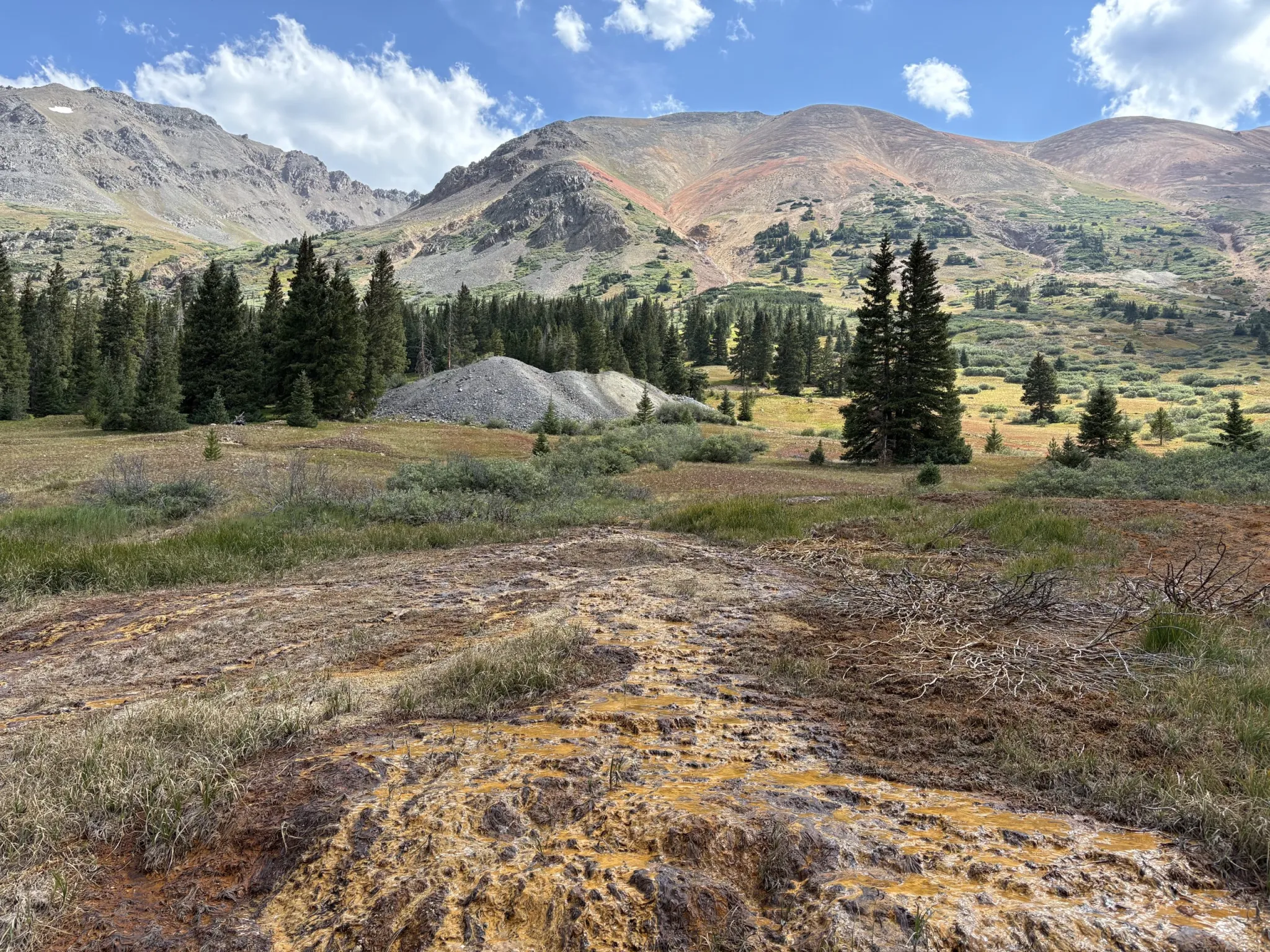
But “reasonably efficient” is not clearly defined. And how much more water ditches should take than what’s needed by crops is also unclear. Determining whether an irrigation practice is reasonable or wasteful is subjective.

Much like the famous Supreme Court test for obscenity, Rein said water commissioners have a good idea of what waste is when they see it. DWR has not done an efficiency analysis on the Crystal ditches, and Rein said he cannot identify a threshold for “reasonable” because every system is different. 

“I don’t know whether it was intentional or not, but it’s important to our administration that it allows for judgment and for evaluation of myriad factors,” Rein said, referring to the subjective nature of the criteria.

The Rockford Ditch has the oldest water rights on the Crystal River. It irrigates some agricultural land as well as the lawns and gardens of the Colorado Rocky Mountain School and the Satank neighborhood of Carbondale. CREDIT: HEATHER SACKETT/ASPEN JOURNALISM

Divert it or lose it?

Another potential explanation for the low use numbers could be that some irrigators are overdiverting based on a misunderstanding of Colorado water law. The true value of a water right is tied to its historical consumptive use, which is how much water the crops use. However, there is an entrenched, incorrect belief that by maximizing the amount of water taken from a stream, one can increase the future value of a water right or protect it from abandonment. Many interpret Colorado’s famous “use it or lose it” doctrine as “divert it or lose it.” 

“The reality of that is sometimes it can feel like you have something on paper and giving up something you have on paper feels like you’re losing something,” said Assistant Pitkin County Attorney Laura Makar. 
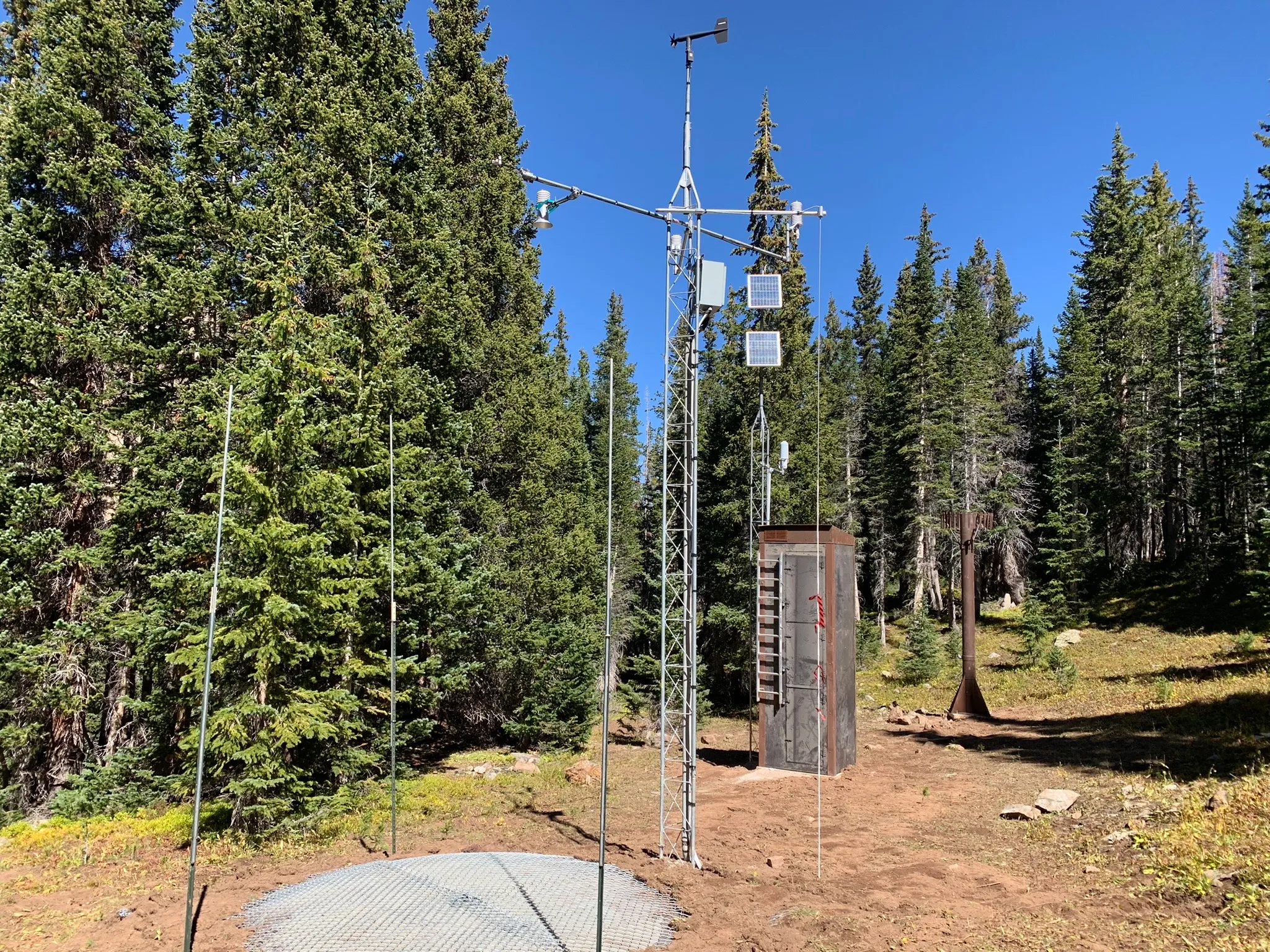
According to a 2016 special report by DWR officials and experts at the Colorado Water Center at Colorado State University, “use it or lose it” is commonly seen as a barrier to implementing water-conservation measures and efficiency improvements.

Users are told to divert their whole amount, “in order to preserve the water right; that is, protect it from abandonment and/or lead to the maximum value of the water right in a water right change proceeding,” the report reads. “This conclusion is based on a misapplication of the law.” 

In reality, there are two requirements for abandonment: A water right must sit dormant and unused for 10 years, and the owner must intend to abandon it. For the past 20 years, DWR has had a policy of not placing water rights that date to before the 1922 Colorado River Compact on the abandonment list, which is compiled every 10 years. This means pre-compact water rights (like many of those in the Crystal analysis) have an additional layer of protection from abandonment, even if they meet the two requirements.

Neubecker said taking more water than you can use violates one of the most sacred concepts at the heart of Colorado water law: the duty of water. The duty of water is the amount needed to grow a crop — not the maximum allowed by a decree — and varies depending on crop type and location.  

“Technically, it is against the law to take more water than you actually need regardless of what your decree says,” Neubecker said. “It’s just that neither the lawyers nor the state engineer’s office are going to enforce it.”

The Bowles & Holland Ditch, named after two of Carbondale’s earliest white European settlers, used to grow crops like potatoes. Now it mostly irrigates the lawns and golf course of River Valley Ranch. CREDIT: HEATHER SACKETT/ASPEN JOURNALISM

Low efficiencies not a problem for state officials

DWR officials don’t have a problem with inefficient ditches as long as irrigators are not wasting water. Rein said that low efficiency doesn’t mean irrigation is being done improperly. 

“I’m not aware that we have evidence of waste occurring on those systems,” Rein said.

There was, however, at least one documented instance of alleged water waste that occurred on the Crystal in recent years. In 2018, former water Commissioner Jake DeWolfe restricted how much water was flowing into the Lowine Ditch for taking more than it could put to beneficial use. Attorneys for one ditch user, Tom Bailey, complained in a letter to DWR, saying that the commissioner’s determination of waste was “ambiguous and erroneous,” and that the guidelines for waste are unlawful, claims that reflect the subjective nature of defining waste. DeWolfe declined to speak with Aspen Journalism for this story.

One of the ways water commissioners determine if waste is occurring is by looking at what is known as the “tail water,” which is where, after irrigating land, the ditch returns the water to the river. In 2018, DeWolfe said the large amount of tail water from the Lowline was an indication of waste. 

The situation on the Crystal in 2018 is indicative of how state officials manage the river. The system is complaint-driven, meaning water commissioners will usually focus their efforts on streams where a water user has placed a call or where they have heard complaints of waste from water users. If a river is not on call, if no one is reporting their neighbors for taking too much or if there are no obvious indicators such as flooding, water commissioners probably won’t scrutinize ditches for waste. In most cases, tail water is not measured.

According to Heath, since 2018, no complaints about waste in the Crystal River basin have been received and waste has not been observed by water commissioners. Therefore, curtailment of structures within the Crystal River basin for waste issues has not occurred since 2018.

Heath said that as long as irrigators aren’t taking extra water to expand their historical irrigated acreage, his office doesn’t have an issue with low ditch efficiencies.

“As long as they continue to operate as they have historically operated, I don’t see that there is a problem with the diversions they are making,” he said. “They are operating their ditches and irrigating as they always have, and it just yields a low system efficiency.” 

This section of the Lower Crystal River dried up during the late summer of 2012, a drought year. The dry stretches occurred again in 2018, 2020 and 2021, with the river hovering at around just 8 cfs. CREDIT: KEN NEUBECKER

When the river is harmed

In Colorado, inefficient or wasteful practices are only considered such if they deprive another senior user of water. 

But what if the other water user being harmed is the river ecosystem itself? There are few ways to ensure that enough water stays in the river for the fish, plants and animals that depend on it.

The stretch of the Crystal River just south of Carbondale near the Colorado Parks and Wildlife fish hatchery has a tendency to dry up during the late irrigation season. The problem is worse in dry years, and the tool meant to address it is limited in what it can accomplish. 

The Colorado Water Conservation Board holds instream flow water rights on the Crystal River, which are intended to preserve the natural environment to a reasonable degree. They date to 1975 and are some of the oldest instream flow rights in the state. Although the Crystal River was here long before any humans inhabited the valley, under the cornerstone of Colorado water law known as prior appropriation — where the oldest rights, which almost always belong to agriculture and cities, get first use of the river — the instream flow rights that protect the river itself might as well have been born yesterday. 

The instream flow right is 100 cfs on the stretch of river between Avalanche Creek and its confluence with the Roaring Fork, but it is rarely met from August to October. The reason?

“It’s the senior uses in the area,” said Rob Viehl, chief of the Colorado Water Conservation Board’s stream and lake protection section. “There are a lot of large senior irrigation ditches right above the fish hatchery gauge that divert a lot of water. They are in priority, and they are legally senior to the instream flow.”

The dry stretch is immediately downstream from the diversion for the Carbondale Ditch, which can pull 42 cfs from the river.

“Carbondale definitely needs to do some ditch-efficiency work,” Neubecker said. “The town of Carbondale is the single-biggest water rights holder on the Crystal.”

Cold Mountain Rancher Bill Fales turns the headgate of the Lowline Ditch. Fales is participating in a non-diversion agreement with the Colorado Water Trust to keep more water in the Crystal River. CREDIT: HEATHER SACKETT/ASPEN JOURNALISM

Possible solutions

Much of western Colorado’s irrigation infrastructure is stuck in the 19th century. Upgrading ditches and headgates — and, in turn, making them more efficient — can be costly. 

Matt Rice, southwest regional director for environmental group American Rivers, said Aspen Journalism’s analysis points to the need to upgrade that infrastructure. And with billions of dollars in federal funding available, now is a good time for these types of projects, he said.

“If you need that much nonconsumptive push water to get your 11 or 7 or 9%, my sense is that there is a lot of opportunity to do things better,” Rice said. “It seems to me that infrastructure modernization on the Crystal could be a key thing to investigate.”

Colorado River environmental groups — including American Rivers, Trout Unlimited, The Nature Conservancy, Pitkin County Healthy Rivers — have funded and worked on agricultural infrastructure improvement projects that claim to have multiple benefits for agriculture, the environment and recreation. The idea is that if a project makes an irrigation system more efficient, less water will need to be diverted from a river. 

But although they may improve riparian habitat or create safer passage for boats, there’s no evidence these projects result in more water left in rivers. Of all the experts Aspen Journalism interviewed for this story, none could point to a ditch infrastructure improvement project that resulted in a measurable decrease in diversions, as reflected in diversion records maintained by DWR. Simply quantifying flow needs specifically for recreation and the environment through stream-management plans has been thwartedin recent years by agricultural interests. 

The town of Carbondale and other groups have recently completed a headgate modernization project on the Weaver Ditch, which supporters say will benefit the environment. But Schorzman, Carbondale’s public works director, said in an email that the project “may or may not impact diversion amounts.”

Environmental groups say they must work with — and not against — agriculture since they are the biggest water-user sector and that building relationships is important. In that spirit, Pitkin County Healthy Rivers has earmarked tens of thousands of dollars (the exact amount the project will cost is still unclear) to fund a piping project for the East Mesa Ditch, which had a blowout from sinkholes in September. Healthy Rivers has not secured a commitment from ditch owners that there will be any benefit to river flows from the piping project, even though part of its mission is to maintain and improve the quantity of water in local streams.

“The question is: How can we stay true to our charter of maintaining streamflow while helping somebody divert water from the river?,” Pitkin County Attorney John Ely said at a September Healthy Rivers meeting. “You simply can’t preserve water in the river at all without someone you can work with and someone who holds a relatively senior water right. … You can’t solve the riddle of how to protect streamflow without working with agriculture.”

An often-heard refrain from water users is that if they leave the water in the river, it will just get picked up by the next downstream user, so they may as well divert it. That is true to a degree. But if all the water users on a system were to become more efficient, they might be able to each take less. 

And a new state law allows water users to get paid to temporarily lease water to the state’s instream flow program for five out of 10 years. The loaned water is tracked by DWR officials so that it stays in the river through the stretch where it’s needed. So far, the program is little-used — just nine projects so far statewide — and no water users on the Crystal are currently doing this type of instream flow loan. 

Crystal River rancher Bill Fales stands at the headgate for the Helms Ditch, with Mount Sopris in the background. As part of an agreement with the Colorado Water Trust, Fales could be paid to reduce his diversions from the ditch when the river is low. CREDIT: HEATHER SACKETT/ASPEN JOURNALISM

Carbondale ranchers Bill Fales and Marj Perry are participating in a slightly different program, a non-diversion agreement with the Colorado Water Trust designed to leave more water in the river. When river flows dwindle to less than 40 cfs, Fales will get paid to reduce his diversions from the Helms Ditch, which could result in an additional 6 cfs in the Crystal.

“Obviously we are like everybody else — we hate to see the river dry,” Fales told Aspen Journalism in 2022.

Colorado’s entrenched water law system protects those European American settlers who first put the water to beneficial use, growing crops and building cities. One hundred and forty years later, that system still reflects the values of the time that the concept of prior appropriation was invented and largely excludes water for the environment, recreation or tribal communities. But as water supplies continue to be squeezed across the Colorado River basin, that may one day change.

“Change is hard,” Makar said. “If we have a system that has been in place and working one way for a long time, it requires new education, new materials. … I think it’s worth it, and I think that the system is eventually going to require it. But that doesn’t mean it’s easy.”

This story was produced in partnership with The Water Desk, an independent initiative of the University of Colorado Boulder’s Center for Environmental Journalism.

Reclamation awards construction contract for Arkansas Valley Conduit treatment facilities: President Biden’s Bipartisan Infrastructure Law supporting major water infrastructure project to provide clean, reliable drinking water to 39 communities in southeastern #Colorado

Arkansas Valley Conduit map via the Southeastern Colorado Water Conservancy District (Chris Woodka) June 2021.

Click the link to read the release on the Reclamation website (Anna Perea and Darryl Asher):

Feb 29, 2024

LOVELAND, Colo. — The Bureau of Reclamation has awarded a contract for the construction of water treatment and connection facilities for the Arkansas Valley Conduit Project to Thalle Construction for $28,710,676. This contract, partially funded by President Biden’s Bipartisan Infrastructure Law, funds construction of a backflow preventor connecting the main trunkline to Pueblo Water’s system, and a treatment facility to address specific water treatment needs for the Project.  

The backflow preventer will be constructed at 36th Lane and U.S. Highway 50, east of Pueblo. The treatment facility will be located along the AVC pipeline route about 4 miles east of 36th Lane. The treatment process will prepare the water for conveyance through the trunkline to Project communities and ensure compatibility of the water with the AVC participants’ water systems.

“We’re extremely pleased to be able to move forward with multiple features of the Arkansas Valley Conduit,” said Jeff Rieker, Eastern Colorado Area Office Manager. “The momentum of making this connection to the eastern end of Pueblo’s water system while downstream pipes are being placed and additional designs are being developed really speaks to the collaborative efforts of all those involved.”

2022 three-party contract between Reclamation, Southeastern Colorado Water Conservancy District Board and the Pueblo Board of Water Works (Pueblo Water), eliminates the need for over 24 miles of pipeline by utilizing Pueblo Water’s existing infrastructure. The water will be either Fryingpan-Arkansas Project water or from participants’ water portfolios, not from Pueblo Water’s resources. 

“This is another important step forward for the Arkansas Valley Conduit, and vital to begin providing high-quality drinking water to the people of the Lower Arkansas Valley. The Southeastern District has tremendous appreciation for the work that Reclamation and our congressional delegation have done to keep this project moving forward,” said Bill Long, President, Southeastern Colorado Water Conservancy District.

In addition to the contract for these facilities, in January, Reclamation awarded a $4.6 million contract to Central Geotechnical Services, LLC to locate and complete subsurface utility engineering surveys for underground utilities along a 34-mile stretch of the Arkansas Valley Conduit. Colorado legislation, SB 18-167, enacted in 2018, set new standards for entities conducting underground excavation.

Arkansas River Basin via The Encyclopedia of Earth

Presentation details Lincoln Creek contamination but solutions unclear: #ClimateChange may be increasing leaching-metals pollution of #LincolnCreek — @AspenJournalism

Grizzly Reservoir was a bright shade of turquoise in September 2022. The man-made alpine lake has high concentrations of metals that are toxic to fish, according to a report from the Environmental Protection Agency. CREDIT: HEATHER SACKETT/ASPEN JOURNALISM

Click the link to read the article on the Aspen Journalism website (Heather Sackett):

February 5, 2024

Presenters at a public meeting Thursday [February 1, 2024] about contamination on Lincoln Creek hosted by agencies that oversee water quality offered a lot of information, but few solutions yet to the problem.

The meeting, held at the Rocky Mountain Institute in Basalt, featured the results of water quality sampling and presentations from a panel of experts from agencies including Environmental Protection Agency, Colorado Parks and Wildlife, U.S. Fish and Wildlife Service, Colorado Department of Public Health and Environment, the U.S. Forest Service, Colorado Division of Reclamation, Mining and Safety, the U.S. Geological Survey, environmental group Trout Unlimited and Pitkin County Environmental Health.

“We have a lot of questions,” said Kurt Dahl, Pitkin County environmental health manager. “Is (the contamination) going to continue to increase? What does it mean for the Roaring Fork? For my office? For human health? … There’s also this question around mitigation. I think we want to get our arms around, is this a possibility? What does this look like? What are the costs? Can we afford it?”

A report released in November by the EPA based on water-quality samples from 2022 found that Lincoln Creek in the four miles between the Ruby Mine and Grizzly Reservoir exceeds state water quality standards for aquatic life for aluminum, cadmium, copper, iron, lead, manganese and zinc. Aluminum and copper concentrations were especially high.

Water quality issues on Lincoln Creek have been a concern for years, with the creek above the reservoir often running a yellowish color, and Grizzly Reservoir often a bright turquoise. In September 2022, Lincoln Creek below the reservoir turned a milky-green color, and white and yellow sediment settled on the streambed, prompting water quality testing in the fall of 2022 and the EPA report. These conditions in 2022 could be seen downstream at the confluence with the Roaring Fork River, sparking concern for local residents and organizations.

And the problem has gotten worse in recent years. The high concentrations of aluminum and copper are toxic to fish, and Lincoln Creek and Grizzly Reservoir experienced a fish die-off in 2021. In fall of 2023, there was a fish kill downstream in the Roaring Fork in the North Star Nature Preserve, which experts say was probably due to a combination of high metals concentrations and too-warm water.

The EPA report also found that the main source of contamination is not drainage from the Ruby Mine, but is naturally occurring from a “mineralized tributary” just downstream from the mine.

During the Q&A portion of the meeting, attendees asked whether the Ruby Mine, where turn-of-the-20th-century prospectors dug for gold and silver, could really be the source of contamination. Mindi May, water quality program director with CPW, said she initially shared the audience’s skepticism that the mine wasn’t the main source of contamination, but after visiting the site she agrees with geologists’ findings that it’s naturally occurring.

“You could just see the water from the mineralized trib just seeping out of the ground,” she said. “So at this point I am convinced … that the mineralized trib and the Ruby are separate and that the mineralized trib is natural and that it really is the problem.”

The fact that the contamination of the creek is naturally occurring creates a question about who’s responsible for cleaning it up. The EPA is authorized to address elevated metals concentrations only from human-caused sources, not contamination from natural sources.

Primarily an ecological problem

Panelists addressed the potential human health impacts from the contaminated water in the creek and at Grizzly Reservoir, a popular spot for summer camping, hiking and fishing. The U.S. Forest Service manages the seven-site Portal Campground near the reservoir.

Mike Carney, a toxicologist with U.S. Fish and Wildlife Service, said his agency is primarily concerned with arsenic and lead, which have health risks but aren’t the main contaminants in Lincoln Creek. He said there’s not much risk associated with someone’s skin coming into contact with the copper and aluminum-laden water. As for drinking the water, backpacking filters are unlikely to filter out all the contamination and gastrointestinal distress could result. But would-be guzzlers of the orange-tinted water would probably be turned off by the taste.

“At those concentrations, that water would likely not be palatable because it would taste very bad,” Carney said. “This is primarily an ecological problem here.”

Carney said they did not find worrisome concentrations of metals accumulating in the tissue of fish sampled from Grizzly Reservoir. CPW restocks the fish every summer so they may not spend enough time living in the reservoir to build up metals concentrations before they die or are caught and eaten by anglers.

Twin Lakes collection system

Lincoln Creek feeds into the Twin Lakes Reservoir and Canal Company’s transmountain diversion system, in which Grizzly Reservoir is used as a collection pool before sending water through the Twin Lakes Tunnel to the Arkansas River basin, where it is used primarily in Front Range cities, including for drinking water. Colorado Springs Utilities owns the majority of the water in the Twin Lakes system.

The November EPA report said the substantial mixing, the distance that the water travels to the Front Range and the water-treatment process limit the impacts to Colorado Springs’ drinking water.

Twin Lakes is planning to drain Grizzly Reservoir this summer so it can do a rehabilitation project, including installing a membrane over the steel face of the dam, replacing the gates that control the flow of water into the Twin Lakes Tunnel and repairing the outlet works that release water down Lincoln Creek.

Repairs to fix damage after a log got caught in the outlet works in 2015 resulted in the release of a slug of contaminated water and sediment from the reservoir that quickly boosted flows in the Roaring Fork near Aspen and turned it yellow, alarming residents. Twin Lakes board president Alan Ward said that wouldn’t happen with this summer’s planned draw-down.

“The company was very embarrassed by that, we do not want that to happen again,” he said. “We talked with our contractor about a drawdown plan and we need to make sure that as we get to those sediments, that we’re moving slowly and have a lot of sediment control in place so that we’re not putting that in the creek.”

Lincoln Creek is one of several drainages that flow into Grizzly Reservoir, a collection pool for Twin Lakes Reservoir and Canal Company. Drainage from defunct upstream mines may be partly responsible for the water’s yellow color. Photo credit: Heather Sackett/Aspen Journalism

Leaching metals and climate change

When water and oxygen come into contact with pyrite-rich rock, it reacts to form sulfuric acid and causes the leaching of metals from the rock. One take-away from Thursday’s presentations is that this type of metals contamination of Colorado waterways is increasing with climate change.

Thomas Chapin, a research chemist with USGS, said drought and climate change have reduced the volume of streamflows, meaning metals concentrations will be higher even if the overall amount of metal leaching stays the same. But melting ice and ground that was once frozen also allow water and oxygen to come into contact with rock that used to be inaccessible to the leaching process.

Prior to mining, snowmelt and rain seep into natural cracks and fractures, eventually emerging as a freshwater spring (usually). Graphic credit: Jonathan Thompson

“The combination of the decrease in flow coming down, so less dilution, and the lowering of the water table and exposing more material to acid rock drainage, it’s a double whammy,” Chapin said.

Pitkin County isn’t the only place in Colorado where increasing metals concentrations is negatively impacting water quality. Chapin said a recent study looking at the Snake River, a tributary of the Blue River in Summit County, found a 100% to 400% increase in the amount of zinc concentrations over 30 years.

“We saw similar data with Lincoln Creek,” he said. “Those September values have gone up quite a bit.”

The recently released Climate Change in Colorado report found that temperatures have warmed more in fall than other seasons.

Dahl wrapped up the meeting, which ran 30 minutes past its scheduled time of 6 to 7:30 p.m., by saying that local water quality experts are talking about next steps and plan to hold another public meeting this spring.

“We recognize that there was a lot of information here without a lot of opportunity to ask questions,” he said. “We’ve already agreed that we need to have another public meeting.”

This story ran in the Feb. 3 edition of The Aspen Times.

Map of the Roaring Fork River drainage basin in western Colorado, USA. Made using USGS data. By Shannon1 – Own work, CC BY-SA 4.0, https://commons.wikimedia.org/w/index.php?curid=69290878

Pitkin County exploring concern that Shoshone deal could harm #RoaringForkRiver: Upper Fork ‘lives and dies’ on the Cameo call — @AspenJournalism #ColoradoRiver #COriver #aridification

The Shoshone hydropower plant in Glenwood Canyon has one of the oldest non-consumptive water rights on the main stem of the Colorado River and that right is in the process of being acquired by the Colorado River Water Conservation District. Pitkin County is exploring potential impacts the deal might create for the upper Roaring Fork River. CREDIT: BRENT GARDNER-SMITH/ASPEN JOURNALISM

Click the link to read the article on the Aspen Journalism website (Heather Sackett):

February 21, 2024

An historic deal to put a senior water right in the hands of the Colorado River Water Conservation District has been celebrated as a victory for the Western Slope. But Pitkin County officials say there’s a chance it could harm the upper Roaring Fork River.

Map of the Roaring Fork River drainage basin in western Colorado, USA. Made using USGS data. By Shannon1 – Own work, CC BY-SA 4.0, https://commons.wikimedia.org/w/index.php?curid=69290878

In December, the Glenwood Springs-based River District signed a deal with Xcel Energy to buy water rights associated with the Shoshone hydropower plant in Glenwood Canyon for $98.5 million. As some of the biggest and oldest non-consumptive water rights on the mainstem of the Colorado River, they ensure water keeps flowing west to the benefit of downstream users because the water runs through Shoshone’s power-generating turbines and then returns to the river.

Pitkin County’s concerns have to do with the complex interaction of the Shoshone water rights with another set of big downstream water rights known as Cameo, which are made up of Grand Valley irrigation water rights. These two senior water rights have the ability to command the flow of the Colorado River and force Front Range cities that send water from the Colorado’s headwaters across the Continental Divide to shut their diversions off.

Under Colorado’s cornerstone of water law, known as prior appropriation, oldest rights get first use of the water. When a senior water right isn’t receiving its full amount, it can place a “call.” When Shoshone, which dates to 1902, places a call, transmountain diverters like Denver Water and Northern Water have to shut off. When Cameo places a call, the Twin Lakes Reservoir and Canal Co., which takes water from the top of the Roaring Fork basin to Colorado Springs, Pueblo and Aurora, has to shut off because its 1930s water rights are junior to Cameo’s 1912 water rights.

About 600 cfs of water from the Roaring Fork River basin flowing out of the east end of the Twin Lakes Independence Pass Tunnel on June 7, 2017. Photo: Brent Gardner-Smith/Aspen Journalism

Pitkin County’s concern is that with Shoshone under new ownership — and the proposed addition of an instream flow use for the water along with hydropower — the call for the water through Glenwood Canyon could be on more often, which might delay or reduce the need for the Cameo call. Aspenites like to see the Cameo call come on because it forces the Twin Lakes diversion to shut off, which means more water flowing down the Roaring Fork, typically during a time of year in late summer and early fall when streamflows are running low and river health is suffering.

“The upper Roaring Fork lives and dies on the Cameo call because that’s what curtails Twin Lakes,” Pitkin County Attorney John Ely, who sits on the River District’s board, said in an interview with Aspen Journalism. “If the Cameo call is changed through administration of the river because there is a change in the flow going to satisfy Shoshone, then that could delay Cameo, which would prolong the operation at Twin Lakes and deplete the upper Fork.”

Pitkin County in November hired Golden-based engineering firm Martin and Wood Water Consultants to do a technical analysis and modeling of the Colorado and Roaring Fork rivers. They bill in monthly installments and have charged Pitkin County $6,600 so far, according to Ely; the firm is expected to produce a report after they finish studying the issue, although Ely did not say when that would be.

Graphic credit: Laurine Lassalle/Aspen Journalism

Health of Roaring Fork dependent on Cameo

The River District has said the goal of owning the Shoshone right is to preserve the status quo and keep water flowing west the same way it always has. Xcel representatives have said they intend to keep operating the plant for hydropower, but the facility is old, frequently offline for repairs and located in a treacherous area of Glenwood Canyon.

Ely isn’t so sure that nothing would change. If the Colorado Water Conservation Board (CWCB) was to place a Shoshone instream flow call, it could alter the way the system has historically operated, he said. The CWCB is the only entity allowed to hold an instream flow water right, which is intended to preserve the natural environment to a reasonable degree.

“If it wasn’t going to change the administration of the river, why would anyone pay $98 million for it? … The potential for injury (to the Roaring Fork) is most definitely there,” he said.

River District General Counsel Peter Fleming said the organization is working with Pitkin County to look into the issue.

“The question has arisen and we’re working in good faith with the county to identify and resolve any concerns,” he said. “We’re going to determine whether there is an actual issue that we can accommodate.”

The Cameo call comes on most years in late summer. But it occurs for more days in dry years than wet ones. According to a database maintained by the Colorado Division of Water Resources, in 2019 and 2023 — both years with above-average snowpack and runoff — the Cameo call was on for 22 and 24 days, respectively. In 2020 and 2021 — two back-to-back below-average years — Cameo called for 88 and 75 days, respectively.

The health of the upper Roaring Fork may be more dependent on the Cameo call in drought years.

Wendy Huber is board chair of Pitkin County Healthy Rivers, a taxpayer-funded organization focused on maintaining and improving water quality and quantity in the Roaring Fork watershed that doles out grants and advises the board of county commissioners. She said Healthy Rivers needs more information from engineers about the impacts from any changes to Shoshone on the Cameo call.

“The Cameo call may allow more water to remain in the Roaring Fork to satisfy the call,” Huber said. “We need to understand the potential impact on quantity of water in our Roaring Fork Valley rivers, especially the Roaring Fork and Crystal rivers.”

Ely said he is optimistic Pitkin County will reach a resolution with the River District, at which point the county would be in a position to support the Shoshone permanency campaign. The River District has committed $20 million from its own pocket, and so far has secured $20 million in funding from the CWCB and $2 million from Grand Valley domestic water provider Ute Water Conservancy District toward purchasing the Shoshone rights. It is in the process of seeking funding from other entities in its 15-county district.

“Water is just simply too scarce a resource to not be mindful that you must protect your interests,” Ely said. “We’re not looking to get in the way of Eagle and Garfield and Mesa counties protecting themselves, but we don’t want to sacrifice our river for them to be able to do so.”

This story ran in the Feb. 22 edition of the Glenwood Springs Post-Independent.

Map of the Colorado River drainage basin, created using USGS data. By Shannon1 Creative Commons Attribution-Share Alike 4.0

Puckett Land Co. drops bid for Thompson Creek reservoir water rights — @AspenJournalism #CrystalRiver #RoaringForkRiver #ColoradoRiver #COriver #aridification

This photo shows the Thompson Creek drainage on the right as it flows into the Crystal River just south of Carbondale. A company with oil shale interests has voluntarily abandoned its conditional water rights for a reservoir on Thompson Creek. CREDIT: ECOFLIGHT

Click the link to read the article on the Aspen Journalism website (Heather Sackett):

January 29, 2024

A company with ties to oil shale development in western Colorado has dropped its attempt to maintain water rights for a proposed reservoir on Thompson Creek.

Puckett Land Co. on Jan. 26 filed a motion to dismiss its diligence application for conditional water rights that date to 1966 and are associated with the construction of a 23,983-acre-foot reservoir on Thompson Creek, a tributary of the Crystal River just south of Carbondale. Later that day, a water court judge signed off on the motion, meaning the water rights have now been abandoned.

The Greenwood Village-based company holds interests in 17,500 acres of land in Garfield and Rio Blanco counties, according to its water court filing. Attorney for Puckett Megan Christensen said the decision to voluntarily cancel these water rights was for business purposes. In its November filing, known as a diligence application, Puckett had said that current economic conditions are adverse to oil shale production.

“Puckett has a portfolio of water rights and in looking at them, they made the decision that this one wasn’t worth maintaining anymore, so they decided to just go ahead and dismiss it,” Christensen said in an interview with Aspen Journalism.

The proposed reservoir site had been on BLM land in Pitkin County within the boundaries of an area that the U.S. Forest Service and BLM are proposing to withdraw from eligibility for new oil and gas leases. The proposed Thompson Divide withdrawal area is comprised of 224,713-acres in Garfield, Gunnison and Pitkin counties that generally straddles the ridge of mountains running from south of Glenwood Springs to the northern edge of the West Elk Wilderness, south of McClure Pass.

Carbondale conservation group Wilderness Workshop supports the withdrawal area and celebrated Puckett dropping the water rights as a win for the Crystal River.

“This is great news for the Thompson Divide, the Crystal River, and our local ecosystem and communities,” Will Roush, executive director of Wilderness Workshop, said in a prepared statement. “Puckett’s intention to cancel their conditional water rights demonstrates just how speculative conditional water rights associated with oil shale development are. Other holders of similar rights ought to follow Puckett’s lead.”

Proposed Thompson Creek reservoir

Map: Laurine Lassalle – Aspen JournalismSource: BLM, Pitkin CountyCreated with Datawrapper

Conditional water rights

Puckett is among the companies with an interest in western Colorado oil shale development, who have water rights dating to the 1950s and ‘60s, which were amassed in anticipation of a boom. A report produced by conservation group Western Resource Advocates in 2009 found that there were conditional water rights associated with oil shale development for 27 reservoirs with 736,770 acre-feet of water in the mainstem of the Colorado River basin.

Companies have been able to hang onto these conditional water rights in some cases for over 50 years without using them because Colorado water law allows a would-be water user to reserve their place in the priority system based on when they applied for the right — not when they put water to use — while they work toward developing the water. Under the cornerstone of water law known as prior appropriation, older waters rights get first use of the river.

To maintain a conditional right, an applicant must every six years file what’s known as a diligence application with the water court, proving that they still have a need for the water, that they have taken substantial steps toward putting the water to use and that they “can and will” eventually use the water. They must essentially prove they are not speculating and hoarding water rights they won’t soon use.

But the bar for proving diligence is low. Judges are hesitant to abandon these conditional water rights, even if they have been languishing without being used for decades.

Before Puckett dropped its diligence application, John Cyran, senior staff attorney for Western Resource Advocates’ Healthy Rivers Program, said holding onto conditional rights like these raised speculation concerns.

“The water is being held without a plan to use it, which violates a central tenet in western water law,” Cyran said in an email. “Water shortages are affecting Colorado’s communities, fish and wildlife. We cannot afford to let companies profit off these shortages by holding onto unused conditional water rights.”

Crystal River Ranch was the only entity to file a statement of opposition to Puckett’s application. The deadline to file a statement of opposition is Jan. 31.

Crystal River Ranch also expressed concern that the over-50-year-old water rights had never been used and said that over the five decades Puckett had not shown it would develop them.

“During that period, the applicant has failed to obtain the necessary federal, state and local permits required to develop this reservoir,” the statement of opposition reads. “Therefore, this subject conditional water right must be canceled and abandoned.”

The Thompson Creek water rights had been part of a proposed “integrated system” that includes conditional water rights for two proposed small reservoirs, and a pump and pipeline on Starkey Gulch, a tributary of Parachute Creek. The application did not specifically mention work regarding the Thompson Creek reservoir site in its list of diligence activities and Puckett had said that diligence on any part of the system constitutes diligence with respect to the entire system. It is unclear how the Thompson Creek reservoir would have operated with these other parts of the system, but Christensen alluded to the reservoir being conceived of as additional back-up supply.

Christensen said the water rights applications for the Starkey Gulch components are still going forward because those water rights are closer to Puckett’s landholdings. These diligence applications were filed on Nov. 30 and so far no entities have filed statements of opposition.

Map of oil shale and tar sands in Colorado, Utah and Wyoming — via the BLM

Excellent water quality starts with water in the stream — #Colorado Water Trust #BoulderCreek #CrystalRiver

North Fork of the Gunnison River. Photo credit: Colorado Water Trust

Click the link to read the article on the Colorado Water Trust website (Sarah Klahn):

It is a bitterly cold December morning and I am tooling up Boulder Canyon to do some backcountry skiing above Nederland. As I slow down for a hairpin turn, the sun makes its way over the edge of the canyon and I notice some movement in the creek. It’s a little bird known as a Dipper, bobbing up and down on a rock in the creek—and now diving into a pool below a fallen tree. These incredible birds live year-round near flowing streams in the Rocky Mountains and elsewhere in the west. They dive underwater for their food—aquatic insects—and actually have an extra eyelid so they can see while they’re underwater! Dipper populations on a stream mean it has excellent water quality and low silt load—both characteristics of Boulder Creek in Boulder Canyon above the City of Boulder.

Excellent water quality for Dippers and other species that live in or around aquatic ecosystem starts—of course—with water in the stream. In Colorado, water use is controlled under the state’s “prior appropriation system”, which forms the legal framework for water distribution in the state. You may have heard the phrase “first in time is first in right” which simply means the more “senior” rights to use a quantity of water are associated with the earliest uses. In many parts of the state (for example the Cache La Poudre River near Fort Collins or the Rio Grande and its tributaries near Alamosa), many irrigation water rights pre-date statehood. And, while the act of putting water to use forms the basis of a water right, that right is only enforceable if confirmed by a district court or, since 1969, Colorado’s water courts.

The habitat of the American Dipper (Cinclus americana) is usually clear, rushing, boulder-strewn, mountain streams, within tall conifer forests. Photo via http://birdingisfun.com

In many, if not most streams in the state, the amount of water decreed far exceeds available water supplies. Such streams are “over-appropriated”, meaning that only in a very wet year will many of the more recent (“junior”) water rights get to divert water.  In fact, Boulder Creek is over-appropriated at locations downstream of the City of Boulder. The Dippers are still safe in the canyon, where there are few actual diversions of water for consumptive use.

“Over-appropriated” as a concept gets a bad rap. At the time of European settlement, those turning the prairie and mountain valleys into farms and cities were focused on building new homes in an unfamiliar place. Whether we agree with these decisions today, at the time, claiming every drop of available water was an obvious start to settling in a place as arid as Colorado. But Colorado’s prior appropriation system also has flexibility that allows volumes of water to be assigned to “instream flow” uses—providing a means to leave water in the stream to benefit aquatic ecosystems, including our friend the Dipper.

The Colorado Water Trust is on the forefront of creative and thoughtful efforts to use flexibility in state water law to put water back into streams. The Trust works to identify both streams in need of additional flows and water rights owners who want to re-imagine the use of their consumptive water rights to improve stream health in their own neighborhood. Broadly, these tools fall into two categories: leases or loans, which are used by the Trust and water right owners who want to maintain ownership of their water rights; and purchase of water rights from owners who are interested in selling to the Colorado Water Trust.

An image of the Crystal River Valley from an EcoFlight mission in August 2022. The view is downvalley, toward Mount Sopris. A group is exploring a federal designation of wild and scenic for the Crystal River in Gunnison and Pitkin counties. Courtesy of Ecoflight

On the Crystal River, a tributary of the Colorado River, the Water Trust and Cold Mountain Ranch, a water user diverting from a critical reach of the Crystal River, entered into an agreement that compensates the Ranch for coordinating diversions in a manner that enhances stream flows. The result is two-fold: the Ranch coordinates its diversions during certain types of water years to benefit the stream flow, but maintains ownership of its valuable, senior irrigation rights for use when water is more plentiful; and the stream benefits in years in which the river reach would otherwise be dry.

The Trust has also, from time to time, purchased portions of water rights, including an interest in the McKinley Ditch which diverts from the Little Cimarron River near Gunnison. Historically, three miles of the Little Cimarron River near Gunnison ran dry during late summer, due to upstream water diversions. Working with the Trust’s frequent partner, the Colorado Water Conservation Board, the Trust obtained a change decree from the Division 4 Water Court. The change decree authorizes the Trust’s water, which would otherwise be limited to irrigation uses, to be left in the stream for the benefit of the aquatic ecosystem.

Sarah Klahn, Board Member, Colorado Water Trust, Shareholder, Somach Simmons & Dunn. Credit: Colorado Water Trust

The Dippers in Boulder Canyon are in good shape, given the water quality and flow regime in Boulder Creek below Barker Dam; any resident Dippers in the Cimarron or Crystal watersheds in the vicinity of the Water Trust’s projects are in better shape than they were before the Trust’s projects were initiated. And for other streams in Colorado that may experience extreme low flows (or dry up completely) during certain types of water years, the Water Trust is actively looking for opportunities to partner with senior water right owners and use available tools provided by the prior appropriation system to enhance stream flows and enhance and protect aquatic ecosystems.

Sarah Klahn is a member of the Water Trust Board of Directors and a shareholder in Somach Simmons & Dunn. Sarah represents farmers and ranchers, as well as institutional clients, on water rights matters in four western states.