Wastewater news

A picture named sewerusa.jpg

From the Lone Tree Voice: “Using accumulated capital improvement reserve funds, the Southgate Sanitation District has been aggressively pursuing a series of sewer improvements to deal with system capacity needs, pipeline deterioration and adverse hydraulic issues. Work is under way at the Furniture Row project element in the city of Lone Tree, north of Park Meadows Drive and west of South Yosemite. The old sewer was showing significant pipe deterioration. It is expected that the work will be completed in the latter part of April.”

From KOAA.com (David Tauchen):

Colorado Springs Utilities is replacing a massive pipeline–one of the biggest in the entire system–on the south end of Colorado Springs. The pipeline is roughly 66 inches in diameter, made of concrete, and carries as much as 10 million gallons of waste water each day. It was installed off 85-87 and Las Vegas in 1973 and Colorado Springs Utilities believes it is nearing the end of its life span… “Any amount [of waste water] that would escape from a pipe like this..could be catastrophic,” said [spokesperson Steve Berry]. Springs Utilities says nothing has leaked from the pipe yet. However, to be safe they are replacing roughly 3,000 feet of it at a cost of about $3 million.

Trinidad Lake: Invasive mussel inspections

A picture named trinidadlake.jpg

From the Pueblo Chieftain (Anthony A. Mestas):

The inspections, which were also given last year, will be between 7 a.m. and 7 p.m., seven days a week. Russ Pallone, park manager, said that all boats will be inspected at the boat ramp before launch and when coming off the lake. Colored seals will be attached to boats leaving the lake to simplify the inspection process upon return. “We are pretty much in line with the rest of the state as far as zebra mussel inspections. It’s a priority for us to try and stop the spread of zebra mussels into Trinidad Lake,” Pallone said.

In other invasive mussel news live critters were found on a boat that sought to launch on Lake Pueblo this week, according to a report from Chris Woodka writing for the Pueblo Chieftain. From the article:

“The boat was being brought in from Missouri and had been on the Mississippi River,” said Brad Henley, assistant ranger at Lake Pueblo State Park. The operator of the South Marina, where the owner plans to launch the craft, reported the boat to State Parks. The boat was being serviced at a Pueblo West boat shop, where inspectors found the mussels. It will be decontaminated with hot water at a State Parks boat wash near the lake…

Henley credited the state’s ongoing education program, initiated last year after zebra and quagga mussel larvae were found in Lake Pueblo, for the awareness of the need to control mussels.

More Coyote Gulch coverage here.

Southern Delivery System: Pueblo West outlines objections to joining Pueblo flow program

A picture named sdspreferredalternative.jpg

Here’s an update on Pueblo West’s reasoning behind their lawsuit against being required to join the Pueblo flow program as a condition of connecting to Colorado Springs Utilities’ proposed Southern Delivery System, from Chris Woodka writing for the Pueblo Chieftain. From the article:

Pueblo County, under its 1041 land-use regulations, is requiring all SDS participants – Colorado Springs, Fountain, Security and Pueblo West – to participate in the flow program set up under 2004 intergovernmental agreements. Colorado Springs and Fountain already participate.

Pueblo West claims it would lose a minimum of $5.3 million in the value of its water if it participates in the flow program, according to a lawsuit filed in district court by attorneys Tom Mullans and Robert Krassa. The estimate is based on an annual average of 531 acre-feet, about 6 percent of the annual water supply for the metro district. The suit claims, among other things, that this amounts to a taking of private property. The suit also acknowledges that Pueblo West stands to gain $3 million to $7 million by its participation in SDS because it would be able to connect to the SDS pipeline for $1 million rather than build a river intake that could cost up to $8 million. “This cost savings is Pueblo West’s sole benefit from participation in SDS,” the lawsuit states. The metro district attorneys claim the condition of participation in the flow program was not brought up until late in the 1041 process, and that Pueblo West never committed to joining the flow program…

While the county cannot directly enforce the flow program, it can hold participants to a portion of the IGA that requires their support for actions that prevent others from exchanging water against forgone exchanges, [Ray Petros, special counsel for Pueblo County] said.

Pueblo West argues that its Wild Horse Dry Creek exchange occurs above the area covered in the city of Pueblo’s recreational in-channel diversion decree and that its exchange decree from Lake Meredith existed long before the Pueblo flow program. Additionally, Pueblo West signed over the authority to negotiate all permits to Colorado Springs Utilities in a 2007 agreement, Petros said.

More coverage from Mike Spence writing for the Pueblo West View:

The SDS is a 50-mile pipeline that would take water from the north side of Pueblo Dam and pump it north to serve Colorado Springs, Fountain, Widefield and Security. Pueblo West officials had hoped to get a “T” off the pipeline as it comes through Pueblo County. That access would increase Pueblo West’s daily water capacity from 12 million gallons to 30 million gallons, assuring the community adequate water when it reached build-out. It also would give Pueblo West a second access to its water in the reservoir. But the county requirement, made as part of its 1041 permit process, would force Pueblo West to give up a portion of that water. The Flow Manage Program is part of an intergovernmental agreement signed in 2004 by Pueblo, the Pueblo Board of Water Works, Colorado Springs, Aurora, Fountain and the Southeastern Colorado Water Conservancy District. Pueblo West was not part of the IGA, nor the negotiations on flow management program – and was not a signee to the pact.

At issue is the amount of water Pueblo West would have to contribute to the Flow Management Program. Pueblo officials estimate Pueblo West’s contribution would be about 92 acre feet of water annually. Pueblo West disputes that, saying the loss could be anywhere from 1,400 to 3,200 acre feet of water annually. Colorado Springs Utilities asked MWH Engineering to model Pueblo West’s participation in the flow management program. MWH Engineering came back with an estimate of at least 649 acre feet on average would be lost under the most ideal conditions. “We think that estimate is conservative,” said Steve Harrison, Pueblo West’s director of utilities, noting that it was based on a flow rate of 100 cubic feet per second in the river’s upper gauge and did not include the loss of further re-use. Using a multiplier of 1.8 to factor in that re-usage, the amount of lost water is approximately 1,200 acre feet of water, according to Harrison. Yet, even using the Colorado Springs estimate, which is more than seven times greater than the estimate made by Pueblo officials, the cost to Pueblo West to replace the water would be millions. “Considering a conservative $11,000 per acre foot for water such as Bessemer Ditch, this would be equal to $7.139 million for replacement water,” according to a report Harrison gave to the board of directors…

If Pueblo West were to attempt to replace that water with shares from Twin Lakes, the cost would be much higher – more than double. The last time Pueblo West purchased water shares from Twin Lakes they cost $26,000 per acre foot. That cost would likely be higher now, if the shares were available at all.

Despite the lawsuit, Pueblo West officials said they still are open to a compromise. “We would be willing to be good partners and contribute some of our water to help the kayak course,” said Pueblo West metro board Chairman Stan Hren. “But not the amount the county is calling for.”

Hren said the amount of water Pueblo West is being asked to contribute to the Flow Management Program is disproportionate to the amount of water it is receiving. “What does Colorado Springs contribute to the Flow Management Program, 1,500 acre feet?” Hren asked. “Colorado Springs has 300,000 acre feet of water, that’s less than one half of one percent of their total water. If you used that percentage for Pueblo West, it would be about 50 acre feet of water a year.”[…]

[Steve] Harrison, director of utilities for Pueblo West, said the district takes water from a pipeline at the dam and releases it from a sewage treatment plant on the eastern edge of Pueblo West. The water then flows down Wild Horse Dry Creek to the Arkansas River, giving Pueblo West the right to take a similar amount again from Lake Pueblo. Pueblo West is allowed to reuse the water because it comes from Twin Lakes, which is non-native to the Arkansas basin. Now, though, the county wants some of Pueblo West’s water to flow from the dam through the city of Pueblo, which has not been done in the past…

…the bottom line is that Pueblo West would lose water, perhaps a significant amount of water to the Flow Management Program. Mullans said it would be expensive to replace that lost water, and later may not be possible at all. There are far more water users in the Arkansas Valley that there is water, he said. “It was not easy to build up this portfolio of water rights,” he said. “And we need more.”

One Pueblo West resident wondered why Pueblo West doesn’t walk away from the SDS project and built a reservoir access of its own. The cost of building a pump station would be about $8 million, compared to the cost of $1 million for the “T” off the SDS pipeline, plus about $250,000 as part of Pueblo West’s share of the SDS project. Another reason, Mullans pointed out, was that even if Pueblo West withdrew from the SDS and sought to build its own pump station from the reservoir, the county would again step in with its 1041 permit process and demand that Pueblo West participate in the flow management program. The county’s 1041 process applies to all water or wastewater pipes 12 inches in diameter or bigger.

More coverage from Chris Woodka writing for the Pueblo Chieftain:

Pueblo County is not in a position to allow Pueblo West an exemption from the Pueblo County flow management program, its water attorney said Wednesday. The reason is not that the county has any power to enforce the flow program, but because the conditions of past intergovernmental agreements require that all participants in Southern Delivery System adhere to the program, said Ray Petros, special counsel for the county…

“The county permitting process is a way of promoting universal application of the flow program. It would be unconscionable for one member not to participate,” Petros said. The March 2004 IGA among Pueblo, the Pueblo Board of Water Works and Colorado Springs has a provision that requires all parties to prevent others from exchanging against flows that are a result of curtailment of exchanges. “The 2004 agreement says that if the forgone flows are exchanged upon, then it’s King’s X for everyone,” Petros explained. The same provisions are referenced in the May 2004 IGA that brought Aurora, Fountain and the Southeastern Colorado Water Conservancy District into the flow program.

A provision of legislation for the Preferred Storage Options Plan, which included Pueblo West, and the Upper Arkansas and Lower Arkansas Valley Water conservancy districts until negotiations were suspended in late 2007, required year-round target flows of 100 cubic feet per second for the Arkansas River below Pueblo Dam. Aurora and the Lower Ark, along with most of the other PSOP partners, are supporting similar federal legislation.

Finally, Pueblo West agreed, in its 2007 IGA with Colorado Springs for SDS to support Colorado Springs Utilities as its bargaining agent for all permits required to build SDS.

In addition, Colorado Springs listed the Pueblo flow program as one of the benefits for Pueblo County in information that was distributed at meetings it sponsored in advance of Pueblo County 1041 hearings – including two in Pueblo West. “Pueblo West should have known of the contractual agreements that had been made,” Petros said. “Pueblo West does not have a case against Pueblo County. The remedy would be is not to go forward with SDS.”

Pueblo West stands to lose much more if it pulls out of SDS, Petros said. The largest loss would be a 10,000 acre-foot storage contract with the Bureau of Reclamation in Pueblo Reservoir, which is part of the SDS package, if the pipeline for the project comes from Pueblo Dam.

More Coyote Gulch coverage here and here.

Flaming Gorge pipeline: Pueblo scoping session

A picture named flaminggorgepipelinemillion.jpg

Here’s a recap of the U.S. Army Corps of Engineers’ scoping session for the Regional Watershed Supply Project held on Wednesday night in Pueblo, from Chris Woodka writing for the Pueblo Chieftain. From the article:

About 30 people attended. What makes the project different is that no specific end users, other than Lake Hattie Reservoir in southern Wyoming, have been identified. There were questions raised at a Denver meeting earlier in the week about whether the project satisfied Colorado water law that prohibits speculative ventures. Brand explained that the Corps expects the project to change over the next five years while it is being evaluated and that end users would have to surface before it could be permitted.

Concerns expressed Wednesday focused on how water from the project would reach the Arkansas River, what the water quality impacts would be, how it could affect Fountain Creek and how the project would fit in with the Southern Delivery System and Colorado Springs water supply. “Personally, I’m concerned about the dry-up of agriculture in our state and the environmental impacts of more diversions from areas like Grand County,” Million told the group in explaining why he wants to develop the project. “This project will bring in a fresh, reliable supply of good water and alleviate the pressure on the high mountain range watersheds.”[…]

Some questioned whether agriculture could afford the water, but Million said he intends to price water at market value for both municipal and agricultural use, while providing some for environmental purposes as well…

Water would be stored in Lake Hattie, 69,000 acre-feet; a new reservoir northeast of Fort Collins, called Cactus Hill Reservoir, 185,000 acre-feet; and a new reservoir on Upper Williams Creek, 25,000 acre-feet. The Upper Williams Creek site is the same one chosen for terminal storage in the Southern Delivery System, a pipeline proposed by Colorado Springs. Colorado Springs Utilities staffer Keith Riley attended Wednesday’s meeting and spoke briefly with Million about the possibility of enlarging the size of the Upper Williams Creek reservoir to accommodate both projects. No decisions were made, however. The Corps must also approve Colorado Springs’ reservoir site. The site is on property now owned by Bob Norris.

Another storage possibility was suggested by Gary Barber, of the El Paso County Water Authority and Pikes Peak Regional Water Authority. He suggested groundwater recharge reservoirs in designated groundwater basins like Upper Black Squirrel Creek. There are several others located in the South Platte River basin. The state is studying how they could be used to store water. The underground storage opportunities all lie fairly close to the pipeline’s proposed route and could even be used to bank water for Wyoming until it’s needed in that state, Barber said.

Meanwhile, the Uinta County (Wyoming) commissioners are considering opposition to the Regional Watershed Supply Project, according to a report from the Uinta County Herald. From the article:

“Ecologically this is going to affect us a lot,” [chairman Mick Powers] said. Powers said he attended a meeting at Green River High School on April 14 where officials outlined a plan to pipe water from Flaming Gorge and Green River for use in Colorado, more than 500 miles away. “This will have a huge impact. There is nothing to gain for anyone in this part of the country. It’s bad for all of us,” Powers added…

Powers said Tuesday that he believes the county needs to go on record and oppose the pipeline as strongly as possible.
He said he would draft a letter for the other commissioners to approve to be sent to the Corp of Engineers.

More Coyote Gulch coverage here and here.

Lower Arkansas Valley Water Conservancy District: John Singletary resigns from board

A picture named lowerarkansasriver.jpg

From the Pueblo Chieftain (Chris Woodka):

John Singletary, 64, turned in his resignation last week. “The main reason is that the board is moving in a direction that I cannot comfortably support,” Singletary said Thursday. The district will advertise for a replacement, who will be appointed by Pueblo District Judge Dennis Maes.

Singletary, who helped circulate the petitions to form the district in 2002, said he was torn by the decision. He praised the current board members and staff of the district and said the Lower Ark has accomplished many good things while he served on the board. But the board’s approval in March of a settlement agreement with Aurora in the 2007 court case against the Bureau of Reclamation for issuing a 40-year contract for storage and exchange was premature, in Singletary’s estimation.

Southern Delivery System: Fremont county alternative on life support

A picture named sdsfremontcountyalt.jpg

Despite the recent approvals by Pueblo County and the Colorado Springs city council there is still a faint possibility that Colorado Springs Utilities’ proposed Southern Delivery System will run through Fremont County instead. Here’s a report from Debbie Bell writing for the Cañon City Daily Record. From the article:

“This is the goal that we laid out for the project — giving our community multiple options — our preferred option and an alternate plan in Fremont County,” John Fredell, SDS project manager, said Wednesday. “Now, we have permits for both.” Pueblo approved and signed the permit for Colorado Springs Utilities to build the $1.1 billion water pipeline from the Pueblo Dam north. If the project came to Fremont County, water would be drawn from the Arkansas River at Colo. 115 and approximately follow the highway’s contours north.

Fredell said CSU and its partners, Security and Fountain, will define the project delivery plan. “This involves a thorough business analysis that examines supply and demand, value engineering, project cost, financing options and timing of construction,” Fredell said. “Once this plan is updated, we will present a recommendation to our utilities board later this summer.”[…]

“Regardless of which alternative we construct, we will follow through on our commitments to Fremont County,” Fredell said. “We are continuing collaborative conversations with Penrose and Beaver Park Water Districts, as well as the City of Florence.”[…]

Once the final decision is made by the Colorado Springs City Council, CSU hopes to break ground by late summer or early fall.

More Coyote Gulch coverage here and here.

Governor Ritter signs H.B. 09-1233 (Recognize Acequias)

A picture named acequiadelcerro.jpg

From the Valley Courier:

House Bill 1233 promotes and encourages the continued operation of acequias, or historic community ditches such as those located in Vigil’s home county of Costilla County. The bill also promotes the viability of the historic communities that depend on this system as a means of irrigation and cultural preservation in southern Colorado. Democratic State Senator Gail Schwartz, who also represents the San Luis Valley as part of her senate district, was the Senate sponsor.

The acequia bill was a significant victory for freshman legislator Vigil who introduced the bill in the House of Representatives. It was personally significant for the representative because his great grandparents were the first water rights owners in Colorado. “The passage of this bill has been long overdue. It is important that we recognize all of Colorado’s diversity,” Vigil said. “House Bill 1233 attempts to tell a story of the culture and history of some of Colorado’s first Hispanics to move to southern Colorado, specifically the San Luis Valley. San Luis is the oldest town in Colorado, and home of the state’s first water right and the San Luis People’s ditch. I am extremely proud and thankful to my colleagues in the House and Senate to recognize the importance of this legislation.”

More Coyote Gulch coverage here and here.

Runoff news

A picture named roaringfork.jpg

From the Aspen Times (Scott Condon):

A hydrologic outlook posted April 16 by the [National Weather Service] said spring runoff flood potential isn’t high for most of western Colorado, with a few exceptions. “The headwaters of the Roaring Fork River have received up to 125 percent of normal snow water equivalent, and while flooding is not likely in Glenwood Springs, upstream locations along the Roaring Fork River need to be monitored,” the bulletin said…

The Fryingpan River is flowing at about 153 cubic feet per second. The Roaring Fork River at Emma was flowing at 560 cfs Thursday afternoon. The mean level for that date over the past 11 years was 452 cfs. Lawrence said the river typically peaks between June 3 and 18. Last year’s peak at Glenwood Springs was 7,070 on June 20.

Pueblo Board of Water Works and St. Charles Mesa Water District amend agreement

A picture named upperarkansasvalley.jpg

From the Pueblo Chieftain (Chris Woodka):

The latest proposal would allow Bessemer shareholders to sell water to users outside Pueblo County, but would restrict leases of water obtained by the Pueblo and St. Charles water boards…

Pueblo and St. Charles Mesa have agreed to first use water within their service areas in Pueblo County, unless service areas expand beyond county lines. Any water not needed would be leased to remaining shareholders on the Bessemer Ditch. If no leases within the ditch or county are possible, Pueblo and St. Charles Mesa could lease the water anywhere in the Arkansas Valley, but not outside the valley. Other shareholders on the ditch would not be restricted in selling water to anyone outside the county or the valley. In the first draft of proposed changes, use was limited to Pueblo County. The requested change came from the Bessemer Ditch board, Hamel said. “(The amended agreement) commits us to lease back our shares,” said Executive Director Alan Hamel. “This reflects the board’s commitment to agriculture and the economy of Pueblo County.” The board also makes commitments in the St. Charles Mesa agreement that safeguard other shareholders on the ditch, Hamel added…

Bessemer Ditch shareholders will have a special meeting at 6 p.m. May 11 at the Pueblo Convention Center to consider changes in the bylaws and articles of incorporation. The changes made in the proposed bylaws satisfy some of the objections raised by shareholders over an earlier version of by-law changes, but there is still organization opposition to any change in bylaws. Some claimed restricting future sales to Pueblo County would lower the value of Bessemer shares and create a monopoly for the Pueblo and St. Charles Mesa water boards. “We still don’t want to change the bylaws,” said Leonard DiTomaso, who was elected to the Bessemer Ditch board in January along with Mike Klun on promises to oppose sales of water outside the ditch boundaries and support farming on the ditch. “That means forever and ever. What’s this land without water? We really don’t want to concede any points.”

More Coyote Gulch coverage here, here and here.

Pat Alderton will not serve second term on Upper Ark board

A picture named upperarkansasvalley.jpg

From The Mountain Mail (Ron Sering): “‘Their public service philosophy doesn’t go along with mine,’ Alderton said. Alderton served a single four-year term on the board. She is also town administrator for Poncha Springs.”

More Coyote Gulch coverage

Moab: First trainload of uranium tailings moved

A picture named moabtailingscleanupsite.jpg

From the Associated Press via the Grand Junction Free Press:

The first trainload departed on Monday. Don Metzler, project director for DOE, says the system is expected to be fully operational after a ribbon-cutting ceremony early next month. After May 4, a train with 88 containers full of the sludge will depart in the evenings Monday through Thursday. This summer, train shipments are planned to increase to seven days a week.

More Coyote Gulch coverage here and here.

H.B. 09-1303: Admin Mineral Development Water Wells

A picture named groundwater.jpg

Here’s a look at the recent decision by the Colorado Supreme Court upholding the water court ruling that dewatering used in production of coalbed methane puts the groundwater to beneficial use and therefore is subject to prior appropriation, from Joe Hanel writing for the Durango Herald. From the article:

The ruling means that all 4,600 coal-bed methane wells across the state have two months to get a water well permit from the state Division of Water Resources. However, both sides in the case are backing a bill in the Legislature that would avert the chaos the ruling could cause. House Bill 1303 calls for a timeout on the need for water permits until March 31, 2010…

The opinion, written by Justice Allison Eid, appears to affect only coal-bed methane wells, [Sarah Klahn, attorney for the plaintiffs] said. But it could open the door for challenges to other types of wells…

Even if only coal-bed methane wells were affected, the applications could swamp the state engineer’s office. In anticipation of the ruling, lawmakers introduced HB 1303. The sponsors are Rep. Kathleen Curry, D-Gunnison, and Sen. Jim Isgar, D-Hesperus. Isgar and State Engineer Dick Wolfe met Monday afternoon to see if the bill needs to be changed in the wake of the court ruling. But most people think the bill will work, Isgar said. “Right now, it looks like the bill’s in good shape, and it is needed because of this Supreme Court decision,” Isgar said. HB 1303 passed the House 60-0 on April 7…

Five justices joined the majority opinion. Justice Alex Martinez did not participate, and Justice Nathan Coats dissented. Coats agreed with one part of the majority’s opinion – that the Colorado Oil and Gas Conservation Commission does not have exclusive jurisdiction over all gas and oil activities in the state.

More coverage from the Pueblo Chieftain (Chris Woodka):

The decision will have implications for the Arkansas Valley, since coalbed methane wells are operating in Las Animas and Huerfano counties…

Depending on location, water from gas-drilling operations can vary in quality. But in areas where it helps feed surface streams, it must now be treated as a “beneficial use” and part of the overall water supply, according to the ruling. Coalbed methane drilling extracts natural gas by draining coal seams, producing large amounts of water while releasing the gas. The ranchers claimed the energy wells were a threat to their own agricultural wells, which have senior water rights, because of the decline in groundwater pressure. Typically, the water taken from the coal seams in the San Juan basin was reinjected to greater depths…

The court opinion, written by Justice Allison Eid, rejected all of the state’s arguments. “The use of water in coalbed methane production is an integral part of the process itself,” Eid wrote. “The presence and subsequent controlled extraction of the water makes the capture of methane gas possible.” Justice Nathan Coats concurred, but said it is not necessary to apply the standard of “beneficial use” to the coalbed methane process in order to give the state engineer authority to regulate the gas wells.

The state was anticipating that it would lose the Supreme Court case and has been working with legislators to draft new legislation that allows the state engineer to regulate water produced by oil and gas wells, Wolfe said Monday. The bill, HB1303, has passed the House and is awaiting Senate action. HB1303 meets the issues raised in the lawsuit, said attorney Sarah Klahn, who represented the ranchers in the case. “It gives everyone a year to get their act together,” Klahn said.

More Coyote Gulch coverage here and here.

Glenwood Springs: Water and wastewater rates go up

A picture named wastewatertreatmentwtext.jpg

From the Glenwood Springs Post Independent (John Gardner):

Customers can expect a 10 percent increase on their monthly water bill, while their wastewater bill will increase 20 percent. The increases will take effect in May. The rate increases are the fourth in as many years designed to create revenue to pay for capital improvement projects like the relocation of the city’s new wastewater treatment plant, as proposed by the 2006 Water and Wastewater Cost of Service Analysis and Rate Study.

Standley Lake/Clear Creek Source Water Protection Planning group stakeholder meeting

A picture named clearcreek1106.jpg

From YourHub

The Standley Lake/Clear Creek Source Water Protection Planning group is having its second stakeholder meeting on behalf of the Standley Lake cities and the broader Clear Creek Watershed. It will be from 6:30 p.m. to 8 p.m., Tuesday, April 28, at the Clear Creek High School cafeteria, 185 Beaver Brook Canyon Road, in Evergreen. The group is developing the Clear Creek Watershed Source Water Protection Plan, which aims to identify sources of nitrogen and phosphorus in the water and ways to limit these pollutants from entering Clear Creek.

More Coyote Gulch coverage here.

Fountain Creek: Don’t go in the water

A picture named studentslesherjhsamples.jpg

From the Colorado Connection (Danielle Leigh):

Fountain Creek is a source of drinking water for Colorado Springs, and so a group of sixth graders from Manitou Middle School have been studying its water ecology all year. Fountain Creek may look pretty but what these students found inside the water is not. “We found pollutants like lawn fertilizer, auto fluids and basically stuff you spray on your lawn to make the bugs go away, which kills the bugs but also kills life in the creek and possibly you if you drink it,” said William Dillinder…

This research is part of a region wide education program put on by the Catamount Institute. These students are planning a clean up Wednesday, April 29, at 3:30 around Fountain Creek in Soda Springs Park.

More Coyote Gulch coverage here and here.

Flaming Gorge pipeline: Corps of Engineers scoping sessions

A picture named flaminggorgepipelinemillion.jpg

Here’s a recap of last week’s Corps of Engineers scoping session for the Regional Watershed Supply Project, from by Mary Bernard writing for the Vernal Express:

Public speakers offered a decidedly negative response to the proposal. Apparently, the measured reaction of the local speakers was a sharp contrast to the previous evening’s scoping meeting in Green River, Wyoming. “There, I felt like Dr. Frankenstein before the hostile villagers,” said Aaron Million, the Colorado-based developer. “Not here.”[…]

Worse still, in a drought of unknown length how can the region be asked to provide a firm yield of 250,000 acre-feet? As one Daggett County resident noted “even the Bureau of Reclamation’s statistics state that only 13 years out of 40 years of flow have produced 250,000 acre-feet.”

Amplifying his comments, Ed Peterson spoke on behalf of the Uintah County commission stating their opposition to the proposed project. “The project amounts to a raid on the Basin’s water,” said Peterson. If a 500-mile pipeline from Flaming Gorge can be built to deliver water to the Front Range then why not take it from the Mississippi or Missouri Basins 500 miles to the east?”[…]

Several residents noted that Colorado’s actions would foreclose on water development on the Western Slope. “Residents of the Yampa and White river basins would not be able to develop their water,” said a Colorado resident, noting the complete absence of meetings planned for these areas. None of the alternatives for project development include developing water conservation efforts for the Colorado Front Range in light of their shortfall.

Several Daggett County speakers pointed to their economic dependence on the recreation industry on the reservoir and the river below the dam. “The impact of low flows on the fisheries economy will be devastating,” says Jeff Taniguchi, Blue Ribbon Fisheries Advisory Council member. It was noted that fluctuations in water levels would affect the quality of flows and also spawning fish…

Not to mention river rafting trips on the lower Green, which Ted Hatch, of Hatch River Expeditions said “would become history.”

More coverage of the Denver scoping session from the Denver Post.

Here’s a recap of Monday’s scoping session in Fort Collins, from Fort Collins Now (Rebecca Boyle):

Many residents who offered opinions said they were concerned the Green River is already too dewatered. Duane Keown, a retired professor at the University of Wyoming, has fished the Green River for 30 years, and in the past five years, he’s seen one of his state’s largest campgrounds stay empty because of drought. “The Green River, truthfully, folks, does not have any extra water,” he said. “If you look at the prognostications over the next 35 years, there are more droughts on the way.”

Others said they wanted the Army Corps to examine other water storage proposals, including the proposed Glade Reservoir project, or even pipelines that would bring water from the frequently flooded Midwest back toward the Rockies. Still others said they wouldn’t support a project that would allow for more growth in arid Colorado…

He said a new water source would diversify the Front Range’s water portfolio, and would help prevent drying up of agricultural land, not to mention draining local rivers to meet municipal water needs. He even sported a savethepoudre.org sticker, hoping to convince Glade opponents that drawing water from the Western Slope would negate the need to drain the Poudre River. “This may be the key to alleviating some of the issues that they see,” he said.

But Gary Wockner, a spokesman for the Save the Poudre Coalition, hinted that Poudre people in Fort Collins would stand with their compatriots in Wyoming. “I’m very happy that you support the Save the Poudre Coalition, and thank you for wearing the sticker tonight,” he said, “but the idea that we would take water out of the Green River and potentially put in the Poudre is sort of a rob Peter to pay Paul scenario, and I don’t think that makes a lot of environmental sense.”[…]

Wockner asked the Corps to consider adding the Million project to its list of potential alternatives to NISP and other water storage projects like the Windy Gap Firming Project; proposed expansions to Halligan and Seaman reservoirs; and others. Million said that would be up to the Corps, but he hoped the Glade opponents would support his project as a more environmentally friendly alternative. “What we have found, to date, is that we have a surplus water supply that can be used to mitigate other impacts on the region,” he said. “We think this is by far the least environmentally damaging alternative out there.”

More Coyote Gulch coverage here and here.

Aurora and the Lower Ark send prototype legislation to Colorado congressional legislation

A picture named puebloreservoir.jpg

From the Pueblo Chieftain (Chris Woodka):

Aurora and the Lower Arkansas Valley Water Conservancy District sent their idea of what legislation should look like to U.S. senators and representatives last week, and provided copies to partners in ongoing talks about the Preferred Storage Options Plan…

The legislation would provide authorization for Aurora and water users who are inside the Arkansas Valley, but outside the boundaries of the Southeastern Colorado Water Conservancy District, to obtain excess-capacity contracts in Lake Pueblo and other Fry-Ark facilities. It would also authorize a feasibility study of enlarging Lake Pueblo and Turquoise Lake, the key features of the original [Preferred Storage Option Plan] legislation.

More Coyote Gulch coverage here and here.

Mesa Verde National Park scores $11.5 million in stimulus dough for water supply

A picture named cliffhousemesaverde1891.jpg

From the Longmont Times Call:

The water system in Mesa Verde National Park in southwest Colorado will get an $11.5 million makeover as part of $750 million in federal economic stimulus funds for the National Park Service. National parks in Colorado will receive a total of $20.4 million, including $2.7 million for Rocky Mountain National Park and $2.5 million for Great Sand Dunes National Park. The money will help pay for work on trails; restoration of historic buildings; replacement of a boardwalk; sewer lines; heating systems in employee housing; and resurfacing of some roads in Rocky Mountain National Park.

More coverage of the $20 million for Colorado national parks from the Denver Business Journal.

Tremors in Paradox Basin likely caused by deep well injection of water

A picture named paradox.jpg

From the Grand Junction Daily Sentinel (Gary Harmon):

Officials with the U.S. Bureau of Reclamation said the movements are to be expected when brine that is taken from the river is blasted through a well into a deep layer of rock. The activity on Saturday and Sunday struck an odd note, officials said, because the bureau’s Paradox Valley Unit has been shut down, as it is twice a year. Paradox Valley is so named because it runs east-west against the southerly run of the Dolores River. The valley was formed by the collapse of a salt dome. The tiny temblors of 2.7 and 2.8, respectively, on the Richter scale “fell within our normal area of seismic activity” near the well, so officials believe they were part of the project, said Brad Dodd, chief of the facility maintenance group of the bureau’s western Colorado office in Durango.

Summitville superfund site scores stimulus dough

A picture named summitvillemine.jpg

From the Conejos County Citizen:

United States Senators Mark Udall and Michael Bennet, and Congressman John Salazar have announced that the Summitville Mine Superfund site in Del Norte will receive between $10 and $25 million in funding under the American Recovery and Reinvestment Act to accelerate hazardous waste clean-up already underway at the site. The funding will complete work begun in 2007, when the EPA and the Colorado Department of Public Health and Environment started designing a new 1,600 gallons-per-minute water treatment plant, with construction slated to begin in 2010. The plant will remove contaminants from acidic metals-contaminated mine drainage before the water leaves the site and enters the headwaters of the Alamosa River, which flows into the Rio Grande. When the plant is operational, all cleanup work at the Summitville Mine site will be complete.

More Coyote Gulch coverage here and here.

Sterling: Exploring options for compliance with CDPHE order

A picture named watertreatment.jpg

Here’s a recap of the Sterling city council’s discussion of compliance with the Colorado Department of Public Health and Environment’s order for the town’s water supply, from Forrest Hershberger writing for the Sterling Journal Advocate. From the article:

Wednesday night, the Sterling city council held a special meeting to hear an update on the city’s water system. The research is being done by Arber and Associates, water, wastewater and reuse engineers. “There are a number of water quality violations the city is dealing with,” Richard Arber said.

The water quality issues are broken down into two categories: primary and secondary. The primary issues are contaminants: uranium, trihalomethanes and nitrates for example. The secondary issues address water hardness and sulfates. According to Arber’s study, the hardness standard is 100 to 200 milligrams per liter and Sterling’s typical range is 208 to 494 milligrams per liter…

Costs of upgrading the city’s water system were estimated Wednesday at between $17 million and $29 million. Earlier discussions among council members indicated residents might eventually be able to trade the cost of a home water purification system for what the city is required to provide. Wednesday night, the city council was addressed by a few residents and business owners regarding the possible price structure…

According to estimates provided by Arber and Associates, the upgraded water system will cost Sterling residents at least $65 per month. The costs would be based on what system is chosen by the city and the associated cost. The RO system would cost about $65 per tap; coagulation and filtration about $87 per month and lime softening $80 per month. The costs do not include existing pumping, distribution and water acquisition costs, according to Arber…

Rick Arber of Arber and Associates said the goal is to bring water quality to below health department’s maximum standards. “We have no choice,” Arber said. “By 2011, we have got to have a treatment plant online.” Arber cautioned that the effort of achieving acceptable drinking water will not get any easier. “Our industry has already picked the low hanging fruit,” he said. “so what’s happened is we’re having to pick lower and lower quality water.”[…]

The city will be meeting with the state health department next week regarding progress on the water system.

More Coyote Gulch coverage here and here.

Denver: Mayor Hickenlooper appoints Paula Herzmark to Denver Water Board of Water Commissioners

A picture named dilloncolorado.jpg

From the Cherry Creek News:

Mayor John Hickenlooper has appointed Paula Herzmark to the Denver Board of Water Commissioners. Herzmark is the executive director of the Denver Health Foundation, a position she has held since July 2004. She previously worked as the chief executive officer of the Robert E. Loup Jewish Community Center, where she managed all activities, programs and operations. “Paula Herzmark is an outstanding leader who has a proven track record of serving the community,” said Mayor Hickenlooper. “She will bring vast administrative and executive experience to the Board of Water Commissioners.”

More coveage from the Denver Business Journal.

Southern Delivery System: Pueblo County commissioners approve Colorado Springs Utilities permit application

A picture named sdspreferredalternative.jpg

It’s been a long time coming but the Pueblo County commissioners approved CSU’s permit application for their proposed Southern Delivery System on Tuesday, according to a report from R. Scott Rappold writing for the Colorado Springs Gazette. From the article:

Pueblo County commissioners voted 3-0 Tuesday to issue a 1041 land-use permit for the Southern Delivery System, a $1.1 billion pipeline from Pueblo Reservoir…

The Pueblo vote marked the end of hearings on the permit that spanned five months. While Utilities needs numerous other local, state and federal approvals, Pueblo County’s was considered the most crucial, considering the history of contention between the two communities on water issues…

“You’ve got a convert here, somebody who, four or five years ago, had a lot of skepticism about where we were going,” said Pueblo County Commissioner Jeff Chostner. To address the county’s concerns, Utilities has agreed to spend $50 million on improvement projects along the waterway by funding the new Fountain Creek Watershed District; spending $75 million to upgrade its own wastewater or water-reuse systems; and dredging the creek at the Pueblo levees at a cost of $2 million…

Last week, the Colorado Springs City Council voted 8-1 to endorse Pueblo County’s conditions for approval, and on Tuesday, Utilities officials praised the Pueblo County process. It’s the first time Utilities has received a 1041 permit. “Your process has been fair. You’ve worked hard to ensure you’ve protected the interests of your community, and you’ve done it in an open process,” Bruce McCormick, Utilities’ chief water-services officer, told commissioners. The permit gives Utilities three years to begin construction…

While there are several other permits and approvals needed, none will involve such a high level of review, said John Fredell, Utilities’ project manager.

More coverage from Peter Roper writing for the Pueblo Chieftain:

After the formalities of reviewing and adopting the agreement, the commissioners and officials from Colorado Springs Utilities and the Pueblo Board of Water Works gathered for a photograph to commemorate the agreement. Not participating in the photo were officials from the Pueblo West Metropolitan District, which has filed a lawsuit in Pueblo District Court over portions of the agreement that require a guaranteed flow in the Arkansas River…

Ray Petros, special counsel to the county, noted that guaranteeing a flow in the Arkansas River had been part of the SDS discussions since 2003. He said the flow program has been part of public hearings and community meetings that Colorado Springs Utilities conducted on behalf of all the SDS partners, including Pueblo West. Petros told the commissioners that if one of the partners, such as Pueblo West, is allowed to opt out of the guaranteed flow program, it would void that requirement for all the partners. Commissioner Jeff Chostner said that guaranteeing the Arkansas River always has a flow through Pueblo has been an important goal of the project negotiations.

More Coyote Gulch coverage here, here, here and here.

Flaming Gorge Pipeline: Denver scoping session

A picture named flaminggorgepipelinemillion.jpg

I attended the Flaming Gorge Pipeline (Regional Watershed Supply Project) scoping session in Denver tonight. Rena Brand from the U.S. Army Corps of Engineers introduced the project to the group. She explained that their involvement stemmed from their regulatory authority under the Clean Water Act. Aaron Million and the Million Conservation Resources Group (MCRG) have applied for a permit from the Corps and the scoping sessions are the first pass at getting input to design the environmental impact statement for the project.

Ms. Brand stressed that the Corps was, “neither a proponent or opponent of the project.” They are charged with doing a thorough assessment of the project and that a project of this magnitude required their most stringent review — hence the EIS. She says that they hope to have the draft EIS ready by 2012 with a record of decision in 2014. However that is a very preliminary timeline and much could change, she said.

She listed some of the entities that will be involved, including, the Bureau of Land Management, Reclamation, USFS, EPA, USFWS, Colorado, Wyoming, Utah, Moffat County (Colorado), Sweetwater County (Wyoming), and the National Park Service. AECOM from Fort Collins won the competition for the RFP for the science and engineering for the EIS which will be funded by MCRG.

Our old friend the Colorado River Compact was discussed by Jim Paulson from AECOM. He detailed the division of Colorado River flows between the upper basin and lower basin (7.5 million acre feet each). He also talked about the Upper Colorado River Basin Compact which divvies up the 7.5 million acre feet to the upper basin states by percentage. The Upper Colorado River Compact also allows a state to move its water from another state if need be.

Aaron Million spoke about the project. There was really nothing new from him for Coyote Gulch readers but he did say, after detailing the findings of Reclamation on available water, that, “If the supplies and surplus [are] not there this project will not be built.” Later in the session he was asked about cost projections. He stated that so far they are looking at $2.2 to $3.0 billion.

Ms. Brand then invited attendees to comment. I was pretty sure that the crowd would be friendly to the project since Million is targeting the Front Range. I was wrong.

Mark Squillace — Professor of Law and Director, Natural Resources Law Center at the University of Colorado — said that it may be too early for an EIS. He asked, “Does the group have water rights?” He made the point that moving water out of Wyoming requires the approval of the Wyoming legislature. (He was corrected later on by a Denver University law professor who said that the approval is required to move water belonging to the state of Wyoming and that Million would be moving Colorado water.)

Professor Suillace also brought up the anti-speculation doctrine under prior appropriation. He cited the High Plains decision by Division 2 Water Court judge Dennis Maes in 2004 which was upheld by the State Supreme Court in 2006. The test a transfer must pass, according to one of my sources, “is to have an ‘end user’ who ‘can and will’ beneficially use the water. Those are the key legal terms. In the High Plains case, the list of end users was so vague and broad that the judge (and justices) were unable to make either of those decisions.”

From the paper, The Anti-Speculation Doctrine in Water Law: Ghost-busting, Trust-busting, or Ensuring Reasonable, Beneficial Use?, written by Sandra Zellmer, University of Nebraska College of Law:

The various anti-speculation provisions are intended to keep the reviled Robber Barons of yesteryear in their place and prevent them from coming back to haunt us as modern-day Water Barons. This talk considers whether restrictions against speculation in water serve a continuing public purpose or, conversely, are an archaic relic of times past. Is there a current need to prevent speculation and monopolistic behavior (trust-busting), or are we merely chasing ghostly apparitions of fictitious Water Barons while discouraging socially beneficial water transfers?

Many scholars of law and economics argue that restraints on water transfers should be removed to allow water marketing to take its place among an array of collaborative, conservation-oriented strategies for water management. Yet because market forces tend to focus only on short planning cycles and fail to prevent the imposition of harmful externalities on non-parties, market transactions have significant potential to compromise the needs of current and future generations of water users and to undermine governmental authority over essential water resources. To the extent that society envisions water marketing as a tool to reallocate water supplies, governments must continue to play a significant role in overseeing water transfers – particularly speculative transactions that fail to put water to reasonable, beneficial uses – to ensure that the interests of affected third parties are protected and that water remains available for the public good.

Million clearly has not identified his customers. Ms. Brand assured Frank Jaeger (Parker Water and Sanitation) later on in the session that the Corps will consider this in the EIS.

Professor Suillace’s third point was the possiblity of litigation by the lower basin states if the upper basin states fail to deliver the required 75 million acre feet of water at Lee Ferry over any 10 year period — as required by the compact. He was reminded later on — again by the DU professor — that the upper basin states have over-delivered every year of the compact.

Bruce Lytle, President of Lytle Water Solutions, LLC, told the Corps that the Flaming Gorge Pipeline is, “Not the right project,” since it is being done, “by a private water speculator.” The Corps needs to identify the, “purpose and need,” for the project and it, “should be based on contractual demand,” he said. He added that, “We don’t know how much water is going where.”

Parker’s Frank Jaeger added, “I have a real concern when it comes to speculation, particularly the costs to end users.” Later on he told me that a, “project for the public good should be controlled by a public entity.”

Afterward I talked briefly with Jim Eddy, one of Million’s partners. Eddy dismissed the idea of collaborating with public entities saying that the project would languish while trying to get different groups to agree. He feels that the only way to get a pipeline built is by a small private group with deep pockets.

We spoke briefly about powering the pipeline. The design right now calls for the firm power to be supplied by natural gas. The corridor they plan to build in has several major natural gas pipelines. He expects to look seriously at wind power and less so at solar. Their engineers are also optimizing the route for the generation of hydroelectric. Eddy feels that in some areas they may generate extra power over the pumping needs.

Make sure that you get your comments to the Corps of Engineers ( https://www.nwo.usace.army.mil/html/od-tl/eis-info.htm ). Comments at this stage of the project are used to set the scope of the EIS. As we’ve seen with the Northern Integrated Supply Project it’s better for the Corps to know up front what the concerns are. Readers may recall that the Corps is going to release a supplemental EIS for NISP sometime next year after receiving scathing comments from the EPA and others on the original EIS.

More Coyote Gulch coverage here and here.

Clear Creek watershed: Molson Coors donates $30,000 to Clear Creek Watershed Foundation

A picture named clearcreek1106.jpg

Here’s a release from Molson Coors via PRNewswire.com:

Molson Coors Donates $30,000 to Clear Creek Watershed Foundation

Brewer Continues to Invest Locally in Improving Conditions of Colorado Clear Creek Watershed and Its Tributaries as Part of Overall Commitment to Water Stewardship

Molson Coors Brewing Company (NYSE: TAP; TSX) today announced a $30,000 donation to the Clear Creek Watershed Foundation (CCWF), a non-profit organization dedicated to improving the ecological, aesthetic, recreational and economic conditions in Colorado’s Clear Creek watershed, which is used for drinking water, agriculture and recreation. This donation will go toward the CCWF’s efforts to stabilize and renew the Clear Creek watershed slope with the introduction of new vegetation, mitigate the impact to the watershed from abandoned mines and continue the foundation’s education and outreach programs.

Today’s donation continues Denver-based Molson Coors’ support of CCWF as part of the brewer’s larger commitment to environmental stewardship and advocacy for pure, accessible water.

“The mission of the Clear Creek Watershed Foundation is to promote sustainable natural resource management throughout the watershed and serve as a model for the arid mountain west,” said Ed Rapp, the foundation’s president. “We are proud to have a partner in Molson Coors who shares this mission. We are grateful for their continued commitment to our goals and for their financial support.”

Molson Coors’ history with The Clear Creek Watershed Foundation began in 1991 with the Clear Creek Watershed Initiative (WIIN), a joint project between Coors Brewing Company and the Center for Resource Management. The goal of the initiative was to pioneer the coordination of environmental and recreational improvements in the Clear Creek Basin.

Today, Molson Coors and its family of brewers continue their commitment to the CCWF both financially and through employee volunteer time. Recently more than 40 Miller Coors employees in Golden, Colo. volunteered to work on the Cumberland Gulch watershed restoration project along with their friends and family members – a project sponsored by the Clear Creek Watershed Foundation, the National Forest Foundation and the U.S. Forest Service.

“As a global brewer, we are committed to safeguarding the quality and quantity of water available in our communities,” said Bart Alexander, vice president, global alcohol policy and corporate responsibility for Molson Coors. “Pure, clean water is an essential part of the brewing process and is absolutely vital to the quality of our beer. Protecting this critical resource, through partnerships with organizations like the Clear Creek Watershed Foundation, is a priority in our global business practices.”

Since 2005, Molson Coors has worked to establish overall standards for energy conservation, water stewardship and waste reduction at its 18 breweries across the United States, Canada and the United Kingdom. To effectively track progress, Molson Coors has been score carding water usage at each brewery, and in 2008, the company set a global target to reduce water usage by four percent. In September 2008, at the Tremblant Forum in Mont-Tremblant, Quebec, Molson Coors chief executive officer Peter Swinburn officially endorsed the United Nations’ CEO Water Mandate, along with its call to action and framework for businesses to address water sustainability in their operations and supply chain.

In addition to its investment and commitment to the Clear Creek Watershed Foundation, Molson Coors is also an active member of the Beverage Industry Environmental Roundtable (BIER). The group brings leading global beverage companies together to define a common stewardship framework and to drive continued improvement in industry practices and performance. BIER also works to inform public policy in the areas of water conservation and resource protection, energy efficiency and climate change mitigation.

For more information about Molson Coors and its global responsibility initiatives, please visit http://www.molsoncoors.com/responsibility. The more we listen, the more we learn – please give us your feedback at http://www.molsoncoors.com/responsibility/feedback.

About Molson Coors Brewing Company:

Molson Coors Brewing Company is one of the world’s largest brewers. It brews, markets and sells a portfolio of leading premium quality brands such as Coors Light, Molson Canadian, Molson Dry, Carling, Coors, and Keystone Light in North America, Europe and Asia. It operates in Canada, through Molson Canada; in the US, through the MillerCoors joint venture; in the U.K. and Ireland, through Coors Brewers Limited. For more information on Molson Coors Brewing Company, visit the company’s Web site, http://www.molsoncoors.com. For more information about the company’s commitments to corporate responsibility, visit http://www.molsoncoors.com/responsibility.

About the Clear Creek Watershed Foundation:

Incorporated in 1997, the Clear Creek Watershed Foundation is a 501(c)(3) non-profit organization dedicated to improving the overall conditions in the Clear Creek Watershed through comprehensive and cooperative efforts with watershed community stakeholders. This includes, but is not limited to, improving the water quality of Clear Creek and its tributaries. With a varied “menu” of 60+ current and potential projects to facilitate and/or implement, the Foundation has plenty of opportunities! The overall approach of the Foundation is to create “culture of cooperation” with knowledge sharing, collaborative strategies that lead to long term solutions. For more information, visit the Foundation’s Web site, http://www.clearcreekwater.org.

More Coyote Gulch coverage here.

Flaming Gorge pipeline (Regional watershed project): Pueblo scoping session

A picture named millionpipelineproject.jpg

From the Pueblo Chieftain: “A plan to build a 560-mile pipeline from Flaming Gorge Reservoir in Wyoming to Colorado’s Front Range will be discussed by the Army Corps of Engineers in Pueblo this week. The scoping meeting is scheduled 6:30 to 9 p.m. Wednesday at Risley Middle School, 625 N. Monument Ave.”

Note: There is a scoping session scheduled tonight at West High School in Denver, 951 Elati St, Denver, CO‎ – (720) 423-5300.

More Coyote Gulch coverage here and here.

Pueblo: Arkansas River flow program

A picture named puebloreservoir.jpg

Here’s a background piece on the Arkansas River flow program, from Chris Woodka writing for the Pueblo Chieftain. From the article:

Since the program was set up under a 2004 intergovernmental agreement, nearly 30,000 acre-feet of water has been released through Pueblo that might not have been otherwise. More than half of that came in 2005, when water providers were figuring out how the program would work. About 56 percent of the water released under the flow program came from mandatory curtailment of exchanges – out-of-priority diversions that are accompanied by an equivalent release of water downstream to satisfy other water rights. Those primarily affected Colorado Springs and Aurora. The remainder were releases of water, primarily by the Pueblo Board of Water Works and Colorado Springs, for special events like kayak races. About 71 percent of the water has been recovered downstream and used in later exchanges. In the process of running the program, the water users have learned how to keep water in the river and still make the numbers work, said Alan Ward, water resources administrator for the Pueblo water board…

For the past two years, the partners in the flow program have agreed to keep 100 cfs in the river and rebalance the accounts with paper trades at the end of the winter water storage season after March 15. That has meant less water lost to program participants while preserving the benchmark flows, Ward said.

In recent weeks, the program has surfaced as a core issue in Pueblo County conditions for SDS. Pueblo West filed a lawsuit for exemption for the program, because it could reduce their future water supplies. Pueblo County officials say the Pueblo West claims of losses are exaggerated. Pueblo City Council President Vera Ortegon last week said preservation of the Pueblo flow program was the main reason council voted to reaffirm parts of the 2004 IGA, including Aurora’s right to use the Fryingpan-Arkansas Project, a disputed point in a federal lawsuit. The Pueblo water board and Colorado Springs have signed an agreement that would put water into the Arkansas River – something they were never required to do under the 2004 IGA – if flows reach below 50 cfs. The cities would maintain a 3,000 acre-foot pool for that purpose, but would not be required to contribute in the driest of years.

More Coyote Gulch coverage here and here.
Northern Colorado Water Conservancy District studying C-BT return flows

A picture named coloradobigthompson.jpg

From the Greeley Tribune (Bill Jackson):

[Luke Shawcross, a water resources engineer with Northern] is developing the model on how that water will be tracked, and if you think that’s complicated, you’re certainly right. The model is designed to catch return flow information from irrigated areas, delivery areas and municipal areas. Once that’s done, Shawcross will develop a flow chart to accurately track the water as it moves through the system.

A return flow is any water that returns to a river or to groundwater. And while C-BT return flows is property of the residents of the eight counties, rain fall runoff to rivers and streams is property of those rivers and streams, which just adds more complications. Andy Pineda, Northern’s water resources manager and Shawcross’ boss, said it’s estimated that return flow to rivers and groundwater from the C-BT could be as much as 100,000 acre-feet. “We need to quantify who got it and how it’s used. But, more importantly, we need to protect it and make sure it stays here,” Pineda said at Northern’s recent spring water users meeting.

Douglas County Water Ambassadors recognized by state legislature

A picture named studentslesherjhsamples.jpg

From YourHub.com (Erin Feese):

For their efforts to spread the word about water conservation, high school students from Douglas County were recognized by the Colorado General Assembly on April 16. The Water Ambassador program, kicked off this year by the Douglas County Water Resource Authority, is aimed at raising awareness of water issues among citizens in the region, said Mark Shively, DCWRA executive director. The DCWRA is made up of water providers, municipalities and Douglas County government with the mission of conserving water resources.

As Water Ambassadors, high school students teach fourth graders about water conservation and motivate them to embrace water-wise practices at home, which helps inform and engage parents, Shively said.

Colorado Supremes rule that coalbed methane wells must be monitored

A picture named groundwater.jpg

From the Associated Press (Judith Kohler) via Forbes:

Groundwater pumped out during coal-bed methane drilling is not just a waste product, the court said, ruling on a lawsuit by landowners who say their water supplies are threatened by companies using groundwater to free natural gas in coal seams….

The state engineer’s office and BP America Production Co. argued that water is a byproduct of drilling and should be regulated by state oil and gas rules. BP America re-injects the water it uses into the ground.

But the Supreme Court upheld a state water court ruling that the water is put to beneficial use and, therefore, is subject to state water laws. The justices rejected the argument that water pumped out while drilling gas was “merely a nuisance.”

Here’s a release from Colorado Trout Unlimited and Western Resource Advocates:

April 20, 2009
For Immediate Release
Contact: Mely Whiting, 720-470-4758
Bart Miller, 303-444-1188 x.219

Colorado Supreme Court rules in favor of ranchers, Colorado streams

In a first of its kind decision in Colorado, the Colorado Supreme Court today ruled in Vance v. Wolfe that coal bed methane producers have to adhere to the same water rules and regulations as other state water users.

For years, CBM producers were allowed to pump large amounts of tributary groundwater (groundwater connected to nearby streams) as part of their extraction operations without a water right or approvals from the State Engineer and the water courts. Water keeps the CBM in place in underground formations. When groundwater is pumped, the gas is released from the formation and can be captured by producers. CBM producers often re-inject most of the water underground, but in different, deeper formations, so the water is not available to other water users or the nearby streams as it was before the CBM operation.

A State Engineer permit and water court approval are usually required before tributary groundwater can be pumped. These approvals are designed to ensure that the water rights of others, including instream flow rights held by the Colorado Water Conservation Board, are not injured. CBM producers have for years argued that they are not “using” the water but are simply disposing of it, therefore they are not subject to these requirements.

In 2005, two ranchers and water rights owners in Archuleta and La Plata county sued the State Engineer, arguing that his failure to require British Petroleum (BP) to get permits and water court approvals to pump tributary groundwater as part of the company’s CBM production was illegal. Judge Gregory G. Lyman, the water judge in Durango, agreed and the State Engineer and BP appealed to the Colorado Supreme Court. Today’s decision affirms Judge Lyman’s decision, finding that the extraction of tributary groundwater for CBM production is a beneficial use of water subject to water rights administration and approvals by the water courts.

“This is a victory for both ranchers and our streams,” said Mely Whiting, an attorney with the conservation group Trout Unlimited, which participated in the appeal in support of the ranchers. “The decision sends a strong message that just because you are part of the oil and gas industry, you are not above and beyond Colorado water laws.”

“The court made a sound ruling based on a common-sense reading of Colorado law,” said Bart Miller, with Western Resource Advocates, also participating in the appeal by filing an amicus—“friend of the court”—brief on the appeal. “The decision implicitly recognizes the scarcity and value of water in Colorado. It’s an important decision.”

Whiting gave credit for the ruling to the Vance and Fitzgerald families, the ranchers who brought the suit, as well as to Sarah Klahn of the Denver law firm of White & Jankowski. “They did the lion’s share of work, and they deserve congratulations for this important achievement,” she said.

Trout Unlimited is the nation’s largest coldwater conservation organization, with 140,000 members dedicated to conserving, protecting, and restoring North America’s trout and salmon fisheries and their watersheds.

Western Resource Advocates protects the West’s land, air, and water. We work in collaboration with other conservation groups, hunters and fishermen, ranchers, American Indians, and others to ensure a sustainable future for the West.

More coverage from the Denver Post (Mark Jaffe):

The ruling means energy companies must prove to the state engineer that their drilling is not impinging upon senior water rights. If the methane wells do affect neighboring water supplies, companies must provide a plan for increasing those supplies. “In Colorado, water is just as important as gas, and this ruling protects water from drilling,” said Bill Vance, an Archuleta County rancher who was a plaintiff in the lawsuit…

The Colorado Oil and Gas Association said the ruling will “just add more fuel to the fire of uncertainty affecting the oil and gas business in Colorado.” About 5,000 coal-bed methane wells operate in the state, primarily in Las Animas, Archuleta and San Juan counties, according to the state. The San Juan Basin wells alone remove nearly a billion gallons of water a year, according to state data.

Vance and a neighbor, Jim Fitzgerald, filed a lawsuit in 2005 claiming that the state engineer was failing to regulate the wells under state water law. The ranches, at the foot of the HD Mountains in the San Juan Basin, depend on seeps and springs to water hay and alfalfa fields, Vance said. The plaintiffs said that energy companies benefit by removing the water to release the methane. Under Colorado law, any “beneficial use” of water needs a permit.

In oral arguments before the Supreme Court, the state Attorney General’s Office said the water removed from coal seams to get the methane is only an incidental byproduct. BP American Production Co., which operates 695 wells in the San Juan Basin affected by the lawsuit, intervened in the case to support the state.

The Supreme Court agreed with the ranchers and a lower court ruling. Five justices supported the decision, one dissented in part and one did not participate.

In a statement, BP said it was “disappointed” in the ruling but will comply with state water laws and ensure that “senior water rights are protected.” State Engineer Dick Wolfe said only wells that affect tributary streams will need a permit and only those affecting senior water rights will need augmentation plans. He said he does not expect all 5,000 methane wells to need a permit. The energy companies should not have a problem meeting their augmentation plans, Wolfe said. “These are companies with resources to develop a plan, and these operations are not in a highly urban part of the state,” he said. A bill working its way through the legislature, supported by Wolfe and water advocates, would give energy companies a year to file for the permits and until 2012 to file augmentation plans.

More Coyote Gulch coverage here and here.

Lake Mead: Water shortages predicted for lower Colorado River Basin

A picture named coloradoriverhooverdam.jpg

From the New York Times (Henry Fountain):

The scope of those potential problems is detailed in a study being published in The Proceedings of the National Academy of Sciences. Tim P. Barnett and David W. Pierce of the Scripps Institution of Oceanography report that under various forecasts of the effects of warming temperatures on runoff into the Colorado, scheduled future water deliveries to the seven states are not sustainable.

The work builds on an earlier study by the researchers that looked at whether Lake Mead, the huge reservoir behind Hoover Dam, would eventually go dry. For the current study, they tweaked their model of river inflows and outflows and looked at the delivery shortfalls that would be needed to keep Lake Mead at the lowest functioning level. The modifications in the model “didn’t really change any of our answers,” Dr. Barnett said. “It just made the study a lot stronger.”

The study found that, with a 20 percent reduction in runoff, by 2050 nearly 9 of every 10 scheduled deliveries would be missed. But the problem may be even worse, because the allotments were determined in the 20th century, when, according to tree-ring data, the region was wetter than normal. So if drier conditions persist, delivery shortfalls will be even greater.

Beautiful snow (and rain)

A picture named soplatteapril09.jpg

According to 9News.com the Denver area received record moisture for April 17 last week:

The spring storm brought an estimated two to five inches of moisture to Denver. That amount is the largest amount of moisture in a 24 hour period for the city on the date of April 17. With water levels at rising, city officials are urging people who go to rivers, walkways and bike paths to be cautious.

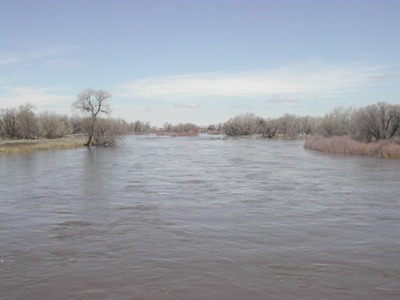
Mrs. Gulch and I were on a quest for South Platte River photos yesterday and were not disappointed. Click on the thumbnail above see how it looked downstream of Denver at the Colorado 144 bridge east of Weldona on the way to Fort Morgan.

Aspinall Unit: Operations meeting

A picture named crystaldamspill0508.jpg

From email from Reclamation (Dan Crabtree):

In response to the beginning of the spring runoff season, Reclamation will be increasing releases from the Aspinall Unit by 300 cfs on Friday April 17. After the change, the total release from Crystal Reservoir will be 1,500 cfs and flow in the Black Canyon and Gunnison Gorge will be about 1,000 cfs.

Please note the Aspinall Operations meeting will held on Thursday April 23rd in Reclamation’s Grand Junction Office beginning at 9:30 a.m. In conjunction with the meeting, the National Weather Service will be holding a Water Supply Meeting beginning at 1:00 p.m. at the same location. Please RSVP Bryon Lawrence at with which meeting you plan to attend to ensure sufficient seating.

Note to Fishermen: Sorry the East Portal Road is not yet open to the public. Still waiting for the basketball-sized rocks to slow their assault on the road.

Windsor: Town board to use FEMA grant to repair tornado damage at Windsor Lake

A picture named tornado.jpg

The Town of Windsor is hoping to get a FEMA grant to repair some of the tornado damage to the shoreline of Windsor Lake, according to a report from Ashley Keesis-Wood writing for the Windsor Beacon. From the article:

The Windsor Town Board agreed to pursue a grant from the Federal Emergency Management Agency that will protect the shoreline along Windsor Lake. “This project allows us to take advantage of some funding made available to us in the wake of the (May 22) tornado,” Windsor Director of Parks and Recreation Melissa Chew said during Monday night’s regular town board session…f the town receives the grant, the funds would go toward a rip rap, or shoreline stabilization, along Windsor Lake to protect the recreational trail as well as two Greeley potable water lines in the area.

Montezuma County: Goodman Point Water District plan

A picture named youngsbarnmesaverde.jpg

From the Cortez Journal: “The board of Montezuma County Commissioners is scheduled to meet at 9 a.m. Monday, April 20, in the commissioners room at 109 W. Main St., Cortez…At 10:30 a.m. a public hearing will cover the Goodman Point Water District’s service plan, which will consider the adequacy of the plan and provide opportunity for public comment.”

Mcphee and Jackson reservoirs status

A picture named uppermcphee.jpg

From the Cortez Journal: “Jackson Gulch reservoir live content stood at 3,532 acre-feet with a 9,948 acre-feet maximum capacity and a 5,008 acre-feet average (1971-2000) end-of-month content. At Jackson Gulch, a daily maximum/minimum of zero cubic-feet-per-second was released into the Mancos River, and 37 acre-feet were released for municipal purposes.

“McPhee Reservoir live content stood at 283,214 acre-feet, with a 381,051 acre-feet maximum capacity and a 305,596 average (1986-2000) end-of-month content. At McPhee, 3,766 acre-feet were released into the Dolores River, and 2,348 acre-feet were released for transbasin purposes. At McPhee, a daily maximum/minimum of 76/48 cubic-feet-per-second was released into the Dolores River.”

Colorado-Big Thompson Project scores $14 million in stimulus dough

A picture named carterlake.jpg

Here’s the background on Reclamation’s plans for the $14 million in stimulus funds slated for the Colorado-Big Thompson Project, from Pamela Dickman writing for the Loveland Reporter-Herald. From the article:

The Bureau of Reclamation will hire a crew to scrape away and replace the coating of the pipes that carry water from the Colorado-Big Thompson Project to the Flatiron Power Plant. The entire cost of the project, $14 million, will be paid for with federal stimulus money…

The penstocks are large pipes that snake about one mile down Bald Mountain near Carter Lake. They bring water from the Colorado-Big Thompson project to the hydroelectric plant to generate power that is doled out through the Western Area Power Administration grid. This is the first time the coating will be replaced since the penstocks were built in 1962. The replacement coating is a new, upgraded product that should increase reliability and integrity, according to Lamb. Crews will scrape the old coating from the outside of the pipe, which drops 1,064 feet vertically, Lamb said. They also will go inside the pipes, which are 6 feet in diameter, to re-coat the inside.

Meanwhile, from email from Reclamation (Kara Lamb):

If Carter and Horsetooth are in your plans for Sunday, here is a quick update: The work on the Charles Hansen Feeder canal has completed. Currently, we are running about 150 cfs to Horsetooth. We will turn the pump to Carter off over the weekend. Once the pump goes off, expect another 300-or-so cfs to begin flowing to Horsetooth. Carter remains pretty full. Horsetooth is still at a water elevation of 5404, but will begin rising Monday.

More Coyote Gulch coverage here and here.

Cañon City: DARCA — Ditches 101

A picture named measuringwithweir.gif

From the Pueblo Chieftain: “A discussion about maintenance, liability and safety issues surrounding irrigation ditches will be held from 9 a.m. to noon Friday at the Four Mile Community Center, corner of East Main Street and Steinmeier Avenue…Speakers include John McKenzie, Executive Director, DARCA; Charles F. Hix, Hix Insurance Associates, Inc.; Mannie Colon, President, Hydraulic Ditch; and Brenda Jackson, Fremont County attorney. The event is free and open to the public.”

Fountain Creek: Mercury and aluminum

A picture named howmercurypollutionspreads.jpg

From the Pueblo Chieftain: “Trace amounts of mercury and aluminum have been detected in Fountain Creek below Colorado Springs. The elements showed up during testing in March, but researchers are not sure about its origin or how much of a problem it could be. ‘We need to see if it’s a one-time release or an ongoing problem,’ David Lehmpuhl, a chemistry professor at Colorado State University-Pueblo, told the Lower Arkansas Valley Water Conservancy District board.”

Colorado Springs: City targets stormwater fee scofflaws

A picture named stormwateroutlet.jpg

From the Colorado Springs Gazettte (Daniel Chacon): “After a two-year reprieve, the city of Colorado Springs has decided to put its foot down and go after delinquent property owners who owe a combined $2.44 million in outstanding Stormwater Enterprise fees. “I think it’s only fair to those people who are paying their bills and paying their fair share of making sure the stormwater infrastructure is taken care of,” Mayor Lionel Rivera said Thursday.”

Lamar: Council approves lift station design contract

A picture named sewageliftstation.jpg

From the Lamar Ledger (Aaron Burnett): “The council approved an agreement with The Engineering Company (TEC) for the design of a new wastewater lift station. Total cost for the design is $177,500…Montgomery told the council that a new lift station would replace the current main lift station that is nearing the end of its useful life and is in dire need of replacement. He noted that the current lift station does not have any screening mechanism in place, so debris and solid objects damage the pump works as they pass through. The new lift station would be designed with a screening system that could catch large particulates and remove them from the system said the water resource manager. Montgomery added that because of the methods used to construct the current facility, it is deemed a “confined space” which limits on site expansion or replacement options. Funding for the design of the new lift station will likely come from the water and wastewater fund’s reserves. City Treasurer Linda Rohlman said there appears to be adequate funding for the project available.”

Lower South Platte Water Conservancy District meeting

A picture named fortmorganrainbowbridge.jpg

Here’s a recap of Tuesday’s meeting of the Lower South Platte Water Conservancy District, from Judy Debus writing for the Sterling Journal Advocate. From the article:

The board suspended their meeting for a public hearing on the inclusion of a well at the Ovid School District into the LSPWCD plan. The executive committee approved it subject to the approval of a specialty contract with the district. Joe Frank, manager, reported that it was published in the paper and there has been no written or public protests. Receiving no public comment, the board reconvened and moved for the approval of adding the specialty contract. It was approved and placed into the March 10 executive committee meeting minutes…

In his manager’s report, Frank presented information of telemetry remote measurement and reporting. He and Fritzler attended a presentation on the use of that on wells. A possible demo-project is being considered using radios and repeater towers. “The big issue that I was concerned with was if the radios would be reliable,” he said. He and Fritzler also reported that the requirements of manpower and cost for data were concerns, as is long-term maintenance and cost. “The key is for us to find something that really works before someone actually goes out and starts putting this in,” Frank said. There was also discussion of licenses and fees and if that investment should be made now in order to do a demo project. Also discussed was satellite telemetry that might be available through the state. Further investigation into the issue will be made.

The annual Water Festival has been scheduled for May 19 at Northeastern Junior College. Frank reported that there are 475 children are signed up and 22 presenters will be involved.

Republican River compliance pipeline: Project may be headed to binding arbitration

A picture named republicanriverbasin.jpg

Here’s a recap of the April 9 meeting of the Republican River Water Conservation District Board of Directors, from Tony Rayl writing for the Yuma Pioneer. From the article:

No significant progress, in regards to getting Kansas and Nebraska to approve the [compliance pipeline] project, has been made in the past few months, it was reported during the Republican River Water Conservation District Board of Directors regular quarterly meeting, last Thursday, April 9, in Yuma. A teleconference with Kansas and Nebraska is set for Tuesday, April 28, for a special RRCA meeting. Colorado will ask for approval for the proposed compact compliance pipeline. If Kansas and Nebraska reject it, as expected, Colorado will move to the arbitration stage.

If not approved, the next step would be arbitration. The system is set up so it is “non-binding” arbitration, meaning the states do not have to adhere to the ruling. It is a step taken, though, in an effort to resolve the issue without going to the U.S. Supreme Court. Colorado, though, is willing to take the pipeline to binding arbitration, meaning the arbitrator’s decision carries weight. “We have offered binding arbitration but Kansas has rejected it, at least initially,” [Alexandra Davis, the assistant director for water for the Department of Natural Resources] said. “We were willing to go to binding arbitration.”[…]

The Republican River Water Conservation District continues to lay the groundwork for the pipeline, while waiting for RRCA approval. Engineer Jim Slattery told the board last Thursday that work continues on easements, an application for a permit from the Corps of Engineers has been submitted, and the district also is dealing with a minor issue with the Colorado Ground Water Commission in regards to “co-mingling” wells. Slattery told the board he has been told bidding among contractors is still competitive due to a slowdown in projects, but it might not last much longer.

The district itself is not moving too far ahead until issues are resolved between the three states. The RRWCD is taking the stance that it developed the pipeline project on the assumption that delivering water to the North Fork would bring Colorado into compliance with the pipeline. However, Kansas asserts Colorado is not in compliance in the South Fork sub-basin, and the pipeline to the North Fork will not address that. Therefore, the district definitely wants that issue resolved, and approval from the RRCA, before building the pipeline. The RRWCD also has requested assurances from state officials that Colroado will drain Bonny Reservoir, or take other actions equivalent to draining Bonny, if Kansas is found to be correct in its interpretation of the South Fork issue.

Also, the Sandhills Groundwater Management District, where the wells for the pipeline are located, has stated it will not hold a hearing on the RRWCD’s request to export water from the management district until the RRCA has approved the augmentation plan.

A $60,000 million, 2-percent interest loan from the Colorado Water Conservation Board was approved by the Colorado Legislature last year, to the RRWCD for the pipeline. The RRWCD does not want to take the risk of borrowing that money until it is certain the pipeline is a go for all parties. Technically, the RRWCD has two years from the date of the loan contract to borrow and complete the project, according to legal representation. The CWCB staff has told the RRWCD it could obtain further time if necessary. However, in light of the budget crisis, the district would like to get going before the end of the year.

More coverage of the meeting from the Yuma Pioneer (Tony Rayl):

The water level at Bonny Reservoir continues to be an issue with the Republican River Water Conservation District. Dave Keeler, the state’s water commissioner for the Republican River Basin, gave a Bonny update to the RRWCD Board during its regular quarterly meeting, last Thursday in Yuma. He said measurements show that currently there is an extra 3,992 acre feet of storage in Bonny, which is considered “out of priority” water. As to when that water will be released, Keeler referred to State Engineer Dick Wolfe. Among the main considerations in releasing the water is the ability to maximize the amount released getting to the gage in Benkleman, Nebraska. It sounds like there will not be a release until the fall. However, there is a live stream flow in the South Fork of the Republican River reaching the Benkelman gage, and there is little irrigation right now. Board Member Eugene Bauerle said the district should consider asking the state to make a release now, since conditions are good for the water getting to the gage.

More Coyote Gulch coverage here and here.

Alamosa: Council approves sewer rate hike

A picture named wastewatertreatmentwtext.jpg

From the Valley Courier (Ruth Heide): “After receiving no public comment during a public hearing on the rate increase, the council voted on an ordinance that will more than double sewer rates over a three-year period. This year the average resident’s utility bill will go up by about $5 a month with proposed increases of another $4 per month each year for the next two years. The average residential customer has been paying about $11.50 a month for sewage services. That involved a flat rate of $3.50 per month plus a usage fee based on $1 per 1,000 gallons of water measured in non-irrigation months (November through February.) Commercial customers paid the same usage fee but their flat rate was $4, and industrial customers’ flat rate was $4.10 per month. The ordinance the council approved on Wednesday increases the flat rate for residential customers from $3.50 to $5 a month and the usage fee from $1 to $1.50 per 1,000 gallons of water. Commercial customers will see an increase of $3 in their flat rate from $4 to $7, and industrial customers’ flat rate will increase just a little more than $3 from $4.10 to $7.20 per month. The usage fees will be the same for all customers, $1.50 per 1,0000 gallons of water. In 2010 the flat rate for residential customers will increase by 25 cents more per month and the cost per 1,000 gallons will increase by 50 cents per month; the flat rate for commercial customers will increase 30 cents per month; and the flat rate for industrial customers will increase 20 cents per month. Again, the usage fee will be the same for all customers in 2010, $2 per 1,000 gallons of water. In 2011 the flat rate will increase 5 cents per month for residential customers and 20 cents for commercial and industrial customers, and the cost per 1,000 gallons will increase by another 50 cents per month, to $2.50.”

Southern Delivery System: Pueblo West to file lawsuit over requirements to join Pueblo flow program

A picture named sdspreferredalternative.jpg

From the Pueblo Chieftain (James Amos): “[Pueblo County] has told the Pueblo West Metropolitan District that it must participate in a program to provide recreation water in the Pueblo kayak course if it wants water from Colorado Springs’ Southern Delivery System pipeline. Under state law, Pueblo County can order some requirements on participants in the pipeline because the pipeline is planned to be built in the county. But the flow program comes from an agreement signed in 2004 by Pueblo, Pueblo Board of Water Works, Colorado Springs, Aurora, Fountain and the Southeastern Colorado Water Conservancy District – but not Pueblo West…

“At the board meeting Tuesday night, Pueblo West board members and staff members repeated their belief that the flow program could cost Pueblo West as much as a third of its yearly water. Tom Mullans, the metro district’s attorney, said he’s spent too long helping to create Pueblo West’s portfolio of water rights to watch part of it literally wash down the river.”

More Coyote Gulch coverage here and here.

Lee Simpson retires from Southeastern board

A picture named arkbasinditchsystem.jpg

From the Pueblo Chieftain (Chris Woodka): “Simpson stepped down from the Southeastern Colorado Water Conservancy District board Thursday after 28 years of service and was recognized at a luncheon following the monthly meeting. ‘We wish you well in the future,’ President Bill Long told Simpson. ‘You’ve got a pretty good replacement, but he’s got pretty big shoes to fill.’ Simpson’s replacement as Pueblo County director is his son, David Simpson, who like his father before him is the manager of the St. Charles Mesa Water District. The elder Simpson has more than 50 years in water and helped found the St. Charles district, serving as its manager for 36 years. During the 1970s and 1980s, Simpson organized and taught classes for water and wastewater operators. He helped form the Colorado Rural Water Association, which provides training and assistance for water operators throughout the state. He was president of the group for eight years and served for eight years on the National Rural Water Association Board. Simpson also is a member of the Bessemer Ditch board.”

Lower Ark requests 2 year stay in lawsuit with Reclamation over Aurora long-term contract

A picture named fryingpanarkansasproject.jpg

Here’s an update on the lawsuit filed by the Lower Arkansas Valley Water Conservancy District over Reclamation’s long-term storage contract with Aurora, from Chris Woodka writing for the Pueblo Chieftain. From the article:

The Lower Ark district, Aurora and Reclamation Wednesday jointly asked federal Judge Philip A. Brimmer for a two-year stay in Lower Ark’s lawsuit against the Bureau of Reclamation over contracts to Aurora. The stay is part of a March 18 agreement between the Lower Ark and Aurora which could settle the case if federal law is changed to allow Aurora to use the Fry-Ark Project to move water out of the valley.

Arkansas Valley Native, a group of four water rights owners, opposes the delay. Members of the group are Pueblo Chieftain Publisher Bob Rawlings, former state lawmaker Bob Shoemaker of Canon City, former Southeastern Colorado Water Conservancy District President Wally Stealey and Wiley banker Frederick Esgar. They entered the case on the Lower Ark’s side, claiming that Fryingpan-Arkansas Project water cannot be used to move water out of the valley under the federal contract.

he Lower Ark-Aurora agreement includes a provision to try to change federal law to allow Aurora, and Aurora only, to move water out of the basin using Fry-Ark facilities. That would remove the central point of the lawsuit. Aurora has used annual excess-capacity contracts since 1986 to move water out of the valley through Lake Pueblo, Turquoise Lake and Twin Lakes, all Fry-Ark reservoirs. The Southeastern district questioned the contracts in 1986 and again in 2003, when it reached its own agreement to allow Aurora to use the Fry-Ark Project. The 2003 agreement binds the district to seek federal legislation to legalize Aurora’s contracts, which it tried to do in now-stalled Preferred Storage Options Plan legislation. The Southeastern board Thursday learned negotiations on the Aurora legislation will begin again in the near future among nine parties who broke off talks when the lawsuit was filed in late 2007. The Pueblo City Council Monday voted to affirm its support of the Aurora legislation.

Reclamation’s position in the 1986 and 2003 disputes over the contract was that it already has the authority to lease excess-capacity storage to Aurora and other users outside the Southeastern district’s boundaries. The district includes parts of nine counties, but not all of the area in the Arkansas Valley.

Aurora, Southeastern and Lower Ark representatives lobbied members of Congress recently on the proposed legislation. Rep. John Salazar, D-Colorado, said he opposes the legislation suggested in the Lower Ark-Aurora agreement. Sens. Mark Udall and Michael Bennet, both Democrats, say they are open to discussion, but want to protect the Arkansas Valley’s interests. In 2007, Reclamation issued a 40-year contract to Aurora for both storage and exchange at Lake Pueblo. Aurora has an account for 10,000 acre-feet and its water would be the first to spill if project water used the entire capacity. Part of PSOP would study enlarging Lake Pueblo, which now can store 257,000 acre-feet of water, while reserving space for flood protection.

More Coyote Gulch coverage here and here.

Arkansas Valley Conduit: No federal stimulus dough for project

A picture named puebloreservoir.jpg

Authorization for the Arkansas Valley Conduit (supply water pipeline from Pueblo Dam to Lamar) has been a moving target for decades and now funding is drying up before anyone starts turning dirt. Here’s a report from Chris Woodka writing for the Pueblo Chieftain. From the article:

The Southeastern Colorado Water Conservancy District learned Thursday that federal economic stimulus money for the project is unlikely and that a loan for the conduit has become a playing piece in efforts to balance the state budget. The Bureau of Reclamation had $1 billion in stimulus funds available, but chose to fund projects that are close to being finished rather than new projects, said Christine Arbogast, a lobbyist for the Southeastern district.

The district had requested $5 million to advance planning on the route and rights of way for the $300 million conduit from Pueblo Dam to Lamar. The conduit would provide fresh drinking water to about 50,000 people in 42 water districts, many of which are facing water issues such as salinity and radium or uranium in wells. The conduit was part of 1962 Fryingpan-Arkansas legislation, but was never built because of the local expense. A bill signed into law last month by President Barack Obama authorizes the conduit to be built using excess-capacity lease revenues from the Fry-Ark Project to repay federal costs. The federal share is 65 percent under the legislation…

Meanwhile, the state House is considering using $35 million of a $60 million Colorado Water Conservation Board loan the district obtained to finance the local share. Executive Director Jim Broderick said using the loan, which is really funding capacity, has been discussed as one source of finding state funds to patch budget deficits for several weeks. The problem with tampering with it at this time is that this Legislature cannot make financial commitments for future bodies. As recently as last Friday, the entire $60 million appeared to be secure in the Senate’s budget, but only $25 million is in the most recent House budget. Broderick has been organizing pressure from several directions to attempt to secure the whole amount. The conduit has not used any money from the loan to date.

More Coyote Gulch coverage here and here.

Beautiful snow (and rain)

A picture named plowingsnowsanjuans.jpg

What a beautiful snow we had yesterday here in Denver and most of Colorado. Here’s a report from the Greeley Tribune: “The storm, which stretched across Colorado, brought more than an inch of rain to Greeley since Thursday night while pounding areas west of Interstate 25 with heavy accumulations of snow. At Buckhorn Mountain, roughly 10 miles west of Fort Collins, about 25 inches of snow fell while at Rist Canyon, roughly 15 miles northwest of Fort Collins, 3 feet of snow fell. Further south in Denver, 9 inches of snow fell, according to Fox 31 Meteorologist Chris Dunn. A tornado, however, was spotted northeast of Pueblo, according to Bill Eckrich, meteorologist at Day Weather.”

Residents of Clear Creek County probably don’t think it was a beautiful snow and would most likely tell me so to my face if they could get down the mountain. Here’s a report from the Summit Daily News:

The American Red Cross is in the process of setting up a warming shelter in Idaho Springs to accommodate the large number of stranded travelers. A ‘warming center’ is a place for people to get off the highway, use the restroom, get warmth and shelter, and acquire basic necessities like water and snacks. These centers do not have cots or full feeding capabilities. The County is still in the process of determining the location. We will pass that along as soon as we know it. Clear Creek County officials are setting up similar ‘warming centers’ in Georgetown. County officials have not yet determined the location. In the interim, Colorado National Guard will escort a caravan of Red Cross supplies and volunteers into Idaho Springs as Clear Creek declares a state of emergency. A state of emergency means that the County is requesting use of state assets such as the Guard and additional snow plows. Clear Creek Middle School is at capacity at over 200 people. An official head count will be taken at midnight.

More coverage from the Pueblo Chieftain (Nick Bonham):

A spring storm brought rain, sleet, small hail, lightning and thunder to Pueblo and the region on Friday. A tornado was even spotted in El Paso County near Truckton, about 40 miles northeast of Pueblo, according to the National Weather Service…

Custer County Road and Bridge Foreman David Trujillo said the Wet Mountain Valley received between 10 and 12 inches of heavy, wet snow. The snow storms were accompanied by rumbles of thunder according to one weather spotter…

Crestone had received 16 inches of snow just before noon, according to a spotter for the National Weather Service. The Sangre’s foothills along the eastern edge of the San Luis Valley were also hit hard Sunday when just under two feet of snow fell on a corridor stretching from Crestone to just south of the Great Sand Dunes National Park. The snowfall tapered off along the valley floor during the day, although a volunteer spotter near Monte Vista reported 4.8 inches of new snow and 0.42 inches of precipitation. Creede reported 4.9 inches of new snow and 0.33 inches of precipitation.

Biosolid use as fertilizer curtailed north of Longmont

A picture named biosolids.jpg

From the Longmont Times-Call (Brad Turner):

Because of fears about groundwater contamination, spreading sludge — or biosolids, as the industry calls the nutrient-rich material produced by sewage-treatment plants — won’t be an easy option for [farmer Issac Drieth], if it’s allowed to happen at all. “I got nothing against the stuff. It’s done wonders for me,” the 79-year-old said Monday afternoon, leaning against a pickup outside his farmhouse on the Jim Clark Open Space property north of Longmont. “But people around here raise hell.”

Data compiled recently by the Colorado Department of Public Health and Environment show Drieth lives on a farm where groundwater may be too close to the surface for biosolids use, even though he had been allowed to use sludge as fertilizer from 1996 to 1999.

Drieth would have to pay a contractor to drill holes on his property that prove the water table is at least 5 feet deep — far enough down that nitrates from the sludge wouldn’t seep into the water, according to state health officials. High levels of nitrates in drinking water can cause oxygen deficiencies in young children.

In addition to shutting down biosolids use on part or all of three farms north of Longmont over concerns about the shallow water table in the area, CDPHE officials suspended biosolids use on four farms that hadn’t used sludge in recent years. The 97-acre farm where Drieth has lived for 30 years is one of the four inactive sites.