
Here’s a report about the prices of raw water and the current trends from Steve Maxwell writing for the American Water Works Association. It’s not hard to predict what would happen if the market moved to private industry. Here’s an excerpt:
Today, declining water availability has become a critical determinant of future growth in many areas of the West: Phoenix and Tucson, Ariz.; Las Vegas, Nev.; Denver, Colo.; Albuquerque, N.M.; and Southern California. As such situations develop, water is gradually transferred from agricultural irrigation to municipal consumption, and the prices of such water transfers are increasing sharply…
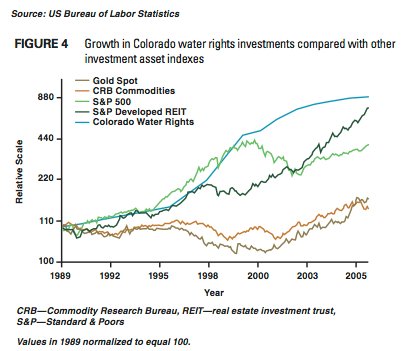
As conditions of water scarcity and stress continue to develop in more and more regions around the world, water will continue to exhibit rapidly increasing prices. As this discussion demonstrates, we have already seen these trends in Australia and the western United States—and the conditions are in place for this or a similar trend to occur in many other parts of the world. As price rises, there will be more and more incentive for improved utilization of water, increased recycling, and increased reuse of water as well as more focus on wiser allocation of water among competing uses. Further- more, as water’s value is increas- ingly recognized and as its price continues to increase, water seems likely to begin to evolve into a new financial asset class as well—an increasingly attractive opportunity to invest in. For example, as shown in Figure 4, the price of Colorado water rights is indexed against various other investment asset indexes from 1989 to 2006. A dollar invested in water rights in that state would have clearly returned more than a dollar invested in most any of the other standard financial investment cate- gories—the stock market, precious metals, real estate, or commodi- ties. Water is our most precious commodity, and its price will increasingly reflect that fact.