
From The Pueblo Chieftain (Patrick Malone):
During its meeting at the Denver West Sheraton on Wednesday, the IBCC unveiled that progress in a draft strategy for sustaining the state’s future water supply. Its four-pronged tenets are a blend of water conservation, identified projects and processes (IPPs), agricultural transfers and developing new supplies.
While agricultural transfers are a staple in the strategy, delicate handling of them and a mindful perspective on their impact also are keys, and minimizing agricultural transfers is an objective of the IBCC’s strategy. “Large-scale dryup of irrigated agriculture has considerable adverse economic and environmental impacts,” the report said. “While some future portion of (municipal and industrial) water will come from agricultural sources, encouraging alternative agricultural transfers and new water supply development is essential to prevent the dryup of agricultural land. To the extent the conservation, IPPs and new water supply development is successful, less water will be transferred out of agriculture to meet the (municipal and industrial) gap.”
One mechanism proposed in the report to protect agricultural water is a legislative fix that makes long-term leasing of water rights more enticing to municipalities. [IBCC member Jay Winner of Pueblo] said that could be an effective step away from the “buy-and-dry” approach that can cripple agricultural areas and the economies they support.
Winner forecast that projects mirroring the Arkansas Valley Super Ditch that feed the urban thirst for water while halting buy-and-dry situations will be another alternative to selling the water that feeds Colorado farms. “It could be the model for the Western United States that keeps agriculture whole while saving municipalities,” Winner said…
The IBCC recommended proceeding with planned water projects such as the Super Ditch in order to be prepared for the population boom and to accommodate its water needs as it gradually arrives. Among the report’s more bold recommendations was state funding for those long-term projects, even if it costs $18 billion. That is a monumental sum at a time when the state is confronting a $1 billion budget deficit, and the general fund at the Colorado General Assembly’s disposal is about $7 billion annually…
Among the more radical ideas contained in the report were the means of conservation. They included adopting a statewide plumbing code for reduced flows and requiring retrofits of water-using fixtures (such as toilets and sinks) to meet certain use conservation standards before a building or house could be sold. Gov. Bill Ritter said he recognized the value of those recommendations, but warned the IBCC to expect a fight from cities and counties that presently enjoy local control over those matters…
Winner said the conservation efforts outlined in the plan aren’t folly, but will be absolutely necessary in order for the state’s water needs to be met a half-century from now. “If the people of Colorado want the state that they envision, they need to take a serious look at this now,” Winner said. Other strategies proposed in the plan include greater state support from permitting to completion of water projects and steep fees to areas that gain water by taking it from another part of the state…
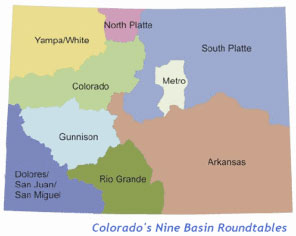
Winner said the timeline is indefinite for the recommendations in the plan to progress from draft to implementation. Certain aspects could be the topic of legislation in the General Assembly when it reconvenes in January, but much of the report will next be vetted by basin roundtables throughout the state.
More coverage — Governor Ritter’s speech at the meeting — from Patrick Malone writing for The Pueblo Chieftain. From the article:
The only way to balance the competing water interests of municipalities and agriculture is to move forward with a strategy for sustained water availability that takes both into account, Ritter said. Likewise, other opposing water forces — energy and nonenergy users, and consumptive and nonconsumptive uses — also must be weighed on the scale of reason when crafting water strategies for the future, the governor said. “You have to reinvent this,” Ritter said, emphasizing that factious fighting between the competing interests in the water arena must join forces to assure that none is left without…
Along with funding for higher education, Ritter said he warned his successor, Gov.-elect John Hickenlooper, that water is a matter of paramount importance awaiting him when he takes office in January. Ritter interjected his belief that human-caused global warming could impact precipitation levels in the future and further limit the water available to the state in the future. He urged even those in the water community who doubt global-warming theories to take heed of the projected impact on precipitation as they plan for the future. “You can’t think about water without some of the forecasting that’s been done, because it’s dire,” Ritter said. “I don’t think it’s something you can dismiss or ignore in terms of planning the future of water availability in Colorado.”
More coverage from the Associated Press (Stephen K. Paulson) via CB Online. From the article:
The panel suggested the state should coordinate, support and endorse projects. One of their main conclusions was that the state needs more storage on the Western Slope. They also suggested that the governor issue an executive order to state agencies to implement a water use reduction and conservation plan. Suggestions included requiring people who sell their house to replace appliances with water efficient models and help utilities reduce water use. Until now, the state has left most water development projects to loca l communities and shied away from promoting water projects until the federal government gave its approval…
“We can’t get to a state with 10 million people without thinking about water. We have often prided ourselves on local control of these issues … but at the same time, we need the statewide vision. If we don’t have statewide vision, we will do the unthinkable, which is become less of an agricultural state and become a state where water usage is for residential and municipal use,” he told the panel…
Former state Agriculture Commissioner Don Ament, a farmer who attended the water basin meetings but has no official role, said the report does little to solve problems in conservation, loss of agricultural land and finding new water sources.
More IBCC — basin roundtables coverage here.