Energy policy — oil shale: The Bureau of Land Management gets an earful about the perpetual fuel of the future up in Rifle

A picture named oilshaledepositsutwyco.jpg

From The Aspen Times (John Colson):

“If there’s any of you out there who don’t like $4 gas, be prepared for $8 gas,” said Allen Burnham, chief of technology at American Oil Shale LLC, arguing that oil shale development is needed to alleviate U.S. dependence on foreign sources of oil.

“Oil shale development would be perpetuating a negative feedback cycle of dirty technology,” countered Melanie Finan, who also said she thinks the BLM should “draw back on the scale of the amount of land that you want to lease.”

A team of BLM officials held a public input session at Colorado Mountain College – West Garfield Campus on Tuesday, as part of a re-evaluation of oil shale leasing decisions made at the end of the administration of former U.S. President George Bush. The Bush administration, in its final days in office, opened up the 1.9 million acres to oil shale leasing, prompting a lawsuit by environmental organizations arguing the administration had violated federal laws…

Tom Alvarez, public affairs specialist for the BLM in Grand Junction, cited the remarks of Garfield County Assessor Jim Yellico as the most memorable of the meeting, explaining, “All he wanted was honest information, the truth.” “It’d be nice if, with your recommendations, there were some facts, and the truth,” said Yellico, a Glenwood Springs native and a self-proclaimed citizen “concerned about the environment.” He told the BLM team that citizens wanted to hear facts rather than divergent claims and counterclaims made by proponents and opponents of the untried industry. “I would like to see some sort of document that includes the facts, from a source that doesn’t have an agenda,” Yellico concluded…

“I require clean air and clean water to live,” said Richard Vottero of Glenwood Springs, “and I believe this process damages both.” Oil shale development would pollute the air with greenhouse gases and consume vast quantities of water, he said. The government would better serve its citizens by pursuing alternative, clean energy sources that do not pollute or put added pressure on the region’s scarce water resources, he added.

From the Summit Daily News (Janice Kurbjin):

…today’s hearing is slated for 1-4 p.m. and 6-9 p.m. at the Denver West Marriott in Golden. The BLM is initiating a planning process for the future of oil shale development in the West, based on Secretary Salazar’s decision in February to take a fresh look at the oil shale plan that was released in 2008 by the Bush Administration, which opened up 2 million acres of western public lands to oil shale.
More oil shale coverage here and here.

Colorado River Cooperative Agreement: Deal lauded as win-win at the ‘Summit State of the River’ meeting

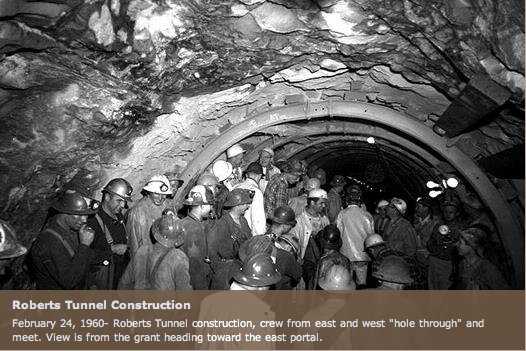
A picture named robertstunnelholethrough02241960dwd.jpg

From the Summit County Citizens Voice (Bob Berwyn):

[Colorado River Water Conservation District general manager Eric Kuhn] sat on a panel with Denver Water manager Jim Lochhead and Summit County manager Gary Martinez, as well as the Summit County commissioners, together outlining the give and take of the deal that clears the way for Denver Water’s proposed expansion of its Moffat Tunnel collection system in Grand County — a project still under scrutiny by federal and state agencies, including the Colorado Division of Wildlife. The Moffat Tunnel project wouldn’t directly take any new water from Summit County, but because of the complex plumbing involved, it would result in increased diversions from the Blue River Basin — 5,000 acre feet, taken during spring runoff in wet and average years…

“Long-time disputes were resolved,” said County Commissioner Karn Stiegelmeier, adding that Denver Water will impose a West Slope surcharge on certain types of water sales, potentially providing an ongoing source of funding for environmental projects, including forest health work.

At one point, Lochhead was asked by an audience member how much of Denver Water’s total usage — about half — goes to outdoor lawn irrigation. “We’re not going to dry up all the bluegrass lawns on the Front Range, we’re not going to get that,” said Commissioner Thomas Davidson. What you’ve got to understand is what we’re getting in this agreement is far more than what we could have gotten in water court from a judge,” Davidson said.

From Steamboat Today (Mike Lawrence):

Local water policy experts say the Colorado River Cooperative Agreement, announced Thursday in Tabernash and touted as a historic framework for future collaboration between Front Range and Western Slope water interests, has little, if any, direct impact on the Yampa River and its tributaries in Northwest Colorado. The agreement primarily addresses Denver Water, metro area suburbs and their interaction with municipalities and river managers along the Colorado River…

While the Upper Yampa and Northern Colorado water conservancy districts are not participants in the agreement, the districts’ interests are deeply intertwined with those who are. In recent years, for example, the Northern Colorado water district has studied the potential for a trans-mountain diversion, or pumpback, of Yampa River water to the Front Range. One hypothetical project proposed diverting Yampa River water near Maybell, in western Moffat County.

Dan Birch, deputy general manager of the Colorado River District, said last week’s agreement, a deal several years in the making, cools pumpback [Yampa Pumpback] proposals. “I think it takes the heat off, for the time being, for trans-mountain diversions,” Birch said…

Talk of pumpbacks also has cooled recently because of the multi-billion-dollar costs of such projects, the recessionary economy and other factors. “I don’t know of anyone else stepping forward at this stage of the game seriously talking about a Maybell pumpback,” Birch said. “I just don’t see anything happening in the near-term out of the Yampa.”[…]

District officials plan to discuss water issues with the Steamboat Springs City Council on May 17 in Centennial Hall.

More Colorado River Cooperative Agreement coverage here.

Interbasin Compact Commission Committee meeting recap: Still looking for a active role in the Colorado’s water world

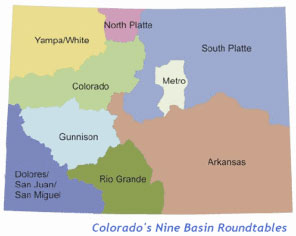
A picture named ibccroundtable.jpg

Where does the IBCC concentrate their efforts? What sort of projects can they pull off? Can they commit the state of Colorado to bringing water from Flaming Gorge to the Front Range and points south? Their strategy report, released in in December 2010, calls for conservation, alternative water transfers from agriculture, building of projects already envisioned and developing new supplies. Their role in Colorado’s bottom-up water world is still unclear as is any progress they’ve made up until now.

Here’s a report on last week’s meeting from Chris Woodka writing for The Pueblo Chieftain. From the article:

Jeris Danielson, a former state engineer who now sits on the IBCC, politely stated that most Coloradans are out of touch with the semi-arid environment most of them live in because municipal water providers have done such a good job plumbing the state so far. But the pipes are old, and the water supplies are being stretched thin, he cautioned. “We have to make sure we don’t get in the way of people who are trying to solve the problem,” Danielson told the IBCC…

At the March Summit, Danielson posed the question to Gov. John Hickenlooper about the possibility of using private capital to build water projects, since the state and federal government are out of money. Hickenlooper responded with a guarded “yes.”[…]

Its best effort so far has been a “framework” [ed. the December strategy report] that attempts to strike a balance between projects already in the works, urban conservation or reuse, new supplies of water and programs like the Arkansas Valley Super Ditch that allow farmers to keep water rights while selling the water through lease agreements. “What we’re trying to do is create a framework that says, ‘yes, if . . .’ and not say ‘no,’ ’’ said Mike Shimmin, a Boulder water lawyer…

Much of the need for new water supplies will be in the growing areas of Douglas and Arapahoe Counties, represented by the South Metro group. That group is investigating the Flaming Gorge pipeline as a possible new source of supply, and South Metro Executive Director Rod Kuharich even suggested advancing it into the category of “identified projects and processes,” as the IBCC calls those things it already knows about. Kuharich gave a hint of what the IBCC’s role might be: “If I have a project moving forward, do I want the IBCC throwing up a bunch of roadblocks? I don’t think so.”

More IBCC coverage here.

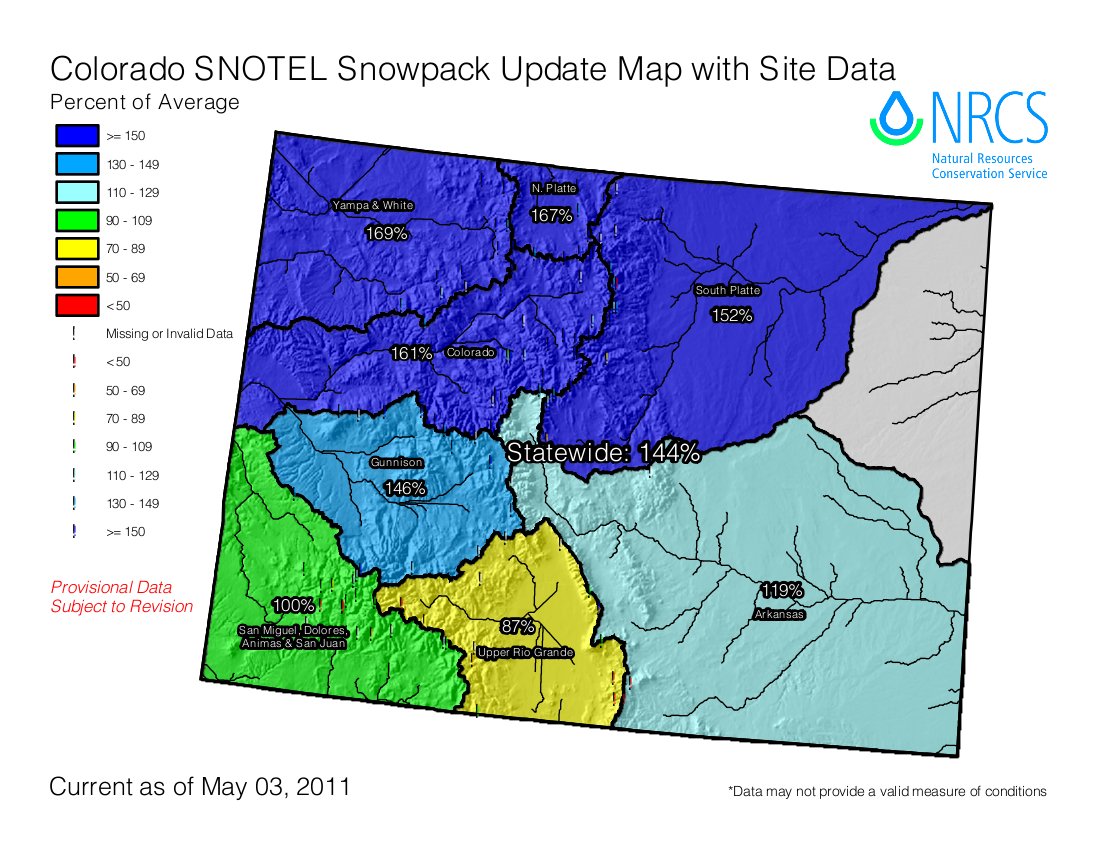
Snowpack news: The upper Colorado River basin — 161% of average, the San Juan, Dolores and San Miguel basins climb to 100% of average

A picture named snowpackcolorado05032011

From the Colorado Connection (Matthew Kruger):

In a banner La Nina year, the northern and central mountain ranges of Colorado have seen abundant snow, with areas around Steamboat Springs concerned about flooding in the early summer. However, a drought is intensifying on the plains, with over 10,000 acres burned in wildfires by late spring…

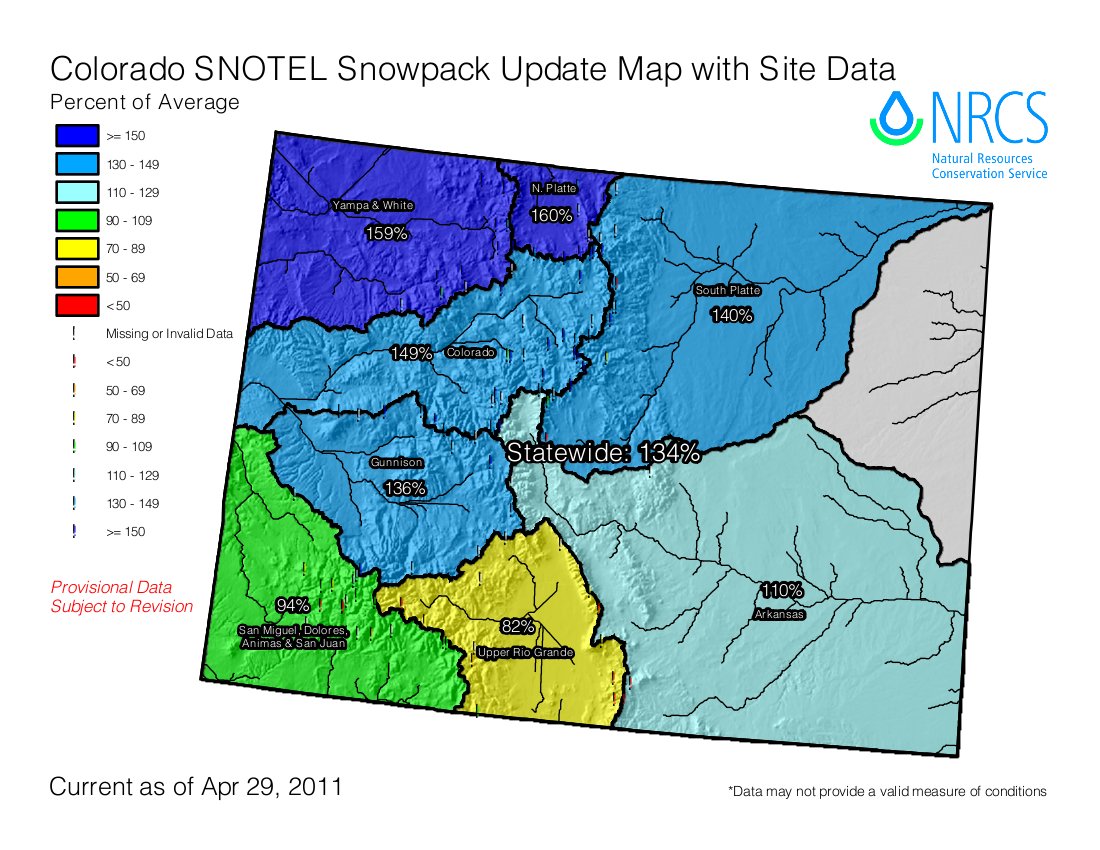
Most river basins and snowpack storage levels are running above average. The North Platte and Yampa basins are seeing the highest percentage of normal, while the Dolores and Upper Rio Grande are actually below normal, but not critical…

Right now, local reservoirs are at about 80% of average, which is considered very healthy. But CSU says water usage on the plains has increased earlier than expected, which will strain water availability.

From NewsFirst5.com (Greg Boyce):

The Greeley Tribune reports that the U.S. Department of Agriculture’s Natural Resources Conservation Service measured snowpack in Poudre Canyon that reached more than 160 inches, or almost 13.5 feet, at one point. Officials say the snow was almost too deep to measure in some places. They say the snow usually starts to decline this time of year.

From the North Forty News:

As of April 21, snowpack in the South Platte Basin, which includes the Cache la Poudre and Big Thompson drainages, stood at 130 percent of average, according to Mike Gillespie, snow survey supervisor for the state. Last year, the South Platte snowpack was just 73 percent of average in late April. With the high snowpack, stream runoff is predicted to be above normal this spring, and the National Weather Service in Boulder is keeping a close eye on the situation. “Flooding is definitely a concern,” said NWS hydrologist Treste Huse. “We’re watching it and getting prepared.”[…]

State water officials make runoff forecasts on the first of each month. On April 1, forecasters estimated this year’s runoff on the Poudre to be 135 percent of average. Gillespie said the May 1 estimate could be even higher. “It’s been extremely wet in the Poudre drainage,” he said. Joe Wright Reservoir, located in the Poudre drainage near Cameron Pass, set a snowpack record this year. Gillespie said the snow-water equivalent was 41.9 inches on April 21, surpassing the previous record of 35.6 inches set on that date in 1986. The average snow-water equivalent for late April is 24.2 inches at Joe Wright…

The snowpack figures in Colorado vary a great deal between north and south basins. On April 21, the North Platte drainage was at 150 percent of average, while the Rio Grande stood at just 70 percent.

National Drinking Water Week May 1-7

A picture named orrmnwatertower.jpg

Here’s the announcement from the U.S. Environmental Protection Agency:

People who travel abroad know the familiar problem with unsafe drinking water. At home, we scarcely give it a thought. Usually, we are right. But the sources of our drinking water are constantly under siege from naturally occurring events and human activities that can pollute our sources of drinking water.

Did you know?

– In the United States, water utilities treat nearly 34 billion gallons of water every day
– In the United States and Canada, the total miles of water pipeline and aqueducts equal approximately one million miles; enough to circle the globe 40 times
– Americans drink more than one billion glasses of tap water per day
– Children in the first six months of life consume seven times as much water per pound as the average American adult.

For some statistics on public drinking water systems and more see the folowing facts and figures page.

More coverage from the Fort Collins Coloradoan. From the article:

The safety, quality and reliability of local drinking water are priorities for Fort Collins Utilities. Drinking Water Week, which started Sunday and goes through Saturday, provides the opportunity to thank the many behind-the-scenes employees who work year-round to ensure our community’s water is remains safe, tastes good and is there when it’s needed.

National Drinking Water Week is a chance for water utilities and the customers they serve to join together and celebrate the immeasurable value of clean and safe water.

“Beyond quenching our thirst, tap water provides community services, such as fire protection, support for the economy and the quality of life we enjoy,” said Lisa Voytko, Fort Collins Utilities’ water production manager. “Tap water is so intricately a part of our lives that it’s hard to imagine a day without it.”

In recognition of the employees who make local drinking-water quality a priority, Fort Collins Utilities recently received the Directors Award of Recognition from the Partnership for Safe Water for the 11th year.

The partnership is a voluntary program that encourages members to increase water quality and safety standards and provide drinking water that surpasses federal requirements. Due to these standards and the dedication of participating water utilities, more than 85 million people currently receive higher-quality drinking water from surface water treatment plants.

More infrastructure coverage here.

Dolores River: The Montezuma Valley Irrigation Company is considering leasing water to the Colorado Water Conservation Board instream flow program

A picture named doloresrivercanyon.jpg

From The Durango Herald (Dan Randolph):

A common understanding of the science and the issues is one thing. Coming up with real solutions is altogether more difficult. Yet a new option has developed. The Montezuma Valley Irrigation Co., which supplies water to a large area around Cortez and Dolores, is now considering leasing water to the Colorado Water Conservation Board to increase flows downstream of McPhee on a short-term, trial basis.

The lease would be paid for by private interests, conservation organizations and other nongovernmental sources. It would supply up to 6,000 acre feet of water in three out of 10 years, to be released from McPhee. The water would come from Montezuma Valley Irrigation Co. water held in Groundhog Reservoir, above Dolores. The company is currently asking its stockholders whether to go forward with the lease.

More instream flow coverage here.

Denver: Denver Water’s summer watering rules took effect May 1

A picture named watersprinkler.jpg

Here’s the release from Denver Water (Lori Peck):

Denver Water would like to remind its customers that its summer water use rules began May 1. In addition to the rules, the utility encourages customers to pay attention to weather and lawn conditions before watering.

“Half of a household’s water use goes to outside watering,” said Melissa Essex Elliott, manager of conservation. “Most lawns don’t need as much water as you might think. Watering your lawn two days a week should be sufficient during May and into June.”

Denver Water’s watering rules, in effect until Oct. 1, are:

– No lawn watering between 10 a.m. and 6 p.m.
– Do not water more than three days per week (there are no assigned days for watering).
– Do not waste water by allowing it to pool in gutters, streets and alleys.
– Do not waste water by letting it spray on concrete and asphalt.
– Repair leaking sprinkler systems within 10 days.
– Do not water while it is raining or during high winds.
– The utility will continue to enforce its rules with a team of 11 Water Savers, including four on bikes.

“The Water Savers’ purpose is as much about educating customers as it is about enforcing Denver Water’s rules,” said Elliott. “We continue to have some monitors on bikes as a more approachable way to talk with our customers one-on-one about wise water use.”

If you see water waste in one of Denver’s parks, call 3-1-1. To report waste elsewhere, call Denver Water at 303-628-6343 or fill out online form.

Colorado’s dry climate means everyone needs to take part to ensure adequate water supplies will be available well into the future. “A small step like adjusting your watering times based on the weather is a great way to become more efficient,” said Elliott. Denver Water’s long-term plan to secure water for the future includes encouraging water conservation as a permanent way of life for Denver residents.

Visit conservation for tips, rebates, irrigation calculators and many more tools for saving water outdoors, including suggested watering times.

More Denver Water coverage here.

Colorado River basin: Grand County ‘State of the River’ meeting May 4

A picture named coloradorivergranby.jpg

Here’s the announcement from the Colorado River District (Martha Moore):

Details of the historic proposed Colorado River Cooperative Agreement between Grand County, 32 other West Slope entities and Denver Water will be discussed with the public at the Wednesday, May 4, Grand County State of the River meeting set for 6:30-8:30 p.m. at the Mountain Parks Electric building, 321 West Agate, Granby.

Representatives from Grand County will join Denver Water Chief Executive Officer Jim Lochhead and Colorado River District General Manager Eric Kuhn in a panel discussion of the proposed landmark water management agreement.

The meeting is sponsored by the Colorado River District.

The proposed agreement, five years in the making, seeks to address many environmental and water supply challenges in Grand County, as well as in Summit County and along the mainstem of the Colorado River all the way to the Grand Valley.
In Grand County, the proposal stems from Denver Water’s desire to permit an expansion of its Moffat Collection System. Benefits in the proposal are meant to go beyond the separate mitigation proposals Denver is making as part of its permit process. The Moffat Project would draw more water to the Front Range from the Fraser River system.

The proposal would provide more consumptive water supplies for Grand County entities as well as water for environmental flows in the late summer. Denver Water would also provide financial support for environmental projects as well as wastewater treatment plant improvements.

The Grand County State of the River will also include an update on the Grand County Water Information Network, the Grand County Outdoor Education Network and projected spring and summer operations of area reservoirs.

More Colorado River basin coverage here.

The Northeast Colorado Health Department recognizes Patrick Woltemath as ‘Colorado Rural Water Operator of the Year’

A picture named watertreatment.jpg

From the Northeast Colorado Health Department (Deanna Herbert) via the Sterling Journal News-Advocate:

Patrick Woltemath who was nominated for several contributions he has made in Sedgwick County, including his role as the certified water operator for the town of Sedgwick and for Lucy’s Place restaurant. His nomination reads as follows: “We have always found Patrick to be pleasant, knowledgeable and cooperative in his various roles and his expertise has led him to be awarded the 2010 Colorado Rural Water Operator of the year.” Woltemath was also recognized for his involvement with an historic lead issue at the town school as well as several other projects including his role in the town’s recent water system improvement project, his involvement in utilizing money received from the Governor’s Energy Office in changing all of the street lights in the town of Sedgwick to LED lighting, and the implementation of funding received from the William Stretesky Foundation to update both the aesthetic appearance and the energy efficiency of many buildings on Main Street. He was also recognized for his aid in helping the owner Lucy’s Place restaurant, a vital business in a very small community, come into compliance with the Colorado Drinking Water Regulations so that her restaurant could remain open. Woltemath was nominated by Carmen Vandenbark, NCHD’s environmental health director and Teena Pierce, NCHD’s environmental health representative.

More water treatment coverage here.

Snowpack news: The South Platte River basin — 151% of average

A picture named snowpackcolorado05022011

Last fall Klaus Wolter said, at a meeting of the Water Availability Task Force, “We’ve never really had a dry winter with La Nina.” Water year 2011 is no exception. Monster snowpack all across the northern mountains while the San Juans are gaining against average. The Rio Grande looks to have a tough year but even they’ve come up 3% against average over the weekend.

A picture named snowpacktimeseriesswe05022011.jpg

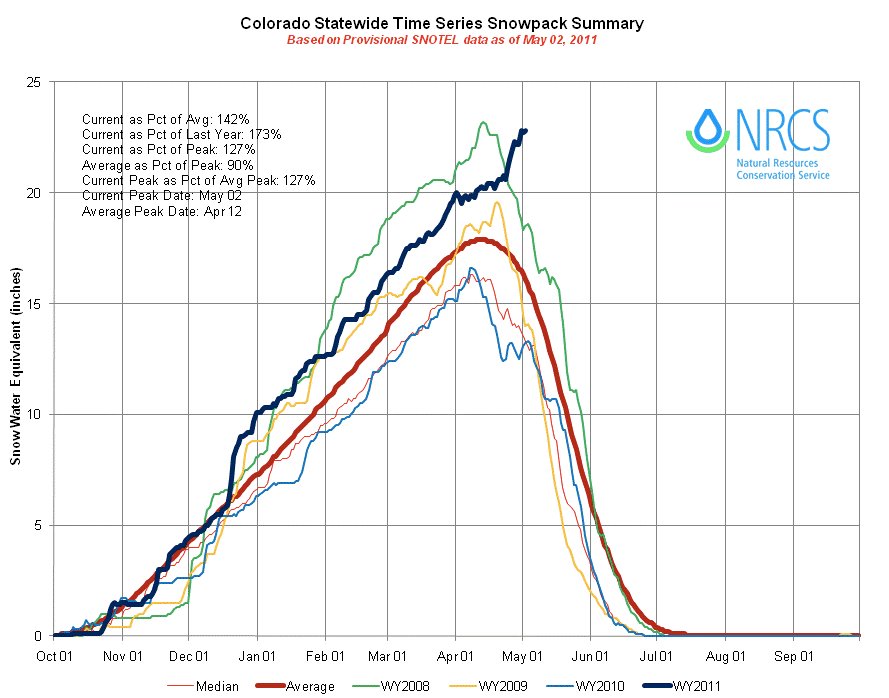
Water watchers know that the average peak is April 12. Click on the thumbnail graphic to the right for a look at the SNOTEL Basin Time Series Snowpack Summary Graphs. Today’s graph shows the highest peak value for the year so far.

From The Greeley Tribune (Bill Jackson):

John Fusaro and Todd Boldt of the U.S. Department of Agriculture’s Natural Resources Conservation Service in Fort Collins measured the snowpack in the Big Thompson and Poudre canyons Wednesday and Thursday and came back with unbelievable numbers — an average snow depth of 133 inches at Cameron Pass, the top of the Poudre. One measurement at that snowfield reached 161.5 inches, or almost 13.5 feet. At the highest field in the Big Thompson Canyon, the snow depth was 95 inches. “I’ve never seen that much snow at the end of April. Usually, the amount of snow starts to decline by this time of the year, but if it keep going like this we may be sent back up there at the end of May, and that’s never happened before,” Fusaro said Friday…

Perichino said the latest projections are that once the snowmelt starts, the Poudre River will flow at 6,0000 cubic feet per second, compared to 4,300 cfs when the river went out of its banks last spring. There is no place to put much, if any, of the expected runoff, he added. “We just hope there’s not a quick thaw along with thunderstorms like we had last year,” Perichino said…

Fusaro said the snow at Cameron Pass was almost too deep to measure in places. About two-thirds of the way up that field, he and Boldt found 161.5 inches of snow, and the measuring tube broke as they started to bring it back up. “We had to dig down 10 feet to get the rest of it. We were up there for the better part of two hours,” Fusaro said. The snow fields are marked with bright yellow signs on 8-foot iron posts. At the lower end of the Cameron Pass field, Fusaro said, they couldn’t find the signs. “We even took a metal detector with us, but it wasn’t good enough to find the signs. They were buried by too much snow,” he said.

Aurora: Watering restrictions in effect starting yesterday

A picture named watersprinkler.jpg

From The Denver Post:

Residents can pick any three days to water but no more than that. Also, watering is not permitted from 10 a.m. to 6 p.m. because that is the part of day when water tends to evaporate more.

Aurora Water officials are encouraging people to get out their hoses and sprinklers, as more trees and lawns are dying this year because of the lack of moisture this winter.

More Aurora coverage here.

Leadville: First ‘Water Aware’ session May 4

A picture named californiagulchleadville.jpg

When it comes down to water rights, it’s not just enough to be at the top of the hill, you had to the one or have acquired the right, that put the water to work watering hay or some other beneficial use. Here’s the announcment from the Leadville Herald Democrat:

The Lake County Watershed Advisory Council will host the first in a three-part series of water-education seminars, starting at 6 p.m. on the evening of May 4, in the Longyear Auditorium at the National Mining Hall of Fame and Museum. Doors will open for registration and informal discussion at 5:30 p.m.

The first session will focus on Colorado Water Law and its impacts on Lake County’s ability to provide a dependable source of water to support sustainable growth.

According to Mike Bordogna, Lake County commissioner, many people in Lake County aren’t aware that we don’t own the water passing through our community and are therefore of the false impression that we have all the water we will ever need to support our current and future needs…

The discussion of Colorado Water Law will be led by Steve Kastner, assistant division engineer for the Colorado Division of Water Resources, who will outline the state laws and regulations that all Colorado communities and individuals must abide by in securing water for their own use.

This will be followed by a presentation by David Hallford of Balcomb and Green, PC, Lake County’s water attorney, who will apply the principles and constraints of Colorado Water Law to the specific needs of Lake County, and discuss the steps needed to determine the county’s water future.

Time will be allowed for questions and answers. The session is free to the public, and refreshments will be served.

For information, go to www.wateraware2011.com

More education coverage here.

Leadville: Parkville Water District waiting on runoff

A picture named fountainpavementdrawing.jpg

Storage in the Parkville Water District’s raw water supply reservoirs is very low due to a combination of events. Here’s a report from Ann E. Wibbenmeyer writing for the Leadville Herald Democrate. From the article:

Most years, said Greg Teter, general manager, runoff begins filling two upper reservoirs by April 15. Evan’s Creek, which fills those reservoirs was still dry early this week. To add to the issue, a water main broke on the 500 block of East 8th Street near the Good Shepherd Lutheran Church at about 10 p.m. April 22. It was discovered at about 6 a.m. the next morning. The cause of this break is speculated to be connected to the ditch dug for the sanitation project last summer, which was parallel to the water line. The dirt began washing away and the water line went with it, said Teter. This caused a loss of about 500,000 gallons of water. “I’ve never seen it lower than this,” he said…

The issues facing the water district are all physical, he said, not legal. The district owns plenty of water rights, but is needing to find better ways of accessing the water. “There are ways to fix the issues that all involve money,” he said.

More infrastructure coverage here.

Energy policy — nuclear: The Japanese disaster played a role in Powertech’s decision to put their Weld County ‘Centennial Project’ on hold

A picture named uraniuminsitu.jpg

From the Fort Collins Coloradoan (Bobby Magill):

The company plans to focus all its efforts on getting its Dewey-Burdock uranium mine permitted and producing uranium in South Dakota before moving ahead with the Centennial Project, Powertech USA President Richard Clement said…

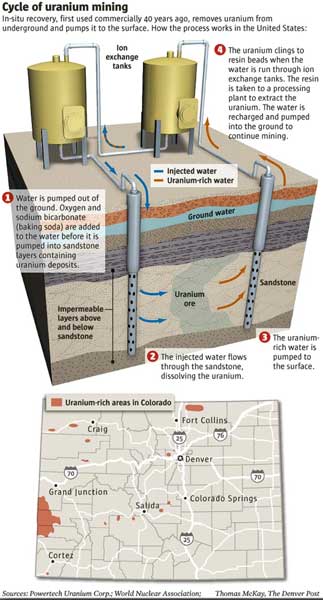
Powertech plans to mine uranium there and at Dewey-Burdock using a process called in situ leaching, requiring the company to inject a baking soda-like solution into the ground, dissolve the uranium ore and pump it out as a liquid. “Dewey-Burdock is the most advanced project the company has, therefore, we’re concentrating our efforts on Dewey-Burdock to get permitted,” Clement said. “Especially in the post-tsunami financial environment, we need to concentrate our efforts as much as any other company.”

The March 11 Tohoku earthquake in Japan and nuclear meltdown at the Fukushima Dai-ichi nuclear power plant that followed sent uranium prices plummeting. Just before the earthquake, uranium prices had topped out around $75. By Tuesday, the price had dropped to $55.25, according to TradeTech, a Denver-based uranium market analysis firm. “This is about as bad a story as you can imagine for the U.S. nuclear power industry,” said Charles Mason, True Chair of energy economics in the economics and finance department at the University of Wyoming, who is writing a book about uranium exploration and its impacts. “It certainly is bad news.”[…]

Dewey-Burdock, planned for South Dakota’s Black Hills on the Wyoming border west of Wind Cave National Park, is in the middle of a complex U.S. Nuclear Regulatory Comm-ission permitting process. NRC spokesman David McIntyre said he expects the Dewey-Burdock permitting process to be complete by mid-2012 unless federal budget cuts affect the agency. The future of Centennial is “going to be dependent upon what the results are going to be and how fast we get operating at Dewey-Burdock,” Clement said. Uranium production at Dewey-Burdock will generate enough cash flow to help finance Centennial, he said…

Powertech’s report also says a new Colorado law requiring complete cleanup of the groundwater at Centennial could affect the project’s profitability. For now, Powertech will continue with Centennial’s state and federal permits already in process, but the company will wait to pursue any additional required permits, Clement said.

From the Associated Press via the The Greeley Tribune:

The Coloradoan in Fort Collins reports that Powertech Uranium Corp. plans to focus on getting permits for a mine in South Dakota before moving forward with the proposed mine near the town of Nunn. Powertech USA President Richard Clement said Wednesday that the company will concentrate on the Dewey Burdock project near Edgemont, S.D., because it is further along. Clement says Powertech will move forward in Colorado only when the mine in southwestern South Dakota starts producing.

From Windsor Now! (Bill Jackson):

The Canadian company announced earlier this week it was putting its plans to mine uranium in northern Weld on hold indefinitely and would focus its efforts on a mining project in South Dakota. The effects of the Japanese nuclear disaster played a part in that decision, company officials said…

Weld County Commissioner Dave Long, who represents that area of the county, said while the decision in the short term is good for residents in the area, “it still doesn’t resolve the cloud that remains over them on the long term” concerning their quality of water. Although the county was asked to take a stance one way or another on the proposal, Long said it could not because it would have to conduct the permitting process for the proposal and a resolution either way would have presented many legal problems.

Jay Davis, who lives about 8 miles northwest of Nunn, is a member of two groups that oppose the project. “There are a lot of people who are pretty excited right now,” Davis said. But he, too, is concerned about the future. “I think what this shows is the volatile market (for uranium) and that’s subject to change overnight,” he said. He noted that when the uranium market crashed in the 1980s, it stayed that way for nearly 30 years before rebounding and that could happen again.

More nuclear coverage here and here.

NIDIS Weekly Climate, Water and Drought Assessment Summary of the Upper Colorado River Basin

A picture named wyutcoprecipitationapril17to232011

I’m very late in posting the link to last week’s webinar from the Colorado Climate Center.

Aspinall Unit update: Annual operations handouts and presentations available online

A picture named aspinallunitdescription.jpg

From email from Reclamation (Dan Crabtree):

The meeting was held at Reclamation’s Grand Junction office. Highlights of the operation meeting include:

Blue Mesa April through July inflow is projected at 800,000 af, representing an average wet year and approximately 111 percent of average. Based on this inflow, the Black Canyon reserved water right 1-day peak target is 6,370 cfs. This will be revisited when the May 1 forecast is received.

Blue Mesa Reservoir is expected to fill; following ramping down from peak flows, flows in the Gunnison Gorge should be in the 1,000-1,200 cfs range for the summer.

If you have any suggestions on improving the operation meetings or summaries, please let us know. The next operation meeting will be on Thursday, August 18th at the Elk Creek Visitors Center at Blue Mesa Reservoir…

Handouts and presentations are available for review at: http://www.usbr.gov/uc/wcao/water/rsvrs/mtgs/amcurrnt.html

Precipitation/snowpack news: One to three inches of snowfall in the Wet Mountain Valley

A picture named snowpackcolorado04292011

From The Pueblo Chieftain:

Across the region, snowfall Sunday ranged from 1 inch in Buena Vista to 5 inches in La Veta, on Monarch Pass, and in Salida. Canon City had about 2 inches, yielding .20 of an inch of moisture. Other snowfall Sunday included 3 inches in Monte Vista, Rosita and Rye and 3.5 inches in Walsenburg and Del Norte.

Denver Water: Williams Fork Dam valve testing, flows to fluctuate May 3-4

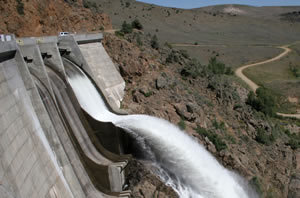
A picture named williamsorkdamspill.jpg

Here’s the release from Denver Water (Stacy Chesney):

Denver Water will be testing the new valve system at Williams Fork Dam, located about 20 miles west of Granby, May 3 and 4. During the testing, the flow in the Williams Fork River below the dam will fluctuate from about 110 cubic feet per second to about 540 cubic feet per second. Denver Water is coordinating the testing with the Colorado Division of Wildlife in order to protect downstream fisheries.

The new valves were installed earlier this year as part of Denver Water’s two-year, $17 million project to install a new hydro turbine and expand and repair the valve system at Williams Fork Dam.

The dam’s valve system controls the amount of water flowing from the reservoir into the Williams Fork River. After valves are tested and any adjustments are made, the utility will have the ability to release much greater amounts of water than is currently possible. With this year’s heavy snowpack, it will be important to have a fully functional valve system to minimize the amount of water passing over the spillway. A prolonged spill period will inhibit the remaining construction on the downstream side of the dam due to the spray and mud that spilling creates.

The Williams Fork Dam valve system was installed during the dam’s original construction in the 1930s. Making repairs to the building’s aging electrical and mechanical systems, as well as to the 50-year-old valves, will bring the valve system up to current state standards and help it run more efficiently.

Later this year, crews will install a new 0.5 megawatt hydro turbine, which will increase the power plant’s generating capacity to 3.6 megawatts — enough electricity to power about 3,000 homes. The new turbine also will allow Denver Water to generate electricity during the winter, when the release rate from the reservoir historically has been too low to generate power.

The original dam at Williams Fork Reservoir was built in the 1930s. In the mid-1950s, Denver Water raised the dam — building it up to its current height of 209 feet — and installed a hydropower plant at Williams Fork, making it the first hydropower plant in Denver Water’s system.

The construction work should be finished in 2012.

More Colorado River basin coverage here.

Colorado River Cooperative Agreement: Should the agreement have included more from a fisherman’s point of view?

A picture named eisenhowerfishing.jpg

The Fraser River was a favorite fishing hole for President Eisenhower whose wife had Colorado roots. The stream has changed much since those days and more changes are coming. In today’s Denver Post Scott Willoughby tempers his enthusiasm for the landmark agreement by asking the obvious question. Where do Colorado-Big Thompson diversions fit in? From the article:

If we can dismiss politics for a moment, the fisherman’s perspective might help simplify things. And by simplify, I mean, point out the obvious flaws in the plan before uncorking the champagne.

For starters, this so-called “global” pact regarding future use of the Colorado River was designed to push Colorado away from trans-basin water diversions, yet it failed to include the Northern Colorado Water Conservancy District, the single largest user of Upper Colorado River water. Northern’s Colorado-Big Thompson and Windy Gap trans-mountain diversions are responsible for removing more water from the Upper Colorado than anything else, and Northern currently has plans on the table to take another 30,000 acre-feet per year through its Windy Gap Firming Project. Yet, during the course of the five-year negotiation, Northern wasn’t at the table.

Denver Water was. And among the greatest rewards it received for playing is a tacit approval of the proposed Moffat Collection System Project that will draw another 18,000 acre-feet annually from the Colorado headwaters and move it to an expanded Gross Reservoir near Boulder…

The Windy Gap Firming Project alone is likely to decrease water level in Lake Granby, reduce trout habitat and food sources in the Colorado River and impose challenges to boaters floating the river at certain times of the year.

And, it seems, the Ute Water Conservancy District is not on board with the agreement. Here’s a report from TheDenverChannel.com. From the article:

The Grand Junction-based district is concerned about its water rights if the Shoshone Generating Station stops operating. The water right for the station is among the most senior on the Colorado River. Ute Water also doesn’t like the way water stored in Green Mountain Reservoir in central Colorado would be accounted for.

More coverage from Joe Hanel writing for The Durango Herald. From the article:

The agreement does not involve water from Southwest Colorado, although it will help the entire western half of the state by creating a new culture that requires agreement from everyone before water can be pumped east, said Eric Kuhn, head of the Colorado River Water Conservation District. “The West Slope’s interests were very simple and that is to preserve what makes Western Colorado special and unique, and that is the ecosystem, and the Colorado River is key to that,” Kuhn said.

Denver and 33 Western Slope groups, including towns and ski areas, signed on to the agreement. But other major Front Range utilities did not join in the accord.

Under the agreement, when water is scarce, Denver Water agrees not to use its legal right to draw down streams in Grand County unless Denver has banned residential lawn watering. In return, Denver secured Western Slope agreement to expand its service area by providing recycled water to its suburbs. The southern suburbs have been among the fastest-growing areas of the country the last 15 years, but they lack a reliable long-term water supply. Denver also agreed not to drain Lake Dillon – its main reservoir – too low, and to support a kayak park in Glenwood Springs that would require water to flow downstream, away from Denver’s system of pumps and reservoirs.

Western Colorado has long been wary of Denver because the city owns legal rights to pump Colorado River water east over the Continental Divide. The Denver suburbs are also on a desperate hunt for water, and their high populations give them the money to buy the rights to even more Western Slope water. Thursday’s agreement is historic because Denver agreed to take less water than it has the legal right to use. The city will devote some of its supply to Western Slope ski resorts and communities.

More Colorado River Cooperative Agreement coverage here.

Arkansas River Basin Water Forum recap: Some of Fountain Creek’s problems were front and center in the discussion

A picture named fountaincreekwatershed.jpg

From The Pueblo Chieftain (Chris Woodka):

While Fountain Creek is a tributary midway between Leadville and the Kansas border, the growth in its basin has had consequences up and down the river. El Paso County has about 80 percent of the Arkansas River basin’s population and Colorado Springs has taken extraordinary measures to move flows from both the Arkansas and Colorado rivers into the Fountain Creek watershed. As a result, the return flows — water that comes out of sewage treatment plants or that percolates off lawns — have increased. Flows into Fountain Creek have been altered as ground where water once soaked in has been paved to accommodate urban lifestyles…

One of the major reasons the [Fountain Creek Watershed Flood Control and Greenway District.] was formed was a proposal by Colorado Springs to divert even more water for itself and its neighbors through the Southern Delivery System. Leaders in Pueblo hammered out a series of agreements to protect the Arkansas River and Fountain Creek as SDS moved through its permitting. “There are serious questions about how to manage the return flows on Fountain Creek and these workshops have brought out many things that we need to take into account as we develop the master plan,” said Larry Small, the executive director of the Fountain Creek district. “I think we have to start with taking care of the eroded areas, and shore up the creek starting from those areas.”[…]

Water rights also will come into play on Fountain Creek as projects progress, Division Engineer Steve Witte said. “Is our prior [appropriation] system flexible enough to accommodate wetlands?” Witte asked, addressing a demonstration project on Fountain Creek in north Pueblo that proposes to create a flood detention pond. “Vested water rights are entitled to a continuation of stream conditions that existed at the time of their water rights appropriations,” he said…

Tougher water quality environmental regulations are coming into play over the next decade that will affect sewage and stormwater discharges into rivers, said Dick Parchini of the Colorado Water Quality Control Division. New standards are being developed for phosphorus, nitrogen and chlorophyll, which are byproducts of both urban and agricultural uses of water. Many come from “non-point” sources which cannot be easily identified or regulated. There are conflicting ideas about what the right standards should be. Water full of nitrogen isn’t good for drinking, but benefits crops. A lake with healthy amounts of algae is good for fish, but too much can choke off oxygen supplies as the algae die, and municipalities like their supplies “gin clear,” he said.

More Fountain Creek coverage here and here.