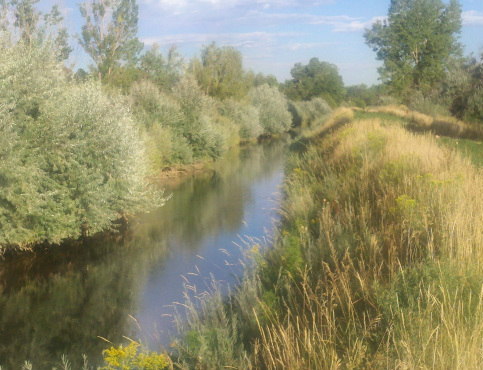
The United States Geological Survey: 1879-1989

johnwesleypowell.jpg

Here’s a nice concise history of the USGS (Mary C. Rabbitt). Click through for the whole series of articles, cool drawings and photographs. Here’s the announcement:

The United States Geological Survey was established on March 3, 1879, just a few hours before the mandatory close of the final session of the 45th Congress, when President Rutherford B. Hayes signed the bill appropriating money for sundry civil expenses of the Federal Government for the fiscal year beginning July 1, 1879. The sundry civil expenses bill included a brief section establishing a new agency, the United States Geological Survey, placing it in the Department of the Interior, and charging it with a unique combination of responsibilities: “classification of the public lands, and examination of the geological structure, mineral resources, and products of the national domain.” The legislation stemmed from a report of the National Academy of Sciences, which in June 1878 had been asked by Congress to provide a plan for surveying the Territories of the United States that would secure the best possible results at the least possible cost. Its roots, however, went far back into the Nation’s history.

The first duty enjoined upon the Geological Survey by the Congress, the classification of the public lands, originated in the Land Ordinance of 1785. The original public lands were the lands west of the Allegheny Mountains claimed by some of the colonies, which became a source of contention in writing the Articles of Confederation until 1781 when the States agreed to cede their western lands to Congress. The extent of the public lands was enormously increased by the Louisiana Purchase in 1803 and later territorial acquisitions.

At the beginning of Confederation, the decision was made not to hold the public lands as a capital asset, but to dispose of them for revenue and to encourage settlement. The Land Ordinance of 1785 provided the method of surveying and a plan for disposal of the lands, but also reserved “one-third part of all gold, silver, lead, and copper mines to be sold or otherwise disposed of, as Congress shall thereafter direct,” thus implicitly requiring classification of the lands into mineral and nonmineral. Mapping of the public lands was begun under the direction of the Surveyor-General, but no special provision was made for classification of the public lands, and it thus became the responsibility of the surveyor. There was,of course, no thought in 1785 or for many years thereafter of employing geologists to make the classification of the mineral lands, for geology was then only in its infancy.

More USGS coverage here.

Irrigators, ranchers and conservationists look to form the Western Agriculture and Conservation Coalition, passage of the farm bill first on agenda

farmershighlinecanalarvada.jpg

Here’s the release from the Environment Defense Fund.

Here’s the list of contacts:

Contacts:
Jeff Eisenberg, Rockspring Resource Solutions, Coalition Staff, 571-355-3073
Trout Unlimited, Russ Schnitzer, 307-438-1365
Family Farm Alliance, Dan Keppen, 541-892-6244
The Nature Conservancy, Sean McMahon, 515-244-5044
Arizona Public Lands Council, Dave Cook, 928-701-3021
Environmental Defense Fund, Dan Grossman, 303-447-7213
Wyoming Stock Growers, Jim Magagna, 307-638-3942
California Farm Bureau, Elisa Noble, 916-561-5618
Public Lands Council, Dustin Van Liew, 202-879-9126
Irrigation Association, John Farner, 703-536-7080

Here’s the text of the release:

Representatives of the California Farm Bureau Federation, Trout Unlimited, Wyoming Stock Growers Association, The Nature Conservancy, Arizona Public Lands Council, Environmental Defense Fund, Family Farm Alliance, Public Lands Council and the Irrigation Association agreed on Saturday, February 25, subject to the approval of their Boards, to form the Western Agriculture and Conservation Coalition to advocate for balanced management of resources in the rural west.

The goals of the Coalition would be to support the common interests of agriculture and conservation through targeted education, advocacy, and outreach and to engage decision makers and resource managers in the spirit of collaboration to further a shared vision for a rural west that is economically and environmentally sustainable.

“Livestock producers look forward to the opportunity to show the inextricable connection between their ability to stay in business, and the health of the economies and natural resources of the West,” said PLC president and rancher from Nevada, John Falen. “Through wise resource use over generations, and through clear private property rights, ranchers have proven themselves diligent stewards of the land.”

Chris Wood, President and CEO of Trout Unlimited, said: “successful conservation depends on collaboration. In the West, many of our conservation projects wouldn’t happen without two things: agricultural producer partners and Farm Bill support. We urge Congress to act quickly to ensure a Farm Bill that continues to provide vital tools for private land stewardship.”

As a first step, the groups agreed to call on Congress to pass the Farm Bill this year in order to ensure the greatest possible amount of funding for the conservation title. The Senate Agriculture Committee is holding a conservation hearing today, an action which the groups agreed was an important step in the right direction. The groups will submit detailed policy proposals to the Committee in the next few days.

While the current farm bill debate is the priority of the coalition, members of the Western Agriculture and Conservation Coalition look forward to potentially expanding the coalition’s focus to include other areas of importance to western agriculture production and conservation efforts.

Here’s a release from Trout Unlimited (Jeff Eisenberg):

A new coalition of conservation and agriculture groups called on Congress to pass the Farm Bill this year to ensure full funding for conservation title programs, saying they are critical to the health of Western economies and landscapes.

The newly formed Western Agricultural and Conservation Coalition
includes the California Farm Bureau Federation, Trout Unlimited, Wyoming Stock Growers Association, The Nature Conservancy, Arizona Public Lands Council, Environmental Defense Fund, Family Farm Alliance, Public Lands Council and the Irrigation Association. The coalition will advocate for balanced management of resources in the West, educate about the common interests of agriculture and conservation, and engage decision-makers to further a shared vision of a rural West that is economically and environmentally sustainable.

As a first step, the groups called on Congress to pass the Farm Bill
this year in order to ensure full funding for the conservation title
programs. The Senate Agriculture Committee held a conservation hearing
this week, an action which the coalition agreed was an important step in the right direction. The groups will submit detailed policy proposals to the Committee in coming days.

”Successful conservation depends on collaboration,” said Chris Wood,
president and CEO of Trout Unlimited. “In the West, many of our
conservation projects wouldn’t happen without two things: agricultural
producer partners and Farm Bill support. We urge Congress to act quickly to ensure a Farm Bill that continues to provide vital tools for private land stewardship.”

The Farm Bill is one of the nation’s most successful and powerful
drivers of on-farm conservation and innovation. More than ever, for
producers to reduce risks and remain competitive, they have to make sure they’re operating as efficiently as possible.

But for many farmers and ranchers, investing in new irrigation
upgrades—not to mention stream habitat improvements—is often
cost-prohibitive.

That’s where the Farm Bill’s highly effective Title II conservation
programs—EQIP, AWEP, CCPI and others—play a key role. For more than 75
years, they’ve helped fund infrastructure modernization and conservation projects that benefit ag operations while protecting stream health and wildlife habitat.

While the current Farm Bill debate is the priority of the coalition,
members of the Western Agriculture and Conservation Coalition look
forward to potentially expanding the coalition’s focus to include other areas of importance to western agriculture production and conservation efforts.

“Livestock producers look forward to the opportunity to show the
inextricable connection between their ability to stay in business, and
the health of the economies and natural resources of the West,” said
John Falen, PLC president and rancher from Nevada. “Through wise
resource use over generations, and through clear private property
rights, ranchers have proven themselves diligent stewards of the land.”

More coverage (and thanks for the heads up) from National Geographic (Jennifer Pitt):

Irrigated agriculture is a vital part of the culture, economy, and landscape of rural communities throughout the region. But with increasing population pressure, the looming threats of deeper, longer droughts, and aging infrastructure, irrigated agriculture faces an uncertain future.

Now, as Colorado River Basin stakeholders contemplate possible solutions to long-term shortfalls in the balance between water supply and demand, a group of agricultural and conservation organizations have joined efforts in a ground-breaking new coalition. The Western Agriculture and Conservation Coalition’s goal is to advocate for balanced management of resources, including water, in the rural West.

The coalition has asked Congress to reauthorize the Farm Bill this year to provide maximum possible funding for a number of conservation programs, including those related to water. Members of the coalition include the California Farm Bureau Federation, Trout Unlimited, Wyoming Stock Growers Association, The Nature Conservancy, Arizona Public Lands Council, Environmental Defense Fund, Family Farm Alliance, Public Lands Council, and the Irrigation Association.

Throughout the West, Farm Bill conservation programs have helped modernize irrigation operations, often in ways that improve river health. We are beginning to see these types of projects in the Colorado River Basin: in Colorado, the Mancos Conservation District is using Farm Bill conservation funding to leverage other local and state funds to replace aging diversion structures and restore instream habitat on the Mancos River.

Another example is the work of ranchers on the Yampa and Gunnison Rivers in Colorado who, working with Trout Unlimited and Farm Bill conservation program funding, are installing new head gates and gated pipe, as well as adding fish passage structures. These projects improve both crop productivity and instream and riparian habitat.

More Colorado River basin coverage here.

Should there be a Clean Water Act exemption for ‘Good Samaritan’ efforts at cleaning up abandoned mines?

big5tunnel.jpg

The idea is catching on in some circles. Here’s a report from Gus Jarvis writing for The Telluride Watch. From the article:

After nearly 20 years of inaction, the creation of a Good Samaritan policy with regard to the cleanup of abandoned mine drainage flows has gained broad support across the West. There is now hope that it might gain traction with federal legislators and policy makers in Washington, D.C…

According to Ouray County Commissioner Lynn Padgett, the liability issue for Good Samaritans working on draining mines goes all the way back to 1994, when the EPA determined that draining mines are point source discharges and require National Pollution Discharge Elimination System permits.

All too often, no viable financially responsible party exists for the abandoned mines. While the water quality in the vicinity of the mine continues to be impaired, no one can be held responsible for cleaning it up. Good Samaritans, be it state or federal agencies, watershed groups, environmental groups, or mining companies, often have programs in place to implement a mine cleanup but the liability issue prevents them from going forward with the cleanup.

“This is something people have been asking for 20 some years,” Padgett said in an interview on Tuesday. “There are some examples in Colorado of filtration systems that have been built but not turned on because of the liability piece. I think there has to be a common sense answer here.”

U.S. Senators Barbara Boxer (D-Calif.), Mark Udall (D-Colo.) and Michael Bennet (D-Colo.) have addressed the issue with the EPA, asking it to use its authority to create a Good Samaritan policy that would allow them to improve water quality without fear of liability or citizen lawsuits under the Clean Water Act. Udall has been in favor of a Good Samaritan policy during his tenure in the Senate and has continued to push the idea. In 2009, Udall introduced the Good Samaritan Cleanup of Abandoned Hardrock Mines Act, which has not yet passed. Last month, after writing a letter to the EPA, Udall again took the issue to the Senate floor to gain support from his colleagues.

“Good Samaritans are too valuable of a resource to keep on the sidelines,” Udall said on Feb. 14. “Congress should do what is necessary to bring their efforts to bear on the cleanup of abandoned mine pollution…Good Samaritans can’t solve all of our abandoned mine pollution problems, but we can’t afford to turn away those willing to help any longer.”

More water pollution coverage here. More Good Samaritan coverage here and here.

Colorado Springs Utilities’ Steve Berry: ‘In looking at the numbers in this executive summary, it does not appear that many of our comments were considered’

transmountaindiversionscoloradostateengineer2011

Last week, the day before the Statewide Roundtable Summit, Western Resource Advocates, et. al., released a report titled, “Meeting Future Water Needs in the Arkansas Basin.” Colorado Springs and Pueblo are taking a hard look at the report, according to this article from Chris Woodka writing for The Pueblo Chieftain. Here’s an excerpt:

There may be a question whether water providers accept the figures used in the reports. “Colorado Springs Utilities was asked to peer review the draft version, and made extensive and substantial comments on it. In looking at the numbers in this executive summary, it does not appear that many of our comments were considered, and many of our suggested changes or corrections were not made,” said Steve Berry, spokesman for Utilities. The largest amounts of water, and presumably the largest conservation and reuse savings, come from Colorado Springs.

The Pueblo Board of Water Works is also reviewing the final report for accuracy, said Alan Ward, water resources manager…

The environmental groups say a combination of projects already on the books — conservation, reuse and temporary ag-urban transfers — could provide as much as 140,000 acre-feet, more than enough to meet the needs. Those numbers are being examined by urban water planners, who say the savings might not be attainable. “In general, we were unable to verify or recreate most of the numbers cited in their report, and their estimates for conservation and reuse are significantly greater than what our water conservation experts have calculated as realistic,” Berry said…

When asked how conservation savings would be applied to new supplies, a practice cities find risky, Jorge Figueroa, water policy analyst for Western Resource Advocates, said they could be put into “savings accounts” for future use. When asked where the water would be stored, he cited the T-Cross reservoir site on Williams Creek in El Paso County that is part of the Southern Delivery System plan…

Drew Peternell, director of Trout Unlimited’s Colorado Water Project, said the group supports [the Southern Delivery System]. Because the project already is under way, the groups look at SDS as a key way to fill the gap. The report also supports programs like Super Ditch as ways to temporarily transfer agricultural water to cities without permanently drying up farmland.

Meanwhile, here’s a look at a report from the Northwest Council of Governments, “Water and Its Relationship to the Economies of the Headwaters Counties,” from Bob Berwyn writing for the Summit County Citizens Voice. From the article:

The report, released in January at a Denver water conference, takes a fresh look at the critical importance to the economy of water in West Slope rivers, and why Colorado leaders may want to take careful thought before making future transmountain diversion policy decisions. Visit the NWCCOG website for the full 95-page report.

“This report makes an important contribution to the on-going dialogue about adverse economic impacts associated with losing water by focusing attention on Eagle, Grand, Gunnison, Pitkin, Routt and Summit counties,” said Jean Coley Townsend, the author of the report. “This has never been done before. The report provides an important counterbalance to earlier studies that show economic impacts of losing water from the Eastern Plains.”

Balancing the supply and demand of water could be the State’s most pressing issue. The report does not take issue with Front Range municipal or Eastern Plains agricultural water users — all parties have important and worthy concerns and points of view — but is meant as a thorough review of water as an economic driver of headwaters economic development.

The report provides a balance to the existing solid body of work that measures the potential economic effects of less water on the Front Range and the Eastern Plains and the loss of agriculture in those parts of the state.

“If we … are going to solve our Statewide water supply shortage challenges there must first be statewide mutual respect and true understanding of each other’s water supply challenges,” said Zach Margolis, Town of Silverthorne Utility Manager. “The report is a remarkable compilation of the West Slope’s water obligations and limitations as well as the statewide economic value of water in the headwater counties of Colorado.”

More transmountain/transbasin diversions coverage here.

Happy 140th birthday to Yellowstone National Park

oldfaithfulanseladams.jpg

Thanks to the Colorado Environmental Coalition Twitter feed (@CoEnviroCo) for the heads up.

A team of geologists is making the claim that all of Yellowstone’s geysers may share the same geology, heat and water source. Here’s a report from Crystal Gammon writing for the Discovery Channel. From the article:

A team from the U.S. Geological Survey in Menlo Park, Calif., recently dove into the question of just where Yellowstone’s water comes from. Their findings indicate that the region — and its variety of geysers, mud pots and hydrothermal pools — could be supplied by a single water source that continuously boils, mixes and flows its way through the park.

” Visitors to Yellowstone and even professional naturalists may not realize that the acid fumaroles and mud pots at Yellowstone represent the steam boiled off of deeper boiling groundwater that ultimately emerges kilometers away,” said Jacob Lowenstern, the geochemist who led the team’s study.

Blue Mesa Dam: ‘The reservoir took away small communities, family homes, fishing resorts, a way of life’ — Delta County Independent

bluemesadamopeningceremony1965deltacountyindependent.jpg

From the Delta County Independent (Kathy Browning):

This winter the museum has had eight presentations on pioneer families and others who made a difference in the community. Two more presentations are scheduled. On March 17 at 1:30 p.m. at the museum, Danny Cotten will give a presentation on sawmills on Black Mesa and in the Crawford area and also the Diamond JO cattle outfit in the 1880s. April 21 at 1:30 p.m., Ross Allen will talk about the Allen family and their influence on the area.

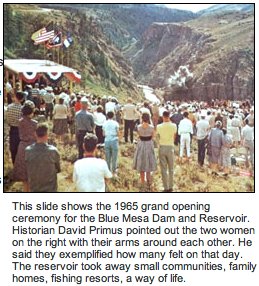
David Primus, Gunnison author and historian, gave a presentation, “Beneath Blue Mesa.” The dam was completed in 1965 on the Gunnison River about 30 miles west of Gunnison, 30 miles east of Montrose and within 1-1/2 miles of Sapinero.

Primus shared what it was like before the dam and reservoir were created. There were homes, hotels, fishing resorts, train service, bridges and cattle ranches in the small towns that were in the area. To make the area ready for the new dam and reservoir, those hotels and homes were moved or burned to the ground. Bridges were left standing and are now beneath a mountainous amount of water. The slide show featured a final cattle round up, trains connecting people and commerce, a group of boaters and fishermen and women who called themselves the Gunnison Navy and the grand opening ceremony for the Blue Mesa.

More Aspinall Unit coverage here.

What does the rate payer get for their dough?

fountainpavementdrawing.jpg

Here’s Part Two of the Mile High Newspapers series “Unquenchable Thirst” (Megan Quinn). Ms. Quinn evaluates what goes into high quality water delivered to your tap. Click through and read the whole article. Here’s an excerpt:

Conservation is key, water providers said. In fact, water bills are often designed to encourage residents to watch their usage. In some cities, such as Thornton, Arvada, Wheat Ridge and Northglenn, rates are determined based on how much is used per month. When families use a base number of gallons, they pay one rate. But if they let the tap run long enough to spill over into the next tier of usage, the same family would pay a higher rate per gallon.

For example, an average Westminster household pays about $3.78 per 1,000 gallons. If usage goes above 20,000 gallons in a given month, the bill will hit $5.60 per 1,000 gallons instead.

Jim Sullivan, Arvada’s utilities director, said the tiered system helps encourage conservation, but it’s rare for households to move into a more expensive tier.

An average household used about 115,000 gallons of water in 2010, according to Denver Water, a public utility that serves about 1.3 million people in the metro region.

More infrastructure coverage here.

Clear Creek: Anne Beierle (City of Golden) — ‘I don’t know another river in Colorado that has so much data collection’

clearcreekwatershedmap.jpg

Here’s Part Three of the Metro North Newspapers series “Unquenchable Thirst” (Megan Quinn). Ms. Quinn explores the world of Front Range municipal diverters and the quality of the surface water supply. Click through and read the whole thing. Here’s an excerpt:

Whether it’s waterborne diseases, invasive species or pollution, it’s up to a combination of water laboratories, testing facilities, activist groups and government agencies to make sure the water we drink is clean. For many cities, monitoring begins at a treatment plant, such as the city of Golden, which serves as a central location for collecting a huge volume of data on Clear Creek and its flow.

Golden is part of a group of cities that helps collect and publish detailed data sets on the water’s quality and condition.

“I don’t know another river in Colorado that has so much data collection,” said Anne Beierle, the city’s deputy director of public works.

The group started in the early 1990s as a way for cities that use Clear Creek water, such as Golden, Arvada, Thornton, Northglenn and Westminster, to monitor quality and share information.

Snowpack news: Storage is near average or slightly above around the state

snowpackcolorado03021012

Here’s Part Four of the Metro North Newspapers series “Unquenchable Thirst” (Linda Detroy). Ms. Detroy explains how the state keeps and eye on the sky to assess water availability for the irrigation season. Click through and read the whole article. Here’s an excerpt:

“If we get a lot of heavy snow from this time of year through the end of the season, we get quick runoff that creates flooding problems and disappears. Then we’re down to low flows for the remainder of the year,” Nettles said. “If a city has reservoirs to capture water, it may be OK.”

According to the most recent report on water supply conditions from the Water Availability Task Force, cities in Division 1, which includes all of Jefferson and Adams counties and is organized around the South Platte, Laramie and Republican river basins, are looking at a so-so situation. The report shows that, as of Jan. 31, reservoir storage was near or above average across the state, but the snowpack was low. As of Feb. 1, for Division 1, snow- pack was 77 percent of normal, and the National Weather Service forecast through May for the South Platte river basin is for below-average precipitation and above-average temperatures.

From the Summit County Citizens Voice (Bob Berwyn):

Long-time weather watcher Rick Bly tallied 33 inches of snow in February, compared to the long-term average of 23.5 inches. On some days, strong winds may have blown some of the snow away from the measuring stick, Bly said. That’s why the snow-water equivalent from the melted snow is a more important reading, and Bly said the February total was an encouraging 2.59 inches of water, well above the average 1.71 inches…

For the year-to-date, the precipitation total is just above average for the first time since October, at 7.95 inches of water, compared to the average 7.52 inches for this time of year. That’s good news for the Blue River Basin, where the snowpack has lagged most of the winter, but statewide, the snowpack is still about 15 percent below average. The Blue River Basin feeds the Colorado Basin, where the snowpack is now at 80 percent of average, up a bit from a month ago.

The South Platte Basin is still reporting the highest snowpack reading, at 93 percent of normal, while the Yampa and North Platte basins are at about 80 percent. In the southwestern river basins, the snowpack ranges between 84 and 88 percent of average…

In Dillon, Denver Water observers recorded 12 inches of snow in February, compared to the average 18.6 inches. That melted down to just 0.75 inches of water, well short of the average 1.2 inches.

Flaming Gorge pipeline: Should Front Range businesses more supportive of the project?

flaminggorgedrycoloradoestuary9billionbillboard.jpg

Bart Taylor (ColoradoBiz) is wondering why Front Range businesses are not clearly on board with Aaron Million’s plans for the Flaming Gorge pipeline. Here’s an excerpt:

There’s been little or no reaction from Front-Range business, the main beneficiary of the pipeline, though more than a dozen communities have committed to buy water if the pipeline is built. Jaeger’s group supports the Colorado Water Authority’s proposal, unaffiliated with Million’s and not affected by the FERC ruling. In a statement, South Metro remained committed to Flaming Gorge as one option to develop new supplies of “renewable surface water” for the region.

Million and Jaeger, famously at odds, are seemingly left to defend Flaming Gorge on their own. Jaeger, in the Post, doubted that the tool-kit proposed by opponents, including conservation, would be sufficient to address the state’s substantial long-term water needs. He’s consistently asserted that Colorado must think big to tackle the issue. So far, businesses here seem unconvinced…

Data may be tilting in favor of Million and Jaeger. One prominent study has show Colorado may be using less water than interstate agreements allow. More research is on the way. The Bureau of Reclamation will release a Basin-wide supply and demand study this summer. If it’s shown Colorado is entitled to more and is able to maneuver to use or store more water, Flaming Gorge will remain very much in play.

It might serve Colorado’s Front-Range business community to determine if its proponents are right.

More Flaming Gorge pipeline coverage here and here.

New National Water Trails System to Promote Healthy, Accessible Rivers: Atlanta’s Chattahoochee River to become first national water trail of its kind

chattahoocheerivergeorgia.jpg

Here’s the release from the U.S. Department of Interior (Adam Fetcher/David Barna):

Secretary of the Interior Ken Salazar today unveiled the National Water Trails System, a new network that will increase access to water-based outdoor recreation, encourage community stewardship of local waterways, and promote tourism that fuels local economies across America.

Today’s announcement comes in advance of Friday’s White House Conference on Conservation hosted by the Department of the Interior. The conference will spotlight community-driven conservation efforts as part of President Obama’s America’s Great Outdoors Initiative.

“Rivers, lakes, and other waterways are the lifeblood of our communities, connecting us to our environment, our culture, our economy, and our way of life,” Salazar said. “The new National Water Trail System will help fulfill President Obama’s vision for healthy and accessible rivers as we work to restore and conserve our nation’s treasured waterways.”

Secretary Salazar signed a Secretarial Order that establishes national water trails as a class of national recreational trails under the National Trails System Act of 1968. The order sets the framework for Secretarial designation of water trails that will help facilitate outdoor recreation on waterways in and around urban areas, and provide national recognition and resources to existing, local water trails.

“The Corps will actively participate, working with many local partners, to develop the water trails system and connect people to the water resources close to their homes,” said Jo-Ellen Darcy, Assistant Secretary of the Army for Civil Works. “The National Water Trails System will recognize and promote local efforts at a national level.”

Today, Secretary Salazar also announced that the Chattahoochee River Water Trail in Georgia will be the first river to be designated as a National Water Trail under the new system. The water trail travels through 48 miles of river within the Chattahoochee River National Recreation Area. The park serves 3.2 million visitors annually, most from the local Atlanta metro-region. In addition to providing over 65% of the public greenspace in this urban region, the river provides most of Atlanta’s drinking water. The park and new water trail contain 18 developed public access points and connects with other local city and county parks. The river is heavily used by anglers, tubers, kayakers, canoers, and rafters.

“The Chattahoochee River Water Trail provides clean water, greenspace, and river access for millions of Americans every year,” Salazar said. “As our nation opens a new chapter on rivers – one where we value our waterways for their recreational, economic and ecological importance – it is fitting that the Chattahoochee River Water Trail leads the way.”

To see pictures of the Chattahoochee River Water Trail, click here.

With each designation, signage, technical assistance and resources will be provided to build on and promote the development of quality water trails. Water trails that are designated can become catalysts for restoring the health of local waterways throughout the community.

The National Trails System Act of 1968 authorized the creation of a National Trails System composed of National Recreation Trails, National Scenic Trails and National Historic Trails. Although National Scenic Trails and National Historic Trails may only be designated by an Act of Congress, National Recreation Trails may be designated by the Secretary of the Interior and the Secretary of Agriculture.

Under the Secretarial Order, the National Park Service will coordinate the national water trail nomination process.

To learn more about the National Trails System, please visit: http://www.nps.gov/nts/

Thanks to Bob Berwyn (Summit County Citizens Voice) for the heads up.

Colorado-Big Thompson Project update: Reclamation is moving water to Carter Lake

coloradobigthompsonprojecteastslopesystemncwcd.jpg

From email from Reclamation (Kara Lamb):

A busy maintenance season that has continued from late fall well into the New Year is starting to wrap up. As a result, we have started pumping water up to Carter Lake again. Also, the water elevation at Horsetooth Reservoir is higher than is typical for this time of year.

More Colorado-Big Thompson Project coverage here.

Reclamation to use aerial photography for Arkansas Valley Conduit

arkansasvalleyconduitproposed.jpg

Here’s the release from the U.S. Bureau of Reclamation (Kara Lamb):

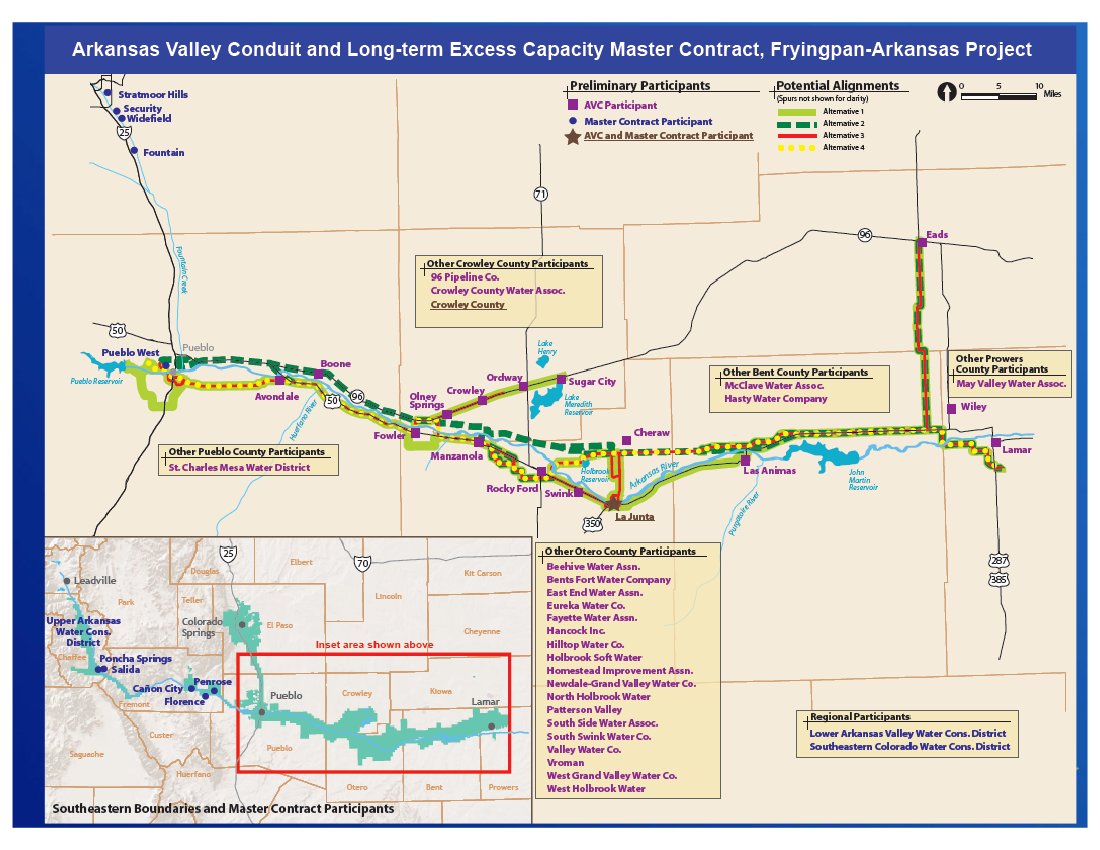
Reclamation employees will perform aerial panel placement for surveying along the Lower Arkansas River Valley corridor March 7-17. The panel placement is part of Reclamation’s National Environmental Policy Act research on the proposed Arkansas Valley Conduit and Long Term Excess Capacity Master Contract.
Reclamation has identified five possible pipeline routes from Pueblo to Lamar that will be surveyed. The survey crews will use large white panels shaped like giant plus signs in conjunction with aerial photography to map the potential routes.

The panels are constructed flat on the ground and the locations are calculated using global positioning equipment. Once placed, they need to remain on the ground for up to three weeks. The panels are used with aerial photography from an airplane flying at 5000 feet to obtain topographic information. The topographical data will be used to design the water pipeline.

During the survey process, some private land may need to be accessed by Reclamation surveyors. In those cases, most property owners will be contacted in person by Reclamation staff.

To learn more about the proposed Arkansas Valley Conduit, proposed Master Contract, and the related NEPA process, please visit: www.usbr.gov/avceis. Media is invited to contact Kara Lamb at (970) 062-4326 or klamb@usbr.gov.

More Arkansas Valley Conduit coverage here.

Twilight for Bonny Reservoir: The draining of the reservoir is nearly complete, thousands of fish die

bonnyreservoir.jpg

From 9News.com (Matt Flener):

Since state officials started draining Bonny Lake’s water in the fall of 2011 because of the decision, thousands of fish have died at the reservoir. Last week, workers from the Federal Bureau of Reclamation, which owns Bonny’s land in cooperation with the State of Colorado, had to unclog the drain from the dam using pitchforks, because so many fish had piled up. Backhoes then buried fish underneath the reservoir’s soil.

Colorado State Engineer Dick Wolfe says the practice has taken place, sometimes every other day, to keep water flowing to Kansas. Wolfe says his department has worked with the Bureau of Reclamation to humanely bury the fish so they would not become a health hazard or a visual problem at the lake in the long term. Knowing they would drain the lake, last year state officials tried to get fishermen to catch as many fish as possible by taking away catch limits at Bonny.

More Republican River basin coverage here and here.

Montrose: BLM’s Regional Advisory Council to meet March 7-8, Upper Colorado fee hikes on the agenda

coloradorivergranby.jpg

From the Summit County Citizens Voice (Bob Berwyn):

At issue is a Bureau of Land Management proposal to up the daily fees at the Pumphouse and Radium sites from $3 to $5 per vehicle, as well as a small hike for commercial users, who make up the bulk of the use at the sites, from $1 to $1.25 per day.

“The river is popular because it’s affordable,” said Dave Costlow, executive director of the Colorado River Outfitters Association, explaining that a half-day run down the relatively gentle waters of the reach costs about $45 per person. “If you have a family of five, it all adds up,” Costlow said, describing it as a 25 percent increase that will be passed on to consumers. The BLM already gets 3 percent of every ticket sold, he added…

The increase is one of the agenda items at a March 7-8 meeting of the agency’s regional Resource Advisory Council in Montrose. The statewide Resource Advisory Council will also meet in Montrose (March 6-8) to consider other matters.

The additional fees at the Colorado River sites would boost the BLM’s revenue for the two sites by about $27,000, helping to boost services and possibly add new boating facilities. Additional road repair will help ease access to popular spots, and the BLM also plans to add a new storage facility and publish a new guide to the Upper Colorado.

More Colorado River basin coverage here.
Cotter Mill history: The mill first processed uranium for the U.S. nuclear weapons program

cottermillcontaminationconcerndenverpost10232011

Here’s the first part of a new series, a look back at the history of the Cotter Mill near Cañon City now that the mill is being decommissioned, from Rachel Alexander writing for the Cañon City Daily Record. From the article:

Construction on the Cotter uranium mill south of Cañon City began in April 1958. By the end of that year, the mill had processed 7,700 tons of uranium ore. Now the company is moving into the process of terminating its radioactive materials license and getting off of the National Priority List.

“There were a lot of thorium deposits in this area,” said Cotter’s Vice President of Milling John Hamrick of the choice of the location. At the time, in the early days of the nuclear industry, it was unclear whether the standard fuel would be uranium or thorium based.

Early on, the mill processed uranium ore into yellowcake — U3O8 — for the federal government. “The mills in that era were operated by the Atomic Energy Commission for weapons,” Cain said…

In the late 1970s and early 1980s, it was discovered that ground water supplies in the Lincoln Park neighborhood had been contaminated by the operations at the mill. The water was discovered to be contaminated with uranium and molybdenum from the mill along Sand Creek and affecting the private wells in the area. Overexposure to either element could cause heavy metal poisoning. The site and the Lincoln Park neighborhood was added to the National Priorities — or Superfund — List in 1984.

More nuclear coverage here.

Colorado Water 2012: A dentist’s perspective

coloradowater2012

From The Pueblo Chieftain (Tom Autobee):

My concerns about future water availability in Colorado, as a whole, relates to the Colorado River Compact because I feel the Colorado River is overappropriated, with the upper basin states compromising their water rights so the lower basin receives its entitlement. Something has to give. As the population in our state grows, there will be more pressure on the Western Slope and on agriculture to provide more water on the Front Range because that is where our state is growing.

I believe that the most critical part of our future water availability in Colorado is storage. Unfortunately, the issue of storage is caught up in various political circles. The politics of storage is softening, so hopefully storage will become a reality in the near future. What is interesting now is the issue of agriculture surface irrigation which requires augmentation. The challenge will be the source of the augmentation and prepare for its side effects.

Fortunately, there is more collaboration now than there has ever been regarding water issues on a state wide basis. Unfortunately, to accomplish meaningful change in the world of water takes 10-30 years.

More Colorado Water 2012 coverage here.

Keystone science school to host H2Outdoors three day water education program April 21-23

studentslesherjhsamples.jpg

From the Summit Daily:

The Keystone Science School, in partnership with Colorado River District, Aurora Water and Denver Water, will be hosting a standards-based, educational, three-day water program known as H2O Outdoors. Open to all Colorado high school students, H2O Outdoors will take place April 21-23.

The aim of the program is to provide students with insight into the world of Colorado’s water supply, laws and quality through hands-on experience in watershed observation. At the close of the program, students will present their findings during a “town hall”-formatted dialogue. Meals and dorm-style housing are provided to all students and chaperones come from the science school. Colorado students can enjoy this experience for only $25. Registration forms and fees are due by March 16. For more info about H2O Outdoors or to register, call Susan Juergensmeier at (970) 468-2098 or visit www.keystonescienceschool.org.

More education coverage here.

Snowpack news: The South Platte basin is at 93% of the thirty year average, statewide — 84%

snowpackcolorado03021012

It’s been good snowboarding weather. Click on the thumbnail graphic to the right for yesterday’s snowpack map from the Natural Resources Conservation Service.

From The Telluride Watch (Gus Jarvis):

“If you look where the statewide snowpack totals are right now, we are where we typically should be on February first. As snowpack levels go, we are kind of a month behind,” said Natural Resources Conservation Service Snow Survey Supervisor Mage Skordahl on Monday. “Currently we are at 77 percent average statewide, which is an improvement from 72 percent at the beginning of February. The percent of average snowfall needed next month (to get to 100 percent average) is 178 percent of average. We are still playing catch-up.”

After a high pressure ridge kept most of Colorado relatively dry in December and for the first part of January, the Pacific jet stream finally shifted southward and positioned itself over southern Wyoming and northern and Central Colorado, bringing precipitation to basins to the west of the Continental Divide. Relatively speaking, Colorado’s southern mountains had a better start to the winter than the central and northern Mountains. But as a typical La Nina precipitation and snowfall pattern returned to Colorado in January, the southern basins saw a significant decrease in precipitation.

That trend didn’t last long though, as February, which is typically a drier month, proved to be a snowy month statewide, including the San Miguel, Dolores, Animas and San Juan river basins.

“The storm tracks changed and dropped lower at the end of January and the first part of February,” Skordahl said. “It was very good news for those basins. As of today, we are at 77 percent of average. That’s a four-point percentage improvement from the beginning of February. That increase occurred in most basins across the state.”

In February, the Gunnison River Basin saw an increase in snowpack from 72 to 74 percent, the Upper Colorado River Basin jumped from 69 to 85 percent, and the Arkansas River Basin increased from 81 to 84 percent.

From the Vail Daily (Lauren Glendenning):

Norris said talk of Vail Mountain intentionally inflating its snow reports is ridiculous. “People say marketing does it to drive their skier numbers — well that’s crap, I’m sorry,” Norris said. “Reporting 12 inches when we’ve got 2 — nobody in their right mind would do that on purpose. … We want to be as accurate as we possibly can.”[…]

Vail Mountain has been doing its snow reporting via video cameras since the 1998-99 season, just after radical environmentalists burned down the Two Elk restaurant while also damaging nearby chairlifts and the Patrol Headquarters apartment. A ski patroller used to sleep in that apartment and was responsible for measuring snowfall manually, but the fires changed that, Norris said. Because Vail Mountain was installing cameras all over the mountain for security purposes following the arson attack, the resort decided to install a camera for the purposes of measuring snow. The camera readings worked, and the communications center has been doing that morning snow report ever since, Norris said.

From Steamboat Today (Matt Stensland):

Ninety-three inches of snow fell at the ski area’s midmountain measuring site last month, which benefited from the extra Leap Year day. The 20-year average for February snowfall at midmountain is 67.9 inches. The ski area summit received 108.75 inches of snow in February. In the city of Steamboat Springs, a measuring site off Anglers Drive recorded 57.6 inches of snow last month, according to local weather observer Art Judson. The city’s historic average for February is 29.6 inches. Snow fell on the slopes of Mount Werner on 17 of the 29 days in February, and 13 of those days recorded 4 inches or more. As of the end of the day Feb. 29, the ski area had received a total of 203 inches of snow at midmountain this season. The 10-year season snowfall average at Mount Werner is 354 inches.

From The Aspen Times:

The city recorded 23.51 inches of snow last month at the water plant, at an elevation of 8,161 feet. The average for February is 25.55 inches, but the record, recorded in February 1936, is 79 inches.

Shell is turning dirt on an experimental oil shale lease in western Colorado

shellfreezewalloilshale.jpg

From the Associated Press via The Washington Post:

Carolyn Tucker of Shell said Thursday that the company continues to make “significant progress” on its oil shale project, which until now has occurred only on Shell land. The Daily Sentinel reports (http://bit.ly/xFbleJ ) Shell is preparing to do a test to address the federal government’s goal of developing oil shale while also extracting, or at least protecting, commercially valuable deposits of nahcolite in the same formations. Shell has three federal leases in Colorado’s Rio Blanco County for research on turning oil shale into oil.

More oil shale coverage here.

Reclamation To Issue a Lease of Power Privilege Permit for a Proposed Hydropower Project on the South Canal Near Montrose

southcanalhydroelectricsitethetelluridewatch1

Here’s the release from the U.S. Bureau of Reclamation (Steve McCall/Justyn Hock):

Reclamation announced today that it will issue a Lease of Power Privilege to the Delta-Montrose Electric Association and the Uncompahgre Valley Water Users Association to develop hydropower resources on the South Canal, a feature of Reclamation’s Uncompahgre Irrigation Project.

Reclamation will issue the LOPP based on the final environmental assessment and Finding of No Significant Impact for the proposal. These documents have been completed in compliance with the National Environmental Policy Act to address the effects of the construction and operation of hydropower facilities.

Federal policy encourages non-federal development of environmentally sustainable hydropower potential on federal water resource projects. The LOPP will ensure that the development of hydropower is consistent and compatible with existing operations and purposes of the Uncompahgre Project.

The final EA and FONSI are available on Reclamation’s web site or a copy can be obtained by contacting Steve McCall at (970)248-0638.

More coverage from Katharhynn Heidelberg writing for the Montrose Daily Press. From the article:

“It’s big news for us and big news for the Western Slope,” said Tom Polikalis, DMEA spokesman. “This will be the first utility scale project undertaken” by DMEA…

Plans are to construct two power houses on the South Canal, starting with a location at the far eastern end of Miguel Road. A second power house is to be built about 1.5 miles downstream on the canal’s “third” drop. When the project is complete, and depending on canal flows, DMEA expects to generate 6.5 to 7 megawatts — enough for 3,000 homes. (A megawatt is 1,000 kilowatts.)

More hydroelectric coverage here.

Snow scientist Chris Landry is doing the science around dust on snow events and snowpack

duststormnearizona04292009modis.jpg

Here’s a look at dust on snow events and their effect on the timing and volume of snowmelt from Eric Ming writing for The Telluride Watch. Click through and read the whole article. Here’s an excerpt:

The Colorado River Basin is losing water at an ever-accelerating rate, and snow scientist Chris Landry wants people to know about it.

But spend a day with Landry, and you will accumulate more questions than answers: How much snow falls (or doesn’t); how dense and water-laden it is (or isn’t); and is there enough of it to reflect surface radiation back into the atmosphere and preserve it, or is it destined to continue to melt away earlier every coming year?

Each winter since 2003, Landry, the director of the Center for Snow and Avalanche Studies, a research organization in Silverton, has been on the job at his two research plots, Swamp Angel and Senator Beck Basin, near the summit of Red Mountain Pass. Here, Landry digs over 100 snow pits over the course of each winter to observe the layers of dust that accumulate on this outlying garrison of Colorado mountain ranges.

IBCC: Portfolio tool assessment completion is on the horizon, after that a new statewide water plan

ibccroundtable.jpg

From The Pueblo Chieftain (Chris Woodka):

Three years of work will culminate, possibly as soon as May, as the Interbasin Compact Committee gets the final assessment of its portfolio tool from basin roundtables. Gov. John Hickenlooper wants to use the information in shaping a statewide water plan. “It remains to be seen how this information will be used,” said John Stulp, director of the IBCC and Hickenlooper’s water policy adviser. “I think the scenarios we focus on will involve all four legs of the stool.”

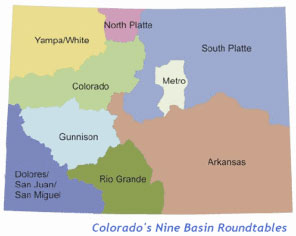
The IBCC has chosen to look at identified projects, municipal conservation, new projects and alternative ag transfers as the pillars for meeting future water needs. Environmental groups have developed their own reports that eliminate new large transmountain water projects from the planning.

Meanwhile, the Arkansas Basin Roundtable has launched a new effort to show the future need for agriculture as well. The area roundtable also has tried to stress the importance of building more storage as an overriding concern for all of the strategies.

More coverage from Chris Woodka writing for The Pueblo Chieftain. From the article:

About 300 people, a mix of roundtable members and others concerned about water, cycled through conversations about how to meet state water needs at Thursday’s Roundtable Summit. The seating arrangements ensured different basins were represented at each table.

“A woman from the Southwest corner of the state was saying, ‘How can the Colorado River demand conservation, when they’re not doing it themselves?’ I was amazed that someone from the Front Range didn’t have to bring that up,” said Paul Fanning, public affairs coordinator for the Pueblo Board of Water Works…

Most of the work by roundtables matched demand to supply, but even then there were serious outcomes. In one model, 48 percent of the South Platte River basin’s farmland was dried up.

“Our group came to the conclusion that it’s time to do something,” said Gary Barber, chairman of the Arkansas Basin Roundtable. “Everyone realized that options we have now are being foreclosed because we’re not acting as a state.”[…]

“Some from the Western Slope are beginning to say the East Slope deserves some water. I think that’s awesome,” [Former state engineer Jeris Danielson] said. “Now we’re beginning to talk about what pace we’re both comfortable with, or at least to have the same level of ‘uncomfortability.’ ”

More coverage from Eric Brown writing for The Fence Post. From the article:

Preserving future water for the state’s farmers and ranchers was a topic that came up as much as any during the discussions at the all-day Statewide Roundtable Summit. At that event, representatives of each of Colorado’s river basins convened to discuss plans and ideas for solving the water-supply gap that’s expected because of the state’s rapid population growth. The Statewide Water Supply Initiative study, compiled by the Colorado Water Conservation Board, estimates the South Platte River Basin alone will face a water-supply gap of between 36,000 and 170,000 acre-feet by 2050.

Thursday’s event served as an opportunity to refine those ideas before a May meeting of the Interbasin Compact Committee — a 27-member committee established to address statewide water issues.

During the discussions in Broomfield, all parties agreed there isn’t one silver bullet to solve future water issues, that new water supplies and water conservation will both be needed, and the depleting of the state’s agriculture production should be minimized as municipalities and industries search for their future water supplies.

Everyone at the event, including the governor, said the unanimous conclusions reached Thursday marked a milestone for water talks, as the state’s water providers — representing diverse interests and regions — couldn’t come to any agreements as recently as last year.

Hickenlooper said that protecting agriculture’s water will be one of his highest priorities.

More IBCC — basin roundtables coverage here.

HR1837: U.S. Representative Scott Tipton wants to make sure the bill remains a San Joaquin Valley water grab

deltasmeltbybmoosepetersonusfws.jpg

Interesting legislation is wending its way through the U.S. Congress. Central Valley farmers are making a play for more water, and less water for the San Joaquin delta. U.S. Representative Scott Tipton is hoping to make sure that it doesn’t open up a new angle for federal reserved water rights in Colorado and the rest of the country. Here’s a report from Chris Woodka writing for The Pueblo Chieftain. From the article:

U.S. Rep. Scott Tipton, R-Colo., sponsored an amendment to the bill which would limit its scope to the San Joaquin Valley in order to avoid opening the door to federal reserve water rights in Colorado. “In order to protect jobs in Colorado, we attached language to the bill that would prevent it from preempting state law in any other state,” Tipton said…

The legislation, HR1837, authorizes the secretary of Interior to review water contracts in the San Joaquin Valley for 40 years, at the request of contractors. Its sponsor is U.S. Rep. Devin Nunes, R-Calif.

The bill would allow water deliveries from Northern California to continue in order to restore irrigation water to farms. The state supported federal preemption of state water law to protect delta smelt fish…

Tipton supports the bill, with his amendment to limit the scope of federal review, because it would protect farm jobs. He does not want the federal review to set a precedent that would be applied to other states, however.

More coverage from Michael Doyle writing for The Miami Herald. From the article:

“The question is, has the bill created so much distrust and chaos that the process of solving the problem has been set back?” said Rep. John Garamendi, D-Walnut Grove. A former top Interior Department official, Garamendi contends the Sacramento-San Joaquin Valley Water Reliability Act approved by the House on Wednesday “creates a huge disruption” that will complicate the search for long-term California solutions…

The water bill’s authors, having secured House passage by a largely party line 246-175 margin, now insist they are on a roll. “We’re going to figure out what our options are, how to bring the bill up on the Senate floor,” said the bill’s chief author, Rep. Devin Nunes, R-Visalia.

The bill would would lengthen 25-year water contracts to 40 years, preempt strict state environmental laws and steer more water to farmers south of the Sacramento-San Joaquin Delta. Carefully negotiated language is designed to reassure Sacramento Valley farmers they won’t lose supplies as a result. The bill also would end an ambitious plan to restore salmon to the San Joaquin River below Friant Dam, replacing it with a more modest proposal for other fish species.

Supporters call the bill a way to save farms and turn water to better use. As Rep. Jeff Denham, R-Turlock, put it, the legislation will “put people to work.” Opponents call it a water grab by south-of-Delta farmers…

“It’s a very selfish bill,” [Senator Diane] Feinstein said of the House effort in an interview. “It says the farmers get the water, and everybody else be damned.” Feinstein, moreover, denounces [U.S. Representative Rep. Devin] Nunes’ characterizations of her. Nunes has run ads that say Feinstein “defines hypocrisy,” and in interviews he has called her a “liar” whose staffers are “radicals” aligned with “radical environmentalists” and the “hippie generation.” “In all my life, I’ve never been exposed to this kind of behavior,” Feinstein said. “It says to me he doesn’t want to work with me.”

More coverage from Karoun Demirjian writing for the Las Vegas Sun. From the article:

What happens in California holds sway over many of Nevada’s most important industries: Californians populate the state’s casinos, they are the state’s best would-be buyers of renewable energy, and now, they may be setting a standard for how Nevada’s scarce water resources will be allocated in the future.

Or at least that is what Nevada, along with a host of other Western states, fears will happen if a federal bill to restructure California’s system for sharing water among urbanites, farmers and conservation projects passes Congress…

The particulars of the dispute are localized to California. But some Nevadans believe that if the federal government can successfully intervene to impose a water settlement on California, there’s no reason government won’t meddle in Nevada’s water disputes too. “This flawed legislation would threaten our ability to determine how we manage Nevada’s most precious natural resource — our water supply,” said Rep. Shelley Berkley, a Democrat, who voted against the bill this week. “That is why the state of Nevada opposed this bill and why I voted to protect the rights of the Silver State when it comes to water.”[…]

“Enacting (the bill) would set a dangerous precedent of preempting state water rights, which could reduce available water supplies from Northern California to the Metropolitan Water District of Southern California,” the CRC of Nevada wrote. “This reduction could increase pressure on limited Colorado River water supplies crucial to Southern Nevada.”[…]

But while the House may have put its weight behind the bill in a 245-171 vote (mostly along party lines), momentum behind the effort is likely to stop there. California’s two Senators, both Democrats, are opposed to the plan, as is President Barack Obama, who complained through his advisers that the House bill “would codify 20-year-old, outdated science as the basis for managing California’s water resources, resulting in inequitable treatment of one group of water users over the other.”

More water law coverage here.

AWRA — Colorado Section: Summary of the Colorado Water Conservation Board’s (CWCB) 2012 Annual Instream Flow (ISF) Workshop

sanmiguelriver.jpg

From the AWRA — Colorado Section website (Margaret Herzog):

The more than 40 attendees represented a wide variety of interests, including the US Forest Service, the US Bureau of Land Management, the Colorado Dept. of Transportation, the Colorado Div. of Parks and Wildlife, several Colorado Water Conservation Board staff and new board members, The Nature Conservancy, Trout Unlimited, the Colorado Water Trust, Western Resource Advocates, the City of Fort Collins, the Colorado River District, High Country Citizens’ Alliance, consultants, and other interested parties.

The workshop went well beyond a review of recommended ISF projects for board consideration this year. It also covered a discussion of potential synergy between ISF appropriations and acquisitions with stream restoration projects and multi-purpose water supply projects. New SWSI 2010 Nonconsumptive Needs Assessment maps and related projects by Basin Round Table (BRT) were also presented, the successful culmination of an Interbasin Compact Committee / Basin Round Tables (IBCC/BRTs) analytical process which began in 2005.

More instream flow coverage here.

Hydraulic fracturing projected to use slightly more than one-tenth of one percent of the total water used statewide by 2015

hydraulicfracturing.jpg

From the Denver Business Journal (Cathy Proctor):

“In 2010, it reflected slightly less than one-tenth of one percent of the total water used [statewide],” says a report from the Colorado Oil & Gas Conservation Commission (COGCC). “In 2015, it is projected to increase by 4,800 acre feet to slightly more than one-tenth of one percent.”

Meanwhile, most oil and gas operators in Colorado are reporting hydraulic fracturing chemicals to the state, according to this report from Cathy Proctor writing for the Denver Business Journal. From the article:

The Colorado Oil & Gas Association (COGA) launched a voluntary water-testing program in January for any energy company that’s drilling in Colorado. It has signed up companies that are drilling 93 percent of all the oil and gas wells being worked in Colorado every year, said Tisha Schuller, COGA’s president and CEO. “And it’s expanding. We think that everyone [drilling in Colorado] should be in this program,” she [said].

More oil and gas coverage here and here.

Statewide Roundtable Summit: Governor Hickenlooper touts the importance of understanding the water-food nexus, adios bluegrass?

ibccroundtable.jpg

From The Pueblo Chieftain (Chris Woodka):

The governor said bluegrass lawns in cities take water away from water needed for agriculture, and one of the easiest fixes is to get people to change their landscape habits. “We’re taking water from ag uses and applying it toward urban landscapes,” Hickenlooper said. “We don’t have an abundance of food. We’re going to need more water for food to make sure farmers don’t run short.”[…]

“Water is a public good, and the roundtables are bringing all of the interests in a river basin together to decide how to manage water in a basin,” he said. “The basin roundtables are on the cutting edge. They become a crucible to determine the needs of the state.”[…]

Citing Denver’s campaign that led to 20 percent water conservation, Hickenlooper outlined several statewide approaches that will increase public awareness of water stress and the need for farm water:

– The ongoing Colorado Water 2012 campaign.
– Incorporating water issues in the upcoming TBD (To Be Determined) Colorado roundtables.
– A “Pedal the Plains” event next fall, similar to “Ride the Rockies.”

The governor also mentioned “shuttle diplomacy” as a strategy to resolve lingering water conflicts. Last year, the state brokered talks between oil companies and environmentalists to rewrite rules on hydraulic fracturing that left both sides feeling like winners.

More IBCC — basin roundtables coverage here.

Paonia: The Delta County commissioners are hosting an oil and gas exploration and production seminar tomorrow

paoniagradeschool.jpg

From the Delta County Independent:

The Delta County Commissioners are holding an oil and gas public information meeting this Saturday at Paonia High School from 9 a.m. until 4:30 p.m. Local residents interested in learning more about oil and gas leasing and development are encouraged to attend.

The morning sessions will include a presentation by David Noe, PhD, a senior geologist at the Colorado Geological Survey in Denver, on the geology of the North Fork Valley. Other sessions will include a panel discussion about the leasing and permitting processes for oil and gas exploration as well as an overview of regulations for hydraulic fracturing, water and air quality.

Presenters from the morning sessions will lead breakout sessions in the afternoon where the public can ask questions and learn more about the oil and gas leasing process, water, air quality, drilling, hydraulic fracturing, private land issues and current oil and gas activities.

Staff from the Bureau of Land Management, Colorado Geological Survey, Colorado Oil and Gas Conservation Commission, Delta County, Delta County Health Department, U.S. Forest Service and industry representatives will participate in the meeting.

For more information, contact Carolyn Clemens, executive assistant, Delta County administration at 874-2101.

More oil and gas coverage here and here.

Animas-La Plata Project Repayment Negotiations Continue between Reclamation and Colorado

lakenighthorsedurangoherald.jpg

Here’s the release from the U.S. Bureau of Reclamation (Ryan Christianson):

The Bureau of Reclamation and the state of Colorado are continuing negotiations on a proposed repayment contract for the Animas-La Plata Project. The contract will provide the terms and conditions by which the state will repay the construction costs associated with all or a portion of its statutory allocation of project water. The third negotiation meeting is scheduled for Wednesday August 10, 2011, at 10:00 a.m. at Reclamation’s office, 835 E. 2nd Ave., Suite 300, Durango, Colo. 81301.

The contract to be negotiated will provide for storage and delivery of project water, identify the amount of project construction costs to be paid to the federal government by the state, and provide for operation and maintenance of the project.

All negotiations are open to the public as observers, and the public will have the opportunity to ask questions and offer comments pertaining to the contract during a thirty minute comment period following the negotiation session. The proposed contract and other pertinent documents will be available at the negotiation meeting, or can be obtained on our website under Current Focus or by contacting Brett Griffin of the Bureau of Reclamation, 835 East Second Avenue, Suite 300, Durango, Colorado, 81301, telephone (970) 385-6531.

More Animas-La Plata coverage here and here.

Denver: Executive Order creates task force to examine oil and gas regulatory jurisdiction between the state and local governments

gelledhyrdraulicfracturingfluid.jpg

Here’s the release from Governor Hickenlooper’s office (Eric Brown):

Gov. John Hickenlooper signed an Executive Order today that creates a task force to help clarify and better coordinate the regulatory jurisdiction between the state and local governments over oil and gas operations.

The task force is expected to report its recommendations and findings to the Governor, the Speaker of the House of Representatives and the President of the Senate no later than April 18, unless the group is either terminated or extended beyond that date by another Executive Order.

“This is an important step to better define state and local jurisdiction regulatory structures as Colorado’s oil and gas industry continues to grow,” Hickenlooper said. “We want to protect public health, the environment and wildlife and to avoid duplication and conflict between different regulations of oil and gas activities. We expect these efforts to also help foster a climate that encourages responsible development and enhances existing cooperation and coordination between state and local government.”

The issues that the Task Force will address include:

• Setbacks of oil and gas facilities or roads necessary for oil and gas operations from any building, public road, above-ground utility line, railroad, or water body, or other restrictions on the location of an oil or gas well and its related production facilities.
• Floodplain restrictions.
• Protection of wildlife and livestock.
• Noise abatement.
• Operational methods employed by oil and gas activities.
• Air quality and dust management.
• Traffic management and impacts.
• Fees, financial assurance and inspection.

“In establishing this task force, we have worked with a variety of stakeholders, including local government, industry, the environmental community, Speaker McNulty, President Shaffer and Majority Leader Morse,” Hickenlooper said.

The Task Force will be chaired by Mike King, the Executive Director of the Colorado Department of Natural Resources. The task force members will include: the Executive Director of the Colorado Department of Local Affairs, or his or her designee; two members of the Colorado Oil and Gas Conservation Commission as determined by said Commission; the President of the Board of Directors of Colorado Counties Inc., or his or her designee who must also be a member of said organization; the President of the Board of Directors of the Colorado Municipal League, or his or her designee who must also be a member of said organization; the Chief Executive of the Colorado Petroleum Association, or his or her designee; the Chief Executive Officer of the Colorado Oil and Gas Association, or his or her designee; the Executive Director of Colorado Conservation Voters, or his or her designee; one member appointed by the Speaker of the House of Representatives; one member appointed by the President of the Senate; and the Colorado Attorney General or the Attorney General’s designee.

The full text of the Executive Order or can be found here.

From the Colorado Independent (Troy Hooper):

The governor signed an executive order Wednesday to create an 11-member task force “to help clarify and better coordinate” the regulatory jurisdiction between the state and local governments over oil and gas operations. He asked the task force to report its recommendations and findings to him, the speaker of the state House and president of the state Senate by April 18.

The move follows heated debate at the capitol, where a Republican senator proposed empowering the state with sole regulatory authority over drilling. The proposal, HB 12-088, died in the Democrat-controlled Senate. A competing bill, introduced by a Democrat, would have assigned oil and gas regulatory power to local governments. It was killed in the GOP-controlled House.

“County land use regulations, ordinances and charter amendments empowered by the Colorado Constitution and upheld by the courts here and in New York, are the only means left for people to protect their communities from the excesses of an abusively powerful industry,” said Ceal Smith of the newly launched Coalition for a Clean Colorado.

“Two weeks ago, thousands of citizens spoke firmly against HB 12-088 and in favor of local regulatory authority over oil and gas activities. The governor’s executive order on fracking is a blatant attempt to circumvent the will of the people,” Smith said. “The communities most impacted have no voice or representation whatsoever on the governor’s hand-picked task force. We are frankly shocked by this autocratic assault on our democracy and community rights.”

From the Denver Business Journal (Cathy Proctor):

Tensions between the two levels of government have risen in recent months as the spectre of drilling rigs in urban and suburban areas — rigs probing for oil locked in Colorado’s Niobrara formation — has spurred local officials to draft new land use regulations focused on the industry.

State officials, including Colorado Attorney General John Suthers and the Colorado Oil & Gas Conservation Commission, have sent a series of letters warning counties and cities that their draft rules conflict with the state’s.

Bills that would give ultimate authority to either the state or local governments have been filed, and killed, during the legislative session, and representatives of local governments have hoped the governor would take the conflict outside the state Capitol by creating a task force to tackle the issues.

From The Denver Post (Mark Jaffe):

Spurred by the discovery of oil in the Niobrara formation, which stretches from El Paso County to the Wyoming border, companies have been buying up mineral leases and ramping up drilling.

In 2011, Weld County had the most drilling activity in the West, according to a study by Headwaters Economics, a Montana-based natural resource consultant.
That led 10 Front Range municipalities and counties to develop drilling rules, raising concerns among drillers that projects could be stalled.

“This makes attracting investment a real challenge,” said Tisha Schuller, president of the Colorado Oil and Gas Association, a trade group, which will have a spot on the task force…

“The composition of the task force seems weighted in favor of industry,” Kate Zimmerman, the National Wildlife Federation’s senior policy adviser, said in a statement.

From the Summit County Citizens Voice (Bob Berwyn):

In court, the Colorado Oil and Gas Association, as well as the Colorado Oil and Gas Commission, have challenged to ability of local governments and citizens to request hearings and exert local control over drilling operations, claiming that statewide rules are the best way to create a level playing field and the regulatory consistency that the industry wants.

In reality, circumstances can differ on the ground from community to community, said Pete Maysmith, director of Colorado Conservation Voters, which is named as one of the groups to be represented on the panel.
Maysmith said he’s glad that the environmental community will be represented on the task force. “As oil and gas drilling moves into heavily populated areas, we need to be able to protect the air, land water and communities,” Maysmith said. “Local communities need to have a say. They’re the ones being directly impacted.”

More coverage from John Fryar writing for the Longmont Times-Call. From the article:

Numerous cities, towns and counties looking into the possibility of enacting tighter local regulations about the location and operations of well drilling have run into legal questions about how far they can go without violating state laws and court decisions giving primary regulatory authority to the Colorado Oil and Gas Conservation Commission.

Hickenlooper said Wednesday that setting up the task force, which will be chaired by Department of Natural Resources director Mike King, “is an important step to better define state and local jurisdiction regulatory structures as Colorado’s oil and gas industry continues to grow.”

The governor, a onetime oil geologist, said in his announcement that “we want to protect public health, the environment and wildlife and to avoid duplication and conflict between different regulations of oil and gas activities. We expect these efforts to also help foster a climate that encourages responsible development and enhances existing cooperation and coordination between state and local government.”

More oil and gas coverage here and here.

Denver: Hydraulic fracturing lecture kicks off CSU’s Engineering Breakfast series March 5

marcellushydraulicfracturing.jpg

Here’s the release from Colorado State University (Emily Narvaes Wilmsen):

Everything from hydraulic fracturing and wind energy to particle beam accelerators will be discussed at lectures hosted by Colorado State University in Fort Collins and the Denver area beginning March 6.

The Innovation Breakfast series is a great opportunity to interact with others who have an interest in science and engineering and hear about the latest technological trends and innovative research projects underway at CSU’s College of Engineering.

Discussions are led by Sandra Woods, dean of the College of Engineering, and various keynote speakers. Each breakfast will be 7:30-9 a.m. Cost is $20/person ($15 for breakfast and a $5 gift to the Dean’s Innovation Fund) and reservations are required at https://advancing.colostate.edu/INNOVATIONSREGISTRATION.

Fracking: March 6 in Sheraton Denver Tech Center (RSVP by March 2)

Ken Carlson, associate professor of civil and environmental engineering, will talk about oil and gas development in Colorado increasing over the next decade due to technological developments such as horizontal drilling and hydraulic fracturing. CSU has formed the Colorado Energy-Water Consortium to study water issues relating to hydraulic fracturing and other practices, communicate complex information to the public and educate the next generation of students in this rapidly evolving field.

Carlson’s talk, titled “The Colorado Energy-Water Consortium: Water Issues and Oil and Gas Development,” will be at the Sheraton Denver Tech Center, 7007 South Clinton St., Greenwood Village.

More oil and gas coverage here.

The Colorado Water 2012 March newsletter is hot off the press

coloradowater2012

Download your copy here.

I missed notifying you about Brad Udall’s Colorado River talk at Metro State tonight. Sorry.

More Colorado Water 2012 coverage here.

IBCC: Jay Winner (Lower Ark District) — ‘It’s time to address the problem and not do more studies’

baselinewaterdemandbybasinswsiii.jpg

From The Pueblo Chieftain (Chris Woodka):

“I think the state of Colorado has a problem, and this is just another study that tells us we have a problem,” said Jay Winner, manager of the Lower Arkansas Valley Water Conservation District. “It’s time to address the problem and not do more studies.” The Lower Ark district has been the primary sponsor of the Super Ditch, which seeks to sell water through leases without permanent land dry-ups.

“I’ve always been a believer in doing,” said Frank Jaeger, manager of Parker Water. “They’re trying to manipulate conservation into a water supply, but that’s not what it is.” Parker is planning a grand opening for Reuter-Hess Reservoir, a 75,000 acre-foot reservoir thirsty for water supplies, on March 21…

Roundtables have been working with the portfolio tool for the past few months to develop scenarios for future water supply. The results of those efforts will be the main topic of today’s meeting [ed. Roundtable Summit], which also includes an address by Gov. John Hickenlooper.

More IBCC — basin roundtables coverage here.