
New snow forecast. #cowx twitter.com/NWSBoulder/sta…
— NWS Boulder (@NWSBoulder) March 12, 2013
Day: March 11, 2013
Forecast news: Light snow possible over northern Colorado today #codrought #cowx
Mostly sunny skies will prevail for most of the area today with milder temperatures closer to normal. A weak distu twitpic.com/cafslv
— NWS Grand Junction (@NWSGJT) March 11, 2013
From the National Weather Service Grand Junction office:
Mostly sunny skies will prevail for most of the area today with milder temperatures closer to normal. A weak disturbance will move across the north today through Tuesday, generating some light snow showers over the northern Colorado mountains. 3 to 5 inches of snow is expected. High pressure will begin to move in Wednesday and dominate the region through the end of the week, with temperatures warming to above normal levels.
Dry and fair weather is expected across most parts of the region today… with isolated late day snow showers over twitpic.com/cah6pa
— NWS Pueblo (@NWSPueblo) March 11, 2013
From the National Weather Service Pueblo office:
Dry and fair weather is expected across most parts of the region today… with isolated late day snow showers over the central mountains…and occasional high cloudiness across the rest of the travel area. Temperatures are going to the 40s to mid 50s in snow covered areas and the mid 50s to around 60 degrees elsewhere. In the high country…high temperatures will be in the 30s and 40s. For you star gazers out there…Comet Pan-Starrs should be coming into view this week and brightening over the next few days. Watch for it low in the evening sky about 30 minutes after sunset. Use binoculars if you have them to enhance your view.
San Juans: Just two dust on snow events so far this winter #codrought

From The Telluride Daily Planet (Collin McRann):
One of the leading local climate research entities in the state is the Silverton Center for Snow and Avalanche Studies, which has been conducting research on local precipitation and snowpack for more than a decade. Over the years, the center has accumulated reams of data about the snowpack, and on Friday a researcher presented some of the center’s findings at the monthly EcoAction Roundtable at the Wilkinson Public Library to a crowd of more than 15 people…
Though a lot of climate change research is focused on increasing temperatures, there are many side effects of warmer temperatures that could have a profound impact locally. One of those is dust on snow, which the center has been studying for years. Since 2004, the center has been gathering data on the amount of sunlight radiation reflected from the snowpack at sites in Beck Basin. When the snow is clean it reflects more heat and melts slower, but when covered in dust it melts faster. [Researcher Kim Buck] said almost all of the dust on snow in Colorado comes off of the Colorado Plateau. She said once the dust blows in and gets on the snow, it can speed up the melt dramatically — by an entire month in the spring…
Locally, there have been two dust blow-ins this winter, but they were mild compared with dust storms of the past few years, notably 2009, Buck said…
The center’s and NOAA’s snowpack data shows that this year’s snowpack is lower than last year at this time. According to NOAA information, the snowpack in the San Miguel, Dolores, Animas and San Juan River Basin is around 85 percent of normal. Last year it was slightly higher. Buck said it could be bad news this summer.
“It is extremely unlikely that we’re going to catch up on precipitation,” Buck said “Last year the state was just coming off of that great big water year, so reservoirs were full. This year reservoirs are low and then we’re getting another low snow year back to back. So I think the cities in the Front Range will have a pretty hard time in the summer.”
Snowpack news: The Upper Rio Grande River Basin is at 76% of normal #codrought

Here’s a report about the current snowpack and how the Upper Rio Grande Basin is drying over time, from Ruth Heide writing for the Valley Courier. You numbers junkies will want to click through for all the detail. Here’s an excerpt:
Dry may be the new normal for the San Luis Valley. “We are having to adjust to a new normal,” Rio Grande Water Users Association Attorney Bill Paddock said during the water users’ annual meeting this week in Monte Vista, “not of the ‘80’s and ‘90’s but of the 2000’s when there is fundamentally less water. We don’t know when this will change.”[…]
Colorado Division of Water Resources Division 3 Engineer Craig Cotten said the initial projection for the annual index supply for the Rio Grande this year is 435,000 acre feet, currently estimated to be a little more than last year’s 407,000 acre feet. The 407,000 acre feet last year was about 66 percent of average for the Rio Grande, “definitely not a real good year,” Cotten said.
The 435,000 acre-foot estimate takes into account the NRCS (Natural Resources Conservation Service) irrigation season forecast (April-September) of 360,000 acre feet.
Of the estimated annual index of 435,000 acre feet, the Rio Grande will have to deliver about 25 percent or about 107,800 acre feet downstream to New Mexico and Texas to meet Rio Grande Compact obligations. Because of winter flows sent downriver prior to the irrigation season and expected to be delivered after it ends this fall, the curtailment on the river during the irrigation season will likely be about 12 percent, Cotten told Rio Grande Water Users Association members on Tuesday…
Cotten reported the snowpack on the Upper Rio Grande Basin as of March 5 was about 78 percent of normal. “Currently we are a fair amount lower than we should be, than the average, lower than we have been the last three years,” he said.
He said to reach average snowpack would require 189 percent moisture from now on.
More Rio Grande River Basin coverage here.
Anvil Points: Oil shale research facility cleanup completed
From The Grand Junction Daily Sentinel (Dennis Webb) via The Denver Post:
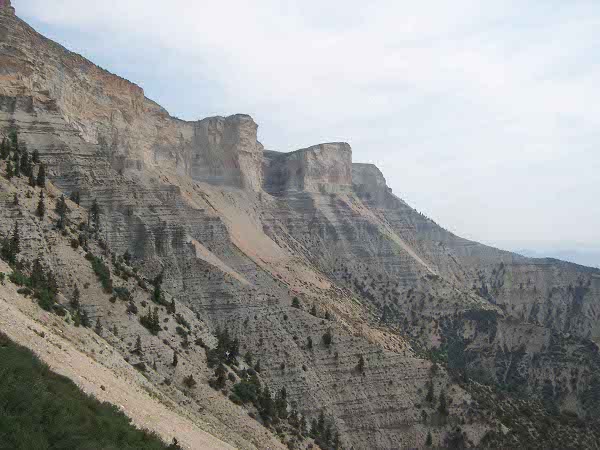
High up the Roan Plateau above the 365-acre research site, four gaping mine portals large enough that big trucks once drove through them have been closed off to all but bats. The portals tapped mines that were sometimes 1,000 feet long or more, employed hundreds of miners at their peak and provided 400,000 cubic yards of oil shale that underwent retort heating processes at the research site…
Congress transferred the research site and the oil shale reserves to the Bureau of Land Management in 1997, and provided that cleanup of the site would be paid for by federal revenues from nearby oil and gas development. “There were huge waste piles of retorted oil shale that didn’t pose an immediate hazard but still needed to be cleaned up,” said John Beck, who is branch chief for lands and realty for the Colorado state office of the Bureau of Land Management, and oversaw the $24 million cleanup project.
“I think they did a very good job with the (cleanup) work over there,” Cooley said.
He said he didn’t think the site posed much of an environmental concern. But still, “I think it did need to be cleaned up and put to bed, so to speak, from an aesthetic standpoint if nothing else,” he said.For the BLM, part of the problem was that waste shale had been dumped in an adjacent valley that’s home to the intermittent West Sharrard Creek, a tributary of the Colorado River, raising concern about the potential for contamination from runoff. Carla DeYoung, a BLM ecologist who was an inspector for the project, said arsenic levels in the waste measured six times background levels in the area.
In addition, a fire of undetermined origin in a waste pile created a lot of ash that had to be shipped to a landfill in Denver. The fire also drew oil out of the shale and it accumulated at the base of the waste pile. Petroleum-contaminated material was shipped to C B Industries Delta, a Delta facility where it could be spread out and “land-farmed,” a process under which bacteria can consume the petroleum.
The sheer volume of waste also proved daunting. The BLM planned on building one waste repository but ran out of room and had to build a second, smaller one nearby, and eventually an even smaller third one…
The repositories include geomembrane liners at the bottom and 30-inch-thick clay caps on top, covered by reseeded topsoil. Other aspects of the cleanup included demolition and site restoration work involving a former water treatment plant near the river that supplied Anvil Points, and closing off of the mine entrances, which are highly unstable because of the loose surrounding shale.