
Observed 48hr Snowfall Totals for Northeast Colorado ending at 7am 3/24/2013. twitter.com/NWSBoulder/sta…
— NWS Boulder (@NWSBoulder) March 24, 2013
Day: March 24, 2013
Forecast news: Unsettled weather over southern Colorado today #codrought #cowx
An upper level disturbance is expected to drop southward through Colorado today…keeping the weather picture unse twitpic.com/ce093i
— NWS Pueblo (@NWSPueblo) March 24, 2013
From the National Weather Service Pueblo Office:
An upper level disturbance is expected to drop southward through Colorado today…keeping the weather picture unsettled for the end of the weekend. Snow is expected to develop in the afternoon and through the evening over much of the region, with the best chances for precipitation expected over the eastern mountains and along the I-25 corridor. Temperatures will stay well below average across the viewing area, with generally 20s to mid 30s expected over most areas.
Very cold temperatures will repeat tonight. Several record lows were set this morning and more of the same is expe twitpic.com/cdzt2f
— NWS Grand Junction (@NWSGJT) March 24, 2013
From the National Weather Service Grand Junction office:
Very cold temperatures will repeat tonight. Several record lows were set this morning and more of the same is expected Monday morning. Except for isolated showers over northern Colorado and Utah through Wednesday, high pressure will keep conditions dry. Clouds will start increasing again Thursday as the next Pacific storm develops off the west coast. This storm should bring precipitation to the western U.S. late Easter weekend.
From The Denver Post (Tom McGhee):
An early spring snowfall that dumped between 8 and 12 inches on the metro area left streets and roads snow-packed and icy on Sunday and with cold weather on tap for the first half of the week it could be a while before some of the snow melts.
Snowpack news: The eastern plains hit hard by snowfall in some locations #codrought #cowx
From The Greeley Tribune:
Forecasters expect the cold to stick around for a few days. Highs will stay near the low-30s until Tuesday, and more snow could fall tonight. Only about an inch of snow fell Friday night and Saturday in most parts of Weld; Johnstown reported 6.1 inches…
[Mike] Baker said the heaviest snow fell on the Eastern Plains, where the small town of Agate saw more than 18 inches and snow drifts as high as five feet. The Denver metro area saw about 7-12 inches. He said he wasn’t surprised Greeley didn’t get much snow. “As of the last couple of days, it looked like we were going to have kind of a dry slot up there across portions of Larimer and Weld counties with that northerly wind coming out of Wyoming,” he said. “It’s not a very favorable wind direction.”
From The Pueblo Chieftain (Anthony A. Mestas):
Pueblo was on a winter weather advisory throughout the day. About 1.6 inches of snow fell Saturday.
Another beautiful spring day in Colorado. 6″ @breckenridgemtn / 4″ @vailmtn / 4″ @beavercreekmtn / 4″ @keystonemtn (24-hr #s) #cowx #snow
— Snow.com (@snowdotcom) March 24, 2013
From the Grand Junction Free Press (Hannah Holm):
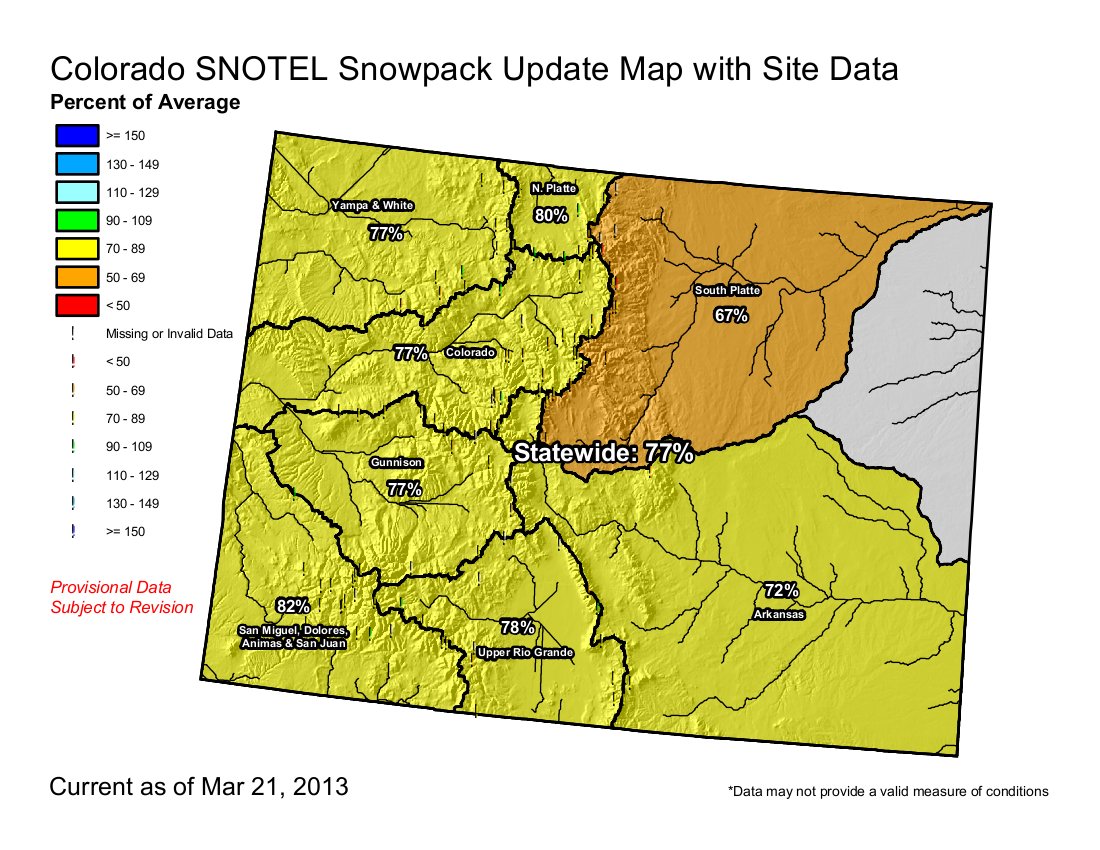
After lagging for most of the winter, the amount of water in the snowpack in Colorado’s part of the Colorado River Basin has finally caught up with last year’s (meager) snowpack for this date. That brings the Colorado Basin snowpack to 73% of the average amount for this time of year. The Gunnison River Basin is at about 75% of average, slightly below where it was at this time last year. These levels are not great, especially with low reservoir levels left over from last year’s drought, but they are a lot better than the sub-50% levels we were seeing in December. Statewide, the snowpack is currently at about 77% of average for this time of year, but the South Platte River Basin is only at 68%, and the Arkansas River Basin is at 73%…
A big problem with last year’s drought was the way the snowpack rapidly melted in early spring instead of continuing to build, as it usually does. Grand Valley water managers are monitoring the situation closely and will release an assessment and guidance for water users (that’s all of us) in early April.
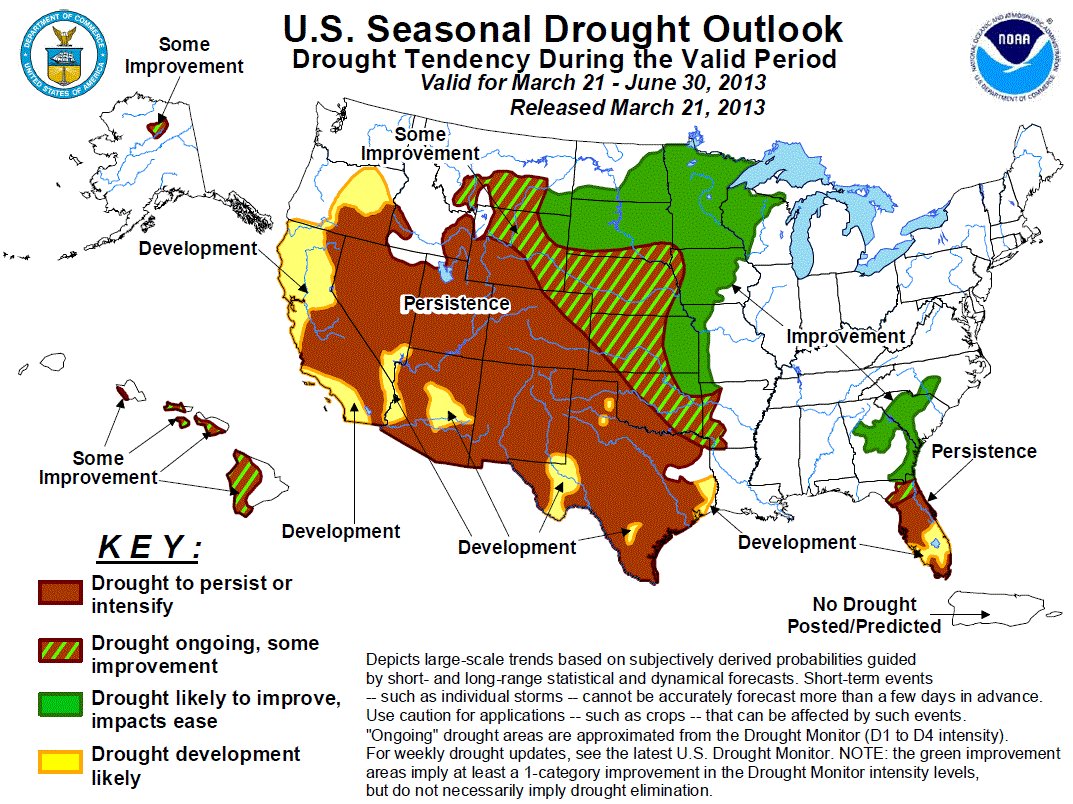
The National Weather Service Climate Prediction Center predicts that the drought will persist or intensify throughout most of Colorado and the rest of the Southwest between now and the end of May. This may not be the best time to put in a new lawn.
Drought news: Colorado Springs launches shower head exchange #codrought

From The Colorado Springs Gazette:
With a prolonged drought and watering restrictions hanging over Colorado Springs, it can’t hurt to do what you can to save every drop.
One way to save water — and money — is with a waterwise shower head, and on Saturday, Colorado Springs Utilities will be giving them away in exchange for your old ones. From 9 a.m. to 1 p.m., CSU water customers can bring in up to two shower heads to the Conservation & Environmental Center, 2855 Mesa Road, to exchange for WaterSense-certified models. People also need to bring their water bills. The waterwise shower heads can save up to $130 a year, compared with standard models, CSU says. About 3,000 will be available at the event, which is tied to Fix a Leak Week.
The event also features tours of the xeriscape garden and information on fixing water leaks, rebates, water-saving tips and a new online tool to track personal utilities usage.
From 24/7WallSt.com:
More than 80% of seven states were as of last week in “severe drought,” characterized by crop or pasture loss, water shortage and water restrictions. Depending on whether the hardest-hit regions see significant precipitation, crops yields could fall and drought conditions could persist for months to come. Based on the latest data provided by the U.S. Drought Monitor, 24/7 Wall St. reviewed the seven states running out of water…
Colorado
> Pct. of state in severe drought: 89.0%
> Pct. of state in extreme drought: 48.1% (7th highest)
> Pct. of state in exceptional drought: 21.2% (3rd highest)Colorado is one of five states where all of its area is considered to be in moderate drought, with nearly 90% of the state experiencing severe drought. With the exception of the Northeast corner of the state, the drought is expected to either persist or get worse over the next several months. Yet even most the Northeast corner is experiencing either extreme or exceptional drought. Due to the ongoing problems, several of Colorado’s largest municipal water providers are considering restricting spring and summer lawn-watering, potentially limiting landowners to watering their grass just twice a week. Crop production declined significantly in 2012 compared to 2011, with wheat production falling 9.3%, while corn production falling a whopping 29%.
From The Greeley Tribune (Eric Brown):
Snowpack in the South Platte basin was only 67 percent of historic average this week, according to the Natural Resources Conservation Service.
Because of the drought that’s plagued the region for months, reservoirs in the South Platte basin were only filled to 82 percent of historic average at the beginning of March, according to NRCS figures.
Statewide, two-thirds of the state’s top soil was “short” or “very short” on moisture, according to a report from the U.S. Department of Agriculture released Monday, and 89 percent of the state’s subsoil was short or very short on moisture.
However, some in the South Platte basin are fairing better than others across the state when it comes to moisture. Through Wednesday, Greeley — in the heart of Weld County, where more than two-thirds of the Colorado’s sugar beets are produced — has received about 11 percent more precipitation than average so far in 2013. However, for the entire snow year, dating back to October, Greeley is still about 18 percent behind normal.
From The Durango Telegraph (Tracy Chamberlin):
With persistent drought conditions across Colorado and low reservoir levels in the southwest, water resource managers are looking at a potentially long and arid summer. Following a dry 2012, the warmest year on record, reservoir levels were already on the low side. Reservoir storage exactly one year ago sat at 104 percent of average, which helped the area get through late summer shortages. Currently, it’s only 67 percent of the average and 64 percent of last year, according to the Natural Resources Conservation Service’s monthly snow survey…
Storage levels are down in all of the area’s reservoirs, according to officials from the Bureau of Reclamation. Lemon had 13,962 acre feet of storage in 2012 and now sits at 7,829 acre feet. McPhee was at 287,844 a year ago; the current storage is 188,976 acre feet. And, Vallecito is less than two-thirds what it was last year…
And although much of the state got a boost from the February storms one area that did not was the southwest. The San Miguel, Dolores, Animas and San Juan Basin, which includes the Durango area, saw a decline in its snowpack of 5 percentage points from the February readings. The area snowpack is 83 percent of the average and 89 percent of last year, according to the snow survey. The data collected for the survey “reflects what the state can expect for surface waters supplies this coming spring and summer.”[…]
The Ute Mountain Ute Tribe Farm and Ranch Enterprise, a 7,700-acre agricultural project headquartered in Towaoc, and the Dolores Project irrigators both rely on McPhee. Those groups are potentially looking at about one-third less water this year than they would typically get…
The one thing it won’t help is the boating community. “There’s not going to be a spill [From McPhee Reservoir] this year,” Preston said. Like last year, there just isn’t enough water to release downstream for kayakers and other whitewater enthusiasts. The focus for 2013 is on irrigation and municipalities. Still, the numbers leading off the spring and summer seasons still don’t compare to the record lows of 2002, the year of the Missionary Ridge Fire. “Mother Nature’s really in charge here,” Preston said.
From The Colorado Springs Gazette (Ryan Maye Handy):
The decision to empty Antero will have a ripple effect for popular reservoirs in the Pikes Peak region and west into South Park. Eleven Mile reservoir, near Lake George, will be lowered in the next couple of weeks to make room for the waters of Antero, Thompson said. While the Eleven Mile might seem low during April, waters should rise again once Antero begins to empty. Eleven Mile, however, is one of two drought reservoirs owned by Denver Water, the reserves of which are only tapped in cases of extreme drought, Thompson said. This spring, Antero, the other drought reserve, will be empty, and Denver Water expects to start tapping Eleven Mile in the next few weeks…
Colorado Springs Utilities has been watching its reservoirs drop as the drought progressed, but it will handle things differently than Denver Water, said Lehermeier. “We are typically moving water in and out of most systems,” Lehermeier said. “There isn’t one that we set aside for a non-rainy day, so to speak.”
But the system of reservoirs that support El Paso County are showing signs of the dry season. Rampart, North and South Catamount reservoirs all are expected to be lower this year. Two other utilities-owned reservoirs in the Blue River water system near Breckenridge are drought impacted — the Upper Blue reservoir, another popular angling spot, is empty. Although the reservoir accounts for a smaller amount of utilties’ water, the fact that it’s empty is a red flag, Lehermeier said.
The One World One Water Center March newsletter is hot off the press
Click here to read the March newsletter from the One World One Water Center.
More education coverage here.
Northern Water’s Spring Water Users Meeting will be held Thursday, April 11 #codrought

From email from the Northern Colorado Water Conservancy District:
Northern Water’s Spring Water Users Meeting will be held Thursday, April 11 at the Thomas M. McKee Building at The Ranch, Loveland, CO. starting at 8 a.m.
The Spring Water Users Meeting is a forum to discuss the current water situation and water-related issues. The 2013 meeting will include updates on the current water year, the Northern Integrated Supply Project and the Windy Gap Firming Project. Go to the
April Calendar page for more information and to register online. Business group registration is now available. The last day to register online is April 9.
Fountain Creek: The Southern Colorado Business Partnership hopes to enable regional cooperation for stormwater management

From The Pueblo Chieftain (Chris Woodka):
A group representing thousands of businesses in Southern Colorado wants to take a crack at calming the waters on Fountain Creek. The Southern Colorado Business Partnership sketched out its plans Tuesday for the Pueblo Board of Water Works. The group wants to launch an effort to clear the air on issues surrounding Fountain Creek sometime later this year. “One of the things we can do is pull the right people together to reach solutions,” said Rod Slyhoff, president of the Greater Pueblo Chamber of Commerce and chairman of the partnership. “We understand the concerns in Pueblo and downstream about Fountain Creek.”
Slyhoff and Randy Scott, the partnership’s president, did not list specific actions about what should be done on Fountain Creek, but said the issue fits into its goal of finding “big picture” solutions to regional problems. The group, which includes chambers and business groups from Castle Rock to Trinidad, represents 5,000 businesses and 150,000 employees, Scott said. It also plans to tackle regional military issues, emergency preparedness, intergovernmental cooperation and air transportation.
Fountain Creek has been a controversial topic for decades. While a watershed improvement district was formed in 2009 after three years of regional meetings, its funding still is in question. An El Paso County stormwater task force reached some conclusions last year, but the level of funding still is at issue because Colorado Springs Mayor Steve Bach is seeking a second opinion on the costs.
Pueblo County commissioners and the Lower Arkansas Valley Water Conservancy District continue to pressure Colorado Springs about controlling stormwater as a condition of its Pueblo County permit to operate the Southern Delivery System.
The EPA joins Colorado in taking formal action against Williams Energy regarding the Parachute Creek spill #coriver
From The Grand Junction Daily Sentinel (Mike Wiggins):
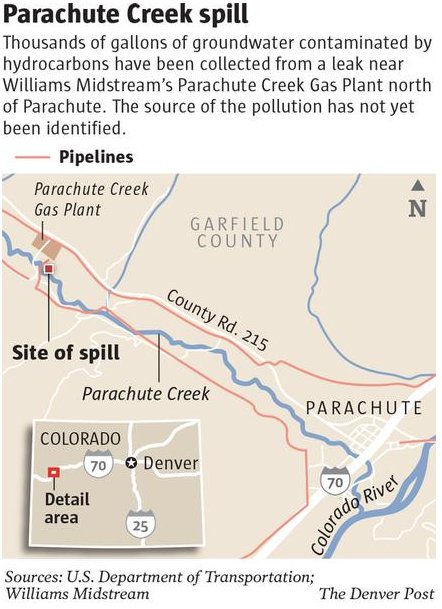
The Environmental Protection Agency has joined state regulators in taking formal enforcement action against an energy company in conjunction with a subsurface leak of thousands of gallons of a liquid hydrocarbon northwest of Parachute.
Meanwhile, the amount of liquid being recovered continues to dissipate, so much so that officials said no measurable amount of hydrocarbon was collected Thursday.
In documents made public Thursday, the EPA issued an administrative order outlining a litany of actions Williams must take to protect nearby Parachute Creek, a tributary of the Colorado River. The order instructs Williams to continue to pump the liquid from existing trenches and potholes, extend the trenches and excavate additional trenches as needed to reduce the threat of the liquid reaching the creek, excavate additional potholes to determine the extent of the plume, install wells to monitor the movement of the plume and routinely collect water samples and conduct daily monitoring of the deployed booms in the creek. The EPA says Williams must submit plans addressing those required actions within seven days and also submit weekly and monthly progress reports.
Williams is already performing most, if not all of the measures required by the EPA. Company officials noted in a news release that crews are collecting samples of creek water on a daily basis and visually inspecting the creek every 30 minutes.
Any violation of the EPA order could be subject to a daily fine of as much as $37,500.
The EPA’s action follows the Colorado Oil and Gas Conservation Commission’s issuance of notices of alleged violation against Williams and WPX Energy.
Williams said Thursday only a sheen of hydrocarbon was recovered Thursday, while 128 barrels of contaminated groundwater — nearly 5,400 gallons — were removed. Altogether, more than 6,000 gallons of hydrocarbon and more than 113,000 gallons of groundwater have been recovered.
Williams first discovered soil contamination March 8 in a pipeline corridor adjacent to its gas plant, which is on land owned by WPX. It was doing pipeline location work in preparation for building a new plant. The source of the hydrocarbon has yet to be identified, and the state, Williams and WPX have yet to agree on what to call the liquid.
State and energy industry officials say there continues to be no evidence of contamination of the creek.
The NOAA spring outlook is hot off the press #codrought #cowx
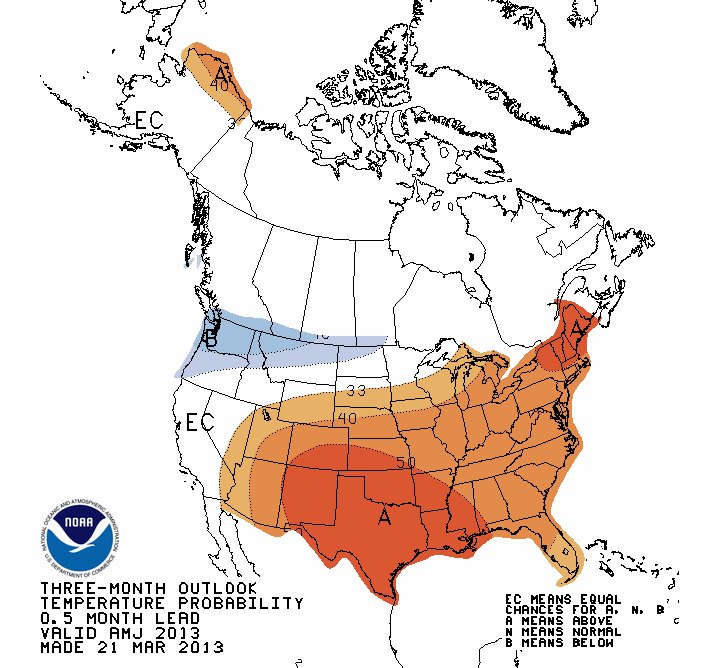

Click here to read the Spring Outlook from the National Oceanic and Atmospheric Administration. Here’s an excerpt:
NOAA issued the three-month U.S. Spring Outlook today, stating that odds favor above-average temperatures across much of the continental United States, including drought-stricken areas of Texas, the Southwest and the Great Plains. Spring promises little drought relief for most of these areas, as well as Florida, with below- average spring precipitation favored there. Meanwhile, river flooding is likely to be worse than last year across the country, with the most significant flood potential in North Dakota.
“This outlook reminds us of the climate diversity and weather extremes we experience in North America, where one state prepares for flooding while neighboring states are parched, with no drought relief in sight,” said Laura Furgione, deputy director of NOAA’s National Weather Service. “We produce this outlook to help communities prepare for what’s likely to come in the next few months and minimize weather’s impacts on lives and livelihoods. A Weather-Ready Nation hopes for the best, but prepares for the worst.”
The U.S. Spring Outlook identifies the likelihood of spring flood risk and expectations for temperature, precipitation and drought. The outlook is based on a number of factors, including current conditions of snowpack, drought, soil moisture, streamflow, precipitation, Pacific Ocean temperatures and consensus among climate forecast models…
Fifty-one percent of the continental U.S.–primarily in the central and western regions–is in moderate to exceptional drought. Drought conditions are expected to persist, with new drought development, in California, the Southwest, the southern Rockies, Texas, and Florida. The outlook favors some improvement in the Midwest, the northern and central Great Plains, Georgia, the Carolinas, and northern Alaska.
MSU Denver: One World, One Water Center presents ‘Water and the Arts’

From YourHub (Tim Carroll) via The Denver Post:
Colorado Supreme Court Justice Gregory Hobbs never expected a poem he wrote about his passion—water—to become the lyrical content of a rap song.
But a rap rendition of his poem, “Colorado Mother of Rivers,” written in celebration of the 30 th year of Colorado’s in stream flow law, was performed by rapper Mr. Figurora at MSU Denver’s first ever “Water and the Arts” symposium. The two-day event on Feb 25-26 brought musicians, authors and artists to Tivoli Turnhalle on the Auraria Campus to raise awareness and explore water issues through the arts.
The event is part of the university’s One World, One Water Center for Urban Water Education and Stewardship initiative, which in addition to bringing water-related events and applied learning activities to campus, also offers an interdisciplinary pilot water studies minor that more than 90 faculty members are involved with.
“The students here at Metro are in a perfect situation,” said Hobbs, who is a member of the One World, One Water advisory board and a co-chair for the “Water and Arts” event. “We’ve identified 100 different courses that have to do with water in some way. English, music, technology of clean water, water infrastructure, engineering, biology…There are so many opportunities for students in the water profession, and this is what this curriculum is trying to do.”
More education coverage here.
Galena fire: Northern Water installs debris booms to mitigate effects to Horsetooth Reservoir #codrought

From the Loveland Reporter-Herald (Pamela Dickman):
Northern Water, which oversees the Colorado-Big Thompson water stored in Horsetooth, installed debris boons in 10 locations of Lory State Park to catch any debris, mud or ash before it reaches the reservoir. Crews from the water district will monitor the traps and clean them out to make sure they protect the water.
Similar measures were taken after the High Park Fire and have worked successfully, said Amy Johnson, project manager for Northern Water. The district spent about $15,000 and completed the work in two days, Wednesday and Thursday.
“The reason we started work so quickly was the precipitation forecast this weekend,” said Johnson. “We want to get his in place before any significant runoff.”
The soils are still porous, so some water will absorb to feed grasses expected to sprout this season alongside trees parks staff will plant in the Galena and High Park zones.
“When we get rain and sunshine, we will get grass,” said Butterfield. “It’s going to green up pretty quickly for us, and every little bit of moisture helps.”
From the Fort Collins Coloradoan (Robert Allen):
Ten booms — mesh bags full of wood chips — were placed this week in park drainages to filter moisture entering Horsetooth Reservoir. “They’ll hopefully trap sediment and ash,” said Amy Johnson with Northern Water, adding that similar booms were placed in areas of the park affected by last summer’s High Park Fire. The Galena Fire burned at a lower intensity than the earth-scorching High Park Fire, and the charred remains aren’t expected to have near the impact on water quality.
Greg Trainor named ‘River Manager of the year’ by the River Management Society #coriver
From the Grand Junction Free Press (Sharon Sullivan):
Trainor was awarded “River Manager of the Year” by the River Management Society at a workshop held at Colorado Mesa University in Grand Junction March 12. The national nonprofit organization’s mission is to support professionals who study, protect and manage North America’s rivers. Its membership includes federal, state and local employees, educators, researchers, consultants, organizations and citizens.
The River Management Society honors those who show leadership in protecting natural, cultural and recreational resources, and who work cooperatively with various user groups and establish long-term partnerships to protect and manage river corridors. “The award is very special, as it is truly peer recognition,” from throughout the nation, said River Management Society president Dennis Willis of Price, Utah.
Trainor, 64, has been a member of the River Management Society for the past 15 years, and currently serves as its secretary. He was editor this past winter of the RMS Journal, for which he has written articles as well as poetry relating to water and the natural world…
A part of Trainor’s job with the city is ensuring that the Persigo Wastewater Treatment Plant discharges meet stringent standards. Trainor is also in charge of catching stormwater and removing trash and other debris from flowing back into the river. Additionally, Trainor works with the U.S. Forest Service, establishing water protection standards as it relates to oil and gas development in the city’s watershed…
Trainor serves on the Colorado River Basin Roundtable, representing municipalities where he helped produce a water and energy report that looked at projected water use of potential oil and gas, uranium, coal and oil shale development through 2050. “As a community we’re connected to the Gunnison and Colorado rivers not only from a utility/public works standpoint, but also more and more from a recreation-related standpoint,” Trainor said. “Those uses are as valid as traditional uses.”
Trainor additionally supports restoration activities along the river, including Tamarisk Coalition efforts to remove the water-hungry invasive species that has crowded out the native cottonwoods in some areas. “I spend time to ensure the Colorado River remains healthy, similar to the goals of the River Management Society,” Trainor said.
Bureau of Land Management: Oil shale and tar sands record of decision hits the street #coriver

From The Grand Junction Daily Sentinel (Dennis Webb):
The Bureau of Land Management on Friday proceeded with plans to sharply reduce the amount of land available in Colorado, Wyoming and Utah for possible oil shale leasing, and to require a research-first approach.
The agency also said it is seeking public comment on proposed revisions to royalty rates and other regulations applying to commercial oil shale development. It has identified several options for amending the rates, including setting a 12.5 percent minimum royalty rate — the same as for oil and gas leases — with the flexibility of the secretary of Interior to increase it later if warranted. Royalty rates adopted by the administration of George W. Bush consist of a 5 percent initial lease rate that eventually reaches 12.5 percent by the 13th year of commercial production. Interior Secretary Ken Salazar has said that approach shortchanges taxpayers.
The BLM said it has decided to make about 679,000 acres available for potential oil shale leasing in the three states, and 132,000 acres available for potential tar sands leasing in Utah. Only 26,300 oil shale acres are available in Colorado, compared to about 360,000 acres previously. Overall, the oil shale acreage is down from about 2 million acres the Bush administration allocated for potential commercial leasing. In addition, the acreage is available initially only for research, development and demonstration leases, with the ability for companies to convert to a commercial lease after meeting clean air and water and other requirements. “This plan maintains a strong focus on research and development to promote new technologies that may eventually lead to safe and responsible commercial development of these domestic energy resources,” Salazar said in a news release. “It will help ensure that we acquire critically important information about these technologies and their potential effects on the landscape, especially our scarce water resources in the West.”
The Obama administration agreed to reconsider the Bush-area shale land allocations and commercial regulations to settle two lawsuits by conservation groups. Conservationists largely praised Friday’s announced decisions.
Michael Saul, an attorney with the National Wildlife Federation, said it’s important that companies show their projects are economically justifiable and environmentally sound before obtaining commercial leases. “On the whole we think this is a common-sense approach,” he said of the BLM decision.
In a news release, Rifle City Council member and former Mayor Keith Lambert noted that the city long has argued commercial leasing shouldn’t occur until R&D leases show oil shale can be developed responsibly, with minimal impacts. “The city of Rifle appreciates that attention has been given to these concerns as the impacts of oil shale development have been and will be felt in this community and others,” he said.
But Garfield County Commissioner Tom Jankovsky said the BLM’s land decision won’t satisfy the county and commissioners will have to meet “and decide where we’re going to head from here.” Asked where that might be, he said, “There’s only one place to head, the same place the environmentalists go when they’re not satisfied.”
Northwest Colorado counties and several in Utah and Wyoming were concerned about the direction the new land plan was heading. Jankovsky said Garfield commissioners will have to talk to other affected counties and see if there might be some agreement on how to move forward, possibly with litigation. The Colorado acreage made available in the plan is centered in Rio Blanco and Garfield counties, home to what are considered the richest deposits of oil shale in the world.
This oil shale actually is a kerogen that’s locked up in the rock and must be processed through means such as heating to extract it. It differs from the liquid oil now being pulled from shale formations in the United States and other countries through hydraulic fracturing and horizontal drilling.
Western Colorado’s oil shale industry has gone through several booms and busts as companies have sought to develop the resource economically. Several companies now hold federal R&D leases in Colorado and Utah. Brian Straessle, a spokesman for the American Petroleum Institute industry group, said Friday’s decision “takes 1.3 million acres off the table for potential investment in American energy development. That is a step backwards for America’s economic and energy future.”
U.S. Rep. Doc Hastings, R-Wash., chairman of the House Natural Resources Committee, decried locking up land from oil shale development and said the new regulations floated Friday would discourage production. “Today, President Obama is turning his back on new innovation by driving investment overseas and hurting America’s energy security,” he said.
However, U.S. Sen. Mark Udall, D-Colo., who serves on the U.S. Senate Energy and Natural Resources Committee, said, “Oil shale holds great promise for Colorado and the West, but despite decades of trying to extract shale oil, there has not yet been an economical or ecologically feasible method to develop it. The Interior Department’s plan will ensure that commercial oil shale development is feasible and sustainable before leases are issued. It also will make sure that we do not sacrifice our most precious resource, water, in pursuit of oil shale development.”
Said Bill Midcap of the Rocky Mountain Farmers Union, “The plan just makes all kinds of sense when it comes to conserving our water resources.” Midcap praised Salazar’s leadership. “He’s brought a lot of common sense to oil shale, (common sense) that we value out here in the West, something we need more of in this country,” Midcap said.
Friday’s oil shale announcements come as Salazar is just about to leave office. The proposed royalty and other regulatory changes also come more than 10 months later than when the Interior Department had committed to proposing them under the lawsuit settlement agreement.
Cotter Corp, Inc. announces plan to mitigate uranium contaminated groundwater at the Schwartzwalder mine
From The Denver Post (Bruce Finley):
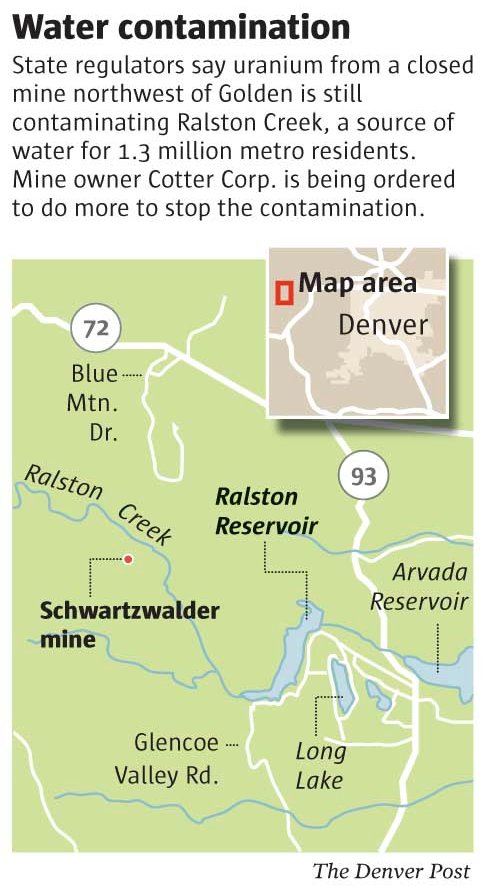
Cotter Corp. is preparing to brew a multimillion-gallon uranium cocktail in a mine shaft west of Denver — an innovation aimed at ending a threat to city water supplies.
If all goes well, mixing molasses and alcohol into a stream of filtered water pumped from the mine and discharged down Ralston Creek, and then re-injecting that mix into Cotter’s 2,000-foot-deep Schwartzwalder mine, will immobilize uranium tainting the creek. Bacteria inside the mine will devour the molasses and dissolved uranium, creating solid uranium particles that will settle at the base of the mine, Cotter vice president John Hamrick said. “We believe we can get the water to such a state that it would be OK to let it come out,” Hamrick said in an interview. “We’re using our best efforts to do this as quickly as we can.” Bacteria “will eat the uranium to live, and part of what they excrete, or the byproduct of that, is a solid particle that will fall down to the bottom of the mine.”
The U.S. Environmental Protection Agency has approved Cotter’s project and state regulators were reviewing it.
Such “bioremediation” would save Cotter tens of millions of dollars as an alternative to perpetually pumping out and treating mine water laced with uranium — which reached concentrations as high as 24,000 parts per billion inside the mine shaft, well above the 30 ppb federal drinking water standard…
“The potential is there for this process to work,” EPA environmental scientist Craig Boomgaard said. “Another form of it is being done at Asarco’s smelter in Denver. Is it solution? I can’t say. But in certain cases it is demonstrated to be effective.”[…]
State regulators’ order to pump out and treat uranium-laced water from the mine “has been in place for quite a while and the mine pool drawdown has not yet commenced,” the statement said. “We are eager to see the company move forward.”
More Schwartzwalder mine coverage here.
U.S. Representative Diana DeGette’s hydropower bill is still on track

From The Denver Post (Mark Jaffe):
…turning flowing water into small hydropower projects is not easy. Even a tiny ranch project requires almost the same paperwork for a federal permit as the Hoover Dam. A bill exempting small projects from the voluminous federal filings — co-sponsored by Rep. Diana DeGette, D-Denver — passed the U.S. House of Representatives 422-0 in February. Last year, a similar bill, also co-sponsored by DeGette, passed the House unanimously but died in the Senate. But this time may be different.
On March 13, companion legislation to the new hydro bill was introduced in a Senate committee with Democratic and Republican sponsors. “We are always talking about streamlining government,” DeGette said. “This is streamlining government.”
The legislation would exempt projects of up to 5 megawatts from the Federal Energy Regulatory Commission requirements. Getting rid of the FERC permit could open several hundred sites in Colorado with a combined capacity of 1,400 megawatts — equal to two power plants, according to the commission.
Small municipal and private hydro plants generate about 662 megawatts of electricity in Colorado, according to a Colorado State University study. There are 200 megawatts of small projects that are likely to be developed, said Kurt Johnson, president of the Colorado Small Hydropower Association…
FERC permitting can run from $10,000 to $30,000, which can be more than the cost of many projects, said Johnson.
2013 Colorado legislation: HB13-1248 gets a rewrite to expand its reach statewide #coleg

From The Pueblo Chieftain (Chris Woodka):
A late bill in the Colorado Legislature would allow the Colorado Water Conservation Board to administer three pilot projects to test water leasing strategies. The bill, HB1248, was introduced earlier this month and is sponsored by Randy Fischer, D-Fort Collins, and Sen. Gayle Schwartz, D-Snowmass Village. They chair legislative agriculture committees. As written, the bill applied only to the Arkansas River Basin. Fischer sent it to a subcommittee to rewrite the bill to apply it to the entire state and to clarify the role of the state engineer in approval of plans. It should be heard in committee this week.
The bill would give the CWCB authority over the pilot projects for one 10year period to demonstrate how irrigated agricultural land could be fallowed and the water temporally leased for municipal use, along the lines proposed by the Arkansas Valley Super Ditch. CWCB board member Alan Hamel said the board already has funded several projects looking at the impact of leasing programs like Super Ditch.
A similar bill, HB1130, seeks to extend state engineer approval of interruptible water supply agreements for up to 30 years. The agreements now can be operated three years out of a 10-year period. The bill would allow that period to be renewed twice. The bill, backed by Aurora, passed the House last month, but has yet to be heard in the Senate ag committee.
Other water bills:
● SB19, allowing water rights to be temporarily used for conservation purposes without penalty to consumptive use calculations, passed the Senate, but reportedly has been amended in the House to exclude water divisions 1, 2, 3 and 7.
● SB41, protecting stored water for drought and long-term needs, passed both houses.
● SB74, concerning ambiguities of water rights, passed both houses. The bill was amended from its original form to give water judges leeway in determining how much acreage historically was irrigated.
● SB181, the water projects bill, passed the Senate and is in the House ag committee. It includes $72 million in water projects administered by the CWCB.
More 2013 Colorado legislation coverage here.
The CWCB approves dough for three Arkansas Basin Roundtable projects

From The Pueblo Chieftain (Chris Woodka):
Three Arkansas River basin projects gained approval last week from the Colorado Water Conservation Board. A new water line for the Ordway Feedyard, bank stabilization on the Frost Ranch on Fountain Creek and a study of historic flows and diversions were approved.
The Ordway Feedyard received a $275,000 grant and $2.5 million loan for a $3.2 million project to complete a 10.5-mile pipeline. The pipeline would provide fire protection, as well as saving about 800 acre-feet of water, said Alan Hamel, CWCB board member. The new pipeline would replace a gravity-flow pipeline from Lake Henry with a system that pumps the water uphill. The feedlot needs as much water as a city of 5,500 people would require for its 65,000 head of cattle. It’s the third-largest employer in the county and has a $50 million impact annually on the local economy. It was built in 1972, but the owners subsequently sold off most of the water rights to large cities.
The Fountain Creek Watershed Flood Control and Greenway District received $105,000 for a bank stabilization project on the Frost Ranch on Fountain Creek in El Paso County. The project would demonstrate methods that other landowners along the creek could use to reduce erosion and sedimentation. The total project is about $160,000.
The Southeastern Colorado Water Conservancy District received a grant of $300,000 for a study of weather patterns and water diversions, with a goal of better understanding how water is used in wet and dry years. The study will also distinguish between native water and water imported into the basin. “We need an accounting tool that tells us how much water is available through native or imported sources, how much is in storage and how much can be exchanged,” said Jim Broderick, executive director of the Southeastern district.
All three grants were approved by the Arkansas Basin Roundtable and funded through the water supply reserve account, which comes from mineral severance taxes.
More CWCB coverage here.
Rio Grande Compact Commission meeting recap: Texas lawsuit with New Mexico delays final accounting

From The Pueblo Chieftain (Matt Hildner):
A dispute with Texas over the calculation of water deliveries under the Rio Grande Compact won’t have an impact on how Colorado manages its share of the river in the San Luis Valley. Craig Cotten, the division engineer for the valley, said the difference in calculations was roughly 300 acre-feet. “It’s a very small amount of water,” he said.
The amount of water in the Rio Grande that has crossed the Colorado state line in the last decade has ranged from as little as 68,000 acre-feet in the drought year of 2003 to as much as 430,000 acre-feet in 2005.
Colorado and New Mexico have disagreed with Texas over how the Bureau of Reclamation has calculated evaporation rates from a pool of credit water contributed by the upstream states that ends up in Elephant Butte Reservoir. Cotten said Colorado and New Mexico would prefer to see the calculations done at the end of the year as opposed to a running basis.
The dispute, which started in 2011, prevented the three states from signing off on the final delivery totals at Thursday’s meeting of the Rio Grande Compact Commission. The calculation of evaporation rates in the pool of credit water is the subject of a lawsuit between New Mexico and the bureau in U.S. District Court in New Mexico.