CWCB: March 2013 Drought Update

klauswolterapriltojune2013

Here’s the update from the Colorado Water Conservation Board:

Activation of Phase 2 &3 of the State Drought Mitigation and Response Plan, and the activation of the Agricultural Impact Task Force remain in effect to respond to ongoing drought conditions throughout Colorado.

Late February and March precipitation coupled with periods of cooler than average temperatures have helped to maintain snowpack levels in the Colorado high country. However, the entire state continues to deal with drought conditions and the eastern plains remain exceptionally dry. Given current conditions, 275% of normal precipitation would be needed to reach average peak snowpack statewide, which typically occurs on April 8th. It is unlikely that this will be achieved. Consequently, water providers are preparing for continued drought conditions throughout the spring and summer and some have announced restrictions. Please visit http://www.COH2O.co for more information on restrictions in specific communities.

 As of the March 19, 2013 US Drought Monitor, 100% of Colorado is experiencing some level of drought
classification. D1 (moderate) and D2 (severe) cover 52% of the state, while D3 (extreme) accounts for an additional 27%. 21% of the state is now experiencing exceptional drought (D4), a slight decrease from last month.

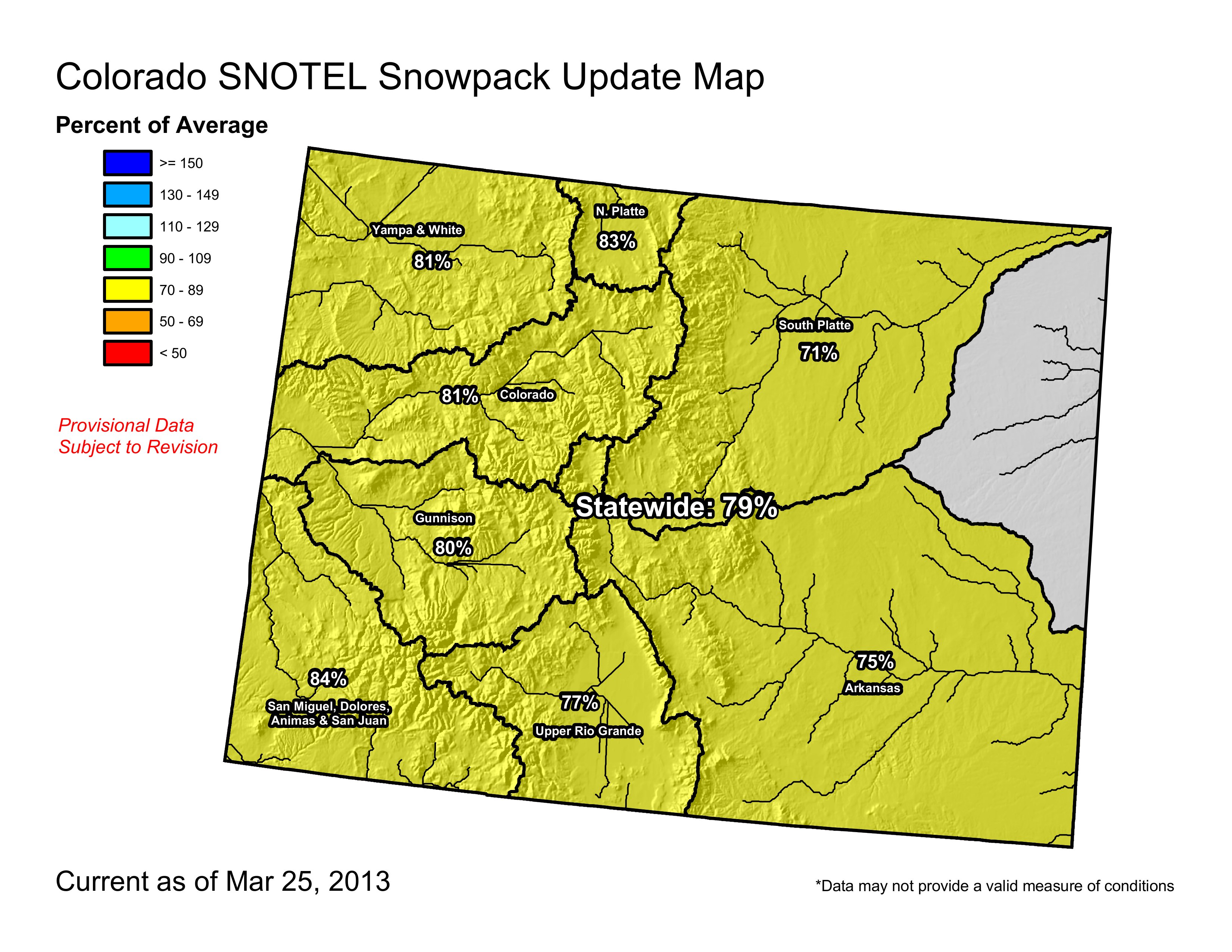
 Despite an increase in beneficial moisture during March statewide snowpack has maintained, but not improved, and is currently 77% of average. The highest snowpack in the state is in the Southwest basins (82%) while the South Platte is experiencing the lowest at 67% of normal for the water year. All other basins range from 73-79% of average.

 Municipalities and water providers are actively preparing to respond to continued drought conditions with both mandatory and voluntary watering restrictions throughout the spring and summer demand season. Many major utilities will implement restrictions beginning April 1st. A website http://www.COH2O.co has been developed to help individuals determine what the restrictions in their specific community are.

 Statewide reservoir storage is at 71% of average and 39% of capacity, a slight increase from last month. The highest storage levels are in the Yampa/ White River Basin, at 106% of average while the lowest storage in the state is the Rio Grande River basin at 53% of average. All other basins range from 55% to 82% of average and 16% to 65% of total capacity. Last year this time the state was at 105% of average reservoir storage.*

 Surface Water Supply Index values have decreased across the entire state over the last month and all values remain negative. Below average reservoir storage and streamflow forecasts contribute to these values.

 NRCS is forecasting below average spring streamflows for the entire state, with most of the basins falling within the 50-69% of average forecast range.

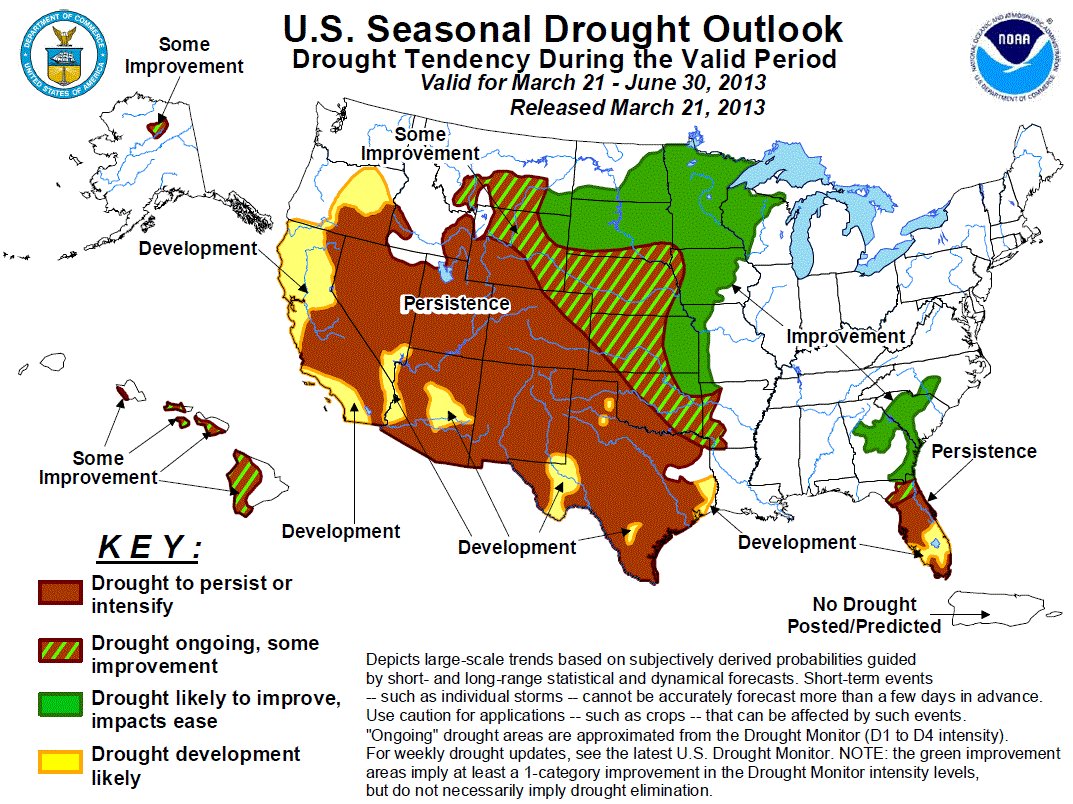
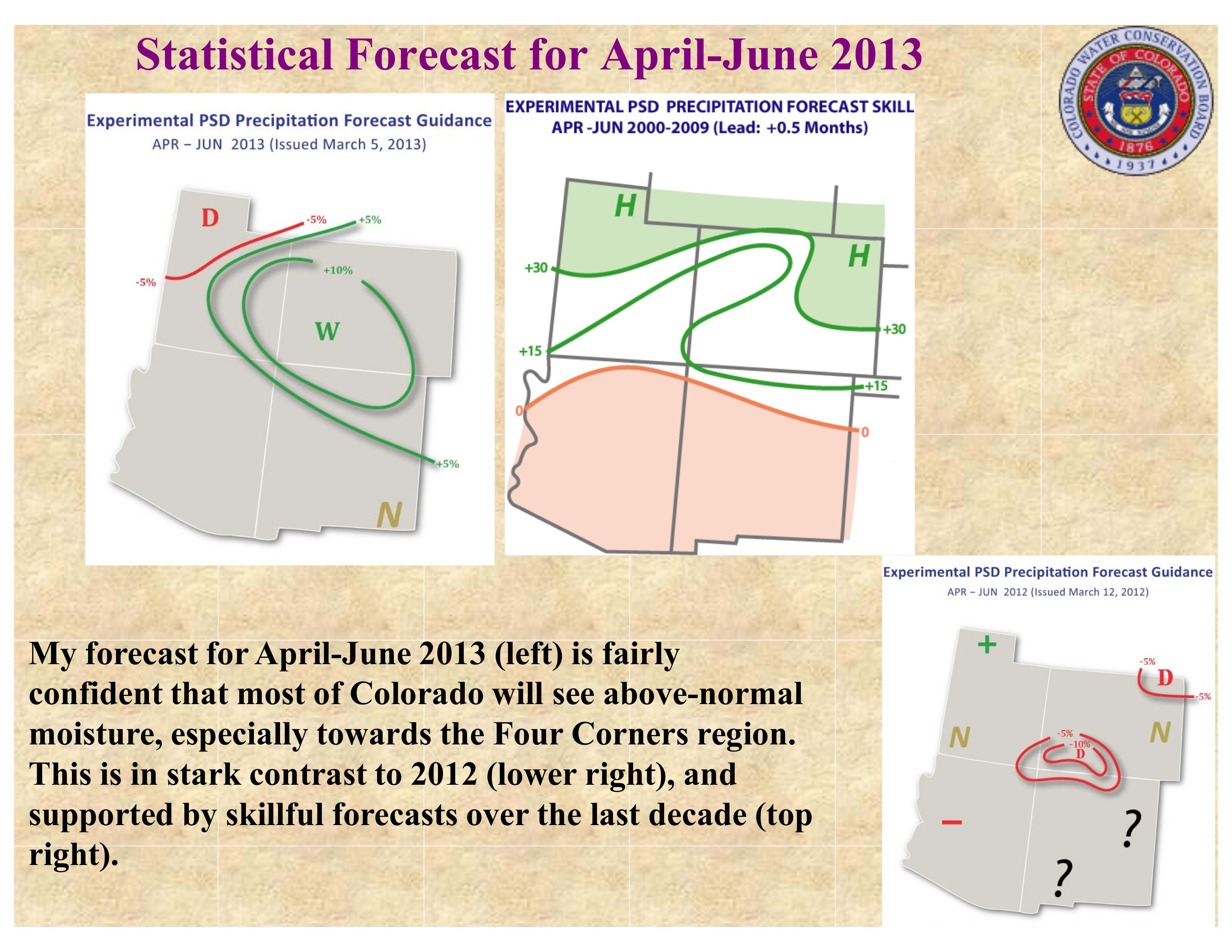
 The long term experimental forecast for April through June of this year is projecting above normal moisture across most of the state, especially around the four corners region. Additionally, the Climate Prediction Center at NOAA is forecasting above average temperatures and persistent drought conditions across much of the state.

Here’s the link to the webpage where you can view all the presentations.

More CWCB coverage here.
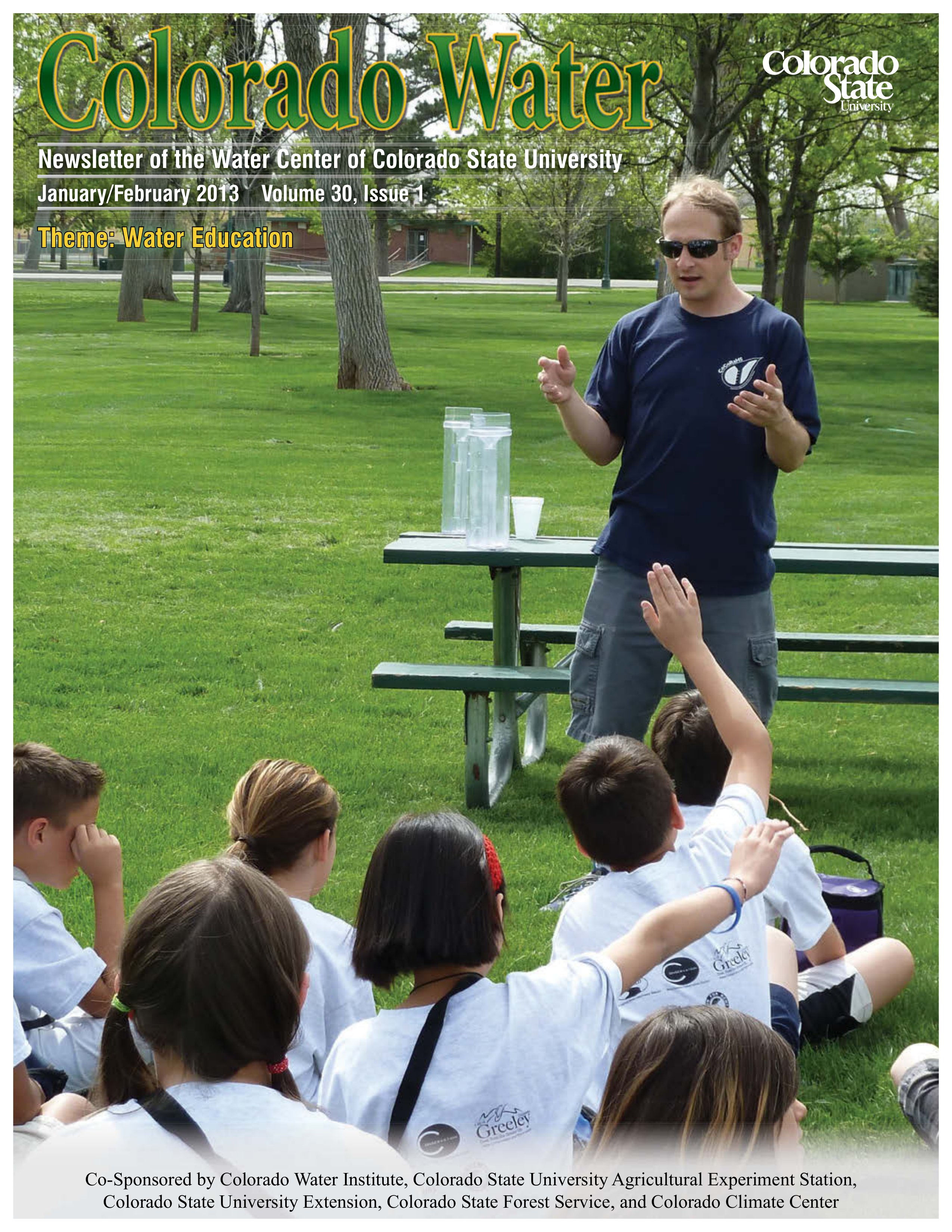
The January/February issue of Colorado Water (Colorado State) is hot off the press

coloradowatercovermarch2013

Click here to read a copy.

Thanks to the Colorado Water 2012 Twitter feed for the heads up

.

More education coverage here.

Drought news: The drought has dried up municipal leases to farmers #codrought

seasonaldroughtoutlookclimatepredictioncenter03212013

usdroughtmonitor03192013

From The Greeley Tribune (Eric Brown):

It’s been a bone-dry search this year for the many farmers and ranchers who depend heavily on leasing water from their municipal neighbors. Greeley, Fort Collins, Loveland and Longmont — each typically leasing thousands of acre-feet of excess water per year to local producers — have all said it’s unlikely they’ll have any extra water available in 2013. Dismal snowpack in the mountains and not having city water as a back-up option is putting farmers in a tough spot, local crop growers say.

With spring planting beginning in the upcoming weeks, many predict they’ll cut back on production even more than they did in a drought-stricken 2012. “There’s just nothing out there to lease,” said Randy Knutson, who farms south, east and north of Greeley, explaining that, on one of his 160-acre farms where he fallowed about 30 percent of his ground last year, he’ll likely fallow about 50 percent of that ground this year.

Knutson — who sits on the board of directors for the Central Colorado Water Conservancy District and the Greeley No. 3 Ditch and Western Mutual Ditch companies — said, based on his conversations with farmers, there will be fallowing aplenty this year.

Water officials from Greeley and Fort Collins said this is the first time in about 10 years they haven’t been able to lease extra water to agricultural users, and for Loveland and Longmont it’s been even longer, officials from those two cities said.

Agriculture uses about 85 percent of the state’s water, according to the Colorado Division of Water Resources, but the ag industry doesn’t own nearly that much of the state’s supply — at least not anymore.

In 1957, when the Colorado-Big Thompson Project first went into operation, 85 percent of the water in the project was owned by agricultural users, according to numbers from the Northern Colorado Water Conservancy District, that oversees operations of the C-BT Project. But today, only 34 percent of the water in the C-BT — the largest water-supply project in northern Colorado — is owned by agricultural users.

For years, when there was limited money to be made in ag, growing cities along the northern Front Range bought water rights from farming and ranching families that were getting out of the business. Also, some producers who stayed in business thought it could be more profitable to sell some of their water rights at a certain price to growing cities, and then rent extra water as needed. “I can’t condemn anyone at all for selling their water rights,” said Lynn Fagerberg, an Eaton-area farmer. “Times were tough for a long, long time. “It’s just led to a complicated situation now.”

A lot of producers today — while owning some of their water rights — play the rental market heavily, according to Brian Werner, the public information officer and historian for the Northern Colorado Water Conservancy District. While only one-third of the water in the C-BT Project is now owned by agricultural users, about two-thirds of C-BT water in most years still goes to ag users, who lease much of that C-BT water from cities who own it, Werner said. Despite the shift of ownership, the C-BT remains the largest, supplemental water supply for ag in the state, he added. But playing the rental market, Werner noted, can make life difficult in dry years when cities are reluctant to lease water — like this year.

In 2012, the drought forced cities and farmers to use up water in reservoirs, but they did so in hopes that this year’s winter and spring would produce at least average snowfall, or better. But through Monday, statewide snowpack was only 79 percent of average, and only 71 percent of average in the South Platte River basin — not enough to replenish reservoirs back up to levels where cities are comfortable with their supplies. According to the most recent report from the Natural Resources Conservation Service, statewide reservoirs were filled to level about 30 percent below-average at the beginning of March.

Additionally, last year’s wildfires, which took place around many high-mountain reservoirs, caused additional complications.

Fagerberg and other farmers and ranchers have expressed frustration in that cities which aren’t leasing water to agriculture this year aren’t putting additional lawn-watering measures in place that could save water — water that could then be leased to ag.

Jon Monson, water and sewer director for the city of Greeley, said the city’s water board will continue looking at potential watering restrictions as the year goes along.

Monson, Fagerberg and others were quick to point out the economic impact agriculture has on Weld County — amounting to about $1.5 billion agricultural goods, which ranks Weld eighth in the nation, according to the most recent U.S. Census of Agriculture. In 2011, the city of Greeley leased 25,427 acre-feet of water to agricultural users, but this year, only has enough available to honor its long-term ag-lease agreements of about 5,000 acre-feet, Monson said.

Many ag water users are tying to decrease their dependency on leased water form cities. The board of directors for the North Weld County Water District nearly a year ago increased water surcharges in order to buy more water down the road. The board cited concerns that dairymen who are customers of North Weld Water don’t own very much of the water they use; collectively, the 20 largest dairies in the district owned only about 7 percent of the water they use, according to their numbers.

The Central Colorado Water Conservancy District passed a $60 million bond issue last fall to purchase water needed by many of its ag users.

None of those efforts, though, will help this year.

In recent years, commodity prices have made farming more profitable, and since 2009, the percentage of CB-T water owned by agriculture has stayed steady at 34 percent — after gradually dropping nearly every year for decades. But the percentage of ag ownership isn’t increasing, and that’s because the water rights agricultural users sold years ago are too expensive for farmers and ranchers to buy now, Werner said. And water rights are certainly pricey in times of drought, Werner added. He said the price of a C-BT share has increased from about $9,000 last year to about $13,500 to $14,000 now. “We’re basically seeing the price increase by about $1,000 per month so far this year,” Werner said, noting that most of that water today is being bought for municipal and industrial uses. “It’s certainly not the farmers who can afford it.”

Forecast news: Chance for snow today for the Park and Gore ranges #codrought #cowx

From the National Weather Service Pueblo office:

Mostly dry and fair weather will continue across the region today, with only a few mountain rain or snow showers expected across the higher elevations. A warming trend will take place over the next few days, with area temperatures warming into the 40s to mid 50s across much of the region this afternoon.

From the National Weather Service Grand Junction office:

A trough will move over the northern half of the area later today and tonight. Scattered rain and snow showers are expected, except over the Park and Gore mountain ranges of northern Colorado, where periods of snowfall will result in 1 to 3 inches of snow accumulating by Wednesday morning. The next significant storm will affect the area next Sunday through Wednesday with widespread precipitation possible.

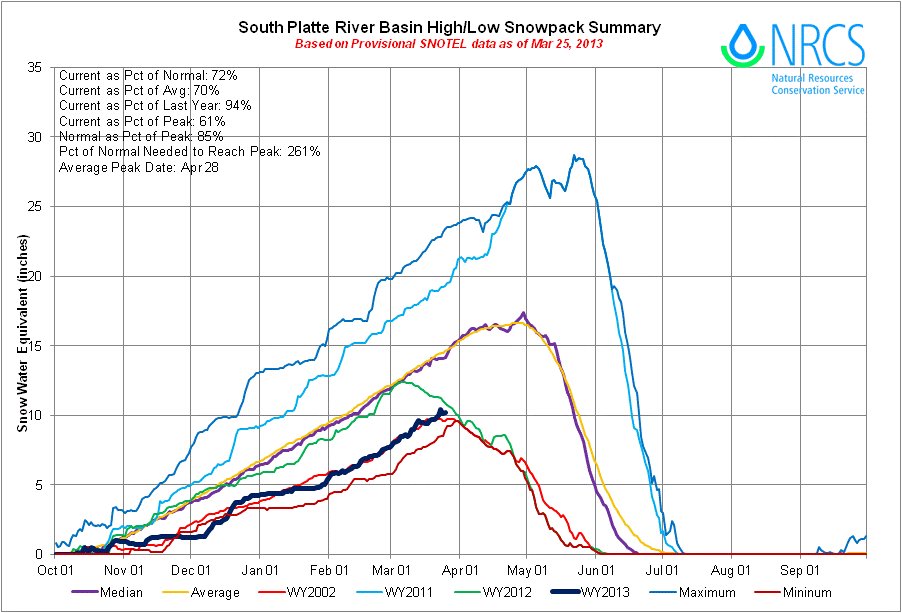
Snowpack news: South Platte Basin above 2002 line at 70% of avg #codrought

snowpackcolorado03252013

southplattebasinhilow03252013

Click on the thumbnail graphics for the statewide snowpack map and the South Platte Basin High/Low graph.

Fountain Creek: ‘Colorado Springs has taken its job very seriously’ — Steve Gunderson

fountaincreekthrucoloradospringsfromdippity

From The Colorado Springs Gazette (Barbara Cotter) via The Denver Post:

Nearly 10 years, $450,000 in penalties and $170 million in fixes later, Colorado Springs Utilities is done with a compliance plan the state imposed over series of wastewater spills into Fountain Creek and some of the tributaries that feed it.

“I would say this has been quite a success story, and Colorado Springs has taken its job very seriously,” said Steve Gunderson, director of the Water Quality Control Division of the state Department of Public Health and Environment. “Why we decided to take enforcement action almost 10 years ago is that we were seeing a pattern of problems. Really, it’s amazing how that pattern has largely disappeared.”[…]

Earlier this month, the Water Quality Control Division sent a letter to Utilities officials notifying them that it was closing the books on the order because all requirements had been met.

More Fountain Creek coverage here and here.

2013 Colorado legislation: SB13-019 moves along to the state house #coleg

dripirrigation

From The Aspen Times (Janet Urquhart) via the Glenwood Springs Post Independent:

The drought-fueled measure, put forth by state Sen. Gail Schwartz, a Democrat from Snowmass Village, passed unanimously in the Senate last week and now moves to the House, starting with the Agriculture, Livestock and Natural Resources Committee. Rep. Randy Fischer, D-Fort Collins, is the sponsor.

While the legislation, Senate Bill 13-19, was amended to gain the necessary support — losing its most ambitious provisions in the process, Schwartz on Thursday called the measure a critical first step and one that will lead to further conversations this summer about water conservation. With Colorado likely facing a second straight summer of severe drought, Schwartz said she hopes to encourage water conservation among agricultural users without punishing them in the process. “We need to modify our thinking and our attitudes about how we use water,” the senator said.

The legislation was originally to apply statewide, but concerns among the state’s seven river basins were varied and ultimately, the bill’s focus was narrowed to the Gunnison, Colorado main stem and Yampa/White River basins…

Under Schwartz’s bill, a water user who enrolls in various conservation programs could reduce their water use in drought years but the reduction would not be considered by a water judge in determining that user’s historic consumptive use. “What we’re trying to say is, ‘If you’re willing to do this, your historical consumptive use is protected,’” Schwartz said.

The conservation programs include those enacted by local water districts. Last year, for example, the Eagle River Water and Sanitation District, which provides water to the eastern half of Eagle County and is a main user of water from Gore Creek and the Eagle River, worked with its customers to conserve water but also convinced other water diverters to do with less, according to spokesperson Diane Johnson. Entities such as golf courses and the town of Avon, which uses raw water to irrigate its parks, got on board, she said. Schwartz’s bill would mean those entities wouldn’t get dinged in a calculation of consumptive use if that voluntarily reduction is repeated, she said.

“Gail’s bill is quite significant,” said Basalt attorney Ken Ransford, secretary for the Colorado Basin Roundtable. The group is one of nine in the state that focuses on water-management issues under the umbrella of the Colorado Water Conservation Board. Ransford has watched Schwartz’s legislation closely. Its passage would mean an important incentive for conservation, he said. “It’s a significant change in the law. It takes away a disincentive to a landowner who wants to enroll their land in a conservation program,” he said…

Gone from the legislation, however, are provisions that would have provided incentives to irrigators to increase the efficiency of their watering systems without jeopardizing their water rights.

More 2013 Colorado legislation coverage here.

‘The lower basin is done with its compact allocation, and on occasion they use some of ours’ — Jennifer Gimbel #coriver

coloradoriverbasin2012doiviatheaspentimes

From The Pueblo Chieftain (Chris Woodka):

State water officials say that results of a Colorado River basin study do not support the conclusion that there is no more water in the river to develop. After the Bureau oyf Reclamation released the study last year, environmental groups have portrayed it as meaning the Colorado River is out of water, but that’s not the case, said Jennifer Gimbel, executive director of the Colorado Water Conservation Board.

“What’s important about it is that it’s a planning study that’s meant to be a tool for folks as they look at the river,” Gimbel told the Southeastern Colorado Water Conservancy District board last week. “You can play it any way you want it, and some have. They say, ‘a pipeline is impossible,’ or ‘we’re running out of water.’ ” In reality, the lower basin states in the Colorado River Compact (Arizona, California and Nevada) have used their full allocation of water, while upper basin states (Colorado, New Mexico, Utah and Wyoming) still could claim water from the river.

“The lower basin is done with its compact allocation, and on occasion they use some of ours,” she said.

Ted Kowalski, who specializes in Colorado River issues for the CWCB, pointed to Colorado’s own studies which found that up to 900,000 acre-feet annually within Colorado could be allocated. The states have been working cooperatively to manage the risk of shortages, which have never occurred under the compact, Kowalski said. “Strategies like water banking would reduce the likelihood of shortages,” he added.

Gimbel added that the study did not take into account that cities that export water from the Colorado River like Los Angeles, Denver and Salt Lake City might find other sources of water to better manage the risks.

“We have a variable climate in Colorado,” said Alan Hamel, the CWCB representative from the Arkansas River basin. “We shouldn’t give up on developing our Colorado River entitlement.”

More Colorado River Basin coverage here and here.