Thanks to the Loveland Reporter-Herald for the link.
Just another day in the canyon country — pretty amazing rope swinging video
Thanks to the Loveland Reporter-Herald for the link.

Thanks to the Loveland Reporter-Herald for the link.
Winter 2012-13 Climate Review and Spring Preview for South Central and Southeast Colorado go.usa.gov/2gnk #cowx
— NWS Pueblo (@NWSPueblo) March 2, 2013
A storm system will pass by the region to the north Sunday night and Monday. This system will bring snow to the ce twitpic.com/c819ps
— NWS Pueblo (@NWSPueblo) March 2, 2013
From the NWS Pueblo Office:
A storm system will pass by the region to the north Sunday night and Monday. This system will bring snow to the central mountains beginning late Sunday and breezy conditions across the I-25 corridor and eastern plains Monday afternoon. Temperatures will cool to near normal values Monday
Patchy fog around Craig will dissipate late this morning, as will isolated snow showers over the northern mountain twitpic.com/c80wda
— NWS Grand Junction (@NWSGJT) March 2, 2013
Warmer Temps Today! Snow & Blowing snow then returning to mountains late Sunday afternoon/evening. #COwx twitter.com/NWSBoulder/sta…
— NWS Boulder (@NWSBoulder) March 2, 2013
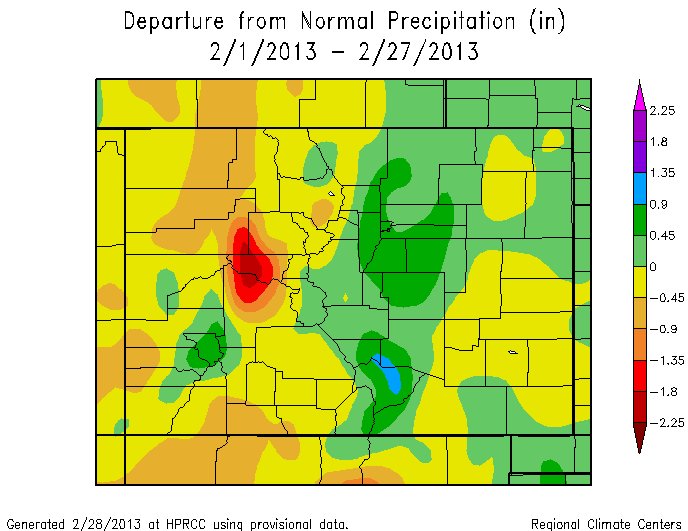
Click on the thumbnail graphic for the February 2013 precipitation departure from normal map from the Regional Climate Centers.
From The Denver Post (Brandon Swedlund):
The unseasonably mild temperatures from January continued into the first week of February. However, a major shift in the jet stream brought colder temperatures and beneficial snowfall to Denver and much of northeastern
Colorado during the last half of the month. Thanks in large part to 9.1 inches of snow on Sunday, the total snowfall for the month will be well above the average of 6.1 inches. As of Wednesday, the unofficial total snowfall at Denver International Airport was 14.1 inches.
Heading into March, a variable weather pattern is expected to continue, as wet storms from the Pacific clash with a cold and drier air mass from the Arctic. This can result in the weather being highly variable, even in just one day. An example of this occurred on March 8, 1992, when thunderstorms and hail during the day gave way to blizzard conditions that night.
On average, March is Denver’s snowiest month at 9.6 inches. However, this snow does not often stay on the ground for very long, due to the variable weather pattern and temperatures.
Where’s the #snow today? 5″ of fresh @breckenridgemtn & 4″ @vailmtn . 24-hr totals. #cowx #COsnow #celebratewinter
— Snow.com (@snowdotcom) March 2, 2013

From The Greeley Tribune (Eric Brown):
Experts who want to know more about fracking’s impacts on groundwater will soon use Weld County as a site for more extensive monitoring.
During the 2013 Big Thompson Watershed Conference in Greeley on Thursday, Colorado State University engineering professor Kenneth Carlson, who serves as a co-director of the Colorado Energy-Water Consortium, said the consortium will set up about 10 new groundwater-monitoring sites, all in Weld. Those sites will provide additional monitoring to the groundwater testing that will take place because of new state rules, Carlson said.
This year, a new regulation was put in place that requires before-and-after groundwater testing at all drilling sites permitted on or after May 1. While the state-regulated testing will provide pre- and post-drilling water data,
Carlson said the consortium’s new monitoring sites in Weld are aimed at constant, real-time data, which will be available to the public.
Hydraulic fracturing, or fracking, involves blasting water, sand and chemicals into rock formations, about 7,000 feet into the ground, to free oil and natural gas. Some have expressed concerns that the chemicals used in fracking could seep into groundwater and contaminate it.
The Colorado Energy-Water Consortium is a public-private partnership between CSU and the oil and gas industry formed a couple years ago, and is working to solve issues related to water and the production of oil and gas in Colorado.
The general public’s concern about groundwater contamination caused by fracking chemicals is one of those issues. Carlson said the consortium selected Weld for its new groundwater monitoring sites because of its extensive amount of oil and gas drilling.
Last year, 63 percent of the state’s 2,172 new oil and gas wells were drilled in Weld County.
The all-day Big Thompson Watershed Forum conference, titled “Critical Surface Water Issues — 2013,” featured a number of experts who discussed water use in fracking, as well as agriculture water sharing with cities, wildfire effects on water quality and watershed management, among other issues.
The Big Thompson River Watershed, an area encompassing more than 900 square miles, provides drinking water to numerous cities in northern Colorado, including Greeley, Estes Park, Fort Collins and Loveland, and is used for agricultural, commercial, recreation and wildlife-habitat purposes.
During the conference, Carlson explained that the consortium’s new monitoring sites will be somewhat spread out, but within a part of the county where drilling is taking place. He said he would know more specifics after a meeting next week in Denver, when oil and gas and water experts and officials meet to further discuss the new monitoring program.
Carlson and other experts on hand also discussed the water demands of fracking and horizontal drilling. Extensive water use has been a source of concern as oil and gas companies have gravitated from traditional vertical drilling toward horizontal drilling.
Carlson acknowledged that the roughly 2.8 million gallons of water needed per horizontal drilling well is a “substantial” amount of water. But he added that, if the public feels it’s necessary to pull energy out of the ground, horizontal drilling is a more water-efficient way of doing it — something researchers have discovered through studies conducted in Weld.
All together, fracking and oil shale development account for less than 1 percent of water use in Colorado, according to the Colorado Division of Water Resources.
Additionally, oil and gas and environmental experts on hand agreed that the rules Colorado has put in place regarding fracking and oil and gas development are some of the most comprehensive in the nation, and other states are looking to Colorado as an example in making their own rules.

From the Montrose Daily Press ( Katharhynn Heidelberg):
The valley needs to brace itself for another tight water year, with even less available than in 2012. The Uncompahgre Valley Water Users Association has delayed turning on the Gunnison Tunnel until a least April 1, does not expect to deliver 100 percent of its water and won’t be renewing pump contracts for approximately 250 people in Montrose and Delta counties. The UVWUA last year turned on the water March 18 and kept it on until early last fall.
From the Glenwood Springs Post Independent (Nelson Harvey):
The “Snapshot assessment of the Roaring Fork Watershed” finds that the Roaring Fork River was driest on July 25 [2012] near Aspen’s Mill Street Bridge, when flows were measured at a trickling 4.7 cubic feet per second (CFS). The lowest flow on the Crystal River was measured near the Thomas Road Bridge south of Carbondale on Sept. 22, at a paltry 1 CFS…
In addition to being used for irrigation, much of the water in the Roaring Fork River above Aspen is diverted in the early summer to users on Colorado’s Front Range, through the Independence Pass Tunnel and into the Arkansas River basin. By mid-July or early August, a water right held by downstream agricultural users in the Grand Valley called the Cameo Call typically comes into effect, leading so-called “transbasin” diversions to cease and prompting water levels to rise in the river through much of the Roaring Fork Valley…
If water levels stay low next summer, Sharon Clarke of the Roaring Fork Conservancy said her group may consider other methods of improving flows, such as deepening and narrowing parts of the river channels or planting vegetation on the banks to add shade and reduce erosion. “One of the things we want to look at is restoring the channel to function better at low flows,” she said.

From the Highlands Ranch Herald (Ryan Boldrey):
In the midst of the worst drought since 2002, Centennial Water and Sanitation District is tapping its 1.7 billion acre-feet supply of groundwater underneath Highlands Ranch to prepare for summer.
“We use it when we have to,” said John Hendrick, general manager for Centennial. “The groundwater program is kind of our Fort Knox, our trump card up our sleeves. Our reserves are big enough that we could use 17,000 acre-feet a year for 100 years.”
To access the groundwater, the district will begin a somewhat lengthy 24/7 drilling process in two locations within the community in early March. The drill sites are located on Salford Lane, north of Gateway Drive and east of Broadway, and near Paintbrush Park, just north of Valleybrook Road and southwest of McArthur Ranch Road.
“It will be disruptive,” Hendrick said. “We could stretch it out for three, four or five months if we limited the time we were working on it, but the cost would escalate significantly. So, we’re going to get in there, get it done and get out of your hair.”[…]
Once complete, the well sites will undergo additional construction work involving the installation of underground piping as well as pumping equipment in the wells. The sites will then be landscaped to make them blend in with the surrounding properties.
More South Platte River Basin coverage here.
From the Montrose Daily Press:
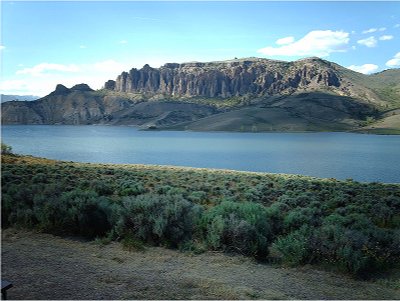
The Black Canyon of the Gunnison National Park and Curecanti National Recreation Area attracted nearly 1.1 million visitors between them in 2011 while generating an economic impact of almost $50 million, according to a report released Thursday by the National Park Service.
The report also claims a total of 621 local jobs were supported by the two entities in 2011, the most recent year for which statistics were available. Black Canyon supported 111 of those jobs, while the other 510 were attributed to Curecanti.
“Black Canyon of the Gunnison National Park is a wonderful place to learn about America’s story,” park superintendent Connie Rudd stated in a press release. “And Curecanti National Recreation Area offers outstanding waters and a healthy fishery. We attract visitors from across the U.S. and around the world that come here to experience these places and then spend time and money enjoying the services provided by our neighboring communities and getting to know this amazing part of the country. The National Park Service is proud to have been entrusted with the care of America’s most treasured places and delighted that the visitors we welcome generate significant contributions to the local, state and national economy.”
More Gunnison River Basin coverage here.

Here’s the letter and order from Chris Urbina at the Colorado Department of Public Health and Environment:
Attached is my signed decision regarding the matter of Energy Fuels radioactive materials license and the pending appeal by Sheep Mountain Alliance. It is a legal document. On January 14, 2013, Judge Richard Dana decided that the hearing conducted was sufficient to meet the requirements of the Colorado Administrative Procedure Act. These decisions clear the way for the department’s final decision regarding the pending radioactive materials license application to be issued in April 2013.
Even though the Sheep Mountain Alliance appeal is being denied, the department will give serious consideration to the testimony provided in this hearing as the department decides whether to issue the license and what mitigation, if any, to include if the license is granted. We have listened, and will continue to listen, to diverse and comprehensive testimony from all interested parties regarding this application, from community members impacted by the potential licensing of the mill; from people who want jobs that would be created by a new mill; from environmentalists who want to know that public health and the environment will be protected; and from industry that wants to develop natural resources.
While there is a disagreement on the nature of this hearing process, there is no disagreement that it helped the state acquire additional information and perspectives useful to the department’s decision.
The license, if approved, will protect public health and the environment. The department’s decision will be based upon an extensive review of the application, and associated documents and testimony, including documents and testimony submitted in the November hearing, and a consideration of the short- and long-term impacts of the proposed mill, including radiological and non-radiological impacts to water, air and wildlife, as well as economic, social
and transportation-related impacts.
From The Denver Post:
Urbina’s executive order clears the way for a final decision on Energy Fuels request for a radioactive materials license for a proposed uranium and vanadium mill near Nucla. That decision is expected in April.
From The Grand Junction Daily Sentinel (Gary Harmon):
A state official on Thursday rejected an environmental organization’s appeal of a license for a uranium mill near Naturita, but stopped short of issuing a new permit.
The Telluride-based Sheep Mountain Alliance last year appealed a decision by the Colorado Department of Public Health and Environment and a Denver District judge invalidated the license. As part of the ruling, the department was required to conduct hearings in which witnesses could be cross-examined, a process that was undertaken over several days last year in Nucla.
The decision by Dr. Christopher Urbina, executive director of the Health Department, leaves the question of whether to issue a radioactive materials-handling permit to Energy Fuels Inc. That decision will be taken up by the department’s radiation-management program, which is to make a decision in April on whether to reissue the permit.
Energy Fuels is planning to build a $150 million mill, the first to be built in the United States in three decades, near Naturita.
From The Grand Junction Daily Sentinel (Gary Harmon):
A favorable action by state regulators has the backers of a planned uranium mill in Montrose County saying that long-term economics also augur well for the mill.
The Colorado Department of Public Health and Environment is to decide in April whether to issue a radioactive materials-handling permit to Energy Fuels Inc., but on Thursday it rejected an appeal of a previous license by an environmental group. The decision, however, requires regulators within the department to consider comments made over several days last fall before an administrative law judge, Richard Dana. The ruling is “another step forward in the process,” Energy Fuels spokesman Curtis Moore said, noting that the company expects continued opposition from environmental groups.
The Sheep Mountain Alliance was pleased that the agency is required to consider evidence raised at the hearing in the fall. “In light of this damning evidence on the potential impacts of the Pinon Ridge Mill and the lack of a thorough and independent review process by the state, we believe they have no other option than to deny the license after a second more professionally conducted review process,” Director Hilary White said.
Environmental groups are “free to do what they wish,” Moore said, but “it seems to me they are wasting their members’ money and resources when they could be solving real environmental issues.”
Energy Fuels remains committed to constructing the $150 million mill, Moore said, noting that while the current market for uranium is “soft,” or about $43 a pound, the medium- to long-term economics of uranium “look better now than they even did pre-Fukushima.”
A tidal wave in 2011 swamped a nuclear reactor in the Fukushima province of Japan, stoking fears of nuclear power around the world and causing the price of uranium to fall dramatically.

From The Pueblo Chieftain (Tracy Harmon):
A Community Advisory Group met for the first time Thursday, kicking off what will be a 15- to 20year process to decommission the Cotter Corp. Uranium Mill south of town.
The Cotter Uranium Mill opened in 1958, became a part of a Superfund cleanup site in 1984 and ceased processing uranium for yellowcake in 2006. Cotter officials plan to close the mill forever and have already torn down most of the buildings on site.
At the meeting Thursday, the 14-member advisory group was introduced to entirely new teams of U.S. Environmental Protection Agency and state health department officials who will help guide the clean up of the site.
“The community advisory group input is always useful to the EPA,” said Martin Hestmark of the EPA. “We are going to listen to you,” said Mario Robles, a project manager for the EPA.Among members of the new group are Jackie Mewes, a Canon City resident who worked 26 years at the Rocky Flats Nuclear Weapons plant during production and closure. “There is a broken infrastructure here because I see that things are not followed up on for sometimes two to three years. The process and regulations need to be up to date and the EPA needs to provide facilitation,” Mewes said.
Joe McMahon will serve as group facilitator on behalf of the EPA. He told the group members, “You all have other hats but in these meetings you are representing the community.”
“Am I missing something or why don’t we have a member from Cotter?” asked group member Marvin Eller. “They can’t be all bad.” McMahon told Eller that the group probably will get input from Cotter officials but that likely will come through the state health department and not through an actual representative sitting on the board. The group will advise state and federal health officials on proposals but it will be up to those agencies to make final decisions on the cleanup process. Chris Urbina, health department executive director, told the group that a road map on how the cleanup will proceed should be ready within a month, giving the group time to organize. At that point, a year-long pause in work will come to an end and cleaning up the mill site will begin, he said.
From The Pueblo Chieftain (Tracy Harmon):
A new Community Advisory Group is ready to get to work and should give direction to cleanup efforts at the Cotter Uranium Mill.
After a nearly yearlong pause to form the group and establish a road map for the complicated decommissioning process, work can begin. The 15member group will meet with state and federal officials at 6 p.m. Thursday at City Hall, 128 Main St.
The group is made up of Colorado Citizens Against Toxic Waste members, City Councilwoman Pat Freda, Fremont County Commissioner Tim Payne, former Fremont County Commissioner Mike Stiehl and several other interested community members.
The group’s members will decide protocols for moving forward and will hear an update on the Cotter Mill site from state health department officials
From The Pueblo Chieftain (Tracy Harmon):
The Cotter Uranium Mill site is mostly a naked landscape these days. For the first time since it opened in 1958, no native Colorado ores are on the site.
“It is a historic milestone; the last pile of ore was moved last week,” said John Hamrick, mill manager. “We tore down the whole mill without any injuries and the only buildings left are the office, change house, maintenance shop and analytical lab.”
All the other mill buildings have been chopped, placed around the edges of the primary impoundment — at least 10 feet from a plastic liner to prevent punctures — and buried in dirt, Hamrick said. Even the boilers have been disposed of after they were filled with a cement slurry.
The mill continues to employ 29 workers, who are busy with environmental monitoring work and the massive report writing that must be done. They measure 100-plus water wells, surface water and air monitors. Hamrick said when the primary and secondary impoundment are capped for good, they will be completely dry repositories that are supposed to last 1,000 years. “We will have to make sure the cover material is impervious enough that if the plastic liner ever goes away, any release would be very slow,” Hamrick said…
believes the tailings and chopped-up buildings should stay where they are and not moved off site as part of decommissioning.
“There is no credible pathway where contamination can get out of the site into the community.
And out of 45 mills in the country, Cotter is one of the very few that has the plastic liner under the impoundment ponds,” Hamrick said.
“Before we have our license terminated there cannot be any remedial activities left and all the remedies that will be implemented have to be shown to be protective of human health and environment,” Hamrick said.
“Before we have our license terminated there cannot be any remedial activities left and all the remedies that will be implemented have to be shown to be protective of human health and environment,” Hamrick said.
From the Cañon City Daily Record (Rachel Alexander):
According to an analysis submitted to the Colorado Department of Public Health and Environment in November, removing tailings from the Cotter Corp., Uranium Mill site south of Cañon City would be prohibitive due to both cost and danger to workers, the public and the environment. Cotter submitted the analysis to CDPHE at the department’s request, said Cotter Vice President of Milling John Hamrick. It is part of the process of updating plans to decommission to the site. According to the analysis, there is an estimated 10,061,000 cubic yards of material in the company’s Main Impoundment, weighing about 15,292,720 tons…
Cotter used the example of the Moab, Utah, Uranium Mill Tailings Remediation Project to make its estimates. “That’s the only yardstick we have,” Hamrick said.
Using that standard, they estimate it would take 5.4 years to move the materials from the Cotter facility and would require 455 trucks or one 114-car freight train every day, five days a week to complete the project. The document estimates the cost of moving the tailings no more than 30 miles would be at least $895 million. The cost estimate was made understanding that no site has been considered or researched…
Gary Baughman, director of the Hazardous Materials and Waste Management Division of CDPHE, said leaving the impoundments in place and sealing the ponds for permanent storage are provisions contained within Cotter’s radioactive materials license.