
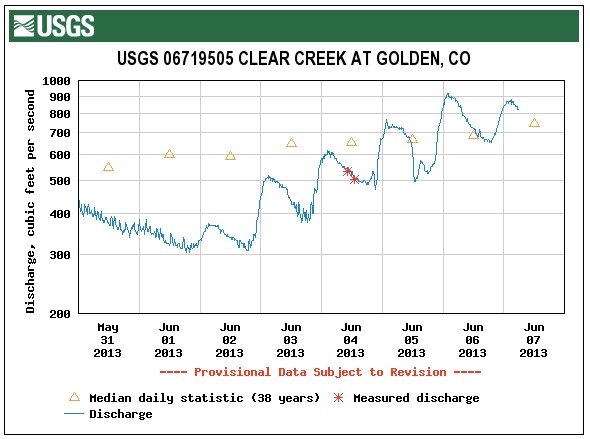


Click on the thumbnail graphics for the Clear Creek at Golden gage this morning along with the latest US Drought Monitor and the latest seasonal drought forecast from the Climate Prediction Center.
From The Pueblo Chieftain (Chris Woodka):
Water levels in the Arkansas River are reaching the highest point in two years as warmer temperatures increase snowmelt and runoff. “We saw a spike (Wednesday) night, and if we keep having warm, sunny days, I think we’ll reach peak runoff,” said Rick Sexton, Clear Creek Reservoir caretaker for the Pueblo Board of Water Works.
While Pueblo stayed under clouds Wednesday, blue skies never left the mountains. Up to 0.4 inches of rain fell in parts of Pueblo, but the rest of the region received only spotty precipitation.
Temperatures are expected to climb through the weekend.
That translates into bigger flows in the Arkansas River. On Thursday, the flows were climbing all along the river, with the highest levels in two years reached at Nathrop and Parkdale, west of Pueblo. At Avondale, the river hit its peak last week, aided by releases of water from Pueblo Dam to compensate for upstream exchanges by Colorado Springs and Aurora. Now, runoff has begun in earnest. “It’s looking like more of a traditional flow, later in the season and we anticipate good flows for at least two to three weeks,” said Rob White, manager of the Arkansas Headwaters Recreation Area.
White said the number of visitors to the park is up dramatically this week because of the flows, warmer temperatures and summer break for many students.
Imports for the Fryingpan-Arkansas Project are already at 40 percent of the projected total for the year. Water is brought across the Continental Divide through the Boustead Tunnel into Turquoise Lake near Leadville. “In the last 10 years, we’ve seen the runoff coming off earlier,” said Roy Vaughan, manager of the Fry-Ark Project for the Bureau of Reclamation.
Other indicators show Southern Colorado is in a drought. Pueblo has received less rain so far this year than in 2012, and remains less than half of average. Dry conditions east of Pueblo have resulted in frequent dust storms this spring.
From The Denver Post (Steve Raabe):
Ongoing drought and late-spring freezes are conspiring to produce one of southeastern Colorado’s poorest wheat crops in memory. “It’s the worst I’ve ever seen,” said Kiowa County farmer Chris Tallman. “We are at zero. We will have absolutely no wheat crop. The entire county is full of dead wheat fields.”
Drought has been a constant conundrum for much of the past decade. But wheat growers suffered an additional blow in April when a series of freezes damaged the already weakened wheat crop. “The freeze was just the death knell,” said farmer Burl Scherler, who grows wheat near the Kansas border. “I’ve never in my 40 years here had a wheat stand just die like this.”
With little or no wheat growth, parched fields are losing their topsoil and causing dust storms reminiscent of the 1930s Dust Bowl…
Darrell Hanavan, executive director of the Colorado Association of Wheat Growers, said one statistic is particularly telling: Already 20 percent of the wheat acreage planted in Colorado is a total loss, and the number could go as high as 30 percent by next month. “That’s an absolutely shocking number,” he said.
Overall, wheat farmers are reporting dismal conditions. A survey last week of Colorado growers by the U.S. Department of Agriculture’s National Agricultural Statistics Service showed 60 percent of wheat farmers reporting poor or very poor crop conditions. A year ago at this time, just 23 percent reported in at poor or very poor.
From email from the Woodmoor Water and Sanitation District No. 1:
The District will begin treating a blend of water from Lake Woodmoor and our deep wells this week in order to meet increasing water demands on the potable water distribution system.
The water in Lake Woodmoor is a renewable water supply that can have different characteristics than deep well water however most people will not notice any significant difference. The water is of a high quality and the treatment processes at our South Water Treatment Plant have the necessary compliance measures to insure that all State and Federal water quality standards are continually met. A low profile, solar-powered mixing unit is also being installed near the lake outlet to help minimize algae growth that can occur in the late summer months.
The use of Lake Woodmoor to provide potable water to our customers will cause the level in the lake to drop throughout the summer months. Drought conditions are expected to stress water resources for most communities throughout the State so your continued support of water conservation and wise water use is encouraged.
Please visit http://www.woodmoorwater.com for more information on water saving tips and for the latest District updates.
From The Mountain Mail (James Redmond):
While the Arkansas River may have had a peak in its flow in late May, officials said the river has not yet seen “the peak” of spring runoff, which could hit during FIBArk.
The river did see a small peak near 1,600 cubic feet per second May 27, Greg Felt, Upper Arkansas Water Conservancy District director and ArkAnglers co-owner, said Tuesday.
However, Felt said he thinks the river will have a second, larger peak near 2,200-2,300 cfs in the next 10 days or so. “It’s just a guess, but it’s a pretty informed one,” he said. A peak flow of about 2,000 cfs “is a little below average,” Felt said, but still more than the flows of summer 2012. Last summer almost did not have a peak – it just sort of went up around 650 cfs and went back down, he said.Weather has a lot to do with how the spring runoff will hit the river. Forecasts for the next week or so call for warm weather, Felt said. High temperatures, coupled with clearer skies and a high angle of the sun, mean light and warmth will reach more areas of the mountains and therefore more of the snowpack, he said. Nighttime temperatures also play a large role in the size of the runoff, Rob White, Arkansas Headwaters Recreation Area park manager, said. Local weather had an early warm stretch and then cooled off. Cooling off for a while could potentially help recreation on the Arkansas River, White said. Historically the highest flows on the river hit during FIBArk, but in the past 10 or so years, they came before the festival. Because of the cool period, the peak flows may occur during FIBArk, he said. If the peak comes in mid-June and near the level that he guesses, Felt said he thinks the flow will stay strong through the month and start to naturally decrease near the beginning of July.
The river will probably need augmentation in July to keep it at good levels for recreation, he said.
From the Denver Water Blog:
It is now runoff season, and we are finally seeing the reservoir storage reach the levels that they were at during the 2002 drought. But watching the precipitation levels, we are reminded that in Colorado the weather can shift at any moment, and we must continue to manage this precious resource in case the April weather was only a blip on the radar, and the drought conditions continue into 2014 and beyond.
It is too soon to look into our crystal ball and predict whether or not we are out of this two-year drought. But, we’ll continue to monitor the weather and our runoff to see how our reservoirs will end up this summer, and we will remain flexible if our water supply situation prompts a change in response.
Click here for the final water supply forecasts for streams in the Upper Colorado River basin, from the NRCS.