What lies beneath #Yellowstone? Magma chamber inferred by seismic waves: http://t.co/vGvMGtQPS8 pic.twitter.com/Qsa7O4Rlyo
— USGS (@USGS) July 11, 2014
More USGS coverage here.

What lies beneath #Yellowstone? Magma chamber inferred by seismic waves: http://t.co/vGvMGtQPS8 pic.twitter.com/Qsa7O4Rlyo
— USGS (@USGS) July 11, 2014
More USGS coverage here.
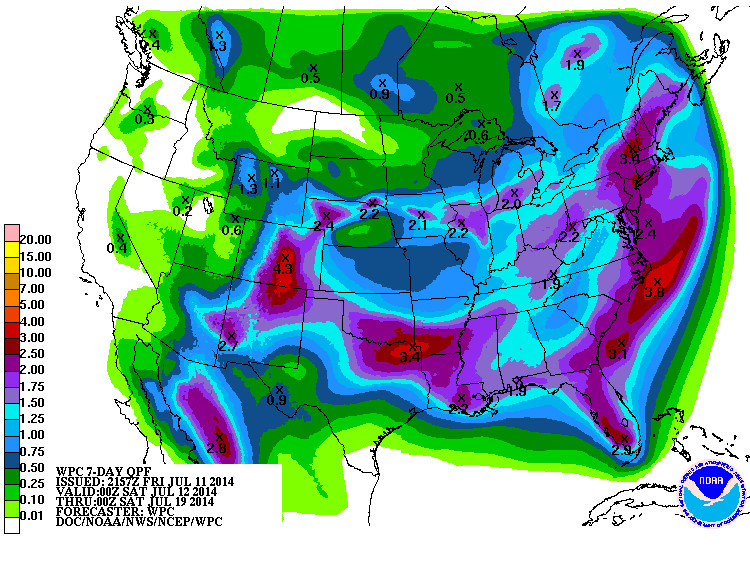
That's a #monsoon: http://t.co/63V4d4Ln3K #nmwx
— jfleck (@jfleck) July 11, 2014


From The Durango Herald:
The Five Rivers chapter of Trout Unlimited is soliciting volunteers to help with a cutthroat trout restoration project Saturday on Hermosa Creek behind Purgatory.
The work involves restoring disturbed areas around the fish barrier built last fall on the East Fork of Hermosa Creek. Volunteers also will breach beaver dams and perhaps install “beaver deceiver” devices to stabilize flows.
While cutthroat thrive on the upper end of the East Fork, non-native species have taken hold in the lower end and in other Hermosa Creek tributaries.
Beaver dams harbor refuges for non-native species.
Volunteers should meet at 9 a.m. at the bottom of Forest Service Road 578, which leads into the Hermosa Valley behind Purgatory.
Information is available from Buck Skillen at 382-8248 or Glenn May at 570-9088.

From the Cortez Journal:
The public is invited to a “Saturday Seminar” at the Animas Museum on Saturday, July 19 at 1 p.m.
Linda Towle will present “Saving the McElmo Creek Flume: Water History of the Montezuma Valley.”
Towle is chairman of the Cortez Historic Preservation Board. The Animas Museum is at 3065 W. 2nd Ave. Information: 259-2402.
More San Juan River Basin coverage here.


From the Las Vegas Review-Journal (Henry Brean @RefriedBrean):
Lake Mead sank to a record this week, its surface nudging downward a few tenths of an inch late Wednesday night to 1,081.82 feet above sea level.
The last time the lake was this low, the town of St. Thomas still had a post office. In late spring of 1937, water from the once-wild Colorado River was still rising steadily behind the new Hoover Dam, inundating empty desert as it pushed toward Moapa Valley. By June of the following year, St. Thomas would be under water, but Mother Nature and human thirst couldn’t keep it there.
In 1983, when the lake was as full as it’s ever been, the ruins of the town were under about 80 feet of water. Today, you can’t even see the lake from St. Thomas.
The past 15 years have been especially hard on the nation’s largest man-made reservoir. Lake Mead has seen its surface drop by more than 130 feet amid stubborn drought in the mountains that feed the Colorado River. The unusually dry conditions have exacerbated a fundamental math problem for the river, which now sustains 30 million people and several billion dollars worth of farm production across the West but has been over-appropriated since before Hoover Dam was built…
Wednesday’s record is unlikely to last. Forecasters expect Lake Mead to hit another new low today, then break that mark Saturday, and so on for the next several weeks.
The streak of all-time lows should end by late August, when current projections from the U.S. Bureau of Reclamation call for the reservoir to tick up slightly. Then it should inch down again, bottoming out sometime in November before starting back up as downstream water users cut their orders heading into winter.
Bureau officials acknowledged this week’s milestone but said it won’t impact operations at Hoover Dam.
“We will meet our water orders this year, and we are not projecting a shortage condition in 2015,” said Terry Fulp, the Boulder City-based director for the Bureau’s Lower Colorado Region. “We continue to closely monitor the projections of declining lake levels and are working with stakeholders throughout the Lower Basin to keep as much water in Lake Mead as we can through various storage and conservation efforts.”[…]
Lake Powell, meanwhile, is expected to start next year 21 feet higher than it was at the beginning of 2014. Right now, the reservoir on the Utah-Arizona border is swelling by almost a foot a day as the last of the mountain snow melts into the Colorado River and its tributaries.
Forecasters are predicting another big drop at Lake Mead next spring, as the lake stair-steps its way down to elevation 1,069, and below. By June 2016, the reservoir could hit 1,064, just 14 feet away from shutting down one of two intake pipes the Southern Nevada Water Authority uses to deliver 90 percent of the Las Vegas Valley’s water supply.
With that in mind, the wholesale water agency is rushing to complete a new intake that will reach deeper into the lake. The $817 million project has seen its schedule slip by more than 2 years, but is on track to finish next summer.
“We feel confident the third intake will be complete before we lose Intake Number One,” said authority spokesman Bronson Mack…
Lake Mead’s decline has been a major headache for the National Park Service.
For every two-foot drop in the water level, the shoreline can recede 60 feet or more. Already the shrinking reservoir has left some boat ramps high and dry, and has pushed marinas into deeper water or closed them altogether.
A decade ago, Lake Mead was home to nine boat launch ramps and six marinas. Six ramps and three marinas remain open today…
While access to the lake has grown more difficult in recent years, she said, there is still more than 125 square miles of open water and roughly 400 miles of shoreline to explore.
More Colorado River Basin coverage here.
From The Pueblo Chieftain (Chris Woodka):
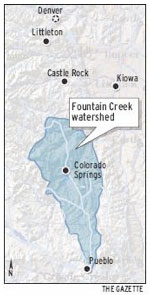
Overshadowing the need to look at the technical details of a study for a dam or detention ponds on Fountain Creek is how it would be funded. As of this week, the study has been battered about with all the care of an uprooted tree bobbing in the water. Other water issues may be getting snagged on it.
In May, Colorado Springs City Council stonewalled funding the study.
This week, the Arkansas Basin Roundtable couldn’t get past the issue of water rights and shrugged off consideration of a state grant for $135,000 that would have been part of a $220,000, 2-year study to look at the consequences of a dam and the feasibility of building it.
Larry Small, executive director of the Fountain Creek Watershed Flood Control and Greenway District, was frustrated after the meeting. Small walked the roundtable through the years of studies that led up to the conclusion that the best way to protect Pueblo from stormwater runoff in Colorado Springs — much of it made worse by development in the last 40 years — is to stop the water upstream of Pueblo.
“Is there a way to balance the needs of flood control and water rights or do we just throw up our hands?” Small said at one point during the meeting. “It may not be possible, but we need to find out.”
After the meeting, he was clearly frustrated.
“This is such a small part of the overall costs,” he said, slapping his hand against a folder of supporting information for the study.
During the meeting, several roundtable members made the point that junior agricultural water rights could be harmed during a flood.
The Fountain Creek district has attempted to deal with that in the past, including a comprehensive workshop on the topic, attended by some farmers, in December 2011.
Some saw value in looking at the water rights question just to determine if the rest of the study could proceed.
“This at least gets the conversation on the table,” said Jay Winner, general manager of the Lower Arkansas Valley Water Conservancy District.
In the end, the water rights question became a deal stopper.
There also are side issues that play into the question, such as a simmering feud between the Fountain Creek and Lower Ark districts about how matching money for grants has been applied under an intergovernmental agreement among the districts and Colorado Springs.
“I would encourage the IGA partners to come together soon and resolve their differences,” said Alan Hamel, the basin’s representative on the Colorado Water Conservation Board.
Hamel was one of the few roundtable members who spoke in favor of the grant.
“I think this is a wakeup call for the Fountain Creek district,” Winner said. “You don’t just sit up in Fountain and pretend to rule the world. The district needs to realize it’s in the water business.”

From The Pueblo Chieftain (Chris Woodka):
Farmers like clean water.
And the Rocky Mountain Farmers Union has broken ranks with many other water users in Colorado to support proposed rules meant to clear up discrepancies in U.S. Supreme Court rulings on the Clean Water Act.
The group claims false claims are being made about the rules. The rules are proposed by the Environmental Protection Agency and the Army Corps of Engineers.
The group placed an ad in Wednesday’s Chieftain claiming: “Washington lobbyists don’t speak for Colorado farmers.”
It’s a message to Colorado Sens. Mark Udall and Michael Bennet, both Democrats, who asked for and received a delay in the deadline for comments last month.
“It is critical that both Colorado senators and leadership at the USDA and EPA understand that ranchers and farmers need clean water to sustain our living, and appreciate balanced water policy. We believe the new rule targets both,” said Bill Midcap, external affairs director for the RMFU.
Midcap said the rules have exemptions that protect the way farmers use water. [ed. emphasis mine]
“We’ve had meetings with the EPA, so they could explain it to ag people,” Midcap said. “There is a lot of fear factor going on, and people ought to really pay attention to what the rule says.”
The rule clears up how the Clean Water Act applies to farms, and does [not] mean agricultural ditches and ponds will be taken over by the federal government, Midcap said.
“In our mission statement, it say we are stewards of the land,” he added. “We ought to care about clean water.”
More Environmental Protection Agency coverage here.