The health of our waters is the principal measure of how we live on the land — Luna Leopold
Wilderness idea birthed in Colorado’s ‘cradle’ — The Grand Junction Daily Sentinel
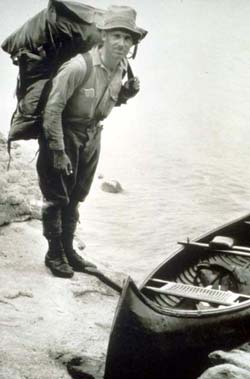
Arthur Carhart via Wilderness.net
FromThe Grand Junction Daily Sentinel (Dennis Webb):
Fifty years after the Wilderness Act became law, wilderness areas can be found in 44 states and Puerto Rico. But only one state, Colorado, can lay claim to what’s called the Cradle of Wilderness. It’s right here on the Western Slope, in the Flat Tops Wilderness Area east of Meeker, at a place called Trappers Lake.
The place has taken on its wilderness moniker thanks to the efforts of one Arthur Carhart, a native Iowan who had a degree in landscape architecture. In 1919, at the age of 27, he was sent by the Forest Service to the lake with instructions to survey it for 100 summer homes and a road circling the lake.
According to information on the White River National Forest website, Carhart did his work but “closed his report with a strongly worded recommendation that the area remain roadless and undeveloped.”
He wrote, “There are a number of places with scenic values of such great worth that they are rightfully the property of all people. They should be preserved for all time for the people of the nation and the world. Trappers Lake is unquestionably a candidate for that classification.”
“This was sort of the beginning of the idea that some places are too beautiful to be developed,” said Sloan Shoemaker, executive director of the Wilderness Workshop nonprofit group, based in Carbondale. “He came back with this idea of wilderness for wilderness’ sake.”
“The whole wilderness ideal started right there,” said Scott Fitzwilliams, supervisor of the White River National Forest, of which Trappers Lake is a part. “Here’s this 20-some-year-old … telling the agency, you’re on the wrong path.”
Carhart’s boss ended up agreeing with him.
Trappers Lake
“In 1920 Trappers Lake was designated as an area to be kept roadless and undeveloped. It remains so to this day. That designation marked the first application of the wilderness preservation concept in Forest Service history.”
That’s according to a biography on Carhart on the website of the Arthur Carhart National Wilderness Training Center, a federal interagency organization based in Missoula, Montana.
Although no one person can be called Father of the Wilderness Concept, Carhart has been referred to as “the chief cook in the kitchen during the critical first years,” the biography says.
He eventually became acquainted with another Forest Service employee, Aldo Leopold. The two put into a memorandum their shared vision for what at the time was still a nascent wilderness concept that they and others turned into a movement. Carhart left the Forest Service in 1923, but not before visiting and recommending preservation of what now is known as the Boundary Waters Canoe Area Wilderness in Minnesota.
He saw his dreams come to fruition with the passage of the Wilderness Act and designation of the Boundary Waters as wilderness in 1964.
“During his long life, Carhart continued to write about and work for the ideal of wilderness,” his training center biography reads. “On March 3, 1973, at the age of 81 Carhart said of himself: ‘I sometimes wonder how I had the nerve as a young punk to get my superiors turned around on some of these things. I feel real good about how it all turned out.’”
Carhart died in 1978. That was long enough to see the Flat Tops Wilderness Area, including Trappers Lake, designated three years earlier.