Shale industry scales back potential in region — The Grand Junction Daily Sentinel #ColoradoRiver

From The Grand Junction Daily Sentinel (Gary Harmon):

An oil shale industry in Colorado, Utah and Wyoming is likely to be about one-third the size it had been envisioned, an industry association said. Instead of a 1.5-million barrel-per-day industry, the more likely scenario is a 500,000-barrel-per-day industry, according to estimates by the National Oil Shale Association. The estimates were dramatically reduced “in light of a more pragmatic view of what an industry might look like in 50 years or so,” the association said, in an estimate that also noted that oil shale production would demand less water than had been previously believed.

The United States in 2013 consumed 6.89 billion barrels of petroleum products or 18.89 million barrels per day, according to the U.S. Energy Information Administration.

The oil shale association’s estimate is based on production of 225,000 barrels per day from in-situ means, or heating shale deep below the surface; 200,000 barrels per day from retorting shale on the surface; and 75,000 barrels per day from modified techniques, such as heating it in an earthen capsule, which is left in place.

Additional information about water demands of each technique sharply lowered the association’s estimate of water use from its 2013 estimate of 1.7 barrels of water per barrel of oil. Depending on approach, production from oil shale could require between 0.7 barrels of water per barrel of oil to 1.2 barrels of water per barrel of oil. Production of 500,000 barrels per day could demand between 16,400 acre feet to 28,900 acre feet of water per year…

The reduction in the anticipated size of an oil shale industry is the result of new information that came to light this year, the association said.

“Projects have matured, and some developers have taken a new look into technologies that dramatically reduce water needs,” the association said. “However, estimates are still preliminary and may change as projects reach commercialization.”

More oil shale coverage here and here.

#ColoradoRiver Concerns Mount as Lake Mead’s Surface Continues to Fall — Colorado PBS

From Colorado PBS (Jim Trotter):

Western water expert Brad Udall, a senior fellow at the University of Colorado Law School, believes it will take a “full-out” crisis to bring meaningful reforms, but that such a crisis may well be at hand.

The surface elevation of Lake Mead reached the historic low of 1,081.75 feet above sea level during the week of July 7, according to the Bureau of Reclamation, and is projected to fall to 1,080 by November. On July 31, it was projected at 1080.61.

However, should it fall to 1,075 feet it would trigger a declared shortage on the river, at which point water deliveries could be impacted. The lake has dropped 128 feet since 2000.

But, Udall told Rocky Mountain PBS I-News, water providers are looking at solutions to avoid a shortage declaration.

There’s a plan underway right now that involves Denver water, involves three of the lower basin water providers, one in each state, plus the Bureau of Reclamation, to put $11 million dollars on the table next year to start buying these water rights from voluntary agriculture users and have them not exercise those rights in order to keep the two reservoirs – Lake Mead and upstream Lake Powell – keep them higher than they might otherwise be.”

To effectively meet the challenges of this century, the basic premise underpinning the Law of the River – first in time, first in right – will have to be rethought.

“The other way to look at this is that the glass is half full,” Udall said. “We still have 80 percent of the river, still a lot of water. But we’ve got to use it correctly, and that means a healthy agriculture industry that doesn’t use 70 percent. It could be a system in which agriculture is paid handsomely not to plant in very dry years. We need to do better in using water wisely.”

From InkStain (John Fleck):

While all eyes have been on Lake Mead’s bathtub ring, Lake Powell is forecast to rise by nearly 1.4 million acre feet by the end of September. But Mead’s 2 million acre foot drop will more than offset the increase, leaving us with the lowest end-of-year total storage in the two reservoirs combined since 1967, when they were first filling Lake Powell.

More Colorado River Basin coverage here

Northern Water is increasing rates to stop the drain on cash reserves

Colorado-Big Thompson Project Map via Northern Water

From the North Forty News (Jeff Thomas):

Northern Colorado Water Conservancy District moved to triple the yearly assessment for agricultural users by 2018, beginning with a 9 percent increase this year, though North Poudre Irrigation Co. users will be largely unaffected.

“It’s a fairly significant increase for agricultural users,” said Northern spokesman Brian Werner. “But we’ve been dipping into our reserves the last couple of years, and the board felt that we had to take a more fiscally responsible path.”

The Northern board in June set the 2015 assessment for a per acre-foot unit of Colorado Big-Thompson water at $30.50 for municipal and industrial users, up from $28, and $10.90 for agricultural users, up from $10. The board also approved a plan in which the rates will rise in 2018 to $53.10 for municipal and industrial and $30.20 for farmers.

The increase does not affect subject-to-change contracts or fixed-rate contracts, established between the creation of the water district in 1937 and 1959, when the district went to open rates. Today only one third of the district’s shares have a fixed-rate contract, which pay only a $1.50 a year assessment, but that includes all 40,000 C-BT shares owned by North Poudre Irrigation Company.

“We’ve really wrestled with these fixed-rate contracts,” Werner said, noting that while attorneys have been asked to take a long look at whether they could be changed, some fixed-rate contract holders have already threatened suit if the board takes such action.

At any rate, the hit on agriculture changes a long-held emphasis at Northern Water of trying not to price farmers and ranchers out of the market.

“We’ve always been focused on ability to pay, but now we are moving to more cost-of-service,” Werner said, noting the board attempted to come somewhere in between. “More than two thirds of our shares are now owned by municipal and industrial users, and they are yelling about why they are taking the brunt of the costs.”

Taking into consideration only the assessment cost, Werner said, the water is fairly inexpensive for agriculture, moving from about 6 cents per 1,000 gallons to about 16 cents through 2018. But after next year, the steep incline begins for farmers and ranchers, as in 2016 the rate will increase 61 percent, followed by a 61 percent raise in 2017.

And that may be just the tip of the iceberg, as the district’s future plans reveal a rate change through 2023 in which municipal and industrial users could be assessed more than $100 per acre foot and agriculture, $80…

For Colorado agriculture, however, the fastest growing cost is most probably water. A share of C-BT, with an average yield of 0.7 acre feet, is now selling for between $20,000 and $25,000, compared to $9,500 in January 2013, Werner said.

More Northern Colorado Water Conservancy District coverage here.

Gov. Hickenlooper announces additional $12 million for wastewater and drinking water systems with flood recovery projects #COflood

Plume of subtropical moisture streaming into Colorado September 2013 via Weather5280

Here’s the release from Governor Hickenlooper’s office (Click through for the details):

Representing his continued commitment to restoring Colorado’s world-class water systems, Gov. John Hickenlooper today announced a second round of grant funding aimed at rebuilding, improving and protecting Colorado’s water quality and treatment infrastructure.

Sixteen community drinking water and wastewater systems impacted by the September 2013 flooding will receive $12 million to fund planning, design, construction, improvement, renovation or reconstruction of systems that were damaged or destroyed as a result of the floods. Part of the funding will go to four counties (Boulder, Jefferson, Larimer and Weld) to help them repair or replace private, non-community septic systems.

“When the flooding receded, we said we would rebuild a better, more resilient Colorado. This funding will help address not just short-term needs but also help communities design and rebuild with the long-term in mind,” said Gov. Hickenlooper. “It’s another boost to spur repairs and improvements in areas that need it most.”

In Jamestown, this funding will provide critical support in rebuilding service lines to individual residences, allowing displaced families to return to their homes. In the City of Evans, the funding allows for the planning and design of a new facility that will have expanded capacity for residents while decreasing vulnerability from future flood events.

This funding is in addition to the $14.7 million awarded last year to help the state address nutrients in Colorado’s rivers, streams and lakes. High levels of nutrients, such as nitrogen and phosphorus, can use up valuable oxygen and choke aquatic life.

These grants are part of the governor’s plan to ensure Coloradans have a reliable infrastructure that ensures safe, clean water for future generations.

“It was a complete defeat for the Western Slope” — Pitkin County Attorney John Ely

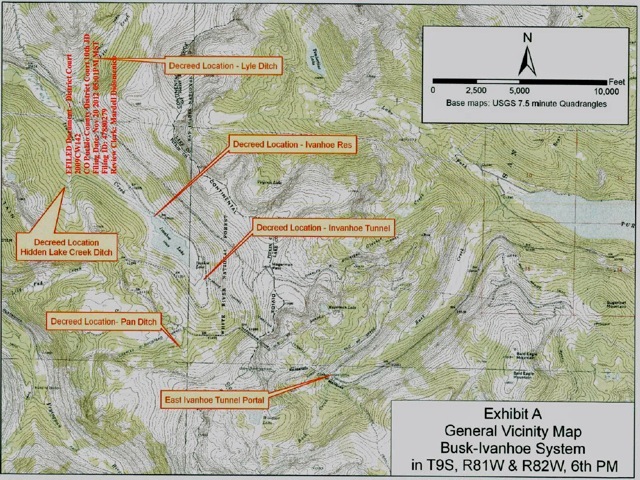
Busk-Ivanhoe system diversions

From the Aspen Daily News (Brent Gardner-Smith):

Pitkin County and the Colorado River District are planning to appeal a judge’s ruling that gives the city of Aurora the right to use water from the upper Fryingpan River basin for municipal purposes, without a penalty for 23 years of “unlawful” water use.

“It was a complete defeat for the Western Slope,” Pitkin County Attorney John Ely said of the order issued on May 27 by Larry C. Schwartz, a state water court judge in Pueblo.

As it stands today, the court’s ruling means Aurora can retain the 1928 priority date on its full right to divert 2,400 acre-feet a year through the Busk-Ivanhoe tunnel for municipal instead of irrigation purposes. Over 60 years, Aurora can divert 144,960 acre-feet under the right.

Pitkin County and other Western Slope entities wanted the court to reduce the scope of Aurora’s water right, as the Front Range city has been using the water from the Busk-Ivanhoe system for municipal purposes, without a decree, since 1987.

The “West Slope Opposers,” as the court called them, also argued that the court should consider that Aurora was also storing water on the East Slope without an explicit right to do so, which they felt constituted an “expansion” of its water rights.

The board of the River District agreed on July 15 to appeal the judge’s ruling, while the Pitkin County commissioners agreed shortly after the May ruling. Ely said he understands the Colorado State Engineer’s Office also plans to appeal.

Pitkin County has spent $247,500 on the Busk-Ivanhoe water case so far, and using money from the county’s Healthy Rivers and Streams fund to pay for outside water attorneys.

Other parties from the Western Slope in the case are Eagle County, Basalt Water Conservancy District, Grand Valley Water Users Association, Orchard Mesa Irrigation District and the Ute Water Conservancy District. Trout Unlimited is also a party to the case, which is 09CW142 in Water Division 2.

Colorado transmountain diversions via the State Engineer's office
Colorado transmountain diversions via the State Engineer’s office

Transbasin water

Since 1928, about 5,000 acre-feet of water a year has been diverted from Ivanhoe, Lyle, Hidden Lake and Pan creeks, headwater streams of the Fryingpan River.

The water is sent from Ivanhoe Reservoir to Busk Creek through a pipe in the Busk-Ivanhoe tunnel, first built as a railroad tunnel in the late 1880s. From Busk Creek, the water flows to Turquoise Reservoir and the Arkansas River, and eventually reaches Aurora and Pueblo.

The Pueblo Board of Water Works owns the right to half of the water diverted through Busk-Ivanhoe tunnel, and in 1993 it changed the use of its water right from irrigation to municipal.

In 1987, Aurora bought the other half of Busk-Ivanhoe water and started using its half of the water for municipal purposes. But it didn’t come in for a change-of-use decree from water court until 2009.

Aurora’s 2009 application received 35 statements of opposition and as is common in water court, opponents were winnowed down to a core group. Many cases are settled before trial, but this case went to a five-day trial in July 2013.

Judge Schwartz’s subsequent ruling in May established the parameters of how a new decree for Aurora’s water should read, and the draft decree is now being prepared, Ely said. Once the proposed decree is filed with the court, it will trigger the appeal period in the case. Appeals in water court cases go directly to the Colorado Supreme Court.

Greg Baker, the manager of public relations for Aurora Water, was contacted early Friday afternoon for comment. He said officials were in various meetings throughout the day, and they couldn’t be reached by deadline.

Busk-Ivanhoe tunnel entrance

“Zero” years

Ely said Pitkin County is primarily concerned about the judge’s decision not to take into account the 23 years that Aurora used water for undecreed purposes, i.e.,, municipal instead of irrigation.

Ely said it is a “fundamental” part of Colorado water law that non-use diminishes the scope of your water right when you go to change it, and it appears Aurora is getting “special treatment” because the water right is a transmountain diversion.

He said that when determining the “historic consumptive use” of a water right — which is what can legally be changed to another use — it is common practice for the court to reduce the scope of a water right by averaging in any years of “zero” or non-use. And undecreed uses typically count as “zero” years.

“But what the court said in this case said was, ‘We’re just not going to look at those years’ of zero use,” Ely said.

Judge Schwartz decided that the period from 1928 to 1986 — before Aurora started using the water — was the best “representative period” to use to determine how much water Aurora had been putting to proper use.

“The representative study period to be utilized should be based on a period of time that properly measures actual decreed beneficial use, and that excludes undecreed uses,” Schwartz concluded.

“The use of zeros during the years of undecreed use would permanently punish (Aurora) for the undecreed use after 1987,” Schwartz also wrote. “This court does not view a change application case as a means to permanently punish a water user for undecreed use.”

In regard to the issue of undecreed storage, the judge looked at the history of the water right, and found that while the original decree from 1928 may have been silent on the subject of East Slope storage, it was always part of the plan by the water developers to store water in a reservoir on the East Slope.

“West Slope Opposers assert that the storage of the Busk-Ivanhoe water in the Arkansas River Basin is an ‘expansion’ of use,” Schwartz wrote. “Storage of the Busk-Ivanhoe water in the Arkansas River Basin is not an expansion. Said storage has always been a part of the water right.”

Ely said the Colorado River District is more concerned about the storage issue than Pitkin County is. However, the county does feel the judge’s overall response to Aurora’s request to change its water right was faulty.

“We knew they were going to be able to change their use, it was just a question of how much,” Ely said. “And it was a question if the Front Range would be held to the same standard as everybody else, in terms of using their water consistent with a decree, or if they get some kind of special treatment for being a transbasin diversion. The judge, and his order, found that they should get some kind of special treatment, and we think that runs contrary to the law.”

Editor’s note: Aspen Journalism and the Aspen Daily News are collaborating on the coverage of land and water in Pitkin County. More at http://www.aspen
journalism.org.

More water law coverage here.

“Want an expert overview on the #COWaterPlan?” — @ConservationCO/@wradv #ColoradoRiver

The latest newsletter from the Water Center at Colorado Mesa University is hot off the presses #ColoradoRiver #COWaterPlan

Colorado transmountain diversions via the State Engineer's office
Colorado transmountain diversions via the State Engineer’s office

Click here to read the newsletter. Here’s an excerpt:

“CONCEPTUAL AGREEMENT” ON FUTURE TRANSMOUNTAIN DIVERSIONS RELEASED
Colorado’s Inter-basin Compact Committee has released a draft conceptual agreement on how additional Colorado River water could be sent East “under the right circumstances.” Central to the draft agreement, which is being circulated for comment, is that the East Slope recognizes that a new transmountain diversion may not be able to deliver water every year and must be used along with back-up non-West Slope sources of water.

The document is available here, and includes an annotated bibliography that summarizes many of the studies, pilot projects and white papers that have been developed over years of debate over how to meet Colorado’s future water needs. Feedback can be submitted via the Colorado’s Water Plan website, which contains draft chapters and information on the individual basin plans that were due at the end of July. The CO legislature’s Water Resources Review Committee is also holding hearings on the plan around the state. See the schedule here.

More Colorado River Basin coverage here and here.

California’s catastrophic drought keeps getting worse — The Washington Post

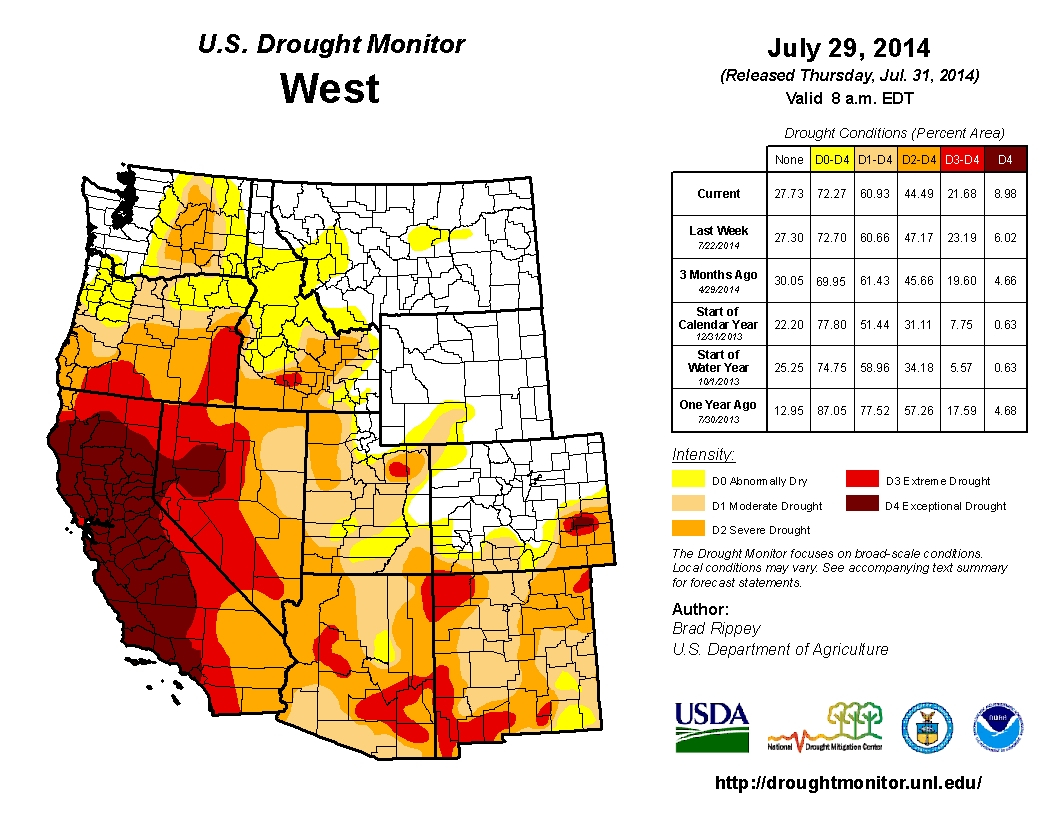
West Drought Monitor July 29, 2014

From The Washington Post (Mark Berman):

The historic drought that has been plaguing California has somehow gotten even worse. On Thursday, the U.S. Drought Monitor reported that more than half of the state is now in experiencing “exceptional” drought, the most severe category available. And most of the state – 81 percent – currently has one of the two most intense levels of drought…

The drought’s incredible three-year duration has nearly depleted both the state’s topsoil moisture and subsoil moisture reserves, according to Brad Rippey of the U.S. Department of Agriculture, who wrote the Drought Monitor report. And California is now short more than a full year’s worth of reservoir water, he wrote.

Drought news: A gallery of late July drought monitor maps since 2010

Click on a thumbnail to view the gallery.

Colorado water users gird for first statewide plan — High Country News #COWaterPlan


From the High Country News (Sarah Tory):

…stakeholders from the state’s eight river basins plus the Denver metro area are tasked with articulating their needs and creating proposals for solutions to future water demand, in order to help create that plan. Today [July 31] marks the deadline for submitting those local concerns to the Colorado Water Conservation Board, the entity in charge of creating the statewide plan. The board will then synthesize the results from the local discussions, write a draft plan due this December, and complete the final version a year later. As each basin’s roundtable crafts their local recommendations, interest groups are jockeying to get fair representation in the final document.

The recent roundtables have been piggybacking on nine years’ worth of meetings, mandated under the Colorado Water for the 21st Century Act, which passed in 2005. With that foundation in place, Hickenlooper’s vision for a statewide plan had a head start in getting differing interests in each basin together. The biggest fights, however, aren’t necessarily within each roundtable, but between the basins themselves, particularly those separated by the Continental Divide…

The most contentious issue that the water plan must address is whether to allow new trans-mountain diversion projects, says Ken Neubecker, executive director for Western Rivers Institute, a river advocacy group, and the environmental representative for the Colorado River Basin Roundtable. The East Slope roundtables have been pushing to keep that option open, anticipating future water demands. But those in the western part of the state are firmly opposed, and some communities are pushing a “not one more drop” campaign.

Joe Frank, vice chair of the South Platte Basin roundtable, said that unlike past diversion projects, new proposals that appear in the draft plan are flexible arrangements under which water would be diverted east only during particularly wet years.

If the east-west divide is one major issue that the new plan must tackle, the other is unfolding on the fertile plains of the South Platte Basin, where the largest water shortages in the state are expected to occur. There, Gene Manuello’s cattle ranch sits near the town of Sterling. A third generation rancher, Manuello is the agricultural representative of his basin’s roundtable. He worries about the growing prevalence of “buy and dry” schemes in which thirsty cities buy up water rights from farmers and ranchers tired of trying to make a living in today’s unreliable agricultural market. That trend has been on the rise as cities grow more desperate for water, and is one that Manuello thinks will hollow out entire agricultural communities…

Driving this surge in demand for water is Colorado’s exploding population, concentrated in water-poor cities along the Front Range. If the state wants to deal with its water woes, it needs to get smart about growth, says Bob Streeter, who serves as the South Platte basin’s environmental representative. Streeter proposed that the government implement a policy to encourage only water-wise industries in the region. But that would mean discouraging profitable operations like dairy factories that contribute millions of dollars in jobs and salaries. The roundtable vetoed Streeter’s proposal. Other proposals include better land-use planning (saying goodbye to water hogging green lawns and suburbs) and making irrigation systems more efficient, like switching from flood to drip and replacing leaky canals.

One problem that’s surfaced during local discussions is that, while efficiency improvements are a sign of progress, they often spell trouble for downstream water users. Currently many downstream users rely on water that flows from leaking pipes and irrigation canals seeping back into rivers and groundwater supplies. The new efficiency practices therefore may impinge on downstream water rights.

Despite continued disagreements among users, roundtable organizers are optimistic that by the end of the year, the state conservation board will have a finished product to review.

“You get to know people,” Neubecker said about the recent years of local meetings. “After you work with these people for all these years, you get a good feel for how we’re all part of the same system.” Previous attempts at such a comprehensive water plan, like the one the Bureau of Reclamation proposed in 1974 were based on a top-down approach from the federal government, which died, according to Eklund, because Coloradans didn’t want bureaucrats from Washington telling them how to manage their water. The grass-roots nature of the current process seems to be the key to progress.

Not only that, said Eklund, like much of the American West, Colorado is growing thirstier. As drought, climate change and an exploding population push water resources to the brink,“there’s finally a sense that we have to tackle water problems as one unit.” If not, it won’t just be farms and lawns that take the hit. Municipal water rates will likely go up, and if too many streams turn to dust, the state’s vital tourist industry will suffer as well.

For Eklund, even an imperfect plan is better than no plan. “What I tell people is if we don’t do it, don’t think for a second it won’t get done for us,” he said, referring to the Bureau of Reclamation’s decision to take control of the Lower Basin States’ water supply when they couldn’t agree on how to share water amongst themselves. The lesson, he tells naysayers is this: “Would you rather us make a plan or the federal government do it for us?”

NWS Boulder: Denver’s monthly climatological report for July

US Department of the Interior and Western municipal water suppliers reach landmark collaborative agreement #ColoradoRiver


Here’s the release from Denver Water (Stacy Chesney/Travis Thompson):

In support of the Colorado River basin states drought contingency planning to address a long-term imbalance on the Colorado River caused by years of drought conditions, municipal water providers in Arizona, California, Nevada and Colorado and the federal government signed a landmark water conservation agreement this week called the Colorado River System Conservation program.

Central Arizona Project, Denver Water, The Metropolitan Water District of Southern California and Southern Nevada Water Authority are partnering with the U.S. Bureau of Reclamation to contribute $11 million to fund pilot Colorado River water conservation projects. The projects will demonstrate the viability of cooperative, voluntary compensated measures for reducing water demand in a variety of areas, including agricultural, municipal and industrial uses.

For more than a decade, a severe drought — one of the worst in the last 1,200 years — has gripped the Colorado River, causing the world’s most extensive storage reservoir system to come closer and closer to critically low water levels. The Colorado River and its tributaries provide water to nearly 40 million people for municipal use, and the combined metropolitan areas served by the Colorado River represent the world’s 12th largest economy, generating more than $1.7 trillion in Gross Metropolitan Product per year along with agricultural economic benefits of just under $5 billion annually.

“This is a critically important first step, and I applaud the far sighted municipal water providers for beginning to address the imbalance in supply and demand on the Colorado River that could seriously affect the economy and the people who rely upon the river,” said U.S. Deputy Secretary of the Interior Mike Connor. “There is still much work to be done, and the Interior Department is committed to supporting the efforts of the Colorado River Basin States and other stakeholders as partners in improving water management and operations, particularly during this historic drought.”

“This situation is becoming increasingly critical. We are already dealing with unprecedented pressure on the southern California region’s water system,” said Jeffrey Kightlinger, general manager for The Metropolitan Water District of Southern California. “This innovative program is aimed at expanding conservation efforts from a local level to a collaborative system-wide program.”

Without collaborative action now, water supplies, hydropower production, water quality, agricultural output and recreation and environmental resources are all at risk, in both the upper and lower basins.

“This agreement represents a unique approach to save water and protect the Colorado River system from the impacts of the on-going drought and the current imbalance between supplies and demands in the Basin,” said Central Arizona Project Board President Pam Pickard. “It is an important milestone in interstate collaboration, with CAP working with partners in California, Nevada, Colorado and the federal government to improve the health of the Colorado River.”

All water conserved under this program will stay in the river, helping to boost the declining reservoir levels and benefiting the health of the entire river system.

“Half of Denver’s water supply comes from the Colorado River, so we have a direct interest in the health of the entire system,” said Jim Lochhead, Denver Water CEO. “This is a proactive contingency plan for drought years to help secure our water supply future with a balanced, economic and environmental approach. This is clearly the right thing to do for our customers, our future water supply and the basin.”

The Colorado River System Conservation program will provide funding for pilot conservation programs in 2015 and 2016. Successful programs can be expanded or extended to provide even greater protection for the Colorado River system.

“The time has come for our states to work together to develop contingency strategies to manage the Colorado River under extreme drought conditions that threaten the levels of Lakes Mead and Powell,” said John Entsminger, general manager for the Southern Nevada Water Authority. “As Lake Mead continues to drop toward critical levels, we must simultaneously begin to take collective action now and plan additional future measures.”

In order to ensure that local concerns are addressed, and that there is equity and fairness among all parties, in the Lower Colorado River Basin, the Bureau of Reclamation will manage the conservation actions in Arizona, California and Nevada in a manner consistent with past programs, while in the Upper Basin, the Upper Basin states of Colorado, New Mexico, Utah and Wyoming, and the Upper Colorado River Commission will have a direct role in program efforts.

From InkStain (John Fleck):

The program has been simmering for months (see here, here and here for previous public discussions), but this evening’s announcement marks the final signing of the deal by federal officials. The program is a partnership of the basin’s four largest municipal water agencies – the Metropolitan Water District of Southern California, the Central Arizona Project, Denver Water and the Southern Nevada Water Authority – and the U.S. Bureau of Reclamation…

This is a small but very significant step forward. Previous conservation efforts were funded by an individual water agency, with water conserved banked in reservoir storage for later use by that agency. In this program, the water conserved will simply become “system water” for the benefit of all.

Significantly, the announcement says pilot programs will be conducted in 2015 and 2016. (I had been hearing water managers talk about the possibility of getting something underway this year, but it looks like July 31 is too late for that.)

Also, there’s some nuance here about who will built the institutional widgets to carry this out. In the Lower Basin, it will be the Bureau. In the Upper Basin, it will be some sort of state-managed effort that I don’t fully understand. There’s apparently been a lot of sensitivity on the question of who’s driving this bus in the Upper Basin.

US Drought Monitor July 29, 2014

From the Associated Press via ABC News:

The Interior Department said Thursday that local water providers in Arizona, California, Nevada and Colorado will take part in the deal.

It aims to create several small pilot programs in 2015 and 2016 that would provide incentives and compensation for conservation by cities, farmers and industry, according to a statement announcing the agreement. The programs that work best can then be expanded, extended, or both.

The move was called very necessary, though only a beginning with the severe shortfall threatening to challenge the region’s long-term water supply…

The project’s partners include the Central Arizona Project, Denver Water, The Metropolitan Water District of Southern California, Southern Nevada Water Authority and the U.S. Bureau of Reclamation.

More Colorado River Basin coverage here and here.

Roaring Fork Watershed Stream Flow Report for July 31, 2014

EPA: It’s time to #ditchthemyth about our proposal to protect clean water

Testimony about Clean Power Plan always earnest and often eloquent — The Mountain Town News

From The Mountain Town News (Allen Best):

Old and young, fat and skinny, plus white (mostly), black and brown, the speakers made their way this week to the microphones at the Environmental Protection Agency’s regional headquarters in Denver. For many, the EPA office in LoDo was just down the street, but others came from Nevada to Minnesota, Arizona to Utah.

Most spoke in favor of the EPA’s regulations to cut carbon pollution from power plants 30 percent by 2030, as compared to 2005 levels.

The Clean Power Plan identifies four key building blocks of improving efficiency at existing power plants, shifting production from coal to gas; increasing renewables and, in some states, nuclear; and, finally, reducing demand by increasing energy efficiency.

The EPA had predicted 1,600 speakers at its forums on July 29-30 in four cities, and each speaker was assigned a five-minute slot. I listened to maybe 40 speakers at the Denver sessions. All spoke earnestly, a few of them eloquently.

Most supported the regulations, emphasizing the long-term costs of unrestrained emissions of fossil fuels. Opponents emphasized the short-term costs. The divisions were mostly the same that we’ve heard for the last decade as the United States argues about the transition away from fossil-based fuels, or at least a transition away from unrestrained pollution of the atmosphere.

Supporters tended to describe the new regulations as a good if small step forward. Max Tyler, a Democrat in the Colorado House of Representative and strong supporter of renewable energy, described the regulations as too modest.

“Ultimately the bar is set too low at 30 percent,” he said. “The cost of continuing carbon pollution is appalling, it’s astronomical,” he added.

“The private sector is pretty darned creative. They can pull it off,” Tyler concluded. He himself had founded several small tech-oriented businesses before becoming a legislator in 2009.

Alex Blackmer, from the Colorado Renewable Energy Society, described it as a “very modest proposal” and downplayed the cost. The average age of existing coal-fired power plants is 42 years old, toward the end of their useful lives, he noted.

Catherine A. Carruthers of a group called Environmental Tax Reform was among those advocating a more sweeping approach to carbon regulation, adoption of a carbon tax or fee.

Lili Francklyn, who identified herself as a former science reporter for National Public Radio, remembered covering a meeting in 1982 at which the climate scientist James Hansen warned of the effects of increasing greenhouse gas emissions.

“Almost all of the climate change predictions issued that day have come true,” she said. “I am sick of hearing, after 30 years, that coal is cheap,” she said. She called for regulations that “reflect the true cost of coal.”

But some weren’t willing to let natural gas stand in for coal. Rick Blotter, a retired teacher and coach, said 40 percent reduction should be the goal and “natural gas is not the solution to our climate problem.”

Patrick Demmer of the Denver Ministerial Alliance said he grew up north of downtown Denver, near the Asarco smelting site and near the Cherokee coal-fired power plant. He reported that his breathing problems are most likely explained by the pollution. “We have only one world. We may have people in outer space, but we have just one Earth.”

Mixing science and religion was James W.C. White, a climate scientist at the University of Colorado-Boulder and a member of the Evangelical Lutheran Church. “Climate change is at its core a moral issue,” he said.

He cited intergenerational inequity. “We all say we love our kids, but how do we show it?” he asked. He also pointed to the disproportionate impacts of carbon pollution as opposed to those who benefit from burning it. And he also spoke to the immortality of species extinction from human activities. “We must be held accountable for any species we lose,” he said.

Hal Bidlack has among the most unusual of resumes. He is a retired lieutenant colonel in the Air Force, and taught political science for 15 years at the U.S. Air Force Academy. In the Clinton Administration, he served as director of global environmental affairs for the National Security Council. He ran unsuccessfully for Congress in Colorado Springs in 2008 and now works for U.S. Sen. Michael Bennet.

He noted that in 2001, Vice President Dick Cheney articulated a 1 percent rule: if there was a 1 percent chance of terrorists getting a weapon of mass destruction, the United States must act as if it were a certainty.

Bidlack countered that 95 percent of climate scientists concur about the role of greenhouse gas emissions in destabilizing the climate, and he further emphasized the threat of changing climate to U.S. security.

Addressing climate change is nothing more than ‘basic risk management,” he said.

Stacy Tellinghuisen, of Western Resource Advocates, emphasized that Colorado, New Mexico and Nevada will be able to hit the 2030 targets with relative ease given plans of utilities already adopted.

The Aspen Skiing Co. stressed that carbon-reduction goals can be achieved without economic distress. Matt Hamilton said the company has reduced its carbon footprint 3.5 percent while adding a hotel, lifts and restaurants. See statement.

But cleaning up the electrical supply is crucial to achieving company carbon-reduction goals, he added. The company gets its electricity primarily from Holy Cross Energy, an electrical cooperative that is poised to soon achieve its goal of a 20 percent carbon-free portfolio.

Chris Menges, project planner for the City of Aspen’s Canary Initiative, similarly made the case that carbon-free electricity need not produce high prices. The city’s electrical portfolio is now more than 80 percent carbon free and customers still enjoy among the lowest electrical rates among municipalities in Colorado. See statement.

He noted the EPA estimate that the energy shift will yield electricity that is 8 percent lower by 2030 while generating enormous savings in health-care costs, with $7 in benefits for every $1 invested.

Those testifying against the EPA regulations emphasized immediate costs. Carl Smith, representing 4,000 railroad workers, pointed to the profits of hauling coal, 28 percent of all railroad revenues, and the middle-class incomes of brakemen and conductors such as himself.

Bill Midcap, president of the Colorado Rural Electric Association, described the proposed regulations as “just not economically sound.” Make sure these don’t overburden America’s most important sector, and that is agriculture,” he said.

The most interesting testimony came from the utilities. Of all those I heard testify, they had most clearly read the fine print of these new regulations (as I have not). Speakers from Colorado, Montana, South Dakota and elsewhere expressed a variety of concerns:

• The new regulations do not give credit for hydroelectric power. Tri-State Generation and Transmission, for example, was formed as a way to provide distribution of hydropower of the new dams to the electrical cooperatives in Wyoming, Colorado and Nebraska. It provides 20 percent of power for coops.

• This is too ambitious of a proposal. To achieve dramatic carbon reduction will require extensive transmission, and getting high-voltage, long-distance transmission built is difficult and takes many years.

• Credit for non-carbon power generation should be given to the states where it is produced, not to the states where it is consumed, in effect favoring the more rural states of the Great Plains and West.

• Because the United States only produces a portion of the world carbon dioxide emissions, this is such a small gain that it will accomplish almost nothing.

• These EPA regulations put the onus on states to figure out how to comply, but state governments do not have the staff expertise to respond effectively. See additional perspectives in CREA blog.

Elsewhere in Denver, there were demonstrations and rallies, most of it pure theater designed for the TV cameras. My take is that these regulations will go forward, but the real interesting story will emerge as the co-ops, utilities and other power producers submit their written comments during the next several months [ed. emphasis mine].