
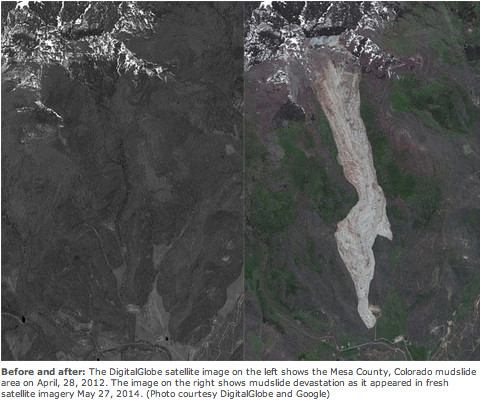
From the Glenwood Springs Post Independent (Chad Thatcher):
As first responders to arrive at the slide on May 26, Frank Kochevar, Mesa County Public Works’ professional surveyor, and Tim Hayashi, Mesa County Public Works’ engineer and field commander, remember getting a glimpse of the area, and uttering the words, “Oh, my God.” No one had seen a slide of this magnitude — ever.
After nearly three and half months, Hayashi and Kochevar traveled to the slide dozens of times, setting up surveillance equipment, clearing roads, building trails and juggling 14 different organizations that have a stake in the outcome. From CMU and U.S. Geological Survey (USGS) geologists to landowners and Mesa County officials, a rather fragile landscape has created a thoughtful and organized crew of individuals working every day to better understand the event.
Sensitive monitors have recorded every movement around the slide, evacuation routes have been established, maps have been rewritten, gas lines have been shut down, roads reconstructed, cell lines installed and lines of communication set up. All this collaboration is designed to answer the one question on everyone’s mind: Will a landslide of this magnitude happen again? And if so, where, when and how?
After meeting with a host of experts, the definitive answer is yes, there will be another landslide on the Mesa — but as to when, that is all speculation. No one could have predicted the West Salt Creek Slide, its size and destructive force. However, in the aftermath, all eyes turn to similar terrain that flanks the side of the Grand Mesa.
Rex Cole, a geology professor at Colorado Mesa University, explained the unique geography and the complicated history that encompassed the slide area. The region has a long history of landslides; in fact, landslide zones surround the entire Grand Mesa. Gravity has been exerting its force on the mesa for eons, contributing to a form of erosion called mass wasting. The term used by geologists describes the movement of soil and rocks down the side of a mountain. A quick examination of the slide area shows mostly a greenish shale rock from the Green River formation, a kind of fine-grained sedimentary rock that literally crumbles in your hand. It’s not the best foundation, especially on the side of a slope.
During the two days prior to the incident, over an inch of water fell in the area. Jeff Coe, with USGS, said the rain added to the “juiciness” of the slide. Adding an intense rain on snow event to an unstable surface creates the perfect recipe for a landslide.
Geologists are still concerned about the West Salt Creek slide area, especially with the formation of a new 190-acre-feet lake at the headwall. The lake continues to fill and is expected to breach the spillway this spring. At that point the entire headwall has the potential to erode away, sending a wall of water down the slide path. Residents of Collbran are concerned about the influx of water, but Bill Edwards of the U.S. Forest Service concluded that the amount of water is consistent with spring runoff and the watershed should absorb the excess. Still, nearby residents and businesses are preparing for the inevitable, the re-emergence of West Salt creek somewhere along its historic path.
Jerald Hawkins, owner of the property, and Oxy, an oil and gas exploration company, are taking a proactive stance by digging a potential drainage where the creek can safely enter and reconnect with its historical waterway. The slide path narrowly missed the Oxy gas pad located on the Hawkins property. Oxy immediately responded to the incident by shutting down all activity at the site.As first responders to arrive at the slide on May 26, Frank Kochevar, Mesa County Public Works’ professional surveyor, and Tim Hayashi, Mesa County Public Works’ engineer and field commander, remember getting a glimpse of the area, and uttering the words, “Oh, my God.” No one had seen a slide of this magnitude — ever.
After nearly three and half months, Hayashi and Kochevar traveled to the slide dozens of times, setting up surveillance equipment, clearing roads, building trails and juggling 14 different organizations that have a stake in the outcome. From CMU and U.S. Geological Survey (USGS) geologists to landowners and Mesa County officials, a rather fragile landscape has created a thoughtful and organized crew of individuals working every day to better understand the event.
Sensitive monitors have recorded every movement around the slide, evacuation routes have been established, maps have been rewritten, gas lines have been shut down, roads reconstructed, cell lines installed and lines of communication set up. All this collaboration is designed to answer the one question on everyone’s mind: Will a landslide of this magnitude happen again? And if so, where, when and how?
After meeting with a host of experts, the definitive answer is yes, there will be another landslide on the Mesa — but as to when, that is all speculation. No one could have predicted the West Salt Creek Slide, its size and destructive force. However, in the aftermath, all eyes turn to similar terrain that flanks the side of the Grand Mesa.
Rex Cole, a geology professor at Colorado Mesa University, explained the unique geography and the complicated history that encompassed the slide area. The region has a long history of landslides; in fact, landslide zones surround the entire Grand Mesa. Gravity has been exerting its force on the mesa for eons, contributing to a form of erosion called mass wasting. The term used by geologists describes the movement of soil and rocks down the side of a mountain. A quick examination of the slide area shows mostly a greenish shale rock from the Green River formation, a kind of fine-grained sedimentary rock that literally crumbles in your hand. It’s not the best foundation, especially on the side of a slope.
During the two days prior to the incident, over an inch of water fell in the area. Jeff Coe, with USGS, said the rain added to the “juiciness” of the slide. Adding an intense rain on snow event to an unstable surface creates the perfect recipe for a landslide.
Geologists are still concerned about the West Salt Creek slide area, especially with the formation of a new 190-acre-feet lake at the headwall. The lake continues to fill and is expected to breach the spillway this spring. At that point the entire headwall has the potential to erode away, sending a wall of water down the slide path. Residents of Collbran are concerned about the influx of water, but Bill Edwards of the U.S. Forest Service concluded that the amount of water is consistent with spring runoff and the watershed should absorb the excess. Still, nearby residents and businesses are preparing for the inevitable, the re-emergence of West Salt creek somewhere along its historic path.
Jerald Hawkins, owner of the property, and Oxy, an oil and gas exploration company, are taking a proactive stance by digging a potential drainage where the creek can safely enter and reconnect with its historical waterway. The slide path narrowly missed the Oxy gas pad located on the Hawkins property. Oxy immediately responded to the incident by shutting down all activity at the site…
In general, unless gravity mysteriously disappears, landslides will continue to shape the landscape; and wherever humans interact with these landscapes, disaster can occur. For example, the state of Washington’s deadly Oso landslide killed 43 people on March 22, taking out an entire rural neighborhood. Despite its isolated location, tragedy also struck at the West Salt Creek slide. While investigating a small landslide that had blocked an irrigation canal, Wes Hawkins, 46, Clancy Nichols, 53, and his son, Danny Nichols, 24, were evidently in the path of the second and more destructive landslide. Their bodies are still missing…
As Grand Mesa residents prepare for winter and the eventual spring runoff, experts are also looking at positive aspects of the West Salt Creek slide. As Bill Edwards of the U.S. Forest Service points out, from an ecological perspective, area experts have an amazing opportunity to observe and monitor the area as life again takes hold. Already flowers and plants are starting to take root in the area.
From The Denver Post (Nancy Lofholm):
Up close, the grayish, topsy-turvy surface of Colorado’s largest recorded rock avalanche yields small surprises that hint at the land as it was before: snail shells, Douglas fir cones, charcoaled wood, nubs of aspen shoots and intermittent clods of rich, brown topsoil.
They’re all tucked into 50 million tons of rock and debris that rumbled and raced down this draw on the Grand Mesa on May 25.
This week, many of the experts who have been studying the slide, along with the county and national officials who have been monitoring it and the landowners impacted by it — one an uncle of a slide victim — walked out on this slide together for the first time.
They shared a thought as they picked their way over the slide’s steep, spongy surface in a whipping wind: They never expect to see anything of this magnitude in this state again in their lifetimes.
“In Colorado, this is historically unprecedented as far as I can tell,” said Jeff Coe, a geologist with the U.S. Geological Survey.
Those watching for the next move of this mass often refer to it as a living entity — a “monster” that churned up pulses of pulverized rock, twisted giant chunks of earth and now hides an underbelly of soaked earth beneath slide matter as deep as 130 feet.
It has proven its danger, even in a sparsely populated area of ranch houses and hayfields, by claiming the lives of Wes Hawkins, Clancy Nichols and Danny Nichols.
The slide’s continuing danger is focused in the 190-acre lake that formed when a massive block of cliffside fell and tilted backward turning into an iffy dam for runoff. The lake is already leaking. That is evident in the smaller seep ponds forming below.
There is no dispute among the experts that the lake will double in size next spring and overflow.
“It is not a question of if, but when,” said Tim Hayashi, an engineer for Mesa County and the field commander for the dozen-plus agencies still studying and monitoring the slide.
When the lake tops, it could form a new creek channel down the middle of the slide. Or it could flow out haphazardly over the the giant hummocks of earth in the middle of the slide path and start a new debris movement. That movement could take debris into an irrigation canal or a creek. It could end up on an Occidental Petroleum Corp. well pad that the initial slide barely skirted.
Occidental is preparing for any slide movement in that direction by abandoning part of the well pad closest to the slide and building berms and a new drainage to divert water or mud.
The need for such measures is underscored by other factors pointed out by the experts this week.
“Those escarpments are a danger, ” said Colorado Geological Survey geologist Jon White as he pointed to a tree-lined ridge that hides large swaths of fractured earth. That could be the next to go.
Coe said the increasing incidence of rain falling on snow — a phenomenon he thinks contributed to this slide — causes snow to melt faster and puts more pressure on unstable rock formations. He expects more of that in more locations with climate change.
For now, monitors on the slide have allowed those living in the vicinity to breath a little easier this summer. But whether the devices will stay put during the winter snows is in doubt.
Hayashi said if the monitors are knocked out, he will climb back up this slide in the early spring even though the danger will be greatly magnified then.
“No one wants to be there,” Hayashi said. “But you just have to do it.”
From The Denver Post (Nancy Lofholm):
Government, industry and scientific experts who recently toured the West Salt Creek rock avalanche area agree that fracking is not to blame for setting off the deadly slide.
The fact that the craggy lower edge of the rock avalanche on the Grand Mesa towers over and curves around a drilling pad where Oxy USA has a gas well is not relevant, they say.
“From my perspective, there is absolutely no evidence fracking was involved in any way,” said U.S. Geological Survey geologist Jeff Coe, who has spent the past 3½ months mapping and studying the slide.
“It was a rain event,” said Jon White, with the Colorado Geological Survey, as he looked out over the mass of pulverized rock that roared down a draw May 25 and buried three local men.
Oxy narrowly escaped the complicated and unusual problem of having a drilling operation buried by tons of debris. But the company, which has wells dotting the Plateau Creek area on the mesa, did not escape claims that drilling activities had caused the slide.
When the first aerial images of the rock avalanche were released, the blaming fingers of online observers immediately pointed at the drilling pad at the toe of the slide. The proximity was taken as proof that fracking — drilling and injecting fluid into the ground at a high pressure to release natural gas — had made the area unstable and caused 39 million cubic yards of earth to move.
Rex Cole, a Colorado Mesa University geology professor who has studied the formations of the Grand Mesa for four decades, underscored the government geologists’ opinions with charts and maps.
They depict the mesa as a sort of layer cake with 10 million-year-old lava rock capping softer slanted layers of shale, basalt and limestone.
Cole described the Green River layer of rock where the slide occurred as being “squishy” and easy to break off and cave in with heavy rain and seeping groundwater.
“There is a lot of science pointing in the other direction,” he said of claims that fracking caused the earth to move. “You get it wet, and down it comes.”
Fracking in the slide area ended in 2008. It took place in the Williams Fork formation more than a mile below ground and more than 2 miles from where the slide began, near the mesa’s top.
There were no injection wells associated with the drilling in that area. The fracking fluids for Oxy’s wells were stored in tanks.
About 300 to 500 gallons of that fluid was hauled out in trucks in the wake of the slide, said Chris Clark of Oxy USA.
Oxy moved equipment on the well pad and abandoned the end of the pad closest to the slide. Clark said the company is building a berm and drainage to prepare for the possibility that the slide could let go again in the spring.