
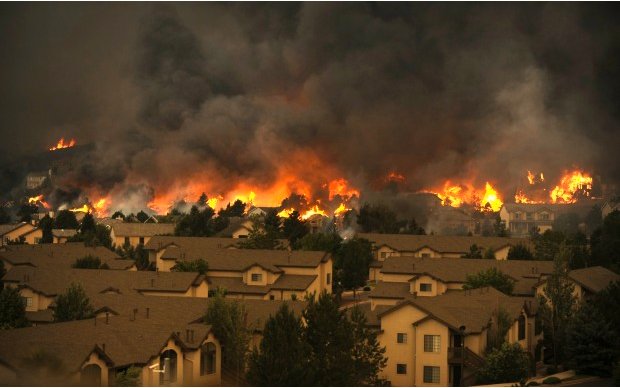
From the Colorado Springs Independent (J. Adrian Stanley):
“I’m looking out my window at North Cheyenne Cañon [Park] right now, and it’s just a carpet of forest out there,” [Dennis Will] says with evident dismay.
If Will had his way, the park would go from having as many as 100 trees per acre to just 30 to 75. While that lush forest is beautiful, Will says the park isn’t meant to support so much greenery. Overgrowth puts the area at risk for fire and other hazards.
His department has done significant mitigation projects in the park recently, but rains spurred new growth, and Will says finding the funds to maintain work that’s already been completed once is a challenge.
If a fire did sweep down the Cañon, it could be a disaster of epic proportions. Steep slopes would make it difficult to fight. Homes, businesses and major parts of the city’s water system would be at risk. Floods would likely follow, carrying huge loads of sediment from the erosive granite hillsides. The Cañon/Bear Creek area is also home to the threatened greenback cutthroat trout, which might not survive such a calamity…
North Cheyenne Cañon is just one of many problems. Will says Colorado Springs has the largest wildland-urban interface of any city in the state of Colorado. According to the city’s 2011 Community Wildfire Protection Plan, the interface totals 28,800 acres. To put this in perspective, 24 percent of the city’s population lives in the wildland-urban interface.
And, as the 2012 Waldo Canyon Fire showed, the interface can go from beautiful to scary very quickly…
Another major player is Colorado Springs Utilities. Its infrastructure runs through the interface, and thus, preventing another major fire is in its best interest. Utilities’ budget for such mitigation was increased from $250,000 to $1.5 million after the Waldo Canyon Fire, according to Eric Howell, Utilities’ forest program manager.
Utilities treats 1,000 to 1,500 acres per year currently and plans to begin treating as many as 3,000 acres a year in the near future. In order to achieve its mitigation goals, Utilities maintains partnerships with the U.S. Forest Service, the Colorado State Forest Service, the Coalition for the Upper South Platte, Pikes Peak Fire Learning Network, the Colorado Springs Forestry Division and the Colorado Springs Fire Department.
While Utilities’ contribution is significant, most of its money is spent on watersheds outside the city. Utilities sets aside $75,000 to help match grants procured by the city’s fire and forestry departments.