The health of our waters is the principal measure of how we live on the land — Luna Leopold
Retrofitting dams in the West for hydroelectric — The Mountain Town News
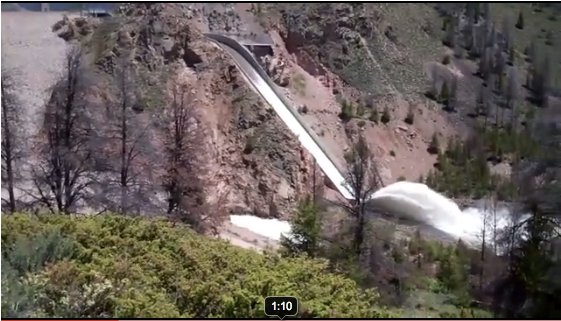
Lake Granby spill June 2011 via USBR. Granby Dam was retrofitted with a hydroelectric component and began producing electricity earlier this year (2016) as water is released in the Colorado River.
One by one, many of the dams built during the 20th century are being retrofitted with hydroelectric turbines to create non-carbon electricity.
In May, power generation began at Granby Dam. The 298-foot-tall dam on the Colorado River was completed in 1959. It is used to hold water that is sent via a tunnel under Rocky Mountain National Park (and the Continental Divide) to cities and farms along Colorado’s Front Range.
The installation cost $5.7 million and can produce 4 million kilowatt-hours of electricity per year. That’s enough for 370 customers of Mountain Parks, the local electrical co-operative for the Grand Lake-Winter Park area.
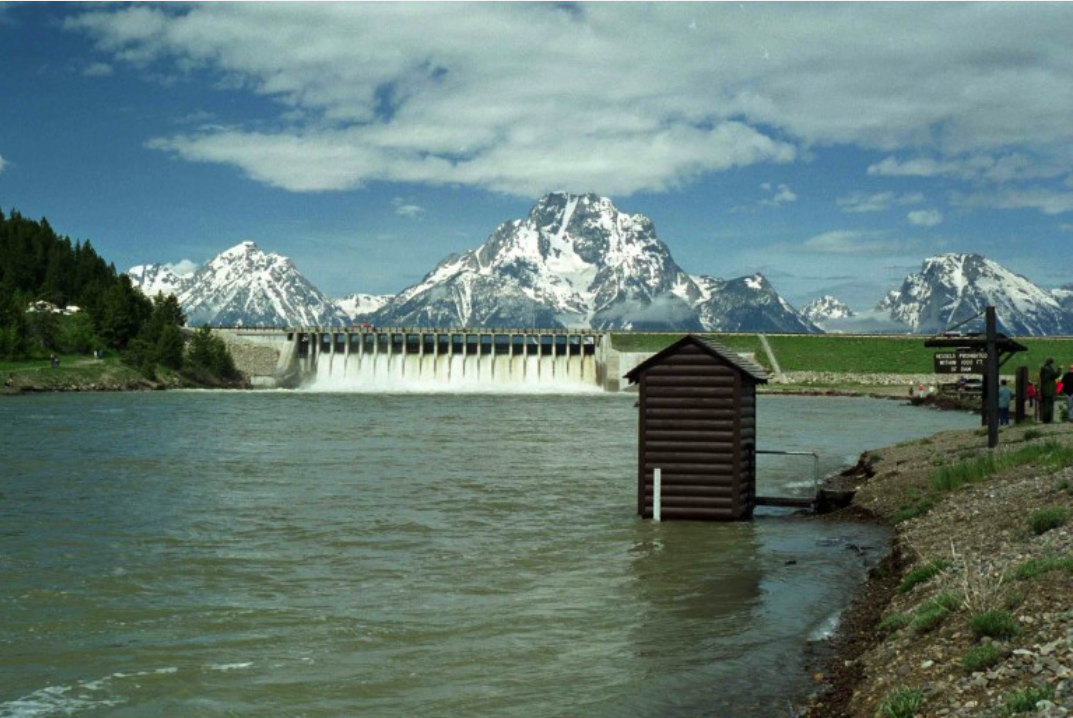
In Wyoming, the Snake River originates in and near Yellowstone National Park, flowing south through Jackson Hole, where it is impounded by a dam in Grand Teton National Park. Paul Hansen, who has spent the last 40 years as an environmental advocate for the Izaak Walton League and other organizations, says he would never have built a dam there. But the dam exists, and so it should be evaluated for its potential to produce electricity, he says.
The Snake River, Jackson Lake Dam and the Teton Range. 1997 photo/Wikipedia
The potential, he says, is to produce enough electricity for more than 3,000 homes in the town of Jackson. It’s also almost exactly the amount that Grand Teton National Park and its concessions use.
“That would effectively make Grand Teton National Park the first carbon-neutral national park in America,” he says. In 2012, a smaller hydro generator was brought on line in Yellowstone.
Currently, most of the power in Jackson Hole comes from hydroelectric dams in the Columbia River Basin, including the Snake River, a tributary. That allocation is now fully subscribed. New demand is supplied from fossil fuel plants.
Hansen, writing in the Jackson Hole News&Guide, says that the hydro conversion has been blocked in the past by sentiments of “not in my backyard.” That, he says, is not a pro-environment position.