The health of our waters is the principal measure of how we live on the land — Luna Leopold
#ClimateChange: What Happens When the Ice Disappears? — Pacific Standard #keepitintheground
Here’s a report from Bob Berwyn writing for Pacific Standard Magazine. Click through for the photos. Here’s an excerpt:
The world depends on snow and ice for everything from water to sun-reflection. But thanks to global warming, big parts of the Earth’s cryosphere have already disappeared.
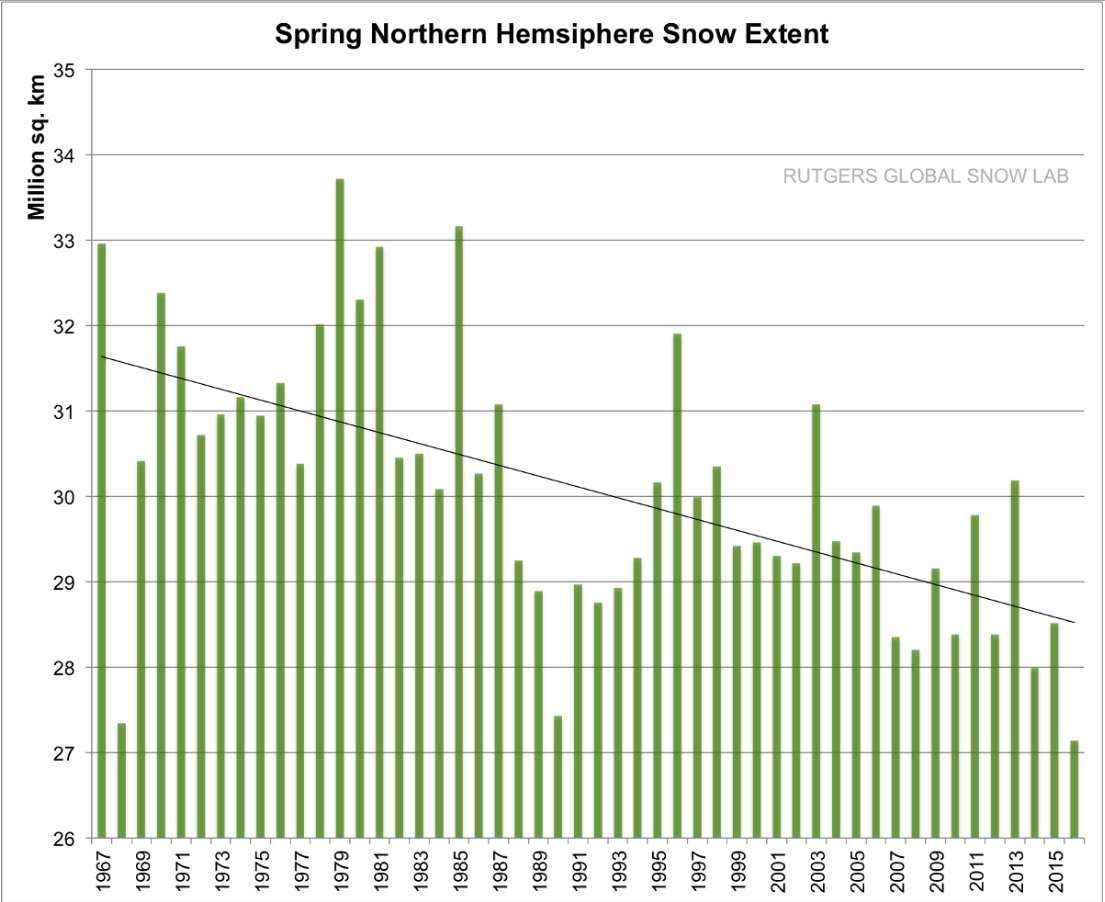
The Rutgers Global Snow Lab tracks hemispheric snow cover extent.
In the age of global warming, one thing is certain: There will be less ice and snow. Glaciers, ice shelves, and sea ice are melting away, and there has been a dramatic drop-off in the number of snow-covered days around the world, as documented by the Rutgers University Global Snow Lab. Since 1967, spring snow cover in the Northern Hemisphere has dwindled by about three million square kilometers.
The loss of Earth’s reflective white surfaces will intensify the spiral of global warming. Darker surfaces absorb more incoming solar radiation. That warmth delays the onset of winter and hastens the arrival of spring. In the Arctic, the decline of the cryosphere is affecting fundamental biological cycles like the reproduction of carbon-storing plankton. And it may also be affecting the jet stream, making weather more extreme across the Northern Hemisphere.
But the realms of ice and snow aren’t confined to the North and South Poles —they also include the world of frozen tundra and boreal forests, as well as snow-covered mountains and highlands, especially the glacial regions of the Andes, Himalaya, Alps, and Rockies. The meltdown in these areas is affecting every ecosystem imaginable.
Water stored in snow and ice represents a crucial global supply for human communities, irrigating rice paddies in Pakistan, cattle pastures in Canada, and verdant fields of mountain hay in the European Alps. Global warming is disrupting the seasonal cycle of those flows nearly everywhere. The changes will require fundamental and costly infrastructure adjustments.
Earth’s icy realms have started melting so fast that even the mainstream media, which hasn’t paid nearly enough attention to global warming, started to heed the issue this past month. In November, even CNN reported on the record-low ice extent at both poles.
But for big parts of the Earth’s cryosphere, it is too late. Even if greenhouse gas emissions were completely stopped today, most of the world’s glaciers would still disappear or dwindle to remnants by the end of this century, just from the CO2 that’s already in the atmosphere, while the polar ice caps will likely keep shrinking for centuries to come.
The cryosphere isn’t just some distant abstract place. If you live outside the planet’s tropics or hot desert belts, it extends, at least seasonally, into your backyard. Snow and ice have cultural, economic, aesthetic, and even spiritual values that will be lost as the world warms. Many communities, regions, and even entire countries identify themselves with snow and ice, from reindeer herders in Lapland to Native American seal hunters and winter sports enthusiasts in the Rocky Mountains. There’s really no way to pin a precise dollar amount to some of those values, but that doesn’t diminish the cost of their loss.