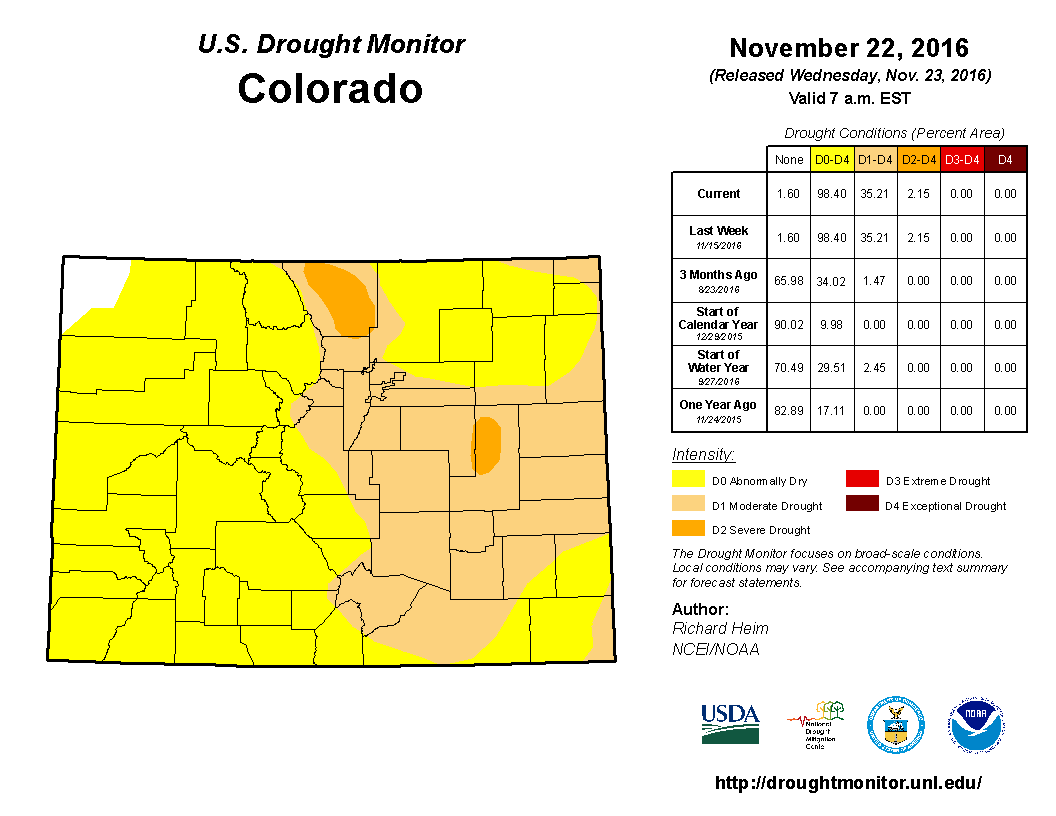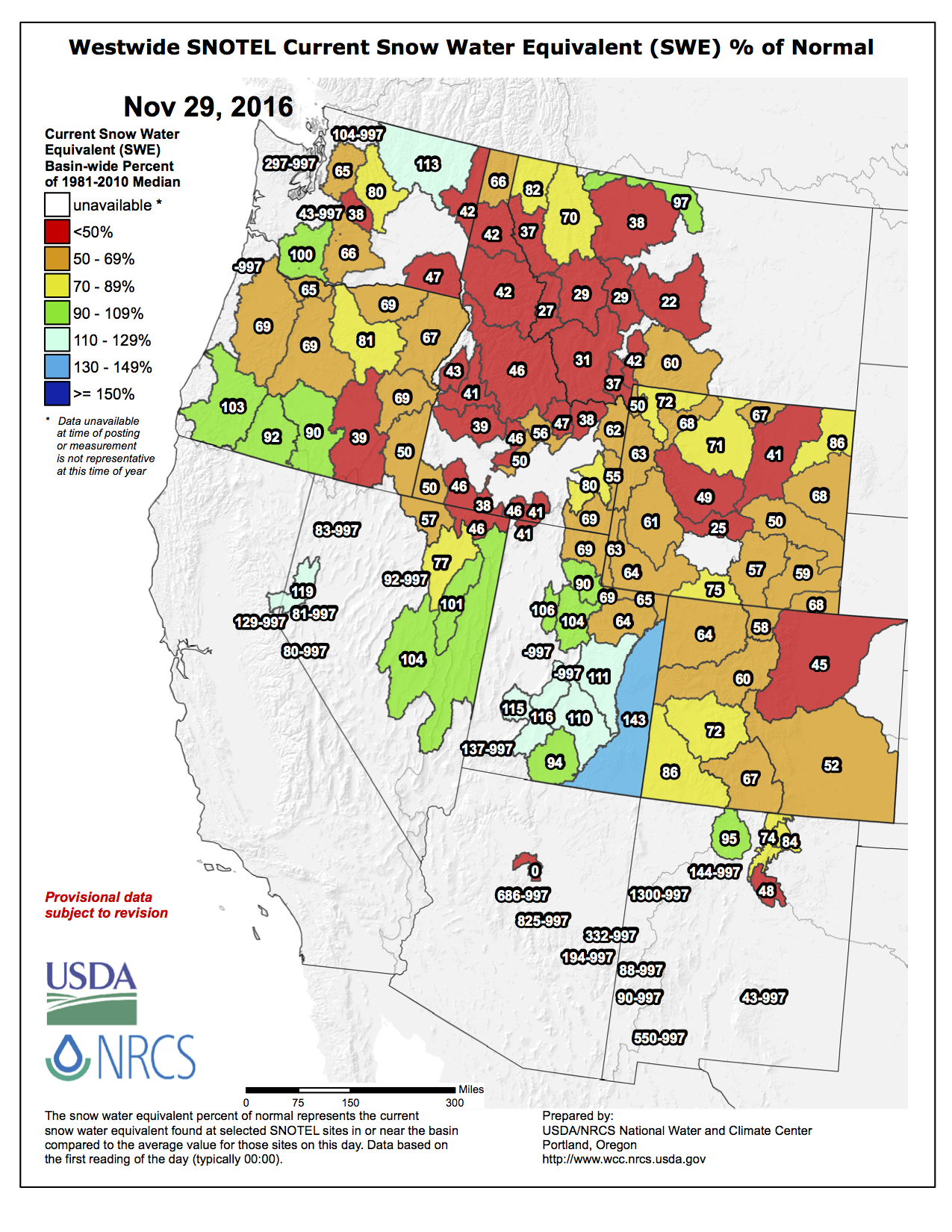
From KRDO.com:
Some farmers unable to plant fall, winter crops
The longer the area’s unusually dry fall weather continues, the more people worry it may continue through winter and into spring.
Tom Laca, a Colorado State University Extension agent for Pueblo County, said few farmers are planting winter wheat this season — a process that normally begins in September.
Laca said except for larger farms with irrigation, it’s too late to plant winter wheat and other late-season crops…
“To get back to where we need to be, we can (do it) several ways,” he said. “One big snowstorm would put us back there, if we got enough in that snowstorm. Can’t say it wouldn’t happen. Several smaller events would also be beneficial, as well. We just need moisture, and we’ll take moisture at this point, any way we can get it.”
[…]
Most farmers can handle the situation, Laca said, because they’re resilient and don’t rely solely on one crop.
“But if it’s still this dry in the spring, farmers will face tough decisions about what to plant,” he said.
Meanwhile, Colorado Springs is dealing with several issues related to the fall dry spell.
The Parks and Recreation Department exceeded its watering budget by $220,000 and needed approval from the City Council to find money from other sources.
“We’ll probably need to ask for $75,000 more,” said Kurt Schroeder, parks operations manager.
Schroeder said the warmer, drier fall means increased use of parks, and greater wear and tear on grass.
“We still need to water but we can’t water everything because we’ve already blown out our sprinkler systems,” he said. “If it continues to be dry, we’ll do what we’ve done before — turn the systems back on in the larger parks and athletic fields, and water them as much as we can until we get some moisture.”
Under that strategy, Schroeder said neighborhood parks won’t be watered, which could leave grass in worse condition when spring arrives.
From 9News.com (Maya Rodriguez):
“Colorado, we’re going through a bit of a shift right now,” said Becky Bolinger, a climatologist with the Colorado Climate Center in Fort Collins.
Every Tuesday, climatologists at the center analyze the state’s soil moisture and snowpack data, which is then used by the U.S. Drought Monitor to put together a map of conditions.
“We were looking at snowpack of about 20 to 25 percent of average,” Bolinger said. “In the past couple weeks, things have started to shift. We started to see a little bit more an accumulation of snow in the high country and that’s really helped to boost those numbers.”
They now range closer to between 40- and 60-percent of what the state would normally see in snowpack at this time, not great numbers, but snow of late is helping.
“The areas that have seen the most improvement are the Southwest Corner and Northwest Corners of the state,” said Colorado Climate Center Climatologist Peter Goble.
So where are things not great? Look east.
“The areas that are struggling the most are east of the Divide,” Goble said.
In the meantime, climatologists say Colorado looks like it’s starting to get back into the swing of snow in the winter. Yet, there is reason for caution.
From The Pueblo Chieftain (Peter Roper):
“This is the slowest start on snowpack that we’ve seen in decades,” said Alan Ward, division manager at the Pueblo Board of Water Works. “The snow monitors we have in the mountains show that there is only 8 percent of the normal amount of snow we typically see in November.”
That said, Ward emphasized the Pueblo utility has enough stored water that, even if the winter stays bone dry, Pueblo residents would probably not face any water restrictions next summer.
“But we’d like to see that snowpack improving,” he said. “A couple of good storms could catch us up to normal.”
There was as little as 2 inches of snow recorded in some mountain areas [November 17, 2016]. And water content was less than that.
“If the winter stays dry, city residents won’t face restrictions but it would affect how much water we lease to farmers,” Ward said.
The dry weather already has had obvious consequences, with two fast-burning wildfires in the mountains west of Pueblo this fall.
And the lack of snow has kept the Monarch Mountain ski resort and other ski areas from their usual November openings.
Monarch staff is advising callers to check on the resort’s website each day for news about when it will open.
The Western U.S. is experiencing weather from a La Nina cooling effect over the Pacific Ocean.
That usually produces warm, dry weather in the Southwest, while Washington, Oregon and the Northwest region may get rain and snow.
Ward said the short-term forecast from the National Weather Service calls for more warm, dry weather; and the three-month forecast also is very uncertain about rain or snow this winter.
“We’ve had that La Nina effect in place for a few years, and we’ve actually done all right in the Pueblo area during winter,” he said.