The next @CWCB_DNR Water Availability Task Force meeting, April 18

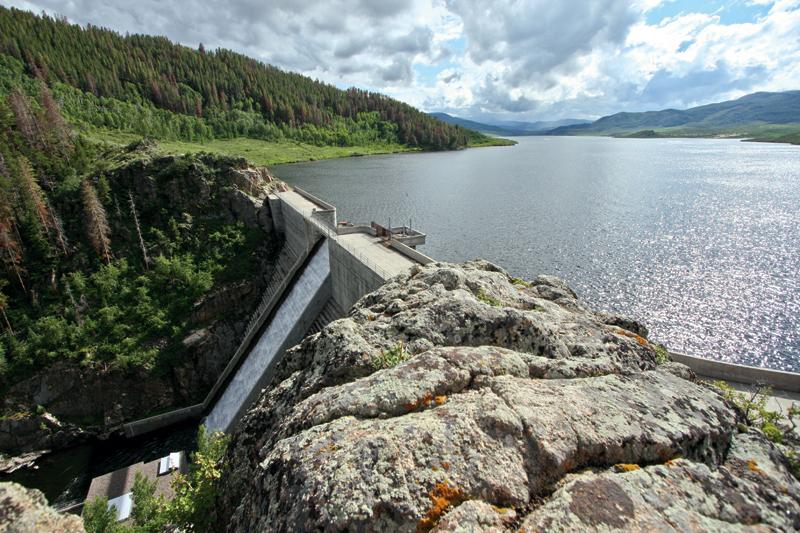
Stagecoach Dam and Reservoir via the Applegate Group

From email from the Colorado Water Conservation Board (Ben Wade):

The next Water Availability Task Force meeting will be on Tuesday, April 18, 2017 from 1:00p-3:00pm at the Colorado Parks & Wildlife Headquarters, 6060 Broadway, Denver in the Red Fox Room.

An agenda will be posted at the CWCB website. In the event you are unable to attend the meeting in person, please email Ben Wade at ben.wade@state.co.us for call in & web conference information.

@USGS Assessment of Brackish Water Could Help Nation Stretch Limited Freshwater Supplies

Here’s the release from the USGS:

A new nationwide assessment by the U.S. Geological Survey suggests that the nation’s brackish groundwater could help stretch limited freshwater supplies.

This study, the first of its kind in more than 50 years, found that the amount of brackish groundwater underlying the country is more than 800 times the amount currently used each year. With issues like drought, groundwater depletion, dwindling freshwater supplies, and demand for groundwater expected to continue to rise, understanding brackish groundwater supplies can help determine whether they can supplement or replace taxed freshwater sources in water-stressed areas.

“This assessment lays the foundation for building a deeper understanding of brackish groundwater resources and how they might be used to better ensure our water security,” said Jennifer Stanton, a USGS hydrologist and lead author of this assessment.

In general, brackish groundwater is groundwater that has a dissolved-solids content greater than freshwater but less than seawater. It is defined for this assessment as having a dissolved-solids concentration ranging from 1,000 to 10,000 milligrams per liter.

This new assessment was authorized by the 2009 SECURE Water Act and builds on a 1965 study which, for more than five decades, has served as the primary source of information on the national distribution of brackish groundwater. By incorporating data from more than 380,000 sites, compared to about 1,000 for the 1965 study, the 2017 assessment provides more comprehensive, nationwide data on the quantity and quality of brackish groundwater across the country. This includes information like chemical composition of the water and well yields, which are necessary for understanding the potential — at the National and regional scales — for expanding brackish groundwater development and for informing decision and policy makers.

All water naturally contains dissolved solids that, if present in sufficient concentration, can make the water brackish, or slightly salty. Sources of these dissolved solids can include ancient seawater, coastal seawater, dissolution of naturally occurring minerals, leaching from saline soils, road salt, brine from oil and gas wells, or other human activities.

The assessment provides data for states and other public agencies interested in using brackish groundwater. It also supports the efforts of the U.S. Bureau of Reclamation to promote sustainable water treatment for brackish aquifers. “The use of brackish groundwater to augment water supply in the West has been analyzed as a potential adaptation strategy in a number of studies under Reclamation’s Basin Studies Program,” said Katharine Dahm, an engineer with the U.S. Bureau of Reclamation.

Advances in desalination technology and increases in demand for uses that don’t need high-quality water, like mining, oil and gas development, and thermoelectric power generation, have led states like Texas and California to turn to brackish groundwater as an alternative to freshwater.

Data from the study released today indicate that brackish groundwater is present at some depth within 3,000 feet below ground beneath parts of every state except New Hampshire and Rhode Island. Using available data, a conservative estimate for the volume of brackish groundwater underlying the country is more than 35 times the amount of fresh groundwater currently used each year. Consequently, it is reasonable to consider brackish groundwater a substantial water resource available for use by the nation.

In some parts of the country, freshwater has become more limited and brackish groundwater use has been increasing. This graph shows the number of municipal desalination facilities through 2010. The blue line shows the number of facilities that are processing brackish water (mostly groundwater) and the red line shows the number of facilities that process seawater. Growth in brackish groundwater facilities is likely due to the fact that brackish water is cheaper to process than seawater and not limited to coastal areas. In 2010, there were 649 active desalination plants in the United States with a capacity to treat 402 million gallons per day. (Shea, 2010) (Public domain.)

Despite the availability of this new information, there’s still more to uncover on sustainable development of brackish groundwater. For many locations, data haven’t been collected for depths greater than 500 feet. “Until recently, brackish groundwater has mostly been overlooked. It was difficult to find data for depths greater than 500 feet below ground in many parts of the country,” said Stanton. “More work is needed to fully understand the resource. Although this assessment can’t answer all of the questions related to sustainable use, it represents a starting point for identifying the gaps in our knowledge and for directing research to locations where further study would be most beneficial.”

The March 2017 Water Information Program newsletter is hot off the presses

Click here to read the newsletter. Here’s an excerpt:

Get Your Feet Wet for River Health!

The Animas Watershed Partnership held two Willow Planting Days during the Spring of 2016 on the Florida River (click above to watch the video). About 15 volunteers from Trout Unlimited, the Southern Ute Indian Tribe, La Plata Conservation District, and individuals came out to help restore native shrubs to the riverbanks. Volunteers cut willows onsite then used rebar, mallets, and a hydraulic “waterjet” stinger to plant the cuttings. The “waterjet” stinger was loaned by the La Plata Conservation District and uses water pressure to poke holes into the ground with little to no manual force.

AWPs upcoming Willow Planting opportunities are April 8th, 22nd, 29th, and May 6th from 10:00am to 2:00pm. Each volunteer will have the opportunity to cut willows, use rebar and mallets, and use the stinger to plant willows on a stretch of the lower Florida River. Lunch will be provided thanks to City Market Durango! No experience is needed and onsite training will be provided on site. The event will be outside next to the river, so be prepared for all weather, terrain, and getting your feet wet! Come join us for a fun filled day of work for river health! Contact Rachel Hoffman at healthyanimas.awp@gmail.com by March 24th if you’re interested!

The latest @CWCB_DNR “Confluence” newsletter is hot off the presses

Click here to read the newsletter. Here’s an excerpt:

Platte River Recovery Implementation Program (PRRIP)

PRRIP is working to recover four threatened and endangered species (the whooping crane, interior least tern, piping plover and pallid sturgeon) in Nebraska, which in turn, allows water use and development to continue on the Platte River by addressing ESA compliance. The States of Colorado, Wyoming, and Nebraska, federal agencies, and several water, power and environmental interests, all participate in PRRIP. Learn more.

The CCWCD April 10, 2017 Newsletter is hot off the presses

Orr Manufacturing Vertical Impact Sprinkler circa 1928 via the Irrigation Museum

Click here to read the newsletter from the Central Colorado Water Conservation District. Here’s an excerpt:

2017 Pumping Quota Set

The CCWCD Board announced the 2017 Pumping Quota at the annual Member Meeting held at the Island Grove 4H Building on March 23. GMS 55% and WAS 55%. GMS say an increase of 5% from last year making it the highest since 2004. Prior to 2004 GMS had no pumping restrictions. WAS members have seen an increase from a 5% quota in 2013 to 55% during the 2016 growing season and again for the 2017 growing season.

The annual assessments paid by the Groundwater Management Subdistrict (GMS), the Well Augmentation Subdistrict (WAS) and bond funds from the 2012 election are used to purchase new water storage facilities and purchase water shares that will help our augmentation plans. To date, CCWCD has purchased 631 acre feet of senior water rights and 8,724 acre feet of storage related project using the 2012 bond funds. The Hokestra Reservoir Complex near Firestone is being purchased from Weld County using member’s annual assessments. Hokestra will increase GMS water supplies by 1,100 acre feet.

The CCWCD Board is dedicated to building a water supply to accommodate both augmentation plans. To read more on our projects please visit our website at http://CCWCD.ORG.

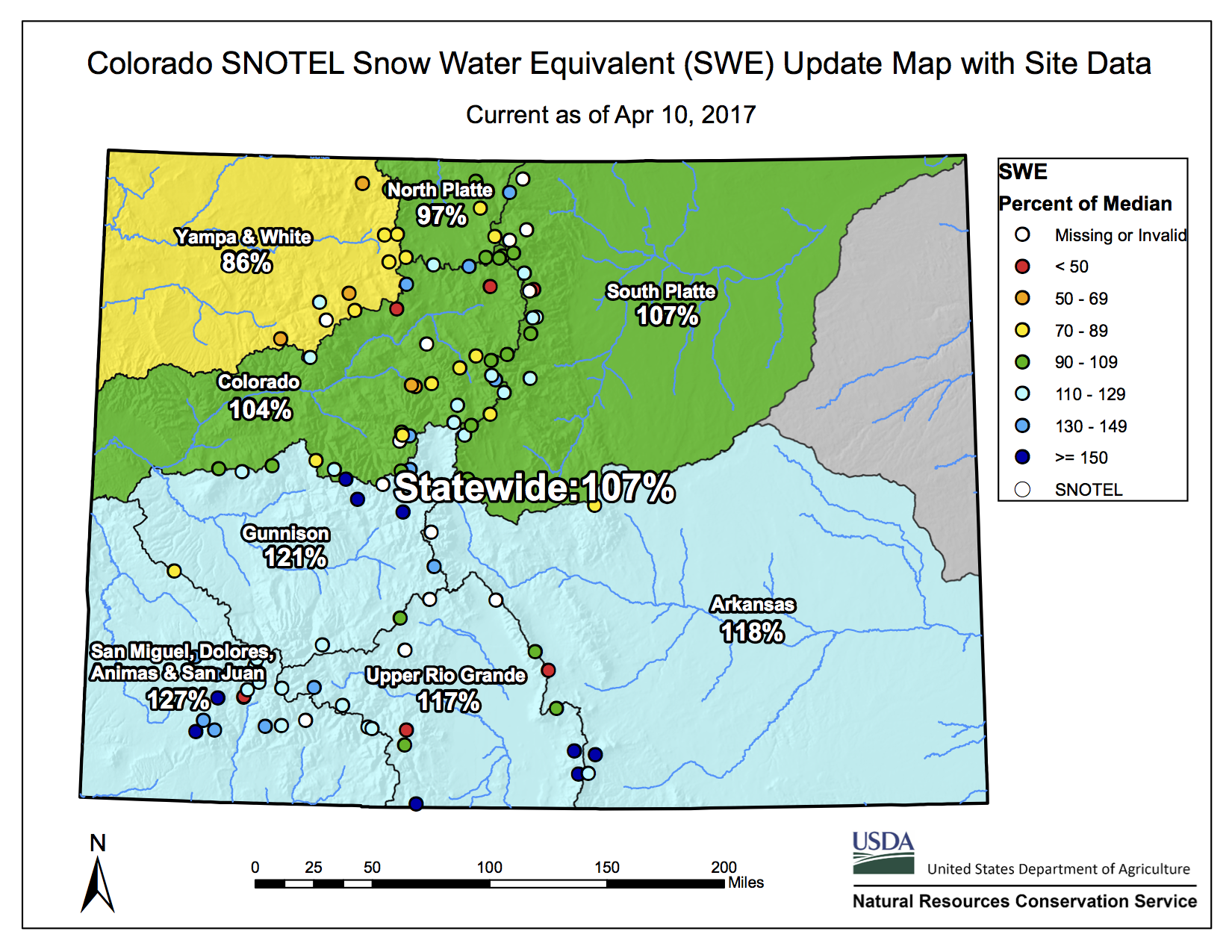
#Snowpack news: Yampa and White drop to 86% of avg.

Statewide snowpack basin-filled map April 10, 2017 via the NRCS.

Colorado Coal Country Sees Economic Salvation In Solar, Organic Farming — @NewsCPR

West Elk Mine. Photo credit Division of Reclamation Mining & Safety

From Colorado Public Radio (Grace Hood):

Workers at the last mine standing in the region, West Elk, met President Donald Trump’s executive order with cautious optimism. But travel to the west central Colorado region, it’s clear that the area isn’t banking on coal coming back to what it used to be. And the decline is clear. It’s meant a few empty storefronts in Paonia, a drop in Delta County School District students, and fewer fully ensured health care patients in the region.

And there’s another challenge: In contrast to big coal producers such as Wyoming and the Appalachia region back East, federal grant dollars to ease the transition away from coal aren’t flowing as freely into Colorado. That’s according to Democratic state Sen. Kerry Donovan, who represents Delta County.

“I think what’s unique about Colorado is it’s not thought of as coal country, Donovan said. “Those federal programs have focused on the more traditional West Virginia, Appalachia communities that we think of as coal country. So I think in Colorado it’s going to fall more on the shoulders of the state.”

[…]

With planning help from state economic developers, Delta County Economic Development Inc. drew up its future plans in 2016. Here’s a look at the key items.

  • Solar: With the help of training school Solar Energy International, the North Fork Valley could see more rooftop solar. Delta County’s high poverty rate has translated into low demand for rooftop panels. With Solarize Delta County, SEI plans to make the energy more accessible and affordable by spurring more local investment. SEI has also launched efforts to retrain coal workers, although SEI Director of Operations Kris Sutton said the effort has been slow going in the short term: “If coal miners here want to pursue solar jobs. They’re going to have to probably move,” Sutton said, referring to the fact that most solar installation jobs are along the Front Range.
  • A specialty food manufacturing incubator: Delta County School District, which runs the region’s technical college, purchased a 22,000 square foot building that will eventually house classrooms, a commercial kitchen and a warehouse. Entrepreneurs could get classes, marketing assistance and a space that helps them create food products out of regional produce from the valley, including organic foods, Ventrello said. “It’s value added. Rather than just selling tomatoes, can you make a high end salsa?”
  • Organic food: In Hotchkiss, Big B’s Juices has evolved from from a shed that sold organic fruit to an outfit that sells juice and a hard cider line across the country. Ventrello says the incubator could help existing businesses like Big B’s expand their business, and hire more folks including out-of-work miners. Shawn Larson, who moved to the area from Utah in 2010 to help start Big B’s hard cider line says every extra job helps. ““We sell products nationwide. You know, we have that reach, but also affect our community,” he said.
  • Recreation and tourism: In its economic blueprint, the county’s economic development group plans to beef up its Gunnison Riverfront property with more access points for water sports, trails and picnic areas. It also calls for a hotel and conference center to make the city more of a destination for travelers.
  • Broadband: Delta-Montrose Electric Association will spend up to $125 million on high-speed broadband internet to the region in the coming years, which includes the towns of Paonia and Hotchkiss. Paonia was one of the first towns to be fully wired with the broadband. Mayor Charles Stewart said it will be one key to recruiting new businesses and drawing more residents to the region. “People like those amenities. When you can say to folks, ‘Yes, you can live in the North Fork and still have high-speed internet access,’ that’s a positive,” said Stewart.
  • Other renewables: It’s not just individual homeowners that could see more solar in Delta County. The region’s electricity provider, Delta-Montrose Electric Association, is also seeking to add more solar and hydroelectric power to its grid. Meantime, regional economic development leaders like Tom Huerkamp are eyeing the region’s shuttered mines and seeing another economic opportunity: generating power from methane that naturally vents from shuttered underground mines. “If we tap the old coal mines, this community has the ability in the next maybe five to 10 years to disconnect from the grid,” Huerkamp said.

Upper Republican Natural Resources District’s second annual water conference recap

Republican River Basin by District

From The Grant Tribune (Russ Pankonin):

Officials from Nebraska and Kansas outlined some of the key details of the agreement during the Upper Republican Natural Resources District’s second annual water conference March 27 in Imperial.

Nebraska requirements

One of Kansas’ goals in the the new agreement was to provide irrigators in the Kansas Bostwick Irrigation District (KBID) and other water users water when they needed it.

Nebraska agreed not to release water from Harlan County Lake (HCL) just to meet compact compliance.

Instead, they will work with Kansas to achieve the most efficiency from the water released.

Compliance calculations for the three Republican Basin NRDs (Upper, Middle and Lower) showed they would need to offset about 37,000 acre feet of overpumping in 2016.

Because the compliance calculations are made after the pumping season, Jesse Bradley, assistant director of Nebraska’s Department of Natural Resources, said the state needed some latitude in making up any differences.

That allows Nebraska to use augmentation and streamflow to ensure there is sufficient water in HCL by June 1.

Kansas estimated it would only need about 20,000 AF from HCL in 2017. So rather than pump the other 17,000 AF, the balance will be stored underground. This reduces water loss due to evaporation from the HCL, improving efficiency of the water.

Kansas retains the right to that 17,000 AF.

Bradley said this gives Nebraska more flexibility to meet compliance with Kansas set forth by the 1943 water compact between the three states.
Kansas agreed to give Nebraska 100 percent credit towards compliance for any augmentation water released in the basin.

Bradley said the agreement provides for preserving water supplies for the future by not pumping augmentation or poorly-timed releases from HCL.
On Oct.1, the two states decide whether or not to pump the water stored underground to meet compliance.

Kansas water management

As part of a U.S. Supreme Court ruling in 2015, Nebraska was ordered to pay Kansas $5.5 million in damages for over-pumping in 2012-13.
Earl Lewis, director of the Kansas Water Office, said they happily accepted the money. Since KBID suffered the most from Nebraska’s non-compliance, Kansas allocated $3.5 million back to that area.

Lewis said they are using $2.5 million to convert KBID canals to underground pipelines. He said this will save the district between 8-10,000 AF of water on an annual basis.

Susan Metzger, Kansas’ assistant ag secretary, said technology will play a key role in the conservation of water going forward.

She said Kansas has created three water technology farms where they put into practice a variety of technological advances and conservation measures.

She said they held a field day at one of the farms and drew nearly 300 people, showing the great interest of farmers in this research.

She added they want to expand to another four farms this year.

Kansas has also created local enhanced management areas, which resemble Nebraska’s NRD system, and provide for local control in water management and conservation.

The program is starting to build momentum across the state and six management areas have been approved.
Bradley said the integrated management plans (IMP) in the Republican Basin will evolve as Kansas and Nebraska continue to work together.

The basin is already on its third generation of IMPs and predicts the fourth generation won’t be far behind. That means things are working, he added.

He noted that 2013 wasn’t a shining year for compact compliance due to drought conditions.

He said prospects for the basin, water-wise, look good going forward.

The system as a whole looks better with more water in reservoirs. In addition, the department hasn’t had to issue any closing notices on surface water for the past three years.

He added that groundwater declines in some areas are starting to stabilize.

As part of the three-state agreement, Kansas and Colorado also crafted resolutions to deal with Colorado’s compact compliance efforts.

Alamosa: 20th annual five-day spring Rio Grande Leaders Course recap

San Luis Valley via National Geographic

From The Alamosa News (Stan Moyer):

Begun in 1998, the presentations by SLV water agency leaders and their longtime legal advisors brought up facts that even those who have been attending Rio Grande Roundtable meetings virtually every month for years were probably not familiar.

The course was held at the Rio Grande Water Conservancy District’s new building at 8805 Independence Way near the Alamosa County administrative facilities.

At least one participant was taking the course for the second year in a row “because there is just so much to absorb,” Frankie Wills, an official of the East Alamosa Water & Sanitation District Board commented.

The fifth day of the Monday-Friday presentations was held the evening of March 31 with a dinner at the Bistro Rialto Restaurant on Main Street in Alamosa, beginning after a social hour with a speech by Chief of Resources Management of Great Sand Dunes National Park Fred Bunch. He far and away took care of any shortage of humor found in previous presentations with rollicking stories, but also a very fact-filled outline of what brought the park into existence, including controversial political issues being solved by a purchase of a Baca Ranch area. Previous owners seemed to be potentially shipping water out of the Valley, and only a combination of forces and decisions brought about by those such as 1998 U.S. Interior Secretary Bruce Babbit and then Attorney General of Colorado Ken Salazar helped bring about the existence of the current park that now draws as many as 380,000 annual visitors and has a $28 million yearly economic impact…

An especially enlightening aspect of the Rio Grande National Forest was explained in a presentation Thursday, March 30 by RGNF Forest Hydrologist Ivan Geroy. After explaining the history of its creation over a period going all the way back to federal legislation in the 1890’s and in the first decade of the 20th Century, he emphasized that while the national forest covers 37 percent of the SLV land area,”The primary purpose is to help water management in the entire San Luis Valley.”

Earlier presentations in the course, such as one conducted by Rio Grande Headwaters Restoration official Emma Reesor and Colorado Restoration Foundation’s Andrea Bachman, brought out results of studies, including ones done both in 2001 and 2016 revealing river problems such as degraded habitat, altered hydrology, and extensive erosion, disconnected flood plain, and impaired water quality. Both the McDonald Ditch restoration project were cited as an “excellent sample of beneficial rebuilding,” and the present Del Norte Riverfront Project was noted as a good example of the promise of cooperation between numerous organizations, “including those specific to the town itself, the Del Norte Trail Organization,” to specify one.

Another feature of the course was to have a discourse by Bethany Howell of the Rio Grande Watershed Conservation and Education Initiative on how she leads area tours and school presentations for kindergarten to twelfth grade students throughout the SLV. She noted one comment made by a sixth grader from the Sargent area: “The way water moves is so fascinating and interesting and how it effects [SIC] life is also pretty cool.”

Information given by attorneys Bill Paddock and David Robbins that together covered an entire three-hour session were extremely enlightening. One observation that can be safely made is that on the other four days of the course, all speakers used a large screen to show highlights, while the lawyers did not. Praise has to be given in how thorough the knowledge of each was, helped by 30 to 40 years of legal experience in water law, and exhaustive awareness of how some current water laws and extremely impactful court decisions were made. The upshot is that both were there when these happened, so play-by-play knowledge of the history is amazing…

The sponsors of the spring 2017 Rio Grande Leaders Course are the Rio Grande Headwaters Restoration Project, the Colorado Rio Grande Restoration Foundation, San Luis Valley Water Conservancy District, Rio Grande Watershed Conservation and Education Initiative, and the Rio Grande Water Conservation District.

Basalt whitewater park good to go for #runoff season

Proposed Basalt whitewater park via the Aspen Daily News

From The Aspen Times (Scott Condon):

Construction is complete on the new whitewater park on the Roaring Fork River in Basalt. Now, just add water.

Two features that create a wave effect were added about one-quarter mile upstream from the confluence with the Fryingpan River.

The water level is still a bit too low in that stretch of the river for the features to be used. They will likely start drawing enthusiasts as the flow rises later this month, according to Jason Carey, an engineer with River Restoration of Carbondale, which designed the project…

There will be a lower volume of water flowing on the Roaring Fork River than on the Colorado, so Basalt’s whitewater park might appeal to users with a wider range of skills.

The two features were installed on a stretch of the river between Fishermen’s Park on the east and a string of riverside commercial development to the west. The features are across Two River Road from the entrance to the Elk Run subdivision.

Two concrete pilings were driven into the riverbed and capped with material that looks like rock. They are separated by about 150 feet.

Each of the structures creates a wave that water enthusiasts can play on. Each has a calmer pool just downstream. When construction started in September, officials said the upper feature will be more “radical” while the lower one would be gentler and accommodate more users with a broader range of skills.

MacArthur said kayakers will find both features alluring. The gentler feature also will attract stand-up paddlers, he said.

He anticipates use to start later this month and stretch into early fall.

Carey said a track hoe and other heavy machinery needed to build the project were out of the river by March 15, as required by a U.S. Army Corps of Engineers permit. A temporary dam was dismantled last month and water restored to the main channel. Water was diverted into a side channel for six months — when the flow was at its lowest.

Pitkin County Healthy Rivers and Streams budgeted $770,000 for the project. The project also gives Pitkin County the ability to call for water in that stretch of river in certain circumstances. That will benefit a stretch of the river that usually has low flows during dry summers, county officials said during public meetings about the project.

Durango: “Solving the Water Funding Puzzle” conference recap

Animas River through Durango August 9, 2015, after the Gold King Mine spill. Photo credit Grace Hood

From The Cortez Journal (Jim Mimiaga):

The Southwestern Water Conservation District hosted a conference titled “Solving the Water Funding Puzzle” at the DoubleTree Hotel in Durango to confront the budget crisis.

Colorado’s overriding challenge lies in how water management is funded, said Bill Levine, budget director for the state Department of Natural Resources.

Much of the state’s revenue stream for water-supply management is tied to federal energy, including severance taxes from the oil and gas industry, which exposes Colorado to the ebb and flow of the volatile oil and gas industry.

“When energy values drop, so does the revenue stream, so it is by nature volatile,” Levine said. “Revenue that is not tied to the energy industry is needed.”

Because of a weak energy market and a costly court ruling, the state’s revenues from severance taxes dropped from $271 million in fiscal year 2015 to $67 million in fiscal year 2016.

And in 2016, the state lost a lawsuit brought by British Petroleum over severance taxes. The state is refunding energy companies – $113 million so far – after the Colorado Supreme Court ruled that the companies qualify for a deduction the Department of Revenue had been denying them.

State and local agencies have paid a price.

The drop in revenues from federal minerals caused program budgets for the Colorado Water Conservation Board to drop from $14 million in 2015 to $8 million in 2016.

The cuts wiped out funding for boat inspection programs needed to stop invasive quagga and zebra mussels, which has limited boating at McPhee Reservoir and Totten Lake in Montezuma County.

Grant programs of the Department of Local Affairs also were cut, because they too depend on severance tax revenues.

Severance tax revenues have funded the Southwest Basin Roundtable grant program that supports water projects in southwest Colorado. Funding will suffer, and there will be less grant money, said roundtable chair Mike Preston.

In La Plata County, the basin fund helped to finance an inlet from Lake Nighthorse as part of a plan to provide municipal water for Fort Lewis Mesa, which includes the communities of Breen and Kline.

It’s been tapped to support a project improving water supply at Lake Durango, which serves Durango West communities. And the grants have supported an Animas River community forum, which is establishing emergency response protocols to protect water users in the event of a toxic spill such as the 2015 Gold King Mine disaster.

Finding funding solutions
Several potential sources of revenue for water-related infrastructure and programs were presented at the packed conference.

Emily Brumit, of the Colorado Water Congress, gave an update on legislative proposals and a ballot initiative that would support water-related budgets, including the struggling boat-inspection programs.

For example, Senate Bill 259 proposes to replace lost severance tax revenues with $10 million from the general fund to support forest restoration, species conservation and boat inspection programs. House Bill 1321, introduced this week, would create a revenue stream through a sticker fee to fund boat inspection programs.

And Initiative 20 focuses on oil and gas severance taxes. Its primary goal is to increase the severance tax rate, eliminate the severance tax credit that is based on property taxes, eliminate the stripper well exemption and require that a portion of severance tax revenue be paid for specific purposes…

Legislators are considering asking voters to approve a container tax on beverages to raise $100 million to $200 million per year for water-related needs. A vote could end-run the Taxpayers Bill of Rights, exempting it from TABOR revenue caps.

Other ideas presented at the conference included a new water fee paid by residential consumers, new water tap fees and new tourism fees…

Government specialist Christine Arbogast said the idea of private-public partnerships is popular for new money. But she does not believe they are a viable local solution locally.

“The expected rate of return of 5-8 percent from private investors is too much for the tax base of smaller communities,” she said.

La Plata County Commissioner Brad Blake urged the crowd to take a long-term vision on solving the budget crisis, like previous generations did.

“We have good water rights, but don’t have a way to move it around well,” he said. “The pioneers built dams, ditches and levees. Now we are tasked with looking ahead to provide water infrastructure in our area. We need more public involvement so we get all the help we need to overcome this monumental task.”